Underwater Still Camera Works in the Habitat
of Nautilus off the East Coast of Viti Levu,
Fiji
著者
SHINOMIYA Akihiko, HATTORI Mutsuo, HAYASAKA
Shozo, TANABE Kazushige, OKI Kimihiko, SUZUKI
Hiroshi
journal or
publication title
南太平洋海域調査研究報告=Occasional papers
volume
15
page range
24-47
URL
http://hdl.handle.net/10232/16577
2.
Underwater Still Camera Works in
the
Habitat
of Nautilus off the East Coast of Viti Levu, Fiji
by
Akihiko SHINOMIYA", Mutsuo HATTORI2', Shozo HAYASAKA3', Kazushige TANABE", Kimihiko OKI3' and Hiroshi SUZUKI1'
Introduction
During the period from the latter part of August to mid-September in 1986, the writers performed the photographic works with a baited underwater camera on the sea bottom ranging from 320 to 460 m in depth at the six stations off
Suva and two off Ovalau Island (Fig. 1). Rather good 266 pictures showing
the bottom sediments and organisms were obtained, and based on these pictures combination of species and their searching for food and feeding behaviors were
analyzed. (A) LAUTHALA BAY (B) OVALAU Is. 0 1 2 3 4 5 km
Fig. I. The stations of underwater still camera works (A: off Suva; B: off Ovalau Island).
1) Laboratory of Marine Biology, Faculty of Fisheries, Kagoshima University, Kagoshima 890, Japan. 2) Japan Marine Science and Technology Center, Yokosuka 237, Japan.
3) Institute of Earth Sciences, Faculty of Science, Kagoshima University, Kagoshima 890, Japan. 4) Department of Geology, Faculty of Science, the University of Tokyo, Tokyo 113, Japan.
The underwater camera used was devised by one of the writers (M. HATTORI).
Small-sized and handy design of this camera system is mainly for convenience in transportation by plane, and its specification is described in the writers' previous paper (HATTORI et al., 1985).
Camera and strobe were attached to an iron frame devised by Dr. U. RAJ
of the University of the South Pacific and a bait-stand covered with wire netting
was welded to the frontal part of the frame. In comparison with the previous
operation (HATTORI et al., 1985), the following three methods were newly introduced this time. (1) The regulator of time interval was improved and longer time interval
(10 seconds to a few hours) became available. (2) A wide-angle lens (24 mm)
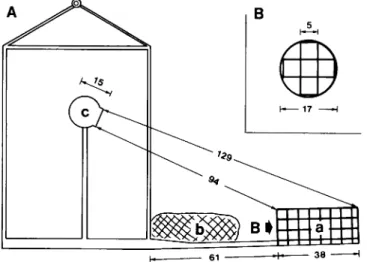
was used instead of standard one (50 mm) to get a larger field of view. (3) A wire netting cover with precisely 5 cm mesh was used for the bait-stand to keep the bait longer and to use as the scale for measuring the sizes of appearing
organisms (Fig. 2).
Field Operation
Among the six stations off Suva, three (SV-P1, SV-P2 and SV-P3) are located at the south of the Ndaveta Nukumbutho passage of the barrier reef with a depth
range from 320 to 400 m, while the other three (SV-P4, SV-P5 and SV-P6) are
closely located to each other at the southwest of the passage and ranging in depth
from 440 to 460 m. The latter three stations are within the area already pointed
out to be most abundantly inhabited by Nautilus (HAYASAKA, 1985) (Fig. 1,
A).
The two stations off Ovalau Island (OL-P1 and OL-P2) are almost the same
Fig. 2. Side view of the frame with camera system (A) and front view of bait-stand (B). Size in cm. a : main bait, b : supplementary bait, c: camera and strobe.
Table I. Time range of pictures and data of photographic Stations off Suva (SV) and Off Ovalau (OL). S : start, F : finish of photographing.
Operation Date and time Time Station Depth Hours
number Time range interval number (m) 0 2 4 6 8 10 12 14 16 18 20 22 24
of pictures) (minutes) t ( 1 1 1 1 | 1 1 1 1 1 |-Aug. 2 7 17:02-18:08) Aug. 28 16:47-17:55) Aug. 29 I 6:01 -18:01 ) Sep. 2 II : 02-16:52) Sep. 2-3 18:32- 0:12) Sep. 9-10 16:32- 9:32) Sep. 15-16 12:02- 3:02) Sep. 17 9:12-14:42) SV-P6 400 400 400 450
position (400m deep), situated near the center of the studied area (Fig. I, B). Slices of a few frozen skipjacks put into wire netting cage and the same kind of slices enveloped in the wire netting of small mesh (supplementary) were
used as the bait for Nautilus.
The photographing time interval was varied between 2 and 30 minutes. The
time range of photography was shifted little by little to be able to cumulate the record of organisms appearing for 24 hours in each area, off Suva and off Ovalau Island. The time range and data of photography are shown in Table 1.
Record of Underwater Photographs taken in Eight Stations
The measurement of animal size was made by comparison with the 5cm mesh
of wire netting cover. The measuring methods, being different between groups
of animals, are as follows: BL : Body length of shrimp
CL : Carapace length of true crab and squat crab TL : Total length of fish
SD : Maximum shell diameter of Nautilus pompilius, disk diameter of sea urchin, and diameter of gastropod shell carried by hermit crab
(1) Station SV-P1 (PI. 1, figs. 1-2). Water depth: 340m
Date: 27th August, 1986
Time range of pictures: 17: 02-18 : 06 Time interval of pictures: 2 minutes
Bottom character: Light brown, muddy sands. Surface smooth but considerable
numbers of mounds and pits are present.
16:54 Landing of the frame with camera system on the bottom.
17:02 (8 minutes after landing) About ten individuals of flower flute porgy,
Tropidinius amoenus already appeared around the baits. Total length
of each of them is about 25 cm.
After landing, 32 pictures were taken with two minutes interval. In all pictures except for eight, one to ten individuals of this fish are observed to occur (PI. 1, fig. 1). Fishes are swimming around the baits and often thrust their mouth into the wire netting covering the baits to tear and drag out the bait fish meat (PI. 1, fig. 2). No other animals than Tropidinius appeared.
(2) Station SV-P2 (PI. 1, figs. 3-8). Water depth: 370m
Date: 28th August, 1986
Time range of pictures: 16 : 00-18:01 Time interval of pictures: 2 minutes
Bottom character: Light brown colored muddy sands. Surface smooth but
mounds and pits of 10 to 30 cm in diameter are widely developed. On the right side of the bait-stand is a faces-like lump (about 7 cm in diameter)
of some small animal.
16:27 Landing of the frame with camera system on the bottom. A squat crab (Munida sp., CL about 1 cm) appeared.
(PI. 1, fig. 3) One more individual of squat crab appeared. And it shows searching behavior for food with widely extending chelipeds
against the bait-stand.
(PI. 1, fig. 4) A rubby snapper (Etelis coruscans, TL about 50cm)
appeared and squat crabs disappeared from the field of picture. On
the bottom near the bait-stand, a cloud of bottom mud stirred up by feeding action of some other big fish is adrift.
A beardfish (Polymixia sp., TL about 20 cm) appeared.
Another beardfish (TL about 20 cm) appeared.
Beardfishes are swimming searching for food with their beards almost touching the bottom 2 to 4 m away from the bait-stand. A cutthroat
eel (Synaphobranchus sp., TL about 40 cm) is approaching to the
baits from the left side of the picture.
16::5I 16::53 16::57 17::05 17:09 17:23
15 :53 16 :01
16 :06
A flower flute porgy, Tropidinius amoenus (TL about 30 cm) appeared. (Pi. 1, fig. 5) A spotted pandalid shrimp, Plesionika sp. (BL about 12cm) appeared.
17:45 (PL 1, fig. 6) A pandalid shrimp, Heterocarpus sibogae (BL about
8 cm) and aristaeid shrimp, Aristaeomorpha foliacea (BL about 12 cm)
appeared.
Among them, H. sibogae kept clinging to the bait-stand until the last
picture taken at 17:55.
17:47 An individual of Munida sp. (CL about 3 cm) appeared. It stayed
at the fixed position without motion until 17:55.
17:49 (PL 1, fig- 7) An individual of Plesionika sp. appeared in front of Munida sp. The latter threatens the shrimp (Plesionika) with its chelipeds opened. A temnopleurid sea urchin (SD about 22 cm) is
approaching to the bait-stand from the right and this side of the
picture.
17:53 (PL I, fig. 8) A snapper, Etelis carbunculus (TL about 70cm) is
approaching to the baits.
(3) Station SV-P3 (PL 2, figs. 1-8; PL 3, figs. 1-5).
Water depth : 400 m Date: 29th August, 1986
Time range of pictures: 16:01-18:01 Time interval of pictures: 5 minutes
Bottom character: Light brown colored muddy sands. Surface smooth but mounds (10-20 cm in diameter) and pits (5-10 cm) are observed. Bottom surface is gently sloping to the left side of the picture.
Landing of the frame with camera system on the bottom.
A squat crab, Munida sp., appeared on the right side of the
bait-stand approaching to the baits with its chelipeds opend.
(PL 2, fig. 1) Munida sp. moved to the left side of the bait-stand and a hermit crab (Pylopagurus sp.) appeared on its left side. The
hermit crab carries a tube of serpulid (Annelida) on its back. A
flower flute porgy (Tropidinius amoenus, TL about 25 cm) approaches
to the baits. At about 2 m beyond the bait-stand, an individual
of beardfish, Polymixia sp., (TL about 20 cm) appeared.
16: 11 (PL 2, fig. 2) Three individuals of Polymixia swim behind the bait -stand, and a snapper (Etelis carbunculus, TL about 60 cm) approaches to the baits. A spotted pandalid shrimp, Plesionika sp., (BL about
7 cm) appeared on the right side of the field of picture. An individual
of Munida sp. moved to the left corner of the picture and kept its position until 17:56. The hermit crab, Pylopagurus disappeared. 16:16 (PL 2, fig.3) Six individuals of Polymixia and one of Tropidinius
amoenus are seen behind the bait-stand. Etelis carbunculus is hanging
on to the bait fish. A box crab (Calappa sp.) appeared.
Etelis carbunculus has appeared six times since (at 16:21, 16:26, 16:31,
16:41. 16: 46 and 16:51). At 16:31, 16:41 and 16:51, another large individual
of this species occurred besides the one observed at 16: 16. The individuals
of Polymixia, continuously existing in all the pictures, always swims around the bait-stand searching for food with beard on the bottom surface without
hanging on to the bait fish (PL 2, figs. 1-8; PL 3, figs. 1-5).
16:36 (PL 2, fig. 4) A sea ster (Astropectinidae, AL about 12 cm) appeared. This continued to wander about the bait-stand until the last picture was
taken.
16:46 (PL 2, fig. 5) The first appearance of Nautilus pompilius (#1, TL about 17 cm) from the left side of the picture. Fairly rapid backward movement of it to the bait-stand is assumed from its swimming posture. 16:51 (PL 2, fig. 6) Nautilus pompilius (#1), bringing its mouth close to the bait-stand, is searching for the bait fish with its tentacles. Two
individuals of Etelis carbunculus are swimming in front of camera,
but Nautilus seems to be indifferent to them.
16:56 (PL 2, fig. 7) Besides#1,#2 Nautilus (SD about 11cm) appeared.
Together with the previously appeared large Nautilus (#1), it clings to the bait-stand extending its tentacles to the bait fish. Besides the individual of Munida sp. appeared at 16: 11, another individual of this species appeared. Both of them stay within two different pits separately until 17: 11 (PL 2, fig. 8).
# 1 Nautilus continued to feed the bait fish on the left side of the
bait-stand until 17:21 and on the camera side from 17:26 to 18:01 without leaving the bait-stand. #2 Nautilus also continued to feed on the left side
of the bait-stand until 18:01.
17:21 (PL 3, fig. 1) N. pompilius (#3), almost of the same size as #1, appeared on this side of picture swimming toward the bait-stand.
An individual of Plesionika sp. (BL about 12cm) appeared.
#3 Nautilus is recognized clinging to the back side of the bait-stand at 17:26 (PL 3, fig. 2), but in the later pictures it was not recognized to
occur. The individual of Plesionika sp. observed at 17: 12 is recognized to occur at 17:26 but disappeared afterwards.
17:26 (PL 3, fig. 2) A cutthroat eel, Synaphobranchus sp., (TL about 25
cm) appeared.
Another individual of this fish (Synaphobranchus sp.) with almost the
same size appeared at 17 : 46 (PL 3, fig. 4). At 17 : 56 and 18 : 01, an individual
of this fish was pictured, respectively.
17:51 (PL 3, fig. 5) An aristaeid shrimp (Aristaeomorpha foliacea, TL about 10 cm) and a pandalid shrimp (Heterocarpus sibogae, TL about 10 cm)
appeared clinging to the bait-stand.
Among them, Heterocarpus sibogae was recognized to stay by the side
of bait-stand at 17:56 and 18:01.
(4) Station OL-P1 (PI. 3, figs. 6-8; PI. 4, figs. 1-6).
Water depth : 400 m
Date : 2nd September, 1986
Time range of pictures : 11 : 02-16:52
Time interval of pictures: 10 minites
Bottom character: Light brown muddy sands. Smooth surface with mounds (10-40 cm in diameter) and pits (2-10 cm in diameter).
9 :45 Landing of the frame with camera system on the bottom.
11 :02 (One hour and 17 minutes after landing) An individual of squat crab, Munida sp., upon the bait frame and the other one on the
bottom beside the bait-stand are recognized to occur.
Munida sp. was photographed by every shot until the last one (16:52)
and four individuals at most appeared feeding the bait fish within the wire netting cover (PL 3, figs. 6, 8; PL 4, figs. 1-6).
11 : 22 An individual of astropectinid sea ster (AL about 6 cm) appeared. 11:31 A hermit crab (Parapagurus dofleini, SD about 8 cm) appeared carrying
a sea anemone on its shell.
This individual of hermit crab appeared at 12:42, 12:52, 13:52 (PL
4, fig. 1), 14:32 and 14:42, and another individual (SD about 12 cm) at
15:12 (PL 4, fig. 3) and 15:22. Further, the third individual (SD about
8 cm) appeared at 16 : 02, 16 : 22 and 16 : 32 (PL 4, figs. 5-6). Three individuals
in all observed during different time ranges are always wandering about the bait-stand leaving trails on the bottom.
11 : 42 Tropidinius amoenus -like fish (TL about 25 cm) is passing through
the right side margin of the picture.
An individual of this fish appeared again at 13:32.
12:12 An individual of snapper, Etelis carbunculus, (TL about 60 cm)
appeared.
This fish is recognized to occur in the pictures taken at 12:22 (PL 3, fig. 7), 13:12, 13:32 (PL 3, fig. 8), 13:42, 14:42, 15:02, 15:32, 15:42,
15 : 52, (PL 4, fig. 4), 16 : 12 and 16 : 52 (only one individual in each picture).
It is difficult to discriminate the individuals in these pictures.
13:02 An individual of cutthroat eel, Synaphobranchus sp., (TL about 40 cm) appeared.
A few individuals of this species appeared at 14:12, 14:22, 14:32, 15:02, 15:12 (PL 4, fig. 3), 15:22, 15:32, 15:52, 16:32, (PL 4, fig. 6), 16:42
and 16:52. Body lengths of the appearing individuals range from TL 15
(TL about 20 cm) lie on the bottom and an individual of about the same size is protruding its head from the muddy bottom (PL 4, fig. 2). An eel thrusting its head into the wire netting and feeding the bait fish was photographed at 15:32, 15:52 (PL 4, fig. 4) and 16:42, respectively. 13:42 An individual of the astropectinid sea star (AL about 6 cm) appeared.
The same individual crept around the bait-stand until 14:02 (PL 4, fig. 1) and disappeared from the photograph at 14:12.
13:52 (PL 4, fig. 1) The first appearance of Nautilus pompilius (#1, SD about 15 cm) from the left side of the picture.
Nautilus pompilius (# 1) feeds the bait fish at the left side of the bait-stand staying at the same position until 15:42. This individual moves to the back side of the bait-stand during 15:52 to 16:22, and subsequently, returns to the left side of the bait-stand at 16:32, and feeds the bait at the same position until 16:55. At 16:55, another individual of Nautilus
pompilius (#2, SD about 14 cm) appeared at the camera side of the bait-stand and feeds the bait fish. Only these individuals of Nautilus were photographed
in this series.
14:22 (PL 4, fig. 2) A geryonid crab (CL about 4cm) appeared.
This individual was photographed again at 16:22 near the bait-stand
(PL 4, fig. 5).
15:12 (PL 4, fig. 3) An individual of the temnopleurid sea urchin (SD about 25 cm) appeared. The sea urchin leaves many small tracks
different from those of hermit crab.
16:22 (PL 4, fig. 5) A spotted pandalid shrimp, Plesionika sp., appeared.
16 : 42 An individual of Plesionika sp. and beardfish (Polymixia sp., TL about 25 cm) appeared.
(5) Station OL-P2 (PL 4, figs. 7-8; PL 5, figs. 1-8; PL 6, figs. 1-4). Water depth: 400m
Date: 2nd to 3rd September, 1986 Time range of pictures: 18 : 32-0 : 12 Time interval of pictures: 10 minutes
Bottom character: Light brown muddy sands. Smooth surface with mounds (5-40 cm in diameter) and pits (2-15 cm in diameter).
16:22 Landing of the frame with camera system on the bottom.
18 : 32 (PL 4, fig. 7) (One hour and 50 minutes after landing) Five individuals of Nautilus pompilius already aggregate around the bait-stand. Two of them (#4 and #8) are feeding the bait fish extending their tentacles to the bait. Another individual of Nautilus (#11) extends its tentacles and clings to one (#4) of the feeding Nautilus shells.
the sea bottom facing to the bait-stand. Two shrimps (Plesionika
longirostris, BL about 8 to 10cm) are clinging to the bait-stand, and the other two are swimming around the bait-stand. Two pandalid shrimps, Heterocarpus sibogae, also cling to the bait-stand.
Nautilus pompilius appeared in all the pictures of this series. The number
of individuals appeared in each picture ranges from one to nine. Based on the color pattern of each shell, it was recognized that the total number of discriminated individuals attains to more than 14. Every individual of Nautilus pompilius avariciously feeds the bait fish, and some of them tend to stay at the same position of the bait-stand and feed the bait for long time. For example, #2 Nautilus stayed and fed for one hour and 50 minutes (from 22 : 22 to 0 : 12), #1 and #3 for one hour and a half (from 21 : 42 to 23 : 12,
22:32 to 0:02, respectively), #4 for one hour and 20 minutes (18:32 to
19:52) and one hour and 10 minutes (22:52 to 0:02), and #5 for one hour (20:42 to 21 : 42).
The only one individual of Synaphobranchus sp. was photographed at
18 : 32 in this series.
Plesionika longirostris appeared in almost all the pictures of this series,
but it has never been recognized to occur in the pictures of the other series.
The maximum number of individuals of this species (about ten) appeared
at 18:52. This shrimp is easily distinguishable from the other species in having long and white antennae and thoracic legs. H. sibogae, occurring in most of the pictures of this series, the number of appearing individuals was
about 8 at most.
18:42 (PL 4, fig. 8) A snapper (Randallichthys filamentosus, TL about 70 cm) appeared. An morid cod, Physiculus sp., (TL about 15 cm)
was photographed near the bait-stand.
Randallichthys filamentosus appeared only once at 18:42. On the other
hand, one or two individuals of Physiculus sp. occurred in more than
two-thirds of the pictures of this series.
18:52 (PL 5, fig. 1) A dogfish shark (Centrophorus scalplactus, TL about 80 cm) was photographed swimming around the back of the bait-stand. An individual of the dogfish shark seemingly the same as the one appeared
at 18:52 was observed again at 21 : 22 to swim across about 3 m above the
sea bottom behind the bait-stand.
19 : 02 (PL 5, fig. 2) Two phadalid shrimps, Heterocarpus laevigatus, appeared.
This species has a red colored body and most of the individuals
photographed are about 10 cm long.
One to three individuals of this species appeared at 19 : 12, 19 : 32, 19 : 52,
20:02. 20:12 and 20:32 (PL 5, figs. 3, 5, 7 and 8, respectively).
photographed swimming across foreground of the picture. This eel appeared only in this picture.
21 :02 (PL 6, fig. 2) Two individuals of Nautilus pompilius are swimming
at about 1 m above the sea bottom. One of them extends its tentacles to adhere to the shell surface of another individual.
The same individuals of Nautilus keeping the same posture were
photographed at 21:22.
21 :42 (PL 6, fig. 3) Two ratfish (Chimaera sp., TL about 120cm) are
swimming at about 1 m above the sea bottom behind the bait-stand. One of these fishes appeared again at 21 : 52.
Comparing the pictures taken before and after the appearance of the dogfish shark or the ratfish, it was recognized that most of the individuals of Nautilus
pompilius earnestly continued to feed the bait indifferently.
23 : 52 A hermit crab (Parapagurus dofleini, SD about 8 cm) appeared behind
the bait-stand.
(6) Station SV-P4 (PL 6, figs. 5-8; PL 7, figs. 1-4). Water depth: 460m
Date: 9th to 10th September, 1986 Time range of pictures: 16 : 32-09 : 30 Time interval of pictures: 30 minutes
Bottom character: Light brown muddy sands.
Flat surface with pits (2-10
cm in diameter), but without mounds. On the sea bottom in the foreground
of pictures, there are innumerable small protruding tubes (about 5 mm
both in length and thickness) which are assumed to be nest tubes of
the serpulid (Annelida).
16:07 Landing of the frame with camera system on the bottom.
16:32 (25 minutes after landing) One spotted pandalid shrimp (Plesionika sp.) and three pandalids (Heterocarpus sibogae) are already aggregated. The spotted pandalid shrimp also appeared at 17:02 (three individuals)
and at 17:32 (one individual), respectively. This species did not appear
until 6:02 in the next morning, and subsequently, one individual at 6:32 and 7 : 02, eight at 7 : 32 and three at 8 :02 were photographed.
Another pandalid shrimp (Heterocarpus sibogae) abundantly appeared for longest time in this series of pictures. However, the occurrence of this species fluctuate to some extent in each picture, nemely, one to eight individuals were photographed in each picture from 16:32 to 18:32 (PL 6, fig. 6), 12 to about 50 individuals appeared in the pictures from 19:02 to 6:02 (PL
6, figs. 7-8; PL 7, figs. 1-2), and one to nine from 6:32 to 9:32 (PL 7, figs. 3-4).
cm) is swimming behind the bait-stand.
The same individual appeared again on this side of picture at 18:02.
17:32 An individual of Nautilus pompilius occurred. A squat crab, Munida
sp. (CL about 3 cm) approaches to the bait-stand.
Subsequently, 1-5 individuals of Nautilus pompilius, were photographed
in the seven pictures until 20:32, 1-4 individuals were in the 13 pictures from 21 : 32 to 3:32, and 1-9 individuals in the 12 pictures from 4:02 to 9:32, respectively. All of them seems to be adult with diameter of 14-17
cm, and juveniles did not appear. Most of individuals of Nautilus avariciously
fed the bait, and some of them kept the same posture of clinging to the
bait for more than two hours. It was often observed for some individuals to extend their tentacles to attach to shell surface of the other individual.
The one individual of Nautilus appeared at 10:02 at night was photographed nine times until 9 : 02. This suggests a phase of their feeding habit, namely,
feeding baits for very long time.
The squat crab, Munida sp., disappeared from the pictures from 18:02 to 7:02. An individual of it appeared again at 7:32 (PL 7, fig. 3) and
8:32 (PL 7, fig. 4), respectively.
18:02 (PL 6, fig. 6) Two aristaeid shrimps (Aristaeomorpha foliacea, BL about 10-14 cm) are swimming around the bait-stand to search for
foods.
One individual of this shrimp was photographed at 18:32, 20:32, 21 :
32 and 22 : 32, respectively.
19:32 Three pandalid shrimps (Heterocarpus laevigatus, BL about 8-10 cm)
appeared.
One to four individuals of H. laevigatus were photographed at 20: 32, 21:32, 22:02, 23:02, 23:32, 2:02, 3:02 and 3:32, respectively.
20:02 (PL 6, fig. 7) A cloud of bottom mud stirred up by feeding action
of some fish was photographed in this and the two previous pictures (at 19:02 and 19:32). The fish itself is not photographed in any
one of these three pictures. It was recognized, however, that the
water current flows from the right foreground to the back left side of the picture.
20 : 32 A pandalid shrimp (Heterocarpus gibbosus, BL about 10 cm) is clinging to the bait-stand mingling with H. sibogae.
Subsequently, 1-5 individuals of H. gibbosus were photographed at 21 :
02 (PL 6, fig. 8), 21 : 32, 22 : 32, 23 : 02, 23 : 32, I : 32 and 2 : 32, respectively.
21 : 02 (PL 6, fig. 8) A sea cucumber was photographed on the right
background of the picture.
In the next picture (at 21 : 32) this species is observed to occur on the left side, and it is inferred that the moving speed of the sea cucumber was
22 : 32
A ratfish, Chimaera sp., appeared at the background of the picture,
about 4 m beyond the bait-stand.,
After one hour, the tail part of the swimming ratfish was photographed
on the right side of the picture. It was recognized that the frame with camera
system was shifted by a certain animal, from the change of locations of pits
and mounds on the pictures at 23 :02 and 23 : 32. At 0: 32, the species of
Chimaera showing upside-down posture is facing its abdomen to the camera
and its mouth to the bait-stand (PL 7, fig. 1). The body length of this
ratfish is about 150 cm. The shift of the frame might be resulted from the
feeding activity of this ratfish. The Chimaera fish did not appear in the
following pictures.
3:32 (PL 7, fig. 2) A hermit crab (Parapagurus dofleini, SD about 8 cm) appeared near the bait-stand carrying a sea anemone on its dorsal side. The sea anemone opens its tentacles.
The same hermit crab appeared carrying a sea anemone opening its tentacles at 4:32, 5:32, 6:02 and 8:32 (PL 7, fig. 4), respectively.
7:32 (PL 7, fig. 3) Four individuals of Nautilus pompilius were feeding
the bait fish, and another individual was swimming with widely opend
tentacles. About eight individuals of Plesionika sp. aggregated on
the sea bottom. A gurnard (Lepidotrigla sp., TL about 25 cm) was
photographed on the left side of the picture. This fish appeared
only in this picture. One individual of Synaphobranchus and two
of Polymixia were also recognized.
(7) Station SV-P5 (PL 7, figs. 5-8; PL 8, figs. 1-6).
Water depth : 440 m
Date: 15th to 16th September, 1986 Time range of pictures: 12 : 02-03 : 02 Time interval of pictures: 30 minutes
Bottom character: Light brown muddy sands. Flat and smooth without pits
and mounds until the picture at 19:02. The frame with camera system
was largely shifted at 19:32 (cause unknown). In the pictures from 20
: 02 to 3:02, many parallel drag marks with about 50 cm intervals are observed.
11 : 27 Landing of the frame with camera system on the bottom.
12 :02 (PL 7, fig. 5) (35 minutes after landing) A spotted pandalid shrimp
(Plesionika sp.) is approaching to the bait-stand.
This shrimp disappeared after 12:32. Four, seven, and four individuals of this spotted pandalid shrimp occurred again at 15:32 (PL 7, fig. 7), 16:32
(PL 7, fig. 8) and 17:32, respectively. Subsequently this shrimp disappeared.
13:02 A rubby snapper (Etelis carbunculus, TL about 70cm) appeared on
This ruddy snapper stirring up a cloud of bottom mud by feeding action on the bait fish was photographed at 14:02 (PL 7, fig. 6). An individual of this fish of the same size occurred swimming around the bait-stand at
15:02 and 21 : 02.
14:32 Two Nautilus pompilius appeared.
Two to four individuals of Nautilus pompilius were photographed in the
seven pictures until 18:02 (PL 7, figs. 7-8; PL 8, fig. I). The species of
Nautilus did not appear until 20:02.
Subsequently, two individuals were
photographed at 20:32 and 22:02, 1-3 from 23:02 to 0:02 and 1-7 from
1 : 02 to 3:02, respectively. The photographed individuals were all of adult stage, and were always clinging to and feeding the bait fish. The individuals
swimming with widely opened tentacles are larger in number at night (PL
8, figs. 2-5) than in the daytime (PI. 7, figs. 7-8; PL 8, fig. 1).
This suggests
that the momentum of Nautilus at night is much larger than that in the daytime.
Through the comparison between the individuals appearing in the daytime
(from 14:32 to 18:02) and at night (from 1:02 to 3:02), it is recognized
that the individuals are perfectly replaced with each other.
15 : 32 (PL 7, fig. 7) A beardfish (Polymixia sp., TL about 20cm) is swimming
about 3 m above the sea bottom far from the bait-stand. A cutthroat
eel (Synaphobranchus sp., TL about 20cm) was photographed at the
left corner of the picture.
These fishes did not appear in the other pictures of this series.
16 : 32
(PL 7, fig. 8) A homolid crab (CL about 5 cm) appeared near the
bait-stand. A squat crab (Munida sp., CL about 3 cm) extends its
chelipeds toward the bait-stand.
The homolid crab, of which dactylus on the 4th ambulatory leg is
subchelate, has a habit to carry a chip of wood, a piece of shell, etc., on
its carapace with 4th ambulatory legs for protecting from the predator.
The
photographed homolid crab carries a piece of wood of about 30 cm length
on the dorsal side. This individual crawled around the bait-stand at 17:
02 and 17 : 32.
17:02
Two aristaeid shrimp, Aristaeomorpha foliacea, and three pandalid
shrimp, Heterocarpus sibogae, were clinging to the bait-stand. One to two individuals of A. foliacea were photographed at 23:32, 3:
02 and 3 : 32, respectively.
H. sibogae abundantly appeared for long time in the pictures of this series.
One to ten individuals were photographed in each picture from 17:02 to 18:02 (PL 8, fig. 1), 15 to about 50 individuals appeared in each picture
from 18 : 32 to 3 : 32.
19 : 32 Five individuals of pandalid shrimp, Heterocarpus laevigatus, appeared. One individual of this shrimp was photographed at 21 : 32, 0:32, 2:02
and 2:32 (PL 8, fig. 5), respectively.
20:32 (PL 8, fig. 2) An individual of pandalid shrimp, Heterocarpus gibbosus
was clinging to the bait-stand mingling with H. sibogae.
Subsequently, 1-7 individuals of H. gibbosus were photographed in each
picture until 3 : 32.
(8) Station SV-P6 (PL 8, figs. 7-8). Water depth : 450 m
Date: 17th September, 1986
Time range of pictures: 9:12-14:42 Time interval of pictures: 10 minutes
Bottom character: Light brown muddy sands. Almost flat in the pictures
until 11 :42. At 11 : 52 the frame with camera system was shifted a little during trawling experiment. Then the lower half of bait-stand was buried in the bottom. The bottom features after this was also flat with many tubes (about 2 cm in length) probably of the serpulid nest.
9:10 Landing of the frame with camera system on the bottom.
9:22 (12 minutes after landing) A conger eel (Congriscus megastomus, TL about 22 cm) appeared. This species did not appear in the other pictures.
9 :42 An individual of Nautilus pompilius is clinging to the bait fish.
Table 2. List of species and hourly maximum number of occurrence off Suva.
S c i e n t i f i cname H o u r s
MOLLUSCA
Nautilus pompilius Linnaeus 9 6 8 5 1 3 3 5 4 4 3 4 3 5 3 4 3 3 7 6 3 4 6
CRUSTACEA
Aristaeomorpha foliacea (Risso) 2 2 1 1 1 1 2
Heterocarpusgibbosus Bate 1 5 7 4 3 6 3 3
H. laevigatus Bate 2 5 1 3 1 4 1 2 3
H. sibogaeDe Man 12 9 2 3 3 3 32 29 36 26 34 35 31 36 38 33 26 17 Plesionika longirostris (Borradaile)
P. sp. 1 8 3 1 4 7 4
Munida sp. 1 1 2 2
Parapagurusdofleini Balss 1 1 1 1 1
Pylopagurus sp. 1 Homolid crab 1 1 Calappa sp. 1 Geryonid crab ECHINODERMATA Holothurian 1
Temnopleurid sea urchin
Astropectinid seastar 1 1 1
PISCES
Centrophorus scalplactusMcCulloch 1
Chimaera sp. 1 1 1
Synaphobranchussp. 1 1 2 1
Conger verreauxi Kaup
Congriseus megastomus (Gunther) 1 1 1
Physiculus sp.
Polymixia sp. 2 2 3 2 20 16 4
Etelis carbunculus Cuvier 1 1 1 1 1 2 1 E. coruscans Valenciennes 1
Randallichthys filamentosus (Fourmanoir)
Tropidinius amoenus (Snyder) 110 4
The same individual of N. pompilius was photographed at 10:02. After this, no Nautilus appeared until 12:22. Another individual of this species appeared at 12:32, subsequently, 2-3 individuals were photographed in five pictures until 13:22. From 13:42 to 14:42, 2-5 Nautilus occurred in each picture. All individuals photographed were of adult stage, and they avariciously
fed the bait within the half-buried bait-stand (PI. 8, figs. 7-8).
10:02 A rubby snapper [Etelis carbunculus, TL about 70 cm) appeared.
Seemingly the same individual was phothgraphed in both pictures at 10: 22 and II: 02.
12 : 32 Two individuals of beardfish (Polymixia sp., TL about 20 cm) appeared. Two and three individuals of this species were photographed at 12:42 and 13:12 (PL 8, fig. 7), respectively. Subsequently this fish disappeared
from the pictures.
Time-zone of Appearance and Behavior of Each Animal Group
Based on the information from the photographs and the data on the samples obtained by trapping and trawling (SUZUKI el al, in this volume), the organisms seen in photographs were identified. The time of appearance of these organisms
Table 3. List of species and hourly maximum number of occurrence off Ovalau Island.
Scientific name H o u r s
MOLLUSCA
Nautilus pompi1ius Linnaeus 1 1 1 2
CRUSTACEA
Aristaeomorpha foliacea (Risso) Heterocarpus gibbosus Bate H. laevigatus Bate H. sibogae De Man Plesionika longirostris (Borradaile)
P. sp. 1
Munida sp. 4 3 3 4 2 4 Parapagurus dofleini Balss 1 1 1 1 1 1
Pylopagurus sp. Homolid crab Calappa sp. Geryonid crab 1 1 ECHINODERMATA Holothurian
Temnopleurid sea urchin 1 1 Astropectinid sea star 1 1 1
PISCES
Centrophorus scalplactus McCulloch Chimaera sp.
Synaphobranchus sp. 1 3 2 2
Conger verreauxi Kaup Congriseus megastomus (Gunther) Physiculus sp.
Polymixia sp. 1
Etelis carbunculus Cuvier 3 1 1 1 1
E. coruscansValenciennes
Randallichthys filamentosus (Fourmanoir)
Tropidinius amoenus (Snyder) 1 1
were listed in Appendixes 1-8, in which the number of individuals of each species
identified in each picture is described.
Based on these data in the appendixes, the maximum numbers of individuals
of each species observed for every one hour in each area, namely off Suva
(SV-P1-P6) and off Ovalau Island (OL-P1 and P2) were summarized in Tables 2 and 3. For example, if 30 pictures were obtained for one hour, the number
of appearing individuals of each species for this period of time was represented
by the maximum number of individuals counted in one of these pictures.
1. Nautilus
Nautilus with shells of 11-17 cm diameter appeared in the pictures taken at
all the stations except for the Stations SV-P1 and P2. It appeared almost always
(1-9 individuals) except for the time-zone 11:00-12:00, and rather abundantly
appeared from 5:00 to 8:00 and from 20:00 to 21:00.
As the first instance, detailed feeding hehavior of Nautilus will be described
based on the pictures taken at the Stn. SV-P3, where the time interval of pictures
was shortest (2 minutes). At 16:46, 53 minutes after landing of the camera frame on the sea bottom, a rather large (SD about 17cm) individual of Nautilus (#
I) first appeared (PI. 2, fig. 5). It seems moving backward rather rapidly toward
the bait-stand with jet propulsion.
In the picture at 16:51, #1 Nautilus already
turned over and is extending its tentacles to the bait fish (PI. 2, fig. 6). At
16:56, #1 Nautilus brings its body close to the bait-stand and begins to eat
the baits together with another rather small Nautilus (#2, SD about 11cm) (PI.
2, fig. 7).
It may be said that the Nautilus species has a high ability to search
for foods and shows rapid response to the discovered foods. # 1 Nautilus kept
feeding until 17:06 and left there and moved to the camera side of the
bait-stand passing through immediately above #2 (17: 16) (PI. 2, fig. 8).
#2 Nautilus
was pushed by #1 and left the bait-stand (PI. 3, fig. 1), and moved to the
place where #1 was previously feeding (17:26) after ascertaining the behavior
of #1 (PI. 3, figs. 2-3).
From the fact that the earlier arrived larger individual
(#1
Nautilus) behaves advantageously over #2 showing subordinate behavior,
a kind of dominance-subordinate hierarchy is presumed to exist among the
population of this species.
In the ten serial pictures taken at the Stn. OL-P2 with ten minutes interval,
behaviors of 12 individuals discriminated based on the differences in color patten
were observed (PI. 4, figs. 7-8; PI. 5, figs. 1-8). During this period of time,
two individuals kept feeding in the fixed postures for long time; #8 for one
hour and 20 minutes (18:32-19:52) and #4 for one hour and 10 minutes (18
: 32-19: 42).
#7 and #13 kept feeding for 20-30 minutes but frequently changed
the place for feeding.
Attaching behavior of one individual to another by its
5, fig. 2), #9 and #4 (PI. 5, fig. 6) and #12 and #7 (PI. 5. fig. 8).
The Nautilus individuals gathering around the bait-stand showed various
behavior as mentioned above, but on the whole they seemed to keep sticking to the baits. Other than the foregoing cases, several individuals of Nautilus kept
feeding in the fixed postures for long time; one for 2 hours, one for one hour and 50 minutes, two for one hour and a half and two for one hour and 10 minutes. The longest record of stay on the bottom around the bait-stand was
recognized at the Stn. SV-P4; one individual discriminated by its color pattern
continued to appear in the pictures for 11 hours (10:02-9:02).
The maximum number of individuals appearing in one of the serial pictures
taken at the Stn. OL-P2 was nine. Through the discrimination of individuals, however, more than 14 individuals were recognized to occur at this station. This may be also the case at the other stations, individuals namely, individuals more
than the maximum number of individuals appearing in one of the serial pictures
are really existing replacing with each other.
The behaviors of Nautilus around the bait-stand at the Stn. SV-P5 in the
daytime and the nighttime were compared. In the eight pictures taken in the
daytime (14:32-18:02), all the individuals of Nautilus are earnestly feeding and
no moving individuals were photographed. On the contrary, in all the pictures
(nine) taken in the nighttime (20:32-2:32) except for the one (1:02), one to
three appearing Nautilus are moving forwardly or backwardly opening their tentacles.
This suggests that this species behaves more actively at night than in the daytime.
2. Crustacea and Echinodermata
During the photographing at eight stations, about 12 species of Crustacea
appeared. Among them, shrimps were most common. Heterocarpus sibogae was most abundant with subordinate occurrence of H. laevigatus, H. gibbosus and
Plesionika longirostris.
Aristaeomorpha foliacea rerely appeared.
These five species
of shrimp appeared mainly at night. H. sibogae appeared most abundantly between 18:00 and 3:00, and a few early in the morning (7:00-9:00) and in twilight
(16:00-17 :00).
A shrimp showing a peculiar pattern of appearance in contrast to those of
the foregoing five is Plesionika sp. This large species (BL attains up to 14cm)
has a large red spot on the postero-central surface of abdomen, which has a
withish blue colored fringe. The size of red spot varies from individual to individual
and sometimes it is very small. The second antenna is white colored and as
long as three times of body length. The body color is pale blue and almost transparent. The time range of its appearance is 6:00-17:00 and the maximum
number of appearance was observed at 7 : 00-8 : 00 and 15 : 00-17 : 00. It is noticeable
that the time of its appearance is in the daytime, while that of the five species mentioned above is mainly at night.
Differences in type of behavior between the above mentioned six species were
also recognized. The three species, H. sibogae, H. gibbosus and H. laevigatus, were
usually clinging to the bait showing active feeding behavior. On the contrary,
most of the appearing individuals of P. longirostris and A.foliacea were swimming,
and Plesionika sp. kept crawling on the bottom surface.
The latter three species
seems to be rather inactive in feeding behavior.
The number of appearing individuals and species of shrimps shows clear difference between the areas off Suva and off Ovalau Island. P. longirostris appeared
only at the stations off Suva and the numbers of individuals are almost the same
as those of H. sibogae and H. laevigatus. On the contrary, at the stations off
Suva, H. sibogae always predominates over the other species.
Among the Crustacea, Munida sp. and Parapagurus dofleini are also rather
common. Munida sp. usually creeps into the bottom sediments and sometimes
crawl out and shows a feeding behavior. Many individuals of Munida sp. creeping
into and crawling on the bottom sediments were photographed. The appearance
of Munida sp. was restricted to 7:00-17:00 and it is regarded to be diurnal.
P. dofleini, a hermit crab carrying a sea anemone on its back, appeared between
3:00 and 8:00, 11:00 and 16:00 and at 23:00 without fixed time range of
appearance. It stays for rather long time wandering about the bait-stand and sometimes feeds the bait fish. The sea anemone attached to the shell surfase of the hermit crab widely opened its tentacles from 3 :00 to 8 :00 and closed
from 11:00 to 16:00 and at 23:00.
Echinodermata is represented by sea cucumber, temnopleurid sea urchin and
astropectinid sea star. Among them, sea cucumber (only one individual) was
passing through the bottom near the bait-stand without any feeding behavior.
On the contrary, sea urchins and sea star appeared at a few stations wandering around the bait-stand showing searching behavior for food.
3. Pisces
Twelve species of fishes appeared. Among them, the species showing rather
abundant
occurrence are Polymixia sp., Tropidinius amoenus,
Physiculus sp.,
Synaphobranchus sp., and Etelis carbunculus, and next to these species Chimaera
sp., Centrophorus scalplactus and Congriscus megastomus occurred.
Time range of appearance of the abundantly occurring three species, Polymixia sp., T. amoenus and Synaphobranchus sp. were from 7:00 to 18:00 and the former two species appeared most abundantly at the twilight from 16:00 to 18
: 00. These three species are regarded to be diurnal. Although an individual
of E. carbunculus appeared at 23:00, it usually appeared from 6:00 to 17:00
and is regarded to be diurnal. On the contrary, Physiculus sp. appeared only
at night (18:00-23:00) and is regarded to be nocturnal. Among the subordinately
and C. scalplactus appeared at the evening (16:00-21 : 00, twilight to nocturnal). On the other hand, C. megastomus appeared in the daytime and regarded to be
diurnal.
The types of behavior of the foregoing eight species are as follows. The species behaving in crowds are only two, Polymixia sp. and T. amoenus, and were photographed showing their feeding activities. The largest species, Chimaera sp. did not show feeding activity, but during its appearance in a few serial pictures the camera frame had largely shifted (SV-P4). It is inferred that this large fish bites and shakes the frame with a camara system.
Polymixia sp. with a pair of beard always swam around the bait-stand searching
for foods on the sea bottom by its lowered head. This species was always wandering on the bottom a few meters apart from the bait-stand. This suggests the behavior of this species to feed on the small particles of bait fish meat produced by the
feeding actions of the other animals.
Synaphobranchus sp. having a habit to creep into the bottom sediments was sometimes observed protruding its head from the bottom. This species usually stays longer around the bait-stand. Another species making long stay is E.
carbunculus.
It is noticeable that Physiculus sp., Conger verreauxi and Randallichthys
filamentosus appeared at the stations only off Ovalau Island, while C. megastomus, Etelis coruscans and Lepidotrigla sp. appeared only off Suva. Polymixia sp. mostly appeared at the stations off Suva with the exception of only one individual off
Ovalau.
Concluding Remarks
Photographing Nautilus and some other organisms gathering around the baits and analyzing the species composition and searching and feeding behaviors were
carried out. Nautilus always showed active feeding behavior except for one hour
from 11 : 00 to 12:00. Twelve species of Crustacea, three of Echinodermata and 12 of Pisces appeared, and all of them except for sea cucumber showed active
searching for food and feeding behaviors. As the result, three types were
discriminated in mode of appearance, namely, nocturnal, diurnal and twilight. The camera system used in the present study were quite effective for recording the species composition of appearing organisms, time of appearance, and searching
and feeding behaviors of them. As to the time interval of photographing, short
interval (several to ten minutes) was suitable to analyzing the behavior of each
appearing organism, while long interval (ten minutes to a few hours) was to
understanding the whole time range of appearance of them.
Long roll of photographing film is useful to fulfill both the requirements
and the convenience in handling. It is possible, however, to improve the camera system by adding one more strobe light which may give clear image of organisms having been in the shadow of another strobe light.
This camera system is always operated with the baits. Therefore, it is impossible to get the information on distribution and behavior of organisms under natural
condition. In this respect, towing and self-driving photographic system must be useful (OHTA, 1983; HASHIMOTO and HOTTA, 1985), but it has a problem concerning the transportation to the remote areas of study. If it is realized in the future to send a research ship to the area of field study, the use of this type of photograhing system must be quite effective.
Acknowledgments
The writers wish to express their deep gratitude to Prof. Uday RAJ of the Institute of Marine Resources, the University of the South Pacific, for his careful
arrangements and advice for the present study.
Thanks are also due to Prof. Toshio SAISHO, Prof. Yoshiko K.AKINUMA
and Dr. Junzo TSUKAHARA of Kagoshima University, for their cooperation in
interpreting the underwater photographs.
Reference
HASHIMOTO, J. and HOTTA, H., 1985; An attempt of density estimation of megalo-epibenthos by the deep towed TV system and the deep sea research submersible "SHINKAI 2000". Tech. Rep. Japan Marine Sci. Tech. Center, Special Issue,
23-35.
HATTORI, M„ TANABE, K. and OKI, K.., 1985: Underwater TV and still camera
works in the habitat of Nautilus off Suva, Viti Levu, Fiji (In: HAYASAKA, S., ed., 1985). Kagoshima Univ. Res. Center S. Pac, Occasional Papers, 4,
31-36.
HAYASAKA, S. (ed.), 1985: Marine ecological studies on the habitat of Nautilus pompilius in the environs of Vite Levu, Fiji. Kagoshima Univ. Res. Center
S. Pac, Occasional Papers, 4, 1-96.
OHTA, S., 1983 : Photographic census of large-sized benthic organisms in the bathyal zone of Suruga Bay, central Japan. Bull. Ocean Res. Inst., Univ. Tokyo, 15,
1-244.
Suzuki, H., Shinomiya, A., RAJ, U. and SEETO, J., 1988: Studies on fauna
associated whih Nautilus in the area off the east coast of Viti Levu, Fiji,
Appendix 1. List of species and number of occurrence at the Station SV-PI.
18 20 2224 26 2B JO 32 34 36 38 40 42 44 46 48 50 52 54 56 58 0 2 4 6 8
MOLLUSCA
Nautiluspompilius Lii
CRUSTACEA
oinorphafoliacea (Risso)
arpusgibbosusBate
H. laevigatasBate H. sibogaeDe Man Plesionikalongirostris (Borradaile
P. sp.
Munidasp.
ParapagurusdofleiniBalss Pylopagurussp. Homolidcrab Ca lappa sp. Geryonid crab ECHINODERMATA Holothurian
Temnopleuridsea urchin Astropectinidsea star
PISCES
CentrophorusscalplactusMcCulloch '..'111111,1V! ., up.
Synaphobranchus sp. CongerverreauxiKaup Conqriseissnp.iasr ones ( Gun t her )
Physiculussp. Polymixiasp.
EteliscarbunculusCuvier E. coruscansValenciennes
Randallichthysfilamentosus ( Foun Tropidiniusamoenus (Snyder) Lepidotriglasp.
10 2 2 3 4 2 1 4 5 3 2 2 5 4 6 1 3 1
Appendix 2. List of species and number of occurrence at the Station SV-P2.
47 49 5153 55 57 59 1 3 5 7 9 11 13 1517 19 21 2325 27 2931 3335 3739 41 43 454749 5153 55
MOLLUSCA
NautiluspompiliusLinnaeus
CRUSTACEA
Aristaeomorpha foliacea (Risso) !
H.
Hlh
TPU8qi bbosus Bate
sibogaeDeMan
•ika longirostris (Borradaile)
Munidasp. Parapagurusd o f l e i n iBalss Pylopagurus sp. Homolidc r a b Calappasp. Geryonid crab ECHINODERMATA Holothurian
Temnopleuridsea urchin Astropectinidsea star
PISCES
CentrophorusscalplactusMcCulloch
Ch : i sp. Synaphobranchus sp. Conger verreauxiKaup
megastomus (Gunther)
E t e l i scarbunculus
E. <:oruscansValencienne: Randal 1:;chthvsfilamentosus Tropidiiliusamoenus(Snvder)
L e p i d o t r i g l a
Appendix 3. List of species and number of occurrence at the Station SV-P3.
Scientific name M i n u t e s
16: 17: 18:
1 6 11 16 21 26 31 36 41 46 51 56 1 6 11 16 21 26 31 36 41 46 51 56 1
MOLLUSCA
Nautilus pompilius Linnaeus 1 1 2 2 2 2 2 3 3 2 2 2 2 2 2 2
CRUSTACEA
Aristaeomorpha foliacea (Risso) 1
Heterocarpusgibbosus Bate H. laevigatus Bate
H. sibogae De Man 1 1 1 1
Plesionika longirostris (Borradaile)
P. sp. 1 1 !
Munida sp. 2 1 1 1 1 1 1 1 1 1(1)2 2 2 2 1 1 t 1 1 1 1 1 1
Parapagurusdofleini Balss
Pylopagurussp. 1 Homolidcrab Calappa sp. 1 Geryonid crab E C H I N O D E R M A T A Holothurian
Temnopleurid sea urchin
Astropectinid sea star 1 i 1 1 1 1 1 1 1 1 1 1 1
PISCES
Centrophorus scalplactus McCulloch 1 Chimaera sp.
Synaphobranchus sp. 1 1 2 1 1
Conger verreauxi Kaup Congriseus megastomus (Gunther) Physiculus sp.
Polymixia sp. 1 3 7 6 8 3 8 7 11 20 14 14 11 14 13 16 6 10 8 8 3 3 2 4 Etelis carbunculusCuvier 1 1 1 1 2 2 1 2
E. coruscans Valenciennes
Randallichthys filamentosus (Fourmanoir)
Tropidiniusamoenus (Snyder) 1 1 Lepidotriglasp.
Appendix 4. List of species and number of occurrence at the Station OL-PI.
2 12 22 32 42 52 2 12 22 32 42 52 2 1222 32 42 52 2 12 22 32 4 2 52 2 1222 32 A2 52 2 12 22 32 42 52
MOLLUSCA
Mautilus pompilius Linnaeus 1 1 1 1 1 1 1 1 1 1 1 1 1 1 1 2
CRUSTACEA
Aristaeomorpha foliacea(Risso) Hor.t;rocarpus gibbosus Bate
H. laevigatusBate
Plesionikalongirostris[Borradaile)
I- sp. , ,
Munida sp. 3 1 3 2 2 3 2 1 2 2 3 3 2 3 3 3 2 2 3 - 1 3 4 1 2 2 1 1 1 1 1 1 3 2 4 4
Parapagurus dofleini Balss 1 l i 1 1 1 1 1 l l 1 1 1
Pylopagurussp.
Homo!idcrab
ery,
U N O Holothurian
Temnopleurid seaurchin Astropectinidseastar
PISCES
CentrophorusscalplactusMcCulloch Chimaerasp.
Synaphobranchussp. CongerverreauxiKaup
Congriseusmegastomus(Gunther)
Randallichthysfilamentosus[Foun Trojitdinlusamoenus (Snyderl Lepidotriglasp.
Appendix 5. List o( species and number of occurrence at the Station OL-P2.
Scientific name H i t> O t O 8
18: 19: 20: 21: 22: 23: 0: 32 42 52 212 22 32 42 52 21222 32 42 52 2 1222 32 42 52 212 22 32 42 52 2 12 22 32 42 52 2 12
MOLLUSCA
Nautilus pompilius Linnaeus 5 4 5 6 3 5 4 4 4 6 2 5 8 8 4 0 8 6 6 5 4 4 1 4 5 6 8 5 7 6 6 7 6 6 7
CRUSTACEA
Aristaeomorpha foliacea[Risso) HeterocarpusgibbosusBate
£• laevigatus Bate 2 4 3 3 2 3 1 2 1 3 2 2 1 1 1 1 3 3 2 3 1 2 2 1 2
H. sibogae De Man 2 2 5 4 6 5 4 1 2 1 1 3 4 1 1 2 3 3 1 1 2 3 3 3 5 2 2 4 2
Plesionika longirostris (Borradaile) 4 6 6 1 1 3 5 1 4 3 2 3 4 4 3 2 2 1 3 1 2 1 1 1 3 3 1
P. sp.
Munidasp.
Parapagurus dofleini Balss 1
Pylopagurus sp.
Homolidcrab
Calappasp.
ECHINODERMATA
Holothurian
Temnopleurid sea urchin 1
Astropectinidsea star PISCES
Centrophorus scalplactusMcCulloch 1 1 1
Chimaerasp. 2 1
Synaphobranchussp. 1
Congerverreauxi Kaup 1 Congriseus megastomus(Guntherl
Physiculus sp. 1 2 1' 3 2 2 2 2 1 2 2 1 1 1 1 2 1 2 2 1 1
Polymixia sp.
Eteliscarbunculus Cuvier
E. coruscansValenciennes
Randallichthys filamentosus (Fourmanoirl 1 Tropidinius amoenus (Snyder)
Lepidotriglasp.
Appendix 6. List of species and number of occurrence at the Station SV-P4.
Scientific name M i n u t e s
'6: 17: 18: 19: 20: 21: 22: 23: 0: 1: 2: 3: 4: 5: 6: 7: 8: 9:
32 2 32 2 32 2 32 2 32 2 32 2 32 2 32 2 32 2 32 2 32 2 32 2 32 2 32 2 32 2 32 2 32 2 32
MOLLUSCA
NautiluE pompiliu.5 Linnaeus 1 1 3 3 3 5 1 3 3 4 2 3 2 3 2 13 2 3 12 4 6 1 1 9 6 5 6 8 5 5
CRUSTACEA
Aristaeomorphafoliacea (Risso] 2 1 1 1 ;
Heterocarpus gibbosus Bate 1 5 1 1 3 2 1 1
H. laevigatus Bate 3 1 3 1 4 2 2 3 1
%• sibogae De Man 3 2 14 8 17 29 29 26 24 26 18 18 25 19 31 11 32 36 38 33 31 21 26 25 12 17 12 5 9 7 2 1 3 2
Plesionikalongirostris (Borradaile]
P. sp. 1 3 1 1 1 8 3
Munida sp. 1 . .
Parapagurus dofleini Ba1ss , ^ , 1 1 1 .
Pylopagurus sp.
Homolidcrab
Calappa sp. Geryonidcrab
ECHINODERMATA
Temnopleurid seaurchin Astropectinid seastar PISCES
Centrophorus scalplactus McCulloch
Chimaera sp. 1 1 1 , , :;yri.ir.i!;cjbr-,-i!n;!;ii-.:.;j• . Physiculus sp. 2 Polymixia sp. E t e l i scarbunculus Cuvier E. coruscansValenciennes
Randallichthysfilamentosus (Fourmanoir) Tropidinius amoenus (Snyder) Lepidotrigla sp.
Appendix 7. List of species and number of occurrence at the Station SV-P5.
Scientificname M i n u t e s
12: 13: 14: 15: 16: 17: 18: 19: 20: 21: 22: 23: 0: 1: 2: 3:
232 232 232 232 232 232 232 232 232 232 232 232 232 232 232 232
MOLLUSCA
Nautilus pompilius Linnaeus
CRUSTACEA
Aristaeomorpha foliacea (Risso)
HeterocarpusgibbosusBate
H. laevigatusBate
H. sibogaeDe Man
Plesionika longirostris (Borradaile)
P. sp.
Munidasp.
ParapagurusdofleiniBalss
Pylopagurussp. Homolidcrab Calappa sp. Geryonidcrab ECHINODERMATA Holothurian
Temnopleurid sea urchin
Astropectinid sea star
PISCES
Centrophorusscalplactus McCulloch
Chimaera sp. Synaphobranchussp. CongerverreauxiKaup
Congriseusmegastomus (Gunther)
Physiculussp. Polymixiasp.
EteliscarbunculusCuvier
E. coruscansValenciennes
Randallichthys filamentosus (Fourmanoir) Tropidiniusamoenus (Snyder)
Lepidotriglasp.
33 36 (1)25 30 34 24 35 15 28 30 23 32 21 23 33
Appendix 8. List of species and number of occurrence at the Station SV-P6.
S c i e n t i f i c name
MOLLUSCA
NautiluspompiliusLinnaeus
CRUSTACEA
Aristaeomorphafoliacea(Risso)
HeterocarpusgibbosusBate
H. laevigatusBate
H. sibogaeDe Man
Plesionikalongirostris(Borradaile)
P. sp.
Munidasp.
ParapagurusdofleiniBalss
Pylopaguri sp. Homolidcrab Calappasp. Geryonidcrab ECHINODERMATA Holothurian
Temnopleuridsea urchin
Astropectinidsea star
PISCES
CentrophorusscalplactusMcCulloch
Chimaerasp.
Synaphobranchussp.
CongerverreauxiKaup
Congriseusmegastomus(Gunther)
Physiculussp.
Polymixiasp.
EteliscarbunculusCuvier E. coruscansValenciennes
Randallichthysfilamentosus(Fourmanoii
Tropidiniusamoenus (Snyder)
Lepidotriglasp.
122232 4252 2
M i n u t e s
11: 12:
Station SV-P1 (Depth 320m)
Fig. 1. 17:46 Five individuals of (lower flute porgy, Tropidinius amoenus aggregating around the bait-stand.
Fig. 2. 18:06 Tropidinius amoenus clinging to the bait meal.
Station SV-P2 (Depth 370m)
Fig. 3. 16:53 Two squat crabs, Munida sp., extending their chelipeds. Fig. 4. 16:57 A rubby snapper, Etelis sp., at the left side.
Fig. 5. 17:27 A spotted pandalid shrimp, Plesionika sp.. at the right side. Fig. 6. 17:45 A pandalid shrimp (Heterocarpus sibogae) at the foreground and an alistaeid shrimp (Aristaeomorpha foliacea) at the background
of the picture.
Fig. 7. 17:49 An individual of Plesionika sp. (at the left side) and Munida
sp. threatening the shrimp.
Fig. 8. 17 : 53 A snapper, Etelis carbunculus, a temnopleurid sea urchin, and Munida sp. approaching to the bait-stand.
\Kl ""» ak..
41bJ*
m
T'^Mf«
-Station SV-P3 (Depth 370m)
Fig. I. 16:06 A flower flute porgy [Tropidinius amoenus) at the left corner,
a beardfish [Polymixia sp.) at the right side, a squat crab [Munida sp.) and a hermit crab [Pylopagurus sp.) at the left foreground.
Fig. 2. 16:11 A spotted pandalid shrimp [Plesionika sp.) at the right
foreground, a snapper [Etelis carbunculus) at the background, and Polymixia sp. at the left and right sides.
Fig. 3. 16:16 A box crab [Calappa sp.) at the left foreground and E. carbunculus feeding the bait meal.
Fig. 4. 16:36 Astropectinid sea star (at right corner) and Polymixia sp.
searching for foods.
Fig. 5. 16:46 The first appearance of Nautilus (#1).
Fig. 6. 16:51 #1 Nautilus extending its tentacles to the bait and two
individuals of E. carbunculus (at foreground).
Fig. 7. 16:56 #1 and #2 Nautilus clinging to the bait-stand. Fig. 8. 17:11 #1 Nautilus moving forwards and pushing #2.
•r*- ' ..r? *V.^ --V.5? . -; ^ / InKfl
P
^8hL i-«
' -Bp»4 1 ti Jr—p"1" / ' ^ Vbc : m ' . ^ ' ...-^'"' rjiF^ . - , •" ^•Vs ©'*$M
•Hi-Station SV-P3 (continued)
Fig. 1. 17:21 Three Nautilus .(#l-# 3) and a spotted pandalid shrimp [Plesionika sp., at right side).
Fig. 2. 17:26 #2 Nautilus watching the motion of # 1, and #3 clinging to back side of the stand, and a cutthroat eel [Synaphobranchus sp.)
at the left corner.
Fig. 3. 17:41 #2 Nautilus starts feeding again.
Fig. 4. 17:46 Two Synaphobranchus sp. (at the right foreground) and a pandalid shrimp [Heterocarpus sibogae) at the central foreground. Fig. 5. 17:51 An aristaeid shrimp, Aristaeomorphafoliacea on the bait-stand.
Station OL-PI (Depth 400m)
Fig. 6. 11:12 Three squat crabs, Munida sp. on the bait-stand and the sea bottom.
Fig. 7. 12:22 Two snappers, Etelis carbunculus (at the center).
Fig. 8. 13:32 E. carbunculus and temnopleurid sea urchin (at the right
Station OL-PI (continued)
Fig. 1. 13 : 52 Nautilus clinging to the bait-stand, a hermit crab, Parapagurus
dofleini and astropectinid sea star at the left side.
Fig. 2. 14:22 Three cutthroat eel [Synaphobranchus sp.) at the left side
and a geryonid crab at the left corner.
Fig. 3. 15:12 Parapagurus dofleini (at the right foreground), temnopleurid
sea urchin (at the right side), and Synaphobranchus sp. (at the right corner).
Fig. 4. 15:52 A snapper, Etelis carbunculus approaching to the bait-stand
and Synaphobranchus sp. feeding the baits.
Fig. 5. 16:22 A geryonid crab and Parapagurus dofleini.
Fig. 6. 16:32 Two Synaphobranchus sp. approaching to the bait-stand.
Station OL-P2 (Depth 400m)
Fig. 7. 18:32 One hour and 50 minutes after the landing. Five Nautilus
aggregating around the bait-stand, four pandalid shrimp, Plesionika
longirostris, two shrimps, Heterocarpus sibogae, and Synaphobranchus
sp. (at the left foreground).
Fig. 8. 18:42 A snapper, Randallichthys filamentosus (at the left corner)
Station OL-P2 (continued) Fig. 1 18 52 Fig. 2 19 02 Fig. 3 19 12 Fig. 4 19 22 Fig. 5 19 32 Fig. 6 19 42 Fig. 7 19 52 Fig. 8 20 02
A dogfish shark, Centrophorus scalplactus.
The feeding actions of the discriminated individuals of
Nautilus based on the color pattern of their shell (refer
Station OL-P2 (continued)
Fig. 1. 20:42 The posterior view of a congrid eel, Conger verreauxi at the right side of the picture.
Fig. 2. 21 :02 Two individuals of Nautilus connecting together and a morid cod, Physiculus sp. (at the center).
Fig. 3. 21:42 Two ratfish, Chimaera sp.
Fig. 4. 22:42 A pandalid shrimp, Heterocarpus sibogae.
Station SV-P4 (Depth 460m)
Fig. 5. 17 : 02 A conger eel, Congriseus megastomus and two spotted pandalid
shrimps, Plesionika sp.
Fig. 6. 18 : 02 An individual of Nautilus and aristaeid shrimp, Aristaeomorpha
foliacea.
Fig. 7. 20:02 Four Nautilus clinging to the bait-stand and about 30 individuals of H. sibogae aggregating to the stand.
Fig. 8. 21:02 H. sibogae increased in number of individuals and five individuals of pandalid shrimp, H. gibbosus.
Station SV-P4 (continued)
Fig. 1. 0 : 32 The abdominal view of a ratfish, Chimaera sp. Note the change
of the bottom surface resulted from the shift of the frame with camera system.
Fig. 2. 3 : 32 A hermit crab, Parapagurus dofleini, carrying a sea anemone
opening its tentacles on the dorsal side.
Fig. 3. 7 : 32 7-8 individuals of spotted pandalid shrimp [Plesionika sp.)
at the right side, a gurnard, Lepidotrigla sp. at the left side, a conger eel [Synaphobranchus sp.) at the left corner, and a beardfish [Polymixia). Fig. 4. 8 : 32 Nautilus attaching to another individual, Parapagurus dofleini,
and a squat crab, Munida sp. (at the left corner).
Station SV-P5 (Depth 440m)
Fig. 5. 12:02 35 minutes after the landing. One individual of Plesionika
sp. at the right side of the bait-stand.
Fig. 6. 14:02 A rubby snapper, Etelis carbunculus and a cloud of stirred
up bottom mud.
Fig. 7. 15:32 Four Nautilus clinging to the bait-stand, Plesionika sp. at
the foreground, and Polymixia sp. at the background.
Fig. 8. 16:32 Nautilus feeding the baits, a homolid crab (at the right side),
Plesionika sp. (at the left side and on the bait-stand), and Munida
Station SV-P5 (continued)
Fig. 1. 18:02 Three individuals of Nautilus clinging to the bait-stand and about ten individuals of pandalid shrimps, Heterocarpus sibogae. Fig. 2. 20:32 H. sibogae increased in number ,of individuals and some
pandalid shrimps, H. gibbosus.
Fig. 3. 23:02 '
Fig. 4. 1 : 32 > Some Nautilus swimming with opened tentacles.
Fig. 5. 2:32 J
Fig. 6. 3:02 An aristaeid shrimp, Aristaeomorpha foliacea at the center of the picture.
Station SV-P6 (Depth 450m)
Fig. 7. 13: 12 Three individuals of Nautilus and a beardfish, Polymixia sp. Fig. 8. 14:22 Five individuals of Nautilus clinging to the half buried
•: "%*
•
m