1
次元周期的
2
次元
Stokes
流に対する基本解法
Fundamental
Solutionxs
Method for
Two-Dimensional
Stokes Flow
Problems
with
One-Periodic
Periodicity
電気通信大学情報工学科 緒方秀教(Hidenori Ogata)
Department of Computer Science,
The University of Electro-Communications
July 5,
2007
Abstract
In thispaper, weproposeafundamental solution method for the problems of two-dimensional Stokes flow past aone-dimensional periodic array of cylinders. In the presented method, the solution is approximated by a superposition of the periodic Stokeslets, the periodic fundamental $8olutions$ of the Stokes flow equation. The numerical example included in this paper show the effectiveness of the presented method.
1
Introduction
Flow problems with spatial periodicity are attracting subjects from the
viewpoint of theoretical fluid mechanics and important in applications to
science and engineering. The aim of this paper is to present a fundamental
solution method for the problems of two-dimensional Stokes flows past a
one-dimensional periodic array of cylinders as shown in Figure 1.
There
are
many
workson
spatially periodic flowsa.s
follows.As a
work
on
periodic potential flows, Ogata et al. presenteda
chargesim-ulation method (fundamental solution method) for numerical conformal
mappings of two-dimensional Euclidean domains, which is identified with
one-dimensional complex domain, with one-dimensional periodic
periodic-ity [19] and applied their method to the analysis oftwo-dimensional
Oseen
flow, TaIIldda and$\cdot$ Fujikawastudied
the problem of steady
two-$cli_{Il1}ellsioI\iota a1$
Oseen
flow past an infiniterow
of circular cylinders [22]. Asworks $011$ periodic
Stokes
flow, the problemswith whichwe
are concernedin
this paper, Hasimoto prcsented the periodic fundamental solution method
of the two of thrce-dimcnsional Stokes flow equation and applied it to
the analysis of Stokes flow past a periodic array of spheres [7], which was
improved by Sangani and Acrivos [20]. Ishii presented the fundamental
solution of three-dimensional Stokes fiow with planar periodicity and
ap-plied it to the study of three-dimensional
Stokes
flow problem with planararrays of small spheres [8]. In addition,
as works on
application of periodicStokes flow studies, Liron presented studies of Stokes flow due to
an
infinitarray of Stokeslets, which
are
applied to the analysis of ciliary transport[12. 13, 14].
The fundamental solution method is
a
numerical solver of partialdif-ferential equation problems and is widely used in science and engineering,
especially. in potential problems, where the method is usually called the
“charge simulation method” $[15, 21]$, for the
reasons
that it is easy topro-gram, (ii) its computational cost is low and (iii) it achieves high accuracy
under some conditions. In this method, the solution
is
approximated bya
linearcombination of
thefundamental
solutions of the partialdifferen-tiation
operator withsingularities
outside the problem domain.In
termsof physics, the potential which
is
the solution ofa
potential problem isapproximated by a superposition of the Coulomb potentials due to the
charges positioned outside the problem domain. Katsurada and Okamoto
showed the solvability and the high accuracy of the fundamental solution
method from theoretical viewpoints [9, 10, 11]. As works on applications
of the fundamental solution method, Amano et al. presented numerical
conformal mappings by the fundamental solution method [1, 2, 3]. Related
to this paper, Chuwang and Wu presented
a
fundamental solution methodfor Stokes flow problems, whose approximation is based
on
the Stokeslet[4].
It is, however, difficult to apply the fundamental solution method by
Cl$mwaIlg$ and Wu to
our
problem of periodic Stokes flow because theap-proximation of Chuwang and Wu’s method may not be able to
approxi-mate accurately the solution of
our
periodic problem which may includetlze Stokeslet so that it illustrates the flow due to an infinite periodic
ar-ray of concentrated forces of equal magnitude and construct an
approx-imate solution by a linear combination of the above periodic Stokeslet.
It is expected that this method inherits the advantages of the ordinary
fundamental solution method and
can
approximate the solution includingperiodic functions with high accuracy. We here remark that, as work
re-lated to
our
method, Ogata et al. presented fundamental solution methodsfor two-dimensional potential problems with one-dimensional periodicity
[19], two-dimensional Stokes flow problems with a two-dimensional
peri-odic array of cylinders [18], three-dimensional Stokes flow problems with
a two
or
three-dimensional periodic array of obstacles $[16, 17]$.
Greengardand Kropinski presented an integral equation method for two-dimensional
Stokes fl$ow$ problemsin double-periodic domains, which is based on elliptic
function theory and incorporated into the fast multipole method [6]. and
Zick
and Homsy alsopresentedan
integral equationmethod
for Stokes flowproblems with
a
periodic array of spheres, which is based on the periodicfundamental solution of the Stokes flow equation [23].
The contents of this paper are as follows. In
Section
2, we formulatemathematically our problem and prepare some notations. In Section 3, we
present a fundamental solution method for
our
problems. In Section 4, weshow a typical numerical example of our method. In Section 5,
we
givcconcluding remarks.
2
Formulation
of
Problems
We first
formulate our
problem mathematically and givesome
notations.Throughout this paper,
we
denote by $\mathbb{Z}$ the set of all the integers and by $\mathbb{Z}$the set of all the complex numbers. We denote the Cartesian coordinates
of the
two-dimensional
Euclidean plane $\mathbb{R}^{2}$ by$(x_{1}, \prime x_{2})$ and identify a point
$(x_{1},x_{2})\in \mathbb{R}^{2}$ with the complex number $z=x_{1}+ix_{2}\in \mathbb{C}$
.
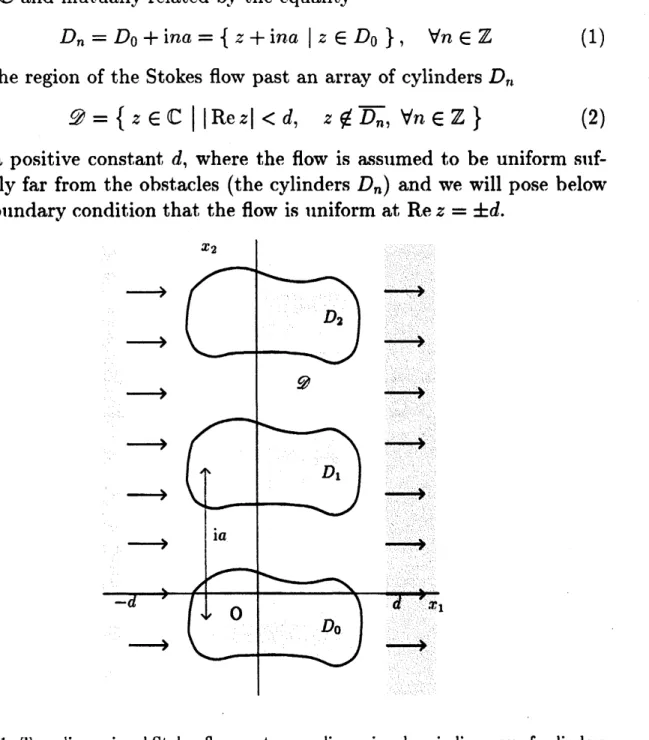
We here consider thc problem of a stationary two-dimensional Stokes
flow past a one-dimensional periodic array of cylinders
as
shown in Figure1). In the figure, $D_{n},$ $n\in \mathbb{Z}$
are
the cylinders of thesame
shape whichare arranged in a one-periodic array of period $ia(a>0)$
.
In terms ofplaIie $\mathbb{C}$ alid rnutually related by tlie equality
$D_{n}=D_{0}+ina=\{z+ina|z\in D_{0}\}$ , $\forall n\in \mathbb{Z}$ (1)
$\overline{\swarrow}^{c_{:}}$ is the region of the Stokes flow past an array of cylinders $D_{r\iota}$
$\ovalbox{\tt\small REJECT}=\{z\in \mathbb{C}||{\rm Re} z|<d, z\not\in\overline{D_{n}}, \forall n\in \mathbb{Z}\}$ (2)
with a positive constant $d$, where the flow is assumed to be uniform
suf-ficiently far from the obstacles (the cylinders $D_{n}$) and we will pose below
the boundary condition that the flow is uniform at ${\rm Re} z=\pm d$
.
Figure1: Two-dimensional Stokes flow past a one-dimensionalperiodic arrayofcylinders.
3
Fundamental Solution
Method
Our
problem of the periodic Stokes flow isgiven
in terms ofmathematics
byequatioIi
Stokes flow equation $\mu\Delta v-\nabla p=0$ in
9
(3)continuity equation $\nabla\cdot v=0$ in
9
(4)boundary conditions $v=0$ on $\partial D_{n}(n\in \mathbb{Z})$ (5)
$v=(U,0)$ on $lx_{1}=\pm d$
.
(6)From (4), there exists a stream function $\Psi(x_{1}, x_{2})$ such that it gives the
velocity $v=(v_{1}, v_{2})$ by
$v_{1}= \frac{\partial\Psi}{\partial x_{2}}$
,
$v_{2}=- \frac{\partial\Psi}{\partial x_{1}}$.
(7)From
(3) and (7),we
can easily find that$\Delta^{2}Psi=0$, (8)
that is, the stream function $\Psi$ is a biharmonic function. Therefore, the
stream function
can
be written as$\Psi(z)={\rm Im}\{\overline{\sim_{\wedge\prime}\sim}\varphi(z)+\int^{z}\psi(z’)dz’\}$ $(z=x_{1}+ix_{2})$ (9)
with analytic functions $\varphi(z),$ $\psi(z)$, which is called “Goursat’s
representa-$tion[5]$
.
Basedon
(9), the complex velocityis
writtenas
$\dagger l^{r}\equiv v_{1}-iv_{2}=2i\frac{\partial\tilde{\Psi}}{\partial}=\overline{z}\varphi’(z)-\overline{\varphi}(\overline{z})+\psi(z)$
.
(10)As
a
fundamental solution of the Stokes flow equation (3) and theconti-nuity equation (4), we know the “Stokeslet”, the flow such that the analytic
function $\varphi(z)_{:}\psi(z)$ in (9) is given by
$\varphi(z)=-Q_{0}\log(z-\zeta_{0})$, (11) $\psi(\approx)=\overline{Q_{0}}(z-\zeta_{0})\log(z-\zeta_{0})-Q_{0^{\frac{z-2{\rm Re}\zeta_{0}}{z-(0}}}$ (12)
where
$Q_{()}$is
a
complex constant and $\zeta_{0}$ isa
fixed pointin
the complexplane, and the complex velocity is given by
Ill terms of physics, the
Stokeslet
is aStokes
flow due to a concentrated$force-8\pi\mu Q_{0}=-8\pi\mu({\rm Re} Q_{0}, {\rm Im} Q_{0})$
on
the point$\zeta_{0}$ in the complex plane.Therefore, in the fundamental solution method for ordinary Stokes flow
problem in a domain
9,
the analytic function $\varphi(z),$ $\psi(z)$ in (9)are
ap-proximated by
$\varphi(z)\simeq-\sum_{j=1}^{N}Q_{j}\log(z-\zeta_{j})$, (14)
$\psi(z)\simeq\sum_{j=1}^{N}\overline{Q_{j}}(z-\zeta_{j})\{\log(z-\zeta_{j})-1\}$ , (15)
and, then, the complex velocity
is
approximated by$W \simeq 2\sum_{j=1}^{N}\overline{Q_{j}}1og|z-\zeta_{j}|-2\sum_{j=1}^{N}Q_{j^{\frac{{\rm Re}(z-\zeta_{j})}{z-\zeta_{j}}}}$
.
(16)In (14-16), $\zeta_{j},$ $j=1,2,$
$\ldots,$ $N$ are the singularity points given in the
exte-rior ofI and $Q_{1,}.Q_{2},$ $\ldots,Q_{N}$ are the complex coefficients to be determined
so that the flow satisfies the boundary conditions in
a
sufficient accuracy.In terms of physics, the above approximation (14-16) illustrates the
su-perposition of the Stokes flows due to the concentrated $forces-8\pi\mu Q_{j}=$
$-8\pi\mu({\rm Re} Q_{j}, {\rm Im} Q_{j}),$ $j=1,2,$ $\ldots$ ,$N$
on
the point $\zeta_{j},$ $j=1,2,$ $\ldots$ , $N$.
It is, however, difficult to approximate the solution of
our
problem bythe ordinary fundamental solution method (14-16) because these
approxi-mation
are
not periodicfunctions. Therefore,we
have to modify the abovefundamental solution
method so
that itcan
approximate the periodicso-lutions of
our
problems. A primitive IIlodification may be arranging theStokeslets in a periodic array, that is, approximate the analytic functions
$\varphi(z),$ $\psi(z)$ by
$\varphi(z)\simeq-\sum_{n\in \mathbb{Z}}\sum_{j=1}^{N}Q_{j}\log(z-(\zeta_{j}+ina))$
,
(17)but the infinite sums in the above approximation are generally divergent as
tlrey are. Then, we modify the infinite
sums
so that they are convergent,IldIIlely,
$\sum_{\prime,n\in\wedge}\sum_{jn=1}^{N}Q_{j}\log(z-(\zeta_{j}+ina))arrow\sum_{j=1}^{N}Q_{j}\{\log(z-\zeta_{j})+\sum_{n\neq 0}[\log(1-\frac{\prime\sim\prime-\zeta_{j}}{ina})+\frac{z-\zeta_{j}}{ina}]$
$= \sum_{j=1}^{N}Q_{j}$log sinh $[ \frac{\pi}{a}(z-\zeta_{j})]$
,
(19)$\sum_{n\in Z}\sum_{j=1}^{N}Q_{j^{\frac{z-2{\rm Re}(\zeta_{j}+ina)}{\sim\prime-(\zeta_{j}+ina)}=}}.\sum_{j=1}^{N}Q_{j}(z-2{\rm Re}\zeta_{j})\sum_{n\in \mathbb{Z}}(\frac{1}{z-\zeta_{j}-ina}+\frac{1}{ina})$
$arrow\sum_{j=1}^{N}Q_{j}(z-2{\rm Re}\zeta_{j})\{\frac{1}{z}+\sum_{n\neq 0}(\frac{1}{\approx-\zeta_{j}-ina}+\frac{1}{ina})\}$
$= \frac{\pi}{a}\sum_{j=1}^{N}Q_{j}(z-2{\rm Re}$ (;)
coth
$[ \frac{\pi}{a}(z-\zeta_{j})]$,
(20)
and we have
$\varphi(z)\simeq\varphi_{N}(z)\equiv-\sum_{j=1}^{N}Q_{j}$logsinh $[ \frac{\pi}{a}(z-\zeta_{j})]$ , (21)
$\psi(z)\simeq\psi_{N}(z)\equiv\sum_{j=1}^{N}\overline{Q_{j}}$ logsinh $[ \frac{\pi}{a}(z-\zeta_{j})]-\frac{\pi}{a}\sum_{j=1}^{N}Q_{j}(z-2{\rm Re}\zeta_{j})$coth $[ \frac{\pi}{a}(z-\zeta_{j})]$
.
(22)
These give an approximate complex velocity by
$W\simeq W_{N}\equiv u_{1}^{(N)}-iu_{2}^{(N)}$
$\equiv 2\sum_{j=1}^{N}\overline{Q_{j}}$log sinh $[ \frac{\pi}{a}(z-\zeta_{j})]|-\frac{2\pi}{a}\sum_{j=1}^{N}Q_{j}{\rm Re}(z-\zeta_{j})$coth $[ \frac{\pi}{a}(z-\zeta_{j})]$
.
(23)
The approximation (21-23) is suitable for our problem of periodic
Stokes
expected to iIlherit the advaIltages of the ordinary $fuIldaInental$ solution
luethod that it is easy to compute and it gives approximation with high
accuracy. This approximationis given by a linear coInbination of tfie
‘Mpe-riodic Stokeslct”, the pe‘Mpe-riodic fundamental solutions of the Stokes flow
equation and the continuity equation and, in terms of physics, it
illus-trates the superpositions of the flows due to an infinite periodic array of
concentrated forces $-8\pi\mu Q_{j}=-8\pi\mu({\rm Re} Q_{j}, {\rm Im} Q_{j}),$ $j=1,2,$ $\ldots$
,
$N$on
the
points $\zeta_{j}+ina,$ $n\in \mathbb{Z}$.
Thecomplex coefficients $Q_{j}$
are
determined bythe collocationcondition,the condition that the approximate velocity (23) satisfies the boundary
conditions (6) only at a finite number of boundary points. Namely,
we
choose boundary points
$(+)$ $(+)$
$z_{1}^{(0)},$$z_{2}^{(0)},$
$\ldots,$$z_{N_{0}}^{(0)}\in\partial D_{0}t-$
) $(-)$
$\approx 1$ ,$z_{2}$ ,
...,
$z_{\bigwedge_{+}^{\gamma}}^{(+)}\in\{z\in \mathbb{C}|{\rm Re} z=d\}$ , $z_{1}$ ,$z_{2}$,
...,
$z_{N_{-}}^{(-)}\in\{z\in \mathbb{C}|{\rm Re} z=-d\}$$(N_{0}+N_{+}+N_{-}=N)$
(24)
and
pose
the boundarycontitions
(6)on
$M_{N}^{J’}$ at the above points$\ddagger\phi_{N}^{t^{*}}(z_{i}^{(0)})=0$ $i=1,2,$
. .
.,
$N_{0}$, (25)$W_{N}(z_{i}^{t+)})=U$ $i=1,2,$
$\ldots,$ $1V+$
,
(26)$W_{N}^{r}(z_{i}^{t-)})=U$ $i=1,2,$
$\ldots,$ $N_{-}$
.
(27)The equations (25-27) form a system of linear equations with respect to
the coefficients$Q_{1},Q_{2},$ $\ldots$ ,$Q_{N}$
.
We determinethe coefficient$sQ_{j}$ bysolvingthe above system of linear equations and obtain the approximate velocity
$\iota\prime \mathfrak{s}_{N}^{r}$
.
4
Numerical
Example
We here show a numerical example of the presented $met_{1}hod$
.
All thecom-putations
were
carried out usingprograms
coded in $C++with$ doubleprecision working.
The example is the problem of Stokes flow past
a
periodic array ofcircular cylinders, that is, the Stokes flow problem in the domain
with
$D_{n}=\{\approx\in \mathbb{C}||z-na|<r\}$, $n\in \mathbb{Z}$
.
(29)The collocation points and the singularity points are taken
as
$\sim\sim i(0)=\gamma$
.
exp $( i\frac{2\pi(i-1)}{N_{0}}),$$\zeta_{i}^{(0)}=0.5r\exp(i\frac{2(i-1)}{N_{0}})$
,
$i=1,2,$$\ldots,$$N_{0}$
,
(30)
$\approx i(\pm)=\pm d+i(-\frac{a}{2}+\frac{a(i-1/2)}{\lrcorner V_{0}}),$
$\zeta_{i}^{(\pm)}=\pm\frac{3}{2}d+i(-\frac{a}{2}+\frac{a(i-1/2)}{N_{0}})(31)i=1,2,$$\ldots,$
$1$
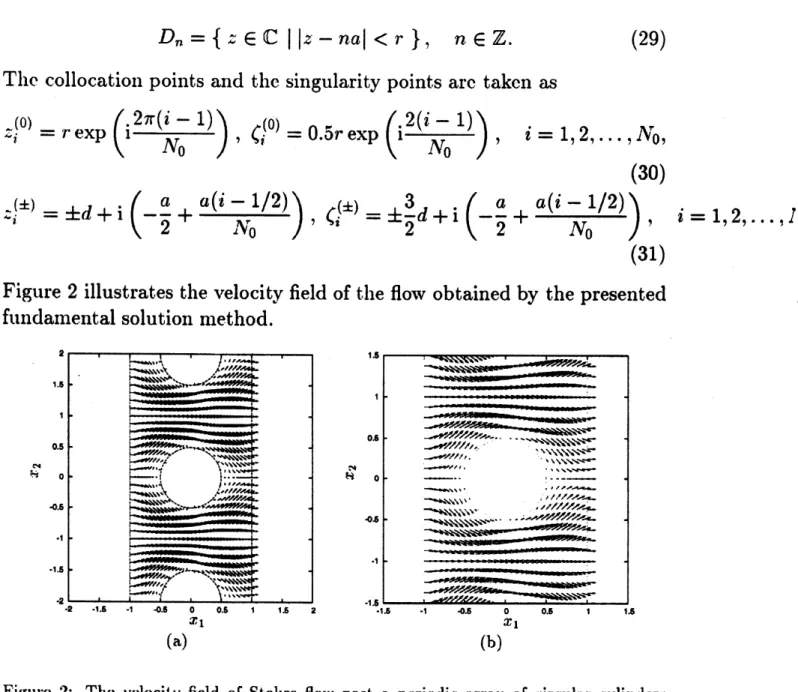
Figure
2
illustrates the velocity field of tbe flow obtained by the presentedfundamental solution
method.Figure 2: The velocity field of Stokes flow past a periodic array
or
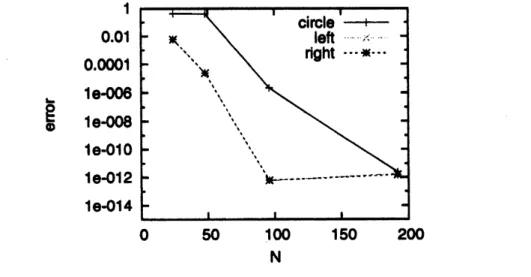
circular cylinders computed by the presented method. The figure (b) is a magnification of the figure (a).In orderto estimate the accuracy ofthe presented method,
we
computedtlle
error
on
theboundaries
$\epsilon(circle)=\sup_{z\in\partial D_{0}}\frac{|W_{N}(z)|}{U}$. $\epsilon(left)=\sup_{B\epsilon z=-d}\frac{|7W_{N}(z)-U|}{U}$
,
$\epsilon(rig1_{1}t)=s\iota\iota p\frac{|fW_{N}(z)-U}{U}{\rm Re} z=d$where the suprima
are
actuallycolnputed as the maximaon 1000
bouIldarypoints distributed by using the uniform random numbers. Figure 3 shows
the error
estimates
(32) as the totalnumbers of the nodes $N=3N_{0}$,
thoughwe cannot distinguish between the
error on
the left boundary $\epsilon(left)$ andthe error
on
the right boundary $\epsilon(right)$.
From
this figure, we find thatthe
errors on
the left and right boundaries $\epsilon(left),$ $\epsilon(right)$are
of the order ofthe square of the
error on
the surfaces of the cylinders $\epsilon(circle)$ with thesame number
of the nodes, and the totalerror
decays exponentiallyas
thenumber of nodes $N=3_{1}V_{0}$
increases.
$\dot{\Phi\xi}$
$0$ 50 100 150 200 $N$
Figure 3: The error $e8timate8$ ofthe presented method as functions of the total number
of the nodes $N=3N_{0}$
.
5
Concluding
Remarks
In this paper, we presented the fundamental solution method for the
prob-lems of two-dimensional Stokes flow past a one-dimensional periodic array
of cylinders. We obtained
our
method by using the biharmonic functiontheory based
on
analyticfunctions and by modifying the Stokeslet includedin the approximation so that the method gives a good approxiInation of
$tl\iota e$ solution including periodic
functions.
Thenumerical
exaInplesfor a
problem with
circular cylinders shows an
exponentialconvergence
ofour
Acknowledgement
This work is supported bya Grant-in-Aidfor Scientific Research (C) (No.18560054),
Japan Society for
Promotion
ofScience.
References
[1] K. Amano, A charge simulation method for the numerical conformal
mapping
of interior,exterior
and doubly-connected domains,J.
Com-put. Appl. Math.
53
(1994)353-370.
[2] K. Amano, A charge simulation method for numerical conformal
map-ping
onto circular and radial slit domains,SIAM
J.Sci.
Comput. 19(1998)
1169-1187.
[3] K. Amano, D. Okano, H. Ogataand M. Sugihara, Numerical conformal
mappings of unbounded multiply-connected domains by the charge
simulatioll method, Bull. Malaysian Math.
Sci. Soc.
26 (2003)3551.
[4]
A.T. Chuwang
andT.Y.-T.
Wu, Hydrodynamics oflow-Reynolds-number flow. Part 2. Singularity method for Stokes flow, J. Fluid
Mech.
67
(1975) $78\overline{/’}-815$.
[5]
\’E.
Goursat, Sur l’\’equation $\Delta\Delta u=0$,
Bull. Soc. Math. France 26(1898)
236-237.
[6] L. Greengard and M.C. Kropinski, Integral equation methods for
Stokes flow in doubly-periodicdomains, J. Eng. Math. 48 (2004) $15\overline{\prime}-$
170.
[7] H. Hasimoto,
On
the periodic fundamental solutions of theStokes
equations and their application to
viscous
flow pasta
cubicarray
ofspheres, J.
Fluid
Mech. 5 (1959)317-328.
[8] K. Ishii,
Viscous
flow past multiple planar arrays of small spheres,J.
Phys.
Soc.
Japan 46 (1979)675-680.
[9] M. Katsurada, A mathematicalstudy of the charge simulation method
[10] M. $Kat_{1}surada$, Asymptotic
error
analysis of the $c\mathfrak{l}\iota arge$ simulationlnethod in a Jordan region with an analytic boundary, J. Fac.
Sci.
Uuiv.
Tokyo, Sect. IA, Math.37
(1990)635-657.
[11] M. Katsurada and H. Okamoto, A mathematical study of the charge
simulation method I, J. Fac. Sci. Univ. Tokyo, Sect IA, Math. 35
(1988)
507-518.
[12] N. Liron, Fluid transport by cilia between parallel plates, J. Fluid
Mech.
86
(1978)705-726.
[13] N. Liron,
Stokeslet
arraysin
a pipe and their application to cliarytransport, J. Fluid Mech. 143 (1984)
173-195.
[14] N. Liron, Stokes flow due to infinite array of Stokeslets in three
di-mensions, J. Engrg. Math. 30 (1996)
267-297.
[15]
S.
Murashima, Charge Simulation Method and its Applications,Morikita Shuppan, Tokyo,
1983
(in Japanese).[16] H. Ogata, A fundamental solution method for
three-dimensional
Stokes
flow
problems with obstacles ina
planar periodicarray,
J.Com-put. Appl. Math.
189
(2006)622-634.
[17] H. Ogata and K. Amano, A
fundamental
solution method forthree-dimcnsional viscous flow problems with obstacles in a periodic array,
J.
Comput. Appl. Math.193
(2006)302-318.
[18] H. Ogata, K. Amano, M. Sugihara and D. Okano, A fundamental
solution method for viscous flow problems with obstacles in a periodic
array, J. Comput. Appl. Math.
152
(2003)411-425.
[19] H.
Ogata,
K. Amano and K. Amano,Numerical
conformal mappingof periodic structurc domaints, Japan
J.
Indust. Appl. Math. 5 (2002)307-318.
[20] A.
S.
Sangani and A. Acrivos, Slow flow througha
periodic array ofspheres, Internat. J. Multiphase Flow 8 (1982)
343-360.
[21] H. Singer, H. Steinbigler and P. Weiss, A charge simulation method for
the calculation of high voltage fields, IEEE Trans. Power Apparatus
[22] K. Taulada and H. Fujikawa, The steady two-dimensional flow of
vis-cous fluid at low Reynolds numbers passing through an infinite
row
of equal parallel circular cylinders, Quart. J. Mech. Appl. Math. 10
(1957)
425-432.
[23] A.A. Zick and G.M. Homsy, Stoke$s$ flow through periodic