Tweedie
一般化線形モデルを用いた
クイーンズランド州の降水量データの解析
統計数理研究所 大西俊郎 (Toshio Ohnishi)
The Institute of
Statistical Mathematics
サンシャインコースト大学
Peter
K
Dunn
University of
the
Sunshine Coast
Abstract
We investigate
a
logarithmic-link generalized linear model, whose underlyingsam-pling density is in
an
exponential fainilydistribution
with power variance function. Themultiple-strata
case
is studied with stratum-dependent intercepts anda
common
slope.Weprove that there exists
a
conjugateprior densityon
the intercept parameter, and theconjugateanalysis is
discussed.
An estimation procedure is given, which incIudes theop-timal estimating function of the parameters other than the intercept, and
an
empiricalBaysianestimation of the hyper-parametersofthe prior density. As
an
example, rainfalldata for Queensland, Australia, is analyzed.
$Key$ Words:
common
slope, conjugate analysis,empiricalBayesian estimation, estimatingfunction, generalized linear model, logarithmic link, Pythagorean relationship, posterior
mode,
Tweedie
distribution1
Introduction
The generalized linear model ($GLM$, McCullagh&Nelder [14]) plays
an
important role indataanalys$is$
,
enjoying wideapplicationinfieldssuchas
insurance,climatolog, economics
and biostatistics. Their popularity is $parti\theta y$ because GLMs
are
basedon
theexponen-tial dispersion model $(EDM)$ family of distributions, which includes
common
distributionssuch
as
the Normal, binomial, Pois@on and gamma distributionsas
specialcases.
Inad-dition, infe.rence for the $GLM$ has aminimax property:
an
exponential famlly distribution$minimize_{\ell}s$ the Fisher
information
for themean
parameterunder agiven mean-variance
relationship (Tsubah [21];
Ohnishi&Tsubaki
[15]).If the response variable $Y$ follows
an
$EDM$ distribution withmean
$\mu$, the variance ls
var
$[1’]=V(\mu)/\tau$, where$\tau>0$is aprecision parameter, and$V(\mu)$ is thevariancefunction,some
function
ofthemean.
Aspecialsubset ofEOMS
are
the Tweediedistributions, with varlancehmction $V(\mu)=$$\mu^{p}$ for
some
$p$.
Specialcases
include the Nomal$(p=0)$, Poisson $(p=1$ with $\tau=1)$,
gamma $(p=2)$ and inverse Gausslan $(p=3)$ distributions. Tweedie distributions exist
for all$p\not\in(0,1)$
.
The Tweedie distributions with $p\in(1,2)$
are
of interest here. These distributionshave support
on
the non-negative reals, andare
continuous for $Y>0$ with apositiveUntilrecently, Tweedie distributions(apartfromthe fourspecial
cases
identifiedabove)were
rarely used since theirdistributions, and hencelikelihood imctions, cannotbe writteninclosed form. $R\epsilon$cent advances haveproducedaccurate numericalmethods for evaluating
the density functions (Dunn&Smyth [3, 4]).
Although Bayesian analysis for GLMS is well established (for example,
see
Gelman etal. [8]$)$, little is known about Bayesian analysis using Tweedie distributions. A conjugate
analysis of
a
particular Bayesian GLM is addressed in this paper. Chen&Ibrahim
[1]discuss the conjugate analysis of GLMS for both the intercept and slope, usingthe power
prior [10], but their analysis depends
on
the covariates.We
assume
a
conjugate prior densityon
the intercept parameters, and develop theconjugate analysis under this prior density. Unllke Chen&Ibrahim [1],
our
priorsare
assumed
on
the intercept only, andour
priors do not dependon
the covariates, butuse
hyper-parameters. Also, the situation under study
assumes
the dataconsist of$K$ strata,with
a common
slope of interest, but separate intercepts. The Bayesian approach isknown to perform well when the dimension of the parameter space is high; the
James-Stein estimator $[$11$]$ is
a
well-known example (see Efron [5]). Inour
model $K$ is assumedtobe large, say
more
than 35.After first introducing GLMS and EDMS (Sect. 2), and Tweedie EDMS in particular
(Sect. 3), the likelihood function forthe scenario under study is developed (Sect. 4),
fol-lowed by
a
conjugate analysis ofthe intercept parameter (Sect. 5). The optimalestimatingfunction is established (Sect. 6)
as
well asan
estimation procedure (Sect. 7). The resultsare
then demonstrated usingan
example (Sect. 8).2
Generalized
linear
models,
the exponential
family
and location-dispersion
models
The $EDM$ family of distributions have probability functions
$f(y;\mu, \tau)=\exp[\tau\{c(\mu)y-M(\mu)\}]a(y;\tau)$, (1)
where $\mu$isthe mean, and $\tau>0$isthe precisionparmeter. The knownfunction $c(\mu)$ is the
canonical parameter; the known function $M(\mu)$, when written in tems of the canonical
parameter, is the cumulant function; $a(y;\tau)$ is the supporting
measure.
The variance of$Y$ is
var
$[Y]=V(\mu)/\tau$ where the variance function $V(\mu)$ is$V( \mu)=\{\frac{dc(\mu)}{d\mu}\}^{-1}$
which uniquely identifies the distribution in the $EDM$ family (Jrgensen [12,
\S 2.3.1]).
Usethe notation ED$(\mu, \tau)$ to denote a random variable $Y$ has the $EDM$ distribution in (1).
As indicated earlier,
common
distributions suchas
the Normal, binomial, Poisson andgamma
distributionsare
in the $EDM$ faimly. EDMSare
importantas
theyare
the responsedistributions for GLMS.
Closely related to the $EDM$ family is the location-dispersion famUy (Jrgensen [12]).
Distributions in this family have the form
$p(y-\mu,\tau)=\exp\{-\tau d(y-\mu)+b(\tau)\}$ , (2)
for
a
normalizing constant $\exp\{b(\tau)\}$, where $\mu$ and $\tau>0$are
the location (but not themean) and precisionparametersrespectively. Thefunction $d(t)$ iscalled the unit deviance
function, where $d(O)=0$, and $d(t)>0$ when $t\neq 0$; that is, $d(t)$ is
a
distanoemeasure.
1. The response variable, $Y_{\dot{f}}’$, follows
an
$BDM$family distribution, with
mean
$\mu$ andprecision parmeter $\tau$ such that $I^{r_{i}}\sim$ ED$(\mu_{i}, \tau w_{i})$ where $w_{i}>0$
are
known priorweights; and
2. The expected values of the $Y_{i}$, say
$\mu_{i}$,
are
related to the covariates$x_{i}$ through
a
monotonic,
differentiable
link function $h(\cdot)$so
that $h(\mu_{i})=\alpha+x_{i}^{T}\beta$, where $\beta$ isa
vector ofunknown regression coefficients, and $\alpha$ represents
a
constant tem.Often the linear component,
or
linear predictor, $\alpha+x_{i}^{T}\beta$is denoted by$\eta_{i}$, when $h(\mu_{i})=$ $\eta_{i}=\alpha+x_{i}^{J}’\beta$
.
3
Tweedie
distributions
$EDM8TheEDMS$ with variance
hnction
$V(\mu)=\mu^{P}$ forsome
red$P$are
ofinterest here. For thue$f(y;\mu, \tau, p)=\exp[\tau\{c(\mu, p)y-M(\mu, p)\}]a(y;\tau, p)$, (3)
with
$V( \mu)=t\frac{\partial c(\mu,p)}{\partial\mu}\}^{-1}=\mu^{p}$
.
These $EDM$
distributions
are
called the Twaediedistributions
by Jrgensen [12] in honorof Tweedie [22]. Use the notation $ED_{p}(\mu, \tau)$ to denote arandom variable $Y$ follows the
Tweedie $EOM$ in (3).
Jrgensen [12] shows distributionsexist for all values of$p\not\in(O, 1)$
.
The Tweedie fanilyincludes important distributions, such
ae
the Nomal $(p=0)$, the Poisson $(p=1$ with$\tau=1)$, the gmma $(p=2)$ and the inverse Gaussian $(p=3)$ distributions. The binomial
distribution is anotable exception.
When
$1<p<2$
, the density (3)can
be representedas
aPoissonsum
ofgmmadis-tributions, and is sometimes caUed the Poisson-gmma distribution. Suppose$N$ random
variables $X_{i}$ $($for $i=1,$
$\ldots,$$N)$
are
observed, where $N$ follows the Poission distributionPo$(m)$ with
mean
(and variance) $m$.
Also, suppose each random variable $X_{i}$ foUowsa
gamma distribution withshape parameter $\theta$ and scaleparameter $\lambda$ such that the
mean
is$\theta\lambda$and variance$\theta\lambda^{2}$
.
Then thedistributionof$\sum_{i\approx 1}^{N}X_{i}$, where$N,X_{1},$
$X_{2},$$\ldots$
are
mutuallyindependent, correspondsto
an
$ED_{p}(\mu, \tau)$ distribution where$m= \tau\frac{\mu^{2-p}}{2-p},$ $\lambda=\frac{(p-1)\mu^{p-1}}{\tau},$ $\theta=\frac{2-p}{p-1}$
.
The probabilty functionfortheTweedie distributionwith
a
powerparmeter$p\in(1,2)$is
$f(y; \mu,\tau,p)=\exp\{-\tau(-\frac{\mu^{1-p}}{1-p}y+\frac{\mu^{2-\dot{p}}}{2-p})\}a(y;\tau,p)$ (4)
for $y>0$ (Jrgensen [12, Chapter 4]), where
$a(y; \tau,p)=\frac{1}{y}\sum_{j=1}^{\infty}\frac{\tau^{j}\{\frac{1}{2-p\Gamma((2}(\frac{\tau y}{p-1p)j/})^{(2-p)/(p-1)}\}^{j}}{-(p-1))j!}$
.
(5)The Tweedie distribution with $1\leq p<2$ has the positive probability of
zero
$P(Y=0)=\exp(-\tau\frac{\mu^{2-p}}{2-p})$
.
The normalizing constant $a(y;\tau,p)$ cannot be written in closed form apart from the
four
summation (5), but Dunn &Smyth [3] presented the first rigorous study of the series
expansion, andfoundit isnot possibleto accuratelyevaluatethisexpansionfor allparts of
theparameter space. Dunn&Smyth [4] thendeveloped
a
methodforinvertingthe simpleform of the moment generating function of the Tweedie densities, producing accurate
computations in the parts of the parmeter space where the series is not accuracate.
These algorithms
are
implementedin thetweediepackage (Dunn [2]) for the $R$ statisticalenvironment [18], and
we
use
these progrms to deriveour
numerical results.In Tweedie GLMS with $p>1$
.
a
logarithm link function is commonly used, since itensures
$\mu>0$as
required.For later convenience, write the Tweedie density in (4) as
$f(y;\mu, \tau, p)=\exp[-\tau\{u(\mu\cdot 2-p)-yu(\mu;1-p)\}]\tilde{a}(y;\tau, p)$ , (6)
for $\tilde{a}(y;\tau, p)=\exp[-\tau\{-(1-p)^{-1}y+(2-p)^{-1}\}]a(y;\tau, p)$, where $u(t;\kappa)=\{$ $\frac{\log tt^{\kappa}-1}{\kappa}$
otherwise.
for $\kappa=0$,
(7) In this form, $u$ is continuous in $\kappa$, and is equivalent to the log-limit fom used by Dunn
&Smyth [3]. The functlon $u(t;\kappa)$ proves crucial later, based
on
the followingproperties.The proof is
a
straightforward calculation, and is omitted.Lemma 1 Consider a
function
$u(t;\kappa)$as
defined
in (7).(i) For any $s,$ $t$ and$\kappa,$ $u(st;\kappa)=t^{\kappa}u(\epsilon;\kappa)+u(t;\kappa)$
.
(ii) Suppose $\kappa$ and $\nu$ are non-negative and $\kappa+\nu>0$
.
Then,for
any $q>0$ and$r>0$ $qu(t;\kappa)-ru(t;-\nu)$$=\delta_{*}\{u(t/t_{*};\kappa)-u(t/t_{*};-\nu)\}+qu(t_{*};\kappa)-ru(t_{*};-\nu)$,
where
$t_{*}=(r/q)+\nu$ and $\delta_{r}=q^{u\nu}r^{\mu y}$
.
4
The
likelihood function
for the
Tweedie glm
Although
an
extension tothe vector slope parameter $is$ straightforward,we
now
focuson
the scalar
case
for simplicity.In this paper, interest is in the logarithmic link Tweedie GLM with linear predictor.
Suppose $Y_{1}$ is distributed according to ED$p(\mu_{i}, \tau)$ with $\log\mu_{i}=\alpha+\beta x_{i}(1\leq i\leq n)$; then
using the expression (6), the density function is given
as
$\prod_{i=1}^{n}f(y_{i};e^{\alpha+\beta x}, \tau,p)=\exp[-\tau\sum_{i=1}^{n}\{u(e^{\alpha+\beta x};2-p)-y_{i}u(e^{\alpha+\beta rt};1-p)\}]$
$x\prod_{i=1}^{n}\overline{a}(y_{i};\tau, p)$
.
(S)For
use
later,use
this density function toform the likelihood function, and re-write sepa-rating $\alpha$ and $\beta$,as
shown in the followin$g$ Proposition.
Proposition 1 The Tweedie likdihood in (8)
can
be writtenas
$\prod_{i=1}^{n}f(y_{i};e^{\alpha+\beta x}‘, \tau,p)=\exp[-n\tau\{A(\beta,p)u(e^{\alpha};2-p)-B(\beta,p)u(e^{\alpha};1-p)\}]$
where
$A( \beta,p)=\frac{1}{n}\sum_{i=1}^{n}e^{(2-p)\beta x}$: and $B( \beta,p)=\frac{1}{n}\sum_{i\simeq 1}^{n}y_{i}e^{(2-p)\beta x_{i}}$
.
As well
as
noting the separation between $\alpha$ and $\beta$, note the symmetrybetween the two
components involving $(1-p)$ and $(2-p)$ in (9). This proves useful when the conjugate
analysis ofthe intercept $\alpha$is studied in
Sect.
5.Proof
ApplyLemma
1(i) to thelikelihood
funct\’ionbased
on
thedensityfunction
in (8);the
summation term in theexponent of thelikelihood function becomes
$\sum_{i_{\overline{\sim}}1}^{n}\{u(e^{\alpha+\beta xi};2-p)-y_{i}u(e^{a+\beta x_{l}};1-p)\}$
$= \sum_{:=1}^{n}\{e^{(2\sim p)\beta\varpi_{i}}u(e^{\alpha};2-p)-y_{i}e^{(1-p)\beta\infty i}u(e^{\alpha};1-p)$
$+u(e^{\beta x}i;2-p)-y_{*}\cdot u(e^{\beta\emptyset j}, 1-p)\}$
$=n\{A(\beta,p)u(e^{\alpha};2-p)-B(\beta,p)u(e^{\alpha};1-p)\}$
$+ \sum_{*=1}^{n}\{:_{i}$
.
From (8), the middle expression is equivalent to the summation term in the exponent
of $\prod f(y_{i};e^{\beta xi}, \tau,p)$; then using the given deflnitions of
$A(\beta_{1}p)$ and $B(\beta,p)$, the result
follows ロ
Now,
we
considera
specific Tweedie GLM usinga
logarithmiclink function, where thedata consist of $K$ strata with $n_{k}$ observations in stratum $k$
.
Fbr eachstratum,
assume
separate intercepts $\alpha_{k}$, butcommon
slope $\beta$ for covariate$x_{ki}$; primary interest is in the
slope $\beta$
.
The density function is
$f(y; \alpha, \beta, \tau, p)=\prod_{k=1}^{K}f(y_{k};\alpha_{k}, \beta, \tau, p)$
$= \prod_{k=1}^{K}\prod_{i=1}^{n_{h}}f(y_{ki};\mu_{ki}, \tau, p)$, (10)
where $\log\mu_{ki}=\alpha_{k}+\beta x_{ki}$
.
In the above, $y=(y_{1}, \ldots, y_{K})^{T}$ with $y_{k}=(y_{k1}, \ldots,y_{kn_{k}})^{T}$,$\alpha=(\alpha_{1}, \ldots, \alpha_{K})^{T}$ is the intercept parmeter vector,
$\beta$ is the
common
slope parameter,and $x_{ki}s$
are
the covariates.To simplify the notation,
we
define severalquantities. We extend $A(\beta, p)$ and $B(\beta, p)$in Proposition 1 to the multi-strata
case
as
$A_{k}( \beta, p)=\frac{1}{n_{k}}\sum_{:=1}^{k}e^{(2rightarrow p)\beta n_{ki}}n$ and $B_{k}( \beta, p)=\frac{1}{n_{k}}\sum_{j=1}^{n_{k}}y_{ki}e^{(1-p)\beta g_{hi}}$ , (11)
respectively. We also introduce the following quantities:
$\hat{\alpha}_{Mk}=\hat{\alpha}_{Mk}(\beta, p)=\log\frac{B_{k}(\beta,p)}{A_{k}(\beta)p)}$
,
The former will be shown to be the maximum likelihood estimator (MLE) for $\alpha$ given
$(\beta, p)$
.
Interestingly, the likelihood function with respect to the intercept parmeter $\alpha$ is
similar to that ofthe location-dispersionfamily,
as
shown in the following proposition.Proposition 2 The likelihood
function
corresponding to (10) is$f(y; \alpha, \beta, \tau, p)=f(y;0, \beta, \tau, p)\exp[-\sum_{k=1}^{K}\delta_{Mk}n_{k}L(\alpha_{k}-\hat{\alpha}_{Mk};p)]$
$\cross\prod_{k=1}^{K}\exp\{-n_{k}C_{k}(\beta, \tau, p)\}$, (12)
where $0\dot{u}$ the K-dimensional
zero
vector,$L(t;p)=u(e^{t};2-p)-u(e^{t};1-p)$, (13)
$C_{k}(\beta, \tau, p)=\tau\{A_{k}(\beta, p)u(e^{\ wk};2-p)-B_{k}(\beta, p)u(e^{a_{htk}};1-p)\}$
.
Noticetheform of (12) is like that of the location-dispersion family (2), where$\tau\equiv\delta_{M_{h}}n_{k}$
and $d(y-\mu)\equiv L(\alpha_{k}-\hat{\alpha}_{Mk};p)$
.
Note that $L(t;p)>0$for $t\neq 0$, and $L(t;p)=0$ if$t=0$,as
required fora
deviance function.Proof
Asan
application of Proposition 1 to the kth stratum,we
have$f(y_{k};\alpha_{k}, \beta, \tau, p)$
$=\exp[-\tau n_{k}\{A_{k}(\beta, p)u(e^{\alpha}h;2-p)-B_{k}(\beta, p)u(e^{\alpha};k1-p)\}]x$
$f(y_{k};0, \beta, \tau, p)$
.
(14)We apply Lemma l(ii) to the linear combination of the $u(\cdot;\cdot)$ terms in the exponent.
Recalling the definitions of $L(t;p)$ and $C_{k}(\beta, \tau, p)$,
we
see
that$A_{k}(\beta, p)u(e^{\alpha_{k}};2-p)-B_{k}(\beta, p)u(e^{\alpha_{k}};1-p)$
$= \frac{1}{\tau}\{\delta_{Mk}L(\alpha-\hat{\alpha}_{M};p)+C_{k}(\beta, \tau, p)\}$
.
(15)Combining (14)
and
(15), the likelihoodfunction
for stratum $k$ is$f(y_{k};\alpha_{k}, \beta, \tau, p)$
$=f(y_{k};0, \beta, \tau, p)\exp\{-\delta_{Mk}n_{h}L(\alpha_{k}-\hat{\alpha}_{Mk};p)-n_{h}C_{k}(\beta, \mathcal{T}_{)}p)\}$
,
(16)which completes the proof 口
The function $L(t;p)$ is used
as a
loss function in the conjugate analysis discussed inSect. 5. Proposition2 shows that $\hat{\alpha}_{Mk}(\beta, p)$ is the MLE for $\alpha$ given $\beta$ and$p$
.
5
Conjugate analysis
of the
intercept
Motivatedby the result of Proposition 2,
assume
the following prior densityon
$\alpha_{k}$, whichis in the location-dispersion family (2):
Here$\alpha_{0}$ and $\delta>0$
are
hyper-parameters, $L(t;p)$is the deviance function defined in (13),
and
$K(p, t)= \int_{-\infty}^{\infty}\exp\{-tL(s;p)\}ds$ (18)
is the normalizing
constant. When
$p=1$or
$p=2$, the density (17) isa
log-transformedgamma
density.The prior density (17) may be derived in two
different
ways.1. Thefirst isbased
on
thelikelihoodapproach,related to the notion ofthepowerpriorproposed by
Ibrahim&Chen
[10]. Tosee
this, consider (16)as a
likelihood
functionof $\alpha_{k}$, supposing the other parameters
are
known. Replace$\hat{\alpha}_{Mk}$ and $\delta_{Mk}$ withthe
hyper-parameters$\alpha_{0}$ and $\delta$, respectively,
and the assumedprior density isobtained.
2. The second is
an
application ofthe method in Yanagimoto&Ohnishi [23]. TheKullback-Leibler
divergencebetween two Tweedie densities is$KL(f(y;\mu_{1}, \tau, p),$ $f(y;\mu_{2}, \tau, p))=\tau\mu_{1}^{2-p}L(\log\mu_{2}-\log\mu_{1};p)$
.
Thusthe
Kullback-Leibler
divergence from model$f(y_{k};\alpha_{k1}, \beta, \tau, p)$ to$f(y_{k};\alpha_{k2}, \beta, \tau, p)$is
$KL(\alpha_{k1}, \alpha_{k2};\beta, \tau, p)=\tau L(\alpha_{k2}-\alpha_{k1_{1}}\cdot p)\sum_{i_{\overline{\vee}}1}^{n_{k}}e^{(2-p)(\alpha+\beta g_{ki})}k1$
.
Consider the prior density proportionalto $\exp\{-\tilde{\delta}KL(\alpha 0, \alpha_{h};\beta, \tau, p)\}$
.
Substitu-tion of$\tilde{\delta}\tau\sum e^{(2-p)(\alpha_{0}+\beta r_{k:})}$ with $\delta n_{h}$ gives the assumed prior
density.
Prove the conjugacy ofthe assumed prior density (17) using
Lemma
1.Proposition 3 The posterior density corresponding to the prior density (17) under the
sampling density$f(y_{k};\alpha_{k}, \beta, \tau, p)$ is $\pi(\alpha_{k}-\hat{\alpha}_{Bk};p,$ $\delta_{Bk}n_{k})$, where $\delta_{Bk}=\delta_{Bk}(\beta, \tau, p, \alpha_{0}, \delta)=\log\frac{\tau B_{k}(\beta,p)+\delta e^{-(1-p)\alpha_{0}}}{\tau A_{k}(\beta|p)+\delta e^{-(2-p)\alpha_{0}}}$ ,
$\delta_{Bk}^{\vee}=\delta_{Bk}(\beta, \tau, p, \alpha_{0}, \delta)$
$=\{\tau A_{k}(\beta, p)+\delta e^{-(2-p)\alpha_{0}}\}^{p-1}\{\tau B_{k}(\beta, p)+\delta e^{-(1-p)\alpha_{0}}\}^{2-p}$
.
Therefore, the prior density (17) is conjugate.
$Pro$of From
Lemma
l(i),$L(\alpha_{k}rightarrow\alpha_{0};p)=u(e^{\alpha_{k}-\alpha_{Q}};2-p)-u(e^{\alpha-\alpha};k01-p)$
$=e^{-(2-p)\alpha_{0}}u(e^{\alpha_{k}};2-p)-e^{-(1-p)\alpha(}\prime u(e^{\alpha k};1-p)+L(-\alpha_{0};p)$
.
This, together with Lemma l(ii), $\dot{p}ves$
$\tau\{A_{k}(\beta, p)u(e^{\alpha_{k}};2-p)-B_{h}(\beta, p)u(e^{\alpha u};1-p)\}+\delta L(\alpha_{h}-\alpha_{0};p)$
$=\{\tau A_{k}(\beta, p)+\delta e^{-(2-p)\alpha 0}\}u(e^{\alpha}h;2-p)$
$-\{\tau B_{k}(\beta, p)+\delta e^{-(1-p)\alpha 0}\}u(e^{\alpha};1-p)+\delta L(-\alpha_{0};p)$
where
$D_{k}(\beta, \tau, p, \alpha_{0}, \delta)$
$=\{\tau A_{k}(\beta, p)+\delta e^{-(2-p)\alpha 0}\}u(e^{\delta_{Bk}};2-p)$
$-\{\tau B_{k}(\beta, p)+\delta e^{-(\iota-p)\alpha 0}\}u(e^{\ }Bk;1-p)+\delta L(-\alpha_{0};p)$
.
(20)It
follows from
(14), (17) and (19) that$f(y_{k};\alpha_{k}, \beta, \tau, p)\pi(\alpha_{k}-\alpha_{0};p, \delta n_{k})$
$= \frac{f(y_{k};0,\beta,\tau,p)}{K(p_{t}\delta n_{k})}\exp\{-\delta_{Bk}n_{k}L(\alpha_{k}-\hat{\alpha}_{Bk};p)-n_{k}D_{k}(\beta, \tau, p, \alpha_{0}, \delta)\}$
.
(21)Thus, using (18), the posteriordensity is calculated
as
$\pi(\alpha_{k}-\hat{\alpha}_{Bk};p,$ $\delta_{Bk}n_{k})=\frac{1}{K[p,\delta_{Bk}n_{k})}\exp\{-\delta_{Bk}n_{k}L(\alpha_{k}-\hat{\alpha}_{Bk};p)\}$ ,
which iS ofthe fomof the location-dispersionfmily (2) This completes the proof. 口
Other propertiesofthe assumed prior density (17)
are
given in the followingLmma,which
wm
be applied in discussingthe conjugate analysis.Lemma 2 Set $\xi(p, t)=1-(2-p)(p-1)(\partial/\partial t)\log K(p, t)$
.
(i) Both the folloutng
are
true:$E_{\pi}[e^{(2-p)\alpha_{k}}]=\xi(p, \delta n_{k})e^{(2-p)\alpha_{0}}$
,
$E_{\pi}[e^{(1-p)\alpha}h]=\xi(p, \delta n_{k})e^{(1-p)\alpha}0$,
where $E_{\pi}[\cdot]$ denotes the $e\varphi ectation$ urth respect to the prior density (17).
(ii) The Kullback-Leibler separator$fmm\pi(\alpha_{h}-\alpha_{01};p, \delta n_{k})$ to $\pi(\alpha_{h}-\alpha_{02};p, \delta n_{k})$ is
$KL(\pi(\alpha_{k}-\alpha_{01};p, \delta n_{h}),$ $\pi(\alpha_{k}-\alpha_{02};p, \delta n_{k}))=\delta n_{h}\xi(p, \delta n_{k})L(\alpha_{01}-\alpha_{02})$
.
Proof
(i) The required result is obvious when $p=1$
or
$p=2$ sinoe the density (17) is alog-transformed gmma density,
so
suppose $1<p<2$.
Differentiating both sides of theequality
$K C^{p,t)}=\int_{-\infty}^{\infty}\exp[-tL(\alpha_{k}-\alpha_{0:}\cdot p)]d\alpha_{k}$
with respect to$\alpha_{0}$ and $t$ gives
$\int_{-\infty}^{\infty}e^{(2-p)(\alpha_{k}-\alpha 0)}-e^{(1-p)(\alpha-\alpha_{0})}\}\exp[-tL(\alpha_{k}-\alpha_{0};p)]d\alpha_{h}=0$,
$\int_{-\infty}^{\infty}L(\alpha_{h}-\alpha_{0};p)\exp[-tL(\alpha_{k}-\alpha_{0};p)]d\alpha_{h}=-\frac{\partial}{\partial t}K(p, t)$
.
Multiplyingboth sides of the latter equality with $(2-p)(p-1)$ and using (18),
$K(p, t)-(2-p)(p-1) \frac{\partial}{\partial t}K(p, t)$
Replaoe $t$ with $\delta n_{k}$
.
Then the above two equalities forma
set oflinearequations
$E_{\pi}[e^{(.-p)(\alpha-\alpha_{0})}k\eta]=E_{n}[e^{(1-p)(\alpha_{k}-\alpha\sigma)}]$ ,
$(p-1)E_{\pi}[e^{(2-p)(\alpha_{k}-\alpha_{0})}]+(2-p)E_{\pi}[e^{(1-p)(\alpha_{k}-\alpha_{0})}]=\xi(p, \delta n_{h})$
.
The results
are
the solution to this set ofequations.(ii) From Lemma l(i),
$L(\alpha_{k}-\alpha_{02};p)-L(\alpha_{k}-\alpha_{01};p)$
$=e(u(e^{\alpha 01}02;2-p)-e^{(1-p)(\alpha_{h}-\alpha_{01})}u(e^{\alpha 0\iota-\alpha_{(12}};1-p)$
.
The deflnition of the
Kullback-Leibler
divergence, together with (i), yields there-quired result,
口
Now
we
discuss the conjugate analysis for $\alpha_{k}$ assumingon a
temporarybasis
that $\beta$,$a_{0}$ and $\delta$
are
known. As stated in Sect. 4, the loss function $L(\alpha_{k}-\text{\^{a}}_{k};p)$ is adopted.
This is
a Kullback-Leibler
loss function, which follows from Lemma2(u). The conjugateanalysis of$\alpha_{h}$ is summarized in thefollowingproposition.
Proposition 4 A
modified
Pythagorean relationship$E_{po*t}[L(\alpha_{k}-\hat{\alpha}_{k};p)-L(\alpha_{k}-\hat{\alpha}_{Bh};p)-\xi[p, \delta_{Bk}n_{k})L(\hat{\alpha}_{Bk}-\hat{\alpha}_{k};p)]=0$
holds
for
any estimator $\hat{\alpha}_{h}$ where$E_{P^{Ol}}t[\cdot]$ standsfor
theposterior $e\varphi ectation$.
Therefore,the estimator$\hat{\alpha}_{Bk}$ is optimal under theloss
function
$L(\alpha_{k}-\hat{\alpha}_{k};p)$.
Proof
Consider theKullback-Leibler
divergenoe from the posterior density $\pi(\alpha_{k}-$$\hat{\alpha}_{Bhi}p,$ $\delta_{Bk}n_{k})$ to another density $\pi(\alpha_{k}-\delta_{k};p,$ $\delta_{Bk}n_{k})$
.
The latter is obtained bysub-stituting $\hat{\alpha}_{Bk}$ with
an
arbitrary estimator$\hat{\alpha}_{k}$
.
Note that the two densities have thesame
normalizing constant. It follows from (17) that
$KL(\pi(\alpha_{k}-\alpha_{Bk};p,$ $\delta_{Bk}n_{k}),$ $\pi(\alpha_{k}-\alpha_{k};p,$ $\delta_{Bk}n_{k}))$
$=\delta_{Bk}n_{k}E_{po*t}[L(\alpha_{k}-\hat{\alpha}_{k};p)-L(\alpha_{k}-\hat{\alpha}_{Bk};p)]$
.
Apply Lemma2(ii) to the left-hand side of this equality.
a
Note that $\delta_{Bk}$ and $\delta_{Bk}$ (in the Bayesian context) coincide with $\hat{\alpha}_{M}$ and $\delta_{M}$ (in the
maximumlikelthood context) respectively in Proposition 2 when $\delta$ is
zero.
The family of distributionstowhich the conjugateprior density (17) belongs
was
flrstderivedby Ohnishi&Yanagimoto [16] in the contextof seekingmembersofthe
location-dispersion family having
a
conjugate prior. They sought location-dispersion densities$f(y-\mu)$ with
a
conjugate prior density of the form $\pi(\mu-m;\delta)\propto\{f(m-\mu)\}^{\delta}$.
Thisrequisitionalso yields theNormal and the
von
Mises distributions.6
The
optimal
estimating
function
We
now
investigatethefollowing estinatlngequationof $(\beta, \tau_{t}p)$:where $l(y;\alpha, \beta, \tau, p)=\log f(y;\alpha, \beta, \tau, p)$ and $\nabla=(\partial/\partial\beta, \partial/\partial\tau, \partial/\partial p)^{T}$
.
Thisesti-mating equation is proved to be optimal under a certain Bayesian criterion. The
hyper-parmeters $\alpha_{0}$ and $\delta$
are
assumed to be known in this Section.The following proposition gives another expression of the estimating
function
(22).The proofis straightforward and is omitted. Proposition 5 It holds that
$\nabla\log f_{m\arg}(y;\beta, \tau, p, \alpha_{0}, \delta)=E_{p\text{。}*t}[\nabla l(y;\alpha, \beta, \tau, p)]$,
where $f_{m\iota r\mathfrak{g}}(y;\beta, \tau, p, \alpha_{0}, \delta)$ is the marginal density.
An optimality of the estimating
function
(22) is shom in the following proposition.Thecriterion hmction in theproposition
was
adopted byFerreira [6], which isan
extendedversion of the
one
in Godmbe&Kale [9] adapted tothe Bayesian frmework.Proposition 6 Suppose$\alpha_{0}$ and$\delta$
are
known, andconsideran
estimatingfunction
$g(y;\beta, \tau, p)$which is unbiased in the
sense
that$E_{\pi}[E_{f}[g(y;\beta, \tau, p)]]=0$, (23)
where $E_{f}[\cdot]$ denotes the $e\varphi ectation$ vith respect to the sampling density. $n\epsilon n$, the
esti-mating
hnction
in (22) is optimal utth respect to the criterion$\mathcal{M}[g]=h(B^{-1}A(B^{T})^{-1})$ (24)
where $A=E_{\pi}[E_{f}[gg^{T}]]$ and $B=E_{n}[E_{f}[\nabla g^{T}]]$
.
Proof Sinoe$g(y;\beta, \tau, p)$ does not depend
on
$\alpha$, write$t_{he}$ unbiasedness condition (23)as
$E_{m\cdot rg}[g(y;\beta, \tau, p)]=0$,
where
Emarg
$[\cdot]$ is the expectation with respect to the marginal density. Similarly, thematrices $A$ and $B$ in the criterion function (24)
can
be expressedas
$A=E_{m\cdot rg}[gg^{T}]$and $B=E_{m\arg}[\nabla g^{T}]$
.
Using criterion (li) in Godmbe&Kale
[9, Section 1.7], theoptimal estimating function is $\nabla\log$fmarg$(y;\beta, \tau, p, \alpha_{0}, \delta)$, which Proposition 5 proves tO be equivalenttO the estimatingfunction in (22) 口
An interesting relationship holds between the flrst element of the above optimal
es-timating function and the optimal estimator derived in Sect. 5. The optimal estimating
function of$\beta$ is expressedin temsof the optimalestimator $\hat{\alpha}_{Bk}$
.
Thescore
function of$\beta$is expressed as $l_{\beta}(y; \alpha, \beta, \tau, p)=\sum l_{k\beta}(y_{k};\alpha_{k}, \beta, \tau, p)$where
$l_{k\beta}(y_{k};\alpha_{k}, \beta, \tau, p)$
$=-\tau\{k.\}$
.
(25)This is shown by noting that
$\log f(y_{kj}\alpha_{k}, \beta, \tau, p)=-\tau\sum_{i=1}^{n_{k}}\{u(e^{\alpha+\beta x_{hl}}k;2-p)-y_{hi}u(e^{\alpha_{h}+\beta x_{ki}};1-p)\}+F_{k}$,
Proposition 7 For any $k\in\{1, \ldots, K\}\dot,$
$E_{post}[l_{k\beta}(y_{k};\alpha_{k}, \beta, \tau, p)]=\xi(p, \delta_{Bk}n_{k})l_{k\beta}(y_{k};\hat{\alpha}_{Bk},$ $\beta,$ $\tau,$ $p)$
.
Therefore, the $op$timum estimating
funct\’ion
is$E_{po*t}[l_{\beta}(y;\alpha, \beta, \tau, p)]=\sum_{k=1}^{K}\xi(p, \delta_{Bk}n_{k})l_{k\beta}(y_{k};\hat{\alpha}_{Bk},$ $\beta,$ $\tau,$ $p)$
.
Proof
Proposition 3 and Lemma 2 yield thatEpost $[e^{(2-p)\alpha_{k}}]=\xi(p, \delta_{Bk}n_{k})e^{(2-p)\ a\iota}$,
$E_{po\iota t}[e^{(1-p)\alpha k}]=\xi(p, \delta_{Bk}n_{h})e^{(1-p)\ }Bk$
.
This, together with (25), completes theproof. ロ
7
Estimation
procedure
We propose to estimate $\beta,$
$\tau,$ $p$ and $\delta$ by mfflimizing the marginal likelihood
function,
although these parmeters
are
assumed to be knom in Sects. 4 and 5. Here set $\alpha_{0}=0$for simplicity.
Proposition 8 The marginal likelihood
function
with $\alpha_{0}=0\dot{u}$$f_{mRf\zeta}(y;\beta, \tau, p, 0, \delta)$
$=f(y;0, \beta, \tau, p)\prod_{h=1}^{K}[\frac{If(p,\delta_{Bk}n_{k})}{If(p,\delta n_{k})}\exp\{-n_{k}D_{k}(\beta, \tau, p, 0, \delta)\}]$ ,
where $\delta_{Bk}=\delta_{Bk}(\beta, \tau_{\}p, 0, \delta)$ and$D_{k}(\beta, \tau, p, \alpha_{0}, \delta)$ is
defined
by (20).Proof Usingthe expression (21) with $\alpha_{0}=0$ and (18),
$\int_{-\infty}^{\infty}f(y_{k};\alpha_{k}, \beta, \tau, p)\pi(\alpha_{k};p, \delta n_{k})da_{k}$
$=f(y_{k};0, \beta, \tau, p)\frac{K(p,\delta_{Bk}n_{k})}{K(p,\delta n_{k})}\exp\{-n_{k}D_{k}(\beta, \tau, p, 0, \delta)\}$ ,
whichcompletes the proof 口
Our estimationprocedure consists of the following two steps:
Step 1. Maximize the marginal likelihood $f_{m\arg}(y;\beta, r, p, 0, \delta)$ with respect to $\beta,$ $\tau,$ $p$
and $\delta$
.
Step 2. Estimate$\alpha_{k}$ byplugging theestimates inStep 1 into$\hat{\alpha}Bk(\beta, \tau, p, 0, \delta)$in
Propo-sition 3.
In practice, the marginal likelihood for given values of$p$ is maximized andthe maximizer
$\hat{p}$ is foundthrough
a
cubic splinecurve
computedover a
suitablerange.
It is interesting to compare the Bayesian estimation procedure with the maximum
likelihood (ML)procedure. ItfollowsfromProposition2thattheMLproceduremaximizes
with respect to $(\beta, \tau, p)$
.
Although $\lim_{\deltaarrow+0}D_{k}(\beta, \tau. p, 0, \delta)=C_{h}(\beta, \tau, p)$,a
positiveestimate for $\delta$ results since$K(p, \delta n_{k})$
tends to infinity
as
$\delta$ approaches tozero.
Thus,our
Bayesian procedure is different fromthe ML procedure.
An $R$ function is available,
on
request, for fitting the models proposed in this paper.Evaluation of the Tweedie density function $f(y;0, \beta, \tau, p)$ in the marginal likelihood
functiongiven in Proposition 8 isperfomedusing numerical algorithms(Dunn&Smyth[3,
4$])$
as
implemented inthetweediepackage(Dunn [2]). Evaluationofthe$K(p, \cdot)$functions,definedin Eq. (18), in themarginal likelihood, is perfomed using the $i$ntegrate
function
in $R$, which is based on QUADPACK routines (Piessens [17]); these progrms routinely
accommodate infinite limits of integration. The optimization in Step 1. is perfomed
using constrained multivariate minimization
as
found inthe $R$ function nlminb, based onthe $POR\Gamma$ routines http: $//netlib$ .bell-labs. $com/netlib/port/$
.
8
Example
Forty-flve stations
were
selected for thi6 study (Fig. 1), all inthe $sme$ climatic regionas
identifiedbytheAustralianBureau of Met$\infty roloy$athttp:$//wm$.bom.$gov.au/cgi-bin/$
$c1imat\bullet/cgi_{arrow}bins$cript$\iota/ciimx$ias$\epsilon$ification.
$cgi$ ($b\infty d$
on
Gaffiey $[\eta)$.
Allsta-tions
are
consideredsubtropical (Cfa in the classlAcation ofK\"oppen [13]).The total July rainfall $bom$ 1970 to $20\infty$ (37 observations per station) $1\epsilon$ used here
(Table 1). Aplot ofthe rainfall at selected stations (Fig 2) shows the extrme skemess
of thedistributions. Also$re\infty rded$, but not shown, is the averagemonthly southem
oeW-lation index,
or
SOI [20], for the corraeponding months. The SOI is deflnedas
dlfferencebetween Tahiti and Darwin air$pr\propto sur\infty$,and$hu$baen linked toAustrdian$r\dot{m}$ffll(Stone
&Auliciems
[19]$)$.
We consider aTwoedie $GLM$ with alogarithmic lin$k$ hmction such that $h(\mu_{ki})=$
$\log\mu_{ki}=\alpha_{k}+\beta x_{ki}$, where $x_{ki}=x_{i}$ represents the SOI. In this exmple, the $interarrow$
cepts$\alpha_{k}$ representspecific featuresof the observation stations and the slope $\beta repr\infty ents$
the
common
$effe\alpha$ of the SOI in the region. Thusour
prin$ary$ interest is pkced
on
thecommon
slope; that is, the effect ofthe SOI on $r\dot{m}$ffll. The interceptsare
paameters ofsecondary interest.
After initially using
acoarse
gridtodetemine$p$, thefinalmodelwas
fltted tothedataconsidering
afiner
grid of values $bomp=1.66$ to$p=1.73$ in steps of0.01. A $sm\infty th$cubic spline interpolationmaybefittedthrough$the\Re$computedpointsfor
amore
accurateestimate. Anominal coffidence interval for$p$ is found uslng that 2$\beta ogL[\hat{p})-\log L[Po)]$
$hu$, asymptotically,
a
$\chi_{1}^{2}$ distribution, wheoe$h$ is the true parmeter value. The profile
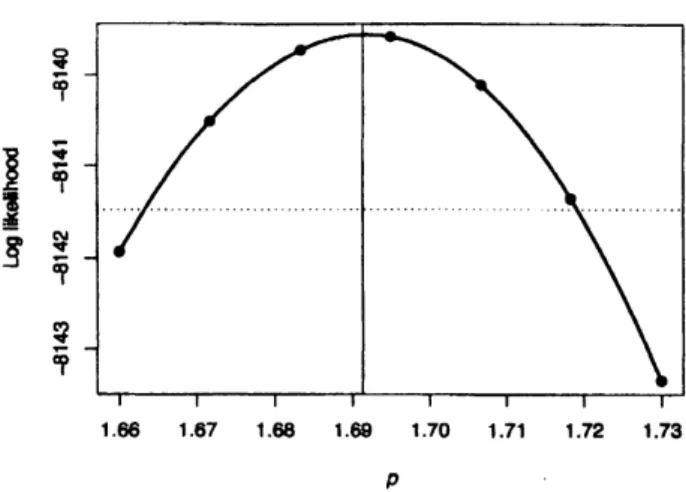
likehhood plot (Fig. 3) indicates
an
estimate of$\hat{p}\approx 1.69$, with anomina195% conRdenceintervd $bom$ 1.663 to 1.719 $appr\propto\dot{m}$ately. In practice, any value of$P$ in the (say) 95%
confldenoe intervd produce.$s$ very similar estimat$\infty$, models and residual plots. At this
empirical Bayesian estimate of$p$, compute $\hat{\beta}=0.0372,\hat{\tau}=0.376$and $\hat{\delta}=0.00173$
.
For each candidate vdue of $p$, numerical methods
are
used to $m\alpha i\dot{m}ze$ thelog-likelihood
over
the $(\beta,\delta)$ space, thenthe optimum vdue of$\tau$ fomd for each $(\beta,\delta)$combi-nation. Theprocedure iteratu until convergence, and the entlre process repeated for the
next value of$p$ under consideration.
In particular, thevalue of$\beta$isof$inter\infty t$
.
The proffle$hkelih\infty d$plotfor$\beta$ (Fig. 4) showsanomina195% confldenoe interW for $\beta$
,
computed sinilaely to that for$p$, is&om 0.032
to 0.0427 apprnimately. This intervd certainly does not contain zero,
so
the $effe\alpha$ ofSOI is statistically $siffiiflcant,$ thoug the $Mue$ is small
so
may not be of any $pra\alpha ical$signiflcance. In this cue, the $m\mathfrak{N}imumlikelih\infty d$ estimates
are
very $s$–lar to thosecomputed using the $emp\ddot{m}cal$ Bayesian approach (Tbble 2); this is $expe\alpha d$ since $\delta$ is
References
[1] CHEN,M.-H.
&IBRAHIM,
J. G. (2003). Conjugatepriors for generalizedlinear
models.Statistica Sinica, 13, 461-476.
[2] DUNN, P. K. (2007). tweedie: Tweedie exponentialfamily models, $R$package.
Avail-able from http://cran.r-proj ect.org/src/contrib/Descript$ions/tweedie$
.
html
[3] DUNN, P. K.
&SMYTH,
G. K. (2005).Series
evaluation ofTweedie
exponentialdis-persion models densities.
Statistics
andComputing,
15,267-280.
[4] DUNN, P. K.
&SMYTH,
G.
K. (2007). Evaluation ofTweedie
exponent\’ial d\’ispers\’ionmodel densities by Fourierinversion. Statistics and Computing, To appear.
[5] EFRON, B.
&MORRIS,
C. (1973). Stein’s estimation rule and its competitors–Anempirical Bayesapproach. Joumal
of
the American Statistical Association, 68, 117-130.[6] FERREIRA, P. E. (1982). Estimating equations in the presenoe of prior knowledge.
Biometnka, 69,
667-669.
[7] GAFFNEY, D. O. (1971). Seasonal rainfall Zones in Australia. Buitau
of
Meteorology,Working paper No 141.
[8] GELMAN, A., CARLIN, J. B., STERN, H. S.
&RUBIN,
D. B. (2003). Bayesian DataAnalysis, 2nd edn.
Boca Raton:
Chapman and Hall.[9] GODAMBE, V. P.
&KALE,
B. K. (1991). Estimatingfunctions:
An overview. InEstimatinghnctions, ed V. P. Godmbe, pp. $3rightarrow 20$
.
Oxford: Clarendon Press.[10] IBRAHIM, J. G.
&CHEN,
$M.rightarrow H$.
(2000). Powerpriordistributions for regressionmod-els. Statistical Science, 15, 46-60.
[11] JAMES, W.
&STEIN,
C. (1961). Estimation with quadratic loss. Proceedingsof
theFourth Berkeley Symposium
on
Math. Statts$t$.
and Probability, University ofCaliforniaPress, Berkeley, Vol. 1,
361-379.
[12] JRGENSEN, B. (1997) The Theory
of
Dispersion Models. London: Chapman andHall.
[13]
K\"oPPEN,
W. (1931), Grundris$s$ der Klimakunde, 2nd edn. Berlin: De Gruyer.[14] $McCuLLAGH$, P.
&NELDER,
J. A. (1989). Generalized linearmodels, 2nd edn.Lon-don: Chapman and Hall.
[15] OHNISHI, T.
&TSUBAKI,
H. (2001). Minimization ofthe Fisher infomation matrixunder
a
given covarianoe matrix function. The Instituteof
Stattstical Mathematics,Research Memorandum No 819.
[16] OHNISHI, T.
&YANAGIMOTO,
T. (2007). Conjugate location-dispersion families.Joumal
of
the Japanese Stat\’istical Society, 37,307-325.
[17] PIESSENS, R.
&DE
DONCKER-KAPENGA, E.,\"UBERHUBER,
C. W. and KAHANER,D. K. (1983). Quadpack: A Subroutine Package
for
AutomaticIntqmtion,Springer-Verlag: Berlin.
[18] R
DEVELOPMENT
CORE TEAM (2007). $R$: A language and environment for statisticalcomputing. R Foundation for StatisticalComputing, Vienna, Austria. ISBN
3-900051-07-0, URL http:$//www.R$-project.org
[19] STONE, R. C.
&AULICIEMS,
A. (1992). SOI phase relationships with rainfall ineastem Australia. Intemational Joumal
of
Climatology, 12,625-636.
[20] TROUP, A. J. (1965). The southern oscillation. The Quarterly Joumal
of
the Royal[21] TSUBAKI, H. (1988). A generalization of the quasi-likelihood and its application to
linear inferenoe (in Japanese). Doctorial dissertation, University
of
Tokyo.[22] TWEEDIE, M. C. K. (1984). An index which distinguishes between
some
important exponentialfmilies. Statistics: Applications and New Directions. Proceedingsof
theIndianStatistical Institute GoldenJubilee IntemationalConference, Indian
Statistical
Institute, Calcutta, pp. 579-604.
[23] YANAGIMOTO, T. &OHNISHI, T. (2005). Extensionsof
a
conjugate prior through theFigure 1: The location of the
stations
in
the
study $-\overline{+}$ $\in\in^{-}$ $s$ $\overline{\overline{\hat{\frac{}{\urcorner 3}}\varpi\varpi\in}}-$ $\frac{\pi}{\succ 0}$ $\check{9}$ $s$論 tlon旧1.66 167 168 169 170 171 172 173
$\rho$
Figure
3:
The profilelikelihood
plotfor
$p$.
The
points represent theactual
log-likelihoodscomputed at the given values of $p$
.
The thicksolid
lineis
a
cubic
spline smooth throughthe
computed points.The dotted
horizontal line
representsthe
height of the nominal 95%
confidence
interval.
The
vertical line
is
the location
of the
empirical Bayesian
estimate
of
$p$.
0.080 $0.\infty 5$ 0.040 0.045
$\beta$
Figure 4: The
profilelikelihood
plot for $\beta$.
The thick solid line is the log-hkelihood. The
dotted
horizontal
line
representsthe
height
of the nominal 95% confidenoe interval. The
vertical line
is
the location of the
empiricalBayesian
estimate of
$p$.
Tbble
1:Summaries
of the
total Julyrainffil
(in millimetres) ateach station
5% 95%
Std
PercentStation
${\rm Min}$ quantileMedian
Mean quantile ${\rm Max}$ dev IQRzeros
$\overline{400141.42.834.0l\delta 6.896.8}$
138.831.2
35.2
0.0
40024
$0$の $0$ゆ29.8
35.7
99.9
1596
350
398
80
40047
$0$ユ 5ユ 50ユ72.4
1786
5202
90.4
54.6
0.0
40075
00
1洛 30 瀞37.7
1183
2266
428
23.9
5.0
40079
$0$の $0$の27.7
35.3
94.8
2580
45.7
25.3
8.0
40082
0.0
0.8
29.9
36.8
89.6
306.4
52.4
28.0
3.0
40083
$0$の $0$の28.2
35.3
99.4
224.2
419
297
30
40094
0.8
2 ユ 34ゐ35.2
90.2
150.8
29.7
27.8
0.0
40096
0.0
0.3
26.2
33.8
107.4
142.6
33.7
36.1
3.0
40104
0.0
0.0
34.8
35.5
107.9
137.7
33.5
32.4
8.0
40110
0.0
1.7
23.1
43.6
112.9
365.4
64.7
34.8
3.0
40117
1.0
4.0
65.4
84.9
228.4
879.9
145.5 42.7
0.0
40120
0.8
3.1
27.8
36.1
101.0
243.7
43.3
24.0
0.0
40124
0.0
$0$の 24 あ34.5
1142
2048
40.3
29.1
10.0
40167
0.0
1.1
53.4
90.9
245.2
885.4
142.6
54.8
5.0
40158
0.0
2.1
32.2
42.8
134.1
273.3
50.4
25.7
5.0
40160
12
55
50ゐ66.8
178.5
367.3
67.8
61.8
0.0
40171
0.0
2.3
32.3
53.9
137.6
481.7
80.7
32.6
3.0
40184
0.8
1.429.0
37.9
104.8
228.1
42.0
38.5
0.0
40190
10
3 ゐ58.8
72.7
153.9
406.2
71.1
62.0
0.0
40196
0.7
3.8
64.2
71.8
178.3
363.4
71.2
69.0
0.0
40197
a.s
4.2
54.0
69.4
184.7
427.3
79.3
44.4
0.0
40224
0.1
2.6
32.4
51.9
149.2
404.0
72.0
27.8
0.0
40229
0.2
1.4
28.0
48.6
162.2
329.6
64.3
28.6
0.0
40231
0.0
3.5
36.1
54.9
153.5
435.6
77.0
44.0
3.0
40237
2 の 6の300
54.1
1618
430.2
76.2
28.2
0.0
40242
04
34
31占510
1429
4230
719
27.7
0.0
40244
0.2
4.9
31.2
52.5
159.4
378.8
68.8
27.3
0.0
40246
0.2
3.8
29.8
48.5
154.5
318.8
60.8
28.4
0.0
40257
12
5ゐ 58ゆ887
2345
8671
1456
516
00
40382
0.0
1.8
40.2
41.2
109.0
212.1
41.1
34.2
3.0
41001
0.0
0.1
30.4
38.8
107.0
122.8
33.6
42.4
5.0
41011
0.0
0.4
30.8
31.9
75.7
128.5
28.3
30.4
3.0
41018
0.4
0.8
31.0
34.9
87.4
115.0
28.6
37.8
0.0
41022
2.3
4.3
45.2
49.3
141.3
158.3
40.2
48.6
0.0
41053
0.0
0.0
21
ユ 1315
41056
1.6
2.6
316
392
41063
0.0
0.5
30.8
37.7
41072
0.0
0.0
25.0
33.3
41082
0.0
1.2
31.2
36.1
41083
0.0
0.6
31 の 0401
41095
13
18
397452
41103
0.2
13
39.0
45.7
41116
2.0
3.1
34.4
45.0
41126
0.0
0.0
302332
833
1384
298
358
80
1043
1843
389
418
00
930
1314
316
399
30
761
1309
292
453
80
986
1374
326
362
50
1042
1249
336
476
50
1283
1438
364
39.7
00
1217
1587
393
532
00
1129
144.1
34.4
43.4
0.0
78.9
1222
287
371
100
Table
2:
EmpiricalBayesian
estimates and the maximum likelihood
estimates
for
fitting
the
model to July
rainfall
Empirical Bayesian Maximum likelihood
Parameter
estimate
estimate
$p$