Strained
Vortex
と乱流の統計法則
“Strained
Vortex
and Statistical
Law
of
Turbulence”
神部勉、
畠山望
(
東大理)
Tsutomu Kambe, Nozomu Hatakeyama
Department
of
Physics, University
of
Tokyo
August 30,
1996
Abstract
In recent computer simulations it is revealed that homogeneous
isotropic turbulence at high Reynolds number is regarded as the field
towhichtheintensevorticity structures, called ‘worms’,aredistributed
randomly [1, 2,3,4]. Itis also reported that ‘worm’ is approximated as
Burgers’ vortexunder external straining $[2, 4]$ and suchintense struc-ture causes intermittency [5]. So the statistical properties of a model
velocity field associated with an isolated Burgers’ vortex are studied.
It is found that, in suchamodel field, the 2nd-order structure function
shows the two-thirds law and the $3\mathrm{r}\mathrm{d}$-order structure function shows
the four-fifth law with a negative sign, which are consistent with the
Kolmogorov’s five-thirds law of theenergy spectrum and the negative skewnessof the velocity derivative respectively. Furthermore the
ex-ponentsofhigher-order structure functions arefound tobe consistent
1
Statistical
theory
of
homogeneous
isotropic
turbulence
1.1
Kolmogorov’s theory
(1941)
(1.5)
Let the velocity components $v_{i}(x)$ at each location $x$ be center-valued
ran-dom variables, while the brackets $\langle(\cdot)\rangle$ denote the ensembleaverage. We
con-sider the instantaneous statistics of the velocity fluctuations at a fixed time.
The center valued property $\langle v_{i}\rangle=0$ can be satisfied by means of Galilean
transformations which are symmetries of the Navier-Stokes equation,
$\frac{\partial v}{\partial t}+v\cdot\nabla v=-\frac{1}{\rho}\nabla p+\nu\triangle v$, (1.1)
$\nabla\cdot v=0$, (1.2)
where $\rho$ is the mass density, $p$ the pressure and $\nu$ the kinematic viscosity.
We consider now turbulence of homogeneous and isotropic velocity field.
The longitudinal velocity increment for the separation $l$ and the pth-order
$l_{on}gitudoeinal$ structure
function
are respectively defined as$\delta v\ell(X,l)\equiv\delta v(X,l)\cdot\frac{l}{l}$, (1.3) $s_{p}(l)\equiv\langle(\delta vt(_{X,l}))^{p}\rangle$ , (1.4)
where $l\equiv|l|$. The dependence of $S_{p}$ on $x$ and $l/\ell$ is dropped because of
homogeneity and isotropy. One reason why we consider the longitudinal
component is that, in the 2nd- and $3\mathrm{r}\mathrm{d}$-order case, the structure functions made of other components are determined by the longitudinal one.
We introduce the mean energy dissipation rate $\epsilon$ defined as, in Cartesian coordinate system,
$\epsilon\equiv\langle\frac{1}{2}\nu\sum_{ij}(\frac{\partial v_{i}}{\partial x_{j}}+\frac{\partial v_{j}}{\partial x_{i}}\mathrm{I}^{2}\rangle$,
and the $I\mathrm{e}’olmogorov$ dissipation scale $\eta$ as, using $\nu$ and $\epsilon$,
$\eta\equiv(\nu^{3}/\epsilon)^{1/4}$ (1.6)
Kolmogorov(1941) made thenext two hypotheses in the case of homogeneous
Kolmogorov’s hypothesis ofsimilarity I In the range
of
scales $l\ll\eta$which is called the dissipationrange, all the statisticalproperties are uniquely
determinedby the scale$\ell$, the viscosity$\nu$ andthe mean energydissipationrate $\epsilon$.
Kolmogorov’s hypothesis of similarity II In the range
of
scales $\ell\gg\eta$which is called the inertial range, all the statistical properties are uniquely
determined by $\ell$ and $\epsilon$ only.
The $2\mathrm{n}\mathrm{d}$-order longitudinal structure function is obtained from the above
hypotheses as
$S_{2}( \ell)=\frac{\epsilon}{15\nu}\ell 2$ $(\ell\ll\eta)$ (1.7)
$=C\epsilon^{2}l^{2}/3/3$ $(l\gg\eta)$, (1.8)
where$C$ is auniversal dimensionless constant. Thebehaviorofthe $2\mathrm{n}\mathrm{d}$-order
structure function as the two-thirds power of the distance in the inertial
range is called the two-thirds law, which holds experimentally for almost any
turbulence [7]. This law corresponds to the
five-thirds
law of the energyspectrum.
The $3\mathrm{r}\mathrm{d}$-order longitudinal structure function becomes
$S_{3}( \ell)=-\frac{4}{5}\epsilon\ell+6\nu\frac{dS_{2}(l)}{d\ell}$, (1.9)
which is derived from the incompressible Navier-Stokes equation (1.1) and
(1.2) [8]. In the inertial range $\ell\gg\eta$, the second term of (1.9) is dropped
on account of Kolmogorov’s second hypothesis, and so-called
four-fiflh
law isobtained as
$S_{3}( \ell)=-\frac{4}{5}\epsilon\ell$ $(\ell\gg\eta)$. (1.10)
For the higher-order structure functions, the following is said from the
Kolmogorov’s second hypothesis. Let $S_{p}(\ell)$ be the $p\mathrm{t}\mathrm{h}$-order longitudinal
structure function,
$S_{p}(l)=C\epsilon^{p/}\ell p3p/3$ $(\ell\gg\eta)$, (1.11)
where $C_{p}$ is the universal dimensionless constant. In general $S_{p}(\ell)$ is
repre-sented in the form of scaling law with the scaling exponent $\zeta_{p}$ as
Thus the exponent $\zeta_{p}$ of the Kolmogorov’s theory (K41) is, from (1.11),
$\zeta_{p}=\frac{p}{3}$. (1.13)
Experimentally and in the DNS, it is found that $\zeta_{p}$ increase less rapidly
with $p$ than the K41 value of (1.13). This fact is called anomalous
scal-ing in the inertial range, which means the stronger fluctuations to exist in
the smaller scales. Thus the various intermittency models subject to some
statistics of the velocity increment or the local dissipation have been
sug-gested after K41, which are summarized in Frisch [7].
1.2
Multifractal model
Parisi and Frisch (1985) presented the
multifractal
model in the followingway [9]. Assuming that, in the limit of infinite Reynolds number, there is a
set $S_{h}\subset R^{3}$ of the
fractal
dimension $D(h)$ for each velocity scaling exponent $h$ as $\ellarrow 0$, that is,$\delta v_{\mathit{1}}(X)\propto\ell^{h}$, $x\in S_{h}$. (1.14)
From this
multifractal
assumption, the $p\mathrm{t}\mathrm{h}$-order structure function is ex-pressed as$S_{\mathrm{p}}(\ell)$ oc $\int d\mu(h)^{\ell^{p+\langle h)}}h3-D$, (1.15)
where $d\mu(h)$ isthe measurewhichgivestheweight ofthedifferent exponents.
In the limit $larrow \mathrm{O}$ the power-law with the smallest exponent dominates, thus
$\zeta_{p}=\min_{h}(ph+3-D(h))$
.
(1.16)1.3
${\rm Log}$-Poisson
model
The $log$-Poisson model with no adjustable parameters was proposed recently
by She et al.(1994) first based on a phenomenology involving a hierarchy
offluctuation structures associated with vortexfilaments, and later the
log-Poisson property was noted by Dubrulle (1994) and She et al. (1995)
inde-pendently [10]. The resulting exponent
$\zeta_{p}=\frac{p}{9}+2-2(\frac{2}{3})^{p/3}$ (1.17)
is ingood agreementwiththeresult of the experiment by Anselmet et al. [11],
2
A
model-vortex field
2.1
Burgers’ vortex
We consider a model-field of isolated Burgers’ vortex whose circulation and
axial stretching rate are the typical values in homogeneous isotropic
turbu-lence, and investigate the structurefunctions of this field.
In the cylindrical coordinate system $(r, \theta, z)$, let the axisymmetric
vortic-ity along $z$ axis$\omega$and the velocity associated with vorticity$v_{\mathrm{t}p}$ berespectively
$\omega=(0,0,\omega(r))$, (2.1)
$v_{\omega}=(\mathrm{O}, v_{\theta}(r),$ $\mathrm{o})$, (2.2) where $\omega=dv_{\theta}/dr+v_{\theta}/r$
.
Imposing the straining of the irrotational andsolenoidal velocity field
$v_{\mathrm{e}}=(- \frac{\sigma}{2}r,0, \sigma z)$, (2.3)
the total velocity $v=v_{\omega}+v_{e}$ is given as
$v=(- \frac{\sigma}{2}r,v_{\theta}(r),\sigma \mathcal{Z})$, (2.4)
where $\sigma$ is a positive constant. The vorticity equation reduced from the
incompressible Navier-Stokes equation (1.1) and (1.2),
$\frac{\partial\omega}{\partial t}+v\cdot\nabla\omega=\omega\cdot\nabla v+\nu\triangle\omega$, (2.5)
has the exact steady solution in the form
$\omega(r)$ $= \omega_{0}\exp(-\frac{\sigma r^{2}}{4\nu})$ $= \frac{\Gamma}{\pi r_{\mathrm{B}}^{2}}\exp(-\frac{r^{2}}{r_{\mathrm{B}}^{2}})$ , (2.6)
$v_{\theta}(r)$ $= \frac{2\nu\omega_{0}}{\sigma r}\{1-\exp(-\frac{\sigma r^{2}}{4\nu})\}=\frac{\Gamma}{2\pi r}\{$$1- \exp(-\frac{r^{2}}{r_{\mathrm{B}}^{2}})\},$ $(2.7)$
where the Burgers’ radius$r_{\mathrm{B}}$ defined as $1/e$ radius of$\omega(r)$ is
and the circulation $\Gamma$ is
$\Gamma\equiv\int_{0}^{\infty}\omega(r)2\pi rdr=\pi r_{\mathrm{B}}^{2}\omega_{0}$. (2.9)
This is called the Burgers’ vortex [12]. TheBurgers’ vortex is also the
asymp-totic solution for the arbitrary initial axisymmetric vorticity distribution in the case of uniform strain as is $\mathrm{a}\mathrm{b}\mathrm{o}\mathrm{v}\mathrm{e}[13]$.
The rate
of
strain tensors defined as, in theCartesian coordinate system,$e_{ij}(x) \equiv\frac{1}{2}(\frac{\partial v_{i}}{\partial x_{j}}(x)+\frac{\partial v_{j}}{\partial x_{i}}(x))$ , (2.10)
is calculated as $e=($$\frac{1}{2}(_{d^{-}r}^{\underline{d}_{\Delta}v}vr_{0}\frac{\sigma}{2}-^{\Delta})$ $\frac{1}{2}(\frac{dv}{d}r^{\mathrm{A}}-\frac{\sigma}{2}r0-^{\Delta}v)$ $\sigma 0$
)
$0$.
(2.11)The axial stretching rate of vorticity has a positive constant value as
$\frac{\Sigma_{ij}\omega_{i}(r)e_{i}j(r)\omega j(r)}{\Sigma_{k}\omega_{k}^{2}(r)}=\sigma$ . (2.12)
The squared strength of $e$ is evaluated as a function of $r$,
$e^{2}(r) \equiv\sum ije^{2}ij(\Gamma)=\frac{3}{2}\sigma^{2}+\frac{1}{2}(\frac{dv_{\theta}}{dr}(r)-\frac{v_{\theta}(r)}{r}\mathrm{I}^{2}$ , (2.13)
thus the local energy dissipation rate is given as
$\mathcal{E}_{1\mathrm{o}\mathrm{c}}(r)\equiv 2\nu e(2)r=\nu\{3\sigma^{2}+(\frac{dv_{\theta}}{dr}(r)-\frac{v_{\theta}(r)}{r}\mathrm{I}^{2}\}\cdot$ (2.14)
Because the azimuzal velocity profile is obtained by (2.7),
$\frac{dv_{\theta}}{dr}(r)-\frac{v_{\theta}(r)}{r}=\frac{\Gamma}{\pi r_{\mathrm{B}}^{2}}\{\exp(-r^{2}/r_{\mathrm{B}}^{2})-\frac{1-\exp(-r2/r_{\mathrm{B}}^{2})}{r^{2}/r_{\mathrm{B}}^{2}}\}$
.
(2.15)If $\Gamma$ is large enough
in comparison with $\sigma$, theenergy ofthe Burgers’ vortex
is strongly dissipated around the Burgers’ radius while at the center of vortex
$\mathrm{r}/\mathrm{r}_{\mathrm{B}}$
Figure 1: Dashed line, theaxial vorticity$\omega$; dotted line, theazimuthal
veloc-ity $v_{\theta}$; solidline, the localenergy dissipation rate $\epsilon_{1\mathrm{o}\mathrm{c}}$ of the Burgers’ vortex. $r_{B}=1,$ $\nu=0.1$ and $R_{\Gamma}\equiv\Gamma/\nu=1257$.
2.2
Calculation
Calculationofaverageof the velocity increment between two separated points
is as follows, suggested first by Kambe et al. [14]. First choose a reference
point $x=(x,0, z)$ in the Cartesian coordinate system, where the dependence
on the $y$ component can be dropped from the axisymmetry of the velocity
field, and choose a running point $x+l$ at a distance $l$ from $x$
.
Next thevelocity increment between the two points is calculated. Last, the average
of the $p\mathrm{t}\mathrm{h}$-order longitudinal velocity increment over the sphere of radius $\ell$
centered at $x$ is taken, and then volume averaging is carried out by shifting
the reference point.
Let the location on the spherical surface centered at the reference point
$x$ be$l=(\ell, \theta, \phi)$ in the spherical coordinate system as shown in figure 2 (a).
The components of $l$ in the Cartesian coordinate system are written as
Figure2: (a) The coordinate system at spherical
average
with respect to therunning point $x+l$ where the reference point $x$ and the separation length$\ell$
are fixed. (b) The integral space with respect to $\mathrm{t}1_{1}\mathrm{e}$ reference point
$x$
.
The longitudinal velocity increment $\delta v\ell(x,l)$ is calculated from the equations
(1.3) and (2.7) as
$\delta v_{\ell}(x,\ell,\theta, \phi)=\sigma\ell\frac{3\cos^{2}\theta-1}{2}+(\frac{v_{\theta}(r)}{r}-\frac{v_{\theta}(x)}{x}\mathrm{I}x\sin\theta\sin\phi$
$= \frac{\nu}{r_{\mathrm{B}}}[\frac{4\ell}{r_{\mathrm{B}}}P_{2}(\cos\theta)+\frac{R_{\Gamma}}{2\pi}\{\frac{1-\exp(-r^{2}/r_{B}^{2})}{r^{2}/r_{B}^{2}}$
$- \frac{1-\exp(-X/2)r_{B}^{2}}{\mathrm{t}^{2}/\Gamma_{B}^{2}}.\}\frac{x}{r_{\mathrm{B}}}\sin\theta\sin\phi]$
,
(2.17)$r^{2}=(x+\ell\sin\theta\cos\phi)2+(\ell\sin\theta\sin\phi)2$, (2.18)
where $P_{2}$ is the second-order Legendre function and $R_{\Gamma}=\Gamma/\nu$ is the Vortex
Reynolds number based on its total circulation. Note that a dependence on
$z$ is dropped in the expression at this moment. The spherical
averag.e
is thuscalculated as
Choosing some region of space as a sample space, we take an average $\langle(\cdot)\rangle$
over the space. One sample is the cylindrical space of radius $r_{\mathrm{c}}$ centered at
the vortex axis shown in figure 2 (b). In the cylindrical coordinate system
$(r,\theta, z)$, the average is
$\langle$$( \cdot))\equiv\lim_{z_{\mathrm{c}^{arrow}}\infty}\frac{1}{2\pi r_{c}^{2_{Z_{\mathrm{C}}}}}\int_{-z_{\mathrm{C}}}^{z_{\mathrm{C}}}\int_{-\pi}^{\pi}\int_{0}^{r_{\mathrm{C}}}(\cdot)rdrd\theta dz$. (2.20)
The $p\mathrm{t}\mathrm{h}$-order longitudinal structure function is given as follows,
$S_{p}(l, r_{\mathrm{C}}) \equiv\frac{2}{r_{\mathrm{c}}^{2}}\int_{0}^{r_{\mathrm{C}}}((\delta v_{l})p\rangle_{\mathrm{s}\mathrm{p}}XdX$
.
(2.21)$10^{6}$ $10^{4}$ $-\mathrm{S}_{3}10^{8}$ $10^{0}$ $10^{-2}$ $1/\mathrm{r}_{\mathrm{B}}$
Figure 3: The $3\mathrm{r}\mathrm{d}$-order structure function times-l. $\mathrm{O},$ $R_{\Gamma}=628;\square ,$ $R_{\Gamma}=$
1257; and $,$ $R_{\Gamma}=12566$
.
The structure functions are calculated at $R_{\Gamma}=628,1257$ and 12566.
are shown. The inertial range begin around $\ell\sim r_{B}$ and is wider as $R_{\Gamma}$ is
larger. It is found that the $3\mathrm{r}\mathrm{d}$-order exponent
$\zeta_{3}$ is about unity
indepen-dent of $R_{\Gamma}$. This scaling is consistent with Kolmogorov’s four-fifth law. In
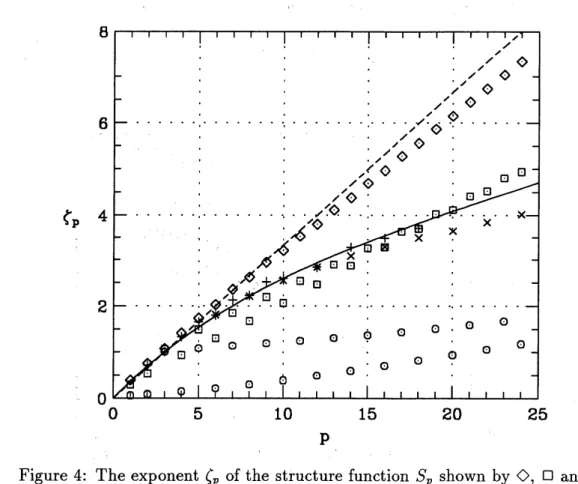
the figure 4 other exponents $(_{p}$ up to $p=25$ are shown in comparison with
K41, $\log$-Poisson model, DNS and experiment. The lager $R_{\Gamma}$ is, the more $\zeta_{p}$
deviates from K41. The tendency of the even exponents to extend the odd
ones in this model is the same in the experiment by Anselmet et al..
$\zeta_{\mathrm{p}}$
$\mathrm{p}$
Figure 4: The exponent $\zeta_{p}$ of the structure function $S_{p}$ shown by $\mathrm{O},$ $\square$ and
${ }$ which are as in figure 3. dashed line, K41 (1.13); solid line, log-Poisson
model (1.17); $\cross$, DNS at $R_{\lambda}=150$, Vincent&Meneguzzi (1991) [1]; $+$, jet
at $R_{\lambda}=852$, Anselmet et al.(1984) [11].
If the vortex is absent, therefore $v_{\theta}=0$, we have $S_{p}(\ell)=C_{p}\sigma^{p}\ell^{p}\propto\ell^{p}$
if the external strain is absent so that $\sigma=0$, we find that the structure
functions of odd order are identically zero by use of(2.7), (2.18) and (2.19).
Hence the scaling consistent with the homogeneous isotropic turbulence as
obtained above is considered to result from the combined field of the vortex
under external straining.
The probability distribution functions of the vortex Reynolds number$R_{\Gamma}$ and the Burgers’ radius $r_{B}$ of worms are obtained by Jimen\’ez et al. [2] in
DNS and by Belin et al. [5] experimentally. Especially $R_{\Gamma}/R_{\lambda^{/2}}^{1}$ distributes
independent of$R_{\lambda}$. Taking that $\mathrm{p}.\mathrm{d}$.f.s into account we expect to obtain the scaling nearer that of experiments which is K41 like scaling of low-order at any $R_{\lambda}$ and the higher-order scaling with the larger deviation from K41.
3
Summary
The conclusions of this study are $\mathrm{S}\mathrm{U}\mathrm{n}\mathrm{m}\mathrm{l}\mathrm{a}\mathrm{r}\mathrm{i}_{\mathrm{Z}\mathrm{e}\mathrm{d}}$as follows.
1. This model field of the isolated Burgers’ vortex withmoderate circula-tion shows that the $2\mathrm{n}\mathrm{d}$-order structure function has about two-thirds
scaling exponent.
2. The $3\mathrm{r}\mathrm{d}$-order structure function of this model have anegativesign and unity exponent independent of the vortex Reynolds number $R_{\Gamma}$
.
3. The scaling exponents of the high-order structure function obtained
from the model-strained vortex field deviates increasingly from K41 as
$R_{\Gamma}$ is larger, i.e. a Burgers’ vortex causes moreand more intermittency of turbulence as it’s circulation is larger.
References
[1] A. Vincent and M. Meneguzzi, J. Fluid Mech. 225, 1-20 (1991).
[2] J. Jimen\’ez, A. A. Wray, P. G. Saffman and R. S. Rogallo, J. Fluid Mech.
255, 65-90 (1993); J. Jimen\’ez and A. A. Wray, CTR Annual Res. Briefs,
287-312
(1994).[3] 山口博、 生出伸$-\text{、}$ 山本稀物、細川巌、第
9
[] 数値流体力学シンポ[4] 店橋護、宮内敏雄、吉田毅、第9o 数値流体力学シンポジウム講演論
文集、pp. 171-172 (1995).
[5] F. Belin, J. Maurer, P. Tabeling, H. Willaime, J. Phys. II France 6,
573-583 (1996).
[6] A. N. Kolmogorov, C. R. Acad. Sci. USSR30,
301-305
(1941); ibid. 32,16-18 (1941).
[7] U. Frisch, Turbulence (Cambridge U.P., Cambridge, 1995).
[8] L. D. Landau and E. M. Lifshits, Fluid8 Mechanics, 2nd edition
(Perg-amon Press, Oxford, 1987),
\S 34.
[9] G. Parisi and U. Frisch, in Turbulence and Predictability in Geopysical Fluid Dynamics, edited by M. Ghil, R. Benzi and G. Parisi (Amsterdam,
North-Holland, 1985), pp.
84-87.
[10] Z. -S. She and E. Leveque, Phys. Rev. Lett. 72, 336-339 (1994); B.
Dubrulle, ibid. 73,
959-962
(1994); Z. -S. She and E. C. Waymire, ibid.74, 262-265 (1995).
[11] F. Anselmet, Y. Gagne, E. J. Hopfinger and R. A. Antonia, J. Fluid
Mech. 140, 63-89 (1984).
[12] J. M. Burgers, Adv. in Appl. Mech. 1, 171-199 (1948).
[13] T. Kambe, J. Phys. Soc. Jpn. 53, 13-15 (1984).
[14] T. Kambe and I. Hosokawa, in Small-Scale Structures in
Three-Dimensional Hydrodynamic and Magnetohidrodynamic Turbulence,
edited by M. Meneguzzi, A. Pouquet and P. L. Sulem (Springer-Verlag,