露地栽培アガリクスの機能性に関する研究
研究分野・紹介教授
生化学・大野尚仁教授
3 略語一覧 本文中に使用した略語は以下のとおりである。 2AA : 2-aminoanthracent 9AA : 9-aminoacridine AF-2 : 2-(2-furyl)-3-(5-nitro-2-furyl)acrylamide BF : 5,6-benzoflavone
CFE : number of colonies/number of cells plated [%] DMSO : dimethylsulfoxide
MMS : methylmethanesulphonate
MPCE : micronucleated polychromatic erythrocytes
NADH : nicrotinamid-adenine dinucleotide, reduced form, disodium salt
NADPH: nicotinamide-adenine dinucleotide phosphate,reduced form, tetrasodium salt
NCE : normochromatic erythrocytes NK : natural killer
PB : phenobarbital
PCE : polychromatic erythrocytes SA : sodium azide
THG : thymidine,hypoxanthine,and glycine
THMG : thymidine,hypoxanthine,methotrexate and glycine VB : vitamine B
Ab : antibody
AgCA : A.brasiliensis cold alkaline extract AgHWE : A.brasiliensis hot water extract AgHA : A.brasiliensis hot alkaline extract
ASBG : Aspergillus niger solubilized cell wall glucan BRM : biological response modifier
BSA : bovine serum albumin
CSBG : Candida albicans solubilized cell wall glucan ELISA : enzyme-linked immunosorbent assay
4 LAM : Laminaran
OVA : ovalbumin SPG : Sonifilan
TMB : tetramethlbenzidine TNF-α : tumor necrosis factor-α Y-Man : yeast mannan
CRD : Curdlan
Ig : immunoglobulin
OX-CA : NaClO-oxidized Candida cell ALT : alanine aminotransferase AST : aspartate aminotransferase BAS : basophil
Cre : creatinine
CRO : contract research organization EOS : eosinophil
ERB : Ethical Review Board Glu : glucose
Hb : hemoglobin HbA1c : hemoglobin A1c HDL-C : HDL cholesterol Ht : hematocrit
IgG : immunoglobulin G IRI : immunoreactive insulin LYM : lymphocyte
MON : monocyte NEUT : neutrophil PLT : platelet QOL : quality of life RBC : red blood cell count T-Bil : total bilirubin TC : total cholesterol TG : triglyceride TP : total protein UN : urea nitrogen
5 Date of efficacy evaluation
6th week 6 weeks from the first day of test food intake
12th week 12 weeks from the first day of test food intake
9
ビタミンB群のひとつであるパントテン酸の発見者、また、葉酸の名付けの親でもあ るロジャー・ウィリアムス(1893-1988)は、自らの著書“The Wonderful World Within
You”で、「私たちの体の中には、私たちが食べたもの以外のものから作られるものは何 一つ存在しないということは、学問的に真実です。」と、述べている 1)。この言葉は食 生活における栄養学的観点による取捨選択の大切さを端的に伝えている。ところが近年、 日本人の食生活が動物性高脂肪食などの欧米型に移行していくにつれ、悪性新生物、循 環系の疾病が増加しており2)、バランスの良い食生活が改めて大切になってくる。また、 それらを整え補う「機能性食品(体調調節機能等第 3 次機能を有する食品)」の素材の 開発と研究も重要になる。 一例を紹介すると、葉酸は、モロヘイヤ、ブロッコリーやほうれん草などの緑黄色野 菜に多く含まれ3)、女子栄養大学等の研究報告では、Wang X らの研究により葉酸に脳卒 中の予防効果があることが実証されている4)。また、Ntaios G らの研究では、動脈硬化 の改善効果があることが立証されている5)。これらを受けて埼玉県・坂戸市は、市民に 葉酸を含む地元産の野菜を多く食べて貰うことが、健康増進や地域コミュニティ再生、 地産地消に役立つとして、2006 年に女子栄養大学との協働により、「坂戸市葉酸プロジ ェクト」www.city.sakado.lg.jp/ が実施された。食品に含まれる葉酸は、比較的体内 に吸収されにくいことで知られている。そのため坂戸市では、1日当たり摂取推奨量を 厚生労働省推奨水準の 240μgではなく、国際水準の 400μgと定めた。その「坂戸市 葉酸プロジェクト」を核とした栄養、運動指導によって平成 18,19 年の 2 年間で 22 億 円の国民健康保険医療費と介護費の節減に成功した6,7)。 このように優れた機能性食品の研究・活用は、高騰する国民医療費の低減化に繋がる。 また、国が平成 27 年(2015 年)4 月より科学的裏付けのある健康食品に対し、機能性 表示食品として届出制度を実施したhttp://www.caa.go.jp/foods/todoke_1-100.html のもその期待の表れであろう。 機能性食品・アガリクスの役割 予防医学の視点からも機能性食品を活用する時代が到来したのではないかと考えら れる。一部の機能性食品は古くから研究されてきた。今回、著者の研究対象のアガリク スもそうである。予防医学の視点、未病を治す機能性食品として、個人の健康状態の回 復や増進に繋がり、牽いては国民医療費の抑制に、更に、西洋医学では困難な分野の医 療にも貢献出来るのではないかと考える。
アガリクスは、学名を Agaricus subrufescens, Agaricus brasiliensis, Agaricus rufoteguli, Agaricus blazei などと呼ばれるが、国際薬用キノコ学会では、Agaricus
10 マツタケやカワリハラタケなどの名称で知られている。 1980 年日本癌学会総会において三重大学医学部より、アガリクスの抗腫瘍活性が報 告8)されてから、抗がん効果に期待が寄せられ、各方面で精力的に研究が進められ、販 売も行われた。2001 年には厚生労働省がん研究助成金による研究班が組織され、「我が 国におけるがんの代替療法に関する研究」が行われた。その調査結果は、平成 17 年(2005 年)に学術論文として発表されている9)。それによると、がん患者の 44.6 %(1382 名 /3100 名)が何らかの補完代替医療を一種類以上行い、そのうち健康食品・サプリメ ントを使用するとの答えは 96.2 %、気功は 3.8 %、灸 3.7 %、鍼 3.6 %(複数回答 可)であった。この健康食品・サプリメントのうち 60.6 %はアガリクスを使用すると いう回答であり、がんの代替療法として広く受け入れられていた。 しかし、その後、市場規模が拡大して行く過程において、低品質の商品やバイブル本 を利用した販売も横行し、まさに市場は玉石混交の状態となった。そして、平成 18 年 (2006 年)2 月厚生労働省より、「アガリクス(カワリハラタケ)を含む製品の安全性 に関する食品安全委員会への食品健康影響評価の依頼について」の中間報告書が公表さ れた10)。 この報告は、粗悪なアガリクス製品を摂取したヒトに健康被害が発生したことをきっ かけとして行われたものであり、ラットを用いた中期多臓器発がん性試験において、実 地中の 3 製品のうち1製品に発がんプロモーション作用が認められたという内容であ る。その該当1製品は中国産アガリクスを原料としていたのであるが、テレビ、ラジオ、 新聞、週刊誌などの多くの報道機関が「アガリクスに発がん作用」「発がん促進作用」 などと一斉にセンセーショナルな報道を行った。また、国立がんセンター医師により「ア ガリクスを使っていたがん患者が重度の肝機能障害を引き起こしたかもしれない(原材 料入手先及びメーカー名は不明)」という旨の研究論文11)も報告された。先の報道のわ ずか1 カ月後の 3 月、厚生労働省は残りの 2 製品について、発がんプロモーション作 用は認められなかった 12)。と発表したが、報道機関による扱いは皆無に近い状態であ り、市場は回復しなかった。 平成 18 年(2006 年)2 月の厚生労働省の通知の発表以後、事実上の安全宣言である 「アガリクスを含む製品について、自治体等から当省に対し、健康被害に関する報告等 はないこと(がんの治療を受けている患者において、アガリクスを含む食品を摂取して 肝障害が発生した事例も、厚生労働省に報告されていない)等から、これらについても ご承知おき願いたい。」との通知が出されたのは平成 21 年(2009 年)7 月であつた13)。 それはセンセーショナルな報道以来、3 年 5 カ月後のことであった。 アガリクス事件後の平成 19 年(2007 年)9 月 23~27 日にスロベニア・リュブリャナ で 行 わ れ た 「 4TH INTERNATIONAL MEDICINAL MUSHROOM CONFERENCE 」
17 第一章 原核ならびに真核生物システムを用いた露地栽培アガリクスの安全性試験 序論 1965 年ブラジル原産のアガリクスが日本に持ち込まれ、その後の 1980 年日本癌学会 総会において、三重大学医学部よりアガリクスの抗腫瘍活性が報告8)されると、その抗 がん効果に期待が寄せられ、各方面で栽培方法から研究、販売まで精力的にその活動が 行われた。しかし、2006 年、ラットを用いた中期多臓器発がん性試験において 3 製品 のうち中国産アガリクスを原料とした1製品に発がんプロモーション作用が認められ た(その後、他の 2 製品は認められなかった)、との厚生労働省よりの発表が報道機関 に大きく報道されたことにより、結果的にただ 1 社の製品で全てのアガリクス製品の安 全性が疑問視される結果となった。 アガリクスは、食品の3次機能として、生体防御や疾病予防などに期待の高い食品で ある。微生物は菌株、栽培条件や産地により、特性や含有成分が変化する可能性がある ので、本研究では食用として既に用いられているA. brasiliensisの安全性について、 汎用されている変異原性試験(復帰突然変異試験、マウスリンフォーマ TK 試験)なら びに遺伝毒性試験(小核試験)を行い評価した。 尚、この試験の組み合わせ方法は、遺伝子の変化に基づく発がん性のリスク評価の精 度向上を目的とした平成 24 年の厚生労働省の「医薬品の遺伝毒性試験及び解釈に関す るガイダンス20」」と合致するものである。 第一章 実験の部 1. 被験物質
ブラジルにて露地栽培されたAgaricus brasiliensis KA21 株子実体(以下,A.
brasiliensisと略)の乾燥粉末を用いた。使用時まで冷蔵で保管した。
2. 細菌を用いる復帰突然変異試験(エームス試験,Ames test) 2.1. 陽性対照物質
18
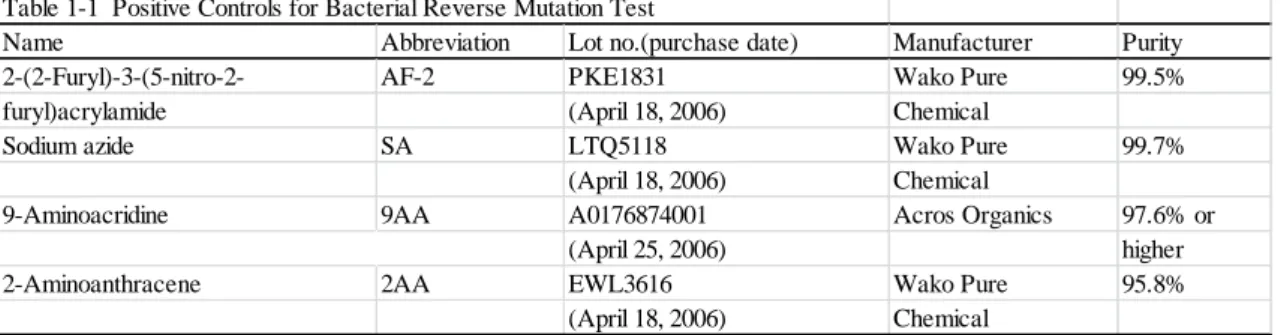
Table 1-1 Positive Controls for Bacterial Reverse Mutation Test
Name Abbreviation Lot no.(purchase date) Manufacturer Purity
2-(2-Furyl)-3-(5-nitro-2- AF-2 PKE1831 Wako Pure 99.5%
furyl)acrylamide (April 18, 2006) Chemical
Sodium azide SA LTQ5118 Wako Pure 99.7%
(April 18, 2006) Chemical
9-Aminoacridine 9AA A0176874001 Acros Organics 97.6% or
(April 25, 2006) higher
2-Aminoanthracene 2AA EWL3616 Wako Pure 95.8%
(April 18, 2006) Chemical
AF-2、9AA および 2AA はジメチルスルホキシド(DMSO:和光純薬工業)に、SA は日局 注射用水(大塚製薬工業)に溶解し、所定の濃度に調整したのち、冷凍保存(設定温度: -20 ℃)し、調整後 6 か月以内に用時に解凍して用いた。
2.2. 検定菌
試験には、S.typhimurium TA100、TA1535、TA98、TA1537 および E.coli WP2uvrA を
用いた。S.typhimurium 4 菌株を用いる試験は、ヒスチジン要求性から非要求性への復 帰突然変異、E.coli WP2uvrA 株を用いる試験は、トリプトファン要求性から非要求性 への復帰突然変異を指標とした遺伝子突然変異誘発性の検出系である。検定菌は冷凍保 存(設定温度:-80 ℃)したものを用いた。冷凍保存菌は、液体培地にて 37 ℃で静 止期の初期まで培養した菌液 0.8 mL に対し、滅菌 DMSO を 0.07 mL の割合で加え、急速 凍結して調製し、試験に用いた。 2.3. 試験材料 2.3.1. 最少グルコース寒天平版培地 極東製薬工業で製造した最少グルコース寒天平版培地を用いた。培地組成は、 Table 1-2 に示した。径 90 mm のシャーレ 1 枚あたり 30 mL を流して固めた。
Table 1-2 Composition of Minimal Glucose Agar Plate
Magnesium sulfate heptahydrate 0.2 g
Citric acid monohydrate 2 g
Dipotassium hydrogen phosphate 10 g
Ammonium phosphate 1.92 g
Sodium hydroxide 0.66 g
Glucose 20 g
19 Table 1-3 Composition of Top Ager
(A) Bacto ager(Becton Dickinson CO.) 0.6 w/v%
Sodium chloride 0.5 w/v%
(B) For Salmonella typhimurium
L-histidine 0.5 mmol/L
D-biotin 0.5 mmol/L
(C) For Escherichia coli
20
Table 1-4 Composition and Preparation of S9 mix
Volume in
Component 1 mL of S9 mix Concentration
S9 0.1 mL 10 vol%
0.2 mol/L Sodium phosphate buffer (pH 7.4) 0.5 mL 100 μmol/mL
Coenzyme solution* 0.38 mL -
Potassium chloride - 33 μmol/mL
Glucose-6-phosphate - 5 μmol/mL
NADH - 4 μmol/mL
NADPH - 4 μmol/mL
0.4 mol/L Magnesium chloride solution 0.02 mL 8 μmol/mL
NADH: Nicotinamide-adenine dinucleotide, reduced form, disodium salt
NADPH: Nicotinamide-adenine dinucleotide phosphate, reduced form, tetrasodium salt
*Coenzyme solution was prepared by mixing the components listed above. The solution was sterilied by filtration, astored at -80℃, and thawed before use for the test witin 6 months of preparation.
23 4.2. 代謝活性 細胞を、先に示されるように S9 mix 存在下および非存在下で被験物質に暴露した。 4.3. 検体及び陽性対照 A. brasiliensisを 95 ℃で 2 時間熱水抽出を行ったものを検体とし、試験にはリン 酸バッファー(PBS)で希釈、ろ過滅菌して用いた。また、最高濃度は 5000 μg/mL と した。DNA 塩基損傷を誘導する薬剤である Methyl methanesulfonate(MMS)を陽性対照 として用いた。 4.4. 実施方法 S9 mix 存在下または非存在下、試験物質で刺激した細胞(各々、6×10⁶ 細胞数/10 mL に調製した)を、37 ℃で 3 時間又は 24 時間培養した。細胞は 2 回の遠心分離で洗浄し、 試験物質を除去し、3×10⁵ 細胞数/mL になるよう溶媒に再懸濁し、37 ℃で、2 日間培 養した。試験物質の毒性は、コロニー形成効率の減少によって示した。 第一章 結果 第一節 細菌を用いる復帰突然変異試験
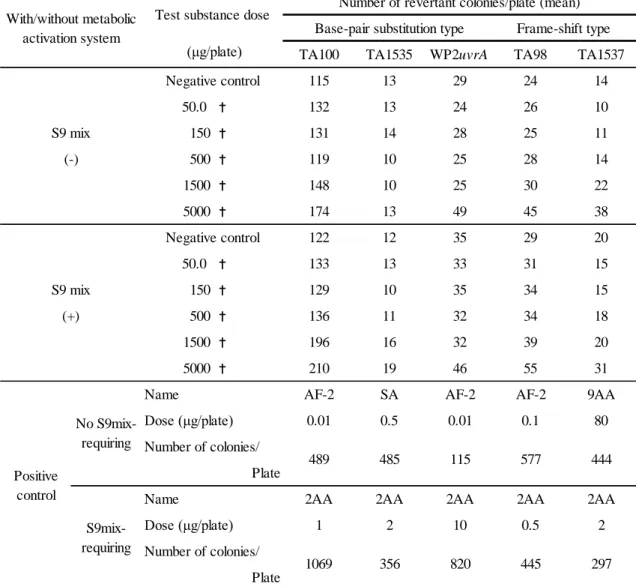
検定菌として、Base-pair substitution type と Frame-shift type を用い、検体は 50.0,150,500,1500 および 5000 μg/plate の 5 段階の容量を設定して容量設定試験 を行った(Table1-5,1-7)。また、酵素など熱に不安定な成分影響について検討するた め、加熱の有無での活性の違いも比較した。その結果、用いたいずれの検定菌において も、S9 mix 非存在下および存在下ともに、菌の成育阻害は認められなかった。
変異コロニー数は、加熱無の状態では、S9 mix 非存在下の WP2uvrA、S9mix の非存在
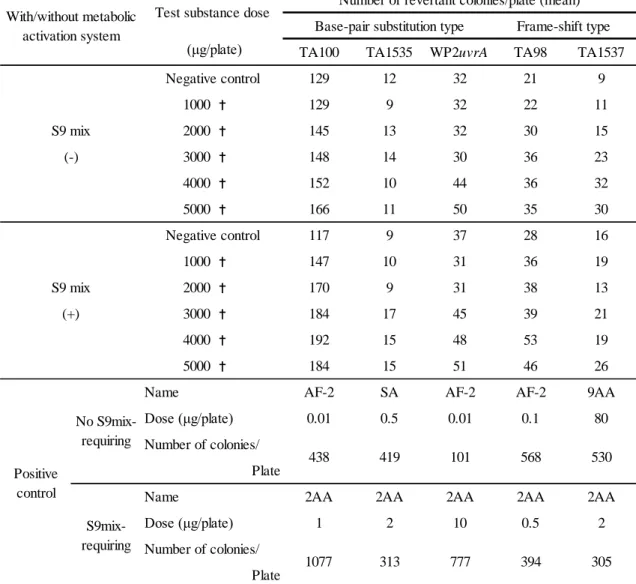
下、存在下の TA1537 のいずれも 5000μg/plate の容量で陰性対照値の 2 倍以上となっ た。また、加熱有の状態下では S9 mix の非存在下の TA1537 において、5000μg/plate の容量で陰性対照値の 2 倍以上になった。その他の検定菌においても、5000 μg/plate の容量で変異コロニー数に増加傾向が認められた。これらの結果に基づき、本試験にお ける最高用量を 5000 μg/plate とした。変異コロニー数の増加について用量依存性あ るいは再現性を確認するために、5 段階の濃度(1000~5000 μg/plate)を設定して本 試験を行った(Table 1-6,1-8)。その結果、用いたいずれの検定菌においても S9 mix 非存在下および存在下ともに、菌の生育阻害は認められなかった。変異コロニー数は、 加熱無の TA1537 の S9 mix 非存在下において、1000μg/plate 以上で、S9 mix 存在下
では 4000μg/plate 以上の容量で、また、WP2uvrAの S9 mix 非存在下において、4000
25
Table 1-5 Bacterial reverse mutation test with A. brasiliensis (Dose-finding study)
TA100 TA1535 WP2uvrA TA98 TA1537
106 9 24 24 9 50.0 ✝ 125 15 27 18 10 150 ✝ 118 11 30 20 9 500 ✝ 141 10 23 25 11 1500 ✝ 153 12 36 28 15 5000 ✝ 205 16 77 47 32 122 11 29 35 18 50.0 ✝ 129 15 29 34 15 150 ✝ 135 9 33 26 17 500 ✝ 166 8 28 33 13 1500 ✝ 168 12 36 48 19 5000 ✝ 221 21 56 58 40
AF-2 SA AF-2 AF-2 9AA
0.01 0.5 0.01 0.1 80
2AA 2AA 2AA 2AA 2AA
1 2 10 0.5 2
✝: Precipitation was observed.
372 943 313 618 377 219 Plate S9mix-requiring 478 Positive control No S9mix-requiring Dose (μg/plate) Name Negative control
Negative control: Japanese Pharmacopoeia distilled water for injection
AF-2: 2-(2-Furyl)-3-(5-nitro-2-furyl)acrylamide; SA: Sodium azide;9AA: 9-Aminoacridine; 2AA: 2-Aminoanthracene
442 389 111 Number of colonies/ Name Dose (μg/plate) Number of colonies/ Plate (+) S9 mix (-) S9 mix With/without metabolic activation system
Number of revertant colonies/plate (mean)
Base-pair substitution type Frame-shift type
Test substance dose (μg/plate) Negative control
26
Table 1-6 Bacterial reverse mutation test with A. brasiliensis (Main test)
TA100 TA1535 WP2uvrA TA98 TA1537
118 14 37 23 7 1000 ✝ 134 13 53 24 19 2000 ✝ 148 13 50 32 27 3000 ✝ 172 20 56 44 23 4000 ✝ 176 14 76 32 30 5000 ✝ 196 17 75 44 32 125 14 37 34 12 1000 ✝ 159 15 46 32 17 2000 ✝ 188 16 52 39 20 3000 ✝ 192 17 44 47 19 4000 ✝ 221 19 60 54 31 5000 ✝ 210 14 71 56 32
AF-2 SA AF-2 AF-2 9AA
0.01 0.5 0.01 0.1 80
2AA 2AA 2AA 2AA 2AA
1 2 10 0.5 2
With/without metabolic activation system
Number of revertant colonies/plate (mean)
Base-pair substitution type Frame-shift type
Negative control S9 mix (-) Negative control S9 mix (+) Name Dose (μg/plate) Number of colonies/ 999 Positive control No S9mix-requiring Name Dose (μg/plate) Number of colonies/ 402
AF-2: 2-(2-Furyl)-3-(5-nitro-2-furyl)acrylamide; SA: Sodium azide;9AA: 9-Aminoacridine; 2AA: 2-Aminoanthracene ✝: Precipitation was observed.
Test substance dose (μg/plate)
322 717 414 262
Plate
Negative control: Japanese Pharmacopoeia distilled water for injection
417 114 468 409
Plate
S9mix-requiring
27
Table 1-7 Bacterial reverse mutation test with A. brasiliensis (heated for 1 min at 105ºC) (Dose-finding study)
TA100 TA1535 WP2uvrA TA98 TA1537
115 13 29 24 14 50.0 ✝ 132 13 24 26 10 150 ✝ 131 14 28 25 11 500 ✝ 119 10 25 28 14 1500 ✝ 148 10 25 30 22 5000 ✝ 174 13 49 45 38 122 12 35 29 20 50.0 ✝ 133 13 33 31 15 150 ✝ 129 10 35 34 15 500 ✝ 136 11 32 34 18 1500 ✝ 196 16 32 39 20 5000 ✝ 210 19 46 55 31
AF-2 SA AF-2 AF-2 9AA
0.01 0.5 0.01 0.1 80
2AA 2AA 2AA 2AA 2AA
1 2 10 0.5 2
With/without metabolic activation system
Number of revertant colonies/plate (mean)
Base-pair substitution type Frame-shift type
Negative control S9 mix (-) Negative control S9 mix (+) Name Dose (μg/plate) Number of colonies/ 1069 Positive control No S9mix-requiring Name Dose (μg/plate) Number of colonies/ 489
AF-2: 2-(2-Furyl)-3-(5-nitro-2-furyl)acrylamide; SA: Sodium azide;9AA: 9-Aminoacridine; 2AA: 2-Aminoanthracene ✝: Precipitation was observed.
Test substance dose (μg/plate)
356 820 445 297
Plate
Negative control: Japanese Pharmacopoeia distilled water for injection
485 115 577 444
Plate
S9mix-requiring
The colony count used the mean of two times of measurements.
28
Table 1-8 Bacterial reverse mutation test with A. brasiliensis (heated for 1 min at 105ºC) (Main test)
TA100 TA1535 WP2uvrA TA98 TA1537
129 12 32 21 9 1000 ✝ 129 9 32 22 11 2000 ✝ 145 13 32 30 15 3000 ✝ 148 14 30 36 23 4000 ✝ 152 10 44 36 32 5000 ✝ 166 11 50 35 30 117 9 37 28 16 1000 ✝ 147 10 31 36 19 2000 ✝ 170 9 31 38 13 3000 ✝ 184 17 45 39 21 4000 ✝ 192 15 48 53 19 5000 ✝ 184 15 51 46 26
AF-2 SA AF-2 AF-2 9AA
0.01 0.5 0.01 0.1 80
2AA 2AA 2AA 2AA 2AA
1 2 10 0.5 2
With/without metabolic activation system
Number of revertant colonies/plate (mean)
Base-pair substitution type Frame-shift type
Negative control S9 mix (-) Negative control S9 mix (+) Name Dose (μg/plate) Number of colonies/ 1077 Positive control No S9mix-requiring Name Dose (μg/plate) Number of colonies/ 438
AF-2: 2-(2-Furyl)-3-(5-nitro-2-furyl)acrylamide; SA: Sodium azide;9AA: 9-Aminoacridine; 2AA: 2-Aminoanthracene ✝: Precipitation was observed.
Test substance dose (μg/plate)
313 777 394 305
Plate
Negative control: Japanese Pharmacopoeia distilled water for injection
419 101 568 530
Plate
S9mix-requiring
The colony count used the mean of two times of measurements.
29 Table 1-9 Free amino acid content of A. brasiliensis
Free amino acid Result (g/100 g) Method
Arginine 0.3 Automatic analysis of amino acids Lysine 0.23 Automatic analysis of amino acids Histidine 0.13 Automatic analysis of amino acids Phenylalanine 0.24 Automatic analysis of amino acids Tyrosine 0.3 Automatic analysis of amino acids Leucine 0.29 Automatic analysis of amino acids Isoleucine 0.15 Automatic analysis of amino acids Methionine 0.04 Automatic analysis of amino acids Valine 0.22 Automatic analysis of amino acids Alanine 0.64 Automatic analysis of amino acids Glycine 0.15 Automatic analysis of amino acids Proline 0.29 Automatic analysis of amino acids Glutamic acid 1.12 Automatic analysis of amino acids Serine 0.26 Automatic analysis of amino acids Threonine 0.32 Automatic analysis of amino acids Aspartic acid 0.2 Automatic analysis of amino acids Tryptophan 0.07 High-performance liquid chromatography Cysteine 0.11 Automatic analysis of amino acids
30
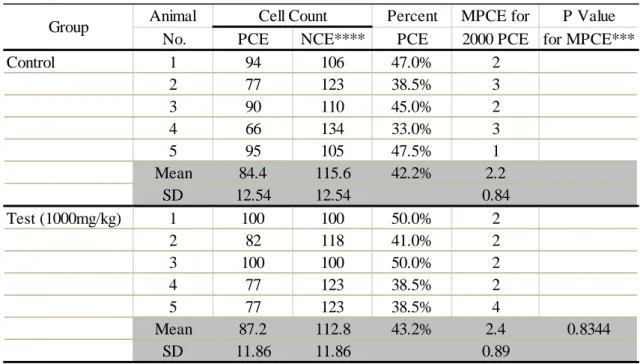
Table 1-10 Results of mouse micronucleus test at 24 hours after administration
Animal Percent MPCE per P Value
No. PCE NCE**** PCE 2000 PCE for MPCE***
Control 1 63 137 31.5% 2 2 88 112 44.0% 8 3 74 126 37.0% 4 4 80 120 40.0% 5 5 76 124 38.0% 6 Mean 76.2 123.8 38.1% 5 SD 9.12 9.12 2.24 Test (1000mg/kg) 1 100 100 50.0% 2 2 83 117 41.5% 1 3 83 117 41.5% 1 4 77 123 38.5% 0 5 96 104 48.0% 1 Mean 87.8 112.2 43.9% 1 * SD 9.73 9.73 0.71 Positive control** 1 70 130 35.0% 13 2 91 109 45.5% 62 3 71 129 35.5% 31 4 79 121 39.5% 28 5 54 146 27.0% 17 Mean 73 127 36.5% 30.2 0 SD 13.55 13.55 19.28
Group Cell Count
* Test was not performed if the total value was lower than or equal to the control value.
**
Oral administration of 100 mg/kg cyclophosphamide.*** P < 0.05 was considered statistically significant.
31
Table 1-11 Results of mouse micronucleus test at 48 hours after administration
Animal Percent MPCE for P Value
No. PCE NCE**** PCE 2000 PCE for MPCE***
Control 1 94 106 47.0% 2 2 77 123 38.5% 3 3 90 110 45.0% 2 4 66 134 33.0% 3 5 95 105 47.5% 1 Mean 84.4 115.6 42.2% 2.2 SD 12.54 12.54 0.84 Test (1000mg/kg) 1 100 100 50.0% 2 2 82 118 41.0% 2 3 100 100 50.0% 2 4 77 123 38.5% 2 5 77 123 38.5% 4 Mean 87.2 112.8 43.2% 2.4 0.8344 SD 11.86 11.86 0.89
Group Cell Count
** PCE: polychromatic erythrocytes; NCE: normochromatic erythrocytes;
*** P < 0.05 was considered statistically significant.
**** PCE: polychromatic erythrocytes; NCE: normochromatic erythrocytes;
MPCE: micronucleated polychromatic erythrocytes.32
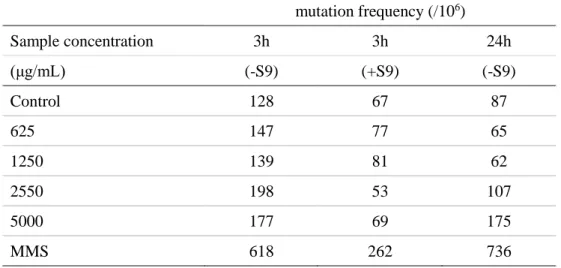
Table 1-12 Mutation frequency of A.brasiliensis assessed by mouse lymphoma test
mutation frequency (/106) Sample concentration 3h 3h 24h (μg/mL) (-S9) (+S9) (-S9) Control 128 67 87 625 147 77 65 1250 139 81 62 2550 198 53 107 5000 177 69 175 MMS 618 262 736 第一章 考察 アガリクスは、食品の3次機能として、生体防御や疾病予防などに期待の高い食品で ある。しかし、菌株、栽培条件や産地により、その特性や含有成分が異なるため 14,22)、 ブラジル露地栽培のA. brasiliensisについて、「細菌を用いる復帰突然変異試験」、「マ ウス小核試験」及び「マウスリンフォーマ TK 試験」を行い、安全性を検討した。 「細菌を用いる復帰突然変異試験」では、A. brasiliensisを用いた試験系において 変異コロニー数は増加したが、被験物質中のアミノ酸(ヒスチジン、トリプトファン) が影響している可能性が示唆された。「マウス小核試験」においては、t 検定の結果、 赤血球に占める幼弱赤血球の比率は、いずれの群も陰性対照群との間に有意差はないた め、骨髄細胞における小核作用を示さず遺伝毒性は認められなかった。「マウスリンフ ォーマ TK 試験」においても、A. brasiliensisは遺伝毒性を示さなかった。以上のin
37
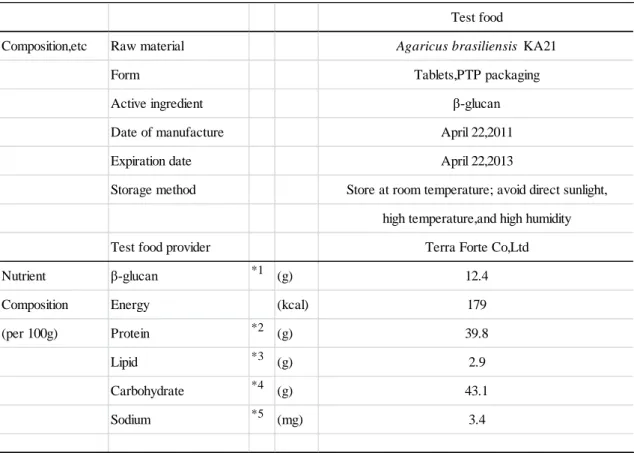
Table 2-1 Test Food Composition, Ingredients and Other Related Information
Test food
Composition,etc Raw material Agaricus brasiliensis KA21
Form Tablets,PTP packaging
Active ingredient β-glucan
Date of manufacture April 22,2011
Expiration date April 22,2013
Storage method Store at room temperature; avoid direct sunlight, high temperature,and high humidity
Test food provider Terra Forte Co,Ltd
Nutrient β-glucan *1 (g) 12.4
Composition Energy (kcal) 179
(per 100g) Protein *2 (g) 39.8
Lipid *3 (g) 2.9
Carbohydrate *4 (g) 43.1
Sodium *5 (mg) 3.4
Assessed by *1:enzymatic method , *2:Kjeldahl method(total nitrogen x6.25),
*3:acid hydrolysis method,*4:100-(moisture+protein+lipid+ash),*5:atomic absorption spectrophotometry
40 女性、45日目、低用量群)あった。また、ID.812 は高用量群に組入れたが、1日3錠し か摂取していなかったため、低用量群として取り扱った。この他に試験実施計画書から の逸脱、禁止食品の摂取はなかった。また、試験食品の摂取率は、ID.803 が91.7 %、 ID.836 が91.8 %、ID.812 が98.8 %であり、それ以外の19名は100%であった。その結果、 有効性解析対象者数は22名となった。なお、ID.849 は摂取78日目から85日目に感冒症 状が発現したため、12週目検査を7日間延期し、92日目に実施した。
Table 2-3 Background Features of Subjects in Efficacy analysis
Unit Low-dose (L) group High-dose (H) group
12 10 Male 7 5 Female 5 5 (years) 42.8±9.9 43.2±10.7 (μg/min) 36.57±10.53 36.02±9.41 Item Number of subjects (people) Sex Age
Salivary IgA secretion rate
41
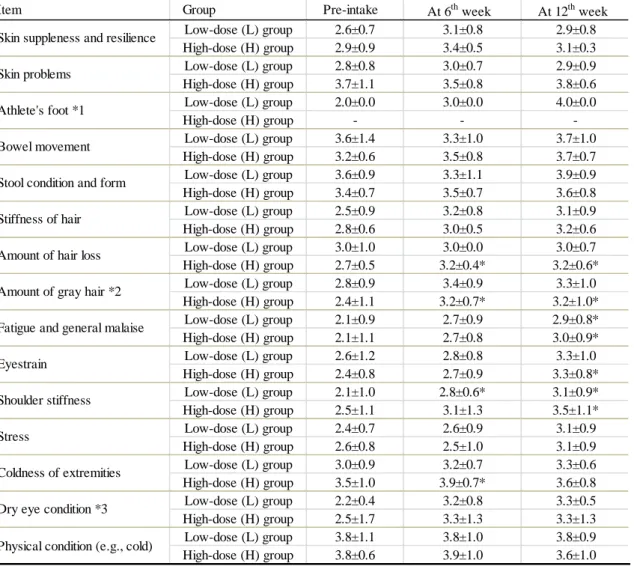
Table 2-4 Subjective Evaluation Questionnaire (1)
Item Group Pre-intake At 6th week At 12th week
Low-dose (L) group 2.6±0.7 3.1±0.8 2.9±0.8 High-dose (H) group 2.9±0.9 3.4±0.5 3.1±0.3 Low-dose (L) group 2.8±0.8 3.0±0.7 2.9±0.9 High-dose (H) group 3.7±1.1 3.5±0.8 3.8±0.6 Low-dose (L) group 2.0±0.0 3.0±0.0 4.0±0.0 High-dose (H) group - - -Low-dose (L) group 3.6±1.4 3.3±1.0 3.7±1.0 High-dose (H) group 3.2±0.6 3.5±0.8 3.7±0.7 Low-dose (L) group 3.6±0.9 3.3±1.1 3.9±0.9 High-dose (H) group 3.4±0.7 3.5±0.7 3.6±0.8 Low-dose (L) group 2.5±0.9 3.2±0.8 3.1±0.9 High-dose (H) group 2.8±0.6 3.0±0.5 3.2±0.6 Low-dose (L) group 3.0±1.0 3.0±0.0 3.0±0.7 High-dose (H) group 2.7±0.5 3.2±0.4* 3.2±0.6* Low-dose (L) group 2.8±0.9 3.4±0.9 3.3±1.0 High-dose (H) group 2.4±1.1 3.2±0.7* 3.2±1.0* Low-dose (L) group 2.1±0.9 2.7±0.9 2.9±0.8* High-dose (H) group 2.1±1.1 2.7±0.8 3.0±0.9* Low-dose (L) group 2.6±1.2 2.8±0.8 3.3±1.0 High-dose (H) group 2.4±0.8 2.7±0.9 3.3±0.8* Low-dose (L) group 2.1±1.0 2.8±0.6* 3.1±0.9* High-dose (H) group 2.5±1.1 3.1±1.3 3.5±1.1* Low-dose (L) group 2.4±0.7 2.6±0.9 3.1±0.9 High-dose (H) group 2.6±0.8 2.5±1.0 3.1±0.9 Low-dose (L) group 3.0±0.9 3.2±0.7 3.3±0.6 High-dose (H) group 3.5±1.0 3.9±0.7* 3.6±0.8 Low-dose (L) group 2.2±0.4 3.2±0.8 3.3±0.5 High-dose (H) group 2.5±1.7 3.3±1.3 3.3±1.3 Low-dose (L) group 3.8±1.1 3.8±1.0 3.8±0.9 High-dose (H) group 3.8±0.6 3.9±1.0 3.6±1.0
Skin suppleness and resilience Skin problems
Athlete's foot *1 Bowel movement Stool condition and form Stiffness of hair
Coldness of extremities Dry eye condition *3 Physical condition (e.g., cold) Amount of hair loss
Amount of gray hair *2 Fatigue and general malaise Eyestrain Shoulder stiffness Stress ・Low-dose(L)group: n=12; High-dose(H)group: n=10 *1 Low-dose(L)group: n=2; High-dose(H)group: n=0 *2 Low-dose(L)group: n=12; High-dose(H)group: n=9
*3 Low-dose(L)group: n=5(at 6th week); n=4(at 12th week); High-dose(H)group: n=4
・Values are expressed as mean ± standard deviation
42
Figure 2-1~2-6 は、いずれもA.brasiliensis の 6 週後、12 週後時点の値と
43 Table 2-5 Subjective Evaluation Questionnaire (2)
Group Pre-intake At 6th week At 12th week
Low-dose (L) group 5.1±2.6 4.0±1.2 3.7±1.4 High-dose (H) group 4.7±1.5 4.5±1.4 3.9±1.1 Low-dose (L) group 1.2±0.6 1.1±0.3 0.9±0.5 High-dose (H) group 1.4±0.5 1.3±0.5 1.1±0.3 Low-dose (L) group 0.3±0.7 0.1±0.3 0.3±0.5 High-dose (H) group 0.2±0.4 0.4±0.5 0.1±0.3 Low-dose (L) group 1.5±0.7 1.4±0.5 1.5±0.7 High-dose (H) group 1.2±0.8 1.3±0.5 1.2±0.6 Low-dose (L) group 0.0±0.0 0.0±0.0 0.0±0.0 High-dose (H) group 0.0±0.0 0.0±0.0 0.0±0.0 Low-dose (L) group 0.8±0.6 0.9±0.5 0.6±0.5 High-dose (H) group 0.9±0.3 1.0±0.0 1.0±0.0 Low-dose (L) group 0.0±0.0 0.0±0.0 0.0±0.0 High-dose (H) group 0.0±0.0 0.0±0.0 0.0±0.0 Low-dose (L) group 1.3±1.1 0.5±0.5* 0.4±0.5* High-dose (H) group 1.0±0.5 0.5±0.7* 0.5±0.7* Low-dose (L) group 1.3±0.5 1.2±0.4 1.0±0.0* High-dose (H) group 1.4±0.5 1.3±0.5 1.1±0.3 C6: Sleeping pill use
C7: Difficulty in staying awake during the day Q5: Ease in getting out of bed
Total score
Item
C2: Time required for falling asleep C3: Sleep duration
C4: Sleep efficiency C5: Difficulty in sleeping
・Low-dose (L) group: n=12; High-dose (H) group: n=10 ・Values are expressed as mean±sandard deviation
・Wilcoxon signed-rank test compared with pre-intake **: p<0.01, *: p<0.05
Figure 2-7~2-8 は、いずれもA.brasiliensis の 6 週後、12 週後時点の値と
44 Table 2-6 Hematology test
Item Unit Group Pre-intake At 12th week
Low-dose (L) group 4.55±0.98 5.06±1.30 High-dose (H) group 4.67±0.60 5.29±1.64 Low-dose (L) group 450.5±44.6 445.8±42.8 High-dose (H) group 450.3±35.4 451.3±42.7 Low-dose (L) group 13.16±1.48 13.43±1.60 High-dose (H) group 13.42±0.89 13.60±1.46 Low-dose (L) group 40.78±4.17 41.56±4.48 High-dose (H) group 41.30±2.57 42.16±4.02 Low-dose (L) group 23.13±6.07 22.38±5.65 High-dose (H) group 24.48±3.10 24.79±4.21 Low-dose (L) group 58.5±3.4 59.4±5.4 High-dose (H) group 51.6±9.1 52.2±10.2 Low-dose (L) group 2.670±0.654 3.030±0.880 High-dose (H) group 2.411±0.528 2.807±1.246 Low-dose (L) group 1.8±1.0 2.8±1.3 High-dose (H) group 3.6±3.1 4.3±3.8 Low-dose (L) group 0.080±0.041 0.140±0.062* High-dose (H) group 0.166±0.141 0.215±0.166* Low-dose (L) group 0.8±0.5 0.6±0.5 High-dose (H) group 0.8±0.6 0.8±0.6 Low-dose (L) group 0.033±0.021 0.027±0.025 High-dose (H) group 0.036±0.030 0.037±0.030 Low-dose (L) group 6.6±1.4 6.8±1.9 High-dose (H) group 5.7±1.1 4.6±0.8** Low-dose (L) group 0.294±0.061 0.331±0.072 High-dose (H) group 0.266±0.061 0.244±0.093 Low-dose (L) group 32.3±3.8 30.3±4.7 High-dose (H) group 38.3±6.7 38.1±8.5 Low-dose (L) group 1.472±0.348 1.531±0.474 High-dose (H) group 1.791±0.378 1.987±0.584 MON count (×103μL) Percentage of LYM (%) LYM count (×103μL) Percentage of BAS (%) BAS count (×103μL) Percentage of MON (%) NEUT count (×103μL) Percentage of EOS (%) EOS count (×103μL) Ht (%) PLT (×104μL) Percentage of NEUT (%) WBC (×103μL) RBC (×104μL) Hb (g/dL) ・Low-dose(L)group: n=12; High-dose(H)group: n=10 ・Value are expressed as mean ± standard
45 Table 2-7 Biochemical Blood Test
Item Unit Group Pre-intake At 12th week
Low-dose (L) group 20.7±7.9 22.8±11.0 High-dose (H) group 20.5±4.9 19.4±3.3 Low-dose (L) group 15.5±5.4 21.3±17.2 High-dose (H) group 18.2±7.2 19.1±8.3 Low-dose (L) group 19.4±12.6 28.5±21.8 High-dose (H) group 19.8±9.7 23.1±13.7 Low-dose (L) group 0.72±0.15 0.71±0.24 High-dose (H) group 0.81±0.38 0.71±0.35 Low-dose (L) group 6.68±0.31 6.92±0.34** High-dose (H) group 6.89±0.31 7.06±0.32* Low-dose (L) group 10.80±2.30 10.37±2.73 High-dose (H) group 10.40±1.68 10.33±1.93 Low-dose (L) group 0.746±0.125 0.747±0.105 High-dose (H) group 0.668±0.151 0.661±0.160 Low-dose (L) group 184.8±20.3 188.7±20.8 High-dose (H) group 196.9±29.6 200.7±32.2 Low-dose (L) group 65.8±14.6 73.8±14.9** High-dose (H) group 62.9±15.9 67.4±16.5* Low-dose (L) group 69.8±30.5 74.7±38.3 High-dose (H) group 61.6±43.4 78.1±58.1* Low-dose (L) group 90.8±10.1 90.8±9.9 High-dose (H) group 91.7±3.7 92.3±5.2 Low-dose (L) group 6.20±2.49 5.49±2.26 High-dose (H) group 5.08±2.35 5.00±3.25 Low-dose (L) group 142.1±1.4 140.9±1.1* High-dose (H) group 141.6±1.3 141.2±0.6 Low-dose (L) group 4.32±0.39 4.24±0.43 High-dose (H) group 4.32±0.36 4.22±0.20 Low-dose (L) group 105.3±1.8 104.6±1.6 High-dose (H) group 105.3±1.1 105.1±1.5 Low-dose (L) group 1178.3±241.8 1217.8±246.2 High-dose (H) group 1259.0±215.6 1278.2±195.7 Low-dose (L) group 4.84±0.22 4.73±0.20 High-dose (H) group 5.02±0.34 4.97±0.31 IgG (mg/dL) HbA1c (%) Na (meq/L) K (meq/L) Cl (meq/L) TG (mg/dL) Glu (mg/dL) IRI (μU/mL) Cre (mg/dL) TC (mg/dL) HDL-C (mg/dL) T-Bil (mg/dL) TP (mg/dL) UN (mg/dL) AST (IU/L) ALT (IU/L) γ-GTP (IU/L) ・Low-dose(L)group: n=12; High-dose(H)group: n=10 ・Value are expressed as mean ± standard deviation
46 Table 2-8 Physical Measurements
Item Unit Group Pre-intake At6th week At12th week
Body height Low-dose(L)group 165.18±9.62
High-dose(H)group 167.26±9.15
Body weight Low-dose(L)group 59.52±10.59 59.22±11.17 59.70±10.81
High-dose(H)group 62.68±12.13 62.93±12.30 63.06±11.71
BMI Low-dose(L)group 21.68±2.60 21.56±2.81 21.74±2.66
High-dose(H)group 22.23±2.56 22.32±2.72 22.39±2.63 Systolic blood pressure Low-dose(L)group 107.1±14.0 108.2±12.9 109.8±13.3 High-dose(H)group 119.1±11.5 115.4±12.6* 120.0±12.4
Diastolic blood pressure Low-dose(L)group 66.4±11.1 66.5±8.8 68.8±9.9
High-dose(H)group 73.7±11.3 72.5±9.5 74.9±7.8
Pulse rate Low-dose(L)group 62.8±4.2 65.6±6.2 64.3±4.9
High-dose(H)group 66.9±5.1 67.1±5.4 68.9±7.5 *Low-dose(L)group: n=12;High-dose(H)group: n=10
*Values are expressed as mean ±standard deviation
47 む食品を摂取した場合に同様の症状が発現したことが度々あったと自己申告があった。 なお、試験食品には一錠当たり56.7 mg の食物繊維が含まれている。試験責任医師は本 症状について、試験食品以外の原因も否定できないが、被験者の体質ならびに試験食品 に含まれる豊富な食物繊維の摂取により症状が発現した可能性を否定できないため、本 事象と試験食品摂取との関連性を「あるかもしれない」と判定した。血液検査では、低 用量群でEOS(細胞数)、TP、HDL-C、Na および高用量群でEOS(細胞数)、MON(百分 率)、TP、HDL-C、TG がいずれも摂取前と比較して有意に変動したが、いずれも基準範 囲内の軽微な変動であり、試験責任医師は臨床上の問題はないと判断した。計測値では、 高用量群で6 週目の収縮期血圧が摂取前に比べて有意な変動を示したが軽微な変動で あり、試験責任医師は臨床上の問題はないと判断した。
Table 2-9 Number of Adverse Events
Low-dose (L) group High-dose (H) group
Number of subjects analyzed (subjects) 13 11
Number of subjects with adverse events (subjects) 4 4
Frequency of incidence (%) 31 36
Total number of incidents (cases) 5 11
Number of incidents by symptom
Itching in the back of the knees (cases) 1 0
Feeling of heaviness of stomach (cases) 0 2
Diarrhea (cases) 0 2
Stomachache (cases) 0 1
General malaise (cases) 0 1
Abdominal pain (cases) 0 2
Runny nose (cases) 1 0
Abdominal pain, abdominal discomfort (cases) 1 0
Diarrhea, abdominal pain (cases) 0 1
Loose stool (cases) 0 1
Cold symptoms (sore throat, fever, cough) (cases) 0 1
Eosinophilia (cases) 1 0
Increased AST, ALT, and γGTP levels (cases) 1 0
Item Unit
48
Group Sex, Age, Outcome,
&Subject Symptom Relationship
ID No. & Date of onset with test food
Male,45, As it was observed during the examination
Increased AST, Unchanged, at 12th week (October 8), reexamination was ALT, Unlikely related performed 4 weeks later on November 5. and γGTP levels, The results showed almost no improvement,
10/8- but no change was observed 4 weeks after
completion of intake. The event was thus evaluated to be unlikely related to the test food.
Male,52, Recovery/ The condition was only observed for a short Itching in the back Disappearance, time on the 6th day of intake, and as it did
of the knees Unrelated not reappear afterward, the event was (both legs),7/21 evaluated to be unrelated to the test food.
Female,37, Recovery/ The subject reported changes in weather Runny nose, Disappearance, condition as the cause. The event was
7/26-7/28 Unrelated deemed unrelated to the test food. Female,40, Recovery/ As the condition appeared from the 36th Abdominal pain, Disappearance, day of intake, it was deemed unlikely abdominal discomfort Unlikely related related to the test food. The subject
(feeling of heaviness requested to withdraw from the study of stomach) ,8/20-9/5 on August 29, and was hence treated
as a dropout. It was confirmed on September 5 that the symptoms had disappeared.Abdominal pain:August 20, 23 (menstrual pain); Abdominal discomfort: August 21, 22, 24-31, September 1-5. Oral intake of 1 tablet of Buscopan A on August 20, 28; oral intake
of 4 tablets of Eve A on August 23 Female,40, Recovery/ During the examination at 6th week Eosinophilia, Disappearance, (discontinuation), an increase in eosinophil
8/29-9/17 Unlikely related count (19%) was observed. A decrease of this count was noted during reexamination 20 days later (4%; 2% during pre-intake examination). This event was evaluated to be unlikely related to the test food. Table 2-10 List of Adverse Events
Physician’s comments, treatment details
L・803
L・804
L・836
L・840
49
Female,44, Recovery/ The symptom appeared from the 18th day Feeling of heaviness Disappearance, of intake.The subject stopped taking the
of stomach, Probably related test food from August 2. Intake was
8/2-8/10 restarted on August 4, but again stopped
because symptom of diarrhea. The from August 5 disappeared on August 10. This event was evaluated to be probably related to the test food.
Female,44, Recovery/ Intake had been stopped since August 2 Diarrhea, Disappearance, because of the feeling of heaviness of the
8/4 Unlikely related stomach.One hour after resuming intake on August 4, the subject experienced diarrhea, although it lasted for only a short time. No similar symptoms were observed after intake was resumed. This event was evaluated to be unlikely related to the test food.
Female,44, Recovery/ Intake was resumed on August 12. Feeling of Disappearance, The subject took 2 tablets on August heaviness of Probably related 12-14,and 5 tablets on August 15 and
stomach, there after,as there was no change in
8/20-8/26 the physical condition.Feeling of heaviness of the stomach reappeared 9 days after the resumption (August 20). Intake was interrupted on August 22,and the symptom disappeared on August 26.This event was evaluated to be probably related to the test food. The subject requested to withdraw from the study on August 27 and was hence treated as a dropout. Oral intake of Tateyama Digestive Medicine A →1 package on August 22, 23; 3 packages on August 23 Female,56, Recovery/ The subject reported having eaten cold Stomachache, Disappearance, food in excess as the cause. The event was
7/23-7/24 Unrelated deemed unrelated to the test food.
Female,56, Recovery/ The subject reported tiredness as the cause. Malaise,8/15 Disappearance, The event was deemed unrelated to the
Unrelated test food. H・808
H・808
H・808
H・826
50
Female,56, Recovery/ The subject reported having eaten cold food Abdominal pain, Disappearance, as the cause. The event was deemed
8/22 Unrelated unrelated to the test food.
Female,56, Recovery/ The subject reported changes in weather Abdominal pain , Disappearance, condition as the cause. The event was
9/25 Unrelated deemed unrelated to the test food. Male,55, Recovery/ The condition was observed only on the Diarrhea, Disappearance, 7th day of intake, and was thus deemed abdominal pain ,7/22 Unrelated unrelated to the test food.
Female,39, Recovery/ The subject reported suffering from cold as Loose stool , Disappearance, the cause. The event was deemed unrelated
7/23 Unrelated to the test food.
Female,39, Recovery/ The subject reported catching gastroenteritis Diarrhea , Disappearance, from her child.The condition was only
8/8-8/12 Unrelated observed from 25 to 29th day of intake, and not afterward.Thus, the event was evaluated to be unrelated to the test food. August 9: oral intake of 1 package of BIO-THREE Female,39, Recovery/ The symptoms were due to a cold and the Cold symptoms Disappearance, event was thus deemed unrelated to the
(sore throat, Unrelated test food. Sore throat, September 30 fever, cough), - October 5; Fever, October 1-2;
9/30-10/7 Cough, October 6. Oral drugs: Kakkonto,
52 第三章 ヒト抗 β-グルカン抗体価における露地栽培アガリクス服用の効果とがん患 者における抗 β-グルカン抗体の研究 序論 β-グルカンは真菌細胞壁主要構成多糖であり、真菌、細菌、植物、藻類など広く自 然界に分布している。また、β-グルカンは免疫賦活作用を示すことが動物ならびにヒ ト臨床試験によって明らかにされている 26-28)。さらに、我国では Lentinus edodes 由
来 Lentinan やSchizophyllum commune由来 Sonifilan(SPG)が抗悪性腫瘍薬として用
いられている29,30)。今世紀に入り受容体研究も盛んになり、その過程で β-グルカン特
異的受容体、Dectin-131)、CR332)、lactosylceramide33)などが同定され、それら受容体
が phagocytosis や他の生物活性に関わっていることが報告されている。一方、抗体は 獲得免疫における認識生体分子であり、phagocytosis を促進することによって、抗原 提示、co-stimulatory molecule の発現を上昇させること、もしくは、Fc receptor の crosslinking、サイトカイン産生の修飾によって病原体に対する生体防御を増強させる など重要な働きを担っていることが知られている 34-36)。β-グルカンは受容体を介して 自然免疫を活性化することは解析が進んできたが、多糖は一般的に抗原性が弱いこと37) からβ-グルカンを抗原として扱った研究は、申請者の共同研究者らが行ってきた研究 以外にはほとんどない。共同研究者の石橋らは,CSBG を標準抗原として用いた固相化 ELISA 法により、ヒト血清中に、抗β-グルカン(CSBG)抗体が広範に存在すること、 また、抗体価は著しい個人差を示すことを見出した38)。また、DBA 系統のマウスやウシ などの血清中にも抗β-グルカン抗体が存在していることを明らかとした39,40)。さらに、 本抗体は生体内で抗原-抗体複合体を形成し、β-グルカンの免疫修飾作用に関与してい ることが示唆された41)。さらに臨床検体を用いた研究により、真菌症、自己免疫疾患の 患者においては抗β-グルカン抗体価が変動することが示され42)、抗β-グルカン抗体は β-グルカン反応、応答の指標の一つとしての可能性がある。そこで本章では、A. brasiliensis 由来のβ-グルカンに対して特異的な抗体の存在を確認し、その特異性、 と個人差を明確にし、また、A.brasiliensis を摂取することによって、抗体力価に影 響を与えるのかについて検討した。 第三章 実験の部 1.実験材料
53
ムは、和光純薬(大阪,日本)から購入した。真菌細胞壁βグルカン(CSBG,ASBG)は既
報に従い、Candida albicans ならびに Aspergillus niger より、次亜塩素酸酸化法に
より調整した43,44)。Grifolan(GRN)は、Grifola frondosaの培養菌糸体より調整した
45)。アガリクスから由来多糖体画分(AgHWE,AgCA-1,AgCA-2,AgHA)は、既報に従い調整
した19)。Sonifilan (SPG)は科研製薬(東京,日本)から購入した。Dextran は生化学(東
京,日本)から入手した。Laminaran (LAM)と酵母由来 Mannan はナカライテスク(京都, 日本)から入手した。 2. ボランティアと研究計画 健常人血清を用いた研究は 1964 年のヘルシンキ宣言(2000 年エジンバラで修正)に 準拠して行われた。また、研究プロトコルは、フィルファインクリニックの倫理委員会 の承認を得て、全てのボランティアがこの研究にあたりインフォームドコンセントを受 け、書面にて承諾後、健康なボランティアが、初回 24 名、2 回目 52 名、3 回目 25 名が 参加した。 3. がん患者の血清と研究計画 がん患者血清を用いた研究はヘルシンキ宣言に準拠し、東京衛生病院の倫理委員会の 承認を受け、2004 年 1 月 16 日から同年 4 月 25 日に東京衛生病院に通院中のがん患者 26 名(平均年齢 49.0±6.6 歳、男性 11 名、女性 15 名)の採決した血清を得て行った。 同病院の水上治医師の協力のもと、がん患者 26 名の血清を採取し、反応性を健常人と 比較した。統計評価は 5 %水準でt 検定を実施した。 4. 抗 BG 抗体の ELISA 法
54 5.2. 2 回目参加者数 52 名 5.2.1. グループ1:健康な 52 名のボランティアをランダムに 2 つのグループに分け、 投与グループ(27 名:平均年齢 43±11 歳、男性 13 名、女性 14 名)は、A. brasiliensis 子実体 100 %の錠剤 1 日 3 g、6 カ月分を与えた。プラセボグループ(25 名:平均年齢 45±9 歳、男性 12 名、女性 13 名)は、プラセボを 6 カ月分与えた(2004 年 5 月 31 日 ~2004 年 11 月 26 日)。 0、3、6 カ月ごとに、それぞれのボランティアから採血した。 5.3. 3 回目参加者数 25 名 5.3.1. グループ 2:健康な 25 名のボランティアをランダムに 2 つのグループに分け、 投与グループ(14 名:平均年齢 49±9 歳、男性 9 名、女性 5 名)は、A. brasiliensis の錠剤 1 日 3 g、3 カ月分を与えた。プラセボグループ〈11 名:平均年齢 46±11 歳、 男性 6 名、女性 5 名〉は、プラセボを 3 カ月分与えた(2005 年 4 月 12 日~2005 年 7 月 8日)。採血は投与前後で行った。 5.4. 採血方法 試験開始前後に、各々のボランティアより採血し、遠心分離を行い血液サンプルとし た。この検体は抗 BG 抗体の ELISA を行うまで-20 ℃の状態で保存した。 第三章 結果 第一節 ヒト血清における抗-グルカン抗体価、抗体反応性の検討 これまでの検討により、抗 β-グルカン(CSBG)抗体価には個人差がかなり存在する ことが報告されている38)。まず、健常人血清における抗 β-グルカン抗体力価の個人差 を検討するとともに、抗 β-グルカン抗体反応性並びに各種 β-グルカンに対する抗体 力価を検討した。A. brasiliensis 由来のβ-グルカンは既報に従い、子実体の熱水 (AgHWE)、冷アルカリ(AgCA1, AgCA2)ならびに熱アルカリ(AgHA)抽出を行うことで調製 した19)。標準品としてはCandida albicans由来の CSBG を用いた43)。標準品ならびに A. brasiliensis由来のβ-グルカンを抗原として健常人ボランティアの抗β-グルカン 抗体力価を測定した。その結果、力価には顕著な個人差が見出された(Figure 3-1)。 さらに、各種 β-グルカンに対する力価を比較したところ、CSBG,AgHWE,ASBG 44 ),GRN 45 ),Y-Man の順であった。また、A. brasiliensis各抽出画分に対する反応性を比較し
たところ、AgHWE のみならず、AgCA ならびに AgHA のいずれの画分に対しても反応性を 示し(Figure 3-1b)、さらに個人差も認められた(Figure 3-2)。各個人ごとの特性につ いて検討したところ CSBG,AgHWE,ASBG に同等な力価を示す者,CSBG,AgHWE に高い力 価を示す者など、各種 β-グルカンに対する力価にも個人差が認められた。また、高力
価者と低力価者では、約 5 倍の力価差を示した(Figure 3-2)。次に、CSBG と A.
55
て用いた系において、各抽出画ならびに CSBG 間で顕著な競合反応を示した(Figure 3-3)。
これらのことから、両グルカンは免疫学的に交差反応性を示すことが示唆された。
Figure 3-1 Comparison of the reactivity of human sera to various polysaccharide-coated plates. An ELISA plate was coated with a) each polysaccharide and b) A. brasiliensis extract (AgHWE, AgCA-1, AgCA-2, AgHA) ( 25μg/mL in carbonate buffer) and blocked by BSA before use. Sera were diluted and the amount of plate-bound Ig was determined with peroxidase-conjugated anti-human IgG+M+A antibody. Enzyme activity was measured by the addition of TMB substrate. Data from twenty healthy volunteers are shown.
Figure 3-2 Comparison of the anti-BG antibody titer of individuals with high and low titers.
An ELISA plate was coated with CSBG (25μg/mL in carbonate buffer) and blocked by BSA before use. Sera were diluted (×200, 500, 1000, 2000, 4000, 8000, 10000, 20000) and the amount of plate-bound Ig was determined with peroxidase-conjugated anti-human IgG+M+A antibody. Enzyme activity was measured by the addition of TMB substrate. Data from the sera of the individuals with low (n=4 ;open symbol) and high (n=2 ; close symbol) titers in Figure 3-1a are shown.
0.0 0.4 0.8 1.2 1.6 A b s (4 50 /6 30 n m ) 0 0.3 0.6 0.9 1.2 1.5 A bs ( 45 0/ 63 0n m )
CSBG AgHWE ASBG GRN Y-Man
a)
b)
CSBG AgHWE AgCA-1 AgCA-2 AgHA
56
Figure 3-3 Cross-reactivity of human sera to A. brasiliensis extracts
An ELISA plate was coated with A. brasiliensis extracts (a)AgHWE, b)AgCA-1, c)AgCA-2, d)AgHA, 25μg/mL in carbonate buffer). Sera were mixed with polysaccharides (CSBG or A. brasiliensis extracts (AgHWE, AgCA-1, AgCA-2, AgHA), Y-Man, 25μg/mL) and then applied to the ELISA plate. The amount of plate-bound Ab was determined with peroxidase-conjugated anti- human IgG+M+A antibody. Enzyme activity was measured by the addition of TMB substrate. 第二節 がん患者の抗 β-グルカン抗体 β-グルカンは免疫機能を修飾する物質であり、抗悪性腫瘍薬としても用いられてい ることから、この機能発現を抗β-グルカン抗体が修飾している可能性がある。そこで、 東京衛生病院(当時)の水上治医師の協力のもと、癌患者の血清を入手し、抗β-グル カン抗体価を健常人と比較した。その結果、健常人と比べて、力価の個人差が著しく広 くなっていることがわかった。また、平均値のレベルでは癌患者が低力価を示した (Figure 3-4)。クラス(isotype)ごとの差の 比較も行ったが、顕著な差は見いだされなかっ た(Figure 3-5)。 Figure3-4 Anti-CSBG antibody titer of cancer
patients.ELISA plate was coated with CSBG (25μg/mL was used to coat plate). The sera of cancer patients (N=26) or healthy donor (N=24) was added to the plate, and the plate-bound Ig was determined with
peroxidase-conjugeted anti Human IgG+IgM.
Enzyme activity was measured by the addition of TMBsubstrate. 0 0.1 0.2 0.3 0.4 0.5 0 1 2 3 4 5 A b s (4 5 0 /6 3 0 n m ) 0 0.1 0.2 0.3 0.4 0.5 0.6 0.7 0 1 2 3 4 5 0 0.1 0.2 0.3 0.4 0.5 0 1 2 3 4 5 add soluble Ag (μg) A b s (4 5 0 /6 3 0 n m ) 0 0.1 0.2 0.3 0.4 0.5 0.6 0 1 2 3 4 5 add soluble Ag (μg) CSBG AgHWE AgCA-1 AgCA-2 AgHA Y-Man 0 2500 5000 7500 10000 A n ti -C S B G A b ( ti te r)
57
Figure3-5 Isotype reactivity of Anti-CSBG antibody titer of cancer patients.
ELISA plate was coated with CSBG (25μg/mL was used to coat plate). The sera of cancer patients (N=26) or healthy donor (N=7) was added to the plate, and the plate-bound Ig was determined with peroxidase-conjugeted anti Human a)IgG, b)IgA or c)IgM. Enzyme activity was measured by the addition of TMB substrate.
第三節 露地栽培アガリクス服用者における抗体価変化
β-グルカンは菌類子実体の主要構成多糖成分である。そこで次に、健常人(27 例,
年齢平均:43±11,性別 男:13 女:14)に、6 カ月間A. brasiliensisを服用させ抗
β-グルカン抗体力価の変化を検討した。服用前の平均力価が、3198 unit であったの に対し、3 カ月服用では、3378 unit,6 カ月服用では 3481 unit に上昇した(Figure 3-6)。
さらに、力価の個人差を除外するため相対的な増加率を算出したところ(Figure 3-7)、 抗体価の増加率も上昇した。ただし、一部には抵抗性を示す者もおり、増加率にも個人 差があった。一方、汎用抗原である卵白アルブミン(OVA)に対する抗体価は有意な変 化は認められなかった。(Table 3-1)。Figure 3-8 には、4 名の服用群における抗 β-グルカン抗体ならびに抗 OVA 抗体の力価の経時的変化を示した。個々に特徴的な変化を 示しているものの、全てで抗 BG 抗体が上昇した。一方、OVA に対する抗体価は、経時 的な差は認められなかった(Figure 3-8)。これらの事から、A.brasiliensis の含有す るβ-グルカンによる抗原刺激によって抗体価が上昇したものと考えられる。 抗体はクラスごとに構造的ならびに機能的な特徴を有しているので、クラス(IgG、 IgM、IgA)ごとの抗体価を調べたところ、IgG クラスの抗β-グルカン抗体の力価が最
も高かった。 IgM および IgA クラスの抗体も検出された(Figure 3-9)。さらに、A.
brasiliensis服用が各クラスの抗β-グルカン抗体価にどのような変化があるのか検討 したところ、増加率に個人差があるものの IgG は平均増加率が 30.4%、IgM は 49.5%、 IgA クラスは、服用後有意に増加し、最も高い平均増加率 90.3 %を示した(Figure 3-10)。 0 0.3 0.6 0.9
Cancer patient healty donor
A bs (45 0nm /630 nm ) 0 0.2 0.4 0.6
Cancer patient healty donor 0 0.3 0.6 0.9
58
Figure 3-6 Effect of the oral administration of the A. brasiliensis preparation on the anti-BG antibody titer An ELISA plate was coated with CSBG (25μg/mL in carbonate buffer) and blocked by BSA before use. Sera were diluted and the amount of plate-bound Ig was determined with peroxidase-conjugated anti-human IgG+M+A antibody. Enzyme activity was measured by the addition of TMB substrate.
Figure 3-7 Rate of increase in the anti-BG antibody titer in the A. brasiliensis or placebo group The anti-BG antibody titer was measured by ELISA using CSBG-coated plates. The rate of increase in the titer was calculated with the following formula: Increase in anti-BG antibody titer (%) = (anti-BG antibody units after taking-anti-BG antibody units) / anti-BG antibody units before taking the preparation.
59 0.0 0.2 0.4 0.6 0 1000 2000 3000 4000 5000 6000 0 3 6 A nt i-BG A b t it er (uni ts ) months
Table 3-1 Increase in titers of anti-β-glucan and anti-OVA antibody in the A. brasiliensis group.
Figure 3-8 Kinetics of anti-BG and anti-OVAantibody titers in volunteers taking the Agaricus
brasiliensis preparation.
An ELISA plate was coated with CSBG (25μg/mL in carbonate buffer) and blocked by BSA before use. The Sera of human volunteers at 0, 3, and 6 months were added to the plate, and the amount of plate-bound Ig was determined with peroxidase-conjugated anti-human IgG+M+A antibody. Enzyme activity was measured by the addition of TMB substrate.
average increase titer (%)
3 months anti--glucan 21.8 ±63.6
anti-OVA 13.8 ±50.5
6 months anti--glucan 33.8 ±77.0
60
Figure 3-9. Comparison of anti-BG IgG, IgM, and IgA antibody titers in human sera.
An ELISA plate was coated with CSBG (25μg/mL in carbonate buffer) and blocked by BSA before use. Sera were diluted and the amount of plate-bound Ig was determined with peroxidase-conjugated
anti-human IgG, IgM, or IgA antibody. Enzyme activity was measured by the addition of TMB substrate. Data from twenty healthy volunteers are shown.
Figure 3-10. Comparison of the increase in the anti-BG IgG, IgM, or IgA antibody titer in A. brasiliensis group.
The anti-BG IgG, IgM, or IgA antibody titer was measured by ELISA using CSBG-coated plates. The rate of increase in the titer was calculated.
*
:Anti-BG IgA antibody was significantly increased after taking compared with before taking (p<0.01, paired t-test).0.0 0.5 1.0 1.5 2.0 2.5 A b s (4 5 0 /6 3 0 n m )
IgG+M+A IgG IgM IgA
66
研究結果の掲載誌
本博士学位申請論文は、以下の論文の内容を総括したものである。
第一章
Safety Study of Culinary‐Medicinal Royal Sun Agaricus, Agaricus brasiliensis S.Wasser et al. KA21 (Higher Basidiomycetes) Assessed by Prokaryotic as well as Eukaryotic Systems
Masuro Motoi, Naohito Ohno
International journal of Medicinal Mushrooms,14(2):135-148(2012)
第二章
Open-Label Study on the Influence of Food Containing the Royal Sun
Mushroom, Agaricus brasiliensis KA21 (Higher Basidiomycetes ), on the
Quality of Life Healthy Human Volunteer
sMasuro Motoi, Akitomo Motoi, Daisuke Yamanaka, Naohito Ohno International journal of Medicinal Mushrooms, 17(9):799-817(2015)
第三章
Effect of Oral Administration of Dried Royal Sun Agaricus, Agaricus brasiliensis S. Wasser et al. (Agaricomycetideae), Fruit Bodies on Anti-β-Glucan antibody Titers in Humans
Ken-ichi Ishibashi, Masuro Motoi, Ying Liu, Noriko N. Miura, Yoshiyuki Adachi, Naohito Ohno
Internatinal journal of Medicinal Mushrooms,11(2):117-131(2009)
Anti β-Glucan Antibody in Cancer Patients (Preliminary Report)
Masuro Motoi, Ken-ichi Ishibashi, Osamu Mizukami, Noriko N. Miura, Yoshiyuki Adachi, Naohito Ohno
Internatinal jorrnal of Medicinal Mushrooms,6(1):41-48(2004)
67 引用文献
1) R J Williams. Kanyaku:Izumitani K, Karada no Kinou wo Kaihatu suru Daiichisyo Chuokoron-Sha, (1985)
2) Kojima S. Tokaigakuin jositandai kiyou, 31, 37-46 (1996) 3) Kagakugijututyou sigentyousakai 5tei syokuhin seibunhyo 4) Wang X,Qin X,Demirtas H,Li J,Mao G,Huo Y,Sun N,Liu L,Xu X.
Lancet, 369, 1876-1882 (2007)
5) Ntaios G,Savopoulos C,Karamitsos D,Economou I,Destanis E,Chryssogonidis I,Pidonia I,Zebekakis P,Polatides C,Sion M,Grekas D,Hatzitolios A.
Internat J Cardiol., 143, 9-16 (2010)
6) Kagawa Y.Rinsyo eiyou ,120 , 398-399 (2012)
7) Kagawa Y. Nppon byotai eiyo gakkaishi, 12 ,311-335 (2009) 8) Simura K. et all. 39th.Nippon gangakkai sokai Dai28hou(1980)
9) Hyodo I,Amano N,Eguchi K,Narabayashi M,Imanishi J,HiraiM,NakanoT, Takashima S.Journal of Clinical Oncology, 23,2645-2654 (2005)
10) Kouseirodosho iyaku shokuhin kyoku tsuti 0213001 (2006)
11) Mukai H,Watanabe T,Ando M,Katsumata N. Jpn J Clin Oncol.,36, 808-810 (2006)
12) Kouseirodosho iyaku shokuhin kyoku tsuti hodo shiryo 20 Mar (2006) 13) Kouseirodosho iyaku shokuhin kyoku tsuti 0703 (2009)
14) Yamanaka D, Motoi M, Motoi A, Ohno N.BMC complement Altern Med., 14, 454- (2014)
15) Furukawa M,Miura NN,Adachi Y,Motoi M,Ohno N. Int J Med Mushrooms , 8,115-128 (2006)
16) Niwa A, Tajiri T, Higashino H. J. Clin Biochem Nutr., 48, 194-202 (2011) 17) Liu Y, Fukuwatari Y, Okumura K,Takeda K, Ishibashi K, Furukawa M,
Ohno N, Mori K, Ming G, Motoi M. e-CAM., 5, 205-219 (2008)
18) Tsubone T, Makimura Y, Hanafusa M,Yamamoto Y, Tsuru Y,Motoi M, Amano S. J Med Food, 17 295-301 (2014)
19) Ohno N,Furukawa M,Miura NN,Adachi Y,Motoi M,Yadomae T. Biol Pharm Bull.,24,820-828 (2001)
20) Kouseirodosho iyaku shokuhin kyoku tsuti 0920(2012)
68
22) Hashimoto S, Akanuma AM, Motoi M, Imai N, Rodrignes CA, Nameda S, Miura NN, Adachi Y, Ohno N. Int J Med Mushrooms ,8, 329-341(2006) 23) Buysse DJ, Reynolds CF, 3rd, Monk TH, Berman SR, Kupfer DJ.
Psychiatry Res., 28, 193-213 (1989)
24) Carpenter JS, Andrykowski MA. J Psychosom Res., 45,5-13 (1998) 25) Doi Y, Minowa M,Uchiyama M,Okawa M,Kim K,Shibui K,Kamei Y.
Psychiatry Res., 97,165-72 (2000) 26) Rios-Hernandez M, Dos-Santos NJ, Silvia-Cardoso,Bello-Garciga JL,
Pedroso M. Arch Med Res., 25, 179-80 (1994)
27) Stone BB, Clarke AE. Chemistry and biology of (1→3)-β-glucans Australia La Trobe University Press,1992
28) Van den Eynde BJ, van der Bruggen P. Curr opin immunol, 9,684-93 (1997) 29) Taguchi T. Lentinan Gan To Kagaku RYoho, 13,3294-304 (1986)
30) Fujimoto S, Furui H, Kimura T, Kondo T, Orita K, Taguchi T, Yoshida K, Ogawa N. Eur J Cancer, 27, 1114-8 (1991)
31) Brown GD, Gordon S. Nature, 413,36-7 (2001)
32) Ross GD, Cain JA, Myones BL,Newman Sl, Lachmann PJ. Complement, 4, 61-74 (1987)
33) Zimmerman JW, Lindermuth J, Fish PA, Palace GP, Stevenson TT, DeMong DE. J Bioi Chem., 273, 22014-20(1998)
34) Schroeder H.W. Jr., Cavacini L. J. Allergy Clin. Immunol., 125, 41-52 (2010) 35) Underhill DM, Goodridge HS. Nat Rev Immunol.,12, 492-502 (2012) 36) Aderem A, Underhill DM. Annu Rev Immunol., 17, 593-623 (1999) 37) Uchiyama M, Ohno N, Miura NN, Adachi Y, Tamura H, Tanaka S,
Yadomae T. Bio Pharm Bull., 23, 672-6 (2000)
38) Masuzawa S,Yoshida M, Ishibashi K, Saito N, Akazhi M, Yshikawa N, Suzuki T, Nameda S, Miura NN, Adachi Y, Ohno N. Drug Dev Res., 58 179-89 (2003)
39) Harada T, Miura NN, Adachi Y, Nakajima M, Yadomae T, Ohno N. Biol Pharm Bull., 26, 1225-8(2003)
40) Ishibashi K, Dogasaki C, Iriki T, Motoi M, Kurone Y, Miura NN, Adachi Y, Ohno N. Int J Med Mushrooms ,7, 533-45 (2005)
41) Ishibashi K, Yoshida M, Nakabayashi I, Shinohara H, Miura NN, Adachi Y, Ohno N. FEMS Immunol Med Microbiol., 44, 99-109 (2005)
69
43) Ohno N, Uchiyama M, Tsuzuki A, Tokunaka K, Miura NN, Adachi Y, Aizawa MW, Tamura H,Tanaka S, Yadomai T. Carbohydr Res., 316,
161-172 (1999)
44) Ishibashi K, Miura NN, Adachi Y, Tamura H, Tanaka S, Ohno N. FEMS Immnol Med Microbiol., 42, 155-66 (2004)
45) Ohno N, Suzuki I, Oikawa S, Miyazaki T, Yadomae T. Chem Pharm Bull., 32, 1142-51 (1984)
46) Tang C, Kamiya T, Liu Y, Kadoki M, Kakuta S, Oshima K, Hattori M, Takeshita K, Kanai T, Saijo S, Ohno N, Iwakura Y. Cell Host Microbe., 2,183-97(2015)
47) Ohno N, Akanuma Am, Miura NN, Adachi Y, Motoi M.Pharm Pharmacol Lett., 2, 87-90 (2001)
48) Yamanaka D,Tada R,Adachi Y,Ishibashi K,Motoi M,Iwakura Y,Ohno N. Internatinal Immunopharmacology, 14,311-319 (2012)
49) Kang K., Shu X.L., Zhong J.X., Yu T.T. Asia Pac J Clin Nutr., 23, 351-359 (2014) 50) Rossen NG,MacDonald JK,Vries EM, D'Haens GR, Vos WM,Zoetendal EG,
Ponsioen CY. World J Gastroenterol, 21, 5359-5371 (2015) 51) Chu H,Mazmanian SK. Nat Immunol., 14, 668-675 (2013) 52) Fukata M, Arditi M. Mucosal Immunol., 6, 451-463 (2013)
53) Tang C,Kamiya T,Liu Y, Kadoki M,Kakuta S,Oshima K,Hattori M,Takeshita K, Kanai T,Saijo S,Ohno N,Iwakura Y. Cell Host Microbe, 18, 183-197 (2015)
54) Yamanaka D, Tamiya Y, Motoi M, Ishibashi K, Miura NN, Adachi Y, Ohno N. PLoS ONE, 7, e36025 (2012)
55) Yamanaka D, Motoi M, Ishibashi K, Miura NN, Adachi Y, Ohno N. Food Chemistry,141 4073-4080 (2013)