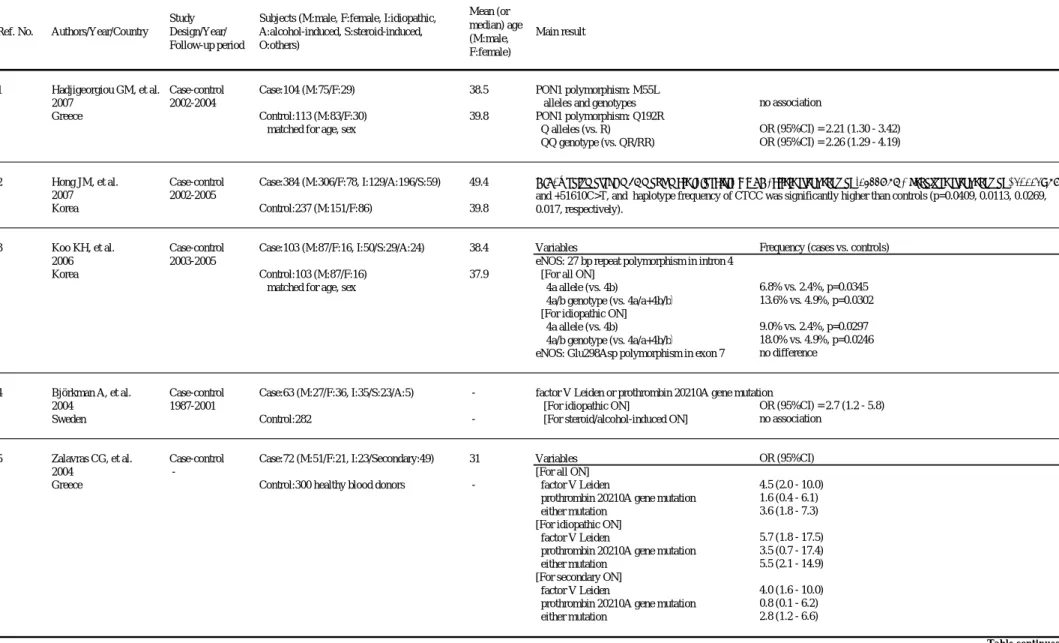
Table 1. Previous studies in relation to associated factors for All ONFH or non-steroidal ONFH (ONFH: osteonecrosis of the femoral head) Study design: Comparison studies
Ref. No. Authors/Year/Country Study Design/Year/
Follow-up period
Subjects (M:male, F:female, I:idiopathic, A:alcohol-induced, S:steroid-induced, O:others)
Mean (or median) age (M:male, F:female)
Main result
1 Hadjigeorgiou GM, et al. Case-control Case:104 (M:75/F:29) 38.5 PON1 polymorphism: M55L
2007 2002-2004 alleles and genotypes
Greece Control:113 (M:83/F:30) 39.8 PON1 polymorphism: Q192R
matched for age, sex Q alleles (vs. R)
QQ genotype (vs. QR/RR)
2 Hong JM, et al. Case-control Case:384 (M:306/F:78, I:129/A:196/S:59) 49.4
2007 2002-2005
Korea Control:237 (M:151/F:86) 39.8
3 Koo KH, et al. Case-control Case:103 (M:87/F:16, I:50/S:29/A:24) 38.4 Variables
2006 2003-2005 eNOS: 27 bp repeat polymorphism in intron 4
Korea Control:103 (M:87/F:16) 37.9 [For all ON]
matched for age, sex 4a allele (vs. 4b)
4a/b genotype (vs. 4a/a+4b/b)
[For idiopathic ON]
4a allele (vs. 4b)
4a/b genotype (vs. 4a/a+4b/b)
eNOS: Glu298Asp polymorphism in exon 7
4 Björkman A, et al. Case-control Case:63 (M:27/F:36, I:35/S:23/A:5) - factor V Leiden or prothrombin 20210A gene mutation
2004 1987-2001 [For idiopathic ON]
Sweden Control:282 - [For steroid/alcohol-induced ON]
5 Zalavras CG, et al. Case-control Case:72 (M:51/F:21, I:23/Secondary:49) 31 Variables
2004 - [For all ON]
Greece Control:300 healthy blood donors - factor V Leiden
prothrombin 20210A gene mutation either mutation
[For idiopathic ON]
factor V Leiden
prothrombin 20210A gene mutation either mutation
[For secondary ON]
factor V Leiden
prothrombin 20210A gene mutation either mutation
Table continues.
0.8 (0.1 - 6.2) 2.8 (1.2 - 6.6) 1.6 (0.4 - 6.1) 3.6 (1.8 - 7.3) 5.7 (1.8 - 17.5) 3.5 (0.7 - 17.4) 5.5 (2.1 - 14.9) 4.0 (1.6 - 10.0) 6.8% vs. 2.4%, p=0.0345 13.6% vs. 4.9%, p=0.0302 9.0% vs. 2.4%, p=0.0297 18.0% vs. 4.9%, p=0.0246
HIF1α polymorphism: Among male idiopathic ONFH, allele frequency of -2755C>A, genotype frequency of +41224T>C and +51610C>T, and haplotype frequency of CTCC was significantly higher than controls (p=0.0409, 0.0113, 0.0269, 0.017, respectively).
OR (95%CI) no association
OR (95%CI) = 2.21 (1.30 - 3.42) OR (95%CI) = 2.26 (1.29 - 4.19)
Frequency (cases vs. controls)
no difference
OR (95%CI) = 2.7 (1.2 - 5.8) no association
4.5 (2.0 - 10.0)
Table 1. (continued)
Ref. No. Authors/Year/Country Study Design/Year/
Follow-up period
Subjects (M:male, F:female, I:idiopathic, A:alcohol-induced, S:steroid-induced, O:others)
Mean (or median) age (M:male, F:female)
Main result
6 Hadjigeorgiou GM, et al. Case-control Case:51 (M:35/F:16) 36.2
2004 -
Greece Control:86 (M:56/F:30) 31.2
matched for age, sex
7 Sakata R, et al. Case-control Case:43 (M:34/F:9) M:46.53 Variables
2003 1994-2001 without history of systemic corticosteroid use F:54.11 [Among male]
Japan Occupation by workload intensity
Control:86 (M:68/F:18) M:44.65 (heavier vs. lighter) matched for ethnicity, gender, age, F:54.44 BMI at examination (/ kg/m2) department, date of initial examination ALHD2 genotype
(1/1 vs. 1/2 or 2/2)
Frequency of green tea drinking (<3 or 4 times/w vs. everyday)
Cumulative alcohol consumption (/drink-years)
8 Tektonidou MG, et al Comparison study 30 primary APS patients (M:7/F:23) Prevalence of asymptomatic avascular osteonecrosis
2003 - without history of corticosteroid use primary APS patients: 20%
Greece 19 SLE patients (M:5/F:14) SLE patients: 0%
without history of corticosteroid use healthy subjects: 0%
10 without aCL, 9 with aCL but not APS 30 healthy subjects (M:7/F:23)
matched for age and sex to the patients with primary APS *APS: antiphospholipid syndrome, aCL:anticardiolipin antibodies
9 Miller KD, et al Comparison study 339 asymptomatic HIV-infected adults Prevalence of osteonecrosis of hip on MRI: HIV-infected 4.4% , HIV-negative 0%
2002 1999 (M:311/F:28)
US Among HIV-infected patients, osteonecrosis occurred more frequently in those with:
any lifetime use of systemic corticosteroids, lipid lowering agents, or testosterone 118 HIV-negative volunteers a history of routine exercise by weightlifting or bodybuilding
matched for age and sex detectable levels of anticardiolipin antibodies
10 Miyanishi K, et al Case-control Case:50 (M:34/F:16, S:20/A:18/I:12) 44.4 Case vs. Control A: high apo B/apo A1 ratio was significantly associated
1999 1996-1997
Japan Control:
A. 50 healthy Japanese volunteers (M:34/F:16) 44.4 matched for age and sex
no association 1.016 (1.004 - 1.028) OR (95%CI)
5.785 (1.211 - 27.635) 0.787 (0.601 - 1.032) no association
White matter lesion (WML) were detected in 29 (29/51; 56.9%) patients with osteonecrosis of the femoral head (p<0.0001, compared to control group). The frequency of history of corticosteroid treatment was statistically lower in patients with WML compared to those without it (58.6 vs. 90.1%, p=0.03).
The apo B/apo A1 ratio in the cases was significantly higher than that in the control A (p<0.001), control B (p<0.01), or control C (p<0.001), but there was no significant difference between the three control groups.
with ON:
44.4, without ON: 41.9
Table 1. (continued)
Ref. No. Authors/Year/Country Study Design/Year/
Follow-up period
Subjects (M:male, F:female, I:idiopathic, A:alcohol-induced, S:steroid-induced, O:others)
Mean (or median) age (M:male, F:female)
Main result
11 Korompilias AV, et al. Case-control Case:40 (M:25/F:15, S:21/A:9/I:7/O:3) 34.3 Presence of anticardiolipin titer:
1997 - Case 37.5% , Control 1% (p<0.001)
US Control:100 (M:52/F:48) 37 Among cases:
from healthy laboratory personnel positive for IgM alone: 15%
positive for IgA alone: 15%
positive for IgM and IgA: 7.5%
12 Moskal JT, et al Comparison study Case:19 (M:5/F:14), idiopathic 52
1997 1987-1995
US
13 Shibata A, et al Case-control Case:90 (M:64/F:26) M:49.0, Variables
1996 1988-1994 without history of systemic corticosteroid use F:56.7 [Among male]
Japan Smoking habit
Control:180 (M:128/F:52) M:49.0 (exsmoker, current vs. nonsmoker) matched for sex, age, ethnicity, department F:56.3 Daily no. of cigarettes
(1-9, 10-19, 20+ vs. non- or ex-smoker) Pack-years
(<10, <20, <30, 30+ vs. never) Drinking habit
(current vs. nondrinker or exdrinker) Daily alcohol consumption [ml]
(<56, <84, 84+ vs. nondrinker or <28) Cumulative alcohol consumption [drink-years]
(<20, <30, 30+ vs.nondrinker or <10) Flushing pattern
History of liver diseases Occupational history BMI
(<23, 23+ vs. <23)
Table continues.
trend p<0.001
1.61 (0.16 - 16.27), 6.92 (0.48 - 99.18), 45.94 (5.64 - 374.26) trend p<0.001
no association 4.79 (0.93 - 24.65) no association OR (95%CI)
no association no association no association
0.16 (0.04 - 0.67), 0.16 (0.04 - 0.62), trend p<0.05
16 patients had an elevated serum cholesterol level (220+ mg/dl). The patients with idiopathic avascular osteonecrosis had statistically significantly (p<0.0031) elevated cholesterol levels compared with the value expected for the general population.
27.09 (2.80 - 262.35)
10.23 (1.02 - 102.12), 17.64 (2.74 - 113.73), 36.71 (5.51 - 244.74)
Table 1. (continued)
Ref. No. Authors/Year/Country Study Design/Year/
Follow-up period
Subjects (M:male, F:female, I:idiopathic, A:alcohol-induced, S:steroid-induced, O:others)
Mean (or median) age (M:male, F:female)
Main result
14 Hirota Y, et al Case-control Case:118 (M:83/F:35) 48.4 Variables
1993 1988-1990 without history of systemic corticosteroid use Alcohol drinking
Japan (former, occasional, regular vs. never)
Control:236 (M:166/F70) 48.3 Weekly ethanol intake [g/week]
matched for sex, age, ethnicity, (<320, 320-799, 800+ vs. nondrinker) department, date of initial examination Drink-years
(<3200, 3200-7999, 8,000+ vs. never) Cigarette smoking
(former, current vs. never) Daily no. of cigarettes smoked (<20, 20+ vs. nonsmoker) Pack-years
(<10, 10-19, 20+ vs. never)
Daily occupational energy consumption [kcal/day]
(1,900-2,499, 2,500+ vs. <1,900) Body mass index [kg/m2] (25+ vs. <25)
History of liver dysfunction
15 Naumann T, et al Comparison study
1990 1982-1987
(M:8/F:69)
6 months
(M:4/F:39)
Table continues.
1.0 (0.4 - 2.4), 2.0 (0.9 - 4.6), trend p<0.05 no association
OR (95%CI)
1.0 (0.2 - 6.2), 3.2 (1.1 - 9.2), 13.1 (4.1 - 42.5), trend p<0.001 2.8 (1.0 - 7.8), 9.4 (3.0 - 29.0), 14.8 (3.8 - 57.2), trend p<0.001 2.2 (0.7 - 6.9), 9.7 (2.6 - 36.1), 12.9 (3.8 - 43.4), trend p<0.001 3.3 (0.9 - 11.6), 4.7 (1.5 - 14.5), trend p<0.01
1.7 (0.6 - 4.5), 2.6 (1.1 - 6.0), trend p<0.05
1.6 (0.4 - 6.3), 6.6 (1.7 - 25.7), 6.5 (1.9 - 21.9), trend p<0.005
mean: 2 years 11 months
Lorenz group: 77 patients with 92 congenital dislocation of the hip joint, reduced with a Hoffman-Daimler brace and subsequently placed in a spica cast in Lange position after a period in the Lorenz position
Fettweis group: 43 patients with 48 congenital dislocation of the hip joint, reduced the same way but retained in a spica
The Lorenz group showed 10 (out of 92, 10.9%) grade II and III femoral head necrosis, whereas there was only one (out of 48, 2.1%) grade III osteonecrosis in the Fettweis group.
8 months 2 weeks
2.2 (1.0 - 5.2)
Table 1. (continued)
Ref. No. Authors/Year/Country Study Design/Year/
Follow-up period
Subjects (M:male, F:female, I:idiopathic, A:alcohol-induced, S:steroid-induced, O:others)
Mean (or median) age (M:male, F:female)
Main result
16 Matsuo K, et al Case-control Case:112 (M:94/F:18) 43 Variables
1988 1980-1985 without history of systemic corticosteroid use Alcohol drinking
Japan (former, occasional, regular vs. never)
Control:168 (M:140/F28) 43 Weekly alcohol consumption [ml/week]
matched for sex, age, ethnicity, (<400, 400-1000, 1,000+ vs. nondrinker) hospital, date of initial diagnosis Cigarette smoking
(former, current vs. never) Daily no. of cigarettes smoked (<20, 20+ vs. nonsmoker)
Daily occupational energy consumption Obesity
History of liver dysfunction
17 Powell EN, et al Comparison study 36 children with 49 complete dislocations Correlation of surgery type versus avascular necrosis
1986 1966-1983 (M:5/F:31)
US -
Open reduction alone 4/16 (25) 0/16 (0) 6/16 (0) 16 Open reduction/VDO 4/18 (22) 1/18 (5.5) 1/18 (61.1) 27 Open reduction/innominate7/15 (46.7) 0/15 (0) 10/15 (66.7) 29
no association no association 5.2 (2.4 - 11.2) OR (95%CI or p value))
Partial avascular
necrosis (%)
Total avascular
necrosis (%)
Additional
surgery (%) Age (mo) Type
1.3 (0.4 - 4.6), 3.9 (1.3 - 11.7) 3.0 (p<0.05), 3.0 (p<0.05)
4.0 (0.6 - 26.0), 5.1 (1.4 - 17.5), 7.8 (2.6 - 23.6)
3.3 (1.2 - 8.7), 9.8 (3.2 - 30.6), 17.9 (3.4 - 95.4), trend p<0.001
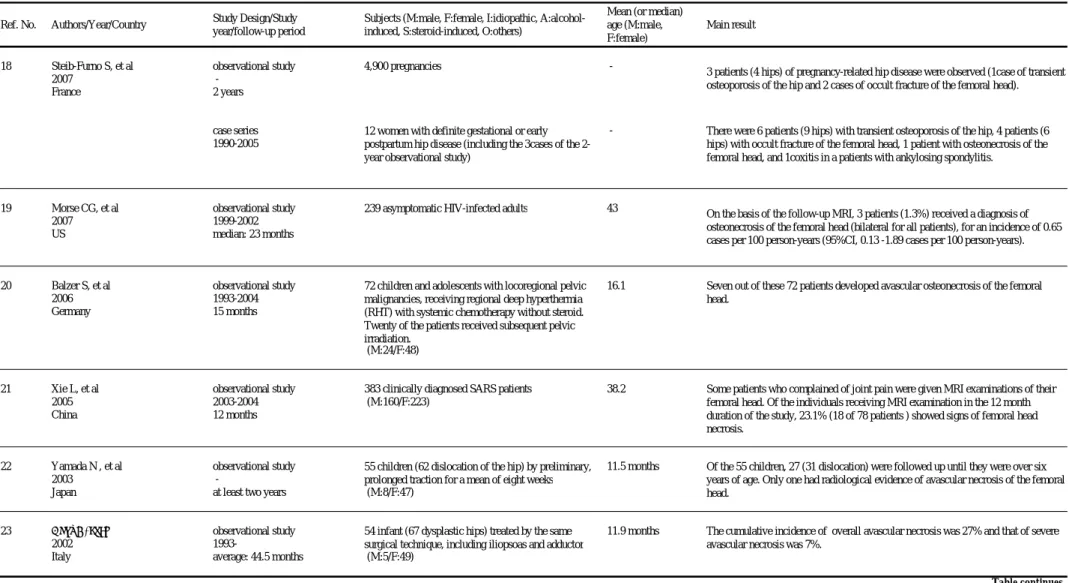
Table 2. Previous studies in relation to associated factors for All ONFH or non-steroidal ONFH (ONFH: osteonecrosis of the femoral head) Study design: Observational studies without comparison group, Descriptive studies, or Case series
Ref. No. Authors/Year/Country Study Design/Study year/follow-up period
Subjects (M:male, F:female, I:idiopathic, A:alcohol- induced, S:steroid-induced, O:others)
Mean (or median) age (M:male, F:female)
Main result
18 Steib-Furno S, et al observational study 4,900 pregnancies -
2007 -
France 2 years
case series -
1990-2005
19 Morse CG, et al observational study 239 asymptomatic HIV-infected adults 43
2007 1999-2002
US median: 23 months
20 Balzer S, et al observational study 16.1
2006 1993-2004
Germany 15 months
(M:24/F:48)
21 Xie L, et al observational study 383 clinically diagnosed SARS patients 38.2
2005 2003-2004 (M:160/F:223)
China 12 months
22 Yamada N , et al observational study 11.5 months
2003 -
Japan at least two years (M:8/F:47)
23 Aguş H, et al observational study 11.9 months
2002 1993-
Italy average: 44.5 months (M:5/F:49)
72 children and adolescents with locoregional pelvic malignancies, receiving regional deep hyperthermia (RHT) with systemic chemotherapy without steroid.
Twenty of the patients received subsequent pelvic irradiation.
The cumulative incidence of overall avascular necrosis was 27% and that of severe avascular necrosis was 7%.
54 infant (67 dysplastic hips) treated by the same surgical technique, including iliopsoas and adductor 55 children (62 dislocation of the hip) by preliminary, prolonged traction for a mean of eight weeks
Table continues.
3 patients (4 hips) of pregnancy-related hip disease were observed (1case of transient osteoporosis of the hip and 2 cases of occult fracture of the femoral head).
12 women with definite gestational or early postpartum hip disease (including the 3cases of the 2- year observational study)
On the basis of the follow-up MRI, 3 patients (1.3%) received a diagnosis of osteonecrosis of the femoral head (bilateral for all patients), for an incidence of 0.65 cases per 100 person-years (95%CI, 0.13 -1.89 cases per 100 person-years).
Some patients who complained of joint pain were given MRI examinations of their femoral head. Of the individuals receiving MRI examination in the 12 month duration of the study, 23.1% (18 of 78 patients ) showed signs of femoral head necrosis.
Of the 55 children, 27 (31 dislocation) were followed up until they were over six years of age. Only one had radiological evidence of avascular necrosis of the femoral head.
Seven out of these 72 patients developed avascular osteonecrosis of the femoral head.
There were 6 patients (9 hips) with transient osteoporosis of the hip, 4 patients (6 hips) with occult fracture of the femoral head, 1 patient with osteonecrosis of the femoral head, and 1coxitis in a patients with ankylosing spondylitis.
Table 2. (continued)
Ref. No. Authors/Year/Country Study Design/Study year/follow-up period
Subjects (M:male, F:female, I:idiopathic, A:alcohol- induced, S:steroid-induced, O:others)
Mean (or median) age (M:male, F:female)
Main result
24 Dzik-Jurasz AS, et al observational study 66.7
2001 -
UK (M:11/F:23)
25 Bonfanti P, et al observational study 1,207 HIV-infected patients with protease inhibitors 37.1
2001 1997- (M:880/F:327)
Italy average: 10.7 months
26 Boechat MI, et al observational study 205 children with chronic renal failure but not end stage 6
2001 1990-1996 (M:159/F:46)
US mean: 3 years
27 Winquist EW, et al observational study - occurrence of ONFH: 2% (2/107)
2001 1950-1995 duration from initiation of chemotherapy to diagnosis: 45 and 47 months
US - total equivalent prednisone dose during chemotherapy: 2,820 mg and 2,240mg
28 Williams PR, et al observational study - incidence of avascular necrosis: none
1999 1987-
UK a minimum of 9 years
29 Enrici RM, et al observational study 30.5
1998 1972-1996
Italy average: 78 months
(M:431/F:353)
30 Thomas IH, et al observational study 22 months
1989 1970-1980
Australia - (M:13/F:59)
31 Gregosiewicz A, et al observational study 1,211 hips with congenital dislocation
1988 -
Poland -
mean time of MRI scanning after the end of treatment: 33.7 months
Radiographic findings of avascular necrosis (AVN) of the femoral head were seen in 14 of 205 patients (7%). The frequency of AVN was similar in boys and girls, and was not related to the duration of renal disease, type of renal disease, or growth hormone therapy. In two instances, AVN developed while the patients were receiving corticosteroids before entering this study.
83 infants (117 type III-IV hips) using Aberdeen splint due to at 'high risk' for developmental dysplasia of the hip
Table continues.
Avascular osteonecrosis was detected in 254 (21%) of all hips.
784 patients treated for Hodgkin's disease either with chemotherapy (CT) containing steroids, combined in some cases with subdiaphragmatic radiotherapy (RT), or with subdiaphragmatic RT combined with CT
9 cases of avascular osteonecrosis emerged in the head of the femur, appearing between 23 and 97 months after initial treatment. All the patients in whom avascular osteonecrosis appeared had received, either as initial treatment or after relapse, RT/CT or CT including steroids.
107 men with testicular cancer receiving chemotherapy with curative intent and with a minimum 2 years of follow-up
72 infants and children with 87 dislocated hips treated by open reduction
Avascular necrosis (AVN) was observed in 37% of the hips, yet open reduction did not appear to contribute to the development of AVN as its prevalence was similar in hips treated by open or closed reduction in our institution.
34 patients previously treated for anal cancer by chemoradiation, currently disease free
No cases (0/34) of symptomatic or asymptomatic femoral head osteonecrosis were detected.
During treatment with protease inhibitors, 4 cases of bilateral osteonecrosis of the femoral head have been reported out of 1,073 person-years.
Table 2. (continued)
Ref. No. Authors/Year/Country Study Design/Study year/follow-up period
Subjects (M:male, F:female, I:idiopathic, A:alcohol- induced, S:steroid-induced, O:others)
Mean (or median) age (M:male, F:female)
Main result
32 Haajanen J, et al observational study 38
1985 1966-1981
Finland
(M:312/F:234)
33 Zabinski SJ, et al descriptive study 56.1
1998 -
US (M:40/F:467)
34 Hanif I, et al descriptive study -
1993 1974-1991
US
35 Ries MD, et al case series 38 patients (M:24/F:14) 37.4
2002 1992-1998
US
36 Castro FP Jr and Harris MB case series 172 patients (M:122/F:50) with 245 hips 44 Distribution of Patients and Hips by Causes, Steinberg Stage
1999 1984-1998 Steroid Alcohol Idiopathic Total
US Patients (hips) 69 (103) 63 (88) 40 (54) 172 (245)
Male 32 61 29 122
Female 37 2 11 50
Age (SE) 39 (2) 49 (1) 42 (2) 44 (1)
Steinberg stage (patients [hips])
I 6 (10) 2 (2) 5 (6) 13 (18)
II 20 (29) 4 (6) 13 (18) 37 (53)
III 19 (25) 12 (15) 22 (30) 53 (70)
IV-V 24 (39) 45 (65) 0 (0) 69 (104)
7 patients were HIV positive, and 31 were HIV negative. Of the 7 patients who were HIV positive, 4 (57%) had none of the known risk factors for osteonecrosis.
Aseptic hip necrosis developed in 39 hips in 29 patients (5.3%) from 3 to 121 months (mean 22 months ) after the renal transplantation.
5,278 patients treated for cancer at a major pediatric oncology center
Table continues.
546 renal transplant patients (639 transplants) with graft survival for a minimum of 12 months.
Glucocorticosteroids and azathioprine were used as immunosuppressive agents.
Osteonecrosis was identified in 66 specimens (12.1%) in one of 2 discrete forms. 32 specimens (5.9%) contained classic subchondral avascular necrosis. 34 specimens (6.2%) contained osteonecrosis in association with degenerative changes.
Corticosteroid therapy was used in 81% of patients with avascular necrosis and 68 % with degenerative osteonecrosis. This was significantly greater prevalence than in patients without osteonecrosis (33%). Average daily prednisone dosage was 8 mg.
545 primary total hip arthroplasties performed in 507 patients with RA
Avascular femoral head osteonecrosis was identified in 15 patients. Both steroids and radiation therapy appear implicated in the pathogenesis of the avascular osteonecrosis: nine patients received high cumulative doses of prednisone (3.4-14 g/m2), four had received 35-64.8 Gy local irradiation involving the femoral head, and one underwent total body irradiation (12Gy).
Table 2. (continued)
Ref. No. Authors/Year/Country Study Design/Study year/follow-up period
Subjects (M:male, F:female, I:idiopathic, A:alcohol- induced, S:steroid-induced, O:others)
Mean (or median) age (M:male, F:female)
Main result
37 Collaborative Osteonecrosis Group case series 36
1999 1980-1996
US
(M:26/F:75)
38 Montella BJ, et al case series 13 pregnant women 31.5
1999 US
39 LaPorte DM, et al case series 34
1998 1976-1996
US (M:8/F:24)
Associated factors included systemic lupus erythematosus (13 patients), inflammatory bowel disease (5 patients), malignancy (4 patients), and renal transplantation (3 patients). Thirty of the 32 patients (94%) had a history of corticosteroid therapy, with the other 2 patients found to have a coagulopathy. All 32 patients had bilateral femoral head involvement.
32 patients with multifocal osteonecrosis (defined as involvement of 3 separate anatomic sites )
Eleven of the thirteen women were primigravid, and the patients typically first had the pain late in the second or third trimester of pregnancy. The women tended to have a small body frame and a relatively large weight gain during the pregnancy.
101 patients with multifocal osteonecrosis (defined as disease involving three or more separate anatomic site)
Ninety-two of the 101 (91%) patients had a history of corticosteroid therapy. Twenty (20%) patients had a history of smoking at least one pack per day of tobacco or had a greater than 10 pack year smoking history. Ten (10%) patients consumed more than 400mL per week of alcohol. Twelve patients (of 14 tested) were found to have a coagulation disorder. All 101 patients had femoral head involvement. Bilaterality was common (98%).
Table 3. Previous studies in relation to associated factors for All ONFH or non-steroidal ONFH (ONFH: osteonecrosis of the femoral head) Study design: Case report
Ref. No. Authors/Year/ Country
number of reported cases
underlying disease or condition case ID sex (M:male, F:female)
age at diagnosis with underlying disease
age at diagnosis with
ONFH site of ONFH status of other risk factors for ONFH
40 Lima GA, et al. 2 AIDS Case 1 F 43 52 left
2005
Brazil Case 2 F 41 43 left
41 Lien YH, et al 1 Fabry disease M 8 32 bilateral none
2005 US
42 Rollot F, et al 3 Case 1 M 55 46 bilateral none
2005 Case 2 F 37 46 bilateral none
France Case 3 M 46 46 right none
43 Siddiqui SA, et al 4 HIV infection Case 1 M 30 34 bilateral none
2004 Case 2 F 23 33 bilateral none
US Case 3 M 36 47 bilateral "social drinker" taking 1 to 2 drinks daily
Case 4 M 39 39 bilateral cigarettes: 1 pack daily; alcohol: 1 to 2 drinks daily
44 Kisielinski K, et al 1 F 49 69 left
2004 Germany
45 Smida M, et al 2 Case 1 M 12 15 left none
2003 Case 2 M 11 17 right none
Tunisia
46 Orpen N, et al 3 Case 1 F 68 68 (4 month after surgery) bilateral none
2003 Case 2 F 72 73 (5 month after surgery) bilateral none
England Case 3 M 73 73 (6 month after surgery) left none
Table continues.
systemic corticosteroid use for eight months due to a neurological condition
megestrol acetate use (synthetic progestetional steroid), 800mg/day for wasting syndrome
Hemocromatosis with homozygous for the C282Y mutation on HFE gene
At aged 54, she had had an intracapsular fracture of the femoral neck that had been treated immediately by screw-plate fixation. The fixation device was left in place and the femoral head remained viable. She experienced no hip pain until the onset of the current episode.
GH (growth hormone) deficiency treated by GH daily inhaled glucocorticoid therapy for chronic bronchitis
surgery for lumber spinal stenosis under prolonged hypotensive anesthesia in the prone position
Table 3. (continued)
Ref. No. Authors/Year/ Country
number of reported cases
underlying disease or condition case ID sex (M:male, F:female)
age at diagnosis with underlying disease
age at diagnosis with
ONFH site of ONFH status of other risk factors for ONFH
47 Bojko P, et al 3 Case 1 F 49 53 bilateral none
2003 Case 2 F 40 47 right none
Germany Case 3 F 39 43 bilateral none
48 Aguiar De Aragão P, et al 1 M 7 bilateral none
2002 Brazil
49 Kubo T, et al 1 M 34 35 bilateral none
2000 Japan
50 Koller E, et al 3 Case 1 M - 55 bilateral none
2000 Case 2 M - 36 unilateral
US
Case 3 M - 34 bilateral none
51 Caniggia M, et al 2 pregnancy Case 1 F - left
1994 Italy
Case 2 F - left
relapsed ovarian cancer receiving high-dose chemotherapy with excessive single-dose treosulfan followed by autologous peripheral blood stem cell transplantation
36 (during the last weeks of uncomplicated second pregnancy)
taking oral contraceptives for four years discontinuing the treatment five months prior to conception
taking oral contraceptives intermittently in the previous eight years discontinuing contraceptives four months before conception hyperlipidemia in AIDS with
protease inhibitors
10 (7 month after the plasma triglyceride levels reached 460 mg/dl)
congenital antithrombin III deficiency
HIV seropositive patients
receiving megestrol acetate undisclosed dose and duration of corticosteroids concurrent with
pentamidine administration
26 (at the end of the seventh month of her first pregnancy)
定点モニタリングシステムによる特発性大腿骨頭壊死症の記述疫学
― 平成 17 年〜19 年の集計結果 ―
福島若葉、廣田良夫 (大阪市立大学大学院医学研究科公衆衛生学)
藤岡幹浩、久保俊一 (京都府立医科大学大学院医学研究科運動器機能再生外科学)
特発性大腿骨頭壊死症(ION)の定点モニタリングシステムに登録された新患・手術症例について、平成 17 年
〜19年の集計を行い、臨床疫学特性を検討した。解析対象となった新患症例は、平成 17 年:187 人(310 関 節)、平成 18 年:246 人(398 関節)、平成 19 年:181 人(296 関節)である。手術症例は、平成 17 年:121 人(126 関節)、平成 18 年:214 人(224 関節)、平成 19 年:153 人(161 関節)である。
新患症例の集計結果の概要を以下に示す。男女比は約 6:4 であった。誘因は、「ステロイド全身投与歴あり」
が 48〜55%と最多であり、「アルコール愛飲歴あり」が 28〜35%であった。「両方あり」を含めると、ステロイド関連 ION は 53〜59%であった。確定診断時年齢は 30〜50 代の割合が多く、30 代にピークを認めた。ステロイド全身 投与の対象疾患は SLE が最多であり、21〜28%を占めていた。確定診断時の病型は Type C-2 が最も多く、病 期は Stage 2〜3B の割合が多かった。
手術症例の集計結果の概要を以下に示す。男性の割合は 54〜69%であり、報告年によるばらつきを認めた。
誘因の分布は新患と同様であったが、平成19 年の報告症例はステロイド性の割合が 62%とやや高かった。手術 施行時の年齢分布は、30〜50 代の割合が多かったが、平成 19 年は 50 代に明瞭なピークを認めた。術直前の 病型は Type C-2 が約 80%を占めていた。病期については Stage 3A〜4 の割合が多かった。術式の内訳は、骨 切り術が 25〜29%、人工骨頭・人工関節置換術は約 60%であった。
1. 研究目的
本研究班では 1997 年に特定大規模医療施設を対象 とした定点モニタリングシステムを開始し1)、本邦におけ る特発性大腿骨頭壊死症(ION)の基本的特性を明らか にしてきた。当該システムの最大の長所は、過去 5 回に わたり実施されてきた全国調査 2-7) のような多大な労 力を要することなく、ION の臨床疫学特性を継続的に調 査可能なところにある。
平成 16 年度の報告書では、本システム開始以降に報 告された症例について 8 年間の集計を行なうとともに、
新患症例ついて確定診断年毎の経年変化を検討した8)。 今回、その後の症例、すなわち平成 17 年〜19 年の報 告症例について集計を行った。
2. 研究方法
および手術症例を所定の様式により逐一(あるいは随 時)報告し、登録するシステムである1)。1997 年6 月に開 始し、1997 年1月以降の症例について報告を得ている。
現在は本研究班員が所属する 25 施設(表1)の整形外 科が参加し、新患および手術に関するデータベース作 成作業を継続中である。
各施設で ION の新患症例および手術症例が発生した 場合、所定の様式の調査票により報告する。調査票は、
新患・手術用ともに各々1枚である。新患用調査票の主 要項目は確定診断時年齢、診断時所見、誘因であり、
手術用調査票の主要項目は、術直前の病型・病期分類、
施行した術式である。症例発生時に逐一報告する場合 もあるが、現在では、ある程度症例を蓄積した時点で随 時報告する場合がほとんどである。
平成 20 年 2 月 10 日現在、新患データベースに 1,990
月 31 日に報告された症例のうち、新患症例については 確定診断日から調査票記入日までの期間が3年以内の 者、手術症例については手術日から調査票記入日まで の期間が 1 年以内である者を抽出し、解析対象とした。
このような基準を設定した理由は、記入日の 10 年以 上前に確定診断を受けた症例なども報告されているた めである。この背景として、本システムの参加施設がい ずれも整形外科領域における高次医療施設であり、各 施設の関連病院で確定診断後、専門的加療が必要と なった後に紹介された、などの状況が考えられる。なお、
手術については参加施設において施行された症例を 報告するものであるため、手術日から記入日までの期 間は 1 年以内に設定した。
(倫理面への配慮)
本システムの運営に関しては、参加施設からの情報を 取りまとめる大阪市立大学大学院大医学研究科におい て、倫理委員会の承認を得た。
3. 研究結果
平成 17 年 1 月 1 日〜平成 19 年 12 月 31 日に報告さ れた新患症例は 673 人、手術症例は 488 人であった。
新患症例のうち、確定診断日から記入日までの期間 が3年以内の者は 614 人(1,004 関節)であった。各報告 年毎の内訳は、平成 17 年:187 人(310 関節)、平成 18 年:246 人(398 関節)、平成 19 年:181 人(296 関節)で あった。
手術症例は、488 人総てが施行後 1 年以内に報告さ れていた。各報告年毎の内訳は、平成 17 年:121 人
(126 関節)、平成 18 年:214 人(224 関節)、平成 19 年:
153 人(161 関節)であった。
A.新患症例の集計 1)男女比および誘因(表2)
各報告年ともに男女比は約 6:4 であった。誘因は、「ス テロイド全身投与歴あり(ステロイド性)」が 48〜55%と最 多であり、「アルコール愛飲歴あり(アルコール性)」が 28〜35%、「両方あり」が 3〜6%、「両方なし」が 6〜13%で あった。「両方あり」の者を含めると、ステロイド関連 ION は 53〜59%となった。誘因別に男女比をみると、ステロイ ド性では 50〜60%が女性であるのに対し、アルコール性 では 80〜90%が男性であった。
2)ION 確定診断時の年齢分布(図1)
確定診断時の平均年齢(中央値)は、平成 17 年:46 歳(43 歳)、平成 18 年:43 歳(41 歳)、平成 19 年:44 歳
(44 歳)であった。対象者全員でみると、確定診断時年 齢は各報告年ともに 30〜50 代の割合が多く、30 代にピ ークを認めた。この傾向は、男性に限った集計でも認め られた。女性に限ってみると、報告年によって分布に差 を認めた。平成 17 年は 2 峰性のピークを認め、他の報 告年と比較すると高齢者の割合が多い傾向であった。
また、20 歳未満の若年発症例は女性で多かった。
3)ステロイド全身投与の対象疾患(表3)
各報告年ともに SLE が最多であり、21〜28%を占めて いた。ステロイド全身投与対象疾患の確定診断から ION 確定診断までの平均年数(中央値)は平成 17 年:
5.6 年(3.0 年)、平成 18 年:5.4 年(3.0 年)、平成 19 年:4.7 年(2.0 年)であった。
4)確定診断時の病型・病期分類(表4)
各報告年ともに、病型は Type C-2 が最も多く、約 60%
を占めていた。病期は Stage 2〜3B の割合が多かった。
B.手術症例
1)性比および誘因(表5)
男性の割合は 54〜69%であり、新患と比較して報告年 によるばらつきを認めた。誘因の分布は新患と同様の 傾向を示していたが、平成 19 年の報告症例はステロイ ド性の割合が 62%とやや高かった。
2)手術施行時の年齢分布(図 2)
手術施行時の平均年齢(中央値)は、平成 17 年:46 歳(47 歳)、平成 18 年:44 歳(43 歳)、平成 19 年:48 歳
(50 歳)であった。平成 17 年、18 年については新患症 例と同様、30〜50 代の割合が多かったが、平成19 年は 50 代に明瞭なピークを認めた。
3)術直前の病型・病期分類(表6)
各報告年ともに、病型は Type C-2 が最も多く、約 80%
を占めていた。病期については Stage 3A〜4 の割合が 多かった。
4)術式(表7)
骨切り術は 25〜29%に施行されていた。人工骨頭・人 工関節置換術の頻度は約 60%であった。
4. 考察および結論
ION 定点モニタリングシステムに平成 17 年〜19 年に かけて報告された新患・手術症例について、臨床疫学 特性を検討した。その概要は、おおむね過去の集計結 果あるいは 2005 年に実施の全国疫学調査結果と似通 っていた。しかし、女性における ION 確定診断時の年 齢分布については、平成 17 年の報告新患症例におい
て 2 峰性のピークが示唆され、高齢者の割合が多い傾 向であった。しかし、当該年は症例数が最も少なかった こと、他の報告年ではそのような傾向を認めなかったこ とより、偶然による可能性がある。今後も本システムを継 続し、特性を経年的に把握して評価することが肝要で ある。なお、本システムにより収集した情報は、全国疫 学調査における報告新患症例の情報の約 40%をカバー していると考えられており、その効率の良さは過去の報 告書に詳述の通りである9)。
また、1997 年のシステム開始からすでに 10 年以上経 過し、データベース上も十分な症例数が蓄積されてい る。平成 20 年度は、1997 年以降 10 年間のまとめを行う とともに、5 年毎の経年変化を検討することを予定して いる。
5. 謝辞
日常診療、教育、研究にご多忙な中、貴重な時間を 割いて調査にご協力くださいました諸先生方に深く感 謝致します。
6. 研究発表
1. 論文発表なし 2. 学会発表
なし
7. 知的所有権の取得状況
1. 特許の取得なし
2. 実用新案登録 なし
3. その他 なし
8. 参考文献
1) 廣田良夫, 竹下節子:定点モニタリングによる特発 性大腿骨頭壊死症の記述疫学研究. 厚生省特定 疾患骨・関節系疾患調査研究班平成 10 年度研究 報告書, 175〜177 頁, 1999.
2) 二ノ宮節夫, 田川宏, 宮永豊, ほか:特発性大腿 骨頭壊死症に関する全国疫学調査最終結果報告.
厚生省特定疾患特発性非感染性骨壊死症調査研
厚生省特定疾患特発性大腿骨頭壊死症調査研究 班昭和 58 年度研究報告書, 63〜65 頁, 1984.
4) 二ノ宮節夫, 小野啓郎:特発性大腿骨頭壊死症に 関する昭和 62 年疫学調査結果. 厚生省特定疾患 特発性大腿骨頭壊死症調査研究班昭和63 年度研 究報告書, 269〜271 頁, 1989.
5) 青木利恵, 大野良之, 玉腰暁子, ほか:特発性大 腿骨頭壊死症の全国疫学調査成績. 厚生省特定 疾患難病の疫学調査研究班平成 7 年度研究業績 集, 67〜71 頁, 1996.
6) Hirota Y, Hotokebuchi T and Sugioka Y: Idiopathic osteonecrosis of the femoral head; nationwide epidemiologic studies in Japan. Osteonecrosis- Etiology, Diagnosis and Treatment, ed. by Urbaniak JR and Jones JP Jr, American Academy of Orthopaedic Surgeons, Rosemont, pp 51-58, 1997.
7) 福島若葉, 廣田良夫, 藤岡幹浩, ほか:特発性大 腿骨頭壊死症の全国疫学調査―最終結果―. 厚 生労働科学研究費補助金難治性疾患克服研究事 業 特発性大腿骨頭壊死症の予防と治療の標準化 を目的とした総合研究 平成 18 年度総括・分担研 究報告書, 1〜6 頁, 2007.
8) 福島若葉, 田中 隆, 竹下節子, 廣田良夫, ほか.
定点モニタリングによる特発性大腿骨頭壊死症の 記述疫学研究―新患症例に関する 8 年間の集計・
確定診断年別の経年変化―. 厚生労働科学研究 費補助金 難治性疾患克服研究事業 特発性大腿 骨頭壊死症の予防と治療の標準化を目的とした総 合研究 平成 16 年度総括・分担研究報告書, 6〜
10 頁, 2005.
9) 福島若葉, 廣田良夫, 藤岡幹浩, ほか:定点モニ タリングシステムにより収集した特発性大腿骨頭壊 死症の臨床疫学情報の特徴―全国疫学調査結果 との比較―. 厚生労働科学研究費補助金難治性 疾患克服研究事業 特発性大腿骨頭壊死症の予 防と治療の標準化を目的とした総合研究 平成 18 年度総括・分担研究報告書, 7〜11 頁, 2007.
表 1. ION 定点モニタリングシステム参加施設(平成 19 年 2 月 10 日現在、順不同)
旭川医科大学 信州大学 大阪市立大学
昭和大学 藤が丘病院 佐賀大学 北海道大学
金沢医科大学 長崎大学 東京大学
名古屋大学 横浜市立大学 神戸大学
大阪大学 鹿児島大学 東京医科歯科大学
独立行政法人国立病院機構 大阪医療センター 宮崎大学 東京医科大学
九州大学 広島大学 関西労災病院
久留米大学医学部附属医療センター 新潟大学
京都府立医科大学 札幌医科大学
性
男性 117 ( 63 ) 142 ( 58 ) 110 ( 61 )
女性 68 ( 37 ) 103 ( 42 ) 71 ( 39 )
記入なし 2 1 ―
誘因
ステロイド全身投与歴あり 89 ( 48 ) 129 ( 53 ) 100 ( 55 ) アルコール愛飲歴あり 66 ( 35 ) 86 ( 35 ) 51 ( 28 )
両方あり 9 ( 5 ) 15 ( 6 ) 6 ( 3 )
両方なし 23 ( 12 ) 15 ( 6 ) 24 ( 13 )
不明・記入なし ― 1 ―
注:表中の数字はn (%)を示す。
H19 (N=181) 表2.新患症例の性および誘因
H17 H18
(N=187) (N=246)
図 1. 確定診断時の年齢分布
0 5 10 15 20 25 30
<20 20- 30- 40- 50- 60- 70- 80-
H17 (N=187) H18 (N=246) H19 (N=180)*
0 5 10 15 20 25 30 35
<20 20- 30- 40- 50- 60- 70- 80-
H17 (N=117) H18 (N=142) H19 (N=110)
0 5 10 15 20 25 30
<20 20- 30- 40- 50- 60- 70- 80-
H17 (N=68) H18 (N=103) H19 (N=70)
(年齢)
(年齢)
(年齢)
(%)
(%)
(%)
【対象者全員】
【女性】
【男性】
*
SLE 18 ( 21 ) 35 ( 28 ) 23 ( 23 )
RA 3 ( 4 ) 0 ( 0 ) 0 ( 0 )
多発性筋炎・皮膚筋炎 2 ( 2 ) 7 ( 6 ) 4 ( 4 )
MCTD 0 ( 0 ) 3 ( 2 ) 0 ( 0 )
シェーグレン 2 ( 2 ) 0 ( 0 ) 3 ( 3 )
その他の膠原病 5 ( 6 ) 6 ( 5 ) 11 ( 11 )
ネフローゼ症候群 2 ( 2 ) 9 ( 7 ) 7 ( 7 )
腎炎 5 ( 6 ) 0 ( 0 ) 2 ( 2 )
腎移植 4 ( 5 ) 1 ( 1 ) 3 ( 3 )
その他の臓器移植 0 ( 0 ) 3 ( 2 ) 4 ( 4 )
血小板減少性紫斑病 3 ( 4 ) 8 ( 6 ) 3 ( 3 )
再生不良性貧血 0 ( 0 ) 1 ( 1 ) 2 ( 2 )
肝炎 2 ( 2 ) 2 ( 2 ) 1 ( 1 )
喘息 3 ( 4 ) 9 ( 7 ) 8 ( 8 )
皮膚疾患 0 ( 0 ) 3 ( 2 ) 2 ( 2 )
眼疾患 2 ( 2 ) 5 ( 4 ) 4 ( 4 )
その他 34 ( 40 ) 34 ( 27 ) 22 ( 22 )
不明・記入なし 4 3 1
注1:
注2: 表中の数字はn (%)を示す。
解析対象は、誘因に「ステロイド全身投与歴あり」と記載があった者。複数回 答については、最も早く診断されたものを選定。
H19 (N=100) 表3.新患症例におけるステロイド全身投与の対象疾患
H17 H18
(N=89) (N=129)
病型分類
Type A 11 ( 3.7 ) 14 ( 3.6 ) 15 ( 5.3 ) Type B 24 ( 8.0 ) 33 ( 8.4 ) 23 ( 8.1 ) Type C-1 90 ( 29.9 ) 113 ( 28.9 ) 84 ( 29.6 ) Type C-2 175 ( 58.1 ) 228 ( 58.3 ) 161 ( 56.7 ) 正常 1 * ( 0.3 ) 3 * ( 0.8 ) 1 * ( 0.4 )
判定不能・不明・記入なし 9 7 12
病期分類
Stage 1 45 ( 15.0 ) 60 ( 15.3 ) 46 ( 15.9 ) Stage 2 77 ( 25.6 ) 99 ( 25.2 ) 74 ( 25.5 ) Stage 3A 79 ( 26.3 ) 100 ( 25.5 ) 94 ( 32.4 ) Stage 3B 75 ( 24.9 ) 90 ( 22.9 ) 47 ( 16.2 ) Stage 4 25 ( 8.3 ) 43 ( 10.9 ) 27 ( 9.3 )
正常 0 ( 0.0 ) 1 * ( 0.3 ) 2 * ( 0.7 )
判定不能・不明・記入なし 9 5 6
注1:
注2:
* 病型・病期のいずれかに異常所見の記載があったため、集計に含めた。
解析対象は、病型・病期ともに「正常」以外の所見が記載されている関節。
表中の数字は関節数 (%)を示す。
(関節数:398) (関節数:296)
表4.確定診断時の病型・病期分類(新分類)
H17 H18
(関節数:310)
H19
性
男性 84 ( 69 ) 124 ( 58 ) 83 ( 54 )
女性 37 ( 31 ) 90 ( 42 ) 70 ( 46 )
記入なし ― ― ―
誘因
ステロイド全身投与歴あり 58 ( 49 ) 117 ( 55 ) 93 ( 62 ) アルコール愛飲歴あり 43 ( 36 ) 67 ( 31 ) 35 ( 23 )
両方あり 5 ( 4 ) 12 ( 6 ) 6 ( 4 )
両方なし 13 ( 11 ) 18 ( 8 ) 17 ( 11 )
不明・記入なし 2 ― 2
注:表中の数字はn (%)を示す。
(N=121) (N=214) (N=153)
表5.手術症例の性および誘因
H17 H18 H19
図2. 手術施行時の年齢分布
0 5 10 15 20 25 30 35
<20 20- 30- 40- 50- 60- 70- 80-
H17 (N=120)*
H18 (N=213)*
H19 (N=152)*
* 各報告年ともに、1 人が手術施行時年齢不明。
(%)
(年齢)
病型分類
Type A 0 ( 0.0 ) 1 ( 0.5 ) 0 ( 0.0 )
Type B 0 ( 0.0 ) 4 ( 1.9 ) 2 ( 1.4 )
Type C-1 20 ( 19.2 ) 48 ( 22.4 ) 27 ( 18.8 ) Type C-2 84 ( 80.8 ) 161 ( 75.2 ) 114 ( 79.2 )
正常 0 ( 0.0 ) 0 ( 0.0 ) 1 ( 0.7 )
判定不能・不明・記入なし 22 10 17
病期分類
Stage 1 0 ( 0.0 ) 3 ( 1.4 ) 3 ( 2.0 ) Stage 2 17 ( 16.4 ) 16 ( 7.3 ) 15 ( 9.8 ) Stage 3A 36 ( 34.6 ) 62 ( 28.3 ) 55 ( 36.0 ) Stage 3B 34 ( 32.7 ) 79 ( 36.1 ) 38 ( 24.8 ) Stage 4 17 ( 16.4 ) 59 ( 26.9 ) 42 ( 27.5 )
正常 0 ( 0.0 ) 0 ( 0.0 ) 0 ( 0.0 )
判定不能・不明・記入なし 22 5 8
注1:
注2:
* 旧分類による報告は「判定不能・不明・記入なし」のカテゴリーに含めて集計。
表中の数字は関節数 (%)を示す。
(関節数:126) (関節数:224) (関節数:161)
解析対象は、「今回の手術あり」と記載があった関節。
表6.術直前の病型・病期分類(新分類)
H17* H18 H19
骨切り術 37 ( 29 ) 62 ( 28 ) 40 ( 25 )
骨移植術 0 ( 0 ) 4 ( 2 ) 0 ( 0 )
人工骨頭・人工関節置換 72 ( 57 ) 132 ( 60 ) 100 ( 63 )
人工骨頭・人工関節再置換 4 ( 3 ) 6 ( 3 ) 6 ( 4 )
その他 13 ( 10 ) 17 ( 8 ) 13 ( 8 )
記入なし ― 3 2
注1: 解析対象は、「今回の手術あり」と記載があった関節。
注2: 表中の数字は関節数 (%)を示す。
(関節数:126) (関節数:224) (関節数:161)
表7.術式
H17 H18 H19
特発性大腿骨頭壊死症の発生要因
−多施設共同症例・対照研究−
阪口元伸、福島若葉、廣田良夫
(大阪市立大学大学院医学研究科 公衆衛生学)
田中 隆 (医療法人朋愛会 朋愛病院)
山本卓明、神宮司誠也 (九州大学大学院医学研究院 整形外科学分野)
西井 孝、菅野伸彦
(大阪大学大学院医学研究科 器官制御外科学講座)
大園健二 (独立行政法人 労働者健康福祉機構 関西労災病院)
李 勝博 (独立行政法人国立病院機構 大阪医療センター)
兼氏 歩、松本忠美 (金沢医科大学 運動機能病態学)
堀内博志、小林千益 (信州大学医学部 運動機能学講座)
川崎雅史、長谷川幸治 (名古屋大学大学院医学系研究科 整形外科学)
寺西 正、松野丈夫 (旭川医科大学・整形外科)
藤岡幹浩、久保俊一
(京都府立医科大学大学院医学研究科 運動器機能再生外科学)
高岡邦夫 (大阪市立大学大学院医学研究科 整形外科学)
特発性大腿骨頭壊死症(ION)の発生要因を検討するため、多施設共同の症例・対照研究を実施した。症例 は、協力機関の整形外科を 2002 年 1 月以降に初診し、過去 1 年以内に初めて ION と確定診断された者とした。
対照は、同一機関整形外科を受診した患者のうち、性および年齢を対応させた他疾患患者 5 例までとした。
Conditional logistic regression model により、各要因のオッズ比(OR)と 95%信頼区間(95%CI)を算出した。
症例 73 例、対照 252 例を解析対象とした多変量解析の結果は、平成 18 年度に報告済みである。しかし、上 記解析を行った時点における臨床および疫学情報には、一部に記入もれ箇所を認めたため、平成 18 年度〜19 年度にかけて欠損データを補完するための再調査を行った。
今回、欠損データの補完を終えた症例 73 例、対照 250 例を最終解析対象とし、ステロイド非投与に対する投 与のリスク推定、およびステロイド・アルコール以外の発生要因について検討を行った。多変量解析の結果、ス テロイド全身投与歴を有する者の OR は 31.2 (95%CI: 7.93-122.7)と有意な上昇を認めた。また、既往歴では、肝 障害の既往で OR 4.03 (95%CI: 1.10-14.8)と有意なリスク上昇を認めた。
1. 研究目的
特発性大腿骨頭壊死症(ION)の関連要因については、こ れまでの症例・対照研究により、アルコール愛飲歴あるい はステロイド全身投与歴を有する者におけるリスクの上昇 が報告されている 1),2)。しかし、アルコールとの関連にお
酒に関して flusher/non-flusher status を考慮すること、② ステロイド非投与に対する投与のリスクを算出すること、を 主たる目的とし、多施設共同研究を実施した。なお、1997 年より実施している定点モニタリングシステムにより報告さ れた新患症例をみても、背景因子にステロイド全身投与