
• 検索結果がありません。

CT 画像データを用いた臓器とガスの死後変化につい ての分析

N/A
N/A
Protected

Academic year: 2021

シェア "CT 画像データを用いた臓器とガスの死後変化につい ての分析"

Copied!
25
0
0

読み込み中.... (全文を見る)

全文

(1)

九州大学学術情報リポジトリ

Kyushu University Institutional Repository

CT 画像データを用いた臓器とガスの死後変化につい ての分析

奥村, 美紀

http://hdl.handle.net/2324/1866266

出版情報:Kyushu University, 2017, 博士(医学), 課程博士 バージョン:

権利関係:Public access to the fulltext file is restricted for unavoidable reason (2)
(2)

Analysis of postmortem changes in internal organs and gases using computed

1

tomography data

2 3

Miki Okumura a , Yosuke Usumoto a,b , Akiko Tsuji a , Keiko Kudo a , Noriaki

4

Ikeda a, *

5 6

7

a Department of Forensic Pathology and Sciences, Graduate School of

8

Medical Sciences, Kyushu University, Fukuoka 812-8582, Japan

9

b Department of Legal Medicine, Yokohama City University Graduate School

10 of Medicine, Kanagawa 236-0004, Japan

11 12 13

*Corresponding author. Address: Department of Forensic Pathology and

14

Sciences, Graduate School of Medical Sciences, Kyushu University, 3-1-1

15

Maidashi, Higashi-ku, Fukuoka 812-8582, Japan. Tel: +81 92 642 6124; Fax:

16

+81 92 642 6126. E-mail address: [email protected] (N.

17

Ikeda)

18 19 20

Abbreviations:

21

body mass index (BMI)

22

body surface area (BSA)

23

computed tomography (CT)

24

postmortem computed tomography (PMCT)

25

postmortem interval (PMI)

26

variance inflation factor (VIF)

27

(3)

Highlights

28

• We investigated postmortem changes using CT data.

29

• We analyzed relationships between PMI and lung volume, intrahepatic gas,

30

and intrarectal gas.

31

• Intrarectal gas decreased with postmortem changes, while intrahepatic gas

32

increased.

33

• We constructed an equation for estimation of PMI.

34

• Our data may provide a useful index of postmortem changes for estimation

35

of PMI.

36

(4)

ABSTRACT

37

Purpose : Postmortem computed tomography (PMCT) is a useful method to

38

identify various causes of death and measure the volume of internal organs

39

and gases. The purpose of this study was to investigate postmortem changes

40

as measured by PMCT, and the relationship between the volume of organs

41

and gases and postmortem interval (PMI).

42

Materials and methods : Forty-six cadavers (22 men, 24 women) were

43

examined by CT before autopsy. The volumes of the lungs, intrahepatic gas,

44

and intrarectal gas were measured by CT using a workstation. A stepwise

45

regression analysis was used to establish a predictive equation to ascertain

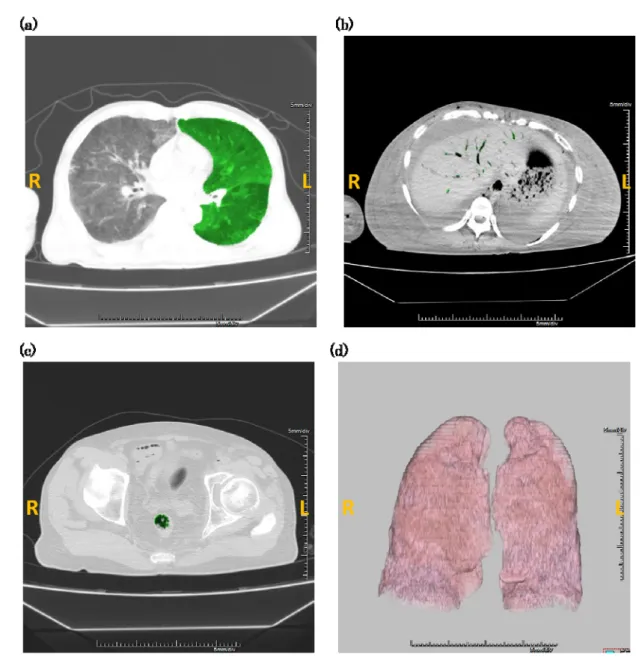
46

the measured volume using factors including sex, age, height, body mass

47

index (BMI), body surface area (BSA), and PMI. For estimation of PMI,

48

stepwise regression analysis was used.

49

Results : In the equations for each measured volume, height, diaphragmatic

50

height, and BSA were adopted for the left lung; height and diaphragmatic

51

height were adopted for the right lung; PMI was adopted for intrahepatic gas;

52

and sex and PMI were adopted for intrarectal gas. In the PMI equations, left

53

lung volume, intrahepatic gas, and intrarectal gas were adopted together

54

(5)

with sex, weight, and BMI.

55

Conclusion : Values of intrahepatic and intrarectal gas volumes obtained by

56

PMCT may be useful in investigation of postmortem change. It will be

57

necessary to include other parts of the intestine and to analyze volume

58

changes in gases from these parts after death.

59 60

Keywords : Postmortem CT, Postmortem change, Forensic radiology, Organ

61

volume, Postmortem interval

62

(6)

1. Introduction

63

Postmortem imaging is a useful technique for determining the cause of

64

death in cases of natural death involving no damage to the body surface, or

65

when the bereaved do not wish to have an autopsy performed. Computed

66

tomography (CT) and/or magnetic resonance imaging are mainly performed

67

to derive internal body information. Many reports have confirmed that

68

postmortem imaging is useful in the detection of various causes of death

69

and/or conditions such as the presence of putrefactive gases, pneumothorax

70

with a mediastinal shift, or comminuted fracture [1-3].

71

Postmortem CT (PMCT) is also useful for measuring the volume of organs

72

or gases. In addition, aortic narrowing and an increase in pleural effusion are

73

reported as postmortem changes observable by CT [4-9].

74

Forensic pathologists conventionally estimate the postmortem interval

75

(PMI) using early postmortem changes, such as livor mortis and/or rigor

76

mortis. Postmortem changes identified by CT can provide an index for

77

objective estimation of PMI. We measured the volumes of organs and gases in

78

cadavers using our PMCT data and a workstation, to investigate postmortem

79

changes and the relationship between PMI and the volumes of organs and

80

(7)

gases.

81

(8)

2. Materials and methods

82

2.1. Materials

83

This study was approved by the Kyushu University Institutional Review

84

Board for Clinical Research (No. 27-316). PMCT was conducted on 131

85

cadavers at Kyushu University, before autopsy, from January 2014 to October

86

2015. Exclusion criteria were an ambiguous PMI, child (age <16 years), chest

87

trauma, injury to the diaphragm, and pulmonary emphysema. Causes of

88

death included both natural and unnatural. Finally, the study population

89

included 46 cases (22 men, 24 women). For each cadaver, the sex, age, PMI,

90

height, body weight, diaphragmatic height (expressed as costal height at the

91

highest diaphragmatic point), and the weights of the left and right lung and

92

liver were recorded.

93 94

2.2. Imaging analysis

95

PMCT was performed before forensic autopsy using a 16-row

96

multidetector CT scanner (ECLOS, Hitachi Medical Co., Tokyo, Japan). Scan

97

parameters were as follows: 120 kVp; 225 mAs; 1 mm collimation; field of view.

98

A workstation (Aquarius H-Premium SI, Ver4.4.8, Hitachi Medical Co.) was

99

(9)

used to measure the volumes of organs and gases. We selected lung volume,

100

intrahepatic gas, and intrarectal gas as our research targets. We defined the

101

rectum as that part of the large intestine from the anus to the sacrum, and

102

intrarectal gas from within this region was measured (Fig. 1). We used the

103

automatic tool of Aquarius H-Premium to calculate the volume of each organ.

104

Each volume measurement was regulated manually as appropriate.

105 106

2.3. Statistical analysis

107

Body mass index (BMI) and body surface area (BSA) were calculated as

108

follows:

109

BMI (kg/m 2 ) = body weight (kg)/height 2 (m 2 ) [10]

110

BSA (cm 2 ) = 100.315 × body weight 0.383 (kg) × height 0.693 (cm) [11]

111

All factors and measurements are expressed as mean ± SD values, and

112

the numbers in parentheses show minimum and maximum values. Welch’s t -

113

test was used to determine differences between men and women. A stepwise

114

regression analysis (forward and backward, p = 0.25) was used to establish

115

the predictive equation needed to ascertain lung volume, intrahepatic gas,

116

and intrarectal gas. For each volume equation, we used the parameters sex,

117

(10)

age, height, weight, BMI, and BSA (the Six Factors) and PMI. We added

118

diaphragmatic height for lung volume, and liver weight for intrahepatic gas.

119

For estimation of PMI, a stepwise regression analysis was used including the

120

following factors: Six Factors, lung volume, intrahepatic gas, and intrarectal

121

gas. A variance inflation factor (VIF) was calculated, with values exceeding

122

10 regarded as indicating multicollinearity. All statistical analyses were

123

performed using JMP

R

, Pro 11.1, Japanese edition (SAS Institute, Inc., Cary,

124

NC).

125

(11)

3. Results

126

3.1. Descriptive statistics

127

Descriptive statistics are shown in Table 1. Significant differences were

128

found between men and women regarding height, weight, BSA, left lung

129

volume, and right lung volume. The average age of the cadavers was 61 ± 18.8

130

years (median age 65 years) and the mean PMI was 34 h (range, 9.5‒96 h).

131

Causes of death included traumatic ( n = 12), drowning ( n = 12), sudden

132

cardiac death ( n = 5), hypothermia ( n = 3), suffocation ( n = 3), drug

133

intoxication ( n = 2), and one case each of methomyl intoxication, chronic

134

kidney failure, pneumonia, hypoglycemia, acute pancreatitis, malignant

135

tumor, nervous disease, acute peritonitis, and pulmonary thromboembolism.

136

Two cadavers were excluded from lung volume analysis because of unknown

137

diaphragmatic height owing to adhesions, resulting in the complete

138

examination of only 44 cadavers (20 men, 24 women). Intrahepatic and

139

intrarectal gas volumes were, however, examined in all 46 cases.

140 141

3.2. Equations used to estimate lung volume

142

For the lung volume equations in this study, height, BSA, and

143

(12)

diaphragmatic height were adopted for the left lung (adjusted R 2 = 0.55);

144

height and diaphragmatic height were adopted for the right lung (adjusted R 2

145

= 0.63). However, PMI was not adopted for lung volume (Table 2).

146 147

3.3. Equations used to estimate intrahepatic and intrarectal gases

148

PMI was adopted for the equation used to estimate intrahepatic gas

149

volume (adjusted R 2 = 0.03) (Table 3).

150

Sex and PMI were adopted for the equation to estimate intrarectal gas

151

volume (adjusted R 2 = 0.09), and both coefficient values were negative (Table

152

4).

153 154

3.4. Equation used for estimating PMI

155

Sex, weight, BMI, left lung volume, intrahepatic gas, and intrarectal gas

156

were adopted for the equation used to estimate PMI (adjusted R 2 = 0.23). The

157

coefficient values of sex, weight, and intrarectal gas were negative. The root

158

mean square error (RMSE) was 16.4336 (Table 5).

159

160

(13)

4. Discussion

161

It was not possible to utilize PMI in the equations for either left or right

162

lung volume in this study. One possible explanation here is that there is no

163

association between lung volume and PMI. Hyodoh et al. reported that there

164

was no statistically significant difference in pulmonary parenchymal volume

165

between two PMCT scans within a particular interval of time [12]. Our

166

findings support their conclusion. Since our study did not consider whether

167

PMI was within 24 h, more useful data could be obtained by studying further

168

cases with PMI established as being within 24 h.

169

The PMI coefficient value was positive in the equation for the volume of

170

intrahepatic gas, which means that intrahepatic gas increased concomitantly

171

with increase in PMI. However, the adjusted R 2 value was low. This might

172

have occurred because about half of the cases in our study had no or little

173

intrahepatic gas. Christe et al. reported that putrefied cadavers can

174

accumulate gas in the liver [13]. In our study, slight putrefaction was found

175

in all cadavers with only a few days’ interval from death to PMCT, so

176

intrahepatic gas volume was low even in cases where it was present. In our

177

study, we did not distinguish between cases with or without cardiopulmonary

178

(14)

resuscitation (CPR). Yokota et al. reported that intrahepatic gas is

179

suggestively associated with CPR [14]. It is thought that in cases with slight

180

putrefaction, intrahepatic gas is influenced by CPR. To produce an equation

181

for estimation of intrahepatic gas, we need to examine cases with a longer

182

PMI, and also cases in which CPR was not performed.

183

One key point of our study is that the coefficient values of sex and PMI

184

were negative for the intrarectal gas volume equation. We selected intrarectal

185

gas because it was easy to extract and measure. It is widely known that

186

intestinal tract gas volume increases after death; however, in our study,

187

intrarectal gas volume tended to decrease. All cadavers in this study had their

188

rectal temperature measured by thermometer at the time of police

189

investigation. In cases with a long PMI, rigor mortis may no longer be present

190

and intrarectal gas readily leaks from the anus. Another consideration is that

191

intestinal tract gas volumes increase after death because of putrefaction, and

192

as intra-abdominal pressure rises, intrarectal gas is pushed out and leaks

193

from the anus. It is therefore necessary to study parts of the intestine that

194

are not affected by external factors. Regarding cadaver gender, there are

195

certain anatomical differences between the sexes regarding the pelvic cavity,

196

(15)

such as the prostate and uterus. In addition, the size of skeletal bones varies

197

between the sexes. We should therefore investigate more cases after

198

segregating them by sex.

199

The PMI equation showed an association with left lung volume,

200

intrahepatic gas, and intrarectal gas, together with sex, weight, and BMI.

201

RMSE was 16.4336, so the PMI equation estimated PMI to within about ±16

202

h. In the equations used for estimating volume, PMI was adopted for

203

intrahepatic gas and intrarectal gas, but not for the left lung. A question

204

remains as to why only left lung volume was adopted in the equation, but not

205

right lung volume. This can be explained from an anatomical viewpoint. The

206

left lung is located near the stomach and spleen, while the right lung is

207

located near the liver; any potential increase in the volume of the latter,

208

therefore, is somewhat restricted by the solid bulk of the liver. The left lung

209

volume itself could be thought of as an adjustment factor regarding the

210

production of equations to estimate PMI using intrahepatic and intrarectal

211

gas volume.

212

There are two main limitations in this study. First, it included a small

213

number of cases. It is considered that the relationship between postmortem

214

(16)

changes in organs or gases and PMI could be understood more precisely with

215

a greater number of cases. Second, the measurements were performed

216

manually. A program that measures automatically or uniformly using a clear

217

protocol, such as CT values, is thus needed.

218

In our study, intrahepatic and intrarectal gas volumes tended to increase

219

and decrease, respectively, with postmortem changes. Postmortem changes

220

identified by CT could become a useful tool in the estimation of PMI. We aim

221

to continue this line of research, and would like to determine diachronic

222

postmortem changes on CT images using PMCT.

223

(17)

Conflict of interest

224

All authors declare that they have no conflict of interest.

225

(18)

Acknowledgments

226

The authors would like to thank editage (https://online.editage.jp/dashboard)

227

for the English language review.

228

229

(19)

References

230

[1] M.J. Thali, K. Yen, W. Schweizer, P. Vock, C. Boesch, C. Ozdoba, G. Schroth,

231

M. Ith M. Sonnenschein, T. Doernhoefer, E. Scheurer, T. Plattner, R.

232

Dirnhofer, Virtopsy, a new imaging horizon in forensic pathology: virtual

233

autopsy by postmortem multislice computed tomography (MSCT) and

234

magnetic resonance imaging (MRI) a feasibility study, J. Forensic Sci. 48

235

(2003) 386-403.

236

[2] M. Mitka, CT, MRI scans offer new tools for autopsy, JAMA 298 (2007)

237

392-393.

238

[3] I.S. Roberts, R.E. Benamore, E.W. Benbow, S.H. Lee, J.N. Harris, A.

239

Jackson, S. Mallett, T. Patankar, C. Peebles, C. Roobottom, Z.C. Traill,

240

Postmortem imaging as an alternative to autopsy in the diagnosis of adult

241

deaths: a validation study, Lancet 379 (2012) 136-142.

242

[4] L.C. Ebert, G. Ampanozi, T.D. Ruder, G. Hatch, M.J. Thali, T. Germerott,

243

CT based volume measurement and estimation in cases of pericardial

244

effusion, J. Forensic Leg. Med. 19 (2012) 126-131.

245

[5] N. Takahashi, T. Higuchi, Y. Hirose, H. Yamanouchi, H. Takatsuka, K.

246

Funayama, Changes in aortic shape and diameters after death:

247

(20)

Comparison of early postmortem computed tomography with antemortem

248

computed tomography, Forensic Sci. Int. 225 (2013) 27-31.

249

[6] N. Ishikawa, A. Nishida, D. Miyamori, T. Kubo, H. Ikegaya, Estimation of

250

postmortem time based on aorta narrowing in CT imaging, J. Forensic

251

Leg. Med. 20 (2013) 1075-1077.

252

[7] N. Sogawa, T. Michiue, T. Ishikawa, O. Kawamoto, S. Oritani, H. Maeda,

253

Postmortem volumetric CT data analysis if pulmonary air/gas content

254

with regard to the cause of death for investigating terminal respiratory

255

function in forensic autopsy, Forensic Sci. Int. 241 (2014) 112-117.

256

[8] M. Ishida, W. Gonoi, K. Hagiwara, H. Okuma, Y. Shintani, H. Abe, Y.

257

Takazawa, K. Ohtomo, M. Fukayama, Fluid in the airway of

258

nontraumatic death on postmortem computed tomography, Am. J.

259

Forensic Med. Pathol. 35 (2014) 113-117.

260

[9] N. Sogawa, T. Michiue, O. Kawamoto, S. Oritani, T. Ishikawa, H. Maeda,

261

Postmortem virtual volumetry of the heart and lung in situ using CT data

262

for investigating terminal cardiopulmonary pathophysiology in forensic

263

autopsy. Leg. Med. (Tokyo) 16 (2014) 187-192.

264

[10] WHO Expert Consultation, Appropriate body-mass index for Asian

265

(21)

populations and its implications for policy and intervention strategies,

266

Lancet 363 (2004) 157-163.

267

[11] Y. Kurazumi, T. Hirokoshi, T. Tsuchikawa, N. Matsubara, The body

268

surface area of Japanese, Jpn. J. Biometeor 31 (1994) 5-29.

269

[12] H. Hyodoh, J. Shimizu, S. Watanabe, S. Okazaki, K. Mizuo, H. Inoue,

270

Time-related course of pleural space fluid collection and pulmonary

271

aeration on postmortem computed tomography (PMCT), Leg. Med.

272

(Tokyo) 17 (2015) 221-225.

273

[13] A. Christe, P. Flach, S. Ross, D. Spendlove, S. Bolliger, P. Vock, M.J. Thali,

274

Clinical radiology and postmortem imaging (Virtopsy) are not the same:

275

Specific and unspecific postmortem signs, Leg. Med. (Tokyo) 12 (2010)

276

215-222.

277

[14] H. Yokota, S. Yamamoto, T. Horikoshi, R. Shimofusa, H. Ito, What is the

278

origin of intravascular gas on postmortem computed tomography? Leg.

279

Med. (Tokyo) 11 (2009) S252-S255.

280

281

(22)

Figure legend

282

Fig. 1. Left and right lung (a), intrahepatic gas (b), and intrarectal gas (c)

283

were measured manually for each slice. Volumes are marked in green. (d)

284

Virtual reconstruction of a three-dimensional lung image.

285

286

(23)

Table 1

Descriptive statistics.

Measurements are expressed as mean ± SD values. The numbers in parentheses show minimum and maximum values.

Men Women p value Total

Number 22 24 46

Age (years) 58.55 ± 18.52 (18-89)

63.25 ± 19.14

(19-87) 0.4016 61 ± 18.79

(18-89) Height (cm) 164.64 ± 6.90

(152-178)

148.96 ± 7.77

(134-170) <0.0001 156.46 ± 10.76 (134-178) Weight (kg) 58.10 ± 9.41

(32.3-78.3)

47.39 ± 12.12

(27.4-76.3) 0.0016 52.51 ± 12.07 (27.4-78.3) BMI (kg/m 2 ) 21.42 ± 3.24

(13.27-28.76)

21.20 ± 4.48

(12.84-29.80) 0.847 21.31 ± 3.89 (12.84-29.80) BSA (cm 2 ) 16,290 ± 1,306

(12,561-18,340)

14.011 ± 1,768

(11,086-17,776) <0.0001 15,101 ± 1,928 (11.086-18,340)

PMI (h) 33.18 ± 19.44

(9.5-96)

34.81 ± 17.96

(12-84) 0.7696 34.03 ± 18.49

(9.5-96) Left lung volume (cm 3 ) 1207.95 ± 514.46

(476-2081)

794.04 ± 278.73

(365-1359) 0.0014 982.18 ± 449.41 (365-2081) Right lung volume (cm 3 ) 1,423.15 ± 571.83

(368-2,621)

1,006.33 ± 314.87

(491-1,739) 0.0059 1,195.80 ± 491.52 (368-2,621) Intrahepatic gas (cm 3 ) 8.80 ± 30.45

(0-142)

3.01 ± 6.08

(0-24.3) 0.3905 5.78 ± 21.45

(0-142) Intrarectal gas (cm 3 ) 17.58 ± 14.92

(0.67-64.1)

10.64 ± 9.97

(0.59-40) 0.0747 13.96 ± 12.92

(0.59-64.1)

PMI: postmortem interval, BMI: body mass index, BSA: body surface area.

(24)

Table 2

Coefficient value of equations used to estimate lung volume without considering lung weights.

Left lung Right lung

Intercept -4013.196 -3801.717

Sex - -

Age - -

Height 28.1296 20.3375

Weight - -

BMI - -

BSA -0.069 -

Height of diaphragm 327.1052 423.1151

PMI - -

Adjusted R 2 0.5475 0.6258

PMI: postmortem interval, BMI: body mass index, BSA body surface area.

Table 3

Coefficient value of equations used to esutimate intrahepatic gas volume.

Intrahepatic gas

Intercept -2.7601 Sex - Age - Height - Weight - BMI - BSA -

Liver weight -

PMI 0.251

Adjusted R 2 0.0251

PMI: postmortem interval, BMI: body mass index, BSA: body surface area.

(25)

Table 4

Summary of equations used to estimate intrarectal gas volume.

Intrarectal gas

Intercept 19.6625 Sex -3.3331 Age - Height - Weight - BMI - BSA - PMI -0.1633

Adjusted R 2 0.0873

PMI: postmortem interval, BMI: body mass index, BSA: body surface area.

Table 5

Coefficient value of equations used to estimate PMI.

PMI

Intercept 10.0487

Sex -7.1682 Age - Height - Weight -1.7257 BMI 5.1377 BSA -

Left lung 0.0112

Right lung -

Intrahepatic gas 0.1941 Intrarectal gas -0.4383

RMSE 16.4336

Adjusted R 2 0.2291

PMI: postmortem interval, BMI: body mass index, BSA: body surface area,

RMSE : Root mean squared error.

Figure legend

参照

関連したドキュメント

Instagram 等 Flickr 以外にも多くの画像共有サイトがあるにも 関わらず, Flickr を利用する研究が多いことには, 大きく分けて 2

(2)特定死因を除去した場合の平均余命の延び

In this study, we focused on the structural difference, and selected two analysis methods: (1) quantitative determination of reducing sugar obtained by enzymatic hydrolysis, and

原子炉水位変化について,原子炉圧力容器内挙動をより精緻に評価可能な SAFER コ ードと比較を行った。CCFL

 分析実施の際にバックグラウンド( BG )として既知の Al 板を用 いている。 Al 板には微量の Fe と Cu が含まれている。.  測定で得られる

「東京都スポーツ推進計画」を、平成 30 年 3 月に「東京都スポーツ推進総合計画」を策定すると ともに、平成 25 年

自分ではおかしいと思って も、「自分の体は汚れてい るのではないか」「ひどい ことを周りの人にしたので

 千葉 春希 家賃分布の要因についての分析  冨田 祥吾 家賃分布の要因についての分析  村田 瑞希 家賃相場と生活環境の関係性  安部 俊貴