With increasing globalization, English has become an essential tool for communication across national and cultural borders. For Asia-Pacific countries, which include a diverse range of languages, there is a sustained and growing interest in expanding the percentage of their population competent in English (Kachru, 1997). As a result of this movement, English language has been taught as a compul- sory component of secondary and middle school in many Asia-Pacific countries such as Korea, China, and Taiwan for several decades (Ho, 2002). However, it is only during the past couple of decades that English language education has been extended to include primary school. English was introduced to the Korean elementary school national curriculum in 1997, China in 2001, and Taiwan began in 2001 (Butler, 2004; Ho, 2002). Japan has only recently begun introducing English instruction, beginning with fifth and sixth grade curricula, with initial curricula being piloted in April, 2011. In step with the growing international popularity of elementary school English education, many different context specific issues have arisen, including curriculum and materials development, teacher experience and methodology, and appropriate assessment (Butler, 2015).
Language education was introduced to Japanese elementary schools with the general goal of improv- ing students’ communicative skills for corresponding to current globalization in Japan (MEXT, 2008;
2013). Despite the expansion of English into elementary school curricula, teaching certification for elementary teachers does not include a licensing system for English language education; Japanese elementary teachers are not required or expected to possess any English proficiency. As a result, native speaker of English (NS) teachers are generally perceived as an essential support component for English language classes (Butler, 2006). Thus, classes are often taught by a pair of native and non-native English speaking teachers in a system known as team teaching. For the current study, team teaching is defined as a “concerted endeavor made jointly by the Japanese Teacher of English and the Assistant English Teacher in an English language classroom in which the students, the Japanese Teacher of English, and the Assistant English Teacher are engaged in communicative activities” (Brumby & Wada, 1990, Introduction). While team-teaching has been extensively employed in Japanese junior and high schools (Brumby & Wada, 1990; Tajino & Tajino, 2000), the NS teachers’ role within English instruction in
Expanding Japanese Elementary School English Education:
Native and Nonnative Speaking Team-Teachers’
Perspectives on Team-Teaching Quality
Kaori Nakao, W. L. Quint Oga-Baldwin, Luke K. Fryer
Japanese classrooms remains to be clearly defined (Nakao, 2009; Butler, 2005; Mahoney, 2004). Given the government plan to increase the number of NS teachers in Japanese schools (MEXT, 2016), the role of native and non-native English speaking teachers is an essential issue for the future success of Japanese elementary school language education. Native speaking teachers have an important role and need to be as effective, if not more so than, their Japanese counterparts in promoting communicative use of language. The current study was therefore undertaken to extend our understanding of this broad issue and specifically examine the potential for native speaking teachers in Japanese elementary school English language classrooms. While this current study aimed to provide a framework to address these issues from the perspective of native and non-native service teachers working within Japanese elemen- tary schools, given the importance of Native speaker teachers to English language classrooms across Asia.
Background
Japanese elementary school English education development
The introduction of English to Japanese public elementary school has been under consideration since the 1990s (Butler, 2007; Imura, 2003; MEXT, 2008). In 1992, two elementary schools were officially designated as pilot schools for the research of “International understanding education including English study.” The initial pilot program was eventually extended to 86 elementary schools, with at least one in each prefecture (Butler, 2007; Matsukawa, 2004; Matsukawa & Oshiro, 2008). All Japanese elementary schools were permitted to provide instruction in foreign language (English in most schools) conversation as a part of students’ “international understanding education” within students’ “period for integrated study” beginning in 2002. In 2008, the government formally announced the implementation of new foreign language curricula guidelines (MEXT, 2008). In April 2011, all Japanese elementary schools began providing English language instruction for fifth and sixth grade students. In December 2013, MEXT announced the introduction of English into third and fourth grades once or twice a week.
In addition, they made English a formal academic subject for fifth and sixth grades, and classes were implemented two or three times a week.
Key issues post-introduction of foreign language as an elementary school academic subject While the important first step of introducing English to elementary school curricula has been made, several issues impede both further development and eventual comprehensive implementation. First,
“English” language is not currently a compulsory subject in elementary school in Japan, instead treated as a school activity (Gaikokugo katsudo, “foreign language activities”), similar to music, art, and physical education. These activities are mandatory, but not a part of the formally assessed curricula; no grade
is given to students based on their English language performance (Hashimoto, 2011). Second, current elementary school teachers, who are responsible for the instruction of English, have generally had little or no English language skill, teaching methods, and materials development training.
One way in which MEXT appears to be addressing the broader teaching issue is through ongoing plans to substantially increase the number of native speaker teachers (MEXT, 2013; 2016), often referred to as assistant language teachers or ALTs. Running concurrent with this national shift in language instruction in elementary schools in Japan, is an ongoing international debate about the role of native speaker of English (NS) vs. non-native speaker of English (NNS) teachers within the instruction of second and foreign languages. In this article, we will use the terms ALT and NS as interchangeable.
Native and non-native teachers roles in language instruction
The instructional proficiencies of NS teacher or NNS teachers are at the heart of a long-standing international discussion about the role language teachers’ (e.g., Cook, 1999; Mahoney, 2004; Medgyes, 1992; Phillipson, 1992; Tang, 1997). Early in this debate Medgyes (1992) has suggested that “native and non-natives have an equal chance to become successful teachers” (p. 340), yet there is still the widespread belief that NSs make superior language teachers (e.g., Phillipson, 1992). In Hong Kong, Tang (1997) interviewed 47 NNS teachers about their perception of their roles in the ESL classroom.
Based on this study, Tang (1997) suggested that NNS teachers in some Hong Kong English classrooms appeared to believe that NSs were superior to NNSs, particularly in oral communicative abilities.
Tang noted that the authority and confidence of some nonnative English teachers might be vulnerable because of such beliefs. Japanese teachers held similar views, indicating that native speaker pronun- ciation models were more desirable than non-native (Butler, 2007). These teachers were also highly concerned with saving face and preserving the status of their own language (Japanese) compared to English—and thus desired to outsource the teaching of English to non-Japanese. These findings are consistent with earlier commentary from Cook (1999), who noted that the native speaker model appeared to be firmly entrenched in SLA research.
Native and Non-Native role within Japanese Team-Teaching
In Japan specifically, NS/NNS teaching arrangement in many Japanese English language classrooms has faced considerable criticism (Aline & Hosoda, 2006; Mahoney, 2004; Tajino & Tajino, 2000). For example, Mahoney’s exploration of team-teaching within junior high school and high school (2004) indicated a substantial gap between the perspective of assistant NS teacher and NNS teacher regarding their own roles. Even earlier than this, Wada and Cominos (1994) had stated that “lessons performed by Japanese Teachers of English (JTE) alone still tend to concentrate on drills and learners are not
provided with opportunities to use the accumulated parts of language for actual communication” (p. 14).
It is chiefly for this reason of team-teaching for communication that ALTs were introduced into junior and high school. Yet, as Tajino & Tajino (2000) have indicated, it is not realistic to assume that NS and NNS teachers always work well together. This point should be a clear cautionary signal for countries like Japan who seek to increase the hiring of native speakers as teaching assistants in foreign language classes.
Practical issues with native speaking teachers in Japanese elementary school classrooms Despite longstanding issues with team-teaching, ALTs are being formally introduced to Japanese elementary schools for reasons similar to their original introduction to Japanese high schools and junior school; the base assumption is that native speakers can make classes more communicative. The practi- cal criticisms that surround this approach reflect international questions of instructional proficiency of NS/NNS teachers and the quality of their potential team teaching. In Japan, this issue begins with the requirements necessary to apply for the JET Programme, which has long supplied the majority of the country’s ALTs. Teaching experience, training, and licensing are not required for successful application to the program (CLAIR, 2013a). NS teachers’ qualification issues are sharpened in the elementary school setting by the under-development of NNS teachers.
Within the national Japanese elementary school teacher license, very few courses are related to the teaching or learning of a foreign language. Individual universities decide what kind and how much language skill and teaching methodology should be provided to aspiring elementary school teachers, with no standard national guidelines for licensing pre-secondary language educators. Due in part to this uneven preparation of elementary school teachers, they continue to lack confidence in teaching English to their students (Benesse, 2010; Butler, 2005; MEXT, 2005; Butler, 2007)
Reflecting the lack of preparation many elementary school teachers have had for language teaching, as early as 2005 over 60% of the English classes within Japanese elementary schools were taught with an ALT (MEXT, 2006). During the proceeding decade, team-teaching assumed an essential role within English language instruction at Japanese elementary schools. This approach to supporting elemen- tary school English teaching, however, can act as little more than temporary support. The fact is that most ALTs do not have the requisite knowledge of language teaching methodology and experience to effectively direct the teaching of English in elementary schools.
The issues of teaching and language competence of both NNS and NS need to be addressed by the hiring organizations and are largely out of the hands of educators. How NS and NNS teachers work together in these teaching situations, however, is clearly within educators’ purview. Given the centrality of good teaching in promoting student engagement and motivation (Oga-Baldwin, Nakata, Parker, &
Ryan, 2017), teachers’ roles and how they create effective team-teaching environments together are important factors that deserve further exploration and support.
Teachers’ role within elementary school team-teaching
There is a prevailing idea that NS teachers are a necessary component for the cultivation of students’
English communicative skill in Asian Pacific countries (Butler, 2004; Carless, 2006). Carless (2006) suggested that teachers generally perceived team-teaching as having positive influence on English classes. In the context of Japanese elementary schools, a recent study reported students found little difference in their perceived influence of both NS teachers and NNS Japanese teachers of English (Oga-Baldwin & Nakata, 2013). The students evaluated the team-teaching led by NNS homeroom teachers, however, to be the most helpful when it came to speaking.
Despite the importance of teachers’ roles within team-teaching in English classrooms, they are still inadequately defined (Butler, 2005; Nakao, 2009). Government guidelines apparently limit NS teachers’
roles to teaching natural pronunciation and phrases (MEXT, 2001), placing the responsibility for class preparation, management, and other aspects of instruction on the HRT. More recent guidelines confirm that Japanese NNS teachers are primarily responsible for implementing and planning classes (MEXT, 2008). For the range of reasons reviewed to this point, HRTs often have low perceived and actual English proficiency (Butler, 2007)—a less than perfect arrangement for teachers entirely responsible for the elementary school English language curricula. Further complicating this situation, these classes need to offer both opportunities for active communication and enable students to understand a broad range of cultures; skills and knowledge which many HRTs lack. Clearly, to create an effective classroom environment capable of meeting these goals, cooperation between NS and NNS teacher beyond a simplistic division of labour is necessary.
An illustration of the trans-disciplinary skills and experience necessary are clear when presented with a list of the components which need to come together for a successful class of the type called for by the national curriculum. To begin with, classes demand careful lesson plan construction which can effectively integrate two teachers within an active classroom. Lesson plans need to address classroom management (time and sharing of teaching responsibilities) as well as activities that support students’
willingness to communicate in English, cultural understanding, and language competence (MEXT, 2008). The dichotomy of responsibility suggested by national curriculum documents appears simplis- tic given the average educational preparation and language competencies of many HRTs and ALTs.
Despite this apparent barrier, English instruction in primary schools continues to expand without further clarification from either policy makers or empirical research. The current study aims to extend our understanding of the issues facing team-teaching pairs of native and non-native teachers from each
teachers’ own perspective. Current practice may inform our theoretical understanding of how native and non-native teacher work together during effective language instruction, thus providing direction similar language teaching contexts in Japanese schools and beyond.
The Current Study
Substantial research has examined team-teaching in the context of junior and high school English instruction (e.g., Mahoney, 2004; Tajino & Tajino, 2000). Few studies, however, have examined teachers’
roles within team-taught English classes at elementary school (recent exceptions: Aline & Hosoda, 2006;
Oga-Baldwin & Nakata, 2013). To date, no study has offered elementary school team teachers’ own perspectives regarding the individual roles of NS and NNS teachers connected to their ideal and actual classroom practice.
Related to this point, there is reason to believe that the larger body of junior/high school research might not be in a strong position to inform elementary school language teaching. As noted, no license is currently available for specifically teaching English in elementary schools. For that reason, it has been pointed out that HRTs may be under a great deal of strain (e.g., Butler, 2005). As a result ALTs have an especially important role in this context. In order to extend our understanding of this issue and examine the potential of native and non-native speakers within the elementary school English language classroom, the current study explores and compares the instructional roles of ALTs and HRTs within Japanese elementary school team-teaching classrooms.
This study builds on the large scale survey conducted by Mahoney (2004) in that we allowed the participants to offer their own ideas in their own words. Crucially, previous studies of these roles have been based solely on self-report without direct connection to classroom practice. We attempt to offer a situated perspective (Cresswell, 2009) by connecting real instructional practices with teachers’ expecta- tions and perspectives on their roles.
Aims
In order to ensure the success of increasing the number of ALTs within elementary schools in Japan, as well as maintain and improve the HRT-ALT team-teaching instructional model, it is necessary to clarify their respective roles. This study therefore aims to contribute to this goal by examining and comparing the perceptions of ALTs and HRTs of their individual and shared roles within the current Japanese elementary school team-teaching environments.
Methods
The current study conducted semi-structured interviews as described by Flick (2002). Firstly, English instruction was observed at 16 different Japanese public elementary schools in southwestern Japan.
With the permission of the local board of education, classes were video-recorded and field notes, based on personal observation, were recorded. Then, based on these observations, semi-structured interviews were organized and conducted with ALTs, HRTs and administrators who manage “English activities.” It took between fifteen and fifty minutes for each interview.
Interviews focused on teachers’ perceptions of Japanese elementary school English classes from the participating ALT and HRTs’ personal perspectives. Specifically, it examined the instructional roles of homeroom and assistant language teachers within elementary school English classes. Notes were taken both during and following the interviews for future analysis. Interviews were carried out with thirty- six public elementary school teachers (16 ALTs and 20 HRTs; four of the participating HRTs were also administrators managing the “English activities”). Teachers were all engaged in English teaching (from 16 different public elementary schools). During the interviews, teachers were asked to report their experiences and opinions with regard to team-teaching. Interview results for each teacher were coded by the first author (Flick, 2002) and confirmed by the second and third using peer debrief (Cresswell, 2009). Final coded results were converted to percentages within HRTs and ALTs. These results were then organized in tables (Table 1, 2, and 3) for comparison and discussion.
Results And Discussion
The results of this study are presented in the following order. First, the HRT ’s role is examined.
Second, the ALT ’s role is examined from the HRT ’s perspective. Finally, the ALT ’s role is examined from the ALT ’s perspective.
Table 1. HRTs’ roles as seen by HRTs. Multiple answers possible (n = 20).
Teacher roles # of Teachers expressing this role
Time management 13
Plan and prepare for class 7
Class management 3
Explain an important point 2
Help students and ALT to relate 1
Provide model 1
The homeroom teacher’s role
Coded data emerging from interviews employing a set of open ended questions are presented in Tables 1, 2, and 3. Table 1 reports that 13 out of 20 the HRTs perceived that their role within team-teach- ing was best described as “time management coordinator / chair / master of ceremony” of instruction and learning, aligning with the MEXT (2001) indication that HRTs’ role includes “time management.”
Seven out of the 20 HRTs reported that the HRT ’s role was to “plan and preparation for class”.
With the initial introduction of English into Japanese elementary school curricula, it was understood that the classroom role of native teachers was teaching students natural English: pronunciation, expressions and listening skills (MEXT, 2001). Based on the HRTs’ answers to the open-ended survey, it is clear that they were keenly aware of their role as a “manager of English activities,” rather than as an instructor. For example, “The job of HRTs is preparing a class outline. ALT ’s role is definitely pronunciation and engagement with the students” (School K HRT). The following exchange with an Administrator from School E also revealed this pattern:
School E Administrator: The HRT ’s role is time keeper Interviewer: Master of Ceremonies?
School E Administrator: Yes!
(School E Administrator).
While HRTs and administrators were aware of their role within English language instruction, ALTs were far less certain about the Japanese teacher’s responsibility. Four out of the 16 ALTs interviewed, stated that the HRT ’s role was the “planning and preparation of lessons.” Others, however, stated that they do not fully understand the role of their team-teaching partners. Whether stemming from a lack of understanding of official policies (MEXT, 2008a) or differences between the official policy goals and real teaching, ALTs’ comments bear careful consideration as they indicate that for many ALTs, the role of the HRT is unclear.
My role in class…[is] to build friendly relationships with my students, motivate students to practice their English skills, provide chances for students to hear natural English and introduce my home country and other countries… Actually, I haven’t done team teaching. I teach students based on guidelines approved by the education committee. So I don’t understand the HRT ’s role. (School I ALT)
Making the lesson plan? It depends on the school, I sometimes make and send it to the school
if requested. Not this school. But I want HRT to plan and make the lessons as soon as possible.
(school E’s, ALT)
School I’s HRT indicated that this school’s teachers usually let the ALT determine and carryout English activities, such as the game mentioned in the following comment:
I usually leave it entirely up to the ALT. The ALT likes games. Today, I let him do today’s game. If not for the ALT, I couldn’t handle it. When only the HRT teaches the lesson, children aren’t particu- larly active but with ALT, they become more and more engaged. They like him (school I’s HRT).”
Based on the teachers interviewed for the current study, it is reasonable to suggest HRTs and ALTs have very different perspectives regarding the role of HRTs. The HRT indicated that their role was mainly as a “time keeper” and to “plan and prepare for class”; however, ALTs were less certain what the HRT ’s role was: e.g., “I don’t know about their role in the classroom” (School I ALT).
School E’s ALT remarked that, “I have to make the lesson plan…it depends on schools.” These remarks suggested that this ALT agrees that HRT ’s role may be to “Plan and preparation for classes”
but there are major differences between schools, especially those just beginning to introduce English instruction and schools with experienced staff. According to the Course of Study (MEXT, 2008b), both the HRT and the school’s foreign language activities specialists are responsible for planning elementary school English lessons. However, when a specialist is not available and HRTs have little experience teaching English, an ALT who has experience may be employed as a source of support when construct- ing lesson plans.
Based on teachers’ interviews, over half of the HRTs perceive that their role includes time manage- ment (13 teachers), followed by planning and preparing lessons (7 teachers); and class management (3 teachers). ALTs generally expected HRTs to try to use English positively. Similarly, some ALTs wanted HRTs to not just act as “time managers” but also be models for their students. For example,
HRT should not just “think they cannot speak English”, they have to try. There are many HRTs who don’t try and instead just watch the class in the back. It is important for HRTs to be involved in the English class. (School K ALT)
Even if the HRT is not very good at English, the HRT should pretend to speak English in front of children. HRT should show confidence in front of the students. (School M ALT)
It depends on teachers, HRT should try to use English with confidence even if they can’t speak very well. If the classroom teacher is shy about using English, then students will become shy.
(School A ALT)
Remarks for each of these ALTs were very interesting, because they show that ALTs perceived that the HRT ’s role is to act as a role model for the children as reported by Oga-Baldwin and Nakata (2013).
School A’s ALT in particular pointed out that the HRT ’s attitude is important because it influences students’ attitude and behavior when learning English. All of the ALTs quoted here made this clear without ever stating the HRT ’s role directly. Clearly, from the ALTs perspective, acting as a role model for the students is an important role that only the HRT can and therefore should undertake. Given this perspective and the importance of the HRT for promoting students’ positive classroom communication, it is important to note that only one of HRTs indicated that providing a model for students was a part of the HRT ’s role.
The role of native speakers in the classroom The Homeroom Teachers’ Perspective
Homeroom teachers also shared their perspectives on the native speakers they worked with. Table 2 presents the HRTs’ perspective of ALTs’ classroom role, based on interviews with the 20 HRTs.
HRT ’s were asked what they felt the role of the ALT was in the elementary English language classroom. Table 2 reports that 14 out of 20 HRTs reported that the ALT ’s role in English class might best be described as pronunciation. In addition, 7 of the HRTs reported teaching about a different culture and 3 HRTs reported teaching real/natural English/expressions as being important aspects of the ALTs role.
First, we will examine the HRTs’ comments about ALT ’s role as a source of natural pronunciation.
HRTs expressed ALTs’ role as teaching pronunciation in English education in the following comments:
“I lack confidence in pronunciation, so I want the ALT to check our pronunciation. So I prefer
Table 2. ALTs’ roles as seen by HRTs. Multiple answers possible (n = 20).
Teacher roles # of Teachers expressing this role
Pronunciation 14
Different culture 7
Involvement of children 4
Activities (e.g.,game) 3
Teach real/natural English/expressions 3
Support HRT 1
team-teaching to teaching alone” (school N HRT); “Pronunciation! Japanese pronunciation and Native English speaker’ are different, right? So I leave the pronunciation instruction to the ALT” (school G HRT). Consistent with past research (Benesse, 2010), these HRTs lack confidence in their English skills, and in particular their pronunciation. Furthermore, School G’s HRT emphasized that,
ALTs don’t have a strong accent when they speak English. They don’t have to have a British accent but I don’t like it when they are hard to understand. I prefer a native speaker with very little accent, who is easy to understand.
This HRT has a concrete conception of what kind of English students should learn and clearly perceives British English as “real” English. The HRT is concerned that ALTs with strong accents will be hard for students to understand and therefore learn from.
Bringing a “different culture” to the classroom was reported by 7 of the HRTs as being an important part of the ALTs role within English language instruction. Some HRTs indicated that they expected ALTs to teach students about difference in culture. For example, how gestures might differ and their importance within communication. School O’s HRT saw and expressed the ALT ’s role as bringing a different culture, creating an international atmosphere within the class in the following comment:
The role of ALTs is to bring their culture, create an atmosphere, and be expressive in their communication with students. We need ALTs because they teach us new things about the world in general. My students have fun with the ALT who comes to our class. (School O HRT)
In the interviews, “Pronunciation” was closely related to “Teaching real/natural English/expres- sions.” HRTs want to leave the modeling and instruction of pronunciation and natural expressions to ALTs. In fact, over half of HRTs felt that the ALT ’s role is oral in nature, in particular the ALT ’s role is to teach pronunciation (14 teachers), while a minority believed they should teach real/natural English expressions (3 teachers).
I have worked with an ALT, who did not just teach textbook phrases to students but tried to teach natural/real English to students. He was experienced and confident. He knew what he wanted to do and I generally accepted his ideas. We worked together well. I think that if the HRT gets along with the ALT, that team-teaching is definitely better than teaching alone. The ALT then teaches English pronunciation and differences in culture. (School M HRT)
From this comment, school M’s HRT expects the ALT to not just teach the textbook phrases, but natural/real English to students. It’s interesting to note that ten percent of HRTs recognize that the important role of ALT is the interaction with children (Table 2).
There are some things that only ALTs can do. For example, only ALTs can communicate with children, talk to them, and praise them. Students take great pleasure in communicating with ALTs.
That is what I can’t do with students. Only ALT can do it effectively. (School P HRT)
The reason ALTs are in the classroom is to motivate the children to learn English. Their role is not just to teach pronunciation but also to speak with children. For example, in my class (experience), I ask the ALT to talk and praise children who are feeling down. Praise from an ALT helps the students have a lot more fun and become more cheerful…. (School D Administrator)
As mentioned above, school P’s HRT expressed that at his school and class, the ALT ’s role is to communicate with and praise children. This teacher suggests that ALT ’s role is to improve students’
self-confidence and motivate them in learning a new language. School D’s administrator concurred, saying that ALTs should motivate students to learn English by providing emotional support and helping students feel positive about English class.
The Assistant Language Teacher’s Role From The Assistant Language Teacher’s Perspective Interview results reporting ALTs’ perspectives of their own classroom role are presented in Table 3.
ALTs were asked what they felt their role was within the elementary English language classroom.
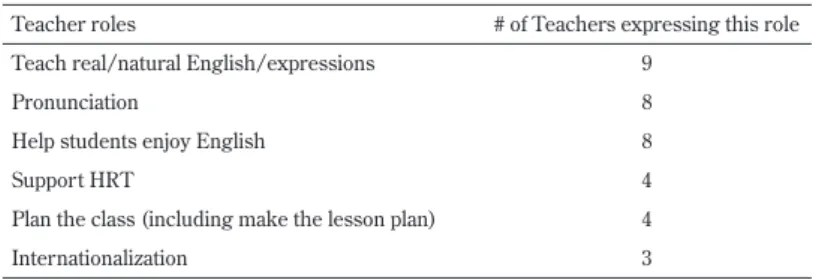
Table 3 reports that ALTs described their roles in classroom as chiefly teaching real/natural English/
expressions (9 teachers) and the instruction and modeling of pronunciation (8 teachers). In addition to these key roles, different ALTs each indicated other roles they felt they played in the classroom, such as helping students enjoy English (8 teachers), supporting the HRT (4 teachers), planning the class (4 teachers), and internationalization (3 teachers).
Table 3. ALTs’ roles as seen by ALTs. Multiple answers possible (n = 16).
Teacher roles # of Teachers expressing this role
Teach real/natural English/expressions 9
Pronunciation 8
Help students enjoy English 8
Support HRT 4
Plan the class (including make the lesson plan) 4
Internationalization 3
HRTs and ALTs have a common understanding of “pronunciation” as an ALT ’s role in English class, however, ALTs are also keenly aware of other roles not considered by HRTs. Several recognized their important positive effect on students’ learning attitude. Some ALTs also believe they have a role in classroom management. School J’s ALT expressed his position on the role ALTs in the following comment:
The ALT should be a big brother. The ALT should help students talk without being shy and enjoying conversation. My role is to support the HRT and work together…I have a bunch of ideas, so, they ask me and utilize my ideas in the class. (School J ALT)
While MEXT ’s curriculum English instruction guidelines for “foreign language activities” state that it is the HRTs job to plan and implement (MEXT, 2008); it is clear that some ALTs want to work with HRTs in the preparatory stages of classes. School J’s ALT remarked that it is important to work together with the HRT. indicating that the ALT ’s role included supporting the HRT by providing ideas and materials to the HRT, and then teaching the class as partners. This ALT and nearly quarter of others want to share their ideas about what the students need to learn during class. This is notable in that HRTs did not appear to share this perspective.
The results of interviews presented in the current study have indicated that the role of ALTs in the classroom is clear to English teachers within elementary school English classrooms. Regarding ALTs’
role, HRTs and ALTs have a common understanding that pronunciation is fundamental. Only a minority of HRTs believed that real or natural English expressions should be taught, while more than half of the ALTs believed this was a crucial part of their role. In addition to these roles, a smaller percentage of ALTs also see class management as a key part of their job, primarily in the role of supporting the HRT.
HRTs, however, do not appear to consider this as an ALT ’s classroom role.
Viewed in the light of the results presented, “the ALT is not a guest and not a tape recorder. I want to be utilized 50-50 as a partner in the class” (School D ALT). This perspective largely conflicts with the ideas presented by the HRTs, who see ALTs primary role as to teach pronunciation. Discussing the specific role of each teacher is necessary and should be carried out between HRTs and ALTs in their teaching context. In order to cultivate students’ communication skills, ALTs are a necessary component of elementary school language curricula. Yet, some teachers are deeply concerned about introduc- ing ALTs into elementary school through the JET programme. School P’s HRT and school J’s ALT discussed this in the following comments:
I have talked to many ALTs about their problems with the JET program. I have translated and
handed in ALTs’ reports of their complaints to the town office. They complain about poor communi- cation with Japanese teachers in the teachers’ staff room. They feel isolated and wonder why they are here. Many ALTs say things like “What is my purpose at this school?” “What am I doing here?” ALTs also often complain that Japanese teachers prevent ALTs from doing anything in the classroom. ALTs know they are being paid well and think it is strange that they are not given the chance to work. (School P HRT)
I think that the JET programme should be reconsidered. In elementary school English, people who care about elementary school English education should teach. Some of the ALTs who come on the JET programme are just thinking about making money and travelling to Japan. I know plenty of ALTs on the JET programme who just do what they have to and no more than that. The Japanese government should make good use of local native speakers as ALTs. (School J ALT)
The above quotes illustrate the in-between status of many ALTs, as well as some of the connected behaviors and attitudes. While it is beyond the scope of the current study to indicate the reasons behind certain ALTs attitudes, the HRT at School P indicates that the isolation and lack of purpose at work may have a role in certain teachers’ behaviors.
Conclusions and Future Directions
The aim of this study was to begin to refine our understanding of HRT and ALT ’s role based on the perspectives of experienced ALTs and HRTs. The interviews directly followed English classes, and so offer insight into teachers’ understanding of their work and the work of their colleagues, referent to the actions which took place in the classroom. Results suggest that there is a perception gap between ALTs and HRTs about teacher’s role of team-teaching in the classroom. Regarding HRT ’s role, many HRTs focused on their roles as a class manager, identifying with roles such as a time manager for the class, and expected ALTs to focus on pronunciation and culture. Most ALTs, however, did not share this understanding, but were aware of their own multiple potential roles within the classroom. They understood that they were expected to teach aspects of English such as pronunciation/expressions and help students enjoy the class. ALTs primarily hoped that HRTs would help to be a behavioral model for elementary students, though most HRTs did not share this perspective. ALTs were likewise at times sensitive to being used like classroom materials rather than colleagues (“not a guest and not a tape recorder”), an understanding that HRTs seemed to lack.
As noted previously, Medgyes (1992) suggested that native and non-natives have an equal chance of becoming successful language teachers. Ideally, ALTs and HRTs should share in all aspects of English
instruction. Then, as a product of their combined effort, ALTs and HRTs will naturally complement each other’s strengths and weaknesses. In order to implement effective team-teaching, close coordination and cooperation with HRTs from the preparatory stages, as well as knowledge of, and attention to student affective state and developmental stage is essential. Both ALTs and HRTs should be aware of the roles they can play in the English classroom and be ready to share responsibility for instructing students.
Several teachers interviewed felt that the JET programme’s recruitment practices and implementation should be reconsidered (School J’s ALT; School P’s HRT). Interview results indicated that ALTs may be helpful in teaching natural pronunciation and involving students in the class; however, ALTs with the proper mindset are needed to fulfill this role. Therefore, for effective elementary school English education, work to improve the quality of teachers is necessary at the same time as increasing their quantity.
While the current study focuses solely on Japan, these teachers’ perspectives may be echoed across the Asian context. Consistent with Butler’s (2005) call for HRT/ALT group training opportunities, one way forward may be for relevant government agencies to provide the opportunities for homeroom teachers and native-speaker teachers to learn how to work together. Key to this may be opportunities to clarify teachers’ specific roles, along with chances to collaborate and develop as a team. Given the expansion of policies employing native speaker teachers in various Asian countries, if Japan is to offer a model for team teaching in elementary schools to accompany the expense of these foreign language programs, appropriate preparation of all stakeholders is necessary.
Acknowledgments
The authors would like to express thanks to Hideto Furuta, the homeroom teachers, and assistant language teachers who actively participated in the interviews for this study.
References
Aline, D. & Hosoda, Y. (2006). Team teaching participation patterns of homeroom teachers in English activities classes in Japanese public elementary schools. JALT Journal, 28, 5–22.
Benesse. (2010). Shoggako eigo-ni kansuru kihon chosa (Kyouin) daijesuto(06.08.13). Retrieved from http://
benesse.jp/berd/center/open/report/syo_eigo/2010/
Brumby, S. & Wada, M. (1990). Team teaching. London: Longman.
Butler, Y. G. (2004). What level of English proficiency do elementary school teachers need to attain in order to teach EFL? Case studies from Korea, Taiwan, and Japan. TESOL Quarterly, 38, 245–278.
Butler, Y. G. (2005). Nihon-no shogakko eigo-wo kangaeru- Ajia-no shiten-karano kensho-to teigen. Tokyo: Sanseido.
Butler, Y. G. (2007). Foreign language education at elementary schools in Japan: Searching for solutions amidst growing diversification. Current Issues in Language Planning, 8, 129–147. doi:10.2167/cilp115.0
Butler, Y. G. (2015). English language education among young learners in East Asia: A review of current research
(2004–2014). Language Teaching, 48 (3), 303–342. doi:10.1017/S0261444815000105
Carless, D. R. (2006). Good practices in team teaching in Japan, South Korea and Hong Kong. System, 34, 341–351.
Cook, V. (1999). Going Beyond the Native Speaker in Language Teaching. Tesol Quar terly, 33, 185–209.
doi:10.2307/3587717
Flick, U. (2002). Qualitative forschung (H. Oda, N. Yamamoto, T. Kasuga, & N. Miyaji, Trans.). Tokyo: Shunjyusha.
Hashimoto, K. (2013). “English-only,” but not a medium-of-instruction policy: the Japanese way of internationalising education for both domestic and overseas students. Current Issues in Language Planning, 14(1), 16–33. doi:10.10 80/14664208.2013.789956
Ho, W. K. (2002). English language teaching in East Asia today: An overview. Asia-Pacific Journal of Education, 22, 1–22. doi:10.1080/0218879020220203
Imura, M. (2003). Nihon-no eigo kyoiku 200 years. Tokyo: Taishukan shoten.
Kachru, B. B. (1997). World Englishes and English-using communities. Annual Review of Applied Linguistics, 17, 66–87. doi:10.1017/S0267190500003287
Mahoney, S. (2004). Role controversy among team teaching in the JET programme. JALT Journal, 26, 223–244.
Matsukawa, R. (2004). Asu-no shogakko eigo kyoiku-wo hiraku. Tokyo: Apurikotto.
Matsukawa, R., & Oshiro, K. (2008). Genba-no sensei-wo sapooto-suru shogakko gaikokugo katsudo jissen manyuaru.
Tokyo: Obunsha.
Medgyes, P. (1992). Native or non-native: Who's worth more? ELT Journal, 46, 340–349. doi:10.1093/elt/46.4.340 MEXT. (2001). Shogakko eigo katsudo jissen-no tebiki. Tokyo: Kairyudo.
MEXT. (2005). Shogakkko-no eigo kyoiku-ni kansuru ishiki chosa kekka-no gaiyo. Retrieved from http://www.mext.
go.jp/b_menu/shingi/chukyo/chukyo3/015/gijiroku/05032201/004.htm
MEXT. (2006). Shogakko eigo katsudo jisshi jokyo chosa kekka gaiyo: Heisei 17 nendo. Retrieved from http://www.
mext.go.jp/b_menu/houdou/18/03/06031408/001.htm
MEXT. (2008). Shogakko gakushu shido yoryo kaisetsu gaikokugo hen. Tokyo: Toyokan Press.
MEXT. (2013). Guroobaruka-ni taio-shita eigo kyoiku kaikaku jisshi keikaku (Reforming English education for a globalize world). Retrieved from http://www.mext.go.jp/b_menu/houdou/25/12/__icsFiles/afield- file/2013/12/13/1342458_01_1.pdf
MEXT. (2016). Gaikokugo waakingu guruupu-niokeru torimatome (an) betten shiryo. Retrieved from http://www.
mext.go.jp/b_menu/shingi/chukyo/chukyo3/058/siryo/__icsFiles/afieldfile/2016/09/14/1373448_1.pdf Nakao, K. (2009). Shogakko English learning environments: The ALT role. Paper presented at the JALT2008
Conference Proceedings.
Oga-Baldwin, W. L. Q. & Nakata, Y. (2013). Native vs. non-native teachers: Who is the real model for Japanese elementary school pupils? Journal of Asia TEFL 10, 91–113.
Oga-Baldwin, W. L. Q., Nakata, Y., Parker, P. D., & Ryan, R. M. (2017). Motivating young language learners: A longitudinal model of self-determined motivation in elementary school foreign language classes. Contemporary Educational Psychology, 49, 140–150. doi:10.1016/j.cedpsych.2017.01.010
Phillipson, R. (1992). ELT: The native speaker's burden? ELT Journal, 46, 12–18. doi:10.1093/elt/46.1.12
Tajino, A., & Tajino, Y. (2000). Native and non-native: What can they offer? ELT Journal, 54, 3–11. doi:10.1093/
elt/54.1.3
Tang, C. (1997). The identity of the nonnative ESL teacher on the power and status of nonnative ESL teachers. Tesol Quarterly, 31, 577–580. doi:10.2307/3587840
Wada, M., & Cominos, A. (1994). Studies in team teaching. Tokyo: Kenkyusha.