A Method for Monitoring Pesticide
Transformation Products in Water environments
(PTPWs) without their Authentic Standards
著者
HASHIMOTO Fumi, TAKANASHI Hirokazu, NAKAJIMA
Tsunenori, OHKI Akira, UEDA Takehiko, KADOKAWA
Jun-ichi, MIYAMOTO Nobukazu, ISHIKAWA Hidenori
journal or
publication title
The Research Reports of the Faculty of
Engineering, Kagoshima University
volume
60
page range
5-5
year
2019
Water and Environment Technology Conference 2017 (WET2017), July 22-23, 2017, Sapporo, Japan
A Method for Monitoring Pesticide Transformation Products in Water
environments (PTPWs) without their Authentic Standards
Fumi HASHIMOTO
1, Hirokazu TAKANASHI
1, Tsunenori NAKAJIMA
1, Akira OHKI
1,
Takehiko UEDA
1, Jun-ichi KADOKAWA
1, Nobukazu MIYAMOTO
2, Hidenori ISHIKAWA
2Abstract
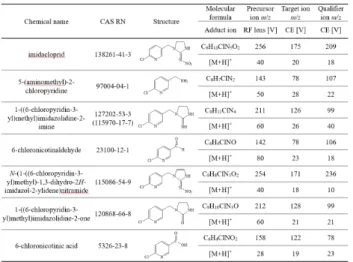
Pesticides are ubiquitous contaminants in water environments, so many researchers have reported their concentrations in surface waters. As well as the pesticides, Pesticide Transformation Products in Water environments (PTPWs) can be detected in the surface waters. In order to detect the PTPWs, authentic standards are needed. But the number of commercially available standards has been still limited. Thus in this study, a technique to detect the PTPWs without any of authentic standards was developed by coupling a LC-MS/MS with a high resolution LC-MS. A neonicotinoid pesticide imidacloprid was used as a model compound. Five purchasable PTPWs were detected in the irradiated aqueous solutions of imidacloprid by the analysis with the high resolution LC-MS, being acquired their retention times and m/z values. The product ion scan of the solution was conducted with the LC-MS/MS using the same chromatographic conditions, which resulted in the detection of five chromatographic peaks whose retention times are almost identical with those in the LC-MS analysis. Given this fact, SRM conditions were developed for each of these five compounds using the irradiated samples (Table 1). The developed conditions were verified by using the authentic standards, which indicates that the developed method in this study was shown to be effective (Figure 1).
Table 1. SRM conditions for imidacloprid and its PTPWs
1
Graduate School of Science and Engineering, Kagoshima University, Kagoshima 890-0065 Japan 2 Institute of Environmental Ecology, IDEA Consultants, Inc., Shizuoka 421-0212, Japan
Figure 1. PTPW concentrations in the river water samples and their risk assessments