Some Cremastinae of South East Asia, with
Descriptions of Three New Species
(Hymenoptera: Ichneumonidae)
著者
KUSIGEMATI Kanetosi
journal or
publication title
南海研紀要
volume
5
number
1
page range
1-9
URL
http://hdl.handle.net/10232/15645
Mem. Kagoshima Univ. Res. Center S. Pac, Vol. 5, No. 1, 1984
Some Cremastinae of South East Asia,
with Descriptions of Three New Species
(Hymenoptera: Ichneumonidae)
Kanetosi KUSIGEMATT*
Abstract
Seven species of the subfamily Cremastinae belonging to three genera are recorded from Fromosa, Hong Kong, Malayas, and Indonesia. Of those, Temelucha nagatomii,
Pristmerus parilis, and P. kendarensis are described as new, and Trathala flavoorbitalis
(Cameron) in Indonesia and Pristmerus chinensis Ashmead in Formosa, are recorded for the first time, respectively.
Introduction
The present article is based on material collected by the author in Indonesia (in the "First Survey Team on Animal and Plant Ecology in the South West Pacific Area"), by A. Nagatomi in Hong Kong, by H. Kawase in Malayas, and by H. Takemoto in Formosa, respectively. It includes descriptions of three new species, Temelucha nagatomii,
Pristmerus parilis and P. kendarensis and notes on some other species. All specimens, including type specimens of the new species described herein, are housed in the collec tion of the Entomological Laboratory, Kagoshima University, Kagoshima.
1. Trathala flavoorbitalis (Cameron)
Trathala flavo-orbitalis Cameron, 1907, Jour. Bombay Nat. Hist. Soc. 17: 589.
Specimen examined. Indonesia: l£, Passo, Ambon Is., 23-xi-1974, K. Kusigemati
leg.
This is the first record of the species from Indonesia.
The Indonesian specimen
examined agrees well with the Japanese except the body is slightly paler, the postocciput is infuscate, the first abdominal tergite is dark yellowish brown with the postpetiole
light yellowish brown, and the mesoscutum is yellow to yellowish brown without any
black markings.
Distribution: China, Hong Kong, Japan, Formosa, Philippines, Sri Lanka, Burma, India, Hawaii, Micronesia, Singapore, Indonesia, and Fiji.
Entomological Laboratory, Faculty of Agriculture, Kagoshima University, 21-24, Korimoto 1-Chome, Kagoshima
2 Kusigemati : Some Cremastinae of South East Asia
2. Temelucha philippinensis Ashmead
Temelucha philippinensis Ashmead, 1904, Jour. N. Y. Ent. Soc. 12: 18. Specimens examined. Malayas: 2$ $ & 19-?- £, Perak, 21-ii - 16-iv-1962, H.
Kawase leg.
Distribution: China, Formosa, India, Thailand, Philippines, and Malayas.
3. Temelucha nagatomii, sp. nov. (Figs. 2, 5 & 8)
•f-. Face about 1.9 times as wide as high, mat, and finely and densely punctate on the median portion; malar space 5/7 as long as basal width of mandible ; clypeus weakly and evenly convex, subpolished, with fine and sparse punctures, 1.7 times as wide as high, the apical margin of clypeus truncate ; mandible weakly tapering towards apex, the apical teeth approximately equal in length ; frons almost flat, strongly mat; distance between lateral ocelli and eyes about 1.7 times as long as diameter of an ocellus; occipital carina weak but distinct, widely interrupted above ; temple weakly swollen, about 1/2 as long as eye in lateral view. Pronotum subpolished, finely and sparsely punctate, with a large impunctate area just behind epomia ; mesoscutum strongly mat, weakly and densely punctate, the punctures becoming weaker anteriorly ; notaulus weak and short, extending to basal 3/8; scutellum weakly convex, with sparse and large punctures, the lateral carina weak and reaching to apex; mesopleurum subpolished, weakly mat, weakly and sparsely punctate, with a finely and vertically striate area just below specullum; specullum polished and smooth ; metapleurum subpolished, weakly and rather sparsely punctate. Propodeum (Fig. 2) subpolished, distinctly and rather sparsely punctate, and strongly areolated ; areola not confluent with petiolar area; basal area small, about as long as its basal width, the posterior margin narrowly truncate ; areola 2.4 times as long as wide, about as long as petiolar area and about 1.4 times
as wide as basal width of 2nd lateral area ; petiolar area with several, transverse striae.
Forewing (Fig. 5) with stigma rather small, 3.3 times as long as wide, with radius emitted from basal 1/2; intercubitus basad of 2nd recurrent vein by 4/9 of its own length; nervulus interstitial; subdiscoideus emitted from lower 5/6 of postnervulus; nervellus rather strongly reclivous, intercepted at lower 4/9 (Fig. 8). Hind femur slender, 4.9 times as long as wide in lateral view. Abdomen with postpetiole stout, about 1.3 times as long as its basal width, polished and smooth; 1st tergite about 1.3 times as long as propodeum ; 2nd tergite 5.6 times as long as wide at base ; ovipositor
sheath 2.2 times as long as 1st tergite.
Yellow and black, with abdomen largely reddish brown. Head pale yellow to
yellowish brown ; median portion of frons, ocellar area, dorsomedian area of occiput and dorsal half of postocciput dark brown, these dark brown areas confluent each other ; scape and pedicel light yellowish brown ventrally and infuscate dorsally ; flagellum light infuscate, a little paler basally. Pronotum and propleurum entirely pale yellow ; mesoscutum blackish, anterior margin of lateral lobe, longitudinal line along notaulus and a large subpostmedian spot yellowish brown; mesosternum dark brown with a yellow longitudinal stripe, the stripe widened basally ; mesopleurum light yellowish
Mem. Kagoshima Univ. Res. Center S. Pac, Vol. 5, No. 1, 1984 3
brown ; specullum and its surrounding area dark brown ; subtegular ridge pale yellow ; metapleurum yellowish brown, darker posteroventrally. Propodeum dark brown to black, a little paler posteriorly. Abdomen with petiole yellowish brown medially, dark brown basally and apically ; postpetiole dark brown basally and yellowish brown apically ; 2nd tergite blackish brown on basal 5/6, yellowish brown on apical 1/6; 3rd and following tergites dark brown to yellowish brown, paler lateroventrally ; ovipositor sheath blackish. Wings hyaline.
Length: Body 5.5mm., forewing 3.0mm.
$. Unknown.
Holotype (•£): Tai Lung Farm, Hong Kong, ll-xii-1970, A. Nagatomi leg. Distribution : Hong Kong.
This species is closely related to the Oriental species, T. philippinensis Ashmead, 1904, in that its occipital carina has a wide interruption and the scutellum has a com plete lateral carina, but is distinguished at once from that species by the slender hind femur, the interstitial nervulus, the pointed basal part of the 2nd discoidal cell, and
the colouration of the thorax and propodeum. Furthermore, this species is similar to
the Japanese species, T. kerrichi Momoi, 1968, from which it is easily distinguishable by the slightly slanted costula, by the dully pointed basal area of the propodeum, by the basal part of the second discoidal cell which is pointed, and by the slender hind femur.
It is my real pleasure that this species is named in honour of Prof. A. Nagatomi who collected the type-specimen.
^ & <
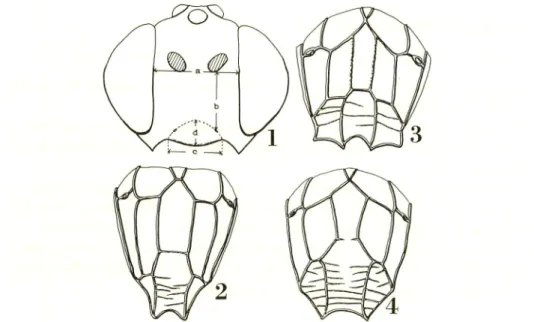
Fig. 1. Head in frontal view (a, width of face; b, height of face; c, width of clypeus; d, height of clypeus): Pristmerus kendarensis, sp.nov., $.
Figs. 2-4. Propodea in dorsal view : 2, Temelucha nagatomii, sp. nov., £ ; 3, P. kendar ensis, sp. nov., £ ; 4, P. parilis, sp. nov., •£.
4 KusiGEMATl: Some Cremastinae of South East Asia
The two species of Temelucha treated above may be distinguishable from each
other by the following key: —
1. Forewing with nervulus slightly antefurcal; basal part of second discoidal cell not pointed. Postpetiole finely and longitudinally striate. Propodeum light yellowish brown ; mesosternum and mesopleurum entirely yellow... 2.philippinensis Ashmead — Forewing with nervulus interstitial; basal part of second discoidal cell pointed (Fig. 5). Postpetiole polished and not striate. Propodeum blackish; mesosternum
black and yellow 3. nagatomii, sp. nov.
4. Pristmerus punctatus Uchida
Pristmerus punctatus Uchida, 1932, Jour. Fac. Agr. Hokkaido Imp. Univ. 33:
197.
Specimen examined. Formosa: l£, Wulai, Taipei Hsien, l-v-1981, H.Takemoto
leg.
The present specimen agrees well with the original description of punctatus Uchida, 1932, except for the frontal orbit which is narrowly tinged with reddish brown, the yellowish brown tegula, scutellum and postscutellum, the mesopleurum which is weakly tinged with dark brown, the light reddish brown mesoscutum with blackish lateral side and anterior half of median lobe, the yellowish brown apical parts of propodeum and metapieurum, and the narrow areola which is 2.4-2.6 times as long as wide at costula and slightly narrower than basal width of 2nd pleural area of propodeum.
Distribution: Formosa.
5. Pristmerus chinensis Ashmead
Pristmerus chinensis Ashmead, 1906, Proc. U. S. Nat. Mus. 30: 186.
Specimens examined. Formosa : 3 -£ -£, Lushanwenchuan, 1000 m, Nantou Hsien, 26-iv-1981, H. Takemoto leg.
This is the first record of the species from Formosa. The present material agree well with the original description of chinensis Ashmead, 1906, but differs in having
the following aspects: —
-£. Propodeum with areola narrow, 1.5—2.1 times as long as wide at costula, 0.8—
1.0 times as wide as basal width of 2nd lateral area. Face and clypeus a little darker; pronotum and propleurum almost entirely blackish; meso- and metapieurum, upper
division of metapieurum and scutellum entirely black; hind coxa dark brown to blackish, with apex yellowish brown; hind femur dark brown, with both ends yellowish brown.
Distribution: Formosa, China, Korea, and Japan.
6. ,Pristmerus parilis, sp. nov. (Figs. 4, 6 & 9)
-£. Face 1.5 times as wide as high, distinctly and sparsely punctate, the punctures becoming sparser centrally and laterally, with a dull median prominence ; clypeus pol ished, weakly convex, impunctate, 1.7 times as wide as high, the apex marginated with
Mem. Kagoshima Univ. Res. Center S. Pac., Vol. 5, No. 1, 1984 5
a weak carina and almost truncate ; malar space 1/2 as long as basal width of mandible ;
mandible weakly tapering towards apex, sparsely haired, the lower tooth a little shorter
than the upper one ; inner margins of eyes parallel-sided ; temple flat, narrow, about
1/6 as long as eye in lateral view; frons almost subpolished, faintly-and longitudinally
striate, mat on dorsal and lateral sides; distance between lateral ocelli and eyes about
as long as diameter of an ocellus; occipital carina weak but distinct, and complete.
Antennae with 30 segments; 2nd flagellar segment 6/7 as long as the 1st and 1.0 times as long as the 3rd. Pronotum polished and impunctate ; mesoscutum weakly and dense ly punctate, the punctures becoming weaker and sparser laterally; notaulus distinct; mesopleurum weakly and densely punctate ; specullum polished and impunctate ; scutellum
weakly convex, finely and rather sparsely punctate, without lateral carina ; metapieurum
weakly convex, finely and densely punctate.
Propodeum (Fig. 4) distinctly areolated ;
areola incompletely confluent with petiolar area, 1.5 times as long as wide at costula,
and about 1.1 times as wide as basal width of 2nd lateral area; basal area small, triangu
lar, 1.1 times as long as wide, the posterior margin pointed; petiolar area with a lon
gitudinal shallow groove and weak transverse striae; 3rd lateral area with several trans verse striae. Forewing (Fig. 6) with stigma large, 2.0 times as long as wide, with radius
emitted from basal 5/8; nervulus postfurcal by about 1/3 of its own length ; intercubitus
basad of 2nd recurrent vein by 1.5 times of its own length ; nervellus weakly inclivous,
intercepted at lower 2/5 (Fig. 9). Hind femur about 4.5 times as long as wide except
ventral teeth in lateral view, with a short tooth on ventral side, and without a rowof denticles on ventral side between the large tooth and apex of femur; hind tibia
without a longitudinal ventral carina. Abdomen with 1st tergite 1.2 times as long as
propodeum; postpetiole rather slender, about 2.0 times as long as its basal width, finely
and longitudinally striate; 2nd tergite 3.1 times as long as wide at base, finely and
longitudinally striate ; 3rd tergite finely and longitudinally striate, the striae being weaker
posteriorly ; ovipositor sheath 1.3 times as long as 1st tergite.Black.
Face, frons, vertex and occiput faintly tinged with dark brown; clypeus
light reddish brown; mandible whitish, the apical teeth dark brown ; scape, pedicel and
basal 2 segments of flagellum yellowish brown; flagellum except basal 2 segments in
fuscate ; malar space dark brown ; palpi light yellowish brown. Pronotum, propleurum
and subtegular ridge yellowish brown; mesopleurum blackish, with a large yellowish
brown spot on posterior portion ; scutellum light reddish brown ; postscutellum dark
brown. Legs yellowish brown, about apical 1/5 of hind tibia indistinctly banded by
dark brown, and hind tarsus a little darker. Abdomen with 1st tergite light yellowish
brown on basal 1/2, blackish on apical 1/2; 2nd and 3rd tergites blackish brown, a
little paler apically; 4th and following tergites dark brown, a little paler laterally;
ovipositor sheath blackish. Stigma blackish brown. Length : Body 4.6 mm., forewing 2.8 mm.
J. Unknown.
Holotype (£): Kendari, Sulawesi, Indonesia, 3-xii-1974, K. Kusigemati leg.
Distribution : Indonesia (Sulawesi).
This species is very closely related to the Formosan species, P. punctatus Uchida
1932, but is at once distinguishable from the latter by the incomplete areola, by the
6 KusiGEMATl: Some Cremastinae of South East Asia
finely and sparsely punctate scutellum and specullum, and by the entirely black meso
scutum, etc. as mentioned in the key.
7. Pristmerus kendarensis, sp. nov. (Figs. 1, 3, 7 & 10)
$. Face 1.7 times as wide as high, weakly and rather densely punctate, the punc tures becoming weaker and sparser centrally, with a dull median prominence ; clypeus weakly convex, polished, 1.9 times as wide as high, with weak and sparse punctures, the apex widely rounded and marginated by a weak carina ; malar space about 3/8 as long as basal width of mandible ; inner margins of eyes almost parallel-sided (Fig. 1); mandible weakly tapering towards apex, the apical teeth equal in length ; temple narrow, 2/7 as long as eye in lateral view; frons weakly mat, slightly convex ; distance between lateral ocelli and eyes 1.1 times as long as diameter of an ocellus; occipital carina weak but distinct, and complete. Antennae with 33 segments, 2nd flagellar segment 7/8 as long as the 1st and about as long as the 3rd. Pronotum polished, almost entirely im punctate, with a few longitudinal striae on lower portion ; mesoscutum subpolished, finely and sparsely punctate, finely and obliquely striate on posterior portion ; notaulus shallowly impressed ; mesopleurum polished, finely and rather sparsely punctate, with a vertically striate area just before specullum ; specullum with a few weak punctures ; metapieurum polished, weakly convex, weakly and sparsely punctate ; scutellum almost impunctate. Propodeum (Fig. 3) polished, very finely and sparsely punctate, and strongly and completely areolated; basal area small, triangular, 1.1 times as long as wide at base, with a short stalk on posterior margin; areola narrow, 2.7 times as long as wide at costula, 1.2 times as long as petiolar area and about 1.1 times as wide as basal width
of 2nd lateral area ; petiolar and 3rd lateral area with a few strong, transverse striae.
Forewing (Fig. 7) with stigma large, about 2.3 times as long as wide, with radius emitted from basal 5/8; nervulus interstitial; intercubitus basad of 2nd recurrent vein by 1.6 times of its own length ; nervellus vertical, intercepted at lower 2/9 (Fig. 10). Hind femur 4.2 times as long as wide in lateral view, with a long tooth on ventral side, and a row
of 8 denticles on ventral side between the large tooth and apex of femur ; hind tibia without a weak longitudinal carina on ventral side. Abdomen with 1st tergite 1.1 times
as long as propodeum; postpetiole rather slender, polished, with a few fine punctures, 1.9 times as long as its basal width; 2nd tergite 3.3 times as long as wide at base and 1.4 times as long as 3rd tergite, longitudinally and finely striate ; 3rd tergite very finely
striate basally.
Yellowish brown. Face, frons, vertex, occiput and postocciput blackish, the inner
orbit weakly tinged with dark brown ; malar space yellowish brown ; clypeus yellowish
brown, a little darker dorsally ; mandible yellowish brown, the apical teeth dark brown ;
palpi yellowish brown. Scape, pedicel and basal 2 segments of flagellum light yellowish
brown, darker dorsally ; flagellum except for basal 2 segments, infuscate. First tergite pale yellow on basal 1/2, dark brown on apical 1/2; 2nd tergite dark brown, yellowish
brown on about apical 1/3 ; 3rd tergite yellowish brown, dark brown on about basal 1/3 ; 4th and 5th tergites entirely yellowish brown ; 6th tergite dark brown dorsally, yellowish brown laterally ; 7th tergite almost entirely dark brown. Wings subhyaline,
Mem. Kagoshima Univ. Res. Center S. Pac., Vol. 5, No. 1, 1984
Figs. 5-7. Left forewings: 5, Temelucha nagatomii, sp.nov., £;
6, Pristmerus parilis,
sp.nov., -£ ; 7, P. kendarensis, sp.nov., $.
Figs. 8-10. Left hind wings: 8, T. nagatomii, sp.nov., £ ; 9, P. parilis, sp.nov., £ ; 10,
P. kendarensis, sp. nov., $.
a little darker apically (Fig. 7); stigma blackish.
Legs yellowish brown; hind tibia
yellowish brown medially, the basal and apical parts indistinctly banded by dark brown;
hind tarsus infuscate, a little paler basally.Length: Body 4.6mm., forewing 3.1mm.
•?-. Unknown.
Holotype ($): Amoito, Kendari, Sulawesi, Indonesia, l-xii-1974, K. Kusigemati leg.
Distribution: Indonesia (Sulawesi).
This species is similar to the preceding species, P. parilis, sp.nov., from which it is
immediately distinguished by the complete areola of the propodeum, the smooth
postpetiole, the mesopleurum with a vertical striate area, and by the colouration of
the body.
Furthermore, it is closely allied to P. erythrothracis Uchida, 1933, from
Japan and Korea, but differs from the latter by the parallel-sided inner margins of
the eyes, the impunctate scutellum, the polished and unstriated postpetiole, and the
8 KusiGEMATl: Some Cremastinae of South East Asia
The four species of Pristmerus treated above may be distinguishable from each
other by the following key : —
1. Male. Hind tibia with a longitudinal ventral carina ; scutellum almost impunctate. Abdomen with postpetiole unstriate. Thorax entirely light yellowish brown. Forewing subhyaline (Fig. 7) 7. kendarensis, sp.nov. — Female. Hind tibia without a longitudinal ventral carina ; scutellum more or less
distinctly punctate. Abdomen with postpetiole longitudinally striate. Thorax black, sometimes pronotum yellowish brown or mesonotum yellowish brown partly.
Forewing hyaline (Fig. 6) 2
2.. Propodeum with areola narrow, 2.4-2.6 times as long .as wide at costula, and slightly
narrower than basal width of 2nd lateral area. Pronotum and propleurum dark brown to black; scutellum black. Hind coxa black, yellowish brown at apex;
hind femur dark brown 5. chinensis Ashmead
— Propodeum with areola wide, 1.5-1.6 times as long as wide at costula, and wider
than basal width of 2nd lateral area. Pronotum, propleurum and scutellum yellow
ish brown. Hind coxa entirely yellowish brown ; hind femur yellowish brown or
dark brown 3
3. Propodeum with areola separated by a strong carina ; specullum strongly punctate ; intercubitus of forewing basad of 2nd recurrent vein by 1.8 times of its own length. Mesoscutum light reddish brown, with 3 blackish large markings
4. punctatus Uchida
— Propodeum with areola incompletely confluent with petiolar area (Fig. 4); specullum finely punctate ; intercubitus of forewing basad of 2nd recurrent vein by 1.5 times of its own length. Mesoscutum entirely black 6. parilis, sp. nov.
Acknowledgements
The author wishes to thank Prof. K. Ueki of the Kagoshima University, who gave
me the opportunity to join in the "First Survey Team of Animal and Plant Ecology
in the South West Pacific Area" and for his guidance in various ways. The author
also wishes to express his thanks to Prof. S.Iwakiri, Prof. J. Amemiya and other members of our party for their kind support and help in various ways during the course of the study. The author is grateful to Prof. A.Nagatomi of the Kagoshima University for his kindness in reading through the manuscript and for offering valuable material.
Thanks are also due to Messrs. H. Kawase and H. Takemoto for their kindness in offer ing valuable material.
References
Ashmead, W. H.: Descriptions of new Hymenoptera from Japan. Proc. U. S. Nat. Mus.
30: 169-201 (1906).
Mem. Kagoshima Univ. Res.Center S. Pac, Vol. 5, No. 1, 1984 9
with descriptions of new species. Part 3. Subfamilies Ophioninae, Cremastinae and Ichneumoninae. Mushi 41 (17): 215-220 (1968).
Momoi, S.: Ichneumonidae (Hymenoptera) of the Ryukyu Archipelago. Pacific Insects
12: 327-399 (1970).
Morley, CI.: The fauna of British India, including Ceylon and Burma. Hymenoptera
3. Ichneumonidae, 352 pp. (1913).
Sonan, J.: A few host-known Ichneumonidae found in Formosa (Hym.) (2).
Trans.
Nat. Hist. Soc. Formosa 20: 137-144 (1930).
Szepligeti, V.: Neue exotische Ichneumoniden aus der, Summlung des ungarischen
National Museum. Ann. Mus. Nat. Hangarici 4: 119-156 (1906).
Townes, H.: Insects of Micronesia Hymenoptera: Ichneumonidae, Stephanidae and
Evaniidae. Insects of Micronesia 19(2): 35-87 (1958).
Townes, H., M. Townes and V. K. Gupta: A catalogue and reclassification of the Indo-Australian Ichneumonidae. Mem. Amer. Ent. Inst. 1, 522 pp.(1961).
Townes, H., S. Momoi and M. Townes: A catalogue and reclassification of eastern
Palearctic Ichneumonidae. Mem. Amer. Ent. Inst. 5, 661 pp. (1965).
Townes, H.: The genera of Ichneumonidae, part 4. Mem. Amer. Ent. Inst. 17: 372 pp.
(1971).
Uchida, T.: Neue und wenig bekannte Japanische Ophioninen-Arten (Hym.). Trans.
Nat. Hist. Soc. 12: 73-78 (1932).
Uchida, T.: H.Sauter's Formosa-Ausbeute Ichneumonidae (Hym.).
Jour. Fac. Agr.
Hokkaido Imp. Univ. 33: 133-222 (1932).