Some Ephialtinae of South East Asia, with
descriptions of eleven new species
(Hymenoptera: Ichneumonidae)
著者
KUSIGEMATI Kanetosi
journal or
publication title
南海研紀要
volume
5
number
2
page range
126-150
URL
http://hdl.handle.net/10232/15655
Some Ephialtinae of South East Asia,
with descriptions of eleven new species
(Hymenoptera: Ichneumonidae)
Kanetosi KUSIGEMATI*
Abstract
Twenty-eight species belonging to twelve genera of the subfamily Ephialtinae are recorded from Formosa, Hong Kong, Guam, Thailand, Malayas and Indonesia. Of them, eleven species are described as new to science, and nine species are newly recorded from South East Asia, viz., Coccygomimus laothoe (Cameron), C. carinifrons (Cameron),
Dreisbachia punctata (Uchida and Momoi) and Zahrachypus unicarinata (Uchida and
Momoi) in Formosa, Xanthopimpla japonica Krieger and Theronia (Poecilopimpla)
brachyura Gupta in Hong Kong, X. punctata (Fabricius) in Guam and Ambon Is., X. emaculata Szepligeti in Malayas, and X. stemmator (Thunberg) in Thailand.
Introduction
The present article is based on material collected by the author (1974 & 1975) in Indonesia and Guam (as a member of the First and Second Survey Teams on Animal and Plant Ecology in the South West Pacific Area), by A. Nagatomi (1970-1971) in Hong Kong and Thailand, by H.Kawase (1962) in Malayas, and by H. Takizawa (1977), S.Hashimoto (1968), K. Ohara (1981 & 1984) and H. Takemoto (1981) in Formosa.
It includes descriptions of eleven new species, Coccygomimus alishanensis, Clistopyga nagatomii, Tromatobia taiwana, Acropimpla tricolor, A.emmiltosa, Scambus (Endro-mopoda) perparvulus, Acrodactyla syndromosa, A.inoperta (which also occurs in Japan), A.articoxa, Zahrachypus alhifacilis and Polysphincta asiatica (also occurring in Japan)
and notes on some other species. All specimens, including type specimens of the new
species described herein, are preserved in the collection of the Entomological Labora tory, Kagoshima University, Kagoshima.
1. Xanthopimpla clavata Krieger
Xanthopimpla clavata Krieger, 1914, Arch. f. Naturgesch. (A) 80 (6): 40, 91.
Specimens examined. Formosa: l-£, 18-iv-1981, Hsitsun-Chihtuan, 1000-1200 m, Taoyuan Hsien, K. Ohara leg.; l£, 27-iv-1981, Jihyetan, 750m, Nantou Hsien,
Entomological Laboratory, Faculty of Agriculture, Kagoshima University, 21-24, Korimoto 1-Chome, Kagoshima
Mem. Kagoshima Univ. Res. Center S.Pac, Vol.5, No. 2, 1984 127
H. Takemoto leg.
Distribution: Formosa and Japan (Kyushu; Ryukyu Is.). 2. Xanthopimpla emaculata Szepligeti
Xanthopimpia emaculata Szepligeti, 1908, Notes Leyden Mus. 29: 256.
Specimens examined. Malayas: 1^, l-iii-1962, Cameron High Land, H. Kawase leg.; 2££, 3-iv-1962, 3$$ & l£, 24-iv-1962, 1$, 26-iv-1962, 1$ & l£, 3-v-1962, Perak, H. Kawase leg.
Distribution: Formosa, India, Java, Nepal, Micronesia, Pakistan, Philippines, Hong
Kong, Ryukyu Is., Sumatra, Sarawak and Malayas.
This is the first of the species to be recorded in Malayas. 3. Xanthopimpla erythroceros Krieger
Xanthopimpla erythroceros Krieger, 1914, Arch. f. Naturgesch. (A) 80 (6): 32.
Specimen examined. Formosa: l£, 18-iv-1981, Hsitsun-Chihtuan, 1000-1200m, Taoyuan Hsien, K. Ohara leg.
Distribution: Formosa.
4. Xanthopimpla japonica Krieger
Xanthopimpla japonica Krieger, 1899, Sitzber. Naturf. Gessel. Leipzig 1897/98:
81.
Specimens examined. Formosa: 1-f, 20-viii-1968, Towfen, Miaoli Hsien, S.
Hashimoto leg.; l£, 14-iv-1981, Wulai, Taipei Hsien, K. Ohara leg.; l£, 26-iv-1981, Lushanwenchuan, 1000 m, Nantou Hsien, K. Ohara leg. Hong Kong: 1-f,
28-xii-1970, Tai Lung Farm, A. Nagatomi leg.
Distribution: China, Hong Kong, Formosa, India and Japan (Honshu; Kyushu;
Ryukyu Is.).
This is the first of the species to be recorded in Hong Kong.
5. Xanthopimpla punctata (Fabricius)
Ichneumon punctata Fabricius, 1781, Species insectrum 1: 437.
Specimens examined. Malayas: 1 $, 24-iv-196 2, Perak, H. Kawase leg. Indonesia:
1£, 23-xi-1974, Waii, Ambon Is., K.Kusigemati leg.; l£, 25-xi-1974, Latuhal,
Ambon Is., K. Kusigemati leg. Guam: 7$$ and l£, Agana, 18-xii-1975, K.
Kusigemati leg. Formosa: 1$, 20-viii-1968, Towfen, Miaoli Hsien, S.Hashimoto leg.
Distribution: Afganistan to Mollucca Is., Mauritius, Indonesia (Ambon Is.). Sabah, Malayas, Sri Lanka, Sarawak, Philippines, Guam, Thailand, India, Nepal, Hong Kong, Formosa, Tibet?, China and Japan (Shikoku; Kyushu; Ryukyu Is.).
This is the first of the species to be recorded in Guam and Ambon Is. The propodeum and abdominal tergites are variable in colouration. One specimen from
Indonesia (-f, 23-xi-1974, Waii, Ambon Is.) the first lateral area of the propodeum is
slightly tinged with dark brown, the second tergite with a pair of small dark brown
spots, and the other specimen from Indonesia ($-, 25-xi-1974, Latuhal, Ambon Is.)
the first lateral area of the propodeum and the 2nd tergite are entirely ivory.
6. Xanthopimpla stemmator (Thunberg)
Ichneumon stemmator Thunberg, 1822, Mem. Acad. Imp. Sci. st. Petersbourg 8:
262.
Specimen examined. Thailand: 1$, 28-i-1971, Sampaton, Chieng Mai, A. Nagatomi leg.
Distribution : Molucca Is., Lang Is., Krakatau Is., Java, Thailand, India, Sarawak, Borneo, Pakistan, Sri Lanka, Philippines, Formosa, China and Japan (Ryukyu Is.).
This is the first of the species to be recorded in Thailand.
7. Itoplectis homonae Sonan
Itoplectis homonae Sonan, 1930, Trans. Nat. Hist. Soc. Formosa 20: 137.
The male of this species was previously unknown. On the basis of the present specimen a description of the male is given below: —
$. Face nearly as wide as high at level of clypeal fovea, finely and rather densely punctate ; clypeus nearly as wide as high, its apical margin almost truncate medially ; malar space 1/2 as long as basal width of mandible ; temple weakly swollen, about 4/5 as long as eye in lateral view. Antennae slightly thickened towards apex, with 23 segments; 2nd flagellar segment 2/3 as long as the 1st and about 1.1 times as long as the 3rd. Pronotum polished, almost smooth, finely punctate along dorsal margin ; mesoscutum very finely and densely punctate, with dense short hairs ; notaulus weakly and shortly impressed ; scutellum weakly convex, polished, covered with rather
sparse hairs; mesopleurum largely smooth and hairless, with a comparatively wide band
of sparse hairs along prepectal carina; prepectus weakly and moderately densely punctate ; prepectal carina gently curved, its dorsal end attaining near anterior margin of mesopleurum; metapleurum almost smooth, with sparse hairs along anterior, dorsal and posterior margins. Hind femur about 2.6 times as long as wide in lateral view ; last hind trasal segment about 1.8 times as long as the 2nd; tarsal claws simple. Abdomen with 1st to 6th tergites strongly and densely punctate, their apices narrowly impunctate ; 7th tergite weakly to strongly punctate, the punctures stronger basally ; postmedian transverse groove of 2nd to 5th tergites weak laterally, obsolete medially.
Black. Antennae blackish ; palpi pale yellow. Tegula and hind corner of pronotum pale yellow. Front and middle legs with coxae blackish except at apex ; apex of coxae and trochanters pale yellow; femora, tibiae and tarsi light yellowish brown, the 3rd and 5th tarsal segments of front and middle tarsi a little darker. Hind leg with coxa black except at apex pale yellow; 1st trochanter infuscate basally, pale yellow apically;
femur fusco-ferrugineous, a little paler basally; tibia fuscous on basal 1/4, whitish on
Mem.Kagoshima Univ.Res. Center S.Pac, Vol. 5, No. 2, 1984 129
white. Abdomen black ; extreme apices of 2nd to 7th tergites tinged with dark brown
to pale yellow. Wings hyaline.
Length : Body 3.6 mm., forewing 3.0 mm.
Specimen examined.
Formosa:
1$, 15-iv-1984, Nanshanchi, Nantou Hsien, K.
Ohara leg.
Distribution: Formosa.
8. Coccygomimus carinifrons (Cameron)
Pimpla carinifrons Cameron, 1899, Mem. & Proc. Manchester Lit. Phil. Soc. 43
(3): 172.
Specimen examined. Formosa: 1$, 10-vii-1977, Tungpu, Nantou Hsien, H.
Takizawa leg.
Distribution : Formosa and India.
This is the first of the species to be recorded in Formosa. 9. Coccygomimus laotho'e (Cameron)
Pimpla laotho'e Cameron, 1897, Mem. & Proc. Manchester Lit. Phil. Soc. 41 (4): 22.
Specimens examined. Formosa: 2$$, 10-vii-1977, Tungpu, Nantou Hsien, H. Takizawa leg.
Distribution: Formosa, India, Pakistan and Sri Lanka. This is the first of the species to be recorded in Formosa. 10. Coccygomimus leucogonia (Cushman)
Epfucdtes leucogonia Cushman, 1933, Ins. Mats. 8: 44.
Specimens examined. Formosa: 2$$, 17-iv-1981, Mt.Lalashan, 1300-1500m, Taoyuan Hsien, K. Ohara leg.; 1$ & I-f, 17-iv-1981, Mt.Lalashan, 1300-1500m, Taoyuan Hsien, H. Takemoto leg.
Distribution: Formosa.
11. Coccygomimus nipponicus (Uchida)
Ptrnpia spuria var. nipponica Uchida, 1928, Jour. Fac. Agr. Hokkaido Imp. Univ. 25: 45.
Specimen examined. Formosa: 1$, 26-iv-1981, Lushanwenchuan, 1000 m, Nantou Hsien, K. Ohara leg.
Distribution: Formosa, China, Korea, Japan (including Ryukyu Is.), Kuriles and Sakhalin.
12. Coccygomimus alishanensis, sp. nov.
rather sparsely punctate, the punctures a little sparser laterally, rugoso-punctate on dorsomedian portion; clypeus with sparse and strong punctures along basal margin,
about 1.5 times as wide as high, its apical margin broadly rounded, sometimes slightly
concave medially ; malar space about 2/3 as long as basal width of mandible ; frons polished, smooth on lower portion, rather sparsely and strongly punctate and covered with long blackish hairs dorsally and laterally. Antennae filiform, with 35-37 segments; 2nd flagellar segment 5/7 as long as the 1st, 1.0-1.1 times as long as the 3rd and 1.9-2.2 times as long as the 6th. Pronotum polished, more or less sculptured, withsparse short hairs, the collar covered with short and dense hairs; mesoscutum finely
punctate, covered with short, greyish dense hairs; mesopleurum polished, sparsely andrather weakly punctate, with dark brown sparse hairs; prepectus finely and densely
punctate, with dense hairs; metapleurum polished, bare ventrally, weakly and obliquely
rugose dorsally, with sparse hairs on the rugose portion; scutellum polished, with rather dense hairs, without lateral carina. Propodeum polished, weakly but distinctly trans-striate except for smooth undefined petiolar area and almost unsculptured basomedian area, covered with rather sparse long brownish hairs, the hairs sparser on petiolar area; pleural area of propodeum more or less vertically striate, sometimes almost unsculptured on lower half, the posterior portion bare; propodeal spiracle elliptic, about 3.0 times as long as wide. Forewing with nervulus postfurcal by2/5-1/2 of its own length. Leg with 4th front tarsal segment about 1.8 times as long as
wide, not bilobed. Abdomen with 1st tergite polished, very sparsely and shallowlypunctate, sometimes weakly trans-striate laterally, its basomedian concavity bare; 1st tergite as seen in lateral with its median truncation not attaining beyond middle, with
a pair of dull tubercles on summit of its basal concavity ; 2nd to 6th tergites more or less mat, with very fine trans-striae except for each apical area, with short sparse brownish hairs; 7th tergite faintly mat, with very fine sparse punctures and short
sparse brownish hairs; epipleurae narrow, the 3rd one about 1/7 as wide as basal width of 3rd tergite.
Briliant metallic-blue. Mandible, apical 2/3 of clypeus and pedicel metallic
blue-black. Labial palpus infuscate; maxilary palpus black on 1st segment, yellowish brown to dark brown on 2nd and 3rd segments, infuscate on 3rd and 4th segments. Flagellum
black. Front leg covered with rather dense dark brown hairs; coxa with a small
ventroapical yellow spot; 1st trochanter pale yellow at apex; 2nd trochanter weakly tinged with dark brown ; femur metallic blue, with longitudinal pale yellow to yellwish brown band, the band widened apically ; tibia pale yellow to light yellowish brown, a little darker on inner side ; tarsus yellowish brown to dark brown, the last segment infuscate. Middle and hind tibiae and tarsi blue-black, the tarsi darker. Subgenital plate metallic blue, weakly tinged with dark brown apically. Wings subhyaline, weakly
tinged with light yellowish brown.
Length: Body 10.5-11.5 mm., forewing 9.4-9.7mm. $, Unknown.
Holotype. $, Formosa: Jumeitang, Alishan, Chiai Hsien, 14-iv-1984, K. Ohara
leg. Paratype.
1$, Alishan-Chushan, Alishan, Chiai Hsien, 13-iv-1984, K.Ohara leg.
Mem. Kagoshima Univ. Res. Center S. Pac, Vol.5, No. 2, 1984 131
This species may be immediately distinguished from any other Formosan and Japanese species by the brightly metallic blue body. Furthermore, in general appearance this species is most closely related to the Indian C. cyanator (Morley, 1913), from
which it is readily distinguished by the normal lateral longitudinal carina of the
propodeum, the front coxa with a yellow spot, the face with dark brown hairs, and the
metallic blue head, thorax, hind coxa and femur.
13. Theronia (Poecilopimpla) brachyura Gupta
Theronia (Theronia) brachyura Gupta, 1962, Pacific Insects Monog. 4: 36.
Specimen examined. Hong Kong: 1$, Hong Kong, 24-xii-1970, A. Nagatomi leg.
Distribution : Formosa and Hong Kong.
This is the first of the species to be recorded in Hong Kong.
14. Theronia (Poecilopimpla) zebra diluta Gupta
Theronia (Theronia) zebra diluta Gupta, 1962, Pacific Insects Monog. 4: 18. Specimens examined. Formosa: 1$, 10-vii-1977, Tungpu, Nantou Hsien, H. Takizawa leg.; 1-f, 23-iv-1981, Nanshanchi, 650-700 m, Nantou Hsien, K. Ohara leg.
Distribution: Formosa, China, Burma, Japan (Izu-shichi-to ; Ryukyu Is.).
15. Theronia (Parema) nigrobalteata formosana Cushman Tfieronia formosana Cushman, 1933, Ins. Mats. 8: 48.
Specimen examined. Formosa: l£, 23-iv-1981, Nanshanchi, 650-700 m, Nantou Hsien K. Ohara leg.
Distribution: Formosa.
16. Sericopimpla segrae sauteri (Cushman)
Philopsyche sauteri Cushman, 1933, Ins. Mats. 8: 38.
Specimen examined. Formosa: 1^, 10-vii-1977, Tungpu, Nantou Hsien, H.
Takizawa leg.
Distribution: Formosa and Japan (Honshu; Kyushu).
17. Clistopyga nagatomii, sp. nov. (Fig. 5)
$-. Face about 1.3 times as wide as high at level of clypeal fovea, slightly convex,
strongly and moderately densely punctate, the punctures becoming weaker and sparser laterally and ventrally; clypeus (Fig. 5) weakly convex, polished, sparsely haired, somewhat concave apically, 1.5 times as wide as high, its apical margin broadly truncate ; malar space 2.0 times as long as basal width of mandible; frons (Fig. 5) polished,
finely and transversely striate basomcdially, elsewhere weakly and rather sparsely
punctate, with a dull, median protuberance ; temple weakly swollen, rather wide, polished,sparsely haired, bare along eye margin, about 5/6 as long as eye in lateral view;
occipital carina strong and complete. Antennae with 19 segments; 1st flagellar segment
1.2 times as long as the 2nd; 2nd flagellar segment about 1.1 times as long as the
3rd. Pronotum subpolished, weakly and rather sparsely punctate along upper margin, weakly and longitudinally striate along posterior margin, elsewhere weakly mat; epomia
distinct, gently curved ; mesoscutum covered with short and rather dense hairs, elongate,
about 1.5 times as long as its middle width; notauli strongly impressed, extending to basal 7/9 of mesoscutum, with very short trans-striae; scutellum weakly convex,
sparsely haired ; transverse groove just before scutellum with a small, shallow pit on
each lateral corner; mesopleurum subpolished, weakly mat, with sparse punctures;
metapleurum subpolished, slightly convex, rather strongly mat; submetapleural carina
distinct and complete. Propodeum moderately convex, weakly to strongly mat, about 1.0 times as long as 1st tergite, with a pair of bare areas on basolateral portion; median longitudinal carinae of propodeum almost parallel-sided, very weak, extending to basal 1/2; lateral longitudinal carina of propodeum present on about posterior 2/5.
Forewing with 1st intercubitus very short; 2nd intercubitus absent; portion of cubitus
between intercubutus and 2nd recurrent vein about 1.8 times as long as 1st intercubitus ; nervulus interstitial, vertical; nervellus weakly reclivous, intercepted at lower 3/8; discoidella absent. Abdomon with 1st tergite 1.3 times as long as wide at apex,
strongly mat, with strong and complete lateral longitudinal carina, the median longi
tudinal carinae extending to basal 5/7 ; basomedian concavity of 1st tergite subpolished ;
2nd tergite weakly mat, with large and rather sparse punctures, about 1.0 times as long as wide at apex; 3rd and 5th tergites weakly and sparsely punctate, mat partly; 6th tergite weakly and rather sparsely punctate ; subgenital plate covered with dense hairs. Ovipositor subcylindric, weakly mat wholly, weakly upcurved ; ovipositor sheath about
1/5 as long as forewing.
Black. Clypeus yellowish brown to dark brown, darker basally ; mandible yellowish brown on basal half, blackish on apical half; palpi light yellowish brown, the last segment of maxilary palpus light fuscous; antennae light yellowish brown to light ferrugineous, a little paler basally. Anterior 2/3 of collar, posterodorsal corner of pronotum yellow to yellowish brown; anterior margin of pronotum tinged with yellowish brown. Front leg with coxa, trochanter and base of femur pale yellow to light yellowish brown ; femur except at base, tibia and tarsus light ferrugineous. Middle
leg with coxa and trochanter pale yellow to light yellowish brown ; femur, tibia and
tarsus light yellowish brown, apex of femur, apical 2/7 of tibia, apices of 1st to 3rd tarsal segments and apical 1/2 of last tarsal segment infuscate. Hind leg light ferrugineous; apex of femur, apical 2/9 of tibia, apices of 1st to 3rd tarsal segments and apical 1/2 of last tarsal segment infuscate. First tergite blackish, with a subapical yellowish brown band ; 2nd tergite light ferrugineous, dark brown basomedially, the apical margin tinged with dark brown; 3rd to 5th tergites yellowish brown to light ferrugineous ; 6th tergite blackish, slightly tinged with dark brown basally and apically ;
subgenital plate dark brown to blackish, a little paler basally and apically ; ovipositor light ferrugineous ; ovipositor sheath infuscate. Wings subhyaline.
Mem. Kagoshima Univ. Res. Center S. Pac, Vol. 5, No. 2, 1984 133
$. Unknown.
Holotype. $•, Thailand: Sampaton, Chieng Mai, 22-i-1971, A. Nagatomi leg.
Distribution: Thailand.
This species is similar to the Formosan Clistopyga latifrontalis (Uchida, 1941), but it is readily distinguished from the latter by the flagellum with 17 segments, the
strongly punctate face, the trans-striate frons, the mat propodeum with weak median longitudinal carinae, the entirely black face and thorax, and the colouration of abdomen. It is my real pleasure to name this species in honour of Prof. A. Nagatomi who collected the type specimen.
18. Tromatobia taiwana, sp. nov. (Figs. 3, 20 & 29)
$-. Face (Fig. 3) polished, very finely and sparsely punctate, the punctures becoming
denser and stronger dorsomedially, about 1.1 times as wide as high at level of clypeal fovea; clypeus covered with rather dense long greyish hairs, 1.9 times as wide as high, its apical margin strongly concave ; malar space about 1/3 as long as basal width of mandible ; upper tooth of mandible clearly longer and stouter than the lower ; frons with a shallow median longitudinal goorve ; distance between lateral ocelli and eyes as long as diameter of an ocellus ; occipital carina strong and complete, not dipped on the middorsal area ; temple slightly convex, covered with rather dense, regularly spaced hairs. Antennae filiform, with 29 segments; 2nd flagellar segment 2/3 as long as the 1st and 1.0 times as long as the 3rd. Pronotum polished, almost bare, finely punctate along dorsal margin; epomia weak and very short; mesopleurum with very sparse setiferous punctures, with a large bare area just before mesopleural suture ; prepectal carina almost straight, ending naerly at level of mesopleural pit, its upper end distant from front edge of mesopleurum by about 1.1 times of tegular width; metapleurum with sparse hairs on about posterior 1/3, with a dense hair band along anterior
margin. Propodeum without any carinae and ridges, with a shallow, median longitudinal groove on anterior 1/2, its dorsal face sparsely and weakly punctate, hairless on undefined petiolar area, its lateral face covered with long and rather dense hairs. Wings (Figs.
20 & 29) with nervulus postfurcal by about 1/5 of its own length; areolet pentagonal; radius emitting from basal 4/9 of stigma*; nervellus intercepted at lower 1/2. Hind femur 4.9 times as long as wide in lateral view. Abdomen with 1st tergite, in profile, evenly convex, without dorsomedian angle, its dorsomedian carina not attaining to spiracle; 1st basomedian concavity polished, bare; 2nd to 6th tergites strongly and
densely punctate, their apices narrowly impunctate. Ovipositor compressed, almost
entirely mat, rather strongly tapering towards apex ; ovipositor sheath long, 0.9 times as long as hind tibia.
Black. Face black, with a pair of yellow markings just below each antennal socket; clypeus stained with dull ferrugineous ; mandible black with dull ferrugineous teeth; palpi pale yellow; antennae infuscate, yellowish brown basoventrally. Lower margin of propleurum, lower and hind corners of pronotum, tegula, subtegular ridge,
scutellum and postscutellum pale yellow to light yellowish brown ; posterior magrin of
brown, darker anteriorly. Propodeum blackish, the central portion, area of lateral subapical tubercle and pleural area dull ferrugineous, those portions fused with each otjier. Front and middle legs pale yellow to light yellowish brown; middle tibia
with a subbasal fuscous band. Hind leg with coxa light ferrugineous, a little paler apically ; trochanter light yellowish brown; femur ferrugineous, with a subapical fuscous marking on dorsal side ; tibia infuscate, a little paler medially, with a pale yellow basal
band; tarsus infuscate except for basal 1/3 of basitarsus yellowish brown. Abdominal tergite black; 2nd to 6th tergites with a yellowish brown basal band each; apex of 6 th tergite stained with yellowish brown; ovipositor reddish brown; ovipositor sheath infuscate. Wings hyaline.
Length: Body 9.5 mm., forewing 7.7 mm.
$. Unknown.
Holotype. -£, Formosa: Hsitsun-Chihtuan, 1000-1200m, Taoyuan Hsien, 18-iv-1981, K. Ohara leg.
Distribution: Formosa.
This species is closely related to the Japanese T. maculata Momoi, 1970, but it differs from the latter by the long ovipositor, the nervellus which is intercepted at the middle, the black face with a pair of yellow markings, the entirely black mesoscutum, and the 2nd to 6th tergites with yellowish brown basal band each.
19. Acropimpla tricolor, sp. nov. (Figs. 6, 10, 15 & 24)
•?•• Face polished, weakly convex medially, with very sparse punctures, the punctures becoming a little denser dorsally, 1.1 times as wide as high at level of clypeal
fovea, its median convex area impunctate; clypeus covered with rather sparse long
hairs, 2.1 times as wide as high, its apical margin strongly concave medially (Fig. 6); malar space 2/5 as long as basal width of mandible; upper tooth of mandible obviously stouter and longer than the lower; frons polished, almost impunctate, very sparsely punctate along dorsal margin, with a pit between antennal sockets; distance between lateral ocelli and eyes about 1.3 times as long as diameter of an ocellus; temple slightly swollen, narrow, 4/9 as long as eye in lateral view, sparsely haired, bare along eye margin ; occipital carina weak but complete, the middorsal area weakly dipped. Antennae filiform, with 23 segments; 2nd flagellar segment 5/7 as long as the 1st and 1.0 times as long as the 3rd. Pronotum polished, almost bare, finely and rather closely punctate along dorsal margin ; epomia short and weak ; mesoscutum covered with short and dense hairs throughout; scutellum moderately strongly convex, sparsely haired basally, bare apically ; mesopleurum very sparsely and weakly punctate, with a large bare area just before mesopleural suture ; prepectal carina almost straight, ending a little above level of mesopleural pit, its upper end distant from front edge of mesopleurum by about 1.7 times of tegular width; metapleurum very sparsely haired on about posterior 1/2, bare on about anterior 1/2 and along lower margin. Propodeum (Fig. 10) without any carinae and ridges, its dorsal face largely and sparsely punctate except for undefined areola and petiolar area which is hairless, and its lateral face covered with long and rather sparse hairs; propodeal spiracle small, circular, distant from pleural carina by its
Mem. Kagoshima Univ. Res. Center S. Pac, Vol. 5, No. 2, 1984 135
own diameter. Wings (Figs. 15 & 24) with nervulus slightly antefurcal; stigma narrow, about 4.9 times as long as wide, with radius emitting from basal 4/9; portion of cubitus between intercubitus and 2nd recurrent vein about 1.7 times as long as intercubitus ; 2nd intercubitus absent; nervellus intercepted at lower 2/5. Abdomen
with 1st tergite, in profile, weakly and evenly convex, its dorsal carinae strong, extending to basal 2/3 ; 1st tergite 1.0 times as long as wide at apex and 0.9 times as long as the 2nd, strongly and closely punctate, with a rather small impunctate area on sublateral median portion, the basomedian concavity polished and bare; 2nd to 6th
tergites largely and closely punctate, their apices narrowly impunctate; 3rd to 6th
tergites with a pair of subbasal distinct tubercles each ; ovipositor moderately compressed, the tip of dorsal valve broadly and slightly concave behind the nodus in profile, the lower valve with 7 oblique ridges; ovipositor sheath 2.1 times as long as hind tibia.
Black. Clypeus light yellowish brown, black along basal margin ; mandible pale yellow basally, light reddish brown apically, the apical teeth blackish ; palpi pale yellow ; antennae blackish, a little paler apicalliy. Pronotum black, with a large ferrugineous marking on posterodorsal portion, the hind corner and posterodorsal margin yellow ; tegula and subtegular ridge yellow; mesopleurum with a ferrugineous marking just below subtegular ridge ; prepectus with a small yellow marking on its upper corner ; mesoscutum dull ferrugineous, the anterior portion of median lobe infuscste ; scutellum dull ferrugineous, with a yellow apical band ; postscutellum black on basal 2/3, yellow on apical 1/3. Front and middle legs pale yellow to light yellowish brown. Hind leg with coxa pale yellow to light yellowish brown, a little darker ventrally ; trochanter pale yellow ; femur light ferrugineous, a little paler dorsally ; tibia pale yellow, with subbasal
and apical fuscous bands; 1st to 3rd tarsal segments light yellowish brown, with an
apical fuscous band each; 4th and 5th tarsal segments fuscous. First tergite entirely black; 2nd to 6th tergites black, yellowish brown to light ferrugineous on lateral sides each; 7th and 8th tergites blackish, weakly tinged with dark brown. Ovipositor ferrugineous ; ovipositor sheath blackish. Wings hyaline.
Length: Body 8.8 mm., forewing 7.4 mm.
$. Unknown.
Holotype. $-, Formosa: Meifeng-Tsuifeng, 2200-2300 m, Nantou Hsien, 25-iv-1981, K. Ohara leg.
Distribution: Formosa.
This species is closely allied to the Formosan A. nigrescens (Cushman, 1933), but
it is easily distinguished from the latter by the propodeum without median longitudinal carinae, the face black without yellow marking, the malar space black and the mesoscutum ferrugineous.
20. Acropimpla emmiltosa, sp. nov. (Figs. 9, 16 & 25)
This new species is very similar to the preceding species, A. tricolor, sp. nov., from which it may be separated by the following characters: —
£. Face weakly convex, about 1.2 times as wide as high at level of clypeal fovea, the punctuation a little sparser than in tricolor; clypeus about as wide as high ; malar
space about 2/5 as long as basal width; frons without pit between antennal sockets; temple about 2/5 as long as eye in lateral view, distance between lateral ocelli and eyes 1.1 times as long as diameter of an ocellus. Antennae with 23 or 24 segments; 2nd flagellar segment 7/9-6/7 as long as the 1st and about as long as the 3rd. Mesopleurum and propodeum a little more sparsely punctate than in tricolor; scutellum sparsely haired, bare apically ; prepectal carina ending nearly at level of mesopleural pit.
Propodeum (Fig. 9) with median longitudinal carinae on basal 1/2-2/3; propodeal spiracle small and circular, distant from pleural carina by 1/3 of its own diameter.
Wings (Figs. 16 & 25) with stigma narrow, about 5.3 times as long as wide, with
radius emitting from basal 3/7-1/2; portion of cubitus between 1st intercubitus and 2nd recurrent vein about 1.8 times as long as 1st intercubitus; areolet present; nervulus interstitial; nervellus intercepted at lower 1/3. Abdomen with 1st tergite about 1.1 times as long as wide at apex, about 0.9 times as long as the 2nd, the impunctate area
more extensive; punctuation of tergites a little more weaker than in tricolor; lower
valve of ovipositor with 8 oblique ridges ; ovipositor sheath about 2.4 times as long
as hind tibia.
Black. Clypeus pale yellow, black along basal margin ; palpi and mandible except for apical teeth infuscate, pale yellow. Pronotum ferrugineous largely, the anterior margin and collar blackish; mesoscutum, scutellum and postscutellum ferrugineous; mesopleum black, with a wide oblique ferrugineous band, the band fused with ferrugineous subtegualr ridge ; metapleurum black, sometimes slightly tinged with reddish
brown. Legs a little paler than in tricolor. First tergite black ; 2nd and subsequent
tergites weakly tinged with dark brown, the lateral margin of each tergite a little paler. Length: Body 8.4-9.1 mm., forewing 7.0-7.6 mm.
$. Unknown.
Holotype. £, Formosa: Meifeng-Tsuifeng, 2200-2300 m, Nantou Hsien, 16-17-iv-1884, K. Ohara leg. Paratype. Formosa: l-£, 25-iv-1981, Meifeng-Tsuifeng,
2200-2300 m, Nantou Hsien, K. Ohara leg.
Distribution : Formosa.
21. Scambus (Endromopoda) perparvulus, sp. nov. (Figs. 7, 18 & 27)
$. Face polished, very finely and rather densely punctate, as wide as high at level
of clypeal fovea ; clypeus polished, almost bare, with a few hairs along basal margin,
slightly convex along basal margin, its apical margin weakly concave, about 1.5 times
as wide as high; malar space 3/8-1/2 as long as basal width of mandible; apical teeth
of mandible nearly equal in length ; occipital carina weak but complete, the dorsomedian part weakly arched downward; distance between lateral ocelli and eyes 1.5 times aslong as diameter of an ocellus ; dorsal part of frons and vertex very sparsely haired ;
temple weakly swollen, sparsely haired, bare along eye margin, 3/4 as long as eye in
lateral view. Antennae with 21 or 22 segments; 1st flagellar segment about 2/3 aslong as the 1st and as long as the 3rd. Pronotum polished, almot bare, but the collar
with very sparse hairs ; mesoscutum covered with dense and short hairs ; mesopleurum
very sparsely haired, with a large bare area along mesopleural suture ; metapleurum
Mem. Kagoshima Univ. Res. Center S. Pac, Vol. 5, No. 2, 1984
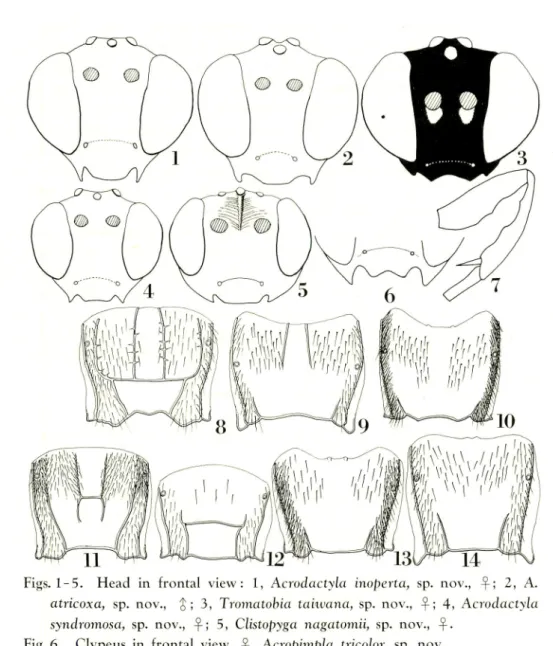
Figs. 1-5. Head in frontal view: 1, Acrodactyla inoperta, sp. nov., $-; 2, A.
atricoxa, sp. nov., $; 3, Tromatohia taiwana, sp. nov., $-; 4, Acrodactyla
syndrornosa, sp. nov., $-; 5, Clistopyga 7ragatOTnii, sp. nov., $-.
Fig. 6. Clypeus in frontal view, -^, Acropimpla tricolor, sp. nov.
Fig. 7. Front femur and tibia in inner lateral view, $, Scambus (Endromopoda)
perparvulus, sp. nov.
Figs. 8-14. Areolation and hair arrenement of propodea: 8, Acrodactyla
atricoxa, sp. nov., $; 9, Acropimpla emmiltosa, sp. nov., •$•; 10, A. tricolor,
sp. nov., ^; 11, Acrodactyla inoperta, sp. nov., ^; 12, A. syndrornosa, sp. nov., •£; 13, Polysphincta asiatica, sp. nov., £; 14, Zctbracfvypus albifacialis,
sp. nov., ^f-.
137
polished, rather strongly convex, with a few hairs; scutellum polished, weakly convex, sparsely haired. Propodeum polished, very sparsely haired, bare on petiolar area, more densely haired on pleural area; median longitudinal carinae present on basal 7/9, almost parallel-sided or weakly widened posteriorly; areola more or less rugulose; lateral longitudinal carina weak but complete ; apical transverse carina weak, sometimes
obsolete; propodeal spiracle small, circular, touching pleural carina. Wings (Figs. 18 & 27) with nervulus postfurcal by 1/5-2/9 of its own length; areolet rather large, quadrangular; nervellus intercepted at lower 1/7-2/7. Hind femur 3.6-3.8 times as long as wide in lateral view; front femur (Fig. 7) with a pair of excions on ventral side; front tibia (Fig. 7) with a pair of strong concavities on ventral side, the basal one more strongly impressed. Abdomen with 1st tergite weakly rugulose, with sparse hairs, rather slender, 1.4-1.6 times as long as wide at apex, its median dorsal carinae and dorsolateral carinae strong and reaching to apex; 2nd tergite about 1.1 times as long as the 1st; 2nd and 3rd tergites strongly and densely punctate, their apices impunctate; sclerites of sternites small, elongate, clearly longer than wide.
Black. Antennae blackish ; pale yellow, the last segments of palpi infuscate ; mandible black. Tegula and hind corner of pronotum pale yellow. Front and middle legs pale yellow, coxae blackish basally, pale yellow apically; trochanters pale yellow; femora and tibiae yellowish brown; tarsi light yellowish brown, the last segments infuscate. Hind leg with coxa black except for extreme apex pale yellow; trochanter pale yellow; femur dark brown, both ends pale yellow; tibia pale yellow, with subbasal and apical infuscate bands; tarsus infuscate, the basal 2/3 of basitarsus, bases of 2nd and 3rd segments pale yellow.
Length : Body 4.4-4.9 mm., forewing 3.6-3.9 mm. •£. Unknown.
Holotype and paratype. 2$$, Formosa: Alishan-Chushan, 2200-2500m, Chiai Hsien, 13-iv-1984, K. Ohara leg.
Distribution: Formosa.
This species is similar to the Japanese S.(E) annulitarsis (Ashmead, 1906). It may, however, be distinguished from the latter by the small sized body, the pronotum impunctate, the meso- and metapleurum very sparsely haired and the colouration of legs.
22. Dreisbachia punctata (Uchida and Momoi)
Laufeia punctata Uchida and Momoi, 1959, Ins. Mats. 22: 84.
Specimen examined. Formosa: l£, 17-iv-1981, Mt. Lalashan, 1300-1500 m, Taoyuan Hsien, K. Ohara leg.
Distribution: Formosa and Japan (Hokkaido).
This is the first of the species to be recorded in Formosa. The present specimen agrees well enough with the original description of punctata, but it differs in having
the following aspects: —
•£. Legs a little paler than the Japanese form; subtegular ridge weakly tinged with yellow; scutellum entirely black ; propodeum covered with rather sparse hairs on anterior 2/5, bare on posterior 3/5. Body ca. 6.3 mm., forewing 5.2 mm. in length.
23. Acrodactyla syndrornosa, sp. nov. (Figs. 4, 12, 21 & 30)
Mem. Kagoshima Univ. Res.Center S. Pac., Vol. 5, No. 2, 1984 139
at level of clypeal fovea ; inner margins of eyes weakly convergent ventrally ; clypeus strongly convex on basal half, slightly convex on apical half, polished, bare, separated from face by a weak groove, 1.6 times as wide as high, its apical margin slightly concave, with a few hairs ; malar space 0.9 times as long as basal width of mandible ;
mandible strongly tepering towards apex, its upper tooth longer than the lower one ; frons polished, almost entirely bare; vertex with a few hairs; temple moderately swollen, wide, about 5/8 as long as eye in lateral view, with very sparse hairs ; distance between lateral ocelli and eyes 1.3 times as long as diameter of an ocellus. Antennae with 23 segments; 2nd flagellar segment about 7/9 as long as the 1st and about 1.1 times as long as the 3rd. Pronotum polished, virtually bare, with a few hairs along dorsal margin; epomia strong, not reaching to upper edge of pronotum; mesoscutum polished, sparsely haired on posteromedian area, elsewhere bare, its anterior vertical carina strong ; notaulus distinct, without trans-striae ; scutellum sparsely haired, long, roof-shaped in anterodorsal view; prepectal carina weak, its upper end distant from front edge of mesopleurum by about 1.4 times of tegular width ; mesosternum sparsely haired; metapleurum polished, very sparsely haired on dorsal half, bare on ventral half. Propodeum (Fig. 12) polished, with a few hairs, bare on petiolar area ; pleural area with sparse hairs; median longitudinal carinae entirely absent; apical transverse carina strong and complete ; lateral longitudinal carina strong on petiolar area. Wings (Figs. 21 & 30) with stigma large, 3.4 times as long as wide, with radius emitting from basal 1/2; 2nd recurrent vein subvertical, almost straight; portion of cubitus between intercubitus and 2nd recurrent vein 3.0 times as long as intercubitus ; nervulus postfurcal by 3/8 of its own length; nervellus intercepted at lower 1/3; discoidella slightly pigmented. Hind femur slender, 7.0 times as long as wide in lateral view; front and middle femora not specialized. Abdomen with 1st tergites slender, about 2.1 times as long as wide at apex and about 1.2 times as long as the 2nd, polished, with very sparse hairs, its median dorsal and dorsolateral carinae present on basal 4/5 each ; 2nd and 3rd tergites polished, with very sparse, iregularly spaced hairs, the hairs a little denser laterally ; 4th and subsequent tergites sparely, evenly haired. Ovipositor sheath about 4/9 as long as hind tibia.
Black, with abdominal tergites, mandible and clypeus piceous black. Palpi pale
yellow; scape and pedicel light yellowish brown, infuscate on dorsal side ; flagellum piceous, a little paler apically. Tegula and hind corner of pronotum pale yellow. Front and middle legs with coxca pale yellow to light yellowish brown, paler apically ; trochanters pale yellow; femora, tibiae and tarsi except for last segments yellowish
brown, the last tarsal segments infuscate. Hind leg with coxa yellowish brown to
dark brown, paler ventrally ; trochanter light yellowish brown ; femur yellowish brown, infuscate on dorsal side and at apex ; tibia yellowish brown, with basal, subbasal and
apical infuscate bands; tarsus infuscate. Ovipositor sheath blackish. Wings hyaline; stigma pale ; veins pale to pale infuscate.
Length: Body 4.3 mm., forewing 3.9 mm.
$. Unknown.
Holotype. •f, Formosa: Meifeng-Tsuifeng, 2200-2300 m, Nantou Hsien,
Distribution: Formosa.
This species belongs to the degener species-group, and is very closely related to the Holarctic A. degener (Haliday, 1838). It differs from A. degener by the comparatively slender hind femur, the median part of the median lobe of the mesoscutum with a few hairs along the sides and the posteromedian part of lateral lobes of the mesoscutum
with about 15 hairs.
24. Acrodactyla atricoxa, sp. nov. (Figs. 2, 8, 23 & 32)
$. Face (Fig. 2) polished, densely covered with white hairs, 0.7 times as wide as
high at level of clypeal fovea; inner margins of eyes rather strongly convergent below ; clypeus polished, very sparsely haired, separated from face by an indistinct groove, 1.5 times as wide as high, its apical half flattened and the apical margin subtruncate ; malar space 1/3 as long as basal width of mandible ; mandible moderately strongly tapering towards apex, the upper tooth longer than the lower one ; frons polished, virtually bare ; vertex polished, with a few hairs ; occiput bare ; temple slightly swollen, narrow, 1/2 as long as eye in lateral view, with a few hairs; distance between lateral ocelli and eyes 1.6 times as long as diameter of an ocellus. Antennae with 24 segments; 2nd flagellar segment about 4/7 as long as the 1st and 1.0 times as long as the 3rd. Pronotnm polished, bare except for sparsely haired dorsal margin; epomia strong, reaching to upper edge of pronotum; median lobe of mesoscutum rather densely and evenly haired, its anterior vertical carina very short, but distinct; lateral lobes of mesoscutum
rather sparsely haired, the hairs sparser posteromedially ; notaulus strong, with short
trans-striae; scutellum weakly convex, polished, sparsely haired basally and laterally,
bare medially ; prepectal carina very strong, its upper end distant from front edge of
mesopleurum by about 1.2 times of tegular width ; mesosternum covered with dense
white hairs; metapleurnum rather coarsely rugose, with moderately dense hairs. Propodeum (Fig. 8) polished, strongly areolated, sparsely haired, the petiolar area hairless; median longitudinal carinae weakly convergent anteriorly, with short
trans-striae beside the carinae; pleural area with short trans-trans-striae beside the lateral and
pleural carinae. Wings (Figs. 23 & 32) with stigma wide, about 3.8 times as long as
wide, with radius emitting from basal 4/9; 2nd recurrent vein weakly inclivous, weakly
curved; nervulus postfurcal by 2/3 of its own length; portion of cubitus between
intercubitus and 2nd recurrent vein 9.3 times as long as intercubitus ; nervellus inter
cepted at lower 0.3 ; discoidella absent. Hind femur comparatively stout, 4.9 times as long as wide in lateral view; front and middle femur and tibia not specialized. Abdo
men with 1st tergite slender, about 2.2 times as long as wide at apex and about 1.3 times as long as the 2nd, polished, with very sparse hairs, its dorsal carinae present on basal 6/7, the dorsolateral carina reaching to the apex ; 2nd and 3rd tergites polished, very sparsely haired, each with a large bare basomedian area; 4th and 5th tergites very sparsely haired, the hairs sparser medially ; 6th and following tergites rather densely
and evenly haired.
Black, with abdominal tergites piceous black. Palpi pale yellow ; mandible dark brown basally, light yellowish brown apically, the apical teeth reddish brown ; clypeus
Mem. Kagoshima Univ. Res. Center S. Pac., Vol.5, No. 2, 1984
Figs. 15-23. Forewings: 15, Acropimpfa tricolor, sp. nov., £; 16, A.
emmiltosa, sp. nov., •£; 17, Zarnachypus albifac'ialis, sp. nov., -f; 18,
Sca7nht(s (Endromopoda) perparvulus, sp. nov., $; 19, Polysphincta asiatica, sp. nov., £; 20, Tromatobia taitcana, sp. nov., £; 21,
Acrodactyla syndrornosa, sp. nov., $•; 22, A. inoperta, sp. nov., -f; 23,
A. atricoxa, sp. nov., J.
Figs. 24-32. Hind wings: 24, Acropimpla tricolor, sp. nov., $-; 25, A. emmiltosa, sp. nov., ^-; 26, Zahrachypus albifacialis, sp. nov., -^; 27, Scarnbus (Endromopoda) perpanndus, sp. nov., £ ; 28, Polysphincta
asiatica, sp. nov., §•; 29, Tromatobia taiwana, sp. nov., -f-; 30, Acrodactyla syndrornosa, sp. nov., •£; 31, A. inoperta, sp. nov., ^-; 32,
Mem. Kagoshima Univ. Res. Center S. Pac, Vol. 5, No. 2, 1984 143
piceous black basally, dull ferrugineous apically. Scape and pedicel piceous ; flagellum piceous black. Hind corner of pronotum weakly tinged with dark brown ; tegula dark brown, a little paler apically. Front and middle legs pale yellow to yellowish brown,
the middle tarsus a little darker. Hind leg with coxa piceous black, a little paler basoventrally; trochanter and femur yellowish brown; tibia yellowish brown, with basal and apical infuscate bands; tarsus infuscate. Wings subhyaline, the forewing
weakly clouded apically ; stigma and veins infuscate. Length: Body 5.0 mm., forewing 4.4 mm.
£, Unknown.
Holotype. $, Formosa: Wulai, Taipei, Taipei Hsien, 14-iv-1981, K. Ohara leg. Distribution: Formosa.
This species belongs to the rnadida species-group. On account of the areolation of the propodeum, the rugose metapleurum and the colouration of the legs, the species
is superficially allied to the Japanese A. varicarinata (Uchida and Momoi, 1958), but
it is at once distinguished from the latter by the polished vertex, occiput, temple and
scutellum with very sparse hairs, the notaulus with short trans-striae and strongly
convergent inner eye margins.
25. Acrodactyla inoperta, sp. nov. (Figs. 1, 11, 22 & 31)
•f-. Face (Fig. 1) about 7/9 as wide as high at level of clypeal fovea, polished, rather densely haired, the hairs sparser medially, sometimes hairless on median portion ; inner margins of eyes rather strongly convergent ventrally ; clypeus polished, separated from face by a shallow groove, about 1.5 times as wide as high, moderately strongly convex, flattened on apical 2/3, with very sparse hairs along basal and apical margins; apical margin of clypeus broadly and weakly convex; malar space 1/2-5/9 as long as basal width of mandible ; mandible strongly tapering towards apex, the upper tooth a little longer than the lower one ; frons polished, almost bare, sparsely haired on frontal
orbit; vertex and occiput very sparsely haired; temple moderately swollen, rather wide, 1/2-5/9 as long as eye in lateral view, very sparsely haired ; distance between lateral ocelli and eyes 1.0 times as long as diameter of an ocellus. Antennae with
23-25 segments ; 1st flagellar segment 5/8-2/3 as long as the 1st and about as long as
the 3rd. Pronotum polished, almost hairless except for hind corner with sparse hairs ;
epomia strong, reaching to upper edge of pronotum; mesoscutum densely and evenly
haired, its anterior veritcal carinae moderately strong ; notaulus distinct, without
trans-striae ; scutellum moderately convex, very finely and densely punctate, with dense
hairs ; prepectal carina strong, its upper end distant from front edge of mesopleurum
by 1.1-1.3 times of tegular width; mesosternum covered with dense hairs; metapleurum finely and sparsely punctate, impunctate and hairless on lower 1/3. Propodeum (Fig. 11) polished, rather sparsely and finely punctate; median longitudinal carinae distinct, sometimes obsolete on anterior portion; petiolar area impunctate, without hairs ; petiolar and lateral areas incompletely combined ; pleural area very finely and rather sparsely punctate, with rather sparse hairs. Wings (Figs. 22 & 31) with stigma narrow, 4.7-5.4 times as long as wide, with radius emitting from about basal 3/8; 2nd
recurrent vein strongly inclivous, weakly curved ; nervulus postfurcal by 3/8-4/9 of its
own length; portion of cubitus between intercubitus and 2nd recurrent vein 2.5-3.8
times as long as intercubitus; nervellus intercepted at lower 1/3-4/9, sometimes not
intercepted; discoidella obsolete or absent. Hind femur slender, 5.9-6.3 times as long
as wide in lateral view ; front and middle femora and tibiae not specialized. Abdomen
with 1st tergite slender, 2.2-2.4 times as long as wide at apex and 1.3-1.4 times as
long as the 2nd, very sparsely haired, with dorsal carinae on basal 6/7-8/9; 2nd tergite
polished, very sparsely haired, the apical 1/3 hairless ; 3rd and following tergites densely
and evenly haired. Ovipositor sheath about 1/2 as long as hind tibia.
Black, with abdominal tergites piceous black. Palpi pale yellow; mandible yellowish
brown to dull ferrugineous, a little darker basally; clypeus piceous, blackish basally.
Antennae piceous black.
Hind corner of pronotum yellowish brown; tegula pale
yellow; subtegular ridge yellowish brown to dark brown. Front and middle legs with
coxa and trochanters pale yellow; femora, tibiae and tarsi yellowish brown, the tarsi a
little darker. Hind leg with coxa pale yellow to yellowish brown, a little darker basally ;
1st trochanter pale yellow, a little darker on basal inner side; 2nd trochanter pale
yellow to dark brown, paler basally ; femur yellowish brown to dark brown, infuscate
laterodorsally; tibia light yellowish brown on median 3/7, infuscate on basal and
apical 2/7 each, the basal infuscate band indistinct; tarsus entirely infuscate. Ovipositor
sheath black. Wings subhyaline ; stigma and veins infuscate.
Length : Body 5.0-6.0 mm., forewing 4-7-5.4 mm.
$.
Closely resembles the female in general structure and colour, from which
it differs by the following points: —
Face 4/5-8/9 as wide as high at level of clypeal fovea; inner margins of eyes less
strongly convergent ventrally; distance between lateral ocelli and eyes 0.9-1.1 times as
long as diameter of an ocellus. Antennae with 22-24 segments; 2nd flagellar segment
2/3-3/4. Epomia sometimes not reaching to upper edge of pronotum. Hind femur
a little stouter, 5.1 times as long as wide in the Japanese form, 5.5-5.7 times as long
as wide in lateral view in the Formosan form. Legs a little paler than in female.
Length: Body 4.6-5.8 mm., forewing 4.1-5.1 mm.
Holotype. £, Formosa: Mt. Lalashan, 1300-1500m, Taoyuan Hsien, 17-iv-1981,
K. Ohara leg.
Paratypes. Formosa:
3$$.. data same as the holotype; 1-f,
25-iv-1981, Meifeng-Tsuifeng, 2200-2300m, Nantou Hsien, K. Ohara leg. Japan:
l£,
2-vi-1969, 1$, 3-2-vi-1969, all Kosugidani, Yaku-shima, Kyushu, K.Kusigemati leg.; 1
16-vi-1972, Aiko-dake, Yaku-shima, Kyushu, K. Kusigemati leg.; l£, 30-vi-1976
Naidaijin, Gokanosho, Kumamoto-ken, K. Ohara leg.; l£, 28-vi-1976, Choja-baru
Kuju-san, Kyushu, K. Ohara leg.; l£, 3-5-vii-1975, Hikimi, Shimane-ken, Honshu
A. Nagatomi leg.; l£, 3-ix-1966, Gassan, Yamagata-ken, Honshu, K. Kusigemati leg
2$$, 29-vii-1967, Mt.Daisetsu (Taisetsu-san), Hokkaido, K.Kusigemati leg.; l£,
30-viii-1967, Soranuma-dake, Hokkaido, K. Kusigemati leg.Distribution:
Formosa and Japan (Hokkaido; Honshu; Kyushu).
This species is variable in the structures of the stigma and the hind femur. In the
Formosan form, the stigma is 5.4 times as long as wide in female, the hind femur
6.1-6.3 times as long as wide in lateral view in female, 5.5-5.7 times as long as wide in
Mem. Kagoshima Univ. Res. Center S. Pac, Vol. 5, No. 2, 1984 145
lateral view in male, while in the Japanese form, the stigma is 4.7-4.9 times as long as wide in female, the hind femur 5.9 times as long as wide in lateral view in female, 5.1 times as long as wide in lateral view in male.
This species belongs to the madida species-group. It is similar to the preceding species A. atricoxa, sp. nov., from which it differs by the notaulus without trans-striae,
the areolation of the propodeum, the rugose metapleurum and the hind coxa yellowish brown. Furthermore, this species is very closely related to the Japanese A. varicarinata (Uchida and Momoi, 1958), from which it differs by the comparatively narrow face and malar space, the face, occiput, and temple with very sparse hairs, and the hind
coxa yellowish brown.
26. Zahrachypus unicarinata (Uchida and Momoi)
Polysphincta unicarinata Uchida and Momoi, 1958, Ins. Mats. 22:
24-Specimen examined. Formosa: 1$, 16-17-iv-1981, Meifeng-Tusifeng,
2200-2300 m, Nantou Hsien, K. Ohara leg.
Distribution: Formosa and Japan (Hokkaido; Honshu ; Kyushu).
This is the first of the species to be recorded in Formosa. The present specimen
agrees well enough with the original description and the Japanese material. The scutel
lum and postseutellum are dirty yellowish brown. The hind femur is a little darker
than in the Japanese form. The hind tarsus except for the basal 1/3 is infuscate.
27. Zahrachypus albifacialis, sp. nov. (Figs. 14, 17 & 26)
•£.
Face polished, moderately densely haired, about 5/8 as wide as high at level
of clypeal fovea; clypeus polished, separated from face by a distinct groove, very
sparsely haired, moderately strongly convex, about 1.9 times as wide as high, its apical
margin rather strongly reflexed and its apex broadly convex ; malar space 2.2 times aslong as basal width of mandible; mandible strongly tapering towards apex, with 2
small teeth, the upper tooth clearly longer than the lower one ; frons polished, bare ;
vertex and occiput polished, with very sparse hairs ; occipital carina strong and complete,
the dorsomedian portion slightly arched upward ; temple weakly swollen, about 3/5 as
long as eye in lateral view, with sparse and regularly spaced hairs; distance between
lateral ocelli and eyes 1.1 times as long as diameter of an ocellus. Antennae with 24 segments; 2nd flagellar segment 2/3 as long as the 1st and 1.1 times as long as the3rd. Pronotum polished, almost hairless except for hind corner with sparse hairs; epomia
strong, reaching near upper edge of pronotum ; mesoscutum covered with short densehairs throughout; notaulus strong ; scutellum weakly convex, rather sparsely haired;
prepectal carina strong, its upper part weakly curved posteriorly, and its upper end
distant from edge of mesopleurum by about 1.0 times of tegular width ; mesosternum
rather densely haired ; metapleurum polished, almost hairless except for posterior corner
with very sparse hairs.
Propodeum (Fig. 14) polished, sparsely haired basally, bare
apically ; pleural area sparsely haired, incomplete, so that the lateral carina is present on
posterior 1/3 ; propodeal spiracle small, circular, touched with pleural carina. Wings (Figs. 17 & 26) with stigma slender, 4.4 times as long as wide, with radius emitting from basal 4/9; nervulus postfurcal by about 1/3 of its own length; portion of cubitus between intercubitus and 2nd recurrent vein 2.9 times as long as intercubitus ; nervellus intercepted at lower 3/8; discoidella distinct, reaching near hind margin of hind wing. Hind femur slender, about 5.4 times as long as wide in lateral view. Abdomen with 1st tergite rather stout, about 1.7 times as long as wide at apex, about as long as the 2nd, polished, very sparsely haired, with dorsal carinae on basal 8/9, its dorsolateral carina strong and complete; 2nd tergite polished, largely and sparsely punctate on median swelling area, longitudinally or loosely striate with sparse hairs on basolateral area, almost entirely bare on about posterior 1/3; 3rd and 4th tergites strongly and rather densely punctate, the punctures weaker and sparser posteriorly, their apices
broadly impunctate and hairless; 5th tergite rather densely and weakly punctate, the
punctures weaker posteriorly ; 6th and 7th tergites finely and evenly punctate. Ovi positor sheath 5/6 as long as hind tibia.
Black, with mesoscutum, scutellum, mesopleurum and mesosternum ferrugineous. Face, clypeus, malar space, mandible except for apical teeth, lower margin of temple and palpi white to pale yellow ; scape and pedicel whitish ventrally, infuscate dorsally ;
flagellum piceous black. Propleurum, anterior margin and hind corner of pronotum, tegula and subtegular ridge yellowish brown; mesoscutum dull ferrugineous, a little darker anteriorly ; scutellum light ferrugineous, paler apically; postseutellum dirty yellowish brown; mesosternum, lower 2/3 of mesopleurum ferrugineous; metapleurum tinged with reddish brown. Front and middle legs pale yellow to light yellowish brown; apex of middle basitarsus, apical 1/2 of middle 2nd tarsal segment and middle 3rd tarsal segment infuscate. Hind leg with coxa and trochanter light yellowish brown; femur yellowish brown, infuscate laterally ; tibia pale yellow, infuscate on about apical 2/7, with indistinct basal and subbasal infuscate bands; apical 1/3 of basitarsus and 2nd to 5th tarsal segments infuscate. Abdominal tergites more or less piceous black ; 2nd to 4th tergites with a pair of posterotransverse yellow spots each; ovipositor sheath blackish. Wings subhyaline ; stigma pale infuscate.
Length: Body 6.7 mm., forewing 5.5 mm.
$. Unknown.
Holotype. £, Formosa: Meifeng-Tsuifeng, 2200-2300m, Nantou Hsien,
25-iv-1981, H. Takemoto leg.
Distribution: Formosa.
This species is closely related to the preceding species, Z. unicarinata (Uchida and Momoi, 1958), but it can be clearly distinguished from the latter by the propodeum without apical transverse carina, the radius emitting from near the middle of the stigma, the whitish face, clypeus and mouth parts, and by the ferrugineous mesosternum,
mesopleurum, mesoscutum and scutellum.
28. Polysphincta asiatica, sp. nov. (Figs. 13, 19 & 28)
Mem. Kagoshima Univ. Res. Center S. Pac, Vol.5, No. 2, 1984 147
1.0-1.2 times as wide as high at level of clypeal fovea; inner margins of eyes slightly
convergent ventrally ; clypeus polished, separated from face by a distinct groove, very
sparsely haired, 2.1-2.3 times as wide as high, weakly convex, its apical half flattened;
apical margin of clypeus thin, broadly convex, slightly concave medially ; malar space
4/7-7/9 as long as basal width of mandible; mandible strongly tapering towards apex,
the upper tooth clearly longer than the lower one ; frons polished, bare ; vertex and
occiput polished, with very sparse hairs; distance between lateral ocelli and eyes 1.0
times as long as diameter of an ocellus; temple polished, rather wide, 4/9-4/7 as long
as eye in lateral view, with very sparse hairs; occipital carina strong and complete, the
median dorsal portion weakly arched upward.
Antennae with 28-30 segments ; 2nd
flagellar segment 5/8-2/3 as long as the 3rd.
Pronotum polished, almost bare, very
sparsely haired on hind corner and dorsal margin ; epomia strong,
far distant from
upper edge of pronotum; mesoscutum except for basal half of median lobe virtually
bare ; basal half of median lobe densely haired, the hairs sparser posteriorly ; notaulus
very weak and short; scutellum moderately strongly convex, very sparsely haired;
mesosternum finely and sparsely punctate ; prepectal carina strong, its upper end distant
from front edge of mesopleurum by 1.5-1.8 times of tegular width; metapleurum
finely and sparsely punctate, narrowly bare along lower margin, with sparse hairs;
submetapleural carina strong and complete. Propodeum (Fig. 13) polished, weakly and
very sparsely punctate on anterior 1/2, virtually bare on posterior 1/2, without median
longitudinal carinae, with a shallow longitudinal groove ; pleural area rather sparsely
and finely punctate; lateral longitudinal carina present on posterior 1/5-1/4; propodeal
spiracle small, circural, distant from pleural carina by 2/5-8/9 of its own diameter.
Wings (Figs. 19 & 28) with stigma slender, 4.5-4.8 times as long as wide, with radius
emitting from basal 2/5-4/9; nervulus interstitial to postfurcal by 1/2 of its own
length, sometimes slightly antefurcal; portion of cubitus between intercubitus and 2nd
recurrent vein 2.6-4.1 times as long as intercubitus; nervellus intercepted at lower
3/8-1/2; discoidella distinct, reaching near hind edge of hind wing.
Hind femur
slender, 5.3-5.9 times as long as wide in lateral view. Abdomen with 1st tergite stout,
1.3-1.5 times as long as wide at apex and about 0.9 times as long as the 2nd, polished,
very sparsely haired, with a large bare area on posteromedian portion, its dorsal carinae
present on basal 1/3-4/9; 2nd to 6th tergites polished, the hairs becoming a little
denser on posterior tergites, and with a median pair of large rounded swellings each;
7th and 8th tergites evenly covered with moderately dense hairs.
Ovipositor sheath
1.1-1.4 times as long as hind tibia.
Black.
Clypeus blackish, sometimes tinged with dark brown apically ; palpi pale
yellow ; scape blackish, with a apical whitish band on ventral side ; pedicel infuscate,
paler apically ; flagellum infuscate, paler basoventrally ; mandible pale yellow, blackish
at extreme base, the apical teeth light ferrugineous. Tegula, subtegular ridge and hind
corner of pronotum pale yellow to light yellowish brown ; scutellum yellowish brown,
sometimes with a median blackish band ; postseutellum yellowish brown.
Front leg
pale yellow to yellowish brown, the tarsus a little darker.
Middle leg with coxa and
trochanter yellowish brown ; femur and tibia light ferrugineous ; tarsus infuscate, basal
half of basitarsus and bases of 2nd and 3rd tarsal segments yellowish brown. Hind leg
with coxa light ferrugineous, pale yellow on dorsal side; 1st trochanter and femur
yellowish brown to light ferrugineous; tibia light yellowish brown, with basal and apical
infuscate bands, the basal band indistinct; tarsus infuscate, base of basitarsus yellowishbrown. Abdominal tergites more or less piceous black, the base of 2nd to 5th tergites
a little paler, sometimes with yellowish brown basal band each.
Ovipositor sheath
blackish. Wings hyaline; stigma pale infuscate to infuscate.Length: Body 6.7-10.1 mm., forewing 5.3-7.4 mm.
$. Closely resembles the female in general structures and colouration, from which
it is differs by the following points: —
Face a little more sparsely punctate, 1.1-1.2 times as wide as high at level of
clypeal fovea; clypeus 2.2-2.4 times as wide as high; distance between lateral ocelli
and eyes 8/9 as long as diameter of an ocellus. Antennae with 27 or 28 segments; 2nd flagellar segment 1.1-1.2 times as long as the 1st. Propodeum with weak median longitudinal carinae, sometimes replaced by dull ridges, with a shallow median groove. Wings with portion of cubitus between intercubitus and 2nd recurrent vein about 2.2 times as long as intercubitus. Hind femur about 4.9 times as long as wide in lateral view. First tergite about 1.3 times as long as wide at apex, with dorsal carinae onbasal 7/9-5/6. Legs a little paler than in female. Length: Body 8.6-10.8 mm., forewing 5.9-6.2 mm.
Holotype. -?-, Japan: Osore-zan, Aomori-ken, Honshu, 3-viii-1979, K. Ohara leg. Paratypes. Formosa: 1^, 25-iv-1981, Meifeng-Tsuifeng, 2200-2300 m, Nantou
Hsien, K. Ohara leg.; l£, 25-iv-1981, Meifeng-Tsuifeng, 2200-2300 m, Nantou Hsien,
H. Takemoto leg. Japan: l£, 20-ix-1966, l£, 6-ix-1967, l£, 13-ix-1968, all
Sapporo, Hokkaido, 2££, 27-ix-1967, Jozankei, Hokkaido, 1$ & l£, 8- &
9-vii-1967, T6ya-ko, Hokkaido, K. Kusigemati leg.: 1$, 26-ix-9-vii-1967, Jozankei, Hokkaido, H. Takizawa leg.; l£, 8-ix-1967, Nasu-dake, Tochigi-ken, Honshu, K. Kusigemati leg.Distribution: Formosa and Japan (Hokkaido; Honshu).
This species is similar to the Holarctic P. tuberosa Gravenhorst,*1829, but is imme diately distinguished by the complete and strong submetapleural carina, the complete
pleural carina, and the propodeum which is bare on the posterior half and is very
sparsely punctate on the anterior half.Acknowledgements
The author wishes to thank Prof. K. Ueki of the Kagoshima University, who gave
me the opportunity to join the "First and 2nd Survey Team on Animal and Plant Ecology in the South West Pacific Area" and for his guidance in various ways. The author also wishes to express his thanks to Prof. S. Iwakiri, Prof. J. Amemiya and other members of our party for their kind support and help in various ways during the
course of the study. The author is grateful to Prof. A. Nagatomi of the Kagoshima
University for his kindness in reading through the manuscript and for offering valuable
material. Thanks are also due to Messrs. H. Kawase, H. Takizawa, S. Hashimoto, K. Ohara and H. Takemoto for their kindness in offering valuable material. The study
Mem. Kagoshima Univ. Res. Center S. Pac, Vol. 5, No. 2, 1984 149
was greatly assisted by the continuous efforts of Miss Yoshiko Ikeshima of the Kagoshima University.
References
Ashmead, W H.: Descriptions of new Hymenoptera from Japan. Proc. Nat. Mus.
30: 169-201 (1906).
Cushman, R.: New Oriental and Australian Ichneumonidae. Philippine Jour. Sci. 20:
543-597 (1922).
Cushman, R.: H. Sauter's Formosan collection : Xanthopimpla (Ichneumonidae: Hy
menoptera). Ent. Mitteil. 14: 41-50 (1925).
Cushman, R.: H. Sauter's Formosan-collection : Subfamily Ichneumonidae (Pimplinae
of Ashmead). Ins. Mats. 8: 1-50 (1933).
Gupta, V. K.: Taxonomy, zoogeography, and evolution of Indo-Australian Theronia
(Hymenoptera: Ichneumonidae). Pacific Insects Monog. 4, 142 pp. (1962).
Momoi, S.: Ichneumonidae (Hymenoptera) collected in paddy field of the Orient,
with descriptions of new species, part 1. Subfamilies Ephialtinae, Gelinae,
Banchinae, Anomalinae and Mesochorinae. Mushi 40: 1-10 (1966).
Momoi, S.: Some new Ichneumonidae (Hymenoptera) from New Guinea and adjacent
areas. Pacific Insects 8: 152-164 (1966).
Momoi, S.: Some Ephialtinae, Xoridinae and Banchinae of Thailand (Hymenoptera:
Ichneumonidae). Kontyu 36: 182-185 (1968).
Momoi, S.: Some Ephialtinae, Xoridinae and Banchinae of Taiwan (Hymenoptera: Ichneumonidae). Kontyu 36: 186-189 (1968).
Momoi, S.: Ichneumonidae (Hymenoptera) collected in paddy field of the Orient, with descriptions of new species, part 4. Suppliment. Mushi 42 : 147- 154 (1969).
Momoi, S.: Ichneumonidae (Hymenoptera) of the Ryukyu Archipalago. Pacific Insects
12: 327-399 (1970).
Momoi, S.: Some Ephialtinae, Xoridinae and Banchinae of the Philippines (Hymenop tera: Ichneumonidae). Pacific Insects 13: 123-139 (1971).
Momoi, S.: A synopsis of the New Guinean Itoplectis and Coccygomimus (Hymenoptera :
Ichneumonidae). Pacific Insects 15: 363-378 (1973).
Morley, Cl.:The fauna of British India, including Ceylon and Burma. Hymenoptera
3. Ichneumonidae, 532 pp. (1913).
Sonan, J.: A new host-known Ichneumonidae found in Formosa (Hym.) (2). Trans. Nat. Hist. Soc. Formosa 20: 137-144 (1930).
Townes, H. & M. Townes : Ichneumon-flies of America North of Mexico: 2. Sub
family Ephialtinae, Xoridinae and Acaenitinae. U. S. Nat. Mus. Bull. 216, part
2. 676 pp. (1960).
Townes, H., M. Townes & V.K.Gupta: A catalogue and reclassification of the Indo-Australian Ichneumonidae. Mem. Amer. Ent. Inst. 1, 522 pp. (1961).
Townes, H., S. Momoi & M. Townes: A catalogue and reclassification of eastern
Townes, H.: The genera of Ichneumonidae, part 1. Mem. Amer. Ent. Inst. 11, 300
pp. (1969).
Uchida, T.: Dritter Beitrag zur Ichneumoniden-Fauna Japans. Jour. Fac. Agr. Hokkaido
Imp. Univ. 25: 1-115 (1928).Uchida, T.: Beschreibungen der neuen echten Schlupfwespen aus Japan, Korea und
Formosa. Ins. Mats. 4: 121-132 (1930).
Uchida, T.: Beitraege zur systematik der Tribe Polysphinctini Japans. Ins. Mats. 15:
112-122 (1941).
Uchida, T.: Eine neue Schmarotzerwespe von Spinnen. Ins. Mats. 15: 161-162 (1941).
Uchida, T. & S. Momoi: Descriptions of new species of the Tribe Ephialtini from
Japan (Hymenoptera, Ichneumonidae). Ins. Mats. 21: 6-11 (1957).
Uchida, T. & S. Momoi: On the species of Polysphincta Gravenhorst and Zatypota
Fbrster from Japan (Hymenoptera, Ichneumonidae). Ins. Mats. 22: 22-30(1958).
Uchida, T. & S. Momoi: On the species of the genera Laufeia and Lycorina occurring