Alteration and Mineralization in La Suerte
Mine, Camarines Norte, Philippines
著者
Mamaril-Diegor E.J., Tomita K, Domingo E.G.,
Duroy A.C., Janer F, Juan R.A., Lacsamana
E.C., Pitargue G.M.F.
journal or
publication title
鹿児島大学理学部紀要. 地学・生物学
volume
22
page range
23-42
別言語のタイトル
フィリッピン, カマリネス ノルテ, ラ スエルテ鉱
山における変質と鉱化作用
URL
http://hdl.handle.net/10232/5978
Alteration and Mineralization in La Suerte
Mine, Camarines Norte, Philippines
著者
Mamaril-Diegor E.J., Tomita K, Domingo E.G.,
Duroy A.C., Janer F, Juan R.A., Lacsamana
E.C., Pitargue G.M.F.
journal or
publication title
鹿児島大学理学部紀要. 地学・生物学
volume
22
page range
23-42
別言語のタイトル
フィリッピン, カマリネス ノルテ, ラ スエルテ鉱
山における変質と鉱化作用
URL
http://hdl.handle.net/10232/00003928
Rep. Fac. Sci., Kagoshima Univ.,(Earth Sci. & Biol.) No. 22, p.23-42, 1989.
Alteration and Mineralization in La Suerte Mine, Camarines Norte, Philippines
EJ. Mamaril-Diegor , K. Tomita , E.G. Domingo , A.C. Duroy F.Janer *, R.A.Juan* *, E.C. Lacsamana and G.M.F. Pitargue
(Received September 5, 1989)
ABSTRA CT
The La Suerte Mine, re-developed by Benguet Corporation, lies in the northeasトtrending gold-bearing Luna Pelang quartz vein which is composed of pyrite, chalcopyrite, sphalerite and galena. The vein occurs within the Paracale Granodiorite near its contact with the partially serpentinized ultramafic rocks. Alteration minerals associated with the gold mineralization have been studied by means of X-ray Diffraction Analysis, Scanning Electron Microscopy and Differential Thermal Analysis.
X-ray diffraction results showed that the predominant alteration minerals consist of quartz, mica, feldspars and kaolinite with minor amounts of dolomite, calcite, gypsum, anhydrite and mixed-layer clay minerals(? ). Scanning electron microscopy and differential thermal analysis revealed welトcrystallized kaohnite occurring in individual hexagonal grains or occasionally as fine particles on altered plagioclases, and mica, in platy hexagonal crystals.
INTRODUCTION Purpose and Scope
The geologic investigation of La Suerte Mine was made in connection with the
"Comparative Study on Gold Occurrences in Camarines Norte and Masbate , a joint project
between the Philippine Bureau of Mines and Geo-Sciences (BMG) and the Philippine
Council for Agriculture and Resources Research and Development (PCARRD). The
project was created to study known gold occurrences in Camarines Norte and Masbate,
●Philippines as to their geology, mineralogy, alteration, mineralization, temperature of
●
formation, tectonic setting and base metal contents. It was aimed at establishing a hydrothermal model for gold deposits in the Philippines that would be of use to future gold
●
exploration work of mining companies and prospectors.
A series of fieldwork was conducted during the period May 1986 to March 1987 0n different target areas in Camarines Norte. The work consisted of subsurface mapping of underground workings, e.g. tunnels, drifts, cross-cuts, and spot checks of surface manifestation of vein occurrences. However, the activities of the project were abruptly
Institute df Earth Sciences, Faculty of Science, Kagoshima University, Kagoshima, Japan. PETROLAB, Mines and Geo-Sciences Bureau, Philippines
24 E.J. Mamaril-Diegor,et al
terminated due to the reorganization that has unfortunately befallen the BMG. The present
paper, therefore, documents the results of the laboratory analyses conducted on the alteration minerals related with the gold mineralization in one of the gold areas in Camarines Norte-the La Suerte Mine.
Location, Accessibility and Topography
The La Suerte Mine is presently being developed by Benguet Corporation as its Paracale Gold Project. It is situated in Barrio Sta. Rosa Norte which is about a kilometer from the town of Panganiban, Camarines Norte, which is in turn, 340 kms southeast of Manila
(Fig. 1). It is approximately bounded by 14015′-14016′ N latitude and 122044′-122045′ E
longitude.
Fig.1. Location of study area.
The area is readily accessible by a well-maintained mine road taking off of the Panganiban provincial asphalt road. It is about six- to seven-hours drive from Manila along the Manila South Road and about two-hours'drive from the nearest airport in Naga City.
Alteration and Mineralization in La Suerte Mine, Camarines Norte, Philippines 25
The La Suerte Mine lies in a low to moderate topography with Mt. Bonotan located on the east. The Gumaus River drains the area and empties its load at Gumaus Bay.
GEOLOGIC SETTING
Regionally, the mine area lies in the so-called Paracale Mining District consisting of Paracale Granodiorite, a stock measuring 12 kms long and 4 kms wide (Fig. 2). Alongthe margins of this stock is a series of basic and ultra-basic rocks that are characteristically t
●
serpentinized (Caleon, 1973).
Fig. 2. Simplified geology ofCamarines Norte and La Suerte Mine, modified from the UNDP Technical Report No. 1 (1987).
Locally, the serpentinized ultramafic rocks, which are massive and dark-green in color, outcrop at the southern portion of the area. The granodiorite, on the other hand, almost wholly covers the area, especially its northern extreme. It is predominantly coarsely crystalline, almost equigranular and generally gneissic in texture. Large crystals of biotite, plagioclases and welトformed hornblende are some of the distinguishing features of this plutonic body.
A geologic study of the Panganiban area conducted by a BMG-UNDP Project (UNDTCD, 1987) showed that the granodiorite stock is a Pre-Cretaceous pluton as indicated by its texture and contact relations with the overlying ultramafic rocks. Its
26 E.J. Mamaril-Diegor,et al
strong foliation, mostly sub-parallel to the contact with the overlying rock unit, suggests that the deformation accompanied tectonic emplacement. The inferred thrust contact between the two rock units is first suggested by a Benguet Corporation geologist of La Suerte Mine (UNDTCD, 1987) and is further verified by the mylonitization observed in one of the BC drill holes where the contact occurs. Dikes of aplite, dacite porphyry, andesite porphyry and amphibolite were also observed cutting the grandodiorite.
METHODOLO GY
Altered samples were obtained from the surface and subsurface manifestations of the Luna Pelang vein, the most exploited gold-bearing quartz vein in La Suerte Mine. Through the courtesy of Benguet Corporation, sampling was done in their underground workings at levels 4, 56, 86 and 126 (Fig. 3) alongthe strike as well as on the footwall and hangingwall of the vein. The mineral constituents of the samples were identified by means of optical and mineragraphic microscopy, X-ray diffraction (XRD) , scanning electron microscopy (SEM) and differential thermal analysis (DTA).
孤 160 l <4サ 80 40 rlrl o ′三 三-・三-=‡・ヱ-三-d=ニ=・=王正三 ′. ′ ー -ー - ■一- 一 一 -80」 -_一 一 ∵ - - ・ - ∵■ ニ ∵ - - - -■■-rLW5 r 一 一・・- ・ ヽ -120 ヽ一、一 -160 1一一㌧一一一一ヽ -200 Lyz¥サ) -280 ー一一 一一一一一一一、 ≡:詔三===≡二二ニニ 'I 二二 二 ー II --.--1-二二二二 ∵∵=二二.一二二「二二二 一一一一一一一一--、 、一一一一一一一一一、 -_/二 ∴∴ ==コ 二二二二コ 一一一一一一一一一一一一一 \ 1 一 -/ SCALE: I:4000
/, "i Qre body (doshed whore inferred) t・
-、一′
Fig. 3. A longitudinal section of the underground workings in La Suerte Mine.
Samples analyzed by XRD were pulverized to 270 mesh using a vibrating mill. Oriented mounts were prepared by sedimentation method and the <2/Jm suspended particles were smeared into glass slides. Some of the prepared materials were glycolated,
and others were heated t0 550℃ for 1 hr. Diffraction patterns of treated and untreated
samples were obtained with the use of Rigaku Geigerflex X-ray diffractometer using a CuK α
radiation at 30kV and 15 mA. The relative abundances of the various alteration minerals were semi-quantitatively determined by a method modified by two of the authors (Tomita and Mamaril-Diegor) from the techniques of Oinuma (1968). Relative intensities of
Alteration and Mineralization in La Suerte Mine, Camarines Norte, Philippines 27
specific hkl spacings of minerals such as quartz, plagioclase, mica and kaolinite were
●
estimated by measurement of the area under the diffraction curves corresponding to these
●
spacings and were compared to those of the standard samples of the minerals.
Using a JEOL JSM- 25 scanning electron microscope, the morphological properties of clay minerals were observed. Specimens of these minerals concentrated by sedimentation
method were pasted in halトinch diameter brass discs and were sputtered with gold-paladium ions to insure electrical conductivity and prevent charging effects. For
DTA, 300 mg of powdered sample placed in a holder was heated continuously at a rate of
10℃ per minute up to 1000℃ and analyzed by Rigaku Thermoflex apparatus.
Thin and polished sections of the ores were prepared and examined under optical and mineragraphic microscopes, respectively. Some samples of vein, footwall and hanging wall materials were also submitted to the assay laboratory of the BMG Regional Office in Daet,
Camarines Norte for their base metal contents.
RESULTS
ORE MINERALS
Mineragraphic analysis was undertaken to identify the primary and secondary ore
● ●
minerals associated with the auriferous Luna Pelang vein.
Pyrite
Pyrite is the most abundant ore mineral and is ubiquitious, occurring in isolated and/or in clustered aggregates. In polished sections, it displays a light yellow color and commonly takes the form of subhedral grains, cubic crystals or tiny disseminated specks. Sometimes, it exhibits matted or skeletal features.
Chalcopyrite
This brass-colored mineral occurs as isolated hypidiomorphic grains or as disseminations of random distribution. It is also observed interlocking with pyrite or sphalerite, or in fine blebs and spindles within coarse granular grains of the latter.
Sphalerite
Mineragraphic studies revealed that sphalerite is often intergrown with other ore minerals though independent plates and skeletal grains of this mineral are also noted. It is usually observed filling some fractures within the vein.
Galena
Galena, on the other hand, is present in minute plates, rounded to elongated specks, or in coarse aggregates. Massive galena associated with pyrite intergrowths is common. Fine exsolution blebs and large grains of this mineral also occur within chalcopyrite crystals.
28 E.J. Mamari卜Diegor,et al
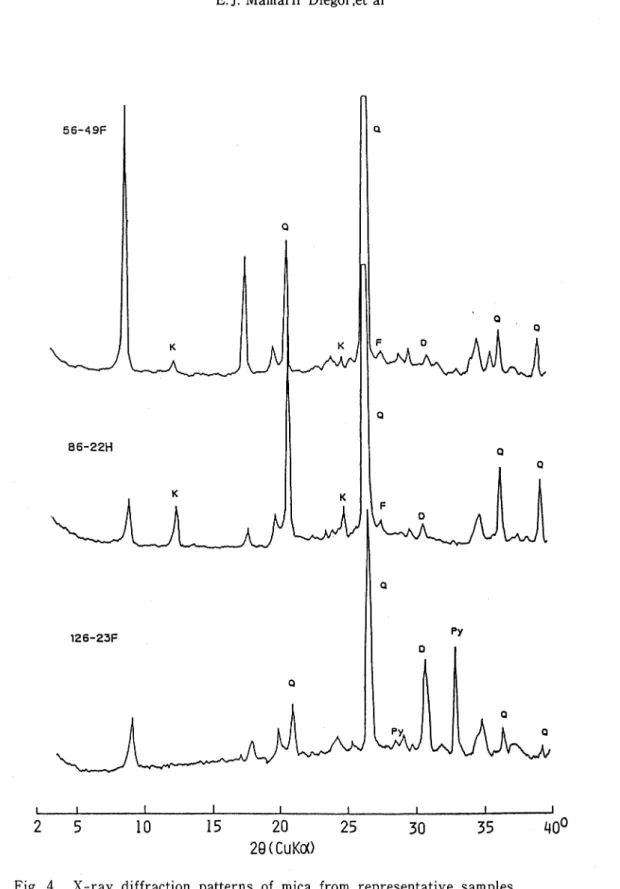
10 15 20 25 30 35 叫00 29(CuKd)
Fig. 4. X-ray diffraction patterns of mica from representative samples.
Alteration and Mineralization in La Suerte Mine, Camarines Norte, Philippines 29
Accessory Ore Mineral
Minor ore minerals are covellite and goethite. Fine streaks of bluish covellite
marginally replaced some chalcopyrite grains while stains of reddish orange goethite traverse some fractures.
ALTERATION MINERALS
Minerals present in the altered samples were analyzed by XRD, DTA, SEM and optical
microscopy.
Mica
X-ray diffraction patterns of selected samples show reflections of mica at 10.04A, 3.36A
and 5.01A (Fig. 4). The 10-A reflection is changed neither by treatment with ethylene
glycol nor by heat treatment at 550℃.
Scanning electron micrographs show that mica is present in poorly defined flakes commonly grouped together in irregular aggregates (Fig. 5a) , or exhibits distinct hexagonal outlines (Figs. 5b).
\J
Fig. 5. SEM micrographs of mica present in samples a) 38 and b) 49, footwall, level 56.
Kaolin Minerals
Well-crystallized kaolinite occurs in most of the samples as shown by its x-ray
diffraction patterns (Fig. 6). Its basal spacingof 7.03A is easily destroyed upon heatingto
550℃ but is not changed with ethylene glycol treatment. A typical differential curve of this
mineral, shown in Fig. 7, has endothermic and sharp exothermic peaks caused by expulsion of structural water and formation of a new substance, respectively. Kaolinite observed
under SEM develops into hexagonal crytals (Fig. 8a) or into fine一grained particles in
30 E.J. Mamaril-Diegor,et al
2 5 1 15 20 25 30 35 40u
2Q(CuK(ユ)
Fig. 6. X-ray diffraction patterns of kaolinite from representative samples.
M:mica; Q:quartz; F:feldspar; D:dolomite.
100 200 300 400 500 600 700 '800 900 1000
Temperature ( C)
Alteration and Mineralization in La伽erte Mine, Camarines Norte, Philippines 31
Fig. 8. SEM micrographs of kaolinite present in samples a) 20 and b) 29, footwall, level 56.
Fig.9. SEM micrographs of the dacite porphry cutting the Luna Pelang Vein.
a : kaolinite ; b : halloysite.
A sample of dacite porphyry dike found cuttingthe vein was also analyzed. Based on SEM analysis, two kinds of kaolin minerals exist namely, a book-type kaolinite (Fig. 9a) and aelongate tabular halloysite (Fig. 9b). XRD results, however, indicate only the presence of kaolinite (Fig. 10). These contrasting observation might be attributed to the minimal presence of halloysite which can hardly be detected by XRD.
32 E.J. Mamaril-Diegor,et al
t . t _ t
10 15 20 25 30 35 W
29 CuKq)
Fig. 10. X-ray diffraction patterns of untreated and treated specimens of dacite porphry.
Alteration and Mineralization in La Suerte Mine, Camarines Norte, Philippines 33
Mixed-Layer Clay Minerals
Traces of mixed-layer smectite-chlorite(? ) and mixed-layer smectite-mica(? ) were determined in a few samples. However, the interstratification could not be ascertained since they only show firsトorder reflections around 28A and 24A, respectively.
Silicate Minerals
Quartz and feldspars are the predominant silicate minerals in almost all of the altered samples. Plagioclase occurs in greater abundance than K-feldspar.
Secondary Minerals
Aside from the alteration minerals described above, carbonates and sulfates occur in lesser amounts. Dolomite and calcite sometimes are abundant but anhydrite and gypsum
●
occur only in traces.
DISCUSSION
Mineralization
The main locus of mineralization in La Suerte Mine is largely concentrated in Luna Pelang vein which is mineralized over a distance of one kilometer. The vein trends∫
N30-45 E and dips steeply to the southeast. Thickness is variable from a few centimeters to less than a meter. Texture of the vein also varies from a massive gray to white quartz, banded to vuggy. Quartz crystals develop into more than 1 centimeter in size.
Sulfide mineralization is indicated by pyrite, chalcopyrite, sphalerite and galena. Cubic crystals of pyrite sometimes develop in zones in the vuggy quartz. No trace of gold was observed in the samples collected.
Fire assay of samples showed marginal gold values generally not more than 2 gm/MT.
It can be surmised that gold is probably closely associated with sulfides. Alteration
Based on the XRD, SEM and DTA performed on the samples collected, alteration minerals generally consist of quartz, mica, feldspar and kaolinite with small amounts of dolomite, calcite, anhydrite, gypsum and mixed-layer clay minerals. Presence and relative abundances of these minerals, however, differ in samples taken at- various levels.
As shown in the x-ray diffraction patterns of selected samples from level 4, footwall side, it is observed that in some samples, mica, quartz and/or kaolinite and plagioclase are
abundant (Fig. lla′). This mineral assemblage also occurs in level 4, hanging wall side
(Fig.lib).
Samples collected at level 56, hanging wall and footwall (Figs. 12a & b), similarly consist of the same minerals except that there are others with a relatively high content of
kaolinite than that of mica and quartz. Moreover, there seems to be an inverse relationship
●
in amount between kaolinite and plagioclase based on comparison of their peak intensities. As kaolinite tends to become abundant, a corresponding decrease in the amount of
(b) 34 E.J. Mamaril-Diegor,et al
2 1 十てい-弓F-寸0 0
20 CuKa 2 5 1 15 20 25 30 35 40u 20 CuKa)Fig. ll. X-ray diffraction patterns of selected samples from the footwall (a) and hanging wall (b) of the vein in level 4.
Alteration and Mineralization in La Suerte Mine, Camarines Norte, Philippines 35 LEVEL 56F Q.M ● M q K 皿 l▲▲
I
-■
什
二 ㌦
J
勅
■
1
人
A
u
一
■
1
!
ち
」
2 5 10 20 30 401-20(CuKa) (o) LEVEL 56H 10 20 29(CuKa) (b) 30 40つFig. 12. X-ray diffraction patterns of representative samples from the footwall (a) and hanging wall (b) of the vein in level 56.
M:mica; K:kaolinite; Q:quartz; P:plagioclase; F:feldspar; D:dolomite;
LEⅥ:L 86F 36 E.J. Mamaril-Diegor,et al I-一 1 サ. . . ! 一 I 2 5 10 20 2Q CuKa (o) 3 40^ 2 5 10 20 30 40L 2Q(CuKn) (b)
Fig. 13. X-ray diffraction patterns of selected samples, footwall (a) and hanging wall (b) ,level 86.
M:mica; K:kaolinite; Q:quartz; P:plagioclase; D:dolomite; C:clacite;
Alteration and Mineralization in La Suerte Mine, Camarines Norte, Philippines 37
(b)
Fig. 14. X-ray diffraction patterns of representative samples, footwall (a) and hanging wall (b), level 126.
M:mica; K ! kaolinite; Q:quartz; P:plagioclase; D:dolomite; C:clacite;
00-0 38 ( % ) a o u B p u n q v e A i q -B " [ a ^ I LEVEL上IF E.J. Mamaril-Diegor,et al
M/Q
田MICA LEVEL qH LEVEL 56F LEVEL 86F LEVEL 56H LEVEL 86H GヨMICA 正ヨMICA LEVEL 126F Sample Number LEVEL 126H 10 20 30 40 Sample Number 圧】MICA A C = U M i.R
=
=
=
町
6
0
(q)∩.=〓い.L
(
%
)
a
o
u
^
p
u
n
q
v
^
a
t
^
x
^
U
Alteration and Mineralization in La Suerte Mine, Camarines Norte, Philippines
K/M
LEVEL qF LEVEL 56F LEVEL 86F LEVEL 126F nU 0 O 9 AO K 0 O O C 3 0 8 ー 6 t r ' o 0 n U 0 0 一 一 一 ′ _ -LEVEL qH LEVEL 56H 屯KAO i 田KAO 10 20 30 1)0 '50 60 Sample Number (b) LEVEL 86H LEVEL 126H Ea KAO gヨKAO 巴ヨKAO 旺コKAO 10 20 30 勺0 50 60 Sample NumberFig. 15b. Histograms of the relative abundances of kaolinite with respect to mica (K/M). KAO indicates relative abundance of kaolinite.
E.J. Mamaril-Diegor,et al
K/P L
LEVEL qF LEVEL 56F 田KAO LEVEL qH LEVEL 56H EコKAO(
巴
a
u
u
q
p
u
n
q
v
3
A
T
q
-B
T
9
∝
LEVEL 86F LEVEL 126F 正ヨKAO E KAO LEVEL 86H LEVEL 126H EコKAO 監> KAOFig. 15c. Histograms of the relative abundances of kaolinite with respect to plagioclase (K/PL). KAO indicates relative abundance of kaolinite.
ヽ ヽ_'
Alteration and Mineralization in La Suerte Mine, Camarines Norte, Philippines 41
plagioclase occurs. This relationship may be explained by the alteration of plagioclase into kaolinite as further supported by the SEM analysis of samples containing large amount of
●
kaolinite as mentioned earlier. Furthermore, dolomite and calcite begin to appear in this level. The presence of these two minerals could be attributed to the proximity of the contact of granodiorite with the ultramafic rocks.
At level 86, the same observations arise (Figs. 13a & b). However, the amount of dolomite and calcite are relatively high. Gysum is also identified. The same mineral suite as in the previous levels were determined in level 126, at the footwall and hanging wall
(Figs. 14a & b).
To determine the relative abundances of the minerals with respect to other minerals in each sample collected, quantification curves were made using standard samples of mica,●
quartz, kaolinite and plagioclase. Based on these curves, histograms of the relative aboundances of mica, quartz, kaolinite and plagioclase were obtained (Figs. 15a, b & c.) The figures indicate that these minerals are the preponderant alteration products in most of the samples collected from all the levels of the underworkings of La Suerte Mine.
SUMMARY AND CONCLUSION
Based on the results of laboratory analyses conducted by the authors, the Luna Pelang vein is composed of pyrite, chalcopyrite, sphalerite and galena. Alteration minerals associated with this gold-bearing vein consist of quartz, mica, feldspar and kaolinite with
●
minor dolomite, calcite, gypsum, anhydrite and mixed-layer clay minerals.
The study, however, does not end with mere determination of the mineralogy in the area. These are only preliminary results. In order to establish a model for this type of deposit, further studies are required such as on the following : (1) alteration zones that exist or are related with the mineralizat享on ; (2) factors or mechanisms that brought about these zones (3) petrogenesis of the ore minerals ; (4) temperature of formation ; and other criteria
important in characterizing this kind of deposit.
●
A CKNOWLEDGMENT
We are indebted to Dr. Guillermo R. Balce without whom the project would not be made
possible ; to the personnel and staff of the Benguet Corporation-Paracale Gold District for allowing us to collect samples in their underground workings in La Suerte Mine ; to all the personnel of the Mines and Geo-Sciences Bureau, Region V and Central Office for their unselfish assistance during the course of the project ; and to the staff of the Institute of Earth Sciences, Faculty of Science, Kagoshima University for the use of their laboratory instruments. We give our special thanks to Mr. Alvin M. Matos for some of the figures ; to Mr. Fernando Sajona for helpingus with the ore micrographs ; and to Mr. Wilfredo G. Diegor and Mr. Lauence P. James for their encouragement and valuable comments on this report.
REFERENCES
42 E.J. Mamari卜Diegor,et al
Resources and Industries, Incorporated, Jose Panganiban, Camarines Norte : Unpublished report, Bureau of Mines, Philippines, 16pp.
Oinuma, K. (1968) Method of quantitative estimation of clay minerals in sediments by X-ray diffraction analysis : Jour, of the Toyo Univ. Gen. Ed. 10, 1-15.
Pineda, O.M. (1976) Report on the evaluation of geologic reserves of La Suerte Gold Mining Corporation in Sta. Rosa Norte, Panganiban, Camarines Norte : Unpublished report, Bureau of Mines, Philippines, 12pp.
●
United Nations Department of Technical Cooperation for Development (1987) Geology and Mineralization in the Panganiban - Tabas and Bulala areas, Camarines Norte : Manila,