
JAIST Repository: フラーレン・インターカレーション化合物の合成と固体物性
4
0
0
全文
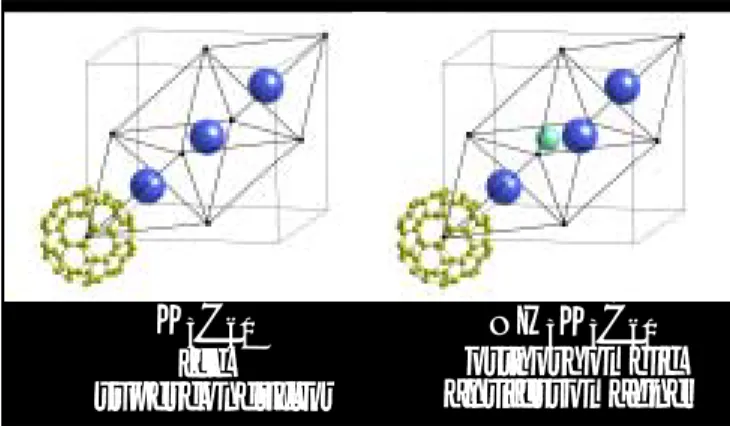
(2) 1. Synthesis and solid state properties of fullerene intercalation compounds Japan Advanced Institute of Science and Technology 1.. Taishi Takenobu. INTRODUCTION. Generally, the carbon cluster is called fullerenes. It is well known that the Novel Prize was awarded for the discovery of the succor ball-shaped fullerene, C60. Fullerenes usually form van der Waals solids with large interstitial sites, which are a few angstrom in diameter. These interstitial sites can be occupied by not only metal ions but also small molecules. Moreover, because of its very specific spherical shape, fullerene molecules are able to rotate easily with a fixed center of gravity. They are sole molecules that have a rotational degree of freedom which should provide novel aspect in fullerene based solids. The present research is concerned with two specific features of fullerenes, namely, the molecular rotation and intercalation, and has derived new science from the two abundant fullerenes C60 and C70 (Figure 1). In C60 compounds, the author has synthesized new types of fullerenebased antiferromagnets with the highest Neel temperature (TN) among molecular materials. Moreover, we found that the orientational ordering of molecules are closely correlated with the magnetic spin structure via molecular orbital. For C70 C 60 fullerenes, several new intercalation C 70 compounds of alkaline earth metals and rare earth metals have been discovered, Figure 1. Molecular structures of C60 and C70. including the first C70 based ferromagnets. 2.. C60 COMPOUNDS. Fullerene C60 is known to form a vast variety of compounds including superconductors, by intercalation of alkali (A) metals, alkaline earth metals, rare earth metals, and molecules. Especially, A3C60 superconductor has attracted considerable interest due to its high superconducting transition temperature (TC), which is 33 K at its maximum at ambient pressure, only surpassed by copper oxide high TC superconductors. For example, K3C60 is the most well known superconductor with TC=19 K. The intercalation of neutral ammonia molecules into fcc K3C60 transforms the crystal structure to orthorhombic and changes its ground state drastically from superconductivity to antiferromagnetism (Figure 2). Because the crystal and electronic structures of these materials are very similar to each other, the strong correlation between superconductivity K3C60 NH3K3C60 and antiferromagnetism is expected. The goal orthorhombic fcc of this study is to clarify the feature of this antiferromagnet superconductor important antiferromagnetic phase. For this purpose, the author adopts two kind of Figure 2. Schematic structures of K3C60 and NH3K3C60. approach. One is a detailed structural research C60s, K+ ions, NH3 molecule are represented as dots, big of (NH3)K3C60. A combined analysis of the and small balls, respectively..
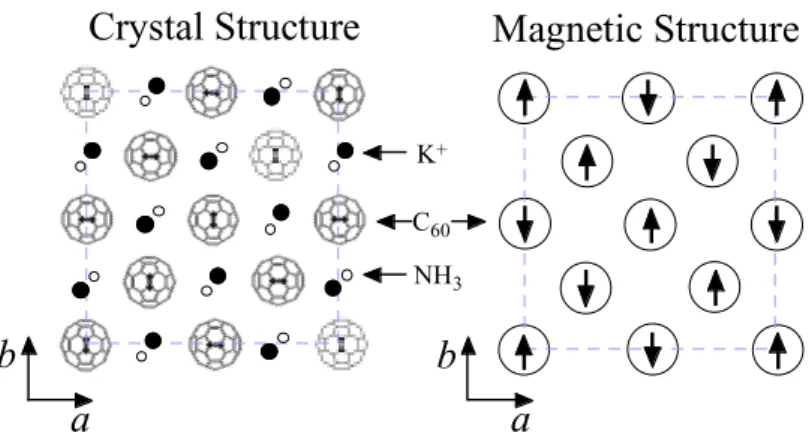
(3) 2. b. neutron and x-ray powder diffraction Crystal Structure Magnetic Structure data shows the molecular orientational ordering below the structural transition temperature at 150K (Figure 3). This is in a striking contrast with the molecular K+ orientational disordering in the C60 superconducting state of K3C60. An important and significantly new result NH3 is that the magnetic structure determined by an independent NMR b experiment is strongly correlated with a a this orientational ordering (Figure 3). This is the first molecular magnet Figure 3. Crystal and Magnetic structure of NH3K3C60. controlled by the molecular rotation.. (NH3)K3C60. (NH3)K2RbC60. (NH3)KRb2C60. (NH3)Rb3C60. Figure 4. Schematic structures of (NH3)A3C60. C60s, Rb+ ions, K+ ions, NH3 molecules are represented as dots, big, middle, and small balls, respectively.. N. T (K). The other approach is the synthesis of new (NH3)K3C60 type compounds, (NH3)A3C60 80 (NH )KRb C (NH )K RbC 3 2 60 3 2 60 (A=K or Rb) (Figure 4). The author T = 76 K T = 67 K N N succeeded to synthesize these compounds 60 despite the failure of competitors. ESR, (NH )Rb C 3 3 60 SQUID, and SR experiments on this new T N= 58 K 40 series of compounds revealed that all materials are antiferromagnets. The TN C60 based (NH )K C 3 3 60 20 increased with lattice expansion from 40 K T = 40 K Antiferromagnets N for (NH3)K3C60 to 76 K for (NH3)KRb2C60, 0 which is the highest magnetic transition 750 760 770 780 790 800 temperature among molecular substances 3 Volume/C60 ( ) without magnetic elements (Figure 5). Moreover, the author found that, in Figure 5. TN v.s. volume per C60 in NH3A3C60. (NH3)KRb2C60, the molecular orientational ordering is destroyed by quenching accompanied with a considerable reduction of TN. These results also show a strong correlation between the molecular orientational ordering and magnetic states. 3.. C70 COMPOUNDS. In striking contrast with a variety of C60 compounds, the understanding of C70 intercalation compounds is quite poor. The most unique feature of C70 solid is the larger interstitial site than C60, providing large space for intercalants. In fact, the number of intercalated metals in saturated phase.
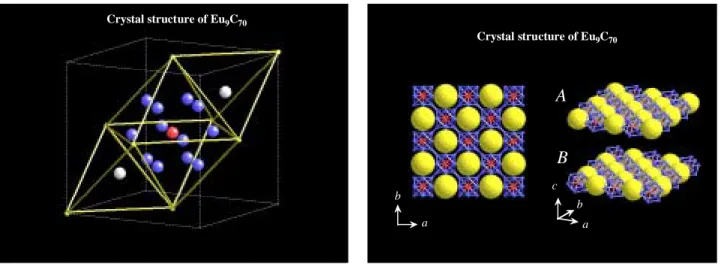
(4) 3 is nine metals per fullerene in C70, while it is six in C60. In this study, the author has first found C70 compounds with alkaline earth and rare earth metals. In contrast to monovalent alkali metals, alkaline earth metals (A ) supplies two electrons to each fullerene, producing a tremendously high reduction state (C70)18- in A 9C70. The author succeeded to synthesize BaxC70 and SrxC70 (x=3, 4, 6, and 9). The crystal structure was determined by structure analysis, and the highly reduced state is confirmed by Raman spectra. The former result indicates a similarity of structure sequence between C60 compounds and C70 compounds except for the M9C70 phase (M=A, A ), which is specific to C70 compounds. The latter result suggests a possible application of higher fullerenes to battery materials, since a tremendously high reduction state (C70)18- is available. This carbon/electron ratio is comparable to that for the carbon nanotube. Crystal structure of Eu9C70 Crystal structure of Eu9C70. A. B c. b. b a. a. Furthermore, EuxC70 was synthesized and, Eu3C70 and Eu9C70 were found to be the first C70 based ferromagnets. The crystal structure of Eu9C70 is very unique and similar structure is expected in M9C70 (Figure 6). Particularly, the Curie temperature of the latter compound reached 40K, which is also the highest among the fullerene based ferromagnets (Figure 7).. Magnetization ( arb. units ). Figure 6. Schematic structure of Eu9C70. Left figure is the unit cell of Eu9C70 crystal. C70s and Eu ions are represented by dots and balls, respectively. Right figure is the large view of Eu9C70 structure. Here, C70s and Eu ions are represented by large and small balls, respectively.. Eu9 C70. TC = 40 K H = 10 Oe 0. 10. 20. 30. 40. 50 60. 70 80. Temperature ( K ). 4.. SUMMARY. Figure 7.. Ferromagnetic interaction in Eu9C70.. In C60 compounds, the author has synthesized new types of fullerene-based antiferromagnets with the highest Neel temperature (TN) among molecular materials. Moreover, we found that the orientational ordering of molecules controls the magnetic spin structure via molecular orbital. Experimental observation of molecular orbital ordering and clarification of relationship between superconductor and antiferromagnets are next issue. For C70 fullerenes, several new intercalation compounds of alkaline earth metals and rare earth metals have been discovered, including the first C70 based ferromagnets with the highest Curie temperature among the fullerene based materials. These results reveal the unique properties and the possibilities of C70 compounds..
(5)
図
関連したドキュメント
associatedwitllsideeffectssuchasgingivalhyperplasia,somnolencc,drymonth,andgcncral
Chondrite-normalized rare earth element patterns and primitive-mantle-normal- ized trace element patterns of the biotite-phenocryst-rich volcanic rocks from Kat- suyama
It is suggested by our method that most of the quadratic algebras for all St¨ ackel equivalence classes of 3D second order quantum superintegrable systems on conformally flat
In particular, we are able to prove that for Volterra scalar systems with a creep kernel a(t) such that a(0 + ) > 0; the finite-time and the infinite-time L 1 -admissibility
Hence, for these classes of orthogonal polynomials analogous results to those reported above hold, namely an additional three-term recursion relation involving shifts in the
At TEPCO, we are pursuing the production of power with low CO 2 emission levels by means such as nuclear power generation, which emits no CO 2 ; improving increase in the thermal
Amount of Remuneration, etc. The Company does not pay to Directors who concurrently serve as Executive Officer the remuneration paid to Directors. Therefore, “Number of Persons”
図 21 のように 3 種類の立体異性体が存在する。まずジアステレオマー(幾何異 性体)である cis 体と trans 体があるが、上下の cis
