ハイブリッドカ学系理論とその応用
東京大学生産技術研究所 合原 一幸 (Kazuyuki Aihara) Institute of Industrial Science
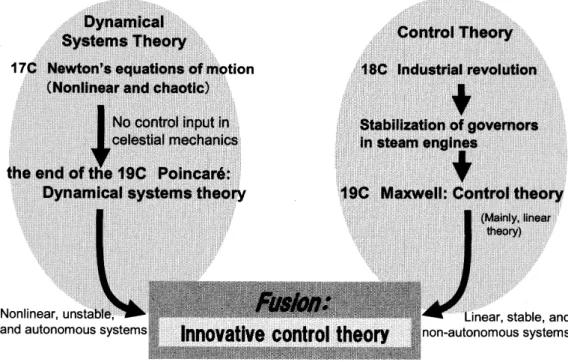
UniversityofTokyo 天体の運行をはじめとして、 この世の中は様々なダイナミクスに満ちている。 このようなダイ ナミクスを理論的に研究する主な学問分野として、 数学における力学系理論と工学における制御 理論がある。 興味深いことに、 この力学系理論と制御理論は、ほぼ独立に互いにあまり交流もな く、各々大きく発展してきている (図1)。力学系理論は主として非線形、不安定、 自律系を、そ して制御理論は主として線形、 安定、 非自律系を対象とする。 この意味で相補的であるため、 こ れらを融合することにより、 強力な最先端制御理論が構築できる可能性がある。 現在筆者らは、 特にハイブリッドカ学系に着目して、 この融合に関する取り組みを進めている [1]。ハイブリッドカ学系は、連続値変数と離散値変数が共存する力学系のことであり、 ハイブリ ッドカーをはじめとして応用上も重要である。 特に、生命システムや医学システムには、様々なハイブリッドカ学系が存在する[1]。たとえば、 筆者らが研究している前立腺がんの間欠的ホルモン療法も、ハイブリッドカ学系として記述され る$[2]-[8]$。さらには、細胞内の遺伝子タンパク質ネットワークや細胞間の非線形ダイナミクス の数理モデリングにおいても、 ハイブリッドカ学系はたいへん重要な概念となる$[1],[9]$。
図1 :TOward fusion ofdynamicalsystemstheoryand controltheory.
数理解析研究所講究録
$[$参考文献】
[11 Kazuyuki Aihara (Ed.): Theme Issue ”Theory of Hybrid Dynamical Systems and its
Applications to Biologicaland MedicalSystems,” PhilosophicalTransactionsoftheRoyal Society$A$, Vol.368, No.1930 (2010).
[2] A.M. Ideta, G. Tanaka, T. Takeuchi, and K. Aihara: “A Mathematical Model of Intermittent Androgen Suppression for Prostate Cancer,” J. Nonlinear Science, 18(6) 593-614 (2008).
[3] G.Tanaka, K. Tsumoto, S. Tsuji, K. Aihara: “BifurcationAnalysis
on
aHybridSystemsModel of Intermittent Hormonal Therapy for Prostate Cancer,” Physica $D$, 237(20)
2616-2627(2008).
[4] T. Shimada and K. Aihara: “A Nonlinear Model with Competition between Prostate
Tumor Cells and its Application to Intermittent Androgen Suppression Therapy of ProstateCancer,”Math. Biosci., 213(1) 134-139(2008).
[5] Q. Guo, Y. Tao, K. Aihara: “Mathematical Modelling of Prostate Tumor Growth under Intermittent Androgen Suppression with Partial Differential Equations,” Int. J.
Bifurcation and Chaos, 18(12), 3789-3797 (2008).
[6] Y. Tao, Q. Guo, and K Aihara: “A Model at the Macroscopic Scale of Prostate Tumor Growth under IntermittentAndrogen Suppression,”Mathematical Models and Methods
inApplied Sciences,Vol.19,No.12,pp.2177-2201 (2009).
[7] Y. Hirata, N. Bruchovsky, and K. Aihara: ”Development
of.a
Mathematical Model that Predicts the Outcome of Hormone Therapyfor Prostate Cancer,” J. Theoretical Biology, Vol.264, pp.517-527(2010).[8] Y. Tao, Qian Guo and Kazuyuki Aihara: “A Mathematical Model of Prostate Tumor GrowthUnderHormoneTherapywithMutationInhibitor,”J. NonlinearScience, Vol.20, No.2,pp.131-275 (2010).
[9] L. Chen, R. Wang, C. Li, and K. Aihara: Modeling Biomolecular Networks in Cells:
StructuresandDynamics,”Springer, London(2010).