有機触媒を用いたa,b-不飽和アルデヒドとケトンと
の不斉マイケル反応およびプロスタグランジン類の
ポットエコノミーな合成への展開
著者
楳窪 成祥
学位授与機関
Tohoku University
URL
http://hdl.handle.net/10097/00131667
a,b-º
a,b-a,b- / Corey 152 º º / cis-hydrindanes / º / bicyclo[2.2.2]octane / bicyclo[2.2.2]octane
Evidence for an enolate mechanism in the asymmetric Michael reaction of α,β-unsaturated aldehydes and ketones via a hybrid system of two secondary amine catalysts
N. Umekubo, T. Terunuma, E. Kwon, Y. Hayashi, Chem. Sci. 2020, 11, 11293-11297.
Pot and time economies in the total synthesis of Corey lactone N. Umekubo, Y. Suga, Y. Hayashi, Chem. Sci. 2020, 11, 1205-1209.
Asymmetric synthesis of Corey lactone and latanoprost
N. Umekubo, Y. Hayashi, Eur. J. Org. Chem. 2020, 6221-6227.
Pot-Economical Total Synthesis of Clinprost
N. Umekubo, Y. Hayashi, Org. Lett. 2020, 22, 9365-9370.
One-pot synthesis of chiral cis-hydrindanes via diphenylprolinol silyl ether mediated domino reaction and aldol condensation
N. Umekubo, R. Iwata, Y. Hayashi, Chem. Lett. 2020, 49, 867-869.
Asymmetric domino Mukaiyama Michael/Michael reaction catalyzed by diphenylprolinol silyl ether
Ac acac AcOH AIBN aq. BINOL Bn CSA DIP-Cl DIBAL DMSO ee Et EtOH EtOAc Et2O HPLC HRMS i-Pr i-PrOH IR LDA m Me mCPBA MeCN MeOH MS4A n NMR Nu acetyl acetylacetine acetic acid azobis(isobutyronitrile) aqueous 1,1'-bi-2-naphthol benzyl 10-camphorsulfonic acid diisopinocampheyl chloroborane diisobutylaluminium hydride dimethyl sulfoxide enantio excess ethyl ethanol ethyl acetate diethyl ether
high performance liquid chromatography high-resolution mass spectrometer isopropyl isopropanol infrared spectroscopy lithium diisopropylamide meta methyl meta-chloroperoxybenzoic acid acetonitrile methanol molecular sieve 4A normal
nuclear magnetic resonance nucleophile
p Pd/C Ph sat. TASF TBAOH TBAF TBS t-Bu t-BuOH TES TMS Tf THF THP TIPS TLC TsOH TsCl wt para palladium on carbon phenyl saturated tris(dimethylamino)sulfonium difluorotrimethylsilicate tetrabutylammonium hydroxide Tetrabutylammonium fluoride tert-butyldimethylsilyl tert-butyl tert-butyl butanol triethylsilyl trimethylsilyl trifluoromethanesulfonate tetrahydrofuran 2-tetrahydropyranyl triisopropyllsilyl thin-layer chromatography para-toluenesulfonic acid p-toluenesulfonic chloride weight
1828 Wöhler 1) Wöhler 59 1887 Michael º 2) 88 1975 Helder 1-3 b- 1-1 1-2 Scheme 1-1 3)
Scheme 1-1. Quinine mediated asymmetric Michael reaction
1 1976 1-5
1-6 Scheme 1-2 4)
º
Scheme 1-2. Mukaiyama-Michael reaction O Me O CO2Et + Toluene, rt N HO N MeO H O CO2Et O Me 1-1 1-2 1-4 1-3 Ph OTMS O O Ph O TiCl4 CH2Cl2, -78 ºC 1-5 1-6 1-7 +
b- 1-1 1-2
Scheme 1-3 5)
66%
Scheme 1-3. Chiral ligand and Co(acac)2 mediated asymmetric Michael reaction
10 1994 BINOL º
1-9 a,b- 1-10 Scheme 1-4 6)
95% ee
Scheme 1-4. BINOL and La(Oi-Pr)3 medataed asymmetric Michael reaction
1979 Trost 1-3 1-12
hirsutic acid C 1-14 Scheme 1-5 7)
O Me O CO2Et + Toluene, -50 ºC O CO2Et O Me 1-1 1-2 1-4 Ph NH2 H2N Ph Co(acac)2 1-8 CO2Bn BnO2C Me O + 1-9 1-10 OH OH La(O-i-Pr)3 O BnO2C CO2Bn Me THF, -20 ºC 1-11 N HO N MeO H O NC CO2Me O CO2Me NC 1-12 1-13 H H O OH HO2C 1-14 1-3
1982 Woodward º 1-16 º /
erythromycin A 1-17 Scheme 1-6 8)
Scheme 1-6. Total synthesis of erythromycin A
2000 Corey º 1-20 a,b- 1-18
º 1-19 baclofen 1-22
Scheme 1-7 9)
Scheme 1-7. Total synthesis of baclofen
21 10) 11) 12) S S O O OBn N H CO2H MeCN S S O N OBn HO2C S S O N OBn HO2C retro-Michael reaction 1-15 1-16 S S O N OBn HO2C H H Michael reaction S S O OBn 1-16 H H OH H O O OH O HO O O O O HO H H OMe NMe2 OH 1-17 N BnO N MeO H 1-20 Br Cl O Ph + MeNO2 1-18 1-19 Cl O OH NH3·Cl Cl O Ph NO2 1-21 1-22 CsF, Toluene, -40 ºC
14)
15)
2013 º
1-2516) º 1-23 1-24 /
prostaglandin E1 methyl ester 1-28 3 Scheme 1-8 17)
Scheme 1-8. Three-pot synthesis of prostaglandin E1 methyl ester
2016 º 1-31 1-29 º 1-30 Oseltamivir 1-33 1 60 Scheme 1-9 18) O2N CO 2Me H O H O OH O CO2Me N H Ph OTMS Ph 5 mol% O HO O2N CO2Me H HO i-Pr2NEt P MeO O OMe O
LiCl, i-Pr2NEt THF, rt HO O2N CO2Me O 3-pot synthesis 14% overall yield 1-23 1-24 + 1-26 1-27 1-28 1-25 OEt O NH2 AcHN O NO2 AcHN O H O P EtOO EtO OEt O N H Ph OSiPh2Me Ph NO2 AcHN O H O 10 mol% TMSCl TBAF TMSClZn 1-29 1-30 + 1-32 1-33
1-pot & 60 min synthesis 15% overall yield 1-31
2017 º 1-36 º
1-34 a,b- 1-35 /
estradiol methyl ester 5 Scheme 1-10 19)
Scheme 1-10. Five-pot synthesis of estradiol methyl ester
º a,b- º
º
2007 º 1-36
a,b- 1-40 º 1-19
Scheme 1-11 20)
Scheme 1-11. Diphenylprolinol silyl ether mediated asymmetric Michael reacton using nitromethane
2007 Jørgensen º 1-44 a,b-1-40 º 1-43 Scheme 1-12 21) N H Ph OTMS Ph 10 mol% MeO O2N O O O2N O MeO OH Me Me O H H O OH MeO Me H H H 1-35 1-34 + 1-36 1-37 aq. KCN CS2, MeI; SO2Cl O2N O MeO Me NC O MeS S 1-38 1-39 5-pot synthesis 15% overall yield R O H + MeNO2 1-40 1-19 R O H NO2 1-42 MeOH, rt N H Ph OTMS Ph 10 mol% 1-36 PhCO2H up to 90% yield up to 95% ee
Scheme 1-12. Diphenylprolinol silyl ether mediated asymmetric Michael reacton using dibenzyl malonate º a,b-22) Scheme 1-13 1-36 HA a,b- 1-40 1-47 º 1-49 1-36 1-46 º º º R O H + 1-40 1-43 R O H CO2Bn 1-45 EtOH, rt N H Ar OTMS Ar 10 mol% 1-44 up to 94% yield up to 95% ee CO2Bn BnO2C Ar = 3,5-(CF3)2-C6H3 CO2Bn R O H + H-Nu 1-40 R O H Nu 1-46 N H Ph OTMS Ph 10 mol% 1-36 HA N H Ph OTMS Ph N OTMSPh Ph R A N OTMSPh Ph R Nu N OTMSPh Ph R Nu R O H HA 1-36 1-40 H2O H2O R O H Nu 1-46 H-Nu HA 1-47 1-48 1-49
a,b- 1-50
1-51 Scheme 14 23) º
1-31 a,b- 1-50 1-53
º 1-52 1-51 1-54
Scheme 1-14. Two secondary amine catalysts mediated asymmetric Michael reaction
a,b-º a,b-HMG-CoA º a,b-/ º º a,b-cis-hydrindane º bicyclo[2.2.2]octanone a,b-24) º 1-36 4-(triisopropylsilyl)but-3-yn-2-one 1-56 a,b- 1-40 Scheme 1-15
HMG-CoA methyl (3R,
5S)-3,5-isopropylidenedioxy-6-heptynoate 1-58 2 16% O Ph O H N H Ph OSiPh2Me Ph 15 mol% 1-31 N H 15 mol% 1-52 p-nitroohenol, H2O EtOH/Toluene, rt; Ph3P=CHCO2Et 1-50 1-51 + O N OSiPhPh 2Me Ph Ph 1-53 N 1-54 Ph EtO2C 1-55
Scheme 1-15. Asymmetric Michael reaction between a,b-unsaturaed aldehyde and alkynyl ketone
º 1-36 a,b-
1-59 a,b- 1-40 /
º Scheme 1-16
Scheme 1-16. Asymmetric domino Michael/ Michael reaction to provide multi-substituted cyclopentanone
Corey 1-62 152 25)
Scheme 1-17
Scheme 1-17. One-pot & 152-minutes synthesis of enantiopure Corey lactone
R CHO O + TIPS 20 mol% EtOH, rt O TIPS R CHO p-nitrophenol, H2O N H Ph OTMS Ph 1-36 1-56 1-40 1-57 up to 78% yield up to 98% ee O O CO2Me 2-pot synthesis 16% overall yield 1-58 N H Ph OTMS Ph 10 mol% p-nitrophenol, H2O i-PrOH, rt O CO2Et R CHO CO2Et O R CHO 1-59 1-40 up to 90% yield single isomer up to >99% ee 1-36 + 1-60 aq. HBF4 80 ºC, 15 min p-nitrophenol, H2O i-PrOH, rt, 60 min N H Ph OTMS Ph 10 mol% O PhMe2Si CHO CO2Et RO PhMe2Si CO2Et OR THF, 60 ºC, 15 min PhMe2Si OH O O K2CO3 DMF, H2O, 1 min HO O O OH aq. H2O2, KF DMF, 40 ºC, 60 min FMe2Si OH O O LiAl(Ot-Bu)3H Concentrated rt, 1 min R = Li or H O CO2Et PhMe2Si CHO 1-59 1-61 + 1-62 1-pot & 152min synthesis
50% overall yield 1-25
26) Scheme 1-18
Scheme 1-18. Seven-pot synthesis of enantiopure latanoprost
º 1-67 7 17% 27)
Scheme 1-19
Scheme 1-19. Seven-pot synthesis of chiral clinprost
º 1-36 a,b-1-40 3-hexene-2,5-dione 1-68 / cis-hydrindane 1-69 p-nitrophenol, H2O i-PrOH, rt N H Ph OTMS Ph 10 mol% O PhMe2Si CHO CO2Et O CO2Et PhMe2Si CHO 1-59 1-61 + P MeO O OMe O Ph LiCl, i-Pr2NEt
MeCN, rt O PhMe2Si CO2Et O Ph 1-63 Ph3P CO 2H Br HO HO OH Ph 1-64 CO2i-Pr 7-pot synthesis 25% overall yield 1-25 p-nitrophenol, H2O i-PrOH, rt N H Ph OSiPh2Me Ph 20 mol% O Ph3Si CHO CO2Et O CO2Et Ph3Si CHO 1-59 1-65 + 1-66 HC(OMe)3 aq. HCl O Ph3Si CO2Me OMe OMe P MeO O OMe O B CO2Me HO OH CO2Me 1-67 7-pot synthesis 17% overall yield
Scheme 1-20. One-pot synthesis of chiral cis-hydrindanes via diphenylprolinol silyl ether mediated domino reaction and aldol condensation
º a,b-
1-40 diethyl 2-(2-oxopropylidene)malonate 1-70 /
º 1-71
Scheme 1-21
Scheme 1-21. Asymmetric domino Michael/ Michael reaction to provide multi-functional cyclopentanone
º 1-31 (cyclohexa-1,5-dien-1-yloxy)trimethylsilane 1-72 a,b- 1-40 / bicyclo[2.2.2]octanone 1-73 29) Scheme 1-22 O R CHO N H Ph OTMS Ph O CHO R O H H O 15 mol% p-nitrophenol (100 mol%) H2O (3.0 equiv) i-PrOH, rt, 24 h; evaporation TsOH·H2O (20 mol%) Toluene, 80 ºC, 5 h 61%, >99% ee R O H H O up to 63% yield single isomer >99% ee 1-36 1-40 1-68 1-69 O R CHO N H Ph OSiPh2Me Ph CHO R O 10 mol% PhCO2H (100 mol%) H2O (3.0 equiv) CO2Et CO2Et CO2Et CO2Et i-PrOH, rt up to 82% yield single isomer >99% ee 1-31 1-70 1-40 1-71
Scheme 1-22. Asymmetric one-pot Mukaiyama Michael/Michael reaction catalyzed by diphenylprolinol silyl ether º 1-31 a,b-1-74 a,b- 1-40 bicyclo[2.2.2]octanone 1-75 Scheme 1-23
Scheme 1-23. Asymmetric domino Michael/Michael reaction to construction of an bicyclo[2.2.2]octanone skelton containing a quatnary carbon center catalyzed by diphenylprolinol silyl ether
OTMS N H Ph OSiPh2Me Ph H2O (5.0 equiv) MeCN, 0 ºC; evaporation + 20 mol% R CHO O R OHC H R H O i-PrOH, reflux, 8 h; Ph3P=CHCO2Et EtO2C up to 78% yield single isomer up to 99% ee 1-72 1-40 1-31 1-73 R CHO 20 mol% O R’ + H R H OHC O R’ N H Ph Ph OSiPh2Me
4-dimethylaminobenzoic acid (40 mol%) H2O (3.0 equiv) i-PrOH, 50 ºC up to 81% yield single isomer up to >99% ee 1-31 1-75 1-74 1-40
[1] F. Wöhler, Ann. Chim. Phys. 1828, 88, 253. [2] A. Michael, J. Prakt. Chem. 1887, 35, 349.
[3] H. Wynberg, R. Helder, Tetrahedron Lett. 1975, 46, 4057.
[4] (a) K. Narasaka, K. Soai, Y. Aikawa, T. Mukaiyama, Bull. Chem. Soc. Jpn. 1976, 49, 779. (b) T. Mukaiyama, S. Kobayashi, Heterocycles 1987, 25, 245.
[5] H. Brunner, B. Hammer, Angew. Chem., Int. Ed. Engl. 1984, 23, 312. [6] H. Sasai, T. Arai, M. Shibasaki, J. Am. Chem. Soc. 1994, 116, 1571.
[7] B. M. Trost, C. D. Shuey, F. DiNinno Jr. J. Am. Chem. Soc. 1979, 101, 1284.
[8] R. B. Woodward, E. Logusch, K. P. Nambiar, K. Sakan, D. E. Ward, B. W. Au-Yeung, P. Balaram, L. J. Browne, P. J. Card, C. H. Chen, J. Am. Chem. Soc. 1981, 103, 3210.
[9] E. J. Corey, Fu-Yao Zhang, Org. Lett. 2000, 2, 4257.
[10] (a) B. M. Trost, Science, 1991, 254, 1471. (b) B. M. Trost, Angew. Chem., Int. Ed. Engl. 1995, 34, 259.
[11] (a) P. A. Wender, M. P. Croatt, B. Witulski, Tetrahedron, 2006, 62, 7505. (b) P. A. Wender, V. A. Verma, T. J. Paxton, T. H. Pillow, Acc. Chem. Res. 2008, 41, 40. (c) P. A. Wender, Nat. Prod. Rep. 2014, 31, 433.
[12] N. Z. Burns, P. S. Baran, R. W. Hoffmann, Angew. Chem. Int. Ed. 2009, 48, 2854. [13] Y. Hayashi, Chem. Sci. 2016, 7, 866.
[14] Y. Hayashi, J. Org. Chem. 2021, 86, 1.
[15] (a) Enantioselective Organocatalysis: Reactions and Experimental Procedures; Dalko, P. I., Eds.; Wiley-VCH: Weinheim, 2007. (b) Asymmetric Organocatalysis 1: Lewis Base and Acid Catalysts; List, B., Eds.; Georg Thieme Verlag KG: New York, 2012.
[16] (a) Y. Hayashi, H. Gotoh, T. Hayashi, M. Shoji, Angew. Chem. Int. Ed. 2005, 44, 4212. (b) M. Marigo, T. C. Wabnitz, D. Fielenbach, K. A. Jørgensen, Angew. Chem. Int. Ed. 2005, 44, 794. [17] Y. Hayashi, S. Umemiya, Angew. Chem. Int. Ed. 2013, 52, 3450.
[18] Y. Hayashi, S. Ogasawara, Org. Lett. 2016, 18, 3426.
[19] Y. Hayashi, S. Koshino, K. Ojima, E. Kwon, Angew. Chem. Int. Ed. 2017, 56, 11812. [20] H. Gotoh, H. Ishikawa, Y. Hayashi, Org. Lett. 2007, 9, 5307.
[21] S. Brandau, A. Landa, J. Franzén, M. Marigo, K. A. Jørgensen, Angew. Chem. Int. Ed. 2007, 45, 4305.
Seebach, Chem. Eur. 2014, 20, 17077. (b) H. Gotoh, T. Uchimaru, Y. Hayashi, Chem. Eur. 2015, 21, 12337.
[23] Y. Hayashi, N. Umekubo, Angew. Chem. Int. Ed. 2018, 57, 1958.
[24] N. Umekubo, T. Terunuma, E. Known, Y. Hayashi, Chem. Sci. 2020, 11, 11293. [25] N. Umekubo, Y. Suga, Y. Hayashi, Chem. Sci. 2020, 11, 1205.
[26] N. Umekubo, Y. Hayashi, Eur. J. Org. Chem. 2020, 6221. [27] N. Umekubo, Y. Hayashi, Org. Lett. 2020, 22, 9365.
[28] N. Umekubo, R. Iwata, Y. Hayashi, Chem. Lett. 2020, 49, 867. [29] N. Umekubo, Y. Hayashi, Eur. J. Org. Chem. 2020, 5596.
a,b-Scheme 2-1 1) º 2-3 a,b- 2-1 2-5 º 2-4 2-2 2-6 º 2-3 º 2-4
Scheme 2-1. Two secondary amine catalysts mediated asymmetric Michael reaction
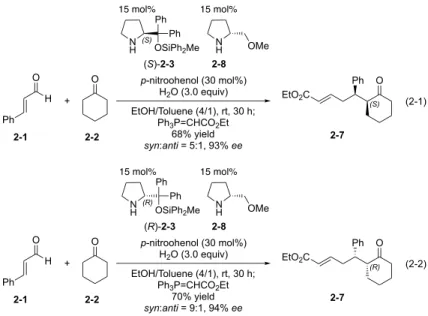
º syn anti Scheme 2-2 (S)- º 2-3 (R)-(methoxymethyl)pyrrolidine 2-8 (5R,2S)- 2-7 syn:anti = 5:1 Eq. 2-1 (R)- º 2-3 (R)-2-(methoxymethyl)pyrrolidine 2-8 (5S,2R)- 2-7 syn:anti = 9:1 Eq. 2-2 º 2-3 (R)-2-(methoxymethyl)pyrrolidine O Ph O H N H Ph OSiPh2Me Ph 15 mol% 2-3 N H 15 mol% 2-4 p-nitroohenol, H2O EtOH/Toluene, rt; Ph3P=CHCO2Et 2-1 2-2 + O N OSiPh2MePh Ph Ph 2-5 N 2-6 Ph EtO2C 2-7
Scheme 2-2. Two chiral secondary amine catalysts mediated asymmetric Michael reaction (R)-2-(Methoxymethyl)pyrrolidine º º 2) (R)-2-(methoxymethyl)pyrrolidine 2-9 2-10 2-11 Figure 2-1
Figure 2-1. Enamine, enol and enolate
2,6- 3)2-12 2-13 º[3.3.1] 2-16 57% Scheme 2-3 2-16 a R a Eq. 2-1 O Ph O H N H (S) Ph OSiPh2Me Ph 15 mol% (S)-2-3 N H 15 mol% 2-8 p-nitroohenol (30 mol%) H2O (3.0 equiv) EtOH/Toluene (4/1), rt, 30 h; Ph3P=CHCO2Et 68% yield syn:anti = 5:1, 93% ee 2-1 2-2 + OMe (S) O Ph EtO2C 2-7 (2-1) O Ph O H N H(R) Ph OSiPh2Me Ph 15 mol% (R)-2-3 N H 15 mol% 2-8 p-nitroohenol (30 mol%) H2O (3.0 equiv) EtOH/Toluene (4/1), rt, 30 h; Ph3P=CHCO2Et 70% yield syn:anti = 9:1, 94% ee 2-1 2-2 + OMe (R) O Ph EtO2C 2-7 (2-2) N OH O N H2 2-9 2-10 2-11
Scheme 2-3. Equimolar reaction between enamine 2-12 and iminium salt 2-13
2-12 1-methoxycyclohex-1-ene 2-17
1-(trimethylsiloxy)cyclohex-1-ene 2-18 Scheme 2-3
Scheme 2-3. Equimolar reaction between iminium salt 2-13 and compound 2-17 or 2-18
TASF4) 2-12 1-(trimethylsiloxy)cyclohex-1-ene 2-18
2-7 80% syn:anti = 5:1 95% ee
Eq. 2-1 TASF
4)
Scheme 2-3. Equimolar reaction between iminium salt 2-13 and compound 2-18 with TASF N (R) OMe 2-14 Ph N Ph Ph TMSO H N (R) OMe 2-15 Ph N Ph Ph TMSO H N Ph Ph OTMS Ph N + ClO4 2,6-lutidine MS4A CH2Cl2 - 30 ºC, 12 h; Buffer 57% yield (R) O Ph N Ph TMSO Ph 2-16 OMe 2-13 2-12 Ph N OTMSPh Ph ClO4 + OMe or OTMS EtOH/Toluene (4/1) rt, 48 h No reaction 2-12 2-17 2-18 + OTMS CH2Cl2, -30 °C, 1 h; Ph3P=CHCO2Et 80% yield syn:anti = 5:1, 95% ee TASF (1.0 equiv) MS4A O Ph EtO2C 2-18 Ph N OTMSPh Ph ClO4 2-12 2-7
Et3N
2-7 71% syn:anti = 5:1 98% ee Scheme 2-4
Scheme 2-4. Diphenylprolinol silyl ether and Et3N catalyzed asymmetric Michael reaction
DMSO º a º 26.4 5) Et3N·H 9.00 6) Et3N º H2O º a º 17.8 7) cyclohex-1-en-1-ol OH 12.1 7) 2-19 a º
ESI-MS Eq. 2-3 Figure 2-2 º p- nitrophenol
Figure 2-2 red line i-Pr2NEt p-
nitrophenol Figure 2-2 green
line
p- nitrophenol Figure
2-2 blue line i-Pr2NEt Figure
2-2 yellow line O Ph O H N H Ph OSiPh2Me Ph 15 mol% 2-3 Et3N (15 mol%) p-nitroohenol (30 mol%) H2O (3.0 equiv) EtOH/Toluene, rt; Ph3P=CHCO2Et 71% yield syn:anti = 5:1, 98% ee 2-1 2-2 + O Ph EtO2C 2-7
Figure 2-2. Generation of deuterated substrates in eqn (2-3), green: i-Pr2NEt and p-nitrophenol, red: pyrrolidine and p-nitrophenol, blue: p-nitrophenol, yellow: i-Pr2NEt.
Scheme 2-5 i-Pr2NEt p-nitrophenol
Brønsted i-Pr2NEt Brønsted
i-Pr2NEt Brønsted
O NO2 X X X X X = H, D with or without p-nitrophenol (10 mol%) D2O + 1.0 equiv 4.0 equiv Toluene, rt O NO2 5 mol% N H i-Pr2NEt or 5 mol% 2-19 (2-3) O O H H R3N OH R3N O R3NH
R3N = i-Pr2EtN, HOAr = p-HOC6H4NO2 R3NH · OAr
NR3
HO NO2
+
i-Pr2EtN i-Pr2EtN·H OAr
pKa = 11.1 pKa = ~ 10.95
Schem 2-6 º 2-3 a,b- 2-1 p- nitrophenol 2-20 2-2 2-9 º 2-4 Brønsted 2-11 2-22 º 2-3 2-16
Scheme 2-6. A mechanism of two secondary amine catalysts mediated asymmetric Michael reaction
a,b-N H Ph Ph OSiPh2Me Ph N OSiPhPh 2Me Ph O Ph N OSiPhPh 2Me Ph O2N O Ph O N OSiPh2MePh Ph N H O OH pyrrolidine p-nitorophenol O N H2 Ph O H O O2N OH Ph O H2O 2-16 2-1 2-3 2-20 2-11 2-21 2-2 2-9 2-4 2-22
1) Y. Hayashi, N. Umekubo, Angew. Chem. Int. Ed. 2018, 57, 1958.
2) (a) S. J. Blarer, W. B. Schweizer, D. Seebach, Helv. Chim. Acta, 1982, 65, 1637. (b) S. J. Blarer, D. Seebach, Chem. Ber. 1983, 116, 2250. (c) D. Seebach, M. Missbach, G. Calderari, M. Eberle, J. Am. Chem. Soc. 1990, 112, 7625. (d) E. Butkus, A. Stončius, Synlett, 1999, 234. (e) T. Husch, D. Seebach, A. K. Beck, M. Reiher, Helv. Chim. Acta, 2017, 100, e1700182.
3) H. Gotoh, T. Uchimaru, Y. Hayashi, Chem. Eur. 2015, 21, 12337.
4) (a) E. Nakamura, M. Shimizu, I. Kuwajima, J. Sakata, K. Yokoyama, R. Noyori, J. Org. Chem.
1983, 48, 932. (b) R. Noyori, I. Nishida, J. Sakata, J. Am. Chem. Soc. 1983, 105, 1598.
5) F. G. Bordwell, H. E. Fried, J. Org. Chem. 1991, 56, 4218.
6) (a) I. M. Kolthoff, M. K. Chantooni, S. Bhowmik, J. Am. Chem. Soc. 1968, 90, 23. (b) M. R. Crampton, I. A. Robotham, J. Chem. Res. 1997, 22.
7) (a) J. P. Guthrie, P. A. Cullimore, Can. J. Chem. 1979, 57, 240. (b) J. P. Guthrie, Can. J. Chem.
a,b-º a,b-º 1) º 2) a,b-º 3) 3-1 Scheme 3-1
Scheme 3-1. Diphenylprolinol silyl ether catalyzed asymmetric Michael reaction using alkynyl ketone
3-1 3-5
Table 3-1 Table 3-1, entries
1 to 4 NMR
º
1,4-Figure 3-1, A º
Figure 3-1, B TIPS 4-(triisopropylsilyl)but-3-yn-2-one
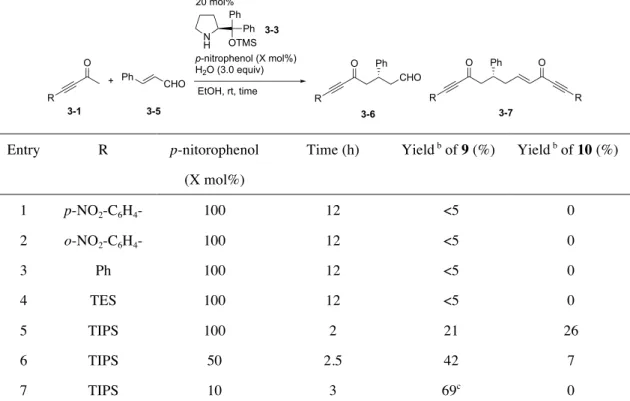
3-6 23% Table 3-1, entry 5 4-(triisopropylsilyl)but-3-yn-2-one 3-7 26% p-nitrophenol 3-7 69% 95% ee O R CHO + N H Ph OTMS Ph R O R R CHO 3-1 3-2 3-4 3-3
Table 3-1. Screening of asymmetric Michael reactiona
Entry R p-nitorophenol
(X mol%)
Time (h) Yield b of 9 (%) Yield b of 10 (%)
1 p-NO2-C6H4- 100 12 <5 0 2 o-NO2-C6H4- 100 12 <5 0 3 Ph 100 12 <5 0 4 TES 100 12 <5 0 5 TIPS 100 2 21 26 6 TIPS 50 2.5 42 7 7 TIPS 10 3 69c 0
a Unless otherwise shown, reactions were performed by employing a,b-unsaturated aldehyde 3-5 (0.18 mmol), ketone 3-1 (0.15 mmol), organocatalyst (0.030 mmol), water (0.45 mmol) and p-nitrophenol (indicated amount) in EtOH (0.60 mL) at room temperature for the indicated time. b Isolated yield. c 95% ee. Enantiomeric excess (ee) of the products, as determined by HPLC analysis over a chiral solid phase after conversion to a,b-unsaturated ester by the treatment with Ph3P=CHCO2Et.
Figure 3-1. Sterically effect of alkynyl ketone
Table 3-2
a,b-b Ph Table 3-2, entry 2
Table 3-2, entries 3 to 5
b 2-fury Table 3-2, entry 6 SiMe2Ph Table 3-2, entry 7
Me O Ph CHO + N H Ph OTMS Ph 20 mol% R O R Ph CHO p-nitrophenol (X mol%) H2O (3.0 equiv) EtOH, rt, time 3-1 3-5 3-6 O R Ph O R 3-7 3-3 O N H Ph OTMS Ph O N H Ph OTMS Ph A B
Table 3-2, entry 8
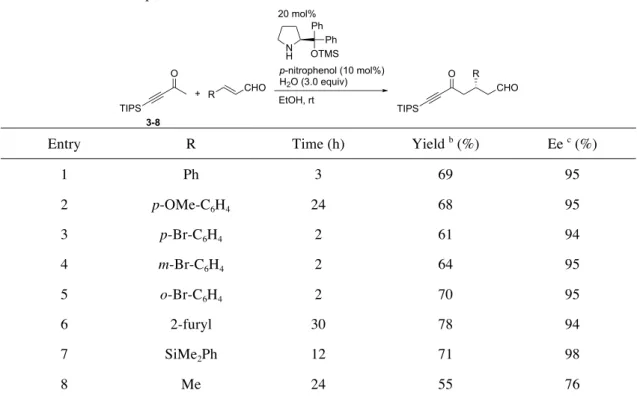
Table 3-2. Substrate scopea
Entry R Time (h) Yield b (%) Ee c (%)
1 Ph 3 69 95 2 p-OMe-C6H4 24 68 95 3 p-Br-C6H4 2 61 94 4 m-Br-C6H4 2 64 95 5 o-Br-C6H4 2 70 95 6 2-furyl 30 78 94 7 SiMe2Ph 12 71 98 8 Me 24 55 76
a Unless otherwise shown, the reaction was performed by employing aldehyde (0.18 mmol), ketone 3-8 (0.15 mmol), organocatalyst (0.030 mmol), p-nitrophenol (0.015 mmol), water (0.45 mmol) in EtOH (0.60 mL) at room temperature for the indicated time. b Isolated yield. c Enantiomeric excess (ee) of the products, as determined by HPLC analysis over a chiral solid phase after conversion to a,b-unsaturated ester by the treatment with Ph3P=CHCO2Et.
HMG-CoA 4) methyl (3R, 5S)-3,5-isopropylidenedioxy-6-heptynoate 4-(triisopropylsilyl)but-3-yn-2-one 3-8 3-(dimethylphenylsilyl)propenal 3-9 3-10 71% 98% ee Scheme 3-2 3 3-12 R CHO N H Ph OTMS Ph O + TIPS 20 mol% p-nitrophenol (10 mol%) H2O (3.0 equiv) EtOH, rt O TIPS R CHO 3-8
Scheme 3-2. Asymmetric Michael reaction between ketone 3-8 and aldehyde 3-9
Table 3-3 (-)-DIPCl5) 62% syn:anti
= >20:1 Table 3-3 entry 1 L-selecride®
58% syn:anti = >20:1 Table 3-3 entry 2
BH3•(t-BuNH2) 81% syn:anti = 1:1 Table 3-3 entry 3 THF
NaBH4 75% syn:anti = 2:1 Table 3-3 entry 4
MeOH NaBH4 88% syn:anti = >20:1
Table 3-3 entry 5 NaBH4 EtOH
syn:anti = 13:1 Table 3-3 entry 6 i-PrOH syn:anti = 6:1 Table 3-3 entry 7 O PhMe2Si CHO + N H Ph OTMS Ph 20 mol% p-nitrophenol (10 mol%) H2O (3.0 equiv) EtOH (0.25 M), rt, 12 h TIPS NaClO2 (1.0 equiv) NaH2PO4•2H2O (2.0 equiv) 2-methyl-2-butene (3.0 equiv) t-BuOH/H2O (3/1) 0 ºC, 2 h MeI (3.0 equiv) K2CO3 (4.5 equiv) DMF, rt, 2 h O SiMe2Ph CO2Me TIPS 3-8 3-9 3-12 O SiMe2Ph CHO TIPS 3-10 O SiMe2Ph CO2H TIPS 3-11
Table 3-3. Screening of stereoselective reductiona
Entry Reductant
(X equiv)
Solvent Temp. (ºC) Time (h) Yield b (%) syn:antic 1 (-)-DIP-Cl (2.0) THF -20 2 62 >20:1 2 L-Selectride® (1.0) THF -78 4 58 >20:1 3 BH3•(t-BuNH2) (1.0) CH2Cl2 0 8 81 1:1 4 NaBH4 (3.0) THF 0 6 75 4:1 5 NaBH4 (3.0) MeOH 0 2 88 >20:1 6 NaBH4 (3.0) EtOH 0 2 90 13:1 7 NaBH4 (3.0) i-PrOH 0 4 70 6:1
a Unless otherwise shown, reactions were performed by employing ketone 3-12 (0.10 mmol), and reductant (indicated amount) in indicated solvent (0.30 mL) at indicated temperature for the indicated time. b Isolated yield. c Ratio of syn:anti was determined by 1H-NMR.
Felkin-Ahn6) Fleming 7) Figure 3-2 PhMe2Si antiperiplanar D TIPS C Bürgi-Dunitz 8)
Figure 3-2. Transition state of stereoselective reduction
TIPS 3-20 Scheme 3-3 syn:anti = O SiMe2Ph CO2Me TIPS 3-12 Conditions OH SiMe2Ph CO2Me TIPS 3-13 H H H Si O Me Me MeO2C TIPS H H H Si O Me Me MeO2C TIPS Favor Disfavor C D
3:1 TIPS
Scheme 3-3. Stereoselective reduction of ketone 3-20
methyl (3R, 5S)-3,5-isopropylidenedioxy-6-heptynoate Scheme 3-4 º 4-(triisopropylsilyl)but-3-yn-2-one 3-8 3-(dimethylphenylsilyl)propenal 3-9 9) 3-14 42% NaClO2 10) NaBH4 3-14 - 11) TIPS
-3-14 TIPS PhMe2Si Si-Ph Si-F
methyl (3R, 5S)-3,5-isopropylidenedioxy-6-heptynoate 3-19 16% 2 O SiMe2Ph CO2Me NaBH4 (3.0 equiv) MeOH, 0 ºC, 1 h OH SiMe2Ph CO2Me syn:anti = 3:1 3-20 3-21
Scheme 3-4. Two-pot synthesis of methyl (3R, 5S)-3,5-isopropylidenedioxy-6-heptynoate (3-19)
Scheme 3-5 methyl
(3R, 5S)-3,5-isopropylidenedioxy-6-heptynoate 3-19 Lindlar 12)
3-22
13)
Scheme 3-5. Determination of absolute configuration
º a,b-O PhMe2Si CHO + N H Ph OTMS Ph 20 mol% p-nitrophenol (10 mol%) H2O (3.0 equiv) EtOH (0.25 M), rt, 12 h; evaporation TIPS NaClO2 (1.0 equiv) NaH2PO4•2H2O (2.0 equiv) 2-methyl-2-butene (3.0 equiv) t-BuOH/H2O (3/1), 0 ºC , 2 h; acetaldehyde (10 equiv); evaporation TMSCHN2 (3.0 equiv) Et2O/MeOH(4/1), rt, 15 min; evaporation TBAF (2.0 equiv) THF, 0 ºC, 30 min; AcOH (2.0 equiv); evaporation MgSO4 (100 wt%) HBF4•OEt2 (10 equiv) CH2Cl2, 40 ºC, 2 h; TBAOH (10 equiv), MeOH; evaporation
KF (3.0 equiv) KHCO3 (3.0 equiv) aq. H2O2 (3.0 equiv)
THF/MeOH (1/1) 40 ºC, 1 h NaBH4 (3.0 equiv) MeOH, 0 ºC, 1 h; AcOH (12 equiv); evaporation O SiMe2Ph O TIPS TsOH•H2O (3.5 equiv) Dimethoxypropane 50 ºC, 2 h O O CO2Me O SiMe2Ph CHO TIPS O SiMe2Ph CO2H TIPS O SiMe2Ph CO2Me TIPS OH SiMe2Ph CO2Me TIPS CSA (1.0 equiv) CH2Cl2, rt, 1 h O SiMe2Ph O O SiMe2F O OH SiMe2F CO2Me OH OH CO2Me evaporation 42%, single isomer 40% 16% overall yield
Five reaction steps in one-pot sequence
Five reaction steps in one-pot sequence
3-8 3-9 3-10 3-11 3-12 3-13 3-14 3-15 3-16 3-17 3-18 3-19 O O CO2Me 3-19 H2 (1 atm) Lindlar catalyst (10 wt%) quinoline(1.0 equiv) Tolunene, rt, 3 h O O CO2Me 3-22 91% [α]28D = -2.9 (c = 1.0) lit. [α]20D = -2.8 (c = 1.4)
methyl (3R,
[1] H. Gotoh, H. Ishikawa, Y. Hayashi, Org. Lett. 2007, 9, 5307.
[2] S. Brandau, A. Landa, J. Franzén, M. Marigo, K. A. Jørgensen, Angew. Chem. Int. Ed. 2007, 45, 4305.
[3] Y. Hayashi, N. Umekubo, Angew. Chem. Int. Ed. 2018, 57, 1958.
[4] (a) N. Miyachi, Y. Yanagawa, H. Iwasaki, Y. Ohara, T. Hiyama, Tetrahedron Lett. 1993, 34, 8267. (b) M. H. Ansari, T. Kusumoto, T. Hiyama, Tetrahedron Lett. 1993, 34, 8227. (c) K. Takahashi, T. Minami, Y. Ohara, T. Hiyama, Bull. Chem. Soc. Jpn. 1995, 68, 2649.
[5] (a) J. Chandrasekharan, P. V. Ramachandran, H. C. Brown, J. Org. Chem. 1985, 50, 5446. (b) C. Ohta, S. Kuwabe, T. Shiraishi, I. Shinohara, H. Araki, S. Sakuyama, T. Makihara, Y. Kawanaka, S. Ohuchida, T. Seko, J. Org. Chem. 2009, 74, 8298.
[6] (a) M. Cherest, H. Felkin, N. Prudent, Tetrahedron Lett. 1968, 9, 2199. (b) N. T. Anh, O. Eisenstein, J.-M. Lefour, M.-E. Dau, J. Am. Chem. Soc. 1973, 95, 6146.
[7] A. Barbero, D. C. Blakemore, I. Fleming, R. N. Wesley, J. Chem. Soc., Perkin Trans. 1, 1997, 1329.
[8] H.-B. Bürgi, J. D. Dunitz, J.-M. Lehn, G. Wipff, Tetrahedron, 1974, 30, 1563.
[9] (a) G. A. Kraus, M. J. Taschner, J. Org. Chem. 1980, 45, 1175. (b) B. S. Bal, W. E. Childers, Jr., H. W. Pinnick, Tetrahedron 1981, 37, 2091.
[10] Y. Hayashi, J. Org. Chem. 2021, 86, 1.
[11] (a) K. Tamao, M. Akita, M. Kumada, Organometallics, 1983, 2, 1694. (b) I. Fleming, R. Henning, H. Plaut, J. Chem. Soc., Chem. Commun. 1984, 29.
[12] H. Lindlar, Helv. Chim. Acta 1952, 35, 446. [13] Y. Gu, B. B. Snider, Org. Lett. 2003, 5, 4385.
a,b- /
º
º 1)
2) º
Scheme 4-1
Córdova a,b- 4-1 methyl (E)-5-nitropent-2-enoate 4-2
/ º
3)
Eq. 4-1 Ma a,b- 4-1 triethyl 3-oxobut-1-ene-1,1,4-tricarboxylate
4-4 / º
4)
Eq. 4-2 º
1,3-Scheme 4-1. Background of construction of chiral multi-substituted cyclopentanne using organocatalyst
a,b-5) ethyl (E)-4-oxopent-2-enoate 4-5 / º Scheme 4-2 a,b-4-1 Ethyl (E)-4-oxopent-2-enoate 4-5 4-6 4-6 6-endo-trig º 4-7 4-8 O CO2Et R CHO 4-4 4-1 O R CHO CO2Et N H Ph OTMS Ph EtO2C CO2Et EtO2C CO2Et CO2Me R CHO 4-2 4-1 R CHO CO2Me N H Ph OTMS Ph O2N O2N Toluene, 0 ºC DABCO (20 mol%) CH2Cl2, rt 20 mol% 2-5 mol% 4-3 + + (4-2) (4-1)
Scheme 4-2. A working hypothesis of asymmetric domino Michael/Michael reaction
/ Table 4-1 i-PrOH
º
(E)-3-(dimethyl(phenyl)silyl)acrylaldehyde 4-10 ethyl (E)-4-oxopent-2-enoate 4-5
º 4-11 62% Table 4-1 entry 1
2,4,6-Trichlorophenol 4-11 52%
Table 4-1 entry 2 p-Nitrophenol 4-11 65% Table
4-1 entry 3 p-nitrophenol
1.0 M 4-11 82% Table 4-1 entry 4 2.0 M
4-11 83% Table 4-1 entry 5 4.0 M 4-11
85% Table 4-1 entry 6 8.0 M 4-11 78%
Table 4-1 entry 7 4.0 M
10 mol% 4-11 85% Table 4-1 entry 8 5 mol%
4-11 90% Table 4-1 entry 9 2.5 mol%
4-11 79% Table 4-1 entry 10 5.0 mol%
CHO R O CO2Et N H Ph OTMS Ph CHO CO2Et R O O CO2Et O CO2Et CHO R + R N Ph TMSO Ph O R N Ph TMSO Ph O R N Ph TMSO Ph CO2Et OEt O 4-5 4-1 4-3 4-6 4-8 4-7 4-9
Table 4-1. Screening of asymmetric domino Michael/Michael reactiona Entry Catalyst (X mol%) Acid Concentration (Y M) Time (h) Yield b (%) 1 10 PhCO2H 0.25 24 62 2 10 2,4,6-trichlorophenol 0.25 24 52 3 10 p-nitrophenol 0.25 24 65 4 10 p-nitrophenolc 1.0 6 82 5 10 p-nitrophenolc 2.0 4 83 6 10 p-nitrophenolc 4.0 3 85 7 10 p-nitrophenolc 8.0 2 78 8 10 p-nitrophenol 4.0 1 85d 9 5 p-nitrophenol 4.0 8 90d 10 2.5 p-nitrophenol 4.0 24 79d
a Unless otherwise shown, reactions were performed by employing α,β-unsaturated aldehyde 4-10 (0.15 mmol), ketoe 4-5 (0.18 mmol), organocatalyst (X mol%) and acid (1.5 mmol) in i-PrOH (Y M) at room temperature for the indicated time. b Isolated yield. c Acid (0.75 mmol). d With >99% ee. Enantiomeric excess (ee) of the products, as determined by HPLC analysis over a chiral solid phase after conversion to a,b-unsaturated ester by the treatment with Ph3P=CHCO2Et.
Table 4-2 a,b- b
Table 4-2 entry 1 Table 4-2 entry 2 Table 4-2
entries 3 and 4 Table 4-2 entries 5 to 9 º Table 4-2
entry 10 Table 4-2 entry 11
O CO2Et PhMe2Si CHO 4-5 4-10 O PhMe2Si CHO CO2Et N H Ph OTMS Ph + X mol% Acid (100 mol%) H2O (3.0 equiv) i-PrOH (Y M) rt, time 4-11 4-3
Table 4-2. Substrate scope of asymmetric domino Michael/Michael reactiona
Entry R Time (h) Yieldb (%) Drc Eed (%)
1 Phenyl 10 98 >98:2 >99 2 2-Naphyl 6 84 >98:2 >99 3 p-Me-C6H4 12 91 >98:2 >99 4 p-MeO-C6H4 15 88 >98:2 >99 5 p-F-C6H4 6 81 >98:2 >99 6 p-Cl-C6H4 5 85 >98:2 >99 7 p-Br-C6H4 4 83 >98:2 >99 8 m-Br-C6H4 4 74 >98:2 >99 9 o-Br-C6H4 7 82 >98:2 >99 10 2-Furyl 24 80 >98:2 >99 11e SiMe 2Ph 1 85 >98:2 >99
a Unless otherwise shown, reactions were performed by employing a,b-unsaturated aldehyde (0.15 mmol), ketone 4-5 (0.30 mmol), organocatalyst (0.015 mmol), water (0.45 mmol) and p-nitrophenol (0.15 mmol) in i-PrOH (0.075 mL) at room temperature for the indicated time. b Isolated yield. c Diastereomer ratio (dr) was determined by 1H-NMR analysis of a crude mixture. d Enantiomeric excess (ee) of the products, as determined by HPLC analysis over a chiral solid phase after conversion to a,b-unsaturated ester by the treatment with Ph3P=CHCO2Et. e Ketone 4-5 (0.18 mmol) was used.
Scheme 4-3 º
4-3 a,b- 4-1 p- º
4-13 ethyl (E)-4-oxopent-2-enoate 4-5
4-14 p- º Brønsted
º a º
Brønsted ethyl
(E)-4-oxopent-2-enoate 4-5 a º O CO2Et R CHO 4-5 4-1 O R CHO CO2Et N H Ph OTMS Ph + 10 mol% p-nitrophenol (100 mol%) H2O (3.0 equiv) i-PrOH (4.0 M), rt, time 4-12 4-3
p- º º 4-16 5-exo-trig 6-endo-trig 5-exo-trig 6) º 4-3 º 4-12
Scheme 4-3. A mechanism of asymmetric domino Michael/Michael reaction
º a,b-ethyl (E)-4-oxopent-2-enoate / º N OTMSPh Ph R O EtO2C N H Ph OTMS Ph N OTMSPh Ph R CHO O EtO2C N OTMSPh Ph R O EtO2C CHO CO2Et O R R H2O OH NO2 O NO2 OH NO2 H2O 4-12 4-3 4-1 4-13 4-16 4-5 4-15 OH EtO2C 4-14
[1] (a) Y. Hayashi, H. Gotoh, T. Hayashi, M. Shoji, Angew. Chem. Int. Ed. 2005, 44, 4212. (b) M. Marigo, T. C. Wabnitz, D. Fielenbach, K. A. Jørgensen, Angew. Chem. Int. Ed. 2005, 44, 794. [2] (a) Enantioselective Organocatalysis: Reactions and Experimental Procedures; Dalko, P. I., Eds.; Wiley-VCH: Weinheim, 2007. (b) Asymmetric Organocatalysis 1: Lewis Base and Acid Catalysts; List, B., Eds.; Georg Thieme Verlag KG: New York, 2012.
[3] I. Ibrahem, G.-L. Zhao, R. Rios, J. Vesely, H. Sunden, P. Dziedzic, A. Cordova, Chem. Eur.J.
2008, 14, 7867.
[4] A. Ma, D. Ma, Org. Lett., 2010, 12, 3634.
[5] Y. Hayashi, N. Umekubo, Angew. Chem. Int. Ed. 2018, 57, 1958.
[6](a) J. E. Baldwin, J. Chem. Soc. Chem. Commun. 1976, 18, 734. (b) J. E. Baldwin, R. C. Thomas, L. I. Kruse, L. Silberman J. Org. Chem. 1977, 42, 3846. (c) J. E. Baldwin, M. J. Lusch, Tetrahedron 1982, 38, 2939.
Corey 152
º
1982 º
º Corey1) Woodward2) Stork3) 4)
Baran 5) Aggawal 6) 7)
º Corey 5-1
Corey Diels-Alder
10 1) Scheme 5-1 Stork cis-cyclopentene-1,4-diol
7 3) Woodward cis-cyclohexane-1,3,5-triol
11 2)
Scheme 5-1. Corey’s synthetic route of chiral Corey lactone
º a,b--20 ºC, 300 min OBn + Br CHO CH2Cl2, -78 ºC, 480 min BnO Br CHO O p-ClC6H4COO OBn O Total 10 steps over 2880 min BnOCH2Cl Tl2SO4, KOH NB O Ts H O N H 5 mol% NH2OH RT, 600 min RT, 600 min TsCl pyridine BnO Br CN KOH RT, 120 min mCPBA 0 ~ -10 ºC
KOH then CO2 0 ºC BnO O O O BnO
I2, KI, K2CO3 0 ~ 5 ºC, 720 min O HO OBn O I p-ClC6H4COCl pyridine 25 ºC, 60 min n-Bu3SnH, AIBN 55 ºC 5-1
º 5-5
Scheme 5-2 Corey
Corey
Scheme 5-2. Asymmetric domino Michael/Michael reaction catalyzed by diphenylprolinol silyl ether
Corey a,b- b
º b a,b- /
Figure 5-1 SiMe2Ph b
a,b- 5-6 /
º 5-7 85% >99% ee Scheme 5-3
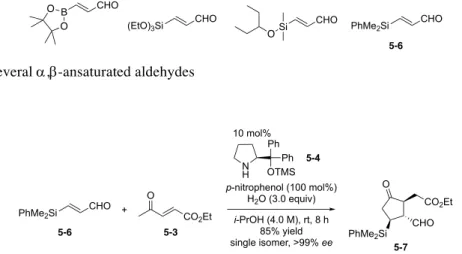
Figure 5-1. Several a,b-ansaturated aldehydes
Scheme 5-3. Asymmetric domino Michael/Michael reaction using a,b-ansaturated aldehyde 5-6
Corey Scheme 5-4 º ent 5-4 (E)-3-O CO2Et R CHO 5-3 5-2 O R CHO CO2Et N H Ph OTMS Ph + 10 mol% p-nitrophenol (100 mol%) H2O (3.0 equiv) i-PrOH (4.0 M), rt, time 5-5 5-4 B CHO O
O (EtO)3Si CHO Si CHO
O PhMe2Si CHO 5-6 O CO2Et PhMe2Si CHO 5-3 5-6 O PhMe2Si CHO CO2Et N H Ph OTMS Ph + 10 mol% p-nitrophenol (100 mol%) H2O (3.0 equiv) i-PrOH (4.0 M), rt, 8 h 85% yield single isomer, >99% ee 5-7 5-4
/ º 5-8 85% >99% ee 5-8 NaBH4 3:1 LiAl(Ot-Bu)3H 5-9 82% THF 5-10 91% Si-Ph Si-F ClCH2CH2Cl aq. HBF4 5-11 5-11 Si-F Si-OH - 8) Corey 5-12 58% 15 5
Scheme 5-4. Five-pot synthesis of enantiopure Corey lactone
9) 10) PhMe2Si OH O O aq. HBF4 (10 equiv) ClCH2CH2Cl 80 °C, 4 h FMe2Si OH O O HO OH O O aq. H2O2 (10 equiv)
KF (10 equiv) DMF 40 ºC, 1 h 86% yield (2 Steps) 2 N HCl THF, rt, 1 h 91% yield PhMe2Si OH 5-9 5-10 5-11 5-12 CO2Et CHO CO2Et O PhMe2Si 5-8 LiAl(Ot-Bu)3H (3.5 equiv) O CO2Et PhMe2Si CHO 5-3 5-6 N H Ph OTMS Ph + 10 mol% p-nitrophenol (100 mol%) H2O (3.0 equiv) i-PrOH (4.0 M), rt, 8 h 85% yield single isomer, >99% ee ent-5-4 HO THF, rt, 1 h 82% yield Total yield: 58%
Total reaction time: 900 min Four purifications
Scheme 5-5 º ent 5-4 (E)-3-(dimethyl(phenyl)silyl)acrylaldehyde 5-6 ethyl (E)-4-oxopent-2-enoate 5-3
/ LiAl(Ot-Bu)3H
60 ºC
Scheme 5-4 aq. sat. NH4Cl
aq. HBF4 Si-Ph Si-F
Brønsted Brønsted
5-13
aq. HBF4 5-10
THF ClCH2CH2Cl
Si-Ph Si-F 4
15 aq. HBF4 1) O-Li O-H
2) LiAl(Ot-Bu)3H 3)
4) Si-Ph Si-F aq. K2CO3
Corey 5-12 152 50%
>99% ee 1 g
Scheme 5-5. One-pot & 152-minutes synthesis of enantiopure Corey lactone evaporation 80 °C, 15 min PhMe2Si OH O O aq. HBF4 (10 equiv) 1 min FMe2Si OH O O HO OH O O aq. H2O2 (10 equiv)
KF (10 equiv) 40 ºC, 1 h PhMe2Si OR 5-13 5-10 5-11 5-12 CO2Et CHO CO2Et O PhMe2Si 5-8 LiAl(Ot-Bu)3H (3.5 equiv) O CO2Et PhMe2Si CHO 5-3 5-6 N H Ph OTMS Ph + 10 mol% p-nitrophenol (100 mol%) H2O (3.0 equiv) i-PrOH (4.0 M), rt, 60 min ent-5-4 RO THF, 60 ºC, 15 min Total yield: 50%
Total reaction time: 152 min One purifications One pot R = Al or Li K2CO3 (10 equiv) DMF/H2O (2:1) rt, 1 min
Corey 152
º a,b-
[1] (a) E. J. Corey and X. M. Cheng, The Logic of Chemical Synthesis, Wiley, New York, 1995. (b) E. J. Corey, N. M. Wesinshenker, T. K. Schaaf, W. Huber, J. Am. Chem. Soc. 1969, 91, 5675. (c) E. J. Corey, T. K. Schaaf, W. Huber, U. Koelliker, N. M. Wesinshenker, J. Am. Chem. Soc.
1970, 92, 397. (d) E. J. Corey, S. M. Albonico, U. Koelliker, T. K. Schaaf, R. K. Varma, J. Am.
Chem. Soc. 1971, 93, 1490. (e) E. J. Corey, H. E. Ensley, J. Am. Chem. Soc. 1975, 97, 6908. (f) E. J. Corey, T. P. Loh, J. Am. Chem. Soc. 1991, 113, 8966.
[2] R. B. Woodward, J. Gosteli, I. Ernest, R. J. Friary, G. Nestler, H. Raman, R. Stitrin, C. Suter, J. K. Whitesell, J. Am. Chem. Soc. 1973, 95, 6853.
[3] G. Stork, P. M. Sher, H.-L. Chen, J. Am. Chem. Soc. 1986, 108, 6384. [4] R. Noyori, M. Suzuki, Angew. Chem. Int. Ed. Engl. 1984, 23, 847.
[5] J. T. Edwards, R. R. Merchant, K. S. MaClymont, K. W. Knouse, T. Qin, L. R. Malins, B. Vokits, S. A. Shaw, D.-H. Bao, F.-L. Wei, T. Zhou, M. D. Eastgate, P. S. Baran, Nature, 2017, 545, 213. [6] (a) G. Coulthard, W. Erb, V. K. Aggarwal, Nature, 2012, 489, 278. (b) S. Prévost, K. Thai, N. Schützenmeister, G. Coulthard, W. Erb, V. K. Aggarwal, Org. Lett. 2015, 17, 504. (c) H. Baars, M. Classen, V. K. Aggarwal, Org. Lett. 2017, 19, 6008. (d) Pelšs, N. Gandhamsetty, J. R. Smith, D. Mailhol, M. Silvi, A. Watson, I. Perez-Powell, S. Prévost, N. Schützenmeister, P. Moore, V. K. Aggarwal, Chem. Eur. J, 2018, 24, 9542.
[7] (a) Y. Hayashi, S. Umemiya, Angew. Chem. Int. Ed. 2013, 52, 3450. (b) S. Umemiya, D. Sakamoto, G. Kawauchi, Y. Hayashi, Org. Lett. 2017, 19, 1112. (c) G. Kawauchi, S. Umemiya, T. Taniguchi, K. Monde, Y. Hayashi, Chem. Eur. J. 2018, 24, 8409.
[8] (a) K. Tamao, M. Akita, M. Kumada, Organometallics, 1983, 2, 1694. (b) I. Fleming, R. Henning, H. Plaut, J. Chem. Soc., Chem. Commun. 1984, 29.
[9] Y. Hayashi, Chem. Sci. 2016, 7, 866. [10] Y. Hayashi, J. Org. Chem. 2021, 86, 1.
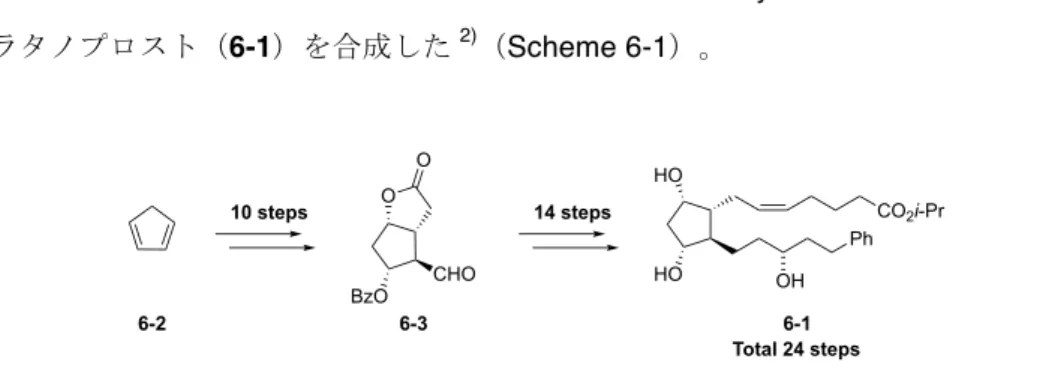
º º F2a º Xalatan® 6-1 1) Figure 6-1 º
Figure 6-1. Structure of latanoprost (Xalatan®)
º
º 6-2 10 Corey 6-3 14
º 6-1 2) Scheme 6-1
Scheme 6-1. Pfizer’s synthetic route of latanoprost
2015 Aggawal º 3) Scheme 6-2 L- º 2 6-4 / / 6-5 7 º 6-1 / / 14% HO Ph OH HO CO2i-Pr 6-1 BzO CHO O O HO OH Ph HO CO2i-Pr 14 steps 10 steps Total 24 steps 6-1 6-2 6-3
Scheme 6-2. Aggawal’s synthetic route of latanoprost º 4) a,b-a,b- / º º º Scheme 6-3 º 6-1 a 6-6 Wittig 5) 6-6 C11 -w 6-8 Horner-Wadsworth-Emmons HWE 6) º º
6-9 ethyl (E)-4-oxopent-2-enoate 6-10
(E)-3-(dimethyl(phenyl)silyl)acrylaldehyde 6-11 /
Scheme 6-3. Retrosynthesis of chiral latanoprost
º Scheme 6-4 º
6-9 ethyl (E)-4-oxopent-2-enoate 6-10
(E)-3-(dimethyl(phenyl)silyl)acrylaldehyde 6-11 / O OH O O O N H CO2H 2 2-MeTHF, rt ; Bn2NH2+-O2CF3 14% yield 2 mol% HO OH Ph HO CO2i-Pr Total 8 steps Total yield : 4 % 7 steps 6-1 6-5 6-4 N H Ph OTMS Ph O PhMe2Si CHO CO2Et O CO2Et PhMe2Si CHO 6-10 6-11 + P MeO O OMe O Ph Ph3P CO 2H Br HO HO OH Ph 6-1 CO2i-Pr HO OH Ph O OH 6-6 6-8 6-9 PhMe2Si OH Ph O O 6-7 Wittig reaction Tamao-Fleming oxidation HWE reaction 11
º 6-12 72% (-)-DIP-Cl8) w a,b- 1,2-6-7 80% 6-7 Pd/C 6-13 - 9) Si-Ph Si-F 6-14 80% DIBAL Wittig a 6-15 64% 6-15 º º 6-1 7 25%
Scheme 6-4. Seven-pot synthesis of enantiopure latanoprost
º 7 25% º a,b-a,b- / º CO2Et O PhMe2Si O Ph P MeO O OMe O Ph LiCl, i-Pr2NEt MeCN, rt, 6 h 72% yield p-nitrophenol H2O i-PrOH, rt, 8 h N H Ph OTMS Ph 5 mol% (-)-DIP-Cl THF, -20 ºC, 24 h PhMe2Si OH Ph O O H2, Pd/C EtOH, rt, 1 h aq. HBF4 toluene concentrated 80 ºC HO OH Ph O O Br Ph3P t-BuOK CH2Cl2 -78 ºC, 2 h THF, -10 ºC, 4 h64% yield HO HO OH Ph CO2H HO HO OH Ph CO2i-Pr Cs2CO3 i-PrI DMF rt, 6 h 85% yield aq. K2CO3, DMF ; aq. H2O2, KF 60 ºC, 1 h 80% yield PhMe2Si OH Ph O O HO OH Ph O OH DIBAL O CO2Et PhMe2Si CHO CO2Et O + PhMe2Si CHO 6-11 6-10 6-12 6-7 6-15 CO2H CO2Et HO PhMe2Si OH Ph rt, 4 h 80% yield FMe2Si OH Ph O O 2 N HCl 6-14 6-1 6-9 6-13 6-6
[1] (a) S. S. Patel, C. M. Spencer, Drugs Aging 1996, 9, 363. (b) C. M. Perry, J. K. McGavin, C. R. Culy, T. Ibbotson, Drugs Aging 2003, 20, 597.
[2] B. Resul, J. Stjernschantz, K. No, C. Liljebris, G. Selen, M. Astin, M. Karlsson, L. Z. Bito, J. Med. Chem. 1993, 36, 243.
[3] S. Prévost, K. Thai, N. Schützenmeister, G. Coulthard, W. Erb, V. K. Aggarwal, Org. Lett. 2015, 17, 504.
[4] (a) Y. Hayashi, H. Gotoh, T. Hayashi, M. Shoji, Angew. Chem. Int. Ed. 2005, 44, 4212. (b) M. Marigo, T. C. Wabnitz, D. Fielenbach, K. A. Jørgensen, Angew. Chem. Int. Ed. 2005, 44, 794. [5] (a) G. Wittig, U. Scholkopf, Ber. 1954, 87, 1318. (b) G. Wittig, U. Scholkopf, Ber. 1955, 88, 1654.
[6] (a) L. Horner, H. M. R. Hoffmann, H. G. Wippel, Ber. 1958, 91, 61. (b) W. S. Wadsworth, Jr. W. D. Emmons, J. Am. Chem. Soc. 1961, 83, 1733.
[7] M. A. Blanchette, W. Choy, J. T. Davis, A. P. Essenfield, S. Masamune, W. R. Roush, T. Sakai, Tetrahedron Lett. 1984, 25, 2183.
[8] (a) J. Chandrasekharan, P. V. Ramachandran, H. C. Brown, J. Org. Chem. 1985, 50, 5446. (b) C. Ohta, S. Kuwabe, T. Shiraishi, I. Shinohara, H. Araki, S. Sakuyama, T. Makihara, Y. Kawanaka, S. Ohuchida, T. Seko, J. Org. Chem. 2009, 74, 8298.
[9] (a) K. Tamao, M. Akita, M. Kumada, Organometallics, 1983, 2, 1694. (b) I. Fleming, R. Henning, H. Plaut, J. Chem. Soc., Chem. Commun. 1984, 29.
º º 1976 1) º Figure 7-1 in vivo 3 2) º º 7-1 7-2 º 3) 4)
Figure 7-1. Prostacyclin (PGI2), carbacyclin, isocarbacyclin, and clinprost
º 5) 6) 7)
endocyclic º[3.3.0]
Corey 7-3
º[3.3.0] 6 7-2
5) Scheme 7-1
Scheme 7-1. Shibasaki’s synthetic route of isocarbacyclin (7-2) O HO OH CO2H prostacyclin (PGI2) HO OH CO2R R = Me: clinprost (7-1) R = H: isocarbacyclin (7-2) HO OH CO2H carbacyclin HO OH 3 steps Ph2NH•TFA 6 steps THPO O O OTBS THPO OTBS CHO THPO OTBS OHC CHO 7-3 7-2 CO2H
7-4 º[3.3.0]
5 7-2 6) Scheme
7-2
Scheme 7-2. Noyori’s synthetic route of isocarbacyclin (7-2)
º a,b-a,b- / º º º Schme 7-3 º 7-1 C11 7-5 - 8) a -9) w Horner-Wadsworth-Emmons 10) endocyclic 7-6 a,b- 1,4- º[3.3.0] Schme 7-3 route A º[3.3.0] Horner-Wadsworth-Emmons Schme 7-3 route B º / OHC 6 steps TBSO OTBS HO hν, Et3N HO OH TBSO O TBSO OTBS 5 steps 7-4 7-2 CO2H
Scheme 7-3. Retrosynthesis of chiral clinprost
º[3.3.0]
Schme 7-3 route A Scheme 7-4 º
7-1411) 3-hexene-2,5-dione 7-8 3-(dimethylphenylsilyl)propenal 7-12
/ º 7-15
87% 96% ee º 7-15
7-16 85%
Scheme 7-4. Synthesis of intramolecular aldol condensation precursor
R OH CO2Me R O OMe OMe R OMe OMe O O CHO R O O Suzuki-Miyaura coupling HWE reaction 7-7 7-8 7-9 R OMe OMe O CHO R O 7-10 7-11 7-9 (MeO)2P O O R = SiMe2Ph or SiPh3 A B CO2Et HO OH 7-1 CO2Me 7-5 7-6 11 CHO PhMe2Si O O 7-8 7-12 p-nitrophenol (100 mol%) H2O (3.0 equiv) i-PrOH, rt, 8 h 87% yield N H Ph OTMS Ph 5 mol% + CHO PhMe2Si O O 7-15 HC(OMe)3 (1.0 equiv) TsOH•H2O (20 mol%) MeOH (3.0 equiv) CH2Cl2, 0 ºC, 5 h 85% yield, 97% ee PhMe2Si OMe OMe O O 7-16 7-14
KOH Table 7-1 entry 1 Table 7-1 entries 2 to 5
º 12)
Table 7-1. Screening of intramolecular aldol condensationa
Entry Reagent (X equiv) Solvent Temp. Time (h) Result
1 KOH (5.0) EtOH reflux 2 Dcomposed
2 t-BuOK (1.0) t-BuOH rt 12 No reaction
3 L-Proline (1.0) DMSO rt 12 No reaction
4 Pyrrolidine (1.0) ClCH2CH2Cl reflux 12 No reaction
5 Pyrrolidine (1.0)
AcOH (1.0) ClCH2CH2Cl reflux 12 No reaction
a Unless otherwise shown, reactions were performed by employing ketone 7-16 (0.10 mmol) and reagent in solvent (0.30 mL) at room temperature for the indicated time.
Horner-Wadsworth-Emmons º[3.3.0]
13) Schme 7-3 route B Schme 7-5 º
7-14 ethyl (E)-4-oxopent-2-enoate 7-11
(E)-3-(dimethyl(phenyl)silyl)acrylaldehyde 7-12 / º 7-18 90% Horner-Wadsworth-Emmons Dimethylmethylphosphonate 7-18 7-18 LDA 7-19 Claisen b- 7-20 b- 7-20 º 7-21 7-21 7-22 PhMe2Si OMe OMe O O 7-16 PhMe2Si O OMe OMe Conditions 7-17
Horner-Wadsworth-Emmons º[3.3.0] 7-23 86% 7-18 L-selectride® a,b- 7-23 1,4-endocyclic 7-24 7-24 McMurry 14) 7-25 72% - 7-26 93% 7-26 Horner-Wadsworth-Emmons 7-27 86% 7-27 Si-Ph Si-F 7-27
BF3·2AcOH 15) Si-Ph Si-F endocyclic
7-28 7-28’ 1:1 7-27 Si-Ph Si-F 7-27 Si-Ph Si-F THF 7-27 TBAF a,b-THF 7-26 TBAF 7-26 SiMe2Ph SiPh3
Scheme 7-5. Failed synthesis of clinprost º ethyl (E)-4-oxopent-2-enoate 7-11 (E)-3-(triphenylsilyl)acrylaldehyde 7-29 / Table 7-2, entry 1 i-PrOH (E)-3-(triphenylsilyl)acrylaldehyde 7-29 THF Table 7-2, entry 2 DMF
Table 7-2, entry 3 Toluene
61% 30% Table 7-2, entry 4 CH2Cl2 65% 27% Table 7-2, entry 5 CH2Cl2 CHO PhMe2Si CO2Et O 7-11 7-12 + p-nitrophenol (100 mol%) H2O (3.0 equiv) i-PrOH, rt, 8 h; evaporation N H Ph OTMS Ph 5 mol% HC(OMe)3 (1.0 equiv) TsOH (20 mol%) MeOH (3.0 equiv) CH2Cl2, 0 ºC, 5 h 90% (2 steps) CO2Me PhMe2Si OMe OMe O 7-18 LDA (1.0 equiv) Toluene -78 ºC, 15 min LDA (5 equiv) -78 ºC, 1 h AcOH (5.0 equiv) MeP(=O)(OMe)2 (5 equiv) PhMe2Si OMe OMe O L-selectride® (1.0 equiv) THF, -78 ºC, 1 h Tf2NPh (1.0 equiv) rt, 12 h 72% yield PhMe2Si OMe OMe OTf 7-25 PhMe2Si OMe OMe B CO2Me
aq. Cs2CO3 (5.0 equiv) Pd(PPh3)4 (10 mol%) THF-DMF (2:1), rt, 2 h 93% 7-26 (3.0 equiv) 2N HCl/THF (1:3) rt, 2 h P MeO O OMe O NaH (3.0 equiv) (4.0 equiv) THF, rt, 8 h 86% (2 steps) PhMe2Si O 7-27 BF3•2AcOH (10 equiv) CH2Cl2 rt, 2 h FMe2Si O 7-28 FMe2Si O 7-28’ 7-14 CO2Me PhMe2Si OMe OMe LiO 7-19 PhMe2Si OMe OMe O O P MeO LiO MeO PhMe2Si OMe OMe O P MeO LiO MeO OLi 7-21 7-20 PhMe2Si OMe OMe O P MeO O MeO OLi 7-22 rt 86% yield 7-23 PhMe2Si OMe OMe OLi 7-24 CO2Me
Table 7-2, entry 6 ethyl (E)-4-oxopent-2-enoate 7-11 (E)-3-(triphenylsilyl)acrylaldehyde 7-29 ethyl (E)-4-oxopent-2-enoate 7-11 (E)-3-(triphenylsilyl)acrylaldehyde 7-29 Figure 7-2 1,4- Figure 7-2 A SiPh3 1,2-Figure 7-2 B E1cB 1,2- º Figure 7-2 C TES 79% 10% Table 7-2, entry 7 SiMePh2 91% 96% ee Table 7-2, entry 8
Table 7-2. Screening of asymmetric domino Michael/Michael reactionusing aldehyde 7-29
Entry Solvent Catalyst
(mol%) Time (h) Yieldb of 7-30 (%) Yieldb of 7-31 (%) 1 i-PrOH A (10) 24 0 0 2 THF A (10) 24 0 0 3 DMF A (10) 24 0 0 4 Toluene A (10) 24 61 30 5 CH2Cl2 A (10) 24 65 27 6 CH2Cl2 A (20) 12 70 21 7 CH2Cl2 B (20) 14 79 10 8 CH2Cl2 C (20) 24 91c 0
a Unless otherwise shown, reactions were performed by employing ethyl (E)-4-oxopent-2-enoate (7-11) (0.30 mmol), (E)-3-(triphenylsilyl)acrylaldehyde (7-29) (0.15 mmol) organocatalyst (0.015 or 0.030 mmol), water (0.45 mmol) and p-nitrophenol (0.15 mmol) in indicated solvent (0.075 mL) at room temperature for the indicated time. b Isolated yield. c With 96% ee.
Figure 7-2. Effect of the silyl substituent of the catalyst: red circle, (A) PhMe2Si or (B and C) Ph3Si; blue circle, (A and B) Me3SiOPh2C- or (C) Ph2MeSiOPh2C-
º ethyl (E)-4-oxopent-2-enoate 7-11 (E)-3-(triphenylsilyl)acrylaldehyde 7-29 / º Scheme 7-6 7-30 7-30 Organocatalyst (X mol%) p-nitrophenol (100 mol%) H2O (3.0 equiv) O Ph3Si CHO CO2Et O CO2Et Ph3Si 7-31 N H Ph OTMS Ph N H Ph OTES Ph N H Ph OSiPh2Me Ph CHO Ph3Si CO2Et O 7-11 7-29 + solvent, rt, time A B C N Nu N N A B C Nu Nu
7-32 85% SiPh3
THF 7-32
7-33 79%
Scheme 7-6. Synthesis of compound 7-33
º 7-1 º
ethyl (E)-4-oxopent-2-enoate 7-11
(E)-3-(triphenylsilyl)acrylaldehyde 7-29 / 7-33 60% 7-33 Claisen º º Horner-Wadsworth-Emmons 7-38 86% L-selectride® 1,4- McMurry 7-40 71% - 7-41 82% 7-41 Horner-Wadsworth-Emmons 7-42 Figure 7-3 79% 7-42 a,b- 1,2-- 16) 7-42 (-)-DIP-Cl SiPh3 Horner-Wadsworth-Emmons w -7-41 TBAF endocyclic , Si-Ph Si-F 7-43 7-44 7-44 7-45 81% 7-45 Horner-Wadsworth-Emmons 7-47 81% (-)-DIP-Cl 1,2-HC(OMe)3 (10 equiv) TsOH•H2O (20 mol%) MeOH (3.0 equiv) CH2Cl2, rt, 24 h 85% yield CO2Me Ph3Si OMe OMe OMe MeO 2N HCl/THF rt, 30 min 79% yield CO2Me Ph3Si OMe OMe O 7-32 7-33 7-30 O Ph3Si CHO CO2Et
Scheme 7-7. Seven-pot synthesis of clinprost LDA (1.0 equiv) Toluene -78 ºC, 15 min LDA (5.0 equiv) -78 ºC, 1 h rt, 24 h 86% yield AcOH (5.0 equiv) Ph3Si OMe OMe O 7-38 CO2Me LiO Ph3Si OMe OMe Ph3Si OMe OMe OLi O P MeO LiO MeO 7-34 7-36 MeP(=O)(OMe)2 (5.0 equiv) CHO Ph3Si CO2Et O 7-11 7-29 p-nitrophenol (100 mol%) H2O (3.0 equiv) CH2Cl2, rt, 24 h N H Ph OSiMePh2 Ph 20 mol% HC(OMe)3 (10 equiv) TsOH•H2O (40 mol%) MeOH (3.0 equiv) CH2Cl2, rt, 24 h; evaporation CO2Me Ph3Si OMe OMe O 7-33 L-selectride (1.0 equiv) THF, -78 ºC, 1 h Tf2NPh (1.0 equiv) rt, 12 h 71% yield Ph3Si OMe OMe OTf Ph3Si OMe OMe B CO2Me
aq. Cs2CO3 (5.0 equiv) Pd(PPh3)4 (10 mol%) THF/DMF, rt, 2 h 82% yield CO2Me 7-40 7-41 (3.0 equiv) TBAF (10 equiv) DMF, 80 ºC, 2 h KF (10 equiv)
aq. H2O2 (10 equiv) MeI (3.0 equiv) DMF, 80 ºC, 10 min 81% yield DMF, 80 ºC, 2 h HO OMe OMe CO2Me 7-45 Acetone/H2O rt, 3 h TsOH•H2O (1.0 equiv) P MeO O OMe O NaH (3.0 equiv) (4.0 equiv) THF, rt, 1 h 81% yield (-)-DIP-Cl (4.0 equiv) THF, -20 ºC, 20 h CHO HO CO2Me HO O CO2Me 7-47 7-46 Ph3Si OMe OMe OLi 7-39 HO OH CO2Me 7-1 2N HCl/THF rt, 30 min 60% yield Ph3Si OMe OMe OLi O P MeO O MeO 7-37 FyPhxSi OMe OMe CO2Me 7-43 HO OMe OMe CO2K 7-44 7-30 O Ph3Si CHO CO2Et CO2Me Ph3Si OMe OMe OMe MeO 7-32 Ph3Si OMe OMe O O P MeO LiO MeO 7-35 (x,y) = (0,3), (1,2), (2,1)
Figure 7-3. Structure of compound 7-43 º 7 17% 1) / º 2) Horner-Wadsworth-Emmons º[3.3.1] 3) a,b- 1,4- -endocyclic Ph3Si O CO2Me 7-42
[1] S. Moncada, R. Gryglewski, S. Bunting, J. R. Vane, Nature 1976, 263, 663.
[2] W. Cawello, H. Schweer, R. Müller, R. Bonn, H. W. Seyberth, Eur. J. Clin. Pharmacol. 1994, 46, 275.
[3] S. Matsuda, T.-C. Wen, Y. Karasawa, H. Araki, H. Otsuka, K. Ishihara, M. Sakanaka, Brain Res. 1997, 769, 321.
[4] T. Minagawa, K. Sakanaka, S.-I. Inaba, Y. Sai, I. Tamai, T. Suwa, A. Tsuji, J. Pharm. Pharmacol. 1996, 48, 1016.
[5] (a) M. Shibasaki, Y. Torisawa, S. Ikegami Tetrahedron Lett. 1983, 24, 3493. (b) Y. Torisawa, H. Okabe, M. Shibasaki, S. Ikegami, Chem. Lett. 1984, 13, 1069. (c) M. Shibasaki, Y. Torisawa, S. Ikegami Tetrahedron Lett. 1983, 24, 3493. (d) T. Mase, M. Sodeoka, M. Shibasaki Tetrahedron Lett. 1984, 25, 5087. (e) M. Sodeoka, M. Shibasaki, Chem. Lett. 1984, 13, 579. (f) Y. Ogawa, M. Shibasaki, Tetrahedron Lett. 1984, 25, 1067. (g) M. Sodeoka, Y. Ogawa, T. Mase, M. Shibasaki, Chem. Pharm. Bull. 1989, 37, 586.
[6] K. Bannai, T. Tanaka, N. Okamura, A. Hazato, S. Sugiura, K. Manabe, K. Tomimori, Y. Kato, S. Kurozumi, R. Noyori, Tetrahedron 1990, 46, 6689.
[7] T. Mandai, S. Matsumoto, M. Kohama, M. Kawada, J. Tsuji, S. Saito, T. Moriwake, J. Org. Chem. 1990, 55, 5671.
[8] (a) K. Tamao, M. Akita, M. Kumada, Organometallics, 1983, 2, 1694. (b) I. Fleming, R. Henning, H. Plaut, J. Chem. Soc., Chem. Commun. 1984, 29.
[9] N. Miyaura, A. Suzuki, Chem. Rev. 1995, 95, 2457.
[10] (a) L. Horner, H. M. R. Hoffmann, H. G. Wippel, Ber. 1958, 91, 61. (b) W. S. Wadsworth, Jr. W. D. Emmons, J. Am. Chem. Soc. 1961, 83, 1733.
[11] (a) Y. Hayashi, H. Gotoh, T. Hayashi, M. Shoji, Angew. Chem. Int. Ed. 2005, 44, 4212. (b) M. Marigo, T. C. Wabnitz, D. Fielenbach, K. A. Jørgensen, Angew. Chem. Int. Ed. 2005, 44, 794. [12] A. Yungai, F. G. West, Tetrahedron Lett. 2004, 45, 5445.
[13] Y. Kotewar, R. M. Nagarajan, Tetrahedron Lett. 1988, 29, 107. [14] J. E. McMurry, W. J. Scott, Tetrahedron Lett. 1983, 24, 979.
15) M. Yang, F. Yin, H. Fujino, S. A. Snyder, J. Am. Chem. Soc. 2019, 141, 515.
16) (a) H. -J. Knölker, G. Wanzl, Synlett, 1995, 378. (b) E. J. Corey, Z. Chen, Tetrahedron Lett.
/ cis-hydrindanes hydrindanes bicyclo[4.3.0]nonane º 1) º 2) 3) º 4) 8-3 3-hexene-2,5-dione 8-1 a,b- 8-2 / º 8-4 Scheme 8-1 / hydrindane
bicyclo[3.3.0]octenone 8-5 Scheme 8-1 path A
hydrindane 8-6 Scheme 8-1 path B
Scheme 8-1. A working hypothesis of intramolecular aldol condensation of compound 8-4
º 8-3 3-hexene-2,5-dione 8-1 8-7 / º 8-8 89% >99% ee Eq. 9-1 Tolunene 80 ºC TsOH·H2O º 8-8 CHO R O O 8-1 8-2 N H Ph OTMS Ph CHO R O O 8-4 8-3 + CHO R O R O O H 8-5 8-6 A B α
8-9 C2 /
cis-hydrindane 8-9 61%
>99% ee Eq. 9-2
Scheme 8-2. A synthesis of chiral cis-hydrindanes via domino Micahel/Michael reaction and aldol condensation reaction
Table 8-1 a,b- b
Table 8-1 entry 1 Table 8-1 entries 2 and 3
Table 8-1 entries 4 to 8 Table 8-1 entry 9 Table 8-1
entry 10 O Ph CHO N H Ph OTMS Ph O Ph CHO O H H O 15 mol% p-nitrophenol (100 mol%) H2O (3.0 equiv) i-PrOH, rt, 24 h 89%, single isomer, >99% ee + 8-1 8-7 8-8 TsOH·H2O (20 mol%) Toluene, 80 ºC, 5 h 85%, >99% ee Ph O H H O 2 8-3 8-9 O Ph CHO N H Ph OTMS Ph O Ph CHO O H H O 15 mol% p-nitrophenol (100 mol%) H2O (3.0 equiv) i-PrOH, rt, 24 h; evaporation + 8-1 8-7 8-8 TsOH·H2O (20 mol%) Toluene, 80 ºC, 5 h 61%, >99% ee Ph O H H O 2 8-3 8-9 (9-1) (9-2)
Table 8-1. One pot synthesis of hydrindanes from α,β-unsaturated aldehyde 8-2 and 3-hexene-2,5-dione (8-1)a
Entry R Timeb (h) Yieldc (%) Eed (%)
1 Phenyl 24 61 >99 2 p-Me-C6H4 24 53 99 3 p-MeO-C6H4 36 54 98 4 p-F-C6H4 20 61 >99 5 p-Cl-C6H4 18 63 >99 6 p-Br-C6H4 18 60 >99 7 m-Br-C6H4 16 61 98 8 o-Br-C6H4 14 60 96 9 CO2Et 6 51 98 10 SiMe2Ph 4 60 98
a Unless otherwise shown, reactions were performed using α,β-unsaturated aldehyde 8-2 (0.15 mmol), 3-hexene-2,5-dione (8-1) (0.30 mmol), organocatalyst 8-3 (0.023 mmol), water (0.45 mmol) and p-nitrophenol (0.15 mmol) in i-PrOH (0.60 mL) at room temperature for the indicated time. After the concentration under reduced pressure, toluene (1.0 mL) and TsOH·H2O (0.060 mmol) were added at 80 °C. b Reaction time for the first domino reaction. c Isolated yield of hydrindane. d Determined by HPLC analysis on a chiral column. º 8-3 a,b-8-2 3-hexene-2,5-dione 8-1 / cis-hydrindane 8-6 O R CHO N H Ph OTMS Ph O R CHO O H H O 15 mol% p-nitrophenol (100 mol%) H2O (3.0 equiv) i-PrOH, rt, 24 h; evaporation + 8-1 8-2 8-4 TsOH·H2O (20 mol%) Toluene, 80 ºC, 5 h 61%, >99% ee R O H H O 2 8-3 8-6
[1] (a) L. A. Porter, Chem. Rev. 1967, 67, 441. (b) E. Grossinger, Prog. Chem. Org. Nat. Prod.
2010, 93, 71.
[2] J.-F. Biellmann, Chem. Rev. 2003, 103, 2019.
[3] (a) P. Jankowski, S. Marczak, J. Wicha, Tetrahedron 1998, 54, 12071. (b) N. A. Eddy, P. Ichalkaranje, Molecules 2016, 21, 1358. (c) C. F. Heinrich, C. Peter, L. Miesch, P. Geoffroy, M. Miesch, Synthesis 2016, 48, 1607.
[4] (a) Y. Hayashi, H. Gotoh, T. Hayashi, M. Shoji, Angew. Chem. Int. Ed. 2005, 44, 4212. (b) M. Marigo, T. C. Wabnitz, D. Fielenbach, K. A. Jørgensen, Angew. Chem. Int. Ed. 2005, 44, 794.
/ º º 1) º 2) ethyl (E)-4-oxopent-2-enoate a,b- / º º diethyl 2-(2-oxopropylidene)malonate 9-1 a,b- 9-2 / Scheme 9-1
Scheme 9-1. Asymmetric domino Michael/Michael reaction using diethyl 2-(2-oxopropylidene)malonate
i-PrOH º diethyl
2-(2-oxopropylidene)malonate 9-1 9-5 /
Table 9-1 A Table 9-1 entry 1
9-6 11% 9-7 21% 9-7 Scheme 9-2 9-6 º 9-8 9-5 A 9-9 9-10 9-7 B Table 9-1 entry 2 9-6 17% 9-7 15% C 9-6 31% 9-7 11% Table 9-1 entry 3 C 60 ºC Table 9-1 entry 4 3) O R CHO N H Ph OTMS Ph CHO R O + 9-1 9-2 9-4 9-3 CO2Et CO2Et CO 2Et CO2Et
6 45%
9-7 100 mol%
Table 9-1 entry 6 9-6 72%
Table 9-1 entry 7 9-6 82% >99% ee
Table 9-1. Condition screening of asymmetric domino Michael/Michael reaction using diethyl 2-(2-oxopropylidene)malonate (9-1)a
Entry Catalyst Amount of PhCO2H (X mol%)
Temp. (ºC) Time (h) Yieldb of
9-6 (%) Yieldb of 9-7 (%) 1 A 20 60 10 11 21 2 B 20 60 10 17 15 3 C 20 60 2 31 11 4 C 20 rt 24 no reaction no reaction 5 C 50 rt 72 45 0 6 C 100 rt 24 72 0 7c C 100 rt 24 82d 0
a Unless otherwise shown, reactions were performed by employing cinnamaldehyde (9-5) (0.15 mmol), diethyl 2-(2-oxopropylidene)malonate (9-1) (0.18 mmol), organocatalyst (0.015 mmol) and PhCO2H (X mol%) in i-PrOH (0.30 mL) at indicated temperature for the indicated time. b Isolated yield. c Diethyl 2-(2-oxopropylidene)malonate (9-1) (0.15 mmol) was used. d With >99% ee. Enantiomeric excess (ee) of the products, as determined by HPLC analysis over a chiral solid phase after conversion to a,b-unsaturated ester by the treatment with Ph3P=CHCO2Et.
O Ph CHO N H Ph OSiR1R2R3 Ph CHO Ph O 10 mol% PhCO2H (X mol%) H2O (3.0 equiv) + 9-1 9-5 9-6 CO2Et CO2Et CO2Et CO2Et i-PrOH 9-7 Ph O CHO Ph EtO2CCO2Et N H Ph OTMS Ph N H Ph OTES Ph N H Ph OSiPh2Me Ph A B C
Scheme 9-2. A proposed mechanism of generation of side-product 9-7
Table 9-2 a,b- b
Table 9-2 entry 1 Table 9-2 entries 2 and 3
Table 9-2 entries 4 to 6
Table 9-2. Substrate scope of asymmetric domino Michael/Michael reaction to construct multi-functional cyclopentanone 9-4a
Entry R Time (h) Yieldb (%) Eec (%)
1 Phenyl 24 82 >99 2 p-Me-C6H4 24 70 >99 3 p-MeO-C6H4 36 65 >99 4 p-F-C6H4 24 73 >99 5 p-Cl-C6H4 24 71 >99 6 o-Br-C6H4 36 61 >99
a Unless otherwise shown, reactions were performed using α,β-unsaturated aldehyde 9-2 (0.15 mmol), diethyl 2-(2-oxopropylidene)malonate (9-1) (0.18 mmol), organocatalyst (0.015 mmol), water (0.45 mmol) and benzoic acid (0.15 mmol) in i-PrOH (0.30 mL) at room temperature for the indicated time. b Isolated yield. c Enantiomeric excess (ee) of the products, as determined by HPLC analysis over a chiral solid phase after conversion to a,b-unsaturated ester by the treatment with Ph3P=CHCO2Et.
º diethyl 2-(2-oxopropylidene)malonate 9-1 a,b- / Ph O 9-8 CO2Et CO2Et 9-7 R O CHO Ph EtO2CCO2Et N OTMSPh Ph Ph 9-9 R O Ph EtO2CCO2Et N O O Ph Ph OTMS 9-10 O R CHO N H Ph OSiPh2Me Ph CHO R O 10 mol% PhCO2H (100 mol%) H2O (3.0 equiv) + 9-1 9-2 9-4 CO2Et CO2Et CO2Et CO2Et i-PrOH, rt
[1] (a) D. Enders, C. Wang, J. W. Bats, Angew. Chem. Int. Ed. 2008, 47, 7539. (b) B. Tan, P. J. Chua, X. Zeng, M. Lu, G. Zhong, Org. Lett. 2008, 10, 3489. (c) B.-C. Hong, N. S. Dange, C.-S. Hsu, J.-H. Liao, Org. Lett. 2010, 12, 4812. (d) M. Laugeois, S. Ponra, V. Ratovelomanana-Vidal, V. Michelet, M. R. Vitale, Chem. Commun. 2016, 52, 5332. (e) K. S. Halskov, L. Næsborg, F. Tur, K. A. Jørgensen, Org. Lett. 2016, 18, 2220. (f) J. Blom, A. Vidal-Albalat, J. Jørgensen, C. L. Barløse, K. S. Jessen, M. V. Iversen, K. A. Jørgensen, Angew. Chem. Int. Ed., 2017, 56, 11831. [2] (a) Y. Hayashi, H. Gotoh, T. Hayashi, M. Shoji, Angew. Chem. Int. Ed. 2005, 44, 4212. (b) M. Marigo, T. C. Wabnitz, D. Fielenbach, K. A. Jørgensen, Angew. Chem. Int. Ed. 2005, 44, 794. [3] S. Duce, I. Alonso, A. M. Lamsabhi, E. Rodrigo, S. Morales, J. L. G. Ruano, A. Poveda, P. Mauleón, M. B. Cid, ACS Catal. 2018, 8, 22.
/ bicyclo[2.2.2]octane Bicyclo[2.2.2]octane 1) 2) bicyclo[2.2.2]octane 3) 2009 Zhen 10-3 º 10-1 º 10-2 Diels-Alder bicyclo[2.2.2]octane 10-4 4) Eq. 10-1 2009 Marco 10-6 º 10-1 10-5 / bicyclo[2.2.2]octane 10-7 5) Eq. 10-2 2010 Jørgensen º 10-9 º 10-1 10-8 / / bicyclo[2.2.2]octane 10-10 6) Eq. 10-3
Scheme 10-1. Previous work for construction of chiral bicyclo[2.2.2]octane using organocatalyst O Ph NO2 N H 10 mol% 4-CF3-C6H4CO2H (20 mol%) brine, rt S N H Ph H O2N O + 10-1 10-2 10-3 10-4 Ph H HO H O veratrole, rt N HO N MeO H 10-6 O + 10-1 10-5 Ph H O 10-7 O Dioxane, 45 ºC;
sat. aq. NaHCO3, TBAI toluene, 45 ºC N H2N N MeO H 10-9 O + 10-1 10-8 R O 10-10 S O O N S R (10-3) (10-2) (10-1)