モノマー含浸・重合による医療用チタン・ポリマー
三次元複合体の作製と力学的特性評価
著者 仲井 正昭
平成20年7月16日
ERYS研究成果発表会
片平キャンパス さくらホール
モノマー含浸・重合による医療用チタン・ポリマー
三次元複合体の作製と力学的特性評価
金属材料研究所 生体材料学研究部門
助教 仲井正昭
Metallic biomaterials: biomedical applications for
replacing hard tissues
(Bone plate, Hip joint, dental root, etc.)
Stress shielding
Bone atrophy
Cortical bone:
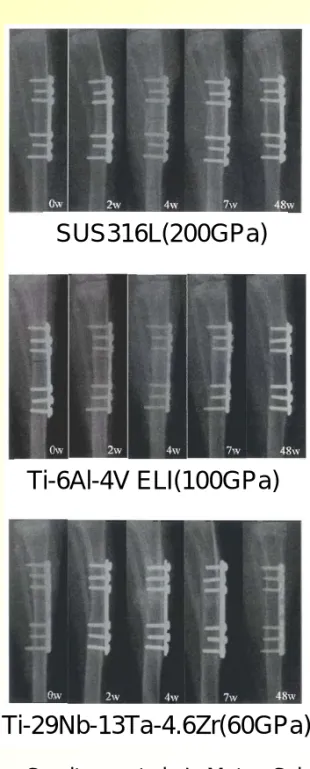
Ti-29Nb-13Ta-4.6Zr alloy: Ti-6Al-4V ELI alloy:
SUS316L stainless steel:
10-30 GPa
60-100 GPa 100-110 GPa 190-200 GPa
In order to inhibit stress shielding, Young’s modulus
similar to that of bone is required for metallic biomaterials. Fig. Result of animal experiment on fracture fixation of rabbit’s tibia.
Bone plate SUS316L(200GPa) Ti-6Al-4V ELI(100GPa) Ti-29Nb-13Ta-4.6Zr(60GPa) Young’s modulus
Background
Sumitomo et al., J. Mater. Sci. Mater. Med., 19 (2008), 1581.
Background
Using porous metallic materials is one of the effective ways for obtaining low Young’s modulus.
Fig. Young’s modulus of porous pure titanium as a function of porosity.
Fig. 0.2% proof stress of porous pure titanium as a function of porosity.
(I.H.Oh et al., Scripta Mater., 49 (2003), 1197.)
Increase in porosity ⇔ Reduction of Young’s modulus ⇔ Deterioration of strength
Balance between Young’s modulus and strength is important when the porous metallic materials are used in practical use.
Background
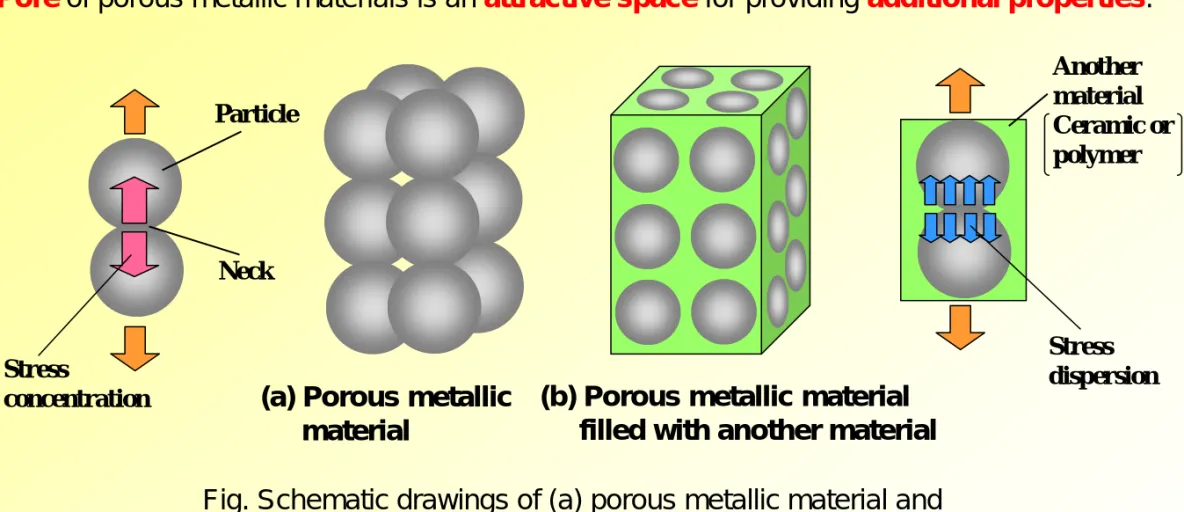
Pore of porous metallic materials is an attractive space for providing additional properties.
Another material Ceramic or polymer
(a) Porous metallic material Particle Neck Stress concentration Stress dispersion (b) Porous metallic material
filled with another material
Fig. Schematic drawings of (a) porous metallic material and (b) porous metallic material filled with another material.
(1) Stress concentration at the necks between particles is likely to be released. This effect leads to the improvement of strength of porous metallic materials. (2) Certain ceramics and polymers exhibit biofunctionalities intrinsically. Therefore,
Purpose
Fig. Typical appearance of PMMA Fig. Typical micrograph of cross-section of pTi
Porous metallic material:
Porous sintered compact made
of pure titanium powder (pTi)
Medical polymer:
Poly methyl methacrylate (PMMA)
(1) An process of polymer filling in pores of porous metallic
materials was developed.
(2) An effect of the polymer filling on mechanical properties of
porous metallic materials was investigated.
Experimental procedures
Particle range diameter (µm) Mean particle diameter (µm) < 45 24 0.130 0.008 0.047 45~150 79 0.070 0.006 0.044 150~250 179 0.065 0.006 0.045Material - pTi
Chemical composition (mass%)
O C Fe
Table Chemical composition of pure titanium powder.
100µm
< 45 µm 45 ~ 150µm 150 ~ 250 µm
100µm
100µm
Spherical pure titanium powders produced by a gas-atomizing technique were sintered at an constant temperature under an vacuum atmosphere.
Experimental procedures
Material - pTi
Table Particle diameter range and porosity of porous pure titanium.
Name Particle diameter range, (µm) Porosity(%)
pTi45-22 < 45 < 45 45~150 45~150 45~150 150~250 150~250 22 pTi45-35 35 pTi150-27 27 pTi150-38 38 pTi150-45 45 pTi250-45 45 pTi250-50 50
Experimental results
(a) (a) (c)(c) (f)(f) (g) (g) (d) (d) (e) (e) 50µm 50µm (b) (b) 50µm 50µm 50µm50µm 50µm 50µm 50µm 50µm 50µm50µm 50µm50µm Sintering temperature High Low Large Particle diameter SmallFig. SEM micrographs of cross-sections of (a) pTi45-22, (b) pTi45-35, (c) pTi150-27, (d) pTi150-38, (e) pTi150-45,(f) pTi250-45, and (g) pTi250-50.
Experimental procedures
Process of PMMA filling in pores of pTi
Monomer solution
Glass tube
Experimental procedures
Process of PMMA filling in pores of pTi
Tensile specimen of pTi
Experimental procedures
Process of PMMA filling in pores of pTi
Chamber
(Vacuum desiccator)
Evacuation
Process 3: Air babbles in the pores of the pTi is removed in a
chamber under a reduced pressure at room temperature.
Experimental procedures
Process of PMMA filling in pores of pTi
Water bath
Heater
Process 4: Monomer solution is polymerized in air under an atmospheric
pressure by soaking the glass tube in a water bath at a constant temperature.
Experimental procedures
Process of PMMA filling in pores of pTi
Process 5: PMMA including the tensile specimen of pTi, which is solidified
in the shape of glass tube, is taken out from it after the polymerization.
Experimental procedures
Process of PMMA filling in pores of pTi
Tensile specimen of
pTi filled with PMMA
Experimental results
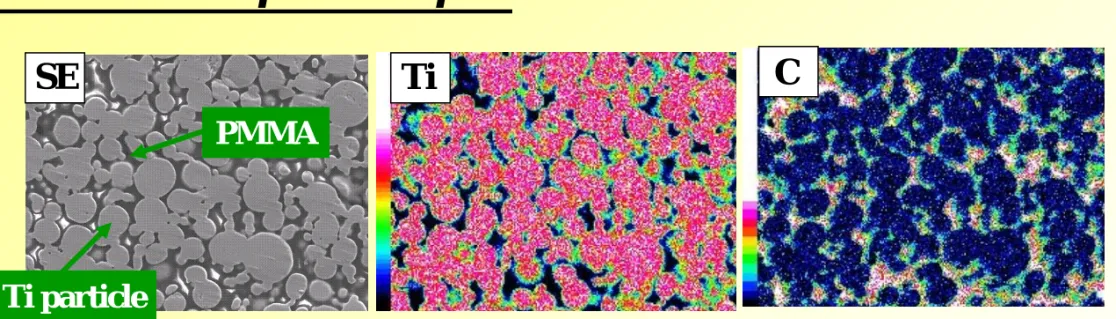
SE
Ti
C
Ti particle
PMMA
PMMA filled in pores of pTi
Fig. Typical result of EDX showing the distributions of Ti and C in cross-section of pTi filled with PMMA.
As a result of an image analysis, fairly high PMMA filling rate, greater than 98%, was obtained from pTi filled with PMMA.
PMMA is certainly present in the pores of pTi, because one of the main element of PMMA, C, is detected from the pores of pTi.
Experimental results
Tensile strengths of pTi and pTi filled with PMMA
0 50 100 150 200 250 pTi pTi/PMMA Ten sile str eng th, σ B /MPa Cortical bone σBone=60~150MPa
pTi45-22 pTi45-35 pTi150-27 pTi150-38 pTi150-45 pTi250-45 pTi250-50
Fig. Tensile strengths of pTi and pTi filled with PMMA.
Experimental results
Young’s moduli of pTi and pTi filled with PMMA
0 20 40 60 80 100 Cortical bone EBone=10~30GPa pTi pTi/PMMA Young ’s m odulus, E/ GPa
pTi45-22 pTi45-35 pTi150-27 pTi150-38 pTi150-45 pTi250-45 pTi250-50
Fig. Young’s moduli of pTi and pTi filled with PMMA
Future plans
Biodegradable polymer
In this study, PMMA was employed as a medical polymer filled in pores of porous metallic material. However, if pores are filled with a biodegradable polymer mixed with an agent for promoting bone formation, osteoconductivity is expected to be improved in comparison with as-porous one !
PMMA
Agent for promoting bone formation