Abstract
Sociolinguistics is defined as the study of language in the social context. Socio-linguists are interested in both stylistic variation, how in different contexts different individuals speak in different ways, and social variation, how speakers who differ from each other in categories such as age and social class differ from one another in their speech. One topic that has been examined in the last 30 years is the linguistic differences between men and women. This paper is concerned with these differences and how they are represented in current EFL textbooks. The purpose of this paper is to evaluate how one current EFL conversation textbook represents gender through linguistic features found in both male and female speech and visual representation of each gender in the text. The text was analyzed for Robin Lakof's (1975) 10 features of female linguistic representation as well as amount of talk, conversational topics, and interruptions. Vocabulary, grammar, discourse, and vocal patterns were all evaluated, as well as firstness, occupation, omission, and visual representation and treatment of males and females. A qualitative analysis based on the preceding criteria found both genders to be linguistically and visually represented in an equal, fair, and positive way.
Key Words: socio-linguistics, gender representation, EFL textbook,
1 Historical Perspective
The feminist movement of the 1960's started the drive for research of male/female language and the oppression of women by men through language. Robin Lakof's oft quoted and challenged 1975 gender study served as a starting point for many research studies to follow in the eighties and nineties. Lakof(1975, in Holmes 1995: 314) proposes that women's speech can be identifi ed by linguistic features such as:
1. Lexical hedges or fi llers, e.g. you know, sort of, well, you see 2. Tag Questions, e.g. she's very nice isn't she?
3. Rising intonation on declaratives, e.g. It's really good? 4. Empty Adjectives, e.g. divine, charming, cute. 5. Precise color terms, e.g. magenta, aquamarine 6. Intensifi ers such as just and so, e.g. I like him so much.
7. 'Hypercorrect' grammar, e.g. consistent u se of standard verb forms.
A Case Study
Brien DATZMAN
8. 'Superpolite' forms, e.g. indirect requests, euphemisms. 9. Avoidance of strong swear words, e.g. fudge, my goodness 10. Emphatic stress, e.g. it was a BRILLIANT performance.
These linguistic features, according to Lakof, are all identifi ed as a means of expressing uncertainty, tentativeness, or a lack of confi dence in womens speech. Although these claims were based on her own intuitions and observations the specifi c nature and the ease with which they could be investigated led many linguists to use these categories as a starting point for research(Holmes1995: 315). Subsequent research has both supported and challenged Lakof's claims, often the same feature has been both supported and challenged in different studies. Many linguists have taken her data and created a more refi ned study into gender and language, most notably with the form or intent of these certain features. For example tag questions can be seen as serving different purposes in different social contexts and therefore not categorized as a whole as being a sign of uncertainty. More recent studies have also analyzed other features such as amount of talk (dominance of conversation) of men and women and interruptions.
Research has also been done on gender and gender representation in texts. Numerous studies (Hartman and Judd 1978, Porreca 1984, Babaii and Ansary 2001) in the last 30 years have shown women as omitted, misrepresented and represented unequally in texts. Data in categories such as firstness, occupation and omission, and visual representation has been collected and supported this claim.
2 Data Collection
The textbook Breakthrough English 1 was selected because it is current, first published in 2008, and was in use at a language university I taught at in Japan. At the time it was being used for the fi rst time by three teachers who all had positive comments about the book, its layout, and effectiveness in pre-intermediate classes. The textbook has also been used by this writer since April 2008 and has been found to be effective and useful. After listening to all of the cd`s, reading the tape scripts and written texts, evaluating the images, and gathering the data tables were created to compare results and texts were evaluated against the research and literature available. The results are as follows.
3 Text Examination
3.1 Spoken Discourse
3.1.1 Overview
The textbook was examined for any evidence of Lakof's(1975) linguistic features as well as amount of talk, conversational topics, and interruptions. Before continuing with the results of the evaluation it is important to note that the text has been specifi cally designed for East Asian students studying English and that it is written for intermediate to high intermediate young adults and adults. This implies that the language provided is aimed to provide a model for learners of English and may not be an accurate representation of natural discourse, thus limiting the instances of some of the linguistic features found in the study above. The authors write that
3.1.2 Dominance of Conversation – Amount of Talk
The traditional stereotype of gender and amount of talk is that of the talkative female. Contrary to this widespread belief of the 'talkative' or 'chatty' female in western cultures the bulk of recent research has shown men to be the more talkative gender. Coates (1994: 115) cites a number of studies on amount of talk to support her statement that 'research on conversational dominance establishes unambiguously that it is men who dominate the fl oor in mixed interaction.' She cites studies done in a variety of settings; staff meetings(Eakins and Eakins 1978), television panel discussions(Bernard 1972) , experimental pair(Argyle et al. 1968), e-mail discussion via computer (Herring 1992; Herring et.al in press), and husband and wife pairs in spontaneous conversation(Soskin and John 1963). The popular explanation for these fi ndings is that men are exploiting their power and exercising dominance and control over women. They devalue women and therefore prevent them from speaking. James and Drakich(Tannen 1993: 281) in a comprehensive review of the research on gender and amount of talk found that while the majority of the research found men to talk more than women that the results weren't that consistent. There are studies in which women were found to talk more than men and numerous studies in which there were no differences between the sexes. The amount of talk in Breakthrough English 1 more closely resembles some of the fi ndings quoted in James and Drakich's review than those found in Coates'.
In Table 1 the difference between the amount of talk is only 133 words (Male>Female). This small difference is explained by the Interview sections of the textbook. Males were interviewed seven times while females were interviewed fi ve times. The average amount of talk in a female interview is 115 words. With an additional interview or two of females the total would be about even or women would have the
(Table 1) Breakthrough English 1, 2008
Conversation Types Women Men
12 Interviews 5 Female Interviews 155, 119, 83, 102,114 = 573 Words 7 Male Interviews 110, 103, 91, 117, 161, 157, 137 = 766 Words
6 Same Gender Conversations
3 Female Female Conversations 73, 129, 126
=328 Words
3 Male Male Conversations 97, 121, 102 = 320 Words 28 Mixed Gender Conversations 28 Women 49, 28, 36, 40, 66, 40, 34, 16, 47, 62, 16, 17, 12, 73, 52, 61, 57, 76, 61, 52, 38, 32, 49, 36, 41, 36, 83, 36 = 1,246 Word 28 Men 56, 30, 28, 40, 54, 36, 54, 28, 21, 58, 24, 6, 15, 58, 47, 52, 61, 56, 72, 53, 43, 48, 32, 50, 43, 30, 49, 50 = 1,194 Words Results 36 Women Total = 2,147 words Avg. 59.6 words/conversation 38 Men Total = 2,280 words Avg. 60 words/conversation
larger amount. As will be seen throughout this paper it appears that the author is giving equal, or near equal, representation of both sexes. Although it does not represent the bulk of the research fi ndings to date, that of male dominance in conversation, it does succeed in giving both sexes equal representation.
3.1.3 Topics of Conversation
Research has shown that when men talk to other men the content is focused on competition and teasing, sports, aggression, and doing things. When women talk with other women the focus tends to be on self, feelings, home, and family. In mixed interactions both genders tend reduce the amount of their own gender 'talk (Warbaugh, 1992: 319). While it isn't clear that the author made a conscious choice to represent these fi ndings there are some instances in which the conversational topics refl ect these fi ndings.
In Breakthrough English 1 there is only one instance of competition and teasing and that is in one of the three male only conversations. There is only one instance of a discussion of feelings and that is in one of the three female only conversations. Men talk about sports 40% more than women. Men talk about traveling (i.e. doing things) , more than women. There is also evidence that men and women are toning down their 'gender talk'. In mixed interactions men and women talked more about topics that can be seen as a middle ground. School, shopping, and future plans all appear to be a common ground for men and women in the textbook. There is one exception to this, house and home. There are some other noticeable differences in topics which run contrary to the research discussed above. Men talk of house and home 80% more than women. In addition women talk about sports more than the research might suggest, both with other women and with men.
3.2 Speaking Patterns
The following linguistic features were found in the textbook.
3.2.1 Interruptions/Overlaps
Overlaps occur when the next speaker begins to speak immediately following the current speakers turn. Interruptions occur when the next speaker begins to speak while the current speaker is still speaking. There are also silent interruptions in which the next speaker begins to speak as soon as the current speaker completes the utterance of a word while in mid-turn. It`s these kind of interruptions, silent, which are found in the textbook. Research has shown that women often overlap in their conversations with other women, while men often interrupt other women in cross sex interactions.
Interruptions are seen as a violation of the turn taking rules of conversation. Recent research has (Table 2) Breakthrough English 1, 2008
Pattern Female Male
Interruptions 1 4
Fillers 46 41
Hedges 9 10
shown that whether the interaction is taking place between co-workers, husband and wife, or doctor and patient the pattern holds, men interrupt women more often than women interrupt men. If the woman is the doctor or the patient the pattern holds (Holmes, 1995; 326). These interruptions are seen as men infringing on women`s right to speak. In same sex conversations women have been shown to use overlaps as a positive conversational tool. In cross sex interactions women do not use overlaps. Coates (1994; 110) suggests that this is because women do not want to violate the man's turn.
In Breakthrough English 1 there are only fi ve total interruptions, which one might argue does not truly represent the amount of interruptions or overlaps in natural conversation. The textbook is for students at the beginner - intermediate level which may have an aim to provide a general framework for students to work with and from. This might explain the low number of interruptions in the textbook. However, the interruptions, one in particular, do provide a valuable model for students.
(Conversation 1) Breakthrough English 1, Student Book Unit 10 pg. 64)
Kate: Really? Well now I'm thinking about Egypt or...
Jim: Egypt! I came back form Cairo three weeks ago. The Pyramids are amazing. Kate: Are they? Anyway, I want to go there or maybe South Africa because... Jim: South Africa! I traveled around South Africa last year....for six months. (Kate could overlap or interrupt here)
Kate: Hmm. Well, there's Europe too, of course. I'd love to visit Italy, and... Jim: Italy! Did you know I lived in Rome for two years?
Kate: No, I didn't know that, Jim.
Jim: Would you like to have lunch? I can tell you all about it. Kate: No, thanks, Jim. I'm ...er...busy. Bye!
In fi gure 4 Jim, while not changing the subject, is clearly trying to dominate the conversation with three interruptions. This exchange also exemplifi es women's not using overlaps in cross sex interactions as they do in female female discussions. When Jim talks about South Africa there is a clear pause which Kate could take advantage of to regain the fl oor, but she doesn't. She politely waits and rejects, no thanks, Jim later in the conversation when he invites her to lunch. This example provides a good example of how interruptions, though a reality, can be rude and viewed as negative. Other examples of the interruptions in Breakthrough are made by interviewers and can be seen as facilitative or supportive rather than dominating the conversation.
(Conversation 2) Breakthrough English, 2008 Teachers Book Unit 12 page 85
Lucy: Yes, but my fi nal exams are next June,so...
Interviewer: Do you know what you're going to do after that?
3.2.2 Hedges and Fillers
Analysis of the use of hedges and fi llers by both genders in Breakthrough English 1 did not reveal a signifi cant difference. This does not refl ect the claim of many studies that women use hedges and fi llers more than men. Some studies have found that women use three times as many hedges as men(Holmes, 2001: 28). Coates has defi ned hedges in all female discourse as being used to express the speakers certainty or uncertainty about the subject of discussion, to weaken the strength of an assertion, to encourage the participation of others, and to respect the face needs of all participants. (Coates, 1994: 116)
(Conversation 3) Breakthrough English Student Book, Unit 4 page 24
Mandy: Yeah, but I prefer my hometown. It's small and the people are friendly.
Diane: Small towns are boring. There aren`t any good stores and there is nothing to do in the evening. I mean, is there a fi tness center in your hometown.
In the example Diane, by using the hedge I mean, can be seen as weakening the strength of her assertion, encouraging the participation of her partner, and helping to respect the face needs of her partner all at the same time.
The many studies that have shown women to use hedges and fi llers more than men is often used as evidence to describe women's speech as 'tentative'(Coates, 1986: 116). Breakthrough English 1 does not refl ect these studies and the author may be trying to represent women and men equally, in both confi dent and uncertain roles.
3.2.3 Intensifi ers
Lakoff hypothesizes that women use more hedging and boosting devices than men because they have less confi dence than their male counterparts (Holmes, 2001: 288). The total number of intensifi ers, fi llers, and hedges found in Breakthrough English refl ects both Lakoffs predictions and the subsequent research on gender and the use of hedging and boosting devices.
Table 3 Breakthrough English 1, 2008
Hedges Female Male Filler Female Male
I guess 3 7 Well 16 9 I think 3 2 Really 5 6 You know 2 1 So 7 8 I mean 1 Er.. 6 11 Total 9 10 Hmm 6 3 Oh yes? 6 3 Um.. 1 Total 46 41
3.2.4 Questions
Questions are used to encourage further dialogue and retrieve information. In research it has been found that woman use questions, especially tag questions, more than men. Pamela Fishman's(Thorn, 1994;89-103) recording of three heterosexual couples in their homes for over 50 hours found the women asking two and a half times the questions that the men did. Subsequent studies and critiques have found questions as a tool to keep conversations alive and continuing, and thus can be seen as a controlling, powerful device in a conversation.
The textbook does refl ect the research that women ask more questions than men, but only slightly. A further study of the different types of questions found in the text would be more revealing but is beyond the scope of this paper.
3.3 Lexis
3.3.1 Compliments and Politeness
Throughout all of the conversations in Breakthrough English 1 most of the characters are polite with one another and provide appropriate responses to their conversation partner's statements and questions. However a closer look reveals that women are slightly more polite than men. Women use the polite response of thank you, thanks, or no thanks four times as much as men(16:4). It is particularly evident in the interview sections of the text where men make an observational comment or simply thank the interviewee, while women thank their interviewee or give a word of encouragement.
(Conversation 4) Breakthrough English 1, 2008
Male Interviewer: Wow Kim. You're very busy these days.
Male Interviewer: OK. Well, thank you Ben. That's all. (Table 4) Breakthrough English 1, 2008
Intensifi er Female Male
Very 9 3 Really 4 2 Pretty 3 2 Fairly 2 0 So 1 0 Totals 19 7
Total Intensifi ers + Fillers + Hedges 74 58
(Table 5) Breakthrough English 1, 2008
Conversation Female Male
Same Gender Conversations 10 questions 19 questions
Mixed Gender Conversations 58 questions 39 questions
Women Interviewer: Great! Thanks for telling me about Hong Kong's markets. John, now can we... Women Interviewer: Well that's a busy week, for sure. I hope you have fun, Erol! Good luck with your exams.
There were a total of seven compliments found in the text. Six of these compliments were of a very general natur e(see example 1) about what somebody had done, what they were planning to do, or what they owned. There was one instance of a specifi c compliment about someones hair and present action (see example 2) in a all female conversation. This refl ects research done in New Zealand, the US, and Britain which suggests that women both give and receive more compliments than men(Coates 128).
(Conversation 5) Breakthrough English 1, 2008
Todd: Hey, I like your guitar.
Amy: Thanks. It's new. I'm in a band, you know. Sandra: Great Party Lisa. I love your hair – it's so blond. Lisa: Thank you. Glad you like it. Hey, do you know everyone.
3.3.2 Competitiveness and teasing in male speech
As mentioned above men's speech has been found to be competitive, aggressive, and often involves teasing when involving other men. There were only three all male conversations and one of these conversation accurately portrays this aspect of men's speech from beginning to end. In each turn the male partner is either acting competitive or aggressive or teasing their partner.
(Conversation 6) Male to Male Speech
Michael: Hey, Raymond. What are you doing? You can't play baseball!
Raymond: No, but I'm going to learn. I want to be a professional. Michael: You? A professional baseball player! Oh, please...(teasing).
Raymond: Hey I'm serious. One day I'm going to be rich and famous. What are you going to do with your life?(aggressive)
Michael: Me? I'm going to travel around the world. I want to go to Africa, and see all of Europe. (competitive) Raymond: That sounds really expensive. Where are you going to get the money?(competitive)
Michael: Well, when you're a rich and famous baseball player, maybe I can ask you for money. (teasing) Raymond: Sure...you can ask!(teasing)
3.4 Vocal Patterns
3.4.1 Rising Intonation
Women use certain patterns of intonation associated with surprise and politeness more often than men(Wardhaugh2002; 319). Many examples of rising intonation were found in both female and male speech throughout BE1. The author uses rising intonation to indicate involvement in the conversation
and the nearly equal use of intonation in both women's and men's speech presents both genders as active, interested and positive conversation participants.
Rising intonation, like that in Figure 13 is found throughout the textbook and can be seen as a positive example of how an attentive, engaging, and interested conversation partner, male or female, actively participates.
(Conversation 7) Breakthrough English 1, 2008
Female: I'm from China.
Male: Really? Do you live in Beijing. Female: No, I don't. I live in Shanghai. Male: Wow! Shanghai is a beautiful city. Female: Do you know it?
Male: Yes, I do. My brother and sister are students there, at Fudan University. Female: That's amazing. I study at Fudan University.
Words in bold mark rising intonation.
3.5 Written Text
3.5.1Overview
Written text analysis included fi rstness, omission, and visual representation and treatment. Hartman and Judd's review in 1978 of then-current ESL/EFL textbooks found evidence that ELT material refl ected sexist attitudes and values in all of these categories (Ansary & Babaii). Porreca (1984) found this still to be true years later when she found that “there is evidence that sexism continues to fl ourish in ESL textbooks. (1984: 718 found in Ansary & Babaii). The goal of this paper was to examine Breakthrough English 1 and fi nd out if this still true today. The results were as follows.
3.5.2 Sex Firstness
The fi rstness of males and females, the number of times that males or females were presented fi rst in exercises, examples, or sentences was counted and it was found that the percentage of male fi rstness and women fi rstness are both near 50%. Women were presented fi rst in the text 46% of the time while men were presented fi rst 54% of the time. This is in rejection of the social 'norm' of always treating men fi rst, women second( Harashima, 2005). Presenting women and men fi rst may encourage both men and women to take the initiative in class or in society as a whole. This along with other data analyzed, amount of talk and intonation, leads me to believe that the author made a conscious effort to present both genders in a fair, balanced, and equal way.
3.5.3 Omission
After counting all of the sex-linked nouns, proper names, and non-generic pronouns in the text it was found that the total number of references of women and men is nearly identical (82:81).
In the table above, it is again noticeable that the author consciously gave an effort to treat men and women equally. The references almost mirror each other and the differences in number is no more than one in any reference category. Also the author has avoided any age related or sexist references to either men or women. In fact the author has introduced a relatively recent phenomenon into the text, that of the househusband.
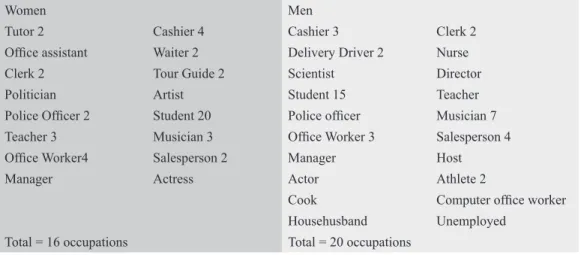
3.5.4 Occupational Roles
Eckert and McConnell-Ginet defi ne traditional women's jobs as ones that “are in the service sector and often involve nurturing, service and support roles”(Eckert and McConnell-Ginet, 2003:30). An analysis of the data in the textbook did not fi nd evidence of women being placed into solely traditional, stereotypical roles.
The majority of characters presented in the text were students and most of the professions named are popular part- time jobs for university and or high school students. It is signifi cant that women are placed in two traditionally male roles, police offi cer and politician, while the men are not represented in those categories.
Table 6 Breakthrough English, 2008
Female Male
First Name 57 First Name 56
She 7 He 8 Sister 5 Brother 4 Woman 3 Man 2 Her 3 Him 3 Girlfriend 2 Boyfriend 3 Girl 1 Guy 2
Mom 1 Father/ Dad 2
Wife 1 Househusband 1
Ladies 1
Total: 82 References Total: 81 References
Table 7 Breakthrough English 1, 2008
Women Men
Tutor 2 Cashier 4 Cashier 3 Clerk 2
Offi ce assistant Waiter 2 Delivery Driver 2 Nurse
Clerk 2 Tour Guide 2 Scientist Director
Politician Artist Student 15 Teacher
Police Offi cer 2 Student 20 Police offi cer Musician 7
Teacher 3 Musician 3 Offi ce Worker 3 Salesperson 4
Offi ce Worker4 Salesperson 2 Manager Host
Manager Actress Actor Athlete 2
Cook Computer offi ce worker
Househusband Unemployed
In addition a traditionally female role is given to a male, that of housewife (househusband). There is only one female-exclusive masculine generic construction, actress. This accurately represents western culture today as the use of the term actor and actress are both generally accepted in American culture.
Interestingly there is one example of a misused masculine generic pronoun which can be seen as a subliminal form of sexism. In the following excerpt a male cashier is talking to his friend, a female customer.
(Conversation 8) Breakthrough English, 2008
Jo: Anyway are you enjoying your new job? Kevin: It's OK. I guess. I need the money.
Jo : You don't sound very happy about it. Are you sure your ok? Kevin: Well, it's my boss. Jo: Oh, no. What's he like?
In this conversation Jo seems to be assuming that the boss is a man. There is no frame of reference given in the conversation that would support this assumption. One might therefore conclude that Jo is assuming 'the boss' is a man, because 'the boss' is usually a man. Throughout the text the author has given a fair representation of both women and men, and an anti-sexist one, but it seems that the author or editors may have overlooked this.
3.5.5 Visuals
Studies of past and present textbooks have often shown a gender bias in textbooks through an analysis of the number and treatment of images (Hartman and Judd 1978, Porreca 1984,Peterson &Kroner(1992) Babaii and Ansary 2001). Porecca(1984) found that women are represented only half as often as males in both texts and illustrations(Babaii & Ansary 2003). Although women are slightly underrepresented the difference is not that great. It shows a ratio of 1:1.1 with women being represented in 47.5% of images and men in 52%.
3.5.6 Treatment of Images
Ansary and Babaii(2003) found in their analysis of two current English language teaching textbooks that “sex- related activity types revealed that females were fundamentally shunted into indoor passive activities such as sitting in the classroom, watching TV at home, reading etc” while males were mainly portrayed “in outdoor active roles of playing football, driving a car, riding bicycle, washing a car,....”.
(Table 8) Breakthrough English, 2008
Activity Type Female Male
Active Outdoor (playing baseball, mowing
the lawn, etc…) 39 41
Active Indoor (yoga, cooking, cleaning, etc…) 33 30
Passive Outdoor (reading outside, sunbathing) 3 0
Passive Indoor (watching TV, listening to
music, etc…) 12 13
Working (part time or professional) 12 15
Analysis of the illustrations in the textbook found that women were not 'shunted' into indoor passive activities. In fact, as Table 7 shows, women were more active indoors and almost as active outdoors as men. Women and men were both treated equally outdoors and indoors. Both women and men are both pictured doing a variety of activities such as scuba diving, home repair, laundry, basketball, and enjoying parties. Women and men are both pictured sitting in passive indoor activities such as reading or watching TV in addition to other indoor activities. There were no pictures of men participating in passive outdoor activities such as reading a book outside. The number of women illustrated in this way, 2, was so small that the omission of men in this type of activity is hardly noticeable.
4 Elements not Found in Breakthrough English 1
The following linguistics elements were not represented in Breakthrough English 1. From Lakof's linguistics features of women's language: precise color terms; super polite forms; avoidance of swear words; tag questions, and emphatic stress. Others include sexist language and women's speech seen as gossip laden.
5 Conclusion
Overall Breakthrough English 1 represents both genders linguistically and visually in an equal, fair, and positive way. The author has represented both genders almost equally in amounts of talk, use of intonation, and in their visual representation and treatment. Both genders talk about and are pictured doing a variety of different activities and jobs. Both genders are portrayed as active participants in all conversations. In addition to this the author has assigned both genders relevant linguistic characteristics to their own gender. Men's speech is represented in the focus of one conversation, competition and teasing, and many others in the predominance of sports. Women's speech is represented in the focus of one conversation, about feelings, and in their use of intensifi ers, hedges and fi llers. The author achieves this without over representing those qualities to a point where a student or teacher might
see those linguistic attributes as stereotypical. Women and men in the text are seen as active, confi dent, engaging, and interesting.
In the final analysis of an EFL textbook teachers may ask the question does the text represent the natural discourse of men and women in society today and the research that defi nes that discourse, or does it attempt to portray both genders in a positive light with some of the tendencies we know to be true of that discourse? As seen above research done on gender and linguistics has only begun recently, the last thirty years, and is far from consistent or conclusive. Further studies need to be done. We must also ask ourselves as people in the fi eld of education do we want to represent only reality or do we want to help create a new reality?
References
Babaii, E., & Ansary, H (2003). Subliminal Sexism in Current ESL/EFL Textbooks. Asian EFL Journal, accessed July 2, 2008.
EFL Journal, accessed July 2, 2008.
Coates, J( 1993). Women, Men, and Language. Longman, Second Edition
Eckert and McConnell-Ginet(2003) Language and Gender. Cambridge University Press. Fishman, P. (1983) Interaction: The Work that Women Do in Language Gender and Society. Heinle & Heinle
Harashima, H. (2004) Sexual Bias in an EFL Textbook: A Case Study. JALT 2004 Conference Proceedings. Tokyo: JALT
Holmes , J. (2001). An Introduction to Sociolinguistics. Longman. Second Edition
Lakof, R. (1975). Language and Woman`s Place: Text in Commentaries (Studies in Language and
Gender). Oxford University Press
Montogomery, M. (1986) An Introduction to Language and Society. Methuen and Co. Wardhaugh, R. (2002). An Introduction to Sociolinguistics. Blackwell. Fourth Edition.