SPECIAL ISS UE
O c e a n S c i e n c e s E d u c a t i o n f o r t h e 2 1 s t C e n t u r y
Sharon H. lMflker The LhHversity ~!f Souther~i Mississippi • Occa1~ Springs, Mississiptq U S A Paula Coble Llnivcrsity of South Florida ° St. Petcrsbul N, Florida LISA Frances Lee Larkin CollGe ~!f William ami Mary ° Gloucester Point, ViiNinia LISA
I n t r o d u c t i o n
Never before has the need for science literacy within our citizenry been more critical than it is today. N e w technologies, increased environmental stresses with global implications, precollege teacher shortages, and the need for additional students majoring in math, sci- ence, and engineering require responsible decision- making at all levels of government. Yet despite ongoing efforts at math and science reform, two landmark stud- ies, A NaHon A t Risk (U.S. National Commission on Excellence, 1983) and Educating Americans &r the 21st Century (U.S. National Science Board, 1983), followed more recently bv reports from two equally powerful efforts--the National Science Foundation Survey Report (1988) and the Third IntcrluTtional Math a m l Scicllce Study [TIMSS] (National Science Teachers Association [NSTA]
Reports, 1996)--have re-enforced our awareness of the lack of competitiveness exhibited by this country's pub- lic schools and its students in math and science when compared to other countries. Major problem areas are inadequate K-12 science and math curricula, which are
"a mile wide and an inch d e e p " (NSTA Reports, 1996), inadequate teacher preparation, and lack of continuing education opportunities for inservice teachers. Science education literature is replete with research over the last two decades that concludes science teaching and learn- ing need to be improved nationally. And, the authors of this manuscript believe that as we enter this new mil- lennium, there remains a p r o n o u n c e d disconnect between scientists' research results and bridging the gap between the interpretations and relevance of those data to teachers, precollege students, and the general public. The disconnect and the subsequent need for enhanced ocean sciences education is clearly recog- nized by members of the oceanographic community, from scientists to classroom and informal education experts (Consortium for Oceanographic Research and Education, 1996).
According to the NSTA (2000), the nation's 52 million students are taught bv 186,000 secondary and middle school science teachers and 1.9 million elementar'~
teachers. Thirty-seven percent high school, 83% middle school, and almost all elementary science teachers are teaching without degrees in science. These teachers
"teaching out of their speciality area" often lack the means to improve their professional skills during their careers. Further, a recent s t u d y by Ingersoll (1999) revealed that in grades 7-12, approximately 33"o of the mathematics teachers and 2()";, of the science teachers do not have either a major or minor in their field. In
"high p o v e r t y schools," this figure approaciles 50%.
Ocean sciences are typically i n c l u d e d in the American educational process only as a peripheral elec- tive, if at all. Ocean science--as perceived by the educa- tional hierarchy--is a relatively new discipline and is not part of the standard curriculum in most precollege or teacher training programs. State and national stan- dards largely ignore ocean studies. Whether a cause or result of this situation, few graduates of ocean science degrees programs pursue careers in K-12 education.
Based on a report by Nowell (2000), a m o n g graduates with bachelor degrees, less that 1% of those in the ocean sciences enter high schools as teachers, compared with 10% of the physics majors. A m o n g those w h o do have degrees in science, few have studied the ocean sciences.
If ocean sciences are to be incorporated into school cur- ricula, the c o m m u n i t y of practicing oceanographers, w h o n u m b e r approximately 3,400 (NSF/SRS, 1997), are a possible source of help. H o w e v e b the ratio of oceanographers to students (1:15,294) suggests that one-to-one or one-to-few interactions between these sci- entists and students can have no hope of reaching more than a tiny fraction of students ~. The ocean sciences 'Then' mr also scientists idc11~!fied with othrr disclpliJws who rvorlc in the ocean sciences, but the ratio qf scM~tists It) studc~zts rcmai~zs small.
32 Oceanography • VoL 13 • No. 2/2000
c o m m u n i t y has a crucial role to play in the national education reform process now underway. According to a 1990 NRC Report, Fu!filling the Promise: Biolo~y Education in the Nation's Schools, sustained reform is best i m p l e m e n t e d by leadership from the scientific c o m m u n i t y "as both guide and ~o~,, ~d, both resource and participant." The CORE Report (1996) concluded that agencies which fund ocean sciences research have
" u n e q u a l e d opportunities and u n t a p p e d resources for precollege (K-12) education." This same s t u d y also challenged the ocean sciences research c o m m u n i t y and K-12 educators to develop partnerships (both formal and informal) to, over the long term, mutually develop new ways to infuse the ocean sciences into K-12 educa- tion at all curricular levels.
These ocean science partnerships m a y help reverse students' lack of understanding and interest in entering science, and consequently their failure to pursue careers in science. It has been reported this disinterest in the sci- ences and failure to pursue ocean sciences careers by precollege and ultimately undergraduate and graduate students m a y be the result of several factors: uninspiring a n d / o r poorly educated teachers, a lack of "hands-on"
scientific experiences, disconnected and unattractive subject material, the perception that science is difficult and irrelevant, and changing societal patterns (Walker et. al., 1992). To improve ocean sciences education for all of our students, scientists' time, a limited and valuable resource, must be deployed in ways that magnify and multiply efforts. The National O c e a n o g r a p h i c Partnership P r o g r a m (NOPP) offers this capability through its support of partnering specifically designed to reach large numbers of teachers and students.
It was partially in response to these recommendations that funding for education programs was included in the first year of NOPP awards. NOPP was established by an act of Congress to foster the
d e v e l o p m e n t of collaboratives which
"share resources, intellectual talent, and facilities to strengthen science e d u c a t i o n and c o m m u n i c a t i o n through improved knowledge of the ocean." The three education programs described in this manuscript, Project Oceanography, the BRIDGE, and COAST seek to meet the goal of a shared, coordinated national invesb ment in ocean sciences education for the K-12 and informal communities through involvement of scientists and well-prepared science professionals and educators. Combined, these efforts currently reach approximately 3,586,148 students and 87,298 teachers
(7,686 first and second tier teachers actually taught;
7g,612 teachers reached through the authors' combined websites) each year nationwide (about six percent of all students and approximately four percent of the authors'
teachers). The overarching goal of these three projects is to make quality ocean sciences content and activities, as well as the importance of research results, available to as m a n y teachers and their respective precollege students within this country as possible.
The three N O P P education projects described in this article addressed the needs of educators, students and researchers, with the following intent:
• to increase accessibility and quality of materials and programs available for training pre- and inservice teachers and informal educators by enhancing con- tent and integrating c o m p l e m e n t a r y instructional strategies;
• to improve hands-on and other interactive learning experiences, thereby enhancing the relevance of ocean sciences to teachers informal educators, stu- dents, and the general public;
• to bridge the information gap between research results and what the K-12 and informal science c o m m u n i t y know about the interpretations of those data;
• to build a multimedia delivery infrastructure to c o m p l e m e n t development, distribution, promotion, and subsequent implementation of curricular mate- rials; and
• to obtain m a x i m u m benefit to the educational com- munity from researchers' outreach activities.
Approach
An overview of each of the three NOPP educational projects in meeting these needs is described below:
PROJECT OCEANOGRAPHY
Project O c e a n o g r a p h y is a live, satellite-televised science education program designed to ei~hance science and math learning in the middle school classroom.
Ocean science researchers teach each
To improve ocemz science education for all of our studet#s, scientists' time, a limited
mid valuable ivsource, must be deployed in ways that magzl!& a n d multiply efforts.
The National Oceanographic Partnership Program (NOPP) qffers this capability through its support of partnering spec!fically
designed to t'each lmxe numbers of teachers and students.
p r o g r a m using a f u l l y - e q u i p p e d b r o a d c a s t studio with a d v a n c e d distance learning technologies, located on the St. Petersburg campus of the U n i v e r s i t y of South Florida. The weekly half-hour programs are tele- vised during the school dav (11:30 ET).
Two-way audio connectivity (a live telephone call-in) allows for interac- tion between the scientists in the stu- dio and participants at remote sites.
Interactivity is further enhanced bv the presence of a live studio audience, c o m p o s e d primarily of school groups from u p to 90 miles away. All programs and materials are distrib- u t e d at no charge to participants.
Teacher information packets and videos of past pro- grams are also available on the Project Oceanography web site < h t t p : / / w w w . m a r i n e . u s f . e d u / p j o c e a n > . Although designed for use in middle school science
Oceanogrophy • VoL 13 • No. 2/2000 33
classrooms, m a n y of the instructional television (ITV) stations which televise the p r o g r a m rebroadcast it dur- ing after school and w e e k e n d hours, thereby making the p r o g r a m accessible to cable and satellite television viewers nationwide. The unlimited scale-up potential of this p r o g r a m makes it especially accessible to stu- dents in inner city and isolated rural areas.
Project Oceanography's major objective is to make a direct connection b e t w e e n ocean science researchers and students and their teachers in the classroom look- ing for a mechanism to participate in K-12 outreach activities. The project is mutually beneficial, providing the students with a real-world curriculum that is both current and accurate, science role models, and hands-on materials such as preserved fish and water-test kits, and the o p p o r t u n i t y to experience the tools and techniques used in oceanographic research (Figure 1). Teachers receive free teaching materials prepared b y experts, and unavailable in textbooks, which they can use for sever- al years to enhance their lesson plans. Scientists benefit b y having guidance and assistance in preparation of grade-appropriate materials, assurance their efforts will reach a large audience of both formal and informal sci- ence communities, and perhaps most importantly, the d o c u m e n t a t i o n of their efforts and products which is essential for tenure and promotion.
Project Oceanography Products
• 102 original half-hour programs on ocean science;
• 51 hours of v i d e o t a p e d programs;
• 24 University of South Florida scientists and 26 out- side scientists have participated;
• 22 partnerships with state agencies, universities, pri- vate research laboratories, schools, and museums;
• International distribution n e t w o r k consisting of more than 302 registered sites in 35 states, the District of Columbia, Greece, Brazil, and England.
This n e t w o r k includes 65 ITV stations that reach an estimated 1.7 million 6th, 7th, and 8th grade stu- dents in 3,500 schools; and
• Website for distribution of written curricular mate- rials and o n - d e m a n d distribution of past programs at < h t t p : / / w w w . m a r i n e . u s f . e d u / p j o c e a n > .
THE BRIDGE: O C E A N SCIENCES E D U C A T I O N TEACHER RESOURCE CENTER
The BRIDGE: Ocean Sciences Education Teacher Resource C e n t e r <http: / / w w w . m a r i n e - e d . o r g >
improves educators' access to data and current infor- mation about ocean sciences. Problems with teachers' access to current science-based teaching materials are acute in the ocean sciences, where the research c o m m u - nity interacts infrequently with the educational com- munity, and the few resources that are available reach only a small fraction of teachers and students nation- wide. Without current, accurate information suitable for classroom use, science teachers cannot reasonably be e x p e c t e d to i n c o r p o r a t e ocean sciences into their instructional programs.
The Web can address this situation. Internet access is c o m m o n p l a c e in schools t o d a y but web access alone does not assure that teachers will locate useful and accurate information. A typical Web search results in h u n d r e d s of thousands of confusing page rifles; busy teachers have little time to assess the quality and utility of thousands of sites.
The BRIDGE, sponsored b y the National Marine Educators Association (NMEA) and the National N e t w o r k of Sea Grant Marine Educators, is a focused portal site for ocean sciences education. It offers teachers an easy-to-navigate, comprehensive collection of the best on-line resources for ocean science education. Here, teachers can find materials prepared and a p p r o v e d b y scientists and science educators, including:
• O c e a n o g r a p h i c data a n d topical collections of marine science information suitable for use in class- rooms;
• Bibliographies of on-line and traditional marine teaching materials and lesson plan collections;
• Information about grants and awards, careers, pro- fessional d e v e l o p m e n t a n d organizations, and ocean sciences research centers, aquariums, muse- ums. science centers, field schools and graduate programs;
• Featured exemplary ("Stellar") sites; and
• Visitors' feedback and contribution forms and user evaluation forms.
The "Data Tip of the M o n t h " series provides teachers with tips on incorporating online scientific data into
34 Oceanography • VoL 13 • No. 2/2000
classroom instruction in a manner that is easily under- stood by and interesting to students. This new section jumped quickly into the top-ten list of most-visited BRIDGE pages. "Data Tips" topics have included E1 Nifio (1/99), Swordfish (2/99), Oil Spills (3/99), Exotics (4/99), Coral Bleaching (5/99), The Chesapeake Bay (6/99), Seafloor Mapping (7/99), Hurricanes (8/99), Sharks (9/99), The Gulf of Mexico Dead Zone (10/99), Aquaculture (11/99), Icebergs (12/99), and Whales
(1/00).
The Web makes partnering possible on a scale that would be unmanageable in any other medium. The BRIDGE network of links ties together resources from more than 900 sites containing ocean sciences material useful to teachers. Hundreds of science education resource websites have posted links to the BRIDGE, including CORE, the Environmental Protection Agency (EPA), the N a t i o n a l A e r o n a u t i c s and Space Administration (NASA), the U.S. Navy, National Oceanic and Atmospheric Administration (NOAA), the National Science Foundation (NSF), Sea Grant, the U.S.
Department of Agriculture (USDA), the U.S. Geological Survey (USGS) and many universities, research institu- tions, and science education facilities. A network of regional coordinators conduct BRIDGE teacher training programs nationwide and work with local NMEA chap- ters to assure that regional information is available through the BRIDGE network.
B R I D G E Products
• BRIDGE visitors come from more than 90 countries;
• The BRIDGE network ties together 933 sites from academia (33%), organizations (24%), private industry (14%), and government (11%);
• Seventeen "Data Tips," new ones added monthly;
• 1,000,000 hits and 100,000 visitors annually; and
• "Scuttlebutt" ocean science education discussion list.
Figure 2
and university research and formal and informal learn- ing environments through focused teacher education.
The three primary COAST components and their respec- tive institutions and locations are as listed: Pathfinder has been facilitated through The University of Southern Mississippi's Institute of Marine Sciences/JL Scott Marine Education Center and Aquarium, located in Biloxi; the Sea Scholars Program based at St. Norbert College in DePere, Wisconsin: and STARBORD, repre- sented by Mississippi State University located in Starkville. Other essential partners in this collaborative include various components of the U.S. Navy, NMEA;
and NOAA's National Sea Grant College Program and its various state programs. These COAST resources have been used to deliver integrated content and resources aimed at strengthening teachers in three areas: oceano- graphic and coastal processes science, content-oriented technology integration, and curriculum strategies to establish broad content integration, aligned with the National Science Education Standards (Figure 2).
During 1998 and 1999, the COAST: Pathfinder project involved 309 precollege pre-and inservice teachers in 12 different, 14-day Regional Institutes. The Regions repre- sented included all coastal and Great Lakes states, as
THE C O N S O R T I U M OF
O C E A N O G R A P H I C ACTIVITIES FOR S T U D E N T S A N D TEACHERS (COAST)
The Consortium of Oceanographic Activities for Students and Teachers (COAST) is an innovative collaborative designed to deliver technology enriched, oceanographic and coastal processes education to cadres of pre- and inservice K-12 teachers throughout the nation. The primary COAST partners include Pathfinder, a national- ly recognized inservice and curriculum development program for K-8 teachers of predominantly minority students, Sea Scholars, a teachers-to-sea program with Web-based support, and STARBORD (Stimulating Teachers About Resources for Broad Oceanographic Research and Discovery), with expertise in visualization technologies and computational science tools for ocean sciences research. Each of these programs has individu-
ally created bridges between ongoing Naval, Sea Grant, Figure 3
Oceanography • Vol. 13 • No. 2/2000 35
well as Puerto Rico and the Pacific Islands. The geo- graphic representation encompassed the Gulf and South Atlantic, the Mid-Atlantic, the Northeast, the Great Lakes, the Pacific, and the Pacific Island Network.
The teacher participants were "immersed" in enhanced content knowledge involving: marine and aquatic resources, deep sea technologies, marine and aquatic pollution, physical parameters, and plate tectonics (Figure 3). The participants were also provided an aug- mented understanding of pedagogy, improved teaching methodologies, an appreciation of and understanding for the National Science Education Standards, gratitude for integrated curricular discussions, and a broadened knowledge of interactive, computational science based on the analyses and interpretations of scientific data sets derived from NOAA and the U.S. Navy (unclassi- fied). Annually, each region averaged ten guest presen- ters with scientific a n d / o r educational expertise in the six topics previously discussed. Regional field trips and
"state of the art" technology sessions were given envi- able evaluations by all participants.
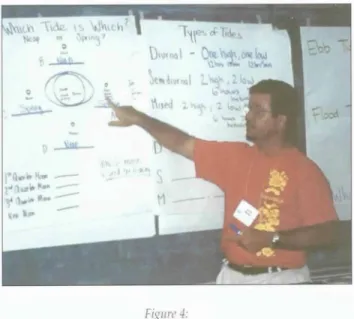
Two essential requirements for participant selection for the Regional Institutes included forming coopera- tive learning groups to design professional develop- ment programs for implementation in their respective school districts and making presentations at local, state, regional or national meetings concerning either content or teaching strategies (Figure 4). Additionally, the teach- ers-to-sea effort involved placing teachers aboard oceanographic survey ships during the spring, summer, and fall of 1998 and 1999 for the total involvement of 56 precollege teachers, the majority of w h o m were involved in the Regional Institutes (Figure 5).
Figure 4:
It should be noted the COAST foundation has been based on the Operation Pathfinder teacher enhancement model implemented from 1993-1997 in which approxi- mately 400 precollege teachers were involved in similar
Institutes, to include the development and field-testing of the Oceanography and Coastal Processes Resource Guide.
The first edition of this Resource Guide was printed in late spring of 1998. The second printing of this Resource Guide occurred in June 1999 with its alignment to the NSES. This Resource Guide has also been pressed on CD after the incorporation of various appropriate glossaries, career exploration data, over 700 complementary resource URLs, and interactive data sets. Further, this Resource Guide was placed on the COAST Website at
<http://www.coast-nopp.org/toc.html> in June 1999.
This website received an average of more than 106,000 page requests in February 2000 and an average of 4,000 pages were printed daily during this time period.
I,.1 S NA~J'AL SHIP
PA THbTND-E~
Figure 5 C O A S T Products
• 366 precollege teacher participants (Operation Pathfinder and Sea Scholars);
• 7,320 "second tier" teachers have been positively affected through the staff development programs implemented by the Regional Institute and Sea Scholar participants. These 7,320 teachers have the potential-over a five-year teaching career-of impact- ing 3,985,740 precollege students;
• Oceanography and Coastal Processes Resource Guide-- aligned with the NSES---developed by teachers for teachers in hard copy, CD-ROM, and on the COAST website;
•