福島県立医科大学 学術機関リポジトリ
This document is downloaded at: 2021-11-08T00:41:40Z
Title Vehicle configurations associated with anatomical-specific severe injuries resulting from traffic collisions( 本文 )
Author(s) 伊藤, 文人
Citation
Issue Date 2020-03-24
URL http://ir.fmu.ac.jp/dspace/handle/123456789/1077
Rights © The Author(s)
DOI
Text Version ETD
Title
Vehicle configurations associated with anatomical-specific severe injuries resulting from traffic collisions
Fumihito Ito, MD
1,21. Department of Clinical Epidemiology, Fukushima Medical University, Fukushima City, Fukushima, Japan
2. Department of Innovative Research & Education for Clinicians and Trainees
(DiRECT), Fukushima Medical University Hospital, Fukushima City,
Fukushima, Japan
Abstract
Objectives:
Vehicles can be classified by configuration as either bonnet-type or cab-over type according to engine location. Compared to bonnet-type, the front compartment of cab- over type vehicles is considerably shorter; thus, it may be less likely to absorb the energy generated in a collision, and in turn be unable to prevent deformation of the occupant space and protect occupants from injury.
Setting:
Ohta Nishinouchi Hospital, Koriyama City, Fukushima, Japan.
Participants:
943 occupants of mini-vehicles who were injured in frontal collision accidents between 2001 and 2015 and transferred to Ohta Nishinouchi Hospital.
Measurements:
The vehicle configuration was divided into bonnet-type and cab-over type (i.e., truck- type and wagon-type). The tested outcomes were anatomical-specific severe injury of the pelvis and extremities, the head and neck, the abdomen, and the chest. To estimate adjusted odds ratios (AOR) for associations between vehicle configuration and anatomical-specific severe injury, we fitted generalized estimating equations for each outcome.
Results:
Compared with bonnet-type vehicles, a greater risk of serious pelvis and extremities injury was found for both truck (AOR: 2.21; 95% Confidence Interval [95% CI]: 1.22–
4.00) and wagon-type vehicles (AOR: 3.43; 95%CI 1.60–7.39). For serious head and neck
injury, truck-type vehicles were associated with greater risk (AOR: 2.04; 95% CI: 1.10–
3.79) than bonnet-type vehicles, whereas wagon-type vehicles were not. Compared with the occupants of bonnet-type vehicles, cab-over type vehicle occupants were more likely to have serious pelvis and extremities injury during frontal collisions. Additionally, truck- type vehicle occupants were more likely to have serious head and neck injury than bonnet- type vehicle occupants.
Conclusion:
These findings are expected to promote safer behaviors for vehicle occupants and the
automobile industry.
Introduction
Road traffic accidents constitute a leading global cause of human fatalities and injury.
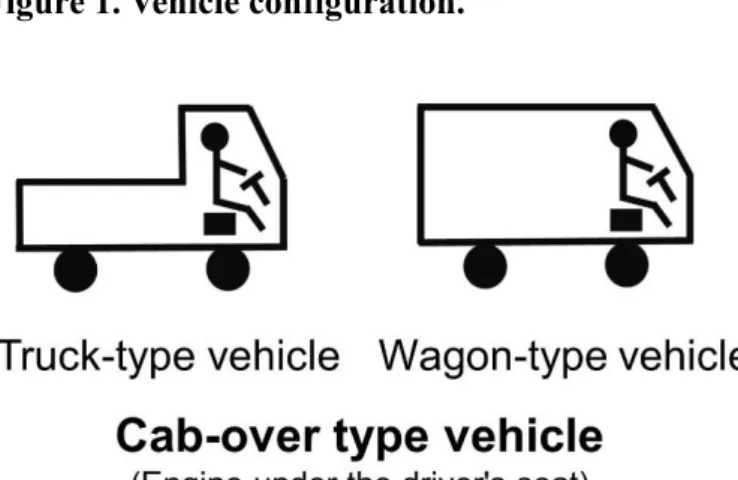
Globally, the number of road traffic deaths is ~1.25 million per year. According to the Global Status Report on Road Safety 2015, published by the World Health Organization [1], road traffic injuries are the number one cause of death among 15–29 year-old individuals. One possible determinant of road traffic injury fatality is vehicle configuration, which can be classified as bonnet or cab-over type according to the engine location (Fig 1 and S1 Fig). Compared with that in bonnet-type vehicles, the front compartment of cab-over type vehicles are considerably shorter; thus, they may be less likely to absorb the energy generated in a collision, and in turn, less likely to prevent deformation of the occupant space and protect front occupants from injury. However, despite the widespread use of both vehicle types, evidence with regard to whether vehicle configuration is related to severe injury remains scarce.
Previous studies have reported that the cab-over type configuration is associated with a higher likelihood of severe anatomical injury [2,3]. A study from Korea reported that cab- over type vehicles are associated with more severe lower limb and abdominal injuries than bonnet-type vehicles [2]. However, this finding is confounded by the accident vehicles’ speed and the weights of the collided objects. Another study from Japan reported that the proportions of severe anatomical injuries differed among the vehicle occupants of cab-over and bonnet-type vehicles [3]. However, in that study, the differences in characteristics other than the vehicle configuration were not considered. Therefore, it is unclear whether anatomical-specific severe injuries are affected by vehicle configuration when appropriate safety equipment are used (e.g., airbags and seatbelts).
In this study, we examined whether differences in vehicle configuration contribute to
anatomical-specific severe injuries using an observational study design involving
occupants injured in accidents in Fukushima, Japan (Reduction of Emergency and Death
for Occupants of Collison Study [REDOCS]). The results of this study will allow car occupants to select safer vehicle types for purchase, and will assist the automobile industry in producing safer vehicle bodies.
Materials and methods Study design and participants
This study was a retrospective observational study involving vehicle occupants injured in frontal collision vehicle accidents and transferred to Ohta Nishinouchi Hospital, a tertiary emergency medical facility that covers the medical care zone for approximately 500,000 residents around Koriyama, Fukushima Prefecture. The accidents occurred between January 2001 and December 2015. We restricted our study to those injured in frontal collision accidents based on the assumption that vehicle configuration significantly influences the severity of the occupants’ injury only in frontal collisions.
Further, only the occupants of mini-vehicles (Kei-car vehicles; defined as engine displacement ≤ 660 cc, vehicle length ≤ 3.4 m, width ≤ 1.48 m, and height ≤ 2.0 m according to the Japanese Road Transport Vehicle Act [4]) were considered. The mini- vehicle (Kei-car vehicle) is a vehicle class unique to Japan. This choice allowed us to minimize the influence of the vehicle size and weight on the occupants’ injury severity.
We considered that inclusion of vehicles other than mini-vehicles for our study is
inappropriate to examine the association between vehicle configuration and the severity
of the occupant’ injury, as the vehicle size (i.e., volume) of those other than mini-vehicles
is greatly variable and thus confounds such association. In addition, study on mini-
vehicles is valuable because they are popular in Asia, especially in Japan [5]. We excluded
occupants aged 16 years and under and occupants in rear seats.
Exposure
The main exposure in this study was vehicle configuration divided into bonnet-type and cabover type (Fig 1 and S1 Fig). Engines in bonnet-type vehicles are in front of the frontal seats, whereas engines in cab-over type vehicles are under the right frontal seat (driver’s seat). The frontal compartment of a bonnet-type vehicle is longer than that of a cab-over type vehicle, owing to the different engine position. Cab-over type vehicles are subdivided into truck- and wagon-types. Truck-type vehicles have no rear seats and the back of the front seats is the loading platform. In contrast, wagon-type vehicles have rear seats.
Outcomes
The outcomes of this study present data on anatomical-specific severe injuries of the pelvis and extremities, the head and neck, the abdomen, and the chest based on vehicle type. Injury severity was assessed according to the Abbreviated Injury Scale (AIS) coding system of 1990 (revision update 98) based on medical records and radiographic findings [6]. The AIS scores ranged from zero to six (see S2 Table for details). All values were determined during hospital stay by a single well-trained trauma specialist and registered in medical records. We defined severe injuries as those with AIS = 3 or greater for each anatomical site.
Covariates
Covariates were selected if a variable was potentially correlated with the vehicle
configuration and outcomes. We collected demographics (age and sex), seat position
(right front—the driver’s position in Japan—and left front), vehicle factors (seatbelt
(seatbelt use or not), frontal airbag deployment (“equipped and deployment,” “equipped and non-deployment,” or “not equipped”), vehicle weight determined by car model (see S1 Appendix for details), self-reported vehicle speed before collision, and collided object (static object, vehicle with weight < 1t, vehicle with weight 1t ≤ to < 2t, or vehicle with weight ≤ 2t)). The category for vehicle weight in the collided object variable was determined based on the volume size of the vehicle (see S2 Appendix for details).
Statistical analysis
The baseline characteristics (i.e., age, sex, vehicle factors, and collided object) were described by the mean and standard deviation (SD) for continuous variables and by the number and proportion (%) for categorical variables.
To estimate the odds ratios for associations between the vehicle configuration and the anatomical-specific injury severity, we separately fitted generalized estimating equations for each outcome, considering the clustering of occupants in the same accident using a robust variance estimator.
For each outcome, we conducted primary and sensitivity analyses. In the primary analysis, we entered all covariates into the fitted model and any missing values were imputed through multiple imputations using chained equations methods, assuming that the analyzed data were missing at random. The missing values were imputed using the existing AIS and other covariates. Five imputations were conducted. In the sensitivity analysis, we entered all covariates except for those with 30% or more missing values (vehicle speed before collision and vehicle weight) into the fitted model and conducted complete case analyses.
All statistical analyses were conducted using Stata
Ⓡversion 14.0 (Stata Corp LP,
College Station, TX). P values < 0.05 (two-tailed) were taken as indicators of statistical
significance.
Ethical consideration
In this study, anonymized data collected during routine practice were used. Informed consent was not mandatory, according to the ethical guidelines for epidemiological research in Japan. The study protocol was approved by the institutional review board of Ohta Nishinouchi Hospital (No. 11), Kyoto University Graduate School of Medicine (R0708), and Fukushima Medical University, School of Medicine (ippan-29004). The study was conducted in accordance with the Declaration of Helsinki and the ethical guidelines for epidemiological research in Japan.
The datasets generated during and/or analyzed during the study are available from the corresponding author on reasonable request.
Results
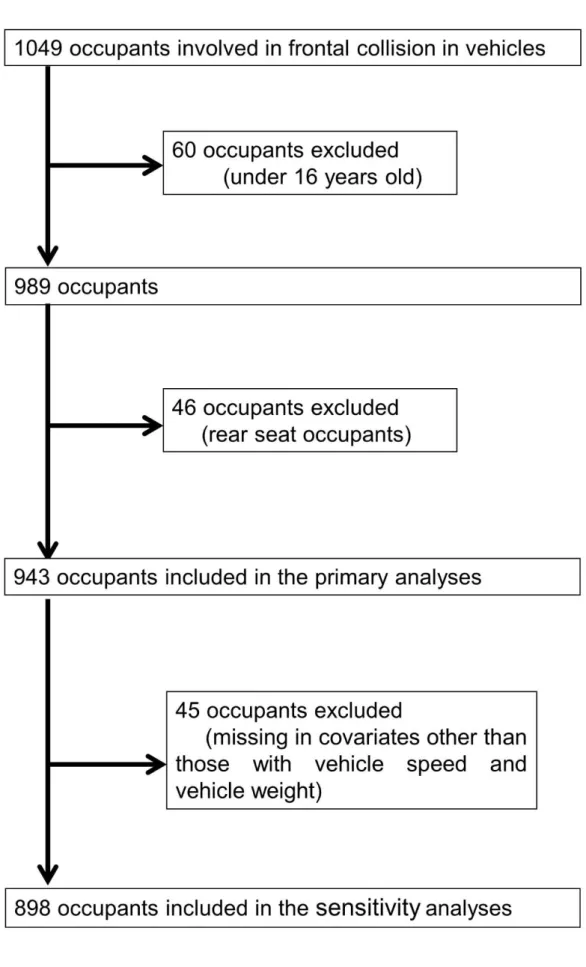
Of the 1049 occupants who were transferred because of frontal collision accidents over the 15 years, 60 were under 16 years old and 46 were rear occupants; all of these were excluded. Therefore, 943 occupants were included in our analyses (Fig 2).
Table 1 lists the characteristics of the vehicle occupants in the study. Of the occupants, 73% were in bonnet-type vehicles, and 27% were in cab-over type vehicles. Among the cab-over type occupants, 17% were truck-type occupants and 10% were wagon-type occupants. The mean age was 45.4 years.
In total, 86% of the subjects were right frontal (driver’s seat) occupants, 77% were belted,
and 46% were in vehicles not equipped with airbags. The mean vehicle speed before
collision was 45.1 km/h, and the mean vehicle weight was 805 kg. The proportion of
accidents in which one target occupant was transferred to the study facility was 95%. The proportions having anatomical-specific AIS = 3 or greater were 12%, 9%, 7%, and 15%
for the pelvis and extremities, the head and neck, the abdomen, and the chest, respectively.
Notably, the vehicle speed before collision and the vehicle weight had large proportions of missing values (56% and 28%, respectively).
The proportion of men in truck- and wagon-type vehicles was greater than that in bonnet-type vehicles. The bonnet-type vehicles had more frontal airbag equipment than the truck-type vehicles. The bonnet- and wagon-type vehicles had more frontal airbag deployments than truck-type vehicles.
The proportions of occupants in truck- and wagon-type vehicles with AIS = 3 or greater for the pelvis and extremities, the head and neck, and the chest, were higher than for the occupants of the bonnet-type vehicles.
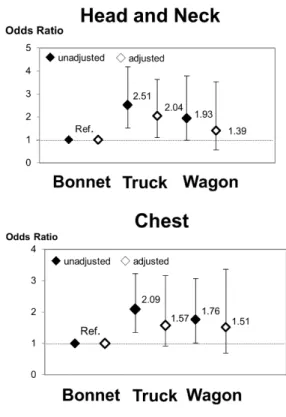
Table 2, S1 Table, and Fig 3 show the associations between the vehicle type and the anatomical-site specific AIS = 3 or greater. Table 2 shows the associations with adjustments for all covariates using multiply imputed data (N = 943). S1 Table shows the associations without adjustments for any covariates (N=943). Fig 3. shows the associations with or without adjustments for those covariates. Compared with bonnet- type vehicles, a greater risk of serious pelvis and extremities injury was associated with both truck-type vehicles (adjusted odds ratio (AOR): 2.21; 95% Confidence Interval (95%
CI): 1.22–4.00) and wagon-type (AOR: 3.43; 95% CI: 1.60–7.39). For serious head and neck injury, truck-type vehicles were associated with a greater risk (AOR: 2.04; 95% CI:
1.10–3.79) than bonnet-type vehicles, whereas wagon-type vehicles were not. For serious abdominal and chest injuries, cab-over type vehicles were not associated with greater risk than bonnet-type vehicles.
Table 3 shows the associations between the vehicle type and the anatomical-site specific
AIS = 3 or greater with the adjustment of covariates listed in Table 1, except for the vehicle speed before collision and the vehicle weight (N = 898). The directions and the magnitudes of the associations are similar to those presented in Table 2.
Discussion
The results of this study show that occupants of cab-over vehicles (i.e., truck- and wagon-type vehicles) are more likely to have serious pelvis and extremities injury than bonnet-type vehicle occupants. These findings are expected to encourage vehicle occupants and the automobile industry to consider objective facts about safety during frontal collisions and to change their behaviors accordingly.
Our findings concur to some degree with the results of previous studies. A previous study
from Japan reported that the proportion of severe injuries among cab-over type vehicle
occupants was higher than that for bonnet-type vehicle occupants. These severe injuries
were observed not only in the pelvis and extremities, but also in the head and neck,
abdomen, and chest regions [3]. For example, the proportions of occupants having AIS≥3
(i.e., severe injury defined similarly to our study) among cab-over type and bonnet-type
occupants were 13.6% vs. 5.6%, 6.0% vs. 3.4%, and 11.9% vs. 8.5% for the pelvis and
extremities, the abdomen, and the chest, respectively. However, their results were not
adjusted for confounding factors such as seat belt use and airbag deployment. In our study,
the proportions of occupants in vehicles not equipped with airbags were higher for the
cab-over type than for the bonnet-type (Table 1). The lack of adjustment for airbag
equipment in the previous study likely explains the differences in the results, with the
proportions suffering from severe injuries of the abdomen and the chest being
overestimated (Fig 3). In addition, the previous study failed to divide the cab-over type
into truck- and wagon-type. However, by separating the truck-type from the wagon-type,
we were able to show the magnitude of the association between truck-type (vs. bonnet- type) and severe injury of the head and neck differs from that of the association between wagon-type (vs. bonnet-type) and the severe injury.
Another study from Korea reported that the cab-over type was associated with more severe lower limb and abdominal injuries than the bonnet-type (AOR: 4.820 and 2.465, respectively) [2]. However, the associations in the study may have been confounded by the accident vehicle speed and the weights of the collided objects, and thus the magnitude of the associations may be overestimated. In our study, the proportions of collided objects in the heaviest weight category (2t≤weight) were higher among cab-over type vehicles than with bonnet-type vehicles (Table 1); therefore, the failure of adjustment for the collided objects in the previous study could have resulted in apparently stronger associations between the cab-over type and severe injury.
More importantly, the proportions of the cab-over vehicles deploying airbags were lower
than those of the bonnet-type vehicles in the present study (Table 1). However,
discrimination based on airbag status (i.e., whether “a vehicle is equipped with airbag but
is not deployed” or “a vehicle is not equipped with airbag”) was not made in the previous
study. As “Equipment and deployment of airbags” is a strong preventive factor for severe
injury and death [7,8], this distinction and adjustment in the multivariable analysis is
crucial. Thus, the stronger magnitude of the association between the cab-over type
vehicles and severe injury in the Korean study than that in the present study may be
explained by the potential dominance of vehicles not equipped with airbags in the cab-
over group. We believe that our findings provide more robust results than those provided
by the previous studies because we adjusted all important confounding variables. Finally,
previous studies limited the cab-over type to the truck-type; the wagon-type was not
examined in the Korean study. The inclusion of wagon-type vehicles is of greater
importance, because wagon-type vehicles having occupants is more common than truck-
type vehicles [9].
Some potential mechanistic reasons can explain our findings on severe injuries of the pelvis and extremities and the head and neck. First, the greater likelihood of having severe injuries of the pelvis and extremities among the cab-over type than among the bonnet- type could be attributed to the absence of the crash energy absorbing compartment in the cab-over type vehicles. The crash energy absorbing compartment of the bonnet lessens the energy generated in the event of a crash by denting; thereby, preventing deformation of the occupant space and injuries to the front occupants. The size of the crash energy absorbing compartment of cab-over type vehicles is much smaller than that of bonnet- type vehicles, because the engine is located under the driver’s seat. In addition, some bonnet-type vehicles contain shock-absorbing materials in the bonnet space. Second, the greater likelihood of having severe head and neck injuries among the truck-type than those among the wagon- and bonnet-type vehicles may be attributable to the absence of a wall just behind the seat in the truck-type vehicles. The frontal seats of truck-type vehicles cannot move backward because of the wall (Fig 4); therefore, the heads of truck- type vehicle occupants are positioned further forward than those of wagon- and bonnet- type vehicle occupants. For this reason, truck-type vehicle occupants are more likely to move upwards with relation to the seatbelt rather than downwards at the time of a collision.
Compared with bonnet-type vehicles, greater risks of serious chest and abdominal injury associated with cab-over-type vehicles were not observed. The chest and abdomen are protected by airbags and seat belts and thus those of cab-over type vehicle occupants do not positioned further forward than those of bonnet-type vehicle occupants.
Our study has several strengths. First, our findings are derived from a large sample size,
with analyses adjusted according to several important confounding factors (i.e., seatbelt,
frontal airbag deployment, vehicle weight, self-reported vehicle speed before collision,
and weights of the collided objects). Second, we obtained data not only for truck-type
vehicles but also for wagon-type ones. Third, to mitigate the potential effects of the vehicle weight and vehicle size on severe injuries, our analyses focused on the occupants of mini-vehicles. Larger vehicles (e.g., passenger vehicles and SUVs) than mini-vehicles have greater variations in vehicle volume; thus, the effects of frontal shape may be greatly confounded by vehicle volume if we include the larger vehicles in the present analyses.
In fact, mini-vehicles have become increasingly popular because they are convenient to drive and have economic benefits, including low purchase price, low tax, and good fuel economy. In 2017, mini-vehicles accounted for 39.1% of all registered vehicles in Japan [5]. The demand for mini-vehicles has spread worldwide. Both the importation of mini- vehicles, including used cars, from Japan and the local production of mini-vehicles are increasing among other countries in South Asia, East Asia, and Southeast Asia.
Our results have several implications for the public, medical personnel, and the
automobile industry. First, our findings provide consumer safety information for the
selection of vehicle type during vehicle purchase. Previous studies of vehicle preference
among United States teenagers revealed that priority is given to vehicle price; thus, mini-
vehicles, small vehicles, and/or old vehicles were preferred [10,11]. Many mini-vehicles
adopt cab-over configurations to expand the internal space. The notification of the
relatively higher risks associated with the cab-over vehicles than those with the bonnet-
type vehicles could change consumer choices. Second, our findings may be applicable to
pre-hospital settings for patient transfer. If an accident vehicle is a cab-over type, an
ambulance crew can predict that the occupant may have severe internal injuries (e.g.,
pelvic injury) even if his/her external trauma does not seem to be severe; then, the crew
can place a high priority on transferring the occupant to a level I trauma center. Third, our
findings should encourage the automobile industry to invest in greater safety technology
for cab-over vehicles. In Japan, all cab-over vehicle models must pass crash safety tests
prior to sale. However, our results clearly show that cab-over vehicles are disadvantages
relative to bonnet-type vehicles in frontal collisions, despite them passing the crash safety
tests.
This study had several limitations. First, our findings are applicable only for mini-
vehicles, they may not be generalizable to larger-sized vehicles. Further study is
warranted to examine whether or not vehicle configuration is associated with severe
injury for standard-sized vehicles. Second, our study setting was based on a tertiary
emergency medical facility; this may give a skewed sample of patients in terms of injury
severity. In general, patients with severe injuries are more likely to be transferred to
tertiary emergency facilities; patients with slight injuries are less likely to be transported
to such facility. Thus, proportions of severe injuries at a hospital will be higher than those
seen at accident sites. However, we believe that associations between vehicle
configuration and severe injuries are unlikely to be severely biased because the selection
of patients transported to the hospital was determined by injury severity and irrespective
of vehicle type at present. Third, the values of some covariates may be proxies. The
velocity right before a collision is a self-reported measure. Regarding the vehicle weight,
the values were based on standard equipment without consideration of the weights of
occupants or cargo. Fourth, we were not able to collect the following variables in this
study: driver’s factors such as fatigue, fainting, and aggressive driving behavior; roadway
factors such as light traffic, number of lanes, and hourly traffic volume; temporal factors
such as traffic jam time, night, and weekend; environmental factors such as rain, snow,
wet road surface, snow road surface, ice road surface, and fog, and oncoming vehicle
speed before the collision [12–14]. While these variables are potential predictors of severe
injuries, they do not necessarily meet the criteria for confounding in this study according
to the classical epidemiologic framework. They do affect injury severity; however, they
do so irrespective of the vehicle configuration in this study (i.e., these variables could not
logically be used to determine the likelihood of a vehicle being cab-over type rather than
bonnet-type). Further study is warranted to determine whether adjustment of these
variables can alter the associations between vehicle configuration and injury severity
examined in this study. Fifth, severities of the upper extremities, lower extremities, and pelvis were not analyzed separately. Only the most severe AIS score in the extremities and pelvis to calculate the ISS was recorded in our database. Our retrospective study design allowed us to obtain only this AIS score.
Conclusions
This study found that occupants of cab-over mini-vehicle (i.e., truck- and wagon-type vehicles) occupants are more likely to have severe pelvis and extremities injury than bonnet-type mini-vehicle occupants during frontal collisions. In addition, truck-type mini-vehicle occupants are more likely to have severe head and neck injury than bonnet- type mini-vehicle occupants. Further study is required to determine if these findings extend to larger-sized vehicles.
Funding
This study was supported by a Grant for Research Support of Fukushima Medical University. The funders had no role in the study design, data collection and analysis, decision to publish, or preparation of the manuscript.
Competing interests
The authors have declared that no competing interests exist.
References
1.