MEXT Guidelines for teaching English through English:
A study of teachers` beliefs and practices
O`HALLORAN, Jane
Department of Architecture Okayama University of Science
1-1 Ridai-chou, Kita-ku, Okayama 700-0005, Japan
Research on the effectiveness of using English as the sole medium of instruction in Japanese English classrooms which seeks to compare the teacher and student perspective is rather limited. Therefore, this paper is intended to fill this research gap and enrich this area of language and educational research. Results showed that many of the native speakers of English were not aware of the guidelines and opted to use Japanese in the English classroom for various reasons.
Keywords: English Medium Instruction, teachers` beliefs, student motivation, English rich classroom
Background
In 2009 MEXT (Ministry of Education, Culture, Sports, Science and Technology of Japan) issued its updated guidelines Eigo ga tsukaeru nihonjin no ikusei no tameno koudoukeikaku [An Action plan to cultivate “Japanese with English abilities”]. These guidelines form part of a series The Course of Study which were first published in 1947 and are updated approximately every ten years. The 2009 revisions were designed to shift the focus away from the traditional yakudoku or grammar and translation approach to more communicative methodologies in secondary English classrooms. Teachers were henceforth expected to conduct English classes in high school principally in English. In addition, the guidelines called for an increase and improvement of debating and discussion skills.
Timed with the 2020 Tokyo Olympics, in order for the full-scale development of new English education in Japan, MEXT will incrementally promote educational reform from FY2014 including constructing the necessary frameworks based on this plan.
1At the time of writing, the Tokyo Olympics are rapidly drawing near and many observers are questioning what the legacy of the 2020 Games will be in comparison to the epoch-changing effect of the Tokyo Olympics of 1964. Those Games were described as representing the `rebirth` of Japan and its reacceptance into the international community after World War II. The tangible benefits of those games were undeniable;
Tokyo’s infrastructure was greatly improved with new subway and train lines, Haneda airport was expanded to cater for the new jetliners transporting international tourists to the Games. But the ultimate legacy would be the commencement of the shinkansen line, timed to coincide with the opening of the
1
http://www.mext.go.jp/en/news/topics/detail/__icsFiles/afieldfile/2014/01/23/1343591_1.pdf
(Received October 31, 2019; accepted December 9, 2019)
Games in October. As the fastest trains in the world, the shinkansen project demonstrated that Japan was once again a leader in technological advances.
So, what might be the language legacy of the 2020 Tokyo Olympics?
For the first time in the history of Course of Study Guidelines, MEXT has declared that “classes, in principle, should be conducted in English in order to enhance the opportunities for students to be exposed to English” (MEXT, 2009). The current situation of CLT in Japan Communicative Language Teaching (CLT) is defined as an approach to foreign or second language teaching which considers communicative competence the goal of language learning and emphasizes that learners learn a language through using it to communicate (Richards & Schmidt, 2010; Richards & Rodgers, 2001).
2As English is a core subject for entrance exams and those exams have never required an oral element, many Japanese teachers of English have felt under pressure to focus on the aspects that will be examined in the written university entrance tests, to the detriment of the spoken language.
MEXT was aiming at a great leap forward in the English speaking ability of the younger generation in order to prepare them for an increasingly diverse workplace, reflecting the continuing decline in the birth rate in Japan which will be accompanied by an increasing dependence on overseas markets and overseas workers contributing to the workforce. In order to achieve this, the Ministry sought a radical departure in the way English is taught, decreeing that schools instigate the following:
Classes will be conducted in English in principle.
Upper Secondary School -Nurture the ability to understand abstract contents for a wide range of topics and the ability to fluently communicate with English speaking persons.
-Classes will be conducted in English with high-level linguistic activities (presentations, debates, negotiations).
3Building on the base of this anticipated improvement in communication ability acquired at secondary level, MEXT then outlined its ambitions for tertiary level classes, with a particular focus on attracting overseas students:
Amid ongoing globalization, in order to develop an educational environment where Japanese people can acquire the necessary English skills and also international students can feel at ease to study in Japan, it is very important for Japanese universities to conduct lessons in English for a certain extent, or to develop courses where students can obtain academic degrees by taking lessons conducted entirely in English. In Japan, many universities have already established classes taught in English.
42
‘Behind MEXT’s new course of study guidelines.’ Tahira, (2012).
3
http://www.mext.go.jp/en/news/topics/detail/__icsFiles/afieldfile/2014/01/23/1343591_1.pdf
4
Ibid. p.17
The desired outcome of this new emphasis is two-fold, to attract overseas students to Japanese universities and to provide an English-rich teaching environment for all students. This new approach required various adjustments to the curriculum, teaching methods and university entrance exams as a large percentage of the English syllabus in secondary school classrooms is not aimed at communicative ability but rather takes an exam-focused approach. As part of MEXT`s reforms, the National Centre Test for University Entrance, the current standard test for university entrance, is being replaced from 2020. Although the final form of the new test is not yet confirmed, the aim will be to test students` ability to use English as an academic language rather than the current multiple choice form which solely targets their knowledge of English grammar and vocabulary. A certain positive `washback` is expected, accompanied by changes in English- language teaching at secondary level as language use takes precedence over study
5.
The growth of EMI can also be an exciting development in terms of students’ engagement with English. Japanese students face some motivational issues when studying English and many lose their motivation by the end of high school (Falout & Mauyama, 2004), possibly due to poor facilities and materials, noncommunicative teaching styles, and the excessive focus on testing common in many high schools (Kikuchi & Sakai, 2009). This demotivation can carry over into university English programs, particularly required language classes
6.
English as a Medium of Instruction
The British Council in its 2014 publication English as a medium of instruction – a growing global phenomenon
7offers this description of EMI:
There appears to be a fast-moving worldwide shift, in non-Anglophone countries, from English being taught as a foreign language (EFL) to English being the medium of instruction (EMI) for academic subjects such as science, mathematics, geography and medicine. In this report a working definition of EMI is: The use of the English language to teach academic subjects in countries or jurisdictions where the first language (L1) of the majority of the population is not English. […]
The term English medium instruction itself is relatively new and no universally accepted definition exists. The term EMI is used in some countries (for example Hong Kong) and not in others. It is sometimes used as synonymous with CLIL (Content and Language Integrated Learning). However, CLIL has a dual educational objective built into its title (the enhancement of both content and language) whereas EMI does not. Taken at ‘face value’ EMI simply describes the practice of teaching an academic subject through English which is not the first language of the majority population.
In April 2015, Okayama University of Science introduced a new course of instruction known as Hasshin Eigo (
発 信 英 語) in order to meet the new requirements for a communication-oriented curriculum.5
Brown: English-Medium Instruction in Japan: Discussing Implications for Language Teaching .
6
Ibid.
7
English as a medium of instruction – a growing global phenomenon, pp. 4 and 7.
Additional teachers were hired, new textbooks ordered and freshmen students entered what was intended to be an English-only classroom in continuation of the practice referred to above in the secondary school context. In addition to English communication classes being conducted through English, students also receive Sogou Eigo (総合) or general English classes, and Senmon Eigo, or what is generally described as English for Specific Purposes (ESP) which are taught by content rather than language teachers.
All undergraduate students at this university are required to complete a course of Hasshin Eigo (Communicative English) over four quarters as freshmen. As Hasshin Eigo is a required course, there is resistance amongst some students to the concept of an immersion-style approach where all the classes are intended to be offered in English only. This resistance can largely be explained by the negative experience of many Japanese students at high school level where the focus in English classes was on grammar and translation and test preparation rather than communicative activities.
This paper seeks to assess the degree to which the theory on which the classes were created has been achieved in practice in Hasshin Eigo classes conducted by native speakers of English. It forms the first part of a projected two-part study which will seek to compare the attitudes and beliefs of the native speakers who teach the Hasshin Eigo classes with those of the students who take the classes.
Methodology and Participants
This study was exploratory in nature and intended as a two-part investigation into the perceptions of students and teachers of the importance and necessity of English classes conducted entirely through English.
Further research will be conducted into the students` perspectives and will be presented in a follow-up article. The present study focuses on the attitude of native teachers of English, on actual teaching practices and on communication-oriented policies versus classroom realities in one private university in Japan.
A composite questionnaire of both closed and open-ended questions was administered to 155 students in a Japanese translation and eleven native English speakers who received an English version of the same questionnaire. It was decided that a binary option for the closed questions was preferable and the choice was a simple Yes or No. As mentioned above, the students` responses will form the basis of a further study.
The present research focuses on the native speakers who are a mix of full and part time teachers from various countries, including the United States, England, Canada and New Zealand.
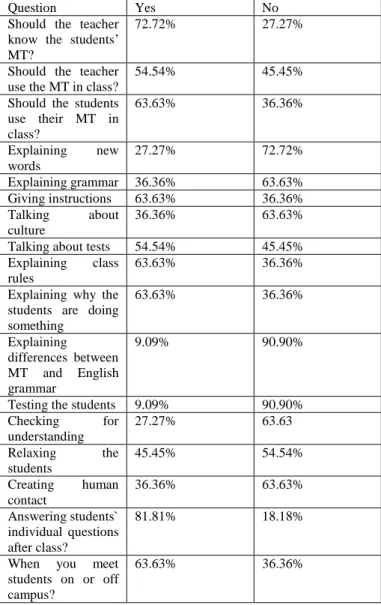
In the close-ended questions, it was found that 54% (6 of the 11 participants) believed that the students`
mother tongue (MT) should be used in the English classrooms. As for the open-ended responses, deductive
qualitative analyses were made. Overall, the findings showed that 36% of the teachers believe that the
instruction at higher education level needs to be conducted in English only. Of that cohort only 18%, or
two individuals, reported using no Japanese in classes. Although the participants were aware that the policy
of the classes was to use English only in order to establish an immersion style of teaching, less than half
were putting the policy into full effect. This demonstrates that the new educational policy is putting a burden
on teachers as well as students. MEXT seems to have anticipated this dilemma when it defined the language outcome it envisages:
Foreign language proficiency required in global society can be defined as capability of smooth communication with people of different countries and cultures using foreign languages as a tool.
The capability of smooth communication implies, for example, confident and active attitude toward communication with people of different countries and cultures as well as accurate understanding of partner’s thoughts and intentions based on his/her cultural and social background, logical and reasoned explanation of one’s own views, and convincing partners in course of debates
8.
Table 1. Survey Questionnaire
Question Yes No
Should the teacher know the students’
MT?
72.72% 27.27%
Should the teacher use the MT in class?
54.54% 45.45%
Should the students use their MT in class?
63.63% 36.36%
Explaining new words
27.27% 72.72%
Explaining grammar 36.36% 63.63%
Giving instructions 63.63% 36.36%
Talking about culture
36.36% 63.63%
Talking about tests 54.54% 45.45%
Explaining class rules
63.63% 36.36%
Explaining why the students are doing something
63.63% 36.36%
Explaining
differences between MT and English grammar
9.09% 90.90%
Testing the students 9.09% 90.90%
Checking for understanding
27.27% 63.63
Relaxing the students
45.45% 54.54%
Creating human contact
36.36% 63.63%
Answering students`
individual questions after class?
81.81% 18.18%
When you meet students on or off campus?
63.63% 36.36%
While research suggests that as English proficiency is ultimately the main objective of English teaching and learning, students should be exposed to as much English as possible in English lessons, nevertheless
8
http://www.mext.go.jp/en/news/topics/detail/__icsFiles/afieldfile/2014/01/23/1343591_1.pdf
many teachers find that in low-level or mixed-ability classes, use of the mother tongue is part of their teaching practice. This confirms Tahira`s (2012) conclusion that “There remains a big gap between the stated policies and what is actually done in the classroom.’’
9One of the challenges to closing this gap will be ‘Overcoming the perceived need for L1‘Scaffolding’ by interlocutors which mediates L2 learning (Lantolf, 2000.)
While there is no reason to doubt that all teachers support the stated goals, there is a diversion of opinion as to how best to achieve them. In answer to the open-ended question `Please share your thoughts in relation to your use of Japanese in the classroom` some of the comments serve to explain the individual`s attitude:
When explaining class rules and what tests will entail, etc., especially on the first day of classes, a clear explanation in the students` mother tongue clarifies things well. Even if the teacher hardly uses students` mother tongue in class, if the teacher has a knowledge of it the teacher can anticipate problems students are likely to encounter as to the differences between the two languages.
Another comment read:
I use Japanese only when students need support when it comes to details not pertaining to the actual lesson plan, textbook, grammar, and vocabulary. On the other hand, I will use Japanese to restate information about homework, tests or rubrics.
Of those teachers enforcing the English-only practice, one commented that:
If Japanese is necessary in the classroom, it`s because the material is too difficult for the students.
There`s always some confusion and misunderstanding in a foreign-language classroom and ideally this will provide a challenging and intellectually-stimulating environment for the students […]
The creation of such a stimulating environment will be the wish of each instructor. How to achieve this with a diversity of teachers` beliefs as to the efficacy of the policy? Individual achievements must be fostered so that efforts made by every single teacher produce ever greater results. It is important that English teachers set common goals, and work as a team to improve lessons
10.
The awareness of teachers must be raised to convince them of the importance of creating an English-rich environment which rather than relying on teachers explaining in L1, instead focuses on creation of level appropriate materials and the simplification of classroom language. Such a classroom policy will help to motivate students by demonstrating that the language is more than a burdensome requirement to graduate but rather an enjoyable means of communication and thereby increasing their confidence in using it, both inside and outside the classroom. In order to conduct a class in “English that takes into account the level of students’ understanding,” it is important to give due consideration to factors such as word selection and rapidity of speech. For example, rather than the teacher translating new vocabulary into Japanese, language should be elicited from the students themselves `how do you say ~ in Japanese?’ This small alteration
9
Tahira, M. (2012), p.3.
10
An Action Plan to Cultivate “Japanese with English Abilities’’, p. 10.
switches the student from a passive to an active role. In particular, when students’ communication ability is a concern, the teacher must make efforts to adequately grasp their level of understanding and give due consideration to speaking slowly and using simple English. Class instructions will be repeated every week, giving the students the opportunity to make the necessary connection to their native language. In all cases, it is important to strive to expand instruction to help students become accustomed to the use of English.
In a study carried out in Hong Kong, a city which provides its residents with greater opportunities to interact with English on a day-to-day basis than is the case for the average Japanese student, it was found that ‘If teachers allow native languages to be used in English classrooms, student opportunities to learn English are lessened. In a rather monolingual society, maximising students’ chances and exposure to English should be one of the prime responsibilities of an English teacher. Allowing bilingualism in the English classroom will generally only deprive students of an excellent opportunity to use and learn English.
In conclusion, it is the individual English teacher who plays the deciding role in what kind of English- learning atmosphere will be established. How English-rich the teaching environment becomes greatly depends on how determined each English teacher is in maximising the English exposure of students through policy and its enforcement.’
11The full-time native speaker teachers will be able to support their part-time colleagues by overcoming a lack of awareness of curriculum goals and MEXT guidelines. In respect to teachers` beliefs that students require the scaffolding of the L1, it is required that individuals evaluate their teaching practice and rely more on eliciting language to create an authentically active classroom in which students are productive, rather than receptive learners. Distinguished SLA researcher Patsy Lightbown wrote of her experience:
In my own research, I have observed teachers whose language proficiency was excellent switch to the students` L1 for anything that was not part of the day`s lesson. That is, when there were doors to open or papers to distribute, the teacher used the students` L1 as a ‘management’ language, thereby depriving students of an important opportunity to use the new language for genuine communication. Ellis and Shintani (2014) have reviewed the research on L1 use in light of the importance of ensuring that students` have as much access to L2 input as possible. On this basis, they argue that ‘the L2 needs to become the medium as well as the object of instruction, especially in a foreign language setting.’
12Conclusion
The aim of this study is to evaluate the policy of an English-only medium of instruction for Hasshin Eigo lessons, and teachers` beliefs in respect to its implementation. These classes form an important element of a concerted university-wide curriculum aimed at providing a range of opportunities for students to achieve the language skills they will need in their future lives. Classes taught by native speakers provide a language
11
Wong, p. 127.
12
Lightbown p. 246.
learning context and a path which should eventually lead to learners becoming proficient enough to follow the content in their major subjects. This can be best achieved by collaboration between content and language teachers. The role of the EFL teacher is likely to evolve in an education system increasingly favouring EMI.
‘For this purpose, everyday efforts of each English teacher are of greatest importance; moreover, intensive training of English teachers is needed to improve their qualifications and performance.’
13In fact, this collaboration can provide the authenticity of purpose which can motivate even lack-lustre learners.
Student motivation is a growing field of study (e.g. Dörnyei, MacIntyre, & Henry, 2015), and two of the most influential factors for learning outcomes have been identified as aptitude and motivation. In a seminal study, motivation was identified as falling into two categories: instrumental and integrative (Gardner &
Lambert, 1972). Instrumental motivation occurs when students study a language for a specific purpose – to pass an examination or to increase their employability. Integrative motivation occurs when students want to study the language in order to communicate with its speakers. The two aspects function independently but educational programmes that combine the two are found to be the most successful. If students find that they are required to use L2 in order to communicate with the teacher – to find out what the homework is or to ask to leave the room they discover intrinsic motivation. Much intrinsic motivation is incidental rather than intentional in nature and the English-rich classroom provides it in abundance. A teacher using L2 for casual discussion, giving instructions, asking the students to open their textbook, close the door etc. is providing a wide range of opportunities to hear and speak the language in a natural way. These opportunities to interact are central to developing proficiency in L2. By maximizing the use of English in the Hasshin Eigo class, L2 becomes not just the object but the medium of learning. By so doing, new contexts are created and learners are facilitated in challenging new activities which may be beyond their current level of proficiency but by stretching the boundaries, confidence in L2 can be achieved. The English classroom offers the chance to experience a wide range of contexts. Each individual teacher will be encouraged to consider the circumstances they can create in the Hasshin Eigo class. The final words are from one teacher who took part in the survey and commented that:
‘English conversation means English conversation. Giving instructions, explaining rules, etc. are an integral part of conversation, hence only English should be used in class. Taking students out of their comfort zone means they have to adapt to speaking a different language in any circumstance they may find themselves in when they need English. Speaking the student`s native tongue takes away a great opportunity for learning.’
References
http://www.mext.go.jp/en/policy/education/highered/title03/detail03/__icsFiles/afieldfile/2012/06/19/130 2653_1.pdf
Ministry of Education, Culture, Sports, Science, and Technology MEXT, Action plan to cultivate ‘Japanese with English abilities.’ (2003).
Brown, H. ‘English-medium Instruction in Japan: Discussing implications for language
teaching’. In P. Clements, A. Krause, & H. Brown (Eds.), Focus on the learner, Tokyo: JALT (2016).
13