タイトル
Acquiring English Communication Skills in Global
Business Environments
著者
Mark, MATSUNE; NAITOi, Hisash; ITO, Tomoaki
引用
北海学園大学経営論集, 14(3): 21-43
Acquiring English Communication Skills
in Global Business Environments
Mark MATSUNE, Hisashi NAITO, Tomoaki ITO
Abstract:
There is a growing necessity for Japanese people to interact in global business environments. This paper will report on a two-semester overseas study program offered to undergraduate students majoring in business administration. The main objective of this Kaigai Sogo Jishu program is for the students to acquire English communication skills that they can use with business people overseas and improve their autonomous learning skills. The program had three basic aims for the students: (1) Experiencing a World Englishes environment through a 3-week ESL program at a university in Canada, (2) Encountering foreign corporate culture through an introductory comparative corporate analysis, (3) Using English in social and business settings through on-site studies at selected Canadian businesses. To accomplish these aims and maximize on the effect of the short term program, task-based English learning was utilized task-based on an ESP approach. After completing the first semester preparatory components and theʠstudy abroadʡcomponent, students completed a follow-up report on their experiences. The reports as well as their self-evaluation based on the Common European Framework of Reference for Languages adapted for Japan (CEFR-J) indicated this short term experience was undeniably effective in raising their cross-cultural awareness and self-confidence in their English ability.
Keywords: Business English, Studying Abroad, ESP
1. Background Introduction
As more Japanese universities accentuate developing global citizens, overseas programs such as this are attracting students to gain cross-cultural experience to boost their future career potential. This paper will outline the various components of the Kaigai Sogo Jishu program in the Faculty of Business Administration at Hokkai Gakuen University along with the results of a follow-up survey on its effectiveness. The questionnaire consisted of three parts: (1) English learning during the program, (2) English learning activities after the program, (3) Future prospects for their careers. The general findings showed that almost all the students continue to study English outside the university curriculum and many also hope to apply these experiences to potential career opportunities. The
survey also examined some of the obstacles to going abroad that the students face. The results clearly illustrate that this initial program has been very effective in stimulating students to look for subsequent opportunities to study abroad or to work in international environments.
1.1 Main Objective
The general objective of this program is for the students to acquire English communication skills that they can use with business people overseas and improve both autonomous and cooperative learning skills. The preparatory English self-study requirements combined with the business-related research components required the students to take the initiative to complete necessary tasks prior to their on-site study abroad. Upon their return the students completed a comparative corporate analysis of the selected businesses in Japan and Canada.
1.2 Three Aims
The program had three primary aims. First, we wanted students to experience a World Englishes environment through a 3-week ESL program module. This is important because native speakers are now a minority in the global environments that Japanese people are exposed to. The richly multicultural setting at Brock University, which is located in the most densely populated area of Canada, along with the ESL program gave the students abundant opportunities for interaction in a World Englishes environment. Secondly, we also wanted students to encounter foreign corporate culture through an introductory comparative corporate analysis. This program gave the students in-person exposure to top level management in a foreign environment. Finally, we wanted students to use English in social and business settings through on-site studies. In 2013 the on-site studies took place at a winery and large scale retail chain and in 2014 the settings were a Canadian bank and an international hotel chain. The experience of successful communication in English in aʠreal world settingʡand actual interaction with Canadian business people was an important motivating factor for the students.
2. Main Program Components
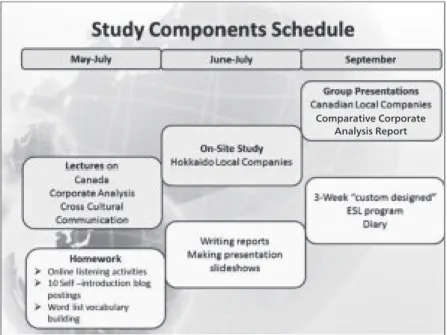
The program components had two primary focuses (see Figure 1). The upper diagonal row of cells denote the business-related components in the program. The activities included corporate analysis, lectures on cross-cultural communication, on-site visits to local companies and preparing a business presentation. The lower diagonal row of cells denote the English skill related components. The ESL components incorporated an ESP approach to blend in with the business studies and comparative corporate analysis. These activities included online listening practice, vocabulary building, ten self-introduction blog postings, slideshow and presentation skill training, and a 3-week ʠcustom designedʡESL program. The ESL program was taken at Brock University, which is located near Toronto, Canadaʟs largest city. This location offers various attractions to ESL students from around the world. Finally, the upward diagonal progression of the activities over the five month period is meant to represent the increasing level of difficulty in each module. There were fifteen class sessions including two localʠon-siteʡstudy visits. The class sessions were primarily conducted in the
1st semester with two follow-up lessons after returning from the 3-week ESL program module in
Canada. Basically the lecture schedule included three different content areas: content-based lectures on Canada, methods of corporate analysis, and cross-cultural communication. English presentation skill training made up the remaining course sessions (see Appendix A).
2.1 Participants
In the initial year 2013, the group was made up of ten 2ndyear students. In 2014, the second year
of the program, the participants included nine 2ndyear and two 3rdyear students all majoring in Business
Administration. The program was primarily overseen by three faculty members. Their respective roles included overall program coordination, business-related components, EFL and English presentation skill training. Each year the students were divided into two groups. Each group was assigned to conduct research and make a group presentation on a specific industry and local company.
2.2 Business-related Components
The purpose of the corporate and industry analysis was to accumulate valuable background information that the students could utilize in their dialogue during the on-site visits with local companies and subsequent company visits in Canada.
In the industry analysis students were required to investigate the following factors: 1. Market size (Sales volume)
2. Growth rate for the past few years
Comparative Corporate Analysis Report
3. Ratio of domestic production and imports 4. Profile of major competing companies 5. Trends of customers
6. Current topics and future prospects
The students were encouraged to become familiar with various domestic industry sources. For example, in the areas of retail and wine in the 2013 program, students utilized organizations such as: the Japan Council of Shopping Centers (日本ショッピングセンター協会), the Japan Chain Stores Association (日本チェーンストア協会), the Japan Winery Association (日本ワイナリー協会), and the Sake Culture Research Institute (酒文化研究所). In addition, students also found the National Diet Library site (http://rnavi.ndl.go.jp/rnavi/) to be another valuable resource.
In the corporate analysis students were required to explore the following aspects: 1. Basic corporate profile
2. Management policy, vision, mission 3. Business purposes
4. Features of production and sales 5. Future tasks of the target company
The students were directed toward the particular or relevant company websites to gather information on the aforementioned points as well as examining other features such as investor relations, research and development and corporate social responsibility activities undertaken by the companies. Students were also encouraged to investigate competitive companies in the same business sector. From this background information the students became more knowledgeable before making their on-site visits to the respective companies. In the on-site study visits the students were able to tour the company facilities and interview the domestic business managers.
For example, in the 2013 on-site study excursion to a retail center chain, the students received a ninety-minute lecture given to them by the Human Resource Section Director of AEON. The contents focused on AEONʟs mission statement, their CSR activities and the management of human resources. One notable point from this on-site study, was that the students were able to engage in a lengthy Q&A session with the director. This was also followed by a one-hour photo opportunity in the store.
In that same year, the on-site study session at the Hokkaido Winery was conducted by the Sales Manager. The students were shown the wine factory and given a tour of the winemaking process. A thirty-minute lecture also included a brief history of the wine industry in Japan and Hokkaido. The students also experienced aʠwine tastingʡand participated in a Q & A session. From this on-site study, students collected noteworthy information for their presentation such as the increasing popularity of screw cap bottling throughout the world. The students learned that the reason was
primarily because, in terms of quality management, screw caps preserve the quality of the wine better. The students learned however that cork remains popular in Japan, because the screw caps still have an image associated with cheap wines. The students also learned about the size difference in the bottles between Japanese wines and foreign wines, and how bottle coloring poses problems for recycling.
Combined with the industry and corporate analysis material they had previously researched and the new information they collected in the on-site study excursions, they were able to complete a preliminary report in Japanese which would serve as the foundation for the English presentation that would be given to corresponding companies in Canada. In their follow-up report upon returning from the overseas module of the program, they put together a comparative analysis of the Japanese companies and Canadian companies. Ultimately this created a firsthand opportunity for the students to deepen their interest in corporate management from a global perspective.
2.3 English Skill Related Components
The lower diagonal row of cells denote the English skill related components (see Figure 1). The ESL activities followed an ESP approach focusing on business management. The students were required to complete three types of English study activities: online listening practice, ten self-introduction blog postings, and vocabulary building. In addition, students received English presentation skill training and participated in a 3-weekʠcustom designedʡESL program at Brock University in Canada.
The online listening practice was a daily requirement which the students would report feedback on the Kaigai Sogo Jishu program website. In 2013 the listening topics focused on giving presentations, management, the introduction of winery and retail businesses, and typical ESL classroom activities. In 2014 the listening topics focused on introductions to the Toronto and Niagara areas of Canada, giving presentations, management, the introduction of banking and hotel services, and typical ESL classroom activities. The materials were primarily collected from YouTube clips. Students were required to post regular comments and reactions to the various clips on an online ʠlistening skillsʡblog. This also served to provide authentic Canadian business information and gave
the students some comparative background material for their English presentations.
The second homework activity was an online blog that was intended to prepare the students to initiate English conversation with classmates, host family members and the staff of Brock University. They were required to write on ten self-introduction themes in order to help them prepare and stimulate ideas they could later utilize in casual conversations with host families and fellow students abroad. The self-introduction blog required the students to write approximately 300-word length posts on ten typical conversation topics ranging from family and hobbies to their career plans. The students received personal comments and feedback from this writer on their content and some suggestions on how they could use these topics in their everyday communication in Canada.
In addition, students were also required to create a business terminology wordlist for the two selected Canadian businesses in each respective year. This activity was intended to help the students build a glossary of terms from corporate analysis materials and the listening homework activities. It was hoped that they could pool their wordlists together to use in theʠstudy abroadʡmodule and their ongoing Business Administration studies. Finally, they were required to prepare group presentations introducing two corresponding Japanese businesses to corporate managers in Canada.
2.3.1 ESL Program Itinerary in Canada
Basically the 3-week ESL program at Brock University was only customized for the business administration students in one way. In addition to the standard level-based short-time ESL program, all the Kaigai Sogo Jishu students participated together in two on-site visits to two companies which loosely matched their original corresponding businesses in Japan. In 2013, the respective companies were quite similar. The group responsible for the presentation on the AEON shopping center chain had the opportunity to make a presentation at the Niagara Pen Center shopping center and the group responsible for the presentation on the Hokkaido Winery had the opportunity to make a presentation at the Flat Rock Cellars Winery in the Niagara area. In addition, the students were given the opportunity to individually audit/observe actual business administration lectures while they were at Brock University.
2.3.2 Business Presentations in Canada
For all of these students this was the first opportunity to make a group presentation in English to actual managers in a foreign business environment. The experience of making themselves understood in a semi-formal setting and successfully engaging in a Q&A session with the managers and staff was extremely rewarding for all the students.
This experience also increased the studentsʟmotivation to search for new opportunities to develop their English skills in foreign business settings. For most of the students this was the first opportunity to make presentations in English to an audience outside Japan. For many of them, it was also their first travel and study experience abroad. The impact of successfully completing their business presentations in English stimulated many of the students to join subsequent overseas business study, trade show and internship programs.
3. CEFR-J and Follow-up Survey Analysis on the Effectiveness of this Program
3.1 CEFR-J Evaluation
The CEFR-J is based on the Common European Framework of Reference for Languages (CEFR). It is an adaptation of the CEFR for specific English language teaching contexts in Japan. It is based upon theʞaction-oriented approachʟproposed in the original CEFR, which describes foreign language proficiency based on six levels and isʠaccompanied by a detailed analysis of communicative contexts, themes, tasks and purposes as well as scaled descriptions of the competences on which we draw when
we communicateʡ(CEFR, 2014). The CEFR-J consists of a series ofʞcan doʟdescriptors, which indicateʠwhat one can do with languageʡThe CEFR-J has the following twelve levels based on the A1 to C2 levels in CEFR:
- Pre-A1
- A1: A1.1, A1.2, A1.3 - A2: A2.1, A2.2 - B1: B1.1, B1.2 - B2: B2.1, B2.2 - C1
- C2
Just like the CEFR, the relative order of descriptors across levels have been validated by several different empirical studies (CEFR-J, 2012). For the purposes of this study and the range of our studentsʟproficiencies, they made self-evaluations for the range of levels from Pre-A1 to B2.2 as indicated in Figure 2. The writers were particularly interested in the perceived growth of the studentsʟ English skills.
PreA1 A1.1 A1.2 A1.3 A2.1 A2.2 B1.1 B1.2 B2.1 B2.2
1 2 3 4 5 6 7 8 9 10
Figure 2: CEFR-J Evaluation
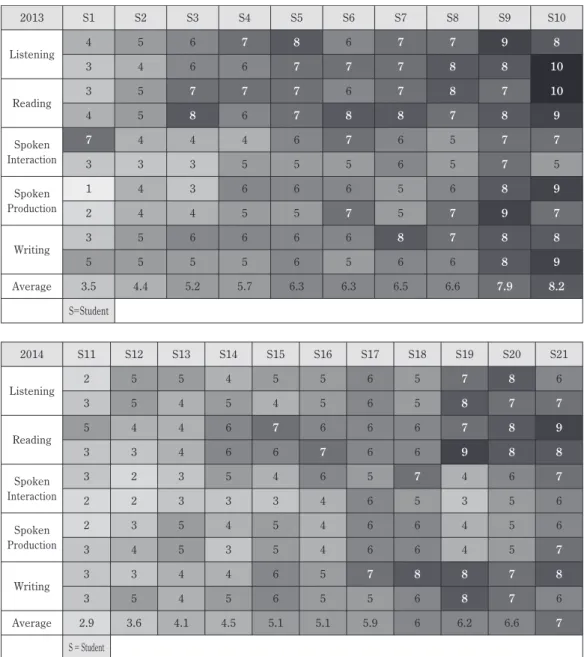
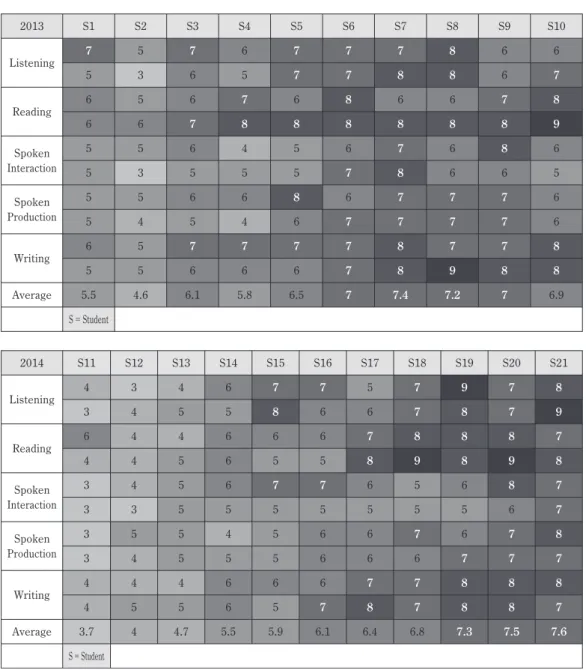
The Pre-CEFR-J evaluation was carried out in May of each year before the English learning component commenced and the Post-CEFR-J evaluation was done at the conclusion of the Kaigai Sogo Jishu program in October of each year. As can be seen in the comparison for the respective students (S1-S21) in Figure 3 and 4, there was a general increase in the self-evaluation levels in both 2013 and 2014. Figure 5 shows the overall group average in the CEFR-J levels. Perhaps the greater overall increase in the 2014 can be attributed to the streamlined nature of the English study components prior to the on-site program in Canada.
The analysis indicated that students with lower English proficiencies tended to have lower self-evaluations for the various language skills. However students with higher proficiencies generally had higher self-evaluations for those same variables. These results were consistent with similar research done by Pérez-Vidal & Juan-Garau (2011). In addition there was also a general pattern that students with lower English proficiencies experienced more development in their various language skills from the Pre-CEFR to Post-CEFR evaluations.
2013 S1 S2 S3 S4 S5 S6 S7 S8 S9 S10 Listening 4 5 6 7 8 6 7 7 9 8 3 4 6 6 7 7 7 8 8 10 Reading 3 5 7 7 7 6 7 8 7 10 4 5 8 6 7 8 8 7 8 9 Spoken Interaction 7 4 4 4 6 7 6 5 7 7 3 3 3 5 5 5 6 5 7 5 Spoken Production 1 4 3 6 6 6 5 6 8 9 2 4 4 5 5 7 5 7 9 7 Writing 3 5 6 6 6 6 8 7 8 8 5 5 5 5 6 5 6 6 8 9 Average 3.5 4.4 5.2 5.7 6.3 6.3 6.5 6.6 7.9 8.2 S=Student 2014 S11 S12 S13 S14 S15 S16 S17 S18 S19 S20 S21 Listening 2 5 5 4 5 5 6 5 7 8 6 3 5 4 5 4 5 6 5 8 7 7 Reading 5 4 4 6 7 6 6 6 7 8 9 3 3 4 6 6 7 6 6 9 8 8 Spoken Interaction 3 2 3 5 4 6 5 7 4 6 7 2 2 3 3 3 4 6 5 3 5 6 Spoken Production 2 3 5 4 5 4 6 6 4 5 6 3 4 5 3 5 4 6 6 4 5 7 Writing 3 3 4 4 6 5 7 8 8 7 8 3 5 4 5 6 5 5 6 8 7 6 Average 2.9 3.6 4.1 4.5 5.1 5.1 5.9 6 6.2 6.6 7 S = Student
2013 S1 S2 S3 S4 S5 S6 S7 S8 S9 S10 Listening 7 5 7 6 7 7 7 8 6 6 5 3 6 5 7 7 8 8 6 7 Reading 6 5 6 7 6 8 6 6 7 8 6 6 7 8 8 8 8 8 8 9 Spoken Interaction 5 5 6 4 5 6 7 6 8 6 5 3 5 5 5 7 8 6 6 5 Spoken Production 5 5 6 6 8 6 7 7 7 6 5 4 5 4 6 7 7 7 7 6 Writing 6 5 7 7 7 7 8 7 7 8 5 5 6 6 6 7 8 9 8 8 Average 5.5 4.6 6.1 5.8 6.5 7 7.4 7.2 7 6.9 S = Student ・・・・・・・・・・・・・・・・・・・・・・・・・・・・・・・・・・・・・・・・・・・・・・・・・・・・・・・・・・・・・・・・・・・・・・・・・・・・・・・・・・・・・・・・・・・・ ・・・・・・・・・・・・・・・・・・・・・・・・・・・・・・・・・・・・・・・・・・・・・・・・・・・・・・・・・・・・・・・・・・・・・・・・・・・・・・・・・・・・・・・・・・・・ ・・・・・・・・・・・・・・・・・・・・・・・・・・・・・・・・・・・・・・・・・・・・・・・・・・・・・・・・・・・・・・・・・・・・・・・・・・・・・・・・・・・・・・・・・・・・ ・・・・・・・・・・・・・・・・・・・・・・・・・・・・・・・・・・・・・・・・・・・・・・・・・・・・・・・・・・・・・・・・・・・・・・・・・・・・・・・・・・・・・・・・・・・・ ・・・・・・・・・・・・・・・・・・・・・・・・・・・・・・・・・・・・・・・・・・・・・・・・・・・・・・・・・・・・・・・・・・・・・・・・・・・・・・・・・・・・・・・・・・・・ ・・・・・・・・・・・・・・・・・・・・・・・・・・・・・・・・・・・・・・・・・・・・・・・・・・・・・・・・・・・・・・・・・・・・・・・・・・・・・・・・・・・・・・・・・・・・ ・・・・・・・・・・・・・・・・・・・・・・・・・・・・・・・・・・・・・・・・・・・・・・・・・・・・・・・・・・・・・・・・・・・・・・・・・・・・・・・・・・・・・・・・・・・・ ・・・・・・・・・・・・・・・・・・・・・・・・・・・・・・・・・・・・・・・・・・・・・・・・・・・・・・・・・・・・・・・・・・・・・・・・・・・・・・・・・・・・・・・・・・・・ ・・・・・・・・・・・・・・・・・・・・・・・・・・・・・・・・・・・・・・・・・・・・・・・・・・・・・・・・・・・・・・・・・・・・・・・・・・・・・・・・・・・・・・・・・・・・ ・・・・・・・・・・・・・・・・・・・・・・・・・・・・・・・・・・・・・・・・・・・・・・・・・・・・・・・・・・・・・・・・・・・・・・・・・・・・・・・・・・・・・・・・・・・・ ・・・・・・・・・・・・・・・・・・・・・・・・・・・・・・・・・・・・・・・・・・・・・・・・・・・・・・・・・・・・・・・・・・・・・・・・・・・・・・・・・・・・・・・・・・・・ ・・・・・・・・・・・・・・・・・・・・・・・・・・・・・・・・・・・・・・・・・・・・・・・・・・・・・・・・・・・・・・・・・・・・・・・・・・・・・・・・・・・・・・・・・・・・ ・・・・・・・・・・・・・・・・・・・・・・・・・・・・・・・・・・・・・・・・・・・・・・・・・・・・・・・・・・・・・・・・・・・・・・・・・・・・・・・・・・・・・・・・・・・・ ・・・・・・・・・・・・・・・・・・・・・・・・・・・・・・・・・・・・・・・・・・・・・・・・・・・・・・・・・・・・・・・・・・・・・・・・・・・・・・・・・・・・・・・・・・・・ ・・・・・・・・・・・・・・・・・・・・・・・・・・・・・・・・・・・・・・・・・・・・・・・・・・・・・・・・・・・・・・・・・・・・・・・・・・・・・・・・・・・・・・・・・・・・ ・・・・・・・・・・・・・・・・・・・・・・・・・・・・・・・・・・・・・・・・・・・・・・・・・・・・・・・・・・・・・・・・・・・・・・・・・・・・・・・・・・・・・・・・・・・・ ・・・・・・・・・・・・・・・・・・・・・・・・・・・・・・・・・・・・・・・・・・・・・・・・・・・・・・・・・・・・・・・・・・・・・・・・・・・・・・・・・・・・・・・・・・・・ ・・・・・・・・・・・・・・・・・・・・・・・・・・・・・・・・・・・・・・・・・・・・・・・・・・・・・・・・・・・・・・・・・・・・・・・・・・・・・・・・・・・・・・・・・・・・ ・・・・・・・・・・・・・・・・・・・・・・・・・・・・・・・・・・・・・・・・・・・・・・・・・・・・・・・・・・・・・・・・・・・・・・・・・・・・・・・・・・・・・・・・・・・・ ・・・・・・・・・・・・・・・・・・・・・・・・・・・・・・・・・・・・・・・・・・・・・・・・・・・・・・・・・・・・・・・・・・・・・・・・・・・・・・・・・・・・・・・・・・・・ ・・・・・・・・・・・・・・・・・・・・・・・・・・・・・・・・・・・・・・・・・・・・・・・・・・・・・・・・・・・・・・・・・・・・・・・・・・・・・・・・・・・・・・・・・・・・ ・・・・・・・・・・・・・・・・・・・・・・・・・・・・・・・・・・・・・・・・・・・・・・・・・・・・・・・・・・・・・・・・・・・・・・・・・・・・・・・・・・・・・・・・・・・・ ・・・・・・・・・・・・・・・・・・・・・・・・・・・・・・・・・・・・・・・・・・・・・・・・・・・・・・・・・・・・・・・・・・・・・・・・・・・・・・・・・・・・・・・・・・・・ ・・・・・・・・・・・・・・・・・・・・・・・・・・・・・・・・・・・・・・・・・・・・・・・・・・・・・・・・・・・・・・・・・・・・・・・・・・・・・・・・・・・・・・・・・・・・ ・・・・・・・・・・・・・・・・・・・・・・・・・・・・・・・・・・・・・・・・・・・・・・・・・・・・・・・・・・・・・・・・・・・・・・・・・・・・・・・・・・・・・・・・・・・・ ・・・・・・・・・・・・・・・・・・・・・・・・・・・・・・・・・・・・・・・・・・・・・・・・・・・・・・・・・・・・・・・・・・・・・・・・・・・・・・・・・・・・・・・・・・・・ ・・・・・・・・・・・・・・・・・・・・・・・・・・・・・・・・・・・・・・・・・・・・・・・・・・・・・・・・・・・・・・・・・・・・・・・・・・・・・・・・・・・・・・・・・・・・ ・・・・・・・・・・・・・・・・・・・・・・・・・・・・・・・・・・・・・・・・・・・・・・・・・・・・・・・・・・・・・・・・・・・・・・・・・・・・・・・・・・・・・・・・・・・・ ・・・・・・・・・・・・・・・・・・・・・・・・・・・・・・・・・・・・・・・・・・・・・・・・・・・・・・・・・・・・・・・・・・・・・・・・・・・・・・・・・・・・・・・・・・・・ ・・・・・・・・・・・・・・・・・・・・・・・・・・・・・・・・・・・・・・・・・・・・・・・・・・・・・・・・・・・・・・・・・・・・・・・・・・・・・・・・・・・・・・・・・・・・ ・・・・・・・・・・・・・・・・・・・・・・・・・・・・・・・・・・・・・・・・・・・・・・・・・・・・・・・・・・・・・・・・・・・・・・・・・・・・・・・・・・・・・・・・・・・・ ・・・・・・・・・・・・・・・・・・・・・・・・・・・・・・・・・・・・・・・・・・・・・・・・・・・・・・・・・・・・・・・・・・・・・・・・・・・・・・・・・・・・・・・・・・・・ ・・・・・・・・・・・・・・・・・・・・・・・・・・・・・・・・・・・・・・・・・・・・・・・・・・・・・・・・・・・・・・・・・・・・・・・・・・・・・・・・・・・・・・・・・・・・ ・・・・・・・・・・・・・・・・・・・・・・・・・・・・・・・・・・・・・・・・・・・・・・・・・・・・・・・・・・・・・・・・・・・・・・・・・・・・・・・・・・・・・・・・・・・・ ・・・・・・・・・・・・・・・・・・・・・・・・・・・・・・・・・・・・・・・・・・・・・・・・・・・・・・・・・・・・・・・・・・・・・・・・・・・・・・・・・・・・・・・・・・・・ ・・・・・・・・・・・・・・・・・・・・・・・・・・・・・・・・・・・・・・・・・・・・・・・・・・・・・・・・・・・・・・・・・・・・・・・・・・・・・・・・・・・・・・・・・・・・ ・・・・・・・・・・・・・・・・・・・・・・・・・・・・・・・・・・・・・・・・・・・・・・・・・・・・・・・・・・・・・・・・・・・・・・・・・・・・・・・・・・・・・・・・・・・・ ・・・・・・・・・・・・・・・・・・・・・・・・・・・・・・・・・・・・・・・・・・・・・・・・・・・・・・・・・・・・・・・・・・・・・・・・・・・・・・・・・・・・・・・・・・・・ ・・・・・・・・・・・・・・・・・・・・・・・・・・・・・・・・・・・・・・・・・・・・・・・・・・・・・・・・・・・・・・・・・・・・・・・・・・・・・・・・・・・・・・・・・・・・ ・・・・・・・・・・・・・・・・・・・・・・・・・・・・・・・・・・・・・・・・・・・・・・・・・・・・・・・・・・・・・・・・・・・・・・・・・・・・・・・・・・・・・・・・・・・・ ・・・・・・・・・・・・・・・・・・・・・・・・・・・・・・・・・・・・・・・・・・・・・・・・・・・・・・・・・・・・・・・・・・・・・・・・・・・・・・・・・・・・・・・・・・・・ ・・・・・・・・・・・・・・・・・・・・・・・・・・・・・・・・・・・・・・・・・・・・・・・・・・・・・・・・・・・・・・・・・・・・・・・・・・・・・・・・・・・・・・・・・・・・ ・・・・・・・・・・・・・・・・・・・・・・・・・・・・・・・・・・・・・・・・・・・・・・・・・・・・・・・・・・・・・・・・・・・・・・・・・・・・・・・・・・・・・・・・・・・・ ・・・・・・・・・・・・・・・・・・・・・・・・・・・・・・・・・・・・・・・・・・・・・・・・・・・・・・・・・・・・・・・・・・・・・・・・・・・・・・・・・・・・・・・・・・・・ ・・・・・・・・・・・・・・・・・・・・・・・・・・・・・・・・・・・・・・・・・・・・・・・・・・・・・・・・・・・・・・・・・・・・・・・・・・・・・・・・・・・・・・・・・・・・ ・・・・・・・・・・・・・・・・・・・・・・・・・・・・・・・・・・・・・・・・・・・・・・・・・・・・・・・・・・・・・・・・・・・・・・・・・・・・・・・・・・・・・・・・・・・・ ・・・・・・・・・・・・・・・・・・・・・・・・・・・・・・・・・・・・・・・・・・・・・・・・・・・・・・・・・・・・・・・・・・・・・・・・・・・・・・・・・・・・・・・・・・・・ ・・・・・・・・・・・・・・・・・・・・・・・・・・・・・・・・・・・・・・・・・・・・・・・・・・・・・・・・・・・・・・・・・・・・・・・・・・・・・・・・・・・・・・・・・・・・ ・・・・・・・・・・・・・・・・・・・・・・・・・・・・・・・・・・・・・・・・・・・・・・・・・・・・・・・・・・・・・・・・・・・・・・・・・・・・・・・・・・・・・・・・・・・・ ・・・・・・・・・・・・・・・・・・・・・・・・・・・・・・・・・・・・・・・・・・・・・・・・・・・・・・・・・・・・・・・・・・・・・・・・・・・・・・・・・・・・・・・・・・・・ 2014 S11 S12 S13 S14 S15 S16 S17 S18 S19 S20 S21 Listening 4 3 4 6 7 7 5 7 9 7 8 3 4 5 5 8 6 6 7 8 7 9 Reading 6 4 4 6 6 6 7 8 8 8 7 4 4 5 6 5 5 8 9 8 9 8 Spoken Interaction 3 4 5 6 7 7 6 5 6 8 7 3 3 5 5 5 5 5 5 5 6 7 Spoken Production 3 5 5 4 5 6 6 7 6 7 8 3 4 5 5 5 6 6 6 7 7 7 Writing 4 4 4 6 6 6 7 7 8 8 8 4 5 5 6 5 7 8 7 8 8 7 Average 3.7 4 4.7 5.5 5.9 6.1 6.4 6.8 7.3 7.5 7.6 S = Student
Figure 4: Post CEFR-J Evaluation 2013 2014 Pre CEFR-J 6.1 5.2 Post CEFR-J 6.4 6.0
+/- +0.3 +0.8
3.2 Follow-up Survey
Upon returning to Japan after the overseas module, students were required to complete their comparative analysis study between Japanese and Canadian companies. They completed this report in Japanese. They also completed the CEFR-J Evaluation examining the various English skills along with a survey in Japanese which compiled student feedback on the studentsʟgeneral evaluation of the course (see Appendix B). It should be mentioned that the denoted student numbers (S1 - S21) in the survey data are random and do not correspond the designated student numbers in the CEFR-J evaluations.
Regarding the English skill related components students completed prior to the overseas component, they gave positive feedback on the English learning attained through the ten prepared self-introduction blog topics. Comments from the students indicated that the self-introduction blog postings made prior to the overseas host family experience were utilized in actual conversational situations in Canada. On the other hand students indicated that the online listening and speaking practice components were not sufficient to instill individual confidence in them when they initially arrived in Canada.
There was some consensus that the daily blogʠdiaryʡreports that were required during the overseas component were troublesome, but in retrospect gave them a good chance to reflect what they had learned and experienced. Unfortunately the assignment to create a business terminology wordlist for the two Canadian businesses was not completed by any of the students. However, as a short footnote, in the studentsʟfollow-up report, some students commented that they regretted their lack of vocabulary during their on-site visits and presentations in Canada. Other additional positive feedback from the students included their improvement in the following areas: the importance of positive attitudes, negotiation skills and taking initiative. They also felt significant improvement in producing utterance/responses in English without hesitation, learning of different cultural values from the Canadians, host families and other foreign students. Most importantly there was a strong consensus that the students increased in their own overall self-confidence.
3.2.1 English Interaction During the Overseas Program Component
The survey identified six settings which required English interaction by the students during the overseas program module. They included interaction with other ESL students, the ESL staff, host families, public transportation, shopping and company visits (see Figure 6). The results showed that five of the settings share a high rating on a 5-point Likert scale ranging fromʠI couldnʟtʡ─ʠI couldʡ. 76% of the students felt their English skills improved and that they were more confident communicating in various settings such as using English in ESL learning situations and with their host families. However they remained less confident and faced the most difficulties in using the specialized English needed when they made the company visits and making their business presentations.
sociocultural theory (as cited in Cai, 2013) that higher forms of cognitive development occur in a social environment with the interaction between individuals. That is, an individualʟs functional systems are shaped by their experiences and interactions with the surrounding community. The interactions during the overseas module varied in their impact on the students perceptions. Similar to findings by Cai (2013) the students felt the program enabled them to gain exposure to a second/foreign language in daily life and increase their ability to communicate in the language in the overseas environment. 3.2.2 English Learning Activities After the Program
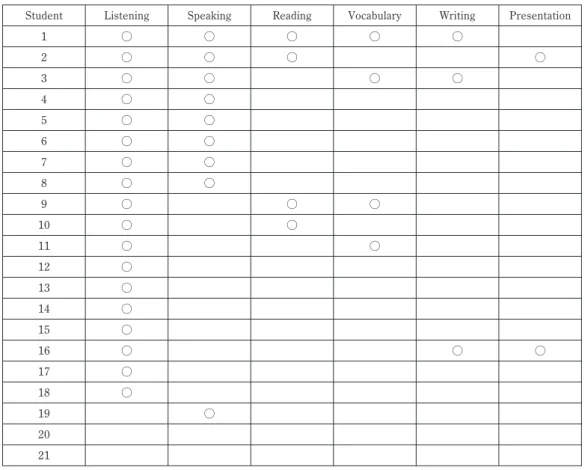
After completing the Kaigai Sogo Jishu program nineteen students (95%) studied English outside of the university curriculum (see Figure 7). The largest number of students continued to work individually on their listening and speaking skills using various methods and tools. The most popular options included TED, Eikaiwa Sapuri, Shadowing with various sources such as CBC (which is Canadaʟsnational broadcaster) Radio, YouTube pronunciation activities, TOEIC activities and actual LINE communication with Canadians and other international students they became friendly with in Canada. Similar to findings by Cai (2013) students felt they improved their overall English language proficiency as well as developing practical, academic skills (i.e. writing English presentation content, giving oral reports, doing project work, etc.) through actual social interaction in English.
Student Listening Speaking Reading Vocabulary Writing Presentation 1 ○ ○ ○ ○ ○ 2 ○ ○ ○ ○ 3 ○ ○ ○ ○ 4 ○ ○ 5 ○ ○ 6 ○ ○ 7 ○ ○ 8 ○ ○ 9 ○ ○ ○ 10 ○ ○ 11 ○ ○ 12 ○ 13 ○ 14 ○ 15 ○ 16 ○ ○ ○ 17 ○ 18 ○ 19 ○ 20 21
Figure 7: English learning activities after the program 3.2.3 Future Desire to Study Abroad
Of the students who participated in the Kaigai Sogo Jishu program over the two years 95% expressed the desire to study abroad again in the future (see Figure 8). Similar findings by Walker et al. (2001) indicated that students felt that ongoing and future involvement in global studies and activities increased the chances of getting a job, as well as having better career opportunities. Another interesting finding was that a majority of the students indicated that their university professors were considered the most useful information source for future study abroad options. They also found that the desire to gain valuable international experience was deemed to be the most influential factor in studying abroad in the future. This was definitely the case for the students who participated in the Kaigai Sogo Jishu program.
Evans et al. (2008) has presented research findings that foundʠWith regard to theʠbuild your own programʡexercise, a relatively clear picture emerged regarding what students would like to see as part of a business study tour. Students were asked when they prefer to travel, how much they would expect to pay for theirʠperfectʡprogram, how much input they would like to have in determining the specifics of the program, whether they felt they were prepared for an overseas study tour, the relative
importance of five characteristics of the trip (friends attending, cost, cities/countries visited, business visited and leisure/free time available), and finally whether they would go on theirʠperfectʡstudy tour if it were offered.ʡThe students who participated in the Kaigai Sogo Jishu program also identified similar characteristics influencing their future international study activities.
Finally, as cited in Walker et al. (2001) a related study by Chieffo (2000) examining the determinants of student participation in study abroad programs found that the determining factors of participation fell into five main categories: (1) financial, (2) social, (3) academic, (4) personal, and (5) institutional. Her research showed that students obtained the greatest amount of study abroad information from their friends and classmates.
Student Group Study Abroad Individual StudyAbroad Internship Workingholiday University Graduate
GE BE GE BE Short Long 1 ○ ○ 2 ○ ○ 3 ○ 4 5 ○ 6 ○ ○ ○ 7 ○ 8 ○ ○ 9 10 ○ 11 ○ ○ ○ 12 ○ ○ ○ ○ 13 ○ ○ ○ ○ 14 ○ ○ 15 ○ ○ 16 ○ 17 ○ 18 ○ ○ 19 ○ ○ ○ ○ ○ ○ ○ ○ ○ 20 21 ○
3.2.4 Actual Follow-up Activities
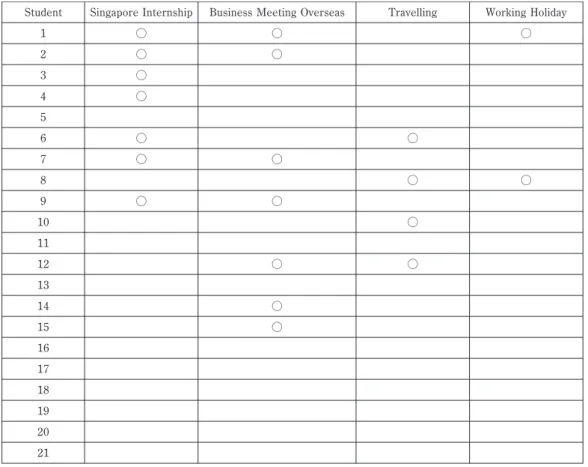
Student Singapore Internship Business Meeting Overseas Travelling Working Holiday
1 ○ ○ ○ 2 ○ ○ 3 ○ 4 ○ 5 6 ○ ○ 7 ○ ○ 8 ○ ○ 9 ○ ○ 10 ○ 11 12 ○ ○ 13 14 ○ 15 ○ 16 17 18 19 20 21
Figure 9: Actual Follow-up Activities
Over the two year period the largest number of students participated in a Singapore Internship Program and Business Meetings Overseas in actual follow-up activities prior to their graduation (see Figure 9). Eight students (80%) of the 2013 group went abroad for internship in Singapore and Hong Kong. In addition, four students made individual trips abroad to countries such as Australia, Indonesia, Korea, Thailand, and Sri Lanka among others.
3.2.5 Future Prospects for their Careers
Figure 10: Future Prospects for their Careers
The future career prospects included possibilities such as working overseas, working for foreign based companies, trading companies and NPO or NGOs (see Figure 10). Walker et al. (2001) also found that business students tended to have a more global mindset compared to non-business students. Fifteen students (71%) have an interest in an occupation that involves some kind of international interaction. As you can see the largest number of students were interested in working in international NPO and NGO settings or companies outside of Hokkaido. The 5-point Likert scale ranged fromʠIʟm not interestedʡ─ Iʟm seriously interestedʡ.It might be notable to mention that, ten students (48%) hope to work abroad in a trading company, and eight students (38%) would like to work for a foreign company in Japan.
Students exploring careers in NPO and NGO organizations could also be attracted to sectors, such as tourism. Tiessen (2012) offers thatʠVoluntourism is popular among all age groups because it is something that can take place during annual leave or holiday time. It generally consists of travel and adventure combined with a short-term volunteer experience (perhaps building a house or volunteering at an orphanage). The emphasis in voluntourism is often on adventure and travel with some opportunity for charitable, rather than developmental, work.ʡSupported by similar findings by Cai (2013), students came away from this program with an expanded outlook on their future career options provided to them by this valuable international experience.
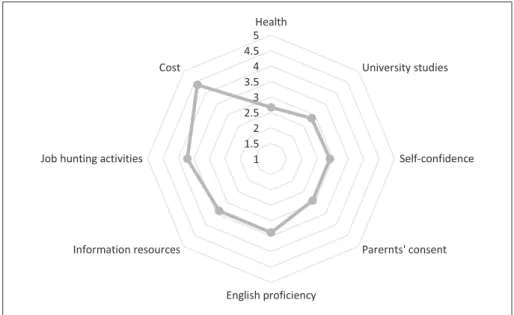
3.2.6 Obstacles to Going Abroad
Eight factors were identified as potential obstacles to going abroad again in the future. They included things like English proficiency, parental consent, university studies, self-confidence, etc. As you can see from the results, two factors share the highest rating. The 5-point Likert scale ranged from
ʠIrrelevantʡ─ʠRelevantʡ. Generally the students think that cost, English ability, anticipated job-hunting time commitments, and lack of information on overseas study programs are the biggest obstacles to going abroad. They feel their own individual physical condition, parental consent, self-confidence, their current university curriculum are less problematic issues.
These results indicated that financial matters were the most significant obstacle to future activities overseas. This is corroborated by similar findings by Evans et al. (2008) which also identified financial aid, academic credit and reasonable prices as issues that impacted the students future desires to study abroad. Specifically Evans et al. (2008) stated,ʠAmong these are student perceptions of the effect of a study tour on future job opportunities, the likelihood of getting time off work to participate, restrictions on who is permitted to participate in study tours and the time of year most appropriate. And while the perceived importance of these issues varied, none of these issues seemed to arouse the intensity of the responses that pertained to familiarity and money.ʡ
4. Discussion and Summary:
Most participants became very confident about using English in ESL learning situations and with their host families, but remained tentative in their English usage in business environments. After they finished the program nineteen students (95%) studied English outside the university curriculum. Again it is notable to mention that eight students (80%) of the 2013 group went abroad for internship in Singapore and Hong Kong and ten students (91%) from the 2014 group intended to participate in similar programs abroad. Generally the students think that cost, English ability, anticipated job-hunting time commitments, and lack of information on overseas study programs are the biggest
obstacles to going abroad. As for applying these experiences to potential career opportunities, fifteen students (71%) are now interested in an occupation that involves some level of international interaction. The results clearly indicate that this initial program has been very effective in motivating students to look for subsequent opportunities to study abroad or to work in international environments.
The Kaigai Sogo Jishu program described here has shown some success in helping our students recognize the necessity for individuals to have the ability to work in environments of increasing cultural diversity. In addition to the language learning opportunities, the students experienced firsthand cross-cultural interactions and relationships. Cross et al. (1989) defined cross-cultural competence (as cited in Bean, 2008, p 12) as:ʠA set of congruent behaviors, attitudes and policies that come together in a system, agency, or amongst professionals and enables that system, agency or those professionals to work effectively in cross-cultural situations. A culturally competent system of care acknowledges and incorporates ─ at all levels ─ the importance of culture, the assessment of cross-cultural relations, vigilance towards the dynamics that result from cultural differences, the expansion of cultural knowledge, and the adaptation of services to meet culturally-unique needs.ʡ Although this program may have offered only a brief exposure to these elements, for some individuals it was a valuable initial experience in growing their cross-cultural aptitude.
As Bean (2008) points out employers are increasingly looking at cross-cultural competence as an important attribute when recruiting new staff and developing it in current employees. He mentions the benefits of enhancing the employeesʟjob performance through improving their interpersonal relationships with people from different cultures. By developing their sensitivity to their own culture and to the cultures of others, they can increase their competence to recognize and negotiate any differences arising from cultural background, thus leading to better performance in their business interactions. Cited by Walker et al. (2001), consistent findings by (Ayers, 1996; Hutchins, 1996; Zhai & Scheer, 2002; Arnold, 2003) reinforced thatʠstudy abroad programs provided a variety of opportunities for students to increase their awareness and appreciation of cultural diversity, personal growth and developed skills and attitudes that allowed them to function successfully in an interdependent world.ʡ
There is little question that students can benefit enormously from short study programs. They offer flexibility, in that they can take place between semesters, during spring break, or in the summer months and they are often far less costly than other study abroad options, because of reduced food and lodging expenses arising from the short duration. Even after a short experience abroad many students undergo a positive change in their attitudes, confidence level and interpersonal behavior. The authorsʟ interest in this area is due in large part to the benefits observed by both students and overseeing faculty members.
own individual skills, particularly their discussion skills, and subsequently many have shown more initiative to study independently. Furthermore students and faculty members recognized the need for a systematic framework to stimulate their overseas studies in business settings. The follow-up survey allowed the authors to assess the views and preferences of the past student participants and provides valuable information and insights to the potential program participants as we organize and conduct the program in subsequent years. From a faculty perspective the writers also concluded that the program needs standardized procedures to enable it to be executed by any members of the faculty. This will better ensure the ongoing continuity of the program in future years.
To conclude the writers feel that the results clearly indicated that the initial two-semester program has been very effective in motivating students to look for subsequent opportunities to go abroad and to work in international environments. Students who participated in the Kaigai Sogo Jishu program successfully expanded their own self-perceptions and their perceptions on the other cultures and countries.
5. Acknowledgements:
This article is based on presentations given by two of these writers, Mark Matsune and Hisashi Naito, at the 大学英語教育学会(JACET 2014)第 53 回全国大会 and 大学英語教育学会(JACET 2015)第 54 回全国大会.
6. References:
Bean, Robert. (2008). Cross-cultural training and workplace performance. National Centre for Vocational Education Research (NCVER), Australian Government, pp. 1-48. Retrieved on December 28, 2015 from http://eric.ed.gov/?id =ED503402
Cai, W., Li, X., Liu, M. (2013). Academic and linguistic gains during a semester-long study abroad: A cohort case study 1. Studies in Second Language Learning and Teaching, 3 (4). pp. 505-522. Retrieved on December 28, 2015 from https://repozytorium.amu.edu.pl/handle/10593/10311
Council of Europe (2001). The Common European Framework of References for Languages: Learning, Teaching, Assessment. Retrieved from http://www.coe.int/t/dg4/linguistic/Source/Framework_EN.pdf
Common European Framework of Reference for Languages: Learning, Teaching, Assessment (CEFR) website (2012). Retrieved from http://www.coe.int/t/dg4/linguistic/cadre1_en.asp
CEFR-J website (2012). What is CEFR-J?, Retrieved from http://www.cefr-j.org/english/whatis.html
Cross, T, Barzon, J, Dennis, K & Isaacs, R (1989). Towards a culturally competent system of care: A monograph on effective services for minority children who are severely emotionally disturbed, Technical Assistance Center, Georgetown University Development Center, Washington, DC.
Evans, J., Finch, J., Toncar, M. R., Reid, J. S. (2008). Student Perceptions Of And Preferences for short overseas study programs. Contemporary Issues In Education Research ─ Third Quarter 2008 1 (3), pp. 11-17, Retrieved on January 5, 2016 from http://search.proquest.com/openview/9d0e298020ef7a7ea517776a2f58cf52/1?pq-origsite=gscholar Li, Jaun (2014). Study on the Effective Ways to Organize Business English Classes. Studies in Literature and Language,
8, (3) pp. 111-115. Retrieved on January 5, 2016 from http://www.cscanada.net/index.php/sll/article/viewFile/4924/ 5990
1-24. Retrieved on December 28, 2015 from http://eric.ed.gov/?id=EJ898196
Ngo, Mai (2012). Canadian Youth Volunteering Abroad: Rethinking Issues of Power and Privilege. Current Issues in Comparative Education, v16 (1), p49-61. Retrieved on December 28, 2015 from http://files.eric.ed.gov/fulltext/ EJ1020596.pdf
Peden, Tony, (2001) Studying Abroad: The Experience, Retrieved on August 21, 2014 from http: //www. abroadviewmagazine.com/archives/spring_01/studyabroad.html
Pérez-Vidal, C., & Juan-Garau, M. (2011). The effect of context and input conditions on oral and written development: a study abroad perspective. IRAL, 49, pp. 157-185.
Soneson H. M., Cordano, R. J., (2009). Universal Design and Study Abroad. Frontiers: The Interdisciplinary Journal of Study Abroad, v18, pp.269-288. Retrieved on December 28, 2015 from http://eric.ed.gov/?id=EJ883703 Tanaka, Koichi. (2007). Japanese students contact with English outside the classroom during study abroad. New
Zealand Studies in Applied Linguistics, 13 (1), pp. 36-54. Retrieved on December 28, 2015 from https://search. informit.com.au/documentSummary;dn=384373285108439;res=IELIND
Tiessen, Rebecca. (2012). Motivations for Learn/Volunteer Abroad Programs: Research with Canadian Youth. Journal of Global Citizenship & Equity Education 2 (1), pp. 1-21. Retrieved on December 28, 2015 from http://journals.sfu. ca/jgcee/index.php/jgcee/article/viewArticle/57
Vygotsky, L. (1978). Mind in society: The development of higher psychological processes. Cambridge: Harvard University Press.
Walker, S., Bukenya, J. O., and Thomas, T. (2001). Examining StudentsʟPerceptions of Globalization and the study abroad programs at HBCUs (historically black colleges and universities). US-China Education Review B 1 pp. 77-88 Retrieved on December 28, 2015 from http://eric.ed.gov/?id=ED522212
7. Appendix
Appendix A: Lecture Schedule (One-Semester Course Credit) 1 Guidance: English assignments, Goals of this course 2 Lectures on Canadian geography, culture, and industry 3 Lectures on the methods of corporate analysis 4 Cross-cultural communication workshop
5 Research on industries: Winery and Retailer (2013), Hotel and Bank (2014) 6 Research on Japanese companies
7 On-site study: Hokkaido Wine (2013), Mori No Uta Hotel (2014) 8 On-site study: AEON Hokkaido (2013), Hokkaido Bank (2014) 9 Presentation Skills Training and Preparation
10 Presentation Skills Training and Preparation 11 Presentation Skills Training and Preparation 12 Presentation Skills Training and Preparation 13 Presentation Skills Training and Preparation 14 Presentation Skills Training and Preparation
3-Weekʠcustom designedʡESL program in Canada 15 Follow-up Corporate and Post-ESL program.
Appendix B: Kaigai Sogo Jishu Survey (Retrieved from Google Forms on July 14, 2015 from https: //docs.google.com/forms/d/1X2ZCPLy0Onhac6-9Ou5dXrXYCW7krCkq0P2HdegGenM/viewform) KSJ アンケート調査 *Required KSJ で英語力は改善しましたか? 改善しない 1 2 3 4 5 改善した 氏名: * 参加年度: 2013 2014* KSJ の出発前に十分に準備ができましたか?* できなかった 1 2 3 4 5 できた 上記の質問で⽛改善した⽜場合,何が改善されましたか? □スピーキング □リスニング □ライティング □リーディング □プレゼンテーション □語彙 □ Other: 上記の質問で⽛十分準備ができなかった⽜場合,何ができませんでしたか? □スピーキング □リスニング □ライティング □リーディング □プレゼンテーション □語彙 □企業調査 □ Other: カナダで空港や税関などでの英語のやりとりはできましたか?* できなかった 1 2 3 4 5 できた カナダでバスや地下鉄などでの英語のやりとりはできましたか?* できなかった 1 2 3 4 5 できた カナダでレストランやお店などでの英語のやりとりはできましたか?* できなかった 1 2 3 4 5 できた カナダで訪問企業先,見学先などとの英語のやりとりはできましたか?* できなかった 1 2 3 4 5 できた カナダでブロックの先生やスタッフなどとの英語のやりとりはできましたか?* できなかった 1 2 3 4 5 できた カナダでクラスメートとの英語のやりとりはできましたか?* できなかった 1 2 3 4 5 できた カナダでホストファミリーとの英語のやりとりはできましたか?* できなかった 1 2 3 4 5 できた カナダから帰国後に授業以外に勉強をしましたか?* □スピーキング □リスニング □ライティング □リーディング □プレゼンテーション□語彙 □ Other: 上記の質問で⽛勉強をした⽜場合,どのような勉強をしたか具体的に書いてください。
カナダから帰国後にどのようなことをしましたか?* 商談会,シンガポールインターンシップなど,内藤が関わっているプロジェクトについては書かなくていい です。それ以外を書いてください。 □特に何もしていない □短期留学 □海外インターンシップ □外国人との交流 □海外交流団体への参加 □ Other: 上記の質問で何かをしている場合,様子が分かるようにいつ何をしたか,詳しく教えてください。 今後どのような活動をしたいですか?* □短期グループ留学で一般英語プログラム □短期グループ留学でビジネス英語プログラム □短期個人留学で一般英語プログラム □短期個人留学でビジネス英語プログラム □短期海外インターンシップ □長期海外インターンシップ □ワーキングホリデー □海外専門学校入学 □海外大学入学 □海外大学院入学 □特にない □ Other: 上記の活動について,希望国,期間,などについて詳しく教えてください。 上記の活動をする上で,障害となるものを教えてください。 英語の実力 関係ない 1 2 3 4 5 関係ある 上記の活動をする上で,障害となるものを教えてください。 実現するための情報 関係ない 1 2 3 4 5 関係ある 上記の活動をする上で,障害となるものを教えてください。 親などの同意 関係ない 1 2 3 4 5 関係ある 上記の活動をする上で,障害となるものを教えてください。 就活との兼ね合い 関係ない 1 2 3 4 5 関係ある 上記の活動をする上で,障害となるものを教えてください。 ゼミや大学カリキュラムとの兼ね合い 関係ない 1 2 3 4 5 関係ある 上記の活動をする上で,障害となるものを教えてください。 やりとげる自信 関係ない 1 2 3 4 5 関係ある 上記の活動をする上で,障害となるものを教えてください。 自分自身の体力や健康 関係ない 1 2 3 4 5 関係ある 上記の活動をする上で,障害となるものを教えてください。 費用負担 関係ない 1 2 3 4 5 関係ある
将来の仕事観について,具体的にアクションを起こすという意味で,* 海外で働くこと 興味ない 1 2 3 4 5 興味ある 将来の仕事観について,具体的にアクションを起こすという意味で,* 北海道外で働くこと 興味ない 1 2 3 4 5 興味ある 将来の仕事観について,具体的にアクションを起こすという意味で,* 北海道内で働くこと 興味ない 1 2 3 4 5 興味ある 将来の仕事観について,具体的にアクションを起こすという意味で, 外資系で働くこと 興味ない 1 2 3 4 5 興味ある 将来の仕事観について,具体的にアクションを起こすという意味で,* 商社・貿易関係で働くこと 興味ない 1 2 3 4 5 興味ある 将来の仕事観について,具体的にアクションを起こすという意味で,* 国際交流に関わる分野で働くこと 興味ない 1 2 3 4 5 興味ある 将来の仕事観について,具体的にアクションを起こすという意味で,どのような希望を持っていますか?*