MEXT Guidelines for teaching English through English Part II: A study of student`s attitudes and beliefs
O`HALLORAN, Jane
Institute for the Advancement of Higher Education Okayama University of Science
1-1 Ridai-chou, Kita-ku, Okayama 700-0005, Japan
Research on the effectiveness of using English as the sole medium of instruction (EMI) in Japanese English classrooms which compares the teacher and student perspective is rather limited. This paper seeks to expand on the research commenced in the previous edition of this publication which addressed the issue of the attitudes of native speaker teachers of English to the use of EMI. In the present paper, the attitudes of students and their beliefs in relation to the English-only classroom will be contrasted with the findings of the earlier research.
Keywords: English Medium Instruction, students` beliefs, student motivation, English-rich classroom
Background
In 2009, MEXT (Ministry of Education, Culture, Sports, Science and Technology of Japan) issued its updated guidelines Eigo ga tsukaeru nihonjin no ikusei no tameno koudoukeikaku [An action plan to cultivate “Japanese with English abilities”]. These guidelines form part of a series The Course of Study which were first published in 1947 and are updated approximately every ten years. The 2009 revisions were designed to shift the focus away from the traditional yakudoku or grammar and translation approach to more communicative methodologies in secondary English classrooms. Teachers were henceforth expected to conduct English classes in high school principally in English. For the first time in the history of Course of Study Guidelines, MEXT has declared that
“classes, in principle, should be conducted in English in order to enhance the opportunities for students to be exposed to English” (MEXT, 2009). The current situation of CLT in Japan Communicative Language Teaching (CLT) is defined as an approach to foreign or second language teaching which considers communicative competence the goal of language learning and emphasizes that learners learn a language by using it to communicate (Richards & Schmidt, 2010; Richards & Rodgers, 2001).
MEXT then outlined its ambitions for tertiary level classes, with a particular focus on attracting overseas students:
Amid ongoing globalization, in order to develop an educational environment where Japanese people can acquire the necessary English skills and also international students can feel at ease to study in Japan, it is very important for Japanese universities to conduct lessons in English for a certain extent, or to develop courses where students can obtain academic degrees by taking lessons conducted entirely in English. In Japan, many universities have already established classes taught in English.
In 2019, the present author presented the findings of research carried out amongst the native speaker teachers at this science university. Herewith a brief recap of the aims of that article:
(Received November 2, 2020; accepted December 11, 2020)
In April 2015, Okayama University of Science introduced a new course of instruction known as Hasshin Eigo (発信英語) in order to meet the new requirements for a communication-oriented curriculum. Additional teachers were hired, new textbooks ordered and freshmen students entered what was intended to be an English-only classroom in continuation of the practice referred to above in the secondary school context. In addition to English communication classes being conducted through English, students also receive Sogou Eigo (総合) or Integrated English classes, and Senmon Eigo, or what is generally described as English for Specific Purposes (ESP) classes which are taught by content rather than language teachers.
The first article sought to assess the degree to which the theory on which the classes were created has been achieved in practice in Hasshin Eigo classes conducted by native speakers of English. The current paper forms the second part of the study and seeks to compare the attitudes and beliefs of the native speakers who teach the Hasshin Eigo classes with those of the students who take the classes.
Participants and Methodology
A composite questionnaire of both closed and open-ended questions was administered to 155 students in a Japanese translation at this private university. An English language version was administered to the eleven native speakers of English. It was decided that a binary option for the closed questions was preferable and the choice was a simple Yes or No rather than a Likert scale.
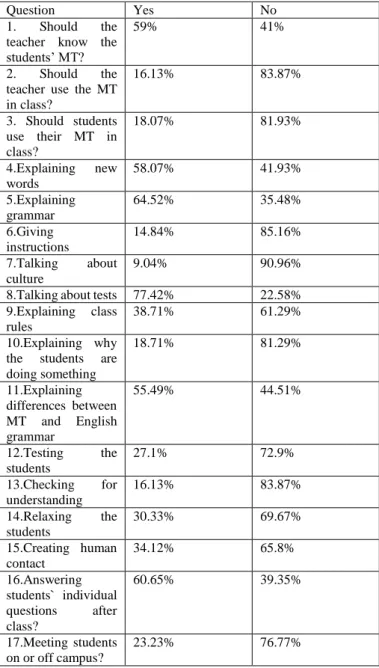
In the close-ended questions, it was found that fully 83.87% (130 of the 155 participants) of students believed that it was not necessary that their mother tongue (MT) be used in the English classrooms. As for the open-ended responses, deductive qualitative analyses were made. Overall, the findings showed that 77% of the students stated their belief that instruction at higher education level should be conducted in English only. This is in sharp contrast with the figure of 18% of teachers who reported using no Japanese in classes. The results of that body of research, published in this journal in 2019, was that the native teachers in practice relied on the use of L1 in the classroom through a belief that without using Japanese the students would be unable to follow the class. The survey conducted amongst the cohort of students indicates that that, at least in theory, they are more willing to rely on their English language nexus and the teacher`s ability to adapt the level of classroom language as appropriate.
The breakdown of percentages who believed that Japanese was necessary in the language classroom presents a contrast to the beliefs of their teachers. The students reported a belief that native speakers of English should know Japanese but some comments show that this belief is in part formed by a concern for the individuals` convenience in living in the country, coupled with a desire to avoid inconvenience for those coming into contact with them who may feel that they have to use English in order to communicate.
Table 1. Survey Questionnaire: When should L1 be used? Student responses.
Question Yes No
1. Should the teacher know the students’ MT?
59% 41%
2. Should the teacher use the MT in class?
16.13% 83.87%
3. Should students use their MT in class?
18.07% 81.93%
4.Explaining new words
58.07% 41.93%
5.Explaining grammar
64.52% 35.48%
6.Giving instructions
14.84% 85.16%
7.Talking about culture
9.04% 90.96%
8.Talking about tests 77.42% 22.58%
9.Explaining class rules
38.71% 61.29%
10.Explaining why the students are doing something
18.71% 81.29%
11.Explaining differences between MT and English grammar
55.49% 44.51%
12.Testing the students
27.1% 72.9%
13.Checking for understanding
16.13% 83.87%
14.Relaxing the students
30.33% 69.67%
15.Creating human contact
34.12% 65.8%
16.Answering students` individual questions after class?
60.65% 39.35%
17.Meeting students on or off campus?
23.23% 76.77%
In addition to a clearly stated view that the native speaker teacher does not need to use English in the classroom was an almost equally high percentage who felt strongly that the students should not use their mother tongue in the English classroom. Observation suggests that this is not common practice but the aspiration may be sincere.
Another conspicuous figure from the survey reveals that the single aspect about which the students were exercised was that of tests. 77.42% wanted to receive information about the tests in their mother tongue; a figure that is indicative of the standing of the formal test in this exam-focused society. It contrasts with the low number of 9.04%
who believed that Japanese would be necessary for them to follow a discussion on cultural aspects. It is unclear if this indicates a confidence in their own abilities to understand the content, an intrinsic interest in the topic which ignites their attention, or an indifference to the topic which suggests that understanding cultural components is not a priority. In the next section we will examine the factors that contribute to the students` stated enthusiasm for English as the medium of instruction, at least according to their survey responses and compare it to the results of the survey of English teachers.
Table 2. Results of Survey Questionnaire from native English teachers.
Question Yes No
Should the teacher know the students’
MT?
72.72% 27.27%
Should the teacher use the MT in class?
54.54% 45.45%
Should the students use their MT in class?
63.63% 36.36%
Explaining new words
27.27% 72.72%
Explaining grammar 36.36% 63.63%
Giving instructions 63.63% 36.36%
Talking about culture
36.36% 63.63%
Talking about tests 54.54% 45.45%
Explaining class rules
63.63% 36.36%
Explaining why the students are doing something
63.63% 36.36%
Explaining
differences between MT and English grammar
9.09% 90.90%
Testing the students 9.09% 90.90%
Checking for understanding
27.27% 63.63
Relaxing the students
45.45% 54.54%
Creating human contact
36.36% 63.63%
Answering students`
individual questions after class?
81.81% 18.18%
When you meet students on or off campus?
63.63% 36.36%
As discussed in Part 1 of this research and published in this journal in 2019, although the teachers were aware that the policy of the Hasshin Eigo classes was to use English only in order to establish an immersion style of teaching, less than half were putting the policy into full effect in the belief that students required Japanese language instruction in order to understand the content of the class.
This demonstrates that the new educational policy is putting a burden on teachers as well as students. While research suggests that as English proficiency is ultimately the main objective of English teaching and learning, students should be exposed to as much English as possible in English lessons, nevertheless many teachers find that in low-level or mixed-ability classes, use of the mother tongue is part of their teaching practice. This confirms Tahira`s (2012) conclusion that “There remains a big gap between the stated policies and what is actually done in the classroom.’’ One of the challenges to closing this gap will be ‘Overcoming the perceived need for L1‘Scaffolding’ by interlocutors which mediates L2 learning (Lantolf, 2000.) (O`Halloran 2019)
MEXT appears to have anticipated this dilemma when it defined the language outcome it envisages:
Foreign language proficiency required in global society can be defined as capability of smooth communication with people of different countries and cultures using foreign languages as a tool. The capability of smooth communication implies, for example, confident and active attitude toward communication with people of different countries and cultures as well as accurate understanding of partner’s thoughts and intentions based on his/her
cultural and social background, logical and reasoned explanation of one’s own views, and convincing partners in course of debates.
This is the stated aim of the Hasshin Eigo classes but in practice the teachers` perceptions of the students` level of ability to rise to this level of ‘smooth communication’ does not meet this target. On the other hand, the students themselves express a willingness to take aim at the target.
Gardener`s theory of integrative and instrumental motivation
Canadian psychologist R. C. Gardner laid the foundations of the study of student motivation in a social psychological framework which consists of integrative and intrinsic forces affecting language learning. The framework puts emphasis on the learning context and Gardner divided influences into internal and external factors.
Internal factors include curiosity arousal, perceived value of the activity, anticipated value of the learning outcome, and the awareness of a developing ability in the area of study. External factors include the influence of teachers and parents, larger societal influences, cultural norms, and the local education system.
Dornyei, as pointed out by Ryan, (2009, 122) further developed the concept but questioned whether extrinsic motivation is as relevant in situations where students have few opportunities to use English, as is the case in the Japanese context. Ryan quotes Dornyei`s (2005) description of the “integrativeness enigma.” With whom are our students seeking to integrate? (Ryan, 2009) Gardner, conducting his research in Canada, a nation with two official languages, could anticipate students with easy access to opportunities for authentic L2 exposure in their day to day lives. The reality for Japanese students is that they are more likely to be integrating with others from a third culture where English is likely to be a second language but one in daily use, for example, classmates or colleagues from other Asian countries such as Vietnam, China or Pakistan and India.
This English-speaking community is an aspect of globalisation that will have increasing relevance in a Japan facing a rapidly declining population of citizens of working age. What are the students` motivations for learning English when their exposure to L2 is presumably going to be limited in their futures if they remain in a provincial city? Rather than finding motivation in traditional L2 situations such as study abroad or overseas vacations, it is likely that many of our students will be using English in the workplace with colleagues from an increasingly diverse range of countries.
There is a preconception that Japanese students have been turned off language study by the time they reach tertiary level as a result of their negative experiences of the exam-focused conveyor belt of repetitive grammar studies combined with the practice of learning vast quantities of vocabulary without context. Nevertheless, the students partaking in this research are freshmen and this may be a contributing factor to their apparent enthusiasm for the immersion-style of teaching. Yashima (2009) put forward the concept of “international posture, “ that is, “the possible and ideal L2 self in relation to 'international posture', the concept postulated for EFL contexts as an alternative to the Gardnerian concept of integrativeness.” It is this idea of the `Ideal L2` self that the English-only classroom seeks to exploit to the students` benefit. As freshmen, they are young people on the threshold of a new way of life which allows the possibilities of a new way of viewing themselves, their abilities and their potential selves. By tapping this sense of possibility, the instructor can create a positive learning environment and maximise each individual student`s WTC, or willingness to communicate.
By continuing to create the same conditions that had been found in the high school English class, native speaker teachers may be falling in to a trap of underestimating the students` appetite for a stimulating new experience and an opportunity to help forge a new sense of identity as an international citizen, capable of communicating in a second language without a safety net of the L1. This vision of the ideal L2 self can be constructed by class exercises in which the young people are invited to imagine themselves as graduates and members of society and to create a dynamic image of who that person may be when they enter the adult, working world. Even an
exercise as basic as participation in the survey offers an opportunity for self-reflection and analysis of what is required of them as a university student and, eventually, as shakaijin, or fully-fledged member of society.
Instructors in the first year classroom are ideally placed to take advantage of this sense of openness and adventure by tapping the potential of the concept of “desirable difficulty.” This is a concept that was developed by Robert Bjork and his wife Elizabeth in 1994. In a study the Bjorks conducted in that year they discovered that when students were presented with a challenge that was beyond their present abilities the apparent rate of learning was initially slowed down. Predictably enough, those taking part in the study complained about the new techniques, nevertheless they discovered that long-term retention was greatly improved as a result. Amongst the practices that the Bjorks introduced was spaced repetition, rather than the mass repetition that is still the backbone of much English learning in Japanese high schools.
“It is not enough to simply provide educators with a list of desirable difficulties and claim that our work in optimizing learning has been completed. It may be that certain combinations of desirable difficulties interact to yield super-additive or sub-additive effects, if the processes by which the desirable difficulties work enhance or interfere with each other. Research into these interactions is therefore important on both practical (“What is best for learning?”) and theoretical (“How do these desirable difficulties work to influence memory?”) levels.” (Bjork, 2011)
Bjork does not, however, argue that difficulty is in and of itself motivating but rather that there is a ‘challenge point’- an optimal level of difficulty or challenge. This is the point at which difficulty can produce the learning processes that produce long term changes in language ability. Instructors who intend to support students by using L1 in the classroom may, conversely, unwittingly deprive the students of a challenge to which they could rise.
“We want, in short, to create durable and flexible access to to-be-learned information and procedures. Towards achieving that goal, the conditions of learning need to induce encoding and retrieval processes that are substantial and varied, and incorporating desirable difficulties helps to induce those processes.” (Bjork, 2011)
Looking at the students` responses to the open-ended question “What are the good and bad points of a class conducted only through English, responses were varied but the majority were positive and expressed similar ideas.
For example, a frequent response was this: “It`s English class therefore it is natural that it be conducted in English,”
“It will be good to get used to hearing spoken English”, “My listening ability will progress” and so forth.
Allowance must be made for the acquiescence tendency by which the students produce the answers they know are expected. Yet many expressed an innate understanding of the concept of `desirable difficulty` as they indicated their belief that it would be difficult at first but that they would get used to the English-only classroom and that it was a good thing. One student summed up the attitude of many when they said `To be familiar with a native speaker teacher will give many opportunities to use natural everyday English which they had never had before.
100% English classes will help us to make progress quickly.” The last quotation will go to a student who was foreseeing their own future and commented that “From now there is no doubt that the ability to speak English will be important in our lives. If we can improve our spoken ability through this class it will be a good thing.”
These representative remarks, coupled with the results of the survey, demonstrate that our students have a positive attitude, although tempered with a certain degree of trepidation, at the prospect of a challenge being offered to them by English as the Medium of Instruction. A path could be taken to greater fluency by explaining the long-term benefits of a level of desirable difficulty. As one student put it: 集中して聞かないと何言ってる か分からないので授業に集中できる。”Because if we don`t concentrate we won`t know what is being said, we will have to concentrate on the class.” The students instinctively understand Gardner`s theory of intrinsic motivation.
Conclusion
The aim of this two-part study was to evaluate the policy of an English-only medium of instruction for Hasshin Eigo lessons, and to compare and contrast teachers` and students` beliefs in respect to its implementation. These classes form an important element of a concerted university-wide curriculum aimed at providing a range of opportunities for students to achieve the language skills they will need in their future lives. By furnishing students with a controlled level of challenge and creating an authentic English-speaking environment, these classes enable L2 learners to develop their confidence as citizens of a globalized world in which they do not require that every word is translated for them but rather to create subjective new selves by taking on the identity of an independent learner. In short they can come to see themselves as language acrobats performing with the safety net of L1. The instructors who persist in the belief that without providing translation the learners will fail, are themselves failing to believe in the possibility of transformation and the human desire to meet a challenge, overcome difficulty and create an image of themselves in an ‘international posture.’ In order to enhance the opportunities for students to be exposed to English, teachers can create an English-rich classroom that mirrors the international workplace of the future.
References
http://www.mext.go.jp/en/policy/education/highered/title03/detail03/__icsFiles/afieldfile/2012/06/19/1302653_1 .pdf
Ministry of Education, Culture, Sports, Science, and Technology MEXT, Action plan to cultivate ‘Japanese with English abilities.’ (2003).
Bjork, E. L., & Bjork, R. A. ‘Making things hard on yourself, but in a good way: Creating desirable difficulties to enhance learning’. In M. A. Gernsbacher, R. W. Pew, L. M. Hough, & J. R. Pomerantz (Eds.), Psychology and the real world: Essays illustrating fundamental contributions to society (pp. 56-64). New York: Worth Publishers, (2011).
Burden, Peter. ‘When Do Native English Speaking Teachers and Japanese College Students Disagree about the Use of Japanese in the English Conversation Classroom?’ The Language Teacher, (April 2001). (Thanks to Peter Burden for his kind permission to use his original survey questions)
Dörnyei, Z. (2005) The Psychology of the Language Learner: Individual Differences in Second Language Acquisition. Mahwah, NJ: Lawrence Erlbaum.
Gardner, R. C., & Lambert, W. E. (1972). Attitudes and motivation in second language learning. Rowley, MA:
Newbury House.
Ryan, Stephen, (2009) ‘Self and Identity in L2 Motivation in Japan: The Ideal L2 Self and Japanese Learners of English’ (pp. 120-144) in Motivation, Language Identity and the L2 Self, Edited by Zoltán Dörnyei and Ema Ushioda, Multilingual Matters.
Tahira, M. ‘Behind MEXT’s new course of study guidelines’. The Language Teacher Vol. 36 pp. 3–8 (2012).
Yashima, Tomoko, (2009) ‘International Posture and the Ideal L2 Self in the Japanese EFL Context’(pp .114-164) Motivation, Language Identity and the L2 Self, Edited by Zoltán Dörnyei and Ema Ushioda, Multilingual Matters.