]. Saitama Univ. Fac. Educ.,57 (2): 91-103 (2008)
The analysis of English teaching methods as the second language in Thailand and Japan
Sodsai KHANARAT* and Tairo NOMURA* *
Abstract
This study compares English LanguageTeaching methodologies between Japan and Thailand with a view to highlighting mutually beneficial strategies for improving the way English is taught in schools in both Japan and Thailand. It is appreciatedthat each of these countries has differentissues to deal with. Consequentlyyou could not expect them to be exactly the same, indeed perhaps they should not be. However, there may be areas that each country can learn from each other. This can be done by a comparison of teaching methodologies, lesson structures, classroom activities, books used and other teaching aids available. From these we can determine what methods have a beneficial effect for students and what don't. Both countries may have methods the other may find useful and can implementinto their current curriculum.The English student can only benefit from these shared ideas and methods in teaching.
Keyword: English language teaching, Teaching methodology, Second language, Native tongue, Junior high school
Introduction
At present, Thailand and Japan both teach English as a second language. They have a lot more in common than you might think. Both countries have similarly structured educational systems. The state education system in Thailand has the same basic framework as Japan: six years elementary, three years junior high, three years senior high and four-year universities and currently nine years of compulsory education. They both have characterized their students in similar ways, and both have acknowledged a distinct lack of achievement on the part of students to attain a reasonable standard of English proficiency.
On the other hand, there are also differing factors in the education systems: the dissimilar ways to improve teaching English methods as the second language and the strategic plan to cultivate English abilities. The basic problem for Thai education is economics and general quality of teaching staff is low. Generally, teaching is something that people go into if they are unable to do anything else .
• Kanlayanee Si Thammarat School, Nakon Si Thammarat province, Thailand.
•• Faculty of Education, Saitama University, Japan
Especially at the elementary levels, teachers are unqualified, the classrooms are over crowded and the focus is on rote memorization and comprehension tests.
However at present, Japan also has issues to deal with. Many Japanese are restricted in their exchanges with foreigners and their ideas or opinions are not evaluated appropriately. At present it is also necessary for Japanese to develop their ability to clearly express their own opinions in Japanese in order to learn English. In order to respond to this situation, the Ministry of Education, Culture,
Action Plan to Cultivate "Japanese with English Abilities"
(Goals) English language abilities required for all Japanese nationals
"On graduatingfrom junior high school and seniorhigh school, graduates can communicate in English"
On graduation from a junior high school, students can conduct basic communication On graduation from a senior high school, students can conduct normal communication On graduating from university, graduates can use English in their work
Action to Improve English education
Action to Improve English education Goals
1. Improvement of English classes "Cultivating communication abilities through the repetition of activities making use of English"
+
Almost
allEnglish teachers will acquire English skills (STEP pre-first level, TOEFL 550, TOEIC 730 or over) and the teaching ability to be able to conduct classes to cultivate communication abilities through the repetition of 2. Improving the teaching ability of activities making using of English.
English teachers and upgrading
+Centering on leading teachers at the local community level, the improvement of English abilities in the community will be enhanced.
the teaching system
+
A native speaker of English will attend English classes at junior and senior high schools more than once a week.
+
People living in the local community proficient in English will be positively utilized
+
10,000high school students will study abroad every year.
3. Improving motivation for learning
+Opportunities to use English outside the class will be enhanced.
English
+International exchange will be further developed through such means as communicating with the world using English.
4. Improvement in the evaluation
+Communication abilities, including listening and speaking, will be appropriately evaluated.
system for selecting school and
Utilization of listening tests or external proficiency examinations will be
university applicants
+encouraged for entrance examinations of universities and high schools.
At elementary schools where English conversation activities take place in 5. Support for English conversation the Period for Integrated Study, approximately 1/3 of these sessions will be activities in elementary schools guided by personnel such as foreign teachers, those who are proficient in
English and junior high school English teachers
6. Improvement of Japanese language In order to cultivate communication abilities in English, the ability to express appropriately and understand accurately the Japanese language, which is the abilities
basis of all intellectual activities, will be fostered.
Practical research relating to English education at junior high schools, high 7. Promotion of practical research schools, and universities will be comprehensively implemented for promoting approaches to improve English education. (A report will be issued in the autumn of 2003 including initial conclusions.)
Fig.L Action Plan to Cultivate "Japanese
withEnglish Abilities" (MEXT, 2003)
Sports, Science and Technology (MEXT) has formulated various measures such as the revision of the Ministry's courses. In order to make improvements, it is necessary to carry out simultaneously a number of different measures. These include improving teaching methods, improving the teaching ability of teachers, improving the. selection system for school and university applicants as well as creating a better curriculum (MEXT, 2003; See also Fig.l).
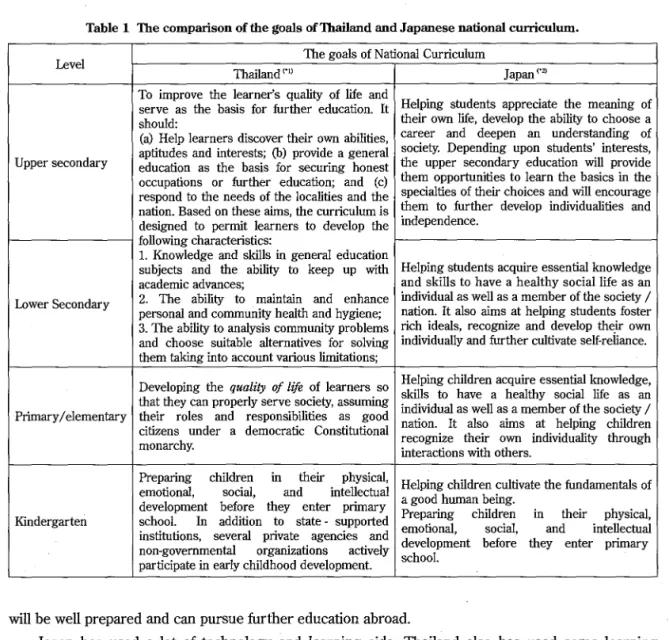
In order to achieve such improvements, both in Thailand and Japan can learn from other individual, institutions and education systems. We might gain a new perspective on our own situation and ideas about directions which educational reforms in Thailand and Japan might take. As you can see from the information provided in the tables, the main fundamentals of international curriculum at . every school level in both Thailand and Japan do not differ greatly. Both countries give priority to the development of human resources. However, looking deeper into the factors of the reform, you will find something difference.
For Thailand, the main factor needed in education reform is economical. Therefore, international curriculum is aiming to develop a knowledge-based society as a pre-requisite for a knowledge-based economy. The government decided that rather than having 'outsiders' involved and taking some of the profits from Thai businesses, it would be better if the Thai people could benefit by carrying out their own business negotiations in English. So the Ministry of Education has undertaken several steps to promote the teaching and learning of English for communicative purposes. These include formulation of a long-term strategic plan (2005-2015) to increase the ability of Thais to communicate in English, as well as a plan to review the entire system of English teaching and learning.
In Japan, the aim of changing curriculum came from the idea of providing common education for all children to one of providing different education for various children. This marks a revolutionary change in the history of education in Japan because Japanese educators have believed since the war that all children can enormously benefit from a common educational experience and that providing different types of education would be discriminatory. The new national curriculum of English seems to emphasize the nations need to survive in international competition. This means that English education allows children to experience becoming friends with people from around the world and to nurture qualities in children that will help them to live together with others.
Despite some different concepts about education reform in Thailand and Japan, both countries need to mutually co-operate in order to achieve the same purpose which is a successfully revolutionized and developed educational system.
1. The interesting points about Thailand and Japanese curriculumf'"
There are some interesting points in Thai curriculum that differ from the Japanese education system (See Tabel 1). Thailand has continuously encouraged and supported an international educational program. There are currently 588 fields of study in 727 international programs offered by both public and private universities which use English as a medium of instruction. Both foreign and Thai students are able to take courses for credits from such programs.
We believe that this international education will enhance students' career opportunities. Students
Table 1 The comparison of the goals of Thailand and Japanese national curriculum.
Level The goals of National Curriculum
Thailand
('1)Japan
('2)To improve the learner's quality of life and
Helping students appreciate the meaning of serve as the basis for further education.
Itshould: their own life, develop the ability to choose a
(a) Help learners discover their own abilities, career and deepen an understanding of aptitudes and interests;
(b)provide a general society. Depending upon students' interests, Upper secondary education as the basis for securing honest the upper secondary education will provide occupations or further education; and (c) them opportunities to learn the basics in the respond to the needs of the localities and the specialties of their choices and will encourage nation. Based on these aims, the curriculum is them to further develop individualities and designed to permit learners to develop the independence.
followingcharacteristics:
1. Knowledge and skills in general education
subjects and the ability to keep up with Helping students acquire essential knowledge academic advances; and skills to have a healthy social life as an Lower Secondary
2.The ability to maintain and enhance individual as well as a member of the society / personal and community health and hygiene; nation.
Italso aims at helping students foster 3. The ability to analysis community problems rich ideals, recognize and develop their own and choose suitable alternatives for solving individuallyand further cultivate self-reliance.
them taking into account various limitations;
Developing the
quality of lifeof learners so Helping children acquire essential knowledge, that they can properly serve society, assuming skills to have a healthy social life as an individual as well as a member of the society / Primary/elementary their roles and responsibilities as good nation.
Italso aims at helping children
citizens under a democratic Constitutional
monarchy. recognize their own individuality through
interactions with others.
Preparing children in their physical,
Helping children cultivate the fundamentals of emotional, social, and intellectual
a good human being.
development before they enter primary
Kindergarten school.
Inaddition to state - supported Preparing children in their physical, emotional, social, and intellectual institutions, several private agencies and
development before they enter primary non-governmental organizations actively
participate in early childhood development. school.
will be well prepared and can pursue further education abroad.
Japan has used a lot of technology and learning aids, Thailand also has used some learning sources; such as ERIC and a Self-Learning Center set up for training activities organized for lifelong learning sources. Furthermore, theg development of the Infrastructure and Networking System has provided more Educational television programs in Thailand. However, due to a limited budget, there are still more funds needed for the better distribution of the educational television programs since some local and distant schools do not have televisions.
Thailand also encourages a continuous learning curve for English teachers. Between 2005 and
2006, there was a project to upgrade the English language' proficiency of 15,000 primary and
secondary school teachers. They received 'Intensive instruction for ERIC 2006' to train 180 qualified
individuals to be English instructors at the British Council and the Regional English Language Office
of the United States Embassy, the AUA Language Center and ERIC Centers. Finally, We hope that
with the continuation of this improving process, we will be able to see a dramatic change in Thailand's
education system.
2. English Education in both Thailand and Japan
2.1 When did Thailand start English Education?
In the early 1990, Thai education ministry invited EFL experts in bilingualism from the UK and the US to form the Curriculum Reform Committee (CRe). On behalf of the government, they recommended that English education should start as early as possible. Based on this recommendation, in 1995 the education ministry decided that an extra four years of English education would be added starting from first grade, rather than fifth (See Tabel 2).
This major curriculum change was implemented in 1996 for public schools that were able to do so, with all schools given the deadline of 2002 for implementation. The CRC suggested that the elementary school system lead from an initial focus on listening and speaking then reading and writing would be introduced in a theme based format, after which students should learn in secondary education through content-based English language instruction. At the same time, the national curricular reforms shift away from rote memorization to communicative methods, student- centered learning and the development of critical thinking skills.
Initially, the teaching guidelines for the new curriculum were developed for primary and secondary education by a mainly British team that focused on the communicative approach. These were revised after extensive consultation with teachers. Next, a new teaching influenced by the American education system was drafted to develop the curriculum standards. This produced a rough outline of the Course of Study, which stated that courses should include the four C's:
1. Communication - - focus on listening/speaking 2. Culture - .- knowledge of and sensitivity to others 3. Connections - - links to other subject content
4. Community - - project work and application outside the classroom
With these ideals, the education ministry set out an ambitious plan for elementary school education, which controlled teaching methodology and thematic content of lessons. For the first three grades, students are to be taught listening and speaking using total physical response (fPR). In the fourth year, students start to learn reading and writing through theme-based methods, as indicated in Table 2.
2.2 When did Japan start English Education?
In April 2002, a new class period called 'Sogo tekina Gakushu no ]ikan' (Sogo) was established in
Table 2 Thai elementary school education reform plan.
Grade Skill focus Pedagogic focus Hrs/week
1 (second term) Listening/speaking 1PR 2
2 Listening/speaking TPR 2
3-4 4 skills Theme-based 2
5-6
4 skills Theme-based 5
Note: In private schools, students typically receive five hours per week of English instruction from grade one.
(Alan S. Mackenzie, 2002)
Japanese elementary schools. The aims of Sogo are to encourage children to involve themselves actively in learning, to develop their skills and also to get them to think about their own way of life. In order to fill this slot, which is alloted three class hours a week, schools can choose from options such as international understanding, information technology, environmental studies and health and welfare.
They can study according to their own goals. However, English in elementary school, in it's current state called 'English Activities' (EA), is not a formal subject but is placed within the framework of Sogo and falls under the theme of international understanding.
As a result, elementary schools are not required to offer EA; it is one option among many.
Individual schools and districts can plan their schedules according to their local circumstances.
According to a survey conducted by the Ministry of Education among all elementary schools in Japan, 88.3% of school conducted EA during the 2003 school year for grades 3-6 and 90% of these schools conducted EA within the allotted time for Sogo. For grades 1 and 2, which did not have the Sogo period in the curriculum, 43% schedule EA in time allotted for special activities, such as homeroom and club activities and the remaining 57% of schools placed EA in extracurricular hours. (Kate Tindle, 2005)
In Japan the new Courses of Study that have been implemented since 2002 are responses to the advance of internationalization and focus on the viewpoint that basic practical communication abilities, which include the ability to conduct daily conversation and the ability to exchange basic information in a foreign language, are required of all students. A status report on improvements in English education in junior and senior high schools will be implemented in 2003. By 2005, a total of 100 schools will be designated as Super English Language High Schools. Innovative English education will be promoted at senior high schools and unified secondary schools. The results of the program will be disseminated.
It is necessary to give a system of unified instruction through each school level inJapan. Thus, attainment targets for the English abilities required at each school level, based on the new Courses of Study, will be established. The improvement of English classes, the upgrading of the teaching abilities of English teachers, the enhancement of systems for instruction, and strengthening the motivation for English learning will be addressed. Through cooperation between the schools at different levels, instruction to allow student to acquire steadily the English required at each stage will be promoted.
In 2002 when the new Courses of Study were fully implemented, English conversation activities
were carried out at approximately 50% of all public elementary schools. In English conversation
activities during the "Period for Integrated Study," the simple introduction of junior high school
English education at an earlier stage as well as teacher-centered methods for cramming knowledge
should be avoided. It is important that experiential learning activities that are suitable for elementary
school students are carried out, and that the motivation and attitude for children to communicate
positively is fostered by providing children with exposure to foreign language conversation in an
enjoyable manner, and by familiarizing them with foreign cultures and ways of living. In the
implementation of such activities it is important for children to come into contact with different
languages and cultures, to be interested in them, and to have experiential activities involving speaking
and listening. Thus, for English activities at the elementary school, the aim is to have one third of all
sessions taught by personnel such as native speakers of English and English teachers at junior high schools
("4) •2.3 What's the difference between Thailand and Japanese English Education?
Thailand started English at the first grade in elementary school before Japan 6 years ago. Why does Thailand proceed so slowly in English learning? And what are the differences between their English lessons at elementary level? Mer looking into Japanese Action plan carefully, we found that Japan just started the first grade of English in elementary school in early 2002 while Thailand started in 1996.In Japan, each elementary school can set its own goals for the Sogo period. The curriculum is then designed in accordance with these decisions made at the local level. As a result, a unified national curriculum does not exist for English activities (EA) in Japan. Each school must design it's curriculum to fu1fill its own goals and to enable students to reach the goals set for Sogo.
On the other hand, in Thailand, they have a national curriculum for English in elementary schools English is already being taught as a formal subject in elementary schools. Also, the English textbooks are available and appropriately organized to suit each level. The similarity is that they think at the same point about what the nature of language acquisition is. They understand that children first learn their native language by listening, then speaking, reading and writing in that order. So English at elementary school level should be centered on oral skills. Moreover, it is natural that listening should take priority over speaking. There is so much emphasis put on children speaking out, and as a result the question of input tends to be overlooked. It is important to realize that when children are able to listen to instructions and answer questions that these are situations where communication has been successful.
3. Whafs the difference between Thailand and Japan in terms of English classes.
On both the 12
thand 13
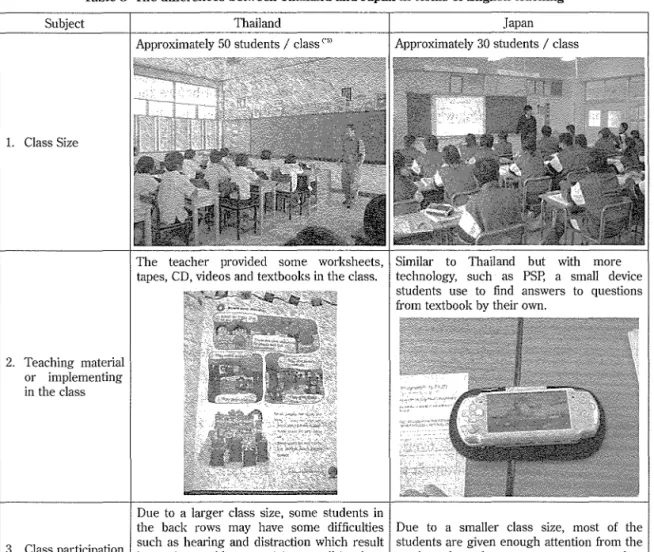
thof Feb. 2008, we are fortunate enough to observe 6 English classes at Fujimi-shiritsu Higashi Junior high school.There are approximately 270 students divided into 3 classes per grade, each class was not crowded with 30 students. Fortunately this school is one of great Junior high schools in Japan. As an observer, we have learned the similarities and differences between Thailand and Japan in terms of English teaching, as well as other mportant aspects which indicate the educational development of the two countries as shown in Table 3.
We were a foreign guests visiting Fujimi-Shiritsu Higashi Junior high school. We communicated with English teachers at the school and they could communicate with us in fluent English. It is possible that some students might think that they could not become friendly with a foreigner unless they spoke English well. On the other hand, if their teachers were to try to communicate with limited English, or by using gestures and other methods, children might see more possibility of being able to communicate in English themselves. Nevertheless, it is important for the teachers to be role models for communication rather than model English speakers
These observations have given me a greater understanding about the characteristics of Japanese
students in their English classes. They are very keen to learn and listen to the teacher carefully. They
Table 3 The differences between Thailand and Japan in terms of English teaching Subject
1. Class Size
2. Teaching material or implementing in the class
3. Class participation
4. Classroom/school atmosphere
5. Confidence
6. Teaching method
7. Native speaker teachers
Thailand
Due to a larger class size, some students in the back rows may have some difficulties such as hearing and distraction which result in not being able to participate well in class.
However, teachers try to give attention to individual students as much as possible.
Classrooms are sometimes dirty. Even though each student is assigned with a specific date during a week to clean a classroom, there are still some problems such as trashes and dust. The most major problem is a dust from a chalk when teachers erase the blackboard.
Thai students are quite confident in asking and answering questions in English. Still, they are sometimes shy to pronounce the sounds like r, l.s,v, etc.
There is a balance in practicing four skills in English: listening, speaking, reading and writing. However, teachers tend to focus more on grammar.
A limited budget prevents public schools from hiring native speakers to teach, unlike private schools. Students of public school have a chance to meet native speakers only on special occasions, such as Christmas Day.
Japan Approximately
30students / class
Due to a smaller class size, most of the students are given enough attention from the teacher; thus, they are more encouraged to participate in class.
The schools in Japan are very clean. Students have to take off their shoes and change into slippers. Students have their own locker to put away their possessions and have a rag hanging below their chairs for cleaning.
Japanese students participate well in class in terms of asking and answering questions.
However some English words are still troublesome for them such as hot-to instead of hot.
Students practice all skills, but Japanese English education appears to focus on speaking and listening to encourage students to be able to communicate in a daily life.
According to the new reform curriculum in
Japan, students have a good chance to
practice their English with native speakers in
the integrated classes. Some schools will hire
native speakers to teach in public schools.
Subject Thailand Japan
Teachers use textbooks authorized by the Teachers use compulsory textbooks under regulations from the Ministry of Education government and the content of each textbook
similar to Thailand. Teachers in both 8. Textbooks has been appropriately organized to best suit
countries provide more worksheets for their each students' level. (read more about
Thailand and Japanese textbook below.) students or need to skip some part of exercises due to limited time.
Class periods are normally 50 minutes in Thailand and Japan.
InThailand, the
Japanese classrooms usually start on time
9.Period Duration schedule changes quite often because of
and there are few changes to the schedule.
activities, holiday events and ceremonies. So Classes frequently do not start on time.
The uniform differs slightly from school to The uniform is seasonal. I also notice that it 10. Uniform school, but mostly under the same definition: is typical for a Japanese school girls wear white shirt, black or blue short pants and very short skirts which is considered in black or blue pleated skirt. appropriated in Thailand.
Cram schools have become big business in Cram schools are called
'Juku'in Japan. Most students also attend cram schools which are Thailand. It's a common sight in Bangkok to
a common feature of Japanese education. So see thousands of students flock to cram
11. Cram School schools on holidays and after class. They are much of a child's future depends on going to the right school and university. The extra seeking the edge in entrance examinations
lessons may be used to push bright students that will get them into prestigious state further or to help others catch up to the universities.
crowd.
are reflective, not impulsive and tend to think things over carefully before they speak. They have no problems working in groups and boys and girls work well together. Thai students seem to be very enthusiastic about speaking English with foreigners and tend to be stronger in speaking skills. Both countries are similar in that students like to play games but don't try hard enough in writing activities.
They tend to become reticent about it when they get older. Our Experience has shown us that children's temperaments are not that different. Their ability to learn can depend greatly on how much a teacher can inspire them.
4. What's interesting about Thailand and Japanese Education System?
4.1 Teaching methods
In English classrooms both in Japan and Thailand, anything is better than the grammar- translation method; attention should be given to the four skills, with an emphasis on speaking and listening skills which are essential for effective communication. Instead of using the ancient and ineffective grammar-translation method, teachers should rather use a mix of the communicative approach, the direct method (only English is used without translation, making use of props such as regalia, flashcards, etc.), the audio-lingualmethod (focus on drilling, memorization and pronunciation) and the lexical approach (focus on vocabulary, phrases and chunks of language).
The ways to improve existing teachers' skills include appropriate and regular workshops in
English led by qualified teacher trainers, teacher observations with useful feedback and peer
observations. Teachers should also gradually move from teacher-centered learning to student-
centered learning. The teacher-centered approach that Thai teachers use is obsolete, does not allow
any student participation and stifles debate and critical thinking. Even today, too many Thai teachers still see themselves as either omnipotent classroom dictators or infallible preachers who are never to be challenged. Unfortunately they haven't noticed that most of their audiences have long fallen asleep.
So in order to improve students' English skills, teachers should use a mix of appropriate teaching methods, be proficient in English, use more English when teaching (the more the better, but we feel that 50% - if not more - is an absolute minimum) and give more importance speaking and listening.
(Philip Roeland, 2008)
4.2 English Textbooks in Thailand and Japan
Both schools in Thailand and Japan use compulsory textbooks under a regulation of the Ministry of Education. A substance of each textbook has been appropriately organized to best suit each level of study. However, it has been found that these textbooks are only a standard medium. Instructors and users need to further adapt lesson plan for a textbooks to suit their students appropriately. For example,there might be additional worksheets to provide students with more information or a need to skip some exercises due to limited time.
Nevertheless, each school is required by the Ministry of Education to provide adequate and standard lessons to students in order for the students to be able to take a national entrance examination. Some schools in Thailand hardly use exercises or practices from a textbook. On the other, instructors will provide additional work sheets from several textbooks or create their own exercises to suit their students and provide extensive knowledge beyond compulsory textbooks.
Another similarity is that most of textbooks consist of a conversation part, listening part, speaking practice part, reading comprehension, writing part and grammar. Also, at the end of each lesson, there is an exercise so that student can review and practice what they have learnt on their own.
Furthermore, we have found that both textbooks from Thailand and Japan contain cultural information,traveling information and daily life knowledge of their own countries and others.
We would not say that it is a difference, but rather a unique qualification and style of Thai and Japanese textbook. One obvious matter is that there is a lot of use of cartoon and animation pictures in Japanese, which can encourage and attract students' attention. However, textbooks in Thailand use
Fig.2 Thailand's English textbook