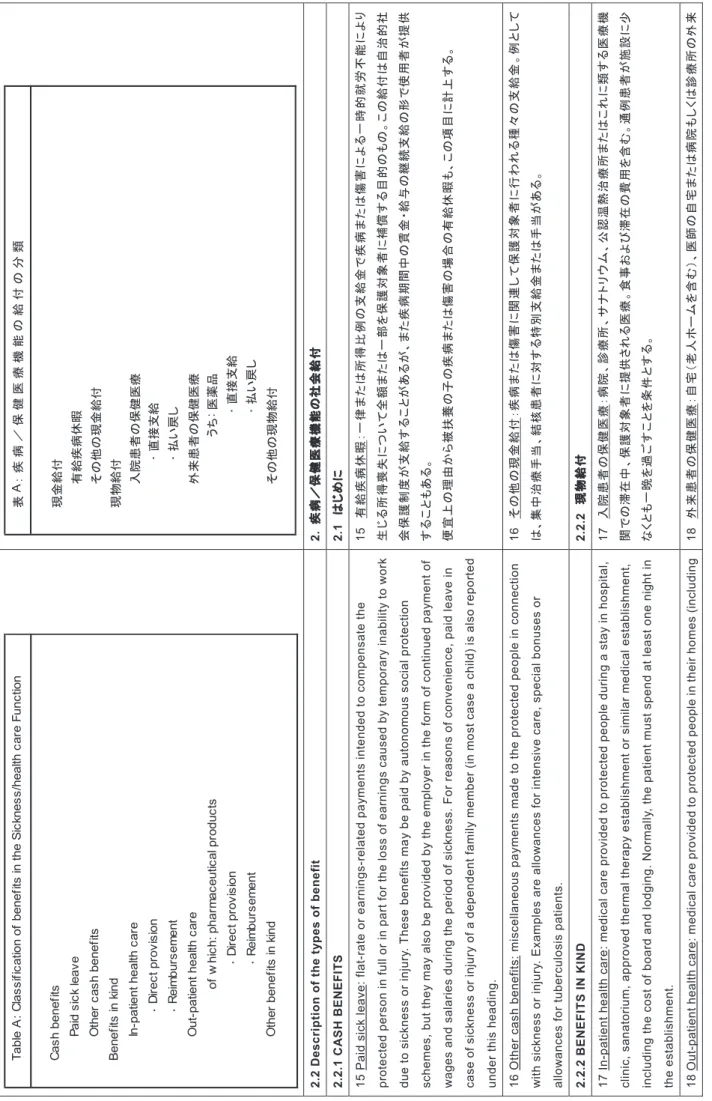
1
付録: ESSPROS マニュアル 2016 年版 仮訳(日英併記)
ESSPROS マニュアルは 1981 年初版、 1996 年第二版、 2008 年第三版、 2011 年第四版、
2016 年は第五版と改定が重ねられてきた。1996 年の第二版は国立社会保障・人口問題研 究所において翻訳がなされている。 2008 、 2011 年は主に付属資料に収録された年金受給 者、純社会保護モジュールのマニュアルが拡充され、本編は大きな変更はなされなかった。
2016 年改定においては、本編について 1996 年版をベースとしつつ、次の四点に関して定 義が変更、より明確なものへ拡充された。
・給付税額控除( Payable Tax Credit )
・集団的サービス
・ミーンズテストの定義
・給付から差し引かれた税と社会保険料
上記の四点については、マニュアルとは別に、解説 ESSPROS: Compendium of methodological clarifications として 2017 年中に公表予定となっている。
2017 年4月の作業部会においてその原案が示されており、上記四点について改定の背景、
内容、各国の事例について収録されている。
ESSPROS: Compendium of methodological clarifications Version 1 (2017)
https://circabc.europa.eu/sd/a/8f1b797c-2f4e-4258-a3ff-21208bd04e5e/DOC_SP-2017-0 8.6_Annex%20-%20Compendium%20of%20methodological%20clarifications.pdf
ESSPROS 基準は、今後も毎年の作業部会により改善に向けた議論が継続され、数年ご
とにマニュアルの改定が予定されている。日本は非欧州のため、作業部会に参画すること ができないが、 EU 統計局サイトから公開される作業部会の資料や、オブザーバーで参画
する OECD-SOCX 担当者を通じて、情報を継続的にフォローしていくとともに、
EU-ESSPROS 担当者に不明点は照会できるよう、関係構築を継続的に行っていく必要が
ある。今後、同基準に沿って日本のデータ整備を高い精度をもって継続的に行うには、
OECD および EU 統計局の協力が不可欠である。
ESSPROS マニュアル 2016 年版は下記より英語版がダウンロード可能である。
http://ec.europa.eu/eurostat/documents/3859598/7766647/KS-GQ-16-010-EN-N.pdf
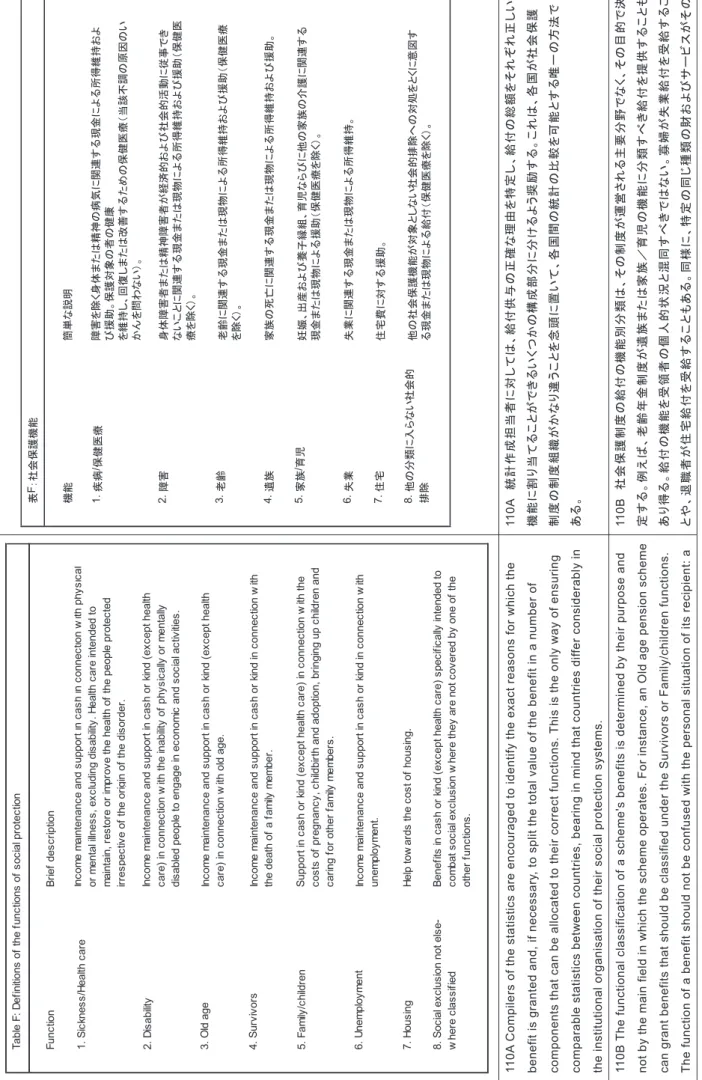
ES SP RO S: E ur o p ea n Sy st em o f i nt eg ra ted Social Protection Statistics 欧州総合 社 会保護統 計 システム M a nu a l a nd U se r g ui d el in es 2016 edition マニュア ル および利 ⽤ 者のため の ガイドラ イ ン 2016 年 版(仮訳 ) European Union, Euro stat 欧州連合 、 欧州統計 局 編 Luxembo ur g : Publ ication Offi ce o f the European Union 欧州連合 出 版局 発 ⾏
⽬次
Part 1: ESSPROS: General principles and core system 3第1部 ESSPROS:⼀般原則およびコア・システム 1 Introduction to the ESSPROS System 41. ESSPROSシステムについて:イントロダクション 2 The conventional definition of social protection 82. 社会保護の標準的な定義 21 Introduction 82.1 はじめに 22 General definition 82.2 全般的定義 23 Further explanation 92.3 追加説明 3 Accounting structure and classifications in the core system 143. コア・システムの会計構造および分類項⽬ 31 Introduction 143.1 はじめに 32 Delimitations of the Core System 143.2 コア・システムの範囲 33 The accounting structure 153.3 会計構造 4 Definition and grouping of social protection schemes 174. 社会保護制度の定義および分類 41 The statistical unit 174.1 統計単位 42 Grouping of Social protection schemes 184.2 社会保護制度の分類 5 Receipts of social protection schemes 255. 社会保護制度の収⼊ 51 Introduction 255.1 はじめに 52 Types of receipts 255.2 収⼊の種類 53 Classification of institutional sectors from which receipts originate 305.3 収⼊発⽣源となる制度部⾨の分類 6 Expenditure of social protection schemes 336. 社会保護制度の⽀出 61 Introduction 336.1 はじめに 62 Types of expenditure 336.2 ⽀出の種類 7 Social benefits, main classifications 367. 社会給付の主要な分類 71 Classification by function 367.1 機能別分類 72 Classification by type 387.2 種類別分類 73 Means-testing 407.3 資産調査 8 Accounting conventions 418. 会計⽅法 81 Introduction 418.1 はじめに 82 The principles of exhaustiveness and consistency 418.2 網羅性および⼀貫性の原則 83 Valuation 418.3 評価 84 Time of recording and the accounting period 448.4 計上時期および会計年度 85 Netting and consolidation 448.5 差額表⽰および整理統合 86 Recognising the principal party 458.6 主要当事者の認識 9 The rest of the world 469. 海外部⾨ 91 Transactions with the rest of the world 469.1 海外部⾨との取引 92 The definition of residence 469.2 居住の定義Part 2: Classification of benefits in the core system 49第2部 コア・システムにおける給付の分類 1 Introduction 501. はじめに 2 Social benefits in the Sickness/health care function 522. 疾病/ヘルスケア機能の社会給付 21 Introduction 522.1 はじめに 22 Description of the types of benefit 542.2 給付種類の説明 23 Further guidance 552.3 その他の指針 3 Social benefits in the Disability function 563. 障害機能の社会給付 31 Introduction 563.1 はじめに 32 Description of the types of benefit 573.2 給付種類の説明 33 Further guidance 583.3 その他の指針 4 Social benefits in the Old age function 604. ⽼齢機能の社会給付 41 Introduction 604.1 はじめに 42 Description of the types of benefit 614.2 給付種類の説明 43 Further guidance 624.3 その他の指針 5 Social benefits in the Survivors' function 645. 遺族機能の社会給付 51 Introduction 645.1 はじめに 52 Description of the types of benefit 655.2 給付種類の説明 53 Further guidance 655.3 その他の指針 6 Social benefits in the Family/Children function 666. 家族/育児機能の社会給付 61 Introduction 666.1 はじめに 62 Description of the types of benefit 666.2 給付種類の説明 63 Further guidance 676.3 その他の指針 7 Social benefits in the Unemployment function 697. 失業機能の社会給付 71 Introduction 697.1 はじめに 72 Description of the types of benefit 707.2 給付種類の説明 73 Further guidance 717.3 その他の指針 8 Social benefits in the Housing function 728. 住宅機能の社会給付 81 Introduction 728.1 はじめに 82 Description of the types of benefit 728.2 給付種類の説明 83 Further guidance 738.3 その他の指針 9 Social benefits in the function Social exclusion not elsewhere classified 749. 他の分類に⼊らない社会的排除機能の社会給付 91 Introduction 749.1 はじめに 92 Description of the types of benefit 759.2 給付種類の説明 93 Further guidance 759.3 その他の指針 Appendices 77付属資料 APPENDIX I: The ESSPROS questionnaire detailed classification 781. ESSPROS調査票の詳細分類 APPENDIX II: Qualitative information by scheme and detailed benefit 1022.制度と給付の詳細な情報 APPENDIX III: Methodology of the module on pension beneficiaries 1073. 年⾦受給者モジュールの作成⽅法 APPENDIX IV: Methodology of the module on net social protection benefits (restricted4. 純社会保護給付(限定アプローチ)モジュールの作成⽅法 APPENDIX V: List of social protection schemes in the Member States 1495. EU加盟国の社会保護制度⼀覧 APPENDIX VI: Differences between the ESSPROS and the national accounts (ESA 1995) 2066. ESSPROSと国⺠経済計算との相違点 APPENDIX VII: The classification of various government disbursements 2087. 各種の政府⽀出の分類 APPENDIX VIII: The treatment of taxes and social contributions payable on benefits 2118. 給付について⽀払う租税および社会保険拠出の取扱い
Appendices 77付属資料 APPENDIX I: The ESSPROS questionnaire detailed classification 781. ESSPROS調査票の詳細分類 APPENDIX II: Qualitative information by scheme and detailed benefit 1022.制度と給付の詳細な情報 APPENDIX III: Methodology of the module on pension beneficiaries 1073. 年⾦受給者モジュールの作成⽅法 APPENDIX IV: Methodology of the module on net social protection benefits (restricted4. 純社会保護給付(限定アプローチ)モジュールの作成⽅法 APPENDIX V: List of social protection schemes in the Member States 1495. EU加盟国の社会保護制度⼀覧 APPENDIX VI: Differences between the ESSPROS and the national accounts (ESA 1995) 2066. ESSPROSと国⺠経済計算との相違点 APPENDIX VII: The classification of various government disbursements 2087. 各種の政府⽀出の分類 APPENDIX VIII: The treatment of taxes and social contributions payable on benefits 2118. 給付について⽀払う租税および社会保険拠出の取扱い
PA R T 1 : ESSPRO S: GENERAL PRIN CIPLES ANDCORE SYSTEM
1.Introduction to theESSPROS System1.ESSPROSシステムとは 1 EU Treaties identify the promotion of social protection and the development of the economic and social cohesion of the Member States as tasks of the Union. In order to monitor theprogress of these tasks, the European Commission needs access to detailed and up-to-dateinformation on the organisation, current standing and developments of social protection in theMember States and beyond.1 EU条約は社会保護の促進、加盟国の経済および社会統合の発展をEU連合の任務と規定して いる。これらの任務の進捗状況を監視するため、EU理事会は加盟国およびそれ以外の地域の社会 保護の組織、現状および進展に関する詳細かつ最新の情報へのアクセスが必要である。 2 The European System of integrated Social PROtection Statistics (ESSPROS) was developed in the late ‘70s by Eurostat jointly with representative of the Member States of the European Union in response to the need for a specific instrument of statistical observation of social protection in the EC Member States.
2欧州総合社会保護統計制度(ESSPROS)は、欧州統計局と加盟国代表によって、当時のEC加 盟国における社会保護の統計的観察の具体的な道具の必要性に応えて、1970年代末に創設され た。 3The first ESSPROS methodology was published in 1981. In 1993, Eurostat undertook a general revision of the ESSPROS, in close co-operation with the Members States. The ESSPROS Manual 1996 was the outcome of this revision process.
3最初のESSPROS作成方法は1981年に公表された。1993年には、EU統計局が加盟国との緊 密な協力のもと改訂を行った。ESSPROS1996年版はその改訂プロセスの成果であった。 4 In April 2005, Eurostat proposed to introduce a legal basis for the ESSPROS project. The legal basis was proposed as a Regulation of the European Parliament and the Council (1) (frame Regulation) supplemented by Commission Regulations (2) implementing in particular: ESSPROS core system (including qualitative information by schemes and detailed benefits), the module on pension beneficiaries and the pilot data collection on Net social protection benefits. (1) Regulation (EC) No 458/2007 of the European Parliament and of the Council of 25 April 2007 on the European system of integrated social protection statistics (ESSPROS) published in OJ L113, 30.04.2007, p.3. (2) Commission Regulation (EC) No 1322/2007 of 12 November 2007 implementing Regulation (EC) No 458/2007 of the European Parliament and of the Council on the European system of integrated social protection statistics (ESSPROS) as regards the appropriate formats for transmission, results to be transmitted and criteria for measuring quality for the ESSPROS core system and the module on pension beneficiaries published in OJ L294, 13.11.2007, p.5. Commission Regulation (EC) No 10/2008 of 8 January 2008 implementing Regulation (EC) No 458/2007 of the European Parliament and of the Council on the European system of integrated social protection statistics (ESSPROS) as regards the definitions, detailed classifications and updating of the rules for dissemination for the ESSPROS core system and the module 4 2005年4月にEU統計局はESSPROSプロジェクトの法的な基礎の導入を提案した。法的基礎 とは、欧州議会および理事会(注1)の指令(枠組み指令)であり(注2)、特にESSPROSコアシステ ム(制度と給付の詳細に関する質的情報を含む)、年金受給者モジュール、純社会保護給付のパイロ ットデータに関する委員会指令を含むものとして提案された。 注1)略。 注2)略。
on pension beneficiaries published in OJ L5, 09.01.2008, p.3. 5 Simultaneously, an update of the ESSPROS Manual 1996 was undertaken because it was necessary to adjust its structure in order to incorporate some methodological clarifications. The ESSPROS Manual published in 2008 did not contain significant changes in respect to 1996 version, but mainly adjustments in the definitions and classifications. The first two parts of the Manual deal with the Core System. It consists of a stable, annually collected set of data on the receipts and expenditures of social protection schemes in the European Union. Supplementary sets of statistical information (modules), whose subjects were determined on the basis of the needs expressed, were introduced by the EP and Council ESSPROS Regulation: the module on Pension beneficiaries and the module on net social benefits. At the time of updating the manual, as the module on pension beneficiaries had already been planned, the methodology was added to the text. The second module, on net social benefits, was to be developed
5同時に、1996年ESSPROSマニュアルの改訂が行われ、いくつかの作成方法上の明確化を行う ためにマニュアルの構造を整える必要があった。ESSPROSマニュアルは2008年に改訂版が刊行さ れた。1996年版からの大きな変更はなく、主に定義や分類の向上が図られた。マニュアルの第1部、 2部はコアシステムを扱う。コアシステムは毎年収集される社会保護制度の収入と支出に関するデー タである。補完的な統計情報(モジュール)は、EPおよび理事会ESSPROS指令によって導入され、 そこで表明されたニーズを基に決定されたもので、年金受給者モジュールおよび純社会保護給付モジ ュールを含む。マニュアルの改訂時に、年金受給者モジュールがすでに計画されていたため、マニュア ルにその作成方法が追加された。第二のモジュールである純社会保護給付も開発された。 6 A pilot data collection on net social protection benefits was launched in year 2008, and an EUsynthesis report revealed positive results for a large majority of pilot studies. The report waspresented to the Task Force (TF) on net social benefits in November 2009. All TF membersagreed that the report provided the requisite backing for moving towards a full data collection. In the 2010 Working Group (WG) on Social Protection Statistics a Gentlemen's agreement was set up in order to collect data on the module for years 2007, 2008 and 2009 on a voluntary basis according to the so-called restricted approach. Two Commission Regulations implementing the full net data collection were approved in year 2011(3). As the methodology on the module on the net social protection benefits (restricted approach) was finalised at the same time, an update of the ESSPROS Manual was undertaken in order to include this new methodology. On the other hand, a pilot study on the net social benefits according to the so-called enlarged approach was launched at end of 2010. The 2011 edition of the Manual is equivalent to the previous version but complemented by the methodology on the module on net social protection benefits (restricted approach) finalized during the work on the pilot data collection. The ESSPROS Manual is the reference document in the four Commission Regulations implementing the EP and Council ESSPROS Regulation. It contains all detailed definitions and classifications. Concurrently, an extended Manual (or the "ESSPROS Manual and user guidelines") was 6純社会保護のパイロットデータ収集は2008年に始まり、EU報告書がパイロットスタディの大部分 の結果が良好なものであることを示した。その報告書は2009年11月の社会保護給付のタスクフォー スに提出された。すべてのタスクフォースメンバーがその報告書がすべての国に範囲拡大に向けて必 要な内容を提供していることに同意した。2010年の社会保護統計に関するワーキンググループでは、 2007年のデータ提供のための紳士協定がセットされ、2008、2009年はボランタリーベースで、いわゆ る「制限的アプローチ」に沿ったデータ提供が行われることとなった。 完全な純社会保護データ収集に関する二つの委員会指令が2011年に承認された(注3)。純社会保 護給付のモジュールの作成方法(制限アプローチ)が完成し、ESSPROSマニュアルの改訂がこの新 たな作成方法を含めるために行われた。他方で、純社会保護のパイロットスタディがいわゆる拡大ア プローチに基づき2010年に実施された。 2011年版マニュアルでは、先の版と同じであるが、純社会保護給付モジュールの作成方法(制限アプ ローチ)が補完され、パイロットデータ収集の実施中に完成した。 近年では、拡大マニュアル(もしくはESSPROSマニュアルおよび利用者ガイドライン)が2012年に作 成された。これはESSPROSをとりまとめ、利用するためのガイドとして提供されたものである。 ESSPROSマニュアルおよび利用者ガイドラインは追加的な事例や、追加的説明、各国の完全な制 度一覧を含んでいる。これらの特別編は必要に応じ更新されるであろう。 2016年版マニュアルでは、2016年の社会保護統計ワーキンググループで合意されたマニュアルの変 更および定義の明確化が反映されたもので、以下の点に関して改定された。 ・税額控除
produced in 2012. Its nature is serving as a User's Guide for compiling and using ESSPROS. The "ESSPROS Manual and user guidelines" contains in addition examples, further explanations and a complete list of schemes for each country. These specific items will be updated if necessary. The 2016 edition of the ESSPROS Manual and user guidelines was produced after methodological amendments and clarifications to the Manual were agreed by the 2016 Working Group on Social Protection Statistics in regards to the following topics: ・ Payable tax credits ・ Collective services ・ Definition of Means-testing ・ Withheld taxes and social contributions. (3) Commission Regulation (EU) No 263/2011 of 17 March 2011 implementing Regulation (EC) No 458/2007 of the European Parliament and of the Council on the European system of integrated social protection statistics (ESSPROS) as regards the launch of full data collection for the ESSPROS module on net social protection benefits published in OJ L71, p. 4 Commission Regulation (EU) No 110/2011 of 8 February 2011 implementing Regulation (EC) No 458/2007 of the European Parliament and of the Council on the European system of integrated social protection statistics (ESSPROS) as regards the appropriate formats for transmission, the results to be transmitted and the criteria for measuring quality for the ESSPROS module on net social protection benefits published in OJ L34, p.29..
・集団的サービス ・ミーンズテストの定義 ・給付から源泉徴収された税と社会保険料 注3)略。 7 The objectives of ESSPROS are to provide a comprehensive and coherent description of social protection in the Member States: ・ covering social benefits and their financing; ・ geared to international comparability; ・ harmonising with other statistics, particularly the national accounts, in its main concepts.
7ESSPROSの目的は、加盟国における社会保護の包括的かつ首尾一貫した描写、すなわち、 ・社会保護給付とその財源をカバーし、 ・国際比較可能とするために調整がなされ、 ・他の統計、特に国民経済計算と主な概念の調和が図られたもの、 上記を提供することである。 8 ESSPROS, the integrated system of social protection statistics, provides a coherent comparison between European countries of social benefits to households and their financing.Social benefits are transfers to households, in cash or in kind intended to relieve them from the financial burden of a number of risks or needs.
8総合社会保護統計であるESSPROSは、欧州諸国における家計への社会給付とその財源の首尾 一貫した比較を提供する。社会給付は家計への移転であり、現金あるいは現物の形式で家計がリス クやニーズから被る経済的負担を取り除く目的で行われる。 9 The risks or needs of social protection refer to the ESSPROSS functions that are 9社会保護のリスクやニーズはESSPROS機能として表される包括的なものである。教育は子ども
comprehensive, but do not include education unless it is a support to indigent families with children. The functions are disability, sickness/health care, old age, survivors, family/children, unemployment, housing and social exclusion.
のいる低所得家族を支援する場合を除き、含めない。ESSPROSでいう機能とは、障害、疾病・保健 医療、高齢、遺族、家族・児童、失業、住宅、社会的排除である。 10 Social benefits are made through collectively organised schemes by government and/or collective agreements. The schemes do not necessarily refer to institutions, although they are in many cases. These schemes can be defined solely for ESSPROS as a classification of schemes exists, where schemes are grouped by criteria. All schemes that are solely based on individual arrangements or where simultaneous reciprocal agreements exist are not regarded as social protection.
10社会給付は政府、団体協約、政府兼団体協約により、集団的に組織された制度を通じてなされ る。制度は必ずしも機関を意味しないが、多くの場合は機関を意味する。制度はESSPROSにおいて 個別に定義される。ESSPROSでは制度の分類があり、制度はその基準に沿ってグループ化される。 制度が個人的なアレンジや同時互恵的な合意に基づく場合は。すべて除外される。 11 The scheme concept of social protection is straightforward as it starts from the point of view ofthe beneficiaries and therefore differs from other concepts that concentrate on institutional units spending or budgetary costs. The schemes are defined nationally according to the ESSPROS framework.
11社会保護の制度概念は受給者の観点が出発点であるのでわかりやすく、それゆえ費用を支出す る制度的単位に特化する他の概念とは異なっている。制度はESSPROS枠組みにそって各国で定義 される。 12 There are links with National Accounts, although there is not a complete conceptual match between the ESSPROS system and National Accounts. Particularly, the achievement of ESSPROS is its accounting structure similar to the National Accounts (benefits and their financing) at the level of the statistical unit of ESSPROS system (the scheme). There is also a link to the risks or needs to social benefits in the National Accounts.
12国民経済計算とリンクはしているが、SNAとESSPROSは完全な概念上の一致はしていない。特 に、ESSPROSは国民経済計算と統計の単位(制度)のレベルで類似の構造(給付とその財源)とな っている。またリスクやニーズに関しても国民経済計算とリンクしている。 13 Whereas the Core system corresponds to the standard information on social protection receipts and expenditures, the modules contain supplementary statistical information on particular aspects of social protection. Each module has its own methodology and is based on a particular Commission regulation. The introduction of any additional modules shall require extensive preliminary consultations with the Eurostat Working Group on Social Protection Statistics and shall require a specific EP and Council Regulation.
13コアシステムは社会保護の支出と財源に関する標準的な情報を提供する一方、モジュールは社 会保護の特定の側面に関する補完的な統計情報を含む。各モジュールごとに作成方法が定められ、 それは特別な委員会規則に基づいている。いずれの追加的モジュールの導入も事前にEU統計局の 社会保護統計ワーキンググループでの協議を要し、また特別な欧州議会・理事会指令を必要とする 可能性がある。 14 The subjects covered by the modules were determined on the basis of the needs expressed by the Commission and the Member States. Currently included in ESSPROS are modules that cover: ・ the number of pension beneficiaries; ・ net social protection benefits, i.e. the influence of fiscal systems on social protection by the taxes and social contributions paid on benefits by beneficiaries and the extent to which social benefits are provided in the form of tax rebates or tax reductions. At the moment this module is implemented via the restricted approach in order to maintain the 14モジュールで扱われる課題は、委員会や加盟国によって表明されたニーズに基づき決定されたも のである。最近ESSPROSに追加されたモジュールとしては、 ・ 年金受給者モジュール ・ 純社会給付(税や保険料拠出が受給者により支払われることにより税財政システムが社会 保護に与える影響、あるいは社会給付に匹敵するものが税還付や税控除により提供される こと等)現在のところこのモジュールはコアシステムの範囲を維持するために、制限アプロー チにより行われている。
scope of the Core System. SCHEMATIC REPRESENTATION OF THE FULL ESSPROSESSPROSの全体構成 2. The conventional definition of social protection2. 社会保護の標準的な定義 2.1 Introduction2.1はじめに 15 There is no universally accepted definition of the scope of social protection, nor does there exist one that suits all purposes (including the compilation of statistics). It is therefore necessary to formulate a conventional definition of the scope of social protection which meets as well as possible the needs of social policy analysis and data collection on an international level. This chapter begins with a general definition, relevant to both the Core system of the ESSPROS and its modules, that is further explained and specified for use in the Core system in the following paragraphs.
15 社会保護の範囲については普遍的に認められた定義がなく、また全ての目的(統計の編纂を含 む)に適した定義も存在しない。したがって、国際レベルの社会政策分析およびデータ収集のニーズを できるだけ満足させる社会保護の範囲の標準的な定義を行うことが必要である。本章ではまず、 ESSPROSのコア・システムおよびそのモジュールの両方に関連する全般的定義を行い、その後の各 節でコア・システムにおける使用に関して更に説明・規定を行う。 2.2 General definition2.2全般的定義 16 Social protection encompasses all interventions from public or private bodies intended to relieve households and individuals of the burden of a defined set of risks or needs, provided that there is neither a simultaneous reciprocal nor an individual arrangement involved. The list of risks or needs that may give rise to social protection is, by convention, as follows(4): 1. Sickness/Health care 16社会保護には、定義された一連のリスクまたはニーズの負担を世帯および個人から免除するため の公共機関または民間機関からの全ての介入を含む。ただし同時互恵的措置も個人的措置も含まな いことを前提とする。 社会保護を発生させる可能性のあるリスクまたはニーズのリストは、慣例的に次のように決まってい る。(注4)
Number of pension beneficiaries
Links with National Accounts
Module widening the scope of the core system Net social benefits CORE SYSTEM (quantitative+qualitative) Module with supplementary information補完的情報モジュール 年金受給者数
コアシステムの範囲を拡大したモジュール 純社会保護給付 国民経済計算との連携コアシステム (量的情報+質的情報)
2. Disability 3. Old age 4. Survivors 5. Family/children 6. Unemployment 7. Housing 8. Social exclusion not elsewhere classified. (4) There are a number of differences between the ESSPROS and the national accounts in the list of risks or needs giving rise to social benefits. The most important one is that the national accounts include the need "Education". See Appendix I.
1. 疾病/保健医療 2. 障害 3. 老齢 4. 遺族 5. 家族/育児 6. 失業 7. 住宅 8. 他の分類に入らない社会的排除 注4)社会給付が生じるリスクとニーズの種類はESSPROSと国民経済計算とで異なっている。最も重要な相違は、 国民経済計算では教育をニーズに含む点である。詳細はAppendix1参照。 2.3 Further explanation2.3追加説明 2.3.1 TYPES OF INTERVENTION2.3.1 介入の種類 17 The word intervention in the definition should be understood in its broadest sense to cover the financing of benefits and related administration costs, as well as the actual provision of benefits.
17 定義中の「介入」の語は、給付および関係管理コストの調達ならびに給付の実際の供与を対象と する語として最も広義に理解すべきである。 18 Benefits granted within the framework of social protection can take many forms; however, inthe Core system, they are limited to: (i) cash payments to protected people (ii) reimbursements of expenditure made by protected people (iii) goods and services directly provided to protected people.
18 社会保護の枠内で供与される給付は、種々の形態を取り得る。ただし、コア・システムにおいて は、給付は次のものに限られる。 (i) 保護対象者に対する現金支給 (ii) 保護対象者に対して行う経費の払い戻し (iii)保護対象者に直接提供する財およびサービス 2.3.2 PROVISION BY PUBLIC AND PRIVATE BODIES2.3.2 公的・私的機関からの提供 19 The condition that the intervention must come from public or private bodies excludes from the definition of social protection all direct transfers of resources between private households or individuals in the form of gifts, help to relatives and so on, even if their purpose is to protect the recipient from the risks or needs listed in paragraph 16. For practical reasons, small-scale, informal and incidental types of support such as whiprounds, Christmas collections, ad-hoc humanitarian aid and emergency relief in the event of natural disasters, which do not require regular management and accounting, are also excluded from the definition.
19 介入が公的機関または私的機関からのものでなければならないという条件によって、贈り物、親 類への援助などの形での家計間または個人間の財源の直接移転は全て、その目的が第16節で挙 げたリスクまたはニーズから受領者を保護することであっても、社会保護の定義から除外される。 実際上の理由から、小規模の、非公式のかつ付随的な種類の支援、例えば寄付集め、クリスマス募 金、特別の人道的援助、天災の際の緊急救援など、定期的管理および会計を要しないものも、定義 から除外する。 19A Generally, the bodies most frequently intervening are: ・ social security funds;19A一般に、最も頻繁に介入する機関は、次のものである。 ・社会保障基金
・ central, state and local government agencies; ・ autonomous and self-administered pension funds; ・ insurance companies: in Denmark the pension funds running labour market pensions can delegate the administration of these pensions to insurance companies; ・ mutual benefit societies; ・ public or private employers providing benefits to their current and former employees directly; ・ private welfare and assistance institutions: for instance, the Red Cross, the Portuguese religious foundation Casa Misericordia and the (Roman Catholic) charitable organization Caritas.
・中央政府機関、州政府機関、地方政府機関 ・独立の、自治的な年金基金 ・保険会社 ・共済組合 ・現在のおよび以前の被用者に直接給付を提供する公共または民間の使用者 ・民間福祉・援助機関。例えば赤十字やポルトガルの宗教財団Casa Misericordiaなど。 2.3.3 THE RISKS OR NEEDS2.3.3 リスクとニーズ 20 The list of risks or needs given in paragraph 16 has two purposes. On the one hand it restricts the scope of social protection to the areas which are felt to be most relevant in the European context. On the other hand, it is a tool for producing comparable statistics where the institutions, regulations and social traditions of the Member States diverge widely. The various risks and needs define the primary purposes for which resources and benefits are provided, irrespective of legislative or institutional structures behind them. In this context, it is customary to use the term functions of social protection.
20 第16節に記したリスクまたはニーズのリストには、二つの目的がある。一つにはこのリストは、社 会保護の範囲を欧州の状況において最も適切と思われる分野に限定している。他方それは、加盟国 の制度、法制および社会的伝統が大きく異なる場合に類似の統計を生み出すツールである。これらの リスクおよびニーズは、背後の立法構造または制度構造のいかんにかかわりなく財源および給付が 提供される主たる目的を定義づけている。この場合は、「社会保護の機能」の語を用いるのが慣例で ある。 21 Functions are defined in terms of their end-purpose, not in terms of given branches of social protection or pieces of legislation. For instance, the benefits granted by a pension fund cannot simply be classified in their entirety under the Old age function, as some benefits may have the purpose to relieve the beneficiary from needs related to the death of a breadwinner (which belong to the Survivors function) or to the loss of the physical ability to engage in economic and social activities (which are to be classified under the Disability function). The ESSPROS applies the functional breakdown exclusively to social protection benefits, and not to receipts. It is recognised, in fact, that a single type of receipts can be used to finance benefits under several different functions.
21 各(社会)保護機能は、社会保護の各部門または法律に基づいてではなく最終目的に基づいて 定義してある。例えば年金基金の供与する給付を全部、老齢給付機能にそのまま分類することはでき ない。というのは、給付の一部が一家の稼ぎ手の死亡に関するニーズ(これは遺族給付機能に属す る)あるいは経済・社会活動に従事する身体的能力の喪失に関するニーズ(これは障害給付機能に 分類すべきである)について受給者を救援する目的を持つ可能性があるからである。 ESSPROSでは保護機能の分類を専ら社会保護給付のみに適用しており、収入には適用していな い。事実、一つの種類の収入を数種の異なる保護機能の給付の資金に使用できることが認められて いる。 22 Paragraph 110 briefly describes the functions distinguished in the ESSPROS. Part 2 of the Manual contains a detailed specification of the types of benefits covered by each function and gives further guidance to their interpretation.
22 第110節に、ESSPROSにおいて区別している保護機能について簡単に説明してある。本マニュ アル第2部には各保護機能の扱う給付の種類の詳細な説明があり、その解釈に対する追加のガイダ ンスを提供している。 2.3.4 ABSENCE OF A SIMULTANEOUS RECIPROCAL ARRANGEMENT2.3.4同時互恵的措置のないこと 23 The conventional definition of social protection stipulates that the intervention does not 23 社会保護の標準的な定義では、介入には同時互恵的措置を含まない、と規定している。この規
involve a simultaneous reciprocal arrangement. This should be conceived as excluding from the scope of social protection any intervention where the recipient is obliged to provide simultaneously something of equivalent value in exchange. For instance, interest-bearing loans granted to households are not social protection because the borrower commits himself to paying interest and to refund the capital sum (5). Likewise, the portion of the full cost of health care and other provisions that beneficiaries are required to meet personally falls outside the field of social protection. This does not preclude that social protection benefits may be conditional on some action to be undertaken by the beneficiary (such as taking part in a vocational training programme), provided that this action does not have the character of salaried work or sale of services. (5) Still, if the loan is interest-free or granted at an interest rate well below the current market rate for social protection reasons, the amount of interest waived qualifies as a social benefit.
定は、受領者が同等価値のものを同時にその代わりに提供する義務を負う介入を社会保護の範囲か ら除外するものと受けとめるべきである。例えば、家計に提供される利子付き貸付金は、借り手自身 が利子の支払いと元金額の返済とを約束しているから社会保護ではない(注5)。同様に保健医療の 全費用やその他の供給物で受給者が個人的に手当する必要のある部分は、社会保護の領域外に該 当する。 このことは、社会保護給付が受給者の行う行動(職業訓練プログラムへの参加など)を条件とすること ができること(ただしこの行動が有給勤務またはサービスの販売の性格を持たないことを前提とする) を排除しない。 注5)貸付金が無利子のとき、または金利が社会保護を理由に市場金利よりはるかに低いときは、金利の減免分は 社会給付として扱う。 24 The principle that the intervention should not involve a simultaneous reciprocal arrangement is particularly important for distinguishing social protection provided directly by employers to employees from the flows which make up gross wages and salaries.
24 介入には同時互恵的措置を含めるべきでないとの原則は、使用者が被用者に直接供与する社 会保護を総賃金・給与支払額を構成するフローと区別するためにとくに重要である。 24A Any expenditure by employers for the employees' benefit that can reasonably be regarded as compensation for work is not considered a social benefit. Examples are: ・ cost of living allowances, local allowances and expatriation allowances; ・ allowances for transport to and from work; ・ payments made by employers to their employees under saving schemes; ・ free housing or housing allowances to active employees; ・ crèches for the children of employees; ・ holiday pay for official and annual holidays; ・ sports, recreation and holiday facilities for employees and their families.
24A被用者の給付に関する使用者の費用であって労働に対する報酬と正当にみなし得るものは、社 会給付と認めない。その例としては次のようなものがある。 ・生活費手当、地方手当、国外移住手当 ・通勤手当 ・企業貯蓄制度に基づき使用者が被用者に行う支払額 ・積極的被用者に対する無料社宅または住宅手当 ・被用者の子女用の託児所 ・公休日・年休日出勤に対する休日賃金 ・被用者および家族のためのスポーツ・レクリエーション・休日用施設 25 However, where the reciprocal arrangement from the employee is not simultaneous, the expenditure is classified as social protection. For example, retirement and survivors' pensions paid by an employer, free housing to retired employees and so on are social benefits (even if the right to the benefit arises from the previous period of service with the employer, that is, work during active life being the reciprocal arrangement). Following the same reasoning, the continued payment of wages and salaries while an employee is unable to work during sickness, maternity, disability, redundancy and so on is classified as social protection provided 25 しかし被用者からの互恵的措置が同時でない場合は、その費用は社会保護に分類する。例え ば、使用者の支払う退職年金や遺族年金、退職した被用者に対する無料社宅の提供などは(この給 付の受給権が使用者との過去の勤務期間から生じるとき、すなわち在職期間中の勤務が互恵的措 置であるときであっても)社会給付である。同じ理由から被用者が疾病、出産、障害、人員過剰などで 勤務できない期間の賃金・給与の継続支給は、使用者の供与する社会保護に分類する。
by the employer. 26 Furthermore, in line with national accounts’ definitions, social protection does not include expenditure by employers which is to their own benefit as well as to that of their employees because it is necessary for the employers' production process.
26 さらに、国民経済計算の定義に沿って、社会保護には使用者自身ならびに被用者の利益になる 使用者の費用は含まない。これはこの費用が使用者の生産過程に必要なものだからである。 26A Examples are allowances for or reimbursement of travelling expenses incurred by the employees in the course of their duties, medical examinations required by the nature of the work and accommodation provided at the workplace that cannot be used by the employees' households, such as cabins and dormitories.
26A例えば、被用者が業務遂行の過程で生じる旅費、職務の性質上必要な健康診断、従業員の世 帯が使用できない職場で提供される収容施設(山小屋、寄宿舎など)に対する手当または費用の払い 戻しである。 27 In practice, therefore, social protection provided directly by employers to their employees is limited to: (i) the continued payment of normal, or reduced, wages and salaries during periods of absence from work as a result of sickness, accident, maternity etc.; (ii) the payment of statutory special allowances for dependent children and other family members; (iii) health care which is not related to the nature of the work.
27 したがって実際には、使用者が被用者に直接提供する社会保護は次のものに限られる。 (i) 疾病、事故、出産等で欠勤する期間中の通常のまたは減額した賃金・給与の継続支給。 (ii)扶養する児童その他の家族に対する法定特別手当の支給。 (iii)職務の性質に関係のない保健医療。 2.3.5 THE EXCLUSION OF INDIVIDUAL ARRANGEMENTS2.3.5個人的取引の除外 28 Social protection excludes all insurance policies taken out on the private initiative of individuals or households solely in their own interest. For instance, the payment of a capital sum or an annuity to the holder of a private life insurance policy is not considered to be social protection.
28 社会保護では、個人または世帯の私的イニシャチブで専ら自己の利益のために契約する全ての 保険証券は除外する。例えば、私的生命保険証券の保有者に対する一時払保険金または年金の支 払いは、社会保護とはみなさない。 29 This rule should not be interpreted as meaning that all individual policies are excluded from social protection. When social protection is provided by the employer in the form of insurance, it is sometimes allowed, or even required, that the policies be taken out in the names of the individual participants.
29 このルールは、個人的保険証券を全て社会保護から除外することを意味するものと解釈すべき ではない。使用者が保険の形で社会保護を提供する場合は、保険証券を個々の加入者の名義で契 約することが認められ、場合によってはそれが必要とされることがある。 30 Nor does this rule imply that all collective contracts must be classified as social protection. Insurance policies that are taken out collectively with the sole purpose of obtaining a discount, as for example, a joint sickness policy covering a group of people travelling together, are not classified as social protection.
30 またこのルールは、団体保険契約を全て社会保護に分類しなければならないことも意味していな い。専ら保険料割引を得るために団体で契約する保険証券、例えば一緒に出張するグループを保証 する団体疾病保険は、社会保護には分類しない。 31 An insurance policy is included in the scope of the ESSPROS if it is based on social solidarity, whether or not it is taken out on the initiative of the person insured. An insurance policy is based on the principle of social solidarity if, as a matter of policy, the contributions charged are not proportional to the individual exposure to risk of the people protected (6).
31 保険証券が社会的連帯に基づいているときは、その契約が被保険者のイニシャチブであると否 とにかかわらず、その保険証券はESSPROSの範囲に含まれる。「社会的連帯」の原理に基づく保険 証券では、方針として、徴収する拠出金が保障対象者のリスクへの個別のエクスポージャーに比例し ないものである(注6)。
(6) This definition pertains exclusively to insurance schemes. The principle of social solidarity is also applied elsewhere and is, for instance, a feature of all non-contributory schemes.
注6)この定義は、保険証券のみに関するものである。社会的連帯の原理は他の場合にも適用され、例えば無拠出 年金制度の一つの特徴をなしている。 31A Types of insurance that are often based on the principle of social solidarity are: ・ schemes which are established specifically for persons belonging to the same profession or trade; ・ insurance offered by mutual benefit societies; ・ government-based voluntary schemes open to certain categories of households, such as small businessmen or other low income groups. This is sometimes referred to as opting in.
31A保険のタイプで社会的連帯原理に基づくものとして以下がある。 ・特定の職域に属する者に対して特別に設立された制度 ・共済により提供される保険 ・ 政府運営の任意制度で小規模ビジネスや低所得の世帯を対象とするもの。この種の制度は オプティングインとよばれる。 32 It is noted that social solidarity is a sufficient, but not necessary, condition for an insurance scheme to be classified as a scheme of social protection. Specifically, (i) where by law or by regulation certain groups of the population are obliged to participate in a designated insurance scheme, or; (ii) where employees and their dependants are insured as a consequence of collective wage agreements, the insurance is included in the scope of the ESSPROS even if it is not based on the principle of social solidarity.
32 社会的連帯は保険プランを社会保護の一つに分類する十分条件であるが必要条件ではないこ とに注意すること。とくに、 (i)法または規則によって人口の一定グループが指定保険プランへの加入を義務づけられる 場合、または (ii)被用者とのその扶養家族が団体賃金契約の結果として保証される場合には、その保険は 社会的連帯の原理に基づいていなくてもESSPROSの範囲に含まれる。 32A Difficult borderline cases arise from the so-called contracting out, where the law allows people to leave the general scheme managed by the social security fund and acquire protection through other channels. The simple fact that coverage is compulsory by law (although no particular scheme is specified) or that an insurance policy replaces a government scheme, is not sufficient reason to classify it as social protection. In these instances, the criterion of social solidarity can be a useful guide. If the alternative chosen is a company scheme, a professional scheme, a scheme established by a trade union or another kind of mutual benefit scheme, cover is presumed to be based on the principle of social solidarity. These cases, therefore, fall within the scope of the ESSPROS. When a person contracting out of a social security fund or a company scheme takes out an individual policy with a commercial insurance company the case should be examined individually, as the principle of social solidarity may still apply. The Appropriate Personal Pension Schemes in the United Kingdom are an example.
32Aいわゆる「脱退」(法に基づき社会保障基金管掌の一般的制度を脱退して他の形態の保護を得 ることが認められる場合)については、分類の困難なボーダーラインのケースが生じる。保証が法によ り義務づけられている(特定の制度の指定はないが)、または保険証券が政府管掌制度の代わりにな っている事実だけでは、これを社会保護に分類する十分な理由とはならない。これらの場合には社会 的連帯の原理が有用な指針となり得る。 代わりに選択した保険が企業プラン、専門職プラン、労働組合が設立するプランまたは他の共済プラ ンであるときは、保証は社会的連帯の原理に基づいていると推定される。したがってこれらのケース は、ESSPROSの範囲内に該当する。 社会保障基金または企業プランを脱退して商業保険会社と個人保険プランを契約した場合は、社会 的連帯の原理がなお適用できるかも知れないので、ケースバイケースで検討すべきである。この例の 一つは、英国の適格個人年金である。 OVERVIEW OF THE CORE SYSTEMコアシステム概観
3 Accounting structure and classifications in the core system3. コア・システムの会計構造および分類項目 3.1 Introduction3.1はじめに 33 This chapter provides an overview of the Core system of the ESSPROS. It introduces a number of concepts and classifications which will be discussed further in the following chapters, and in Part 2 of the Manual.
33 本章では、ESSPROSのコア・システムの概観について説明する。ここでは、以下の各章および 本マニュアル第2部でさらに検討するいくつかのコンセプトと分類項目とを述べる。 3.2 Delimitations of the Core System3.2コア・システムの範囲 34 There are three essential differences between the Core system and the full ESSPROS. Firstly, as stated in paragraph 18, the Core system deals only with social protection given in the form of cash payments, reimbursements and directly provided goods and services to households and individuals. Secondly, the statistical description is confined to receipts and expenditures of social protection schemes. Finally, the Core takes only distributive 34 コア・システムとESSPROSトータル・システムには三つの基本的な違いがある。第一に、第18 節で述べたように、コア・システムは現金支給、払い戻しおよび直接支給の財・サービスの形で家計や 個人に与えられる社会保護のみを扱う。第二に、統計的説明は社会保護制度の収入・支出に限定さ れる。最後にコア・システムでは再分配取引のみを考慮に入れる。
Grouped by characteristics: • government-controlled versus not governmentcontrolled • compulsory versus non-compulsory • contributory versus general versus special • basic versus supplementary By economic type:By economic type: • social contributions• social benefits • general government contributions• administration costs • transfers from other schemes• transfers to other schemes • other receipts• other expenditure By sector of origin:By function:By type: • Corporations• Sickness/Health care• Cash benefits: • General government• Disability•Periodic • Households• Old age•Lump sum • Non-profit institutions• Survivors• Benefits in kind • Rest of the world• Family / Children • UnemploymentBy characteristic: • Housing• Means-tested • Social exclusion• Non meanstested n.e.c.
SCHEMES RECEIPTSEXPENDITURE
特徴による分類 • 公営 対 民営 • 義務的 対 非義務的 • 拠出 対 一般 対 特別 • 基礎的 対 補完的 経済タイプ別経済タイプ別 • 社会保険拠出• 社会給付 • 一般政府拠出• 管理費 • 他制度からの移転• 他制度への移転 • 他の収入• 他の支出 収入発生源別機能別:種類別: • 企業• 疾病/保健医療• 現金給付: • 一般政府• 障害•定期的 • 家計• 高齢•一時金 • 非営利団体• 遺族• 現物給付 • 海外部門• 家族 / 児童 • 失業特性別: • 住宅• ミーンズテストあり • 社会的排除その他• ミーンズテストなし
収入支出
制度
transactions into account. 35 The social protection scheme is a unit specially defined for the ESSPROS, and must be clearly distinguished from legal entities or other types of statistical units in common use. Chapter 4 will define a scheme as a distinct body of rules, supported by one or more institutional units, governing the provision of social benefits and their financing. The scheme should be as specific as possible as to the risk or need for which protection is provided and the categories of people protected, without being so small that it becomes impossible to draw up an account of receipts and expenditures. The schemes are characterised according to the following five criteria: (i) Which unit takes the main decisions? (ii) Is membership of the scheme enforced by government? (iii) Are entitlements to benefits conditional on the payment of contributions? (iv) Is the scheme protecting the full population or only particular sections of it? (v) What is the level of protection provided by the scheme? All relevant definitions are contained in chapter 4.
35 社会保護制度とはESSPROSのためにとくに定義する統計単位で、通例使われる法的組織体 その他の種類の統計単位とは明確に区別しなければならない。第4章では社会保護制度を「明確な 規則の機関(body of rules)で一つまたはそれ以上の制度的単位にサポートされ、社会給付供与およ びその資金調達を司るもの」と定義している。社会保護制度はそれに関して保護を提供しかつあるカ テゴリーの人を保護するリスクまたはニーズについてできるだけ具体的であるべきだが、あまり小規模 すぎて収入・支出の会計が不可能となることのない規模とすべきである。 社会保護制度は、次の五つの基準に従って特徴づけてある。 (i)どの統計単位が主要な決定を行うか。 (ii)社会保護制度の実施主体は政府か。 (iii)給付受給権は拠出金支払いを条件としているか。 (iv)社会保護制度の保護対象は全国民かそれともその特定部分か。 (v)社会保護制度の提供する保護レベルはどうか。 関連する定義は全て第4章に記載されている。 35A Appendix V presents the list of schemes identified by the Member States in 2006(7). (7) A yearly update of the lists of schemes will be available in the qualitative information database.
35A付属資料5に、本マニュアル作成時点で加盟国が挙げた社会保護制度のリストを載せてある (注7)。 注7)制度のリストは毎年更新され、質的情報データベースより利用できる。 36 The Core system records receipts and expenditures of social protection schemes, but only in the form of: (i) distributive transactions, whether current or capital; (ii) administration costs charged to the scheme. Any receipts or expenditures relating to production activities (for instance, the production of administration services or of goods and services for direct provision to beneficiaries) are excluded. Likewise, no financial transactions by the scheme (such as the issue of a loan or bonds) are recorded.
36 コア・システムは、社会保護制度の収入・支出を次の形でのみ記録する。 (i)流通取引(経常取引または資本取引) (ii) 社会保護制度に生じる管理費 生産活動(例えば管理サービスまたは受給者への直接供与のための財・サービスの生産)に関する 収入または支出は、除外される。同様に、社会保護制度の財務的取引(借款または債券の発行など) の計上は行わない。 3.3 The accounting structure 3.3会計構造 37 There are various ways of presenting the main categories of receipts and expenditures of social protection schemes. The most straightforward method is by listing them one under the other, beginning with receipts, as in Table A below.
37 社会保護制度の収入・支出の主なカテゴリーとその調整項目を提示する方法はいろいろある。 最も平明な方法は、下記表Aのように収入から始めて項目を上下にリストする方法である。
38 The description of receipts and expenditures of social protection schemes is the subject of chapters 5 and 6 respectively.38 社会保護制度の収入・支出の解説は、それぞれ第5章、第6章のテーマである。 39 Social benefits are a main focus of the ESSPROS. They are broken down by function (see paragraphs 20 to 22) and by type (the form in which the protection is given). The classification of social benefits by type contains two levels: an aggregate level which allows cross-functional analysis (e.g., benefits in cash and in kind, see section 7.2) and a detailed level which defines categories usually only relevant to one function (i.e., old age pensions, unemployment benefits). Part 2 of the Manual contains a detailed description of the various benefit categories.
39 社会給付は、ESSPROSの主要な重点部門である。これを社会保護機能別(第20節-第22節 参照)および種類別(社会保護の供与形態)に分ける。種類別の社会給付の分類は、二つのレベルを 含む:クロスファンクショナル分析(現金給付と現物給付など。7.2参照)ができる総計レベルと通常一 つの社会保護機能(老齢年金、失業給付)のみに関連するカテゴリーを定義する機能別レベルであ る。本マニュアル第2部には各種の給付カテゴリーの詳細な説明がある。 40 The ESSPROS contains extensive classifications of both schemes and transactions of schemes, covering the many ways in which social protection is organised within the European Union.
40 ESSPROSには、社会保護制度およびその取引の広範な分類項目が含まれており、EU内で社 会保護が組織される多くの方法をカバーしている。 40A It is noted that certain categories may not be relevant to some Member States. For example, while some government-controlled schemes are controlled by both central and local government units in Spain or Italy, they are all dominated by central government in Denmark. Similarly, taxes earmarked for social protection are found in Belgium, Greece, France, Luxembourg, Portugal and United Kingdom but, for time being, are non-existent in many other countries 40A一部の加盟国に関連性のないカテゴリーがある可能性があることに注意すべきである。例えば、 スペインまたはイタリアでは一部の公営制度は中央政府、地方政府両方の管掌であるのに対して、デ ンマークでは全て中央政府の管轄である。同様に、ベルギー、ギリシャ、フランス、ルクセンブルグ、ポ ルトガル、イギリスでは社会保護向けの目的税があるのに対して、他の国にはこれが存在しない。
Table A: Transaction categories of social protection schemes in the Core system Receipts 1Social contributions 2General government contributions 3Transfers from other schemes 4Other receipts Expenditure 1Social benefits 2Administration costs 3Transfers to other schemes 4Other expenditure
表A:コア・システムの社会保護制度の取引カテゴリー 収入 1社会保険拠出 2一般政府拠出 3他の社会保護制度からの移転 4その他の収入 支出 1社会給付 2管理費 3他の社会保護制度への移転 4その他の支出
4 Definition and grouping of social protection schemes4. 社会保護制度の定義および分類 4.1 The statistical unit 4.1統計単位 41 The Core system presents data on benefits provided, and their financing, as expenditures and receipts of the units that are responsible for providing social protection This method has a number of advantages. Firstly, the statistical information can be structured in a single accounting framework covering both the provision of social protection and its financing. Secondly, the data can easily be grouped according to the main characteristics of the providing units, making it easier to compare and analyse the ways in which the Member States organise their systems of social protection. Thirdly, the method allows to exploit in a coherent way the administrative files of the Member States, which are reliable and low-cost sources of statistical data (8). (8) A full understanding of social protection, however, requires information that cannot be exclusively obtained from the administrative files of the providing units. For example, when no administrative data are available on benefits provided by employers in the form of continued payment of wages in case of sickness, information can be gathered from labour cost surveys.
41 コア・システムは供与される給付およびその資金調達に関するデータを、社会保護供与を担当す る単位の支出・収入として提示する。 この方法には、いくつかの利点がある。第一に、統計情報を社会保護提供およびその資金調達の両 方をカバーする単一の会計枠組み内に組み立てることができる。第二に、データの分類が提供単位 の主要な特徴に従って容易にでき、加盟国の社会保護制度の組織方法の比較・分析がしやすくな る。第三に、この方法により加盟国の管理ファイル(これは信頼できかつ低コストの統計データ供給源 である)の首尾一貫した方法での利用が可能となる(注8)。 注8)しかし、社会保護の十分な理解には、提供単位の管理ファイルからしか得られないものでない情報が必要であ る。例えば疾病の場合の継続賃金支給の形で使用者が提供する給付について管理データが入手できない場合は、 労働費調査から情報を得ることができる。 42 The statistical unit in the ESSPROS is called social protection scheme. It is defined as follows: A social protection scheme is a distinct body of rules, supported by one or more institutional units, governing the provision of social protection benefits and their financing. This definition calls for further clarification: (i) Social protection schemes should at all times meet the condition that it must be possible to draw up a separate account of receipts and expenditures. (ii) Preferably, social protection schemes are chosen in such a way that they provide protection against a single risk or need and cover a single specific group of beneficiaries.
42 ESSPROSにおける統計単位は、社会保護制度と呼ばれる。その定義は次の通りである。 社会保護制度とは明確な規則の機関で一つまたはそれ以上の制度的単位にサポートされ、社会給 付供与およびその資金調達を司るものである。 この定義には、さらに明確化が必要である。 (i)社会保護制度は常に、別個の収入・支出の会計を行うことが可能でなければならないという 条件を満たすべきである。 (ii) 社会保護制度は、できれば単一のリスクまたはニーズから保護しかつ単一の特定の受給者 グループをカバーする方法で選択する。 43 Social protection schemes are concerned exclusively with redistribution and not with production. They are supported by institutional units and are not themselves institutional units. Some institutional units support social protection schemes as their main activity; for example, social security funds, pension funds, welfare funds or mutual benefit societies. Others run social protection schemes only as a subsidiary activity; for example, employers, insurance companies or trade unions.
43社会保護制度は、専ら再分配に関係するものであって、生産には関係しない。この制度は制度的 単位にサポートされており、それ自体は制度的単位ではない。 社会保護制度のサポートが主たる活動である制度的単位もある。例えば、社会保障基金、年金基 金、福祉基金、共済組合などである。社会保護制度の運営を単に副次的活動とする制度的単位もあ る。例えば、使用者、保険会社、労働組合などである。 受給者に現物支給される財およびサービスは、当該社会保護制度をサポートする制度的単位(一つ
Goods and services provided in kind to beneficiaries are considered to be produced by the institutional unit (or units) which support the scheme in question, or else to be purchased from other institutional units. Institutional units can support more than one social protection scheme, when they administer and provide very diverse types of social benefits. On the other hand, a single social protection scheme can be supported by several institutional units, where each is responsible for, say, a specific geographic region, group of enterprises or category of workers.
またはそれ以上)が生産するものまたは他の制度的単位から購入するものとみなされる。 制度的単位は、多くの種類の社会給付を管理・提供する場合は、二つ以上の社会保護制度をサポー トできる。他方、単一の社会保護制度は、各制度的単位が例えば特定の地域、企業グループ、または 勤労者グループを担当する場合は、複数の制度的単位のサポートを受けることができる。 44 The body of rules referred to in this definition may be established de jure, by virtue of laws, regulations or contracts, or de facto, by virtue of administrative practice. De facto schemes are, for example, set up by employers to provide their employees with extra-legal benefits, often topping up benefits provided by existing basic schemes.
44 この定義で述べた「規則の機関」は、法律上、法、規則もしくは契約により、または事実上、管理 慣行により、設けることができる。例えば事実上の制度は、法定外の給付を被用者に提供するため使 用者が設立するが、この給付は既存の基礎的社会保護制度の提供する給付を補足することが多い。 45 A separate account of receipts and expenditures means the availability of a full and itemized set of records on resources and uses during the accounting period. Such account of receipts and expenditures may be derived directly from administrative sources or else be constructed by means of estimation. It should be noted that the resources of some schemes include imputed receipts. This is particularly the case with government social assistance schemes (which are financed implicitly through imputed government contributions) and non-autonomous schemes run by employers (which draw on imputed employers' contributions).
45 この定義で述べた「規則の機関」は、法律上、法、規則もしくは契約により、または事実上、管理 慣行により、設けることができる。例えば事実上の制度は、法定外の給付を被用者に提供するため使 用者が設立するが、この給付は既存の基礎的社会保護制度の提供する給付を補足することが多い。 「別個の収入・支出の会計」とは、会計年度中の財源および用途の記録の十分なかつ項目別のセット が存在することをいう。この収入・支出の会計は、管理部門から直接得てもよいしまた別途に概算の 手段によって構築することもできる。 一部の社会保護制度の財源には帰属収入が含まれることに注意すべきである。これはとくに、政府の 社会扶助制度(この資金は政府帰属拠出によって黙示的に調達される)や使用者の運営する非自発 的制度(これは使用者の帰属拠出を利用する)の場合にあてはまる。 46 The conventionally agreed list of risks or needs - the social protection functions - is given in paragraph 16 above. The wish to define schemes in such a way that they provide protection against a single risk or need for a single specific group of beneficiaries could produce a multitude of units. The tendency to fragmentation, however, is kept within boundaries by the need to be able to compile information on both receipts and expenditures for each scheme. In practice, therefore, many schemes provide benefits which come under several functions.
46 リスクまたはニーズ-社会保護機能-の慣例的に認められているリストは、上記第16節にあ る。 単一の特定受給者グループを単一のリスクまたはニーズから保護する方法で社会保護制度を定義し ようとすれば、多数の統計単位が生じ得る。しかしこの細分化の傾向は、各制度の収入・支出の情報 を編集する必要上から一定限度内に押さえられる。したがって実際上は、複数の社会保護機能に該 当する給付を提供している制度が多い。 46A Appendix V presents the list of schemes identified by the Member States in 2006.46A付属資料5に、本マニュアル作成時点で加盟国が挙げた社会保護制度のリストを掲げた。 47 In several Member States, a specialised agency is set up for the financing of public social protection and the distribution of resources among the institutional units which are responsible for the granting of benefits. In such cases, a fundamental choice has to be made whether to: (i) combine the financing and provision of benefits in a single social protection scheme, 47一部の加盟国では、公的社会保護の資金調達および給付支給を担当する制度的単位への財源 の分配を目的とする専門の機関が設けられている。この場合、次のいずれかの基本的選択が必要で ある。 (i)資金調達と給付支給とを単一の社会保護制度に結合させる。
or: (ii) distinguish several schemes of social protection, among which one that finances the others through transfers between schemes. It is recommended to choose the second option, as this provides more opportunities for analysing the structure of social protection.
(ii) いくつかの社会保護制度を区別し、一つの制度が他の制度に制度間移転により資金を提 供する。 後者の方が社会保護の構造分析の機会が多いため、こちらを選択するよう勧告する。 4.2 Grouping of Social protection schemes4.2社会保護制度の分類 4.2.1 NO SINGLE CLASSIFICATION4.2.1単一の分類はない 48 The ESSPROS does not contain a single classification of schemes, but instead defines a number of characteristics which can be freely combined to produce different groupings of schemes as required by analysis. For instance, schemes managed by social security funds are usually both government - controlled (ref. 11) and contributory (ref. 31). The categories are defined on the basis of (i) the type of unit which takes the essential decisions, (ii) the existence or absence of a legal obligation, (iii) the way entitlements are established, (iv) the scope of the scheme, (v) the level of protection provided. For each of these criteria, the schemes are allocated to the group which agrees with their predominant character. This implies that each scheme is classified into one single category per criterion.
48 ESSPROSには単一の社会保護制度の分類はなく、その代わりに分析に必要な種々異なる制 度の分類を行うため自由に組み合わせることができるいくつかの特徴を定義している。 例えば、社会保障基金の運営する制度は通例、公営(参照番号11)であると同時に拠出型(参照番 号31)である。制度カテゴリーの定義は、(i)基本的決定を行う制度的単位の種類、(ii)法的義務の有 無、(iii)受給権の確立方法、(iv)制度の適用範囲、(v)提供する保護のレベルを基にして行う。これらの 各基準について各制度をその優勢な性格と一致するグループに割り当てる。