Mathematicaland Numerical Analyses
on
a
Hamilton-Jacobi-Bellman Equation Governing Ascending Behaviour of Fishes(邦題 :魚類の遡上行動を支配するHamilton-Jacobi-Bellman 方程式の数理および数値解析)
HidekazuYoshioka1,Koichi
Unami2,
and MasayukiFujihara2
1
Faculty of Life and Environmental Science, Shimane University Nishikawatsu-cho 1060, MatsueCity, ShimanePrefecture,690-8504,Japan
$E$-mail: voshih$(\partial 1ife.shimane-u.ac.i_{-}D-$
2
Graduate School of Agriculture, Kyoto University
Kitashirakawa-Oiwake-cho, Sakyo-ku, KyotoCity,KyotoPrefecture,606-8502, Japan
$E$-mail:unami$(\partial adm.$$kvot\circ-u.ac.i_{-}D-$kais. (K. Unami),fuiihara\copyright kais.kvoto-u.ac.$i_{-}D$(M.Fujihara)
Abstract
Ascending behaviour of individual fishes in 1-D open channels is considered
as
a
transport phenomenongovemed bya
continuoustime stochasticprocessmodel. Astochastic control problemis formulated that determines the drift of the model basedon a
minimizationprinciple of physiological energy consumption of the fish during migration. The problem ultimately reduces to solvinga
Hamilton-Jacobi-Bellmanequation goveming the optimal ascending velocity, whichisa
nonlinear and nonconservative parabolic partial differential equation. Mathematical and numerical analyseson
the equationare
performed for comprehending behaviour of its solutions. Some numerical issues encountered insolving theequationare
alsodiscussed.Key words: Ascendingbehaviour, stochastic differentialequation, stochastic control problem, energy
minimizationprinciple, Hamilton-Jacobi-Bellman equation, ascending condition 1. introduction
Ascending behaviour of fishes in
open
channels, suchas
rivers, agricultural drainage canals, and fishways, is a complicated transport phenomenon. Assessment ofascending behaviour of individual fishes isone
of the most crucial hydro-environmental research topics because ofthe urgent need toestablish
an
effective framework for improving and preserving aquatic ecological systems where fishes play central roles. One example is designinga
fishway passaging upstream and downstreamwater bodies of
a
physical barrier, suchas
dams and headworks (Katopodis and Williams, 2012).Another example is assessmentof ecological functions of surface water systemsserving
as
passages
and habitals forfishes, suchas
stream networks (Cote et al.,2009) and surface agricultural drainagesystems(Unamiet al.,2010).
Ascendingbehaviour of fishes is subject to inherent disturbances dueto
our
limited knowledgeand environmental and ecological stochasticity. Mathematical models
serve
as
effectivemeans
forsimulatinghydraulicprocesses in surfacewater bodies,which provide basic hydraulic information for
considering migration of fishes. Although a large number of researches discussed the hydraulic
processes, far less number of researches focused on migration offishes, mainly dueto difficultiesto findtheir reasonablemathematical expressions (Liao, 2007; Willis, 2011). It has been suggested that stochastic process models
are
effective for comprehending migration of fishes, in which thestochasticity embedded in the dynamics is considered(FujiharaandAkimoto, 2010).Although these models are effective forassessingthe ascendingbehaviour offishes, they
assume
that the hydraulicprocesses determine the behaviour without considering biological and ecological feedbacks, such
as
the physiological energy consumption of fishes during the migration (Brodersen etal., 2008). One possible way to developa more
reasonable model for ascending behaviour of fishes consideringhydraulics, biology, and ecology in a feedback
manner
is to formulate theproblem in the context ofoptimalcontrolbased
on
the stochastic differential equation(SDE) ($\emptyset$ksendal, 2007);however,such
a
Thepurpose ofthis paper is to presenta stochasticprocess model for ascending behaviour of
fishes,inwhichthehydraulic,ecological, biologicaleffects involvedinthedynamics
are
considered ina
feedbackmanner
basedon a
stochastic control theory. Lagrangian movement of individual fish is consideredas
a
controlled Markov process subject to shallow water flows. A stochastic controlproblem is then formulated for determining the optimal ascending strategy that harmonizes the two
conflictingobjectives: minimization ofthetotal physiological energyconsumption and maximization
ofthe profit gained when reaching the upstreamarea.
2. Stochasticprocessmodel
This
paper
focuses exclusivelyon
1-Dproblems. The domain ofwaterflows isthe 1-Dopenchannel$\Omega=(0,L)$ with its lengh $L(>0)$ and water depth $h(>0)$
.
The flow velocity of water in thechannelis denotedby $V$,whichis assumedto beunidirectionaland its positivedirectionis
same
withthat ofthe $x$ abscissadefined along the channel $(V>0)$
.
The upstream- and downstream- ends ofthe channel
are
$x=0$ and $x=L$, respectively. The position of individual fish at the time $t$ isdenoted by $X_{t}$, whichis
a
continuous time stochastic process. Inspiring from the stochastic processmodelforLagrangianmovementof solute particles (Yoshiokaand Unami, 2013),the SDE goveming
$X_{l}$ is proposed
as
$M_{t}=(V-u)dJ+\sqrt{2D}dB$, (1)
where $B$, isthe 1-D standard Brownianmotion ($\emptyset$ksendal, 2007), $u$ isthe ascending speed offish
where its positive direction is taken
same
with that of $-x$, and $D(>0)$ is the dispersivity thatmodulates the magnitude of the stochasticity involved in the dynamics, which should be related with turbulent intensity of the flow. The ascending velocity $u$ isthecontrol variable of themodel, which is assumedtobeconstrained in the admissibleset
$U=\{u\Vert u|\leq u_{M}\}$ (2)
forapositive constant $u_{M}$ that
can
be naivelytakenas
themaximum swimming speed offishes, butwouldactually varyin both space and timedepending
on
hydraulic andbiological conditions. In thispaper, $u_{M}$ is assumed to be constant for the sake ofbrevity and is referred to
as
the maximum swimming speed. The coefficients $V$ and $D$are
assumed not to involve the control variable $u.$The generator $A$ ofthecoupled stochastic process $Y_{l}=(t,X_{t})$ conditioned on $Y_{s}=(s,x)$ is given
by($\emptyset$ksendal,2007)
$AY= \frac{\partial y}{\partial s}+(V-u)\frac{\partial y}{\ }+D \frac{\partial^{2}y}{\partial x^{2}}$ (3)
for
a
sufficiently regular function $y=y(s,x)$.
3. Stochastic controlproblem
3.1 Hamilton-Jacobi-Bellmanequation
Astochastic control problemis formulated in ordertodeterminethe ascending velocity $u$
.
Literaturesindicate that fishesminimize physiological energyconsumptionduring migrationdependingon local
hydraulic conditions (Brodersen et al., 2008). Assuming that the fish strategically ascends the open
channel $\Omega$ toward the upstream boundary $x=0$ based on a physiological energy consumption
minimizationprinciple, inwhichthevaluefunction $J^{u}$ to bemaximized isproposed
as
$J^{u}(s,x)= E^{S,X}[\int_{S}^{\overline{T}}(-\frac{1}{2}u^{2})dt+G(\overline{T},Y_{\overline{T}})]$ with $\overline{T}=\min(T,\tau^{s.x})$ (4)
where $E^{s,x}[\cdot]$ representstheexpectation conditionedon $Y_{s}=(s,x)$, $T$ is the terminaltime, $\tau^{s,x}$ is
the first exit time of the process $Y_{t}$ from the spatio-temporal domain $–=\Omega\cross(-\infty,T)$, and $G(\geq 0)$
3.2 Ascending condition
The ascending condition of the fish is defined
so
thatpassage
efficiency ofthe channel $\Omega$can
beanalyticallyassessed with thepresentmodel. The ascending condition in this
paper
is givenby$V_{g}=V-u<0$ in $\Omega$, (14)
which
means
that the ground velocity $V_{g}$ ofthe fish with the optimal ascending velocity $u$ isnegative (is directed toward the upstream) everywhere in the channel $\Omega.$
$Eq.(14)$ is rewritten with
Eq.(9)
as
AccordingtoEq.(14), fishes do not ascend the channel if $V-u_{M}>0$ in $\Omega$
.
Sucha
trivial conditionisoutoftheinterestofthispaperand thecondition $V-u_{M}\leq 0$ is assumedtobesatisfiedin $\Omega.$
4. Mathematical analysisontheHJBE
Mathematical analysis
on
the HJBE(13) isperformed. The HJBE(13) is non-dimensionalizedforthe sake ofbrevity ofthe analysis.Eqs.(12) and (13)are
non-dimensionalizedas
$(1+w) \frac{d\phi}{dy}+\frac{1}{p}\frac{d^{2}\phi}{dy^{2}}-\frac{1-\chi}{2}w_{M}^{2}=0$ (16)
and
$w= \frac{\chi}{2}\frac{d\emptyset}{dy}+(1-\chi)w_{M}sgn(\frac{d\emptyset}{dy})$, (17) respectively,using the non-dimensional variables
$y= \frac{x}{L},$ $\emptyset=\frac{\Phi}{VL},$ $w_{M}= \frac{u_{M}}{V},$ $p= \frac{VL}{D}$,and $P_{0}= \frac{P}{VL}$
.
(18)Thefollowing two
cases
$w_{M}$are
considered in thispaper,whichare
Case(a): $w_{M}=+\infty$ ($u_{M}=\dashv\infty$:unboundedcase)
and
Case(b): $0<w_{M}<+\infty$ ($0<u_{M}<+\infty$:boundedcase).
4.1 Case(a):unbounded
case
$(w_{M}=+\infty)$This is
an
idealizedcase
where the admissible set $U$is identified with the 1-D space. $\mathbb{R}$ although ithas been indicated that there certainly exists
an
upper bound of the maximum swimming speed foreach fish(IosilveskiiandWeihs,2008). Inthis case,Eqs.(16) and (17) reduce to
$(1+ \frac{1}{2}\frac{d\emptyset}{dy})\frac{d\emptyset}{dy}+\frac{1}{p}\frac{d^{2}\emptyset}{dy^{2}}=0$
.
(19)Assuming thatEq.(19) has
a
classicalsolution,applicationofthevariabletransformation$\psi=e$
理
(20)
toitleads to
$\frac{d\psi}{dy}+\frac{1}{p}\frac{d^{2}\psi}{dy^{2}}=0$, (21)
whichisanalytically solvable. The modelis therefore tractable inthis
case.
If $P_{0}\neq 2$,the solutiontoEq.(21) isanalyticallyderivedwiththe transformedboundaryconditions
$\psi(0)=e^{\frac{pP_{0}}{2}}$
and $\psi(1)=1$ (22)
as
$\psi=\frac{1-e^{p(\frac{P_{0}}{2}1)}+(e^{\frac{pP_{0}}{2}}-1)e^{-py}}{1-e^{-p}}$
.
(23)ByEqs.(20) and $(23\rangle, the$solution$to Eq.(19)$ is derived
as
withitsgradient
$\frac{d\emptyset}{dy}=\frac{2(e^{\frac{pP_{0}}{2}}-1)}{(e^{F(\frac{P_{0}}{2}1)}-1)e^{\mathscr{O}}-(e^{\frac{pP_{0}}{2}}-1)}$
.
(25)The steady solution for $P_{0}=2$ is derived with the application of the L’Hospital’s rule to Eq.(24),
whichisgiven by
$\emptyset=2-2y$ (26)
withitsgradient
$\frac{d\phi}{dy}=-2$
.
(27)For $p>>1$ and $P_{0}>2$,themaximumabsolutevalueofthegradient $\frac{d\emptyset}{dy}$ isevaluated
as
$| \frac{d\emptyset}{dy}|_{y=I}=-\frac{d\emptyset}{dy}|_{y=I}=o(e^{P(\frac{P_{0}}{2}1)})$, (28)
indicatingthat thereexists
a
boundary layernear
$y=1$ with thewidth of $o(e^{-p(\frac{P_{0}}{2}I)})$.
Figures $1(a)$and $1(b)$ show profiles ofthe solution (25) for different values of $p$, showing thatthere certainly
exists
one
sharp boundary layer in each solution profile. According to Eq.(14), the optimal groundvelocity $V_{g}$ inthepresent
case
divergesnear
$y=1$as
$p$ increases.o.o
0.5 1.0o.o
0.5 $\iota.\mathfrak{o}$$Di\infty Ioe$ $Di\Phi ICG$
Figure 1: Steady solutionsinEq.(24) with(a) $p=10$ and(b) $p=100$ fortheboundaryvalues $P_{0}=0.1$ and
$P_{0}=1,2\ldots,10$.The solutionsarenormalizedwith $P_{0}.$
ByEq.(25),thesolution (24) satisfiesthe ascending condition
$1-w. =1+ \frac{d\emptyset}{dy}<0$ (29)
if
$P_{0}> \frac{2}{p}\ln(\frac{1+e^{p}}{2})$
.
(30)Eq.(30) issatisfied if
$P_{0}\geq 2$, (31)
which does not depend
on
the parameter $p$.
The right-hand side of Eq.(30) is a non-increasing(or equivalently
as
$D$ increases), indicating that the increase of turbulence would enhance theascending behaviour of fishes.Eq.(31) isrewritten in
a
non-dimensional formas
$P\geq 27\mathcal{I}$, (32) showing that the fishes ascend the channel $\Omega$ iftheprofit gained when reaching the upstream-end
$y=0$ issufficiently large forfixed $V$ and $L.$
4.2 Case(b):bounded
case
$(w_{M}=+\infty)$Inthiscase,Eqs.(12) and (13) reduceto
$(1+ \frac{1}{2}\frac{d\emptyset}{dy}I\frac{d\emptyset}{dy}+\frac{1}{p}\frac{d^{2}\emptyset}{dy^{2}}=0$ (33)
if $\chi=1$ andto
$\frac{d\phi}{dy}+w_{M}|\frac{d\phi}{dy}|+\frac{1}{p}\frac{d^{2}\phi}{dy^{2}}-\frac{1}{2}w_{M}^{2}=0$ (34)
if $\chi=0$
.
Straightforward calculations show that the condition $\chi=1$ issatisfiedover
$\Omega$ if$P_{0}\leq 2\leq w_{M}$
.
(35)Similarly, the condition $\chi=0$ is satisfied
over
thedomain $\Omega$ if$1<w_{M}<2$ and $2< \frac{w_{M}^{2}}{2(w_{M}-1)}<P_{0}$
.
(36)Application of
an
elliptic maximum principle to Eq.(34) leads to $\frac{d\emptyset}{dy}<0$ in$\Omega$,
which reduces
Eq.(34) to
$(1-w_{M}) \frac{d\phi}{dy}+\frac{1}{p}\frac{d^{2}\phi}{dy^{2}}=\frac{1}{2}w_{M}^{2}$. (37)
Bq.(37) has the analyticalsolution
$\emptyset=P_{0}+\frac{w_{M}^{2}}{2(w_{M}-1)}y-(P_{0}+\frac{w_{M}^{2}}{2(w_{M}-1)})\frac{e^{p(w_{M}-1)y}-1}{e^{p(w_{M}-1)}-1}$ (38)
withitsgradient
$\frac{d\emptyset}{dy}=\frac{w_{M}^{2}}{2(w_{M}-1)}-p((w_{M}-1)P_{0}+\frac{w_{M}^{2}}{2})\frac{e^{p(w_{M}-1)y}}{e^{p(w_{M}-1)}-1}<0$, (39) showing that the solution (38) satisfies the ascending condition if $w_{M}>1$, namely ifthe maximum
swimmingspeed $u_{M}>1$ islarger than the flow velocity $V$
.
Althoughnot presented in thispaper, ithas been numericallyconfirmedthatthesolution $\phi$ satisfies the ascending condition if both $P_{0}>2$
and $w_{M}>2$
are
satisfied. Maximum absolutevalueofthegradient $\frac{d\emptyset}{dy}$ is evaluatedas
$| \frac{d\emptyset}{dy}|_{y=1}=-\frac{d\emptyset}{dy}|_{y=1}=O(p)(p>>1)$, (40)
indicating that there exists a boundary layer near $y=1$ for sufficiently large $p$, but which is less
sharp compared withthatin the unbounded
case
where thelayerhas exponential width. Figures 2(a)and 2(b) show the solutionsto the HJBE in the bounded
case
with $w_{M}=1.5$ for different valuesof.
$p$. Similarly, Figures 3(a) and 3(b) showthe solutions with $w_{M}=2.5$. Figures 2 and 3 show that
thereexists
one
sharpboundary layerin each solutionprofilebut isnotapparentlysharper than that inthecorresponding unbounded
case
subject tothesame
values of $p$ and $P_{0}$ inFigure 1. Figures 2o.o
$\mathfrak{o}.5$ 1.0 $0.\mathfrak{o}$ 0.5 1.0$Dis\infty nc\epsilon Dis\alpha nc.$
Figure2:Steady solutions in the boundedcasefor $w_{M}=1.5$ with(a) $p=10$ and(b) $p=100$ for the
boundary values $P_{\mathfrak{o}}=0.1$ and $P_{0}=1,2\ldots,10$
.
The solutionsarenormalized with $P_{0}.$o.o
0.5 1.0 $\mathfrak{o}.\mathfrak{o}$0.5 1.0
$Dis\alpha nc.
DiS\mathfrak{g}nCe$
Figure3:Steadysolutionsintheboundedcasefor $w_{M}=2.5$ with(a) $p=10$ and(b) $p=100$ for the
boundary values $P_{0}=0.1$ and $P_{0}=1,2\ldots,10$.The solutionsarenormalized with $P_{\mathfrak{o}}.$
If the twoparameters $P_{0}$ and $w_{M}$ satisfy neitherEqs.(35)
nor
(36),then theremayexistatleastone
point $\sigma\in\Omega$ servingas
the interface of the sub-domain with $\chi=0$ and that with $\chi=1.$Numerical simulations for
a
variety of theparametervalues $(P_{0},p)$ suggest thatthereexistsat mostone
$\sigma$ for each solution profile with fixed $(P_{0},p)$.
It has also been numerically checked that thesolution is such that $\chi=1$ in $(0,\sigma)$ and $\chi=0$ in $(\sigma,1)$ if $w_{M}>2$, and $\chi=0$ in $(o,\sigma)$ and
$\chi=1$ in $(\sigma,1)$ if $w_{M}<2$
.
Noanalyticalexpression of $\sigma$ has been derivedso
far.Underthe other conditions in the bounded case, analytical solution to the HJBE isnotavailable.
In addition, regularity of the solution to the HJBE in such
cases
is nota
trivial issue andcomprehending its mathematical properties requires the
use
ofan
appropriate mathematics. In this paper,aregularization method for the HJBEispresented for smoothnessofits solution,whichis laterimplementedintoanumerical method. Firstly, the function $h_{K}=h_{K}(a)$ is defined
as
$h_{K}=\{\begin{array}{l}a(|a|\leq K)Ksy1(a)(|a|>K)\end{array}$ (41)
withitsgradient
$\frac{\partial h_{K}}{\partial a}=\{_{0}^{1}(|a|>K)(|a|\leq K)$ (42)
where $K(>0)$ is
a
positive, bounded constant. Eqs.(41) and (42) show that $h_{K}$ and $\frac{\partial h_{K}}{\partial a}$are
$\chi_{\epsilon}=H_{\epsilon}(\frac{d\emptyset}{dy}+w_{M})-H_{\epsilon}(\frac{d\phi}{dy}-w_{M})$, (43) where $\epsilon$ is a sufficiently small positive constant and
$H_{\epsilon}$ represents the regularized Heaviside
function
$H_{\epsilon}(a)= \frac{1}{2}(1+\tanh(\frac{a}{\epsilon}))$ (44)
whosepartial derivative $\frac{\partial H_{\epsilon}}{\partial a}$ isbounded
as
$(0<) \frac{\partial H_{\epsilon}}{\partial a}=\frac{1}{\epsilon\cosh^{2}(\frac{a}{\epsilon})}$
.
(45)ByEq.(45),theconditions
$|a \chi_{\epsilon}|,|a\frac{\partial\chi_{\epsilon}}{\partial a}|<+\infty$ (46)
are
derived.Thirdly,definethefunction $f$ as$f=(1+w_{\epsilon})a- \frac{1-\chi_{\epsilon}}{2}w_{M}^{2}$ (47)
with theregularized $w$ givenby
$w_{\epsilon}= \frac{1}{2}\chi_{s}h_{K}-(1-\chi_{\epsilon})w_{M}$, (48) whichisbounded because
$|w_{\epsilon}|=| \frac{1}{2}\chi_{\epsilon}h_{K}-(1-\chi_{\epsilon})w_{M}|\leq\frac{1}{2}|h_{K}|+w_{M}<$十力.(49)
Thepartialderivative $\frac{\partial w_{\epsilon}}{\partial a}$ isexpressedas
$\frac{\partial w_{\epsilon}}{\partial a}=\frac{\partial}{\partial a}(\frac{1}{2}\chi_{\epsilon}h_{K}-(1-\chi_{\epsilon})w_{M})=\frac{1}{2}(\frac{\partial\chi_{\epsilon}}{\partial a}h_{K}+\chi_{\epsilon}\frac{\partial h_{K}}{\partial a})+\frac{\partial\chi_{\epsilon}}{\partial a}w_{M}$, (50)
which leadsto
$|a \frac{\partial w_{\epsilon}}{\partial a}|=|\frac{1}{2}(a\frac{\partial\chi_{s}}{\partial a}h_{K}+\chi_{\epsilon}a\frac{\partial h_{K}}{\partial a})+a\frac{\partial\chi_{\epsilon}}{\partial a}w_{M}|\leq\frac{1}{2}|a\frac{\partial\chi_{\epsilon}}{\partial a}||h_{K}|+\frac{1}{2}|a\chi_{\epsilon}||\frac{\partial h_{K}}{\partial a}|+w_{M}|a\frac{\partial\chi_{\epsilon}}{\partial a}|<+\infty$. (51)
Eqs.(49), (50),and (51) lead to.
$| \frac{\partial f}{\partial a}|=|1+w_{\epsilon}+a\frac{\partial w_{\epsilon}}{\partial a}+\frac{1}{2}w_{M}^{2}\frac{\partial\chi_{\epsilon}}{\partial a}|<1+w_{\epsilon}|a\frac{\partial w_{\epsilon}}{\partial a}|+\frac{1}{2}w_{M}^{2}|\frac{\partial\chi_{\epsilon}}{\partial a}|<+\infty$
.
(52)ByEq.(52) and the Schauder’s fixedpointtheorem,theregularizedHJBE,which isgivenby
$(1+w_{\epsilon}) \frac{d\emptyset}{dy}+\frac{1}{p}\frac{d^{2}\emptyset}{dy^{2}}-\frac{1-\chi_{\epsilon}}{2}w_{M}^{2}=0$ (53)
witha non-zero $\epsilon$ has auniqueclassical solution subject tothe boundary conditions because
it has
the bounded driftand
source
terms inthesense
ofYamomotoandOishi(2006).Anumericalanalogueofthepresentregularizationis used in thefollowingsection.
5. Numericalanalysis
on
theHJBEThis section focuses
on
numerical simulation ofa HJBE in a periodic open channel, whichcan
beregarded
as
afishway having alongitudinally periodicstructure. Numerical issues encounteredwhensolving the HJBE
are
also discussed. The channel $\Omega$ is assumed to be infinitely long and havea
et al. 2015, in press). According to the computational results from a priori performed numerical
simulations, it has been indicated that
a
numerical counterpart of the regularizationmethodpresentedin Section 4.2 is crucial for solvingtheHJBE(60). Ifthe CPGFEM without theregularizationmethod
is usedfor solving Eq.(60), its numerical solutions involve spurious oscillations and/orunphysically
flattenprofiles. Ithas been confirmed that the choice $K=0.2(\Delta y)^{-1}$ where $\Delta y$ representsthe mesh
sizegives reasonable numerical solutions for sufficiently fine meshes$(\Delta y<0.0025)$
.
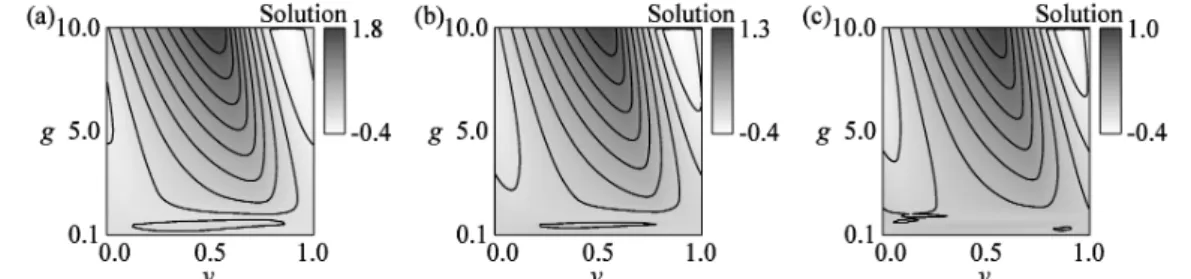
Figures 4(a) through 4(c) show the numerical solutions in the 2-D phase space $(y,g)$ with
$p=5$ for different values ofthe non-dimensionalized maximum swimming speed
$w_{M}$
.
Similarly,Figures 5(a) through 5(c) show the computed optimal ground velocity $V_{g}$ in the 2-D phase space
$(y,g)$ with $p=5$ for different values of $w_{M}$
.
The computational results show that the ascendingconditionis satisfied for sufficiently high valuesof the trend $g$
.
The computationalcases
withlowerand higher values of $p$ have also beenperformed. The results withthelower values of $p(p=0.5$
and $p=1)$
are
qualitativelysame
with those in Figures 4 and 5 except for that the numerical solutions are much smoother. On the other hand, the numerical solutions forthe high values of $p$$(p\geq 10)$exhibitlongitudinaloscillations,whichareconsideredtobe numericalartifacts.
$y$ $y$ $y$
Figure4:Steadysolutionsinthe boundedcasefor $p=5$ and thetrend $0.1\leq g\leq 10$ with(a) $w_{M}=5$, (b)
$w_{M}=6$,and(b) $w_{M}=7$.Thecounterscorrespondtotheten-sectionlines ofthemaximumandminimum
values.
ア $y$ ア
Figure5: The optimalgroundspeedintheboundedcasefor $p=2$ andthetrend O.$1\leq g\leq 10$
with(a) $w_{M}=5$,(b) $w_{M}=6$,and(b) $w_{M}=7$
.
The black linescorrespondto the contour line for $V_{g}=0.$6. Conclusions
Astochastic process model for analytical assessment of ascendingbehaviourofindividual fishes
was
proposedand basicproperties ofits solutions
are
investigatedbothfrom analytical and numerical pointofviews.A regularized counterpart has also beenpresented and
was
applied to numerical simulationof ascending behaviour of fishes in
a
longitudinally periodic channel. Although the presentedanalytical solutions
are
for the dynamics underthe simplified cases, theywouldserve
as basics for comprehending mathematical properties ofthe HJBE.Inthis paper, the model
was
applied to the problems in 1-D open channels. Extension ofthehydraulic properties
are
appropriately distributed, is possible if intemal boundary conditionsare
appropriately specified at junctions. Horizontally 2-D counterpart of the model has already beenproposed in Yoshioka et al. (2014b) where the flow field is computed with the 2-D shallow water
equations. Otherproblemsnotfocused
on
in thispaperinvolve migrationoffishschools,whichcan
beat least partially solved with
an
altemative SDE basedon
an
appropriatemean
field approximation technique. Migration with moving and resting regimes, which isatypical behaviouroffishes,was
notaddressed
as
well. This research topic will be addressed witha
regime-switching diffusion process model that the authors recently developed, which isa
continuous time SDE coupled witha
discrete-state Markovprocess
$(Yin and Zhu, 2010;$Yoshioka$et al., 2014a)$.
Acknowledgements:Thisresearch is supportedby JSPSundergrant No. $25\cdot 2731$
.
The authorsthankto Dr. KenMori for his valuable suggestions andcomments
on
this research.References
[1] Brodersen, J., Nilsson, P.A., Ammitzbll, J., Hansson, L.A., Skov, C., and $Br6$nmark, C.(2008)
Optimal swimming speed in head currentsand effects
on
distancemovementofwinter-migratingfish,PLOSONE,Vol.3, No.5,$7pp$
.
DOI: $10.1371\Gamma_{j}ouma1.$pone.$0002156.$[2] Cote, D., Kehler, D.G., Boume, C., and Wiersma, YF. (2009) A
new
measure
of longitudinalconnectivity forstreamnetworks,LandscapeEcology, Vol.24,No. 1,pp. 101-113.
[3] Fujihara, M. and Akimoto, M. (2010) A numerical model of fish movement in
a
vertical slotfishway,Fisheries Engineering,Vol.47,No. 1,
pp.
13-18.[4] Iosilveskii, G. andWeihs, D. (2008) Speed limits
on
swimming of fishes and cetaceans,Journalofthe
RoyalSociety, Interface, Vol.5, No. 20,pp. 329-338.[5] Katopodis, C.andWilliams,J.G.(2012)Thedevelopmentsof fishpassageresearch in
a
historicalcontext,Ecological Engineering, Vol. 48,pp. 8-18.
[6] Liao, J.C. (2007) A review of fish swimming mechanics and behaviour in altered flows,
Philosophical Transactions
ofthe
RoyalSociety(BiologicalSciences),Vol.362,pp. 1973-1993.[7] $\emptyset$ksendal,B.(2007)Stochastic
Differential
Equations,Springer-Verlag,Berlin, 1-167.[8] Unami, K., Ishida, K., Kawachi, T., Maeda, S., and Takeuchi, J. (2010) A stochastic model for
behavior offishascending
an
agriculturaldrainage system,Paddyand WaterEnvironment, Vol.8, No.2,pp. 105-111.[9] Willis, J. (2011) Modelling swimming aquatic animals in hydrodynamic models, Ecological
Engineering, Vol. 222,pp. 3869-3887.
[10]Yamamoto, T. and Oishi, S. (2006)Amathematical theory for numerical treatment of nonlinear
two-pointboundaryvalue problems, Japan Joumal of IndustrialandAppliedMathematics,Vol. 23,
No. 1,pp. 31-62.
[11]Yin, G.G. and Zhu, C. (2010) HybridSwitching Diffiions, Springer Science$+$Business Media,
LLC,pp. 1-67.
[12]Yoshioka, H. and Unami, K. (2013) A cell-vertex finite volume scheme for solute transport
equations inopenchannelnetworks,ProbabilisticEngineeringMechanics,Vol.31,pp. 30-38.
[13]Yoshioka, H., Unami, K.,andFujihara, M.(2014a)A regime-switchingdiffusionprocessmodel
for longitudinal dispersion phenomena in vegetated open channels, Proceedings
of
the $63rd$NationalCongresson Theoretical andAppliedMechanics,OS-15-02-03,pp. 1-2.
[14]Yoshioka, H., Unami, K., and Fujihara, M. (2014b) A stochastic process model for ascending
behaviour of fishes infishways, Proceedings
of
the $22nd$JapanRainwater Catchment SystemsAssociation Congress,pp.31-36.
[15]Yoshioka, H., Unami, K.,and Fujihara, M.(2015) Mathematical analysis
on
a
conformingfiniteelement scheme for advection-dispersion-decay equations