21COE-GLOPE Working Paper Series
If you have any comment or question on the working paper series, please contact each author.
When making a copy or reproduction of the content, please contact us in advance to request permission. The source should explicitly be credited.
GLOPE Web Site: http://www.waseda.jp/prj-GLOPE/en/index.html
Endogenous Timing in a Mixed Duopoly:
Price Competition with Managerial Delegation
Yasuhiko Nakamura and Tomohiro Inoue
Working Paper No. 30
Price Competition with Managerial Delegation ∗
Yasuhiko Nakamura
†Tomohiro Inoue
‡Abstract
We introduce a managerial delegation contract into the model of B´arcena-Ruiz (2007) and examine its influence on a price-setting mixed duopoly in the context of the endogenous timing problem. We obtain the result that the owners of both firms prefer to set their own prices as late as possible, and thus in equilibrium, the firms choose their prices simultaneously in the latter stage of the game. This is in contrast to the findings of B´arcena-Ruiz (2007) that firms choose prices simultaneously in the former stage.
Keywords: mixed duopoly, managerial delegation, endogenous timing JEL Classifications: D43, L13, L32
1 Introduction
This study investigates the effects of a managerial delegation contract on the analysis of mixed oligopoly when the timing of the firms’ moves is endogenous. An industry in which welfare- maximizing public firms compete with profit-maximizing private firms is usually referred to as a mixed oligopoly. In the real world, despite the worldwide wave of privatization since 1980s, many public firms compete with private firms in private goods markets. The analyses of mixed oligopoly intend to explain the impact of public firms and their privatization on market outcomes. The literature of modern theoretical game analyses on mixed oligopolies can be traced back to a study
∗We appreciate the financial support from the Japanese Ministry of Education, Culture, Sports, Science and Tech- nology under Waseda University 21st-COE GLOPE project. Needless to say, we are responsible for any remaining errors.
†Corresponding. Address of author: Graduate School of Economics, Waseda University, 1-6-1, Nishi-waseda, Shinjuku-ku, Tokyo, 169-8050, Japan. (e-mail: [email protected])
‡Address of author: Graduate School of Economics, Waseda University, 1-6-1, Nishi-waseda, Shinjuku-ku, Tokyo, 169-8050, Japan. (e-mail: [email protected])
of De Fraja and Delbono (1989) and it has offered logic to explain observed phenomenon in mixed oligopolistic market.
The conventional literature on mixed oligopoly mainly assumes that the order of the firms’
moves is exogenous. However, in recent years, there has emerged some literature on mixed oligopoly that endogenizes the timing of the firms’ moves. Pal (1998), who has done pioneering work in this field assumed a situation in which firms decided quantities and obtained strikingly different results from those in a corresponding private oligopoly, namely, that the public firm can be the follower in equilibrium. Matsumura (2003) and Lu (2006) also considered the issue of endogenous timing in mixed oligopoly. They extended Pal’s (1998) model to investigate the situation in which a domestic public firm competes with foreign private firms. Although most of the literature assumed the quantity-setting game, B´arcena-Ruiz (2007) considered the model where a public firm and a private firm, whose goods are substitutes, choose their prices sequentially or simultaneously.
The above-mentioned papers adopt the observable delay game of Hamilton and Slutsky (1990) to determine the endogenous decision of firms’ moves, and thus, in the models of the four papers, the firms simultaneously decide in an initial stage to move early or late and then play in subsequent stages, based on these timing decisions.
This study examines how a managerial delegation contract affects the above results. We con- sider the contract `a la Fershtman and Judd (1987) and Sklivas (1987). They explicitly modeled the interaction between internal owner-manager contracting and external strategic market competition, according to which, the firms’ owners who aim to maximize their own profits hire managers who do not profit-maximize. Both of Fershtman and Judd and Sklivas considered two-stage duopoly games where, at the first stage, owners choose managerial incentive contracts for managers and in the second stage managers compete in the duopolistic market. The Fershtman-Judd-Sklivas model has become popular and has been applied to competition among private firms.1 As described later, we model the managerial delegation based on Lambertini (2000). Considering such a delegation contract, we analyze a case in which the public sector indirectly manages its firm by delegating managerial decision-making to an agent, in contrast to the conventional analysis in which all man- agerial decision-making is directly carried out by the public sector. In this regard, however, there exist a few studies on managerial delegation in mixed oligopoly. Barros (1995) and White (2001) were based on Fershtman and Judd (1987) and Sklivas (1987) regarding the basic structures of the models and assumed that each of the owners provided a linear combination of profit and sales
1Fershtman et al. (1991), Polo and Tedeschi (1992), B´arcena-Ruiz and Paz Espinoza (1996) and Lambertini (2000) also considered the interplay between market competition and the internal organization of the firm in the fashion of Fershtman and Judd (1987) and Sklivas (1987).
revenue as a managerial incentive contract to their managers.2 However, they considered simulta- neous quantity competition as well as most works on mixed oligopoly. Thus, Nakamura and Inoue (2007), our companion study, examined the effects of the managerial delegation through compar- isons with Pal (1998), who analyzed the endogenous timing in quantity-setting mixed oligopoly.
In that study, we showed that the delegation contract does not affect the equilibrium timing of quantity-settings and proved the robustness of the result in Pal (1998).
In this paper, we provide the analysis on a price-setting mixed duopoly with the managerial delegation contract. As mentioned above, since B´arcena-Ruiz (2007) examined the endogenous timing in a price-setting mixed duopoly, we clarify the role of the delegation contract in mixed oligopoly by comparing our results with B´arcena-Ruiz (2007). Under price competition with substi- tute goods, the firms have upward-sloping reaction functions unlike the case of strategic substitutes in a quantity setting.
We explicitly recognize separation of ownership from management and analyze the game with the stage at which owners provide their managers with incentives that deviate from profit maxi- mization, unlike a simple observable delay game in the context of a price-setting mixed duopoly in B´arcena-Ruiz (2007). Thus, in our model, each firm’s manager decides his or her own price in the market competition. In the literature on private duopoly, Lambertini (2000) adopted the same approach as ours. He first addressed the issue of the timing for deciding strategic variables (prices/outputs) by each firm’s manager in the observable delay game between managerial firms.
We also take the same approach concerning managerial delegation. Specifically, the owners of firms provide the incentive contract as a linear combination of the profit Πi and salesqi to their managers. Each manager sets prices to maximize his or her own payoff in terms of the incentive contract provided by the owner. Our interest lies in whether the result in B´arcena-Ruiz (2007) varies or not by introducing the managerial delegation. The result is striking and surprising. We show that the public and private firm set prices simultaneously in the later stage, since it is a dominant strategy for the two owners to set prices as late as possible. This result is in contrast to that in B´arcena-Ruiz (2007), in which a public firm and a private firm set prices as soon as pos- sible when both of them are entrepreneurial. Our result, as well as that of B´arcena-Ruiz, justifies and explains the reasoning behind the assumption in most of the literature on price-setting mixed oligopoly that all firms simultaneously set their own prices.
The rest of this paper is organized as follows: In Section 2, we formulate the basic setting, and
2Nishimori and Ogawa (2005) also applied the managerial delegation contract to the mixed oligopolistic setting.
They extended the intertemporal contract decision in a private duopoly by B´arcena-Ruiz and Paz Espinoza (1996) into the mixed duopolistic case.
in Section 3 we analyze three types of competition of fixed timing and present the equilibrium of our model. Section 4 contains concluding remarks.
2 Setting
We adopt a simplified version of the linear demand model initiated by Dixit (1979) and applied by Singh and Vives (1984). We have an economy composed of a monopolistic sector with a public firm and a private firm, and a competitive sector producing the numeraire good. Each of the firms produces a differentiated good in the monopolistic sector. In the rest of this paper, we often refer to the public firm as Firm 0 (private firm as Firm 1) and the owner of the public firm as Owner 0 (owner of private firm as Owner 1). There exists a continuum of consumers of the same type with a utility function linear and separable in the numeraire good. The representative consumer maximizesU(q0, q1)−p0q0−p1q1, whereqi≥0 is the amount of the goodithat Firmiproduces andpi is its price (i= 0,1). We assume that the functionU(q0, q1) is quadratic, strictly concave, and symmetric inq0 andq1:
U(q0, q1) =a(q0+q1)−1
2(q02+ 2bq0q1+q21) a >0, b∈(0,1),
where b represents the degree of product differentiation. The specification implies the following direct demand function:
qi =a(1−b)−pi+bpj
1−b2 i, j= 0,1; i6=j.
Each firm has an identical technology represented by a constant marginal cost functionC(qi) =cqi (c≥0). The profit function of Firmiis denoted by
Πi= (pi−c)qi i, j= 0,1; i6=j,
whereqiis given by the above demand function. Social welfare, denoted byW, is measured as the sum of consumer surplus (denoted byCS) and producer surplus (denoted byP S).
W =CS+P S, whereP S= Π0+ Π1and consumer surplus is given by
CS=U(q0, q1)−p0q0−p1q1= 2a2(1−b) +p20−2bp0p1+p21−2a(1−b)(p0+p1)
2(1−b2) .
Owner 0 is assumed to be a welfare maximizer, while Owner 1 is assumed to maximize his or her own profit.
In addition, This paper focuses on the managerial aspects of firms. Thus, we consider the situation where the firms’ owners decide to delegate control to managers. To formalize managerial delegation, we follow Lambertini (2000). Each of the owners can assess the performance of his or her manager according to two readily observable indicators,i.e., the profit and output of the firm.
Following the precedents of the literature on managerial incentive contract, we assume that the manager of Firmi maximizes the following functionVi(Πi, qi):
Vi(Πi, qi) = Πi+θiqi θi∈R, i= 0,1,
where parameterθiidentifies the weight attached to the value of sales.3 In this delegation regime, the manager of Firmican maximize his or her payoff by choosing the pricepi that maximizesVi. This can be supported by the assumption that the payoff to the manager of Firmiis represented asλi+µiVifor some real numberλi and some positive numberµi. This type of delegation scheme functions as a commitment device, since it is common knowledge before the managers compete against each other.4 Similar to most literature on managerial delegation, we assume that the effect of the managers’ payoffs on profits is negligible, since we emphasize the influence of incentive contracts on market outcomes.
We consider the observable delay game in the context of a price-setting mixed duopoly. Note that in this model, a preplay stage is added to the normal mixed duopolistic game. In the game, the firms’ owners first announce in which stage their managers will choose their own prices and are committed to the choice before the price competition. After both the owners’ announcements, each of the managers sets his or her own price, knowing when the opponent will set his or her own price.
Formally, the game runs as follows: In the first stage, Owneriindependently choosesti ∈ {3,4}, where ti indicates the time at which price pi should be set (i = 0,1). ti = 3 implies that Firm i’s manager sets his or her own price in the third stage, and ti = 4 implies that he or she sets his or her own price in the fourth stage. In other words,ti = 3 means that the manager selects an earlier choice of price, andti = 4 means that the manager selects the later choice of price. At the end of the first stage, the timing-decisions are revealed. In the second stage, Owners 0 and 1 simultaneously set their respective firm’s value of θi. In the third stage, the manager of Firmi selects his or her own pricepi when Owneri chooses ti = 3. If the corresponding owner chooses ti= 4, the manager does nothing at this stage. At the end of the third stage, the manager of the rival firmj (6=i) that Ownerj choosestj = 4 in the first stage, observes the value ofpi which the
3Even if we replaceqiwithpiinVi(i= 0,1), our results hold.
4Katz (1991) showed general conditions under which unobserved agency contracts can operates as a commitment device.
manager of Firmi has already decided. In the fourth stage, the manager of Firm iselects his or her own pricepiwhen Ownerichoosesti= 4. At the end of the game, the market opens and each firm sells its own product. We adopt a subgame perfect Nash equilibrium, and thus the game is solved backward.
3 Results for Endogenous Timing
We analyze the subgame perfect Nash equilibrium in the above four-stage game. In this regard, we use a case in which both Owners 0 and 1 set their respective delegation parametersθi to zero (no-delegation case) as a benchmark to clarify the role of managerial delegation (i= 0,1).
3.1 Price-setting
In the third and fourth stages, the manager of Firmichooses his or her price to maximizeVi(Πi, qi).
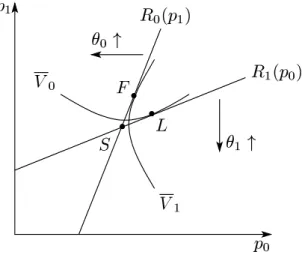
Since there are three subgames — the simultaneous game (CaseS), the sequential game with Firm 0 as the leader (Case L), and the sequential game with Firm 0 as the follower (Case F) — we analyze the respective equilibrium. Figure 1 represents the equilibrium points of three cases. In this figure, pointk∈ {S, L, F}is the equilibrium point in Casek, andRi(pj) denotes the reaction curve of Firmi(i, j= 0,1; j 6=i).
Ri(pj) = a(1−b) +c+bpj−θi
2 .
Viexpresses the iso-payoff curve of the manager of Firmi. This figure shows that the price of each firm is a strategic complement for the other firm’s price and the increase inθi shifts the reaction functionRi(pj) inward.
3.2 Managerial Delegation
In the second stage, the owners of both firms simultaneously choose their delegation parameters to maximize their objectives. In analogy with the price-setting stages, we should classify the analyses into CasesS,L, andF.
Case S. The reaction functions of both owners,rS0(θ1) andrS1(θ0), are rS0(θ1) = (2−b−b2)2(a−c) +b3θ1
4−3b2 , rS1(θ0) =−b2[(2−b−b2)(a−c)−bθ0] 4(2−b2) .
p
1
p
0 R
0 (p
1 )
R
1 (p
0 )
L F
S
V
1 V
0
0
"
1
"
Figure 1: Equilibrium points in the price-setting stages
From these equations, the delegation parameters in equilibrium are as follows:5 θ0S= (1−b)(8−8b2−2b3+b4)(a−c)
8−8b2+b4 , θS1 =−b2(1−b)(2−b2)(a−c) 8−8b2+b4 .
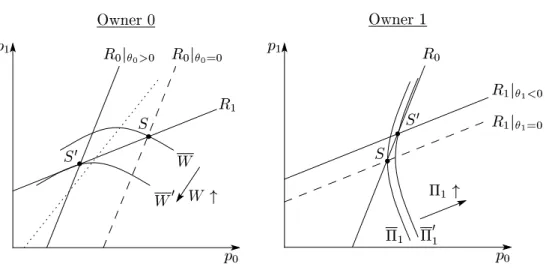
The equilibrium delegation parameter of Owner 1 is negative for anyb ∈(0,1), whereas that of Owner 0 is positive in the wide range ofb (0 < b <0.942). This is because Owner 1 prefers to raise the equilibrium price by shifting his or her reaction function outward for the purpose of increasing profit. On the other hand, since Owner 0 aims at maximizing social welfare, he or she wishes to decrease the price in order to increase consumer surplus. However, whenbis sufficiently close to 1 (in other words, the degree of product differentiation is sufficiently low),θS0 is negative because, in this case, the equilibrium prices of both firms are close to the marginal cost c and more reduction in price leads to excessive decrease in producer surplus. This mechanism can be explained by comparing it with the no-delegation case as in Figure 2. On the left of this figure, equilibrium pointS moves left by increasing θ0. As a result, Owner 0 can obtain a higher payoff (social welfare).6 On the other hand, Owner 1 gets a higher payoff (profit) by reducingθ1.
The respective values in the equilibrium are as follows:
pS0 = 2ab(1−b) +c(8−2b−6b2+b4)
8−8b2+b4 , pS1 = 2a(2−2b−b2+b3) +c(4 + 4b−6b2−2b3+b4)
8−8b2+b4 ,
ΠS0 =2b(1−b)(8 + 2b−8b2−2b3+b4)(a−c)2
(1 +b)(8−8b2+b4)2 , Π1S =2(1−b)(2−b2)3(a−c)2 (1 +b)(8−8b2+b4)2 , CSS= (40 + 8b−78b2−18b3+ 50b4+ 12b5−12b6−2b7+b8)(a−c)2
(1 +b)(8−8b2+b4)2 ,
5Henceforth, we indicate the equilibrium values with superscriptk∈ {S, L, F}.
6The dotted line on the left in Figure 2 represents the reaction function of Firm 0 when its manager maximizes social welfare.
R
0 j
0=0 R
0 j
0>0
R
1
S 0
W
W 0
W "
S p
1
p
0 Owner0
1
0
1
1
"
R
0
R
1 j
1
<0
R
1 j
1=0
S S
0 Owner1
p
0 p
1
Figure 2: The choice of the delegation parameter in the simultaneous game
WS =(56 + 8b−114b2−14b3+ 74b4+ 6b5−16b6+b8)(a−c)2 (1 +b)(8−8b2+b4)2 .
Case L. The reaction functions are
r0L(θ1) = (8−8b−6b2+ 5b3+b4)(a−c) +b3θ1
8−10b2+ 3b4
r1L(θ0) =−b2[(1−b)(4 + 2b−b2)(a−c)−b(2−b2)θ0] (2−b)(2 +b)(4−3b2) . Thus, the equilibrium delegation parameters are as follows:
θL0 = (1−b)(32−40b2−4b3+ 10b4+b5)(a−c)
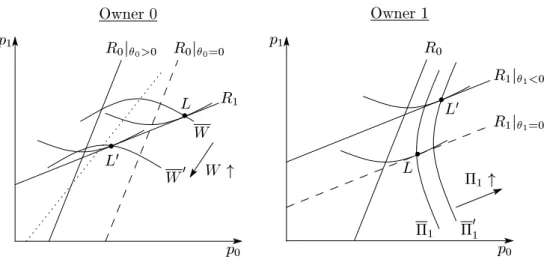
(2−b2)(16−20b2+ 5b4) , θ1L=−2b2(1−b)(2−b2)(a−c) 16−20b2+ 5b4 . By analogy to Case S, θ1L < 0 for anyb ∈(0,1), but θ0L >0 for b ∈(0,0.978). The reason for this is similar to that in Case S and is illustrated in Figure 3. For both the owners, the change of the delegation parameter from zero (Owner 0 raisesθ0, while Owner 1 reducesθ1) makes the equilibrium point move from Lto L0. If the opponent does not change his or her delegation parameter, each owner gets a higher payoff from the change.
The equilibrium prices, profits, consumer surplus, and social welfare are as follows:
pL0 =ab(4−4b−b2+b3) +c(16−4b−16b2+b3+b4)
16−20b2+ 5b4 ,
pL1 =a(8−8b−6b2+ 6b3+b4−b5) +c(8 + 8b−14b2−6b3+ 4b4+b5)
16−20b2+ 5b4 ,
ΠL0 = b(1−b)(2−b)(2 +b)(16 + 4b−20b2−5b3+ 5b4+b5)(a−c)2
(1 +b)(16−20b2+ 5b4)2 ,
R
0 j
0=0 R
0 j
0>0
R
1
W
W 0
W "
p
1
p
0 Owner0
1
0
1
1
"
R
0
R
1 j
1<0
R
1 j
1
=0 Owner1
p
0 p
1
L 0
L
L L
0
Figure 3: The choice of the delegation parameter in the sequential game (leader: Firm 0)
ΠL1 = (1−b)(2−b)(2 +b)(4−3b2)(2−b2)2(a−c)2 (1 +b)(16−20b2+ 5b4)2 ,
CSL=(320 + 64b−784b2−176b3+ 684b4+ 164b5−251b6−59b7+ 33b8+ 7b9)(a−c)2
2(1 +b)(16−20b2+ 5b4)2 ,
WL= (448 + 64b−1136b2−144b3+ 1012b4+ 108b5−369b6−31b7+ 47b8+ 3b9)(a−c)2
2(1 +b)(16−20b2+ 5b4)2 .
Case F. The reaction functions of both owners are
r0F(θ1) = (16−16b−20b2+ 18b3+ 7b4−5b5)(a−c) +b3(2−b2)θ1
16−20b2+ 5b4 , r1F(θ0) = 0.
In this case, Owner 1 setsθ1 = 0 independent ofθ0. This is because Firm 1 is the Stackelberg leader in the price-setting stages, and thus, the price change by the managerial delegation does not increase its profit. This behavior of Owner 1 (profit maximizer) was pointed out by Lambertini (2000). Therefore, the delegation parameters in the equilibrium of CaseF are as follows:
θ0F =(1−b)(2−b)(8 + 4b−8b2−5b3)(a−c)
16−20b2+ 5b4 , θF1 = 0.
As in the above two cases, Owner 0 chooses a positiveθ0 in the wide range of b(0< b <0.961).
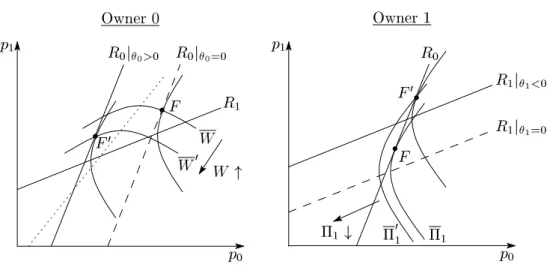
Figure 4 depicts this mechanism. For example, even though Owner 1 choosesθ1<0, the profit of Firm 1 does not increase, whereas social welfare is improved by settingθ0>0.
The equilibrium values in CaseF are as follows:
pF0 = 2ab(2−2b−b2+b3) +c(16−4b−16b2+ 2b3+ 3b4)
16−20b2+ 5b4 ,
pF1 = a(8−8b−6b2+ 6b3) +c(8 + 8b−14b2−6b3+ 5b4)
16−20b2+ 5b4 ,
R
0 j
0=0 R
0 j
0>0
R
1
W
W 0
W "
p
1
p
0 Owner0
0
1
1
1
#
R
0
R
1 j
1<0
R
1 j
1
=0 Owner1
p
0 p
1
F 0
F
F F 0
Figure 4: The choice of the delegation parameter in the sequential game (leader: Firm 1)
ΠF0 =2b(1−b)(2−b2)(16 + 4b−20b2−4b3+ 5b4)(a−c)2 (1 +b)(16−20b2+ 5b4)2 , ΠF1 =2(1−b)(2−b2)(4−3b2)2(a−c)2
(1 +b)(16−20b2+ 5b4)2 , CSF = (10 + 2b−12b2−2b3+ 3b4)(a−c)2
(1 +b)(16−20b2+ 5b4) , WF = (14 + 2b−18b2−2b3+ 5b4)(a−c)2 (1 +b)(16−20b2+ 5b4) .
3.3 Timing Choice
In the first stage, both owners determine whether their firms set their own prices at the third or fourth stage. Matrix 1 represents this situation. Each owner chooses the strategy according to his or her payoff ranking. Thus, we first consider the ranking based on the results of the previous subsection. As a result, we obtain the following lemma.
Owner 1
t1= 3 t1= 4
Owner 0
t0= 3 (WS, Π1S) (WL, ΠL1) t0= 4 (WF, Π1F) (WS, ΠS1) Matrix 1: The choice of the timing
Lemma 1. In the second stage, the equilibrium values of three cases are ranked as follows:
(i) θL0 > θ0F > θ0S andθF1 > θ1S> θ1L.
(ii) pL0 > pS0 > pF0 andpL1 > pS1 > pF1. (iii) ΠL0 >ΠS0 >ΠF0 andΠL1 >ΠS1 >ΠF1.
(iv) CSF > CSS > CSL andWF > WS > WL.
Since in the no-delegation case the prices of both firms in CasesLandF are higher than those in CaseS, Owner 0 who aims at maximizing social welfare prefers to reduce the prices in order to increase consumer surplus. Thus, he or she sets the higher delegation parameter in Cases Land F. On the other hand, since Owner 1 can increase the profit of Firm 1 by reducing the delegation parameter from zero in CasesS andL,θ1S and θL1 are smaller thanθ1F (= 0).
With regard to the equilibrium prices, in Case F, since Firm 1 is the Stackelberg leader of the price-setting stages, Owner 1 cannot increase the profit of Firm 1 by changing the delegation parameter from zero. Hence, the decision of Owner 0 in the second stage is directly reflected in the ensuing behavior of both firms. As a result, pFi is the lowest in the three cases (i = 0,1).
On the other hand, in CasesS andL, Owner 1 can increase the profit by reducing the delegation parameter from zero. Considering thatθL1 < θS1 and pL1 > pS1 at θL1 =θS1 = 0, we find that the price of Firm 1 in Case L is higher than that in Case S. In addition, it also raises the price of Firm 0 because in the above price-setting stages, the equilibrium price of Firm 0 is the decreasing function ofθ1. Therefore,pLi is the highest in the three cases.
The rank order of the both firms’ profits is identical with that of the prices (ΠLi >ΠSi >ΠFi );
however, in consumer surplus, the ranking is inverted (CSF > CSS > CSL). Finally, social welfare is ranked asWF > WS > WL.
Taking into account Lemma 1, we obtain the following proposition.
Proposition 1. In the subgame perfect Nash equilibrium of the four-stage game with the manage- rial delegation, both firms decide their prices simultaneously at the fourth stage (t0=t1= 4).
By Lemma 1, Owners 0 and 1 wish to set their firms’ prices after the price-setting of their opponents. Accordingly, both owners have dominant strategies in the first stage, as described in Matrix 1, to set prices at ti = 4, and thus, the managers of the firms decide their prices simultaneously at the fourth stage.
The equilibrium timing of the price-setting in B´arcena-Ruiz (2007) is different than that in the above proposition. In the former, the owners of both firms wish to set their prices before their opponents do; however, in the latter, they prefer to set them after their opponents because the price-setting of each firm occurs only once in B´arcena-Ruiz (2007), whereas both firms twice set their prices substantially in our model because of managerial delegation. In addition to this, the
fact that in our model, the objective of the public sector to maximize social welfare is reflected in Firm 0 only through the decision of the delegation parameter, also affects the result.
In B´arcena-Ruiz (2007), since the decision for maximizing social welfare is made in the price- setting stages, the equilibrium prices are influenced a great deal by the objective of the Stackelberg leader. Thus, the rank order of the equilibrium prices ispFi > pSi > pLi (i= 0,1). On the other hand, in our model, since the decisions of both the owners are entered before the price-setting stages, the adjustment of the price through the managerial delegation affects the result. As a result, the ranking ispLi > pSi > pFi .
Since a rise in prices increases the profits but decreases consumer surplus, Owner 0 prefers the case in which lower prices are realized. On the other hand, Owner 1 prefers the case in which higher prices are realized. Accordingly, both the owners have dominant strategies to set their prices in the fourth stage.
4 Conclusion
This paper examined a model in which a public firm and a private firm set their own prices sequentially or simultaneously, by focusing on the managerial delegation of firms. We extended B´arcena-Ruiz’s (2007) setting as an application of the observable delay game of Hamilton and Slutsky (1990) by introducing a delegation contract `a la Fershtman and Judd (1987) and Sklivas (1987). In our model, we showed that in the subgame perfect Nash equilibrium, both the public and the private firms choose their own prices in the later stage. Our result is different from the result in B´arcena-Ruiz (2007).
In a quantity-setting mixed duopoly, Nakamura and Inoue (2007) extended Pal’s (1998) observ- able delay game by introducing managerial incentive contracts in the same manner as ours. They showed that Pal’s (1998) results are robust against the introduction of the managerial delegation.
In short, they found that two managerial firms sequentially set outputs in equilibrium. However, in a price-setting mixed duopoly, the result of the observable delay game in the context of mixed duopoly varies as a result of introducing the delegation contract. The owners of the public and private firms are reluctant to be the leaders in the case of price competition.
In this paper, we assumed that the technologies of both public and private firms are represented by the same constant marginal cost functions. It can be easily verified that the result that both firms’ managers decide prices simultaneously in the fourth stage (t0=t1= 4) remains unchanged against the assumption that the public firm is less efficient than the private firm.
As a valid next step, two extensions of our model can be considered. The first is to generalize
the number of (private) firms in the market and the periods of price competition. We restricted our attention to two firms and two periods in the price competition as in B´arcena-Ruiz (2007).
Similar to Pal (1998) and Lu (2006), by considering the more generalized observable delay game in the context of mixed oligopoly, we can discuss the influence of the number of the firms and the degree of product differentiation on the equilibrium outcomes. The other possible extension is to consider the case that some firms are foreign-owned. It seems to more productive to analyze the model in which foreign shareholders are taken into account. Moreover, as is indicated by Lu (2006), one generally considers that foreign firms are more efficient than domestic ones. These issues are left for future research.
References
B´arcena-Ruiz, J. C. (2007): “Endogenous Timing in a Mixed Duopoly: Price Competition.”Jour- nal of Economics 91: 263–272.
B´arcena-Ruiz, J. C., and Paz Espinoza, M. (1996): “Long-Term or Short-Term Managerial Con- tracts.” Journal of Economics and Management Strategy5: 343–359.
Barros, F. (1995): “Incentive Schemes as Strategic Variables: An Application to a Mixed Duopoly.”
International Journal of Industrial Organization13: 373–386.
De Fraja, G., and Delbono, F. (1989): “Alternative Strategies of a Public Enterprise in Oligopoly.”
Oxford Economic Papers41: 302–311.
Dixit, A. (1979): “A Model of Duopoly Suggesting a Theory of Entry Barriers.”Bell Journal of Economics10: 20–32.
Fershtman, C., and Judd, K. (1987): “Equilibrium Incentives in Oligopoly.”American Economic Review 77: 927–940.
Fershtman, C., Judd, K., and Kalai, E. (1991): “Observable Contracts: Strategic Delegation and Cooperation.” International Economic Review32: 551–559.
Hamilton, J. H., and Slutsky, S. M. (1990): “Endogenous Timing in Duopoly Games: Stackelberg or Cournot Equilibria.”Games and Economic Behavior2: 29–46.
Katz, M. L. (1991): “Game-Playing Agents: Unobservable Contracts as Precommitments.”RAND Journal of Economics 22: 307–328.
Lambertini, L. (2000): “Extended Games Played by Managerial Firms.”Japanese Economic Re- view 51: 274–283.
Lu, Y. (2006): “Endogenous Timing in a Mixed Oligopoly with Foreign Competitors: The Linear Demand Case.”Journal of Economics 88: 49–68.
Matsumura, T. (2003): “Stackelberg Mixed Duopoly with a Foreign Competitor.” Bulletin of Economics Research55: 275–287.
Nakamura, Y., and Inoue, T. (2007): “Endogenous Timing in a Mixed Duopoly: The Managerial Delegation Case.”Economics Bulletin, 12(27): 1–7.
Nishimori, A., and Ogawa, H. (2005): “Long-Term and Short-Term Contract in a Mixed Market.”
Australian Economic Papers44: 275–289.
Pal, D. (1998): “Endogenous Timing in a Mixed Oligopoly.”Economics Letters61: 181–185.
Polo, M., and Tedeschi, P. (1992): “Managerial Contracts, Collusion and Mergers.” Ricerche Economiche 46: 281–302.
Singh, N., and Vives, X. (1984): “Price and Quantity Competition in a Differentiated Duopoly.”
RAND Journal of Economics15: 546–554.
Sklivas, S. D. (1987): “The Strategic Choice of Management Incentives.”RAND Journal of Eco- nomics18: 452–458.
White, M. D. (2001): “Managerial Incentives and the Decision to Hire Managers in Markets with Public and Private Firms.”European Journal of Political Economy17: 877–896.