21COE-GLOPE Working Paper Series
If you have any comment or question on the working paper series, please contact each author.
When making a copy or reproduction of the content, please contact us in advance to request permission. The source should explicitly be credited.
GLOPE Web Site: http://www.waseda.jp/prj-GLOPE/en/index.html
Cooperative Games with Two-Level Networks
Takumi Kongo
Working Paper No. 20
Cooperative Games with Two-Level Networks
Takumi KONGO∗
First version: July 2006 Latest version: July 2007
Abstract
This paper studies the cooperative games with restricted cooperation among players.
We define the situations in which both a coalition structure and a network exist simultane- ously and each of them mutually depends on each other. We call such situations two-level networks. By using a two-step approach, we define and axiomatize an allocation rule of the cooperative games with two-level networks. The allocation rule is an extension of the Myerson value and also, is characterized by the Owen value.
JEL classification: C71
Keywords: cooperative game, coalition structure, network,
1 Introduction
In many social and economic situations, agents form a group and act as if they were a single agent. For example, neighbor countries form a regional economic bloc such as EU and APEC and get into line with each other against other countries, labors form a labor union and negotiate jointly with a manager, firms form a cartel and jointly set a uniform high price and politicians form a political party and coordinate their policy. The reason why agents act in such a way is, in such situations, forming a group and coordinating the actions of each of the agents in the group lead to better outcomes for each of them if they appropriately distribute the surplus generated by their cooperation. Such group formation and surplus distributions are analyzed mainly by the cooperative games.
Since cooperation needs coordination and coordination requires communication, in real situations, agents who are not able to communicate with each other cannot cooperate even if they preferred to do so. The cause of lack of communication is, for example, lack of friendship, restriction by geographical location, technological problems and legislation. By introducing a network, Myerson (1977) generalized cooperative games and considered such cooperation restricted situations. In the Myerson’s model, only those players who are connected in a network by themselves can cooperate. Aumann and Dreze (1974) also considered the restriction of cooperation in a different way. They used coalition structures and only those players who are in the same element of a coalition structure can cooperate. The Aumann and Dreze’s model can be interpreted as special cases of the Myerson’s model, but later, Kamijo (2006) extended the possibility of cooperation in the Aumann and Dreze’s model. In his interpretation, players in different elements of a coalition structure can also cooperate if all players in the elements
∗Graduate school of Economics Waseda University. 1-6-1 Nishi-Waseda, Shinjuku-ku, Tokyo, Japan. E-mail:
kongo [email protected]
gather. Such cooperation restriction structures are no longer represented by the Myerson’s model.
The Myerson’s model focuses on individual aspects of the communication in a group while, the Aumann and Dreze model (with Kamijo interpretation) focuses on collective aspects of groups. Since these two aspects are closely related, we have to consider both of the two simultaneously. Vazquez-Brage et al. (1996) considered the situation in which both networks and coalition structures exist simultaneously. In their model, however, both networks and coalition structures are treated independently and hence the second aspects of communications and group formations which we mentioned in the above is not represented in the model itself.
They include this aspect by use of a coalitional solution concept. While, in this paper, we consider the situation in which both networks and coalition structures exist simultaneously and mutually depend on each other. Communication in such situations can be represented by two-level: the first level is only between players in the same element of a coalition structure and the second level is between elements of the coalition structure. We call such structures two-level networks and study cooperative games with two-level networks.
Two-level networks are observed in many social and economic situations. As an example, consider the case of a cartel. In a cartel, there are many firms and, inside of each firm, there are some workers. Each worker of a firm can only communicate with other workers in the same firm because, in general, each firm has its industrial secrets and hence only a worker of a firm does not have the authority to communicate with the outside of the firm. Such worker’s restricted communication situations are described in the first level. Also, if a firm do business with another firm, in general, all workers in the firm jointly communicate with the all workers who are in the other firm. Such collective communication situations between firms are described in the second level.
The paper is organized as follows. Basic definitions and notations are given in Section 2.
The definition of the two-level networks is given in Section 3. Cooperative games with the two-level networks and an allocation rule of the games are discussed in Section 4. Another representation of the allocation rule is given in Section 5. Further discussions are given in Section 6.
2 Basic definitions and notations
2.1 Cooperative games
A pair (N, v) is a cooperative game with transferable utility or, simply, a game where N = {1,2, . . . , n}is a set of finite players andv: 2N →Rwithv(∅) = 0 is acharacteristic function.
Let|N|=nwhere| · |represents the cardinality of a set. A subsetS of N is called acoalition.
For any S ⊆N, v(S) represents a value of the coalition. For any S ⊆ N, a pair (S, v|S) is a subgame of (N, v) on S where v|S(T) =v(T) for any T ⊆S.
Let π be a permutation on N and Π(N) be a set of all permutations onN. Givenπ and a player i ∈N, a player j ∈N satisfies π(j) < π(i) is called apredecessor for i in π and a set of all predecessors for i in π is denoted by P Rπi. Let v(P Riπ∪ {i})−v(P Rπi) be i’s marginal contributions inπ. TheShapley valueϕ(Shapley (1953)) is defined as follows: For eachi∈N,
ϕi(N, v) = 1
|Π(N)|
∑
π∈Π(N)
(v(P Rπi ∪ {i})−v(P Rπi)).1
2.2 Games with coalition structures
Let Bbe a partition of N, that is, any two elements ofB are mutually disjoint and the union of all the elements ofB isN. We call Ba coalition structure and each element ofB ablock. A triple (N, v,B) is a game with a coalition structure.
Three generalizations are considered as the Shapley value on games with coalition struc- tures. One is the Aumann and Dreze value introduced by Aumann and Dreze (1974). In Aumann and Dreze value, players interact with only players in the same block and gets his Shapley value of the restricted game. TheAumann and Dreze value ψAD is defined as follows:
For eachi∈N withi∈B ∈ B,
ψiAD(N, v,B) =ϕi(B, v|B).
Another is the two-step Shapley value introduced by Kamijo (2006). In the two-step Shapley value, the game (N, v,B) is treated as a two-step. For the first step, each player participate in the game within the block to which he belongs and he gets the Shapley value of the game.
For the second step, players in the same block unite and participate in a game between blocks as if they were a single player. The game between blocks in defined as a pair (B, w) where w: 2B →R satisfiesw(S) =v(∪
B∈SB)−∑
B∈Sv(B) for any S ⊆ B. Each block gets its the Shapley value of the game and it is equally distributed to all players in the block. We call this method a two-step approach and thetwo-step Shapley value ψK is defined as follows: For each i∈N withi∈B ∈ B,
ψKi (N, v,B) =ϕi(B, v|B) +ϕB(B, w)
|B| .
Unlike the Aumann and Dreze value and the two-step Shapley value, Owen (1977) restricted the set of permutations on N and introduced the Owen value. A permutation π ∈ Π(N) is consistent with B if for any i, j, k ∈N withπ(i) < π(k) < π(j) andi, j ∈B ∈ B thenk ∈B.
In other words, π is consistent with B if players in the same block appear successively in π.
Let Σ(N,B) be a set of all permutations on N, which is consistent with B. The Owen value ψO is defied as follows: For any i∈N,
ψiO(N, v,B) = 1
|Σ(N,B)|
∑
π∈Σ(N,B)
(v(P Rπi ∪ {i})−v(P Rπi)).
2.3 Games with networks
GivenN, we call a two players coalition{i, j} ⊆N a link. A link{i, j} represents a communi- cation channel betweeniandjand, for simplicity, is denoted byij. Let ¯L={ij|i, j∈N, i̸=j} be a complete links on N. A pair (N, L) is a network where L ⊆ L. For any¯ S ⊆ N, a pair (S, L(S)) is a subnetwork on S where L(S) = {ij ∈ L|i, j ∈ S}.2 Given (S, L(S)), if there exists a finite sequence of players i1, . . . , iH such that (i) i1 = i, (ii) iH = j and (iii) for any
1The Shapley valueϕcan be represented by the following way: For eachi∈N,
ϕi(N, v) = X
S⊆N\{i}
|S|!(n−1− |S|)!
n! (v(S∪ {i})−v(S)).
2By definition,L(N) =L. We abbreviateL(N) toL.
h= 1, . . . , H−1, ihih+1∈L(S) then iis connected to j in the subnetwork. Clearly, ifiis con- nected toj in (S, L(S)), then j is connected toiin (S, L(S)) and vice versa. In a subnetwork, two players are connected with each other if and only if they can communicate with each other.
Notice that, even if two players do not have a link between them, they can communicate with each other if they are connected. In that case, communication among them relies on other players. For any i∈S, let
Ci(L(S)) ={i} ∪ {j|j is connected to iinL(S)} be a set of players with whom ican communicate with iin (S, L(S)) and let
S/L={Ci(L(S))|i∈S}
be a communicable partition of S, that is, only i, j ∈ C ∈ S/L can communicate with each other in (S, L(S)).
A triple (N, v, L) is a game with a network. A generalization of the Shapley value of games with networks is the Myerson value introduced by Myerson (1977). The Myerson value evaluates each player’s contributions not only in a characteristic function but also in a network.
Given (N, v, L), we restrict the functionv by L as the following way: For anyS⊆N, vL(S) = ∑
C∈S/L
v(C)
The Myerson value µis defined as follows: For anyi∈N, µi(N, v, L) =ϕi(N, vL).
3 Two-level networks
In this section, we define communication situations in which networks and coalition structures exist simultaneously and mutually depend on each other. Such communication situations are called two-level networks. In a two-level network, there are two types of communication. Each of the two is represented by links between players and links between blocks respectively.
Let ˆL1 = {ij|i, j ∈ B, i ̸= j, B ∈ B}. ˆL1 contains all links between players in the same block but does not contain links between players in different blocks. A pair (N, L1) is a first level network where L1 ⊆ Lˆ1. By definition, a first level network describes a communication situation among players but the communication is restricted to the players within each block.
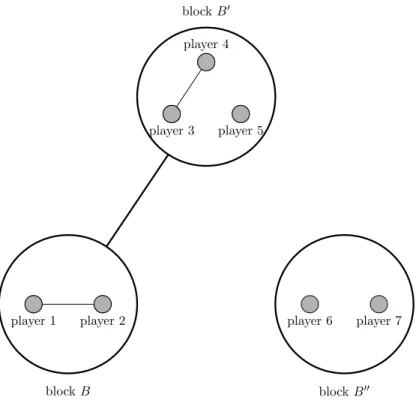
Next, let ¯L2 = {BB′|B, B′ ∈ B, B ̸=B′}, where BB′ represents a link {B, B′}. ¯L2 contains all links between blocks. A pair (B, L2) is a second level network where L2 ⊆ L¯2. A second level network describes a communication situation between blocks. Then a triple (N,B,L) is a two-level network where L= (L1, L2). An example of the two-level network is given in Fig.1.
By the definitions of first and second level networks, each of first and second level networks corresponds to the networks mentioned in Subsection 2.3. Since subnetworks, connectedness and communicable partitions are defined parallel to each definition, we don’t mention them in detail here but, let me point out one thing. For second level networks, subset of a coalition structure is a collection of a set of players. To represent a collection, we use the script such as S ⊆ B,L2(S) or CB(L2).
The important problem is, in a two-level network as a whole, who can cooperate with each other? Considering the two aspects of communication and group formation we mentioned in
player 1 player 2
player 5 player 3
blockB′
blockB
player 4
player 6 player 7
blockB′′
Figure 1: An example of the two-level networks
Section 1, we define the set of players with whom each player can cooperate in a two-level network as a whole as following way. For eachi∈N withi∈B ∈ B, Let
Di(L) = {
Ci(L1) If there exists noB′ ∈ B such that BB′ ∈L2
∪
B′′∈CB(L2)B′′ otherwise .
We can interpretDi(L) as a set of players with whom ican cooperate in (N,B,L). If a block which contains him does not form any link in the second level network, he can only cooperate with players who are connected with him. Otherwise, from the collective aspect of groups, he can cooperate with any players in blocks which connected with the block containing him in the second level network. In addition, through communication between players who are in different blocks, he can cooperate with all players who are in the same block even if who are not connected with him in the first level network. Let
N/L={Di(L)|i∈N}
be a communicable partition of N in (N,B,L). N/L is a collection of the maximal set of players who can communicate in (N,B,L). Hence it is composed of unions of blocks connected with each other and sets of players connected with each other in each block which forms no link in the second level network. In the case of Fig.1, the coalition{1,2,3,4,5}can cooperate but{6,7}cannot cooperate because they are not connected andB′′does not have link between other blocks. Therefore,N/L={{1,2,3,4,5},{6},{7}}.
4 Games with two-level networks and allocation rule
A 4-tuple (N, v,B,L) is agame with a two-level network. GivenN, let ΓN be a set of all games with two-level networks. An allocation rule of games with two-level networks is a function
which assigns a n-dimensional vector to all games in ΓN. We mention three axioms, which allocation rules should satisfy.
The first axiom is related to efficiency. In the games, each coalition generates a value by cooperation among players in the coalition. Hence the value generated by a maximal set of players who can cooperate with each other must be fully divided among them.
Two-level component efficiency; An allocation rule χ satisfies two-level component effi- ciency if for any (N, v,B,L)∈ΓN and any D∈N/L,
∑
i∈D
χi(N, v,B,L) =v(D).
The second axiom is related to fairness of allocation. Assume that a link between players is formed if both players agree. Then, two players should gain equally from their bilateral agreement. In other words, the influence of breaking a link between players should be equal to both of the players.
Within block fairness; An allocation ruleχsatisfies within block fairness if for any (N, v,B,L)∈ ΓN whereL= (L1, L2) and any ij ∈L1,
χi(N, v,B,L)−χi(N, v,B,L −ij) =χj(N, v,B,L)−χj(N, v,B,L −ij), whereL −ij= (L1−ij, L2) and L1−ij =L1\{ij}.
The third axiom is also related to fairness of allocation. Assume that a link between blocks is formed if both blocks agree and a block agrees only if all players in the block agree.3 Then, two blocks should gain equally from their bilateral agreement. Moreover, from collective aspect of the group, all players in the same block should gain equally. In other words, among each blocks, the sum of the influence of breaking a link between blocks should be equal to both of the blocks and the influence of breaking a link between blocks should be equal to all players in the same block.
Between block fairness; An allocation rule χ satisfies between block fairness if for any (N, v,B,L)∈ΓN where L= (L1, L2), anyBB′∈L2, any i∈B and any j∈B′,
|B|(
χi(N, v,B,L)−χi(N, v,B,L −BB′) )
=|B′|(
χj(N, v,B,L)−χj(N, v,B,L −BB′) )
,
whereL −BB′ = (L1, L2−BB′) andL2−BB′ =L2\{BB′}.
In the above axiom, the collective aspects of the group plays a critical role. If we ignore the aspect and modified the axiom as “the influence of breaking a link between blocks is same for any players in both of the blocks” then, the modified axiom and within block fairness together are equivalent to fairness on the game with conference structures introduced by Myerson (1980).
By the three axioms, we can define a unique allocation rule. To define the allocation rule, we need some more definitions. In the allocation rule, we use the two-step approach. For the first
3For this assumption, readers may have the following question: In the case of Fig.1, blockB′ forms a link although players in the block are not connected with each other within the block. How do they reach the agreement with forming link to other blocks? The answer of this question is the following. Communication between blocks are executed by agents employed by each block and the agents are connected with all players in the block which employs him.
step, each player participates in the game within the block to which he belongs and he receives the Myerson value of the game. For the second step, each block which want to collaborate with other block employs a agent and the agents participate in the game between blocks as a representative of each block. This agent is not a member of the player set N. Each agent participates in the game, receives the Myerson value of the game and distributes it equally among all players in the block. Mathematically, for players in B ∈ B, the game considered in the first step is defined as a triple (B, v|B, L1(B)) and the game considered in the second step is defined as a triple (B, wL1, L2) where wL1 : 2B → R with wL1(∅) = 0 is defined as follows:
For anyS ⊆ B,
wL1(S) =
0 if|S|= 1
v( ∪
B′∈S
B′)− ∑
B′∈S
vL1(B′) otherwise .4
In addition, in our allocation rule, the functionwL1 is restricted byL2as the following way:
For anyS ⊆ B,
(wL1)L2(S) = ∑
C∈S/L2
wL1(C) Then, the next theorem holds.
Theorem 1. For any(N, v,B,L)∈ΓN, there exists a unique allocation ruleχM which satisfies two-level component efficiency, within block fairness and between block fairness. The allocation rule is defined as follows: For each i∈N withi∈B ∈ B,
χMi (N, v,B,L) =µi(B, v, L1) + µB(B, wL1, L2)
|B| .
The following example illustrates the allocation rule defined in the above theorem.
Example 1. Let N = {1,2,3,4,5}, v(S) = (|S| − 1)2 for any S ⊆ N,B = {B, B′} = {{1,2,3},{4,5}} and L= (L1, L2) ={{12,23,45},{BB′}}.
Then, µ(B, v, L1) = (1412,1220,1412), µ(B′, v, L1) = (126,126 ). and µ(B, v, L2) = (6612,6612). Thus, χM(N, v,B,L) = (3612,1242,3612,3912,3912).
Before we give proof, it is worth mentioning the relationships between the allocation rule defined in the above theorem and values we mentioned in Section 2. If there exists no links between blocks, (one typical example is the case that the coalition structure is the coarsest one), χM coincides with the Myerson value of (N, v, L1). Moreover, in this case, Theorem 1 is equivalent to the axiomatization of the Myerson value (Myerson (1977)) since two-level component efficiency is equivalent to component efficiency, within block fairness is equivalent to fairness and between block fairness is trivial. In the case that the coalition structure is the finest one, the similar result is obtained. If there exist all links between all players in the same block and no/all links between all blocks,χM coincides with the Aumann and Dreze value/the two-step Shapley value respectively.
Proof of Theorem 1. First of all, we identifyχM satisfies each of three axioms. First, we check two-level component efficiency. There are two types ofD∈N/L, such that (i)D⊆B for some B ∈ B or (ii) otherwise.
4Readers may not be confused by writing (B, v, L1) instead of (B, v|B, L1(B)) and (B, vL1) instead of (B,(v|B)L1(B)). We use these simpler representation hereafter.
In case (i), D=C∈B/L1 and component efficiency ofµimply χM satisfies the axiom.
In case (ii), D=∪
B′∈CB(L2)B′. By component efficiency of µand the definition ofwL1,
∑
i∈D
χMi (N, v,B,L) = ∑
B′∈CB(L2)
∑
i∈B′
(
µi(B′, v, L1) +µB′(B, wL1, L2)
|B′|
)
= ∑
B′∈CB(L2)
vL1(B′) +wL1(CB(L2)) =v( ∪
B′∈CB(L2)
B′) =v(D).
Next, we check within block fairness. For any ij ∈L1 withi, j∈B∈ B, χMi (N, v,B,L)−χMj (N, v,B,L) =µi(B, v, L1) +µB(B, wL1, L2)
|B| −µj(B, v, L1)−µB(B, wL1, L2)
|B|
=ϕi(B, vL1)−ϕj(B, vL1)
= ∑
S⊆B\{i}
|S|!(|B| −1− |S|)!
|B|!
(
vL1(S∪ {i})−vL1(S) )
− ∑
S⊆B\{j}
|S|!(|B| −1− |S|)!
|B|!
(
vL1(S∪ {j})−vL1(S) )
= ∑
S⊆B\{i,j}
|S|!(|B| −2− |S|)!
(|B| −1)!
(
vL1(S∪ {i})−vL1(S∪ {j}) )
.
The last equation is obtained by adding the coefficients of vL1(T) for any T ⊆B. (See proof of Theorem 2.4 in Slikker and van den Nouweland (2001)). Similarly,
χMi (N, v,B,L −ij)−χMj (N, v,B,L −ij)
= ∑
S⊆B\{i,j}
|S|!(|B| −2− |S|)!
(|B| −1)!
(
vL1−ij(S∪ {i})−vL1−ij(S∪ {j})) .
For anyS ̸∋ior anyS ̸∋j, vL1(S) =vL1−ij(S). Hence, we have
χMi (N, v,B,L)−χMj (N, v,B,L) =χMi (N, v,B,L −ij)−χMj (N, v,B,L −ij) which implies the equation in the axiom.
Next, we check between block fairness. First we show for any BB′ ∈ L2, the following equation holds.
∑
i∈B
(
χMi (N, v,B,L)−χMi (N, v,B,L−BB′) )
= ∑
j∈B′
(
χMj (N, v,B,L)−χMj (N, v,B,L−BB′) )
.
(1) Calculating in the same manner as the case within block fairness, we get
∑
i∈B
χMi (N, v,B,L)− ∑
j∈B′
χMj (N, v,B,L)−∑
i∈B
µi(B, v, L1) + ∑
j∈B′
µj(B′, v, L1)
=µB(B, wL1, L2)−µB′(B, wL1, L2)
=ϕB(B,(wL1)L2)−ϕB′(B,(wL1)L2)
= ∑
S⊆B\{B,B′}
|S|!(|B| −2− |S|)!
(|B| −1)!
(
(wL1)L2(S ∪ {B})−(wL1)L2(S ∪ {B′}) )
,
and ∑
i∈B
χMi (N, v,B,L −BB′)−∑
j∈B′
χMj (N, v,B,L −BB′)−∑
i∈B
µi(B, v, L1) + ∑
j∈B′
µj(B′, v, L1)
= ∑
S⊆B\{B,B′}
|S|!(|B| −2− |S|)!
(|B| −1)!
(
(wL1)L2−BB′(S ∪ {B})−(wL1)L2−BB′(S ∪ {B′})) .
For anyS ̸∋B or anyS ̸∋B′,(wL1)L2(S) = (wL1)L2−BB′(S). Therefore,
∑
i∈B
χMi (N, v,B,L)−∑
j∈B′
χMj (N, v,B,L) =∑
i∈B
χMi (N, v,B,L−BB′)−∑
j∈B′
χMj (N, v,B,L−BB′) which implies eq.1.
Next, by direct calculation, for anyBB′ ∈L2 and anyi, j ∈B, χMi (N, v,B,L)−χMi (N, v,B,L −BB′)
=µi(B, v, L1) +µB(B, wL1, L2)
|B| −µi(B, v, L1)− µB(B, wL1, L2−BB′)
|B|
=µj(B, v, L1) +µB(B, wL1, L2)
|B| −µj(B, v, L1)− µB(B, wL1, L2−BB′)
|B|
=χMj (N, v,B,L)−χMj (N, v,B,L −BB′). (2) Equations 1 and 2 together imply the equation in the axiom.
Lastly, we show the uniqueness of the allocation rule. Let an allocation rule χ satisfies these three axioms. Given N and B, let L1N,B ={(L1, L2)|L1 ⊆ Lˆ1 and L2 = ∅} and L2N,B = {(L1, L2)|L1 ⊆ Lˆ1 and L2 ⊆ L¯2}. By definitions, L1N,B ⊆ L2N,B. As we mentioned before, for any L ∈L1N,B,χM coincides with the Myerson value and it is unique.
In case of L ∈ L2N,B, for any L ∈L2N,B, there exist ˜L = ( ˜L1,∅) ∈L1N,B and L2 ⊆ L¯2 such that L = ( ˜L1, L2). If |L2| = 0, then L ∈ L1N,B and χ =χM. Suppose χ =χM holds in case
|L2|=a−1 (ais a natural number), and consider the case|L2|=a.
For the caseD∈N/L, which satisfies there existsB∈ B such thatB ⊇D, the coincidence is shown by the same manner as previous one. For the caseD∈N/L, which satisfiesDincludes at least two blocks, for any BB′ ∈ L2, with B, B′ ⊆D, any i∈ B and any j ∈B′, between block fairness and supposition above imply
|B|χi(N, v,B,L)− |B′|χj(N, v,B,L) =|B|χi(N, v,B,L −BB′)− |B′|χj(N, v,B,L −BB′)
=|B|χMi (N, v,B,L −BB′)− |B′|χMj (N, v,B,L −BB′)
=|B|χMi (N, v,B,L)− |B′|χMj (N, v,B,L).
This implies for any B (D with B ∋i,|B|(
χi(N, v,B,L)−χMi (N, v,B,L))
is constant. Let dD =|B|(
χi(N, v,B,L)−χMi (N, v,B,L))
withi∈B and B (D, then,
∑
i∈D
(χi(N, v,B,L)−χMi (N, v,B,L))
=|CB(L2)|dD.
Two-level component efficiency and |CB(L2)| ̸= 0 implies dD = 0. The fact that for any B ⊆D,|B| ̸= 0 implies for eachi∈D, χi(N, v,B,L) =χMi (N, v,B,L). Therefore, χ=χM in case |L2|=a. By induction of a,χ=χM for anyL ∈L2N,B.
Let’s check the independence of each axiom. For any i∈N withi∈B ∈ B, χ1i(N, v,B,L) =
∑
D∈N/Lv(D)
|B| · |B| .
In this allocation rule, the total value generated by all players is equally divided among all blocks and then the value each block receives is equally divided among all players in the block.
This allocation rule satisfies within block fairness and between block fairness but does not satisfy two-level component efficiency.
For any i∈N withi∈B∈ B, χ2i(N, v,B,L) =µi(B, v, L1) +
∑
D∈N/Lv(D)−∑
B∈B∑
j∈Bµj(B, v, L1)
|N| .
In this allocation rule, first, each player receives his Myerson value of the game within block to which he belongs. Then, the total value generated by all players minus sum of the value each player has already received is equally divided among all players. This allocation rule satisfies within block fairness and between block fairness but does not satisfy two-level component efficiency. This allocation rule satisfies two-level component efficiency and within block fairness but ifL2 ̸=∅, dose not satisfy between block fairness.
For any i∈N withi∈B∈ B, χ3i(N, v,B,L) =
v(Ci(L1)) + µB(B,wL1,L
2)
|B| ifi= minCi(L1)
µB(B,wL1,L2)
|B| otherwise.
This allocation rule also use the two-step approach. For the first step, in the game with in each block, the value generated by each component is monopolized by the player who has smallest number in the component. For the second step, as same as χM, each block receives the Myerson value and it is equally divided among all players in the block. This allocation rule satisfies two-level component efficiency and between block fairness but, ifL1 ̸=∅, does not satisfy within block fairness.
5 Another characterization of the allocation rule
By definition, our allocation rule seems to strongly depend on the two-step approach. This section gives our allocation rule another characterization which does not use the two-step approach. Instead of using the two-step approach, we restricts the function v by a two-level networkL as a whole and apply the Owen value.
For any S ⊆ N, let a triple (S,B|S,L(S)) be a two-level subnetwork on S where B|S = {B∩S|B ∈ B}and L2|S ={BB′ ∈L2|B, B′ ⊂S}.5 Let
S/L={Di(L(S))|i∈S}
where for each i∈S, Di(L(S))⊆S is defined just like the definition of Di(L). For any two- level network and any S⊆N, the value which the coalitionS can surely achieve is the sum of
5By definition,B|N=B, L2|N=L2 andL(N) =L. We abbreviate each of them and writeB, L2 andL.
the each maximal set of players who can cooperate with each other in (S,B|S,L(S)). Hence a two-level network restricted characteristic functionvL is defined as follows: For eachS⊆N,
vL(S) = ∑
D∈S/L
v(D).
Then, the following theorem holds.
Theorem 2. For any (N, v,B,L)∈ΓN
χM(N, v,B,L) =ψO(N, vL,B).
Proof. Given π ∈ Σ(N,B), for any i ∈ N with i ∈ B ∈ B, i’s marginal contributions in π, vL(P Rπi ∪ {i})−vL(P Rπi)), is represented as follows.
vL1((P Rπi ∩B)∪ {i})−vL1(P Rπi ∩B) + (wL1)L2( ∪
B′⊆P Rπi∪{i}
B′)−(wL1)L2( ∪
B′⊆P Rπi
B′).
(3) The first term representsi’s marginal contributions with respect to communication within the block and the second term representsi’s marginal contributions with respect to communication between blocks. If there exists j ∈ B such that π(j) > π(i), that is, in π, i does not appear last among players in B then all blocks contained in P Rπi ∪ {i} also contained in P Rπi. Hence in that case, the second term equals zero.
For each B ∈ B let Π(B) be a set of all permutations on B and let Π(B) be a set of all permutations on B. Then,|Σ(N,B)|=|Π(B)| ·∏
B′∈B|Π(B′)|. For any i∈N withi∈B∈ B,
χi(N, v,B,L) =µi(B, v, L1) + µB(B, wL1, L2)
|B|
=ϕi(B, vL1) + ϕB(B,(wL1)L2)
|B|
= 1
|Π(B)|
∑
θ∈Π(B)
(vL1(P Rθi ∪ {i})−vL1(P Rθi)) + 1
|B| 1
|Π(B)|
∑
σ∈Π(B)
((wL1)L2(P RBσ ∪ {B})−(wL1)L2(P RσB))
= |Π(B)| ·∏
B′∈B,B′̸=B|Π(B′)|
|Π(B)| ·∏
B′∈B|Π(B′)|
∑
θ∈Π(B)
(vL1(P Rθi ∪ {i})−vL1(P Rθi)) +
∏
B′∈B|Π(B′)|
|Π(B)| ·∏
B′∈B|Π(B′)| 1
|B|
∑
σ∈Π(B)
((wL1)L2(P RσB∪ {B})−(wL1)L2(P RσB)) (4) whereθ is a permutation onB and σ is a permutation on B.
Fix a block B ∈ B and θ∈Π(B). The number ofπ ∈Σ(N,B) which satisfies π(j)> π(k) for any j, k ∈ B with θ(j) > θ(k), that is, the number of permutations in Σ(N,B) which satisfies the permutations restricted onB is fixed is|Π(B)|∏
B′∈B,B′̸=B|Π(B′)|. Hence,
|Π(B)| ∏
B′∈B,B′̸=B
|Π(B′)| ∑
θ∈Π(B)
(vL1(P Riθ∪ {i})−vL1(P Rθi))
= ∑
π∈Σ(N,B)
(vL1((P Rπi ∩B)∪ {i})−vL1(P Rπi ∩B)).
Fix a playeri∈N with i∈B ∈ B and σ∈Π(B). The number ofπ ∈Σ(N,B) which satisfies (i) iappears last among players inB and (ii) if σ(B′)< σ(B′′), then all players in a block B′ are predecessors for each player in a blockB′′is (|B| −1)!·∏
B′∈B,B′̸=B|Π(B′)|=
Q
B′∈B|Π(B′)|
|B| . Hence,
∏
B′∈B|Π(B′)|
|B|
∑
σ∈Π(B)
((wL1)L2(P RσB∪ {B})−(wL1)L2(P RσB))
= ∑
π∈Σ(N,B)
((wL1)L2( ∪
B′⊆P Rπi∪{i}
B′)−(wL1)L2( ∪
B′⊆P Riπ
B′)).
Therefore, for any i∈N withi∈B∈ B, eq.4 = 1
|Σ(N,B)|
∑
π∈Σ(N,B)
(vL1((P Rπi ∩B)∪ {i})−vL1(P Rπi ∩B))
+ 1
|Σ(N,B)|
∑
π∈Σ(N,B)
((wL1)L2( ∪
B′⊆P Rπi∪{i}
B′)−(wL1)L2( ∪
B′⊆P Rπi
B′))
=ψOi (N, vL,B)
where the second equation holds by eq.3.
6 Concluding remarks
Myerson (1980) axiomatized the Myerson value by component efficiency and balanced contri- butions. This result also extended to our model in the following way.
Theorem 3. For any(N, v,B,L)∈ΓN, there exists a unique allocation ruleχM which satisfies two-level component efficiency, within block balanced contributions and between block balanced contributions.
Within block balanced contributions; An allocation rule χsatisfies within block balanced contributions if for any (N, v,B,L)∈ΓN where L= (L1, L2) and any i, j∈B ∈ B,
χi(N, v,B,L)−χi(N, v,B,L−j) =χj(N, v,B,L)−χj(N, v,B,L−i), where L−k = (L1−k, L2) andL1−k =L1\{kh∈L1|h∈N} for k=i, j.
Between block balanced contributions; An allocation rule χ satisfies between block bal- anced contributions if for any (N, v,B,L)∈ΓN where L= (L1, L2), anyB, B′ ∈ B, any i∈B and any j∈B′,
|B|(
χi(N, v,B,L)−χi(N, v,B,L−B′) )
=|B′|(
χj(N, v,B,L)−χj(N, v,B,L−B) )
, where L−S = (L1.L−2S) and L2−S=L2\{SS′ ∈L2|S′ ∈ B}for S=B.B′.
The proof of this theorem is a mixture of the proof of the above mentioned axiomatization of the Myerson value and Theorem 1 of this paper. Hence we omit it.
Similarly, many results obtained in the game with networks can be extended to our model as well. For example, the pairwise stability property (Myerson (1977)), the weighted extension of the Myerson value (Haeringer (1999), Slikker and van den Nouweland (2000)), the extension of the position value introduced by Borm et al. (1992) and its weighted extension introduced by Kongo (2007b), Kamijo and Kongo (2007) and so on.
Lastly, we refer to further extensions of our model. In the similar way as we did in the paper, the situations in which networks and levels structures (Winter (1989)) exist simultaneously and mutually depend on each other, can be defined inductively. Such communication structures are called the multi-level networks. In addition, networks can be generalized to conference structures (Myerson (1980)) and we can consider multi-level conference structures. Most of these extensions mentioned here have already studied in Kongo (2007a).
Acknowledgment The author thanks Yukihiko Funaki, Koichi Suga, Yoshio Kamijo, Rene van den Brink and Gerard van der Laan for helpful comments and discussions.
References
Aumann, R. J. and J. H. Dreze, “Cooperative Games with Coalition Structures,” Inter- national Journal of Game Theory, 1974,3, 217–237.
Borm, P., G. Owen, and S. Tijs, “On the Position Value for Communication Situations,”
SIAM Journal of Discrete Mathematics, 1992, 5, 305–320.
Haeringer, G., “Weighted Myerson Value,” International Game Theory Review, 1999, 1 (2), 187–192.
Kamijo, Y., “Implementation of the Shapley Value of Games with Coalition Structures,”The Waseda Journal of Political Science and Economics, 2006, 363, 105–125.
and T. Kongo, “Weighted position value,” June 2007. mimeo.
Kongo, T., “Cooperative Games with Multi-level Networks,” Master’s thesis, Waseda Uni- versity 2007.
, “Weight Monotonic Allocation Rules on Communication Situations with Asymme- try,” June 2007. 21COE-GLOPE Working Paper Series No.17, DOI: http://21coe- glope.com/paper/21COE WP17.pdf.
Myerson, R. B., “Graphs and Cooperation in Games,” Mathematics of Operations Research, 1977, 2, 225–229.
, “Conference Structure and Fair Allocation Rules,”International Journal of Game Theory, 1980, 9, 169–182.
Owen, G., “Value of Games with a Priori Unions,” in R. Henn and O. Moesechlin, eds., Mathematical Economics and Game Theory, Springer-Verlag, 1977.
Shapley, L. S., “A Value for n-Person Games,” in A. E. Roth, ed., The Shapley Value, Cambridge University Press, 1953, pp. 41–48.
Slikker, M. and A. van den Nouweland, “Communcation Situations with Asymmetric Players,” Mathematical Methods of Operations Research, 2000,52, 39–56.
and , Social and Economic Network in Cooperative Game Theory, Kluwer Academic Publishers, 2001.
Vazquez-Brage, M., I. Garcia-Jurado, and F. Carreras, “The Owen Value Applied to Games with Graph-Restricted Communication,” Games and Economic Behavior, 1996, 12, 42–53.
Winter, E., “A Value for Cooperative Games with Levels Structure of Cooperation,” Inter- national Journal of Game Theory, 1989,18, 227–240.