21COE-GLOPE Working Paper Series
If you have any comment or question on the working paper series, please contact each author.
When making a copy or reproduction of the content, please contact us in advance to request permission. The source should explicitly be credited.
GLOPE Web Site: http://www.waseda.jp/prj-GLOPE/en/index.html
Mixed Oligopoly and Productivity-Improving Mergers
Yasuhiko Nakamura and Tomohiro Inoue
Working Paper No. 18
1 Introduction
The literature on horizontal mergers is roughly divided into two categories. The first deals with the profit effects of mergers. Salant et al. (1983) and Deneckere and Davidson (1985) examine whether mergers are beneficial with regard to the profits of the participants in a quantity or price setting game, respectively. The second category deals with the welfare effects of mergers. In particular, Farrell and Shapiro (1990) indicate that mergers may have welfare-improving effects by redistributing production from less efficient to more efficient firms.
On the other hand, except for B´arcena-Ruiz and Garz´on (2003), there exist few studies on the decision to merge by public and private firms in a mixed oligopoly. They explore the case in which a public and a private firm merge into a multiproduct firm and show that both firms want to merge when the shareholding ratio of the owner of the public firm takes an intermediate value and the substitutability of the goods produced by both the public and private firms is sufficiently low.
In contrast, they ignore the case where mergers improve production efficiency. Several reasons exist why mergers may lead to an improvement of productivity. One is the “learning effect,” in which a partner to the merger learns from the other partner’s patents, management expertise,etc.
Despite assuming that there are economies of scale,1 B´arcena-Ruiz and Garz´on (2003) disregard this improvement of productivity. However, if firms combine some form of “capital” between their facilities after a merger, it certainly results in improving productivity of the merged firm when economies of scale exist. There are no existing studies on productivity-improving mergers in the context of a mixed oligopoly. This study aims to fill this gap and have an impact on the subject. For this purpose, we investigate the productivity-improving merger as considered in McAfee and Williams (1992) under the assumption that firms have identical technologies represented by the quadratic cost function.
In our model, there exist one public firm and n identical private firms in a market for a homogeneous good; this is in contrast to B´arcena-Ruiz and Garz´on (2003), who explore a mixed duopoly in a differentiated market. We show that if a merger improves productivity, both a public and a private firm want to merge when the shareholding ratio of the owner of the public firm takes an intermediate value after the merger, even though there exist only a few private firms in the market. In addition, we find that if the number of private firms is sufficiently large, the owner of the public firm is always willing to merge whenever its shareholding ratio in the merged firm is lower than a critical value.
This paper has four sections and an Appendix. Section 2 sets up the model. We refer to McAfee and Williams (1992) for the cost function of the merged firm.2 In Section 3, we explore the problem of a merger between a public firm and a single private firm. Our purpose here is to analyze whether the public and the private firm want to merge, when the merger has an effect of improving the productivity. Section 4 provides the conclusion. In the Appendix, we investigate in detail the case of a merger without any improvement in production.
1They assume that firms have identical technologies represented by the quadratic cost function.
2They assume that the total cost of firmi(i= 1, . . . , n) is equal to (qi)2/2ki, whereki is the firm’s capital stock. In addition, we assume that the capital stock of each firm is normalized to 1,i.e.,k0=k1=· · ·=kn= 1.
2 The model
We consider a mixed market in which (n+ 1) firms produce a homogeneous good. One of the firms is a welfare-maximizing public firm (denoted by firm 0), and the others are symmetric profit-maximizing private firms (denoted by firm 1, firm 2, · · ·, and firm n). We assume the following linear inverse demand function:
P(Q) =a−Q a >0,
whereQis the total output of the good. Each firm produces the good using identical technology, and the cost function of firmiis given by
Ci(qi) = (qi)2 i= 0,1, . . . , n,
whereqi (i= 0,1, . . . , n) is the output of each firm. The profit of firmiis expressed as
πi=P(Q)−Ci(qi) = (a−Q)qi−(qi)2 i= 0,1, . . . , n. (1) Each private firm chooses its output level in order to maximize (1). On the other hand, the public firm chooses its output to maximize social welfare. Social welfare is represented by the sum of consumer surplus (denoted by CS) and profits of all firms as follows:
W =CS+
∑n i = 0
πi, (2)
where CS =
∫ Q
0
P(z)dz−P(Q)Q= 1 2Q2.
We assume that the public firm and one of the private firms decide whether to merge and set up a multiplant firm whose ownership is shared by the owners of the public and private firms.
For simplicity, we describe the owner of the public firm after the merger as “the public sector”
and one of the private firms as “the private sector.” Since the private firms are symmetric, we assume that firm 1 can merge with the public firm without loss of generality. We consider that the merged firm (denoted by firm m) has two plants, one of which is owned by the public firm and the other by the private firm before the merger. Thus, the merged firm can produce the good at lower cost than the other firms. The cost function of the merged firm is given by3
Cm(qm) = 1 2(qm)2,
whereqm is the output of the merged firm. The profit of the firm is expressed as πm = (a−Q)qm− 1
2(qm)2.
Note that the total number of firms is reduced from (n+ 1) to nby the merger.
3The merged firm may be regarded as a multiplant firm, operating the two former firms as “plants.” In this paper, we assume that a (multiplant) merged firm operates under a situation in which both plants perform most efficiently (see McAfee and Williams, 1992). We assume that the productivity of the public and private firms is symmetric,i.e., the cost function of each firm is represented by the quadratic form of its own output. Therefore, a merged firm has technology that is twice as efficient as that of the two pre-merger firms.
The public and private sectors share the ownership of the merged firm. Let α∈[0,1] denote the shareholding ratio of the public sector and let the merged firm choose its output qm to maximize the weighted average of social welfare and its own profit as in Matsumura (1998).
This objective function is given by
V =αW + (1−α)πm. (3)
Since the total number of the firms is reduced by the merger, social welfare is as follows:
W =CS+
∑n
k= 2
πk+πm.
The profit of the merged firm is distributed according to the shareholding ratio. Thus, we assume that the private sector receives profit at the rate of (1−α).
Assumption 1. The payoff of the private sector that partially owns the merged firm is(1−α)πm. When social welfare improves and the profit received by the private sector increases as the result of the merger, the public and the private firm merge.
We consider a two-stage game: In the first stage, both the public and the private firm decide whether to merge. In the second stage, each firm chooses its own output level.
3 The decision by firms to merge
We consider the following two cases: First, the firms do not merge, resulting in the case of a mixed oligopoly in which one public firm and nprivate firms compete. We denote this case as N (No merger). Second, the firms merge; this case is denoted as M (Merger).
We first examine the second stage of the game in caseN. As stated in the previous section, the public firm chooses q0 to maximize (2), while the private firm j chooses qj to maximize (1) (j = 1, . . . , n). Solving these maximization problems simultaneously, we obtain the Nash equilibrium in the second stage:
q0N = 3a
9 + 2n, qjN = 2a
9 + 2n, πN0 = 9a2
(9 + 2n)2, πNj = 8a2 (9 + 2n)2, CSN = a2(3 + 2n)2
2(9 + 2n)2 , WN = a2(27 + 28n+ 4n2)
2(9 + 2n)2 , j= 1, . . . , n.
The output of the public firm is larger than that of each private firm regardless of the number of private firms,n. Consumer surplus and social welfare are increasing functions ofn, while the profit of each firm is a decreasing function of n.
When the public firm (firm 0) and the private firm (firm 1) merge, they set up a multiplant firm that chooses qm to maximize (3). The other firms choose their output level to maximize (1). As a result, we obtain the Nash equilibrium in the second stage:
qkM = a(2−α)
7 + 2n−α(2 +n), qMm = 3a
7 + 2n−α(2 +n), πkM = 2a2(2−α)2
[7 + 2n−α(2 +n)]2, πMm = 9a2(3−2α) [7 + 2n−α(2 +n)]2,
CSM = a2[1 +α+ (2−α)n]2 2[7 + 2n−α(2 +n)]2,
WM = a2(2−α)(6 + 10n+ 2n2+ 3α−2nα−n2α)
2[7 + 2n−α(2 +n)]2 , k= 2, . . . , n.
The output of the merged firm is larger than that of each private firm irrespective of n and α. In addition, consumer surplus and social welfare are increasing functions of n, while social welfare decreases as α increases when the value of α is sufficiently high.4 The rise of α widens the output gap between each private firm and the merged firm. Although the productivity- improving merger enhances social welfare within the bounds of lowα, the widening gap reduces social welfare because of the convexity of the cost function when α is sufficiently high. In addition, when the market is a monopoly after the merger (n= 1), social welfare is maximized atα= 1.
Next, we analyze both the public and private firm’s incentives to merge in the first stage of the game. First, we examine whether the public firm wishes to merge with the private firm. Since the public firm aims at maximizing social welfare, it has an incentive to merge if WM > WN. Letα∗0 and α∗∗0 denote the values ofα such thatWM =WN:
α∗0 = 378 + 122n+ 4n2+ 3(9 + 2n)√
27−2n+ 2n2
351 + 166n+ 14n2 ,
α∗∗0 = 378 + 122n+ 4n2−3(9 + 2n)√
27−2n+ 2n2
351 + 166n+ 14n2 .
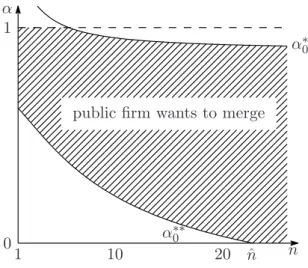
We obtain the following proposition usingα∗0 and α∗∗0 . Proposition 1. WM > WN if and only if α∗∗0 < α < α∗0.
Proof. Subtracting WN from WM, we obtain the following equation:
WM −WN = −a2[(351 + 166n+ 14n2)α2−(756 + 244n+ 8n2)α+ 351 + 76n−4n2] 2(9 + 2n)2[7 + 2n−α(2 +n)]2 . The sign of RHS depends on that of its numerator. Since this numerator is a quadratic concave function of α and is equal to zero when α = α∗0 or α = α∗∗0 , WM > WN if and only if α0∗∗< α < α∗0.
This proposition shows that if the number of private firms is greater than or equal to 6 (n ≥ 6), the public firm does not want to merge at α = 1, since α∗0|n = 6 < 1 and α0∗ is a decreasing function ofn. In addition, when the number is greater than or equal to 23 (n≥23), the public firm wants to merge atα= 0, becauseα∗∗0 |n= 23<0 andα∗∗0 is a decreasing function ofn. In other words, even if the public sector does not have a share of the merged firm, the public firm has an incentive to merge in n ≥ 23. Figure 1 illustrates this incentive in relation with parameters n and α. The shaded area represents the range in which the public firm wants to merge. This range broadens asnincreases until n= ˆn, but whenn >ˆn, it narrows conversely.5
4Since ∂W∂αM =3a[7+2n2[8+n−−α(2+n)]α(7+2n)]3 ,WM decreases asαrises whenα > 7+2n8+n. In addition, 7+2n8+n is a decreasing function ofn.
5More precisely, the critical value is ˆn= (19 + 2√
178)/2≈22.8417.
α
1 10 20 n
1
α∗0
α∗∗0
public firm wants to merge
0 nˆ
Figure 1: Illustration of Proposition 1
The increase in the number of private firms reduces the public firm’s contribution to consumer surplus, but the output gap between the public and private firms remains. Since the gap decreases social welfare, the increase enhances the public firm’s incentive to merge. Thus, the shaded area widens as nincreases. This logic coincides with that of De Fraja and Delbono (1989), who show that the privatization of a public firm can improve social welfare.
However, Proposition 1 depends heavily on our assumption that the merger improves the productivity of the firm. If we do not assume this effect, the public firm will not wish to merge with the private firm regardless of the number of private firms (see Appendix).
Next, we consider whether the private firm (firm 1) decides to merge with the public firm.
By Assumption 1, the private firm decides to merge if (1−α)πMm > πN1 . Letα∗1 and α∗∗1 denote the values of α such that (1−α)πMm =πN1 :
α∗1= 3197 + 1268n+ 116n2+ 3(9 + 2n)√
3289 + 1156n+ 100n2
2(1394 + 584n+ 56n2) ,
α∗∗1 = 3197 + 1268n+ 116n2−3(9 + 2n)√
3289 + 1156n+ 100n2
2(1394 + 584n+ 56n2) .
We obtain the following proposition using these equations.
Proposition 2. (1−α)πMm > πN1 if and only if α < α∗∗1 .
Proof. Subtracting πN1 from (1−α)πmM, we obtain the following equation:
(1−α)πmM−π1N = a2[(1394 + 584n+ 56n2)α2−(3197 + 1268n+ 116n2)α+ 1403 + 524n+ 44n2] 2(9 + 2n)2[7 + 2n−α(2 +n)]2 . The sign of RHS depends on that of its numerator. Since this numerator is a quadratic convex function of α and is equal to zero when α = α∗1 or α = α1∗∗, (1−α)πmM > πN1 if α > α∗1 or α < α∗∗1 . However,α∗1 >1 for all n, and thus the constraint ofα∈[0,1] is violated. Therefore, (1−α)πMm > πN1 if and only if α < α∗∗1 .
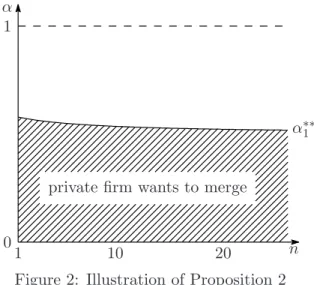
Proposition 2 is illustrated in Figure 2. Since the increase in the number of private firms reduces the market price and the increment of profit by the merger, the private firm demands a
α
1 n 0 1
10 20
α∗∗1
private firm wants to merge
Figure 2: Illustration of Proposition 2
higher profit distribution ratio to compensate the profit reduction. Therefore,α∗∗1 is a decreasing function ofn(in other words, (1−α∗∗1 ) is an increasing function ofn). Note that limn→∞α∗∗1 = 1/2; thus, the private firm always decides to merge irrespective ofnwhen the shareholding ratio of the private sector is more than 1/2.
We present the following lemma in which we compare α∗∗1 with α∗0 and α0∗∗ to determine whether the public and private firms merge.
Lemma 1. α∗0 > α∗∗1 for n∈[1,∞) and α∗∗0 > α∗∗1 at n= 1, but there exists ˜n∈(1,∞) such thatα∗∗1 ≥α∗∗0 for n≥n.˜
Proof. See Appendix.
When the number of private firms is sufficiently small, α∗∗0 is greater than α∗∗1 . However, when the number exceeds the critical value ˜n, this relation is reversed (α∗∗1 ≥α∗∗0 ). We obtain an approximate value of nsuch that α∗∗0 =α∗∗1 is 1.9907,i.e., the firms do not merge in mixed
“duopoly.” This coincides with the result of B´arcena-Ruiz and Garz´on (2003).6 By Propositions 1 and 2 and Lemma 1,7 we obtain the following proposition:
Proposition 3. The public firm 0 and the private firm 1 will merge when α∗∗0 < α < α∗∗1 . Figure 3 illustrates Proposition 3. Ifn∈(˜n,n), the area in which both the public and privateˆ firm want to merge broadens as nincreases.8 In addition, whenn is larger than ˆn, both firms want to merge even if the merged firm is owned only by the private sector (viz.,α = 0). This is because the welfare loss due to the excess production of the public firm is larger than the welfare improvement as a result of increasing consumer surplus as stated above.
6B´arcena-Ruiz and Garz´on (2003) do not consider the productivity-improving merger. However, even if the merger improves the productivity of the merged firm, the firms do not merge in a mixed duopoly with a homo- geneous good.
7Lemma 1 guarantees the existence of the range in whichα∈(α∗∗0 , α∗∗1 ).
8However, inn≥n,ˆ α∗∗0 is less than 0, and the area narrows asnincreases by the constraint ofα≥0.
α
1 10 20 n
1
α∗0
α∗∗0 0
α∗∗1
˜ n
both firms want to merge
ˆ n Figure 3: Illustration of Proposition 3
4 Conclusion
This paper investigated how a public and private firm’s decision whether to merge depends on the shareholding ratio and the number of private firms. We showed that when the shareholding ratio of the public sector is α ∈ (α0∗∗, α∗∗1 ), which is achieved in n > n, both firms decide to˜ merge. Note that the number of private firms is not less than two when the merger is achieved.
B´arcena-Ruiz and Garz´on (2003) demonstrate that the firms do not merge in a mixed duopoly with a homogeneous good. However, we proved that if mergers improve the efficiency of the firms and the number of private firms is sufficiently large, the result is not necessarily the same as theirs. In particular, the productivity-improving merger is critical to the result. If we do not assume this effect, the public firm does not choose to merge regardless of the number of private firms.
Our analysis contributes to the literature on mixed oligopoly by showing that a public firm may have an incentive to merge with a private firm in a homogeneous market. However, the analysis of mergers in a mixed market suggests subjects for future research. One is the situation in which the public firm merges with multiple private firms, and another is where there exist foreign shareholders of the private firms. Since it would appear that these situations would have an impact on the firms’ decision to merge, the investigation of these situations is important for studies of mergers in mixed markets.
Appendix
The public firm’s decision without productivity improvement
We show that the public firm does not have an incentive to merge with the private firm in the case where the merger does not improve the productivity of the merged firm. In this case, social welfare before and after the merger is as follows:
WN = a2(27 + 28n+ 4n2) 2(9 + 2n)2 ,
WM = a2[36n+ 9n2+ (6−18n−6n2)α−(3−2n−n2)α2] 2[9 + 3n−(2 +n)α]2 .
Subtracting WN from WM, we examine the public firm’s incentive to merge with the private firm.
WM −WN = −a2[(351 + 166n+ 14n2)α2−(1458 + 576n+ 36n2)α+ 2187 + 810n+ 54n2] 2(9 + 2n)2[9 + 3n−(2 +n)α]2 . The sign of RHS depends on that of its numerator. This numerator is a quadratic concave function of α and the discriminant of this quadratic equation,D, is9
D=−432(9 + 2n)2(27 + 14n+n2)<0.
Thus, for all n,WN is larger thanWM and the public firm does not want to merge.
Proof of Lemma 1
We divide this proof into three steps.
First, we prove that α∗0 > α1∗∗forn∈[1,∞). Evaluatingα∗0 and α∗∗1 atn= 1, then α∗0|n= 1= 56 + 11√
3
59 ≈1.2721>0.5792≈ 509−11√ 505
452 =α∗∗1 |n= 1. Using computer software, we obtain
nlim→∞α∗0 = 2 + 3√ 2
7 ≈0.8918> α∗∗1 |n = 1.
Since, in addition to this, α∗0 and α∗∗1 are decreasing functions of n, we obtain α∗0 > α∗∗1 for n∈[1,∞).
Second, we prove that α∗∗0 > α∗∗1 atn= 1. Evaluatingα∗∗0 atn= 1, we obtain α∗∗0 |n= 1= 56−11√
3
59 ≈0.6262.
Therefore, α∗∗0 |n= 1> α∗∗1 |n= 1.
Finally, we prove that there exists ˜n∈(1,∞) such thatα∗∗1 ≥α∗∗0 forn≥n. As mentioned˜ in Section 3, bothα∗∗0 andα∗∗1 are decreasing functions ofn. In addition, we obtain the following limit relations:
nlim→∞α∗∗0 = 2−3√ 2
7 ≈ −0.3204<0.5 = lim
n→∞α∗∗1 .
Consideringα∗∗0 |n= 1> α∗∗1 |n= 1, there exists ˜n >1 such thatα∗∗1 ≥α∗∗0 forn≥n.˜ References
B´arcena-Ruiz, J. C. and M. B. Garz´on, “Mixed Duopoly, Merger and Multiproduct Firms,”
Journal of Economics, 2003, 80, 27–42.
Deneckere, R. and C. Davidson, “Incentives to Form Coalitions with Bertrand Competition,”
Rand Journal of Economics, 1985, 16, 473–486.
9a2 is omitted for simplicity.
Farrell, J. and C. Shapiro, “Horizontal Mergers: An Equilibrium Analysis,”American Economic Review, 1990, 80, 107–126.
De Fraja, G. and F. Delbono, “Alternative Strategies of a Public Enterprise in Oligopoly,”
Oxford Economic Papers, 1989,41, 302–311.
Matsumura, T., “Partial Privatization in Mixed Duopoly,” Journal of Public Economics, 1998, 70, 473–483.
McAfee, R. P. and M. A. Williams, “Horizontal Mergers and Antitrust Policy,” Journal of Industrial Economics, 1992, 40, 181–187.
Salant, S. W., S. Switzer, and R. J. Reynolds, “Losses from Horizontal Merger: The Effects of an Exogenous Change in Industry Structure on Cournot-Nash Equilibrium,” Quarterly Journal of Economics, 1983, 98, 185–199.