Title
Evaluation of seizure foci and genes in the Lgi1(L385R/+)
mutant rat( Dissertation_全文 )
Author(s)
Fumoto, Naohiro
Citation
Kyoto University (京都大学)
Issue Date
2014-07-23
URL
http://dx.doi.org/10.14989/doctor.k18500
Right
This dissertation is author version of following the journal
article. Naohiro Fumoto, Tomoji Mashimo, Atsushi Masui,
Saeko Ishida, Yuto Mizuguchi, Shoko Minamimoto, Akio
Ikeda, Ryosuke Takahashi, Tadao Serikawa, Yukihiro Ohno,
Evaluation of seizure foci and genes in the Lgi1L385R/+
mutant rat, Neuroscience Research, Volume 80, March 2014,
Pages 69-75, ISSN 0168-0102,
http://dx.doi.org/10.1016/j.neures.2013.12.008.
Type
Thesis or Dissertation
Textversion
ETD
Evaluation of seizure foci and genes in the
Lgi1
L385R/+
mutant rat
Naohiro Fumoto
a, b
, Tomoji Mashimo
b
*, Atsushi Masui
c
, Saeko
Ishida
b
, Yuto Mizuguchi
c
, Shoko Minamimoto
c
, Akio Ikeda
a, d
,
Ryosuke Takahashi
a
, Tadao Serikawa
b
, Yukihiro Ohno
c
a
Department of Neurology, Graduate School of Medicine, Kyoto University,
Kyoto 606-8501, Japan
b
Institute of Laboratory Animals, Graduate School of Medicine, Kyoto
University, Kyoto 606-8501, Japan
c
Laboratory of Pharmacology, Osaka University of Pharmaceutical Sciences,
Takatsuki 569-1094, Japan
d
Department of Epilepsy, Movement Disorders and Physiology, Graduate
School of Medicine, Kyoto University, Kyoto 606-8501, Japan.
*Corresponding author: T. Mashimo, Institute of Laboratory Animals,
Graduate School of Medicine, Kyoto University, Yoshidakonoe-cho, Sakyo-ku,
Kyoto 606-8501, Japan. Tel.: +81-75-753-9318; fax: +81-75-753-4409.
ABSTRACT
Mutations in the leucine-rich, glioma inactivated 1 (LGI1) gene have been
identified in patients with autosomal dominant lateral temporal lobe
epilepsy (ADLTE). We previously reported that Lgi1 mutant rats, carrying
a
missense
mutation
(L385R)
generated
by
gene-driven
N-ethyl-N-nitrosourea (ENU) mutagenesis, showed generalized
tonic-clonic seizures (GTCS) in response to acoustic stimuli. In the present
study, we assessed clinically-relevant features of Lgi1 heterozygous
mutant rats (Lgi1L385R/+) as an animal model of ADLTE. First, to explore
the focus of the audiogenic seizures, we performed electroencephalography
(EEG) and brain Fos immunohistochemistry in Lgi1L385R/+ and wild type
rats. EEG showed unique seizure patterns (e.g., bilateral rhythmic spikes)
in Lgi1L385R/+ rats with GTCS. An elevated level of Fos expression
indicated greater neural excitability to acoustic stimuli in Lgi1L385R/+
rats, especially in the temporal lobe, thalamus and subthalamic nucleus.
Finally, microarray analysis revealed a number of differentially expressed
genes that may be involved in epilepsy. These results suggest that
Lgi1L385R/+ rats are useful as an animal model of human ADLTE.
Keywords
Highlights
>EEG of Lgi1
L385R/+rats shows patterns that correspond to seizure behavior.
>Neural activity is increased in the lateral temporal lobe, including auditory
cortex.
>Microarray analysis identified candidate genes responsible for audiogenic
seizures.
Abbreviations
ADLTE, autosomal dominant lateral temporal lobe epilepsy; AGS,
audiogenic
seizures;
EEG,
electroencephalography;
ENU,
N-ethyl-N-nitrosourea; GTCS, generalized tonic-clonic seizures; IR,
immunoreactivity; Lgi1, leucine-rich, glioma inactivated 1;
1.
Introduction
Autosomal dominant lateral temporal lobe epilepsy (ADLTE) is a rare
familial partial epilepsy syndrome mainly reported in Europe, the United
States, Australia and Japan (Kawamata et al., 2009). The estimated
penetrance ranges widely from 51 to 80% (Ottman et al., 1995; Ottman et al.,
2004; Michelucci et al., 2009). ADLTE is characterized by focal seizures with
auditory auras such as simple sound or auditory hallucinations in 55–64% of
cases (Michelucci et al., 2003; Ottoman et al., 2004). Secondarily generalized
tonic-clonic seizures (GTCS) are seen in 90% of cases (Michelucci et al., 2009).
In some patients, seizures are induced by acoustic stimuli such as sudden
noises or answering the phone (Winawer et al., 2000; Michelucci et al., 2003;
Michelucci et al., 2007), indicating a lateral temporal lobe onset. Some MRI
studies have reported developmental abnormalities in the left lateral
temporal lobe of patients (Kobayashi et al., 2003; Tessa et al., 2007). Fujita et
al. (2009) also found left lateral temporal lobe hypometabolism using
FDG-PET, and Brodtkorb et al. (2005) reported a predominance of left
temporal EEG abnormalities. In addition, a mutation in the leucine-rich,
glioma inactivated 1 (LGI1) gene has recently been reported to be a cause of
ADLTE (Kalachikov et al., 2002; Morante-Redolat et al., 2002), and
Kawamata et al. (2009) reported two ADLTE families with LGI1 mutations
in Japan.
Lgi1 null knockout mice show spontaneous seizures and die within 20 days
of birth, while heterozygous Lgi1 mice do not have spontaneous seizures, but
show auditory stimulus-induced seizures (Fukata et al., 2010). A lack of Lgi1
also reduces synaptic transmission mediated by AMPA, ADAM22, and
ADAM23 receptors in the hippocampus (Fukata et al., 2010) and enhances
excitatory synaptic transmission by increasing the release of glutamate (Yu
et al., 2010). Seizure-induced damage, such as neuronal loss, mossy fiber
sprouting, astrocyte reactivity and granule cell dispersion in the
hippocampus after recurrent seizures, was also reported in Lgi1
-/-mice
(Chabrol et al., 2010). Rat models, because of their larger brains, are useful
for studying clinically relevant features such as the detection of seizure foci.
We therefore generated an Lgi1 missense mutant (L385R) rat on an F344
background by N-ethyl-N-nitrosourea mutagenesis (Baulac et al., 2012). Lgi1
homozygous (Lgi1
L385R/L385R) mutant rats have spontaneous seizures after
postnatal day (P) 10 and die prematurely (by P17). Although Lgi1
heterozygous (Lgi1
L385R/+) mutant rats do not have spontaneous seizures, all
Lgi1
L385R/+rats primed with acoustic stimuli at P16 displayed wild running
behavior and subsequent GTCS after exposure to acoustic test stimuli at 8
weeks (Baulac et al., 2012).
Here, we describe further study of the Lgi1
L385R/+mutant rat, using
electroencephalography (EEG) and Fos-immunoreactivity (Fos-IR) to
identify the foci of audiogenic seizures (AGS), and microarray analysis to
identify candidate genes that may be responsible for AGS.
2.
Materials and methods
Lgi1 mutant rats carrying a heterozygous missense mutation (L385R/+)
(strain name, F344-Lgi1
m1kyo) (Baulac et al., 2012), and wild type (WT)
F344/NSlc rats were bred and maintained at the Institute of Laboratory
Animals, Graduate School of Medicine, Kyoto University, in air-conditioned
rooms under a 14-h light/10-h dark cycle. Animal care and experiments
conformed to the Guidelines for Animal Experiments and were approved by
the Animal Research Committee of Kyoto University.
2.2.
Audiogenic seizure induction
Lgi1
L385R/+rats and WTs were divided into 3 groups (Fig. 1A). Group A (8
Lgi1
L385R/+rats and 6 WTs) received no acoustic stimuli; Group B (7
Lgi1
L385R/+rats and 9 WTs) received an acoustic priming stimulus only (120
dB, 10 kHz, 1 min.) at P16; Group C (7 Lgi1
L385R/+rats and 7 WTs) received
both the priming stimulus and an acoustic test stimulus (120 dB, 10 kHz, 5
min.) at 8 weeks of age (Fig. 1A), as previously described (Baulac et al.,
2012).
2.3.
EEG during seizures
Cortical EEG was recorded from group C rats, with simultaneous
behavioral observation. At 6 weeks of age, electrodes were positioned
stereotaxically (Paxinos and Watson, 2007; Hanaya et al., 2012) under
sodium pentobarbital anesthesia (40 mg/kg i.p., Somnopentyl®, Kyoritsu
Seiyaku Corp., Tokyo, Japan). A stainless steel bipolar electrode (0.2 mm
diameter) was implanted in all rats in the left lateral temporal lobe
(
–
3.96
depth from brain surface (D)). Then, in six rats (three per genotype), a screw
electrode (1 mm diameter) was placed in the left frontal lobe (P, -3.8; L, 2.0; D,
-2.2). In three other
Lgi1
L385R/+rats and two WTs, a second 0.2 mm bipolar
electrode was implanted in the right lateral temporal lobe
(P,
–
3.96; L,
–
6.0;
D,
–
5.0). A reference electrode was fixed on the frontal cranium. Electrode
positions are shown in Fig. 1C. The rats recovered for 2 weeks and EEG was
recorded at 8 weeks (Baulac et al., 2012).
2.4.
Fos immunohistochemistry
At 8 weeks of age (groups A and B), or 2-h after the last acoustic stimulus
(group C), rats were perfused with 4% paraformaldehyde and Fos
immunohistochemistry was performed as described by Ohno et al. (2009).
Fos-IR nuclei were counted within a
350-µm × 350-µm grid laid over each of
the brain regions illustrated in Fig. 2A by observers who were blinded to
seizure activity.
2.5.
Microarrays
Lateral temporal lobes were dissected from rats in groups B and C (n=3 per
group). Brain tissues were transported on ice immediately after surgery and
pulverized in 1 ml of Isogen reagent (Nippon Gene, Tokyo, Japan) using a
tissue homogenizer. Fifty milligrams of tissue from the temporal lobes were
used for RNA isolation. Total RNA was then extracted and purified using an
RNase free kit containing chloroform, isopropanol, and ethanol according to
the protocol of Isogen reagent. The quantity and quality of the RNA was
determined with a NanoDrop ND-1000 UV-vis spectrophotometer (Thermo
Scientific, Wilmington, DE, USA). One-color hybridization was performed
using the SurePrint G3 Rat GE 8 × 60 K microarray (Agilent Technologies,
Santa Clara, CA, USA) and data were generated using Agilent Feature
Extraction software. Scatter plot clustering, and pathway analysis were
conducted using GeneSpringGX software (Agilent Technologies).
2.6.
Statistical analysis
All values are expressed as mean ± SEM. Statistical significance at p < 0.05
was determined by Student’s t-test.
3.
Results and discussion
3.1 Audiogenic seizures and EEG characteristics
The auditory test stimulus induced wild running behavior, typical of AGS,
in all WT and Lgi1
L385R/+rats in group C (n=7 per group). In addition, all
Lgi1
L385R/+rats had GTCS immediately after wild running (Fig. 1B and
Supplementary video). Acoustic priming stimuli at P16 were critical for
inducing AGS in Lgi1
L385R/+rats, as we reported previously (Baulac et al.,
2012). EEG in Lgi1
L385R/+rats showed 5–7 Hz slow rhythmic activity and
then rhythmic spikes (Fig. 1D).
An onset of AGS at 8 weeks in rats is comparable to the age of onset of
ADLTE in humans (Michelucci et al., 2009). The developing auditory system
of rats at P16 is plastic enough to be affected by environmental acoustic
stimuli (Romijn et al., 1991; Mashimo et al., 2010). This suggests that
newborn babies with a mutation in LGI1 may benefit from an environment
with minimal acoustic stimuli until the sensitive neurodevelopmental phase
has passed. Indeed, considering the incomplete penetrance of ADLTE in
families (Ottman et al., 1995; Ottman et al., 2004; Michelucci et al., 2009),
environmental factors such as acoustic stimuli before neurological
maturation may be essential for evoking seizures in later life.
No interictal EEG abnormality was observed in WT or Lgi1
L385R/+rats
without acoustic stimulation. Furthermore, no notable time-lags in the onset
of wild running behavior or GTCS were observed between the two
hemispheres (Fig. 1E), or between the left lateral temporal lobe and left
frontal lobe (Fig. 1F). In patients with ADLTE, however, the left lateral
temporal lobe is preferentially affected. The nature of these differences is
unclear; however, the existence of intrinsic interhemispheric differences
remains debated (Cain et al., 1989; Vinogradova, 2010). In addition, the
brain may have functional asymmetry, observable in the lateralization of
reinforcement sensitivity in rats (Glick and Ross, 1981), indicating that both
congenital and environmental factors might contribute to the hemispheric
asymmetry in epileptogenesis.
3.2 Fos immunohistochemistry after AGS
After AGS (group C), Lgi1
L385R/+rats had a marked elevation of Fos-IR cells
compared with those that received a priming stimulus only (group B), in
several structures including the temporal lobe, thalamus and hypothalamus
(Fig. 2C). Elevated Fos immunoreactivity in group C WT rats was observed
only in the posterior hypothalamus and CA2 field of the hippocampus (Fig.
2D).
Fos immunoreactivity was not different between Lgi1
L385R/+and WT rats
without acoustic stimulation (group A) in any brain region except the
posteromedial cortical amygdaloid nucleus (Fig. 2B). Similarly, Lgi1
L385R/+rats in groups A and B showed no differences in Fos-IR cell numbers except a
reduction of Fos activation in the cingulate cortex and dorsomedial striatum
after the priming stimulus (Fig. 2E). In WT rats, however, markedly more
Fos-IR cells were observed in group B in numerous subregions in the cortex,
hippocampus, amygdala, thalamus, and hypothalamus, compared with
group A (Fig. 2F).
The excited areas in Lgi1
L385R/+rats after GTCS, such as the temporal lobe
and thalamus, correspond to the acoustic neural network (Valjakka et al.,
2000). These areas are also consistent with the epileptic focus in human
ADLTE patients, whereas previous studies indicate that seizures initiate in
the hippocampus in Lgi1 knockout mice (Fukata et al., 2010; Baulac et al.,
2012). LGI1 protein is abundant in the human temporal neocortex, especially
in the lateral temporal lobe (Furlan et al., 2006), while mouse Lgi1 is highly
expressed in the dentate gyrus and CA3 field of the hippocampus (Senechal
et al., 2005; Herranz-Perez et al., 2010). While spontaneous seizures
originate in the hippocampus in mice and rats, AGS in rats may originate in
the acoustic neural network, as is seen in human ADLTE patients.
After exclusion of unnamed genes, and genes with less than a twofold
difference in expression, a total of 447 genes with differential expression
between groups B and C were identified in Lgi1
L385R/+rats (Fig. 3A) and in
WTs (Fig. 3B). In Lgi1
L385R/+rats, 99 genes were upregulated and 109 were
downregulated in group C compared with group B, while in WTs 85 genes
were upregulated and 200 were downregulated. A summary of differentially
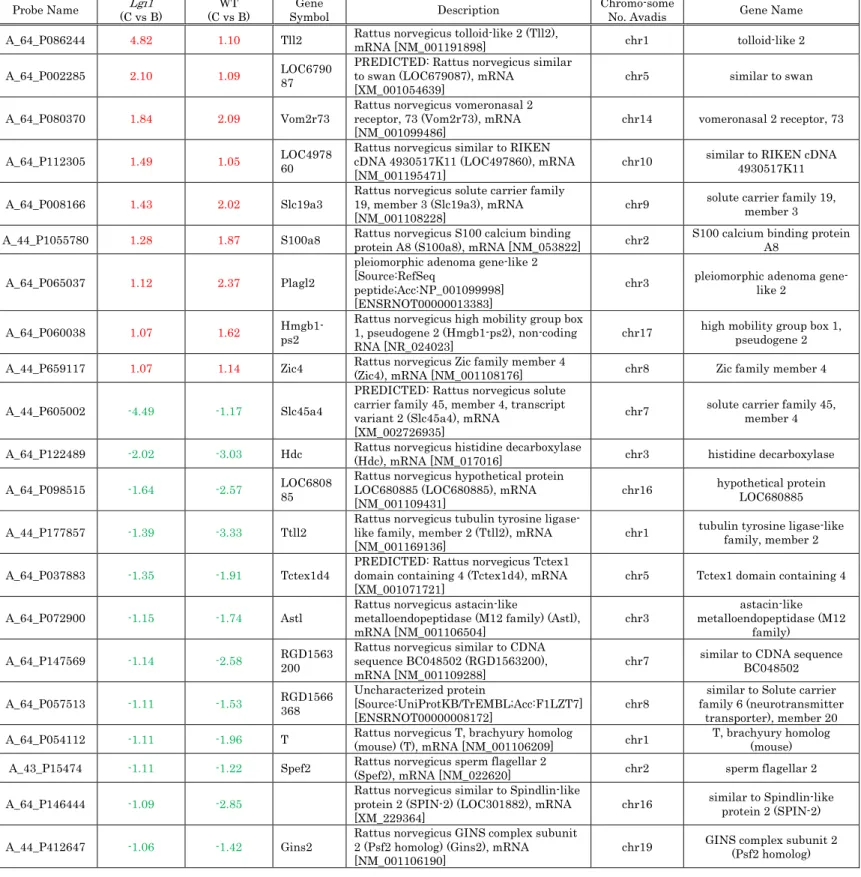
expressed genes is provided in Fig. 3C, and fold-change values for all 447
genes are provided in Supplementary Table S1.
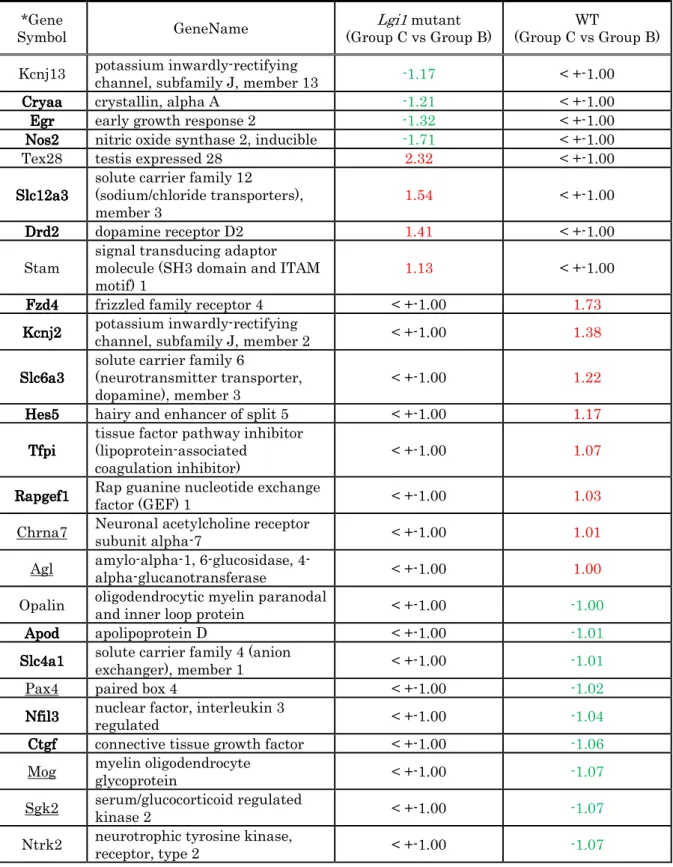
Some of the differentially expressed genes have previously been associated
with epilepsy (Supplementary Table S2 and Fig. 3C). Adora2a and Rgs9
interact with Lgi1, according to the STRING database; these interactions
might affect epileptogenesis in Lgi1
L385R/+rats. Egr2 and c-Fos are both
activity-dependent genes whose expression is highly correlated with the
amplitude and frequency of interictal spikes (Rakhade et al., 2007). However,
this is inconsistent with the downregulation of Egr2 in Lgi1
L385R/+rats
following the acoustic test stimulus. Considering the apparent inhibition of
Fos activation in Lgi1
L385R/+rats after the acoustic priming stimulus,
suppression of c-Fos and Egr2 might be related to epileptogenesis in
Lgi1
L385R/+rats. Kcnj13 was previously reported as a candidate gene for
epileptogenicity (Winden et al., 2011); however, its expression was
downregulated after the test stimulus in Lgi1
L385R/+rats. Conversely, it was
reported that mice lacking the Stam gene had a loss of hippocampal CA3
pyramidal neurons (Yamada et al., 2001), whereas the expression of Stam
was upregulated in Lgi1 mutant rats after the test stimulus. These results
indicate that the change in expression of these genes was due to the response
after GTCS rather than to the epileptic susceptibility of Lgi1 mutant rats. In
addition, genes associated with inflammation, such as interleukin 1 beta
(Il1b) and chemokine (C-C motif) ligand 3 (Ccl3), were particularly
upregulated after the audiogenic seizures.
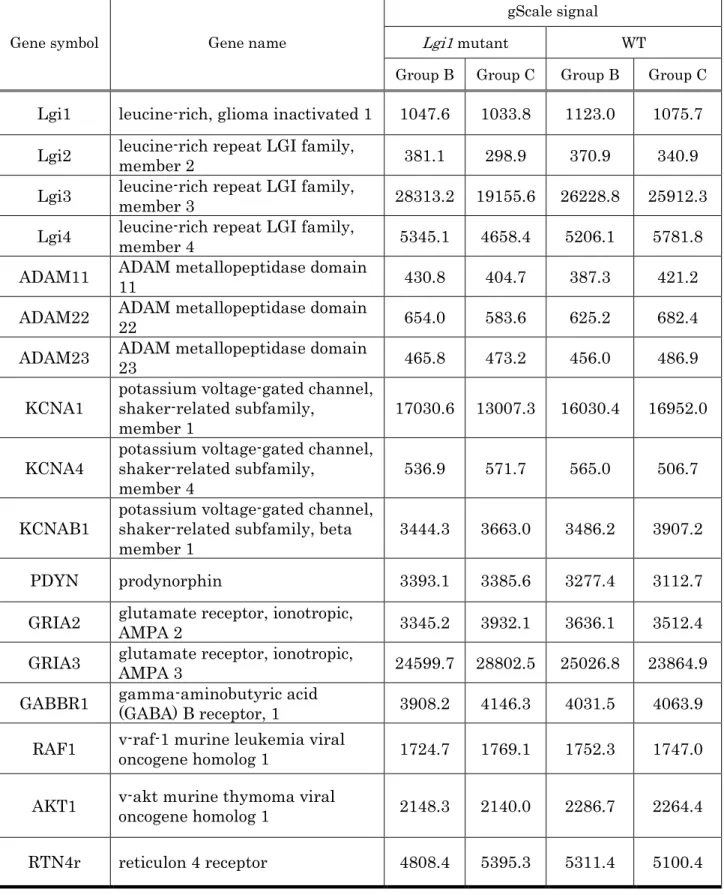
The Lgi1 gene itself and 16 genes previously reported to be associated with
it showed no significant differences in mRNA expression (Table 1). This is
consistent with the idea that the phenotype of Lgi1
L385R/+rats is derived from
the loss of functional LGI1 protein rather than that of mRNA (Baulac et al.,
2012). Most patients with ADLTE have mutations in the LGI1 gene that
impair protein secretion (Senechal et al., 2005; Michelucci et al., 2009; Nobile
et al., 2009; Di Bonaventura et al., 2011). Recently, Striano et al. (2011)
reported a family with ADLTE with a novel LGI1 mutation (R407C) that did
not disturb LGI extracellular protein secretion; the R407C LGI1 mutation,
however, disrupts interactions with its target proteins (Striano et al., 2011).
In the case of Lgi1
L385R/+rats, we previously demonstrated that L385R-LGI1
protein was unstable and appeared to have a short half-life, leading to loss of
function (Baulac et al., 2012).
4.
Conclusions
Neurons in the lateral temporal lobe, in particular the auditory cortex, of
Lgi1
L385R/+rats were significantly activated by acoustic stimuli. The
significantly changed uniquely in Lgi1
L385R/+rats after AGS, while those of
Lgi1 itself and associated genes were not altered. Our study indicates the
existence of an unknown seizure mechanism in the AGS rats and highlights
the utility of Lgi1
L385R/+rats as an animal model of ADLTE.
Author Contributions
NF conceived the study and wrote the manuscript. TM designed and
coordinated the study. SI assisted with EEG recording and microarray. JM,
YM, and SM performed Fos immunohistochemistry. AI, RT, TS, and YO
participated in interpreting the results and revising the manuscript. All
authors read and approved the final manuscript.
References
Baulac, S., Ishida, S., Mashimo, T., Boillot, M., Fumoto, N., Kuwamura, M.,
Ohno, Y., Takizawa, A., Aoto, T., Ueda, M., Ikeda, A., LeGuern, E., Takahashi,
R., Serikawa, T., 2012. A rat model for LGI1-related epilepsies. Hum. Mol.
Genet. 21(16), 3546-3557.
Brodtkorb, E., Steinlein, O. K., Sand, T., 2005. Asymmetry of long-latency
auditory evoked potentials in LGI1-related autosomal dominant lateral
temporal lobe epilepsy. Epilepsia 46(10), 1692-1694.
Cain, D. P., Desborough, K. A., McKitrick, D. J., Ossenkopp, K.-P., 1989.
Absence of a hemispheric difference in seizure sensitivity and kindling rate
in the rat brain. Physiol. Behav. 45(2), 219-220.
Chabrol, E., Navarro, V., Provenzano, G., Cohen, I., Dinocourt, C.,
Rivaud-Péchoux, S., Fricker, D., Baulac, M., Miles, R., Leguern, E., Baulac,
S., 2010. Electroclinical characterization of epileptic seizures in leucine-rich,
glioma-inactivated 1-deficient mice. Brain 133(9), 2749-2762.
Di Bonaventura, C., Operto, F. F., Busolin, G., Egeo, G., D'Aniello, A., Vitello,
L., Smaniotto, G., Furlan, S., Diani, E., Michelucci, R., Giallonardo, A. T.,
Coppola, G., Nobile, C., 2011. Low penetrance and effect on protein secretion
of LGI1 mutations causing autosomal dominant lateral temporal epilepsy.
Epilepsia 52(7), 1258-1264.
Fujita, Y., Ikeda, A., Kadono, K., Kawamata, J., Tomimoto, H., Fukuyama,
H., Takahashi, R., 2009. Clinical features in a Japanese patient with
autosomal dominant lateral temporal epilepsy having LGI1 mutation.
Rinsho Shinkeigaku 49(4), 186-190.
Fukata, Y., Lovero, K. L., Iwanaga, T., Watanabe, A., Yokoi, N., Tabuchi, K.,
Shigemoto, R., Nicoll, R. A., Fukata, M., 2010. Disruption of LGI1-linked
synaptic complex causes abnormal synaptic transmission and epilepsy. Proc.
Natl. Acad. Sci. U.S.A. 107(8), 3799-3804.
Furlan, S., Roncaroli, F., Forner, F., Vitiello, L., Calabria, E., Piquer-Sirerol,
S., Valle, G., Perez-Tur, J., Michelucci, R., Nobile, C., 2006. The
LGI1/epitempin gene encodes two protein isoforms differentially expressed
in human brain. J. Neurochem. 98(3), 985-991.
Glick, S. D., Ross, D. A., 1981. Lateralization of function in the rat brain:
Basic mechanisms may be operative in humans. Trends Neurosci. 4,
196-199.
Hanaya, R., Hosoyama, H., Sugata, S., Tokudome, M., Hirano, H., Tokimura,
H., Kurisu, K., Serikawa, T., Sasa, M., Arita, K., 2012. Low distribution of
synaptic vesicle protein 2A and synaptotagimin-1 in the cerebral cortex and
hippocampus of spontaneously epileptic rats exhibiting both tonic convulsion
and absence seizure. Neuroscience 221, 12-20.
Herranz-Perez, V., Olucha-Bordonau, F. E., Morante-Redolat, J. M.,
Perez-Tur, J., 2010.
Regional distribution of the leucine-rich glioma
inactivated (LGI) gene family transcripts in the adult mouse brain. Brain
Res. 1307, 177-194.
Kalachikov, S., Evgrafov, O., Ross, B., Winawer, M., Barker-Cummings, C.,
Martinelli Boneschi, F., Choi, C., Morozov, P., Das, K., Teplitskaya, E., 2002.
Mutations in LGI1 cause autosomal-dominant partial epilepsy with auditory
features. Nat. Genet. 30(3), 335-341.
Kawamata, J., Ikeda, A., Fujita, Y., Usui, K., Shimohama, S., Takahashi, R.,
2009. Mutations in LGI1 gene in Japanese families with autosomal
dominant lateral temporal lobe epilepsy: the first report from Asian families.
Epilepsia 51(4), 690-693.
Kobayashi, E., Santos, N. F., Torres, F. R., Secolin, R., Sardinha, L. A. C.,
Lopez-Cendes, I., Cendes, F., 2003. Magnetic resonance imaging
abnormalities in familial temporal lobe epilepsy with auditory auras. Arch
Neurol. 60(11), 1546-1551.
Mashimo, T., Ohmori, I., Ouchida, M., Ohno, Y., Tsurumi, T., Miki, T.,
Wakamori, M., Ishihara, S., Yoshida, T., Takizawa, A., Kato, M.,
Hirabayashi, M., Sasa, M., Mori, Y., Serikawa, T., 2010. A missense
mutation of the gene encoding voltage-dependent sodium channel (Nav1.1)
confers susceptibility to febrile seizures in rats. J. Neurosci. 30(16),
5744-5753.
Michelucci, R., Mecarelli, O., Bovo, G., Bisulli, F., Testoni, S., Striano, P.,
Striano, S., Tinuper, P., Nobile, C., 2007. A de novo LGI1 mutation causing
idiopathic partial epilepsy with telephone-induced seizures. Neurology
68(24), 2150-2151.
Michelucci, R., Pasini, E., Nobile, C., 2009. Lateral temporal lobe epilepsies:
clinical and genetic features. Epilepsia 50 Suppl 5, 52-54.
Michelucci, R., Poza, J. J., Sofia, V., de Feo, M. R., Binelli, S., Bisulli, F.,
Scudellaro, E., Simionati, B., Zimbello, R., D'Orsi, G., Passarelli, D., Avoni,
P., Avanzini, G., Tinuper, P., Biondi, R., Valle, G., Mautner, V. F., Stephani,
U., Tassinari, C. A., Moschonas, N. K., Siebert, R., Lopez de Munain, A.,
Perez-Tur, J., Nobile, C.,2003. Autosomal dominant lateral temporal
epilepsy: clinical spectrum, new epitempin mutations, and genetic
heterogeneity in seven European families. Epilepsia 44(10), 1289-1297.
Morante-Redolat, J. M., Gorostidi-Pagola, A., Piquer-Sirerol, S., Sáenz, A.,
Poza, J. J., Galán, J., Gesk, S., Sarafidou, T., Mautner, V., Binelli, S., 2002.
Mutations in the LGI1/Epitempin gene on 10q24 cause autosomal dominant
lateral temporal epilepsy. Hum. Mol. Genet. 11(9), 1119-1128.
Nobile, C., Michelucci, R., Andreazza, S., Pasini, E., Tosatto, S. C. E., Striano,
P., 2009. LGI1 mutations in autosomal dominant and sporadic lateral
temporal epilepsy. Hum. Mutat. 30(4), 530-536.
Ohno, Y., Shimizu, S., Harada, Y., Morishita, M., Ishihara, S., Kumafuji, K.,
Sasa, M., Serikawa, T., 2009. Regional expression of Fos-like
immunoreactivity following seizures in Noda epileptic rat (NER). Epilepsy
Res. 87(1), 70-76.
Ottman, R., Risch, N., Hauser, W. A., Pedley, T. A., Lee, J. H.,
Barker-Cummings, C., Lustenberger, A., Nagle, K. J., Lee, K.S., Scheuer, M.
L., Neystat, M., Susser, M., Wilhelmsen, K. C., 1995. Localization of a gene
for partial epilepsy to chromosome 10q. Nat. Genet. 10, 56-60.
Ottman, R., Winawer, M. R., Kalachikov, S., Barker-Cummings, C., Gilliam.
T. C., Pedley. T. A., Hauser, W. A., 2004. LGI1 mutations in autosomal
dominant partial epilepsy with auditory features. Neurology 62(7),
1120-1126.
Paxinos, G., Watson, C., 2007. The Rat Brain in Stereotaxic Coordinates, 6th
ed. Academic Press, Amsterdam
Rakhade, S. N., Shah, A. K., Agarwal, R., Yao, B., Asano, E., Loeb, J. A.,
2007. Activity-dependent gene expression correlates with interictal spiking
in human neocortical epilepsy. Epilepsia 48(Suppl. 5), 86-95.
Senechal, K. R., Thaller, C., Noebels, J. L., 2005. ADPEAF mutations reduce
levels of secreted LGI1, a putative tumor suppressor protein linked to
epilepsy. Hum. Mol. Genet. 14(12), 1613-1620.
Striano, P., Busolin, G., Santulli, L., Leonardi, E., Coppola, A., Vitiello, L.,
Rigon, L., Michelucci, R., Tosatto, S. C. E., Striano, S., Nobile, C., 2011.
Familial temporal lobe epilepsy with psychic auras associated with a novel
LGI1 mutation. Neurology 76(13), 1173-1176.
Romijn, H. J., Hofman, M. A., Gramsbergen, A., 1991.
At what age is the
developing cerebral cortex of the rat comparable to that of the full-term
newborn human baby? Early Hum. Dev. 26(1), 61-67.
Tessa, C., Michelucci, R., Nobile, C., Giannelli, M., Della Nave, R., Testoni, S.,
Bianucci, D., Tinuper, P., Bisulli, F., Sofia, V., De Feo, M. R., Giallonardo, A.
T., Tassinari, C. A., Mascalchi, M.,2007. Structural anomaly of left lateral
temporal lobe in epilepsy due to mutated LGI1. Neurology 69(12), 1298-1300.
Valjakka, A., Jaakkola, M., Vartiainen, J., Olkkonen, H., Semiokhina, A.,
Fedotova, I., Virkkala, J., Ylikoski, J., Tuomisto, L., 2000. The relationship
between audiogenic seizure (AGS) susceptibility and forebrain
tone-responsiveness in genetically AGS-prone Wistar rats. Physiol. Behav.
70(3–4), 297-309.
Vinogradova, L. V., 2010. Interhemispheric difference in susceptibility to
epileptogenesis: evidence from the audiogenic kindling model in Wistar rats.
Brain Res. 1329, 175-181.
Winawer, M. R., Ottman, R., Hauser, W. A., Pedley, T. A., 2000. Autosomal
dominant partial epilepsy with auditory features: defining the phenotype.
Neurology 54(11), 2173-2176.
Winden, K. D., Karsten, S. L., Bragin, A., Kudo, L. C., Gehman, L., Ruidera,
J., Geschwind, D. H., Engel, J., 2011. A systems level, functional genomics
analysis of chronic epilepsy. PLoS ONE 6(6), e20763.
Yamada, M., Takeshita, T., Miura, S., Murata, K., Kimura, Y., Ishii, N., Nose,
M., Sakagami, H., Kondo, H., Tashiro, F., Miyazaki, J.-I., Sasaki, H.,
Sugamura, K., 2001. Loss of Hippocampal CA3 Pyramidal Neurons in Mice
Lacking STAM1. Mol. Cell. Biol. 21(11), 3807-3819.
Yu, Y. E., Wen, L., Silva, J., Li, Z., Head, K., Sossey-Alaoui, K., Pao, A., Mei,
L., Cowell, J. K., 2010. Lgi1 null mutant mice exhibit myoclonic seizures and
CA1 neuronal hyperexcitability. Hum. Mol. Genet. 19(9), 1702-1711.
Figure Legends
Fig. 1. EEG during audiogenic seizures. (A) Lgi1
L385R/+rats and WTs are
divided into 3 groups: A (no auditory stimulation), B (acoustic priming
stimulus only), and C (acoustic priming and test stimuli). (B) Behavior
following acoustic test stimulation in group C rats. All Lgi1
L385R/+rats
showed wild running behavior and GTCS while all WT rats showed only wild
running. (C) Placement of electrodes. Red asterisks, bipolar electrode in the
left lateral temporal lobe; monopolar electrode in the right lateral temporal
lobe or left frontal lobe. Blue asterisk: indifferent electrode in right frontal
area of cranium. (D) EEG recording during audiogenic seizure. Slow (5–7 Hz)
rhythmic activity was followed by rhythmic spikes. (E, F) EEG of Lgi1
L385R/+rat with wild running and GTCS. There was no notable time lag between
temporal lobes (E) or between the left lateral temporal lobe and the left
frontal lobe (F) in onset of either wild running (blue arrow) or GTCS (purple
arrow). GTCS, generalized tonic-clonic seizures.
Fig. 2. Fos immunohistochemistry. Results presented are from the right
hemisphere. (A) Brain regions (black squares) selected for quantitative
analysis of Fos-IR cells; cited from Ohno et al. (2009). Anteroposterior
coordinates (distance from Bregma) are shown above each brain section. (B)
Fos-IR cell numbers in WT vs. Lgi1
L385R/+rats in group A. (C) Fos-IR cell
numbers in Lgi1
L385R/+rats, group B vs. group C. Results demonstrate a
group B, as well as significant increases in AuC, LHb, Pt, AM, AH, PH, DMH,
Pir2 and CA3. (D) Fos-IR cell numbers in WT rats, group B vs. group C. Fos
immunoreactivity is similar in most subregions except CA2 and PH, where it
is significantly higher in group C. (E) Fos-IR cell numbers in Lgi1
L385R/+rats,
group A vs. group B. Results demonstrate reduced Fos immunoreactivity in
CgC and dmST after priming stimulation. (F) Fos-IR in WT rats, group A vs.
group B. A general elevation in Fos-IR cell numbers is seen in group B, with
significant differences in mPFC, MC3, SC2, SC3, Pir2, PRh-Ent, CA2, PMCo,
PT, VM and PH. Data are expressed as mean ± S.E.M. Student t-test,
*p <
0.05; **p < 0.01. AcC, nucleus accumbens core; AcS, nucleus accumbens shell
AH, anterior hypothalamus; AIC, agranular insular cortex; AM,
anteromedial thalamus; AuC, auditory cortex; BMA, basomedial amygdaloid
nucleus; Cg, cingulate cortex; CM, centromedial thalamus; DG, dentate
gyrus of the hippocampus; dlST, dorsolateral striatum; DMH, dorsomedial
hypothalamus; dmST, dorsomedial striatum; Fos-IR, Fos-like
immunoreactive; GP, globus pallidus; LaVM, lateral amygdaloid nucleus
ventromedialis; LHb, lateral habenula; LS, lateral septum; MC, motor
cortex; mPFC, medial prefrontal cortex; PH, posterior hypothalamus; Pir,
piriform cortex; PMCo, posteromedial cortical amygdaloid nucleus; PRh-Ent,
perirhinal-entorhinal cortex; PT, paratenial thalamus; SC, sensory cortex;
VM, ventromedial thalamus.
Scatter plot analysis of gene expression in (A) WT and (B) Lgi1
L385R/+rats in
group B vs. group C. Upregulated genes are identifiable as a leftward shift
from the correlation line, and downregulated genes as a rightward shift. (C)
Genes were divided into 8 groups by patterns of expression changes in group
C compared with group B. ↑, upregulated gene expression in group C
compared with group B (≥ twofold); ↓, downregulated gene expression in
group C compared with group B (≤ half); →, gene expression in group C
within 0.5–2 times that in group B; Lgi1, Lgi1
L385R/+rats; F344, WT rats;
*Epilepsy-related genes (see Table S2).
Table 1. Expression of Lgi1 and 16 related genes. No significant differences
were seen in mRNA expression between genotype or acoustic stimulus group.
The gScale signal value of LGI1 and related genes are given.
Table S1 Genes whose mRNA expression doubled or halved in secondary
acoustic stimuli.
Table S2. Examples of epilepsy-related genes with differential expression
between group B (priming stimulation only) and group C (priming
stimulation and test stimulation-induced audiogenic seizures). Genes were
found using PubMed, Sciverse Scopus and Web of Science, with the search
terms ‘epilepsy and [gene name]’.
P16
8 weeks
Group A
Acoustic test stimulation (120 dB, 10 kHz, 1 min., no interval) Group B
Group C
Acoustic priming stimulation (120 dB, 10 kHz, 5 min., no interval) (8 Lgi1L385R/+ rats and 6 WTs)
(7 Lgi1L385R/+ rats and 9 WTs)
(7 Lgi1L385R/+ rats and 7 WTs) A
wild running only
n(%) wild running + GTCSn(%) WTs (n=7) 7 (100%) 0 (0%) Lgi1L385R/+rats (n=7) 0 (0%) 7 (100%)
Acoustic test stimulation in group C rats. B
*
*
3.8mm 6.0mm Lateral temporal lobe Frontal lobe 6.0mm
*
Indifferent electrode Lambda Bregma*
C Wild running GTCSLeft lateral temporal lobe
Left frontal lobe
1 sec. 0.5 V 1 sec. 0.5 V (time) A mp lit ud e A mp lit ud e (V) (V) D
Left lateral temporal lobe
Right lateral temporal lobe Seizure pattern onset
GTCS onset A mp lit ud e A mp lit ud e (time) (mV) (mV)
E Left temporal lobe
Left frontal lobe Seizure pattern onset GTCS onset
A mp lit ud e A mp lit ud e (time) (mV) (mV) F
A
mPFC AcC AcS Pir1 AIC CA1 CA2 SC2 LS Bregma 2.76 Bregma 1.32 Bregma -1.20 Bregma -3.48 MC1 SC1 Cg MC2 dmSTdlST PT AM AH GP AuC PRh-Ent DG CA3 PH DMH LHb CM VM Pir2 LaVM PMCo BMA MC3 SC3 0 10 20 30 40 50 60 70 80mPFC MC1 MC2 MC3 SC1 SC2 SC3 Pir1 Pir2 AIC CgC AuC PRh-Ent
WT Lgi1 mutant 0 10 20 30 40
AcC AcS dmST dlST GP CA1 CA2 CA3 DG PMCo BMA LaVM LS LHb PT AM CM VM AH PH DMH WT Lgi1 mutant **
Lgi1L385R/+rats vs. WTs; Group A cortex
subcortex
WT
WT
basal ganglia hippocampus amygdala thalamus subthalamic nucleus
Lgi1L385R/+ Lgi1L385R/+
B
Fos expr ession (cells/ gr id) Fos expr ession (cells/ gr id)Lgi1L385R/+rats; Group B vs. Group C
0 10 20 30 40 50 60 70 80
mPFC MC1 MC2 MC3 SC1 SC2 SC3 Pir1 Pir2 AIC CgC AuC PRh-Ent
stimuli (-) stimuli (+) * * 0 10 20 30 40 50 60 70 80
AcC AcS dmST dlST GP CA1 CA2 CA3 DG PMCo BMA LaVM LS LHb PT AM CM VM AH PH DMH stimuli (-) stimuli (+) * * * ** * * ** cortex subcortex
basal ganglia hippocampus amygdala thalamus subthalamic nucleus
C
Fos expr ession (cells/ gr id) Fos expr ession (cells/ gr id) Group B Group C Group B Group C WTs; Group B vs. Group Cbasal ganglia hippocampus amygdala thalamus subthalamic nucleus
0 10 20 30 40 50 60 70 80
mPFC MC1 MC2 MC3 SC1 SC2 SC3 Pir1 Pir2 AIC CgC AuC PRh-Ent
group (b) group (c) 0 10 20 30 40 50 60 70 80
AcC AcS dmST dlST GP CA1 CA2 CA3 DG PMCo BMA LaVM LS LHb PT AM CM VM AH PH DMH group (b) group (c) * * cortex subcortex
D
Fos expr ession (cells/ gr id) Fos expr ession (cells/ gr id) Group B Group C Group B Group C 0 10 20 30 40 50 60 70 80mPFC MC1 MC2 MC3 SC1 SC2 SC3 Pir1 Pir2 AIC CgC AuC PRh-Ent
cortex
stimuli (-) stimuli (+)
*
Lgi1L385R/+rats; Group A vs. Group B
0 10 20 30 40
AcC AcS dmST dlST GP CA1 CA2 CA3 DG PMCo BMA LaVM LS LHb PT AM CM VM AH PH DMH
subcortex
stimuli (-) stimuli (+)
*
basal ganglia hippocampus amygdala thalamus subthalamic nucleus
Group A Group B Group A Group B
E
Fos expr ession (cells/ gr id) Fos expr ession (cells/ gr id) WTs; Group A vs. Group Bhippocampus amygdala thalamus subthalamic nucleus cortex 0 10 20 30 40
AcC AcS dmST dlST GP CA1 CA2 CA3 DG PMCo BMA LaVM LS LHb PT AM CM VM AH PH DMH group (a) group (b) * * * * * subcortex
F
0 10 20 30 40 50 60 70 80mPFC MC1 MC2 MC3 SC1 SC2 SC3 Pir1 Pir2 AIC CgC AuC PRh-Ent
group (a) group (b) Fos expr ession (cells/ gr id) Fos expr ession (cells/ gr id) basal ganglia * * * * * * Group A Group B Group A Group B
F344 control rats of group (b) (expression signal in log10) F3 44 co nt ro l r at s o f g ro up (c )(e xp re ss io n sig na l in lo g1 0) A
Lgi1L385R/+rats of group (b) (expression signal in log10)
Lg i1 L 3 8 5 R /+ra ts o f g ro up (c ) ( ex pr es si on sig na l in lo g1 0) B
58717 genes in
SurePrint G3 Rat GE 8㽢60K
Lgi1 ↑ F344 ↑ 9 genes Lgi1 ↓ F344 ↓ 14 genes Lgi1 ↑ F344 ↓ 11 genes Lgi1 ↑ F344 → 79 genes Lgi1 → F344 ↓ 175 genes Lgi1 ↓ F344 ↑ 12 genes Lgi1 ↓ F344 → 83 genes Lgi1 → F344 ↑ 64 genes *Seizure-relatedgenes Slc19a3, Zic4 Hdc Nts, Rgs9, Adora2a Slc12a3, Stam Adamts4, Kcnk16 Eln Kcnj13, Egr Kcnj2
Lgi1
L385R/+rats
group C vs. group B
group C vs. group B
F344 control rats
Lgi1
L385R/+rats
↑ 131 genes, ↓ 158 genes
↑ 160 genes, ↓ 288 genes
F344 control rats
No change
Excluded
Excluded
Lgi1
L385R/+rats
↑ 99 genes, ↓ 109 genes
Total 447 genes
↑ 85 genes, ↓ 200 genes
F344 control rats
Without nomenclature Duplicated
Excluded
Excluded
Table 1. Expression of Lgi1 and 16 related genes. No significant differences were seen in
mRNA expression between genotype or acoustic stimulus group.
Gene symbol
Gene name
gScale signal
Lgi1 mutant
WT
Group B
Group C
Group B
Group C
Lgi1
leucine-rich, glioma inactivated 1
1047.6
1033.8
1123.0
1075.7
Lgi2
leucine-rich repeat LGI family,
member 2
381.1
298.9
370.9
340.9
Lgi3
leucine-rich repeat LGI family,
member 3
28313.2 19155.6 26228.8
25912.3
Lgi4
leucine-rich repeat LGI family,
member 4
5345.1
4658.4
5206.1
5781.8
ADAM11
ADAM metallopeptidase domain
11
430.8
404.7
387.3
421.2
ADAM22
ADAM metallopeptidase domain
22
654.0
583.6
625.2
682.4
ADAM23
ADAM metallopeptidase domain
23
465.8
473.2
456.0
486.9
KCNA1
potassium voltage-gated channel,
shaker-related subfamily,
member 1
17030.6 13007.3 16030.4
16952.0
KCNA4
potassium voltage-gated channel,
shaker-related subfamily,
member 4
536.9
571.7
565.0
506.7
KCNAB1
potassium voltage-gated channel,
shaker-related subfamily, beta
member 1
3444.3
3663.0
3486.2
3907.2
PDYN
prodynorphin
3393.1
3385.6
3277.4
3112.7
GRIA2
glutamate receptor, ionotropic,
AMPA 2
3345.2
3932.1
3636.1
3512.4
GRIA3
glutamate receptor, ionotropic,
AMPA 3
24599.7 28802.5 25026.8
23864.9
GABBR1
gamma-aminobutyric acid
(GABA) B receptor, 1
3908.2
4146.3
4031.5
4063.9
RAF1
v-raf-1 murine leukemia viral
oncogene homolog 1
1724.7
1769.1
1752.3
1747.0
AKT1
v-akt murine thymoma viral
oncogene homolog 1
2148.3
2140.0
2286.7
2264.4
Table
Table
Table
Table S1
S1
S1.... Genes whose mRNA expression doubled or halved in secondary acoustic
S1
stimuli.
Probe Name Lgi1
(C vs B) WT (C vs B) Gene Symbol Description Chromo-some
No. Avadis Gene Name
A_64_P086244 4.82 1.10 Tll2 Rattus norvegicus tolloid-like 2 (Tll2),
mRNA [NM_001191898] chr1 tolloid-like 2
A_64_P002285 2.10 1.09 LOC6790
87
PREDICTED: Rattus norvegicus similar to swan (LOC679087), mRNA
[XM_001054639]
chr5 similar to swan
A_64_P080370 1.84 2.09 Vom2r73
Rattus norvegicus vomeronasal 2 receptor, 73 (Vom2r73), mRNA [NM_001099486]
chr14 vomeronasal 2 receptor, 73
A_64_P112305 1.49 1.05 LOC4978
60
Rattus norvegicus similar to RIKEN cDNA 4930517K11 (LOC497860), mRNA [NM_001195471]
chr10 similar to RIKEN cDNA
4930517K11
A_64_P008166 1.43 2.02 Slc19a3
Rattus norvegicus solute carrier family 19, member 3 (Slc19a3), mRNA [NM_001108228]
chr9 solute carrier family 19,
member 3
A_44_P1055780 1.28 1.87 S100a8 Rattus norvegicus S100 calcium binding
protein A8 (S100a8), mRNA [NM_053822] chr2
S100 calcium binding protein A8
A_64_P065037 1.12 2.37 Plagl2
pleiomorphic adenoma gene-like 2 [Source:RefSeq
peptide;Acc:NP_001099998] [ENSRNOT00000013383]
chr3 pleiomorphic adenoma
gene-like 2
A_64_P060038 1.07 1.62
Hmgb1-ps2
Rattus norvegicus high mobility group box 1, pseudogene 2 (Hmgb1-ps2), non-coding RNA [NR_024023]
chr17 high mobility group box 1,
pseudogene 2
A_44_P659117 1.07 1.14 Zic4 Rattus norvegicus Zic family member 4
(Zic4), mRNA [NM_001108176] chr8 Zic family member 4
A_44_P605002 -4.49 -1.17 Slc45a4
PREDICTED: Rattus norvegicus solute carrier family 45, member 4, transcript variant 2 (Slc45a4), mRNA
[XM_002726935]
chr7 solute carrier family 45,
member 4
A_64_P122489 -2.02 -3.03 Hdc Rattus norvegicus histidine decarboxylase
(Hdc), mRNA [NM_017016] chr3 histidine decarboxylase
A_64_P098515 -1.64 -2.57 LOC6808
85
Rattus norvegicus hypothetical protein LOC680885 (LOC680885), mRNA [NM_001109431]
chr16 hypothetical protein
LOC680885
A_44_P177857 -1.39 -3.33 Ttll2
Rattus norvegicus tubulin tyrosine ligase-like family, member 2 (Ttll2), mRNA [NM_001169136]
chr1 tubulin tyrosine ligase-like
family, member 2
A_64_P037883 -1.35 -1.91 Tctex1d4
PREDICTED: Rattus norvegicus Tctex1 domain containing 4 (Tctex1d4), mRNA [XM_001071721]
chr5 Tctex1 domain containing 4
A_64_P072900 -1.15 -1.74 Astl
Rattus norvegicus astacin-like
metalloendopeptidase (M12 family) (Astl), mRNA [NM_001106504] chr3 astacin-like metalloendopeptidase (M12 family) A_64_P147569 -1.14 -2.58 RGD1563 200
Rattus norvegicus similar to CDNA sequence BC048502 (RGD1563200), mRNA [NM_001109288]
chr7 similar to CDNA sequence
BC048502 A_64_P057513 -1.11 -1.53 RGD1566 368 Uncharacterized protein [Source:UniProtKB/TrEMBL;Acc:F1LZT7] [ENSRNOT00000008172] chr8
similar to Solute carrier family 6 (neurotransmitter
transporter), member 20
A_64_P054112 -1.11 -1.96 T Rattus norvegicus T, brachyury homolog
(mouse) (T), mRNA [NM_001106209] chr1
T, brachyury homolog (mouse)
A_43_P15474 -1.11 -1.22 Spef2 Rattus norvegicus sperm flagellar 2
(Spef2), mRNA [NM_022620] chr2 sperm flagellar 2
A_64_P146444 -1.09 -2.85
Rattus norvegicus similar to Spindlin-like protein 2 (SPIN-2) (LOC301882), mRNA [XM_229364]
chr16 similar to Spindlin-like
protein 2 (SPIN-2)
A_44_P412647 -1.06 -1.42 Gins2
Rattus norvegicus GINS complex subunit 2 (Psf2 homolog) (Gins2), mRNA [NM_001106190]
A_64_P101425 -1.06 -3.03 RGD1560 137
PREDICTED: Rattus norvegicus similar to expressed sequence AU021034 (RGD1560137), miscRNA [XR_008828]
chr15 similar to expressed
sequence AU021034
A_43_P12619 -1.01 -1.02 Nr4a3
Rattus norvegicus nuclear receptor subfamily 4, group A, member 3 (Nr4a3), transcript variant 1, mRNA [NM_031628]
chr5 nuclear receptor subfamily 4,
group A, member 3
A_44_P1030165 2.36 -4.74 Nts Rattus norvegicus neurotensin (Nts),
mRNA [NM_001102381] chr7 neurotensin
A_44_P1019604 2.17 -3.61 Ube2c
Rattus norvegicus ubiquitin-conjugating enzyme E2C (Ube2c), mRNA
[NM_001106542]
chr3 ubiquitin-conjugating
enzyme E2C
A_44_P430547 2.17 -1.75 Ntrk1
Rattus norvegicus neurotrophic tyrosine kinase, receptor, type 1 (Ntrk1), mRNA [NM_021589]
chr2 neurotrophic tyrosine kinase,
receptor, type 1
A_64_P132856 2.11 -2.62 Lhx8 Rattus norvegicus LIM homeobox 8
(Lhx8), mRNA [NM_001012219] chr2 LIM homeobox 8
A_44_P637087 1.80 -2.94 Fam178b
Rattus norvegicus family with sequence similarity 178, member B (Fam178b), mRNA [NM_001122658]
chr9 family with sequence
similarity 178, member B
A_43_P11983 1.79 -1.14 Rgs9 Rattus norvegicus regulator of G-protein
signaling 9 (Rgs9), mRNA [NM_019224] chr10
regulator of G-protein signaling 9
A_64_P121932 1.77 -1.23 Spag6l
Rattus norvegicus sperm associated antigen 6-like (Spag6l), mRNA [NM_001106125]
chr17 sperm associated antigen
6-like
A_64_P158693 1.18 -1.13 LOC3674
36
Rattus norvegicus similar to Y-LINKED TESTIS-SPECIFIC PROTEIN
(LOC367436), mRNA [XM_346138]
chrUn similar to Y-linked
testis-specific protein
A_44_P1034950 1.69 -1.71 Adora2a Rattus norvegicus adenosine A2a receptor
(Adora2a), mRNA [NM_053294] chr20 adenosine A2a receptor
A_42_P676553 1.25 -1.13 Tnni3 Rattus norvegicus troponin I type 3
(cardiac) (Tnni3), mRNA [NM_017144] chr1 troponin I type 3 (cardiac)
A_64_P116013 1.18 -2.70 LOC6869
07
PREDICTED: Rattus norvegicus similar to cis-Golgi matrix protein GM130, transcript variant 2 (LOC686907), mRNA [XM_001076221]
chr3 similar to cis-Golgi matrix
protein GM130
A_64_P395299 6.18 <±1.00 Dnah17
Uncharacterized protein
[Source:UniProtKB/TrEMBL;Acc:D4A2Y8 ] [ENSRNOT00000004047]
chr10 dynein, axonemal, heavy
chain 17
A_43_P22761 5.69 <±1.00 Spaca5
Rattus norvegicus sperm acrosome associated 5 (Spaca5), mRNA [NM_001108058]
chrUn sperm acrosome associated 5
A_64_P009117 5.49 <±1.00
LOC6863 88
PREDICTED: Rattus norvegicus similar to Prostatic steroid-binding protein C1 chain precursor (Prostatein peptide C1) (LOC686388), mRNA [XM_001073908]
chr1
similar to Prostatic steroid-binding protein C1 chain
precursor
A_64_P134674 5.24 <±1.00 Adad2
PREDICTED: Rattus norvegicus similar to testis nuclear RNA-binding protein (LOC691275), mRNA [XM_002725395]
chr19 adenosine deaminase domain
containing 2 A_44_P690802 4.76 <±1.00 LOC4982 36 Rattus norvegicus LRRGT00186 (LOC498236), mRNA [NM_001047926] chr13 LRRGT00186 A_64_P051957 4.66 <±1.00 Olr670
Rattus norvegicus olfactory receptor 670
(Olr670), mRNA [NM_001000633] chr3
oxidized low density lipoprotein (lectin-like)
receptor 670
A_64_P004062 4.41 <±1.00 Olr250 Rattus norvegicus olfactory receptor 250
(Olr250), mRNA [NM_001001037] chr1 olfactory receptor 250
A_64_P036820 4.41 <±1.00 Fam109b
Rattus norvegicus family with sequence similarity 109, member B (Fam109b), mRNA [NM_001130511]
chr7 family with sequence
similarity 109, member B
A_44_P546117 4.10 <±1.00 LOC3613
46
Rattus norvegicus similar to chromosome 18 open reading frame 54 (LOC361346), mRNA [NM_001017462]
chr18 similar to chromosome 18
open reading frame 54
A_44_P401110 3.38 <±1.00 Tesp2
Rattus norvegicus testicular serine protease 2 (Tesp2), mRNA [NM_001108209]
A_44_P480852 3.28 <±1.00
RGD1565 947
Rattus norvegicus similar to netrin 4
(RGD1565947), mRNA [NM_001106780] chr7 similar to netrin 4
A_64_P063716 3.04 <±1.00
RGD1561 766
PREDICTED: Rattus norvegicus similar to basic transcription factor 3
(RGD1561766), miscRNA [XR_009374]
chr3 similar to basic transcription
factor 3
A_44_P137497 2.97 <±1.00
Rattus norvegicus Ac1-283 mRNA,
complete cds. [AY325224] chr7 Ac1-283
A_44_P288359 2.91 <±1.00
Rattus norvegicus similar to
Translationally controlled tumor protein (TCTP) (p23) (21 kDa polypeptide) (p21) (Lens epithelial protein) (LOC289930), mRNA [XM_223826]
chr15
similar to Translationally controlled tumor protein
(TCTP) (p23) (21 kDa polypeptide) (p21) (Lens
epithelial protein)
A_64_P112889 2.81 <±1.00 Ccdc152
Rattus norvegicus coiled-coil domain containing 152 (Ccdc152), mRNA [NM_001191959]
chr2 coiled-coil domain containing
152
A_64_P112291 2.74 <±1.00 Slc1a7
Rattus norvegicus solute carrier family 1 (glutamate transporter), member 7 (Slc1a7), mRNA [NM_001108973]
chr5
solute carrier family 1 (glutamate transporter), member 7 A_64_P087698 2.71 <±1.00 LOC4995 42 Rattus norvegicus LRRGT00178 (LOC499542), mRNA [NM_001047943] chr2 LRRGT00178 A_64_P109844 2.41 <±1.00 Anubl1
AN1-type zinc finger and ubiquitin domain-containing protein 1
[Source:RefSeq peptide;Acc:NP_775454] [ENSRNOT00000043556]
chr4
AN1-type zinc finger and ubiquitin domain-containing
protein 1
A_64_P081581 2.36 <±1.00 Zc3h12d
Rattus norvegicus zinc finger CCCH type containing 12D (Zc3h12d), mRNA [NM_001107469]
chr1 zinc finger CCCH-type
containing 12D A_44_P166418 2.34 <±1.00 Samd11 RCG31097, isoform CRA_aUncharacterized protein [Source:UniProtKB/TrEMBL;Acc:D3ZMX 5] [ENSRNOT00000027564]
chr5 sterile alpha motif domain
containing 11
A_64_P058297 2.32 <±1.00 Tex28
Rattus norvegicus testis expressed 28
(Tex28), mRNA [NM_001191103] chrX testis expressed 28
A_64_P090851 2.27 <±1.00 Zfp521
zinc finger protein 521 [Source:RefSeq peptide;Acc:NP_001100873]
[ENSRNOT00000022637]
chr18 zinc finger protein 421
homolog A_44_P976680 2.26 <±1.00 Cenpw Centromere protein W [Source:UniProtKB/Swiss-Prot;Acc:A1L1L1] [ENSRNOT00000065677] chr1 Centromere protein W A_64_P154646 2.20 <±1.00 Slc7a15
Rattus norvegicus solute carrier family 7 (cationic amino acid transporter, y+ system), member 15 (Slc7a15), mRNA [NM_001106714]
chr6
solute carrier family 7 (cationic amino acid transporter, y+ system), member 15 A_64_P236835 2.15 <±1.00 Ccdc96 Uncharacterized protein [Source:UniProtKB/TrEMBL;Acc:D3Z9F2] [ENSRNOT00000008601]
chr14 coiled-coil domain containing
96
A_64_P113179 2.15 <±1.00 Stk32a
Rattus norvegicus serine/threonine kinase
32A (Stk32a), mRNA [NM_001191894] chr18 serine/threonine kinase 32A
A_64_P066493 2.12 <±1.00
LOC1003 59653
PREDICTED: Rattus norvegicus rCG43168-like (LOC100359653), mRNA [XM_002728431]
chr16 rCG43168-like
A_44_P192010 1.98 <±1.00 Tubgcp5
Rattus norvegicus tubulin, gamma complex associated protein 5 (Tubgcp5), mRNA [NM_001107516]
chr1 tubulin, gamma complex
associated protein 5
A_44_P937601 1.98 <±1.00
O16480_CAEEL (O16480) Serpentine receptor, class t protein 8, partial (5%) [TC627292]
chr15 Serpentine receptor, class t
protein 8
A_44_P993051 1.98 <±1.00 Bpifa1
Rattus norvegicus palate, lung and nasal epithelium associated (Plunc), mRNA [NM_172031]
chr3 BPI fold containing family A,
member 1
A_64_P017631 1.97 <±1.00 RGD1563
669
Rattus norvegicus similar to Mediator of RNA polymerase II transcription, subunit 9 homolog (RGD1563669), mRNA [NM_001127302]
chr10
similar to Mediator of RNA polymerase II transcription,
A_64_P084054 1.91 <±1.00 Lrrc10b
Rattus norvegicus leucine rich repeat containing 10B (Lrrc10b), mRNA [NM_001107577]
chr1 leucine rich repeat
containing 10B
A_64_P116606 1.88 <±1.00 Rcan1
Rattus norvegicus regulator of calcineurin
1 (Rcan1), mRNA [NM_153724] chr11 regulator of calcineurin 1
A_64_P058809 1.79 <±1.00 Zfp469
Rattus norvegicus zinc finger protein 469
(Zfp469), mRNA [NM_001107123] chr12
zinc finger protein 469 homolog
A_44_P393985 1.73 <±1.00
Rattus norvegicus similar to cytoplasmic beta-actin (LOC298169), mRNA [XM_233107]
chrX similar to cytoplasmic
beta-actin
A_64_P022452 1.72 <±1.00 Pebp4
PREDICTED: Rattus norvegicus phosphatidylethanolamine binding protein 4 (Pebp4), mRNA
[XM_001080758] chr15 phosphatidylethanolamine-binding protein 4 A_64_P160774 1.70 <±1.00 Zkscan2 Uncharacterized protein [Source:UniProtKB/TrEMBL;Acc:D3ZXU0 ] [ENSRNOT00000020281]
chr1 zinc finger with KRAB and
SCAN domains 2 A_64_P149869 1.70 <±1.00 Vit Uncharacterized protein [Source:UniProtKB/TrEMBL;Acc:F1M095 ] [ENSRNOT00000006360] chr6 vitrin A_64_P097824 1.68 <±1.00
PREDICTED: Rattus norvegicus similar to hypothetical protein 4932411N23 (RGD1561151), mRNA [XM_001066024]
chrX similar to hypothetical
protein 4932411N23
A_44_P353618 1.67 <±1.00 S100a9
Rattus norvegicus S100 calcium binding
protein A9 (S100a9), mRNA [NM_053587] chr2
S100 calcium binding protein A9
A_43_P23118 1.66 <±1.00 Igfbpl1
Rattus norvegicus insulin-like growth factor binding protein-like 1 (Igfbpl1), mRNA [NM_001108972]
chr5 insulin-like growth factor
binding protein-like 1
A_44_P552830 1.63 <±1.00 A3galt2
Rattus norvegicus alpha
1,3-galactosyltransferase 2 (A3galt2), mRNA [NM_138524]
chr5 alpha
1,3-galactosyltransferase 2
A_64_P071485 1.59 <±1.00 RGD1563
941
Rattus norvegicus similar to hypothetical protein FLJ20010 (RGD1563941), mRNA [NM_001109293]
chr8 similar to hypothetical
protein FLJ20010
A_64_P066505 1.54 <±1.00 Esrp1
Rattus norvegicus epithelial splicing regulatory protein 1 (Esrp1), mRNA [NM_001127564]
chr5 epithelial splicing regulatory
protein 1
A_64_P015618 1.54 <±1.00 Slc12a3
Rattus norvegicus solute carrier family 12 (sodium/chloride transporters), member 3 (Slc12a3), mRNA [NM_019345]
chr19
solute carrier family 12 (sodium/chloride transporters), member 3
A_64_P103596 1.52 <±1.00 Gpr152
PREDICTED: Rattus norvegicus G protein-coupled receptor 152 (Gpr152), mRNA [XM_002725764]
chr1 G protein-coupled receptor
152
A_64_P027625 1.50 <±1.00 Rxrg
Rattus norvegicus retinoid X receptor
gamma (Rxrg), mRNA [NM_031765] chr13 retinoid X receptor gamma
A_64_P031966 1.48 <±1.00 Adamts17 Uncharacterized protein [Source:UniProtKB/TrEMBL;Acc:D4ABB3 ] [ENSRNOT00000055877] chr1 ADAM metallopeptidase with thrombospondin type 1
motif, 17
A_44_P1047364 1.48 <±1.00
RGD1566 265
Rattus norvegicus similar to RIKEN cDNA 2610002M06 (RGD1566265), mRNA [NM_001134589]
chrX similar to RIKEN cDNA
2610002M06
A_42_P625922 1.41 <±1.00 Drd2
Rattus norvegicus dopamine receptor D2
(Drd2), mRNA [NM_012547] chr8 dopamine receptor D2
A_42_P738549 1.35 <±1.00 Napsa
Rattus norvegicus napsin A aspartic
peptidase (Napsa), mRNA [NM_031670] chr1 napsin A aspartic peptidase
A_64_P109919 1.31 <±1.00 Myh2
Rattus norvegicus myosin, heavy chain 2, skeletal muscle, adult (Myh2), mRNA [NM_001135157]
chr10 myosin, heavy chain 2,
skeletal muscle, adult
A_64_P046353 1.27 <±1.00 Hs6st1
Rattus norvegicus heparan sulfate 6-O-sulfotransferase 1 (Hs6st1), mRNA [NM_001108210]
chr9 heparan sulfate
6-O-sulfotransferase 1
A_64_P246847 1.25 <±1.00 LOC6832
82
PREDICTED: Rattus norvegicus similar to developmental pluripotency-associated 2 (LOC683282), mRNA [XM_001065240]
chr11 similar to developmental
A_64_P014457 1.24 <±1.00 Zfp278
Rattus norvegicus zinc finger protein 278
(Zfp278), mRNA [NM_001107231] chr14 zinc finger protein 278
A_64_P054621 1.17 <±1.00 Tmem164 transmembrane protein 164 [Source:RefSeq peptide;Acc:NP_001102484] [ENSRNOT00000005633] chrX transmembrane protein 164 A_64_P095670 1.15 <±1.00 Olr1688
Rattus norvegicus olfactory receptor 1688
(Olr1688), mRNA [NM_001000275] chr20 olfactory receptor 1688
A_43_P22238 1.15 <±1.00 Naf1
Rattus norvegicus nuclear assembly factor 1 homolog (S. cerevisiae) (Naf1), mRNA [NM_001024772]
chr16 nuclear assembly factor 1
homolog (S. cerevisiae)
A_44_P128564 1.13 <±1.00 Stam
Rattus norvegicus signal transducing adaptor molecule (SH3 domain and ITAM motif) 1 (Stam), mRNA [NM_001109121]
chr17
signal transducing adaptor molecule (SH3 domain and
ITAM motif) 1
A_64_P018482 1.13 <±1.00
C5AR_RABIT (Q9TUE1) C5a
anaphylatoxin chemotactic receptor (C5a-R) (C5a(C5a-R) (CD88 antigen) (Fragment), partial (7%) [TC623897]
chr11 C5a anaphylatoxin
chemotactic receptor (C5a-R)
A_64_P137369 1.13 <±1.00 Myh13
PREDICTED: Rattus norvegicus myosin, heavy chain 13, skeletal muscle (Myh13), mRNA [XM_001078857]
chr10 myosin, heavy chain 13,
skeletal muscle
A_64_P011610 1.12 <±1.00 Ftsjd1
Rattus norvegicus FtsJ methyltransferase domain containing 1 (Ftsjd1), mRNA [NM_001106186]
chr19 FtsJ methyltransferase
domain containing 1
A_64_P127016 1.12 <±1.00 Zbtb39
Rattus norvegicus zinc finger and BTB domain containing 39 (Zbtb39), mRNA [NM_001130537]
chr7 zinc finger and BTB domain
containing 39 <±1.00
A_64_P057717 1.11 <±1.00 Gan
Rattus norvegicus gigaxonin (Gan),
mRNA [NM_001107434] chr19 gigaxonin
A_43_P19799 1.11 <±1.00
RGD1563 222
Rattus norvegicus similar to RIKEN cDNA A930018P22 (RGD1563222), mRNA [NM_001108585]
chr3 similar to RIKEN cDNA
A930018P22
A_64_P085861 1.10 <±1.00 Rtbdn Rattus norvegicus retbindin (Rtbdn),
mRNA [NM_001107165] chr19 retbindin
A_64_P036345 1.08 <±1.00 Zfp563
Rattus norvegicus zinc finger protein 563
(Zfp563), mRNA [NM_001134561] chr7
zinc finger protein 563 homolog
A_64_P163698 1.06 <±1.00
RGD1564 677
PREDICTED: Rattus norvegicus similar to transcription factor ONECUT2 (RGD1564677), partial mRNA [XM_002725360]
chr18 similar to transcription
factor ONECUT2
A_64_P053084 1.05 <±1.00 Grifin
Rattus norvegicus galectin-related inter-fiber protein (Grifin), mRNA
[NM_057187]
chr12 galectin-related inter-fiber
protein
A_44_P416695 1.05 <±1.00 Krt15
Rattus norvegicus keratin 15 (Krt15),
mRNA [NM_001004022] chr10 keratin 15
A_64_P122297 1.05 <±1.00
LOC6911 41
Rattus norvegicus hypothetical protein LOC691141 (LOC691141), mRNA [NM_001109624]
chr8 hypothetical protein
LOC691141
A_64_P074914 1.02 <±1.00 Prtn3
Rattus norvegicus proteinase 3 (Prtn3),
mRNA [NM_001024264] chr7 proteinase 3
A_44_P992367 1.02 <±1.00 Tulp2 Rattus norvegicus tubby-like protein 2
(Tulp2), mRNA [NM_001012168] chr1 tubby like protein 2
A_44_P699502 1.02 <±1.00
LOC6871 05
Rattus norvegicus hypothetical protein LOC687105 (LOC687105), mRNA [NM_001127591]
hypothetical protein LOC687105
A_44_P776423 <±1.00 -1.00 Opalin
Rattus norvegicus oligodendrocytic myelin paranodal and inner loop protein (Opalin), mRNA [NM_001017386]
chr1
oligodendrocytic myelin paranodal and inner loop
protein
A_44_P513511 <±1.00 -1.01 Ccdc135
Rattus norvegicus coiled-coil domain containing 135 (Ccdc135), mRNA [NM_001106169]
chr19 coiled-coil domain containing
A_43_P11558 <±1.00
-1.01
Apod Rattus norvegicus apolipoprotein D
(Apod), mRNA [NM_012777] chr11 random apolipoprotein D
A_44_P289637 <±1.00
-1.01
Slc4a1
Rattus norvegicus solute carrier family 4 (anion exchanger), member 1 (Slc4a1), mRNA [NM_012651]
chr10 solute carrier family 4 (anion
exchanger), member 1
A_64_P091662 <±1.00
-1.02 RGD1306
233
Rattus norvegicus similar to hypothetical protein MGC29761 (RGD1306233), mRNA [NM_001106564] chr3 similar to hypothetical protein MGC29761 A_42_P540950 <±1.00 -1.02 Ier2
Rattus norvegicus immediate early response 2 (Ier2), mRNA
[NM_001009541]
chr19 immediate early response 2
A_44_P314110 <±1.00
-1.02
Ermn Rattus norvegicus ermin, ERM-like
protein (Ermn), mRNA [NM_001008311] chr3 ermin, ERM-like protein
A_64_P003749 <±1.00 -1.02 Pax4 Rattus norvegicus paired box 4 (Pax4),
mRNA [NM_031799] chr4 paired box 4
A_64_P110599 <±1.00 -1.02 Plekhf1
Rattus norvegicus pleckstrin homology domain containing, family F (with FYVE domain) member 1 (Plekhf1), mRNA [NM_001013148]
chr1
pleckstrin homology domain containing, family F (with
FYVE domain) member 1
A_64_P129662 <±1.00
-1.03
Slitrk6
Rattus norvegicus SLIT and NTRK-like family, member 6 (Slitrk6), mRNA [NM_001106057]
chr15 SLIT and NTRK-like family,
member 6
A_44_P260099 <±1.00
-1.04
Ppap2c
Rattus norvegicus phosphatidic acid phosphatase type 2c (Ppap2c), mRNA [NM_139252] chr7 phosphatidic acid phosphatase type 2c A_44_P201028 <±1.00 -1.04 Nfil3
Rattus norvegicus nuclear factor, interleukin 3 regulated (Nfil3), mRNA [NM_053727]
chr17 nuclear factor, interleukin 3
regulated
A_64_P132852 <±1.00
-1.04
Insc
Rattus norvegicus inscuteable homolog (Drosophila) (Insc), mRNA
[NM_001106285]
chr1 inscuteable homolog
(Drosophila)
A_64_P162743 <±1.00 -1.04 Dnajc28
Rattus norvegicus DnaJ (Hsp40) homolog, subfamily C, member 28 (Dnajc28), mRNA [NM_001014124]
chr11 DnaJ (Hsp40) homolog,
subfamily C, member 28
A_43_P16403 <±1.00 -1.04 Clca1
Rattus norvegicus chloride channel accessory 1 (Clca1), mRNA [NM_001107449]
chr2 chloride channel accessory 1
A_64_P005383 <±1.00
-1.04 LOC6853
04
Rattus norvegicus hypothetical protein LOC685304 (LOC685304), mRNA [NM_001195612] chr11 hypothetical protein LOC685304 A_64_P083878 <±1.00 -1.04 Smyd1
Rattus norvegicus SET and MYND domain containing 1 (Smyd1), mRNA [NM_001106595]
chr4 SET and MYND domain
containing 1
A_42_P766909 <±1.00
-1.05
Ppp1r14a
Rattus norvegicus protein phosphatase 1, regulatory (inhibitor) subunit 14A (Ppp1r14a), mRNA [NM_130403]
chr1
protein phosphatase 1, regulatory (inhibitor) subunit
14A
A_42_P484738 <±1.00
-1.06
Ctgf Rattus norvegicus connective tissue
growth factor (Ctgf), mRNA [NM_022266] chr1
connective tissue growth factor
A_64_P025248 <±1.00
-1.06 Rattus norvegicus similar to glutamine
repeat protein 1 (LOC365129), mRNA [XM_344830]
chr1 random similar to glutamine repeat
protein 1
A_44_P320752 <±1.00
-1.06
Rasl11a
Rattus norvegicus RAS-like family 11 member A (Rasl11a), mRNA [NM_001002829]
chr12 RAS-like family 11 member
A
A_44_P914022 <±1.00
-1.07 LOC6899
33
Rattus norvegicus hypothetical protein LOC689933 (LOC689933), mRNA [NM_001135253]
chr7 hypothetical protein
LOC689933
A_43_P12283 <±1.00
-1.07
Mog Rattus norvegicus myelin oligodendrocyte
glycoprotein (Mog), mRNA [NM_022668] chr20
myelin oligodendrocyte glycoprotein
A_44_P1016829 <±1.00 -1.07 Trib1 Rattus norvegicus tribbles homolog 1
(Drosophila) (Trib1), mRNA [NM_023985] chr7
tribbles homolog 1 (Drosophila)
A_44_P424723 <±1.00 -1.07 Sik1
Serine/threonine-protein kinase SIK1
[Source:UniProtKB/Swiss-Prot;Acc:Q9R1U5]
chr20 Serine/threonine-protein