Journal of Thermal Science and Technology
Role of combustion derived magnesia nanoflakes on the
combustion, emission and functional characteristics of diesel
engine susceptible to palm oil biodiesel-diesel blend
Dhanesh CHANDRASEKARAN*, Venkatesan JAYARAMAN**, Suseel Jai Krishnan SASIDHARAN*** and Sankaranarayanan GOMATHINAYAGAM****
Abstract
This research article intends to discuss on the role and effects of dispersing solution combustion derived magnesia nanoflakes (~17 nm) within the biodiesel-diesel blends and pure diesel termed as nanofuels, in order to investigate the functional and pollutant emissions of a single-cylinder, electrically loaded, water-cooled diesel engine. The fuels focussed in this study are a blend of palm oil biodiesel and regular diesel dispersed with 50 ppm magnesia nanoflakes, and a pure diesel dispersed with 50 ppm magnesia nanoflakes. These fuels are compared with regular diesel which is considered as the base reference fuel, as well as with the biodiesel-diesel blend. From the experimental measurements, we inferred that the fuel density, viscous nature, and calorific value enhanced with the addition of nanoflakes. As for the engine performance attributes, the brake specific fuel consumption (BSFC) is lessened by 3.08% and 2.88% for particle dispersed biodiesel-diesel blend and particle dispersed diesel, respectively, whereas the brake thermal efficiency (BTE) enhances by 5.04% for particle dispersed biodiesel-diesel blend and 2.74% for particle dispersed diesel. With reference to emission, the unburnt hydrocarbon (UHC), white damp (CO), particulate exhaust or smoke, and the nitrogen oxides (NOx) are reduced by 9.51%, 18.71%, 13.64%, and 5.63%, respectively for particle dispersed biodiesel-diesel blend and 10.35%, 16.54%, 13.64%, 19.47%, and 4.70%, respectively for particle dispersed diesel.
Keywords : Nanofuel, Magnesium oxide, Palm biodiesel, Fuel additive, Engine performance, Emission
1. Introduction
Almost all the prime movers in the world are run by diesel fuels which are extracted from the fossils which emit green house gases on combustion resulting in serious ecological threats such as climate-warming and ozone depletion causing uneven climatic changes. To curb these potential threats, biofuel due to its biodegradable, environmental-friendly nature with zero sulphur and high oxygen content is an excellent replacement to conventional fuels. A study on the biofuels has been reported to define the significant role of oxygen on the exhaust emittent characteristics. In specific, the reduction in exhaust gas temperature resulting in an elevated brake thermal efficiency is due to the oxygenate ratio in the fuel blends, besides the release of lesser emittents (Agarwal, 2007). However, during the combustion, the NOx emission might be higher due to excess oxygen availability in biodiesels, but contributing to other emittents to be released much less due to the low sulphur content (Dey and Misra, 2017). Hence the use of
*Department of Mechanical Engineering, S.A.Engineering College Chennai 600 077, Tamil Nadu, India
E-mail: [email protected]
**Department of Mechanical Engineering, Sri Venkateswara College of Engineering Sriperumbudur 602 117, Tamil Nadu, India
***Stream of Thermal Sciences, Independent Researcher Chennai 600 037, Tamil Nadu, India
****Department of Mechanical Engineering, Guru Nanak Institutions Technical Campus Hyderabad 501 506, Telangana, India
additives into the fuel as nanoparticles has gained attention since last few years in reducing the NOx. It was also understood from good number of literatures that the fuels with these additives with a larger specific surface area (SSA) provides enhanced thermo-physical properties (Krishnamurthy et al., 2006). These fuels when employed within the engines initiate micro explosions that result in better combustion and thus the engine performance than conventional fuels, due to diminished ignition delay (Tyagi et al., 2008) and improvised heating value (Kao et al., 2008).
The phenomenon of combustion in fuels with nanocatalysts or nanoparticles is intensely complex to explain. When the nanoparticle concentrated fuel is susceptible to a flame front, it is a multi-component system experiencing thermal changes at multiphase due to two or more simultaneous processes: vaporization of liquid fuel droplet, flaming of the droplet in the gaseous regime, flaming of the nanopowder, mass-energy transfer between the particle, fuel droplet and vaporized fuel, particle aggregation, particle interaction and reaction with the other components, and radiation absorption and emission by all the components.
Few studies have claimed that particle aggregation plays a significant role during the burning and combustion within large fuel droplets, unlike it is not a serious consideration for small-sized droplets (Gan and Qiao, 2011). The reason might be the difference in time scale between the formations of aggregates and flaming of droplets. In other words, the time for droplet combustion is lesser than the time required for aggregation, and a difference as such might seriously impact the stages and process of combustion and burning rates. The impact of radiation on the vaporized state of nanofuels was also introduced by them whose results from experiments and modeled analysis have concluded the potential nature of nanoparticles as radiation absorbers that promotes rapid vaporization of fuels (Gan and Qiao, 2012). Although there are other mechanisms reported on the role of nanoparticles as additives or catalyst to enhance the burning rate of fuel, the surface tension/energy at the interface between the solid/liquid and liquid/gas, effective absorption of radiation, and particle wettability due to particle and fuel interaction are the most significant. However, it is unclear about the weightage of each mechanism that drives the phenomenon of complete combustion in fuels with nanoadditives that reduces the emissions by multifold as reported in literatures.
Increase in the BTE with emission reductions with increase in PPM concentrations were reported by Sajith et al. (Sajith et al., 2010) who worked on the dissemination of cerium oxide nanoparticles (40 to 80 PPM) within Jatropha biodiesel. Similarly, Venkatesan and Kadiresh (Venkatesan and Kadiresh, 2016) performed a similar work with 50 PPM of the same additive in a blend of Jatropha biodiesel and diesel and they have found that the BTE increases with considerable reduction in hydrocarbon, nitrogen oxides, and smoke opacity emissions.
Aluminium oxide additives at 50 and 100 PPM were dispersed by Aalam and Saravanan (Aalam and Saravanan, 2017) in B20 Mahua bio-diesel blends, whose results have shown a betterment in BTE with abated HC and CO emissions at 100 PPM compared to conventional diesel, apart from a rise in the in-cylinder pressure, BSFC, NOx emission, and HRR. Shafii and Velraj (Shafii et al., 2011) have reported on a significant improvisation in BTE at full load conditions along with abatement in white damp (CO) emissions with an undesired rise in nitrogen oxides (NOx) emissions, when 100 PPM concentrated Al2O3 was dispersed in B15 soybean biodiesel-diesel blend.
Mirzajanzadeha et al. (Mirzajanzadeh et al., 2015) experimented with the waste cooking oil (WCO) based B5 and B20 biodiesel-diesel blend dispersed with 30, 60 and 90 PPM CeO2-MWCNT hybrid additives. They have found that brake power (BP), BTE increased, while the BSFC, NOx, CO, UHC and soot is lower when compared with pure B20 fuel blend. In another research work on the waste cooking palm biodiesel by Kannan et al. (Kannan et al., 2011), ferric chloride was added to it, to report a slight improvement in the engine performances. Similarly, the addition of TiO2 into the palm biodiesel by Fangsuwannarak and Triratanasirichai (Fangsuwannarak and Triratanasirichai, 2013) and improvised the Cetane number, Flash point, calorific value as well as lowered the fuel viscosity. They have also reported upon the rise in BTE with lowered CO, CO2 and NOx emissions.
Karthikeyan et al. (Karthikeyan et al., 2014) dispersed 50 and 100 PPM ZnO nano-additives in two different B20 fuel blends, namely, the oils from Pomolion Stearin Wax and seeds of grapes, to study the engine functional characteristics apart from the exhaust pollutant characteristics. In both the cases, there was refinement in the brake thermal efficiency, and specific fuel consumption as well as a less emission in the volumes of unburnt HCs, CO, and smoke opacity apart from the undesirable rise in NOx.
Deepti et al. (Khatri et al., 2019) dispersed ZnO (5-25 mg) in the conventional diesel and investigated its role on the functional and exhaust characteristics of a single-cylinder four stroke diesel engine. They resulted with 16% BTE rise and, 11% BSFC drop. In addition to this, at compression ratio 18, all the emissions were abated by more than 57%, whereas the CO2 and PM were reduced by 41% when compared with pure diesel.
Deb Barma and Misra (Debbarma and Misra, 2018) investigated on the engine function and exhaust emittent attributes of B20 palm biodiesel-diesel blend containing 50 PPM iron nanoparticles. With addition of the nanoparticles, the mass density, kinematic viscosity, and heating value increased in the relevant blends of the fuel. Increase in BTE with decrease in BSFC with reduction in HC, CO and NOx was also reported by them. In general, there are ample count of research works reporting on the role of biodiesel-diesel blends dispersed with various metal nanoadditives such as aluminium, barium, calcium, cerium, copper, manganese, nickel, platinum, silicon, zinc, etc. on the engine performance and emission (Gürü et al., 2009, Wang et al., 2011, Lee et al., 2013, Farzaneh et al., 2017).
In one of the relatively recent research work (Ranjan et al., 2018), synthesized magnesia nanoparticles were dispersed in 20 to 50 PPM into three different WCO biodiesel-diesel blend (B10, B20 and B100) to investigate the cold flow properties, functional, exhaust emittent, and combustion characteristics. 30 PPM concentrated fuel samples showed refinement in the cold flow properties. The BSFC of same particle concentrated B100, B20 and B10 fuels were approximately 2.5%, 9.5%, and 28% higher than the particle free B10, B20 and B100 fuels, respectively. Though the pure diesel showed lower BSFC and highest BTE, the average BTE of 30 PPM dispersed in all the fuel blends were 4.57% higher than the same fuel blends without particles. In general, the fuel blends with nanoparticles showed lesser emissions than fuels without them.
Hence from all the literature works, we are evident that the scattering of nanoparticles in fuels can enhance the functional attributes and diminish the emission characteristics of the engines. However, with very minimal works reported on the magnesia nanoparticles that possess excellent thermal properties than other metal oxide particles and in addition to the latest work by Ranjan et al. (Ranjan et al., 2018), the waste cooking oil biodiesel contains very high unsaturated fatty acids with the existence of more double and triple bonds in the form of linoleic and linolenic acids. The presence of such bonds leads to lesser oxidation stability which makes it undesirable as a fuel for diesel engine, as they are unsafe during storage, contains lesser heating value, is corrosive in nature, in addition to higher specific fuel consumption. Hence we focused on utilizing the palm biodiesel due to its high oxidation stability which could be altered based on the usage requirements. Therefore, the work we report here aims to probe into the role of synthesizing magnesia nanoflakes which is definitely distinct from regularly shaped nanopowder to achieve a higher specific surface area (SSA) that would be dispersed in a B20 fuel blend comprising of palm biodiesel, for studying the combustion, engine functional efficiency, and exhaust emittent attributes of a diesel engine. Apart from this, we chose magnesia as it is environmental friendly and its release would not be as deteriorating as the existing ceria, alumina or titania particles. We could validate the statement by claiming that the milk of magnesia is used to treat stomach related illness.
2. Materials and Methods
2.1 Synthesis of magnesia nanoflakes
The magnesia nanoflakes are synthesized by solution combustion method, which was reported in the previous work (Suseel Jai Krishnan et al., 2018). The precursor, magnesium nitrate hexahydrate and glycine fuel is mixed with DI water in a beaker and stirred using a magnetic stirrer for few minutes and is warmed using the mantle until the fumes of combustion are formed with the emergence of a flake like product within the beaker. They are collected in a crucible and placed inside a muffle furnace and heated for calcination. It is then ground using a mortar to obtain fineness. The characterized results were similar to those reported in earlier work (Suseel Jai Krishnan and Nagarajan, 2019).
2.2 Synthesis of palm oil biodiesel
The procedure for synthesizing the palm oil biodiesel is as reported in one of our earlier works (Deepanraj et al., 2011). Palm oil purchased from the local market was filtered to prepare impurity free product. This product is heated at 110°C for an hour to remove the moisture before initiating the first stage of stirring and heating at 55°C using a hot plate magnetic stirrer. While the stirring is performed, the NaOH catalyst and methanol is added. After this process, the product is undisturbed to get them separated into glycerol as lower layer and ester as upper layer. The ester is sprayed with hot DI water, stirred gently and separated using a separating funnel, resulting in a purified palm oil biodiesel. 2.3 Preparation of fuel samples
Three different fuel samples were prepared by continuous stirring and ultrasonication, based on the blend of biodiesel and the particle concentration. However as the particle concentration is restricted to only 50 PPM, the ultrasonication time is the sole variation parameter for stabilized fuel. The samples are categorized as 50 PPM MgO
dispersed diesel (D+50MgO), blend of palm oil biodiesel and diesel in the ratio of 1:4 (D+20PB) and same blend dispersed with 50 PPM MgO (D+20PB50MgO). The optimized ultrasonication time for the (D+50MgO) and (D+20PB50MgO) samples were 35 minutes and 25 minutes respectively, as the viscous nature of the latter fluid sample assists in better dispersion of the particles. The properties of the fuel samples are measured as per the ASTM standards. 2.4 Characterization of powder and fuel samples
The crystallite size of the particle is measured by the De-bye Scherrer relation based on the data obtained from the X-ray Diffractometer (PANalytical X’Pert Powder XRD System). The particle morphology was studied using SEM analysis (M/s COXEM, Korea-EM-30AX). The SSA of the powder samples were measured using BET analyser (Micromeretics Gemini 2360) and was also compared using the Sauter formula. The true density of the nanopowder is measured using helium pycnometer (Micromeretics AccuPyc 1330). The specific heat capacity of the powder sample is measured using a differential scanning calorimeter (DSC 214 Polyma, NETZSCH, Germany). The powder thermal conductivity is measured using thermal conductivity meter (TPS 500S, Hot Disk Instruments, Sweden).
The FTIR spectrum of the D+20PB50MgO fuel sample is obtained using FT-IR Spectrometer (PerkinElmer, USA-Spectrum Two). The corrosion effects by the fuel samples are tested by Copper Strip Corrosion Test Apparatus as per ASTM D130-19 standard. The fuel density is measured using Density meter (Anton Paar DMA 35, Austria) as per ASTM D941 standard and the kinematic viscosity by Constant Temperature Kinematic Viscosity Bath as per ASTM D445-19 standard. The heating value is noted by the aid of Digital Bomb Calorimeter as per ASTM D240-19 standard. Flash and Fire point is determined through Pensky-Martin closed cup tester as per ASTM D93-19 standard.
3. Experimental setup and testing procedure
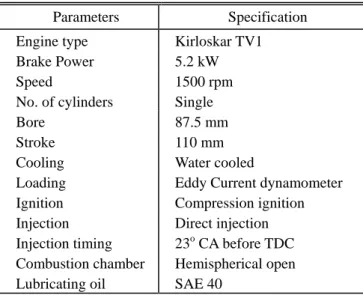
Experiments were conducted on an engine with one cylinder and direct injection fuel system with 5.2 kW power output, 215 bar standard injection pressure, operated at a constant 1500 rpm speed, loaded by an eddy current dynamometer (BENZ), which is cooled by water. The engine specification is detailed in Table 1.
Table 1 Detailed engine specifications Parameters Specification Engine type Kirloskar TV1 Brake Power 5.2 kW
Speed 1500 rpm
No. of cylinders Single
Bore 87.5 mm
Stroke 110 mm
Cooling Water cooled
Loading Eddy Current dynamometer Ignition Compression ignition Injection Direct injection Injection timing 23o CA before TDC Combustion chamber Hemispherical open Lubricating oil SAE 40
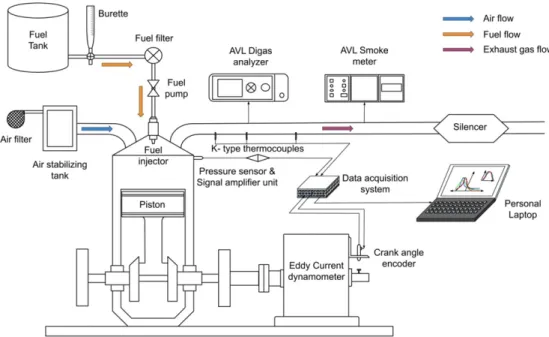
A burette was adopted to note the volume of fuel and a stop watch in addition to measure the fuel flow rate. The gas temperature at the exhaust (EGT) was observed using three different K-type thermocouples which are located at different positions. To measure the cylinder pressure, Type 5015A piezoelectric transducer (from Kistler Instruments, Switzerland) was attached over the cylinder head. An angle encoder with the flywheel was availed to measure the crank angle. All the measuring units are connected to a signal conditioning unit before linking them to a data acquisition system. The entire unit as an experimental test unit is as shown in Fig. 1. Smoke meter (AVL 437) was used to quantify the smoke, while the exhaust pollutant emission is measured using a periodically calibrated AVL 444 Digas exhaust gas analyzer. While the unburnt hydrocarbon and nitrogen oxides were measured in PPM, the other emission parameters were measured in vol. %.
Fig. 1 Experimental set up to quantify the functional and exhaust emittent attributes of nanofuels
4. Results and Discussion
Chemical reactions dealing with any catalytic process within solid, liquids and/or gases are quickened by instigating a solid phase that in a best possible means contain large quantum of the apt type of site for chemical reactants to adsorb, react, and desorb. An optimised catalyst possesses more surface area with least volume and hence the size of it must be reduced. To possess such catalyst, the focus is on nanomaterials for two major facts – (a) their exceedingly small size (typically 20–50 nm), and (b) their special properties.
The smaller the particle size means large surface area to volume ratio, which is a must to achieve a beneficial chemical reaction (Claus and Hofmeister, 1999). We could also infer that the properties of these particles are very special and much enhanced than their own macroscopic sizes. These are the prime reasons for their flexibility of use and productive outcome of being chosen as nanocatalysts. However, the main objective of any catalysis research must be to evaluate the role of particle size and shape in altering the congenital catalytic capabilities beyond simply expanding the specific surface area. In our case the SSA of nanoflakes were nearly 1.8 times more than the conventional spherical particles, which might have provided more sites for the fuel molecules to interact and react with the particles. As mentioned and reported in one of our earlier works, the characterized data of the prepared powder samples are listed in Table 2. However, the characterized details of the fuel samples are summarized in Table 3 and their significance is explained further.
Table 2 Properties of MgO nanoflakes Properties Values Crystallite size 17±5 nm
Colour Pure white
Morphology Flake surfaced Specific Surface Area (SSA) 97±4 m2 g-1 True Density 3.59±0.07 g cc-1 Specific heat 903±24 J kg-1 K-1 Thermal conductivity 48.4±0.7 W m-1 K-1
Once the characterized data is obtained, the engine functionality and exhaust emittent characteristics corresponding to all the fuels were tested in the experimental test setup under different loads viz., 25, 35, 50, 65, 75, 90 and 100%. To
be precise, the diesel fuel is considered as the base fuel with which the first set of experiments is carried out for comparing them with other fuel samples namely, (D+20PB), (D+50MgO) and (D+20PB50MgO). The performance studies include the BSFC, BTE and, the EGT. The emission characteristic investigations involve the measurement of CO, HC and NOx. In order to investigate the combustion characteristics, HRR and cylinder pressure (Pcyl) is noted against varied crank angle.
4.1 Characterization of fuels
The FTIR spectrum of the nanoadditive dispersed biodiesel-diesel fuel blend (D+20PB50MgO) is shown in Fig. 2. The diesel spectra could be attributed to 1608 and 1560 cm-1 related due to C=C stretch in aromatic nuclei and C–H stretching vibrations of methyl group at 1379 cm-1.The spectra of palm oil biodiesel could be related to 2830-2970, 1739 and 1170 cm-1 owing to the aliphatic C-H stretching, C=O stretching due to ester and C–O–C stretching in ester group in triglyceride molecule, respectively. The existence of MgO is attributed to the spectra at 3620-3080, 1413 and 877 cm-1 due to O–H stretching within Mg(OH)2, stretching due to Mg-H-Mg and Mg-O-Mg, respectively. In general MgO is anticorrosive in nature and the pure biodiesel is corrosive in nature due to the presence of water molecules within it. Hence a blend of biodiesel and the nanoflakes into the diesel makes it a good fuel with anticorrosive nature which could be used with no doubt in the engines. To confirm this, the copper strip test was carried out in accordance with the ASTM standards and was weighed up with the ASTM Corrosion standard plate.
Fig. 2 FT-IR spectra of MgO dispersed palm oil biodiesel-diesel blend (D+20PB50MgO)
The density of the fuel samples with the nanoadditives (D+50MgO) is slightly higher than the conventional diesel as the denser magnesia particles were added. However, it is well known that the density of the palm oil biodiesel is nearly 6% higher than the diesel as the biofuels possess long chains of hydrocarbon. This is why the density of D+20PB and D+20PB50MgO is 1.2% and 1.6% higher than pure diesel. Amidst many commercial biodiesel fuels, palm oil biodiesel has lesser density (Alptekin and Canakci, 2008). The instrument accuracy while measuring the density was closer to ± 0.001 g cc-1.
Table 3 Properties of MgO nanoflakes
Properties D D+20PB D+50MgO D+20PB50MgO
Corrosion 1a 1a 1a 1a Density at 25 oC (g cc-1) 0.822 0.832 0.823 0.836 Viscosity at 40 oC (cS) 2.312 2.902 2.325 2.911 Calorific Value (kJ kg-1) 42400 41811 42668 42073 Flash Point (oC) 64 80 66 83 Fire Point (oC) 67 83 68 85
The viscosity of fuel samples were measured at 40oC with ±0.1oC uncertainty. The fuel viscosities with biodiesel blends were higher due to the dense nature of the palm oil biodiesel. The fuels with nanoadditives were also slightly higher due to the density parameters of the nanoflakes. Unless the viscosity is not optimized and lowered, there cannot be fine atomization and better fuel spray, thus making a better air-fuel mixing leading to an aggrandized combustion.
The palm oil biofuel which contains the oxygen molecules within their methyl esters makes the calorific value of the fuel samples containing it lesser than the conventional diesel. But the dispersion of nanoadditives into the fuel samples improvises the calorific value owing to the heat conductive potential and, better surface to volume ratio of the magnesia nanoflakes. Similarly these nanoflakes improvised the flash and fire point of (D+50MgO) by 3.1% and 1.5% when compared with pure diesel (D) and that of (D+20PB50MgO) by 3.8% and 2.4%, while comparing with biodiesel-diesel blend.
4.2 Combustion studies
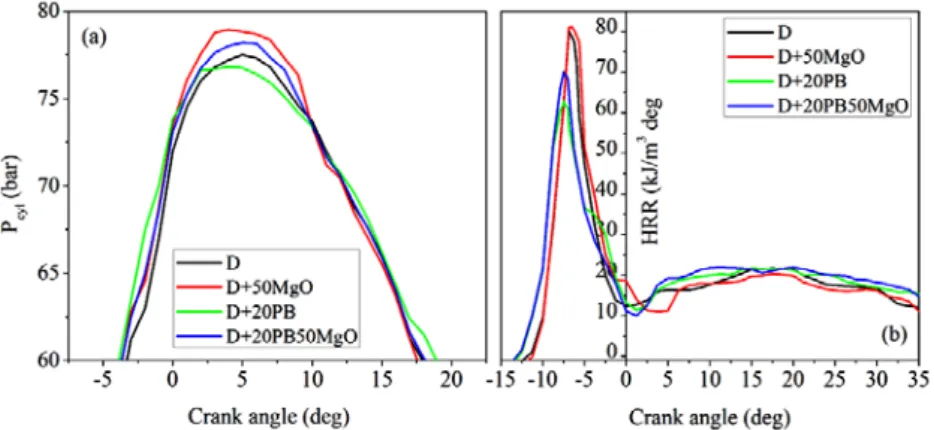
Fig. 3 (a) Cylinder pressure (Pcyl) and (b) Heat Release Rate (HRR) with change in crank angle
The combustion effectiveness of the fuel with nanoflakes might be attributed to the effectiveness of the nanoparticle to absorb and emit the radiation from the flame front during the localized boiling on the fuel droplet. It must be one of the most dominating mechanisms apart from the classical droplet combustion mechanism based only on the thermally conductive heat transfer between droplet and flame. So the fundamental concept of heat transfer between the flame and fuel droplet through exothermic reactions in the flame supplies an additional heat energy rate sufficient enough for the fuel vaporization. And the rapid fuel-vaporization rate is the reason for the enhanced fuel-burning rate. While going down deeper and closer to the particle zone within a fuel droplet, the radiation energy from the flame front might be absorbed by the particles available on the outer layer of the droplet that might promote localized boiling, and hence rapid fuel vaporization resulting in a significant rise of fuel-burning rate, thus ensuring complete combustion and variations in cylinder pressure and heat release rate.
The cylinder pressure variations with reference to the crank angle at maximum load conditions could be noted from Fig. 3(a). It is evident that the rise in peak pressure is notably steeper for D+50MgO and D+20PB50MgO when contrasted with that of the conventional diesel, which might be due to the enhanced SSA of the magnesia nanoflakes that enhances the attribute of mixing thus promoting prompt combustion. In other words, the addition of nanoflakes reduce the chemical delay that significantly increases the ignition rate thus prompting advanced combustion and lowered peak pressure. This is why D+20PB which has no additives, show a slightly lower peak pressure than the ones with additives. With much of an interest, the HRR which signifies the availability of thermal energy to produce useful work is plotted at rated load with respect to different crank angles and is shown as Fig. 3(b).
The diesel fuel with nanoadditives provided highest heat release rate than other fuels whereas the D+20PB50MgO was the lowest. These results could be ascribed to the nanoflake SSA and heat conductive potential in case of D+50MgO, whereas in the case of D+20PB50MgO, the higher viscous nature which leads to deficient atomization feature and its relatively lower calorific value could be the cause of its under performance. This could also be compared with the peak cylinder pressures of the two fuels where the D+50MgO has higher value than D+20PB50MgO. However, the HRR of D+20PB50MgO is towering than that of D+20PB and regular diesel, which is evident that the nanoadditives are combustion promoters.
4.3 Performance studies
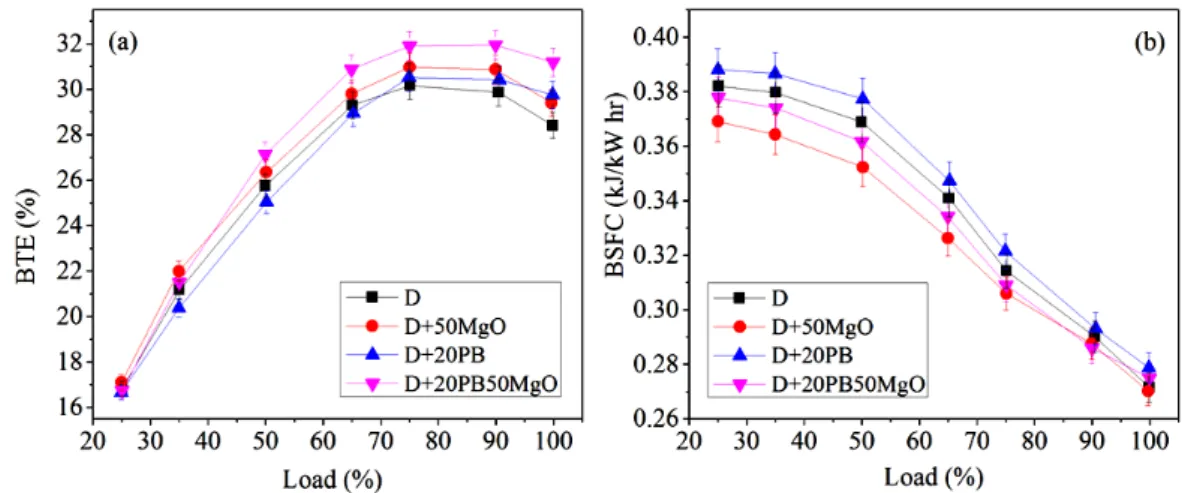
The BTE of D+20PB50MgO increases up to 90%, D+50MgO and D+20PB increases up to 80%, and D increases up to 75% of full load conditions respectively and decreases thereafter which could be observed from Fig. 4(a). To add upon this inference, at the full load conditions, based on the highest to lowest BTE, the fuels could be ordered as follows: D+20PB50MgO, D+20PB, D+50MgO, which are higher than conventional diesel itself. The reason for enhanced performance is due to the presence of molecular oxygen in the biofuel and within the nanoparticles apart from its catalytic abilities due chemically reactive surfaces. Moreover, the use of nanoadditives which has high thermal conductivity promotes paced heat transfer through fluid-particle interaction by suppressing the ignition delay and increasing the cylinder pressure which ameliorates the BTE (Shafii et al., 2011). This is also a possible reason for a lesser BSFC in case of fuels with higher calorific value due to the dispersion of magnesia nanoflakes.
Fig. 4 (a) Brake Thermal Efficiency and (b) Brake Specific Fuel Consumption with change in load
However during the full load conditions, the fuels with palm oil biodiesel were consumed much higher for a unit output power than the conventional diesel due to the viscous and dense nature of biofuel. In addition, we could infer from Fig. 4(b) that for all the fuels, the BSFC lowers with the addition of load which is due to the aggrandized combustion phenomena.
Fig. 5 Exhaust Gas Temperature (EGT) with change in load
The exhaust gas temperature rises with enhanced load conditions as notable from Fig. 5. Due to the presence of molecular oxygen and nanoparticles in the fuel blends, prior fuel evaporation takes place resulting in lesser EGT than regular diesel fuels during low loads. In contrast, a reverse trend is observed due to a rise in combustion zone temperature as a result of aggrandized combustion effects by the thermally conductive surface area of particles, and enhanced heat transfer due to fluid-particle interactions, prompting excess fuel intake to necessitate the higher load conditions, thus amplifying the exhaust gas temperature.
4.4. Emission studies
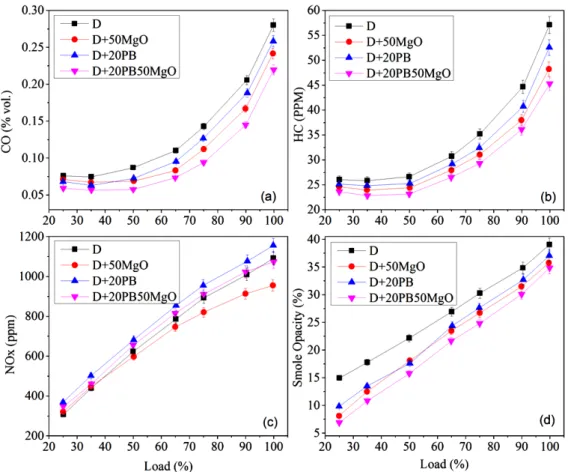
Based on Fig. 6(a), we could understand that the emissions of CO increase with loading. By making a deeper insight to the plots, we could understand that the engine running with D+20PB fuel emits lesser CO than base fuel owing to the availability of excess molecular oxygen within the palm oil biodiesel which has the ability to convert few CO to CO2. Better than these fuels, the fuel blends with magnesia nanoflakes has the tendency to lower the CO emissions due to the thermal and surface properties of the nanoflakes which leads to shorter ignition delay, better air-fuel interactions and enhanced combustion characteristics. These reasons are also attributed to the reduction in HC emissions, which is why the trend noted from Fig. 6(b) is similar to that of CO emissions. In specific the dispersion of magnesia nanoadditives have abated the UHC emissions further when contrasted to the basic fuel and its blends.
The NOx emissions by different fuels with reference to load conditions could be noted from Fig. 6(c). The oxides of nitrogen increases due to the temperature and pressure rise within the engine cylinder, and hence increasing with load conditions. The oxygen in the biodiesel reduces the ignition delay leading to a rise in chamber temperature in addition to enhanced combustion resulting in excess emissions of NOx when the biodiesel-diesel blend (D+20PB) is used. However, the dispersion of MgO nanoflakes within the fuel improves the catalytic process to homogenize and promote absolute combustion with a shortened ignition delay to reduce emission of nitrogen oxides.
In addition to this, the trends of the plots are nearly linear which indicates that there is no interaction between particles within the fluid. The thermal conductivity was found to increase with nanoparticle concentration in a linear fashion, which indicates absence of significant particle–particle interactions. The better stability of the nanofluid and the use of ethylene glycol as base fluid have been significant in avoiding the particle interactions.
Fig. 6 Emission with change in load (a) carbon monoxide (b) hydro carbon (c) oxides of nitrogen (d) smoke opacity It could be observed that for all the fuel combinations, the emission of smoke agitates with the load, as notable from Fig. 6(d). When keenly observed, the fuel samples with MgO nanoflakes emitted lesser smoke than those without the nanoadditives. This could be attributed to the SSA of the nanoflakes which transfers heat of the fuel burnt at a better rate from the outer fuel layer towards the center of the fuel droplet, thus ensuring a nearly complete combustion and hence a lesser smoke.
4.5 Comparison with the existing literatures
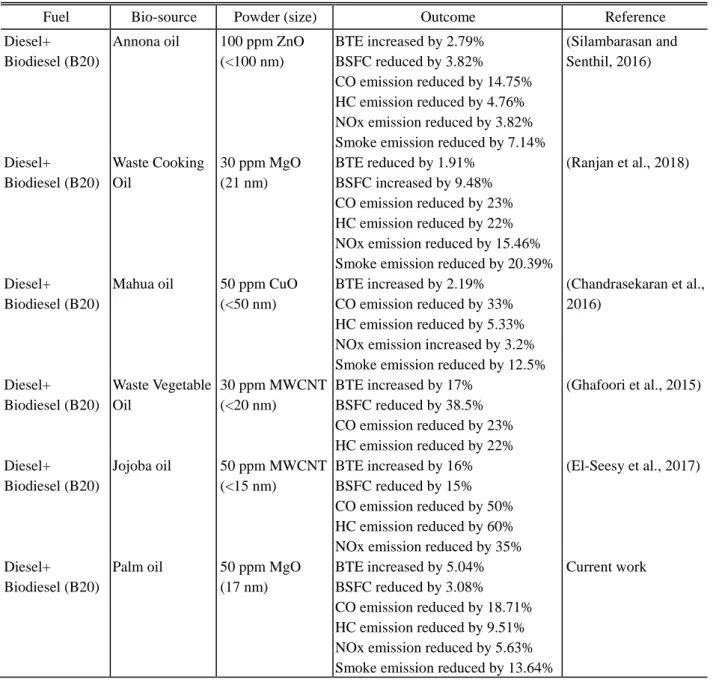
Successful research should conclude by comparing the results with those of the existing research, and hence to justify whether the potential outcome of the current study is achieved or not. Table 4 provides an insight into different but relevantly close works that were reported earlier. It is noteworthy to find that MWCNT is the best among all the other metal oxide nanoparticles due to its enhanced SSA and thermal properties. When our results were compared with Ranjan et al., (Ranjan et al., 2018), we could find that the BTE and BSFC improved well with an almost appreciable reduction in emission. In a nutshell, MgO nanoflakes prove to be a well-optimized nanocatalyst due to their anti-corrosive nature, and low hardness value, despite the outcomes of MWCNT or other metal oxide nanoparticles.
Table 4 Comparative analysis with other works
Fuel Bio-source Powder (size) Outcome Reference
Diesel+ Biodiesel (B20)
Annona oil 100 ppm ZnO (<100 nm)
BTE increased by 2.79% BSFC reduced by 3.82% CO emission reduced by 14.75% HC emission reduced by 4.76% NOx emission reduced by 3.82% Smoke emission reduced by 7.14%
(Silambarasan and Senthil, 2016) Diesel+ Biodiesel (B20) Waste Cooking Oil 30 ppm MgO (21 nm) BTE reduced by 1.91% BSFC increased by 9.48% CO emission reduced by 23% HC emission reduced by 22% NOx emission reduced by 15.46% Smoke emission reduced by 20.39%
(Ranjan et al., 2018)
Diesel+ Biodiesel (B20)
Mahua oil 50 ppm CuO (<50 nm)
BTE increased by 2.19% CO emission reduced by 33% HC emission reduced by 5.33% NOx emission increased by 3.2% Smoke emission reduced by 12.5%
(Chandrasekaran et al., 2016) Diesel+ Biodiesel (B20) Waste Vegetable Oil 30 ppm MWCNT (<20 nm) BTE increased by 17% BSFC reduced by 38.5% CO emission reduced by 23% HC emission reduced by 22% (Ghafoori et al., 2015) Diesel+ Biodiesel (B20) Jojoba oil 50 ppm MWCNT (<15 nm) BTE increased by 16% BSFC reduced by 15% CO emission reduced by 50% HC emission reduced by 60% NOx emission reduced by 35%
(El-Seesy et al., 2017)
Diesel+ Biodiesel (B20)
Palm oil 50 ppm MgO (17 nm)
BTE increased by 5.04% BSFC reduced by 3.08% CO emission reduced by 18.71% HC emission reduced by 9.51% NOx emission reduced by 5.63% Smoke emission reduced by 13.64%
Current work
4.6 Uncertainty analysis
Based on the type of instrument chosen, the instrument condition based on its depreciation period, the ambience under which they are operated, the calibration methods, the error in observation and based on the value of the reading, the uncertainties emerge in any experiments. Hence the analysis for uncertainty is a must to validate the accuracy of the experiments carried out. Based on the method suggested by Holman (Holman, 2011), the uncertainty analysis was carried out using Eq. (1) to (6) and it is detailed in Table 5 and Table 6. Based on the exhaust gas analyser and smoke
meter manufacturers guide, the maximum error possible while measuring the emissions is 5%. UPpeak= σPpeak Ppeak�nPpeak (1) UEGT= σEGT EGT�nEGT (2) UBP BP =�� UVolt Volt� 2 +�UCurrent Current� 2 (3) UTFC TFC=�� Utrise trise� 2 (4) UBTE BTE=�� UTFC TFC� 2 +�UBP BP� 2 (5) UEmissions= σEmissions Emissions�nEmissions (6)
where Emissions can be CO, HC, NOx and smoke; n – number of measurements taken Table 5 Uncertainty of measured parameters
Measured properties Uncertainty (%) Burette for fuel level ±0.1
Stop watch ±0.2
Load indicator ±0.2
Crank angle decoder ±1.2
Speed indicator ±0.1
Manometer ±1.0
Pressure indicator ±1.6
Voltage ±1.3
Current ±1.0
Exhaust gas Temperature ±0.2 Table 6 Uncertainty of derived parameters
Derived properties Uncertainty (%) Total fuel consumption ±0.9
Brake power ±2.3
Brake specific fuel consumption ±2.1 Brake thermal efficiency ±1.9
Carbon monoxide ±3.7
Unburnt hydrocarbons ±2.4
Oxides of nitrogen ±0.7
Smoke ±2.8
Exhaust gas temperature ±1.0 5. Conclusion
The study intends on the aftermath of dispersing the synthesized magnesia nanoflakes into different fuel blends with prime focus on palm oil biodiesel-diesel blend, to study the fuel burning, engine functionality and exhaust emittent attributes of a 4-stroke CI engine. The inferences are listed as follows, which were based on the consolidated results.
a) By dispersing 50 PPM of MgO nanoflakes into the fuel samples such as base reference fuel, here diesel (D) and the biodiesel-diesel blend (D+20PB), the fuel properties such as mass density, kinematic viscosity, flash and fire point, and heating value increased.
b) The BSFC for the fuels D+20PB50MgO and D+50MgO gets lowered by 3.08% and 2.88% when compared with those fuels without nanoadditives. The brake thermal efficiency (BTE) for those fuels has improved by 5.04% and 2.74% when compared with D+20PB and D.
c) The emission of CO, HC, NOx and particulate exhaust reduced when the fuel samples with nanoadditives were tested. These emissions reduced by 18.71%, 9.51%, 5.63% and 13.64% respectively in case of D+20PB50MgO blend when compared with D+20PB fuel. Similarly, in case of D+50MgO, the emissions reduced by 16.54%, 10.35%, 4.70% and 19.47% respectively when compared with the base reference fuel.
d) The characteristics of combustion, engine functionality and exhaust emittent standards have well improved when the MgO nanoflakes were dispersed in conventional diesel (D) and palm oil biodiesel-diesel blend (D+20PB). Conflict of Interest
The authors declare that they have no conflict of interest. Acknowledgement
This work was supported by the Automotive Engine Testing Lab, Sri Venkateswara College of Engineering, Sriperumbudur, Tamil Nadu, India.
References
Aalam, C. S. and Saravanan, C. G., Effects of nano metal oxide blended Mahua biodiesel on CRDI diesel engine, Ain Shams Engineering Journal, Vol. 8, No.4, (2017), pp. 689-696, DOI: 10.1016/j.asej.2015.09.013.
Agarwal, A. K., Biofuels (alcohols and biodiesel) applications as fuels for internal combustion engines, Progress in Energy and Combustion Science, Vol. 33, No.3, (2007), pp. 233-271, DOI: 10.1016/j.pecs.2006.08.003.
Alptekin, E. and Canakci, M., Determination of the density and the viscosities of biodiesel-diesel fuel blends, Renewable Energy, Vol. 33, No.12, (2008), pp. 2623-2630, DOI: 10.1016/j.renene.2008.02.020.
Chandrasekaran, V., Arthanarisamy, M., Nachiappan, P., Dhanakotti, S. and Moorthy, B., The role of nano additives for biodiesel and diesel blended transportation fuels, Transportation Research Part D: Transport and Environment, Vol. 46, (2016), pp. 145-156, DOI: 10.1016/j.trd.2016.03.015.
Claus, P. and Hofmeister, H., Electron Microscopy and Catalytic Study of Silver Catalysts: Structure Sensitivity of the Hydrogenation of Crotonaldehyde, The Journal of Physical Chemistry B, Vol. 103, No.14, (1999), pp. 2766-2775, DOI: 10.1021/jp983857f.
Debbarma, S. and Misra, R. D., Effects of iron nanoparticle fuel additive on the performance and exhaust emissions of a compression ignition engine fueled with diesel and biodiesel, Journal of Thermal Science and Engineering Applications, Vol. 10, No.4, (2018), DOI: 10.1115/1.4038708.
Deepanraj, B., Dhanesh, C., Senthil, R., Kannan, M., Santhoshkumar, A. and Lawrence, P., Use of palm oil biodiesel blends as a fuel for compression ignition engine, American Journal of Applied Sciences, Vol. 8, No.11, (2011), pp. 1154-1158, DOI: 10.3844/ajassp.2011.1154.1158.
Dey, A. R. and Misra, R. D., Effect of infiltration of bio-lubricant on the performance of a compression ignition engine fuelled with biodiesel blends, Clean Technologies and Environmental Policy, Vol. 19, No.2, (2017), pp. 553-563, DOI: 10.1007/s10098-016-1247-3.
El-Seesy, A. I., Abdel-Rahman, A. K., Bady, M. and Ookawara, S., Performance, combustion, and emission characteristics of a diesel engine fueled by biodiesel-diesel mixtures with multi-walled carbon nanotubes additives, Energy Conversion and Management, Vol. 135, (2017), pp. 373-393, DOI: 10.1016/j.enconman.2016.12.090.
Fangsuwannarak, K. and Triratanasirichai, K., Improvements of palm biodiesel properties by using nano-TiO2 additive, exhaust emission and engine performance, Romanian Review Precision Mechanics, Optics & Mechatronics, No.43, (2013), pp. 111-118.
Farzaneh, F., Dashtipour, B. and Rashtizadeh, E., Transesterification of soybean oil for biodiesel production over CaAlSi mixed oxide nanoparticles, Journal of Sol-Gel Science and Technology, Vol. 81, No.3, (2017), pp. 859-866, DOI: 10.1007/s10971-016-4253-3.
Gan, Y. and Qiao, L., Combustion characteristics of fuel droplets with addition of nano and micron-sized aluminum particles, Combustion and Flame, Vol. 158, No.2, (2011), pp. 354-368, DOI: 10.1016/j.combustflame.2010.09.005.
Gan, Y. and Qiao, L., Radiation-enhanced evaporation of ethanol fuel containing suspended metal nanoparticles, International Journal of Heat and Mass Transfer, Vol. 55, No.21, (2012), pp. 5777-5782, DOI: 10.1016/j.ijheatmasstransfer.2012.05.074.
Ghafoori, M., Ghobadian, B., Najafi, G., Layeghi, M., Rashidi, A. and Mamat, R., Effect of nano-particles on the performance and emission of a diesel engine using biodiesel-diesel blend, International Journal of Automotive and Mechanical Engineering, Vol. 12, (2015), pp. 3097-3108, DOI: 10.15282/ijame.12.2015.23.02.
Gürü, M., Artukoǧlu, B. D., Keskin, A. and Koca, A., Biodiesel production from waste animal fat and improvement of its characteristics by synthesized nickel and magnesium additive, Energy Conversion and Management, Vol. 50, No.3, (2009), pp. 498-502, DOI: 10.1016/j.enconman.2008.11.001.
Holman, J., Experimental Methods for Engineers (2011), McGraw Hill.
Kannan, G. R., Karvembu, R. and Anand, R., Effect of metal based additive on performance emission and combustion characteristics of diesel engine fuelled with biodiesel, Applied Energy, Vol. 88, No.11, (2011), pp. 3694-3703, DOI: 10.1016/j.apenergy.2011.04.043.
Kao, M. J., Ting, C. C., Lin, B. F. and Tsung, T. T., Aqueous aluminum nanofluid combustion in diesel fuel, Journal of Testing and Evaluation, Vol. 36, No.2, (2008), pp. 186-190.
Karthikeyan, S., Elango, A. and Prathima, A., An environmental effect of GSO methyl ester with ZnO additive fuelled marine engine, Indian Journal of Marine Sciences, Vol. 43, No.4, (2014), pp. 564-570.
Khatri, D., Goyal, R., Darad, A., Jain, A., Rawat, S., Khan, A. and Johnson, A. T., Investigations for the optimal combination of zinc oxide nanoparticle-diesel fuel with optimal compression ratio for improving performance and reducing the emission features of variable compression ratio diesel engine, Clean Technologies and Environmental Policy, Vol. 21, No.7, (2019), pp. 1485-1498, DOI: 10.1007/s10098-019-01719-8.
Krishnamurthy, S., Bhattacharya, P., Phelan, P. E. and Prasher, R. S., Enhanced mass transport in nanofluids, Nano Letters, Vol. 6, No.3, (2006), pp. 419-423, DOI: 10.1021/nl0522532.
Lee, H. V., Taufiq-Yap, Y. H., Hussein, M. Z. and Yunus, R., Transesterification of jatropha oil with methanol over Mg-Zn mixed metal oxide catalysts, Energy, Vol. 49, No.1, (2013), pp. 12-18, DOI: 10.1016/j.energy.2012.09.053. Mirzajanzadeh, M., Tabatabaei, M., Ardjmand, M., Rashidi, A., Ghobadian, B., Barkhi, M. and Pazouki, M., A novel
soluble nano-catalysts in diesel-biodiesel fuel blends to improve diesel engines performance and reduce exhaust emissions, Fuel, Vol. 139, (2015), pp. 374-382, DOI: 10.1016/j.fuel.2014.09.008.
Ranjan, A., Dawn, S. S., Jayaprabakar, J., Nirmala, N., Saikiran, K. and Sai Sriram, S., Experimental investigation on effect of MgO nanoparticles on cold flow properties, performance, emission and combustion characteristics of waste cooking oil biodiesel, Fuel, Vol. 220, (2018), pp. 780-791, DOI: 10.1016/j.fuel.2018.02.057.
Sajith, V., Sobhan, C. B. and Peterson, G. P., Experimental Investigations on the Effects of Cerium Oxide Nanoparticle Fuel Additives on Biodiesel, Advances in Mechanical Engineering, Vol. 2, (2010), p. 581407, DOI: 10.1155/2010/581407.
Shafii, M. B., Daneshvar, F., Jahani, N. and Mobini, K., Effect of Ferrofluid on the Performance and Emission Patterns of a Four-Stroke Diesel Engine, Advances in Mechanical Engineering, Vol. 3, (2011), p. 529049, DOI: 10.1155/2011/529049.
Silambarasan, R. and Senthil, R., Effects of nano additives on performance and emission characteristics of a diesel engine fueled with Annona methyl ester, Biofuels, Vol. 7, No.3, (2016), pp. 271-277, DOI: 10.1080/17597269.2015.1132370.
Suseel Jai Krishnan, S. and Nagarajan, P. K., Convective thermal performance and entropy generation analysis on Solution Combustion synthesis derived magnesia nano-dispersion flow susceptible by a micro-fin tube, Experimental Thermal and Fluid Science, Vol. 101, (2019), pp. 1-15, DOI: 10.1016/j.expthermflusci.2018.10.002. Suseel Jai Krishnan, S., Nagarajan, P. K., Mamat, R., Vimaladevi, L. and Sathyamurthy, R., Synthesis, characterisation
and thermo-physical investigations on magnesia nanoparticles dispersed in ethylene glycol–DI water (50:50), IET Micro and Nano Letters, Vol. 13, No.3, (2018), pp. 335-340, DOI: 10.1049/mnl.2017.0484.
Tyagi, H., Phelan, P. E., Prasher, R., Peck, R., Lee, T., Pacheco, J. R. and Arentzen, P., Increased hot-plate ignition probability for nanoparticle-laden diesel fuel, Nano Letters, Vol. 8, No.5, (2008), pp. 1410-1416, DOI: 10.1021/nl080277d.
Venkatesan, S. P. and Kadiresh, P. N., Influence of an aqueous cerium oxide nanofluid fuel additive on performance and emission characteristics of a compression ignition engine, International Journal of Ambient Energy, Vol. 37, No.1, (2016), pp. 64-67, DOI: 10.1080/01430750.2014.882863.
Wang, Y., Ma, S., Zhao, M., Kuang, L., Nie, J. and Riley, W. W., Improving the cold flow properties of biodiesel from waste cooking oil by surfactants and detergent fractionation, Fuel, Vol. 90, No.3, (2011), pp. 1036-1040, DOI: 10.1016/j.fuel.2010.11.013.