衣類の溶剤洗浄を水系へ転換するための
水系超音波洗浄システムの構築
0871662443 課題番号15500509
平成 15年度 平成17年度科学研究費補助金 (基盤研究(C)(2))研究成果報告書
平成
1
8年 6月
研 究 代 表 者 多 賀 谷 久 子
滋賀大学教育学部教授
F
7
4
L n J V ' e nvtII 刻 、衣類の溶剤洗浄を水系へ転換するための
水系超音波洗浄システムの構築
課題番号15500509
平成 15年度 平成17年度科学研究費補助金 (基盤研究(C)(2))研究成果報告書
平成
1
8
年
6
月
研 究 代 表 者 多 賀 谷 久 子
滋賀大学教育学部教授
はしがき
こ こ に 報 告 す る 研 究 は 、 研 究 課 題 「 衣 類 の 溶 剤 洗 浄 を 水 系 へ 転 換 す る た め の 水 系 超 音 波 洗 浄 シ ス テ ム の 構 築 」 と し て 、 平 成 14年 度 か ら 平 成 17年 度 の 3年 間 に わ た っ て 文 部 省 科 学 研 究 費 補 助 金 ( 基 盤 研 究 (C) (2) ) の 交 付 を 受 け て 行 わ れ た も の で あ る 。 本 研 究 の 組 織 、 研 究 経 費 、 研 究 発 表 お よ び 研 究 成 果 は 以 下 の と お り で あ る。研 究 組 織
研 究 代 表 者 : 多 賀 谷 久 子 ( 滋 賀 大 学 教 育 学 部 教 授 )交 付 決 定 額 ( 配 分 額 ) 金 額 単 位 : 千 円 )
直 接 経 費 間 接 経 費 A口、 計 平 成 15年 度 1,700。
1,700 平 成 16年 度 1,400。
1,400 平 成 17年 度 600。
600 総 言十 3,700。
3,700 I研 究 発 表
1.学会誌等 ( 1) Hisako TagayaThe Mechanism of Soil Removal from Textile by Ultrasound Application
,
Proceedings 42nd Internationalwfk Detergency Conference 2005, pp.563-563, Dusseldorf, Germany, June 2nd 2'.005
(2) Hisako TAGA Y A
,
Satomi TUD and Ken HIGASITSUJI,
Thermodynamic Study of Fatty Soil.Removal fl;om Polyester
'
, ••.
-Fiber by Liquid Chromatography with Fabric Columns, Journal of Oleo Science, Vo1.53, No.4, pp.167・175 (2004).
(3)多 賀 谷 久 子 、 奥 田 英 理 子 水 系 超 音 波 洗 浄 に よ る 布 か ら の 油 性 汚 れ の 除 去 , 日本油化学会, 第35回 洗 浄 に 関 す る シ ン ポ ジ ウ ム , pp.140-145 (2003) 2003年 10月 28日 2. 口 頭 発 表 (1)多賀谷久子、上谷 真 由 水 系 超 音 波 に よ る 汚 染 布 の 洗 浄 機 構 日 本 家 政 学 会 第55回 大 会 研 究 発 表 要 旨 集 、 p.87 (2003) 2003年 5月 24日 (2)多 賀 谷 久 子 、 吉 岡 美 緒 、 田 井 誠 二 、 越 智 康 夫 脱 気 水 に よ る 布 の 超 音 波 洗 浄 繊 維 学 会 予 稿 集58巻 1号 ( 年 次 大 会 ) , p.273 (2003) 2003年6月 12日 (3) 多 賀 谷 久 子 、 藤 沢 由 香 水 系 超 音 波 洗 浄 に お よ ぼ す 界 面 活 性 剤 の 効 果 日 本 家 政 学 会 第58回 大 会 研 究 発 表 要 旨 集 、 p.71 (2004) 2004年8月 2日 (4)多 賀 谷 久 子 、 藤 沢 由 香 水 系 超 音 波 に よ る 油 性 汚 れ 除 去 の メ カ ニ ズ ム , 日 本 油 化 学 会 、 第43回 日 本 油 化 学 会 年 会 、 講 演 要 旨 集 、 p. 223 (2904). November 2 2004 (6)多 賀 谷 久 子 、 藤 沢 由 香 超 音 波 に よ る ポ リ エ ス テ ル の 油 性 汚 れ 除 去 に お よ ぼ す 界 面 活 性 剤 の効果,
ー11-日 本 家 政 学 会 第
5
8
回 大 会 研 究 発 表 要 旨 集 、 p.(
2
0
0
6
)
2006
年5
月2
8
日-目 次
はしがき
第
1章 TheMechanism o
f
S
o
i
l
Removal from T
e
x
t
i
l
e
by Ultrasound A
p
p
l
i
c
a
t
i
o
n
第
2章 ThermodynamicStudy o
f
F
a
t
t
y
S
o
i
l
Removal from
P
o
l
y
e
s
t
e
r
F
i
b
e
r
by L
i
q
u
i
d
Chromatography w
i
t
h
F
a
b
r
i
c
Columns
第 3章 皮 脂 汚 れ の 水 に よ る 超 音 波 洗 浄
第
4
章 界 面 活 性 剤 水 溶 液 に よ る 油 性 汚 れ の 超 音 波 洗 浄
1 11
6
39 58第
1章
The Mechanism o
f
S
o
i
l
Removal from T
e
x
t
i
l
e
by U
l
t
r
a
s
o
u
n
d
A
p
p
l
i
c
a
t
i
o
n
The Mechanism of Soil Removal from Textile by Ultrasound Application
Hisako Tagaya
Division ofClothing science, Shiga University, Japan
Abstract
Although there have been many studies on ultrasonic and megasonicc1eaning processes for removing partic1e soils企omhard substrates, the soil removal mechanism企om textile substrate is not well understood. The removal efficiency of artificially soiled
fabricwfk 10 C (pigmentlwool fat on cotton), 10 D (pigmentlsebum on cotton) and 30 D (pigmentlsebum on polyester) by the use of ultrasonic irradiation of frequency 28
kHz剖apower density of 1 W cm-2 was investigateq as a function of the sound pressure
and dissolved oxygen concentration in water.Itis shown that the main mechanism responsible for the partic1e soil removal process in a sound field is pressure gradient across the soil. The role played by the sound pressure is also shown to be dependent on the content of白rin water, the nature of fiber substrate, the partic1e soil size and the soil
composition.
Introduction
Ultrasound has been widely used in the removing p訂tic1esoil企omhard substrates. Many studies dealing with hard surface ultrasonicc1eaning have been presented, but this infonnation has provided little understanding of the soil removal from textile substrate.
The knowledge of the mechanism of ultrasonic soil removal for textile substrate is
essenti,al for urtderstanding
,
improving and optimizing thec1eaning process in water as replacements for ecolοgically unacceptable halogenated solvents.Ithas been shown thatthe main mechanisms responsible for thec1eaning process in a sound field are cavitation
,
acoustic streaming and sound pressure [1]. The role played by each ofthese factors is not well understood yet.The purpose of this work is to throw more light on textilec1eaning processes by u1trasound in water as replacements for ecologically unacceptable solvents and as a resu1tto get a better understanding of the soil removal from textile surfaces.Inthe present study
,
an u1trasonicc1eaner,
with a frequency of28 kHz and a power density of1 W/cm
乙
wasemployed. The soil removal of artificially soiled cotton or polyester test fabric in a sound field was studied as a function of the sound press町eand dissolvedoxygen concentration in water. The main mechanisms responsible for the partic1e soil removal企omthe textile substrates in water by ultrasound are discussed.
Experimental Materials
The three artificially soiled fabrics cotton soiled with wfk standard soil pigmentllanoline (wfk 10 C)
,
cotton with pigmentlsebum (wfk 10 D) and polyester with pigmentlsebum (wfk 30 D) were used in this study (Table 1・3).They were cut into 5x5 cm strips alongthe warp and mOUl¥ted in 60x80mm-stainless holders with 40 x 40 mm-window 合ame.
Ultrapure water or deionized water was used asc1eaning medium in the ultrasonic tank.
Methods
The equipment used in the washing experiments consists of six bolt-c1amped Langevin type transducers mounted on the extemal walls at the bottom of a rectangular stainless
steeltank and a generator; these usually operate at a power density of 1 W cm・2 (Fig.l)
The generator power delivered to the transducers is 300 watts. The tank' interior had a width of 250 m m
,
a length of 120 m m and a height of 130 m m,
where the temperat町e-2-probe was installed. The frequency measured at center in tank filled with water was constantly 28 kHz. The soiled fabrics on a fabricated stainless frame were suspended
合omthe arm at the center in the tank filled with water at 30 oC so that the fabric surface
is parallel to the bottom surface, and subjected to ultrasonic waves for 3 min. The depth of water in the tank was 11 cm仕omthe bottom surface.
Removing dissolved gases from water was achieved by the boiling the water or using the degasser (FDO-600, Miura Co., Ltd., Japan). In these experiments the degree of air content in water was assessed by measurement of dissolved oxygen concentration (DO) using Clark-type amperome仕icmethod, Dissolved Oxygen Meter (sens ion6, Hach Co.,
USA). Sound press町ein water was determined by using a hydro-microphone (ST・8004
,
Oki Electric Indus仕yCo., Ltd., Japan) and a sound and vibration signal analyzer (SA-74, Rion Co. Ltd., Japan) ( Fig. 2). Whiteness Checker N W・1(Nippon Denshoku, Jap釦) was used for measuring the reflectance (R) of the test fabrics before and after washing. It has been confirmed that the amount of pigment soil on fabric was proportional t<;> Kubelka K/S= (1・R)2/ (2R) 、、 . , J 唱 a E A , , . ‘ 、 where K is the light absorption or reflectivity coefficient, S is the light scattering coefficient
,
andR the observed ref1ection for monochromatic light.The pigment soil removal efficiencies were estimated as: Rcmoval Efficiency (%) = 100[(K/S)sf-(K/s)wrJ/[(K/S)sf -(K/s)orJ (2) where the subscripts品 wfand of indicate soiled fabrics, washed fabric and original fabric (i.e., fabric before soiling), respectively.今 、
J FResults and Discussion
明弓lenan acoustic field is applied to a liquid, the pressure waves of sonic vibrations create a sound press町ewhich travels through the medium. The sound pressure caused
by the ultrasound radiation versus distance from the tank' bottom surface above a transducer of the center was measured at various content of air in water. The sound pressure varied with the distance, where a standing wave field was build up within the ba血(Fig.3). A loop ofthe standing wave was observed at around 43 rnm from the bottom surface in agreement with the value calculated according to the theory on the sound wave in one dimension [4]. The value ofsound press町edecreased considerably
as the position separating企omthe loop, and was much larger in the degassed water than in the water saturated with air.Itwas confirmed that the content of air in water
influences the sound pressure and therefore the shape of the curves.
The removal efficiency at the position of the loop was examined as function of DO in water.The removal efficiencies forwfk lOC and lOD decreased rapidly with increasing DO up to 3 mglL, following on a minimal or no decrease up to 7 mglL (Fig. 4). The removal efficiency for
W
f
J
<
lOC was appreciably larger than that for lOD. The curves of removal e伍ciencyversus distance from the bottom surface forwfk lOC, lOD and 30Dhad peak values of removal e宜iciencyat around 43 m m, which were similar in shapes to those0 btained for the sound press町e(Fig. 5). These removal efficiencies were also
much larger in degassed water than in the water saturated with air.These results showed that出esound pressure and the soil removal depended upon the content of air in water.
The intensity levelL (dB) and the average intensi守1(W/cm2) in time for sound wave
is defined as follows [4].
-L = 10 log 10//10 (3)
The reference intensityんis 10-16(W/cm2).The sound pressureP (N/cm2) can be estimated from a following equation [5]:
1=P2.1ρc (4)
where ρis the medium density and c is the sound velocity in the medium (1506m/s at 30 oC in water). Then, the removal e百icienciesfor wfk 10C, 10D and 30D were plotted againstP ca1culated using equations (3) and (4) (Fig. 6). Straight lines with a positive slope were obtained between removal e妊iciencyand P.Depending on the chemical
compositions of soil and the nature of fiber, the soil removal from the textile substrate started at a value of sound pressure
,
50,
60 and 100 mN/cm2 for wfkl 0 C,
10 D and 30 D, respectively. In order to remove the pigment particles合omfiber surface in water,sound pressure is necessary more th佃 thevalue. These values can be considered as the
threshold va1ues of sound pressure necessary for the soil to be removed企omthe substrate, depending on the chemical compositions of soil and the chemical nature of fiber.Itwa& observed by a scanning electron microscope (SEM)出剖theparticles over 10μm were most easily removed合omcotton fiber by the maximu)l1sound pressure at the loop ofthe standing wave in the tank, 150mN/cm2 at 28妊-Iz(Photograph 1 ).This is in agreement with theory conceming the frequency dependence of ultrasonic cleaning [6]. Acknowledgments This work was supported In part by Grants-In-Aid for Scientific Research (C・2)企om the Ministry of Education
,
Culture,
Sports,
Science and Tecbnology of Japan. -5-References
[1] Agranat, A.,Bashkirov, V., andKitaigorodskii, Y.,“Ultrasonic Cleaning,"in
Physical Principles ofUltrasonic Technology, L. D. Rozenberg, ed., vol. 2, Part 3,
Plenum Press, New York (1973).
[2]Schott, H.“,Detergency Part1,"Cutler, W. G..and Davis, R. C. ed.ヲMarcelDekker,
Inc.
,
New York (1972).[3] Okuyam, M., Tokuyarna, K., Sakatani, and T., Tsuruta, Y., J. Jpn Oil Chem. Soc. Vol. 30, 432 (1996).
[4] R. D. Ford“,Introduction to Acoustics,"Elsevier Publishing, Co., New York, (1970). [5] Fox, F. E., J. Acoust. Soc.Am.,Vo1.12, 147(1940).
[6] N eppirasヲE.A., Acaustic cavitation, Phys Reports 61, 159 (1980).
6-Table 1 Unsoiled Fabrics
Order- Fabric Width Weight Threads Weave Fineness
code -cm- g/m2 Fd/dm dtex
10A Cotton acc. DIN 53919 80 160 270/270 L 1/1 295/295
with controlled fabric construk -tion, DP, reflectance and ash-contents 30A Polyester fabric 80 160 270/270 P1/1 295/295 correspond 10 DIN 53919 with controlled fabric construktion, and refleclance
From wfk・Testgewebe GmbH, Information about Test Fabrics and their Application in
Detergency Testing, March 01, 1996.
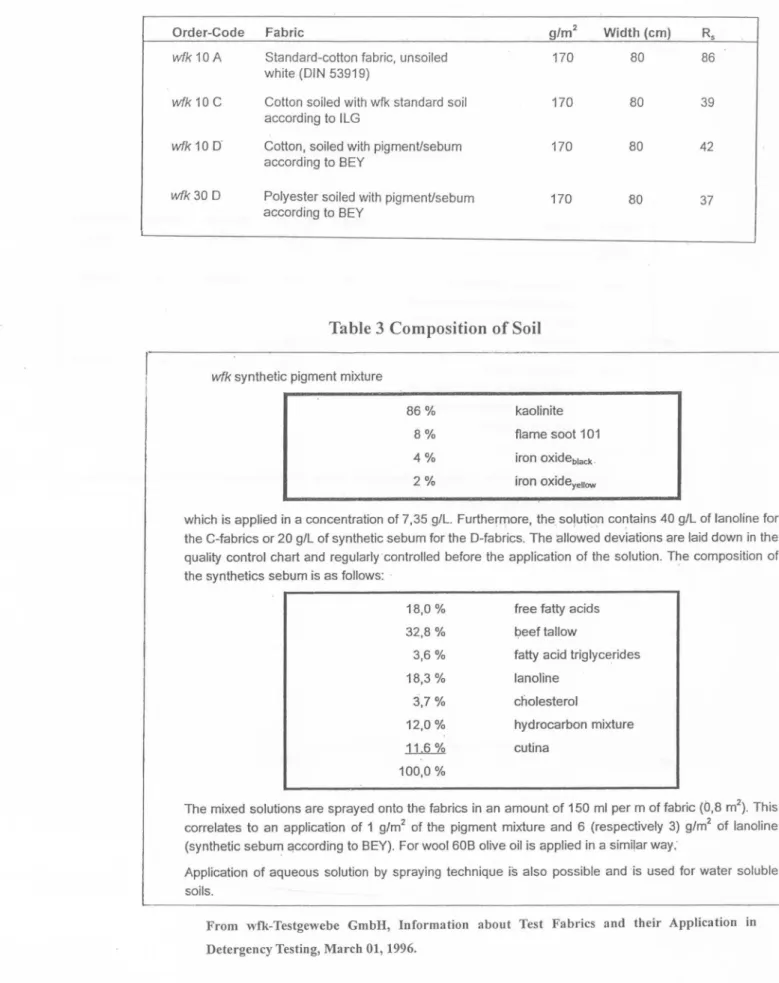
Table 2 Soiled Fabrics
Order-Code Fabric 91m2 Width (cm) Rs wfk 10 A Slandard-cotton fabric, unsoiled 170 80 86 white (DIN 53919) wfk 10C Cotton soiled wilh wfk slandard soil 170 80 39 according to ILG wfk10D Cotton, soiled wilh pigmenUsebum 170 80 42 according to 8EY wfk 300 Polyesler soiled with pigmenUsebum 170 80 37 according10 8EY
Table 3 Composition of Soil wfk synthelic pigmenl mixlure 86 % kaolinite 8 % flame sool 101 4 % iron oxideblack 2 % iron oxideyellow which is applied in a concentration of 7,35 g/L.Furthermore, theso!ution contains 40 g/Lof lanoline for the C-fabrics or 20 g/Lof synthetic sebum for the D-fabrics. Theallowed deviations are laid down in the quality control chart and regularlycontrolled before the application of the solution. The composition of the synthetics sebum is as follows: 18,0 % free fa町acids 32,8 % beef tallow 3,6 % fatty acid triglycerides 18,3 % lanoline 3,7 % choleslerol 12,0 % hydrocarbon mixlure .1.1.盆並 cutina 100,0 %
The mixed solutions are sprayed onto the fabrics in an amount of 150 ml per m of fabric (0,8 m2)ーThis
correlates to an application of 1 g/m2 of the pigment mixture and 6 (respectively 3) g/m2
of lanoline (synthetic sebum according to 8EY).For wool 608 olive oil is applied in a similar way.
Application of aqueous solution by spraying technique is also possible and 'is used for water soluble soils.
From wfk-Testgewebe GmbH, Information about Test Fabrics and their Application in Detergency Testing, March 01, 1996.
CI
亡コ
b
d
e
a
〉ぞ llL:二 ~J
!
て
こ
二
二
一
一
:
フ
=
つ
、><
i
ζ
ここー--三二三
J
Fig. 1 Schematic Diagram of Device for illtrasonic Cle創 出19 a) sa皿ple, b) DO probe, c) dissolved oxygen me旬ξ
d) thermometer, e) ul回 soundosci.llator, :t)ultrasound generatoζ
g)elec凶cmotorあrvertical migration.
.
9
・sound
and
vibration
signal
analyzer
dissolved
oxygen
meter
C
コ
│川
一
{Chydro
-mi
位ophone
liquid
∞
ntainer
tu
仕asound
oscillator
Fig. 2Schematic
Diagram
of
Device
for
Ul
trasound
Inte~ityand
Fr
equency
Spectrum
Measurements
124
122
120
118
116
114
白てコ
民一
ω
﹀む﹂ KA一戸一
ωcω
一
vc-• Degas (DO:O.94-1.08mg/Uo
Non Degas (DO:6.5-6.7mg/U Temp 2g 0 C112
110
ト」 ト・ 4108
20
60
55
50
45
40
35
30
25
mm
Fig.3
Intensity
Level
of
Sound
Wave
versus
Distance
of
Microphon
from
Bottom
Bottom
,
from
Distance
70
• : WFK 10D 企: WFK 10C Time 3min Temp 30 0 C Distance from bottom 41.5mm60
50
40
。、。メ
OC20EU
30
20
一回﹀OEωα
1-' r。
10
O
O
8
7
6
5
mg/L
4
Oxygen
,
3
Dissolved
2
Fig.4
Effect
of
Dissolved
Oxygen
on
Ultrasonic
Cleaning
70
60
S
~50
h Oc
。
-ー
O40
出=
凶30
問 〉。
E 20
ω
f
ピ
1
0
O
30
35
40
45
50
Distance from Bottom
,
m m
F
i
g
.
5
Distance o
f
f
a
b
r
i
c
s
u
r
f
a
c
e
from
Bottom versus Removal E
f
f
i
c
i
e
n
c
y
55
o
:
Non Oegas
,
WFK 100 (00: 7.15-7.58mg/L)
•
:
Oegas
,
WFK 100
(00: 1.03-1
.
12mg/L)
企 :
Oegas
,
WFK 10C
(00: 1.04-1.07mg/L)
Depth o
f
w
a
t
e
r :
1
1
mm
,
Time 3
m
i
n
Temp 30
0C
.13・1
0
0
80
〆園、S
、..../ ~ O~
60
ω
-
ー
OE
凶一
雪
40
。
E
ω
広
20
o
o
ム
C
o
t
t
o
n
(
w
f
k
1
0
C
)
• C
o
t
t
o
n
(
w
f
k
1
0
D
)
• P
o
l
y
e
s
t
e
r
(
w
f
k
30D)
40
80
1
2
0
1
6
0
200 240
Sound Presure (mN/cm
2)F
i
g
.
6
Sound Presure v
s
.
Removal
E
f
f
i
c
i
e
n
c
y
Wfk 10 C Before U
l
t
r
a
s
o
n
i
c
C
l
e
a
n
i
n
g
Wfk 10C A
f
t
e
r
U
l
t
r
a
s
o
n
i
c
C
l
e
a
n
i
n
g
a
t
147 mN/cm
2Photograph 1 Scanning E
l
e
c
t
r
o
n
m
i
c
r
o
s
c
o
p
e
Photograph o
f
S
o
i
l
e
d
F
a
b
r
i
c
(
w
f
k
10 C) B
e
f
o
r
e
and A
f
t
e
r
U
l
t
r
a
s
o
n
IcC
l
e
a
n
i
n
g
第
2
章
Thermodynamic Study o
f
F
a
t
t
y
S
o
i
l
Removal from P
o
l
y
e
s
t
e
r
Thermodynamic Study o
f
F
a
t
t
y
S
o
i
l
Removal from P
o
l
y
e
s
t
e
r
F
i
b
e
r
by
L
i
q
u
i
d
Chromatography w
i
t
h
F
a
b
r
i
c
Columns
Hisako TAGAYA1 ¥Satomi TSUDA 1 and Ken HIGASIDTSUJI2
1 Faculty of Educa tion, Shiga Univel"sity.
Abstract: The mechanisms for removal of synthetic sebum constituents squalene,
cholesterol, triolein and oleic acid from polyester (PET) fabric substrate in an aqueous solution of sodium dodecyl sulfate (SDS) were studied by applying a pseudo-phase retention equation to the migration of a soil in a liquid chromatography column in which the fabric serves as the stationary phase and an aqueous micellar solution of SDS serves as the mobile phase. The retention volume of the four fatty soils on PET fabric was measured as a function of the SDS concentration in the mobile phase. The changes in standard free energy of soil transfer from water onto the fabric substrate(-11G sw), from water into micelles(-11G mw) and合omfabric substrate into the micelles (-11 G ms)were calculated 合om the partition coefficient data determined chromatographically at various concentrations of micellar mobile phases. The -11G. sw for the re-deposition of fatty soil onto the PET substrate increased in the following order: cholesterol < oleic acid< squalene< triolein. The -11G-mw for solubilization of the soil from water (non-micellar solution ) into SDS micelles increased in the following ord((r: oleic acid< cholesterol<
squalene < triolein. The -11 G ms for removal <;>f the soil企omthe PET substrate into SDS micelles decreased in the following order: cholesterol> squalene> triolein. These thermodynarnic parameters suggest that removal of fat匂rsoils合om PET fabric is dcpendent on the tendencies of the soils to redeposit onto the fabric and to solubilize into SDS rnicelles. Key words: fatty soil removal, liquid chromatography, fabric colurnn, aqueous micellar mobile phase, standard企eeenergy change -17・
1 Introduction Contact of fabric surfaces with human skin inevitably results in transfer of human sebum, which cannot be easily removed by washing the fabrics in water with conventional detergents (1). Sebum, the sebaceous secretion of the skin, consists of a complex mixture of triglycerides, squalene, cholesterol and other sterols, free fatty acids and aliphatic hydrocarbons (2) and is the major oily soil constituent in home laundry. Although many studies on the removal of sebum soil企omdifferent substrates have been reported, few address the thermodynamics of sebum soil removal from fiber substrates into aqueous surfactant solutions. The mechanism for removal of oily soil by a substrate-water-micelle system can be considered a two-step process involving the transfer of soil企omsubstrate to water (non-micellar phase) and then from water into micelles. Thus, the free energy change of soil determines whether a detergent process will be successful in removing the soil企omsubstrate. Previously, we proposed a thermodynamic approach for estimating soil removal
企omsubstrates, that is, the transfer of an oil-soluble dyestuff as the oily soil model企oma substrate into an aqueous surfactant solution, using a chromatographic method whereby the yarn filament or the pulverized form of a subs仕ateserves as the stationary phase and a detergent solution serves as the mobile phase (3,生).This method has made it possible to characterize the soil remova1 mechanism thepnodyrtamically without mechanical force. There, however, have been significant di旺erencesin surface properties between the yarn filament form and the powdered form of a substrate. Sebum soil found on clothes has been very impossible to remove from polyester (PET) fabric especially using an aqueous laundry system (1). To understand removal of sebum soil合omPET fabric surfaces, it is necessary to investigate more precisely the complex interactions between the sebum soil and the PET fabric or aqueous surfactant solution. Here, we describe the mechanism of transfer of synthetic sebum soil constituents 企omPET fabric substrate into an aqueous solution of sodium dodecyl sulfate (SDS) -18・
detelmined by a liquid chromatography method with PET fabric used as the stationary
phase. We calculated the partition coefficients and the standard free energy changes for
transfer of synthetic sebum constituents between polyester fabric and SDS micelles and
discuss the relative ease with which the constituents are removed and re-deposited on the
fabric.
2 Experimental
2・1 Materials
The stationary phase comprised of plain-woven white fabric (without optical
brightener) made from 100% PET filament yarn (JIS L・0803,Japanese Standards Association) (Table 1). SDS anionic surfactant standard reagent (99.2% purity), was obtained from 1、~acalai Tesque, Inc., Kyoto, Japan, and was used without further purification. Guaranteed grade squalene (98% purity), cholesterol (99% purity), triolein (99% purity) and oleic acid (99% purity) obtained企omNacalai Tesque, Inc., were usedぉ
the model sebum soil constituents without白rther purification (Scheme 1). Extra pure-grade CI Solvent Yellow 5 (SY5, 1・phenylazo-2・n'l-phthylamine)used for the model colored oily soil was obtained企omNacalai Tesque, Inc. and was purified as described previously (4) (Scheme 1). HPLC-grade water from Nacalai Tesque, Inc., was used as the bulk solvent for the micellar mobile phase. All other reagents were of guaranteed grade
and used without further purification.
2・2 Methods
The app紅a加s and procedure used for liquid chromatography (LC) were
fundamentally the same as those reported previously (4). A deg,asser (model ILD, Waters Co., Milford, M A, USA) for removing dissolved gases form mobile phase was connected between the solution reservoir and the in1et to the pump to decrease baseline drift or shifts and background absorbance at low wavelengths, and to improve detection sensitivjty. A
5-mm i.d.
x
50・mm-longglass colurnn (model 021901,
Waters Co.) was used for chromatography. The co1urnn was packed with 560 sheets of PET fabric disks of the same diameter in the dry state as the interior of the colurnn. The packing in the colurnns was purified as described previously (4). The f10w rate of the PET co1urnn was 2 mLlmin. The detector wave1engths were 277 nm for squalene, 285 nm for cho1estero1, 280 nm for oleic acid, 230 nm for triolein and 445 nm for SY5. E1ution vo1umes for the co1umn were determined for a range of SDS concentrations. Each model soil was introduced individually onto the top of the colurnn as an ethano1 solutions containing 0.1 % squa1ene,
chQ1esterol
,
or trio1ein (w/v) or 2% oleic acid (w/v),
or as a solution of ethano1 and water (50)50 v/v) containing 0.01 % SY5 (w/v). These samp1e solutions were app1ied by syringe to the colurnn with an iniector fitted with a 5-μL sample loop (model 7755・065,Waters Co.).The volume of the stationary phase(民)was ca1culated as the difference between the tota1 colurnn vo1ume (只)and the void volume (凡)of the colurnn (4). The void proportion (Vm/只)ofthe columhs packed with PET fabric was 61 % or 72%. Vm was always measured
before and after each experiment and did not change during any experiment.The streaming potential measurements were the same as those reported previously (3).百lepH of the aqueous SDS solutions was usually 5.5・5.6as determined with a pH meter. All experiments were conducted in a constaiJ.t tempera加reroom剖200C. 2 Results Chromatograms of each fatty soil and the oil-soluble dyestuff SY5 eluted from the PET fabric colurnn with each SDS solution are shown in Figs. 1-5. An initial peak corresponded to the sample solvent (ethanol) of the SY5 or fatty soil. The elution curves of SY5 form PET fabric colurnn (Fig. 1) were smooth and did not have a ripple waveform such as th剖 producedwith the filament y紅ncolurnn (3). Because absorbance of fat,句soils in the ultraviolet region is very weak, the elution peaks for the fatty soils were much
smaller than those for SY5. All fatty soils and SY5 were eluted at SDS concentrations above the critical micellar concentration (cmc) of 8.2
x
10-3 mol dm-3. The elution volume(九)for the fatty soils and SY5 decreased with increase in the SDS concentration.
The corresponding capacity factors (k'
=
(九 -Vm)/Vm) for PET fabric columns are shown in Table 2. The k' for squalene, triolein, oleic acid, cholesterol and SY5 on PET fabric substrate decreased with increasing SDS concentrations above the cmc. This is similar to that of oil-soluble dyestuffs on yam filament or fiber powder substrates,
which have been used as oily soil models (3, 4). It is clear th剖 thek' values are a町民tedby thesolubilization ofthe fatty soils or SY5 into SDS micelles._Thek' values for the fatty soils and SY5 at the same concentrations of SDS increased in the following order: SY5 ~
cholesterol < squalene < oleic acid
<
<
triolein.These results suggest that thek'va1ue depends strongly on the ease of removal of each fatty soil or SY5 from the PET fabric substrate into the aqueous SDS micelle solution. The k' value for SY5 on PET fabric wa.sslightly less than thek'value obtained on PET yam filament (3)
,
suggesting properties of the PET surfaces differ slightly between the fabric used in the present work and yam filament used in the previous report. From these results,
it is inferred that the intensity of interaction between the fa町 soilsand SY5 and PET fabric substrate or aqueous SDS micelle solution alters the behavior of elution合omthe PET fabric column. 4 Discussion 4・1 Thermodynamics of the Fatty Soil Removal Process In liquid chromatography, the elution behavior of a solute eluted with aqueous micellar mobile phase is dependent on the combined e旺ectsof three partition coe伍cients: the partition coefficient of the solute between micelles and water(P mw),
between the stationary phase and water (Psw) and between micelles and the stationary phase (Pms). The partition coe宜icientsPswand P mw can be ca1culated with the following equation proposed by Arrnstrong et a.l(6): -21・v
.
O( P"",-l)_一一一一=一一一一一- L刊 + ー ー
ん 比 ん Psw (1)
where 九isthe vol"4me of the stationary phase (the total colurnn volume minus V m),
九isthe elution volume, Vrnis the volume ofthe mobile phase (the void volume), v is the partial specific volume of the surfactant in the micelle, and Cm is the concentration qf
surfactant present in the micelles ing/mL (the total concentration of surfactant minus the
cmc). To derive Eq.(1), it is assumed th剖 thecmc and the aggregation number or geometry of the micelle are not affected by the small
:
:
p
n
ounts of solute being chromatographed or by increasing the concentration of micelles at lower surfactant concentrations (6LThe ratioVsI(九-Vm)calculated for SY5 and each fatty soil is plottedagainst Cm inF~gs. 6 and 7, respectively. Straight lines with a positive slope were obtained
in agreement with Eq.(1).Table 3 shows the values of Pswand Pmw calculated合om血e intercepts and slopes in Figs. 6 and 7 and theP ms value obtained from the ratio of Pswand
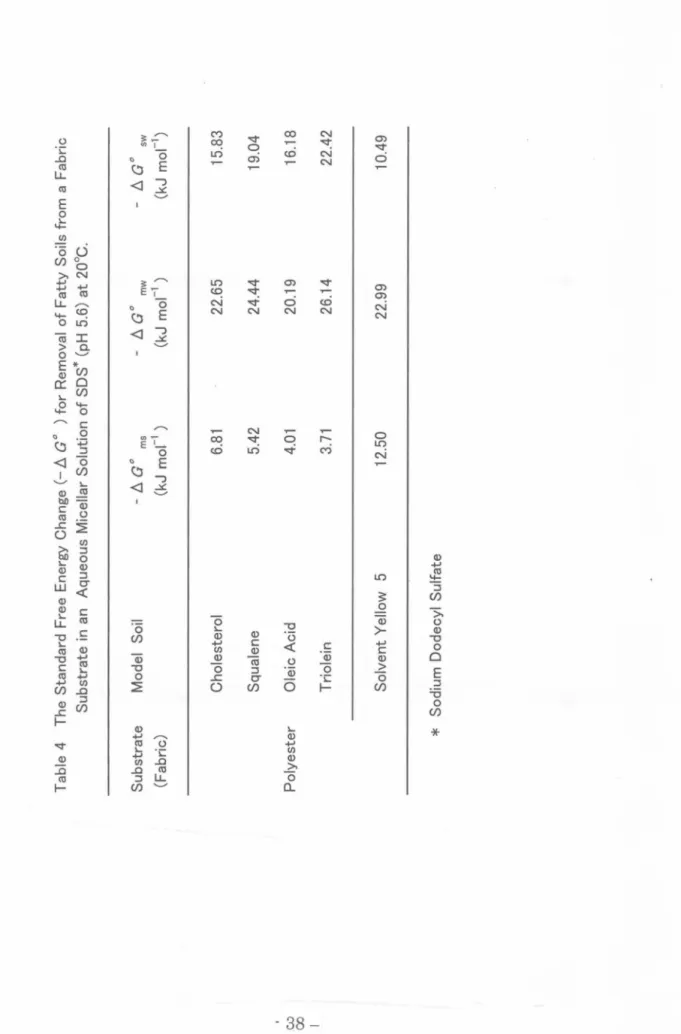
Pmw for each fatty soil and SY5. We usedv = 0.862 mLlg for SDS (7) to ca1culatePmw, The standard企eeeIiergy change for the transfer of fa町 soil合omthe substrate (s) into micelles (m)(-!1G-ms) can be calculated by the following relation瓜 constant
temperature and press町e:
-!1G ms =
RT
lnP
ms (2)where T is the absolute temperat町eand R is the gas constant.The standard free energy
change for the transfer of the fatty soil企omwater (w)ωmicelles (-!1G mw) and企om water onto fiber substrate (-!1G sw)can be ca1culated in the same way. The values of -!1
G ms, -!1 G mw and -!1 G sw for all fatty soils and SY5 are given in Table 4.
4・2 Free Energy Change of Fatty Soil Transfer from Water onto Fabric Substrate In the soil removal process, the -s G sw value can be considered the standard free energy change of ther~-deposition of a soil onto the PET substrate after its removal企om the substrate into water (non-micellar solution). The -
s
GO sw values shown in Table 4 are considerably greater for the four fatty soils than for oil-soluble dyestu百SY5.Structurally, the large di百erencebetween the fo町 fattysoil molecules and SY5 is the presence of methylene chains in the fo町 fattysoil molecules.It can be infeηed that their hydrophobic methylene chains have a high affinity for PET hydrophobic ethylene units,
which produces significantly greater re-deposition ofthe fatty soils than th剖ofSY5 on PET substrate. The -s G sw value for仕iolein,the most hydrophobic of the four fa従ysoils, is similar in magnitude to the a伍nityofC..
r
Disperse Red 1 for polyester fiber in an aqueous dyeing system (22.59 kJ mor1) (8). These -s G O sw values indicate that the re-deposition tendency of the fatty soils onto PET is not negligible. The -s G. sw value for re-deposition of the fatty soils onto PET increases with increases in the length and number of their hydrophobic chains as follows: cholesterol < oleic acid < squalene < triolein. This suggests由atthe s仕onghydrophobic interaction between methylene groups of the fatty soil molecules and ethylene units in PET causes an increase in re-deposition of these fa抗ysoils企omwater onto PET._Thus
,
the -s G sw values shown in Table 4 indicate th剖complete removal of these types of hydrophobic soils合omnonpolar substrates like PET
with aqueous non-micellar solution is impossible.
We have reported that with a filament yarn substrate
,
the-dG sw value of SY5 is 12.64kJ mor1 for polyester (3). The -dGosw value for the PET filament yarn substrate is greater
th如 thosefor the fabric substrate used in the present study. The difference in-dG sw values between the fabric and filament substrates suggests th剖 thephysico-chemical
properties of the surfaces differ between the pdlyester filament yarn and fabric substrates.
The c-potential for the filament yam and fabric substrates was determined in 1 x 1 0-3 mol
dm-3 NaCl aqueous solution to estimate the electrical interfacial properties of these surfaces. The values of -c-potentials for the PET fabric and filament yam were 23.13 mV and 26.82 m V, respectively. The value of -c-potentials for the PET polyester fabric was slightly less than that of the PET filament yam. These results suggest that electrostatic attraction between the positively charged SY5 and the negatively charged polyester substrate is greater for the filament yam than for the f
.
a
hric, and this increases the re-deposition of SY5 onto filament yam substrate. We conc1ude that the -d..Gosw valuedepends strongly on the physico-chemical properties of the surface used as substrate.
4・3 Free Energy Change of Fatty Soil Transfer from Water into Micelles
For solubilization of anthracene and Sudan N into micellar solutions like those used in the present s印dy,S. Kumar et a.l(9) reported values of 22.33 kJ m,or1 and 25.83 kJ mor1 (300C), respectively, as measured spec仕ophotometrically.These values are similar in magnitude to the -d.G mw forcholesterol,室主~ and triolein. Moreover, the -d. G mw value for triolein is the same order of magnitude as that for micelle-water partition coefficients of n-hexane (27.65 kJ mor1
,
250C) (10) and the solubilization of hemicyanine dye, which has 5 carbons in the alkyl groups of dialkyl amino stilhazolium hutyl sulfonate (25.53 kJ mor1, 250C) (11), in a micellar solution of the same surfactant used in the present study. Thus,
the -d.G mw values in Table 4 are reasonable.The -s G mw va,lhes for the fatty soils and SY5 are much grater than the -d.G sw
values, indicating th剖thefatty soils and SY5 have a much grater a伍nityfor SDS mice
l
1
es than for the PET substrate. As the number of carbon atoms of the fatty soil molecules increases, the -d.G. mw values increase in the following order: oleic acid< cholesterol< squalene< triolein. The larger -d.G mw values for the increased number of fatty soil carbon atoms suggest increased hydrophobic interaction with the SDS micelles. Moreover, our results are consistent with those of earlier studies showing that the negative standard-24-free energy change for solubilization of a solubilizate molecule in several aqueous surfactant micellar systems increases with increases in the number of solubilizate carbon atoms (11-13). These thermodynamic parameters suggest th剖 triolein,which is the most hydrophobic and has the greatest -d. G-m w value of the four fatty soils, is buried deep within the core of the micelle because of the strong hydrophobic interaction between the fatty soil and SDS. In contrast, these same parameters suggest that oleic acid, which has a carboxyl group that can become hydrated, is located at an outer region of the micelle where water molecules tend to penetrate.
The SY5 molecule has two less carbon atoms than oleic acid. The value of -d.GO
m w for SY5, however, is greater than that for oleic acid. It can be infeηed that strongly attractive interactions between the positively charged SY5 and the negatively charged micelles produced a lager -d.GO m w value for SY5 than for electronegative oleic acid and much the same -d.GO m w value for cholesterol which has a hydroxyl group and 11 more
carbon atortJ.s than SY5 has. The partitioning of the fatty soils and SY5 between aqueous
bulk phase and the micellar phase depends on their hydrophobicity出 wellas their polarity.
4・4 Free Energy Change of Fat句TSoil Transfer from Fabric Substrate into
Micelles Oily soil removal by s町factantmicellar solution is a two-stage process: transfer of the soil企omsubstrate into water (non-micelle solution) and then from water into micelles (3). After its removal仕omsubstrate into water, the soil will transfer either into micelles or back onto the substrate. For all four fatty soils and SY5, the -d. G-mw values are greater than the -d.G sw values (Table 4); thus
,
the tendency ofthe fatty soils and SY5 to migrate from water into micelles (soil removal) is greater than that from water onto PET substrate (re-deposition). Therefore,
the total soil removal process seems to proceed. The -d.G -ms values of the fo町 fattysoils are much smaller than that of the 25-oil-soluble dyestu
正
SY5(Table 4) because the -!1 G sw value for the SY5 is much smaller than those for the fatty soils and because the difference between the -!1G mw va1ues of the SY5 and those of the fatty soils are not very large. Therefore, we conc1ude th剖 fa抗Y
soil removal企omPET is difficult because of the greater tendency of the fatty soil to redeposit onto PET.Conversely, SY5 is easily removed合omPET because the tendency ofSY5 to redeposit onto PET is much lower than that ofthe four fatty soils.The -!1G ms va1ue for triolein is half that of cholesterol and is the sma11est of the four fatty soils (Table 4). In contrast, the -!1G sw value for triolein is 1.4 times greater 出anthat for cholesterol and is the greatest of the four fatty soils. Triolein is the most di伍cultconstituent to remove because it has the greatest tendency to redeposit onto PET. In comparison with triolein, removal of squalene企omPET is easier, and removal of cholesterol from PET is easiest because the tendency of these soils to redeposit onto PET is low. With the exception of oleic acid, these results are in agreement with the ease of removal offatty soil at 500 C (14) or skin sebum constituents剖 350C(1)企omPET fabric by an alkaline detergent solution. Because oleic acid, which has a carboxyl group, is the most polar of the fo町 fatty soils
,
ease of removal合omPET is expected. However,
because oleic acid has the least tendency to solubilize and the tendency to redeposit onto PET is greater than that of cholesterol, removal of oleic acid is more difficult than removal of squalene or cholesterol. The work of adhesion (Wa) of fatty acids and triglycerides with alkyl groups of 12 to 18 carbons onto PET film in water has been calculated by applying the va111es of surface tension components for those fatty号oils,polyester substrate and water(15). The Wa value for both fatty acids and triglycerides with 12 or 16 carbons剖 200C are almost the same, whereas the Wa value is slightly larger for triglycerides than for fatty acids,
when the nurnber of carbon atoms is 14 or 18. These facts are consistent with our thermodynamic results showing the tendency toward easy removal of oleic acid and triolein. -26・5 Conclusions
The removal of fatty soil仕omfabric by aqueous surfactant solution depends on the
合eeenergy change of the transfer of the soil企oma fabric substrate into micelles (-/J.G
ms). Our findings indicate that the four fa抗ysoils have high a百inityfor PET; thus, the high
tendency of the fatty soils to redeposit onto PET makes removal difficult.Of the fo町 fa仕y
soils, triolein has the smallest -/J.G ms value and the 1訂gestvalue of企eeenergy change of the soil transfer台omwater (non-micellar solution) onto fabric subs仕ate (-/J.G sw). Therefore, triolein is the most di百icultof the four fatty soils to remove企omPET because it has the greatest tendency to redeposit.Cholesterol is the easiest soil to remove合omPET because it has the least tendency to redeposit.
Acknowledgment
This work was supported in part by Grants-in-Aid for Scientific Research (C-2)企omthe Ministry ofEducation, Culture, Sports, Science and Technology of Japan.
References
1.J. MINO, Removal of Oily Soil in Detergent Processes, inDetergency(W.G. CUTLER and E. KISSA eds.) Marcel Dekker
,
New York,
pp.513-515 (1987).2. E. KISSA, Fatty Soils from Skin, inDetergency(W.G. CUTLER and E. KISSA eds.) Marcel Dekker
,
New York,
pp.8・11(1987).3. H. TAGAYA
,
Y. YOSHIDA組 dK. HIGASHITSUJI,
A New Approach to the Study of the Mechanism of Oily Soil Removal by means of Liquid Chromatography with aFilament Yam Colurnn, J Oleo Sci.,Vo1.51, 789・798(2002).
4. H. TAGAYA, Y. YOSHIDA andK.HIGASHITSUJI, The Elucidation of the Mechanism for Oily Soil Removal Using Liquid Chromatography with a Fiber
Powders Column,J Chem. Soc. Jpn, (12),811-816(1998).
5. H. TAGAYA, K.HIGASHITSUJI,
Y
.
TANIZAWA and N.TSUTIKAWA, Paper .27・Chromatographic Observation on the Effects of Surface Active Agents to Remove the Soil on Fiber Assemblies, J.Jpn Oil Chem. Soc., Vol.41, 317-324(1992).
6. D. W. ARMSTRONG and F.NOME, Partitioning Behavior of Solutes Eluted with Micellar Mobile Phases in Liquid Chromatography, J. Anal. Chem., Vol.53,
1662-1666(1981).
7. P. MUKERJEE, The Partial Specific Volume and Density of Micelles of Association Colloidal Electrolytes, J.Phys. Chem., Vol.66, 1733-1735(1962).
8. N. KUROKl, Theoretical Chemistry of Dyeing, Maki-Shyoten, Tokyo, p.497 (1961). 9. S. KUMAR and H.N. SINQH, Competitive solubilization of Sudan IV and
anthracene in micellar systems, ColloiゐSu
ゆ
ces,Vol.69, 1-4(1992).10. R. NAGARAJAN, Mark A. CHAIKO and E. RUCKENSTEIN, Locus of Solubilization of Benzene in Surfactant Micelles, J.Phys. Chem., Vol.88, 2916-2922 (1984).
11. S. S. SHAH, G. M. LAGHGARI, K. NAEEM and S. W. H. SHAH, Partition coefficient of amphiphilic hemicyanine dyesl;>etween the aqueous and the micellar phase of sodiwn dodecyl sulfate by differential absorbance spectroscopy, Colloids Su宅向cesA, Vol.143
,
11ト115(1998).12.Y. MOROI, K, MITUNOBU, T.MORISUE, Y. KADOBAYASI and M. SAK.i生1,
Solubilization of Benzene, Naphthalene, Anthracene, Pyrene in 1-Dodecanesulfonic Acid Micelle, J.Phys. Chem., Vol.99, 2372-2376(1995).
13. G. MARANGONI and Jan C. T. KWAK, Comparison ofExperimental,Methods for the Determination of the Partition Coefficients of n-Alcohols in SDS and DTAB Micelles,
in SOLUBILlZATlON IN SURFACTANT AGGREGATES (D.S. CHRISTIAN and J. F. SCAMEHORN, eds.), Marcel Dekker, New York, pp.455-490(1995).
14. S. YOKOYAMA, S. SHIMAUCHI and H. MIZUSfUMA, Studies on Fatty Soil on Polyester Fiber Using a Radioctive Tracer. ( 1 ) Comparison of the Washing Removability of Various Fatty Soils oIlPolyester and Celluloisic Fabrics, Sen-I
Gakklαishi
,
Vol. 23,
444-448(1967).15. M. SAITO, M. OTANI, andA. YABE, Work of Adhesion of Oil Dirt and Correlation with Washability, Textile Res.J., Vol. 55, 157・164(1985).
T able 1 Characterization of Plain weave T est Fabrics Fabric Thickness Polyester Description Filament Yarn Denier Threads/cm warp X weft 42x38 Mass (g/m 2 ) 70 (mm) 0.0786 ∞C warp weft 100% Polyester fiber 75 75
HO H3C CH3 CH3 CH3 H3C' 、CH3 Squalene H3C Cholesterol ノO CH3(CH2hCH=CH(CH2hC~乙OH OleicAcid 1H2oc-cH2)7CH=CH(CH2)7CH3
1
H O C∞
←一ベ(O 聞叫叫叫叩ρ仇ωh2加刷7氾一
CH CH20CO一一-(CH2ρhCH=CH(CH2ρhCH3 Triolein H2N.口一
CH3 CH3 CH3 Solvent Yellow 5 (SY5, 1.phenylazo-2-naphthylamine) Scheme 1 ChemicalStructures ofModel Soils. -31・ω
O
C
句 ( 七O ω
心
︿
1
2
0
Ve/mL
4
0
O
Effi民:tof SDS Concerr回tionsin the Mob1ie Phase on Chromatogram of Solvent Yellow 5 Elut吋 企omPolyester Fablic Column. SDS Ccincen岡 山n: (a); 8.5x
10・3moldm-3,
(防;8. 75X 1O -3mol dm-3,
(c); 9.0X 1O-3 mol也n-t (d); 9.25X 1O-3mol dm ・3 Flow Rate: 2.0mL min-1 , Wavelen.併1:445 nm,Sample Volume: 5μL of Solutionin E出anoland Fig.l Water (50/50 w/v) Containing 0.01% Solvent Yellow 5 (w/v). -32・8.25Xl0-3moldm-3 8.5XlO-3mol dm-3 8 C S K E ︽ 8.75 X 1 0.3 mol dm・3 9.0X 1 0-3 mol dm-3
。
100 200 300 Ve/mL Fig. 2 Effect of SDS Concentrations in the Mobile Phase on Chromatogram of CholesterolE1uted白・omPolyester Fabric Column. Flow Rate: 2.0 mL min-l, Wavelength: 285 nm, Sample Volume: 5μL of Ethanol Solution Containing 0.1% Cholesterol (w/v). -33・9.5X
,
0-3 mol dni3 9.0Xl0 -mol dm-///8.75X10・3moldrTf3 85×1O 3mol dm3。
UE 史 ゼ O 帆 且 ︿ 400 Effect of SDS Concentrations in the Mobile Phase on Chromatogram of Squalene Eluted from Polyester Fabric Column.Flow Rate: 2.0 mL min-1 , Wavelength: 277 nm,
Sample Volume: 5μL of Ethanol Solution Containing 0.1% Squalene (w/v). Fig.3 8.5X 10⁻³ mol dm-3 ーー-.一一~ 8.8X 1 0-3 mol dm-3 9.0Xl0・3mol dm-3
与
し
一
9.3X 1 0-3 mol dm・3 300 200 Effect of SDS Concentrations in the Mobile Phase on Chromatogram of Oleic Acid Eluted from Polyester Fabric Column. Flow Rate: 2.0 mL min-1 , Wavelength:280nm, Sample Volume: 5μL of Ethanol Solution Containing 2.0% Oleic Acid (w/v).
Ve/ml
-34・
100
8s-sa
︿ 300 Ve/m し Fig. 5 Effect of SDS Concentrations in the Mobile Phase on Chromatogram of Triolein Eluted from Polyester Fabric Column. Flow Rate: 2.0 mL min-1 , Wavelength: 285 nm , Sample Volume: 5μL of Ethanol/
/
/
~
!
O 100 200 400 500 600 。コ 巳只 Solution Containing 0.1 % Triolein (w/v). Table 2 Variation of Capacity Factors of Fatty Soils from a Polyester Column as a Function of SDS Concentration in the Mobile Phase. SDS concentrations in the mobile phase l1 0-3 mol dm-3 Model Soil 8.25 8.50 8.70 8.75 8.80 9.00 9.10 9.25 9.30 9 .4 0 9.50 9.60 9.75 capacity factors (k"=
(丸一 Vm)/V m ) Squalene 486.08 438.36 301 .4 5 222.91 186.05 Cholestero1 368.07 254.78 184.99 133.79 Oleic Acid 363 .4 1 328.11 346 .4 6 347.12 294.37 240.84 217 .3 7 Triolein 1002.64 773 .3 5 453 .4 400.65 374.65 37 1. 73 375.36 Solvent 36.78 27.85 20.64 17.06 Yellow 50.1 ku n u n u ( E ﹀ l ω ﹀ ) ¥ ω ﹀
o
。
0.5 1.5 2 2.5 3 3.5 4 Cm/10-4 g mL-1 Fig. 6 Plots of the Chromatographic Parameters V';(Ve -V m)VS. the Concentration of SDS in the Micelle.Model Soil for Polyester Fabric Column:
口
;
Solvent Yellow 5.Table 3 The Partition Coefficientsof Fatty Soils between the Micelle and the Fabric Substrate (P ms), between the Micelle and Water (P mw),
and between the Fabric Substrate and Water (Psw) at200C
包lyestE Fabric Substrate Soil PmS Pmw Psw Squalene 9.3 2.3X 10⁴ 2500 Cholesterol 16.4 1.1x 10⁴ 667 Fatty soil Oleic Acid 5.2 0.4x 10⁴ 769 Triolein 4.6 4.6X 10⁴ 10000 Oil-soluble dyestuff Solvent Yellow5 169 1.2 x 10⁴ 74 -36・
5
4
3
2
門-OF (E
﹀ iω ﹀)¥ω ﹀ 心コ -:}5
4
2
3
Cm
/
10-4g
mL-1。
。
Plo 包 of the Chromato 伊 phic Parametersvs
〆(九 -Vm)VS. 血.e Conc 印刷 on ofSDS in the Mi celle. Fig.7 Model Soil for Polye 批 r Fabric Column: .; Cholesterol,・;
Sq 凶 lene,・
Oleic aci d,企; Triole in.Table 4 The Standard Free Energy Change (-/). G O ) for Removal of Fatty Soils from a Fabric Substrate in an Aqueous Micellar Solution of SDS* (pH 5.6) at 20 o C . Substrate Model Soil -/). G O ms -/). G O mw -/). G O sw (Fabric) (kJ mol . -1 ) (kJ mol-1 ) (kJ mol -1 ) Cholesterol 6.81 22.65 15 . 83 Squalene 5 .4 2 24 .4 4 19.04 。コ Polyester Oleic Acid α コ 4.01 20.19 16.18 Triolein 3.71 26.14 22 .4 2 Solvent Yellow 5 12.50 22.99 10 .4 9
*
Sodium Dodecyl Sulfate第3章
皮 脂 汚 れ の 水 に よ る 超 音 波 洗 浄
1 . 緒 言
超 音 波 に よ る 洗 浄 は 硬 質 表 面 の 洗 浄 に 多 く 利 用 さ れ て い る が 、 フ レ キ シ ブ ル な 布 に 対 す る 超 音 波 洗 浄 の 利 用 は 限 ら れ た 範 囲 で し か 行 わ れ て お ら ず 、 ま た 布 の 超 音 波 洗 浄 に 関 す る 基 礎 的 研 究 は あ ま り 行 わ れ て い な い 。 著 者 ら は 、 環 境 負 荷 低 減 に 向 け て 、 水 を 洗 浄 媒 体 と す る 衣 類 の 超 音 波 洗 浄 に 関 す る 基 礎 的 知 見 を 得 る た め 、 前 報 1) で は 無 機 粒 子 汚 れ の 除 去 を 中 心 に 超 音 波 の 物 理 的 作 用 か ら 検 討 し た 。 本 研 究 で は 、 布 の 洗 浄 用 に 試 作 し た 低 周 波 (28kHz)の 超 音 波 洗 浄 装 置 を 用 い て 、 水 を 洗 浄 媒 体 と す る 界 面 活 性 剤 不 在 系 で 超 音 波 照 射 に よ る 布 か ら の 油 性 汚 れ の 除 去 に つ い て 検 討 し た 。 油 性 汚 れ の 除 去 に お い て は 、 超 音 波 の 物 理 的 作 用 の ほ か に 、 水 に 超 音 波 を 照 射 し た と き に 生 ず る 化 学 的 作 用 の 寄 与 が 示 唆 さ れ た 。2
.
実 験
2. 1試 料 油 性 汚 れ モ デ ル と し て は 、 ナ カ ラ イ テ ス ク 製 の CISolvent Yellow 5 (SY5、l-phenylazo-2-naphthylamine), ト リ オ レ イ ン (TO,純度:>99覧(TLC)、SP)、 ト リ ス テ ア リ ン (TS, > 99弘 (TLC)、Sp)、 ス ク ア レ ン (SQ >98出(GC)、GR)、 オ レ イ ン 酸(AO、 >99% (GC)、GR)を そ の ま ま 用 い た ( 第 2章参照)。 汚 染 布 と し て は 、 糊 抜 き し た 後 、 ク ロ ロ ホ ル ム / メ タ ノ ー ル の 混 合 溶 媒 で 抽 出 精 製 し た ポ リ エ ス テ ル お よ び キ ュ プ ラ の フ ィ ラ メ ン ト 糸 平 織 布 (JISL-0803、5
x
5cm) の 中 央 約 3cm2に 、 ク ロ ロ ホ ル ム 溶 液 か ら 油 性 汚 れ モ デ ル を 50μg付着させ、 24時 間 冷 暗 所 で エ ー ジ ン グ し た も の を実験に供した。 洗 浄 液 と し て は 、 脱 イ オ ン 水 を 加 熱 脱 気 法 あ る い は 膜 式 脱 気 法 に よ り 所 定 条 件 に 調 整 し て 用 い た 。 洗 浄 液 中 の 溶 存 酸 素 濃 度 (DO) を 溶 存 -39・酸素計 (Sension ™ 6, HACH Co. ) を 用 い て 測 定 し 、 こ れ を 溶 存 気 体 の 指 標 と し た 。 実 験 開 始 前 と 実 験 後 に 洗 浄 液 の 溶 存 酸 素 濃 度 を 常 に 確 認 した。 2. 2方 法 試 作 超 音 波 洗 浄 装 置 の 超 音 波 発 生 装 置 は ボ ル ト 締 め ラ ン ジ ュ バ ン 型 振 動 子 で 、 発 振 周 波 数 28kHz、超音波出力 300W、洗浄槽容量 120L
x
250Wx
130H 凹、 1W / cm2、 の も の で あ る 。 こ の 装 置 は 試 験 布 の 垂 直 移 動 お よ び 垂 直 揺 動 (14 spm, di stance of 32mm)機 構 を 備 え て い る 。 窓 枠 が 40x
40mm の ス テ ン レ ス 製 治 具 に 固 定 し た 汚 染 布 を キ ャ リ ア に 取 り 付 け 、 こ れ を 洗 浄 槽 底 面 対 角 中 央 か ら 所 定 の 距 離 に 懸 垂 し 、 水 温 を 300C
とし、所定洗浄条件で 3分 間 超 音 波 を 照 射 し た 後 , 試 験 布 を 乾 燥 し た 。 洗 浄 槽 内 の 周 波 数 分 布 と 音 波 強 度 レ ベ ル を 水 中 マ イ ク ロ フ ォ ン (ST-80B,沖電気工業(槻)および周波数分析計 (2CHSA-74、RIONCo. ) を 用 い て 計 測 し た 。 水 平 測 定 位 置 は 洗 浄 槽 底 面 対 角 中 央 と し た 。 洗 浄 層 内 の 超 音 波 の 振 動 周 波 数 に つ い て も 適 時 モ ニ タ し た が 、 常 に 28kHz であった。 洗 浄 前 と 洗 浄 後 の 布 の 油 性 汚 れ を 抽 出 し 、S
Y5
に つ い て は 分 光 光 度 法 CV-530, ¥槻日本分光)で、モデ、ル皮脂汚れ成分については次の装置 を 用 い て 内 部 標 準 法 に よ る ガ ス ク ロ マ ト グ ラ フ ィ で 、 定 量 し た 。 ガ ス ク ロ マ ト グ ラ フ : 島津 GC-17A、 GC-14BTF、カラム Frontier Lab (TS、TO)、 ZB-1 (SQ)、 ZB-FFAP (OA)
デ ー タ 処 理 装 置 : 島 津 ク ロ マ ト パ ッ ク C-R7A 測 定 条 件 を Table 1に示す。 洗 浄 前 後 の 汚 れ 付 着 量 か ら 、 洗 浄 効 率 を 次 式 か ら 算 出 し た 。 洗 浄 効 率 (
%)
= [ ( 洗 浄 前 の 汚 れ 付 着 量 一 洗 浄 後 の 汚 れ 付 着 量 )/ (洗浄前 の 汚 れ 付 着 量 ) ]x
100 -40・3
.
結 果
3. 1 洗 浄 時 聞 と 洗 浄 効 率 水 中 の 溶 存 気 体 が 減 少 す る と 、 音 速 の 減 衰 が 少 な く な る た め 超 音 波 強 度 が 大 き く な る 1)。そこでまず水を脱気して、DO
値を1.0
'
"
'
-
'
1.1mg/L
と し た と き の 超 音 波 照 射 に よ る 洗 浄 速 度 を 調 べ た 。 SY5で 汚 染 し た キ ュ プ ラ と ポ リ エ ス テ ル 布 の 洗 浄 効 率 は 、 と も に1
5
秒 の 照 射 で20%
以 上 除 去 さ れ 、 そ の 後 照 射 時 間 が 3分 付 近 ま で 増 加 す る が 、 そ れ 以 後 6 分 ま で の 洗 浄 効 率 の 増 加 は ほ と ん ど 認 め ら れ な か っ た(
F
i
g
.
l
)
。これは、 前 報 の 粒 子 汚 れ を 含 む 汚 染 布(
w
f
k
1
0
D
、1
0
C
、3
0
D
)
の 傾 向 と 同 じ 結 果 で あ っ た 。 以 下 の 実 験 で は 、 超 音 波 照 射 時 間 を 3分とした。 3. 2 油 性 汚 れ の 洗 浄 と 定 在 波 一 般 に 、 低 周 波 数 の 超 音 波 洗 浄 槽 内 で は 、 液 面 に 垂 直 入 射 す る 入 射 波 と 反 射 波 が 重 な り 合 っ て 定 在 波 が 形 成 さ れ る 。 超 音 波 強 度 レ ベ ノ レ (dB) と 洗 浄 槽 底 面 対 角 中 央 に お け る 垂 直 位 置 の 関 係 を 調 べ た 。 本 装 置 の 超 音 波 強 度 レ ベ ル は 、 底 面 か ら4
2
m
m
'
"
'
-
'44mm
で 脱 気 水 、 非 脱 気 水 と も に 極 大 値 を 示 し 、 脱 気 水 の 超 音 波 強 度 レ ベ ル の 方 が 非 脱 気 水 よ り 高 い 値 を 示 し た 。 本 洗 浄 槽 内 で は 定 在 波 形 成 さ れ て い る こ と を 確 認 し た 。 そ こ で 、 底 面 か ら の 垂 直 距 離 が3O
m
m
'
"
'
-
'
50mm
に つ い て 、 汚 染 布 の 水 平 位 置 を 槽 底 面 対 角 中 央 と し 、 布 面 を 底 面 と 平 行 と し 、 脱 気 水 と 非 脱 気 水 に よ る 洗 浄 性 を 調 べ た 。 SY5で 汚 染 し た キ ュ プ ラ と ポ リ エ ス テ ル 布 の 洗 浄 効 率 は 定 在 波 の 音 圧 の 最 も 高 い 位 置 で 、 脱 気 水(
D
O
値:1.0
mg/
L)、 非 脱 気 水(
7
.
5
m
g
/
L
)
と も に 、 最 大 と な っ た(
F
i
g
.
2
,
F
i
g
.
3
)
。この位置は、 理 論 的 に 音 圧 Pが 最 大 値 を と る と こ ろ と 一 致 し た 。 こ れ は 、 前 報 の 粒 子 汚 れ の 付 着 し た 汚 染 布(
w
f
k
1
0
C
、1
0
D
、3
0
D
)
の 洗 浄 率 が 極 大 を と る 位置と一致した。 3. 3 超 音 波 強 度 と 油 性 汚 れ の 除 去 次 に 、 超 音 波 強 度 ( 空 間 平 均 時 間 平 均 強 度 ) を 変 え て 油 性 汚 れ の 洗-4
1
・浄性を検討した。 SY5, TS、 お よ び TOの 洗 浄 率 と 音 圧 の 関 係 を 、 そ れぞれ、 Fig.4と Fig.5に 示 す 。 ま た オ レ イ ン 酸 と ス ク ア レ ン の 洗 浄 率 と 音 圧 の 関 係 を そ れ ぞ れ 、 Fig.6とFig.7に示す。 3.3. 1ポ リ エ ス テ ル 布 の 洗 浄 TSは 、 非 脱 気 水 (7.5 mg/L)を用いて音圧を 107mN/cm2ま で 増 加 し て も ポ リ エ ス テ ル か ら ほ と ん ど 除 去 さ れ な い (Fig.1)。脱気水(1.0 mg/L)を 用 い て 音 圧 を 約 106.6 mN/ cm2にすると、TSの除去が始まり、 洗 浄 率 は 音 圧 に 依 存 し て 増 加 す る 。 す な わ ち ポ リ エ ス テ ル に 付 着 し た TSは 超 音 波 の 音 圧 に 依 存 し て 除 去 さ れ る 。 一方、 TOの 洗 浄 で は 、 非 脱 気 水 に よ る 低 い 音 圧 で も ポ リ エ ス テ ル か ら 除 去 さ れ 、 約 75mN/ cm2で 50%以 上 除 去 さ れ る (Fig.1)。水を脱 気した場合には、 93.6 mN/ cm2の 音 圧 で TOの 除 去 が 始 ま り 、 音 圧 と と も に 洗 浄 率 は 直 線 的 に 増 加 す る 。 脱 気 水 を 用 い た 場 合 、 TOは 除 去 さ れ 始 め る 音 圧 が TSよ り 小 さ く 、 ま た TSよ り 洗 浄 率 の 音 圧 依 存 性 が大きいことから、 TSより除去され易い。 SY5の ポ リ エ ス テ ル か ら の 除 去 は 、 非 脱 気 水 を 用 い た 場 合 、 約 60
mN/cm
2から始まり、上述の TOや TSの 脱 気 水 に よ る 洗 浄 よ り 低 い 音 圧 で 除 去 が 始 ま り 、 洗 浄 率 の 音 圧 依 存 性 が 認 め ら れ る (Fig.2)。 し か し 、 こ の 音 圧 領 域 で の 非 脱 気 水 に よ る TOの 洗 浄 率 と 比 較 す る と 、 か な り 除 去 さ れ 難 い こ と が わ か る 。 脱 気 し た 水 を 用 い た と き の SY 5の 除 去 が 始 ま る 音 圧 は 約115mN/cm
2で あ り 、 上 述 の TOや TSの 脱 気 水 よ り 高 い 音 圧 を 必 要 と す る が 、 洗 浄 率 と 音 圧 の 関 係 、 曲 線 の 勾 配 は 両 者に比べて大きい。 3.3.2 キ ュ プ ラ 布 の 洗 浄 非脱気水では、 TSとTOは 75mN/cm2で約 80%、100mN/ cm2で は 約 90%除 去 さ れ 、 ポ リ エ ス テ ル に 比 べ て 低 い 音 圧 で キ ュ プ ラ か ら 除 去 す る こ と が で き る 。 こ れ ら の 汚 れ モ デ ル 間 の 洗 浄 性 の 違 い は 僅 か で あ る が 、 極 性 の 大 き い TOの方が除去されやすい。 SY5の 非 脱 気 水 に よ る 洗浄では、TSやTOに 比 べ て や や 除 去 さ れ 難 く い が 、 音 圧 が75mN/cm
2 -42・で約 50%、100mN/cm2で は 約 80%除 去 さ れ る 。 親 水 性 基 質 の キ ュ プ ラ に 付 着 し た こ れ ら の 疎 水 性 汚 れ は 、 疎 水 性 基 質 の ポ リ エ ス テ ル に 比 べ て 除 去 さ れ 易 い こ と は 、 こ れ ま で の 他 の 実 験 方 法 か ら 得 ら れ た 知 見 と一致する。 一 方 、 水 を 脱 気 し た と き の キ ュ プ ラ か ら の 油 性 汚 れ の 除 去 は 、 い ず れ の 汚 れ モ デ ル も 非 脱 気 水 よ り 高 い 音 圧 か ら 始 ま り 、 音 圧 を 増 す と 直 線的に増加する。 100%除 去 さ れ る 音 圧 を 見 積 も る と 、 TO、TS、SY5、 そ れ ぞ れ 、 約 146、150、176mN/cm2となり、 ト リ グ リ セ ラ イ ド の 方 が SY5よ り 低 い 音 圧 で 除 去 す る こ と が で き る 。