Japan Advanced Institute of Science and Technology
JAIST Repository
https://dspace.jaist.ac.jp/ Title 北陸先端科学技術大学院大学 共有計算サーバ使用成 果報告2019 Author(s) 本郷, 研太; 辻, 誠樹; 宮下, 夏苗; 井口, 寧 CitationTechnical memorandum (School of Information Science, Graduate School of Advanced Science and Technology, Japan Advanced Institute of Science and Technology), IS-TM-2020-001: 1-63
Issue Date 2020-07-10
Type Others
Text version publisher
URL http://hdl.handle.net/10119/16689
Rights
Description テクニカルメモランダム(北陸先端科学技術大学院大
共有計算サーバ使用成果報告 2019
本郷 研太,辻 誠樹,宮下 夏苗,井口 寧 編 2020 年 7 月 10 日 IS-TM-2020-001 北陸先端科学技術大学院大学 情報社会基盤研究センター 〒923-1292 石川県能美市旭台 1-12 0 .
0 1 0
目次
1. JAIST における共有計算サーバー環境
1
2. 情報科学分野の計算サーバー利用研究
7
物質科学シミュレーションとマテリアルズ・インフォマティクス
本郷 研太
Electrochemical properties and crystal structure of Li
+/H
+cation-exchanged LiNiO
2
Takahiro Toma
全電子第一原理拡散量子モンテカルロ法の高速化
中野 晃佑
Inconsistencies in ab initio evaluations of non-additive contributions of DNA stacking energies
Ken Qin
Electronic structure investigation of doped TiO
2systems using density
functional theory
Abhishek Raghav
Diffusion Monte Carlo study of hydrogen adsorption on silicon carbide nanotube
Genki Imam Prayogo
Large dependence of DMC bandgap on semicore contibution : GaN study
Nikaido Yutaka
High-throughput screening on mixed-valency of cerium in (Nd-Ce)
2Fe
14B
RAMADHAN, Erland Rachmad
General Sieve Kernel を用いた Ideal Lattice Challenge と SVP Challenge の解読
宮城 勇雅
MPI 環境下での動的マルチキャストのための配信アルゴリズムの最適化に関する研究
山田 竜輝,森 眞一郎,井口 寧
Locality-Sensitive Hashing for Information Retrieval System on Multiple GPGPU Devices
Nguyen Mau Toan
オンサイトでの高精度数値シミュレーション実施のための GPU 向き疎行列圧縮スキーム
河村 知記
ニューラルネットワークを用いた材料物性評価方法
水関 博志, 本郷 研太
Ab initio calculations of photocatalyst activity of ZNO nanowire
Mohaddeseh Abbasnejad
Study of the role of exact exchange using hybrid functionals on the phonon dispersions of perovskite
crystals
Dr. Bartomeu Monserrat
未知干渉 MIMO チャネルにおける時空間圧縮チャネル推定法
高野 泰洋
3. マテリアルサイエンス分野の計算サーバー利用研究
33
AB initio search of polymer crystals with high thermal conductivity
Keishu Utimula
Ab initio thermodynamic properties of certain compounds in Nd-Fe-B system
Adie Tri Hanindriyo
ベイジンホッピング法を用いた アルミニウム/アルミナ界面での原子構造の探索
High-throughput screening of superconduting transition temperatures of ThCr
2Si
2-type crystal
Gewinner Senderanto Sinaga
Ab initio evaluation of complexation energies for cyclodextrin drug-inclusion complexes
Kenji Oqmhula
Polymer structure property relationship in order to understand thermal stability and solubility
using DFT method
Kaneko Lab
機械学習を利用した TiCl
4終端 MgCl
2ナノ粒子の構造決定
高棹 玄徳, 谷池 俊明
アモルファス SiO
2上に担持された Cr 種の構造・触媒性能に関する計算化学的検討
八木 勇太, 谷池 俊明
Single-Molecule Imaging of a Polymer and All-atom MD Simulations
篠原 健⼀
Highly proton-conductive polymer thin films with molecularly oriented structure
Yuki Nagao
分子シミュレーションによる糖タンパク質の構造ダイナミクスと機能連関の解明
山口 拓実
自発的な分子集合体の形成とその外場応答
下川 直史, 樋口 祐次, 伊藤 弘明
First-principles study of Dielectric-Screening Reduction-Induced Large Transport Gap in
Suspended Sub-10 nm Graphene Nanoribbon
Muruganathan Manoharan
岩塩型クラスター硫化物 V
4GeS
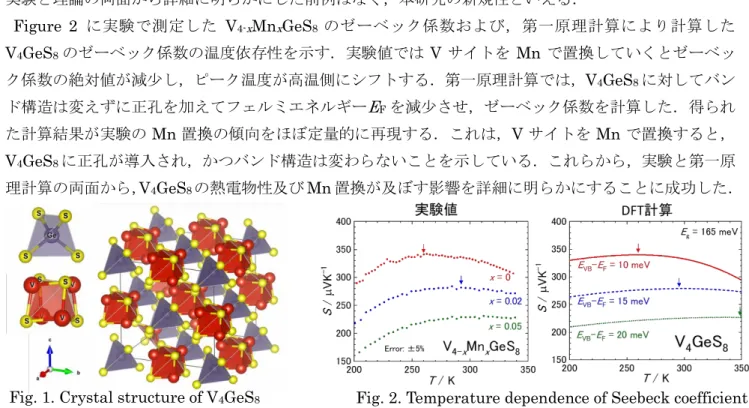
8の熱電物性に関する研究
宮田 全展
分子内電荷移動励起状態の制御に関する研究
江口 敬太郎
Berry curvature calculation in hBN/Bilayer graphene heterostructure
Kareekunnan Afsal
First principles investigations of thermoelectric properties in half Heusler topological
non-centrosymmetric systems
Rakesh Kumar
LogMFD による脂質分子の膜透過自由エネルギー評価に関する研究
齋藤 大明
4. 知識科学分野の計算サーバー利用研究
61
株式掲示板における投稿の信頼度予測
靱 勝彦
5. 謝辞
63
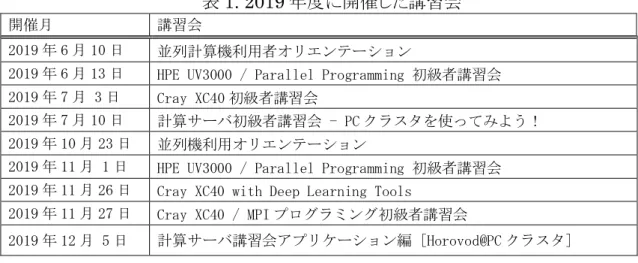
1.1 概要 北陸先端科学技術大学院大学(JAIST)では,全学で共有利用可能な計算サーバは,その利用 者が参加するMPC グループを中心として,MPC グループの取りまとめを行う MPC 管理グル ープと計算機の実務的な運用を担当する情報社会基盤研究センター(以下情報センター)とが親 密な連携をとりながら運用されている.MPC グループは共有計算サーバの利用者から構成され るグループであり,MPC 管理グループは MPC グループのユーザーからの声を吸い上げキュー クラスの設定の調整として反映することやmpc メーリングリストにおける利用者間の利用の調 停を行っている.情報センターと MPC グループ・MPC 管理グループの関係は参考文献[9]や [10]を参照願いたい. 1.2 2019 年度の活動 2019 年度の JAIST における MPC グループおよび MPC 管理グループの主だった活動につい て述べる.例年,各種計算機の新規利用者開拓(オリエンテーション),各種計算機利用者の技 術レベルの向上,理解の促進を目的とし,各システム,ソフトウェアに関する利用者講習会(各 種初級者講習会)を企画している.今年度に開催した講習会の一覧を表1に示す. オリエンテーションでは,新入生や新規利用者を対象として,本学共有計算機の構成や初歩的 な利用方法を解説した後に,ハンズオントレーニングを実施している.ハンズオントレーニング は,GUI 環境しか利用経験のないユーザーに対して, CLI 環境利用への心理的障壁を多少なり とも緩和し,本学での研究活動に向けて各種計算機の円滑利用を目的としている.そこで,Linux コマンド操作から始めて,ファイル編集,プログラムコンパイル,ジョブ投入といった計算機上 での一連の作業を体験し,また本学で利用可能な科学技術計算ソフトウェアについても簡単な 実習を含めた講習内容となっている. システム毎の講習会では,ログインからジョブ投入など初心者向けの内容から,MPI の理論と 実行など中級者向けの内容まで,利用者のレベルに応じたテーマを用意している.2019 年度は 新たな試みとして, Singularity コンテナによる複数ノードの GPU を用いた MPI 実行を講習 会のテーマとして取り入れた.特にGPU は一般的にドライバやライブラリ,ソフトウェアのバ ージョンアップに応じて実行環境を頻繁に構築しなおさなくてはならない状況が発生しやすく, コンテナの利用がこのような状況に対する有効な解決策として期待される.コンテナを利用し たうえで複数ノードのリソースをMPI 経由で使用する手法は,簡易な手順で実行パフォーマン スを底上げできる利便性の高いものと考えられる.今後も,利用状況と利便性の向上に向けた各 種講習会を企画することで,新規利用者の拡大と効率的利用に取り組んでいく. 1
表
1. 2019 年度に開催した講習会
開催月 講習会
2019 年 6 月 10 日 並列計算機利用者オリエンテーション
2019 年 6 月 13 日 HPE UV3000 / Parallel Programming 初級者講習会 2019 年 7 月 3 日 Cray XC40 初級者講習会
2019 年 7 月 10 日 計算サーバ初級者講習会 - PC クラスタを使ってみよう! 2019 年 10 月 23 日 並列機利用オリエンテーション
2019 年 11 月 1 日 HPE UV3000 / Parallel Programming 初級者講習会 2019 年 11 月 26 日 Cray XC40 with Deep Learning Tools
2019 年 11 月 27 日 Cray XC40 / MPI プログラミング初級者講習会
2019 年 12 月 5 日 計算サーバ講習会アプリケーション編 [Horovod@PC クラスタ]
1.3 新規導入・更新システム
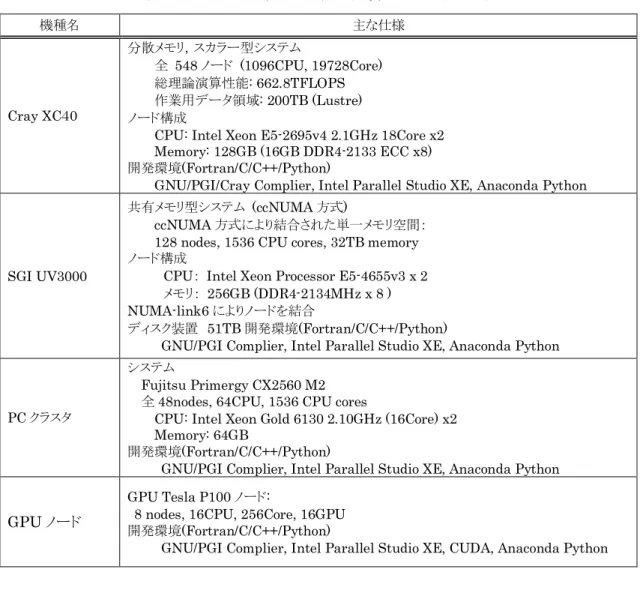
2019 年度の計算サーバの概要を表 2 に示す.今年度のハードウェアに関する変更点として, 2019 年 2 月に,GPU ノード(NVIDIA Tesla K40)と共有メモリ型システム(SGI UV3000) がリースアップとなった.SGI UV3000 の更新システムとして,2020 年 3 月,大容量メモリ型 システム(12TB メモリ搭載の Superdome,6TB メモリ搭載の ProLiant,1.5TB メモリ搭載の ProLiant 30 台)が導入された.
ソフトウェア・システムに関する更新として,サポートするコンテナエンジンをDocker から Singularity に切り替えた.Singularity では,利用者が計算機上でコンテナ起動する際,root に 準ずる権限移譲が不要であるため,セキュリティ上の懸念が解消されただけでなく,コンテナを 用いたマルチノードMPI も実行可能となる.従来の Docker エンジンではコンテナ起動時にコ ンテナ間通信の定義などが要求されるため,共用計算機におけるマルチノードMPI は困難であ ったが,Singularity の実装により一般の MPI ジョブと大きく変わらない手順で MPI ジョブを 取り扱える.さらにSingularity 化によりビルド後のコンテナイメージをファイルとして扱うこ とができるため,プロジェクトメンバー間などでのイメージ共有が簡便化されるという利点も ある. 1.4 アプリケーションソフトウェア 上記プラットフォームに対して,利用可能なアプリケーションソフトウェアを表 3 に示す. マテリアルサイエンス系の科学技術計算ソフトウェアとしては,Gaussian16/GaussView、及び、 Materials Studio,データ科学や機械学習などのソフトウェアとして,MATLAB が利用可能で ある. 2
機種名 主な仕様 Cray XC40 分散メモリ,スカラー型システム 全 548 ノード (1096CPU, 19728Core) 総理論演算性能: 662.8TFLOPS 作業用データ領域: 200TB (Lustre) ノード構成
CPU: Intel Xeon E5-2695v4 2.1GHz 18Core x2 Memory: 128GB (16GB DDR4-2133 ECC x8) 開発環境(Fortran/C/C++/Python)
GNU/PGI/Cray Complier, Intel Parallel Studio XE, Anaconda Python
SGI UV3000
共有メモリ型システム (ccNUMA 方式)
ccNUMA 方式により結合された単一メモリ空間: 128 nodes, 1536 CPU cores, 32TB memory ノード構成
CPU: Intel Xeon Processor E5-4655v3 x 2 メモリ: 256GB (DDR4-2134MHz x 8 ) NUMA-link6 によりノードを結合
ディスク装置 51TB 開発環境(Fortran/C/C++/Python)
GNU/PGI Complier, Intel Parallel Studio XE, Anaconda Python
PC クラスタ
システム
Fujitsu Primergy CX2560 M2 全48nodes, 64CPU, 1536 CPU cores
CPU: Intel Xeon Gold 6130 2.10GHz (16Core) x2 Memory: 64GB
開発環境(Fortran/C/C++/Python)
GNU/PGI Complier, Intel Parallel Studio XE, Anaconda Python GPU ノード
GPU Tesla P100 ノード:
8 nodes, 16CPU, 256Core, 16GPU 開発環境(Fortran/C/C++/Python)
GNU/PGI Complier, Intel Parallel Studio XE, CUDA, Anaconda Python
表
3. 各種コンパイラ・ソフトウェアとプラットフォームの対応表 (2019)
ソフトウェア 概略 XC40 UV3000 PC クラスタ GPU ノード Gaussian 16 Gaussian 社製の 量子化学計算パッケージ — ◯ ◯ — GaussView Gaussian 社製の Gaussian 専用可視化ソフト — ◯ ◯ —Materials Studio BIOVIA 社製の材料開発統合
シミュレーションソフトウェア — — ◯ — MATLAB MathWorks 社製の 数値解析ソフトウェア — — ◯ ◯ Tensorflow (コンテナ環境) Google 社製の機械学習 ソフトウェアライブラリ ◯ — ◯ ◯ Caffe (コンテナ環境) UCB 開発の 深層学習フレームワーク — — ◯ ◯
Chainer (コンテナ環境) Preferred Networks 開発の
深層学習フレームワーク — — ◯ ◯
1.5 まとめ 本報告「北陸先端科学技術大学院大学 共有計算サーバ使用成果報告 2019」は 2019 年度に情 報センター提供の共有計算サーバを利用した研究の概要とその成果を報告している.mpc メー リングリストを通じて,MPC 管理グループと情報センターから本報告への寄稿依頼を行い,各 著者のご厚意により,情報科学分野から16 件,マテリアルサイエンス分野から 18 件,知識科 学分野から1 件と多彩な報告書を提出いただいた.ここに深く感謝申し上げる. 現在,これまで計算機とあまり縁のなかった研究分野でも計算機実験が容易に実施できるよ うになり,最先端の教育研究活動を開拓,実施,展開していく上での強力な研究基盤として,計 算機の重要性は激増している.システム利用状況の把握は,これまで実績のある研究分野に対す るサポート強化だけではなく,新規利用実績のある研究分野を見出すことで,本学における新し い教育研究展開の潮流を知ることができる.こうした教育研究展開の把握は,将来的には,次期 計算サーバ導入時の重要な策定指針となり,より充実した計算機環境の構築に繋がるものと期 待される.寄稿報告を俯瞰すれば,共有計算サーバは本学の教育研究インフラとして幅広い研究 分野で利活用されている様子が見て取れる.共有計算サーバは,本学の先端的な教育研究活動を これまで以上に躍進させる必須の教育研究基盤として,今後益々,その重要性が増していくもの と期待される.
参考文献
[1] 佐藤 理史(編), ”JAIST における超並列関連研究:1992 年度-1993 年度”, 北陸先端科学技術 大学院大学 情報科学研究科テクニカルメモランダム,IS-TM-94-0001, (1994). [2] 佐藤 理史(編),”JAIST における超並列関連研究:1994 年度-1996 年度”, 北陸先端科学技術 大学院大学 情報科学研究科テクニカルメモランダム,IS-TM-97-3, (1997). [3] 佐藤 理史(編),”JAIST における超並列関連研究(1997 年度)”, 北陸先端科学技術大学院大学 情報科学研究科テクニカルメモランダム,IS-TM-98-1, (1998). [4] 林 亮子(編),”JAIST における並列計算機および計算サーバ利用研究(1998 年度-2000 年 度)”, 北陸先端科学技術大学院大学 情報科学研究科テクニカルメモランダム,IS-TM-2002-003, (2002). [5] 林 亮子(編),”JAIST における並列計算機および計算サーバ利用研究(2001 年度)”, 北陸先 端科学技術大学院大学 情報科学研究科テクニカルメモランダム,IS-TM-2002-004, (2002). [6] 林 亮子(編),”JAIST における並列計算機および計算サーバ利用研究(2002 年度)”, 北陸先 端科学技術大学院大学 情報科学研究科テクニカルメモランダム,IS-TM-2003-001, (2003). [7] 林 亮子(編),”JAIST における並列計算機および計算サーバ利用研究(2003 年度)”, 北陸先 4[8] 林 亮子(編),”JAIST における並列計算機および計算サーバ利用研究(2004 年度)”, 北陸先 端科学技術大学院大学 情報科学研究科テクニカルメモランダム,IS-TM-2005-001, (2005). [9] 太田理,尾崎 泰助,佐藤 幸紀(編),”北陸先端科学技術大学院大学 共有計算サーバ使用成 果報告 2007”,北陸先端科学技術大学院大学 情報科学研究科テクニカルメモランダム, IS-TM-2008-002, (2008). [10] 太田理,尾崎 泰助,佐藤 幸紀(編),”北陸先端科学技術大学院大学 共有計算サーバ使用成 果報告 2008”,北陸先端科学技術大学院大学 情報科学研究科テクニカルメモランダム, IS-TM-2009-001, (2009). [11] 太田理,尾崎 泰助,佐藤 幸紀(編),”北陸先端科学技術大学院大学 共有計算サーバ使用成 果報告 2009”,北陸先端科学技術大学院大学 情報科学研究科テクニカルメモランダム, IS-TM-2010-001, (2010). [12] 尾崎 泰助,佐藤 幸紀(編),”北陸先端科学技術大学院大学 共有計算サーバ使用成果報告 2010”,北陸先端科学技術大学院大学 情報科学研究科テクニカルメモランダム,IS-TM-2011-001, (2011). [13] 佐藤 幸紀, 尾崎 泰助 (編),”北陸先端科学技術大学院大学 共有計算サーバ使用成果報告 2011”,北陸先端科学技術大学院大学 情報科学研究科テクニカルメモランダム,IS-TM-2012-001, (2012). [14] 佐藤 幸紀, 尾崎 泰助 (編),”北陸先端科学技術大学院大学 共有計算サーバ使用成果報告 2012”,北陸先端科学技術大学院大学 情報科学研究科テクニカルメモランダム,IS-TM-2013-001, (2013). [15] 佐藤 幸紀, 宮下 夏苗, 尾崎 泰助 (編),”北陸先端科学技術大学院大学 共有計算サーバ使 用成果報告 2013”,北陸先端科学技術大学院大学 情報科学研究科テクニカルメモランダ ム,IS-TM-2014-001, (2013). [16] 宮下 夏苗, 井口 寧 (編),”北陸先端科学技術大学院大学 共有計算サーバ使用成果報告 2014”,北陸先端科学技術大学院大学 情報科学研究科テクニカルメモランダム,IS-TM-2015-001, (2014). [17] 井口 寧, 本郷 研太,宮下 夏苗 (編),”北陸先端科学技術大学院大学 共有計算サーバ使用 成果報告2015-2016”,北陸先端科学技術大学院大学 情報科学研究科・情報科学系 テク ニカルメモランダム,IS-TM-2018-001, (2018). [18] 本郷 研太,辻 誠樹, 宮下 夏苗, 井口 寧, (編),”北陸先端科学技術大学院大学 共有計算サ ーバ使用成果報告2017”,北陸先端科学技術大学院大学 情報科学研究科・情報科学系 テ クニカルメモランダム,IS-TM-2018-002, (2018). 5
[19] 本郷 研太,辻 誠樹, 宮下 夏苗, 井口 寧, (編),”北陸先端科学技術大学院大学 共有計算サ ーバ使用成果報告2018”,北陸先端科学技術大学院大学 情報科学研究科・情報科学系 テ クニカルメモランダム,IS-TM-2019-001, (2019).
: vpcc UV3000 XC40
vpcc CASTEP XC40
VASP/Quantum Espresso
( )
1) T. Oshima, T. Ichibha, K. Oqmhula, K. Hibino, S. Yamashita, K. Fuji, Y. Miseki, K. Hongo, D. Lu, R. Maezono, K. Sayama, M. Yashima, K. Kimoto, H. Kato, M. Kakihana, H. Kageyama, K. Maeda, "Two-Dimensional Perovskite Oxynitride K2LaTa2O6N as a Water Tolerant Photocatalyst for H2
Evolution under visible light", Angew. Chem. 2020, 132, 2-10.
2) A.T. Hanindriyo, S. Sridar, K.C. Hari Kumar, K. Hongo, R. Maezono, "Ab initio thermodynamic properties of certain compounds in Nd-Fe-B system", Comp. Mater. Sci. 2020, 180, 109696:1-13. 3) M. Nakamura, K. Oqmhula, K. Utimula, M. Eguchi, K. Oka, K. Hongo, R. Maezono, K. Maeda,
"Light Absorption Properties and Electronic Band Structures of Lead Vanadium Oxyhalide Apatites Pb5(VO4)3X (X=F, Cl, Br, I)", Chem Asian J. 2020, 15, 540-545.
4) K.S. Qin, T. Ichibha, K. Hongo, R. Maezono, "Inconsistencies in ab initio evaluations of non-additive contributions of DNA stacking energies", Chem. Phys. 2020, 529, 110554:1-9. 5) T. Ichibha, A. Benali, K. Hongo, R. Maezono, "Ti interstitial flows giving rutile TiO 2 reoxidation
process enhancement in (001) surface", Phys. Rev. Mater. 2019, 3, 125801:1-5.
6) Y. Iwasa, H. Ogino, D. Song1, V.C. Agulto, K. Yamanoi, T. Shimizu, J. Ueda, K. Hongo, R. Maezono, S. Tanabe, N. Sarukura, "Synthesis, optical properties, and band structures of a series of layered mixed anion compounds", J. Mater. Sci.: Mater. Elect. 2019, 30, 16827–16832.
7) T. Yoshida, K. Hongo, R. Maezono, "First-Principles Study of Structural Transitions in LiNiO2 and High-Throughput Screening for Long Life Battery", J. Phys. Chem. C 2019, 123, 14126-14131.
8) K. Utimula, T. Ichibha, R. Maezono, K. Hongo, "Ab Initio Search of Polymer Crystals with High Thermal Conductivity", Chem. Mater. 2019, 31, 4649-4656.
9) H. Takagishi, T. Masuda, T. Shimoda, R. Maezono, K. Hongo, "Method for the Calculation of the Hamaker Constants of Organic Materials by the Lifshitz Macroscopic Approach with Density Functional Theory", J. Phys. Chem. A 2019, 123, 8726-8733.
10) H. Fujiwara, K. Hongo, Y. Hori, N. Yoshida, K. Makabe, "β-sheet elasticity of peptide self-assembly mimic, PSAM, with a grafted sequence characterized by comprehensive analyses of
11) S. Wu, Y. Kondo, M. Kakimoto, B. Yang, H. Yamada, I. Kuwajima, G. Lambard, K. Hongo, Y. Xu, J. Shiomi, C. Schick, J. Morikawa, R. Yoshida, "Machine-learning-assisted discovery of polymers with high thermal conductivity using a molecular design algorithm", npj Comput. Mater. 2019, 5, 66:1-11.
12) T. Yasunaga, M. Kobayashi, K. Hongo, K. Fujii, S. Yamamoto, R. Maezono, M. Yashima, M. Mitsuishi, H. Kato, M. Kakihana, "Synthesis of Ba1-xSrxYSi2O5N and Discussion based on Structure Analysis and DFT Calculation", J. Solid State Chem. 2019, 276, 266-271.
1) 28 / /16H06439 H31 2,700 H28 8 R3 3 2) 28 ( ) /JPMJPR16NA H31 10,500 H28 10 R2 3 3) 31 / 19H05169 H31 2,500 H31 10 R2 3 4) 31 C /19K05029 H31 700 H31 4 R5 3
A
CTIVITY
R
EPORT OF
FY2019
1. P
ROJECTT
ITLE:
E
LECTROCHEMICAL
P
ROPERTIES AND
C
RYSTAL
S
TRUCTURE OF
L
I
+/H
+C
ATION
-E
XCHANGED
L
I
N
I
O
2P
RINCIPALI
NVESTIGATOR:
Takahiro TomaA
FFILIATION:
Hongo Lab., JAIST, Nomi, Ishikawa, JapanM
ACHINE USED:
(XC40)2. P
ROJECT DESCRIPTION:
LiNiO2 Ni-rich Ni-rich LiOH Li2CO3 LiHCO3 Li LiNiO2 H2O (Li+/H+ ) XRD DFT LiNiO2 1(a) Li+ H+ LiNiO2 Li Li Li-O ( 1(b)) Li1 (a) / (b)Li O ( Li ) (c)Li
Li-O
3. N
AME OFC
O-
AUTHORS INJAIST
3.1 L
IST OF CO-
AUTHORSA/How many co-authored publication with JAIST faculties so far [1].
B/How many co-authored publication with JAIST faculties planed in future [1 or 2].
4. P
UBLICATION LIST DURINGFY2019
USINGJAIST
FACILITIES[1] 'Electrochemical Properties and Crystal Structure of Li+ / H+ Cation-Exchanged LiNiO 2',
Takahiro Toma, Ryo Maezono, Kenta Hongo, ACS Appl. Energy Mater. 3, 4078-4087 [ / ]
5. C
O-
AUTHORINGP
ROJECTS FORFY2020
USINGJAIST
FACILITIESStudy on the Thermal Stability of Ni-rich layered Cathode Materials
5.1 L
IST OF PLANNED PUBLICATIONS[1] ' Design guidelines for Ni-rich cathode materials with Co, Mn and Al substitutions ', [Ryo Maezono, Kenta Hongo], [journal (temporary)].
[2] ' Oxygen release and thermal stability behavior of Ni-rich cathode materials ', [Ryo Maezono, Kenta. Hongo], [journal (temporary)].
,
:XC40
(First-Principle Quantum Monte Carlo: QMC) ,
, . (DMC) , , , Z Z~6 , , . , TurboRVB [1] (LRDMC) , 1(a) , 2 (a, a’) ( ), , [2], . , , 1(b) , Z~6 Z~5 [3]. , , DMC , (Og, Z=118) , [3]. 1 (a) LRDMC (b) Z . 1 mHa CPU ( ) .
[1] K. Nakano, et al. J. Chem. Phys. in press (2020). [2] M. Casula, et al. Phys. Rev. Lett. 95, 1 (2005). [3] K. Nakano, et al. Phys. Rev. B 101, 155106 (2020).
(a) (b) 1.0 0.5 0.0 p (r ) r rc e- e -e -e a ′a ′a > a Core region Valence region e -pr
()
= exp − r 2 2rc 2 ⎛ ⎝⎜ ⎞ ⎠⎟1. P
ROJECTT
ITLE:
I
NCONSISTENCIES IN AB INITIO EVALUATIONS OF NON
-
ADDITIVE
CONTRIBUTIONS OF
DNA
STACKING ENERGIES
P
RINCIPALI
NVESTIGATOR:
Ken QinA
FFILIATION:
School of Information Science, JAISTM
ACHINE USED:
(XC40/Altix)2. P
ROJECT DESCRIPTION:
The main research methods on biomolecules are experiments at present. As with other materials science studies, experimental methods are difficult to describe the microscopic details of biomolecules, including molecular-level dynamics and basic functional states. For drug development, such as cancer-targeted drugs, precise matching of biological targets is required. Generally, screening of target compounds requires high-throughput experiments, but this is costly. Therefore, computer simulation plays an important role in understanding and studying the structure and biological function of biomolecules compared to traditional experimental methods. In many-body systems, the empirical force field based on pairwise method cannot consider the non-additivity beyond force field superposition. Unlike classical mechanics, the force field superposition of quantum systems cannot be added by the instantaneous polarization. Therefore, the non-additivity in the interactions is expected in inter-molecular bindings due to the induced polarization by quantum fluctuations, such as van der Waals (vdW) forces.
The description and reproduce of the bonding itself, due to intermolecular forces, is a huge challenge for ab initio methods. Non-additivity is a more difficult subject that has long been far from the mainstream research field and has not been well analyzed yet. The ab initio quantum chemistry theory is a good description of the natural stacking energy, which allows reliable energy to be found on any base structure. Calculations, in any case, need to be done at a sufficient theoretical level. For example, standard Density Functional Theory (DFT), Hartree-Fock (HF), and semi-empirical methods all fail in the description of base stacking because they cannot correctly capture the dispersion effect. Of course, the high-precision method coupled-cluster with singles, doubles, and perturbative triples with complete basis set correction (CCSD(T)/CBS) is a widely used method called "gold standard" for quantum chemistry. It is impossible to calculates large systems due to its exponential growth computational cost. Recent advances in accurate calculation methods, especially through Quantum Monte Carlo (QMC) calculations, make it possible to handle larger systems. However, some work applied to systems consisting of weakly constrained subsystems shows that non-additivity is much larger than we expected. Although there is non-additivity in larger molecules, if the non-additive contribution is positive, then there is no research significance. If so, it will only make minor corrections to the C6 (the coefficient of 1/R6 deciation interactions) force without any qualitative impact.
DNA molecules are the basis of biological, genetic variation. The most typical ten kinds of B-DNA molecular structures are composed of two kinds of purines and pyrimidines. For DNA molecules, the number of atoms is around 10, and the weak force between many-body molecules itself is the challenge in the quantum chemistry. We evaluated the non-additive contribution of the inter-molecular interactions in B-DNA stacking by using Fixed-Node Diffusion Monte Carlo (FNDMC) methods. In the previous calculation methods, the sign of the non-additive contribution is positive and tiny. Recent studies have shown that in the calculation using FNDMC method, and negative values appear in the results of non-additive contributions. First of all, the evaluation result in dispersion interaction by the standard SCF methods was proved failed due to the lack of dispersion term. Second, even the CCSD(T) method still evaluates dispersion interaction as the SCF-level, because of the practical handling of CBS at the feasible level with second order Møller–Plesset perturbation theory (MP2). Finally, although the calculation is trustworthy for the DMC method itself, the FN method cannot be ruled out to cancel the approximation error when the sign problem occurs, because we still divide the system according to the H-bond in the non-additive evaluation. While the SCF-level non-additivity is mostly positive, the non-additive contributions described by FNDMC are both positive and negative signs. The negative sign is found to be reasonable, which might be supported by a simple model analysis based on the London theory. It would, however, be premature to draw a conclusion that the FNDMC non-additivity reveals the truth. This is because the Watson-Crick base-pair involves the charge transfer caused by the H-bonds, but we could not verify if the error cancellations of the FN errors were successful for the H-bonds, as
in the case of complexation energies. However, we cannot ignore the FN approximation which is used to solve the QMC sign problem. We analyzed the possible errors in this approach and discussed it.
3. N
AME OFC
O-
AUTHORS INJAIST
3.1 L
IST OF CO-
AUTHORS- Prof. Ryo Maezono/School of Information science.
- Prof. Kenta Hongo/ RCACI & School of Information science.
A/How many co-authored publication with JAIST faculties so far [2].
B/How many co-authored publication with JAIST faculties planed in future [0].
4. P
UBLICATION LIST DURINGFY2019
USINGJAIST
FACILITIES[1] K. Qin, T. Ichiba, K. Hongo, R. Maezono, ‘Inconsistencies in ab initio evaluations of non-additive contributions of DNA stacking energies’, Chemical Physics 2019, 529, 110554, DOI: 10.1016/j.chemphys.2019.110554, Elsevier, 2019.
5. C
O-
AUTHORINGP
ROJECTS FORFY2020
USINGJAIST
FACILITIES1. P
ROJECTT
ITLE:
ELECTRONIC STRUCTURE INVESTIGATION OF DOPED TIO
2SYSTEMS USING
DENSITY FUNCTIONAL THEORY
P
RINCIPALI
NVESTIGATOR:
Abhishek RaghavA
FFILIATION:
Doctoral student (D1), Maezono LabM
ACHINE USED:
XC402. P
ROJECT DESCRIPTION:
In this work an overall electronic structure including the position and formation energies of various intrinsic defects are computed for anatase using Density Functional Theory aided by Hubbard correction (DFT+U). The intrinsic point defects considered here are, oxygen vacancy (VO), oxygen interstitial (Oi), titanium vacancy (VTi) and titanium interstitial (Tii). Out of all the intrinsic defects considered here, VTi and Tii are found to be most stable under equilibrium condition. Whereas, conduction band in anatase is consisted of mainly Ti 3d with a minor component of O 2p states, valence band is found to be mainly composed of O 2p with a minor contribution from Ti 3d states. VO and Tii are found to form localized states in the band gap. Moreover, anisotropy in the effective mass is seen. Finally, an alignment of band diagrams for all the intrinsic defect states is performed using vacuum potential from slab-supercell calculation as reference. This first principle study would help in the understanding of defect-induced insulating to conducting transition in anatase, which would have significant impact in the photocatalytic and optoelectronic area.
3. N
AME OFC
O-
AUTHORS INJAIST
3.1 L
IST OF CO-
AUTHORS- Adie Tri Hanindriyo/School of Material science - Keishu Utimula/School of Material science
- Prof. Ryo Maezono/School of Information science.
A/How many co-authored publication with JAIST faculties so far [01].
B/How many co-authored publication with JAIST faculties planed in future [02].
4. P
UBLICATION LIST DURINGFY2019
USINGJAIST
FACILITIES[1] Intrinsic Electronic Defect States of Anatase using Density Functional Theory (Under review), [Abhishek Raghav, Adie T Hanindriyo, Keishu Utimula, Mohaddeseh Abbasnejad, Ryo Maezono, Emila Panda]
5. C
O-
AUTHORINGP
ROJECTS FORFY2020
USINGJAIST
FACILITIESINVESTIGATING DOPANT INDUCED CHANGE IN THE BAND STRUCTURE AND HENCE THE EFFECTIVE MASS OF CHARGE CARRIERS FOR VARIOUS DOPED TIO2 SYSTEMS.
TiO2 is a very important material in the field of photocatalysts and optoelectronics. It can be readily doped with various dopants to make it suitable for specific purposes like as a photocatalyst or as a transparent conductor. In this project, we are investigating how dopants effect the band curvatures and hence the effective mass of the charge carriers in TiO2, which ultimately effects the material properties. We are examining several dopants including Nb, Ta, V, W, Cu, Co, Ce, La. How the
concentration of dopants affects effective masses and band structures is also investigated. This will help in predicting appropriate dopant systems for optoelectronic and photocatalytic applications.
TURBO-GENIUS: A PYTHON-BASED WORKFLOW SYSTEM FOR QUANTUM MONTE CARLO PACKAGE
"TurboRVB" is a computational package for ab initio Quantum Monte Carlo (QMC) simulations[1]. The code implements two types of real-space QMC algorithms: Variational Monte Carlo (VMC) and Lattice regularized Diffusion Monte Carlo (LRDMC). Turbo-genius is a python-based workflow system for TurboRVB Quantum Monte Carlo package. It automatizes a lot of tasks involved in performing standard QMC calculations like generating input files, convergence tests for optimizing box size, grid size and onebody Jastrow parameter for DFT, preparing the trial wavefunction using DFT, optimizing Jastrow factor and antisymmetrized part at VMC level, postprocessing of the results and so on. Turbo-Genius will be quite useful for future benchmarking studies.
5.1 L
IST OF PLANNED PUBLICATIONS[1] 'Effective mass investigation of doped TiO2 systems (temporary)', [Abhishek Raghav, Emila Panda, Kousuke Nakano, Kenta Hongo, and Ryo Maezono], [Journal (temporary)].
[2] 'Turbo-Genius: Turbo-Genius: A python-based workflow system for quantum Monte Carlo package (temporary)', [Abhishek Raghav, Kousuke Nakano and Ryo Maezono], [Journal (temporary)].
1. P
ROJECTT
ITLE:
D
IFFUSION
M
ONTE
C
ARLO STUDY OF HYDROGEN ADSORPTION ON SILICON
CARBIDE NANOTUBE
P
RINCIPALI
NVESTIGATOR:
Genki Imam PrayogoA
FFILIATION:
Doctoral Student (D1), Maezono Lab.M
ACHINE USED:
XC40/Altix2. P
ROJECT DESCRIPTION:
Hydrogen is one of the candidate for environmentally friendly energy carriers. Although it has a very high energy density per unit weight, its volumetric energy density is rather low, making its storage in a compact manner difficult. This is important in applications where storage volume is paramount, such as in automobile and aviation. Physisorption of hydrogen molecules on materials with high surface area to volume ratio like nanotubes is one of the strategies to increase this volumetric efficiency. Along with carbon nanotube (CNT) and boron nitride nanotube (BNNT), silicon carbide nanotube (SiCNT) is one of the candidate material considered for this use. Although has yet to be experimentally sythesized in single-walled form, larger silicon carbide nanotube has shown promising gain with respect to carbon nanotube in terms of storage capacity and lack of sorption hysteresis. Theoretical studies points to the stronger binding energies and existence of point charges naturally occurring on alternating Si-C surface, but lack of experimental evidence renders this conclusion unclear. We present the first attempt to use Diffusion Monte Carlo (DMC) in studying the adsorption of molecular hydrogen on single walled SiCNT surface. DMC is a stochastic method to directly solve many-body Schrödinger equation, which is capable of describing non-covalent interactions as is prominent in such physisorptive system. Several exchange-correlation functionals used in previous density functional studies are benchmarked against DMC in order to establish their accuracy in this specific system, and assess previous conclusions regarding the suggested improvement of binding characteristics on SiCNT.
3. N
AME OFC
O-
AUTHORS INJAIST
3.1 L
IST OF CO-
AUTHORS- Prof. Kenta Hongo / School of Information Science - Prof. Ryo Maezono / School of Information Science
A/How many co-authored publication with JAIST faculties so far [2].
B/How many co-authored publication with JAIST faculties planed in future [4].
4. P
UBLICATION LIST DURINGFY2019
USINGJAIST
FACILITIES[1] T. Ichibha, G. Prayogo, K. Hongo, R. Maezono, "A new ab initio modeling scheme for ion self-diffusion coefficient applied to ε-Cu3Sn phase of Cu-Sn alloy", Phys. Chem. Chem. Phys. 21, 5158.
5. C
O-
AUTHORINGP
ROJECTS FORFY2020
USINGJAIST
FACILITIESThe LiVX2 system {X: O, S, Se} is a classic case of a Heisenberg antiferromagnet with geometrically induced frustration coming from the triangular lattice of its vanadium layer. This kind of system often exhibits exotic electronic states such as the valence-bond solid (VBS) state especially at lower temperatures, which is experimentally evidenced by metal-to-insulator transition coupled with trimerization of the transition metal lattice. The O- and S-containing compound has been experimentally confirmed to exhibit this metal-to-insulator transition, whereas in LiVSe2 this transition did not occur and thus keeps its metallicity well down to 2 K. As a strongly correlated system, it is often difficult to model by one-body theory such as density functional theory (DFT). Our preliminary calculations revealed that conventional DFT predicted trimerization of all three compounds, which is in contradiction with experimental observations. Attempts to improve the electronic structure by addition of Hubbard U term instead results in non-trimerized structures for all three compounds, which is equally incorrect. In this work, we employed Diffusion Monte Carlo (DMC), which is based on true many-body wave function and thus is able to capture electronic correlation effectively. We compared the relative stability between the trimerized and non-trimerized structures of LiVX2 as optimized by the DFT calculations. Furthermore, we also seek to clarify the true nature of the insulating ground state by comparing energetic values and performing charge density analysis on the DMC wavefunctions with the nodal structures of spin-polarized and non-spin-polarized DFT trial wavefunctions.
5.1 L
IST OF PLANNED PUBLICATIONS[1] ‘Diffusion Monte Carlo Study of Hydrogen Adsorption on Silicon Carbide Nanotube', [K. Hongo, R. Maezono], [journal (temporary)].
[2] ‘Ground state determination of LiVX2 system using Diffusion Monte Carlo (temporary)’, [K. Nakano, K. Hongo, R. Maezono], [journal (temporary)].
[3] ‘SHRY: A Suite for High-throughput generation of models with atomic substitutions implemented by python (temporary)’, [K. Nakano, K. Hongo, R. Maezono], [journal (temporary)].
[4] ‘A Quantum Annealing Approach to Ionic Diffusion in Solids’, [K. Nakano, K. Hongo, R. Maezono], [journal (temporary)].
1. P
ROJECTT
ITLE:
L
ARGE DEPENDENCE OF
DMC
BANDGAP ON SEMICORE CONTRIBUTION
:
G
A
N
STUDY
P
RINCIPALI
NVESTIGATOR:
Nikaido YutakaA
FFILIATION:
JAISTM
ACHINE USED:
XC40, hster2. P
ROJECT DESCRIPTION:
Gallium nitride (GaN) is widely used for electric device such as LED and transistor, taking its advantages of high mobility and thermal conductivity. While band gap of GaN is experimentally reported around 3.4 eV, density functional theory (DFT) underestimate the band gap. This is so-called the band gap problem, which originates from the insufficient cancelation of the self-interactions between the electrons in DFT. Diffusion quantum Monte Carlo (DMC), on the other hand, is a candidate for overcoming the band gap problem. In DMC, the ground state energy of many electrons system is calculated using wave function that undergoes imaginary time development. This formalism is ab initio calculation, hence the band gap problem cannot arise in DMC.
However, some other issues would affect the calculated band gap in DMC. Our focus is mainly on semicore electrons of GaN. Pseudo potential used in DMC has an ambiguity in choosing core electrons and valence electrons. We use “large core” and “small core” for the pseudo potentials. In the “large core” the semicore electrons are included in the core electrons, while in the “small core” the semicore electrons are included in the valence electrons. It is our expectations that the calculated band gap would differ depending on which of the pseudo potentials is chosen. To our knowledge, none of the prior research exists that focuses on the semicore electrons for calculating the band gap in DMC.
In the current project, we desire to calculate the band gaps of GaN using the “large core” and “small core” pseudo potentials in DMC as implemented in CASINO package, and compare the results to obtain some insight in the semicore electrons. Since none of the prior research focuses on semicore electrons in calculating band gap in the framework of DMC, we believe that the results would provide us some novel insights in the relevant field.
3. N
AME OFC
O-
AUTHORS INJAIST
3.1 L
IST OF CO-
AUTHORS- Prof. Maezono Ryo / School of information science.
- Associate Prof. Hongo Kenta / School of information science. A/How many co-authored publication with JAIST faculties so far [0].
B/How many co-authored publication with JAIST faculties planed in future [at least 1].
4. P
UBLICATION LIST DURINGFY2019
USINGJAIST
FACILITIESNone
Study of band gap of GaN calculated in DMC using small and large core pseudo potentials.
5.1 L
IST OF PLANNED PUBLICATIONS[1] 'Large dependence of DMC bandgap on semicore contribution: GaN study' [Ryo Maezono], and [Kenta Hongo].
1. P
ROJECTT
ITLE:
H
IGH
-T
HROUGHPUT SCREENING ON MIXED
-
VALENCY OF CERIUM
IN
(
ND
-
CE
)
2F
E
14B
P
RINCIPALI
NVESTIGATOR:
RAMADHAN, Erland RachmadA
FFILIATION:
Maezono Lab., School of Information Science, JAISTM
ACHINE USED:
(XC40)2. P
ROJECT DESCRIPTION:
Over the years, permanent magnets have made significant impacts on the development of modern technology, particularly in the power plant and communication industry. Among them, R2Fe14B-type compounds are the most sought-after since its discovery. This is due to the outstanding measured magnetic properties of the compound especially Nd2Fe14B with saturation magnetization 1.61 T, magnetocrystalline anisotropy constant 4.5 MJ/m3, and Curie temperature 586 K. With the growing interest in developing permanent magnets for electric vehicle and renewable energy and data storage technology, the demand for Nd2Fe14B has also increased. Unfortunately, the high demand for Nd2Fe14B is not complemented with the supplies of Nd itself. Such circumstance implies that there are demands to develop alternatives for permanent magnets that do not rely solely on scarce rare-earth metals---Nd, Pr, Dy, etc.
Cerium is the most abundant rare-earth metal and considered to be substituted on Nd2Fe14B. It is one of the most fascinating elements in the periodic table. It has, in particular, five allotropic forms. Most of the attention has been focused on its face-centered cubic phases, g-Ce and a-Ce. These phases are thought to contribute to quenching of magnetic moment in (Nd-Ce)2Fe14B.
Unfortunately, this phenomenon is not understood well in the atomic scale. The aim of this project is to investigate the cause of the decrease in magnetic moment of Ce-substituted Nd2Fe14B. In this project, all of the structures of Ce-substituted Nd2Fe14B is calculated by employing first-principle theory. It is observed that some structures agree really well with experimental results that substitution of Ce reduce magnetic moment of Nd2Fe14B. After all of the calculation of the structure is finished, the comparison between structure will be done to determine the most stable structures. These stable structures will be investigated further by analyzing its density of states, structure, and its other properties so that the explanation of the decrease in magnetic moment in (Nd-Ce)2Fe14B is understood well.
3. N
AME OFC
O-
AUTHORS INJAIST
3.1 L
IST OF CO-
AUTHORS- Prof. Ryo Maezono/School of Information science. - Assoc. Prof. Kenta Hongo/School of Information science. - Assist. Prof. Kousuke Nakano/School of Information science - Keishu Utimula/School of Material Science
B/How many co-authored publication with JAIST faculties planed in future [2].
4. P
UBLICATION LIST DURINGFY2019
USINGJAIST
FACILITIES[1]
5. C
O-
AUTHORINGP
ROJECTS FORFY2020
USINGJAIST
FACILITIESO
CTAHEDRAL MORPHOLOGY OF
N
I
O
WITH
(111)
FACET FROM
TRANSFORMATION OF
N
I
OHC
L FOR
NO
X DETECTION AND DEGRADATION
:
E
XPERIMENT AND
DFT
CALCULATION
Nitrogen oxides (NOx) are poisonous gas to humans and the environment and needed to monitor at an early stage. In another hand, facet design on metal oxide semiconductors is an efficient approach to boost their gas sensing and photocatalytic performances due to desirable active sites. However, in a rock-type structure NiO, a highly polar (111) exposed facet cannot exist as is due to thermodynamically unfavorable. Herein, we report the synthesis of NiO with a dominantly (111) facet from the transformation of a layered structure NiOHCl. Cl- ion may act as a ligand for (111) facet formation. Among other crystal facets, NiO (111) exhibited the best NOx gas sensing response (16.5 %) to 300 ppb level and deNOx photocatalytic ability over 50%. The DFT simulation revealed that the abundance of Ni atoms in the clean (111) surface layer allows the favorable adsorption of N adatom, forming the Ni-N bond. The charge transfer took place from NiO to NO orbital has proven to be a cause of bond weakening and stretching from 1.1692 Å to 1.2231 Å, leading to NOx molecular decomposition, consistent with the experimental results.
5.1 L
IST OF PLANNED PUBLICATIONS[1] 'High-throughput screening on mixed-valency of cerium in Nd2Fe14B magnet', [Ryo Maezono, Kenta Hongo, Kousuke Nakano, Keishu Utimula], [journal (temporary)].
[2] 'Octahedral morphology of NiO with (111) facet from transformation of NiOHCl for NOx detection and degradation: experiment and DFT calculation', [Adie Tri Hanindriyo, Ryo Maezono, Kenta Hongo], [Applied surface science].
Ideal Lattice Challenge
SVP Challenge
,
: SGI UV3000
RSA
Shor National
Institute of Standards and Technology (NIST)
2019 1 2 Round2
NIST Round2
Shortest Vector Problem (SVP)
SVP Challenge WorkOut G6K
SVP Challenge Ideal Lattice Challenge G6K
SVP Challenge 115 120 127 129 137 138 139 142 146
Ideal Lattice Challenge 136 138 140 144 148 150 SVP Challenge 1 Ideal Lattice Challenge
2
1) UV3000 General Sieve Kernel Ideal Lattice Challenge SVP Challenge SCIS2020 3A2-4
MPI
環境下での動的マルチキャストのための
配信アルゴリズムの最適化に関する研究
福井大学工学部電気電子情報工学科(情報工学コース) 山田竜輝 森眞一郎 北陸科学技術大学院大学 情報社会基盤研究センター 井口 寧
使用計算機: Cray XC40 使用ソフト Cray MPICH
1 はじめに 近年, プロセッサのメニーコア化やシステムの大規模環境並列化が進み, 潤沢な計算資源が提供されるようになった. 我々は, その潤沢な計算資源を有効活用するために, MPI をベースとしたマスター・ワーカー型の並列処理機構を採用し, マスターノードが特定のワーカーノード群に対してタスクを割り当てることで並列処理を行っている. この時, マスター ノードからある条件が成立する一部の ワーカーノード群のみに対してマルチキャストが必要となる. そこで, MPI を用 いたマスター・ワーカー型の大規模並列処理環境下で, 実行時の動的かつ頻繁なグループ変更に対応可能な動的マルチ キャストの実装がなされた. この機構を適用し, ユーザーがある特定の情報の入力に加えてプログラムの実行環境により 動的マルチキャストに使用するアルゴリズムの最適化を行う機能についての研究を行う. 2 研究概要
先行研究 [1, 2] では動的マルチキャストの配信アルゴリズムとして tree(以下, bino と呼ぶ)と binomial-tree scatter ring allgather(以下, ring と呼ぶ)の 2 種のアルゴリズムを JAIST の前世代スパコン (XC30) に実装し,配信 先ノード数や配信対象となるメッセージサイズに応じてアルゴリズムを切り替える手法を提案した.
本研究では,文献 [3] で提案されている broadcast hybrid d(以下, hybrid d と呼ぶ)を用いたマルチキャストを現 JAIST スパコン (XC40[4]) に実装し評価を行った.
hybrid dは, メッセージを d 分割しながら 3 種類のアルゴリズムを組み合わせて通信を行うアルゴリズムである. hybrid dは, scatter 部と broadcast 部と collect 部の 3 部で構成されている. scatter 部は設定したメッセージの分割数 d より, 1/d に分割したメッセージを分割数 d と同じ数のノードにそれぞれ振り分けて送信する. roadcast 部は分割数毎にグループ を作成し, root となるグループ 0 を最上階として下の階層へ 2 分木的に次々に分配していく. この操作を全グループが完 了すると, グループ内で 1/d に分割したメッセージが散らばっている状態となる. collect 部は, doubling アルゴリズムで 収集を行う. 毎 stage ごとに送受信するメッセージサイズを倍々に増やし, 同じメッセージを持っていないノードとメッ セージの送受信を行っていく. これをグループ内で繰り返し行うことでメッセージの送信を完了させる. このアルゴリズ ムに, 先行研究で提案したビットマップベースのマルチキャスト機能を実装した. 今,ノード間通信速度を M[Byte/sec],ノード間通信遅延を S [sec] とし,集団通信に参加するノード数を p(p=2m( 0≦ m)),送信するメッセージ長を n [byte], broadcast hybrid でのメッセージ分割数を d(d ≦ p, p(mod d) = 0, d=2m( 0≦ m))とする.配信木の高さや通信ステップの回数を stage と表現すると,hybrid d の理論上の通信コスト T[sec] は 次式で示される. T = (2(d 1) d + 1 dlog2 p d)nM + S(log2d + log2p) (1) hybrid d は, d の値によってアルゴリズムの挙動を変えられる包括的なアルゴリズムと考えられる. 具体的には, d=1にすると先行研究で実装した bino と等価な動作が可能であり, d=p とすると文献 [2] で提案されれている bimomial-tree scatter doubling allgather(以下, doubling と呼ぶ)と等価な動作が可能である.
3 実装結果
hybrid 1, hybrid 4, hybrid 8, hybrid p(配信先プロセス数) の 5 つについて調査することとした. Cray XC40 の 64 ノード を用いて評価実験を行った. 起動時のノード数は 4, 8, 16, 32, 64 ノードを用意し, 各ノードに 1 プロセスを割り当てワー カーノードを起動し, 起動したノードすべてにメッセージの送信を行う (p=起動ノード数). それぞれのノード数に対し て 1[Kbyte] から 1[Gbyte] まで 2 倍間隔でメッセージサイズを変化させて計測を行った. 計測方法としては, 始めにメッ セージを所有するノードがあるノードに送信を行う前に計測をスタートし, 全ノードがすべてのメッセージを受け取り 終わるまでの時間を計測する. 各実行毎に 500 回の計測を行い, 上位下位それぞれ 10%を除いたトリム平均を行った値 を実行時間とした. 図 4 に 64 ノードを起動し全ノードにマルチキャストした場合の配信時間の傾向(縦軸は log スケール) を示す.図 4 は実験結果の考察のため MPI で ping-ping プログラムを実装しノード間通信速度の基礎データを取得した結果である. 今回の実験を行った範囲では,メッセージサイズに応じて適切な d を選択できれば hybrid d アルゴリズムを用いた動 的配信アルゴリズムのみ実装すれば十分であることが確認できた. そこで,配信先ノード数,並びにメッセージサイズに応じて d の最適値を予測するモデル式を検討し予測の可能性を 調査した.モデル式の検討においては,XC40 の通信速度がメッセージサイズによって変動すること,MPI の双方向通 信が成功しなかった場合に通信速度が見かけ上半分になることを考慮した.その結果,d の切り替えタイミングについ て大まかな傾向が予測可能であることを確認した.
先行研究の動的マルチキャストで使用されていた複数のアルゴリズムを包括する hybrid d を用いた動的マルチキャス トを実装し有効性を確認した. メッセージサイズや配信先ノード数に応じた最適な d を求める予測式やその効果の詳細 については,今後学会等で発表する予定である. 図 1: メッセージサイズごとの配信時間の傾向 (p=64) 図 2: Cray XC40 のメッセージサイズ毎の通信速度 5 謝辞 本研究は令和元年度北陸地区国立大学学術研究連携支援事業「IoT 社会を支える高信頼性技術」の助成を得て実施し た. 連携事業を通して議論いただいた,金沢大学,北陸先端科学技術大学院大学,福井大学の関係各位に感謝いたします. 参考文献 [1] 長嶺祐輔, 福間慎治, 森眞一郎輔:”実行時の動的かつ頻繁なグループ変更に対応可能な MPI 環境下でのマルチキャス トの実装”, 第 15 回 情報科学技術フォーラム FIT2016, RC-009, pp1–6, 2016(Sep.8). [2] 長嶺祐輔:”投機的手法を用いたインタラクティブシミュレーションシステムの多重投機拡張と動的マルチキャスト の応用”, 福井大学工学部情報・メディア工学科修士論文.2017
[3] Mike Barnett, Satya Gupta, David G. Payne, Lance Shuler, Robert van de Geijn, Jerrel Watts:”Building a High-Performance Collective Communication Library”,Proceedings of the 1994 ACM/IEEE conference on Supercomputing Pages 107-116 [4] https://www.jaist.ac.jp/iscenter/mpc/xc40/
Locality-Sensitive Hashing for Information Retrieval System on
Multiple GPGPU Devices
Nguyen Mau Toan [email protected]
June 26, 2020
Abstract
It is challenging to build a real-time information retrieval system, especially for systems with high-dimensional big data. Locality-Sensitive Hashing (LSH) is a common approach for reducing the number of dimensions of a data set, by using a family of hash functions and a hash table. In this research, we propose to use GPGPU to handle a huge number of queries in parallel.
I. Introduction
Nearest Neighbor Search (NNS) problem: The problem of finding the point x⇤ 2 X that is
closest to the query point q, using: x⇤=NN(q) =arg min
x2X Distance(q, x), (1)
where Distance(,) is the distance function in
the d-dimensional space Rdand arg min()is
the argument of the minimum function, which returns the optimal argument. To find the most similar item to the query.
Approximate Nearest Neighbor (ANN) search problem: the ANN search is a modifica-tion of the NNS, which estimates the nearest neighbor using a threshold [1]. Find a point x 2 X for the given query point q, in such a way that
ANN(q) =x|Distance(q, x)c⇤Distance(q, x⇤),
(2) where x⇤is the nearest neighbor of q in X and
c is the approximation factor.
II. Methods
The preprocessing process is required to pre-pare the hash table. To index all the items from the dataset, we need to calculate the hash values for all of them to detect the buckets.
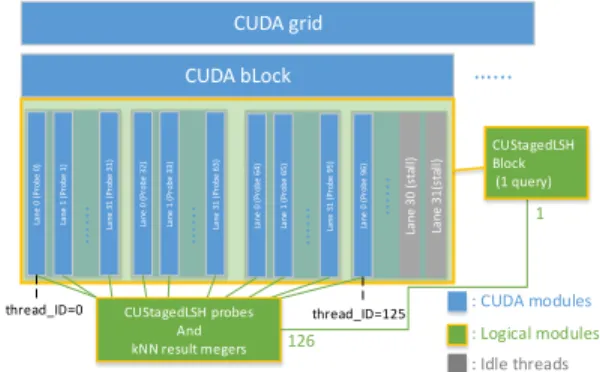
In Figure 1, we propose to use multiple threads of CUDA to process the probes of LSH. There are a total of 128 threads are allocated for process 126 probes, the last two threads are stall. After the threads getting their result, sev-eral threads need to be stalled for other threads to merge the kNN results. To avoid conflict
CUDA grid CUDA bLock La n e 0 (Pr o b e 0) La ne 31 (Pr o b e 31 ) La ne 1 (Pr o b e 1) … ... Lane 0 (Pr o b e 32 ) La n e 31 (Pr o b e 63 ) La n e 1 (Pr o b e 33 ) … ... Lan e 0 (P ro b e 64 ) La ne 31 (P ro be 95 ) La ne 1 (P ro be 65 ) … ... Lane 0 (P ro be 96 ) La n e 31 (s ta ll ) La n e 30 (s ta ll ) … ... …... CUStagedLSH probes And kNN result megers : CUDA modules : Logical modules : Idle threads 1 126 thread_ID=0 thread_ID=125 CUStagedLSH Block (1 query)
Figure 1:Parallel search using multiple threads of GPGPU
writing, the merging process is divided into h steps, after each step, we use a barrier for synchronizing all threads before moving to the next step.
III. Results and Discussion
By using an inverted file for the hash table, we can simply the transferring process between CPU and GPU. Compare to performance on CPU on the same node (vpcc-gpu), we can archive the speed-up ratio up to 71 times with high GPU occupancy from 50% to 82%.
References
[1] Nguyen Mau, Toan, and Yasushi Inoguchi. "Locality-Sensitive Hashing for Informa-tion Retrieval System on Multiple GPGPU Devices." Applied Sciences 10.7 (2020): 2539.
所属・氏名 情報科学研究科 井口研究室 河村 知記 使用計算機: GPU サーバ 概要 近年,計算機の高性能化に伴い数値シミュレーションをオンサイトでリアルタイムに実行し,様々な産 業に応用することが期待されている.このようなシミュレーションは,GPGPU を利用することによって 実用的な計算時間での実行が期待できるが,メモリ容量の制約が大きな問題点である.そこで本稿では 数値シミュレーションの代表的手法であるFinite Element Method(FEM)で現れる疎行列のメモリ使 用量削減手法RBP 法を提案する. 提案手法 RBP 法では,疎行列の列番号を表す値をパッキングし,メ モリに格納する値の数を削減する. 複数の疎行列による評価では,15 個中 13 個において従来手法に対 しメモリ使用量を削減し,最大で26.3%の削減率となった. また,オンサイト実施が期待される分野の 一例として心臓シミュレーション用の疎行列にも適用したところ、メモリ使用量が20.6%削減された. Fig 1 RBP 法の適用例 Fig 2 RBP 法のメモリ使用量の評価 関連発表論文 1) 情報処理学会論文誌「数理モデル化と応用」(TOM56)(査読あり,採録決定)
: XC40
III-V III-V
III Al, Ga, In V
N, P, As, Sb VASP PBEsol
mBJ
Zincblende Wurtzite III V 8
3 III Energy Convex Hull
V 1
VASP
1 Zincblende III-V
Training data 162 Test data 18
1. Hiroshi Mizuseki, “Neural Network Prediction on High-entropy Alloys and III-V Compound Semiconductors”, KIST-JAIST Joint Symposium (Seoul, Korea, December 13, 2019.)
2. Hiroshi Mizuseki, Babu Ram, Ryoji Sahara, Yoshiyuki Kawazoe, and Kenta Hongo (Invited), “Machine Learning on Band Gap Prediction of III-V Compound Semiconductors” ACCMS - International Conference on Materials Genome, ACCMS-ICMG 2020 (SRM University, AP - Amaravati, India, February 5-7, 2020.)
1. P
ROJECTT
ITLE:
AB
INITIO
CALCULATIONS
OF
PHOTOCATALYST
ACTIVITY
OF
ZNO
NANOWIRE
P
RINCIPALI
NVESTIGATOR:
Mohaddeseh AbbasnejadA
FFILIATION:
Shahid Bahonar university of Kerman, Kerman, IranW
EBPAGE:
http://academicstaff.uk.ac.ir/moabbasnejadM
ACHINE USED:
(XC40/Altix/hster/Linux cluster) hster, XC402. P
ROJECT DESCRIPTION:
Zinc Oxide (ZnO) is an example of semiconducting materials which has attracted most attention due to its wide range of applicability in optoelectronic and electronic devices, catalysis and gas sensing. ZnO is usually crystalized in two main forms, namely hexagonal wurtzite and cubic zinc blende in the ambient conditions. However, the former is the most stable one while the latter is metastable. Furthermore, ZnO exhibits many applications at the nanoscale which its performance and properties are controlled by its surface owing to its high surface to volume ratio. Wurtzite ZnO has comprised of both polar and non-polar surfaces.
In the current project, we desire to investigate the structural and electrical properties of ZnO surfaces in the framework of density functional theory using plane wave pseudopotential method as implemented in Quantum ESPRESSO package. Moreover, since adding impurities may also affect the properties of pristine ZnO surfaces, those properties will also study in presence of doped impurities.
3. N
AME OFC
O-
AUTHORS INJAIST
3.1 L
IST OF CO-
AUTHORS- Prof. Ryo Maezono/School of information science.
A/How many co-authored publication with JAIST faculties so far [3].
B/How many co-authored publication with JAIST faculties planed in future [at least 2].
4. P
UBLICATION LIST DURINGFY2019
USINGJAIST
FACILITIES[1] “Bandgap reduction of photocatalytic TiO2 nanotube by Cu doping”, S. K. Gharaei, M. Abbasnejad, R. Maezono, Scientific reports 2018, 8 (1), 14192.
[2] “Magnetic ordering of Ti-doped single ZnO monolayer”, O. Jowhari Shirazi, M. Abbasnejad, R. Fathi, R. Maezono, under preparation.
5. C
O-
AUTHORINGP
ROJECTS FORFY2020
USINGJAIST
FACILITIESStudy of various polar and non-polar ZnO surfaces using ab initio calculations.
5.1 L
IST OF PLANNED PUBLICATIONS[1] 'Electronic and magnetic properties of ZnO non-polar surface', [Ryo Maezono], [Journal of Physics: Condensed Matter].