JAIST Repository
https://dspace.jaist.ac.jp/Title
Parents and School’s Collaboration for Improving Children Food Well-Being by Knowledge
Perspective
Author(s) Tran, Mai Thi Ngoc Citation
Issue Date 2017-03
Type Thesis or Dissertation Text version author
URL http://hdl.handle.net/10119/14114 Rights
Parents and School’s Collaboration for Improving
Children Food Well-Being by Knowledge Perspective
Tran, Mai Thi Ngoc
School of Knowledge Science,
Japan Advanced Institute of Science and Technology March, 2017
Keywords: Education Service, Collaboration, Food Well-Being
Food Well-Being (FWB) is defined as “a positive psychological, physical, emotional, and social relationship with food at both individual and societal levels” (Bublitz, et al. 2013, p.1211), which contributes to human well-being as an aspect of food consumption (World Health Organization, 2011 and Ares, et al. 2014). However, particularly in Vietnam, there is an increase of problems in eating habit leading to poor level of human’s FWB especially in children since a double issue of children’s malnutrition and obesity (Vietnam National Institute of Nutrition, 20141).
To improve the situation of FWB, food education has been developed by school through educational service. In particular, school lunch programs, with the help of teachers, not only provide healthy food but also emphasize on fostering children’s mental and physical health, and individual humanity (Tanaka and Miyoshi, 2012). However, even if children participate in food education at school, their overall FWB may still not improve if their eating habits at home are not healthy (Dunifon and
1
General Nutrition Survey 2009-2010: “In 2010, the prevalence of stunting (Weight-for-Age Z-score < -2.00) among preschool children was 29.3%. The reduction of underweight percentage was only 1.3% whereas the obesity and overweight increased 6 times from 1995”.
Kowaleski, 2003). Parents have been significantly forming children’s preferences and food acceptance patterns by providing certain food and dining schedule at home (Johnson., et al. 2011 and Savage., et al. 2007), which in turn affect their children’s FWB. Therefore, collaboration between school and parents is essential in providing the comprehensive dietary habit for children.
Theoretically, Kakutani (2015) indicated that almost of research on food education especially the school lunch program was focused on children and their activities, and less of parent’s involvement. This may have limited contribution to FWB issues. It should instead pay more attention on research of parents’ roles who have the largest and most meaningful influence on children’s dietary habit in particular and FWB in general.
This research is conducted aiming to motivate the collaboration in term of upgrading children FWB based on knowledge of food and nutrition by focusing on parental perspective. We would like to deal with two tasks: establishing a measurement in order to illustrate the current situation of parents’ food and nutrition knowledge (Task 1) and finding influential factors affecting relationship between parents’ current knowledge and motivation to collaboration (Task 2) in order to enhance children’s FWB. The research task 1 is employed as fundamental for the second task. Suitable model for collaboration will based on current level of parent’s food and nutrition knowledge.
In order to solve the problem as well as satisfy research purpose, we establish a main research question and three subsidiary research questions as follow:
MRQ: How children’s FWB can be improved by collaboration concepts?
SRQ1: What are features of Vietnamese parents’ purchasing behavior about children food?
SRQ2: What is level of Vietnamese parents’ current knowledge about children’s food and nutrition?
SRQ3: Which factors influence on parents’ intension to collaboration with school’s Food Educational Service?
In this research, both qualitative and quantitative method were employed to answering questions. This research combines results from literature review, secondary data (press release data) and primary data (questionnaire survey). This questionnaire was used to investigate Vietnamese parents who have at least a child under 10 years old in Hanoi, Vietnam. 2 public primary school and 5 private kindergarten school were selected to join in this survey with two hundred and twenty two respondents from parents. Regarding to data analytics methods, several techniques as well as algorithms were employed, such as descriptive, classification method, especially hierarchical clustering, ANOVA and cross-tabulation methods from SPSS software.
There are some findings was highlighted in this research. It is noticeable to realize that demographic feature, especially parents’ education, income, age and youngest child’s age have strong influence on their knowledge about children food and nutrition. Besides, such kind of knowledge directly affects not only their children’s home dietary but also their intension to collaboration with school food educational service. Therefore, it is potential to consider carefully parents’ demographic feature in order to motivating collaboration between school and parents in educational service.
In sum, food-related disease is one of the most meaningful trend for other research in this field (Block, et al., 2011). Firstly, it has originality of concerning collaboration in school concept in FWB framework, especially involvement of parents. Secondly, in specific background of Vietnamese children as well as Vietnam children food market, this research has drawn picture originally of enhancing children’s FWB by improving collaboration between school and parents in food educational service.
Finally, there are both significant practical and theoretical implication in this research. A framework of collaboration based on value co-creation among stakeholder are proposed in order to upgrade children’s FWB generally. Additionally, this research suppose an erection of sustainable collaboration concept through value co-creation among stakeholder and more theory for the research path of FWB based on collaboration and value co-creation in term of food knowledge and further more food literacy.
2
Table of Content
Chapter 1: Introduction ... 7 1.1 Research Background ... 7 1.2 Research Purpose ... 8 1.3 Research Question ... 9 1.4 Research Methodology ... 9 1.5 Structure of Thesis ... 10Chapter 2: Literature review ... 13
2.1 Food Well-Being ... 13
2.1.1 Human Well-Being ... 13
2.1.2 Food Well-Being ... 14
2.1.3 Children’s Food Well-Being ... 23
2.2 Collaboration and Knowledge Transferring in Collaboration Concept ... 25
2.2.1 Collaboration in social context ... 25
2.2.2 Knowledge Transferring in Collaboration Concept ... 32
2.3 Collaboration in Food Educational Service ... 34
2.3.1 Food Educational Service ... 34
2.3.2 Collaboration in Food Educational Service ... 39
2.3.3 Service Innovation and Value Co-creation through Collaboration in Food Educational Service ... 42
2.4 Chapter 2’s Conclusion ... 43
Chapter 3: A case study of Vietnamese’s children Food Well-Being ... 44
3.1 Vietnamese Children’s Nutrition ... 44
3.1.1 Vietnamese Population Demographic ... 44
3.1.2 Vietnamese Children’s Nutrition Status ... 44
3.1.3 Nutrition Intervention through Published Information ... 51
3.2 Food Education in Vietnam ... 53
3.2.1. Introduction of Food Education in Vietnam ... 53
3.2.2. School Lunch Program in Vietnam ... 56
Chapter 4: Data Analysis ... 60
4.1 Data collection ... 60
4.1.1. Questionnaire Design ... 60
4.2 Demographic and Purchasing Behaviour Analysis ... 62
4.2.1. Demographic Analysis ... 62
4.2.2. Behavioral Analysis ... 63
4.3 Vietnamese Parents’ Knowledge about Children Food and Nutrition ... 67
4.3.1. Descriptive Analysis of Parents’ Knowledge ... 67
4.3.2. Clustering Analysis of Parents’ Knowledge ... 68
4.4 Influential Factors on Parents’ Intension to Collaboration with Food Educational Service ... 72
4.4.1 Influence of demographic factors ... 72
Chapter 5: Discussion and Theoretical Framework ... 75
5.1 Proposing Theoretical Framework ... 75
5.1.1. Discussion about Relationship between Parents’ Knowledge and Collaboration 75 5.1.2 Theoretical Framework ... 78
5.2 Role of Food Company in Collaboration and Food Educational Service ... 78
Chapter 6: Conclusion ... 82
6.1 Summary of Research and Integration of Results ... 82
6.1.1 Answering Research Question ... 82
6.1.2 Summary of Research ... 85
6.2 Research Originality and Implication ... 86
6.2.1 Research Originality ... 86
6.2.2 Research Implication ... 87
6.3 Research Limitation ... 88
6.4 Proposal for Future Research ... 89
4
List of Figures
Figure 1-1: Research Progress 9
Figure 1-2: Research Organization 11
Figure 2-1: The Paradigm Shift to Food Well-Being (Bublizt et al., 2011) 13
Figure 2-2: Food Well-Being Pinwheel (Block et al., 2011) 14
Figure 2-3: Leverage automatic and deliberative influences to advance FWB 18
Figure 2-4: Customer’s Goal and Motivation and Influential Factors for Advancing FWB 21
Figure 2-5: Social Learning Theory Model 23
Figure 2-6: Knowledge Transferring in Collaboration 32
Figure 2-7: Relationship between SFP and Potential Outcomes and Impacts on School Children 35
Figure 2-8: Japanese Food Guide Spinning Top 36
Figure 2-9: Food and Nutrition Dynamics in the Community: a Case Study of School Children 38
Figure 3-1: Top 10 Countries of Worst Food Safety Violators 49
Figure 3-2: Food Education in Ethnic Minority Area 53
Figure 3-3: A Food Education’s Class for 5-6 Years Old Children 54
Figure 3-4: Kitchen at Vinschool (The Highest Quality School in Vietnam) 56
Figure 3-5a: Lunchtime at Tan Tuc Primary School, Ho Chi Minh City 57
Figure 3-5b: Lunchtime at Hoa Hong Kindergarten, Ho Chi Minh City. 57
Figure 4-1: Questionnaire Structure 60
Figure 5-1: Theoretical Framework of Collaboration Based on Parents’ Children Food Knowledge 77
List of Table
Table 2-1: Some Illustrative Future Research Questions on FWB 16
Table 2-2: Using the Stages of Change Model to advance FWB 18
Table 2-3: A Taxonomy of Strategies for Advancing FWB 19
Table 2-4: Benefits of Collaboration 25
Table 2-5: Different Types of Collaboration 27
Table 2-6: Types of Risk in Collaboration 31
Table 2-7: Different types of Food for Education Programs and Their Pros and Cons 34
Table 3-1: Country Statistics and Estimated Global Health 43
Table 3-2: Cut-off values for public health significance 44
Table 3-3: Development of School Lunch Program 56
Table 4-1: Respondent’s Demographic Feature 61
Table 4-2: ANOVA Table 67
Table 4-3: Test of Homogeneities of Variances 68
Table 4-4: Multiple Comparisons 68
Table 4-5: Cross-tabulation of Knowledge Features and Groups (N=196) 69 Table 4-6: Crosstabulation of Demographic Factors and Groups 71
Table 4-7: Influence of Demographic features 73
6
List of Chart
Chart 2-1: Percentage of Breakfast Skippers 37
Chart 2-2: Year-on-year Changes in Calorie Supply and Actual Daily Individual Intake 37
Chart 3-1: Malnutrition Situation of Vietnamese Children in 2014 46
Chart 3-2: Vietnamese Children’s Anthropometry from 2009 to 2013 47
Chart 3-3: Source of Mass Media Information Related to Food Security 50
Chart 3-4: Information sources influencing mother’s knowledge 51
Chart 4-1: Food categories (N = 222) 63
Chart 4-2: Influential Information Sources (N=217) 63
Chart 4-3: Influential factors of Decision Making Process (N =221) 64
Chart 4-4: Respondent’s Demographic 65
Chart 4-5: Number of Correct Answers Regarding to Nutrition Knowledge 66
Chapter 1: Introduction
1.1 Research BackgroundWell-being is known as the positive side of human’s life having intellectual origins in “philosophy, psychology, economics, political science and other discipline” (Hall, Caton & Weinhardt, 2013). It is a broad c7oncept (Guttman, et al., 1982) and assessed by multi dimension of people life, ranging from emotions to a global evaluation of life satisfaction (McGillivray & Clarke, 2006). Several studies have identified different dimensions of well-being concept and many of them is strongly influenced by food consumption and furthermore dietary habit (e.g. Ares, et al., 2014). Indeed, food consumption was claimed to have ability of affecting people’s emotion as well as global life judgments through life satisfaction and fulfillment (World Health Organization, 2011). Therefore, since the important of food consumption involving well-being, it is considered as Food Well-Being in our research.
The concept of food well-being (FWB) was started by a pattern movement from the “paternalistic, normative model of the relationship of food to health” to a focus on Food Well-being (Bublitz, et al., 2011). Consequently, the definition of FWB was raised by Block (2011), “a positive psychological, physical, emotional, and social relationship with food at both individual and societal levels”. This movement has built a potential path for researchers to study about “how a positive relationship with food may help consumers achieve a higher level of well-being” (Bublitz, 2013). Additionally, the core areas of FWB concept were proposed since the third Transformative Consumer Research conference 2011; in which, food literacy is consider as one of the most common contents of FWB in many different models.
However, particularly in Vietnam, there is an increase of problems in eating habit leading to poor level of human’s FWB especially in children since a double issue of children’s malnutrition and obesity (Vietnam National Institute of Nutrition, 20141).
1
General Nutrition Survey 2009-2010: “In 2010, the prevalence of stunting (Weight-for-Age Z-score < -2.00) among preschool children was 29.3%. The reduction of underweight percentage was only 1.3% whereas the obesity and overweight increased 6 times from 1995”.
8
To improve the situation of FWB, food education has been developed by school through educational service. In particular, school lunch programs, with the help of teachers, not only provide healthy food but also emphasize on fostering children’s mental and physical health, and individual humanity (Tanaka and Miyoshi, 2012). However, even if children participate in food education at school, their overall FWB may still not improve if their eating habits at home are not healthy (Dunifon and Kowaleski, 2003). Parents have been significantly forming children’s preferences and food acceptance patterns by providing certain food and dining schedule at home (Johnson., et al. 2011 and Savage., et al. 2007), which in turn affect their children’s FWB. Additionally, parental control of feeding practices, tend to be associated with overeating and poorer self-regulation of energy intake in preschool-age children (Savage, et al., 2007, pp.9). Therefore, effective school teachers always need parents’ involvement in order to provide successful family environment for children FWB (Dauber & Epstein, 1993). Besides, several studies found that parents want to be more involved with their children’s education and would like more information and help from the schools (Booth & Dunn, 2013, pp.3). Thus, it is important and essential to encourage the collaboration between school and home, especially between teachers and parents.
Theoretically, Kakutani (2015) indicated that almost of research on food education especially the school lunch program was focused on children and their activities, and less of parent’s involvement. This may have limited contribution to FWB issues. It should instead pay more attention on research of parents’ roles who have the largest and most meaningful influence on children’s dietary habit in particular and FWB in general.
1.2 Research Purpose
This research aim to propose a theoretical model of collaboration concept in educational service based on knowledge of food and nutrition in order to identify how children’s food well-being (FWB) can be enhanced through the collaboration between school and parents and food suppliers.
In order to achieve this purpose, we would like to deal with two tasks: establishing a measurement in order to illustrate the current situation of parents’ food and nutrition knowledge (Task 1) and finding influential factors affecting relationship between parents’ current knowledge and motivation to collaboration (Task 2) in order to enhance children’s FWB. The research task 1 is employed as fundamental for the second task. Suitable model for collaboration will based on current level of parent’s food and nutrition knowledge.
1.3 Research Question
In order to solve the problem as well as satisfy research purpose mention in 1.1 and 1.2 section, we establish a main research question and three subsidiary research questions as follow:
MRQ: How children’s FWB can be improved by collaboration concepts?
SRQ1: What are features of Vietnamese parents’ purchasing behavior about children food?
SRQ2: What is level of Vietnamese parents’ current knowledge about children’s food and nutrition?
SRQ3: Which factors influence on parents’ intension to collaboration with school’s Food Educational Service?
1.4 Research Methodology
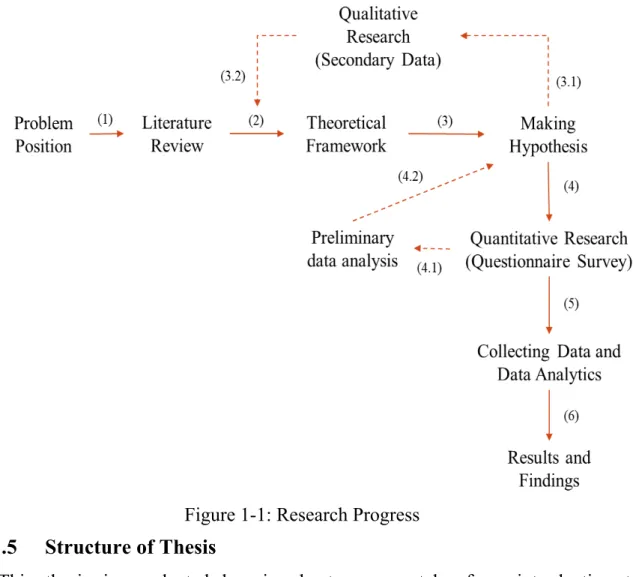
In this research, both qualitative and quantitative method were employed to answering question in section 1.3 (Figure 1-1). This research combines results from literature review, secondary data (press release data) and primary data (questionnaire survey).
In term of quantitative data, a questionnaire survey was establish with four parts in order to answer three subsidiary research questions, including: Demographic questions, children food consumption (SRQ1), and knowledge of children food consumption (SRQ2) and parents’ opinion about school food educational service (SRQ3). This questionnaire was used to investigate Vietnamese parents who have at least a child under 10 years old in Hanoi, Vietnam. 2 public primary school and 5
10
private kindergarten school were selected to join in this survey with two hundred and twenty two respondents from parents. Regarding to data analytics methods, several techniques as well as algorithms were employed. In particular, at first descriptive analysis was used to illustrate the general understanding about parents’ demographics, behavior, and knowledge in term of children food and nutrition. Secondly, classification method, especially hierarchical clustering, ANOVA and cross-tabulation methods from SPSS software were used to exploring findings for SRQ3’s answers.
In regards to quantitative methodology, both literature and press released data are employed to integrate results for answering main research question. Mainly, data provided from government office and other schools which provide information about children’s nutrition and current educational program are useful for proposed conceptual framework based on collaboration.
Figure 1-1: Research Progress
1.5 Structure of Thesis
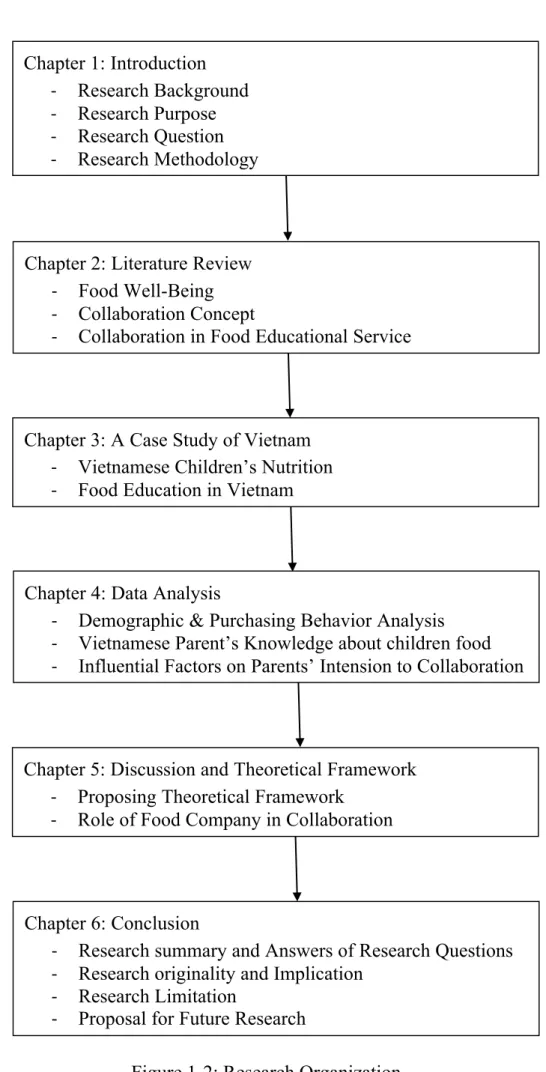
This thesis is conducted by six chapters separately, from introduction to conclusion (Detail in Figure 1-2).
In which, the general outline of research is located in chapter 1. In this chapter, general background, problem of research, research question and methodology are introduced. Therefore, we have an overview about FWB research as well as case study of Vietnamese market.
Chapter 2 was conducted to introduce about literature review. In which, we can have general understanding about human being and how is position of food well-being and children’s food well-well-being in concept of human well-well-being. More importantly, conceptual of collaboration also is introduced about stakeholder, service innovation and trust in collaboration. Finally is merge content about collaboration in food educational service in order to understand about background and potential to conducting research.
Chapter 3 introduces about case study of Vietnamese situation. Information about children’s nutrition situation such as malnutrition, obesity, food insecurity and other intervention conducted by Vietnamese government are firstly mentioned in this chapter. Besides, a general picture of food education in Vietnam, especially school lunch program also are introduced.
In chapter 4, data collected from questionnaire survey are analyzed including results of parents’ demographic, behavior and current knowledge about food and education. Additionally, influential factor affects relationship between their current knowledge and intension to collaboration with school food educational service are illustrated.
Next, chapter 5 declared about reasons of results integrated in chapter 4. Consequently, a conceptual framework is proposed in this chapter. Furthermore, it mentions about involvement of Food Company as third party in the collaboration concept.
Finally, this research finishes with chapter 6, conclusion. We come up with conclusion of research originality, implication and limitation. Besides, all answers of research question are presented in this chapter. Last but not least, some directions for future research are proposed to continue future work.
12
Figure 1-2: Research Organization Chapter 1: Introduction
- Research Background - Research Purpose - Research Question - Research Methodology
Chapter 2: Literature Review - Food Well-Being - Collaboration Concept
- Collaboration in Food Educational Service
Chapter 3: A Case Study of Vietnam - Vietnamese Children’s Nutrition - Food Education in Vietnam
Chapter 4: Data Analysis
- Demographic & Purchasing Behavior Analysis - Vietnamese Parent’s Knowledge about children food - Influential Factors on Parents’ Intension to Collaboration
Chapter 5: Discussion and Theoretical Framework - Proposing Theoretical Framework
- Role of Food Company in Collaboration
Chapter 6: Conclusion
- Research summary and Answers of Research Questions - Research originality and Implication
- Research Limitation
Chapter 2: Literature review
2.1 Food Well-Being2.1.1 Human Well-Being
Human Well-being is an ambiguous notion, which lacks of widespread conventional definition (McGillivray & Clarke, 2006). However, there are abundant literatures have been mentioning about it in order to clarify the most highlighted characteristics. In general, human well-being is known as the positive side of human’s life having intellectual origins in “philosophy, psychology, economics, political science and other discipline” (Hall et al., 2013, p.13). Therefore, the terms of quality of life, well-living, welfare, life satisfaction, living standard, etc. could be used to understand well-being in specific phenomenon and context (McGillivray & Clarke, 2006).
Since the abstract of human well-being, it can not be evaluated downrightly. Its conceptualization have been transformed time by time, shifted from economics to non-economics aspect and recently considered as analogous with consumption levels and income. Indeed, income allows people to increase or decrease their consumption that leads to the amount adjustment of utility. Besides, especially in poverty area, well-being has been expressed as an important function of consumption such as function of consumption and environment (Islam, 1998), as function of consumption weighted by probability of survival (Nordhaus, 1998) and as marginal propensity to consume (Islam, 2000). However, Clark and Islam (2004) indicated that well-being’s measurement based on income and consumption had several limitations around equity, ecosystem and its own structure. Many composite indicators, for instance the human development index (UNDP, 1990) and the physical quality of life index (Morris, 1979) were deliberated to challenge the domination of income as the representative dimension of human well-being. In particular, the human development index illustrated function of life expectancy, human literacy, school enrollment and GDP per capita aiming to extend dimension of human well-being’ development. It was developed from economic-centric nature which using income and consumption simply. Consequently, subjective
well-being or happiness was integrated parallel with the aforementioned objective consideration (e.g. Eid and Diener, 2003). In which, subjective well-being involves a multidimensional evaluation of life, ranging from life satisfaction’s cognitive judgment to affective evaluation of emotional and moods.
2.1.2 Food Well-Being
From a light of standpoint above, it can be imaged that human well-being is a broad and holistic concept that is measured from economics to non-economics dimensions. One of which goes beyond physical health (McMahon et al., 2010) since health and well-being might be employed as interchangeable terms in many situations. Indeed, understanding the way people acquire relationship between subjective well-being and food could contribute to better understanding consumer food choice and furthermore upgrading their eating pattern (Ares et al., 2014). Besides, food consumption also has been claimed as multifunction objective in human life. It does not only providing necessary nutrients but also evolves people’s emotional, social and symbolic values (Rozin, 2005). Therefore, because of the important of food consumption involving human’s being, food well-being notion is potential to investigate in social science.
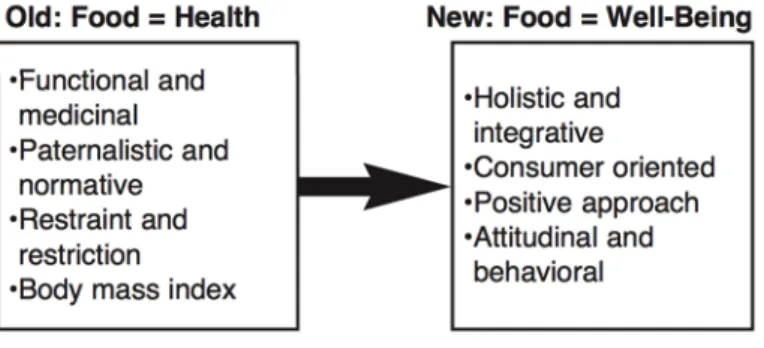
Figure 2-1: The Paradigm Shift to Food Well-Being (Bublizt et al., 2011) The concept of Food Well-Being (FWB) was started as a pattern movement “from the paternalistic, normative model of the relationship of food to health” (Bublitz et al., 2011, pp.1) (Figure 2-1). This movement has built a potential research path about “how a positive relationship with food may help consumers achieve a higher level of well-being” (Bublitz et al., 2013, pp.1211) as well as improved more positive and holistic understanding of the role of food in human’s
overall well-being. Indeed, researchers from the Transformative Customer Research conference 2009, encouraged for research and consumer programs that nurture a positive relationship with food, constructing a vision for the food well-being prototype (Bublitz, 2013). Consequently, the definition of FWB was proposed as “a positive psychological, physical, emotional, and social relationship with food at both individual and societal levels” (Block et al., 2011, pp.6)
Figure 2-2: Food Well-Being Pinwheel (Block et al., 2011)
From the establishment of FWB definition, many scientists have paid much effort and concentration to feature FWB’s characteristics. Since the third Transformative Customer Research conference 2011, the core areas of FWB concept was proposed the first time by Block et al., (2011). In which, they illustrated that there are many influential factors governing people’s food attitudes and behaviors such as culture, environment and legal entities. Dimensions of proposed model was described graphically by FWB pinwheel with three criticized layouts in Figure 2-2. Firstly, FWB must be the central core generated by outer constructs as well as binding them together. Secondly, all constructs including
food socialization (1), food literacy (2), food marketing (3), food availability (4) and food policy (5) represent influential factors ranging from societal to individual level. Lastly, when the pinwheel is opened, it embodies a fluid, nonstatic interchange of ideas and influencers; however when closed, it becomes a cylindrical block implying a unity of strength. Furthermore, it can be observed when rotating the pinwheel to focus on one area and others are considered as context therefore the integration across areas is still remaining. In particular, firstly, food socialization is considered as a main domain represented significantly by cultural component. Actually, food is often used to reflect cultural values for members from this generation to next ones and defining social groups and individual identities through meal traditions. Additionally, socialization is well denoted by family where socializing people from their childhood through providing information, pressuring to conform and support (Moore et al., 2002). Secondly, food literacy is the main domain of FWB in term of knowledge about food and nutrition. According to Worsley (2002), the greater nutrition knowledge people have, the better food choices they make. However, in this context, food literacy is defined more than knowledge, it includes three dimensions including (1) conceptual or declarative knowledge, (2) procedural knowledge and (3) ability, opportunity and motivation to apply knowledge to food decision-making. These all dimensions were proposed to comprehensively promote nutrition goal and FWB as well. The third domain is food marketing also plays important role in FWB concept since the traditional marketing mix (4Ps) is used to affect consumers’ attitude and behavior toward foods. Honestly, marketing activities affect not only the quantities of food consumption but also the emotions and cognitions associated with food. For instance, food taste or nutrition benefits are usually emphasized in food advertising (Kim et al., 2008) and convenience, relationship building, food quality are also focused in marketing promotion strategy (Cheong et al., 2010). The fourth domain of FWB context is food availability involving how the availability and distribution of food influence consumption behaviors at home, restaurants, grocery store and work. At the individual level, people must decide which sources to frequent among market, restaurant, etc., and which food to be
selected among available choice that diverge in level of taste, processing and healthfulness. Besides, at societal level, consumers must select which food to eat away from home and which food to bring home from available option and under influence of constrained food choice as they follow FWB. The last domain in FWB pinwheel is food policy, which is defined broadly as several types of policies related food systems, for example food production, pricing system, food safety policy, and nutrition policy. In which, food production and pricing system are governed by agricultural policy; food safety policy covers rules of how to produce, store, transport food to ensure suitable form for human consumption (World Health Organization, 2003). Nutrition policy is also important regarding to human’s health because it provides guidance of amount of food and nutrients needed for a healthful diet. All of them are necessary for motivating human’s FWB comprehensively. In conclusion, this framework of FWB was proposed in order to employ definition of FWB and the interconnection between academic fields. Furthermore, this approach also illustrated the need for future research connecting other disciplines and patterns outside and within marketing (Block et al., 2011) (Table 2-1).
Continuously, Bublitz et al. (2013) keep working on this concept by emphasizing how to inspire consumers to take steps to advance FWB. At first, they pay much effort to clarify specific goals of FWB and motivation and readiness to change aiming to appreciative consumer attentiveness to advance FWB. Consumer goal was specified by three types: functional goals, symbolic goals and hedonic goals. The functional goals can be observed as preventions or promotion oriented such as healthy eating to avoid future health problems. For example, some consumers usually manage their consumption by monitoring calories, sodium, or fat with support of online tracking tools and mobile application. For them, closely supervising their food consumption may assist them pursue their health goals. The
symbolic goal is perceived when consumers try to explicit their identity through
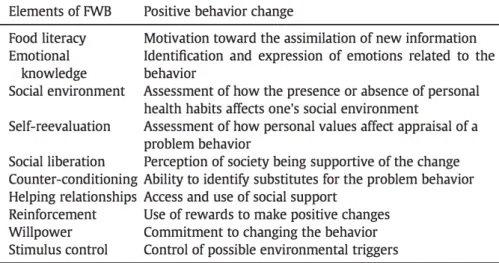
eating by demonstrating self-control (Roth et al., 2001). For instance, people who eat different amounts when having meal with someone of different gender is in order to distinguish their masculinity or femininity (Allen-O’Donnell et al., 2011). Lastly, the hedonic goal focuses on consumers who adore sensory experience of eating. Actually, the pleasure involving to food can be positive and probable intertwined with relations and memories that connect some food with family and other positive experiences. On another hand, hedonic pleasure people may increase calories intake since they focus on consumption experience and enjoyment. In general, it should be noticed that consumer’s goals are not stable because people often fluctuate between dieting goals and hedonic consumption goals (Stroebe et al., 2008). In sum, understanding different goals of consumption may lead toward different paths to continuum FWB. Additionally, not only consumer’s goals but also motivation and readiness to change are considered to understand FWB deeply. At individual analysis, consumers always pursue their personal interest and benefit in situation of health decision-making. This motivation may have specific internal and external drivers that make consumers improving their personal FWB. Stages of Change Model in research of Prochaska & DiClemente (1982) demonstrated five stages of health behavior changing process: precontemplation, contemplation, preparation, action and maintenance. Based on this, ten variables may influence
FWB was described in Table 2-2 to encourage a positive health behavior revolution.
Table 2-2: Using the Stages of Change Model to advance FWB
Besides, at environmental analysis level, there are many variables represent key external factors influencing opportunity to adopt and maintain healthy eating such as point-of-purchase (physical), regulations (political), cost (economic) and family and peer influences (socio-culture) (Brug, 2008). For example, in school, there are opportunities to approve changes to improve FWB since ability and motivation exist. On another hand, system of level efforts such as modifying educational environment or neighborhood commercial structure are required to encourage the provision of healthy offering.
Furthermore, in order to advancing FWB continuum, Bublitz et al. (2013) deconstruct the automatic and deliberative which affect food decision making into cognitive and emotional information that leads to guidance of food choice (Figure 2-3).
Table 2-3: A Taxonomy of Strategies for Advancing FWB
In term of deliberative influence’s cognitive aspect, conscious food choice is considered as the main core. In particular, mindfully evaluating food choice can prevent biased inference and then make more healthful options (E.g. Chandon & Wansink, 2007a). However, thinking obsessively about food also could lead to indulgent food selections. Regarding to emotional aspect of deliberative influence,
another conception was introduced to understanding about consumer’s food decision-making. Indeed, instead of considering readily available information, consumers tend to make decision based on what they feel right or emotional information. Besides deliberative influence, the automatics influences also have cognitive and emotional aspect. In which, cognition influence involves to factors outside of conscious governor and which consumers are interested in or knowledgeable about rather than availability of nutrition information or symbols. They might be trained to prompt automatic perceptions of healthfulness for less nutritious products and then it makes them become more aware of their food choice. As for emotional aspect, many studies illustrated that comfort food could be consumed in either positive and negative emotional states such as happy or bored (Wansink & Sangerman, 2000). Thus, the more recognition consumers have about how positive and negative emotions influence their relationship with food, the better and healthier dietary they can change. Eventually, almost of consumer’s daily food choice are not made in isolation because of interaction of deliberative and automatic influences. For example, deliberative efforts to employ intellectual resource to make healthier food selections can be disturbed by an emotion automatically provoked during an eating and drinking situation (table 2-3). Therefore, both deliberative and automatic influences should be considered in parallel in many other FWB researches. The figure 2-4 describes distinguishing strategies for advancing FWB based on the fully consideration of both deliberative and automatic influence in term of cognitive and emotional aspect.
In conclusion, the establishment of FWB measurement has facilitated its utility and brought more opportunities not only for people to assess and track their progress of FWB continuum but also bring many implications in many interdisciplinary such as policy maker and marketing strategies (Bublitz et al., 2013). On another hand, the FWB framework is efficient of creating research and understand global issues, such as such as food insecurity and food subsidies, and food-related diseases (diabetes, heart disease, and certain cancers linked to foods) (Block et al., 2011).
2.1.3 Children’s Food Well-Being
FWB agenda introduced above endorses research about all health and social challenges related to the categories and volumes of foods and beverages people consume, in addition to the production and consumption contexts of food (Block et al., 2011). In particular, there is an emerging global problem related diseases including both developed and developing countries especially for young children, the “twin” sides of food: global hunger and obesity. Indeed, even within United States, the paradoxical coexistence of food shortage and the food’s overabundance has been paid much attention by much public policy, for instance government programs such as Women, Infant and Children. Besides, Vietnam, a developing country also has been facing with such kind of issue. There is an increase of problem in eating habit leading to poor level of human’s FWB (Vietnam National Institute of Nutrition, 2014). Additionally, in our developing society nowadays, the raising of elderly people are strongly concerned especially in developed countries such America, Japan and other Euroupian countries. However, we also observed that children are important part of our society. They are special citizen because they can not defend their right by themselves, thus mainly depend on their caregiver. Therefore there has been mounting concern about Children Food Well-Being (FWB) playing an essential role in children’s physical and mental development.
Obviously, the environmental context is very important because eating behavior of people in that environment serves as a model for the developing children’s dietary habit (Birch and Fisher, 1998). In particular, parents is known as the first influencing the formation of children FWB since they provide certain food at home and consequently and directly affect children’s preferences and food acceptance patterns (Johnson, et al., 2011; Hood, et al., 2000; Brown & Ogden, 2004 & 2008). Moreover, family meal is an essential part of routine for exchanging information about good food, tasty food, safe food or heathy food especially for baby or young children (De Koning, et al., 2015; Videon and Manning, 2003). Indeed, a study of USDA also shows that if mothers know more about food and nutrition, they can serve the better quality of dietary for their
children (USDA of Economic Research Service, 2000). Therefore, family, particularly parents, has strong effect on children FWB development.
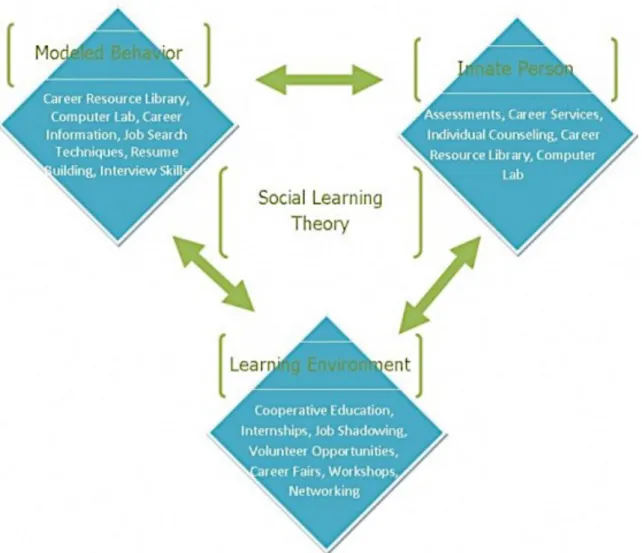
Figure 2-5: Social Learning Theory Model
Additionally, it is essential when health conscious of eating behavior is educated because it dynamically encourages children to become more mindful of their food choices (Bublitz, et al., 2011). Actually, schoolteacher and school lunch program not only provide healthy food but also have purpose to be foundation for fostering children’s mental and physical health as well as individual humanity. For instance, school programs offer incentives and competition for motivating children in order to choose more fruits and vegetables for their meal in term of elementary and middle school ages (Raju, et al., 2010). For instance, American Health Foundation had adapted the “Know Your Body” school health promotion program based on the Social Learning Theory model (Figure 2-5). Children in elementary
school were provided multicomponent workbooks covering mainly “dietary issues, physical activity and fitness, but also dental health hygiene, smoking, drinking and accident prevention” per year (Manios & Kafatos, 1999, pp.445). Otherwise, children who gain benefit from educational effort have better understand about both short and long term health consequences of consuming food (Bublitz, et al., 2011, pp. 8). Furthermore, children always have interaction and exchanging information with their classmate about eating behavior that possible influencing on their own current food preference. Thus, within education context, the changing of the structure of lunchroom, environment, name of food choices and the order of experience to specific food may increase healthy choice by children in a spontaneous manner (smarterlunch-rooms.org, 2011). Hence, educational environment, especially school, strongly drives the development of children FWB in several aspects.
However, even if children participate in school education about dietary, their overall FWB may not improve if their parents compensate for this by decreasing the healthy food provided at home (Dunifon & Kowaleski, 2003). Especially, parental control of feeding practices, tend to be associated with overeating and poorer self-regulation of energy intake in preschool-age children (Savage, et al., 2007, pp.9). Therefore, effective school teachers always need parents’ involvement in order to provide successful family environment for children FWB (Dauber & Epstein, 1993). Besides, several studies found that parents want to be more involved with their children’s education and would like more information and help from the schools (Booth & Dunn, 2013, pp.3). Thus, it is important and essential to encourage the collaboration between school and home, especially between teachers and parents.
2.2 Collaboration and Knowledge Transferring in Collaboration Concept
2.2.1 Collaboration in social context Introduction of collaboration
Nowadays, with the rapidly development of global ocean in term of seemingly nonstop change, enterprises have been required to be highly dynamic and adaptive
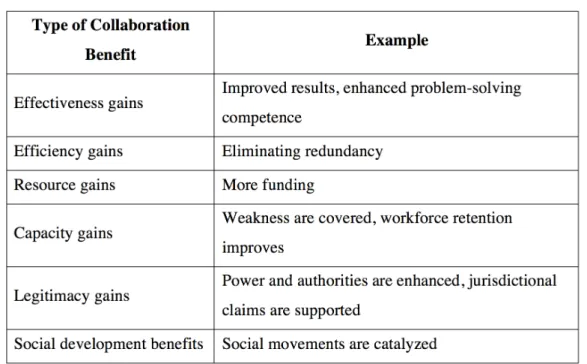
to maintain their competitive advantage by always paying much pressure to provide business services adapting to global change (Orriens, 2006). In order to pursue such kind of passion, enterprises are eager to collaborate with other parties dynamically (Orriens & Yang, 2006). Indeed, collaboration is a complex intervention with various elements and has potential to yield multiple benefits (Lawson, 2004) including effectiveness gains, efficiency gains, resource gains, capacity gains, legitimacy gains and social development benefits (Table 2-4).
Table 2-4: Benefits of Collaboration
By another word, collaboration is considered as common in knowledge concentrated business world. In which no individual worker can not achieve almost business goals by himself that requiring the collaboration from colleagues and customers or using different supporting tools (Ning et al., 2007). Obviously, even as for normal knowledge worker or highly experienced knowledge worker, it is easy to facing with dealing large number of knowledge therefore they usually try to keep up to date with available resources to help them complete a particular goal. Therefore, collaboration is deliberated as operation to solve share problems, meet common desires, capitalize on significant opportunities and acquire valued benefits.
Collaboration Conceptualization
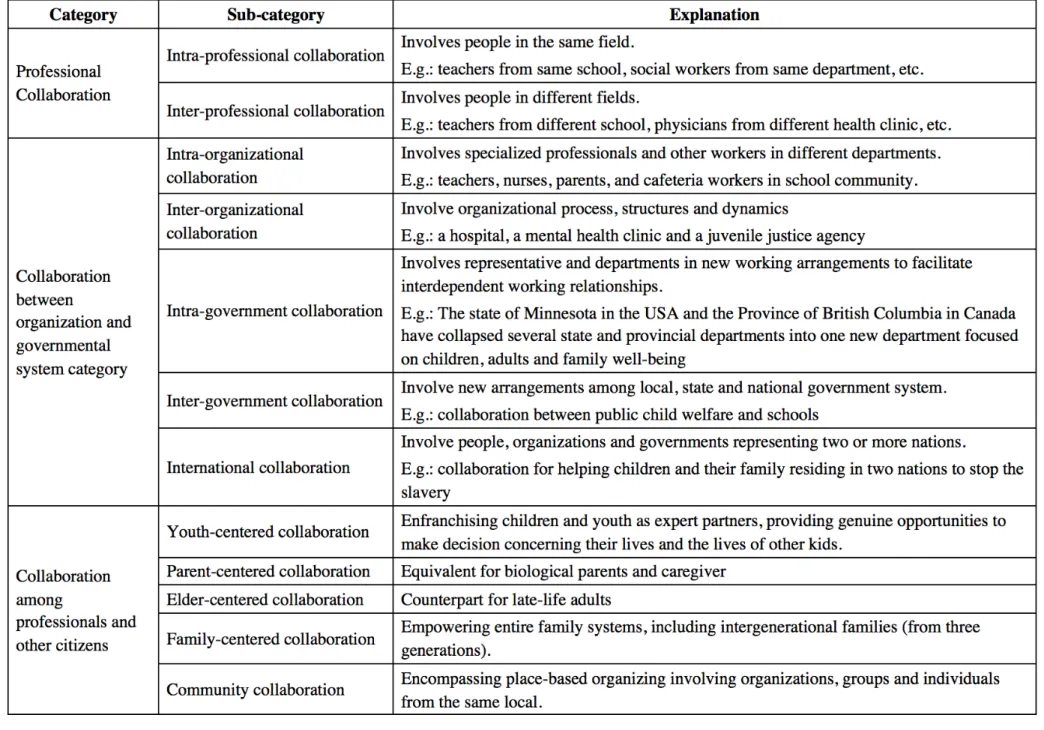
Basically, collaboration relates to new interactions between two or more entities that could be classified into three main categories and twelve smaller segments: (1) collaboration among professional, (2) collaboration among organization and government system and (3) collaboration between professional and citizens (Lawson, 2004). The professional collaboration is subdivided into two subsections: intra-professional collaboration and inter-professional collaboration. In which, intra-professional collaboration related to two or more people in the same field while inter-professional collaboration involved to people from different specialized field. Secondly, the collaboration between
organizational and government category is divided into five kinds:
intra-organizational collaboration, inter-intra-organizational collaboration, intra-government collaboration, inter-government collaboration and international collaboration. Lastly, the collaboration among professionals and other citizens illustrated that professional citizens empower other ones to accept shared duty and joint accountability for desired outcome. This category also is divided into five sections: youth-centered collaboration, parent-centered collaboration, elder-centered collaboration, family-centered collaboration and community collaboration; which are described in detail in table 2-5. Although the three main categories and twelve different types of collaboration were indicated clearly, they are illustrative not exhaustive. It means that classification only comprise a basic inventory or prototype but almost collaboration situations always require the combination some of sections above. For example, in order to improve school and education achievement, it requires community collaboration, inter-professional, intra-professional collaboration, family-centered and youth-centered collaboration. Therefore, collaboration is observed as a special collective accomplishment including a complex intervention.
Collaboration’s Stakeholder
As mentioned above, collaboration requires interactions of two or more ‘entities’ paying shared responsibilities and achieving common as well as their own target. Therefore, it is essential to have the correct mix of stakeholders (Mitchell et al., 1997). As many different kinds of collaboration above, stakeholders might be recruited from the similar, local geographic area or from far distant area (Hall, 2002). However, in general, collaboration’s stakeholder can be categorized into two types: primary stakeholder and secondary stakeholder. In which, primary stakeholder motivates to collaborate because of gaining valuable and unique results when they can not acquire normally by independent way. Whereas, the entities who do not gain benefit immediately or directly through collaboration are called secondary stakeholder. For example, in school lunch program, the involvement of Food Company is not to perceive high revenue at the time of serving food but they can improve their brand image after food quality is accepted by teacher, children, parents and nutritionist.
There are some related problems involving to stakeholder component in collaboration concept, which are balancing autonomy, interdependence and equitable relations. Firstly, in case of casualty collaboration, stakeholder loses their specialized identity and right and then leading to lose their autonomy. For instance, “collaboration” will become a take-over or a merger when a joint creativity “swallows up” other stakeholder(s) (Ferguson, 1999). Therefore, this determination need to be started by define clearly aims and goals of collaboration, furthermore making decision based on stakeholder’ abilities, resources, acceptability, rights and prior histories of working together. Therefore, in order to maintain a good collaboration, the autonomy and interdependence of stakeholder must co-exist. By this way, they can perceive not only healthy balance but also balance of interest, responsibilities and accountabilities between personality and collective ones. Secondly, in term of equitable relations, it is difficult to have an equal among them. Indeed, stakeholders are rarely equivalent because of their dissimilar power, authority, properties and legitimacy they enjoy (McCann & Gray, 1986). In such situation, collaboration is difficult to develop and maintain
when inequalities persevere. Therefore, to have effective and success collaboration, stakeholders must be capable to handle each other fairly and justly but noticeably, this relationship depend on negotiation about their difference, interdependence and reach consensus.
In sum, the decision of stakeholder component is very important in collaboration concept. Because they determine the magnitude, scope, complication and the developmental path of the collaboration.
Collaboration as service innovation
Firstly, collaboration is considered as a type of process innovation because of new intervention, novel strategy or new problem-solving methodology. For instance, in school collaboration concept, a new methodology was proposed when service experts recommend collaboration as the innovation leading to integrated health and social services. In this case, youth development specialists and classroom teachers work as stakeholders of collaboration in order to improve children’s academic achievement. Finally, new results or benefits will be obtained. Secondly, product innovation is also as a type of collaboration. Because when collaboration is established, the team of stakeholders is incubators for new ideas and then makes valuable product innovation. Such collaboration has been known as an innovation being inherently reproductive and nurtures more innovation (Bronstein, 2003; Lawson & Sailor, 2000).
However, unfortunately, it is difficult to achieve the ideal relationship between process innovation and product innovation while the boundary between them is not clear. Continuing the example of school concept, the collaboration between inter-professional teams is established in order to not only integrate services and provide new strategy as process innovation but also aim to achieve improving results for children and families as product innovation. Otherwise, the collaboration often new and complex that is easy to be goal transposition. It means when a new strategy or methodology (process innovation) is established, it is often to convert to a termination or goal in it owns right (product innovation). Therefore, in this
situation, we are able to consider collaboration as service innovation for creating new strategy, methodology and new end or goal in it owns right.
Trust in collaboration
In collaboration concept, social trust is one of the most important elements besides affective or cognitive factor. For instance, stakeholders should trust other’s motives, capability and dependability (Lawson, 2003). Actually, risks are unavoidable problems in collaboration concept because they accompany the inter-reliant relationships among stakeholders. There are at least six kinds of risk being salient and two or more of them are able to appear in a collaboration: strategy risk, capacity risk, dissemination risk, resource risk, reputation risk and legitimacy risk (detail in table 2-6). In which, trust and trusting relationship is observed as mechanism being able to mollify some of collaboration’s risk.
Furthermore, ‘free-riding problem’ is more serious issue in collaboration including both risk and disincentive. It refers to the process that someone reaps the benefits while he/she does not pay much effort and suffer the costs (Molm et al., 2000). Therefore, the norm of reciprocity in collaboration concept is essential for developing alongside trust and reducing uncertainty. Moreover, trust relationship and this norm are able to prevent the ‘free-siding problem’ and connect equitable, interdependent relations between stakeholders.
Table 2-6: Types of Risk in Collaboration
2.2.2 Knowledge Transferring in Collaboration Concept
Recently, knowledge has been rapidly becoming the prime source of prosperity in the world not only for individual or organizations but also for nation and society (Parent et al., 2007). Following the sudden change of global economy, individuals, organizations or even societies and nations require something rather than technology, they must have support from integration or collaboration between others related entities to manage their knowledge. In collaboration concept,
especially nurturing trust in collaboration, knowledge transfer play an important role as core flow and connection, such as stakeholders must decide what knowledge will be shared and who share it (Lawson, 2004). Knowledge transfer is the process which one or more stakeholder in a collaboration is influenced by other’s experiences (Argote and Ingram, 2000). It involves the systematization and storage of some one’s current knowledge into knowledge repositories or databases and then, it can be accessed and reused by other stakeholder in collaboration. Thus, stakeholder who can reuse such knowledge can be more effective and productive in their missions (Alavi and Leidrer, 1999).
Besides, knowledge transfer in collaboration concept brings several benefits for stakeholders. Indeed, there is a potential benefit from an effective knowledge repository, because members are able to save their time and costs by reusing and control existing knowledge instead of creating the new ones. Otherwise, accessed knowledge might have higher quality than what is generated by themselves. Such kind of situation has further capacity to create new and advanced knowledge through knowledge synthesizing and finally leading to improve service quality (Ofek and Sarvary, 2001). Additionally, exchanging knowledge in collaboration concept plays role as the norm of reciprocity which providing to other stakeholders what they needs and perceive what we need. It does not only co-create value in collaboration but also raise the trust and promote the connection among stakeholders.
Figure 2-6: Knowledge Transferring in Collaboration
However, in order to perceive such benefits in collaboration through knowledge transferring, it requires some rules and conditions. Firstly, shared-knowledge must be valuable to put into collaboration’s shared-knowledge repository and to at least another stakeholder that motivating he or she to reuse (Watson & Hewett, 2006). Obviously, much motivation to joint in a collaboration is depend on stakeholder’s demand. Thus, there will be no reason to keep on sharing their responsibility without perceive some benefit to satisfy their need. Finally, although the shared knowledge is valuable for other in collaboration, it required other essential condition. People who access to knowledge repository must use actually in order to develop problem-solving solution. This is the only way to make shared/reused knowledge become valuable and bring worthy results for collaboration (Figure 2-6).
2.3 Collaboration in Food Educational Service
2.3.1 Food Educational Service
Food education became popular nowadays included both developed and developing countries. It is considered as a powerful instrument for acquiring many multi-section benefits such as “education, gender equality, food security, poverty reduction, nutrition and health, and agricultural development” (Lawson, 2012). Many countries in all over the world have run food education for many different purposes (Table 2-7). For instance, United State and United Kingdom utilized food for education to improve children’s health. Brazil and India have established school feeding program by passing legislations.
Table 2-7: Different types of Food for Education Programs and Their Pros and Cons
Otherwise, food education has been established because of many types of demand. First of all, it is required because the purpose of improving public health outcomes. Silk et al., (2006) illustrated that citizens do not have enough knowledge about the negative consequences of health problem from certain food choice as well as issue related cooking and exercise. Secondly, in term of economic problem, food education is necessary to avoid misperception and subsequent economic damage to food. For instance, when people concern about one kind of animal disease or crop problem, it could be result of ignorance and lacking knowledge. Therefore, in this situation, food education plays role as solution to educate and provide more information to consumers to have better choice (Kleinman, 2000). Finally, food education is employed as method to uncover the real ills of modern food system. Actually, the “Taste Education” of the Slow Food movement already helped customer to have daily food choice with awareness and responsibly. In sum, it is reasonably to establish and motivate food education in the world.
In conclusion, food education or school meals is able to contribute many benefit to at least education achievement, children’s health and furthermore citizens’ health improvement (Figure 2-7).
Figure 2-7: Relationship between SFP and Potential Outcomes and Impacts on School Children
Food education in Japan
There are abundant food education program in different nations, however, one of the most significant and well-known model is established in Japan (Shokuiku) (Figure 2-8). Official government commitment to food education turned out to be clearly by the formation of Food Education Law 2003. Following is the basic concept of this law re-enact from 2003:
(1) Shokuiku should have the purpose of promoting people’s health in body and in mind, as well as enriching human lives;
(2) Care should be taken to induce people to develop greater appreciation for and understanding of their diets, including the various roles played by the natural environment and the people who produce, transport and prepare food;
(3) Nationwide, voluntary movements for promotion of Shokuiku should be developed;
(4) Especially Parents, educators and daycare providers should actively promote Shokuiku among children;
(5) Understanding of dietary issues should be reinforced by taking advantage of all available opportunities, such as at home, in schools and in the community or everywhere, to offer a variety of food-related experiences and activities;
(6) Awareness and appreciation of traditional Japanese food culture as well as food supply/demand situations should be promoted, and opportunities of interaction between food producers and consumers should be created, in order to revitalize rural farming and fishing regions, and to boost food self-sufficiency in Japan; (7) Appropriate information on food safety should be offered, in order to help people to practice proper diets.
Figure 2-8: Japanese Food Guide Spinning Top
The Japanese government’s campaign for food education ought to be understood as a response to serious issues in Japan-diet-related health problems and the food safety and quality’s reduction (Kimura, 2011). Actually, nowadays, preference of consumers has been becoming “Westernized dietary habit” that lead to more choosing of fast food or skipping breakfast (Chart 2-1). Consequently, it is raising rate of heart disease, diabetes and obesity in Japanese children. Besides, there has
been many problems related food safety and quality during last two decades because of declining of food self-sufficiency and deterioration of agriculture (Chart 2-2). Therefore, it is difficult for consumers to continue trust on quality of served food.
Chart 2-1: Percentage of Breakfast Skippers
Chart 2-2: Year-on-year Changes in Calorie Supply and Actual Daily Individual Intake
From this situation, Japanese food education, especially school lunches serve as a source of learning for Japanese children that providing opportunities to learn about nutrition, hygiene, culinary culture, local produce, food distribution as well as the importance of good manners, sharing-food fairly with their classmates, making sound judgment about diet and being grateful for food (Public Interest Incorporated Foundation, 2015). By another word, the purpose of such school lunch program is to providing a wide-ranging knowledge and skills involving food and nutrition to help people to ‘eat right’.
In order to promoting food education in Japan, government required the primary collaboration between several departments, such as Cabinet Office’s Food Safety Commission (FSC), and the Ministry of Education, Culture, Sports, Science and Technology (MEXT), the Ministry of Health, Labour and Welfare (MHLW), and the Ministry of Agriculture, Forestry, and Fisheries (MAFF). In this collaboration, these departments aim to share their common understanding as well as their own capacity for improving and effecting a comprehensive education. Otherwise, local government office also have target to have collaboration with related institute or departments such as school, food providers and surrounding community to processing food education. Figure 2-9 bellowing illustrated the mass connection between several departments to implementing food education in school for young children.
Figure 2-9: Food and Nutrition Dynamics in the Community: a Case Study of School Children
2.3.2 Collaboration in Food Educational Service
Through the explanation above about collaboration between organization and food education in the world, especially food education in Japan, this part is aim to introduce about collaboration in Food Educational Service.
Collaboration Conceptualization in Food Educational Service
In this collaboration, especially focusing on school lunch program for young children, it requires interaction between many related social entities. Such interaction is the combination of many different kinds of collaboration, including intra-organizational collaboration, organizational collaboration, inter-government collaboration and youth-center collaboration. In detail, the
intra-organizational collaboration account for the interaction between specialized
professionals and other workers in different departments. In this case, it is the collaboration between teachers and parents; teachers and other school’s staff serving food for lunches; teachers and nutritionists; and parents and nutritionists. Each of them plays their different role and has different responsibility however they have the same target of serving food education for children. Secondly, the presence of food suppliers is represented in inter-organizational collaboration which involves organizational process, structures and dynamics. Honestly, nowadays, not all schools have capacity to cook and provide food or even education program related to current food by them. Therefore, it is compulsory to have involvement of food suppliers who not only provide food but also research and develop food formula being suitable to current consumers’ health situation and preference. In some large organizations, they also employ nutritionist that have abundant knowledge of food and nutrition who is able to collaborate to providing educational service at school. Thirdly, the inter-government collaboration which involves new arrangements among local, state and national government system also is required in this context. Certainly, it is necessary to have collaboration between schools and official public child welfare because food education processing in school must be controlled by local public office. For example, this collaboration support school to pursue up-to-date policy from government on time through local public child welfare, thus the program can be run fluently and efficiently. On another hand, by connecting with schools, local government office has capacity to control and follow current situation of children as well as quality of food education program’s quality rapidly and accurately. Finally, we have the
make decision concerning their lives. In this context, children play an important role as core partner; they need to take part in all activities in this food education, served nutritious food and attract concerning from other stakeholders. Otherwise, educated children have opportunities to improving their food acceptance as well as preference based on knowledge about their physical situation, food and culture. Collaboration’s Stakeholders in Food Educational Service
As mentioned above, there are many entities required to involve in this collaboration: school teacher, nutritionist, food supplier, local community, children and their parents. In which, they might be divided into primary stakeholder and secondary stakeholder.
The group of primary stakeholder should include: children, school, food suppliers who are able to gain results as well as benefits directly which are difficult if they work independently. Firstly, we must mention about children because they are center of collaboration and their involvement are prerequisite condition for establishing this collaboration. Children are the first ‘stakeholder’ can perceive value from others since they are educated more knowledge, understand food culture, improve their physical as well as mental condition and furthermore improve their FWB. Such kind of benefit is obviously unable to perceive by themselves because of their limited ability. Secondly, school also can achieve significant value from this collaboration directly. Providing food education successfully help school to process their function more comprehensively. Similarly, food supplier does not lose out in this collaboration. By interaction with school, they can reach and understand their potential customer more effectively, deliver their service to target consumer directly and more easily. Furthermore, their brand image in school community or even consumers also could be upgraded.
Other stakeholders in this concept could be located in secondary stakeholder category, including parents, nutritionist, and local community. They may not perceive value directly as result of collaboration, however some significant benefits are able to achieve. In term of children’s parents, their FWB is not directly