Total Temperature Measurement of Gas Flow in
Micro-tube with Constant Wall Temperature
著者
MATSUSHITA Seiryu, NAKAMURA Taiki, HONG
Chungpyo, ASAKO Yutaka
journal or
publication title
The Research Reports of the Faculty of
Engineering, Kagoshima University
volume
57
page range
34-34
year
2016-11-01
ASME 2014 International Mechanical Engineering Congress & Exposition, IMECE2014 November 14-20, 2014, Montreal, Quebec, Canada
Total Temperature Measurement of Gas Flow in Micro-tube
with Constant Wall Temperature
Seiryu MATSUSHITA
1, Taiki NAKAMURA
1, Chungpyo HONG
1and Yutaka ASAKO
21
Graduate School of Science and Engineering, Kagoshima University
2
Dept. of Mechanical Eng., Tokyo Metropolitan University,
Abstract
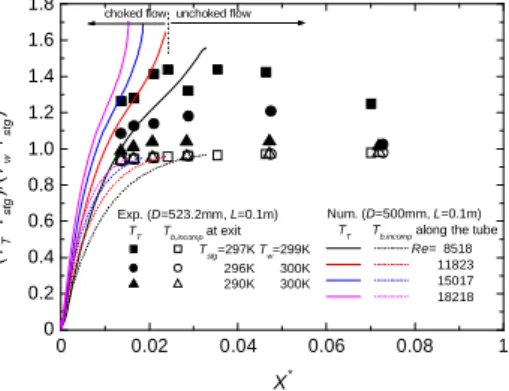
This paper describes experimental results on total temperature measurement of nitrogen micro-jet from micro-tubes outlet measured for the wide range from unchoked to choked flow. The experiments were preformed for a stainless micro-tube of 523.2 m in diameter whose temperature difference between the wall and inlet was maintained at 2, 5 and 10 K by circulating water around the micro-tube, respectively (Fig. 1). The gas flows out to the atmospheric condition. A thermally insulated tube of foamed polystyrene with six baffles fabricated by the companion paper where the gas velocity reduces and the kinetic energy is converted into the thermal energy, was attached to the outlet of the micro-tube. The inner diameter of the polystyrene tube is 22 mm. The baffles are equally spaced and the intervals of the baffles tested are 5 and 10 mm to investigate the effect of the interval of the baffle on the reduction of the gas velocity. The gas temperature measured by thermocouples at locations of baffles is considered as total temperature. The measured total temperature is higher than the wall temperature and increases with increasing the stagnation pressure (Reynolds number) for unchoked flow since the additional heat transfer from the wall to the gas near the micro-tube outlet caused by the temperature fall due to the energy conversion into the kinetic energy. It decreases in the insulated tube for chocked flow since Joule-Thomson effect is dominant in the insulated tube. The measured total temperatures are compared with results obtained by numerical computations (Fig. 2 ).
0 0.02 0.04 0.06 0.08 1 0 0.2 0.4 0.6 0.8 1.0 1.2 1.4 1.6
1.8 choked flowunchoked flow
Num. (D=500mm, L=0.1m)
T
T Tb,incomp along the tube Re= 8518 11823 15017 18218 Exp. (D=523.2mm, L=0.1m) TT Tb,incomp at exit Tstg=297K Tw=299K 296K 300K 290K 300K X*