intangible cultural heritage”in Kelantan,
Malaysia:A case study of the Peranakan Chinese
wedding ceremony
著者
Putthida Kijdumnern
journal or
publication title
Tohoku Anthropological Exchange
number
18
page range
30-59
year
2019-03-31
30
Promoting “Peranakan Chinese tradition” as “intangible cultural heritage” in Kelantan, Malaysia: A case study of the Peranakan Chinese wedding ceremony
Putthida Kijdumnern
Introduction
This paper seeks to explore the complex culture of Kelantan Peranakan Chinese, which is rather less known to the outsiders than other Peranakan Chinese groups. “Traditional wedding ceremony” of the Kelantan Peranakan Chinese is the main focus of this paper. I would like to examine its “uniqueness” in order to understand the role of this ritual plays in forging the cultural identity of Kelantan Peranakan Chinese. I would also like to examine the efforts of local association to promote the ‘traditional’ wedding ceremony. This paper is based on the ethnographic fieldwork I conducted in Kampung Pasir Parit, Kampung Seno, and Kampung Chepa during September 2018. I shall examine the steps of current wedding ceremony and changes in the wedding ceremony and analyze how local people practice this ritual in their daily life. Moreover, I analyze how ‘traditional’ wedding ceremony is utilized by the Kelantan Peranakan Chinese community to preserve its “unique” culture.
Some scholars (Imran Lim Abdullah, 2015; Pue 2017; Tan 2018) point out that the Kelantan Peranakan Chinese culture is being gradually “lost”, and others (Suryadinata, 2007:126 ; Imran Abdullah and Bustami, 2015 : 1) worry that the culture will “die out” in the future. However, some local people are making some efforts to “preserve” the Kelantan Peranakan Chinese culture as a “tradition.” The “traditional” wedding ceremony is a case in point. This paper tries to ethnographically describe the ceremony as it is practiced today and
31
examine which elements of this ritual ate regarded as “traditional” by the local people and, more specifically, what aspects of this ritual are used by the local activists as the basis for their assertion that this ritual qualifies as the “intangible cultural heritage” of Kelantan Peranakan Chinese. A certain group of community members are trying to promote the “traditional” wedding ceremony as a vehicle for their Peranakan cultural identity. In particular, I document the current ‘traditional’ wedding ceremony and analyze how the members of the community are making efforts so that the younger generation continue to practice the “traditionally Peranakan” elements in their wedding ceremonies and that the Kelantan Peranakan Chinese culture is preserved through the wedding ceremonies. They are also trying to identify their own image through the promotion of culture in the actual plan of establishing the cultural village of Peranakan Chinese.
In this paper, I employ St. Clair’s theory “the sedimentation theory of cultural time and space” to analyze the complex layers of cultural sediments that constitute the practice of ‘traditional’ wedding ceremony and the pattern of Peranakan Chinese culture. It is the local practitioners as both cultural carries and change agents that actively develop as well as maintain a “tradition”. I borrow Salemink’s concept of “cultural appropriation” to sort out how the locals and outsiders appropriate elements of cultural practices as “authentic heritage” in accordance with their own agendas. I would like to examine the process in which “traditional” wedding ceremony is appropriated as a constituting part of the “intangible cultural heritage” of Kelantan Peranakan Chinese by various local and outside agents. The ‘usage’ of the traditional wedding ceremony and the cooperation of different agents is highlighted. Also, the impact of the promoting on the locals and the community.
I conducted ethnographic fieldwork in three Peranakan Chinese villages in Kelantan namely; Kampung Pasir Parit, Kampung Chepa in Pasir Mas district
32
and Kampung Pasir Seno in Machang district during September 2018. I was able to carry out participant observation of four marriage ceremonies as a “guest” and recorded how the rituals were conducted. I also carried out in-depth interviews with the community members involved as well as bridal families. I also took pictures and made videos of such aspects of the ritual as food offerings for ancestors, house decoration, and food prepared for celebration, and other ritual components. Finally, I conducted in-depth interviews with such key figures of the communities as the president of the Kelantan Peranakan Chinese association, the association's liaison and treasurer of the gallery, and the former headmaster of Kampung Pasir Parit. This paper focuses on one wedding ceremony held in Kampung Pasir Parit, the bride's residence, and in Kampung Pasir Seno, the groom's residence. Communities were chosen on the following three factors. First, Kelantan Peranakan Chinese distinct is different from other Peranakan Chinese groups in that this sub-ethnic group is assimilated with two cultures, Kelantan Malay and Thai, unlike other groups that are assimilated only with Malay. Second, different villages demonstrate a varying degree of native influences. Balanced influences of both Malay and Thai cultures can be seen in communities that exist in places with a high percentage of Malays in the population located near Thai settlements. Third, those communities allowed me to observe both “traditional” and changing patterns of wedding ceremonies.
Historical and Ethnographic background
Kelantan Peranakan Chinese is a sub-ethnic group in Kelantan province, Malaysia. In Kelantan there are at least 47 known Peranakan Chinese communities (Teo 2003: 51). Most of Chinese resides at ‘Kota Bharu' town which is the state capital. The local Malays know them as the ‘Town Chinese' (Cina Bandar). There are pockets of rural Chinese scattered all over other
33
administrative districts. The local Malays categorize them as the ‘Village Chinese' or ‘Rural Chinese' (Cina Kampung) (Yao Sua Tan, Kamarudin, and Sezali Md 2017: 17). As of 2010, almost half of the Chinese population resided in urban areas such as Kota Bharu (47.2 percent) and Tumpat (13.1 percent), while a small number lived in suburban areas as Tanah Merah (8.5 percent), Kuala Krai (8.4 percent), Gua Musang (8.1 percent) and Pasir Mas (7.5 percent) and even fewer lived in remote areas such as Jeli (0.2 percent), Bachok (1.67 percent), Pasir Puteh (1.8 percent) and Machang (3.6 percent). (Department of statistic, Malaysia, 2010: 64). Kelantan Peranakan Chinese or Rural Chinese who reside outside of capital city is the main focus of this paper, especially Pasir Parit and nearby areas where Chinese settlers concentrated.
‘Peranakan' is Malay/Indonesian language; it is derived from ‘anak' which means child and mixed with ‘per-… ‘an' Peranakan originally refer to a womb. The term refers to a local-born of non-indigenous descents. By the mid-nineteenth century, the term Peranakan became the first specific label used by the Malays to refer to the “mix-blood,” particularly in reference to “Chinese” borne by native mothers (Tan 1988: 44). The large immigration of the Chinese to Malaysia start with the Melaka government's relation with China in the early 15th century. (Purcell 1965: 235). A great number of Chinese emigrated mainly from Min Nan or Southern China from Guangdong (Kwangtung), Guangsi (Kwangsi) and Fujian (Fukien). The settlement in Kelantan was much earlier and smaller compared to late migration in the nineteenth to the twentieth century started from the thirteenth century (Pue,2019: 37 ) The existence of the Kelantan Chinese can be traced based on a physical evidence of the old statue “Mar Chor Beaw” in Sui Yek Khong Temple in Pulai, Gua Musang, Kelantan (Imran Abdullah and Bustami, 2015: 6). The Chinese migrants have settled in significant numbers since the late 18th century, because of various factors, including famine, natural disasters, war, despotic rulers, and seeking job opportunities in the
34
Malay Peninsula. Kelantan Peranakan Chinese traveled from overland and settled down along Kelantan River and a northern region near Thailand border. The Chinese settlers occupied and owned much of the land about 40 kilometers along both sides of the Kelantan River and small canals along Kelantan River (Winzeler 1985: 18). Unlike the ascendants of the Baba-Nyonya community in Malacca who were merchants, the Hokkiens who came to Kelantan were mostly peasants (Pue 2017: 150).
Teo (1993) and Gosling (1983) proposed that the culture of Peranakan Chinese of Kelantan is a result mostly of acculturation and only partially of assimilation. Tan categorized them as ‘Teng-Lang,’ a Hokkien label for Chinese to identify themselves apart from other Chinese groups( Tan,1988: x) Winzeler characterized Kelantan Peranakan Chinese as an acculturated but unassimilated Chinese community (Winzeler,1985: 14). These studies indicate that ‘acculturated process’ played the vital role in adaptation of Kelantan Peranakan Chinese. Thus, their culture has changed due to their contact with a predominant ethnic group, but their “Chinese” identity was maintained.
According to Hsieh Ching-Kao, the local Malays forbade their daughters to marry the Chinese because, in the late 18th century, Kelantan Malay has embraced Islam. Consequently, the Chinese were more inclined to marry Siamese women (Imran Abdullah and Bustami, 2015: 7). Eventually, Chinese settlers were strongly influenced by local Malay in their dressing, spoken language that later becomes creole language, architecture, cuisine, and foodways. However, they still preserve a strong Chinese identity through Chinese customs, celebrating-event, customs, Chinese annual festivals, and traditional house.
The amalgamation of three contrasting cultures, Chinese, Malay, and Siamese (Thai), produced a “unique” culture that has “not only ethnic status but also native status” (Winzeler, 1985: 91-92). Intermarriage with Siamese women
35
is a benchmark as a beginning of Peranakan Chinese society in Kelantan (Teo, 2003: 31). Significantly, intermarriage plays an essential factor to form Kelantan Peranakan Chinese identity. Married with Siamese women was common before nineteenth century because of the shortage of Chinese women (Yao Sua Tan, Kamarudin, and Sezali Md, 2017:16). Their identity is often ambiguous to the outsiders because their appearance, name, and a way of life see, neither Malay nor Chinese. However, Kelantan Peranakan Chinese group, especially Cina Kampung or rural Chinese, is different from other Peranakan Chinese groups in that there the continuity of some rituals in more “traditional” customs and practices can observed in such rituals as wedding ceremony, funeral ritual, hungry ghost festival among others.
Findings
The ‘traditional’ wedding ceremony of Kelantan Peranakan Chinese can be divided into three distinct parts, in sequential order, "Chhiu Thau (上头)" or the hair-combing ritual, the engagement, and the wedding. First, I will focus on the four main features which are said to be “traditional” and thus are regarded as the components that make the wedding ceremony as “intangible cultural heritage” of the Kelantan Peranakan Chinese. The wedding ceremony is arranged according to the selection from the religious master that verify the auspicious day from the Chinese almanac.
36
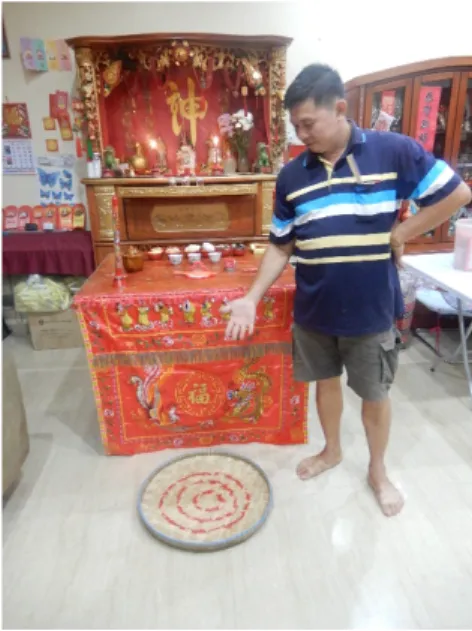
Figure 1: ‘Tok Bun Lai’ explained the main elements for Chhiu Thau rituals comprised of Badang (rice measurer), comb, mirror, and chopsticks
Chhiu Thau ritual is arranged after midnight on the eve of the wedding day. In this case study, they used five elements; a comb, mirror, chopstick, Badang or Chinese rice measurer, and Chair. I observed the ritual at the bride's residence in Kampung Pasir Parit. It started at 4 a.m. when parents of the bride worshipped deities; Kuan Yu (关羽), Ben tou gong (本头公), Tian Gong (天宫), Tudigong (土地宫) with the dry elements such as mung bean noodle, bean curd stick, dried persimmon, daylily flower bud, woody ears, and dried snow fungus mushroom. After that, Tok Bun Lai (religious master) prayed to the deities; he worshipped at Kuan Wu (Kuan Wu is the main deity represents the trustfulness for marriage) by offering tea set and respectively to other deities that were named above. Religious master brought Badang, it had the red cycle from small and expands until the edge. He brought it out and fumigated with kemayan incense stick. Tok Bun Lai explained that a vital instrument is Badang which symbolizes longevity and the initiation of adulthood and symbolize cycle of life. Afterward,
37
he put a chair at the center of Badang, and the bride sat inside it, and then he prepared covering cloth, comb, mirror, and hair gel by fumigated incense stick and recited the spell. After finishing the spell, he put the kemenyan incense under a chair. Later, Bride's parents came to comb her hair vertically by chopstick three times and used golden paper to clean chopstick. Then Tok Bun Lai picked up sweet glutinous rice ball soup or Kuih ee (汤圆) and fed the bride. She must eat three balls and swallow it without chewing. Informant clarified that Kuih ee represents togetherness; thus, the bride must not chew to break the togetherness of being in a relationship. After finishing the ceremony in front of the altar, bride worshipped for the deity at the entrance. Parents stood in front of the house, and the bride brought rice wine and poured it over the grass which symbolizes land. Later, the bride offered the rice wine to her parents to express her gratitude and asks their permission for marriage. At the end of the ceremony, parents burnt golden money paper to finish Chhiu Thua ceremony.
Engagement ritual
The custom of engagement ritual depends on each family and varies. The engagement ritual I focus here was held right after the fetching of the bride ritual finished. After that, the bride and groom exchanged rings and some accessories given by parents and from the parents-in-law from the groom’s side which represented by Tok Bun Lai who accompany with the groom. Tok Bun Lai of the groom is the representative of the groom’s parent, and he also the person who carried the dowry to the bride's residence. In another wedding inside Pasir Parit, bride's family distribute western-style cake with bridegroom topper to groom's relatives. When the engagement ritual finishes, the wedding starts while the couple worship in front of the pantheon. Informants inside the ceremony explained to me that in the past, engagement ritual would have been held before the wedding ceremony and the parents would have given the present to both sides
38
of groom and bride-to-be. The engagement ritual is reduced to a simpler part of the wedding ceremony today.
Wedding ceremony
The ceremony started when the groom arrived by car parade to fetch the bride to the groom’s residence. From the bride’s side, one of the boys who is a cousin will open the door of the car for the groom. However, in this ceremony, a young girl opened the door instead because there were only girls living inside the house. Before entering into the residence, a groom must cross over a basin containing whetstone and water which represents rock undersea; kemenyan incense represents fire; grass represents the earth and land. An informant explained to me that it was arranged to get rid of a devil and bad luck for the marriage life called ‘Buang Soe.' After entering the house, Tok Bun Lai from groom's side worshipped ancestral tablets, and deity altar and put the dowry on the pantheon following by the groom. The groom came along with his groom mate. At the same time, bride mate stood outside of the bridal room to play a game and asked the groom and his groom mate to do a challenge before meeting the bride. Some guests explained to me that this activity was the modern game that the younger generation being influenced by a Chinese drama and Thai drama.
39
Figure 2: shows the newly-wed couple offer tea set to the bride’s relatives during the tea offering ceremony (Pang The) after finished the engagement ritual
Afterward, the newly wed-couple prayed to their ancestors and deities. The engagement ritual was held after the couple rejoined. Later, they performed the tea offering ceremony (Pang Teh) or 敬茶 in Mandarin Chinese. They offered tea to the bride side’s relatives of her family. Her relatives gave ‘Angbao' (红包) or red packet which is a monetary gift in return. After finishing the ritual, children in the house offered the newly-wedding couple a tea set. An informant explained to me that it represents the linkage within a kinship group and connection inside a community and also to accentuate the initiation of adulthood of newly-wedded couple. Before marriage, they could not give other couples blessing. But after wedding ritual they can give a blessing and pocket money to children. Later on, the couple will be able to receive the tea offering because they became fully adult by getting married. Afterward, the couple would have a meal with guests or relatives in even number. I had the meal with the couple together with seven other participants, making us eight. The participants should not get up before the couple finish eating. The ceremony finished before noon, and the
40
car parade started to travel for the groom's house. Bride mate brought the bride's belongings, in particular, an umbrella was the most crucial element. Tok Bun Lai carried it along with the bride.
When car parade arrived at Pasir Seno, the groom’s family arranged Thai procession with long drum dance, and entertainment activities started. The rituals are similar to the ones held at bride's house in Kampung Pasir Parit. The bride walked along with procession. She also did ‘Buang Soe,’ a ritual to step over whetstone, incense stick and grass. The tea ceremony was offered to the groom’s relatives. The major difference from the ritual at the bride’s side was the worship of ancestors from both parents’ sides; they set the ancestral offering food in front of the house and invite an ancestor spirit to bride’s residence Conversely, at the groom's residence, the couple must go to other relative’s house where ancestral tablets located on the altar to invite ancestral spirit by themselves. Tok Bun Lai explained that in the past the couple had to go to the house where tablets were set up to invite them to the wedding. However, in the present days, because the members of a kinship group reside in various places, the complicated ritual step has been simplified, and some rituals are no longer practiced. After the wedding day, the bride must stay in the groom’s residence for three days. Then they can go back to stay at home or move in groom’s residence permanently. However, the bride from the wedding in Kampung Chepa stated that she would not stay at the groom’s residence for three days because she had to go back to work in Kuala Lumpur.
41
Figure 3: the blessing couplets called ‘lian' (联) as the blessing for new marriage. (Photo: Mrs. Ning Boonrak’s house)
Another important element of the wedding is a decoration of the house. The family members hired some Chinese calligraphy writers to engrave blessing couplets called ‘lian' (联). If the bride or groom’s residence was the Kelantan Peranakan Chinese traditional house, the blessing couplets were pasted at the veranda and worship hall. The couplets are in Chinese calligraphy which even the older generation cannot read. However, some elderly said it is custom and they want to continue this practice. The couplets are in the form of Chinese proverb and words related to the wedding ceremony and happy marriage life. In modern style house, they pasted or hanged couplets too but did not paste at the girder and only pasted at the entrance. The additional decoration is the photo backdrop made from fancy cloth decorated with plastic or glitter foam letter, and their pre-wedding picture album. Also, dresses of the bride and groom are noticed, they wore the modern western costumes. The bride wore a white gown, and the groom wore a tuxedo suit. The younger generation and some guests were in the modern costumes. Traditional dress also can be observed from relatives in other
42
wedding ceremonies; bride’s relatives dress in batik sarong (long skirt) and wear kebaya (traditional blouse-dress). In comparison with modern costumes, they are worn in a considerably smaller number.
Guests are entirely separated from the ritual which is held among family members and relatives. When the guests joined the ceremony, they came to greet the bride’s or groom's parents, took meals and started to consume the ceremonial food. The food was self-service provided by catering service and some food prepared by the family. Guests who do not belong to their kinship group stayed only in the tents which were provided and set outside the house or at the patio. However, half of the guests who came for the tea ceremony indicated that they are relatives and have the same surname. Guests participated the wedding day as they received the invitation from the bride, groom and their parents.
Ancestral food and ceremonial food
The foods provided in the “traditional” wedding ceremony are notable, and are divided into the ancestral food offering and the festive food.
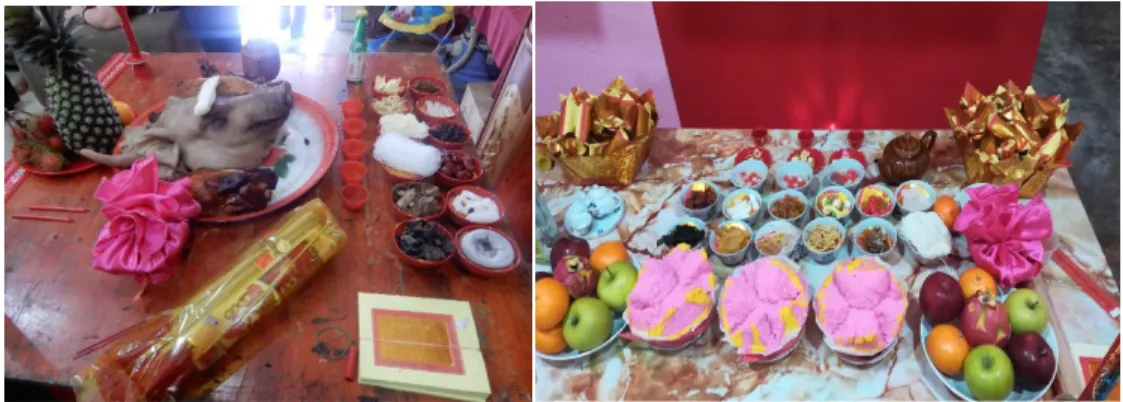
Figure 4 Left: set of ancestral and deity offering at the main altar ‘Seng Lay,' dry elements, rice, and fruit (photo at bride’s residence, Kampung Pasir Parit). Right: set of deity offering at main
alter consists of dry elements, fruits, tea set and golden paper (photo at groom’s residence, Kampung Pasir Seno)
43
First, the ancestral food offering is a vital element for wedding rituals. The foods divide into two categories, fresh cooking food and dry elements. The primary food offering is ‘Seng Lay' which comprises three types of meat -- pork, chicken, and duck. Also, Mee Sua or flour vermicelli. Seng Lay is offered to the deities and ancestors located inside the house. The biggest portion comprised with a pig head, internal organs of pork and tail, whole duck and chicken, and Mee Sua. The food offered to invite parental ancestors is smaller than that on the main altar; the pork head is substituted with a piece of fried pork belly and duck with eggs. The second type is dry elements including twelve dry elements counted as the Chinese elements such as mung bean noodle, bean curd stick, daylily flower bud, woody ears, dried snow fungus mushroom, vermicelli Also made is the Chinese sweet offering or 茶料which consists of black and white raisins, sweet winter melon, rock sugar dried persimmon and Chinese rice wine. The ancestral offering set at groom’s residence in Pasir Seno had more dry elements than the brid’s pantheon particularly; iced gem biscuits, sweet fried dough, dry cherry, and rice flour muffin. These foods are not local food, they must buy from ‘Bak Tiam' or Pork market in the downtown. In my observation, all of the wedding ceremonies utilized catering service for both ancestral food offering and festive food. The ancestral food offering must be arranged in even number. In both of the events, they set eight main dishes, two sweet dishes, two dry elements, and seasonal fruits such as Duku (traditional fruit, especially in Pasir Parit village) which is a local plant in the village. The first dish is Low Kai Kar (Braised Chicken Feet). The second dish is Bak Hong; pork mixed with dark and light soy sauce, palm sugar, and spice. The third, Bak Uan Tanghun Therng (Meatballs and Mung Bean Noodle Soup). The fourth, Bok Nee Goreng Bak (woody ears fried with meat), Ikan Goreng Cili (Spicy Fried Fish), The fifth, fish curry (fish with curry paste and coconut milk), Acar (spicy cucumber pickled), Jam Mamuang
44
(spicy mango salad). However, at Pasir Seno, the groom’s side set the ancestral offering with additional types of food, namely, betel chewing set, coffee, water and can of beer.
Figure 5: the festive food provided by catering service consist of Thai-styled Jam, Chinese noodle, Laksa and Laksam, cucumber Acha and Akok
The second type of the food is festive food which is arranged by catering service. Informants stated that in the past each family cooked all food by themselves aided by neighbors. However, in the present days, the catering service became an option. The groom’s family still cook every dish by themselves and got some help from relatives and neighbors. The festive food in the “traditional” wedding ceremony includes various types and some are heavily influenced by Malay or Siamese culture in each community. I detected heavy Chinese cultural presence in Kampung Pasir Parit, while in Kampung Pasir Seno I observed heavy Siamese or Thai influence. Unlike ancestral food offering that mainly comprises with dry elements, which are not local food and are dominant Chinese ingredients, the festive food shows strong influence of Kelantan Malay and Siamese dishes. The festive dishes in all wedding ceremonies are a similar type. The festive food in Kampung Pasir Parit and Kampung Pasir Seno have identical foods: Budu,
45
Bak Hong, Akok, and fish curry. The Malay condiment called ‘budu’ is a type of Malay fermented fish sauce mix with chilies and lime juice. It is eaten with local vegetables. Budu is fermented from anchovies and salt. Laksam or Laksae is a specialty of Kelantan dish made from thick flat white rice flour noodle. This dish must be eaten together with thick white gravy, which is made from fish, coconut milk, lemongrass, shallots, garlic, tamarind, palm sugar, and salt. Taste is savory and sweet. Some vegetables and herbs, or in Kelantan ‘Ulam,’ which means salad and Sambal (shrimp paste with chilies), can be added to the dishes. Laksa in Kelantan is different from normal laksa curry because it uses the same gravy as the one put in Laksam. Regarding serving fruits, ‘Rojak' is a Malaysian word means fruits mixed with Sambal Belacan (shrimp paste with chili condiment), caramel soy sauce and dried shrimp, Cucumber Achar, and Akok is the Malaysian version of Roti which is fried with oil.
Important agents to support the process of preservation
First, the most important agent is Kelantan Peranakan Chinese Association, or Persatuan Peranakan Cina Kelantan (PPCK), which plays a significant role in the local Peranakan Chinese communities. The association has more than 3,000 members. The association's president and the committee are planning to institute a “cultural village.” They say that they are doing this for the future generation of Peranakan Chinese. In the town of Tanah Merah, the association started a community gallery (Galeri Peranakan Cina Kelantan) by reconstructing the traditional house, which is the first step in association’s plan to create “cultural village.” It consists of the exhibition of the Peranakan Chinese life and is intended as a space where members of the Peranakan Chinese communities and visitors can learn the “unique cultural identity” of the Kelantan Peranakan Chinese. My informants say that they are trying to collect items
46
representing their “cultural heritage,” both tangible and intangible, that they want to display the Peranakan Chinese identity, and they also want to have performances in the gallery. The gallery is to be the main building in their planned “Cultural Village,” and is located near the main office building of Kelantan Peranakan Chinese Association. Community members linked by both descent and marriage join the association. I found through my fieldwork that all Kelantan Peranakan Chinese villages were tied in a web of kinship. To qualify to join the association, a candidate must show that he or she is of patrimonial descent of at least two Kelantan Peranakan Chinese, able to use the language, and have proper knowledge of Kelantan Peranakan Chinese culture.
Second, academic scholars are also crucial agents in that they give a professional outlook to the association's cultural village plan. The scholar who is most actively involved in the association's planning is a lecturer of architecture, Lim Yong Long, from Universiti Teknologi Malaysia, Johor, Malaysia. His central focus is the architectural features of Kelantan Peranakan Chinese traditional house. He is an advisor to the gallery project and offers his expert advice on the designing and renovating of a traditional house into the gallery. The academic scholars who are working on Peranakan Chinese include Tan Chee-Beng (1982), Teo Kok Seong (2003), Hanapi Dollah (1986) and Pue Giok Hun (2012). They have published researches and reports both in native Malay language and English language.1Most of the scholars are familiar with the community and its members
because they are able to speak at least three languages namely Kelantanese
1 I do not understand Malaysian, and I cannot tell how many of their writings
relate to Kelantan Peranakan Chinese. The information on the number of research is cited from ‘Engagement of undergraduate students as custodians in heritage conservation enrichment,’ Pue Giok Hun, 2017
47
dialect, Hokkien Chinese and Siamese or Thai. The community in Kelantan is less studied than more well known communities, for example, in Penang and Melaka.
Third, the village headmasters are also essential agents because they are considered to be knowledgeable elites. One such person is Owi Boon Teck. He is the former headmaster of Kampung Pasir Parit. During my fieldwork, I noticed he is the one who outsiders will contact first by making a phone call or sending a message, if they desire to study and interview the villagers. He plays the role as a knowledgeable elite. For example, it is he who prepares the PowerPoint on the history and recent activities of the community. In cooperation with Institute Terjemahan & Buku Malaysia (Malaysian Institute of Translation & Books), he supported the production of a photo book, "Peranakan Cina Kelantan: Sintesis Cina Tanah Besar dan Melayu Tanah Melayu," in 2016. He showed the ancestral food and the ritual inside his family, and he cooperated with other villages to publicize stories of being Kelantan Peranakan Chinese. The photo book illustrates the social life and the “living heritage of Peranakan Chinese of Kelantan” today and promotes Kelantan Peranakan Chinese as one important ethnic group in the multi-ethnic society in Malaysia. The photos from the book will be displayed in the gallery to illustrate the lifestyle of Kelantan Peranakan Chinese.
Analysis 1: Layers of cultural sedimentation in the Kelantan ‘traditional’ wedding ceremony
Kelantan Peranakan Chinese culture is a product of complex process of acculturation and assimilation. I borrow the idea of “the sedimentation of cultural time and space” from St. Clair (2007) to analyze the “traditional” wedding ceremony into different layers of cultural influences Kelantan Peranakan
48
Chinese received from Malay culture and Siamese (Thai) culture. St. Clair’s theory is found on Foucault’s theory “Archeology of Knowledge” (Foucault 1969). The cultural space is stratified in layers which marks the specific place in time and space. Each layer indicates the different influence that brought new cultural traits into the community. “Cultural change involves the retaining of some cultural practices along with the modification, revision and re-invention of events in the co-present. Just as the present is embedded in the past, the future is embedded in the present.” (St. Clair, 2007: 53)
Figure 6: illustrates the layers of the past on the old paradigm of Chinese culture which is the core of the ‘traditional’ wedding ceremony and the basis for Chinese identity
The foundational layer was laid when Chinese people settled down in area of Kelantan. The early immigrants adapted the “pure” Chinese customs to the social life in the early days. It contains the habitus of the past, the pattern of the wedding ceremony similar to that found in Southeastern China and to those of the Chinese diaspora in other Southeast Asian countries. This layer retains the residue of the cultural space of their origin. The salient feature is “Chhiu Thau” or the hair-combing ritual which parents combs the bride-to-be’s hair and bless
49
the bride with the assist from Tok Bun Lai. This rite is the most central part of the wedding ceremony as a whole and symbolizes the marring couple’s transition to full adulthood. Among the Peranakan Chinese, you are considered fully adult only after marriage. The hair-combing is said to originate in Fujian, China, but it is no longer practiced there (Wee, 2011: 18). Also, it is not observed in other regions of Malaysia such as West Malaysia (Tan, 2002: 109 ; Pue, 2017: 155). This phenomenon suit the explanation of the layer in the past that still embedded in the present which have been changed and dynamic. The ‘traditional’ wedding ceremony used to be common in many areas of Malay Archipelago but it become ‘uncommon’ for other Peranakan groups. It shows the different modification of the meaning that Kelantan Peranakan Chinese give to the wedding ceremony. Kelantan Peranakan Chines e pay attention to the deity from Chinese mythology which play vital role of Kelantan Peranakan Chinese custom. Particular, every houses I observed put Kuan Yu as the center of the altar. The location of alter of deities is always at the central of the house. Also, every rituals that held in the wedding ceremony commenced by worshipping the deities and ancestor at the altar from the beginning of Chhiu Thau and finished ceremony at the groom’s residence. Moreover, the ancestral tablets on the altar and the Chinese blessing couplets pasted at the entrance and girder of the traditional houses certainly represent Chinese “traditions.” The Chinese blessing couplets are inscribed by the calligrapher from Kota Bharu (capital city of Kelantan).
The Peranakan Chinese of today’s Kelantan tries to reconstruct their past within the context of new “co-present” but the reconstruction is never fully complete (Nederveen Pieterse, 2004) because the influences of other cultures in the host country is overlaid. The second layer is the mixture of the cultures from surrounding. The “co-present” is the place that older structures became “re-present” into new definition because the contexts have changed. The second layer is the most important stage of the sedimentation process of the “traditional”
50
wedding ceremony because the Chinese primordial identity still remains yet is amalgamated with Siamese and Malay identities. The combination provided the basic replacement of the Chinese primordial identity. The Malay belief that found in the wedding ceremonies is ‘Baung Soe.’ The ritual is to get rid of bad luck and devil from the wedding ceremony before the groom step in the bride’s residence and also when the bride will step into the groom’s house because they traveled from their home to destination and during the way could have had some devil or spirit attached to them. Other outstanding feature is the ceremonial food and fresh cooked food for ancestral offering which mix the materials and methods of cooking and shows the adaptation of the locals to new foreign soil. Normally, they do not consume pork as a daily food, but during special occasions such as the wedding ceremony pork is cooked and used as a crucial ingredient of ritual offerings. Consumption of pork differentiate Kelantan Peranakan Chinese from the majority Malay residents who live in Kelantan province. Mainly pork is used for the worship of ancestors and deities and is provided by catering services. Informants explained to me that those running catering services are also Kelantan Peranakan Chinese so they can provide pork dishes which are normally unavailable in the villages. The festive food is also a mixture of Chinese food, Malay food and Siamese food. Informant explains the mainly food are Chinese base with the local ingredients. The combination of food illustrates new negotiation of identity among the Kelantan Peranakan Chinese.
Third layer is the process of simplification. Tan (2002) mentioned the wedding ceremony of Kelantan and Terengganu Peranakan Chinese became uncommon and more simplified by omitting some rituals. The Chinese tradition is ‘re-present’ in this layer too but is reduced to a new simple form. For example, the engagement ritual was reduced or removed and, if performed, arranged on the same day of wedding day. Also, with the strong assimilation with Malay culture. Almost all of older generation in the villages cannot read Chinese
51
characters but they claimed that they still use them. The local developed in the simple form of wedding ceremony a new “traditionality.”
Fourth layer is the present “traditional” wedding ceremony. Main definition is fluid and subjective. The current pattern is underpinned by Chinese custom with some influences from Malay and Siamese customs as manifest in food and some rituals, but it is redefined with new influences from outside as modern technology brought the locals close to a wider world. First, the western wedding dress is noticeable in every wedding ceremony. Not only the newly-wed couple but also relatives and guests also wear western costumes unlike Sarong and Kebaya that Kelantan Peranakan Chinese used to wear. Also, an additional game played to get the bride is a new event for younger generation and it shows the influence of mainland Chinese drama and Thai drama. I was told that the numbers of families who practice the hair-combing ritual is decreasing because of the inconvenience especially of scheduling that the ritual must be completed by the wedding ceremony observed in the morning. However, some informants also told me that even though the younger generation is moving out of villages to live in urban areas or to other provinces, they would come back to arrange the hair-combing in their home communities. The newly-wed bride told me that she is proud to practice the “traditional” wedding ceremony. She wanted to continue the ceremony following her parents and her relatives. The new definition of the ‘traditional’ wedding ceremony is reconstructed in the meaning of inherited customs that must be protected, preserved and succeeded to by the descents. The wedding ceremony is dependent on the specialist. Only “Tok Bun Lai” is said to fully understand the whole process of the wedding ceremony. As the religious master, he teaches how to pray to ancestral spirits and deities, how to bow to parents and elders, and so on. “Tok Bun Lai” is a person who stands beside the groom and bride since the wedding ceremony start until the end of the ceremony. “Tok Bun Lai” is regarded as an expert on the “traditional culture” and the
52
complex creole language of Kelantan Peranakan Chinese which is a mixture of Kelantan Malay, Chinese Fujian dialect and Thai language. As such, he plays a key role in the wedding ceremony. The role of “Tok Bun Lai” is orally taught by the older ones to younger apprentices. They must learn the spell in the creole language, the essential elements to perform in particular ritual. Informants told me that each village had two or three “Tok Bun Lai” to practice the Kelantan Peranakan Chinese rituals. “Tok Bun Lai” is the person who insures the traditionality of today’s wedding ceremony.
Analysis 2: Appropriating culture of the Kelantan Peranakan Chinese ‘traditional’ wedding ceremony
I borrow Salemink’s concept of appropriation to analyze how “traditional” wedding ceremony is produced by different agents. Salemink points out that the process of becoming “intangible cultural heritage” in Central Highland, Vietnam, was under the control of the nation and outside cultural experts, and that those authorities recognized only the practices that belongs to one particular group as the “intangible cultural heritage” of Central Highland, Vietnam. Local people’s wishes were not respected there. It was Vietnamese government that gained international recognition and secured the status of cultural diversity site from UNESCO. Laurajane Smith identified an “authorized heritage discourse” that give the privileges to an outside expert and professional heritage practices vis-à-vis popular and community discourse and practices (Smith, 2006: 5). In Kelantan, by contrast, Peranakan Chinese Association tries to initiate the recognition process from the bottom-up, and they try to actively practice what they believe is their “intangible cultural heritage.” The association members say that they are doing this so that the future generation may retain the Kelantan Peranakan Chinese identity and that their project thus serves the Kelantan Peranakan
53
Chinese community. The first initiative they took is to establish the cultural center building to be the place for outsiders to study the culture of Peranakan Chinese group in Kelantan. The attempt is the cooperation between Dr. Lim Yong Long; scholar who is the expert of Kelantan Peranakan traditional house and Peranakan Chinese Association. They define wedding ceremony as the “traditional” ceremony by focusing on ‘Chhiu Thau’ ceremony which is supposed to be an old Chinese tradition but is no longer practiced in China proper. The commission “appropriated” this ritual as the source of traditionality that defines Kelantan Peranakan Chinese. Moreover, head master often emphasized the weakening identity of Kelantan Peranakan Chinese and stated that the simplified version of wedding ceremony must be preserved in such media as recording and documents. The wedding ceremony lost in other Peranakan Chinese groups elsewhere can be thus kept in the community.
The scholars who are currently studying Kelantan Peranakan Chinese culture are mostly native scholar. In the case of Vietnam, appropriation of the cultural practices is done by outside cultural experts to suit the national government policy by changing or re-interpreting some cultural practices, and what the government considers as the “authentic heritage’ is presented to audiences (Salemink, 2013: 169). By contrast, in Kelantan, the appropriation is done by local scholars and from the insider’s perspective. The scholars base their ethnographic research on the understanding of community members. The cultural practices still belong to the cultural carriers, the process of authentication is done by native scholars who practice the culture and also are part of the culture as well. They do not take out any cultural meanings nor do they reconstruct the Kelantan Peranakan Chinese culture in the eyes of the national government.
The locals also trying to “appropriate” the wedding ceremony as their “tradition” worthy of recognition by UNESCO. In Kelantan, it is the insiders who
54
are engaged in cultural appropriation. The gallery is the first project to demonstrate their unique culture through physical exhibits and performances. They are designing the gallery in the “traditional” building style to show that it contains the “cultural heritage” of the Kelantan Peranakan Chinese. They are doing this for the community members and their descents. According to, the Article 2 of the 2003 UNESCO Convention for the Safeguarding of Intangible Cultural Heritage defines the intangible cultural heritage as “the practice, representations, expression, knowledge, skills—as well as the instruments, objects, artefacts and cultural spaces associated therewith—that communities, groups and, in some cases, individuals recognize as part of their cultural heritage.” (UNESCO, 2003). The association’s liaison insists that the wedding ceremony is a “cultural heritage” because it is an age-old ceremony of Kelantan Peranakan Chinese. The notion of UNESCO intangible cultural heritage is “living” and reliant of “cultural carriers” (Salemink, 2013: 168). The agents consist of association and members, scholars and head master are trying establish the cultural space of Kelantan Peranakan Chinese culture by promoting the formation of the ‘traditional’ wedding ceremony by underpin the ‘Chhiu Thau’ and the role of ‘Tok Bun Lai’ that convey their heritage through their Kelantan Peranakan Chinese dialect that preserve inside the verdict and pattern of ceremony. Also, head master, he emphasized of the acculturated local food, this is the method of the ethnic group to adapt and flourished to stay in foreign land.
Conclusion
The four features, the Chhiu-Thau ceremony, the Chinese ancestral worship, the Chinese food, , and Tok Bun Lai or the religious master, distinguish the Kelantan Peranakan Chinese wedding ceremony as its “tradition and some members of local communities are trying to “use” them as evidence that the
55
Kelantan Peranakan Chinese has an “intangible cultural heritage.” Nevertheless, to gain the UNESCO recognition, they have to maneuver politically at the national level. That is a big challenge because they are a minority sub-ethnic group under the Muslim state. The Kelantan Peranakan Chinese remains little known to the outsiders and is yet to be studied academically. One obstacle is the language barrier. Peranakan Chinese, a kind of creole, is very difficult for the outsiders to understand. They probably need to publicize their “culture” more in major languages like English and Mandarin. They deserve more attention as my analyses show that their culture contains many layers of customs and practices “co-present” in today’s Kelantan and that new politics of cultural heritage is attempted from the bottom-up.
References
Abdullah, L.M.S. Imran and R. Bustami
2015, February. “Evolution and Identity of the Kelantan Peranakan Chinese: Issues and Challenges,” International Journal of Multicutural and Multireligious Understanding, 2 (1), 1-17.
Abidin, Mohd Zahirwan Halim Zainal et al.,
2016 “Assimilation of the Malay Culture towards the Straights of Chinese Community in the State of Kelantan: Study in Kampung Pasir Parit, Chetok, Pasir Mas, Kelantan,” International Journal of Academic Research in Business and Social Sciences, 6 (11), 38-51.
56
2010 Population distribution and basic demographic characteristics (Taburan Penduduk dan Ciri-ciri Asas Demografi)
Gosling, L.A.P.
1983 “Changing Chinese Identity in Southeast Asia: An introductoryReview,” L.A.P. Gosling, and L.Y.C. Lim (ed.), The Chinese in Southeast Asia (Vol.2: Identity, Culture &Politics),pp.1-14. Singapore: Maruzen Asia
Lee ,Kam Hing and Tan, Chee-Beng (eds).
2000. The Chinese in Malaysia, Kuala Lumpur: Oxford University Press.
Pieterse, Jan Nederveen
2004. Globalization and Culture: Global Melange, New York: Roman and Littlefield.
Pue, Giok Hun
2017 “Engagement of undergraduate students as custodians in heritage conservation enrichment,” Kajian Malaysia, 35: 141-163.
2018 Cina Peranakan Kelantan Menerusi Lensa Sosiologi, Bangi: Penerbit Universiti Kebangsaan Malaysia
2019 “Kelantan Peranakan Chinese Language and Maker of Group Identity,”
Journal of Language Studies. 19: 33-51
Pue, Giok Hun and Shamsul,Amri Baharuddin
2011. “Discourse of 'Peranakan' with focus on the Peranakan Chinese community in contemporary Kelantan, Malaysia,” 2011 International
57
Conference on Humanities, Society and Culture. 20: 241-245. Singapore: IPEDR.
Purcell, Victor
1965 The Chinese in Southeast Asia, London: Oxford University Press.
Salemink, Oscar
2013 “Appropriating Culture: The Politics of Intangible Cultural heritage in Vietnam,” Hue-Tam Ho Tai and Sidel, Mark (ed.) State, Society and the Market in Contemporary Vietnam: Property,power and values, pp. 158-180, Oxon: Routledge.
Sathian, Mala Rajo and Ngeow, Yoek Meng
2014, July 21 “Essentialising Ethnic and State Identities: Strategic
Adaptation of Ethnic Chinese in Kelantan, Malaysia,” Asian Studies Review, 385-402.
Smith, Laurajane
2006 Uses of Heritage, London and New York: Routledge.
St. Clair, Robert N.
2007 “The sedimentation theory of cultural time and space: the present is embeded in the past,” CÍRCULO de Lingüística Aplicada a la
58 Suryadinata, Leo
2007 Understanding the ethnic Chinese in Southeast Asia, Institute of Southeast Asian Studies.
Tan, Chee-Beng
1982 “Peranakan Chinese in northern Kelantan with special reference to Chinese religion” Journal of the Malaysian Branch of the Royal Asiatic Society, (55): 26-52.
2002 Chinese Minority in a Malay State: The case of Terengganu, Singapore: Eastern University Press.
2004 Chinese Overseas: Comparative cultural issues, Hong Kong: Hong Kong University press.
Tan, Yao Sua, Ngah, Kamarudin, and Abdullah, L.M.S. Imran
2015 “Negotiation of identity and internal contradictions: the Terengganu and Kelantan Peranakan Chinese foodways compared,” Asian Ethnicity, 16 (4): 411-427.
Tan, Yao Sua, Kamarudin, Ngah and Sezali, Md Darit
2017, April 10 Formation and negotiation of identity: the case of the Kelantan Kampung Pasir Parit Peranakan Chinese. Asian Ethnicity, 19(1): 16-35. Teo, Kok Seong
1993 A sociolinguistic Description of the Peranakan Chinese of Kelantan, Malaysia, Berkeley: University of California.
59
2003 The Peranakan Chinese of Kelantan: A study of the culture, language and communication of an assimilated group in Malaysia, London: ASEAN Academic Press.
UNESCO
2003, October 17 Intangible Cultural Heritage. Retrieved from Text of the Convention for the Safeguarding of the Intangible Cultural Heritage
https://ich.unesco.org/en/convention Wallerstein, Immanuel
2005 World-Systems Analysis: An Introduction, Durham, NC: Duke University Press.
Wee, Peter
2011 A Peranakan Legacy: The Heritage of the Straits Chinese, Singapore: Marshall Cavendish International (Asia).
Winzeler, Robert L.
1974 Kelantan: Religion, Society, and Politics in a Malay State, Kuala Lumpur: Oxford University Press.
1985 Ethnic relations in Kelantan: A Study of Thais as Ethnic Minorities in a Malay State. Singapore: Oxford University Press.