Compressional behavior and spin state of δ
-(Al,Fe)OOH at high pressures
著者
Itaru Ohira, Jennifer M Jackson, Natalia V
Solomatova, Wolfgang Sturhahn, Gregory J
Finkelstein, Seiji Kamada, Takaaki Kawazoe,
Fumiya Maeda, Naohisa Hirao, Satoshi Nakano,
Thomas S Toellner, Akio Suzuki, Eiji Ohtani
journal or
publication title
American Mineralogist
volume
104
number
9
page range
1273-1284
year
2019-09-03
URL
http://hdl.handle.net/10097/00129828
doi: 10.2138/am-2019-69131
Revision 3 1
Compressional behavior and spin state of δ-(Al,Fe) OOH at high pressures 2
3
Itaru Ohira1,a*
, Jennifer M. Jackson2, Natalia V. Solomatova2,b, Wolfgang 4
Sturhahn2, Gregory J. Finkelstein2,c, Seiji Kamada1,3, Takaaki Kawazoe4,5, Fumiya 5
Maeda1, Naohisa Hirao6, Satoshi Nakano7, Thomas S. Toellner8, Akio Suzuki1, Eiji 6
Ohtani1 7
1
Department of Earth Science, Graduate School of Science, Tohoku University, Sendai 8
980-8578, Japan 9
2
Seismological Laboratory, California Institute of Technology, Pasadena, California 10
91125, U.S.A. 11
3
Frontier Research Institute for Interdisciplinary Sciences, Tohoku University, Sendai 12
980-8578, Japan 13
4
Bayerisches Geoinstitut, University of Bayreuth, Bayreuth, 95440 Germany 14
5
Department of Earth and Planetary Systems Science, Graduate School of Science, 15
Hiroshima University, Higashi-Hiroshima 739-8526, Japan 16
6
Japan Synchrotron Radiation Research Institute (JASRI), Hyogo, 679-5198, Japan 17
7
National Institute for Materials Science (NIMS), Tsukuba 305-0044, Japan 18
8
Advanced Photon Source, Argonne National Laboratory, Argonne, Illinois 60439, USA 19
a
Present address: HPCAT, Geophysical Laboratory, Carnegie Institution of Washington, 20
Argonne, Illinois 60439, U.S.A. 21
b
Present address: Laboratoire de Géologie de Lyon, Ecole Normale Supérieure de Lyon, 22
Université Claude Bernard Lyon 1, CNRS UMR 5276, Lyon, France 23
2
c
Present address: Hawaii Institute of Geophysics and Planetology, School of Ocean and 24
Earth Sciences, University of Hawaii at Manoa, Honolulu, Hawaii 96822, U.S.A. 25
*
Corresponding author: [email protected] 26
27
ABSTRACT 28
Hydrogen transport from the surface to the deep interior and distribution in the mantle 29
are important in the evolution and dynamics of the Earth. An aluminum oxy-hydroxide, 30
δ-AlOOH, likely influences the hydrogen transport process in the deep mantle because of 31
its high stability extending to lower mantle conditions. The compressional behavior and 32
spin states of δ-(Al,Fe3+)OOH phases were investigated with synchrotron X-ray 33
diffraction and Mössbauer spectroscopy under high pressure and room temperature. 34
Pressure-volume (P-V) profiles of the δ-(Al0.908(9)57Fe0.045(1))OOH1.14(3) (Fe/(Al+Fe) =
35
0.047(10), δ-Fe5) and the δ-(Al0.832(5)57Fe0.117(1))OOH1.15(3) (Fe/(Al+Fe) = 0.123(2),
δ-36
Fe12) show that these hydrous phases undergo two distinct structural transitions 37
involving changes in hydrogen bonding environments and a high- to low-spin crossover 38
in Fe3+. A change of axial compressibility accompanied by a transition from ordered- 39
(P21nm) to disordered-hydrogen bond (Pnnm) occurs near 10 GPa for both Fe5 and
δ-40
Fe12 samples. Through this transition, the crystallographic a and b axes become stiffer, 41
whereas the c axis does not show such a change, as observed in pure δ-AlOOH. A 42
volume collapse due to a transition from high- to low-spin states in the Fe3+ ions is 43
complete below 32–40 GPa in δ-Fe5 and δ-Fe12, which is ~10 GPa lower than that 44
reported for pure ε-FeOOH. Evaluation of the Mössbauer spectra of δ-45
(Al0.824(10)57Fe0.126(4))OOH1.15(4) (Fe/(Al+Fe) = 0.133(3), δ-Fe13) also indicate a spin
3
transition between 32–45 GPa. Phases in the δ-(Al,Fe)OOH solid solution with similar 47
iron concentrations as those studied here could cause an anomalously high ρ/vΦ ratio
48
(bulk sound velocity, defined as √K ρ⁄ ) at depths corresponding to the spin crossover 49
region (~900 to ~1000 km depth), whereas outside the spin crossover region a low ρ/vΦ
50
anomaly would be expected. These results suggest that δ-(Al,Fe)OOH solid solution may 51
be important in understanding the heterogeneous structure of the deep Earth. 52
53
Keywords: δ-AlOOH, δ-(Al,Fe)OOH, hydrous mineral, high-pressure, X-ray diffraction, 54
Mössbauer spectroscopy, diamond anvil cell, synchrotron, water transport in the deep 55 mantle 56 57 INTRODUCTION 58 59
Volatile transport, in particular hydrogen in the forms of water and hydroxyl, from the 60
surface to the deep interior and distribution in the mantle are important in understanding 61
the evolution and dynamics of the Earth. Important hosts of hydrogen in the deep mantle 62
are hydrous and nominally-anhydrous minerals (e.g., Bell and Rossman 1992; Smyth and 63
Jacobsen 2006; Ohtani 2005, 2015, Ohtani et al. 2016; Wirth et al. 2007; Pearson et al. 64
2014; Kaminsky 2017; Tschauner et al. 2018). A dense aluminum oxy-hydroxide, δ-65
AlOOH, likely plays a key role in hydrogen transport in the mantle transition zone and 66
the lower mantle (e.g., Ohtani et al. 2016). This hydrous phase is a high-pressure 67
polymorph of diaspore (α-AlOOH) and boehmite (γ-AlOOH), and was first synthesized 68
by Suzuki et al. (2000) at 21 GPa and 1273 K in a multi-anvil apparatus. High pressure 69
and high temperature experiments using a multi-anvil apparatus and a laser heated 70
4
diamond anvil cell (DAC) combined with in situ X-ray diffraction (XRD) have 71
demonstrated the stability of δ-AlOOH at 21–142 GPa and 973–2410 K, corresponding to 72
the conditions of the regions deeper than the lower transition zone (Sano et al. 2004, 73
2008; Pamato et al. 2015; Fukuyama et al. 2017; Abe et al. 2018; Duan et al. 2018). This 74
high stability implies that δ-AlOOH has the potential to transport hydrogen to the core-75
mantle boundary (CMB) region. 76
The structure and physical properties of δ-AlOOH at ambient and high pressure 77
conditions have also been investigated. At ambient conditions, δ-AlOOH has a distorted 78
rutile-type structure with ordered (asymmetric) hydrogen bond (P21nm, off-centered
79
hydrogen positions termed “HOC-I”) (Suzuki et al. 2000; Komatsu et al. 2006; Sano-80
Furukawa et al. 2009; Kuribayashi et al. 2014; Xue and Kanzaki 2007). During 81
compression, the O···O distance (dOO) of δ-AlOOH decreases, and this phase transforms
82
from HOC-I to a proton-disordered symmetric structure characterized by proton 83
tunneling (Pnnm, HOC-III) when the dOO reaches the critical distance (2.439(6) Å) at 8
84
GPa (Kuribayashi et al. 2014). High-pressure powder and single-crystal XRD 85
measurements showed that this transition involves changes in axial compressibility 86
(Sano-Furukawa et al. 2009; Kuribayashi et al. 2014), which are also supported by the 87
recent computational studies (Cortona 2017; Kang et al. 2017; Pillai et al. 2018). 88
Further compression decreases the dOO, and δ-AlOOH adopts a proton-centered
89
structure in which the dOO is below ~2.366 Å (Pnnm, HC) (Tsuchiya and Tsuchiya 2009).
90
In our paper, the term of symmetrization indicates the transition to a proton-centered 91
structure (i.e. the transition from HOC-III to HC). Because this symmetrization may 92
cause a further increase in the bulk modulus, the determination of this transition pressure 93
5
is important to discuss the effect of δ-phase on the seismic velocity in the lower mantle. 94
However, computational studies using different approximations have shown conflicting 95
pressure conditions for the symmetrization of δ-AlOOH, ranging from 0 to 50 GPa 96
(Cortona 2017; Panero and Stixrude 2004; Tsuchiya and Tsuchiya 2009; Tsuchiya et al. 97
2002; Li et al. 2006; Cedillo et al. 2016; Bronstein et al. 2017; Kang et al. 2017; Pillai et 98
al. 2018). On the other hand, sound wave velocity measurements using Brillouin 99
spectroscopy demonstrated a precipitous increase by ~14% in the sound velocities of δ-100
AlOOH from 6 to 15 GPa (Mashino et al. 2016), and Raman spectroscopy results showed 101
that the B2 mode peaks of P21nm broaden and disappear and the new peaks assigned to
102
the Ag mode of Pnnm appear above 5.6 GPa (Mashino et al. 2016). Infrared spectra
103
obtained from δ-AlOOH also demonstrated the change of pressure dependence of 104
hydrogen-based vibrational modes at 10 GPa (Kagi et al. 2010). The pressure conditions 105
of symmetrization determined from the spectroscopic measurements are in the pressure 106
range where changes in axial compressibility due to the occurrence of the order-disorder 107
(P21nm HOC-I to Pnnm HOC-III) transition (Sano-Furukawa et al. 2009; Kuribayashi et
108
al. 2014). Although the pressure conditions of hydrogen bond symmetrization remains 109
unclear from the computational studies, the experimental data suggest that it would be 110
completed at shallow lower mantle pressures (Sano-Furukawa et al. 2009; Kuribayashi et 111
al. 2014; Mashino et al. 2016; Kagi et al. 2010). The recent neutron diffraction (ND) 112
study on δ-AlOOH by Sano-Furukawa et al. (2018) observed the order–disorder 113
transition of the hydrogen bond at 9.0 GPa and the symmtrization at 18.1 GPa, and 114
concluded that the discrepancy of symmtrization pressure between the experimental and 115
6
several computational studies is due to quantum and temperature effects, which was also 116
suggested in the computational studies by Bronstein et al. (2017). 117
δ-AlOOH forms a solid solution with hydrous MgSiO4H2 Phase H and ε-FeOOH (a
118
polymorph of goethite (α-FeOOH)) phases because they also have P21nm and Pnnm
119
structures. Phase H has a proton-disordered symmetric structure (Pnnm, HOC-III) even at 120
ambient conditions (Bindi et al. 2014), and it transforms to a proton-centered structure 121
(Pnnm, HC) at around 30 GPa (Tsuchiya and Mookherjee 2015; Nishi et al. 2018). ε-122
FeOOH phase has a proton-ordered asymmetric structure (P21nm, HOC-I) at ambient
123
conditions (Pernet et al. 1975). Density functional theory (DFT) calculations on ε-124
FeOOH predicted that hydrogen bond symmetrization (i.e., the transition to HC-structure) 125
occurs at ~10 GPa (Thompson et al. 2017) or ~43 GPa (Gleason et al. 2013), and the 126
high-spin to low-spin (HS–LS) spin transition occurs at 56.5 GPa (Otte et al. 2009) or 127
64.8 GPa (Gleason et al. 2013). Hydrogen symmetrization pressure in ε-FeOOH is higher 128
than that in δ-AlOOH predicted from DFT calculations (~30 GPa; Tsuchiya and Tsuchiya 129
2009). However, it should be noted that the possible occurrence of a proton-disordered 130
symmetric structure (HOC-III), which could appear at pressures lower than a proton-131
centered structure (HC), has not been evaluated in ε-FeOOH. The HS–LS transition 132
pressures in ε-FeOOH predicted by theory are close to those determined with X-ray 133
emission spectroscopy (40–60 GPa) and estimated from the volume collapse (~46–54 134
GPa) measured with XRD (Gleason et al. 2013). 135
The stability of hydrous δ-phase–ε-FeOOH–Phase H solid solution has been confirmed 136
up to at least 128 GPa and 2190 K in the MgO–Al2O3–SiO2–H2O system (Ohira et al.
137
2014; Walter et al. 2015). Ohira et al. (2014) reported the coexistence of bridgmanite 138
7
with minor Al (MgSiO3–6 mol% Al2O3) and Al-rich δ-phase–Phase H solid solution
139
containing about 40 mol% of a phase H component at 68 GPa and 2010 K. At 128 GPa 140
and 2190 K, hydrous δ–H solid solution coexisting with post-perovskite with minor Al 141
(MgSiO3–5 mol% Al2O3) contains only 20 mol% of hydrous Phase H component (Ohira
142
et al. 2014). A recent experimental study has shown a continuous chain of hydrous phases 143
in cold oceanic crusts subducted from the Earth’s surface to the top of the lower mantle 144
(Liu et al. 2019). In the hydrous basalt system, ε-phase is formed as ε-FeOOH–TiO2 solid
145
solution (Liu et al. 2019; Okamoto and Maruyama 2004), which is stable at 8–17 GPa 146
and the cold slab temperatures (Liu et al. 2019; Okamoto and Maruyama 2004; Nishihara 147
and Matsukage 2016). Then, the hydrous δ-AlOOH–ε-FeOOH–phase H solid solution 148
(referred to as “Al-rich Phase H” in Liu et al. 2019) is formed, and it coexists with 149
bridgmanite, CaSiO3-perovskite, stishovite, ferropericlase, and fluid at 25–26 GPa and
150
1273–1473 K, comparable to the condition of cold slabs at the top of the lower mantle 151
(Liu et al. 2019). 152
The composition of this hydrous phase formed in the hydrous basalt system is 153
~Mg0.11Si0.20Al0.63Fe0.03O2H, (Liu et al. 2019), which is close to AlOOH end-member.
154
Although the incorporation of ε-FeOOH is limited, it might influence the physical 155
properties of hydrous solid solution because Fe has large mass and might undergo the 156
spin transition at lower mantle pressures. Therefore, the physical properties of δ-AlOOH– 157
ε-FeOOH (δ-(Al,Fe)OOH) solid solution are important to understand the behavior of this 158
hydrous solid solution under lower mantle conditions. However, the physical properties 159
of δ-(Al,Fe)OOH under lower mantle conditions have not been examined. To address 160
8
these issues, we have conducted a set of high-pressure XRD and synchrotron Mössbauer 161
spectroscopy (SMS) experiments for δ-(Al,Fe)OOH. 162 163 EXPERIMENTAL METHODS 164 165 δ-(Al,Fe)OOH crystals 166
The samples are selected from aggregates of single crystals of δ-(Al,Fe)OOH phases 167
synthesized with a hydrothermal method using a 1000-ton Kawai-type multi anvil 168
apparatus installed at Bayerisches Geoinstitut, University of Bayreuth. The details of the 169
synthesis and characterization of δ-(Al,Fe)OOH under ambient conditions have been 170
reported by Kawazoe et al. (2017). Therefore, we provide only a brief description here. 171
The single crystals of δ-(Al,57
Fe)OOH were synthesized at 21 GPa and 1470 K from a 172
mixture of reagent-grade Al(OH)3 (Rare Metallic Co., Ltd.) and Fe2O3 (96.64% 57Fe,
173
ISOFLEX) using a Kawai-type multi-anvil apparatus. The initial dimensions of the 174
recovered crystals were in the range of 0.1–0.5 mm. The chemical compositions and 175
homogeneity of the δ-(Al,Fe)OOH crystals were confirmed using an electron microprobe 176
operating at 15 kV and 10 nA in the wavelength-dispersive mode (JEOL, JXA-8800, 177
installed at Tohoku University). The oxide mass deficits of the synthesized samples were 178
2–3 wt% greater than H2O contents which would be expected based on the H2O contents
179
in their ideal chemical formulas, suggesting the incorporation of additional water 180
(Kawazoe et al. 2017). In this study, δ-(Al0.908(9)57Fe0.045(1))OOH1.14(3) (Fe/(Al+Fe) =
181
0.047(10)) synthesized and δ-(Al0.832(5)57Fe0.117(1))OOH1.15(3) (Fe/(Al+Fe) = 0.123(2)) were
182
investigated with synchrotron XRD, and δ-(Al0.824(10)57Fe0.126(4))OOH1.15(4) (Fe/(Al+Fe) =
183
0.133(3)) with synchrotron Mössbauer spectroscopy (SMS) experiments. Hereafter, the 184
9
three samples are referred to as δ-Fe5, δ-Fe12, and δ-Fe13, respectively. While δ-Fe5 was 185
selected from the crystals synthesized in the run H4473 in Kawazoe et al. (2017), δ-Fe12
186
and δ-Fe13 were from the crystals synthesized in the run H4468 in that study. The
187
additional sample for the single crystal XRD measurement at ambient conditions
(δ-188
(Al0.807(7)57Fe0.117(4))OOH1.15(3) (Fe/(Al+Fe) = 0.127(3), identical ratio to δ-Fe12 within
189
error) was also from the run H4468 (Kawazoe et al. 2017). The Fe/(Al+Fe) ratios for the 190
Fe-poor sample (δ-Fe5) and the Fe-rich samples (δ-Fe12 and δ-Fe13) are identical to or 191
slightly higher than that of δ-phase formed at 25–26 GPa and 1273–1473 K in a hydrous 192
oceanic crust (~Mg0.11Si0.20Al0.63Fe0.03O2H, Liu et al. 2019).
193 194
XRD experiments 195
The compression behavior of the δ-(Al,Fe)OOH samples were examined with a 196
membrane-type DAC (mDAC). This apparatus allowed the pressure in the sample 197
chamber to be increased without unloading it from the X-ray path, thus reducing time 198
interval between each measurement. Experimental pressure could be set precisely using 199
the gas control system. Flat 300 and 250 μm-culet diamonds were used as the anvils. 200
Rhenium plates pre-indented to thicknesses of 50 and 47 μm were used for the 300 and 201
250 μm-culet anvils, respectively, as gaskets. Crystals of δ-(Al,Fe)OOH were powdered 202
and then loaded into the sample hole in the gasket together with tungsten powder. One or 203
two ruby spheres were placed proximal to the sample. Compressed helium gas was 204
loaded into the sample chamber as the pressure medium at the National Institute for 205
Materials Science (NIMS), Japan (Takemura et al. 2001). 206
10
Two sets of compression experiments were performed, using δ-Fe12 (Run# DAF01) 207
and δ-Fe5 (Run# DAF02). In each run, XRD patterns were collected with the X-rays 208
focused on the tungsten powder before and after each XRD pattern of the sample was 209
collected. The pressure was determined using the equation of state (EoS) for tungsten 210
(Dorogokupets and Oganov 2006), and the ruby fluorescence method (Dewaele et al. 211
2008) was used to compare the pressure determined with the EoS for tungsten and to 212
ensure quasi-hydrostatic conditions in the sample chamber. To avoid the overlapping of 213
tungsten and δ-(Al,Fe)OOH peaks, tungsten patterns were collected without the δ-phase 214
before and after each XRD measurement on the samples. The average pressure drift was 215
0.3 GPa. The difference between the calculated pressures obtained using the EoS for 216
tungsten and the ruby fluorescence method was less than 0.9 GPa in each case. The 217
experimental pressures were increased up to 38 and 35 GPa in runs DAF01 and DAF02, 218
respectively, by tightening the four screws on the mDAC. The pressure was subsequently 219
increased to the maximum desired value by supplying helium gas to the unit. During the 220
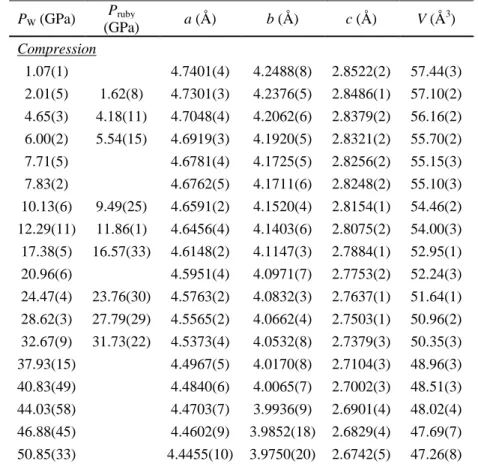
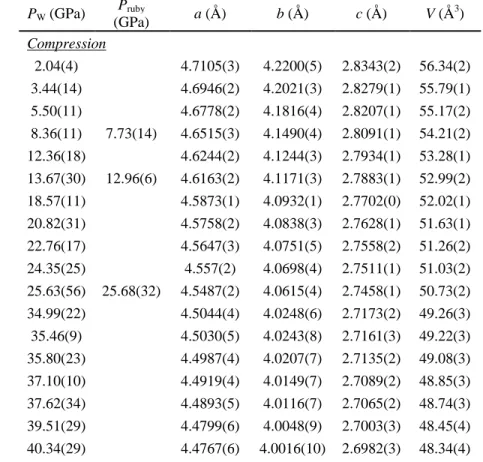
decompression process, the gas was first released followed by loosening of the screws. In 221
the DAF02 experimental run, the ambient XRD pattern of δ-Fe5 was collected after 222
decompression. The ambient XRD patterns of the additional sample, the δ-223
(Al0.807(7)57Fe0.117(4))OOH1.15(3) (Fe/(Al+Fe) = 0.127(3), identical ratio to δ-Fe12 within
224
error), were also collected at the X-ray Crystallography Facility in the Beckman Institute 225
at the California Institute of Technology, where a Mo target (λ = 0.7107 Å) was 226
employed. The single crystal XRD analysis for the δ-(Al0.807(7)57Fe0.117(4))OOH1.15(3) under
227
ambient conditions confirmed the structure of δ-AlOOH under ambient conditions (e.g.,
228
Suzuki et al. 2000) (space group as P21nm, the CIF file is in the deposit).
11
Angle dispersive powder XRD patterns were collected at the BL10XU beamline 230
(Ohishi et al. 2008). An imaging plate (Rigaku, R-AXIS IV++) was used for acquiring the 231
XRD patterns, and the exposure time was 8 min. The X-ray wavelength was 0.4141(1) Å 232
(for compression and decompression in run# DAF01), 0.4152(2) Å (compression in run# 233
DAF02) and 0.4143(1) Å (decompression in run# DAF02). One dimensional diffraction 234
profiles were fitted with a pseudo-Voigt function using the PDIndexer software (Seto et 235
al. 2010). The 110, 101, 011, 111, 210, 211, 121, 220, 310, 002, 301, and 112 reflections 236
were employed to calculate the lattice parameters. The 101, 002, 211, 121, 220, 310, 301, 237
and 112 reflections were excluded from the calculations when they overlapped with 238
helium reflections. The 110, 211, and 220 reflections of tungsten were used for pressure 239
determination (Dorogokupets and Oganov 2006). The determination method of lattice 240
constants follows the previous study on Fe-free δ-AlOOH (Sano-Furukawa et al. 2009) to 241
compare the compressional behaviors of Fe-bearing and Fe-free δ-phases. Pressure vs. 242
unit cell volume (P-V) profiles obtained from the XRD experiments were fitted using a 243
spin crossover EoS with version 2.1.0 of the MINUTI software (Sturhahn 2018). 244
245
Synchrotron Mössbauer spectroscopy experiments 246
A wide-angled piston-cylinder DAC with 300 μm-culet/370 μm-beveled anvils was 247
used to generate high pressure conditions for the SMS experiments. A piece of δ-Fe13 248
with dimensions of 40 × 50 × 20 µm was cut from a larger crystallite in the same 249
synthesis run described above. A beryllium disk pre-indented to a thickness of 38 μm was 250
used as a gasket. The diameter of the sample hole in the gasket was 165 μm for 300 μm-251
culet anvils. A mixture of 10–20 μm thick boron epoxy (amorphous boron powder:epoxy 252
12
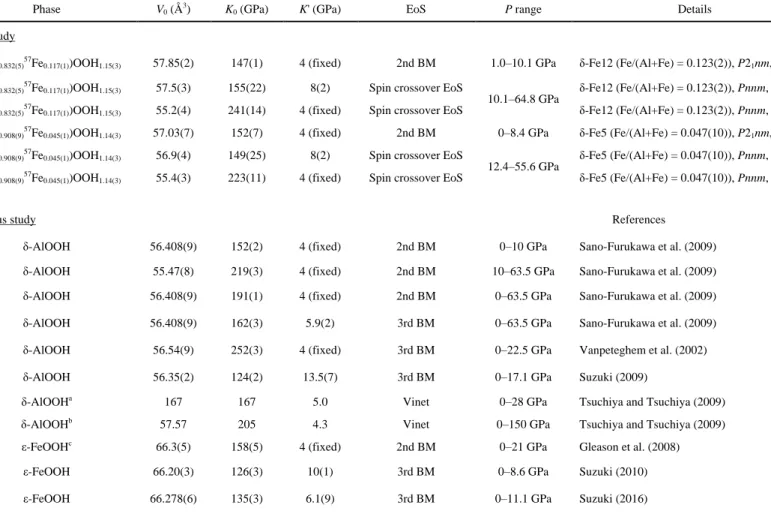
= 4:1 by weight; Lin et al. 2003) was put on the side of a beryllium gasket hole. Two 253
ruby spheres were positioned beside the sample as pressure markers (Dewaele et al. 254
2008). Compressed neon gas was loaded into the sample chamber as a pressure medium 255
at the California Institute of Technology. 256
Time-domain SMS measurements were conducted on a single crystal of δ-Fe13 at 257
Sector 3-ID-B at the Advanced Photon Source (APS). The storage ring was operated in 258
top-up mode with 24 bunches separated by 153 ns. A high-resolution monochromator 259
was tuned to the 14.4125 keV nuclear transition energy of 57Fe with a FWHM of about 1 260
meV (Toellner 2000). The beam was focused to an area of 10 by 14 μm2 using a 261
Kirkpatrick-Baez mirror system. The time spectra were measured with an avalanche 262
photodiode detector positioned about 0.5 m downstream from the sample. A 10 μm thick 263
stainless steel (SS) foil with a natural abundance of 57Fe was placed in the downstream 264
direction as a reference absorber for isomer shift measurements. At each compression 265
point, a spectrum was collected of the sample with and without the SS reference foil. The 266
isomer shift between the SS foil and α-iron metal was measured at the APS using a 267
radioactive source and found to be −0.100(3) mm/s with a corresponding FWHM (due to 268
the effect of site distribution ) of 0.445(9) mm/s (Solomatova et al. 2017). 269
Synchrotron Mössbauer spectra were fitted with version 2.1.1 of the CONUSS 270
software (Sturhahn 2000, 2016), which implements a least-square algorithm to fit iron's 271
hyperfine parameters and material properties. The spectrum of the sample and sample 272
with SS were fitted simultaneously. For a single crystal, the orientation of the electric 273
field gradient tensor of each iron site must be specified with respect to the direction and 274
polarization of the X-ray using three Euler angles (α, β and γ). The orientation of the 275
13
crystal was determined through careful analysis of the reduced χ2
and Monte Carlo 276
searches. The Euler angles of the high-spin site were calculated using the CONUSS 277
module, “kvzz” using the lattice parameters and atomic positions of δ-Fe13. The Euler 278
angles for the low-spin sites were determine through a Monte Carlo search and were 279
fixed with pressure. 280 281 RESULTS 282 283 XRD experiments 284
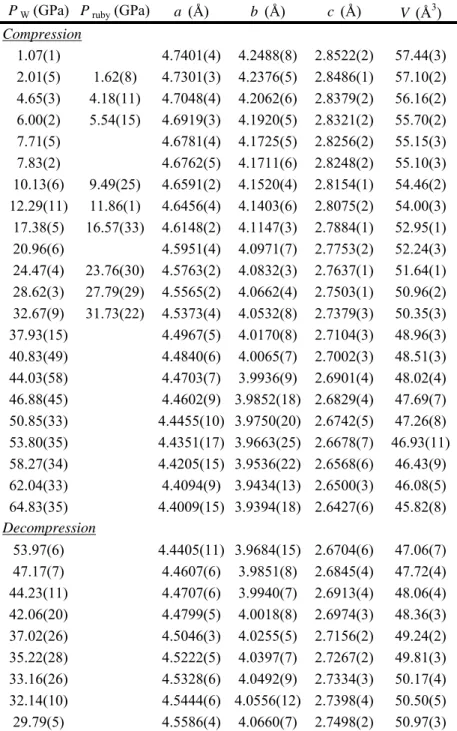
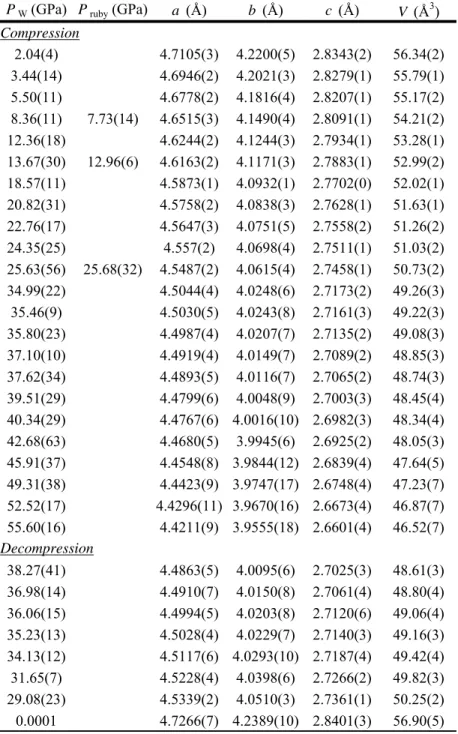
δ-Fe12 (δ-(Al0.832(5)57Fe0.117(1))OOH1.15(3), Run# DAF01) and δ-Fe5
(δ-285
(Al0.908(9)57Fe0.045(1))OOH1.14(3), Run# DAF02) were compressed to 65 and 56 GPa,
286
respectively. The representative one-dimensional XRD patterns of the samples converted 287
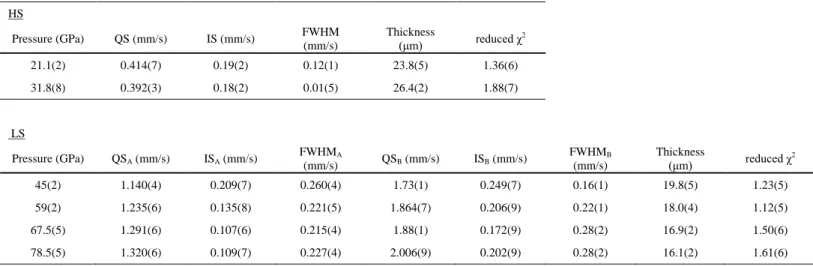
from two-dimensional patterns are shown in Figure 1. The lattice constants (a, b, and c) 288
and unit cell volumes determined from the XRD data for δ-Fe12 and δ-Fe5 are 289
summarized in Tables 1 and 2, respectively. It should be noted that the tungsten pressure 290
scale does not include the errors of EoS parameters (V0, K0, K′), and therefore the
291
experimentally determined pressures in this study might be relatively smaller than the 292
other experimental studies (e.g., Duan et al. 2018). A potential pressure error might be up 293
to ~2%, as presumed in Sano-Furukawa et al. (2009). 294
Figure 2 shows the P-V profiles of the two samples during compression and 295
decompression. The unit cell volume obtained during decompression is plotted along 296
with the compressional profiles (Fig. 2). The P-V profiles of δ-Fe12 and δ-Fe5 show that 297
both δ-(Al,Fe)OOH phases undergo multiple structural transitions over the experimental 298
pressure ranges, related to the change of the hydrogen bonds (e.g., Sano-Furukawa et al. 299
14
2008, 2009, 2018; Kuribayashi et al. 2014) and spin transition in Fe3+ (Gleason et al. 300
2013; Otte et al. 2009). The associated characteristics are: 301
(1) asymmetric (ordered) hydrogen bonds + high-spin state (HOC-I-HS, space group 302
P21nm)
303
(2) symmetric hydrogen bonds + high-spin state (HS, Pnnm) 304
(2a) symmetric (disordered) hydrogen bonds + high-spin state (HOC-III-HS, Pnnm) 305
(2b) symmetric (proton-centered) hydrogen bonds + high-spin state (HC-HS, Pnnm) 306
(3) symmetric hydrogen bonds + low-spin state (LS, Pnnm). 307
It should be noted that the HOC-III-HS (2a) and HC-HS (2b) states cannot be 308
distinguished in the XRD data, as discussed in the previous studies regarding pure δ-309
AlOOH. This is because the former structure (2a) has two crystallographically equivalent 310
hydrogen sites characterized by proton tunneling and further transition to (2b) does not 311
involve a detectable change in compressibility. For example, the recent ND experiment 312
on δ-AlOOH provided direct evidence that the order–disorder transition of the hydrogen 313
bond and the symmetrization occur at different pressure conditions (9.0 and 18.1 GPa, 314
respectively), and argued the importance of the hydrogen bond disorder as a precursor of 315
the symmetrization in understanding the physical properties of minerals under high 316
pressures (Sano-Furukawa et al. 2018). Therefore, the possible transition from HOC-III-317
HS to HC-HS before the onset of HS–LS transition is not evaluated in this study. 318
The P21nm(HOC-I)-HS (1) and Pnnm(HOC-III)-HS (2a) states are separated by the
319
subtle kinks in the P-V profiles (Fig. 2) and the inversion of axial compressibility at ~10 320
GPa (Fig. 3). Pnnm-HS (2) and Pnnm-LS (3) are distinguished by a volume collapse at 321
~32–40 GPa (Fig. 2). Profiles of normalized pressure (F) against Eulerian strain (f) also 322
15
demonstrate changes in compressibility that occur through the symmetrization of 323
hydrogen bonds and spin crossover (Fig. 4). 324
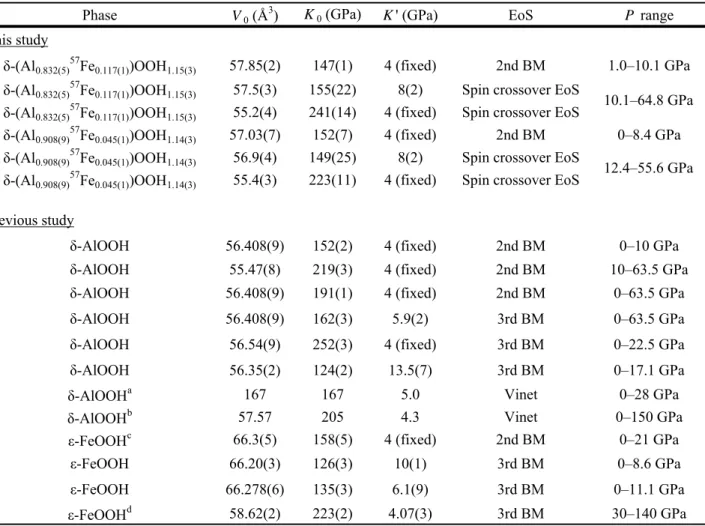
A second-order Birch-Murnaghan (BM) EoS was fitted to the P-V profiles of δ-Fe12 325
and δ-Fe5 with the P21nm structure, while a third-order Birch-Murnaghan spin crossover
326
EoS (hereafter, spin crossover EoS) was fitted to the P-V profiles of δ-Fe12 and δ-Fe5 327
with the Pnnm structure using the MINUTI software (Sturhahn 2018) (Fig. 5 and Table 328
3). We consider the elastic and spin state (i.e., 3d electrons of the Fe atoms) contributions 329
to the free energy of the sample. For the elastic contribution, we adopt an expression 330
corresponding to the commonly-used third-order Birch-Murnaghan EoS (3rd-order BM 331
EoS) 332
Felastic = 92VT0KT0 f 2{1+(KT0' − 4)f }, (1)
333
where the Eulerian strain is given by f = {(V0/V)2/3 − 1}/2, and V0, KT0, and K′T0 are the
334
unit cell volume, isothermal bulk modulus, and the pressure derivative of KT0 at room
335
temperature, respectively. The Eq. 1 with a fixed K′T0 of 4 is called as 2nd-order BM EoS.
336
For the spin contribution, we assume a set of spin states described by the number of 337
unpaired electron, volume-dependent energy, and orbital degeneracy. For a given
338
pressure P, the volume at room temperature is calculated by solving the spin crossover 339
EoS 340
P(V,300 K) = Pelastic(V, 300 K) + Pspin(V, 300K). (2)
341
For more details of the spin crossover EoS, we refer the reader to Chen et al. (2012) and 342
Sturhahn (2018). 343
A spin crossover EoS reproduces the behavior of δ-Fe12 and δ-Fe5 in the crossover 344
region (Fig. 5 and Table 3). The pressure condition where the unit cell volume changes 345
16
due to the HS–LS transition is 50% complete is determined for δ-Fe12 at 36.1 ± 0.7 GPa, 346
which is defined as the spin transition pressure. Although the volume collapse of δ-Fe5 is 347
very small due to the low Fe3+ content in the sample, it was nonetheless possible to 348
determine the spin transition pressure of 34.9 ± 1.1 GPa. The values of F were found to 349
decrease with increasing f through the spin crossover, which is seen clearly in both the 350
Fe-rich δ-Fe12 and the Fe-poor δ-Fe5 samples (Fig. 4). The isothermal bulk modulus (KT)
351
and bulk sound velocity (vФ) of δ-Fe12 and δ-Fe5 also decrease in the spin crossover
352 (Fig. 6). 353 354 SMS experiments 355
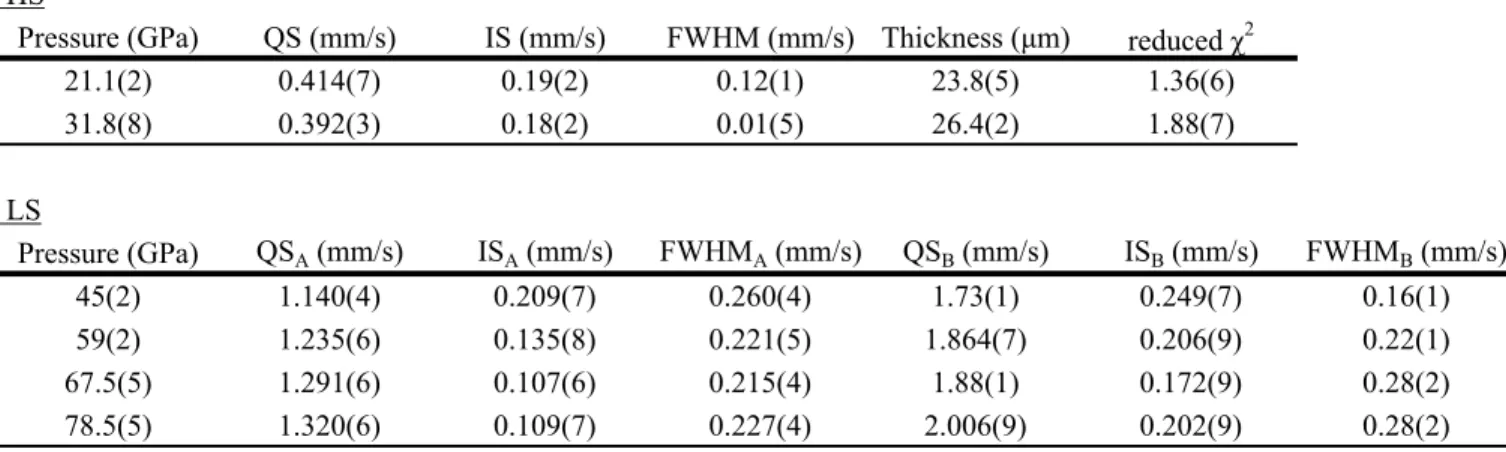
Synchrotron Mössbauer spectra of δ-Fe13 were collected at 21.1(2), 31.8(8), 45(2), 356
59(2), 67.5(5), and 78.6(5) GPa (Fig. 7). The results of SMS experiments demonstrate 357
that the HS–LS transition in δ-Fe13 is completed by 45 GPa (Fig. 8), which is similar to 358
the pressure conditions at which volume collapse is completed in the P-V profiles of δ-359
Fe12 and δ-Fe5. At 21.1 and 31.8 GPa, one high-spin Fe3+-like site was required to fit the 360
spectra with a quadrupole splitting value of ~0.4 mm/s and isomer shift of 0.2 mm/s, thus 361
we find that 100% of the iron in this phase is Fe3+ (see Figs. 7 and 8, and Table 4, which 362
include reported uncertainties). 363
We attempted to fit the spectra above 32 GPa with one low-spin site, but the best 364
model with one low-spin site resulted in a reduced χ2 of 5. Although δ-Fe13 is 365
characterized by one crystallographic Fe site, the Mössbauer spectra above 32 GPa 366
require two distinct nuclear sites. It is possible that the crystal quality decreased and/or 367
next nearest neighbor interactions explain the additional Mössbauer-site. At pressures of 368
17
45 GPa and higher, the two low-spin Fe3+-like sites are characterized as follows: one with 369
a quadrupole splitting value of ~1.14–1.32 mm/s and a second site with a quadrupole 370
splitting value of 1.73–2.01 mm/s with weight fractions of 67% and 33%, respectively 371
(Figs. 7 and 8, and Table 4). The isomer shifts with values 0.107–0.249 mm/s follow a 372
negative trend with pressure indicating an increase of the s-electron density at the iron 373
sites that is probably caused by volume decrease. 374
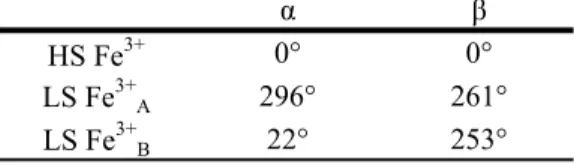
For all evaluations of the time spectra, we assumed axial symmetry of the electric field 375
gradient tensor at the iron sites. Therefore, only two Euler angles, α and β, need to be 376
considered. For the HS site, these Euler angles were calculated from the lattice 377
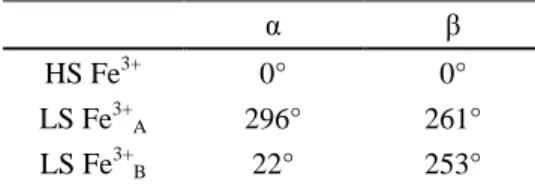
parameters and atomic positions of this phase (Table 5). For the LS sites α and β were 378
determined from a Monte Carlo search resulting in values of 296 and 261 for one of the 379
LS sites and 22 and 253 for the other site, respectively. 380
381
DISCUSSION 382
Subtle kinks in the P-V profiles for δ-Fe12 and δ-Fe5 are observed at approximately 10 383
GPa (Fig. 2), which may be a result of a structural transition from ordered (P21
nm(HOC-384
I)-HS) to disordered hydrogen bonds (Pnnm(HOC-III)-HS), as observed in XRD and ND 385
measurements on pure δ-AlOOH (Sano-Furukawa et al. 2009, 2018; Kuribayashi et al. 386
2014). The a/c and b/c values decrease rapidly with increasing pressure below ~10 GPa, 387
whereas the a/b values increase up to ~10 GPa. The trend in the axial compressibility is 388
reversed above 10 GPa such that the a and b axes are less compressible than the c axis 389
(Fig. 3). Our finding that the a and b axes are less compressible than the c-axis above 10 390
GPa are corroborated by computational studies for pure δ-AlOOH showing that the 391
18
hydrogen bonds in the Pnnm structure are stronger than those in the P21nm phase
392
(Cortona 2017; Tsuchiya and Tsuchiya 2009; Tsuchiya et al. 2002; Kang et al. 2017; 393
Pillai et al. 2018). Such an inversion of the compressibility is also observed in δ-AlOOH 394
at 8–10 GPa (Sano-Furukawa et al. 2009, 2018; Kuribayashi et al. 2014). The hydrogen 395
bonds in the Pnnm structures are almost parallel to the 〈120〉 direction, so the effects of 396
these hydrogen bonds on structures and physical properties are stronger along the b axis 397
than the a axis (Kuribayashi et al. 2014), while the compressibility of the c axis is 398
unlikely to be modified. The pressure conditions of inversions of compressibility in δ-399
Fe12 and δ-Fe5 are very close to that of pure δ-AlOOH (Sano-Furukawa et al. 2009, 400
2018; Kuribayashi et al. 2014). Our data demonstrates that Fe incorporation into the δ-401
phase is insensitive to the pressure condition of P21nm (ordered-hydrogen bond)–Pnnm
402
(disordered hydrogen bond) transition. 403
The SMS experiments show that octahedrally-coordinated Fe3+ in δ-Fe13 undergoes a 404
HS–LS transition at the pressure range of 32–45 GPa. Collapse in unit cell volume is also 405
observed in the δ-Fe12 and δ-Fe5 samples within this pressure range, likely as a result of 406
the Fe3+ spin transition. The spin-crossover pressures estimated from the P-V profiles of 407
δ-Fe12 and δ-Fe5 are within the pressure range of ~32–40 GPa, which is ~10 GPa lower 408
than that of ε-FeOOH examined with XRD experiments (46–54 GPa, Gleason et al. 409
2013), suggesting that the LS state would be stabilized at lower pressures with decreasing 410
FeOOH concentration in the solid solution. The positive correlation between Fe content 411
and spin-transition pressure has also been reported for the MgO (periclase)–FeO (wüstite) 412
solid solution. The spin-transition pressure of Fe2+ in (Mg,Fe)O is reduced with 413
decreasing FeO content (e.g., Lin et al. 2005; Fei et al. 2007; Solomatova et al. 2016). 414
19
Our results demonstrate that this relationship also applies to the δ-AlOOH–ε-FeOOH 415
solid solution. 416
The spin transition in Fe3+ is also observed in the new hexagonal aluminous phase 417
(NAL phase). NAL phase has the chemical formula of AB2C6O12 (A = Na+, K+, Ca2+; B =
418
Mg2+, Fe2+, Fe3+; C = Al3+, Si4+, Fe3+) with the space group of P63/m (Gasparik et al.
419
2000; Miura et al. 2000; Miyajima et al. 2001), and is considered to exist in a basaltic 420
layer of the slab subducted to the upper region of the lower mantle (e.g., Irifune and 421
Ringwood 1993). The recent experimental study under room temperature reported that 422
the Fe-bearing (Na0.71Mg2.05 Fe2+0.09Al4.62Fe3+0.17Si1.16O12) NAL phase showed 1.0%
423
volume reduction at 33–47GPa associated with the Fe spin transition (Wu et al. 2016). In 424
the NAL phase, only Fe3+ in the octahedral C site undergoes the spin transition at the 425
pressure conditions of the upper region of lower mantle, while Fe2+ and Fe3+ in the 426
trigonal-prismatic B site maintain high-spin states up to at least 80 GPa (Wu et al. 2016; 427
Hsu 2017). Therefore, only Fe3+ in the octahedral site contributes to the spin transition in 428
NAL phase at that pressure range, which could explain why the width of the spin 429
crossover where the softening occurs is slightly narrower in δ-(Al,Fe)OOH samples (Fig. 430
9). 431
It should be noted that a HOC-III–HC transition without an observable change in the 432
P-V compression trend may occur in the δ-(Al,Fe)OOH samples before or concurrently
433
with the spin crossover, because the HOC-III–HC transition pressure of δ-AlOOH is ~20 434
GPa (Sano-Furukawa et al. 2018) and for ε-FeOOH it ranges from ~10 to ~43 GPa 435
(Thompson et al. 2017; Gleason et al. 2013), respectively. Further studies are required to 436
20
investigate the relationship between hydrogen symmetrization and spin state in the δ-437
AlOOH–ε-FeOOH solid solution. 438
439
IMPLICATIONS 440
In hydrous rock systems, δ-AlOOH may form a solid solution with isostructural 441
MgSiO4H2 Phase H (Suzuki et al. 2000; Ohtani et al. 2001; Nishi et al. 2014, 2015; Ohira
442
et al. 2014; Walter et al. 2015; Panero and Caracas 2017; Liu et al. 2019) and ε-FeOOH 443
components (Nishi et al. 2015, 2017; Kawazoe et al. 2017; Liu et al. 2019). Therefore, 444
the incorporation of MgSi- and Fe-endmember components into the δ-phase would need 445
to be considered in interpretations of lower mantle seismic observations. However, Nishi 446
et al. (2018) found that the incorporation of a Phase H component into the δ-phase has 447
little effect on the density of the δ-phase because the differences of volume and mole 448
weight between δ-AlOOH and MgSiO4H2 Phase H are only 1.0–1.2% and 1.3% at the
449
pressure condition from top- to mid-lower mantle. Therefore, the physical properties of 450
binary δ-AlOOH–ε-FeOOH solid solution, investigated in this study, are important to 451
understand the behavior of ternary δ-AlOOH–ε-FeOOH–phase H solid solution under 452
lower mantle conditions. 453
Figure 9 shows the isothermal bulk modulus, density, bulk sound velocity, and the 454
ratio of density to bulk sound velocity for δ-Fe12, δ-Fe5, several hydrous phases, and Fe-455
bearing NAL phase at pressures between the top- and mid-lower mantle. Our results 456
show that the isothermal bulk modulus of low-spin Fe12 is larger than those of δ-457
AlOOH, MgSiO4H2 Phase H, and ε-FeOOH, and that of low-spin δ-Fe5 is comparable to
458
that reported for δ-AlOOH and ε-FeOOH, except for the pressure conditions of the spin 459
21
crossover (Fig. 9a). DFT calculations suggest that the bulk modulus of low-spin ε-460
FeOOH is 4–8 % higher than the bulk modulus of δ-AlOOH at pressures of the entire 461
lower mantle and 0 K (Thompson et al. 2017). Interestingly, although the bulk modulus 462
trends of Fe12 and Fe5 overlap within error (see Fig. 6), the values for the Fe-rich δ-463
Fe12 sample are systematically 2–3 % higher than those of the Fe-poor δ-Fe5 sample 464
above 45 GPa in spite of an only ~7 at% difference in Fe content. Therefore, our results 465
suggest that the bulk modulus of low spin δ-(Al,Fe)OOH may be sensitive to smaller 466
amounts of Fe incorporation than the computational study predicted (Thompson et al. 467
2017). This sensitive relationship between the bulk modulus and Fe content δ-468
(Al,Fe)OOH may influence in understanding the origin of seismic anomalies in the lower 469
mantle. The ρ, vΦ, and their ratio (ρ/vΦ) of pure δ-AlOOH were calculated along a mantle
470
geotherm (Brown and Shankland, 1981) to be 11–12% lower, 5–8% higher, and 16–18% 471
lower than those of PREM, respectively, implying that the low ρ/vΦ ratio of pure
δ-472
AlOOH can help identify its potential presence in the lower mantle (Duan et al. 2018). 473
The incorporation of Fe into δ-(Al,Fe)OOH decreases the gaps of these properties 474
between δ-phase and PREM, due to the relatively large mass of Fe. Nevertheless, δ-Fe12 475
and δ-Fe5 samples still exhibit higher vΦ and lower ρ and ρ/vΦ ratio, compared to PREM.
476
Therefore, a low ρ/vΦ anomaly caused by the presence of an iron-bearing δ-phase likely
477
occurs in the lower mantle, with the exception of the spin crossover region. 478
If subducting materials including the hydrous solid solution are transported to the 479
lower mantle, this hydrous phase might accumulate in deep lower mantle regions over 480
geologic time. Continuous transport of subducted slab material to the deep lower mantle 481
has been supported by geophysical simulations and geochemical studies (e.g., Tackley 482
22
2011; Bower et al. 2011; van der Meer et al. 2010). One of the possible contributions of 483
the hydrous δ-AlOOH–ε-FeOOH–phase H solid solution is a high-vΦ anomaly in the
484
lower mantle. For example, the approximately 0.3% vΦ increase is observed at the
485
boundary regions of large low shear velocity provinces (Masters et al. 2000). Those 486
provinces are located at a depth of ~2,000–2,890 km beneath the Pacific Ocean and the 487
Atlantic Ocean–the western and southern part of the African continent, and are adjacent 488
to the path of a subducting slab. If we apply the thermal parameters of δ-AlOOH reported 489
by Duan et al. (2018) to δ-Fe5 or δ-Fe12, this anomaly can be explained by the 490
accumulation of ~6–8 wt% δ-Fe5 or δ-Fe12, which is ~9% lower than the proportion of 491
hydrous δ-AlOOH–ε-FeOOH–phase H solid solution (δ-(Mg0.11Fe0.03Si0.2Al0.63)OOH,
492
termed as “Al-rich Phase H” in Liu et al. 2019) formed in the oceanic basalt + 3.5 wt.% 493
H2O system (Liu et al. 2019). The accumulation of ~6–8 wt% δ-Fe5 or δ-Fe12 is
494
equivalent to the presence of only ~1 wt% H2O.
495
The low ρ/vΦ character of δ-(Al,Fe)OOH becomes inverted to a high ρ/vΦ within the
496
spin crossover due to the softening of the bulk modulus (Figs. 6 and 9). Although the spin 497
transition of Fe3+ in the octahedral site is also observed in the Fe-bearing NAL phase, the 498
transition pressure is lower and the width of spin crossover is slightly narrower in the δ-499
(Al,Fe)OOH samples than the Fe-bearing NAL phase (Wu et al. 2016). The spin 500
crossover and resultant softening are influenced by temperature and valance of Fe. For 501
example, the onset pressure for the LS state in (Mg0.75Fe0.25)O ferropericlase increases
502
from ∼50 GPa at 300 K to 65 GPa at 1200 K, with an appreciable increase in the width of 503
the spin crossover region (e.g., Mao et al. 2011). On the other hand, a computational 504
study by Hsu (2017) showed that the spin transition pressure of Fe3+ in the octahedral site 505
23
of the NAL phase (~40 GPa) remains mostly invariant to temperature and the width 506
moderately increases with temperature. This would imply that for δ-(Al,Fe)OOH at 1200 507
K, the estimated temperature of a subducted slab at the top of the lower mantle (Ricard et 508
al. 2005; Kirby et al. 1996), the spin transition pressure will likely be unchanged from 509
that measured at 300 K and the softening of bulk modulus remains appreciable. The spin 510
transition pressure and the width of spin crossover are slightly lower and narrower in the 511
δ-(Al,Fe)OOH samples than the Fe-bearing NAL phase (Fig. 9). Therefore, the high ρ/vΦ
512
of δ-(Al,Fe)OOH in the spin crossover region would be observable at the pressure 513
conditions of the uppermost lower mantle, especially under relatively cooler 514
temperatures, such as those calculated for a subducted slab. Seismological studies have 515
reported the laterally heterogeneous ρ and vΦ in the upper region of the lower mantle
516
(Masters et al. 2000; Trampert et al. 2004), and the presence of δ-(Al,Fe)OOH may 517
explain these anomalies. 518
In this section, we have focused on drawing comparisons of our results for the δ-519
(Al,Fe)OOH solid solution across the spin transition, with those of endmember phases (δ-520
AlOOH, ε-FeOOH, and MgSiO4H2 Phase H), the Fe-bearing NAL phase, and PREM. We
521
have also suggested that δ-(Al,Fe)OOH could cause low ρ/vΦ anomaly in the lower
522
mantle, except for the conditions where the spin crossover occurs. Specifically, δ-523
(Al,Fe)OOH has high ρ/vΦ ratio due to the spin crossover, which occurs under uppermost
524
lower mantle conditions. These anomalies in geophysical properties of δ-(Al,Fe)OOH 525
suggest that the presence of δ-(Al,Fe)OOH could be detectable and provide new insight 526
for understanding the heterogeneity in the lower mantle. 527
24
ACKNOWLEDGMENTS 529
530
We thank Y. Ito for his help with polishing or the EPMA-analyzing for the crystals 531
used in this work. We also thank R. Njul for his help with polishing for a part of the 532
samples. We are grateful to the editor D. Hummer and two anonymous reviewers for 533
comments that helped to improve the manuscript. This work was supported by a Grant-534
in-Aid for Scientific Research from the Ministry of Education, Culture, Science, Sport 535
and Technology of the Japanese Government to I.O. (JSPS KAKENHI Grant Number: 536
JP16J04690), to E.O. (Number: JP15H05748), to S.K. (Number: 26247089, 15H05831, 537
and 16K13902), to A.S. (Number: JP15H05828 and JP19H01985). This work and I.O. 538
were supported by the International Research and Training Group “Deep Earth Volatile 539
Cycles” funded by the German Science Foundation (grant number: GRK 2156/1), the 540
JSPS Japanese-German Graduate Externship, and the International Joint Graduate 541
Program in Earth and Environmental Science (GP-EES), Tohoku University. This work 542
was also partially supported by a grant from the W.M. Keck Institute for Space Studies 543
and the National Science Foundation (NSF-CSEDI-EAR-1600956) awarded to J.M.J. 544
N.V.S. was partly funded by the European Research Council (ERC) under the European 545
Union’s Horizon 2020 research and innovation program (grant agreement number 546
681818 – IMPACT). XRD measurements were performed at the BL10XU, SPring-8, 547
Japan (proposal number: 2017A1650 to I.O., 2017A1251 to S.K., 2017A1673 to F.M., 548
and 2015B0104, 2016A0104, and 2017B1514 to E.O.). SMS experiments were 549
conducted at 3-ID-B, Advanced Photon Source, the United States, which is partially 550
supported by COMPRES. 551
25 553
REFERENCES CITED 554
555
Abe, R., Shibazaki, Y., Ozawa, S., Ohira, I., Tobe, H., and Suzuki, A. (2018) In situ X-556
ray diffraction studies of hydrous aluminosilicate at high pressure and 557
temperature. Journal of Mineralogical and Petrological Sciences, 113, 106–111. 558
Bell, D.R., and Rossman, G.R. (1992) Water in Earth's mantle: the role of nominally 559
anhydrous minerals. Science, 255, 1391–1397. 560
Bindi, L., Nishi, M., Tsuchiya, J., and Irifune, T. (2014) Crystal chemistry of dense 561
hydrous magnesium silicates: The structure of Phase H, MgSiH2O4 synthesized at
562
45 GPa and 1000 °C. American Mineralogist, 99, 1802–1805. 563
Bower, D.J., Gurnis, M., and Seton, M. (2011) Lower mantle structure from 564
paleogeographically constrained dynamic Earth models. Geochemistry 565
Geophysics Geosystems, 14, 44–63. 566
Bronstein, Y., Depondt, P., and Finocchi F. (2017) Thermal and nuclear quantum effects 567
in the hydrogen bond dynamical symmetrization phase transition of δ-AlOOH. 568
European Journal of Mineralogy, 29, 385–395. 569
Brown, J.M., and Shankland, T.J. (1981) Thermodynamic parameters in the Earth as 570
determined from seismic profiles. Geophysical Journal of the Royal Astronomical 571
Society, 66, 579–596. 572
Cedillo, A., Torrent, M., and Cortona, P. (2016) Stability of the different AlOOH phases 573
under pressure. Journal of Physics: Condensed Matter, 28, 185401. 574
Chen, B., Jackson, J.M., Sturhahn, W., Zhang, D., Zhao, J., Wicks, J.K., and Murphy, 575
C.A. (2012) Spin crossover equation of state and sound velocities of 576
26
(Mg0.65Fe0.35)O ferropericlase to 140 GPa. Journal of Geophysical Research, 117,
577
B08208. 578
Cortona, P. (2017) Hydrogen bond symmetrization and elastic constants under pressure 579
of δ-AlOOH. Journal of Physics: Condensed Matter, 29, 325505. 580
Dewaele A., Torrent, M., Loubeyre, P., and Mezouar, M. (2008) Compression curves of 581
transition metals in the Mbar range: Experiments and projector augmented-wave 582
calculations. Physical Review B, 78, 104102. 583
Dorogokupets, P.I., and Oganov, A.R. (2006) Equations of state of Al, Au, Cu, Pt, Ta, 584
and W and revised ruby pressure scale. Doklady Earth Sciences, 410, 1091–1095. 585
Duan, Y., Sun, N., Wang, S., Li, X., Guo, X., Ni, H., Prakapenka, V.B., and Mao, Z. 586
(2018) Phase stability and thermal equation of state of δ-AlOOH: Implication for 587
water transportation to the Deep Lower Mantle. Earth and Planetary Science 588
Letters, 494, 92–98. 589
Dziewonski, A.M., and Anderson, D. L. (1981) Preliminary reference Earth model. 590
Physics of the Earth and Planetary Interiors, 25, 297–356. 591
Fei, Y., Zhang, L., Corgne, A., Watson, H., Ricolleau, A., Meng, Y., and Prakapenka, V. 592
(2007) Spin transition and equations of state of (Mg, Fe)O solid solutions. 593
Geophysical Research Letters, 34, L17307. 594
Fukuyama, K., Ohtani, E., Shibazaki, Y., Kagi, H., and Suzuki, A. (2017) Stability field 595
of phase Egg, AlSiO3OH at high pressure and high temperature: possible water
596
reservoir in mantle transition zone. Journal of Mineralogical and Petrological 597
Sciences, 112, 31–35. 598
27
Gasparik, T., Tripathi, A., and J.B. Parise. (2000) Structure of a new Al-rich phase, [K, 599
Na]0.9[Mg, Fe]2[Mg, Fe, Al, Si]6O12, synthesized at 24 GPa. American
600
Mineralogist, 85, 613–618. 601
Gleason, A.E., Quiroga, C.E., Suzuki, A., Pentcheva, R., and Mao, W.L. (2013) 602
Symmetrization driven spin transition in ε-FeOOH at high pressure. Earth and 603
Planetary Science Letters, 379, 49–55. 604
Hsu, H. (2017) First-principles study of iron spin crossover in the new hexagonal 605
aluminous phase. Physical Review B, 95, 020406. 606
Irifune, T. and Ringwood, A.E. (1993) Phase transformations in subducted oceanic crust 607
and buoyancy relationships at depths of 600–800 km in the mantle. Earth and 608
Planetary Science Letters, 117, 101–110. 609
Kagi, H., Ushijima, D., Sano-Furukawa, A., Komatsu, K., Iizuka, R., Nagai, T., and 610
Nakano, S. (2010) Infrared absorption spectra of δ-AlOOH and its deuteride at 611
high pressure and implication to pressure response of the hydrogen bonds. Journal 612
of Physics: Conference Series, 215, 012052. 613
Kaminsky, F.V. (2017) The Earth’s Lower Mantle, Composition and Structure, 331 p. 614
Springer International Publishing AG, Switzerland. 615
Kang, D., Feng, Y.-X., Yuan, Y., Ye, Q.-J., Zhu, F., Huo, H.-Y., Li, X.-Z., and Wu, X. 616
(2017) Hydrogen-bond symmetrization of δ-AlOOH. Chinese Physics Letters, 34, 617
108301. 618
Kawazoe, T., Ohira, I., Ishii, T., Boffa Ballaran, T., McCammon, C., Suzuki, A., and 619
Ohtani, E. (2017), Single crystal synthesis of δ-(Al,Fe)OOH. American 620
Mineralogist, 102, 1953–1956. 621
28
Kirby, S.H., Stein, S., Okal, E.A., and Rubie, D.C. (1996) Metastable mantle phase 622
transformations and deep earthquakes in subducting oceanic lithosphere. Reviews 623
of Geophysics, 34, 261–306. 624
Komatsu, K., Kuribayashi, T., Sano, A., Ohtani, E., and Kudoh, Y. (2006) 625
Redetermination of the high-pressure modification of AlOOH from single-crystal 626
synchrotron data. Acta Crystallographica Section E, 62, i216–218. 627
Kuribayashi, T., Sano-Furukawa, A., and Nagase, T. (2014) Observation of pressure-628
induced phase transition of δ-AlOOH by using single‑crystal synchrotron X-ray 629
diffraction method. Physics and Chemistry of Minerals, 41, 303–312. 630
Li, S., Ahuja, R., and Johansson, B. (2006) The elastic and optical properties of the high-631
pressure hydrous phase δ-AlOOH. Solid State Communications, 137, 101–106. 632
Lin, J.F., Shu, J., Mao, H.K., Hemley, R.J., and Shen, G. (2003) Amorphous boron gasket 633
in diamond anvil cell research. Review of Scientific Instruments, 74, 4732–4736. 634
Lin, J.F., Struzhkin, V.V., Jacobsen, S.D., Hu, M.Y., Chow, P., Kung, J., Liu, H., Mao, 635
H.-k., and Hemley, R. J. (2005) Spin transition of iron in magnesiowüstite in the 636
Earth’s lower mantle. Nature, 436, 377–380. 637
Liu, X., Matsukage, K.N., Nishihara, Y., Suzuki, T., and Takahashi, E. (2019) Stability of 638
the hydrous phases of Al-rich Phase D and Al-rich Phase H in deep subducted 639
oceanic crust. American Mineralogist, 104, 64–72. 640
Mao, Z., Lin, J.-F., Liu, J., and Prakapenka, V.B. (2011) Thermal equation of state of 641
lower-mantle ferropericlase across the spin crossover. Geophysical Research 642
Letters, 38, L23308. 643
29
Mashino, I., Murakami, M., and Ohtani, E. (2016) Sound velocities of δ-AlOOH up to 644
core-mantle boundary pressures with implications for the seismic anomalies in the 645
deep mantle. Journal of Geophysical Research: Solid Earth, 121, 595–609. 646
Masters, G., Laske, G., Bolton, H., and Dziewonski, A. (2000) The relative behavior of 647
shear velocity, bulk sound speed, and compressional velocity in the mantle: 648
Implications for chemical and thermal structure. In S.-I. Karato, A. Forte, R. 649
Liebermann, G. Masters, and L. Stixrude, Eds., Earth’s deep interior: Mineral 650
physics and tomography from the atomic to the global scale, Geophysical 651
Monograph 117, p. 63–87. the American Geophysical Union, U.S.A 652
Miura, H., Hamada, Y., Suzuki, T., Akaogi, M., Miyajima, N., and Fujino, K. (2000) 653
Crystal structure of CaMg2Al6O12, a new Al-rich high pressure form. American
654
Mineralogist, 85, 1799–1803. 655
Miyajima, N., Yagi, T., Hirose, K., Kondo, T., Fujino, K., and Miura, H. (2001) Potential 656
host phase of aluminum and potassium in the Earth’s lower mantle. American 657
Mineralogist, 86, 740–746. 658
Nishi, M., Irifune, T., Tsuchiya, J., Tange, Y., Nishihara, Y., Fujino, K., Higo, Y. (2014) 659
Stability of hydrous silicate at high pressures and water transport to the deep 660
lower mantle. Nature Geoscience, 7, 224–227. 661
Nishi, M., Irifune, T., Gréaux, S., Tange, Y., Higo, Y. (2015) Phase transitions of 662
serpentine in the lower mantle. Physics of the Earth and Planetary Interiors, 245, 663
52–58. 664
Nishi, M., Kuwayama, Y., Tsuchiya, J., and Tsuchiya, T. (2017) The pyrite-type high-665
pressure form of FeOOH. Nature, 547, 205–208. 666
30
Nishi, M., Tsuchiya, J., Arimoto, T., Kakizawa, S., Kunimoto, T., Tange, Y., Higo, Y., 667
Irifune, T. (2018) Thermal equation of state of MgSiO4H2 phase H determined by
668
in situ X-ray diffraction and a multianvil apparatus. Physics and Chemistry of 669
Minerals, 45, 995–1001. 670
Nishihara, Y., and Matsukage, K.N. (2016) Iron-titanium oxyhydroxides as water carriers 671
in the Earth’s deep mantle. American Mineralogist, 101, 919–927. 672
Ohira, I., Ohtani, E., Sakai, T., Miyahara, M., Ohishi, Y., Hirao, N., and Nishijima, M. 673
(2014) Stability of a hydrous δ-phase, AlOOH-MgSiO2(OH)2, and a mechanism
674
for water transport into the base of lower mantle. Earth and Planetary Science 675
Letters, 401, 12–17. 676
Ohishi, Y., Hirao, N., Sata, N., Hirose, K., and Takata, M. (2008) Highly intense 677
monochromatic X-ray diffraction facility for high-pressure research at SPring-8. 678
High Pressure Research, 28, 163–173. 679
Ohtani, E. (2005) Water in the mantle. Elements, 1, 25–30. 680
Ohtani, E. (2015) Hydrous minerals and the storage of water in the deep mantle. 681
Chemical Geology, 418, 6–15. 682
Ohtani, E., Amaike, Y., Kamada, S., Ohira, I., and Mashino, I. (2016) Stability of 683
hydrous minerals and water reservoirs in the deep Earth interior. In H. Terasaki, 684
and R. A. Fischer, Eds., Deep Earth: Physics and chemistry of the lower mantle 685
and core, Geophysical Monograph 217, p. 265–275. the American Geophysical 686
Union, U.S.A. 687
31
Ohtani, E., Litasov, K., Suzuki, A., and Kondo, T. (2001) Stability field of new hydrous 688
phase, δ-AIOOH, with implications for water transport into the deep mantle. 689
Geophysical Research Letters, 28, 3991–3994. 690
Okamoto, K., and Maruyama, S. (2004) The Eclogite–Garnetite transformation in the 691
MORB + H2O system. Physics of the Earth and Planetary Interiors, 146, 283–296.
692
Otte, K., Pentcheva, R., Schmahl, W.W., and Rustad, J.R. (2009) Pressure-induced 693
structural and electronic transitions in FeOOH from first principles. Physical 694
Review B, 80, 205116. 695
Pamato, M.G., Myhill, R., Boffa Ballaran, T., Frost, D.J., Heidelbach, F., and Miyajima, 696
N. (2015) Lower-mantle water reservoir implied by the extreme stability of a 697
hydrous aluminosilicate. Nature Geoscience, 8, 75–79. 698
Panero, W.R., and Caracas, R. (2017) Stability of phase H in the MgSiO4H2–AlOOH–
699
SiO2 system. Earth and Planetary Science Letters, 463, 171–177.
700
Panero, W.R., and Stixrude, L.P. (2004) Hydrogen incorporation in stishovite at high 701
pressure and symmetric hydrogen bonding in δ-AlOOH. Earth and Planetary 702
Science Letters, 221, 421–431. 703
Pearson, D.G., Brenker, F.E., Nestola, F., McNeill, J., Nasdala, L., Hutchison, M.T., 704
Matveev, S., Mather, K., Silversmit, G., Schmitz, S., Vekemans, B., and Vincze, 705
L. (2014) Hydrous mantle transition zone indicated by ringwoodite included 706
within diamond. Nature, 507, 221–224. 707
Pernet, M., Joubert, J.C., and Berthet-Colominas, C. (1975) Etude par diffraction 708
neutronique de la forme haute pression de FeOOH. Solid State Communications, 709
17, 1505–1510. 710
32
Pillai, S.B., Jha, P.K., Padmalal, A., Maurya, D.M., and Chamyal, L.S. (2018) First 711
principles study of hydrogen bond symmetrization in δ-AlOOH. Journal of 712
Applied Physics, 123, 115901. 713
Ricard, Y., Mattern, E., and Matas, J. (2005) Synthetic tomographic images of slabs from 714
mineral physics. In R. D. Van Der Hilst, J. D. Bass, J. Matas, and J. Trampert, 715
Eds., Earth’s Deep Mantle: Structure, Composition, and Evolution, Geophysical 716
Monograph 160, p. 283–300. the American Geophysical Union, U.S.A 717
Sano, A., Ohtani, E., Kubo, T., and Funakoshi, K-i. (2004) In situ X-ray observation of 718
decomposition of hydrous aluminumsilicate AlSiO3OH and aluminum oxide
719
hydroxide d-AlOOH at high pressure and temperature. Journal of Physics and 720
Chemistry of Solids, 65, 1547–1554. 721
Sano, A., Ohtani, E., Kondo, T., Hirao, N., Sakai, T., Sata, N., Ohishi, Y., and Kikegawa 722
T. (2008) Aluminous hydrous mineral δ-AlOOH as a carrier of hydrogen into the 723
core-mantle boundary. Geophysical Research Letters, 35, L03303. 724
Sano-Furukawa, A., Komatsu, K., Vanpeteghem, C.B., and Ohtani, E. (2008) Neutron 725
diffraction study of δ-AlOOD at high pressure and its implication for 726
symmetrization of the hydrogen bond. American Mineralogist, 93, 1558–1567. 727
Sano-Furukawa, A., Kagi, H., Nagai, T., Nakano, S., Fukura, S., Ushijima, D., Iizuka, R., 728
Ohtani, E., and Yagi, T. (2009) Change in compressibility of AlOOH and δ-729
AlOOD at high pressure: A study of isotope effect and hydrogen-bond 730
symmetrization. American Mineralogist, 94, 1255–1261. 731
Sano-Furukawa, A., Hattori, T., Komatsu, K., Kagi, H., Nagai, T., Molaison, J.J., dos 732
Santos, A.M., and Tulk, C.A. (2018) Direct observation of symmetrization of 733
33
hydrogen bond in δ-AlOOH under mantle conditions using neutron diffraction. 734
Scientific Reports, 8, 15520. 735
Seto, Y., Nishio-Hamane, D., Nagai, T., and Sata, N. (2010) Development of a software 736
suite on X-ray diffraction experiments. The Review of High Pressure Science and 737
Technology, 20, 269–276 (in Japanese). 738
Smyth, J.R., and Jacobsen, S.D. (2006) Nominally anhydrous minerals and Earth’s deep 739
water cycle. In S.D. Jacobsen, and S. van der Lee Eds., Earth's Deep Water Cycle, 740
Geophysical Monograph Series 168, p. 1–11. the American Geophysical Union, 741
U.S.A 742
Solomatova, N.V., Jackson, J.M., Sturhahn, W., Wicks, J.K., Zhao, J., Toellner, T.S., 743
Kalkan, B., and Steinhardt, W.M. (2016) Equation of state and spin crossover of 744
(Mg,Fe)O at high pressure, with implications for explaining topographic relief at 745
the core-mantle boundary. American Mineralogist, 101, 1084–1093. 746
Solomatova, N.V., Jackson, J.M., Sturhahn, W., Rossman, G.R., and Roskosz, M. (2017) 747
Electronic environments of ferrous iron in rhyolitic and basaltic glasses at high 748
pressure. Journal of Geophysical Research: Solid Earth, 122, 6306–6322. 749
Sturhahn, W. (2000) CONUSS and PHOENIX: Evaluation of nuclear resonant scattering 750
data. Hyperfine Interactions, 125, 149–172. 751
——— (2016) CONUSS (COherent NUclear resonant Scattering by Single crystals). 752
Open source software, http://www.nrixs.com. 753
——— (2018) MINUTI (MINeral physics UTIlities). Open source software, 754
http://www.nrixs.com. 755
34
Suzuki, A. (2009) Compressibility of the high-pressure polymorph of AlOOH to 17 GPa. 756
Mineralogical Magazine, 73, 479–485. 757
——— (2010) High-pressure X-ray diffraction study of ε-FeOOH. Physics and 758
Chemistry of Minerals, 37, 153–157 759
——— (2016) Pressure–volume–temperature equation of state of ε-FeOOH to 11 GPa 760
and 700 K. Journal of Mineralogical and petrological Science, 111, 420–424. 761
Suzuki, A., Ohtani, E., and Kamada, T. (2000) A new hydrous phase δ-AlOOH 762
synthesized at 21 GPa and 1000 °C. Physics and Chemistry of Minerals, 27, 689– 763
693. 764
Tackley, P.J. (2011) Living dead slabs in 3-D: The dynamics of compositionally-765
stratified slabs entering a ‘‘slab graveyard’’ above the core-mantle boundary. 766
Physics of the Earth and Planetary Interiors, 188, 150–162. 767
Takemura, K., Sahu, P.Ch., Kunii, Y., and Toma, Y. (2001) Versatile gas-loading system 768
for diamond-anvil cells. Review of Scientific Instruments, 72, 3873–3876. 769
Thompson E.C., Campbell, A. J., and Tsuchiya, J. (2017) Elasticity of ε-FeOOH: Seismic 770
implications for Earth’s lower mantle. Journal of Geophysical Research: Soild 771
Earth, 122, 5038–5047. 772
Toellner, T.S. (2000) Monochromatization of synchrotron radiation for nuclear resonant 773
scattering experiments. Hyperfine Interactions, 125, 3–28. 774
Trampert, J., Deschamps, F., Resovsky, J., and Yuen, D. (2004) Probabilistic tomography 775
maps chemical heterogeneities throughout the lower mantle. Science, 306, 853– 776
856. 777
35
Tschauner, O., Huang, S., Greenberg, E., Prakapenka, V.B., Ma, C., Rossman, G.R., 778
Shen, A.H., Zhang, D., Newville, M., Lanzirotti, A., and Tait, K. (2018) Ice-VII 779
inclusions in diamonds: Evidence for aqueous fluid in Earth’s deep mantle. 780
Science, 359, 1136–1139. 781
Tsuchiya, J. and Mookherjee, M. (2015) Crystal structure, equation of state, and 782
elasticity of phase H (MgSiO4H2) at Earth’s lower mantle pressures. Scientific
783
Reports, 5, 15534. 784
Tsuchiya, J. and Tsuchiya, T. (2009) Elastic properties of δ-AlOOH under pressure: First 785
principles investigation. Physics of the Earth and Planetary Interiors, 174, 122– 786
127. 787
Tsuchiya, J., Tsuchiya, T., Tsuneyuki, S., and Yamanaka T. (2002), First principles 788
calculation of a high-pressure hydrous phase, δ-AlOOH. Geophysical Research 789
Letters, 29, 1909. 790
van der Meer, D.G., Spakman, W., van Hinsbergen, D.J.J., Amaru, M.L., Torsvik, T.H. 791
(2010) Towards absolute plate motions constrained by lower-mantle slab 792
remnants. Nature Geoscience, 3, 36–40. 793
Vanpeteghem, C.B., Ohtani, E., and Kondo, T. (2002) Equation of state of the hydrous 794
phase δ-AlOOH at room temperature up to 22.5 GPa. Geophysical Research 795
Letters, 29, 1119. 796
Walter, M.J., Thomson, A.R., Wang, W., Lord, O.T., Ross, J., McMahon, S.C., Baron, 797
M.A., Melekhova, E., Kleppe, A.K., and Kohn, S.C. (2015) The stability of 798
hydrous silicates in Earth’s lower mantle: experimental constraints from the 799