THE RELATIONSHIPS BETWEEN PROFICIENCY AND L2 LEARNING VARIABLES:
PERSONALITY, THE WILLINGNESS TO COMMUNICATE, AND MOTIVATION
A Dissertation Submitted
to the Showa Women’s University Graduate School
In Partial Fulfillment
of the Requirements for the Degree of Doctor of Philosophy
By
Masa Tsuneyasu February, 2016
Examining Committee Members
Gordon Robson, Advisory Chair, Showa Women’s University Tomoko Kaneko, Advisory Member, Showa Women’s University Yoshimasa Ogawa, Advisory Member, Showa Women’s University Hideo Oka, External Member, Mejiro University
ii © Copyright 2016 By Masa Tsuneyasu
iii
論 文 要 旨
氏名 恒安 眞佐
論文題名 学力と個人差の関係
iv 論 文 要 旨 第二言語としての英語習得の領域において、学習者がより効果的に第二言語を習得する 方法に関しての研究は数多い。個々の学習者に目を向けた授業の構築・実践を目標とする場 合、学習者の性格や学習スタイル等の個人差を知ることは教員にとって重要であり、それに 伴うカリキュラム開発や指導法の改善など、色々な教育的応用がなされている。 しかしながら、複数の要因と学力における研究の中で、日本の大学における英語学習者を 対象とした研究はほとんど見られない。よって本論の目的は、第二言語としての英語習得に 関する複数の要因と学力(第二言語を運用する能力)の関係を明らかにし、それを大学英語 教育に資することである。複数の要因として、性格・コミュニケーションの意思(WTC)・動
機を取り上げ、学力は認知学力的言語能力(cognitive academic language proficiency: CALP)と 基礎的対人伝達スキル(basic interpersonal communicative skills: BICS)で測定した。以下が 6 つ のリサーチクエスチョンである。 (1) 性格と学力の間にどのような関係があるか。 (2) WTC と学力の間にどのような関係があるか。 (3) 動機と学力の間にどのような関係があるか。 (4) 性格と WTC の間にどのような関係があるか。 (5) 性格と動機の間にどのような関係があるか。 (6) WTC と動機の間にどのような関係があるか。 研究手法は、3つの要因(性格・WTC・動機)に関しては質問紙を実施し、CALP に関 しては TOEIC、BICS に関しては一連の絵を見て物語を英語で描写するタスクを実施し、統 計ソフト(SPSS)を用いて分析した。結果を以下にまとめる。 (1) 内向的な性格を持つ学習者の発話量は少なく、BICS が低い。 (2) WTC が高い学習者は、友人や知り合いとの間では発話量が多く、流暢になり BICS が高い。WTC が低い学習者は、グループのような公共の場や見知らぬ人との間で は発話量が少なく、流暢ではなくなり BICS が低い。 (3) 動機が高い学習者は、流暢ではなく BICS が低い。 (4) 外向的な性格を持つ学習者は、友人や知人と積極的にコミュニケーションを取り WTC が高い。内向的な性格を持つ学習者は、見知らぬ人とコミュニケーションを 取らず WTC が低い。 (5) 内向的な性格を持つ学習者の動機は低い。 (6) 動機が高い学習者は、あらゆる会話の場面で積極的にコミュニケーションを取り
v WTC が高い。動機が低い学習者は、知人とコミュニケーションを取らず WTC が 低い。 以上の結果を踏まえて、学習者がよりよく学べる学習環境を提供するためには、教員が 学習者の複数の要因に目を向けることが重要であると考える。こうすることによって、一 人の学習者を総合的に概観し、相関関係を探求し、個人差に関する理論的な知識をもとに 柔軟なアプローチが可能になる。学習者全員の第二言語としての英語習得に関わる要因を 考慮して授業を実践することは不可能であることはいうまでもない。また、個人差のどの適 性が英語学習に関して最適であると断言できないが、教員にとって本論で取り上げた3つ の要因は学習者の学習機会を最大限に生かすことのできる、より良い授業を実践するため の大切な情報であると考える。 第二言語習得に関わる複数の要因と学力の関係の研究はほとんど見られないため、本論 は研究領域において新しい可能性を拓くものであると考える。
vi ABSTRACT
The purposes of this study are to investigate how ID variables mediate L2 learning
and what kinds of relationships these IDs have with proficiency. It explores the relationships among students’ personality, willingness to communicate (WTC),
motivation, and proficiency in the L2. In this study, L2 proficiency refers to a learner’s
skill in using the L2. Two measures of language learning proficiency were administered.
The speaking test was considered a basic interpersonal communication skills (BICS)
type measure, and the TOEIC was considered a cognitive academic language
proficiency (CALP) type measure. This study specifically aims at university students in
Japan and it should be considered a type of action research.
The data were collected with 45 university students. The participants were asked
to fill in questionnaires to measure their (a) personality, (b) the WTC, and (c)
motivation. In terms of the speaking task, they were asked to describe a sequence of
pictures. They were measured for the amount of output and fluency. The three
instruments were scored and the speaking data were transcribed, and counted for the
total number of syllables, words and C-units. In order to measure temporal variables,
the articulation rate, speech rate, pause, and mean length of run were calculated using
the transcription software Transana. A correlational analysis among the scores, the
number of participants’ utterances, and TOEIC scores, was conducted to answer the
research questions. In addition, to provide a measure of construct validity, all of the
instruments were subjected to factor analysis.
There were interesting relationships between the L2 ID variables and proficiency.
vii
traits and C-units had significant negative correlations and the neurotic participants
were more likely not to produce long utterances. Second, there were relationships
between the WTC and proficiency. The participants were more likely to produce more
utterances in terms of syllables with those close to them. Also, the participants were less
likely to produce more utterances in terms of C-units in large group and were more
fluent with strangers and less fluent with friends. Third, in terms of motivation, the
motivated participants were not fluent in terms of mean length of run (MLR) and
articulation rate (AR). Fourth, there were significant relationships between personality
and the WTC. The extraverted participants tended to actively interact with friends and
acquaintances and the neurotic participants tended not to communicate with strangers.
Fifth, there were relationships between personality and motivation. The participants
who scored high on neurotic traits had low levels of motivation. Finally, there were
relationships between the WTC and motivation. The motivated participants were more
likely to be talkative in various settings. The less motivated participants were more
likely to be quiet with strangers.
This study demonstrated relationships between proficiency as well as multiple L2
variables and found that these IDs greatly mediated learners’ L2 learning. Keeping this
mentioned above in mind, educators will have a better understanding of their learners,
will explore various tasks, and will modify teaching practices. These efforts will help
language learners actively participate in class and may be one of key issues to contribute
viii
ACKNOWLEDGMENTS
My first appreciation goes to the members of oral dissertation defense committee:
Drs. Gordon Robson, Yoshimasa Ogawa, Tomoko Kaneko, and Hideo Oka. Dr. Robson
provided me with suggestions and support throughout my four-year study at Showa Women’s University (SWU). Dr. Robson never lost his temper at me even when I repeatedly made the same mistakes. Dr. Ogawa made insightful suggestions for
statistical analysis as well as assisted me in improving my paper. Dr. Kaneko shared her
in-depth knowledge regarding second language acquisition (SLA) and I really enjoyed
her SLA classes. These professors were always beside me offering informative lectures
and their warm support. I will surely miss being taught by these professors and being
with my other fellow classmates at SWU. Dr. Oka shared his expertise in SLA and
taught me the enjoyment of doing research. Through their support and encouragement, I
could complete the revisions. I am also grateful to Dr. Rod Ellis who lectured me
regarding individual differences, specifically on personality and motivation.
I would also like to offer my thanks to the participants in this study. I hope the
findings will be helpful for educators who are interested in personality, the willingness
to communicate, and motivation.
I am also grateful to my fellow classmates at SWU, my friends, as well as my
family, Makiko, Masao, and Yukiko, who always supported and encouraged me to
complete my study.
Masa Tsuneyasu
ix
Dedicated to the memory of Makiko Tsuneyasu who always supported me.
x TABLE OF CONTENTS PAGE ABSTRACT………vi ACKNOWLEDGEMENT……….vii DEDICATION……….ix TABLE OF CONTENTS………...………...x LIST OF TABLES………...………...xiv LIST OF FIGURES………..…………..……xvi CHAPTER 1. INTRODUCTION Background to the Issue………..…1
Statement of the Problem………6
Purposes of the Study………..7
The Audience of the Study………..7
2. REVIEW OF THE LITERATURE Personality………...……8
An Overview………..……8
Extraversion-Introversion………..9
Personality and Tasks/Instructions, and Proficiency………...10
Neurotic-Stable………....10
Personality, Tasks, Participation, and Proficiency………...11
Measurements for Personality……….12
Myers-Briggs Type Indicator………. .…13
xi
Personality Studies……….….16
Studies based on the Hypothesis that Extraverted Learners Do Better at BICS………...….17 Introverted Dimension……….19 Extraverted Dimension………...….20 Summary………..21 Willingness to Communicate………...….….22 An Overview………...….22
The Heuristic Model………...….23
WTC in L2……….…. 25 International Posture………....27 Measurements of WTC………...….28 Studies Related to WTC………..…....29 Summary………..32 Motivation……….33 An Overview………....33
The Self-Determination Theory………..….37
Intrinsic Motivation, Extrinsic Motivation, and Amotivation……….37
Other Factors that Mediate Motivation………...40
The Effective Application of Motivation in the Second Language……….41
Measurements of Motivation………...………42
Studies Related to Motivation……….44
The Relationships among IDs……….….46
Summary………..47
xii
An Overview………48
Cognitive Academic Language Proficiency and Basic Interpersonal Communicative Skills……….51
Measurements of Proficiency……….….53
Test of English for International Communication………..….54
Studies Related to Proficiency………....55
Measurements of Oral Production………..…56
The Speaking Test………...57
Studies Related to Oral Production……….58
Summary……….59 Research Questions………...………59 3. METHODS Participants………...….61 Procedures……….61 Instruments………....61
Yatabe-Guilford Personality Inventory………....61
Willingness to Communicate Scale……….62
Language Learning Orientation Scale – Intrinsic Motivation, Extrinsic Motivation, and Amotivation Subscales……….….63
Test of English for International Communication………..…….64
The Speaking Test………..…..64
Analysis………..………...66
4. RESULTS Descriptive Statistics for All Variables……….….68
xiii
Correlations among All Variables……….….79
Individual High and Lower Scoring Students……….106
5. DISCUSSION Personality and Proficiency……….111
WTC and Proficiency………..114
Motivation and Proficiency……….117
Personality and WTC………...119
Personality and Motivation……….….120
WTC and Motivation………...122
6. CONCLUSION The Summary of the Findings……….125
Theoretical Implications……….………125 Pedagogical Implications………127 Limitations………...129 Future Studies………..130 Final Conclusion………..131 REFERENCE CITED………....133 APPENDICES A: Yatabe-Guilford Personality Inventory (English Version) ………...143
B: Yatabe-Guilford Personality Inventory (Japanese Version) ………. ………...144
C: Willingness to Communicate Scales (English Version) ………...145
D: Willingness to Communicate Scales (Japanese Version) ……….146
E: Language Learning Orientation Scale-Intrinsic Motivation, Extrinsic Motivation, and Amotivation Subscales (English Version) ………...….147 F: Language Learning Orientation Scale-Intrinsic Motivation, Extrinsic Motivation,
xiv
and Amotivation Subscales (Japanese Version) ………..149
G: The Speaking Test………. ………...150
LIST OF TABLES Tables Page(s) 1. Factors Listed as Influencing Individual Learner Difference in Language Learning in Three Surveys………...3
2. Frequently Used Instruments in Researching Individual Difference Factors in SLA……….……….……4
3. The Big Five Dimensions of Personality………..…...8
4. Comparative Means of College Students from Various Countries in terms of Their WTC……….30
5. Normative Means, Standard Deviations, and Reliabilities for WTC Scores……….31
6. Summary of Main Demotivation Factors………..39
7. The Several Types of Motivational Orientations………..….40
8. TOEIC Organization………..54
9. Definitions of Fluency, Complexity, and Accuracy………..….57
10. Descriptions of Temporal Variables………...58
11. Descriptive Statistics for YG Personality……….….68
12. Descriptive Statistics for WTC………..69
13. Descriptive Statistics for Motivation……….70
14. Descriptive Statistics for TOEIC………...71
15. Descriptive Statistics for Amount of Oral Output and Fluency……….71
16. Principal Components Factor Analysis for YG Personality Inventory………..73
17. Principal Components Factor Analysis for WTC Scale………74
18. Principal Components Factor Analysis for Motivation……….76
19. Principal Components Factor Analysis for Proficiency………78
20. Correlations Between TOEIC and Neurotic/Stable………...79
21. Correlations Between TOEIC and Introvert/Extravert………..80
22. Correlations Between Oral Proficiency and Neurotic/Stable………80
23. Correlations Between Oral Proficiency and Introvert/Extravert………...81
24. Correlations Between TOEIC and Talk to Group or Meeting………...81
25. Correlations Between TOEIC and Friend or Acquaintance………...82
26. Correlations Between TOEIC and Stranger………...82
27. Correlations Between Oral Proficiency and Talk to Group or Meeting………83
xv
29. Correlations Between Oral Proficiency and Stranger………84
30. Correlations Between TOEIC and Introjected Regulation, Intrinsic Accomplishment Stimulation………..………...85
31. Correlations Between TOEIC and Amotivation………85
32. Correlations Between TOEIC and External Regulation………86
33. Correlations Between TOEIC and Identified Regulation………..86
34. Correlations Between TOEIC and Intrinsic Motivation, Knowledge………86
35. Correlations Between Oral Proficiency and External Regulation……….87
36. Correlations Between Oral Proficiency and Identified Regulation………...87
37. Correlations Between Oral Proficiency and Intrinsic Motivation, Knowledge……88
38. Correlations Between Oral Proficiency, Internal Regulation, Intrinsic Motivation Accomplishment, and Intrinsic Motivation, Stimulation………..…88
39. Correlations Between Oral Proficiency and Amotivation……….89
40. Correlations Between Friend or Acquaintance and Neurotic/Stable……….89
41. Correlations Between Talk to Group or Meeting and Neurotic/Stable………..90
42. Correlations Between Stranger and Neurotic/Stable……….91
43. Correlations Between Group or Meeting and Introvert/Extravert……….91
44. Correlations Between Stranger and Introvert/Extravert………92
45. Correlations Between Friend, Acquaintance and Introvert/Extravert………...92
46. Correlations Between Amotivation and Neurotic/Stable………..93
47. Correlations Between External Regulation and Neurotic/Stable………..93
48. Correlations Between Identified Regulation and Neurotic/Stable………94
49. Correlations Between Intrinsic Motivation, Knowledge, and Neurotic/Stable…...94
50. Correlations Between Introjected Regulation, Intrinsic Motivation, Accomplish, and Stimulation, and Neurotic/Stable..………..95
51. Correlations Between Identified Regulation and Introvert/Extravert………96
52. Correlations Between Intrinsic Motivation, Knowledge and Introvert/Extravert...96
53. Correlations Between External Regulation and Introvert/Extravert………..97
54. Correlations Between Introjected Regulation, Intrinsic Motivation, Accomplishment and Stimulation, and Extravert………..97
55. Correlations Between Introjected Regulation, Intrinsic Accomplishment and Stimulation, and Neurotic/Stable………...98
56. Correlations Between Talk to Group or Meeting and Intrinsic Knowledge………..98
57. Correlations Between Talk to Group or Meeting and Identified Regulation……...99
58. Correlations Between Talk to Group or Meeting and External Regulation………...99
xvi
60. Correlations Between Friend or Acquaintance and External Regulation…………100
61. Correlations Between Friend or Acquaintance and Identified Regulation………..101
62. Correlations Between Friend or Acquaintance and Amotivation………101
63. Correlations Between Friend or Acquaintance and External Regulation…………102
64. Correlations Between Friend or Acquaintance and Intrinsic Motivation, Knowledge………..……….102
65. Correlations Between Stranger and Intrinsic Motivation, Accomplishment and Stimulation………103
66. Correlations Between Talk to Group or Meeting and Introjected Regulation, Intrinsic Motivation, Accomplishment and Stimulation………..103
67. Correlations Between Friend or Acquaintance and Introjected Regulation, Intrinsic Motivation, Accomplishment and Stimulation………..104
68. Correlations Between Stranger and Intrinsic Motivation, Knowledge………105
69. Correlations Between Stranger and Identified Regulation………..105
70. Correlations Between Stranger and External Regulation………106
71. Correlations Between Stranger and Amotivation………106
72. Individual High and Low Scoring Students for Personality and Proficiency…...107
73. Individual High and Low Scoring Students for the WTC and Proficiency……...108
74. Individual High and Low Scoring Students for Motivation and Proficiency……..109
LIST OF FIGURES Figures Page 1. The heuristic model of variables influencing WTC………. 23
2. A schematic representation of the interaction between L2 WTC, international posture and English proficiency……….………...28
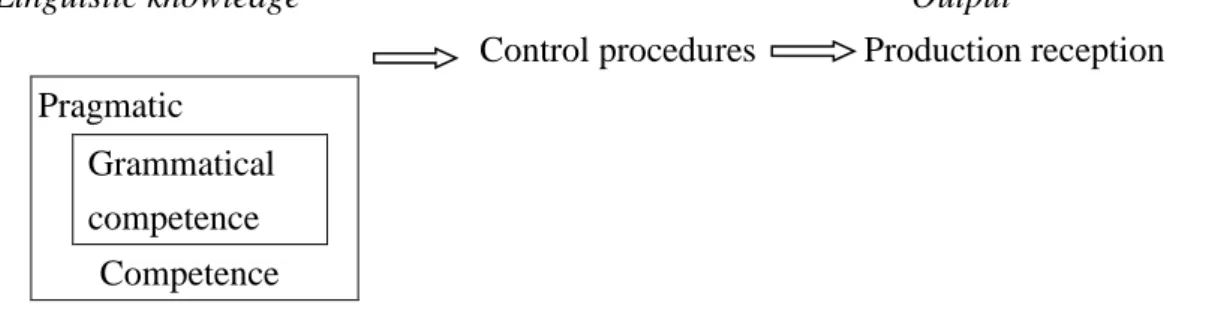
3. The relationship between control procedures and two aspects of linguistic knowledge………..49
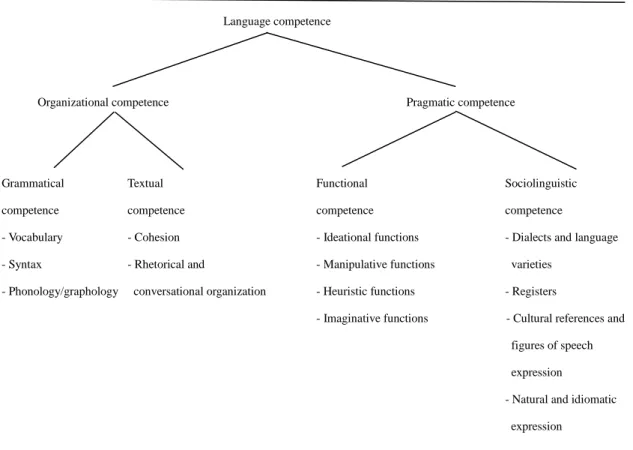
4. Components of language competence………...50
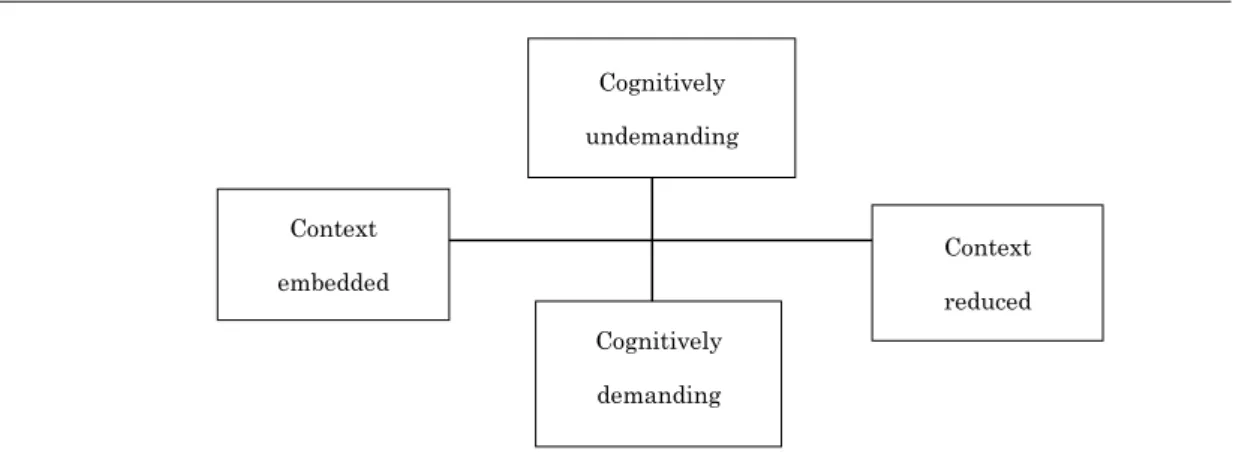
5. Range of contextual support and degree of cognitive involvement in communicative activities………..………...52
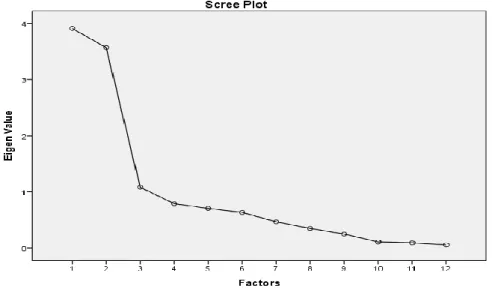
6. Scree plot of the principal components factor analysis for the YG personality inventory………...……….72
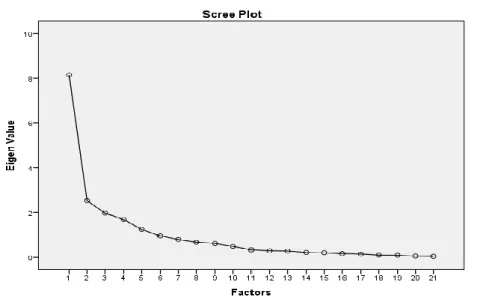
7. Scree plot of the principal components factor analysis for the WTC scale………...74
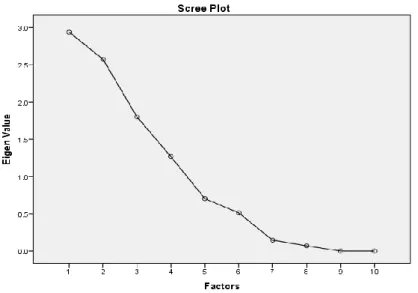
8. Scree plot of the principal components factor analysis for motivation……….75
1 CHAPTER 1 INTRODUCTION
The Background to the Issue
The study of individual differences (IDs) has a long history. At first, learners were classified as “good and bad, intelligent and dull, motivated and unmotivated” (Horwitz, 2000). Recently, on the contrary, researchers have sought to explain why some learners
succeed more than others (Ellis, 2008).
It is important for educators to consider students’ differences. Some favor
communicative activities and others do not. Individuals have different learning
experiences, beliefs, goals, and orientations. There are, of course, differences in how
individual learners respond to classroom instruction and what they learn from it. Ellis
(2012) states that relatively few studies have explored how individual difference factors influence learners’ response to instruction in actual classrooms. Ellis claims that
cognitive processes that have been hypothesized to be involved in language learning are
as explained below, and, in order to activate these processes, instruction can be seen as a
means:
1) Noticing (the learner consciously attends to a linguistic form in the input).
2) Rehearsing (the learner rehearses the form in working memory).
3) Semantic processing (the learner constructs a form-function mapping by assigning
meaning to a linguistic form).
4) Comparing (the learner compares the form noticed in the input with her own mental grammar, registering to what extent there is a “gap” between the input and her grammar).
2
5) Rule-formation (the learner constructs an explicit rule to account for the new
information derived from the above processes).
6) Integrating (the learner integrates a representation of the new linguistic feature into
implicit memory and, if necessary, restructures the existing mental grammar).
Along with these cognitive processes we can add IDs, creating various factors that
have an influence on each other. Dörnyei (2005) defines IDs as enduring personal
characteristics that are considered to apply to all people and on which people differ by
degree.
The ID factors are complex and dynamic: “… the various factors interact with the social and cognitive processes involved in learning in different ways, at different times, and in different kinds of instructional activities” (Ellis, 2012, p. 19). According to another researcher, Dörnyei (2010), IDs are defined as characteristics or traits in respect
of which individuals may be shown to differ from each other. Among researchers, there
is some disagreement as to which factors should be considered as IDs. However, Skehan
(1989), Robinson (2002), and Dörnyei (2005) all agree that they include language
aptitude, motivation, personality, and anxiety. Dörnyei (2009) summarizes three major
sets of learner factors: (a) cognitive factors including language aptitude and working
memory, (b) affective factors including language anxiety and willingness to
communicate, and (c) motivational factors.
Ellis (2008) provides a table that shows the different IDs identified in these three researchers’ taxonomies and divides ID factors into major four groups: (a) abilities, (b) propensities, (c) learner cognitions about L2 learning, and (d) learner actions. These
categories and factors are summarized as follows: abilities (intelligences, working
3
personality, willingness to communicate), learner cognitions (learner beliefs), learner
actions (learning strategies).
Table 1
Factors Listed as Influencing Individual Learner Differences in Language Learning in Three Surveys
Skehan (1989) Robinson (2002) Dörnyei (2005)
1. Language aptitude 2. Motivation
3. Language learning strategies 4. Cognitive and affective
factors a. extraversion/ introversion b. risk-taking c. intelligence d. field independence e. anxiety 1. Intelligence 2. Motivation 3. Anxiety 4. Language aptitude 5. Working memory 6. Age 1. Personality 2. Language aptitude 3. Motivation
4. Learning and cognitive styles 5. Language learning strategies 6. Other learner characteristics
a. anxiety b. creativity c. willingness to communicate d. self-esteem e. learner beliefs (Ellis, 2008) Among the learner factors there are a great number of theoretical and measurement
problems. Aptitude remains largely undefined and appropriate measures are not readily
available. Similarly with language learning strategies and styles, both areas remain
largely undefined and lack valid measures (Dörnyei & Ryan, 2015). This basically
leaves personality, willingness to communicate, and motivation as areas that have been
well defined and that have, particularly in the case of personality, reliable and valid
measures. Moreover, very few studies have actually investigated the relationship among
these three IDs. Thus, these ID factors will be the focus of this study.
In terms of the methodology of ID research, much of this research has been
conducted quantitatively in terms of data collection and analysis (Ellis, 2008). One of
4
self-report on some aspect of their language learning. Researchers have put a lot of
effort into developing questionnaires in order to ensure their validity and reliability. As a
result, there are now various well-established instruments such as those shown in the
following table:
Table 2
Frequently Used Instruments in Researching Individual Difference Factors in SLA
Individual difference factors Research instruments
Personality Eysenck Personality Inventory (Eysenck and Eysenck, 1964) Yatabe-Guilford Personality Inventory (Yatabe and Guilford, 1982) Myers Briggs Type Indicator (Myers and Briggs, 1976)
Willingness to Communicate Willingness to Communicate Scale (MacIntyre, Baker, Clement and Conrad, 2001) Motivation Attitude Motivation Index (Gardner, 1985)
Language Learning Orientation Scale-Intrinsic Motivation, Extrinsic Motivation, and Amotivation Subscales (Noels et al., 2000)
Anxiety
Language aptitude
Learning style
Learners beliefs Learning strategies
Foreign Language Classroom Anxiety Scale (Horwitz, Horwitz, and Cope, 1986) Input Anxiety Scale, and Output Anxiety (Macintyre and Gardner, 1994) Modern Language Aptitude Test (Caroll and Sapon, 1959)
Pimsleur Language Aptitude Battery (Pimsleur, 1966)
Cognitive Ability for Novelty of Acquisition of Language (Grigorenko et al., 2000) Group Embedded Figures Test (Witkin et al., 1971)
Perceptual Learning Style Preference Questionnaire (Reid, 1987) Learning Style Questionnaire (Ehrman and Leaver, 2003) Beliefs about Language Learning Inventory (Horwitz, 1987a) The Strategies Inventory for Language Learning (Oxford, 1990) Language Strategy Survey (Cohen and Chi, 2001)
(Ellis, 2004) Qualitative methods have been seen as complementary to mainstream research in
SLA (Ellis, 2008). This method seeks to explore the processes and experiences of
5
Ushioda, 2012). Observation of learners in classroom settings, interviews, diaries, and
autobiographical narratives are some of the promising methods. Observation
methodology seems effective, but this method has not been successful in the study of
IDs. Ellis continues that the reason is that learners do not reveal much about their
psychological states or their strategies when simple observation is used. There is
increasing recognition that mixed methods approaches can help to capture more of the
complexity of the issues under investigation. Ellis adds that, more recently, triangulation
seems an effective method to investigate ID variables.
Personality is an important learners’ factor and has attracted a great deal of attention
from researchers. Ellis (2008) claims that personality is conceived of as being composed
of a series of traits such as Extraversion/Introversion and Neuroticism/Stability.
Researchers have indicated that extraverts are better language learners but there are, of
course, some exceptions. It is natural that there is no such thing as a good personality
with regard to being a successful learner. Ellis also adds that there is no clear theoretical
basis for predicting which personality variables are positively or negatively related to
which aspects of L2 proficiency. The important thing is, with respect to students’
different characters and natures, that educators provide variety and alternatives in classroom activities to suit students’ personalities (Ehrman, 2008).
The Willingness to Communicate (WTC) is also an important factor for motivation and educators need to take this variable into consideration for learners’ successful learning. Individual’s WTC depends on the situations as well as the interlocutors and, as such, it is obvious that the classroom environment is crucial for learners (Tomimizu,
2013). As the WTC is an individuals’ degree of readiness to participate in discourse,
6
place (MacIntyre, Clement, Dörnyei, & Noels, 1998). Classroom activities should be
designed to reduce anxiety and to build communicative confidence in English.
Motivation is also one of the most important factors for successful learning and is a
well-established area of research. A number of research studies have concluded that the
more motivated learners are, the more successful their language learning. Then, the
question goes to how learners can be motivated. Dörnyei (2010) claims motivation can
go through diverse phases; namely, it is changeable. It is also situation-oriented, so
classroom environments as well as teachers have a huge influence on learners. People
get motivated and engaged in activities when they are enjoyable and satisfying to do
(Noel et al., 2000). In order to sustain learners’ motivation, educators and researchers
need to intervene in their learning processes.
According to Ellis (2008), L2 proficiency refers to a learner’s skill in using the L2. It can be divided into two types: BICS and CALP (Brown, 2007). This distinction is
crucial for language learners in terms of their goals for the target language. Educators
must surely make efforts to enhance these two skills.
Statements of the Problem
In order for students to learn effectively, educators need to consider various
complex ID factors, and thus, it is crucial to pay attention to student IDs more closely. If
teachers know their students well or have information about their students, teachers may
be able to provide better lessons for them. In addition, researchers have sought to
establish direct relationships between various ID factors and measures of language
learning (Ellis, 2012). Most of the ID variables are related to a complicated and rather
7
research regarding the relationships between a particular ID and proficiency; however,
such research often lacks sufficient theoretical coherence (Dörnyei, 2010). Thus, it is
important to investigate the relationships between ID variables and the different kinds of
behaviors in which learners engage based on theoretical principles.
Purposes of the Study
There is not much research that has dealt with multiple ID variables and
investigated them with L2 learning in a Japanese tertiary setting. The central purpose of
this action research study is to investigate how such ID variables as personality, the
willingness to communicate, and motivation impact on proficiency in a particular class
in order to better enhance the participants’ potential in learning.
The Audience of the Study
Although this study may not be generalizable, it will provide effective information
for individuals such as second language researchers, teachers, curriculum/materials
developers, and school administrators in Japan. Getting familiar with the various kinds
of ID factors of English learners will surely be helpful for those who are related to
8 CHAPTER 2 LITERATURE REVIEW
Personality An Overview
Many researchers have shown great interest regarding the relationship between
personality and L2 learning since personality has long been regarded as one of the
important factors in language learning classrooms. Ellis (2008) defines it as follows:
Personality is generally conceived of as composed of a series of traits such as
extraversion/introversion and neuroticism/stability. It constitutes a factor believed
to account for individual differences in L2 learning (p. 975).
One of the most accepted set of traits is known as the “big five” model, which is based
on a long history of factor analyses conducted on questionnaire items (Ellis, 2001;
Dörnyei, 2010; Robson, 1994). The five dimensions of this personality theory are: (a)
Openness to Experience, (b) Conscientiousness, (c) Extraversion-Introversion, (d)
Agreeableness, and (e) Neuroticism-Emotional Stability. Dörnyei (2010) summarizes
these traits as follows:
Table 3
The Big Five Dimensions of Personality
Components High score Low score
openness to experience imaginative, curious conservative, conventional
conscientiousness systematic, meticulous unreliable, aimless
extraversion-introversion sociable, gregarious passive, quiet
agreeable friendly, good-natured cold, cynical
neuroticism-emotional stability worrying, anxious calm, relaxed
9
The “big five” model, as previously mentioned, is a solid model regarding
personality (Ellis, 2001; Dörnyei, 2010; Robson, 1994). Among the five personality
traits, Extraversion/Introversion, and Neuroticism/Stability are the dominant traits
known as the “big two” (Brown et al., 2002; Brown, 2007; Dewaele & Furnham, 1999).
More specifically, the extraversion-introversion dimension has been researched the most
frequently.
Extraversion - Introversion
Brown (2007) defines an extraverted person as one who has deep-seated needs to
receive ego enhancement, self-esteem, and a sense of wholeness from other people. An
introverted person, on the other hand, is defined as one who derives a sense of
wholeness and fulfillment apart from a reflection of this self from other people. Brown
(2002) summarizes these traits by showing the advantages and disadvantages of an
extraverted learner and an introverted learner for language learning.
Extravert
Advantages
a) Practicing English with other people is natural and easy for you, b) You usually do
not mind taking risks, and c) You enjoy group work in class.
Disadvantages:
a) You can be too dependent on people, b) You might not study enough on your own,
and c) You do not like individual work.
Introvert
Advantages
10
usually have good study skills.
Disadvantages
a) You might not try to meet other people, b) You could be a low risk taker, and c) You
do not like group work.
Personality and Tasks/Instructions, and Proficiency
Ellis (2008) emphasizes an important relationship between personality and
tasks/instructions. Extraverts and introverts may make different choices in accuracy
when they are required to perform in the L2. One of the crucial factors may be the task
used to elicit samples of oral language. There is evidence that Extraversion/Introversion
are related to measures of communicative language use, especially fluency. Dewaele
and Furnham (1999) point out that the strength of the relationship depends on the task.
Extraverted people are likely to be more fluent than introverted people in both L1 and
L2.
There are some relationships between language ability and personality. Using
Cummins models (1981), Ellis (2008) states that extraverted learners do better in
acquiring basic interpersonal communicative skills (BICS). The reason for this is that
sociability result in more communicative activities in the L2. Introverted learners, on
the other hand, do better at developing academic language proficiency (CALP) because
they, perhaps, spend more time reading and writing. The research related to these claims
will be discussed in greater detail below.
Neurotic – Stable
11
part of the big five, which is the dominant personality theory in psychology (Ellis,
2004). Neuroticism/Stability is also known as the big two (Ellis, 2001; Brown et al.,
2002; Brown, 2007; Dewaele & Furnham, 1999). In addition, this trait is one of the
categories of the YG Personality Inventory. On the YG Personality Inventory (1957),
there are certain six Neurotic/Stable traits. They are (a) Depression, (b) Cyclic
Tendencies, (c) Inferiority Feelings, (d) Nervousness, (e) Lack of Objectivity, and (f)
Lack of Cooperatives. Several researchers (Dörnyei, 2010; MacIntyre et al., 1994)
found some advantages and disadvantages of these two traits:
Neurotic
Advantages
a) You have increased drive, b) You have increased productivity, and c) You have
greater sensitivity to negative outcomes.
Disadvantages
a) You are worried, b) You are moody, and c) You feel envy.
Stable
Advantages
a) You are calm, b) You are less reactive to stress, and c) You are even-tempered.
Disadvantages
a) You are low in negative emotion and b) You are not necessarily high on positive
emotion.
Also, anxious students tend to underestimate their competence. On the other hand,
less anxious students tend to overestimate their competence.
12
Most research has shown some relationships between Neurotic – Stable traits,
tasks/participation, and proficiency. For instance, Robson and Midorikawa (2008)
investigated the relationship between personality (YG Personality Inventory) and
proficiency for both CALP and BICS. The study found that neurotic students scored
better on the pre-test administration of the TOEIC test (CALP) than extraverted
students. On the post-test, the neurotic students made fewer gains, and the extraverted
students scored lower on the reading section. In terms of the oral proficiency test
(BICS), the socially extraverted participants were more fluent than the neurotic ones.
Also, Robson (1994) investigated the relationship between personality using the
YG Personality Inventory and participation by obtaining a measure of voluntary oral
participation. He found that university students in Japan who were extraverted and
emotionally stable actively participated more in the classes than the students who were
introverted and neurotic.
There are some negative relationships between anxiety, which is a neurotic
sub-trait, and language learning. For instance, Chapman (2002) conducted research
investigating the relationship between second language speaking anxiety and oral
performance. The participants completed anxiety subscales on Foreign Language
Classroom Anxiety Scale (FLCAS) and the International English Language Testing
System (IELTS) interview, which was used to assess oral performance. The study
revealed that there was a significant negative relationship between second language
speaking anxiety and oral performance.
Measurements for Personality
13
questionnaires such as the Eysenck Personality Questionnaire, the Myers-Briggs Type
Indicator (MBTI), or the YG Personality Inventory (Ellis, 2001). In this paper, the
MBTI and the YG inventory are the focus of this review as they have often been
administered in various L2 contexts.
Myers-Briggs Type Indicator
The Myers Briggs Type Indicator (MBTI) is used to describe different personality
types (Myers et al., 1976). This was developed from Carl Jung’s theory of
psychological. Ehrman (2008) states that this questionnaire is used by educational
psychologists, counselors, and organization development specialists and targets four
personality dichotomies: (a) Extraversion-Introversion, (b) Sensing-Intuition,
(c) Thinking-Feeling, and (d) Judging-Perceiving.
The scales have 16 possible combinations of four-letter types, such as ENFP
(Extraversion, Intuition, Feeling, and Perceiving). Myers and Briggs develop a set of
four indices measuring Extraversion-Introversion (EI), Sensing – Intuition (SN),
Thinking-Feeling (TF), and Judgment-Perception (JP). Here is a brief summary of these
dimensions:
a. Extraversion (E)-Introversion (I): An introvert prefers working alone. An extravert
prefers working in a team.
b. Sensing (S)-Intuition (N): A sensor follows a step-by-step approach. An intuitive
thinker thinks about issues using abstract possibilities.
c. Thinking (T)-Feeling (F): A thinking person prefers to make decisions in an
impersonal, logical, and objective manner. A feeling person makes decisions based
14
d. Judging (J)-Perceiving (P): The judger looks for a planned and controlled life. The
perceiver deals with the outside world through sensing or intuition.
Brown (2007) nicely lists the character types for the following categories:
Extraversion (E): sociability, interaction, external
Introversion (I): territoriality, concentration, internal
Sensing (S): experience, past, realistic
Intuition (N): hunches, future, speculative
Thinking (T): objective, principles, policy
Feeling (F): subjective, values, social values
Judging (J): settled, decided, fixed
Perceiving (P): pending, gather more data, flexible
There is a 123-item glossary and the MBTI requires people to decide on one pole of
each of the four preferences. The use of the term indicator does not refer to traditional
scales ranging from positive to negative. Rather, every type can have positive or
negative effects in a specific life domain (Dörnyei, 2010). This approach is similar to
learning styles and is frequently uses personality type inventory in the L2 field. In
addition, it has often been used in L2 studies as a learning styles measure.
Yatabe-Guilford Personality Inventory
As previously noted, personality is typically measured by means of some kind of
self-report questionnaire (Ellis, 2008). One of these example questionnaires is the
Yatabe-Guilford Personality Inventory (YG) which is based on the work of Guilford. He
and his colleagues examined the correlations between typical items on
15
number of personality measures. These became the basis of the 12 traits that make up
this inventory: (a) Depression, (b) Cyclic Tendencies, (c) Inferiority Feelings, (d)
Nervousness, (e) Lack of Objectivity, (f) Lack of Cooperativeness, (g)
Disagreeableness, (h) General Activity, (i) Easy-Goingness, (j) Extraverted Thinking,
(k) Dominance/Controlling/Ascendance, and (l) Social Extraversion. Robson (1994)
summarized the translations of the above traits as follows:
a) Depression (D): an individual frequently feels depressed and has a predisposition for
melancholy and pessimism.
b) Cyclic Tendencies (C): an individual undergoes mood shifts easily, becomes
emotionally excited, and is seen to have a personality that lacks emotional stability.
c) Inferiority Feelings (I): an individual is afflicted with a sense of inferiority and
lacking of self-confidence.
d) Nervousness (N): an individual has a nervous temperament, is given to worrying
and has a predisposition for being irritable.
e) Lack of Objectively (O): an individual engages in improbable daydreams, is unable
to sleep, stays awake fantasizing, and is hypersensitive.
f) Lack of Cooperativeness (Co): an individual is greatly dissatisfied and unreliable
with a predisposition for discontent and insincerity.
g) Disagreeableness (Ag): an individual is short tempered, and acts as if he or she feels
in the right regardless of what other believe.
h) General Activity (G): an individual is physically active and prompt in the
workplace, exhibiting energetic behavior and having bright dispositions.
i) Easy-Goingness/Rhathymia (R): an individual is always seeking some kind of
16
j) Extraverted Thinking (T): an individual has a tendency for thinking about
everything deeply with a propensity for frequently being lost in thought.
k) Dominance/Controlling/Ascendance (A): an individual works for the group or club,
and never thinks about being alone.
l) Social Extraversion (S): an individual enjoys the company of others, and takes great
pleasure in talking to others.
Factor analysis of these twelve traits places the first six in one factor, Neuroticism,
and the second six in another factor, Extraversion (Robson, 1994). In other words, the
six Neurotic-Stable traits are from 1 to 6, and the other six Extravert-Introvert traits are
from 7 to 12. These 12 traits each have ten questions for a total of 120 items. The
participants are required to choose among: (a) yes, (b) no, and (c) uncertain. (a) as well
as (b) are scored two points and (c) is scored one point for a possible zero to 20 points
per trait.
After more than a decade of piloting and revising, the final version of the
Yatabe-Guilford inventory was created by Yatabe and other psychologists in 1957. Nowadays,
in Japan, this method is seen as one of the most effective ways to measure personality in
various contexts. For instance, many companies in Japan have administered this test to
get familiar with new employees and to use it as a screening tool. Also, the YG inventory is often administered in educational institutions in order to know students’ personalities.
Personality Studies
Strong (1983) investigated the relationship between extraversion and proficiency,
17
Robson (1994) found that extraverted and emotional stable learners tended to participate
more in oral activities compared with introverted and neurotic learners. According to
Ellis (2008), extraversion including talkativeness, responsiveness, and gregariousness,
is an important variable in relation to BICS.
On the other hand, several studies have showed a negative relationship between
extraversion and communicative skills. For instance, Dörnyei and Kormos (2000)
conducted a study regarding the relationship between measures of social cohesiveness
or of sociometric interrelationships and measures of engagements in an oral
argumentative tasks with Hungarian EFL students. They found that extraversion was negatively related to learners’ oral language and interpreted this finding as follows: students are more likely to change their learning mode when they perform a task in their
second language which negates the effect of social factors.
Regarding the relationship between introversion and CALP style proficiency, it
seems that there are few positive effects of personality on proficiency. For instance,
Busch (1982) investigated the effects of introversion on formal proficiency measures
using her translated version of the Eysenck Personality Inventory. She found a negative
relationship between introversion and scores measuring a four-part written proficiency
test. However, there are some serious weaknesses with her instruments, particularly her
measure of personality. Generally speaking, Neurotic-Stable and introverted students
are more likely to prefer structured activities and not to participate in the language
classroom (Robson et al., 2008).
Studies based on the Hypothesis that Extraverted Learners Do Better at BICS
18
are basic human personality traits (Robson, 1994; Ellis, 2008). All the models of
personality reviewed accept Extraversion/Introversion and Neuroticism/Stability as
traits of human behavior. Various studies have shown mixed results regarding which
personality trait would be effective for learning. All personality dimensions are just
different. For instance, one research study showed that extraverts tend to spend less
processing time while introverts need more time in testing situations (Eysenck &
Eysenck, 1964). Riding and Parker (1979) conducted a study that looked at the effect of
personality on the recall of prose by children. The 11 year-old pupils took a
comprehension test, and the study found that overall recall was not significantly
different among the personality types.
Also, personality has an influence on the way learners respond to classroom
instruction (Ellis, 2008). Generally speaking, extraverts prefer unstructured classroom
activities, and, on the other hand, introverts seem to prefer structured activities (Brown,
Robson & Rosenkjar, 2002; Robson, 1994). Robson conducted a study with Japanese
college students to compare the amount of voluntary oral participation with personality
traits using the YG inventory. The results showed that extraverts and emotionally stable
individuals favored uncontrolled and unfocused oral participation over introverts and
neurotics.
In addition, Riding and Parker (1979) mentioned that extraverts were better at
identifying the main idea of reading passages and introverts could be better at
processing the details. Extraverts outperformed in identifying the main idea of the
reading passages, while introverts outperformed in the processing of detailed
information. The former had better recall of general information, while the latter had
19
information by using images, and, on the other hand, extraverts tend to store
information verbally. In the following sections, some research results of these
personality traits are described.
Introverted Dimension
Much of the literature has indicated that introverts are better language learners. For
instance, Busch (1982) examined the relationship between extraversion and higher
levels of proficiency for learners in Japan. The study found that introverts were actually
more proficient than extraverts in terms of their pronunciation even though Busch
originally predicted that the extraverts would be more proficient language learners.
Nonetheless, she used her own translation of the Eysenck Personality Questionnaire
despite the existence of an authorized Japanese translation, which casts doubts about the
validity of her instrument. In addition, Ehrman (2008) conducted a study and found that
the best language learners tended to have introverted personalities.
Based on Dewaele and Furnham (1999), their finding probably resulted from the
following descriptions of the behavior of a highly extraverted and highly introverted
person: the typical extravert is sociable, has many friends, and does not like reading or
studying by him/herself. On the other hand, the typical introvert is a quiet, retiring sort
of person and more fond of books rather than people. Midorikawa and others (2008)
found similar results: the introverts outperformed on the pre-test TOEIC. Brown (2007)
adds that introverts may have the patience and focus to attend to learning language.
Understanding the results of the MBTIs allows students to become more effective
language learners. One study found that INTJ (introversion-intuition-thinking-judging)
20
There are, of course, some exceptions. Dörnyei and Kormos (2000) failed to find a
relationship between measures of social cohesiveness among Hungarian EFL students
and measures of engagement in an oral argumentative task such as the number of turns
or words used. They negated a positive relationship between social factors and
performance, such as participants’ relationship to their interlocutor, and the oral task. It
has been theorized that neurotic traits can be a positive factor in test taking and that
extravert traits can be a negative factor.
Extraverted Dimension
Of course, there are some exceptions to positive aspects of introverted personality.
Brown (2007) suggested that extraversion may be a factor in the development of general
oral communicative skills, which require face-to-face communication. Dewaele and
Furnham (1999) confirmed that extraversion affects speech production: “… extraversion does affect both L1 and L2 speech production” (p. 509). In addition, Wakamoto (2000) conducted a study of university students in Japan and found that the
extraverted students were more likely to make better use of learning strategies than the
introverted ones.
Robson (1992, 1994) conducted several studies of English learners in Japan in
order to measure personality using the YG Inventory and voluntary participation in oral
English classes with Japanese female junior college students. The 1992 study showed
that Inferiority Feelings had a negative relationship with participation while the Lack of
Agreeableness or Aggression, General Activity, Rhathymia, and Ascendance had
positive relations. In addition, he found that extravert and emotionally stable learners
21
introverts and neurotics. Robson concludes that the extraverts and the emotionally
stable were fond of uncontrolled and unfocused oral participation over introverts and
neurotics.
Summary
Many researchers agree that it is not clear that extraversion or introversion helps or
hinders the learning of an L2. What is important is that researchers and educators be
sensitive to the extraversion and introversion personality traits that vary from student to student (Brown, 2007). Thus, Skehan (1989) states that, “we may need to accept that both extraversion and introversion have their own positive features, and that an extreme
either way is likely to work against some aspects of target-language development” (pp.
104-105).
Additionally, knowing students’ personal dimensions is surely beneficial for
teachers. It may be possible to provide variety and alternatives in classroom activities to suit students’ different personalities and learning styles (Brown, 2002, 2007). For instance, teachers can help their learners, who are relatively introverted, by not forcing
participation in extraverted activities such as group work, discussion, or presentation, which would be against the students’ natural inclinations. These students would be show more interest in individual work such as paper-pencil based tasks, writing, or reading.
Lastly, learners need to know their preferences. Successful learners know their
strengths as well as their weaknesses. In addition, they utilize their strengths and
compensate for their weaknesses regardless of their natural preferences (Brown, 2002,
22
Willingness to Communicate An Overview
Another variable that can influence SLA is the Willingness to Communicate
(WTC). The WTC is a relatively new concept among individual differences, and this
variable is based on a concept in first language communication research where it has
been studied in the field of speech communication and pathology.
The WTC explains an individual’s degree of readiness to participate in discourse (MacIntyre, Clement, Dörnyei, & Noels, 1998). In other words, it is the probability of
engaging in communication when free to choose to do so, that is, a volitional process or the respondents’ predisposition toward approaching or avoiding the initiation of
communication (McCroskey, 1992). According to Ellis (2008),
This is the extent to which learners are prepared to initiate communication when
they have a choice. It constitutes a factor believed to lead to individual differences
in language learning (p. 983).
McCroskey (1992) explained that the WTC is based on the combination of greater
perceived communicative competence, and a lower level of communication anxiety. It is
also seen to be directly influenced by a combination of communication apprehension
and perceived communication competence (MacIntyre et al., 1998; Yashima, 2002).
According to McCroskey, the WTC captures the implications of communication
apprehension, introversion, and shyness behaviors depending on communication
contexts and interlocutors. The WTC is a complex factor that is influenced by a number
of other ID variables such as communication anxiety, perceived communication
23 The Heuristic Model
It is difficult to describe what effect the WTC has on learning the target language.
However, MacIntyre and others (1998) nicely conceptualized a model. The following
heuristic model of variables influencing the WTC is important for explaining the WTC
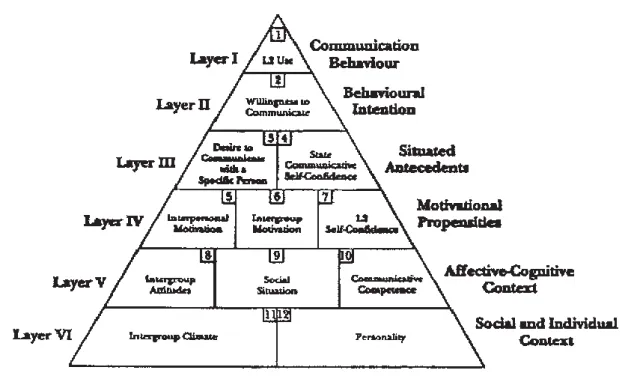
in the L2. This figure, the heuristic model, shows the range of potential influences on
the WTC in the L2 in the form of a pyramid with 6 layers. These are: (a) the social and
individual context, (b) the affective-cognitive context, (c) the motivational propensities,
(d) the situated antecedents, (e) the behavioral intentions, and (f) the communication
behavior. The bottom three layers show that the learners’ WTC is influenced by stable
constructs, namely, enduring influences. The upper three levels show that their WTC is
influenced by situational factors.
Figure 1. The heuristic model of variables influencing WTC (MacIntyre, Clement, Dörnyei, & Noels, 1998)
24
Layer VI: social and individual context
There are two boxes: (a) intergroup climate or situation, and (b) personality. Intergroup climate means the situation surrounding the interlocutors’ group and personality means the person’s traits such as extravert or introvert.
Layer V: affective and cognitive context
There are three boxes: (a) intergroup attitudes, (b) social situation, and (c)
communicative competence. Intergroup attitudes mean the person’s attitude toward the interlocutor’s group. Social situation means that the situation where the person is in socially has an effect on communication. Communicative competence means that the L2
proficiency level has an effect on communication.
Layer IV: motivational propensities
There are three boxes: (a) interpersonal motivation, (b) intergroup motivation, and
(c) L2 self-confidence. Interpersonal motivation is in regards to the various
relationships between the person and the interlocutor that have an effect on L2
communication. For instance, conversation with authorities, such as teachers or doctors,
reduces motivation, as well as affective and behavioral freedom. In other words,
motivation can be changed depending on the interlocutors. Intergroup motivation means
that motivation is affected by the group to which the person belongs. For instance, if the
person communicates with an interlocutor who belongs to a different group, such as a
political rival or a member of a competitive team, motivation can be reduced.
Layer III: situated antecedents
There are two boxes: (a) desire to communicate with a specific person, and (b) state
communicative self-confidence. Desire to communicate with a specific person means
25
communicative self-confidence means that if the person has confidence to communicate using their L2, then the person’s WTC can be motivated.
Layer II: behavioral intention
There is one box: willingness to communicate. It shows that the person is ready to
communicate with people because he/she has confidence using their L2, and a desire to
communicate with an interlocutor.
Layer I: communication behavior
There is one box: L2 use, which is the optimal aim of this heuristic model.
WTC in L2
The origins of studies looking at the WTC lie in the first language communication
literature. Two researchers, MacIntyre and Charos, first started the WTC research in the
field of SLA in 1996. After 2000, in foreign language settings, the WTC research began
to be conducted with Japanese English language learners (Yashima, 2002; Yashima et
al., 2004). There are differences between the WTC in the L1 and L2. For the WTC in
the L2, there is the opportunity to integrate psychological, linguistic, educational, and
communicative approaches (MacIntyre, 2007). MacIntyre adds that the WTC may be
seen as both an ID factor facilitating L2 development and as a nonlinguistic outcome of
the language learning process.
Communication in the L2 depends on a psychological readiness to use the language
and to cope with pressures to use the L2. In the L2, learners need to pay extra attention
to their target language in a more complex manner than native speakers speaking their
first language (MacIntyre et al., 1998). For instance, some learners are willing to
26
included as an affective variable concerning L2 learning.
In addition, compared to L1 settings, as L2 competence levels depend on the
individual learners, there is a wide range of competences. If the learner does not feel
competent, he or she may not be willing to communicate. In terms of second language
acquisition, communicative confidence in the L2 means communication without anxiety
(Yashima, 2002). Dörnyei (2010) adds that L2 WTC is determined by the interaction of
the psychological conditions of excitement, responsibility, and security as well as
situational variables, and the conversational context of the communication. Thus,
communicating with others is a dynamic and is complex processes. The following six
features explain how complicated such communication can be:
a. Communication is a symbolic process only people who are in the conversation can
make the language, which can be verbal or non-verbal, meaningful,
b. Communication is a process involving several components – the meaning of
communication depends on the interlocutors, contexts, or implications,
c. Communication involves the sharing and negotiating of meaning – only at the time
when people communicate, they share and negotiate the meaning of that
communication,
d. Communication is dynamic – communication is changing all the time,
e. Communication does not have to be intentional – people can communicate with
each other without any purposes, and
f. Communication is receiver-oriented.
(Martin & Nakayama, 2000, in Yashima 2004)
To improve communication skills, learners need to use the target language, and,
27
approach is to improve learners’ communicative competence in the target language.
International Posture
When it comes to communicating with others using an L2, the person’s favorable attitude toward that county is crucial. For instance, some learners are more interested in
the culture of English speaking countries than other learners. In this case, these learners
are motivated as well as being willing to study English and communicate in English.
According to Yashima (2002), international posture is defined as interests in foreign
or international affairs and readiness to interact with intercultural partners, and that this
has an influence on motivation. MacIntyre (2007) mentions that one of the major
aspects of the motivation to learn another language is to have some curiosity and
interests in the country, its culture, and its people. In some sense, L2 learners need to
learn a second culture along with a second language (Brown, 2007).
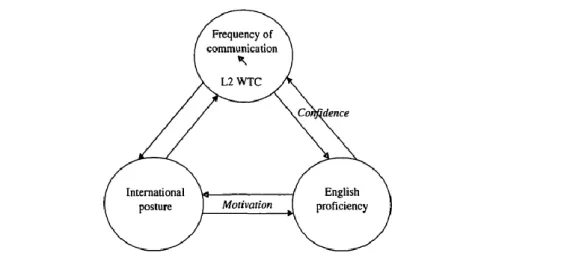
International posture also influences the WTC and L2 proficiency (Yashima, 2002).
This figure is based on her empirical studies and it shows that international posture, the
WTC in terms of frequency of communication, and English proficiency are all related to
each other. She found that international posture is strongly correlated with learning
motivation, which has a positive relationship with both proficiency and communicative
confidence. The last variable, communicative confidence, is related to L2 WTC. She
concluded that interpersonal posture has a positive impact on motivation,
28
Figure 2. A schematic representation of the interaction between L2 WTC, international postre and English proficiency (Yashima, 2002)
Yashima et al. (2004) claim that some students might be willing to communicate as
they have instrumental reasons, but others may be willing to communicate because they
enjoy speaking or writing in English. Thus, these researchers emphasize the importance
of relationships between motivational tendencies and the WTC. Yashima (2002) also
claims that motivated individuals tend to have confidence in communication, and it
influences their WTC in the target language. This is clearly the reason why the WTC is
important in the Japanese EFL context. She concludes that one of the ultimate goals of
successful learning is to have a will to communicate.
Measurements of WTC
McCroskey (1992) claims that the WTC scale is a high quality and valid measure
for use in language learning research. It has a 20-item, probability-estimate scale that
includes eight non-scored fillers with the other 12 items being scored as part of the
29
The scale operationalizes willingness to communicate in terms of listening,
speaking, reading and writing both inside and outside of the classroom.
(Ellis, 2008, p.648)
Ellis (2012) states that similar to anxiety, the WTC can also be considered as a
trait or as a situational variable, which can be influenced by specific instructional
factors. Based on the types of receivers (stranger, acquaintances, and friends), in this
scale, there are three sub-scores. Additionally, based on the types of communication
contexts (public, meeting, group, and dyad), there are four additional sub-scores; e.g., “Present a talk to a group of strangers.”, “Talk with an acquaintance while standing in line.”, and “Talk in a large meeting of friends.”
Participants filling out the scale indicate the percentage of time they would choose
to communicate in each type of situation when completely willing to do so by selecting
a number between 0 and 100 (Appendix F). In other words, the WTC specifically
directs the respondent to complete the scale with this aspect of free choice in mind
(McCroskey, 1992). L2 WTC is not fixed and varies depending on the situations (Ellis,
2008). Ellis continues that L2 communication must be highly situation-oriented and it is
likely to be made up of a combination of a number of psychological, linguistic, and
contextual variables.
Studies Related to WTC
As previously mentioned, the WTC is a complex concept. In addition, the concept
of L2 use differs from country to country. According to McCroskey (1992), the WTC is
highly culturally dependent. The following table indicates that not only are the means