52:1006
<シンポジウム(1)―10―2>片頭痛の病態研究 Update
Cortical spreading depression と遺伝子研究
古和 久典
中島 健二
(臨床神経 2012;52:1006-1008)
Key words:拡延性抑制,チャネル異常,家族性片麻痺性片頭痛,ゲノムワイド関連解析
片頭痛の病態に関する最近の仮説では,皮質拡延性抑制 (cortical spreading depression:CSD)が前兆に関与し,三叉 神経血管系の神経原性(無菌性)炎症や血管拡張が頭痛と関与 していると考えられている.しかし,この両者をつなぐメカニ ズムは十分には解明されていない1). 近年,片頭痛の遺伝子研究に関する成果が,少しずつ増えて きている. 本稿では,片頭痛における CSD と遺伝子について,最近の 知見を概説する.
1.皮 質 拡 延 性 抑 制(cortical spreading depression: CSD) 1944 年ブラジルの生理学者 Leāo は,ウサギをもちいた実 験で発見した脳波上の現象で,神経やグリア細胞の脱分極が, 2∼3mm!min のゆっくりした速度で周囲に進行し,それに続 いて血管径や血流,エネルギー代謝活動の多彩な変化をとも ないながら,自発的な神経活動の抑制された状態が持続する ことを spreading depression(以下,SD と略す)と呼んだ. SD は,大脳皮質をもちいた実験系がよくもちいられてい るため,cortical spreading depression(CSD)と称されること が多いが,すべての神経組織で生じうる現象と考えられてい る.CSD の際には,一過性の血流増加に続いて数 10 分にわ たって血流低下(oligemia)が遷延し,多くの神経伝達物質や 神経修飾因子が放出され,細胞内外のイオンの劇的な変化が 生じ,相互に関連していると考えられている2)3). 動 物 実 験 系 で は,電 気 刺 激,機 械 刺 激 や 塩 化 カ リ ウ ム (KCl),グルタミン酸,ウワバイン,エンドセリンなどをもち いて CSD を誘発させているが,ヒトにおいても CSD が生じ ているとの確証は多くない.片頭痛患者における CSD を直接 確認することは困難と思われるが,片頭痛患者の前兆の変化 と MR などによる脳機能画像上の血流の変化4)5)などが傍証 とされている. CSD と片頭痛の痛みとの関連性について,ラットをもちい た実験ではあるが,CSD が三叉神経を活性化したことが示さ れている6). 前兆のない片頭痛患者と CSD との関係については,前兆の ない片頭痛患者においても後頭葉で CSD を示唆する同様の 画像所見をみとめた7)ことより,近年では silent aura,すなわ ち,電気生理学的には CSD は生じているが臨床的な表現型と しては前兆をきたさないという説明がなされている8).ただ し,何が片頭痛患者に CSD を惹起するのか,その機序につい ては未解明である. 2.片頭痛の遺伝子 以前から片頭痛の家族内発症が多いことは指摘されていた が,近年の家系解析や双生児研究の結果から,片頭痛は,一部 の単一遺伝子による特殊なものを除いて,複数の遺伝的素因 と複数の環境因子が関与している多因子遺伝病であることが 示唆されている.とりわけ,前兆のない片頭痛では遺伝的素因 と環境因子の関与が,前兆のある片頭痛では遺伝的素因がよ り強く関与すると報告されているが,前兆の有無で差がな かったとの報告もある. 片頭痛の原因遺伝子9),すなわち,単一遺伝子の異常により 特殊な家族性片頭痛をきたす遺伝子として,もっともよく知 られているのが家族性片麻痺性片頭痛(familial hemiplegic migraine:FHM)で,現在までに 3 つの原因遺伝子が判明し ている.FHM1(P!Q-type Ca2+channelα1 subunit)では,遺 伝子変異により,Ca チャネルの電流密度の増加,神経筋接合 部での神経伝達物質の放出増加,CSD 閾値低下や CSD 伝搬 速度の上昇など(gain of function)をきたすことが基礎実験よ り示されている.FHM2(Na-K ATPaseα2subunit)では,シ ナプス間隙からのグルタミン酸の細胞内への取り込み低下 (loss of function)によるグルタミン酸の作用過剰をきたすこ とが考えられている.FHM3(brain type I Na+channelα sub-unit)は,以前から熱性痙攣をともなう全般性てんかんの原因 遺伝子として 300 以上の変異がみとめられており,FHM3 として報告されている 5 つのミッセンス変異は,グルタミン 酸神経終末の不活化障害による活性化を呈すると考えられて いる.以上より,FHM 遺伝子変異に共通する病態として,い ずれも細胞膜のチャネル機能に関与し,神経細胞の興奮性亢 進とグルタミン酸の作用過剰を呈することが示唆されてい る. その他の原因遺伝子として,片頭痛を合併する遺伝性疾 患 で あ る CADASIL(cerebral autosomal dominant
arterio-鳥取大学医学部脳神経医科学講座脳神経内科学分野〔〒683―8504 鳥取県米子市西町 36―1〕 (受付日:2012 年 5 月 23 日)
Cortical spreading depression と遺伝子研究 52:1007
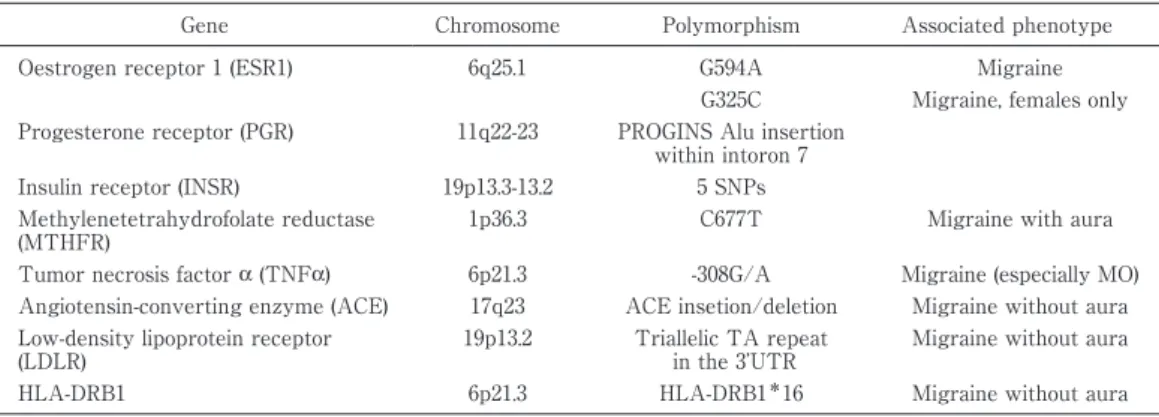
Table 1 Candidate genes and polymorphisms associated with migraine.
Gene Chromosome Polymorphism Associated phenotype Oestrogen receptor 1 (ESR1) 6q25.1 G594A Migraine
G325C Migraine, females only Progesterone receptor (PGR) 11q22-23 PROGINS Alu insertion
within intoron 7 Insulin receptor (INSR) 19p13.3-13.2 5 SNPs Methylenetetrahydrofolate reductase
(MTHFR) 1p36.3 C677T Migraine with aura Tumor necrosis factor α (TNFα) 6p21.3 -308G/A Migraine (especially MO) Angiotensin-converting enzyme (ACE) 17q23 ACE insetion/deletion Migraine without aura Low-density lipoprotein receptor
(LDLR)
19p13.2 Triallelic TA repeat in the 3 UTR
Migraine without aura HLA-DRB1 6p21.3 HLA-DRB1*16 Migraine without aura
(文献10)より引用)
pathy with subcortical infarcts and leukoencephalopathy) の NOTCH3, RVCL (retinal vasculopathy with cerebral leukodystrophy)の TREX1,遺伝性出血性毛細血管拡張症 (hereditary haemorrhagic telangiectasia:HHT)の HHT1,
ミトコンドリア遺伝子などが報告されている. 他方,片頭痛の疾患感受性遺伝子,すなわち,危険因子とし ての関連遺伝子については,候補遺伝子アプローチによる関 連解析が数多くなされ,一部ではメタ解析もおこなわれてお り,Table 110)に示す遺伝子多型で有意な関連性が報告されて いる.FHM の 3 つの原因遺伝子は,一般の片頭痛における関 与は否定されている.連鎖解析では,複数の染色体座位が報告 されているが,遺伝子は同定されていない.大規模なゲノムワ イド関連解析(Genome-wide association study:GWAS)が進 められ,PRDM16,TRPM8,LRP1 など複数の染色体座位や遺 伝子が報告されているが,個々の遺伝因子の寄与率は高いと はいえない.詳細な病態機序は未だ不明であるが,neuro-pathic pain や modulate neuronal glutamate signaling として の関与が推測されている.大規模な前兆のある片頭痛の家系 解析から K+チャネルの遺伝子(KCNK18)異常が報告された. 現在までに報告されている遺伝子異常の多くが,CSD ある いは神経原性(無菌性)炎症,血管拡張との関与を示すものと なっている.ゲノム解析技術は目覚ましい進歩を遂げており, 片頭痛に関する新たな遺伝子の発見が,病態解明のブレーク スルーとなり,有用な治療法の開発や発展へと結びつくこと が期待されている. ※本論文に関連し,開示すべき COI 状態にある企業,組織,団体 はいずれも有りません. 文 献
1)Charles A, Brennan KC. Cortical spreading depression―
new insights and persistent questions. Cephalalgia 2009; 29:1115-1124.
2)Gorji A. Spreading depression : a review of the clinical relevance. Brain Res Rev 2001;38:33-60.
3)Martins-Ferreira H, Nedergaard M, Nicholson C. Perspec-tives on spreading depression. Brain Res Rev 2000;32:215-234.
4)Olesen J, Larsen B, Lauritzen M. Focal hyperemia fol-lowed by spreading oligemia and impaired activation of rCBF in classic migraine. Ann Neurol 1981;9:344-352. 5)Hadjikhani N, Sanchez Del Rio M, Wu O, et al.
Mecha-nisms of migraine aura revealed by functional MRI in hu-man visual cortex. Proc Natl Acad Sci U S A 2001;98:4687-4692.
6)Bolay H, Reuter U, Dunn AK, et al. Intrinsic brain activity triggers trigeminal meningeal afferents in a migraine model. Nat Med 2002;8:136-142.
7)Woods RP, Iacoboni M, Mazziotta JC. Bilateral Spreading Cerebral Hypoperfusion during Spontaneous Migraine Headache. N Engl J Med 1994;331:1689-1692.
8)Sanchez-del-Rio M, Reuter U, Moskowitz MA. New in-sights into migraine pathophysiology. Curr Opin Neurol 2006;19:294-298.
9)de Vries B, Frants R, Ferrari M, et al. Molecular genetics of migraine. Hum Genet 2009;126:115-132.
10)Wessman M, Terwindt GM, Kaunisto MA, et al. Migraine: a complex genetic disorder. Lancet Neurol 2007;6:521-532.
臨床神経学 52巻11号(2012:11) 52:1008
Abstract
Cortical spreading depression and molecular genetics in migraine
Hisanori Kowa, M.D., Ph.D. and Kenji Nakashima, M.D., Ph.D.
Division of Neurology, Department of Brain and Neurological Sciences, Faculty of Medicine, Tottori University Cortical spreading depression (CSD) is a slowly propagated wave of depolarization of neurons and glial cells, followed by a subsequent sustained suppression of spontaneous neuronal activity. Functional imaging studies of migraine patients have shown dramatic changes in blood flow and brain activity whose characteristics are similar to those of CSD, implicated in migraine visual aura. Although the trigeminal nerve innervates the meninges and participates in the genesis of migraine headaches, triggering mechanisms remain controversial and poorly under-stood. It is demonstrated by animal models that CSD activates trigeminovascular afferents and evokes a series of cortical meningeal and brainstem events consistent with the development of headache.
Three familial hemiplegic migraine, a rare monogenic subtype of migraine with aura, genes have been identi-fied, which all encode ion transporters, suggesting that disturbances in ion and neurotransmitter balances in the brain are responsible for this migraine type. Additional molecular insight into the pathophysiology of migraine may come from other monogenic syndromes such as CADASIL, RVCL. Several genetic associations with candi-date migraine genes like ESR1, MTHFR, and INSR, have been convincingly replicated. The genome-wide associa-tion studies may be a successful strategy toward identificaassocia-tion of migraine susceptibility genes.
(Clin Neurol 2012;52:1006-1008) Key words: spreading depression, channelopathy, familial hemiplegic migraine, genome-wide association study