Abstract: Among the 41,000 foreign residents of Kyoto City, more than half of them are Korean long-term residents.Fifteen percentofthe foreign residentpopulation ofKyoto City are aged 65 or older; therefore, making Kyoto City the most relevant Japanese location for focusing on the problemsofaging foreign residents.
Koreanshave been discriminated foralong time in Japan.Elderly Koreans,in particular, face certain difficulties in receiving welfare benefits. A volunteer organization, MORE-NET, was established in Kyoto City to provide adequate information about welfare benefits and directservicesforelderly foreign residents.
We are currently engaged in Participatory Action Research (PAR) with MORE-NET’s members,which involvesconducting asurvey on the foreign elderly and the Japanese elderly in Kyoto City.We analyze the relevance ofPAR with MORE-NET and the prospectsof MORE-NET in orderto contribute to Japan’srealization ofan inclusive and multi-culturalsociety.
Keywords:Problems of the Elderly Foreigner,Volunteer Support Network,Inclusive Society,MORE-NET,Participatory Action Research
1.
I
nt
r
oduct
i
on
Among the 41,000 foreign residentsofKyoto City,more than 55% are Korean long-term residents(oldcomersorZainichi)whose ancestorscame to Japan during the Japanese colonial erain the early 20thcentury.About22% ofthese residentscame from China,halfofwhich are estimated to be those who returned to Japan from Chinaaccompanied by theirrelatives1. In the spring of2006,MORE-NET,avolunteerorganization,wasestablished to support the foreign elderly and disabled individuals who live in Kyoto City. This organization was formed through the collaboration of the Korean residents, in partnership with their two
Vol
unt
eer
Support
Net
wor
k
f
or
El
der
l
y
For
ei
gner
s
:
A
New
Movement
of
Kor
ean
Resi
dent
s
i
n
Kyot
o
OZAWA
Wa
t
a
r
u*,
MAKI
TA
Yuki
f
umi
**,
HI
GUCHI
Koi
c
hi
***,
I
SHI
KAWA
Kuni
ko****,
YAMADA
Hi
r
oko*****,
Ma
r
t
ha
MENSENDI
EK******,
OGAWA
Ei
j
i
*,
KATO
Hi
r
os
hi
*******
* Professor,Faculty ofSocialSciences,Ritsumeikan University ** Part-time Lecturer,Faculty ofEducation,FukuyamaCity University *** Associate Professor,Faculty ofSocialSciences,Ritsumeikan University
**** Associate Professor,DepartmentofSocialWelfare,Osaka-Ningen-Kagaku University ***** Professor,Faculty ofSociology,DoshishaUniversity
****** Associate Professor,Faculty ofSociology,DoshishaUniversity ******* Professor,DepartmentofSocialWelfare,Ryukoku JuniorCollege
supportorganizations,namely Chongryun (Souren)and Mindan,aswellaswelfare workers and Japanese scholars. This was the first time that the branch offices of Chongryun and Mindan decided to collaborate to provide daily supportservicesforaging Koreans2.
In recentyears,anew movementhasbeen emerging in Japanese civilsociety,and anew word,Tabunka Kyousei(multiculturalsymbiosis),hasbecome popularsince the 1990s3.This idearelatesto accepting actualculturaldiversity withoutforcing itto conform to the Japanese culture.Korean residentsin Kyoto think thatthisideaisimportantasamotto fortheirdaily activities.Some ofthese individualscan be thoughtofas“active foreign citizens”(gaikokuseki -shimin) who are beginning to break out of the constraints imposed by their support organizations by establishing networks with other citizen groups that exist beyond the boundariesoftheirown ethnicgroups4.
By focusing on the problem ofthe “minority ofminorities”in Japan,namely the issue of aging foreign residents,we investigate how to empowerthe volunteersectorin orderto open the way to an “inclusive society”during atime when the powerofthe welfare state hasbeen decreasing due to considerable financialdeficits.
The welfare system in Japan is underpinned by people’s volunteer actions in the local community. For example, there is a social work volunteer system (Commissioned Welfare Volunteers system: Minsei-Iin system) in Japan. The Minsei-Iin work as key players in the community to help needy familiesobtain government-based income subsidies5.
The Neighborhood Association (NHA) in the local community has a considerable influence on each family in Japan, although the power of such a community network has recently become relatively weak.Kyoto city hassponsored the Rojin-Fukushi-In system for38 years. Rojin-Fukushi-Iin comprises volunteer staff appointed as support personnel for aging residentsin each NHA.They visitperiodically homesofseniorswho live alone in each local area.
Exclusively Japanese citizens are appointed under the social work volunteer system called the Minsei-Iin system.The Minsei-Iin system hasanationality clause thatautomatically excludesforeign residentsfrom assuming thisrole.Although foreign residentsare eligible to become membersofthe NHA,they often do notknow thatthey can become Rojin-Fukushi-In. Asaresult,very few foreign residentsparticipate in thiscapacity.Withoutthe assistance of volunteers such as Rojin-Fukushi-In and Minsei-Iin, foreign residents face difficulties in accessing servicesin the publicsectoraswellasthe usualcommunity supportsystem. Recognizing the barriersofpublicsocialservice providersthatexistforforeign aging or disabled residents, MORE-NET established the Gaikokujin Fukushi-Iin (supporter of foreign residents)system,which trainsvolunteersto understand the culturalbackground ofitsaging foreign residents, help them overcome these obstacles, and form a network of volunteer organizations.
Thispaperfocuseson the activity ofMORE-NET and addressesthe following questions:
foreigners,among the Korean residentsin Kyoto City?Whatare the problemsMORE-NET isfacing?
2)How can these problemsbe solved?How can we empowerMORE-NET to open the way to an “inclusive society”in Japan?
Two ofourmembers(Kato and Ozawa)have undertaken Participatory Action Research (PAR) with MORE-NET since its establishment in 20066. We attempt to answer the first question raised by the findingsfrom the PAR projectdiscussed in the second chapter7. Thisresearch group wasorganized in 2010 through publicfunding.We began the second stage ofourPAR projectin orderto find answersto the second question above.Atthisstage in research,notonly academicresearchersbutalso membersofMORE-NET,care workers, localvolunteersocialworkers,and studentsparticipated,starting atthe planning phase. These active citizens’ commitment is the core spirit of our PAR project, wherein the motivation and findings from the data are shared among the participants. Because the membersofMORE-NET did notshare close relationshipswith Minsei-Iin and Rojin-Fukushi -In, it was expected that their participation in the research process would improve the relationshipsnecessary forthe daily activitiesbetween them.
The second stage of our PAR project was aimed at discovering how foreign elderly residents used welfare services, what were the difficulties they faced while using these services, and what kind of information they lacked about such services. We anticipate that through the PAR project, social work volunteers for the foreign elderly, Gaikokujin-Fukushi -Iin, can learn more about how to create a network in conjunction with other citizen organizations and that they can acquire skills and a broader view of welfare services. We explain ourfindingsfrom thisPAR projectin the third chapter.
This paper discusses how to empower the volunteer sector in order to realize an inclusive society,focusing on the problemsrelated to aging thatforeign residentsface.
2.
The
Cont
ext
of
Our
St
udy
2.1 SocialContextofa New MovementofKorean Residents
MORE-NET began six yearsago in Kyoto City with the aim ofproviding counseling and supportforforeign aging and disabled persons.Thisvolunteerorganization hasbeen partially subsidized by localgovernmentfunding.Due to conflictswithin the Korean community,we found itdifficultto imagine earlierthatsuch collaboration would be possible in the field of community activities. Even today, the support organizations of Koreans are a “closed community.”Korean residentswho belong to Chongryun (Souren)orMindan usually do not have strong relationships with each other. The aid that these groups provide is limited to theirown memberswithin each organization.
The relationship between these two organizations was not good, mainly because of the differencesin theirpoliticalstances.Thiscould be referred to asthe “North and South Korea problem.”How wassuch aconflictovercome in orderto realize the collaboration of
MORE-NET?
Itisimportantto note thatthese two groupsofKoreanshad a“successfulexperience” during legal proceedings related to the “no pension problem” of Korean elderly residents. Presently,there isno pension plan foraging foreign residentswho are over86 yearsofage (asof2012),due to the lack oftransitionalmeasuresto effectapolicy change8.During this struggle in court, to challenge the lack of a policy, both organizations of Korean residents began to work togetherin Kyoto.They did notwin the case;however,the Kyoto prefecture governmentand the Kyoto City governmentcame to understand theirconcernsand began to pay acertain amountofbenefitsto those elderly foreign residentson behalfofthe national government. The local government had more sympathy toward the foreign minority groups than the nationalgovernment.Moreover,since they began receiving supportfrom the local government, the Korean residents have begun to understand the merits of collaboration in theirstruggle to defend theirhuman rights9.
After the Kyoto prefecture government decided in 2004 to provide benefits to elderly Korean residents with no pension, the Koreans discovered that many elderly members of theircommunity could notaccesspublicinformation and thatitwas,therefore,noteasy for them to obtain these benefits. Second-or third-generation Koreans realized that even if the publicsystem waschanged,elderly Koreanswould stillnotreceive adequate supportbecause ofthe “information gap”thatexistsin Japanese society.
Priorto this,in 1998,the Long-Term Care Insurance Actwasenacted asthe new welfare system formainly the elderly in Japan.Since thislaw wasimplemented,no restrictionshave been placed on foreign residentsregarding theireligibility to enrollin the insurance system. Regardless of nationality, any person can obtain benefits after joining the system. However, consecutively itwasfound thatthe “information gap”on insurance represented asignificant barrierforforeign residents.Many aging Koreanswere reluctant,even to establish acontract with the Office ofCivilService in Japan,because they were stillexperiencing psychological traumathatresulted from the Japanese colonialperiod.Such traumahindered theiraccessto the services provided by the new law, which had at last become available for them. Therefore, it has become imperative for the new generation of Korean oldcomers to understand the suffering oftheirparentsorgrandparents.They mustrecognize the cultural background ofthe first-generation Koreans.
The second-or third-generation of Korean residents discovered that their parents or grandparentswere isolated in nursing homesin Japan.Gradually getting olderand suffering from dementia, they were forgetting the Japanese words they had once known. In this condition,itwasbecoming difficultforthem to live in atypicalJapanese nursing home.They did notknow the old songsthatare usually sung in Japanese homesorhow to fold origami paper,because such gamesforchildren were notpartoftheircustoms.
Second-or third-generation Koreans decided to build a day-care center, ELFA, in 2001 and nursing home, Kokyou-no-Ie (Hometown House), in 2009 in Kyoto. Due to this achievement,the elderly can live there in comfort,singing Korean songsand playing Korean games.They learn Hangul,theirown mothertongue,and enjoy Korean-style lunches.They
say unanimously,“Now isthe happiesttime in ourlives.Thisisourschooland home.”Many ofthem did notreceive formaleducation in theiryoungerdays.ELFA and Kokyou-no-Ie are attempting to convey thisinformation about“the minority ofthe minorities”to the public. The successofthisethnicwelfare facility also triggered amovementto establish MORE-NET. Both the staff and volunteers of such ethnic welfare facilities strongly support and activate the mission MORE-NET.
2.2 From Closed Society to Open Society
Through the initiative ofitsKorean residents,the localcommunity ischanging step by step.Whatisthe impactofsuch aKorean movementon the Japanese civilsociety?
Because Korean residentsare hard workersand the costofeducation fortheirchildren ishigh,they can achieve acertain levelofsocio-economicand culturalcapitalby becoming more integrated with Japanese society. By attaining power as a community, a number of Korean residentshave begun to feelthe responsibility to supportotherethnicminoritieswho lack allformsofcapital.
The support of MORE-NET has gradually become available to other ethnic groups as well.Recently MORE-NET hasshown keen interestin the problemsofreturneesfrom China. These individualsare Japanese orphanswho were leftbehind in Chinaatthe end ofWorld WarII.Starting in the 1980s,apolicy wasimplemented to bring these people back to Japan. According to the Japanese law,aperson isgranted Japanese citizenship ifhe orshe hasone parent who is Japanese; therefore, Japanese orphans are permitted to bring their Chinese spousesand relativesto Japan.
In Kyoto City, this population is segregated in public apartment complexes, with lower than average rents. The number of these individuals in Kyoto City has reached more than 4,000.Japanese orphansare already 67+ yearsold,and face old-age related problems.
Although the ELFA day care centerwasestablished by the second-orthird-generation of Korean residents,itacceptschildren ofJapanese orphanswho wish to learn care-giving skills so asto provide forthe needsofthe elderly.The secretary generalofELFA iscollaborating with Kyoto Gaikokujin Shien Net (an NGO network that provides support to foreign residents) to offer a workshop for these individuals providing information about the credentialsrequired to be caregivers.
The secretary general is also a member of MORE-NET, and she is challenging the organization to aid the returneesfrom China.Asshe said,“Aftersetting outto supportthe returneesfrom China,even though they have Japanese nationality,Icame to realize thatthey are suffering an identity crisis like us. Through such an experience, I have become more aware ofourown problemsthan Iwasbefore,aswellasotherpeople’sproblems.”We can considerthe secretary generalofELFA asan ideal“active foreign citizen,”who forgesnew relationships among ethnic groups to overcome their common problems. In Japan, where discrimination toward minority ethnic groups is strong, the strategy of being an “active foreign citizen” is a good way for foreign residents to earn the respect of the Japanese majority and improve their status in Japanese society. MORE-NET aims to establish “a
publicly authorized support system” for the foreign elderly and the handicapped, because professional social workers in Japan do not have the skills or the concern to help foreign people.MORE-NET isproposing the Gaikokujin-Fukushi-Iin system (socialworkersvolunteer to look afterforeign residents),which issimilarto the Minsei-Iin system.However,the public hasnotyetaccepted such aproposal.MORE-NET now holdsan annualworkshop to educate and train volunteers to become social work volunteers for foreign people. More than 100 people have completed this training and have been nominated as Gaikokujin-Fukushi-Iin. However,regrettably,only about20 workersare presently working.Mostofthem are Korean, and they work only with Korean elderly residents.
The core members of MORE-NET hold a monthly meeting at their office in Higashi -Kujo. However, they feel that MORE-NET has now run into obstacles that prevent it from being effective.
First, MORE-NET is still closed to residents of other ethnicities. Although the management staff is establishing a network with other volunteer organizations and social agencies,mostGaikokujin-Fukushi-Iin do nothave the motivation to do this.Thishasresulted in a lack of power on the part of MORE-NET to address the needs of elderly residents of otherethnicities.
MORE-NET is also closed and has no ties with community volunteers from NHAs. Gaikokujin-Fukushi-Iin lack ties with Minsei-Iin and Rojin-Fukushi-In; therefore, they are unaware ofthe usualsupportactivitiesin the localcommunity.Moreover,there may be many isolated foreign individualswho have no connectionsto the volunteersupportsystem,namely both MORE-NET and the community supportsystem.MORE-NET doesnothave the toolsto locate such isolated foreign residents.
Third,MORE-NET facesamanagementproblem.The program to educate volunteersis an important tool for conveying information to many other citizens about needy foreigners. However, it is a serious problem that 80% of volunteers are inactive against their will. The MORE-NET coordinatorusually selectsvolunteersamong those whom the coordinatorknows well;therefore,mostmembersare excluded from daily assistance work.Japanese volunteers, in particular, who are interested in this activity, cannot work because they lack Korean language skills.
The scholarswho are core membersofMORE-NET,and who obtained agrantfrom the governmentin April2010,decided to undertake thisPAR projectin orderto break through these obstacles.The following chapterexplainsthe procedure and the resultsofourresearch project.
3.
Par
t
i
ci
pat
or
y
Act
i
on
Resear
ch
wi
t
h
MORE-
NET
3.1 Research Purpose and Scheme ofOurParticipatory Action Research
Our research identifies a method to develop a community system for looking after foreign elderly residentsby employing the supportofvolunteers,and eventually understand how to build an inclusive community in the local area where Japanese and foreign elderly
residentsintermingle and live asnext-doorneighbors.
Therefore,itiscrucialforusto grasp the living conditionsofelderly foreign residents and validate that there is a gulf between foreign and Japanese residents in their local community.
Our survey was conducted from February to May in 2010 using a structured questionnaire directed toward elderly residents selected by random sampling. The research methodology wasimportantforthe participants;therefore we arranged forthe survey to be conducted by the scholars, the staff of MORE-NET, the Gaikokujin-Fukushi-Iin, NHA staff, and other volunteers, including students as well as other workers from welfare non-profit organizations(NPOs).
In the processofdesigning the questionnaire,we held severalmeetingsthatwere open to those interested in thisprojectin orderto connectthe diverse volunteerswith each other and share awarenessofthisproject.Afterthe survey,we informed the community’sresidents ofthe resultsaswellasallofthe participantsin thisproject.
Throughout the process, we endeavored to establish a new network among individuals who were interested in thisproject.Thischapterdiscussesourresearch dataand some ofthe resultsofourPAR project.
3.2 Focus Groups and Research Methodology
From Table 1,we observe thatthe population ofKorean residentsand Chinese residents ishighestin the MinamiWard and the FushimiWard in Kyoto,respectively.From Table 2, we observe thatthe population offoreign elderly people in these wardsishigherthan other wards. These results indicate the reason why we selected the Higashi-Kujou area from the MinamiWard and the Daigo areafrom the FushimiWard asourresearch fields.
Higashi-Kujou is located to the south of the Kyoto train station. Korean residents and Japanese Buraku people live there,who have been severely discriminated againstforalong time in the Japanese society. In Daigo, the eastern area of Kyoto City, the Public Housing Corporation built low-rent apartments, where low-income families and the families of returneesfrom Chinalive.With the cooperation ofNHAsin the Sannou schooldistrictand the Toukaschooldistrictin Higashi-Kujou,and the NHA ofthe Ogurisu publicapartmentsin Daigo,we selected ourresearch targetaselderly individualsover70 yearsofage in the first two areasand over65 yearsofage in the latterareaby random sampling from the member list of each NHA10. Our research targets included Japanese elderly residents, Korean residents, and elderly returnees from China. The diversity of this data is a feature of this survey.Moon and Mikami(2007)analyzed the differencesbetween the Japanese elderly and the Korean elderly and suggested that foreign people living in Japan need ethnicity-specific support.
Although thissurvey wascarried outthrough the initiative ofscholars,projectmeetings were held with the staffofMORE-NET and membersofthe Gaikokujin-Fukushi-Iin,because their participation in the decision-making process for designing the survey was very importantforourPAR project.
During the meeting that was open to all who took keen interest in this project, in the process of designing the questionnaire we had the opportunity to observe an important scene.The Korean coordinatorofMORE-NET,forthe firsttime,metthe Rojin-Fukushi-In of the neighborhood, where the MORE-NET office is located. She is also the leader of the Women’sAssociation ofChongryun,which seemsto be aclosed organization asmentioned earlier.Atfirst,she appeared to be uninterested in Japanese community action,butgradually became absorbed in the Rojin-Fukushi-In’s speech, who was speaking frankly about her enthusiasm for visiting needy families. She visited everyone, without discriminating against any type of person. Finally, the Korean coordinator asked about the support system of the
Table 1 Population ofForeign Residents in Kyoto City 2009
Others USA
Peru The Philippines Brazil Korea China Total Ward in Kyoto 350 116 3 28 4 1,729 389 2,619 Kita 13.4% 4.4% 0.1% 1.1% 0.2% 66.0% 14.9% 100.0% 355 108 3 39 13 938 642 2,098 Kamigyo 16.9% 5.1% 0.1% 1.9% 0.6% 44.7% 30.6% 100.0% 1,278 249 8 94 40 2,621 1,499 5,789 Sakyo 22.1% 4.3% 0.1% 1.6% 0.7% 45.3% 25.9% 100.0% 242 72 6 37 17 1,412 475 2,261 Yamashina 10.7% 3.2% 0.3% 1.6% 0.8% 62.5% 21.0% 100.0% 142 46 1 81 1 491 320 1,082 Higashiyama 13.1% 4.3% 0.1% 7.5% 0.1% 45.4% 29.6% 100.0% 287 57 5 192 13 1,249 336 2,139 Yamashina 13.4% 2.7% 0.2% 9.0% 0.6% 58.4% 15.7% 100.0% 279 50 3 37 5 928 587 1,889 Shimogyo 14.8% 2.6% 0.2% 2.0% 0.3% 49.1% 31.1% 100.0% 128 17 4 91 10 5,247 567 6,064 Minami 2.1% 0.3% 0.1% 1.5% 0.2% 86.5% 9.4% 100.0% 342 110 14 98 21 4,450 681 5,716 Ukyo 6.0% 1.9% 0.2% 1.7% 0.4% 77.9% 11.9% 100.0% 222 55 2 57 22 2,408 334 3,100 Nishikyo 7.2% 1.8% 0.1% 1.8% 0.7% 77.7% 10.8% 100.0% 467 80 16 216 32 4,466 3,072 8,349 Fushimi 5.6% 1.0% 0.2% 2.6% 0.4% 53.5% 36.8% 100.0% 4,092 960 65 970 178 25,939 8,902 41,106 Kyoto City 10.0% 2.3% 0.2% 2.4% 0.4% 63.1% 21.7% 100.0% (Statisticsofthe Ministry ofJustice,2009)
NHA.Thisiswhen herself-enclosed mind opened to the possibility ofaJapanese volunteer engaging in activitiesin the localcommunity.
In thisway,we can create agood relationship between the Gaikokujin-Fukushi-Iin (social work volunteersforforeigners)and the Rojin-Fukushi-In (welfare volunteersin the NHA),and share information aboutthe elderly residentswho are each other’sneighbors.
Asthe survey wascarried outthrough interviewsbased on astructured questionnaire, we organized ateam ofabout50 interviewers,who included the Gaikokujin-Fukushi-Iin,staff membersofMORE-NET,university students,and scholars,aswellasothervolunteers.Itwas difficultforthe interviewersto visitthe homesofthe elderly residents,asthe interviewers did notshare any relationship with them.Thus,we asked the Rojin-Fukushi-In,who are local community volunteers, to accompany the interviewers to the door of each targeted elderly person.Ittook 30-60 minutesto complete each interview.
The nextsection analyzesourresearch results.
3.3 Quantitative Research Analysis
3.3.1 Difference in Conditions between Japanese Elderly and Foreign Elderly Residents
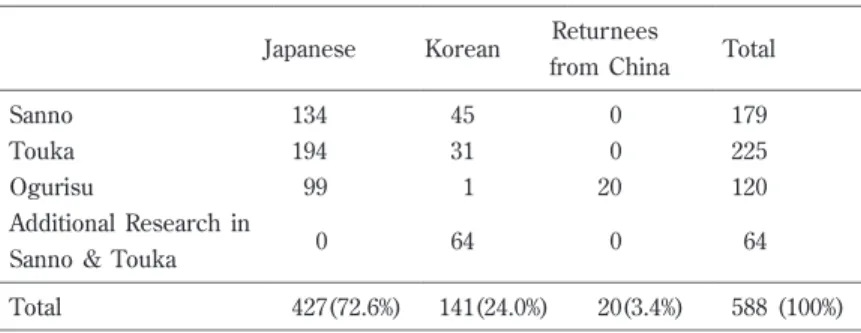
The total number of collected data was 588: 427 are Japanese, 141 Korean or Koreans who have been naturalized in Japan,and 20 are returneesfrom China.
We can explain the differencesamong ethnicorculturalbackgroundsby focusing on the following points,namely 1)health status,2)relationshipswith neighbors,3)participation in community festivals and activities, and 4) degree of well-being or the level of subjective
Table 2 Population ofForeign Residents and Ratio ofthe Elderly in Kyoto City,2010
Ratio Above 65 years in age Total Ward 16.2 429 2,642 Kita 10.0 234 2,350 Kamigyo 10.8 634 5,861 Sakyo 15.9 353 2,223 Nakagyo 7.9 83 1,053 Higashiyama 13.7 287 2,097 Yamashina 9.5 185 1,949 Shimogyo 21.6 1,303 6,046 Minami 18.7 1,032 5,527 Ukyo 16.9 520 3,073 Nishikyo 13.2 1,076 8,165 Fushimi 15.0 6,136 40,986 Kyoto City (StatisticsofKyoto City,2010)
feeling ofhappiness.
First, health status showed a difference based on ethnic and cultural backgrounds. Almost half of the Japanese responded that they were in “good health,” while the Koreans and the returnees from China responded that they had health-related problems. More than 65% ofthe Koreansand 75% ofthe returneesfrom Chinaresponded thatthey were “notin good health.” We can, therefore, assume that the latter two groups face more health problemsthan the Japanese residents.
We asked the intervieweesseveralquestionsaboutthe daily relationship they share with theirneighbors.Forexample,we asked them whetherthey would invite aneighborto teaat theirhome,help take outthe trash,enjoy chatting,and greettheirneighbors.These answers indicate the degree ofintimacy with orestrangementfrom neighbors.
Almost70% and 60% ofthe Japanese elderly and Korean elderly responded,“they have a chat with neighbors when they meet them,” respectively; only 25% of the elderly returnees from China had a chat with neighbors. Therefore, we realize the isolation from the local community of the returnees from China. They share similar features with newcomers to Japan.
We examine elderly residents’ participation in community festivals and activities. In Japan,there are many community festivalsand activitiesorganized by the NHA,thatis,the community neighborhood organization and supportorganizations.In the HigashiKujou area, two Korean organizationsare actively involved in community work.The returneesfrom China also actively organize and manage Japanese language classesin the Ogurisu area.
There isno difference in the rate ofparticipation in community festivalsand events,such as sports, luncheon meetings, and summer festivals, among these groups categorized by ethnic and cultural backgrounds. Almost two-thirds of the elderly responded that they had participated in community festivalsand activitiesin the past.However,when we examined the differences in the participation rate in the community events organized by the NHA, only 38.2% ofthe Korean elderly had participated in them,whereas60.8% ofthe Japanese elderly had participated.
Moreover, they were asked whether they had volunteered as staff of any kind of volunteer organizations. In the respondents’ data, we observed a significant difference between the Japanese elderly and others.Nearly 40% ofthe Japanese elderly responded that
Table 3 Description ofthe Sampling
179 0 45 134 Sanno 225 0 31 194 Touka 120 20 1 99 Ogurisu 64 0 64 0
AdditionalResearch in Sanno & Touka
588 (100%) 20(3.4%) 141(24.0%) 427(72.6%) Total Total Returnees from China Korean Japanese
they had volunteered to oversee NHA events as staff, whereas only 17.7% of the Korean elderly and 20% of the elderly returnees from China had similar responses. In particular, when we asked whetherthey had volunteered asNHA staff,there wasasignificantdifference between the Japanese elderly and the Koreans. Nearly 40% of the Japanese elderly had experience asNHA staff,whereasonly 5% ofthe Korean elderly had the same experience. We also investigated these groups’ desire to participate in community events in the future. There was no significant difference between the Japanese elderly and the Korean elderly;however,almost40% ofthe elderly returneesfrom Chinaresponded thatthey would not participate in such events, mainly because of health problems and a lack of communication ability.Majority ofthem cannotspeak Japanese well.
Afterexamining the responseson the desire to take responsibility by becoming partof the NHA staffin the future,nearly 70% ofthe Korean elderly responded thatthey would not assume a role to support the NHA. This rate was significantly higher than that for the Japanese elderly. Such a difference in attitude toward the NHA sometimes causes friction between the Korean and the Japanese residents.
In ourquestionnaire,the levelofthe subjective feeling ofhappinesswasmeasured using ascale ofwell-being divided into seven degrees,from level1 (Extremely Unhappy)to level7 (Extremely Happy).
Categorizing the answers between levels 1 and 3 as “Unhappy,” level 4 as “Middle or Average,” and between levels 5 and 7 as “Happy,” most of the answers recoded were “Middle” or “Happy.” However 20% of the Korean elderly responded that they were “Unhappy.”Around five percentofthe Korean elderly and the elderly returneesfrom China responded that they were “Extremely Unhappy,” none of the Japanese had such responses. Only 10% of the elderly returnees from China responded that they were “Happy.” As explained earlier, because of their low communication ability, the elderly returnees from China experience difficulties in obtaining community information. They have few opportunitiesto establish relationshipswith theirJapanese neighbors,and theirisolated daily lives might affect their judgment of their level of happiness. The Korean elderly, who have communication problemsdue to aging,sufferfrom the same problem.
We examined whetherthe respondentswere familiarwith the welfare staffby asking the following question: “Do you know who the Minsei-Iin, the Rojin-Fukushi-In, and the care managers are in your local community?” The responses to this question indicated that the Korean elderly and the elderly returneesfrom Chinashow alowerlevelofawarenessofthe Minsei-Iin, compared to the Japanese elderly. Of the Japanese elderly, 31.5% knew who the Rojin-Fukushi-In were,whereasonly 10% ofthe Korean elderly and the elderly returneesfrom Chinaknew this.
3.3.2 Determinants ofSense ofHappiness:Multivariate Analysis
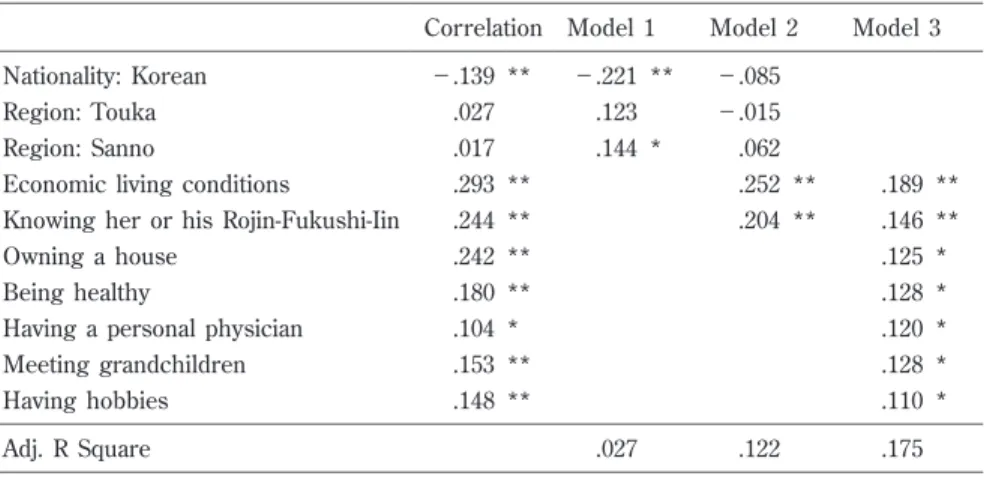
We analyzed the determinant factors of the elderly residents’ sense of happiness by multivariate analysisusing the casesin Toukaand Ogurisu11.
people.We can understand easily thatthe economiccondition ofelderly people,ownership of a house, good health, and having a personal physician, grandchildren, and hobbies are essential factors that determine elderly people’s subjective well-being. However, it is surprising thatwhetheran elderly person knowsthe person in charge oflooking outforhis or her care, such as the Rojin-Fukushi-In, also has a strong influence on their level of happiness.
The volunteer support system of the Rojin-Fukushi-In was introduced 38 years ago in Kyoto City. The Rojin-Fukushi-In visit isolated elderly people periodically. (This system is exclusive to Kyoto City,and an identicalsystem cannotbe found in othercitiesin Japan.)
Having some connection with the Rojin-Fukushi-In may give the elderly peace of mind. Anotherinterpretation isthatelderly people can be happy ifthey have high sociability ora broad network ofhuman connections.
Table 5 shows the difference in determinants of subjective well-being between the Japanese and the Korean elderly residents.
In the case ofthe elderly Japanese,familiarity with the person who istheirRojin-Fukushi -In, the condition of their health, owning a house, and having a personal physician, affects theirsubjective levelofhappiness.In contrast,in the case ofthe elderly Koreans,two factors, namely familiarity with the person who is their Rojin-Fukushi-In and meeting their grandchildren,affectstheirlevelofhappiness.Thisisbecause elderly Koreansgenerally live alone.
In any case, for both the Japanese and the Koreans, it is interesting to note that familiarity with the person who istheirRojin-Fukushi-In isan importantdeterminantfortheir levelofsubjective well-being.
Table4 Multiple Regression Analysis ofSubjective Well-Being
Model3 Model2 Model1 Correlation − .085 ** − .221 ** − .139 Nationality:Korean − .015 .123 .027 Region:Touka
.062 *
.144 .017
Region:Sanno
** .189 ** .252 ** .293 Economicliving conditions
** .146 ** .204 ** .244 Knowing herorhisRojin-Fukushi-Iin
* .125 ** .242 Owning ahouse * .128 ** .180 Being healthy * .120 * .104 Having apersonalphysician
* .128 ** .153 Meeting grandchildren * .110 ** .148 Having hobbies .175 .122 .027 Adj.R Square StdYX Estimates,* p< .05,**p< .01,N= 319
3.3.3 Willingness and Experience ofbeing a managementstaffmemberofthe NHA As explained earlier, elderly Koreans seem to avoid becoming management staff members of the NHA, which can encourage discrimination toward Koreans in the local community.Here,we analyze thisproblem by multiple regression analysis.
Table 6 showsthe determinantsofthe willingnessto be amanagementstaffmemberof the NHA.From thisdata,we can understand thatresidents’willingnessto be amanagement staffmemberdiffersamong the NHAs.In the case ofOgurisu,managementstaffing ofthe NHA isby rotation.The returneesfrom Chinaare given the responsibility ofparticipating in the managementofthe NHA.In contrastto such ademocraticapproach,in both Toukaand Sanno,the staff’sterm ofemploymentisvery long and such aresponsibility isconcentrated among fewer people, so this may explain why the willingness to be a management staff memberofthe NHA islowerthan in the case ofOgurisu.
The determinants of willingness to be a management staff member of the NHA are health status,the ability to read and write (literacy),owning ahouse,and age.
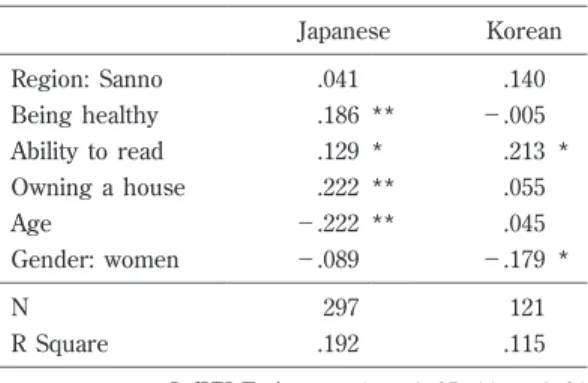
Table 7 showsthe resultsofamulti-group analysisofwillingnessto be amanagement staffmemberofthe NHA.Comparing thisdatawith thatofTable 6,there isno difference in
Table 5 Multi-Group Analysis ofSubjective Well-Being
Korean Japanese
.186 .122
Economicliving conditions
* .221 ** .224 Knowing herorhisRojin-Fukushi-Iin
.126 ** .262 Owning ahouse .013 * .198 Being healthy .011 ** .222 Having apersonalphysician
* .204 .005 Meeting grandchildren .100 .072 Having hobbies 98 124 N .164 .308 R Square StdYX Estimates,* p < .05,** p < .01
Table 6 Multiple Regression ofWillingness to be a ManagementStaffMemberofthe NHA
Model3 Model2 Model1 Correlation − .062 − .049 ** − .151 ** − .194 Nationality:Korean ** − .222 ** − .195 ** − .196 ** − .139 Region:Touka
* − .158 * − .121 * − .138 .001
Region:Sanno
** .165 ** .194 ** .254 Being healthy ** .156 ** .186 ** .264 Ability to read ** .163 * .074 Owning ahouse ** − .137 ** − .221 Age .157 .126 .051 Adj.R Square StdYX Estimates,* p< .05,** p< .01,N= 515
the case ofthe elderly Japanese;however,we can observe thatthe ability to read and write is an importantdeterminantforelderly Koreans.Thisisbecause many first-generation Korean residentswere notable to receive basicformaleducation.
In addition to this analysis, it is necessary to examine the experience level as a managementstaffmemberofthe NHA.Table 8 showsthe resultsofalogisticregression of having experience asamanagementstaffmemberofthe NHA.
From thisdata,itisevidentthatthe type ofethnicity isan importantdeterminantforthe level of experience so as to become a management staff member of the NHA. Korean residentsare notlikely to have the experience to obtain such aposition.
Table 9 shows the results of a multi-group analysis of having experience as a management staff member of the NHA. Comparing the data between the Japanese and the Koreans,we understand that,forKorean elderly people,literacy ability isadecisive factorin holding amanagerialposition.
From these analyses,itisevidentthatthe Korean residentswould notbe able to assume
Table 7 Multi-group Analysis ofWillingness to be an NHA managementstaffmember
Korean Japanese
.140 .041
Region:Sanno
− .005 ** .186 Being healthy * .213 * .129 Ability to read .055 ** .222 Owning ahouse .045 ** − .222 Age * − .179 − .089 Gender:women 121 297 N .115 .192 R Square StdYX Estimates,* p< .05,** p< .01
Table 8 Logistic Regression of Having an Experience as a Management Staff Member ofthe NHA Model Correlation * − .134 ** − .178 Nationality:Korean ** − .280 .085
Region:Touka
** − .619 **
− .340 Region:Sanno
.026 ** .138 Being healthy * .166 ** .172 Ability to read ** .196 − .032 Owning ahouse − .046 ** − .170 Age .179 R Square (McFadden) StdYX Estimates,* p< .05,** p< .01,N= 526
Table 9 Multi-group Analysis of Having an Experience as a ManagementStaffMember ofthe NHA Korean Japanese − .174 ** − .368 Region:Touka
.139 − .007 Being healthy .242 * .284 Ability to read .012 ** .241 Owning ahouse .193 * − .156 Age * .118 − .010 Gender:women 119 309 N .047 .182 R Square (McFadden) StdYX Estimates,* p < .05,** p < .01,N = 526
amanagerialposition even ifthey were willing to assume the responsibility forit.
3.3.4 Correspondence Analysis ofInterviewerCategories and CommentWords In oursurvey,we asked the interviewersto write theircommentson the questionnaire sheet.Regarding the typesofinterviewers,we can categorize the following six types:scholar, university student,Gaikokujin-Fukushi-Iin,staffofthe NHA,NPO staff,and others.
Figure 1 shows the results of a correspondence analysis of interviewer categories and comment words12. In this two-dimensional figure, the listed words located nearby are considered as having a strong relationship with each other. The size of the circle and the square expressthe numberofwordsthatcan be seen in the interviewers’comments.
It is interesting that “scholar” and “university student” are located close together in Figure 1. These interviewers used many words such as “watch,” “person,” and “neighbor,” therefore we can surmise that they have similar interests and mentalities. In addition, it is also interesting that “staff of NHA” and “Gaikokujin-Fukushi-Iin” are located close to each otheratthe centerofthisfigure.Thismeansthatthese individualshave awell-balanced and good sense ofwelfare and are interested in allkindsofmattersequally.We can assume that the collaboration between the NHA staff and the Gaikokujin-Fukushi-Iin is based on a commonality ofgood sense.
3.4 Feedback ofData Analysis to MORE-NET Members and the LocalCommunity Oursurvey yielded some importantfindings.Afterconducting thissurvey,we held four workshopsand tried to disseminate the resultsback to each community and the participants in thissurvey,aswellasthe membersofMORE-NET.
Through the survey, MORE-NET members discovered that not so few elderly Korean residentsare isolated from both the Korean communitiesand the localcommunity,and they now understand thattheirtask isto offertheirsupportto such elderly persons.MORE-NET membersalso learned aboutthe difference in living conditionsamong the Japanese elderly, the Korean elderly,and the elderly returneesfrom China.Thiswasagood chance forthem to understand otherpeople’sscarcity ofsocialcapital,the difficulty they may face in obtaining information about welfare services, and the difficulties they encounter in daily life due to language problems. MORE-NET can now begin to have a common understanding that they have to supportthese othertypesofpersonsaround them who have troubles.
Japanese staff began to participate in MORE-NET activities after taking part in this research project.In the past,the staffofMORE-NET consisted ofonly Koreans.
Thisresearch projectwasthe firsttime thatthe Gaikokujin-Fukushi-Iin collaborated with the NHA staffon the same project.Ofcourse,the projecthelped allofthe participantsget acquainted with each other.However,asforthe NHAs,they do notchange quickly.A welfare services’ staff member reported that a Roujin-Fukushi-Iin felt empowered by our workshop, because she came to understand how she was contributing to elderly persons’ sense of happiness in her local community. It will require a lot of time at the NHA level for its members to be able to understand the importance of collaborating with the Gaikokuji n-Fukushi-Iin, and thus, we should continue to offer workshops with the Roujin-Fukushi-In, leadersand staffofthe NHA,and otherwelfare organization staff.
4.
Concl
usi
on
Given the seriousbudgetdeficitand aging society,itisvery difficultforJapan to solve the problems related to the welfare of the elderly. The welfare of the foreign elderly, in particular, is usually neglected by the Japanese government. Focusing on this kind of “minority of minorities” problem, it is beneficial to conduct further studies as we move toward an inclusive society.
This paper examined the case of a volunteer organization called MORE-NET for the minorities.In the processofconducting ourresearch,we found thatthere are many “cracks” within the local community, for example, between Japanese and Korean residents, between NPOsand NHAs,between officialwelfare staffand volunteerstaff,and between the Korean communities.
It is important for us to repair these cracks by creating a network of volunteer organizations.To promote such aproject,the university can work asakind of“intermediary” fornew networking,and PAR projectfacilitated by the university worksto develop community building.
To solve the problemsfaced by minorities,we musttake action by harnessing volunteer power, and pursue the institutionalization of the professional social worker to support the foreign elderly. It is critical for us to educate the Gaikojin-Fukushi-Iin so that they can function aseffective socialworkers.
Our survey was well designed to be a good education program for the Gaikokuji n-Fukushi-Iin aswellasothervolunteerinterviewers.In the nextstage,the PAR approach will also be useful. As Kurt Lewin indicated, the cyclic action process of “Action-Researc h-Training”isessentialforusin developing acommunity (Bavelas,A.& Lewin,K.1942;Lewin, K.1946).
We will continue to employ the case study to support various types of foreign elderly. Through each case study,we mustaim atdeveloping the skillsofthe Gaikokujin-Fukushi-Iin. A key issue ofthe nextstage ofourPAR willbe how to establish connectionsbetween the staffofthe NHA and Gaikojin-Fukushi-Iin and to enhance the collaboration among them. Old age and death are certain for everybody. By focusing on volunteer projects that attemptto provide supportand assistance to the aged asthey are nearing the end oftheir lives, we will be able to understand means to realize an inclusive and diverse society (Tabunka Kyousei),where Korean activistsorvolunteersare respected aspreciousmembers ofJapanese civilsociety.
Notes
1 The returnees are Japanese nationals who are provided support through the Returnees Assistance Act. They strongly identify themselves as Japanese, even though their culture is Chinese and they cannot speak the Japanese language. In contrast, most of their relatives, who come from China,identify themselvesasChinese.There isadifference in the interests between the returneesfrom Chinaand theirrelatives.There isalso asignificantdifference in the interestsbetween the returneesfrom Chinawho are Japanese nationalsand the Korean long-term residentswho are notprotected by any type ofspecialassistance law.
2 Chongryun (Souren) has a strong relationship with North Korea, whereas Mindan has a strong relationship with South Korea.
3 The Japanese word Tabunka-Kyouseiisdifficultto translate into English,because the meaning ofthisword isso vague.Ithasbeen translated into English asthe following:“multicultural symbiosis,”“socioculturalsymbiosis,”“multiculturalcoexistence,”“multiculturaldiversity,”and “living togetherin amulticulturalsociety.”Befu,H.(2006)attempted to define thisconcept. 4 In Japan,foreign residentsdo nothave the rightto vote fortheirvoicesto be heard in the
politicaldecision-making processateitherthe localcommunity levelornationallevel.Ifthey want to obtain political rights, they must acquire Japanese citizenship. Because dual citizenship isforbidden in Japan,they face agreathurdle in achieving politicalrights. 5 A Minsei-Iin is a social work volunteer, which is translated, for example, as “a person or
personscommissioned to promote and stabilize the livesofpeople”(Goodman 1998:143).The
Minsei-Iin system is the main form of a direct social welfare provision that depends on the volunteersystem in Japan.
The Minsei-Iin system can be traced back to the volunteerorganization called the Homen-Iin
system during the prewar period in Japan. Osaka Prefecture experienced a great influx of migrants from the countryside and Korea, and social problems such as unemployment and poverty emerged in the beginning of the 20th century. In order to tackle poverty and
inadequate reliefprograms,an alternative system ofsocialwelfare within the community was established asthe Homen-Iin system in 1918 in OsakaPrefecture.
Homen-Iin is similar to the German welfare system, called the Elberfeld programme, or the Friendly Visitors of the Charity Society in London. However, membership of the Homen-Iin
was male-dominated, such as teachers, policemen, chemists, and rice dealers. Unlike the volunteersorthe charity work carried outin western society,the Homen-Iin’swork included advising individuals on how to improve the management of their household budgets rather than relying on the state.
The role of Homen-Iin evolved over the next two decades and spread throughout Japan. In 1938,the Homen-Iin wasrefined through sociallegislation.However,the role ofthe Homen-Iin
became increasingly intertwined with the aim of ensuring full cooperation in the war effort untilthe end ofWorld WarII.
In the postwar period, the Homen-Iin was renamed the Minsei-Iin; however, its role as the providerofwelfare remained.
The Minsei-Iin are appointed to renewable three-yearcontracts,on the basisthatthey live in theirdesignated area“foralong time”and thatthey have aclearunderstanding ofthe area’s socialsituation and show the enthusiasm forcarrying outthe promotion ofsocialwelfare.The
Minsei-Iin are appointed by each municipality according to the law of public welfare; the Minister of Health, Labor, and Welfare entrusts to them their role of supporting the social welfare asMinsei-Iin.
The Minsei-Iin system offers an example or model of the Japanese concept of community care.Basically,welfare servicesin Japan heavily emphasize agreatdegree ofself-help and self -reliance;the role offamily iscentral.However,in some caseswhere familieshave notcoped well with their problems, members or leaders of the NHA and the Minsei-Iin voluntarily provide adequate support in everyday life. Some western researchers have pointed out the contrast between the Minsei-Iin and many professional social workers in other industrialized countries,who live outside the communitiesin which they work and visitthem during the day. However,the Minsei-Iin understand the livesand problemsofthose in theirneighborhoods, because they reside in the same community (Ben-Ari1991,Goodman 1998).
The Japanese family hasrecently reduced itssize from thatofthe nuclearfamily to asingle household, and consequently people have been deprived of the opportunity to receive care and have lostthe capacity forself-help.Moreover,more elderly live alone than everbefore in both the city and the countryside,so the demand forwelfare servicesfrom the Minsei-Iin has increased.
Meanwhile,there are insufficientMinsei-Iin in some places,orthe Minsei-Iin themselveshave been aging;therefore,adequate welfare servicesare notbeing provided.
several years as local residents. The Minsei-Iin cannot provide adequate information and servicesforthe country’sdiverse residents.
6 The ideaofPAR wasfirstintroduced in Japan through translationsofthe work ofKurtLewin, who employed thistype ofresearch in orderto addressproblemsrelated to minoritiesin the community.We understand thisconceptasthe following:1)PAR isthe opposite of“research forthe scholar’ssake in the academicworld”and 2)we seek to solve socialproblemsthrough PAR projectsin collaboration with actorsin the community.
7 The studieson ethnicminoritiesin Japan are listed in the Referencessection.Many ofthem analyze and criticize the social conditions in which ethnic minorities live in Japan and the attitude of the Japanese majority toward them as well as their identity crisis (see Ryang,S. (ed.)2000;Lie,J.2004;Kim,J.J.2005;Lee,S.2006;Weiner,M.& Chapman,C.2008;Ryang, S. & Lie, J. (ed.) 2009). In contrast, Chung, E. A. (2006, 2010) and Takezawa, Y. (2008) discussthe possibility ofKorean movementoractivism in orderto change the Japanese civil society.Ozawa,W.(2009)also discussesthe possibility of“active foreign citizen”(gaikokuseki -shimin)by focusing on the new movementsofthe Korean residentsin the Kansaiarea. 8 In 1986, the Japanese government reintroduced new National Pension Act that lifted the
nationality restriction.However,atthe same time,itdetermined thatpensionsshould notbe paid to the elderly foreign residentswho were already over60 yearsold atthattime.Due to the lack of transitional measures for this policy change, more than 15,000 people were excluded from the pension system.
9 We referto the case ofKawasakiCity,where the KawasakiCity Representative Assembly for Foreign Residentswasintroduced starting in 1996.In the 1970s,the Korean residentshad the same form ofsuccessfulexperience in ajudicialcase.
10 The definition ofthe elderly whom the NHA decided to look outforisdifferentin Ogurisu than in Touka and Sanno. According to the definition, we selected those persons who were above the age of65 yearsin Ogurisu,and 70 yearsin Toukaand Sanno.
11 During thissurvey,we were able to research the subjective levelofhappinessofthe residents in Toukaand Ogurisu.However,we could notresearch thissubjectin Sanno,where we had to use asimplified version ofthe questionnaire.
12 We made Figure 2 with a“KH Coder,”which isafree software forquantitative analysisortext mining.
Acknowledgments
This study was financially supported by a Grant-in-Aid for Scientific Research (C) (No. 22530663) and the MEXT-Supported Program for the Strategic Research Foundation at Private Universitiesfrom the Ministry ofEducation,Culture,Sports,Science and Technology ofJapan.We gratefully acknowledge ProfessorE.Fong ofthe University ofToronto and Associate ProfessorJ. S.Moon ofTaiseiGakuin University fortheirusefulcomments.
References
SocialPsychology,37 (1),Jan.115-119.
Lewin,K.(1946)“Action Research and Minority Problems,”JournalofSocialIssues,2.34-46. Ben-Ari,E.(1991)ChangingJapaneseSuburbia:A StudyofTwoPresent-DayLocalities,Kegan Paul
International,London and New York.
Goodman, R. (1998) “The ‘Japanese-Style Welfare State’ and the Delivery of Personal Social Services’,” Roger. Goodman, Gordon. White, and Huck-ju. Kwon. (eds.), The East Asian WelfareModel:WelfareOrientalism and theState.Routledge.140-158.
Ryang,S.(ed.)(2000)Koreansin Japan:criticalvoicesfrom themargin,Routledge. Lie,J.(2004)MultiethnicJapan,Harvard University Press.
Kim, J. J. (2005) Hidden treasures: lives of first-generation Korean women in Japan, Rowman & Littlefield.
Befu, H. (2006) “Conditions of Living Together (kyosei)” in S. Lee, S. Shigematsu and H. Befu (eds.)Japan’sDiversityDilemmas:Ethnicity,Citizenship,and Education.Universe.1-10. Chung,E.A.(2006)“The Korean Citizen in Japanese CivilSociety”in S.Lee,S.Shigematsu and H.
Befu (eds.)Japan’sDiversityDilemmas:Ethnicity,Citizenship,and Education.Universe.125-149. Lee, S. (2006) “The Cultural Exclusiveness of Ethnocentrism Japan’s Treatment of Foreign
Residents,”in S.Lee,S.Shigematsu and H.Befu (eds.)Japan’sDiversityDilemmas:Ethnicity, Citizenship,and Education.Universe.100-124.
Moon,J.S.and MikamiH.(2007)“Difference in subjective well-being between ethnicKorean and Japanese elderly residents in an urban community in Japan,” Geriatrics and Gerontology InternationalVol7,No4.1444-1586.
Takezawa, Y. (2008) “The Great Hanshin-Awaji Earthquake and Town-Making towards Multiculturalism”in Graburn,N.H.H.& Tierney,R.K.(ed.)(2008)Multiculturalism in the New Japan:CrossingtheBoundariesWithin,Berghahn Books.32-42.
Weiner,M.& Chapman,C (2008)“ZainichiKoreansin history and memory”in Weiner,M.(ed.) (2008) Japan’s Minorities: The Illusion of Homogeneity, Sheffield Centre for Japanese Studies, Routledge.162-187.
Ozawa,W.(2009)“Foreign Citizensand PublicSphere in Japan”,Ritusmeikan Sansha-Ronshu Vol45, No3.43-52.
Ryang,S.& Lie,J.(ed.)(2009),Diaspora withouthomeland:beingKorean in Japan,University of CaliforniaPress.
京都市には,約4万1000人の外国籍住民が居住している。その半数以上は在日コリアン永住者が 占めており,京都市外国籍住民の高齢化率はすでに15%を越えている。マイノリティのなかのマイ ノリティ問題と捉えることができる外国人高齢者問題を考えようとする際,京都は格好のフィール ドと言える。 われわれは,京都外国人・障がい者生活支援ネットワーク「モア(MORE-NET)」が2006年に設 立されて以来,参加型アクションリサーチを行ってきた。その一環として,文部科学省科研費助成 (2010年度~2012年度)を基盤として,2011年2月~5月にかけて,京都市東九条(山王学区・陶化 学区)および小栗栖団地において,日本人高齢者,在日コリアン高齢者,中国帰国者高齢者を対象 として,600名を越える人数規模の聞き取り調査を実施した。本論文は,こうしたモアを基盤とす る参加型アクションリサーチを振り返り,日本社会においてインクルーシブな社会を創造するうえ で,こうした実践がいかなる可能性を持つかを質的・量的なデータ分析に依拠しながら考察しよう としたものである。 1982年以降,日本では,社会福祉関連法において国籍条項が撤廃されていったが,その経過措置 は不十分で,一定年齢以上の外国人高齢者の無年金問題が生じた。こうした事態を問題とした在日 コリアンたちは裁判に訴えたが,結局,原告敗訴という結果に終わった。しかし,京都府・市など
外国人高齢者に対するボランティア支援ネットワーク
─京都市における在日コリアンの新たな動き─
小澤 亘
*牧田 幸文
**樋口 耕一
***石川久仁子
*****山田 博子
******マーサ・メンセンディーク
*******小川 栄二
*加藤 博史
******** *立命館大学産業社会学部教授 **福山市立大学教育学部兼任講師 ***立命館大学産業社会学部准教授 ****大阪人間科学大学社会福祉学科准教授 *****同志社大学社会学部教授 ******同志社大学社会学部准教授 *******龍谷大学短期大学部教授の自治体は,こうした処置を問題として,無年金外国人高齢者に対して支援金給付へと動いた。こ うした裁判闘争を通じて,在日コリアンたちは,立場を越えて協働する意義を実感したものと思わ れる。 2000年に導入された介護保険制度には,当初より国籍条項は盛り込まれなかったが,在日外国人 高齢者にとって,ただちに救済措置とはならなかった。在日コリアン1世は,文字が読めない者が 多く,また,高齢化とともに,第二外国語としての日本語の能力を急速に失う者が多く見られるか らである。こうした外国人高齢者や障がい者の支援を目指して,京都市において民団・総連,そし て福祉関係者,大学関係者によって設立されたのが,モアである。 モアは,民生・児童委員制度(この制度には国籍条項が残り,外国籍居住者は任命されない)を 補足するために,「外国人福祉委員制度」の制度化を目指し,外国人福祉委員の養成と外国籍居住者 を対象とする福祉相談活動を行ってきた。しかしながら,在日コリアン高齢者も,また在日コリア ンの支援者も,日本の地域社会からは孤立しがちであり,地域の日本人アクターたち,すなわち, 民生・児童委員や地域自治会役員,そして,なにより,京都市独自の制度と言える老人福祉員と外 国人福祉委員との連携・協働が重要な課題として浮かび上がっている。 本参加型アクションリサーチでは,こうした課題に対して,大学が「媒介者」として,地域に存 在するさまざまな亀裂や分断を乗り越えていくことが模索された。在日コリアンたちが日本社会に おける不可欠な市民として受け入れられる「真にインクルーシブな社会」を構築するためには,さ らに,このような参加型アクションリサーチを発展させ,今後,外国人福祉員活動の個別ケースス タディを深めていく必要があるだろう。 [注記:本論文は,ボランタリーセクター研究に関する国際学会である「インターナショナル・サードセク ター・リサーチ(ISTR)」の第10回世界大会(イタリア・シエナ大学にて開催)で,2012年7月12日に小澤・ 牧田がプロジェクトを代表して報告した内容を論文化したものである。] キーワード:外国人高齢者問題,ボランティア支援ネットワーク,インクルーシブな社会,多文化 共生社会,参加型アクション・リサーチ,京都モアネット