Learning in 2016
Sachiko TAKAHASHI, Ai SUGIMURA, Yuka KAZAHAYA
Keywords:
Japanese university students, English, learner’s belief, e-learning.
This study looks at changing
perceptions of English-language
education and e-learning among first-year
students at Okayama Prefectural
University (OPU) after completing a full year of English classes. We conducted a questionnaire-based survey at the beginning and end of the 2016 academic year, and the results show that although students had similar beliefs about learning English, their desire to learn English had decreased by the end of the year. Furthermore, while only slightly less than half of students felt that the materials were effective, more than half did not like using them.
Introduction
To improve students’ English-language communication skills and provide them with a better learning environment, Okayama Prefectural University (OPU) implemented a new English Language Program (ELP) in the 2016 academic year. The ELP entered a new stage during the 2017 academic year, when the university shifted from a semester to a quarter system.
of the 2016 academic year, one year before the shift (Takahashi, Sugimura, Minamitsu, & Kazahaya, 2017). We found evidence of both integrative and instrumental motivation among students, but also an anxiety about speaking English. This suggests that students may need more encouragement and teaching that meets their specific needs and goals.
This study aims to understand the changing beliefs of OPU first-year students regarding English-language learning and e-learning after finishing an entire year’s English curriculum.
Method
Participants
A total of 392 first-year undergraduate OPU participated in the study. Their majors included health and welfare, information technology, and design. All students were enrolled in English classes and had at least six years of English experience. In most cases, they had not learned English at primary school, but rather through supplementary lessons at cram school.
Procedure
We administered a questionnaire-based survey at the beginning and end of the 2016 academic year. We asked the students to complete the questionnaire in their classroom and informed them that the data would be used for improving the English program and their anonymity would be protected.
Instruments
We utilized two kinds of questionnaire to analyze students’ beliefs towards learning English and e-learning materials.
Questionnaire 1 (English-language
learning)
We used the same questionnaire at the beginning and end of the year. Questionnaire items were created based on previous studies (Dörnyei & Ushioda, 2010; Horwitz, 1988). Over the past ten years, the questionnaire items had been repeatedly scrutinized using principal component analysis and had been reduced to 29 items (Takahashi, 2003, 2011, 2012). Two new items, composed based on collective student feedback in the classroom, were added to the questionnaire for a total of 31 items. Four-point Likert-scale items were used to allow students to express how much they agreed or disagreed with each statement (1 = strongly disagree, 4 = strongly agree).
Questionnaire 2 (e-learning materials)
We used this questionnaire only at the end of the year. The questionnaire asked students about the following three e-learning materials used for activities both in and outside of class. ALC NetAcademy 2 is an e-learning tool focusing on improving vocabulary, grammar, listening, and reading skills. Hatsuon-kentei is a software that analyses a student’s recorded
voice, evaluating how close the student’s recorded voice is to a native speaker’s standard pronunciation. Finally, Open Voice is a web-based method for teaching English speaking. This survey as well used a four-point Likert scale to allow students to express their use of each material (1 =
did not use it at all, 4 = used it very much),
how much they liked each tool (1 = did not
like it at all, 4 = liked it very much), and
how effective they thought it to be (1 = not
effective at all, 4 = very effective).
Results and Discussion
Survey 1
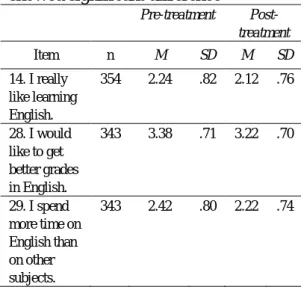
We utilized data from all first-year students for a matched t-test. The results show a significant difference (> .005) in three items, implying that participants changed their beliefs of English-language learning in the following ways (Table 1). In all three of these items, the average scores decreased at the end of the semester.
Table 1. Questionnaire items that showed significant difference
Pre-treatment Post-treatment Item n M SD M SD 14. I really like learning English. 354 2.24 .82 2.12 .76 28. I would like to get better grades in English. 343 3.38 .71 3.22 .70 29. I spend more time on English than on other subjects. 343 2.42 .80 2.22 .74
Although students had similar beliefs about learning English, the results of the end-of-year survey showed a decreased desire to learn English.
There are several possible reasons for these lower scores. For example. The decrease in the item “I spend more time on English than other subjects” may demonstrate students’ desire to learn English in relation to their majors. As students advance to higher grades, they acquire more professional (content) learning, so they learn English through their academic fields. Thus, they spend less time on English-only work.
However, this does not reflect a lessened motivation to learn English; rather students’ desire to learn English will increase if they have access to language-learning resources within their own professional fields.
Survey 2
We divided the answers to Survey 2’s questions into two groups: positive and negative responses about each material’s frequency of use, effectiveness, and how much students liked it (see Table 2).
Table 2. Students’ perceptions of each tool’s use, effectiveness, and how much they liked it.
Not at all
Little Somewhat Very much Use of ALC (n = 364) 34 (9.3) 163 (44.7) 139 (38.1) 29 (7.9) How much they liked ALC 45 (12.4) 194 (53.3) 112 (30.8) 13 (3.6) Effective-ness of ALC 23 (6.3) 137 (37.5) 178 (48.8) 27 (7.4) Use of Hatsuon-kentei (n = 365) 18 (4.9) 130 (35.6) 170 (46.6) 47 (12.9) How much students liked Hatsuon-kentei 47 (12.9) 174 (47.7) 118 (32.3) 26 (7.1) Effective-ness of Hatsuon-kentei 29 (7.9) 124 (34.0) 181 (49.6) 31 (8.5) Use of Open Voice (n = 365) 21 (5.8) 117 (32.1) 168 (46.2) 58 (15.9) How much students liked Open Voice 64 (17.5) 188 (51.5) 104 (28.5) 9 (2.5) Effective-ness of Open Voice 21 (5.8) 128 (35.1) 190 (52.1) 26 (7.1)
Note: Figures in parentheses indicate the percentage.
Many students reported that they did not often use e-learning materials. They primarily used those tools in the classroom, where they were graded on their uses. Furthermore, while only slightly less than half of students felt that the materials were effective, more than half did not like using them. These contradictory perceptions may indicate that e-learning materials are not effective at increasing students’ motivation to learn English.
Conclusions
teachers should be careful not to discourage students and that it is challenging to sustain students’ motivation. While e-learning may seem appealing and effective because people are accustomed to web searches and web-based communication, face-to-face teaching is an equally necessary tool in language education. It is necessary to look for other ways of teaching English in order to maintain students’ positive opinions of language education, including studying abroad or collaborative learning with exchange students. Teachers should carefully examine students’ needs and create an environment that encourages them to construct their own language learning methods in an effective way. Because “learning never takes place in a vacuum” (William & Burden, 1997, p.84), teachers must always be conscious of students’ priorities.
References
株式会社アルク. ALC Net AScademy2. 東 京. Retrieved from
https://www.alc-education.co.jp/academic/net/
株式会社プロンテスト.『発音検定』茨城.
Retrieved from
https://www.prontest.co.jp/wp/soft Dörnyei, Z., & Ushioda, E. (2010).
Teaching and researching Motivation.
London: Routledge.
Horwitz, E. K. (1988). The beliefs about language learning of beginning
university foreign language students.
Modern Language Journal, 72,
283-294.
Kaigai Connection. Open Voice Basic &
Intermediate. 岡山.
Takahashi, S. (2003). The role of
attribution for success and failure in second language reading by Japanese
university students (Doctoral
dissertation, Temple University). Retrieved from ProQuest Dissertations and Theses database. (UMI No. 3097731)
Takahashi, S. (2011). Attribution theory, self-efficacy theory, and their role in metacognitive strategy training in L2 reading. Notre Dame Seishin University Kiyo, 35, 108-116.
Takahashi, S. (2012). The effects of metacognitive monitoring training on L2 reading. Notre Dame Seishin
University Kiyo, 36, 111-119.
Takahashi, S., Sugimura, A., Minamitsu, Y., & Kazahaya Y. (2017). Report on 2016 Okayama Prefectural University students' beliefs in learning English. 『岡山県立大学教育研究紀要』 第 1 巻 1 号 pp. 33-40.
Williams, M., & Burden, R. L. (1997).
Psychology for language teachers.
Cambridge, Cambridge University Press.
高橋幸子・保健福祉学部 杉村藍 ・情報工学部 風早由佳・デザイン学部
岡山県立大学 2016 年度入学生の英語学習に対する認識 本稿は、岡山県立大学 2016 年度に入学した学生を対象として、大学入学当初と 2016 年 度末に学習者ビリーフ(学習に対する態度・不安・願望)を調査した報告である。 主な結果として、多くの学習者が、1年次における英語学習を終えた後、英語学習に対す る意欲を低下させていることが明らかになった。また、e-learning 学習は効果的であると認 めながらも、好きではないと回答した学生が多かった。教師は、学生の英語学習に対するニ ーズが何であるのかを常に意識していかなければいけないことが示唆された。 キーワード:日本人大学生,英語,学習者ビリーフ,e ラーニング