INTERNATIONAL COMMUNICATION : A CASE OF A
JAPANESE JUNIOR COLLEGE
Author(s)
山里、恵子
Citation
沖縄キリスト教短期大学(47): 71-90
Issue Date
2018-01
URL
http://hdl.handle.net/20.500.12001/22167
沖縄キリスト教短期大学紀要第47号 (2018)
HOW TO BUILD A BRIDGE BETWEEN ORDINARY ENGLISH
CLASSES(GRAMMAR AND READING)AND INTERNATIONAL
COMMUNICATION
~ A CASE OF A JAPANESE JUNIOR COLLEGE ~
*短期大学における英文法/英語講読の授業を基盤にした
国際コミュニケーションへの橋渡し
~短期大学での英語教育の一例~
Keiko Yamazato
山 里 恵 子
AbstractForeign language teaching/learning plays a great role in global education, and nobody doubts the English language works as a Lingua Franca anywhere in the world today. Every student at school, and especially at college, is expected to be trained to become a good communicator whenever and wherever he/she encounters others with different languages. However, Japanese college students do not understand this reality well, and they are still worried about grammar translation work in their English classes. So, there is an urgent need to divert them from their inappropriate tasks to more useful tasks that lead them toward becoming good communicators in English.
To educate students to become good communicators using the English language is one of the missions of the English Department of the author’s junior college. She has been interested in finding some good ways to achieve the mission of the department. Communication deals with daily topics or international issues like the Trans-Pacific Partnership(TPP). In the latter case, if students want to join in a communication with others, they will be expected to produce meaningful and cohesive sentences. Therefore, it is very important for the teacher to find some good ways to educate them to do so. The tasks she has utilized in her teaching seem to work well in leading her students one step higher in English communication.
This paper reports about 5 elements:(1)the students’English level, referring to the results of TOEIC tests,(2 )features of the textbooks used in her classes,(3)teacher’s tasks,(4)actual class- work and(5)work results.
The author(teacher)was assigned two ordinary classes, one of which is English Grammar and the other is English Reading. These two classes are reported as Study 1(grammar class)and Study 2(reading class). The main characteristic in Study 1 is that the students are trained to change Japanese sentences to whatever English they know. This is not“translation,”but using the English stored in their minds. The main characteristic in Study 2 is that the students are advised to place a slash between chunks in a sentence in whichever position they want to. They can place slashes as many as possible in a long sentence. The slashes are considered to help the students understand a long sentence relatively easily without going through translation work. To check the work results, the semester ending tests are used. The students’test results are good data to be reported.
The following sections inform of these points in more detail so that you will be able to recognize the unique teaching/learning situation the author made to create a bridge between ordinary English classes(grammar and reading )and international communication.
Keywords: bridge, ordinary English classes, international communication
1. Introduction
The author has been looking for some good study tools which might help her students improve their English ability. Teachers are usually asked to teach ordinary English classes, but not ones specially designed for certain research experiments. It is easy for them to carry out their classes following the textbooks page by page. The author was also assigned two ordinary classes(English Grammar and English Reading)and has worked as hard as possible to help students learn English. So, this paper reports on the students’ class-work in their ordinary classes as a kind of case study. No one can neglect such reports because daily education in ordinary classes is the actual situation of education at school.
As the background of the students’English ability and the characteristics of the classes, she introduces two things: the students’TOEIC scores and the outline of each textbook.
The author describes the meaning of“Bridge”between ordinary English classes and international communication. She also describes how each class was conducted under the name of“Bridge.”
2. Students’ TOEIC results
All freshman students at the author’s junior college are required to take a TOEIC test in April and in September every year. In the school year of 2016, there were 74 students who took the test in April, and 9 months later in January 2017, there were 47. Their average
(mean)scores are as follows.
April 2016 January 2017
Total: 313 367
Listening: 205 243
Reading: 109 125
The highest: 715 685
(Reports given to the author’s college from IiBC April 2016 and January 2017) The two test results show there is a slight improvement in each category except the highest score. The student who got the highest score in each is the same student.
This type of up-and-down is often observed in students’leaming process. The author’s departmental goal of the first step of English education is to lead the freshman students up to the score range 400 ~ 500 by the end of the school year, March 31. Unfortunately, there isn’t any report about their further efforts.
The 66 new comers to school in April 2017 were also assigned to take the test. The result is as follows. It is compared with the National average to know the level of their English ability in Japan.
The author’s students’average scores National average
Total: 297 585.0
Listening: 190 323.3
Reading(Grammar and Reading): 108 261.7
The highest: 630 Not reported yet
(https://toeic-guru.jp/toeic-mean-score 2017.05.25)
The new students’total average(297)is far behind the National total average(585.0). They must be made to know this fact and encouraged to study much harder toward the second test given in January 2018.
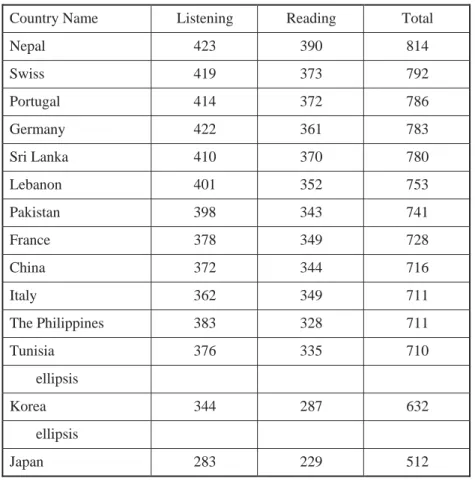
Here are two more good reports that may draw your attention to the TOEIC test results. The reports are about average scores of junior colleges in Japan in 2014 and worldwide test takers’average scores in 2014(Table 1)
TOEIC Average scores of Junior colleges in Japan, 2014
Total: 477 Listening: 280 Reading: 197
Here again the new students’total average score(297)is shown much lower than that of all Japan junior colleges’total average(477).
Table 1: Worldwide test takers’ average scores, 2014
Country Name Listening Reading Total
Bangladesh 464 432 895
Country Name Listening Reading Total Nepal 423 390 814 Swiss 419 373 792 Portugal 414 372 786 Germany 422 361 783 Sri Lanka 410 370 780 Lebanon 401 352 753 Pakistan 398 343 741 France 378 349 728 China 372 344 716 Italy 362 349 711 The Philippines 383 328 711 Tunisia 376 335 710 ellipsis Korea 344 287 632 ellipsis Japan 283 229 512
(2014 Reports on Test Takers Worldwide, https://toeic-guru.jp/toeic-mean-score 2017.05.25)
Table 1 shows people in the world are mastering English while the author’s students are in the early stage of learning English. How can they catch up with them? How can the teacher educate them to become good communicators in the international world? To find the answers to the questions is the main point of this paper.
3. Features of the Textbooks used in English Grammar Class and English Reading Class Textbooks are what students rely on for their learning. Teachers must carefully examine textbooks and choose the most appropriate ones for their classes and their students.
3.1. Textbook for English Grammar Class
Name of the textbook: Forest Comprehensive Grammar for Learners of English, 7th edition, 2015 Author(Supervised by): Teruhiro Ishiguro
Publisher: Kirihara Shoten Contents of each chapter:
Each chapter has grammatical items such as Kinds of sentences, Verbs and Tense, etc. Sample sentences with explanations:
(The textbook explains why Past Progressive is used in the main clause) A few questions: Change the verb in the parentheses into its appropriate form.
Ex. He ran to the station and(catch)the last train. →(caught)
3.2. Textbook for English Reading Class
Name of the textbook: New English Master, 2012
Author: Nagaki Kitayama, Margaret Yamanaka, Keiichiro Fukui Publisher: SEIBIDO,
Contents of each chapter:
Each chapter begins with grammar explanations(ex. nouns, relatives)and exercises Reading material(250 words)
Four Questions about the reading material Dictation(filling in blanks)
Grammar exercise(to explain the underlined parts in the reading material)
4. Meaning of “Bridge”
According to Oxford Dictionary of English(2003), the meaning of“Bridge”is“something intended to reconcile or connect two seemingly incompatible things(the 2nd meaning).” Let me restate the definition of bridge. It is a structure that connects two isolated things.
4.1. Grammar and communication
Grammar and communication are exactly two isolated things and are often taught to students without being related to each other. If a structure(something)connects these two with its elements, then the structure can be a bridge between the two. Grammar deals with rules and communication deals with sending-receiving people’s thoughts. Thoughts are observed in sentences emitted by message senders. If the students in Grammar Class practice to produce grammatical and meaningful sentences, this practice could work as a bridge between Grammar Class and Communication. However, the author’s students are not enthusiastic to emit many sentences. If they produce two sentences, they will be satisfied with their work. So, the teacher gave some Japanese sentences not to make the students translate them into English, but to advise that they should emit their English in their mind which might have the same meaning of the Japanese sentences. They depend on familiar words(Yamashita, 2012)or expressions in real situations. For example, they may choose one of the English sentences below to describe one situation.
It has been raining these days. It rains every day.
We are in the rainy season.
It is rainy today.
We have a lot of rain recently.
The students were urged to change the given Japanese sentences to English.“This practice of changing Japanese into English ” could be a “ bridge between English Grammar Class and Communication”because they are given more than five Japanese sentences with which they can convey a kind of meaningful thought.
4.2. Reading and communication
Reading and communication are another pair of isolated things. The nature of communication is already stated above. Reading involves receiving information and understanding it. “ Understanding ” is usually done by“translating”the information
(reading materials in the textbook)in English Reading class in Japan. If English and the
students ’ native language have the same word order,“ translating ” the information will be good practice to join“communication.”For, the students can understand each sentence following the word order smoothly. However, the Japanese language has totally different word order from the English language. So, the work of translation requires much more time of each student to make him-self/her-self understand each English sentence. Here is an example.
English sentence:
Charlie Chaplin made the main character in The Tramp from clothes that were in a dressing room at a Hollywood studio.(Kitayama, New English Master, 2016)(cf. Appendix 1)
Replacement of the above English words along with Japanese word order:
Charlie Chaplin a Hollywood studio in a dressing room from clothes The Tramp the main character made.
Japanese:
チャーリー・チャプリンはハリウッドのスタジオの楽屋にあった服から『チャプリンの失 恋』の主人公を考え出しました。(Kitayama, Teachers Manual, 2016)
The main verb appears at the end of the sentence in Japanese while it appears right after the subject in English. So, Japanese students always struggle in understanding information.
There is another important element in Reading class as well as“communication.” That is“ responding”to the information they receive. Understanding the received information and responding to it are done quickly in the actual situation of communication. Others outside of the English Reading class do not wait for Japanese
students to finish a series of their work starting with translating the information, understanding it and then responding to it. But, it surely takes a long time. Japanese students are really required to understand the information as quickly as possible and respond to the information as much as possible. Therefore, to exercise reading- understanding as quickly as possible and responding as much as possible could be a bridge between Reading Class and Communication.
If the students can make groups of words(chunks)in a long English sentence, they will be able to understand the sentence following the group(chunk)order.
Example:
Charlie Chaplin made the main character in The Tramp from clothes
that were in a dressing room at a Hollywood studio
With slashes:
Charlie Chaplin made the main character in The Tramp / from clothes / that were in a dressing room / at a Hollywood studio.
Each group can be understood by the students relatively easily. This group order makes the students understand the whole sentence relatively quickly. So, in class they were advised to place a slash between groups(chunks). They were also allowed to have many slashes in a long sentence.
Another aid to improving their understanding is a question-answer exercise. Having many questions, they will pay more careful attention to the information and will try to answer the more thought out questions in the textbook. Therefore,“the practice of placing a slash between chunks(there are many chunks and slashes in a long sentence) and responding to many questions”could be a“ bridge”between English Reading Class and Communication.
5. Methodology
The author handles two studies for this paper. One of them is Study 1 which indicates Grammar Class and the other is Study 2, Reading Class. The purpose of these studies is to show a bridge between ordinary English Grammar Class and Communication, and another bridge between ordinary English Reading Class and Communication.
5.1. How to conduct practices Two studies are introduced here.
The bridge between this class and communication is the practice of changing Japanese sentences made by the teacher as her task to whatever English sentences the students would like to use. For this report, the semester ending test(one part related to this paper)was used to see the result of ordinary class work.
Steps of the practice for everyday class 1. Students were given Japanese sentences.
2. They were asked to change the sentences into English however they like.
3. They were asked to write their sentences on the board in the classroom(one sentence per student). 4. The sentences on the board were checked by all the students and the teacher
5.1.2. Study 2: English Reading Class
The bridge between this class and communication consists of two practices: one of them is to place a slash between chucks(many slashes are placed in a long sentence)and the other is to answer many questions.
Steps of placing slashes
1. Students were given new reading material.
2. They were asked to place slashes wherever they want to.
3. They were asked to check the meaning of each chunk and to guess the whole meaning of the sentence.
Steps of answering questions
1. Students were given 10 questions about the new material. The questions were made by the teacher as her task.
2. They were asked to answer the questions.
3. They were asked to answer four questions in the textbook about the same reading material.
6. Results and Discussion
Using the semester ending tests, the results of Study 1 and study 2 are examined because it is very important to see their learning outcomes(Horava and Curran, 2012)which are seen more clearly in tests. On the other hand, the students in each study were given a questionnaire to evaluate the class work. The responses to each questionnaire are also examined in this section.
6.1. Study 1(English Grammar Class)
The teacher wanted to know how students felt about the class-work as a bridge between English Grammar Class and Communication. The questions are about: Likes/Dislikes of grammar, Likes/Dislikes of changing Japanese sentences to English sentences, and Usefulness of practicing changing Japanese to whatever English they know.
The teacher wanted to know how students felt about the class-work as a bridge between English Grammar Class and Communication. The questions are about: Likes/Dislikes of grammar, Likes/Dislikes of changing Japanese sentences to English sentences, and Usefulness of practicing changing Japanese to whatever English they know.
The total number of students in this class is 25. Their likes and dislikes are observed in the column of Yes or No. And the reasons of Yes/No are also observed in the right- hand column. The reasons in the column are the summarized ones of 25 students’ answers.
The total number of students in this class is 25. Their likes and dislikes are observed in the column of Yes or No. And the reasons of Yes/No are also observed in the right- hand column. The reasons in the column are the summarized ones of 25 students’ answers.
Table 2. Students’ attitude toward English Grammar Class Table 2. Students’ attitude toward English Grammar Class
Item
Item Yes Yes No No Reasons Reasons
Do you like Grammar?
15 ・I feel happy if I solve the problems. ・Grammar helps me speak English.
10 ・difficult, hard to memorize grammar rules, complicated Do you like Changing
Japanese to English?
21 ・It is a good practice of communication in English. ・It makes me try to use MY English.
4 ・difficult
・2 or 3 sentences are good enough, but not more. Is this practice
Changing J → E Useful?
25 ・Practicing emitting sentences makes me speak easily. ・The practice seems to have made me improve my English. 0
Total number of students 25
Although one of the reasons of negative answers to the second question states“2 or 3 sentences are good enough, but not more, ” all the 25 students answered the practice of changing Japanese sentences to English was useful. As far as the numbers of“Yes”and reasons on Table 2 are concerned, the practice is well accepted.
6.1.1. Comparison of two writings
Two writings as examples are introduced here to see if there is a difference in learning between the two students even though they got the same education. Two native speakers of English were asked to evaluate the two writings. The author gives an overall rating to all the student’s works based on the native speakers’evaluation.
Writing 1.
There were many rainy days last week. I have some events but they were canceled. If l Sunday was sunny, I would go to Oonoyama park with my classmates.
There are some grammatical mistakes in Writing 1, but it tells how hard she tried to change the given Japanese to English.
The evaluation of the work by two native speakers of English(college teachers):
Two native speakers of English were asked to examine the student’s work and evaluate it according to a scale. The highest score is 10 and the lowest is 1. The two native speakers gave 7 points to the work with comments as follows:
The language is simple, which means it is easy to understand the meaning. A lot of information was included in a relatively small amount of text.
The Grammar/vocabulary choice is pretty good. Having said that, there were some mistakes with tense.
Writing 2
We made many games.
The student said“Will Aozore teacher join this?” and someone answered“he/she will pick up
the graduated student at the airport and come with him/her.”
He/she works at the Nissan company in
Yokohama. All of workers speak English in this company. I was looking forward to talk to them and play games. But the day was raining and the picnic was canceled.
All of my classmates wanted to see the graduated student so we asked to Aozora teacher that“ please find the place where we can see him/her.” And teache said to us
“If you know Machida syokudou, we can meet up there at 3 pm.”The syokudou is by Urasoe musium and we know there. The day, I talked with the teacher, graduated student and classmates.
It was really fun even though the picnic was canceled.
The two native speakers of English gave a score of 3 and 4 with their comments as follows: The two native speakers of English gave a score of 3 and 4 with their comments as follows:
There are many basic grammar mistakes, and this makes the meaning hard to understand in places There are many basic grammar mistakes, and this makes the meaning hard to understand in places There are lots of spelling mistakes.
There are lots of spelling mistakes.
The biggest weakness of this piece of writing was its structure and how sentences related to each other
The biggest weakness of this piece of writing was its structure and how sentences related to each other
Having the comments, the teacher should carefully modify the writing as her task to make it more understandable for native speakers of English. However, what the teacher can say here is that the student tried very hard to emit as many English sentences as possible. This student didn’t give up on her challenge. The student’s attitude of emitting English sentences should be admired because this attitude is needed in communication. The teacher is expected to give the student a careful advice to pay more attention to grammar.
Having the comments, the teacher should carefully modify the writing as her task to make it more understandable for native speakers of English. However, what the teacher can say here is that the student tried very hard to emit as many English sentences as possible. This student didn’t give up on her challenge. The student’s attitude of emitting English sentences should be admired because this attitude is needed in communication. The teacher is expected to give the student a careful advice to pay more attention to grammar.
The originals of the two examples and the Japanese sentences are in the APENDIX, 3, 4, 5) The originals of the two examples and the Japanese sentences are in the APENDIX, 3, 4, 5)
A lot of school festival are canceled.
If it had sunny last week, I could have went to Onoyama park with my friends.
We think a lot of game.
One student told us,“Aozora teacher into the picnic?”
One student answer to him,“Teacher pick up graduate student. Then come to park with graduate student.”
Graduate student working of Nissan company in Yokohama Everybody using English in this company..
I want to speaking with him and game.
But, Picnic was canceled. Because, this day was raining.
Class mate asked Aozora teacher,“Looking for a place, we want to graduate student.”
Teacher told us,“If you knew Machida restrant, you would come this place. ”
Everybody know to the restrant by Urasoe hakubutsukan. Teacher, senior, classmate are talking.
6.1.2. The semester-ending test results of all the students of English grammar class When we have a chance to read a bunch of English sentences, we pay our attention to how much we understand them. If we get a lot of information from them, we are satisfied. The teacher uses this“satisfaction”as a tool to evaluate the students’works referring to the two native speakers’judgements given to the two writings. If the teacher sees grammatical sentences, she will be happier. Therefore, the“satisfaction”as an evaluation tool consists of“much information and grammaticality”. The full point is 10. Point 5 means understandable. Point 6, 7, 8: better. Point 10: excellent.
Table 3. Scores of Satisfaction and number of students
score 10 9 8 7 6 5 4 3 2 1
Number of students 0 0 0 4 5 8 6 2 0 0
Table 3 shows there are 17 works that are understandable and 8 works that need to be carefully modified. As is already mentioned above, trying to produce as many sentences as possible is required in an actual situation of communication. Although there isn’t any student who got a perfect score in the test, Table 3 tells there are four students who got 7 points, and this high score indicates that these students are able to join in communication attended by college students. 13 students who got a score of 6 and 5 are expected to catch up with these four. There are 8 students who must pay careful attention to grammar to make their works more understandable to native speakers of English. However, they showed their challenges to produce more than two sentences.
6.2. Study 2(English Reading Class)
Reading naturally requires“understanding and responding.”Ordinary Japanese college students try to understand what they are reading by translating it into their native language. If the two languages have the same word order, the translation work will be helpful for them. If one language has totally different word order from the other one, the work of translation gives stress to the students. However, even Japanese simultaneous interpreters translate any sentence from head to toe. They use a special technique which enables them to do so. They insert a slash between chunks. Having many slashes in a long sentence, they can understand the sentence and translate chunk by chunk up to the end. This is known as sight translation(Yamazato, 2003). The author introduced this technique to her students to help them read and understand more smoothly what they are reading. The following Table 4(questionnaire )tells what the students thought of the practice. Another important task of the teacher in a reading class is to help them improve their understanding. Question-answer exercises are usually used for this purpose. Having many teacher-made questions, they will be given more chances of paying attention to the information and will try to answer to the well thought out questions provided in the textbook. Table 5 tells how many they could answer to the teacher-made questions(10
questions)and the questions(4)provided in the textbook.
6.2.1. Questionnaire about the class-work
Table 4: Students’ attitude toward the exercise of using slashes
Item Yes No/? reasons
Do you like the exercise of placing slashes in a sentence? 29
・felt easy to read
・could understand the material better ・could answer questions better ・improved my reading ability
・could be applied to EIKEN(English test for Japanese)
2/1
・ordinary reading is good for me
・prefer reading sentences without slashes ・couldn’t understand this exercise
Do you think the practice of placing slashes
is useful?
16
・could understand word order
・helped me read and understand long sentences better
・ gave me a good hint how to make and speak longer sentences
12/4
・not needed in communication ・prefer not to have slashes ・no comment
Total number of students 32
Having 29 positive answers to the question“Do you like the exercise of placing slashes in a sentence) out of 32, it can be said that most students liked the practice. Two students gave negative answers and one student couldn’t understand the exercise. To the second question“Do you think the practice of placing slashes is useful?,”16 students gave their positive answers, but 12 students preferred not to have slashes. Four students didn’t give any comments. Half of the students in class thought the practice was useful. The other half gave negative answers. In as far as many students out of 32 liked the practice, it can be said the practice was good for them.
6.2.2. How well the students responded to the teacher made questions and the questions in the textbook
Table 5: Teacher-made questions(TMQ)and questions in the textbook(QT)
TMQ 10 9 8 7 6 5 4 3 2 1 0
NCA1 1 2 5 9 2 8 3 1 0 0 1
QT 4,3,2,1 4,3,2,1 4,3,2,1 4,3,2,1 4,3,2,1 4,3,2,1 4,3,2,1 4,3,2,1 x x 3
NCA 2 0,1,0,0 1,1,0,0 1,2,2,0 3,2,4,0 0,1,1,0 0,1,7,0 0,1,2,0 0,0,1,0 0 0 1
TMQ: Teacher Made Questions(10 questions)
QT: Questions in the textbook(4 questions)
NCA2: Number of Correct Answers to four questions in the textbook
If you move your eyes along with the arrow, you will read the 2nd column on the left as follows. 10 questions were answered correctly by 1 student and she answered 3 questions in the text correctly. NCA 2 is read from left to right. 9 questions answered correctly by
2. One of them got 4 correct answers in QTs and the other got 3 correct answers in QTs. So, the summary of NCA 2(calculation: addition)will go like this:4 points(5 students), 3 points(9), 2 points (17), 1 point(1). That is, 4 questions in the textbook were answered correctly by 5 students; 3 questions answered by 9; 2 questions by 17(half of the students); 1 by 1.
Before starting this practice of using slashes and answering many questions, most of them got 2 correct answers out of 4. Table 5 shows there are still many students
(half of them)who got only 2 correct answers. However, as it is reported earlier, there appeared 5 students who got 4 and 9 students who got 3. Considering these facts, placing slashes in long sentences and answering many questions have helped them read the reading material easily and understand it better.
7. CONCLUSIONS
It is English teachers desire to educate students to become good communicators in English due to the present world movements in many fields. In today’s globalized world, business needs people from every corner of the word; politics also needs people who understand others beyond different cultures to keep the world in peace. Sports require good athletes who can enjoy competing against their opponents with good manners. Therefore, the author has tried to educate her students to become good communicators in English conducting the assigned ordinary English Grammar Class and English Reading Class. Text books are naturally used for the classes, but they do not have good exercises or practices for that purpose. She introduced new ways of teaching to achieve the purpose. She made the students change given Japanese sentences into whatever English they know. Before this practice was introduced, the students couldn’t write more than two sentences to express their minds. However, the practice made them produce many more sentences. Although the produced sentences need grammatical corrections, they show the students had their will to emit more sentences. And the results of the questionnaire show they felt favorable to the teaching/learning atmosphere in class. Therefore, the exercise of changing given Japanese to English worked well as a bridge between this English Grammar Class and communication.
In the case of English Reading Class, as a bridge between the class and communication, two practices are introduced. One of them is placing slashes in sentences to make word groups(chunks)in a long sentence. Each group(chunk)is short enough for students to understand the meaning of it easily. Students need not to be bothered
with translation work. Many of the students liked this way of reading, but some of them reported they liked to read sentences without slashes.
The other practice in this reading class was giving/answering many more questions about the reading material. By answering many questions, they were supposed to understand the whole reading material better. Each chapter of the textbook provides only 4 questions. Before the practice started, none of them could get more than two right answers. The practice helped 5 students get 4points, 9 students get 3points while 17 students got 2 points. The practice shows it can be a bridge between English Reading Class and communication.
If a teacher deals only in rules in English Grammar class, he/she will lose a chance to let them use their English in their minds. Even if the sentences they have emitted are not grammatical, they should be encouraged to produce sentences as many as possible, and the teacher and the students work together to modify the sentences. William Littlewood says,“The learners’focus should be more firmly on the communication of meanings, rather than on the practice of language(Littlewood, 2005).”In addition, we know people learn a lot from mistakes. Therefore, this paper is concluded as follows:
A bridge between ordinary English Grammar Class and international communication is to practice changing Japanese sentences to English.
A bridge between ordinary English Reading Class and international communication is to practice placing slashes in a long sentences and answering many questions about the reading text.
Notes
◆ An oral presentation with the same title(with a little chang: SET → BUILD)was given by the author at the 10th annual International Conference of Education, Research and Innovation held in Seville ( Spain ), 16th
-18th of November, 2017. The title is“ HOW TO SET A BRIDGE BETWEEN ORDINARY ENGLISH CLASSES ( GRAMMAR AND READING ) AND INTERNATIONAL COMMUNICATION ~ A CASE OF A JAPANESE JUNIOR COLLEGE ~”
REFERENCES
Curran. Bill, Horava. Tony,“The Importance of Case Studies for LIS Education”Digital commons
@University of Nebraska-Lincoln,Summer Nebraska, USA,
2012. http://digitalcommons,unl.edu/libphilpra
Fukui. Keiichiro, Kitayama. Nagaki, Yamanaka. Margaret, New English Master, SEIBIDO, Tokyo, Japan, 2016.
Ishiguro. Teruhiro, Forest, 7th Edition, Tokyo, Japan, Kirihara Shoten, Tokyo, Japan, 2015. Littlewood, William, Communicative Language Teaching, Cambridge University Press,
Cambridge, 2005, p.50.
Oxford Dictionary of English, Oxford University Press 2003,
Reports given to the author’s college from IiBC April 2016 and January 2017 Reports given to the author’s college from TOEIC-IP, April, 2017.
Yamashita. Miho,“Corpus-Bases Comparative Analysis of Reporting Verbs in English Essays Written by Four Language Nationalities,”Jacet Journal, No. 55, p. 71, The Japan Association of College English Teachers, 2012.
Yamazato, Keiko,“Interpretation and Translation”, Introduction to Language Education
(translated by the author『言語教育学入門』compiled by Yamauchi, Susumu, Taishukan Shoten, 2003. P.77.
Zhang, Xiaopeng,“Second Language Users’Restriction of Linguistic Generalization Errors: The Case of English Un-Prefixation Development,”Language Learning, The University of Michigan by Wiley, Volume 67, Number3, 2017.
Appendix 2 Teacher-made Questions