Studies of Bottom Surface Sediments of South
Yatsushiro Kai
著者
MOJARES Edwin M., TOMITA Katsutoshi, RIFARDI,
OKI Kimihiko, KAWANO Motoharu
journal or
publication title
鹿児島大学理学部紀要. 地学・生物学
volume
29
page range
1-19
別言語のタイトル
八代海の海底堆積物中の鉱物学的研究の予報
URL
http://hdl.handle.net/10232/6049
Preliminary Report on the Mineralogical
Studies of Bottom Surface Sediments of South
Yatsushiro Kai
著者
MOJARES Edwin M., TOMITA Katsutoshi, RIFARDI,
OKI Kimihiko, KAWANO Motoharu
journal or
publication title
鹿児島大学理学部紀要. 地学・生物学
volume
29
page range
1-19
別言語のタイトル
八代海の海底堆積物中の鉱物学的研究の予報
URL
http://hdl.handle.net/10232/00012452
Preliminary Report on the Mineralogical Studies of Bottom
Surface Sediments of South Yatsushiro Kai
Edwin M. MoJARES*, Katsutoshi ToMITA*, RIFARDl*, Kimihiko Okis
and Motoharu KAWANO
(Received September 5, 1996)
Abstract
Mineralogical investigation of bottom surface sediments was conducted
●in the relatively shallow marine environment of South Yatsushiro Kai. Identification of clay fraction minerals in this study was made chiefly by XRD
● ●
analysis complimented with SEM method in determining the type of clay and
non-clay mineral suites present in the sediments. Based on analysis results, detrital clay minerals are dominated by illite; chlorite is the second most abundant clay mineral type, followed by kaohnite, smectite and the least
abundant 10 A halloysite. This suite occurs in all samples analyzed and closely
reflects the type and character of the surrounding source rock and soil sedi-merits. It is unlikely that homogenization of clay mineral suite occurred in this environment since variable transport mechanisms and associated sediment mixing are operative.
Sediment samples also contain considerable proportion of other materials not usually regarded as clay minerals such as quartz, calcite/aragonite, feld-spar and subordinate amount of pyrite, hornblende, gypsum and clinoptilolite. Key words: bottom sediment, mineral suite, clay fraction, South Yatsushiro
Kai
Introduction
Yatsushiro Kai is a semi-enclosed, bay-like body of water in the west central margin of
●
Kyushu mainland. It is one of the most thoroughly studied sites of water effluent and environment pollutant in Japan since the discovery of Minamata disease in 1950's. Other
● ●
significant studies conducted in the area include the ecological investigation of benthic
Institute of Earth Sciences, Faculty of Science, Kagoshima University,ト21-35 Korimoto, Kagosmima, 890 Japan
Department of Environmental Sciences and Technology, Faculty of Agriculture, Kagoshima University, 1-21-24 Korimoto, Kagoshima, 890 Japan
Edwin M. Mojares, Katsutoshi Tomita, Rifardi, Kimihiko Oki and Motoharu Kawano
ecosystem by Tanaka et at. (1987); and the sedimentological report of Rifardi and Oki (1996) on recent marine sediments of South Yatsushiro Kai which highlights some excellent observations on textural characteristics of bottom sediments and behavior of marine currents.
From the same set of sediment samples analyzed by Rifardi, a supplementary minera-logical investigation was carried out utilizing the XRD and SEM methods of mineral
● ●
analysis. This paper presents the results of such investigations which aim to obtain a comprehensive summarization of the character, composition and provenance of clay mm-eral and non-clay minmm-eral constituents in the sediments. It should be noted that clay analy-sis in this report is not quantitative but merely comparative iムterpretation of intensities of
●
X-ray reflections and description of clay's morphological characteristics.
Although this paper contains mostly mineralogical data, some relevant information on continental and marine transport/deposition are briefly discussed to support the depositional features and origin of the mineral suite.
●
Background
A.Geology
Like most of the fine grain size phyllosilicates found in marine environment, the clay and non-clay mineral suites present in the bottom sediments of South Yatsushiro Kai are detrital or allogenic and reflect the composition of the source rocks. Apparently, mineral distribution is closely linked to the vast exposures of sedimentary, volcanic and metamor-phic rock formations observed in the adjacent areas as shown in Fig. 1.
The oldest rocks sorrounding the bay are early Paleozoic low grade metamorphic rocks in the northeast coast which consist mostly of biotite slate and some unmetamorphosed mudstone and sandstone. Deposits of limestone, chert and mafic volcanic rocks are of subordinate amounts (Katada and Yamada, 1977).
Most islands in the west side of the bay are underlain by: 1) several late Cretaceous sedimentary formations of the Goshonoura, Onagawa, and Shimanto Groups which are composed mainly of mudstone, shale and conglomerate and by 2) Eocene clastic rocks consisting predominantly of mudstone and sandstone with coal seams. This Paleogene
●
formation was subsequently intruded by quartz diorite and granite porphyry during middle
Miocene time.
Pyroclastic materials and lava flows of hornblende andesite cover most part of the area S-SE of Yatsushiro Kai. These rocks are the same volcanic rocks found in Nagasaki prefecture which were repeatedly erupted during Neogene volcanism (Isshiki, 1977).
Recent deposits composed of unconsolidated silt, sand and gravel are commonly found on river beds and floodplain while terrace deposits occupy most of the river banks and adjacent low lying terrane.
130o15 32o 10● 「■ √・十㌧︰ -4 . 1 ● ヽ l ▼● ′ ′ m t j ● ● ー - ●
[==I Alluvium and terrace deposit
に≡ヨAndesite
EヨGranite porphyry
囚Sandstone, mudstone and conglomerate
with coal seams
ⅢⅢD Sandstone, shale and conglomerate
( Shimanto Group )
匡≡ヨSandstone, shale and conglomerate
( Onagawa Group )
Sandstone and sha一e with conglomerate
( Goshonoura G叩. )
厩…却Slate, sandstone,basa一t,chert, limestone
and conglomerate
I喜喜ヨ =ne schist
Figure 1 Geological map of the area surrounding South Yatsushiro Kai (after Imai et aL, 1979)
Edwin M. Mojares, Katsutoshi Tomita, Rifardi, Kimihiko ()ki and Motoharu Kawano
B. Environmental Condition of South Yatsushiro Kai
The presence of several islands which nearly enclosed the coastal water of the west central margin of Kyushu mainland has brought the present bay-like configuration of South
●
Yatsushiro Kai. It is connected to the deeper marine environment by three main bay-mouths; two of them are located in the western side of the bay and the other one in the south. Based on the environment's geomorphological outline, Yatsushiro bay might had
●
been formed from valley drowning when sea-water rises during land submergence. This is
● ●
supported by the existence of several features of submerged shorelines where estuaries have developed in river mouths.
Some characteristic features of the bay are given in Table 1. All data presented in this
■
table were taken from the initial report of Rifardi and Oki (1996).
Table 1. Characteristic features of South Yatsushiro Kai
Area A pproxim ately 546 km え(lenght- 39 km ;w idth - 14 km )
Subm arineTopography Characterized by m oderately gentle slope except in som e portions nearthe w estern coastw here channel-like topography exists.
Bottom Current North and south to southeasterly flow ing bottom currents are active near bay-m outh areas and becom ing less actiVe tow ard the shallow ercentra-area■
TidalC urrent Strong tidalcurrents persistw ithin the bay-m outh areas and also along or nearthe shore ines .
Sedim entM ateri al Sand- size m aterials predom inate in the surface sedim ents but silty sand to m uddy sand are com m on nearthe east coast.
Sedim entTexture
Generally poorly sorted;coarsergrained sedim ents occupy the deeper portion of the bay w here strong bottom currents exist; sand to siltsize m aterials are com m only found in coastalareas w hi暮e silty sand to m uddy sand sedim ent predom inate nearthe centerofthe bay.Also,som e fine sedi-m erits are Strikingly concentrated in the northeastern shore■
W aterD ep仙 Com m only rangina fr0m 40m to 50m depth nearthe w estern coast and progressively decreasing toward the shallow er eastern coast.
Bottom W aterTem perature Ranging from 9℃to 11.岳℃(during March 1996 sam pling)
Bottom W aterpH Ranging from 7.3 to 7.8 (surface w aterpH is relatively lowertow ard the near-shore environm ent particularly in river-m outh estuaries.)
C. Sediment Transport and Deposition
The large bulk of source sediment material surrounding the bay is transported by
■
several continuously flowing rivers. It is later deposited in near-shore environment and only during major storms or floods does much sediment escape the near-shore area.
●
Theoretically, most of the coarse sediments are deposited near the coast while much of the fine grained sediments (silt to mud size fractions) containing clay minerals are distributed seaward to the mudline area at a depth at which the proportions of clayey silt, silty clay
and clay reach a near maximum value (Stanley and Wear, 1978). However, some mud
sediments are trapped and remain in near-shore environment, most frequently near river estuaries and subaqueous deltaic plain. In most cases, a significant amount of fine clays are
●
held in suspension during river transport and once these suspended materials escape the
■
river and estuaries, they are exposed to various marine currents which determine how much are trapped on the near-shore areas and how much escape to the deep marine environment
(Weaver, 1989 ).
Sediments which are previously deposited on the offshore marine environment can be transported by either active tidal current or bottom current and redeposited them to the near shore environment. The resulting reworked sediments are usually a mixture of mate-rial from the two source areas.
Material and Method
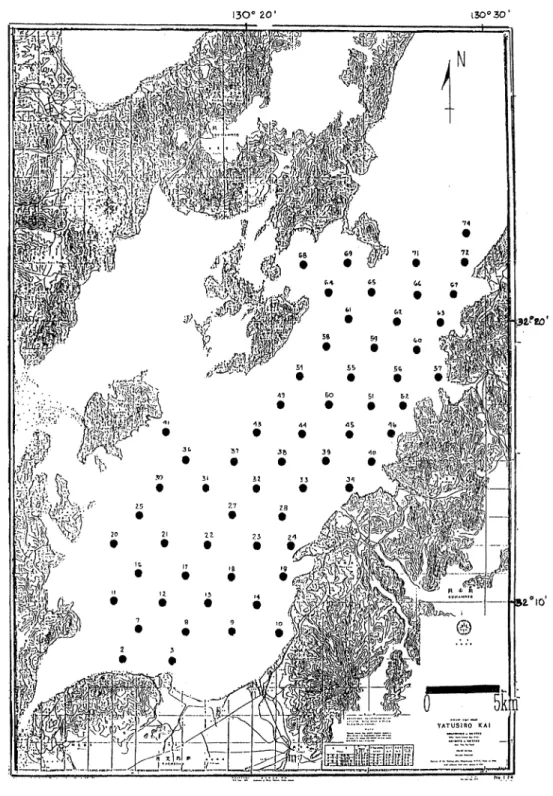
The sixty (60) sediment samples used in this study represent the upper two (2) centime-ters of the core sediments collected by Rifardi. Figure 2 shows the map indicating the sampling locations of all specimens analyzed.
All samples were examined by X-Ray Diffractometry (XRD) method while only repre-sentative specimens were observed using the Scanning Electron Microscope (SEM).
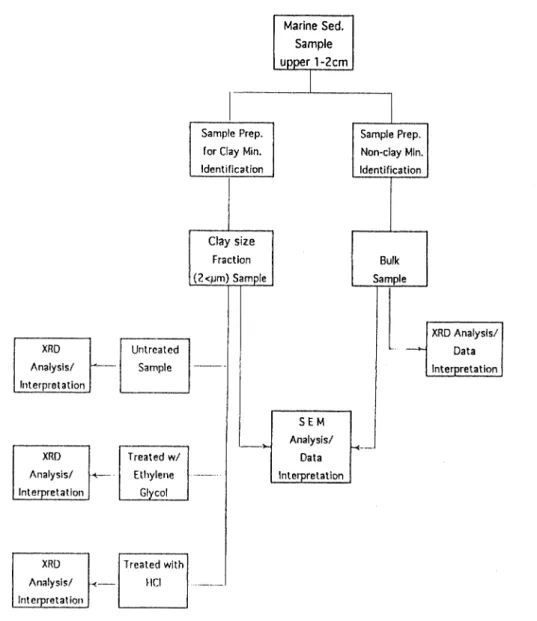
Pro-cedures of mineralogical investigation are given in Figure 3.
●
For X-ray analysis, two sets of sample preparation were made for each raw sample;
●
one for clay mineral (<2/fln) identification and the other for non-clay (bulk) mineral identification. Separation of the clay (<2/fln) from silt fraction was made by sedimenta-tion and centrifugasedimenta-tion and the obtained slurry of <2〃m particles was sedimented and dried on a glass slide (oriented mount sample) for clay analysis. All oriented samples were then subjected to ethylene glycol solvation while some selected <2〃m specimens were separately prepared for HCl treatment. Untreated, glycolated and HCl treated samples were all sub-jected to the Rigaku (Geigerflex) X-ray diffractometer under 30 Kv, 15mA operating
condition. For non-clay mineral identification, bulk samples preparation include some procedures like air drying and powdering of raw samples prior to mounting on the glass
● ● ●
slide.
To determine the morphological characteristics of the clay size fraction minerals, a
special high magnification Scanning Electron Microscope (Hitachi S-41005) was used.
Specimens for this analysis were prepared by placing raw samples on a double sided adhe-sive tape sputtered with Au-Pd alloy to ensure electrical conductivity and to prevent
Edwin M. Mojares, Katsutoshi Tomita, Rifardi, Kimihiko ()ki and Motoharu Kawano
IうOo 20■ L30- 30
Figure 2. Map of South Yatsushiro Kai showing sampling locations of all bottom
Figure 3. Flow chart showing procedures of mineralogical investigation of bottom sediment samples
Edwin M. Mojares, Katsutoshi Tomita, Rifardi, Kimihiko Oki and Motoharu Kawano
●
charging effects. Images generated by the emission of secondary electrons were examined in the phosphorescent screen of the instrument.
Results and Discussions
Analyses of sand, silty sand and muddy sand samples in recent sediments from various localities within South Yatsushiro Kai indicate similar clay mineral suite of Illite-Chlorit e-Kaolinite-Smectite-10Å Halloysite type (in decreasing abundance) , but relative
propor-tions of these clay species vary from sample to sample. It seems that water currents in this environment are not particularly effective in segregating clay minerals by size. In part, this is because the clay minerals commonly occur as mixed mineral aggregates and even if they are dispersed, they commonly are deposited on and in sands during conditions of slack
●
water after the sand is deposited (Weaver, 1989).
The most striking feature of the clay mineral suite is the presence of relatively high content of lllite and chlorite in almost all specimens. Its been noted that chlorite is always
●
a significant component in areas of illite-high, both in near-shore and offshore environ-merits. Kaohnite and smectite are also important clay mineral species in the sediments but their presence is considerably variable. Kaolinite has a point source and is derived almost entirely from several major rivers containing kaolinite-altered materials while smectite
●
occurs as alteration product of volcanic rocks and is commonly dispersed seaward by active
marine currents. The clay mineral 10 A halloysite is commonly of subordinate amount but
nearly present in all samples.
Among the non-clay minerals identified, quartz is predominant in all specimens, along with feldspar and calcite/aragonite. Minor amount of other detrital minerals are present
like pyrite, gypsum, hornblende and zeolite (probably clinoptilolite)
It is plausible that all the phyllosilicates and non-clay minerals in the sediments of South Yatsushiro Kai were current transported (density current or bottom-water flow and shallow water currents) and derived from the major rivers draining the area of west central Kyushu.
Identification of detrital minerals and their provenance are discussed below.
CLAY MINERAL COMPONENT
Ilhte
The diffraction pattern of illite is characterized mainly by intense peak in the region of
●
10Å and a relatively weaker peak at 5Å. These peaks remain unaltered upon ethylene glycol
solvation and upon treatment with 6N HCl at boiling condition (Figure 5). Well defined X-ray reflection is attributed to the moderately high crystallinity of illite mineral in almost all samples.
In electron micrograph, illite appears thin and platy (Figure 4B, 4E) and sometimes shows a crude hexagonal habit. It usually occurs on the surface of fine sediment materials
Table 2. List of clay minerals present in the bottom sediments of South Yatsushiro Kai
S a m p le N 0 ■
C l a y M i n e r a l C o m p o n e n t
S m e c t ite C h lo rite Illite K a o in ite H a llo y 由te
S t-2 ★ ★★ ★★ ★ ★★ S t-3 ★ ★★ ★★★ ★ ★ S t-7 ★ ★★ ★★ ★★ ★ S ト 8 ★ ★★ ★★ ★ ★★ 日● ★★ S t-9 ★ ★★ ★★★ ★★ S t- 1 0 ★ ★★ ★★ ★ s t- n ★★ ★★ ★★ ★ ★ S t- 1 2 ★ ★★ ★★ ★★ ★★ S ト 1 3 ★ ★★ ★★★ ★ ★ S t ー1 4 ★ ★★ ★★ ★★ ★★ S t -1 6 ★ ★★ ★★ ★★ ★ S t ー1 7 ★ ★★ ★★ ★★ ★ S ト 1 8 ★★ ★★★ ★★ ★ ★ S t -1 9 ★ ★ ★★ ★★ ★ S t-2 0 ★ ★★ ★★ ★★ ★★ S t-2 1 ★★ ★★ ★★★ ★ ★ S t -2 2 ★★ ★★ ★★★ ★ ★★ ●日 ★★ S t-2 3 ★ ★★ ★★★ ★★ S t-2 4 ★ ★ ★★ ★★★ S t-2 5 ★ ★ ★★ ★★ ★ S t-2 7 ★ ★★ ★★★ ★ ★ S t-2 8 ★ ★★ ★★ ★ ★ S ト 3 0 ★ ★★ ★★★ ★ ★ ●日 ■●■ ★ S t-3 1 ★ ★★★ \ ★★★ ★ S tー3 2 ★ ★★ ★★★ ★★ S t-3 3 ★ ★★ ★★ ★★ S t-3 4 ★★ ★★ ★★ ★ ★ S t-3 6 ★ ★★ ★★ ★★ ★ S t-3 7 ★ ★★ ★★ ★ ★ S ト 3 8 ★ ★★★ ★★ ★ ★ ●日 ★★ S ト 3 9 ★ ★★ ★★ ★★★ S ト 4 0 ★ ★ ★★ ★★ S t-4 1 ★ ★★ ★★★ ★ ★ S ト 4 3 ★ ★★★ ★★ ★ ★ H ● ★ S t-4 4 ★ ★★★ ★★ ★ S t-4 5 ★ ★★★ ★★ ★ S t-4 6 ★★ ★★ ★★ ★ ★ S t-4 9 ★★ ★★ ★★ ★ ★★
10 Edwin M. Mojares, Katsutoshi Tomita, Rifardi, Kimihiko Oki and Motoharu Kawano
Table2 (cont'd)
te
N0●
C lay
M ine ra l
C o m po n 叩 t
Smectite
Chlorite
Mite
Kaolinite
Halloysite
S t-5 0 ★ ★★ ★★ ★★ ★ ■●● ★★ S ト 5 1 ★ ★★ ★★ ★★ S t-5 2 ★ ★★ ★★ ★ S t-5 4 ★ ★★ ★★★ ★★ ★ S ト 5 5 ★ ★ ★★ ★★★ ★ S t一5 6 ★★ ★★ ★★ ★ ★ S t一5 7 ★★ ★★★ ★★ ★ ★ S t-5 8 ★ ★★ ★★ ★ ★ S t一5 9 ★ ★★ ★★ ★★ ★ S t-6 0 ★ ★★ ★★ ★ ★ S t-6 ー ★ ★★ ★★ ★★ ★ S ト 6 2 ★ ★★ ★★★ ★★ ★ S t-6 3 ★★ ★★ ★★★ ★ ★ S t一6 4 ★★ ★★ ★★ ★ ★ S t一6 5 ★★ ★★★ ★★★ ★ ★ S t-6 6 ★ ★★ ★★ ★★ ★ ●●■ ★ ■●● ★ ●日 ★★ S t -6 7 ★★ ★★ ★★ ★★ S t一6 8 ★ ★★ ★★ ★ S t -6 9 ★ ★★★ ★★ ★ S t -7 1 ★ ★★ ★★ ★★ S t-7 2 ★ ★★ ★★ ★★ S ト7 4 ★ ★★ ★★ ★
Table 3. List of non-clay minerals present in the bottom sediments of South Yatsushiro Kai
Sample
Nd■
N o n -c la y
M in e ra l
C o m p o ne n t
Quartz
Fetdspar
Calcite
Aragonite linoptiloiit Gypsum Hornblende
Pyrite
S t ー2 ●● ● ● ● ● ● ● ● ■●■ ●●■ ■■■ ★ ■■● ★ 一一● ★ ★ ● ■●● ★ I- I ●■■ ■■● ● S ト 3 ● ● ● ● ● ● ★ ★ 日 ■ ■日 ★ ●H H ■ ★ ● ● 日 ● ★ S t - 7 ●● ● ● ● ● ● ● ● S t - 8 ● ● ● ● ● ● ● ★ 日 , ★ S t - 9 ● ● ● ● ● ● ★ S t ー1 0 ● ● ● ● ● ● ● ■■● ● s t - n ● ● ● ● ● ● ● ● ● ★ S M 2 ● ● ● ● ● ● ● ★ 日● ★ ■日 ★ S ト 1 3 ● ● ● ● ● ● ★ ●●● ● ● ●日 日 ● 日 ● ● ● ★ ★ ●●■ ●日 日 ■ ★ ★ ●日 日 ■ ★ S t - 1 4 S t ー1 6 S ト 1 7 ● ● ● ● ● ● ● ● ● ● ● ● ● ● ● ● ● ● ● ● ● ★ 日 ■ ●■一 ★ S t ー1 8 ● ● ● ● ● ● ★ ● ●日 ★ S t ー1 9 ● ● ● ● ● ● ■●● ★ 日 ● ● ■■■ ★ ★ ●日 日 -■●■ ● ★ S t - 2 0 ●● ● ● ● ● ● ★ S t - 2 1 ●● ● ● ● ● ● ★ 日 ● ★ ■●■ ● ● ● 日 ● tH ● S t ーZ Z S ト 2 3 ● ● ● ● ● ● ● ● ● ● ● ● ● ★ 日 ■ ★ ●日 ● S t> 2 4 ● ● ● ● ● ● ★ S t ー2 5 ● ● ● ● ★ ●●● ★ 日 ● ★ ■日 日 ● ■日 日 ■ ★ ■■● ★ ●日 ★ ●■■ ★ ★ S t - 2 7 ● ● ● ● ● ● ● ★ 日 ■ ● ● ★ ★ ●●■ ★ S t - 2 8 ●● ● ● ● ● ● ★ ■一● 日 ■ ●■● ★ ● S ト 3 0 ●● ● ● ● ● ● ★ S t ー3 1 ● ● ● ● ● ● ● ● ● ★ ● 日■ 日● ● S t ー3 2 ●● ● ● ● ● ● ● ● ● t H H 一 ● ● ★ S t - 3 3 ●● ● ● ● ● ● ● S t - 3 4 ●● ● ● ● ● ● ★ ■H H l -★ ★ S ト 3 6 ●● ● ● ●● ★ ● 日■ ★ S t - 3 7 ●● ● ● ● ● ● ● ● ★ S t - 3 8 ●● ● ● ● ● ● ● ● ● ● S t - 3 9 ●● ● ● ● ★ ●日 ● ● ★ ● 日 ● ★ ★ ●■● ●H H t H ● ● 日 ■ H ■ S t ー4 0 ●● ● ● ● ● S t - 4 1 ●● ● ● ● ● ● ★ ■■● ● S t ー4 3 ●● ● ● ● ● ● ● ★ ★ ■-● ★ S t ー4 4 ●● ● ● ● ● ● ● 日 ● 日 ■ ★ S ト 4 5 ●● ● ● ● ● ★ ■日 ★ ★ S ト 4 6 ● ● ● ● ● ★ ★ S t - 4 9 ●● ● ● ● ● ● ● ● A b u n d a n t C o m m o n R a r e ★ T r a c e a b le … A b s e n t
12 Edwin M. Mojares, Katsutoshi Tomita, Rifardi, Kimihiko Oki and Motoharu Kawano
Table3 (cont'd)
Sam pte
N0■
N on-clay
M ine ral
C om p onent
Quartz
Feldspar
Cal
ci
te
Aragonite ー
inoptii
olit Gypsum Hornbl
ende
Pyrite
S t L5 0 ●● ● ●● ●● ■●● ■■● ★ ●●● ■●● ■●■ ★ ■■■ ▼一● ★ ●■● ★ ■●● ● ★ S t- 5 1 S t -5 2 ●● ●● ● ●● ●● ●● ●● ●日 日■ ● ■日 日■ ■●● ★ ★ ●日 日■ ● S t ー5 4 ●●● ●●● ● ★ S t -5 5 ●● ●● ●● ★ ★ ●日 ★ ■●● ■●■ ★ S t -5 6 ●● ●● ●● ★ ★ S t -5 7 ●● ●● ● ★ 日■ ● ● -日 日■ ★ S t 一5 8 S t -5 9 ●●● ●● ●●● ●● ● ●● ★ 日● ■●■ ● S t -6 0 ●●● ●● ●● ★ ★ 日● ● S t -6 1 ●●● ●● ●● ★ 日■ ●●■ ●●■ l.-★ ■日 ●● ●日 ★ 一日 ★ ★ ★ 日■ ★ S t -6 2 ●●● ●● ● ● ● S t -6 3 ●● ●● ● ● ● ● S t -6 4 ●●● ● ● ★ ●日 日一 日■ ★ ★ 日■ 日● ★ 日● ★ ★ ●日 ★ 日■ ★ ★ S ト 6 5 S t -6 6 S ト 6 7 ●●● ●● ●●● ●● ●● ● ●● ● ● ★ ■日 ● S t 一6 8 ●● ●● ●● ★ S t -6 9 ●● ● ● ★ ★ ★ S t 一7 1 S t -7 2 S t -7 4 ●●● ●●● ●●● ●● ●● ●● ● ● ● ★ 日● ■日 ● ●一● ★ ● 日-● ★ 日■ ★ A b u n d a n t C o m m o n R a re ★ T ra c e a b le … A b s e n t
^
^
^
^
h
[
v
;
i
-,
:
i
-.
-'
J
Figure 4. Scanning electron micrographs of selected bulk sediment samples showing smectite - coated surface of volcanic material (A); thin and platy illite minerals associated with minor amount of smectite (B and E): well-formed six sided flakes ofkaolinite (C); irregular fluffy masses of smectite (D); and framboidal pyrite (F).
14 Edwin M. Mojares, Katsutoshi Tomita, Rifardi, Kimihiko Oki and Motoharu Kawano 田即 o e n J-Jf
\
oA ⊂J ㌦ A 00-月 > J I I . ' " li
g
S
t / i f
o へ
l A l鷹
川
眼
■∴
rC K S I 田ffiraei 闇 ォs へ・八ノ l∋ 工 ・\叫㌦へへ仙芸、、、人、小ノ C 20 5 10 150 29(CuKα) s 17.3 ...A fiサ3 回 St-50 田wp m∴ 17.33A K,C」へ、、∼、ふ.V 。
L∼ll -20 10 150 20(CuKα) T一 > ㌔ -㌧ /-'5四
劇
■
塩
八
十
、
r - -C、\・、、.、、八
八
・
1
1
-W
7 ′ -′ 「 ‖ ■ ■ 」 %,M K,CハB K VnA jiA机∧人d牛㌦ 5 10 15-29(CuKα) A¥, ,A. ・v/y* K ffl^^Hffl配玉 顔 10 150 29(CuKα)Figure 5. X-ray diffraction patterns of representative clay (<2〟m) samples under various treatments.
A. oriented sample (untreated) ; B. ethylene glycol-treated ; C. HCl-treated (I-illite, C-chlorite, K-kaolinite, S-smectite, H-10A halloysite)
The high illite content reflects the abundance of Mesozoic sedimentary formations and
Paleozoic metamorphic rocks in much of the coastal area fringing the east and west of
●
South Yatsushiro Kai. These rocks might have undergone considerable alteration and weathering to permit accumulation of argillaceous materials in soil sediments which is the
●
ideal condition for illite to become more prevalent.
Chlorite
X-ray identification of chlorite in presence of smectite in the untreated samples is accomplished by the addition of ethylene glycol. This treatment expands smectite to 17-18Å (Figure 5) whereas chlorite remains unaffected at 14Å. Differentiation between chlorite and kaolinite with 7Å reflection was accomplished by subjecting the sample to boiling HCl. This test dissolved the Mg-chlorite mineral and the remaining peak at 7Å is assigned to
●
kaolinite (Figure 5).
The abundant presence of chlorite not only reflects conditions of mild to no chemical weathering but source rock with a relatively high chlorite content - low grade metamor-phic rock. Generally, chlorite is largely inherited as primary mineral found in slates and
●
igneous rocks near Yatsushiro Kai or it may occur as alteration products from minerals such as hornblende, biotite and other ferr0-magnesian minerals (Barnhisel, 1977). In
addi-tion, the average shale which has approximately 10% chlorite (Weaver, 1989) may also
contribute to its presence.
Kaohnite
As previously mentioned, the 7A reflections in the untreated and glycolated samples belong to both kaolinite and chlorite minerals, however, upon HCl treatment only kaolinite reflection remains at 7A peak.
Analysis of electron micrographs shows that, in general, poorly crystallized kaohnite showing less distinct six-sided flakes is present in most specimens. The edges of the flakes are somewhat ragged and irregular and the hexagonal outline is only crudely shown. But in few samples, well crystallized kaolinite (Figure 4C) shows well-formed six-sided flakes, frequently with a prominent elongation in one direction.
The concentration of kaolinite mineral in the near-eastern-coast samples is believed to be caused by runoff of coastal rivers which is highly suggestive of the presence of kaolinitic source material, most likely from volcanic terrain.
Smectite
The ethylene glycol saturated samples which have X-ray spacings between 16.9 to 17.1Å are considered to be due to smectite (Figure 5), however, for untreated samples, the basal
reflection peaks appear in the region of 14-16A.
In electron micrographs, smectite shows irregular fluffy masses of extremely small particles (Figure 4D). But in some cases the larger masses appear to be stackings of flaked-shape unit without regular outlines. Smectite-coated surface of sand grains (Figure 4A) exhibiting characteristic cellular morphology is noticeable in several specimens.
16 Edwin M. Mojares, Katsutoshi Tomita, Rifardi, Kimihiko ()ki and Motoharu Kawano
●
Commonly, smectite is found to be limited to places where there are neighboring areas of basic volcanic activity. In South Yatsushiro Kai, the most probable source of smectite in the bottom sediments is the prevalence of altered pyroclastic materials and lava flows of hornblende andesite surrounding the bay and in part, the considerable deposition of smectite-rich Cenozoic sedimentary rocks near the coastal area.
Smectite in most cases, preferentially stays in suspension and can be transported a long distance by marine currents. This is supported by the mineral's extremely slow settling velocity which range from.0023 to.088 cm/min in quiescent sea water having low (0.9ppt)
to moderate (32.5ppt) salinity (Whitehouse et al., 1960).
The less-abundant character of smectite in the near-coast sediments of South Yatsushiro Kai may be attributed to the active agitation action of waves which causes the fine grained material like smectite to be removed (Oinuma and Kobayashi, 1966).
●
Halloysite
In the untreated samples, 10Å halloysite mineral is identified from the lOÅ peak (overlapping illite peak) and shifted to llÅ upon treatment with etylene glycol (Figure 5). The halloysite peak is characterized by weak, broad reflection owing to its curved disor-●
derly particles.
Some loose aggregates of halloysite spheroids are observed in scanning electron micrographs which are possibly formed from volcanic glass and feldspar. Recent studies from many parts of the world indicate that this highly disordered form of kaolinite has been identified mostly in weathered volcanic and other igneous deposits (Dixon, 1977) and is degraded in materials derived from sedimentary rocks.
NON-CLAY MINERAL COMPONENT
Quartz
Quartz in bulk (raw) samples is easily identified because it yields a characteristic X-ray pattern with an intense, well defined peaks at 3.34 and 4.26Å (Figure 6). Nearly all of the quartz in the total clay fraction (<2〃m) of sediments is concentrated in the coarse clay fraction (0.2 to 2/fln) (Kunze and Oakes, 1957). Surface morphology of quartz is basi-cally recognized by the occurrence of conchoidal breakage pattern and the presence of flat cleavage plates.
Sources of quartz in the area may include sandstone (average sandstone contains 67% quartz) (Clarke, 1924), silica-rich igneous rocks and volcanic ash.
Feldspar
In many samples, intense feldspar reflections occur at at 3.23, 3.33 and 3.79Å (Figure 6). Like quartz, this mineral is also a significant constituent of the bottom sediments ; a major portion of it was derived from the source sedimentary rocks which are believed to be of igneous origin and accumulated in sedimentary environments as weathering residue of
● ●
-。
二
十
︰
「
-^/V/^/y-ん<㌦′イ障
≠
古
s,c .. '蝣? *A' 小 MR 一㌔一一一 I- -、=_- :- : _I:,:-,TI 畑へ叫一\ハ、、一心へ/s/V*㌦仰、、山、*--ハ小・、,¥^V ・蝣 fflSE匂 ノv i> 1、仰\ノ'W¥w ・ a ・へGyp Aayrrnyv Hb 爪-^爪,、山人ハ、、∼凡叫.avM,-"' ・ハ.、、ヽ、 7㌦∧へ、J†¥v*レナ'Uトへ,uAへ㍗
Jl 恥Enm L 。KSRH^HS熟HHSilH 〔qI Ca!㍑叫--叫凡
し左へへ-、- ^-VAA/^yへvJL -I--l∼心-且叫
・へへ、九㌦人血ノ、
し
JM - J㌦Jt∼㌦ 10 15 20 25 20(CuKa) 30 35 40-S卜71 Sト63 Sト40 S卜25 St-3 S -llFigure 6. X-ray diffraction patterns of bulk sediment samples
(Q-quartz, F-feldspar, Cal-calcite, Arg-aragonite, Py-pyrite, Gyp-gypsum, Hb-hornblende, Cli-clinoptilolite, S-smectite, C-chlorite, K
-kaolinite, I-illite)
Calcite/Aragonite
Calcium carbonate minerals (calcite and aragonite) are present in the samples as particles or coatings over or between other particles. Calcite is identified from the strong 3.03A peak while aragonite is very evident at 3.40Å reflection (Figure 6). Coarse
aggre-gates of coral material and other biogenic debris are frequently associated with fine frac-tions of calcite; aragonite needles, which are typical in fine carbonate mud, are
●
considerably abundant.
Sources of calcite may occur either from the original soil parent materials or as the result of pedogenic processes and its widespread presence in the bottom sediments of South Yatsushiro Kai indicates that the area has been a favorable condition for its precipitation
●
18 Edwin M. Mojares, Katsutoshi Tomita, Rifardi, Kimihiko Oki and Motoharu Kawano
Gypsum
Characteristic strong peak at 7.62Å is attributed to gypsum (Figure 6). Scarse distri-bution of this mineral gives clue to limited point source. As with the deposition of
carbon-●
ate minerals, CaSO4 is transported by the soil solution and gypsum precipitates when the solubility of the mineral is exceeded.
●
Pyrite, Hornblende, Clinoptololite
Pyrite mineral in bulk samples is detected at 2.41A peak (Figure 6), although other
Fe-bearing minerals may also be present. Microscopic framboidal pyrite (Figure 4F) is
common in several samples which exhibits spheroidal cluster of pyrite grains resembling raspberry seeds. To many mineralogists, framboid was considered to be the result of colloi-dal processes but is now linked with the presence of organic materials.
Among the ferromagnesians, only hornblende mineral is observed in the XRD pattern and it shows a distinct well defined peak at 8.5A region. This type of amphibole is widely
●
distributed in igneous rocks surrounding the bay such as hornblende-andesite, diorite and
●
granite porphyry. In most cases, this mineral occurs in the clay fractions of soil that are later transported by rivers and deposited in marine environment.
Fine grained zeolite (probably clinoptilolite) is also detected in limited samples and
gives a characteristic x-ray reflection at 9.02A SEM shows some clinoptilolite minerals in
●a generally long, slender crystal clusters that are commonly arranged in divergent bunches. Ordinarily, this type of zeolite is secondary mineral occurring chiefly in igneous and
● ● ●
pyroclastic rocks, especially in volcanic rocks.
●
Ackowledgement
We are deeply indebted to the staff of the Institute of Earth Science and the Department of Biology, Faculty of Science, Kagoshima University for generously allowing us to use some of their sophisticated laboratory equipment.
●
Special thanks to Concepcion Mendoza of the Department of Applied Chemistry,
Faculty of Engineering for providing us some English software programs during the
prepa-● prepa-● prepa-●
ration of tables, figures and text materials for this paper.
References
Barnhisel, R. I. (1977) Chlorite and hydroxy interlayered vermiculite and smectite. In: J. B. Dixon and S. B. Weed (Editors), Minerals in Soil Environments. Soil Science Society of America, Madison, Wise, Chapter 10, 33ト356.
Carranza, C. U., Tomita, K. and Oki, K. (1994) Preliminary report on the mineralogical studies of bottom surface sediments of Kagoshima Bay. Rep. Fac. Sci., Kagoshima Univ. (Earth Sci. and BioL), No.27, 23-40.
Carranza, C. U., Tomita, K. and Oki, K. (1996) Clay minerals in the bottom sediments from Kagoshima Bay, South Kyushu, Japan. Clay Science, No.9, 317-334.
Clarke, F. W. (1924) The data of geochemistry. U. S. Geol. Survey Bull., 770.
Dixon, J. B. (1977) Kaolinite and serpentinegroup minerals. In: J. B. Dixon and S. B. Weed
(Editors), Minerals in Soil Environments. Soil Science Society of America, Madison,
Wise, Chapter ll, 357-403.
Imai, I., Teraoka, Y.,Ono K., Matsui K., and Okumura, K. (1979) 1: 500,000 geological map
sheet 15 Kagoshima Geological Survey.
●Isshiki, N. (1977) Neogene and Quaternary. In: Geology and mineral resources of Japan. Geological Survey of Japan, 3rd edition, Chapter 23, 373-417.
●
Katada, M. and Yamada, N. (1977) Late Mesozoic and Paleogene. In: Geology and mineral resources of Japan. Geological Survey of Japan, 3rd edition, Chapter 22, 319-372.
●
Kunze, G. W. and Oakes, H. (1957) Field and laboratory studies of the Lufkin soil, a planosol. Soil Sci. Soc. Am., Proc. 21, 330-335.
Oinuma, K. and Kobayashi, K. (1966) Quantitative study of clay minerals in some recent marine sediments and sedimentary rocks from Japan. Clays and Clay Minerals, Proc. 14th Conf., 209-219. Pergamon Press, New York.
Rankama, K. and Sahama, Th. G. (1950) Geochemistry. 5th Printing. The University of Chicago Press, Chicago, Illinois.
Rifardi and ()ki, K. (1996) Preliminary report on the grain-size distribution of the bottom sediments of South Yatsushiro Kai (paper in preparation for publication).