Abstract
Thomas Chippendale’s The Gentleman and Cabinet Maker’s Director (The Director) was intended to be used as sales promotional tools, containing both commissioned and promotional designs. Another purpose of the publication of the Director was to gain a leading position among 18th century London furniture makers. After having published the Director, Chippendale managed to stay as a leading fi gure by adding new designs to reprints of the Director without showing all details of his designs.
Keywords: Thomas Chippendale, The Gentleman and Cabinet Maker’s Director, furniture drawings, sales promotion 概要 受注製作済みデザイン・販売促進用デザインの双方を包含するトーマス・チッペンデールの『紳士と箱物 家具職人のための指導書』は,販売促進用ツールとして使用されることが意図されていた。指導書発行のも う一つの目的は,18 世紀ロンドン家具業界における指導的立場を獲得することであった。指導書発行後の チッペンデールは,再版本に新しいデザインを追加することによって,またその家具デザインの詳細をすべ て明かさないことによって,その指導的立場に留まり続けることができた。 キーワード:トーマス・チッペンデール,紳士と箱物家具職人のための指導書,家具図,販売促進 1. Introduction
1. 1 Background: Former Studies
Thomas Chippendale, the Elder (1718-79) and the Younger (1749-1822), ran their furniture workshop in London from mid 18th century to early 19th century. They were furniture designers as well as entrepreneurs. It was the publication of the fi rst edition of The Gentleman and Cabinet Maker’s Director (The Director) in 1754 that made Chippendale, the Elder, famous. It was the first occasion in British history that a mere furniture workshop owner could have published such a large portfolio of furniture designs. Then he published the second edition in 1755 and the third edition from 1759 to 1762. Following these publications his commissions for furniture and furnishings for aristocrats’ country houses and town houses increased. Having seen them worked, many furniture makers followed this attempt. Among them there were Ince & Mayhew, Sheraton, and Hepplewhite.
Functional Analysis of Thomas Chippendale’s “The Gentleman and Cabinet Maker’s Director” (2)
指導書の目的と用途
─トーマス・チッペンデールの『紳士と箱物家具職人のための指導書』の機能論的分析(2)─
Ryuji ARAI 新井 竜治
There are many preceding studies on Thomas Chippendale’s furniture pieces and the Director. Early studies on Chippendale include Oliver Brackett’s [1] and Anthony Coleridge’s [2]. The most thorough research was carried out by Christopher Gilbert [3]. Gilbert examined all the known furniture pieces and existing documents, and he wrote a two-volume set on the life and work of Thomas Chippendale. In his well-known study, he describes how the Director was prepared and put into print, and he also mentions how it was advertised and who subscribed. The latest extensive research of furniture pattern books in 18th and 19th centur y England was done by Akiko Shimbo for her Ph.D. thesis, and it was published as Furniture-Makers and Consumers in England, 1754-1851: Design as Interaction in 2015 [4].
In those former studies, Chippendale’s remaining furniture pieces, the Director and its original drawings, accounting books, correspondence, and so on were thoroughly examined. However, as far as I know, to date, neither an aspect of sales promotional tools of the Director nor an aspect of means to gain a leading position among fellow furniture makers by the publications of the Director have been thoroughly studied.
1. 2 Purposes and Study Methods
In my previous study on the Director, which is “Furniture Types and Drawing Methods in the Director: Functional Analysis of Thomas Chippendale’s “The Gentleman and Cabinet Maker’s Director” (1),” I made the following points clear: Thomas Chippendale employed two different kinds of drawing methods, such as perspective and orthographic projection, in the Director. The perspective drawings were intended to convey whole images of his furniture designs to potential clients, who were noblemen and gentlemen. The orthographic projection drawings were intended to tell his fellow cabinet-makers and subcontractors exact sizes of furniture pieces. As the orthographic projection drawings, Chippendale drew ‘plans’ (top views), ‘uprights’ (front views), ‘profi les’ (side views) and ‘mouldings at large’ (cross sections of mouldings). All the chairs in the Director were drawn in perspective. The desks and cabinets in the Director were drawn either in perspective or orthographic projection, or both [5].
In this paper, I will clarify purposes of the publications of the Director, and I will also identify usage of the Director in relation to its functions. There seemed to be two main reasons why Chippendale published the Director. It seemed that the Director was used by Chippendale: (1) To promote furniture sales to potential clients; (2) To gain a leading position among furniture makers at that time. I will clarify and identify those two aspects through thorough investigation of Chippendale’s descriptions about furniture drawings in the Director. For (1) the aspect of sales promotional tools, I will examine drawings and their descriptions to identify whether they were (i) commissioned furniture designs, meaning actually executed designs, or (ii) promotional furniture designs, meaning mere ideas. Furthermore, I will cross-check executed furniture pieces with their drawings. For (2) the aspect of gaining a leading position among furniture makers, I will also examine both drawings and their descriptions. Then I will consider how Chippendale kept his leading position among furniture makers after the publications of the Director.
In this study, I thoroughly inspected the facsimile edition of the first edition of the Director, which was published in commemoration of the 250th anniversary of its first publication [6]. Moreover, I looked into the third edition of the Director [7] as well. Plate numbers in this paper indicate the plate numbers of the fi rst edition unless otherwise stated.
2. The Director as Sales Promotional Tools
The Director was intended to act like sales promotional tools. In this chapter, I will examine drawings in the Director together with their descriptions written by Chippendale to show that these drawings were actually intended to be used as sales promotional tools. Then I will examine some of Chippendale’s original drawings, printed drawings in the Director, and manufactured furniture pieces to confi rm this theory.
2. 1 Furniture Drawings for Sales Promotion
There were at least two distinct ways how printed drawings in the Director contributed themselves for furniture sales: (1) The fi rst one was to show commissioned furniture designs to get reproduction orders; (2) The second one was to show new furniture designs through the Director and wait for potential clients to order them.
2. 1. 1 Commissioned Furniture Designs
According to some of Chippendale’s descriptions in the notes at the beginning of the Director, some furniture drawings in the Director had already been executed at the time of their publications. Here are some examples;
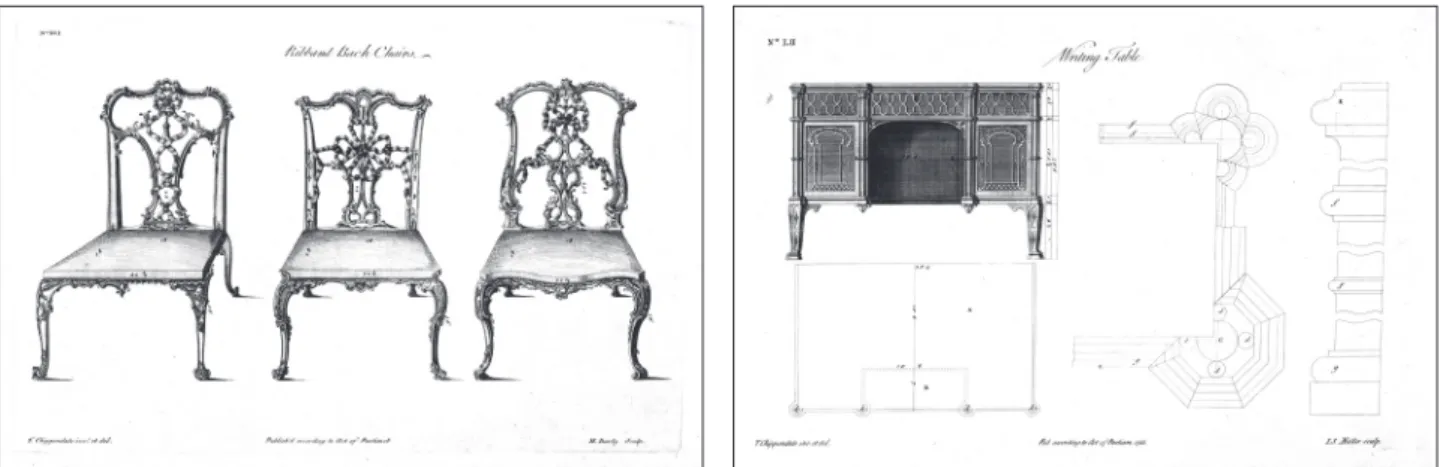
Chippendale had already produced a ribband-back chair of the left-hand side design in Plate 16, which was entitled as “Ribband-back chairs” (Plate 16: Fig. 1), but he had not yet made any chairs of other two designs when the fi rst edition of the Director was published [8].
Chippendale had already produced a Gothic style writing desk (Plate 52: Fig. 2) several times before the first edition was published. He, however, mentioned in the note that the real furniture pieces were much better than the drawing [9]. Plate 52 consists of a plan, an upright and mouldings at large. It was highly likely that Chippendale was worried about the fact that this desk was not drawn in perspective, but in orthographic projection, and it was not suffi cient to carry its fascinating characteristics and attracting appearance to potential clients, so he mentioned that the real furniture pieces were far more attractive than the drawing.
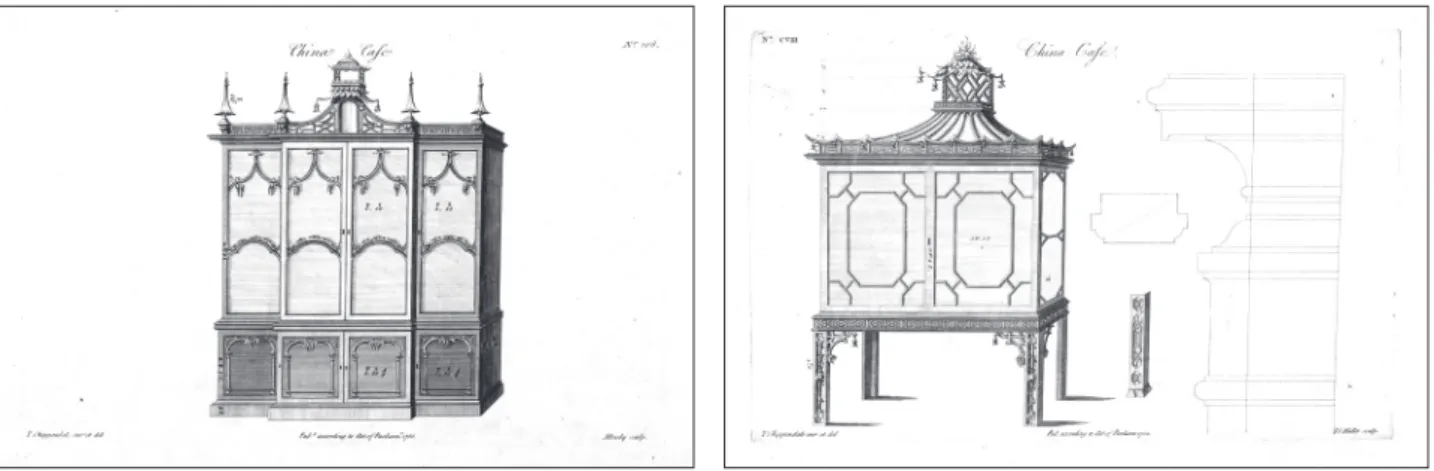
The note for a China cabinet drawn in Plate 106 (Fig. 3) and Plate 107 sounded as though Chippendale was looking at a fi nished furniture piece and said that the real furniture piece was much more magnifi cent than the drawing [10].
The note for a four-legged China cabinet drawn in Plate 108 (Fig. 4) sounded as if Chippendale had just fi nished making a real furniture piece with satisfaction, and there was a customer who had ordered it [11].
These are the cases that Chippendale had already created real furniture pieces and used their drawings for
sales promotional purposes by publishing them. Thus, the process of this fi rst pattern is as follows:
Drawing furniture designs >>> Getting commissions >>> Producing pieces >>> Printing drawings >>> Distributing images >>> Promoting sales
2. 1. 2 Promotional Furniture Designs
Fur thermore, according to some other Chippendale’s descriptions in the notes at the beginning of the Director, some of the furniture drawings in the Director had never been executed at the time of their publications. They, however, were intended to promote Chippendale’s furniture designs to potential clients hoping to receive some orders from them.
Chippendale’s word, “if neatly executed,” in the note for a librar y bookcase (Plate 67: Fig. 5; Plate 68) indicated that this bookcase must not have been executed when this design was published [12].
In the note for a Gothic style library bookcase (Plate 75: Fig. 6; Plate 76), Chippendale said “This design …. would give me great pleasure to see it executed,” so this library bookcase had not also been made when the drawing was published [13].
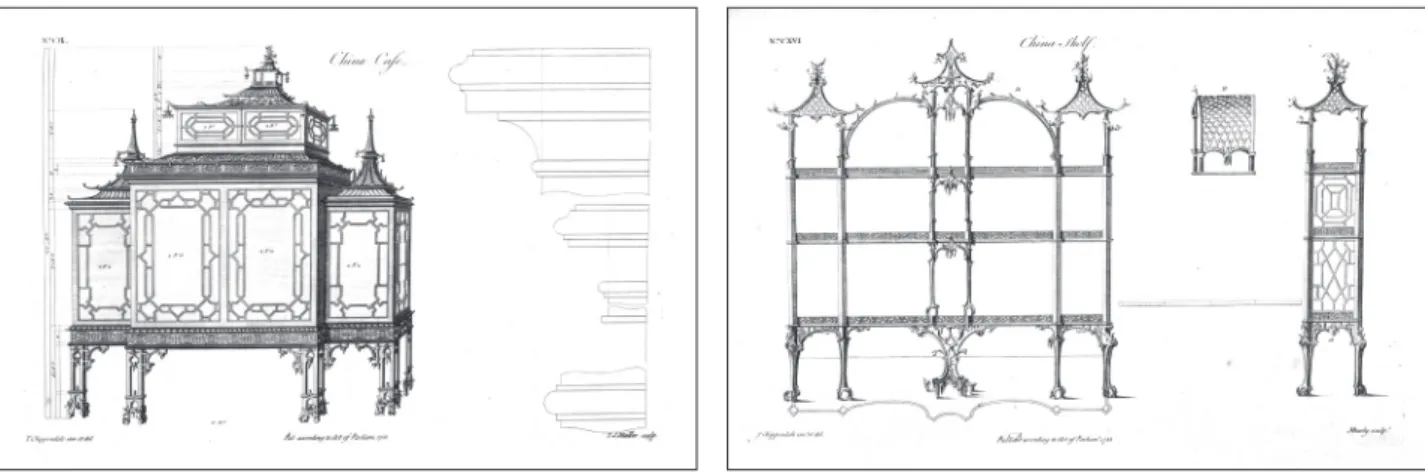
When Chippendale said “I had a particular pleasure in retouching and fi nishing this design, but should have much more in the execution of it, as I am confi dent I can make the work more beautiful and striking than the drawing.” in the note for an eight-legged Chinese style cabinet for fi ne China (Plate 111: Fig. 7), he seemed to express his earnest desire to execute the design, and at the same time he sounded as if he desperately asked
Fig. 5 (Plate 67) Library Bookcase Fig. 6 (Plate 75) Library Bookcase Fig. 3 (Plate 106) China Case Fig. 4 (Plate 108) China Case
for some orders of this China case [14].
What is more, according to Chippendale’s comments in the notes for Chinese style cabinets for fine China (Plate 115; Plate 116: Fig. 8; Plate 118), all the designs should not have been executed yet, either [15]. Chippendale sounded as if these furniture pieces would have been made exceedingly well if some potential clients should have ordered him to execute them.
These are the cases that Chippendale showed his new furniture designs to potential clients via the Director and waited patiently to receive some orders from them. Thus, the process of this second pattern is as follows:
Drawing furniture designs >>> Printing drawings >>> Distributing images >>> Promoting sales >>> Getting commissions >>> Producing pieces
2. 2 Original Drawings, Printed Drawings, and Manufactured Furniture Pieces
In this section, I would like to examine how these two patterns stated above, which are (1) showing commissioned furniture designs for further sales promotion and (2) showing promotional furniture design ideas to receive actual commissions, were carried out in some real cases.
2. 2. 1 Recorded Commissioned Furniture Designs
Here I would like to talk about the fi rst case: (1) Showing commissioned furniture designs for further sales promotion.
The original hand-drawn design of a Rococo style bed for Dumfries House, Ayrshire, Scotland was drawn by Chippendale in 1759 (Fig. 9), and the bed was manufactured according to the drawing in the same year (Fig. 10). The etched drawing of the bed was included as Plate 39 (Fig. 11) in the third edition of the Director in 1759-62. The etched drawing, however, was a mirror image of the original hand-drawn design [16].
This is an example that a commissioned furniture design was included in the Director for further sales promotion.
2. 2. 2 Modifi ed Promotional Furniture Designs
Here I would like to talk about the second case: (2) Showing promotional furniture design ideas to receive actual commissions.
A library table (Fig. 12) for Nostell Priory, West Yorkshire, England was completed in 1766 and delivered to Nostell Priory in 1767. It was made after a furniture design included in the fi rst and second editions of the
Director published in 1754 and 1755 (Plate 57: Fig. 13) and also included in the third edition of the Director published in 1759-62 (Plate 83 of the 3rd ed.). When it was executed, however, some ornamental details were modifi ed.
This is an example that a promotional design was modifi ed and executed for an actual client.
3. The Director and a Leading Position among 18th Century London Furniture Makers
In this chapter, I would like to examine how the publications of the Director functioned for Chippendale to get a leading position among 18th century London furniture makers and how he kept a leading position after the publication of the fi rst edition of the Director.
Fig. 9 Chippendale’s hand-drawn design of a Rococo style bed for Dumfries House, Ayrshire, Scotland in 1759
Fig. 10 A Rococo style bed at Dumfries House, Ayrshire, Scotland
Fig. 11 (Plate 39 of the 3rd ed.) A Bed in 1759-62
Fig. 12 A Library Table at Nostell Priory, West Yorkshire,
3. 1 The Director to Gain a Leading Position
Here in this section, I would like to examine how the publications of the Director functioned for Chippendale to gain a leading position among furniture makers at that time.
3. 1. 1 Subscribers
Before the fi rst edition of the Director was published, subscriptions had been taken. There is a lengthy list of subscribers for the fi rst edition of the Director, situated between the preface and the notes of plates. The list could be divided into the following three groups; (1) Potential clients; (2) Coworkers and rivals; (3) Booksellers. (a) Potential Clients
The first group was potential clients who would have acquired some furniture pieces executed by Chippendale according to patterns shown in the Director. Among these potential clients, you can see some noble names like the Duke of Beaufort, the Earl of Chesterfi eld, the Duke of Hamilton, the Earl of Hopton, the Earl of Halifax, the Duke of Kingston, the Marquises of Lothian, the Earl of Morton, the Duke of Norfolk, the Duchess of Norfolk, the Earl of Northumberland, the Duke of Portland, and the Countesses of Shaftsbury. Apart from those aristocrats, there you can see some other names of noble men and women described as Lords, Ladies, Sirs and Esquires.
What is more, there is a name of an architect: Mr. James Payne, architect; and there are names of professors of Philosophy: Mr. David Young and John Young. They too seemed to have been potential clients.
This was the fi rst group, and they were accredited as “Gentleman” in the title of the Director. (b) Coworkers and Rivals
The second group was furniture makers and other craftsmen who were entitled as “Cabinet-Maker” in the title of the Director. They seemed Chippendale’s associates and subcontractors. In the list of subscribers, they were described as cabinet-makers, carpenters, car vers, enamellers, engravers, founders, a jeweler, joiners, painters, a picture-frame-maker, an organ-maker, plasterers, upholders, upholsterers, a watch-maker, and so on.
Among those cabinet-makers’ names, you can find “William Ince, cabinet-maker.” William Ince & John Mayhew were another London furniture maker who published their furniture designs as Universal System of Household Furniture [17] in July 1759 shortly after the fi rst and second editions of Chippendale’s Director were published. So, the list of subscribers included not only his associates and subcontractors, but also his rivals. (c) Booksellers
The third group was booksellers. There were some booksellers’ names such as: Mr. Thomas Rivington, bookseller; James Sayer, bookseller, 6 Books; Francis Swan, bookseller, 12 Books; Stabler, and Barstow, booksellers, York.
Thus, stated above, the publications of the Director were not only to promote its sales to noblemen and gentlemen who were Chippendale’s potential clients, but it was also to show his own designing ability to his associates and subcontractors, and even to his rivals. It is, therefore, possible to say that Chippendale must have intended to gain a leading position among furniture makers at that time by publishing fashionable furniture designs in a large portfolio together with enough information about his genuineness.
3. 1. 2 Furniture Drawings and Descriptions
Types of drawings and Chippendale’s descriptions in the notes at the beginning of the Director may imply why he published the Director in the fi rst place.
(a) Drawings of Five Classical Orders
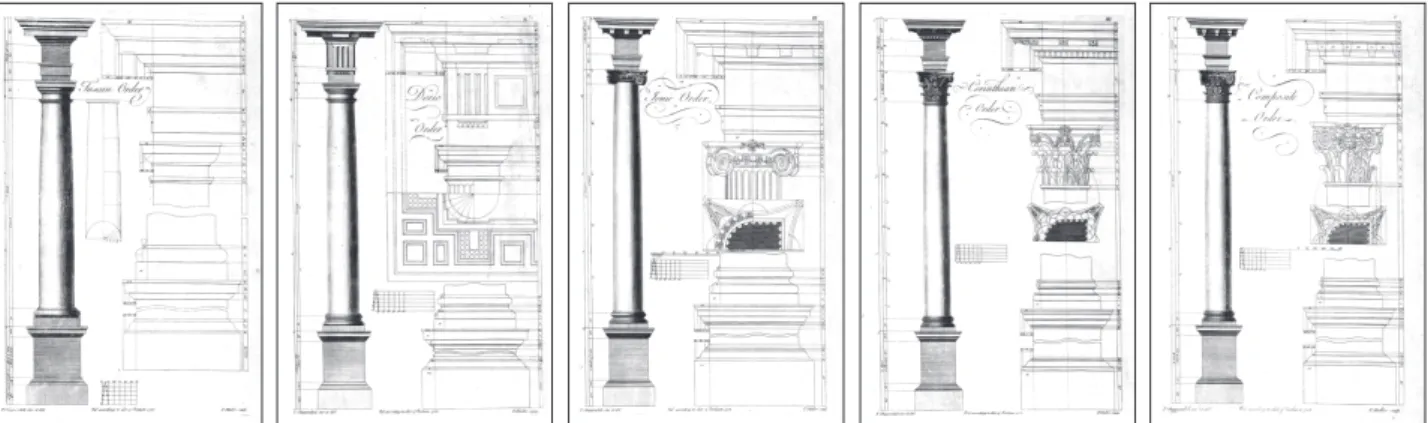
At the beginning of the Director, from the first edition through the third edition, there were the general proportions of fi ve Classical orders: Tuscan, Doric, Ionic, Corinthian and Composite (Plates 1-5: Fig. 14) [18]. They were well drawn and accurate.
So then, why was it necessary for Chippendale to include those Classical orders at the front of his celebrated furniture design portfolio?
In 18th century English country houses and town houses, architectural styles, interior styles, and furniture styles were very closely related. Around the time when the Director was published, the main architectural style in England was 18th century Baroque style, which had been evolved from Renaissance style. Not to mention, Renaissance style had revived Classical style. Therefore, Chippendale must have had to show his potential clients the fact that he was well trained in Classical style by exhibiting those fi ve Classical orders since he was a mere cabinet-maker who had come from Yorkshire to London. At the same time, by showing his understanding of Classical style, Chippendale must have wanted to be one step ahead of his fellow furniture makers at that time.
Fig. 14 (Plates 1-5) Tuscan Order, Doric Order, Ionic Order, Corinthian Order, and Composite Order
(b) Single Vanishing Point Perspectives
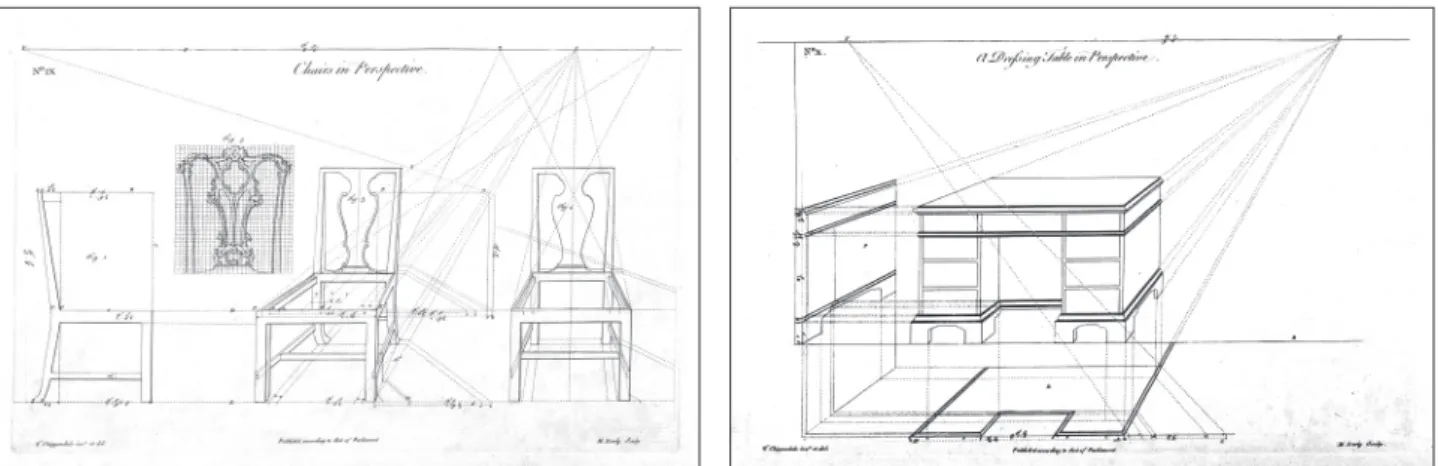
As I mentioned in my previous article, in the fi rst edition of the Director, following the general proportions of fi ve Classical orders, there were three plates that explained how to draw single vanishing point perspectives of chairs, a desk and a bookcase (Plate 9: Fig. 15; Plate 10: Fig. 16; Plate 11: Fig. 17) [19].
So then, why was it necessary for Chippendale to insert those explanations about how to draw perspectives? It seemed as if he was eager to tell his potential clients his drawing ability in order to add more credibility to his work. At the same time, it seemed that he was trying to get a leading position among furniture makers of the day by showing his design education level to his associates, subcontractors, and even to his rivals.
Those three plates, which showed how to draw single vanishing point perspectives, were dropped off when the third edition of the Director was published. It is uncertain why they were omitted, but I think that one of the reasons was that, having achieved the goal, they became unnecessary any more.
(c) Practical Advice for Changing Designs
In the Director, there was some practical advice for potential clients and cabinet-makers that it was possible to modify designs when executing those drawings.
For Gothic style side chairs (Plate 21: Fig. 18; Plate 22), it was stated in the note that most of the decorative motifs could have been deleted if necessary [20].
For a Chinese style settee with a canopy (Plate 25b: Fig. 19), it was also stated that it would have been possible that the settee could have been transformed into a bed enlarging its depth [21]. By the way, it is an example to promote two different furniture designs at the same time showing only one drawing.
Fig. 15 (Plate 9) Chairs in Perspective
Fig. 17 (Plate 11) A Bookcase in Perspective
Fig. 19 (Plate 25b) Chinese Sopha
Fig. 16 (Plate 10) A Dressing Table in Perspective
Fig. 18 (Plate 21) Gothick Chairs
What is more, for library bookcases (Plates 60, 61; Plate 62: Fig. 20), it was stated that you should have kept their proportions when changing their sizes [22].
Thus, Chippendale left some practical advice, mainly for cabinet-makers, how to modify his designs. This shows Chippendale’s genuine concern for his own designs as a designer, and it also shows his tender care for his fellow furniture makers as a leader.
3. 2 How Chippendale Kept a Leading Position after Publishing the Director
In this section I would like to consider how Chippendale could have managed to keep a leading position after publishing the fi rst edition of the Director.
3. 2. 1 Adding New Designs
As I have already mentioned, Ince & Mayhew published Universal System of Household Furniture in July 1759, following the first and second editions of Chippendale’s Director. In order to compete with this work, Chippendale published the third edition of the Director. When he published the third edition, Chippendale added new furniture designs. In the third edition, Chippendale inserted Neo-Classical style furniture designs, which had just become popular in mid 18th century England.
The first edition of the Director contained one hundred and sixty-one plates all together [23]. The second edition did not change a lot compared to the fi rst edition. In the third edition, however, only ninety-four plates, including eight modifi ed plates, of the fi rst and second editions remained, and one hundred and six new plates of contemporary furniture designs were added. So, the total number of the plates in the third edition became two hundred [24].
It shows that Chippendale managed to keep his leading position through continual launching of new product designs into the market.
3. 2. 2 Ingenuity of Furniture Drawings
As far as editorial methods are concerned, it is possible to say that Chippendale managed to keep superiority of his furniture workshop over other furniture makers at that time by NOT doing two things as follows: (1) Not showing details and sizes of all furniture drawings in the Director; (2) Not showing whole images of furniture pieces in the Director.
(a) Not Showing All Details and Sizes
There were two ways how Chippendale gave sizes to furniture drawings. They were such as follows: (i) Writing down overall dimensions in feet and inches nearby perspective drawings; (ii) Adding scales beside perspectives, top views, front views, side views, or moulding details.
A Gothic style library desk (Plate 57: Fig. 13) is an example of (i) the fi rst case. You can see numbers on/near the perspective drawing.
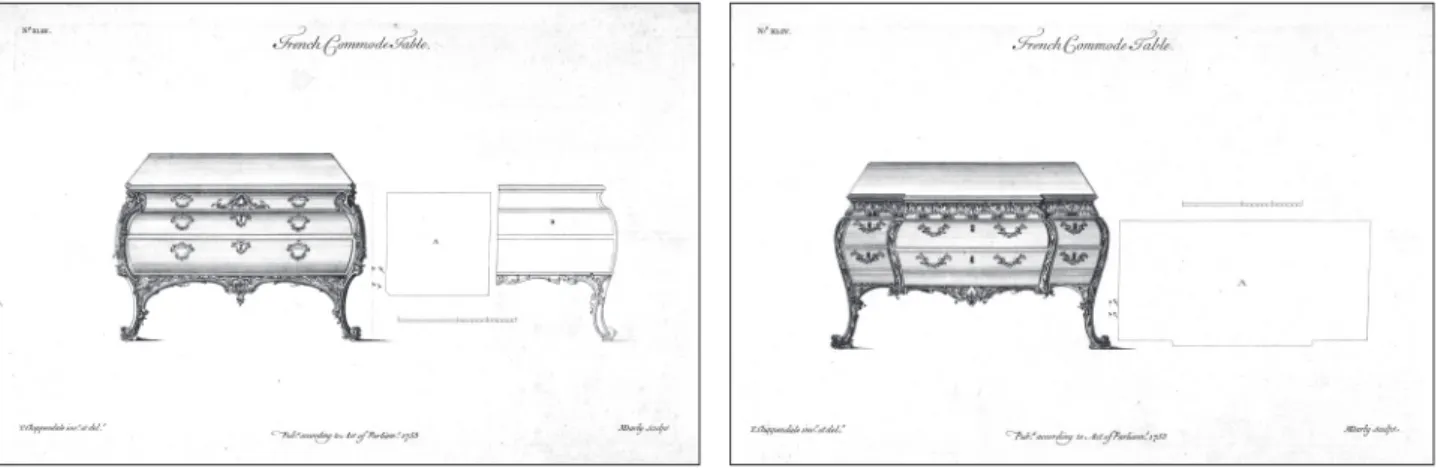
Two French lower chests of drawers, commodes, (Plate 43: Fig. 21; Plate 44: Fig. 22) are examples of (ii) the second case. Chippendale said in the note that you could have taken sizes of their front views (uprights) and top views (plans) using scales [25].
In the second case, readers could have taken measurements quite easily. On the other hand, in the first case, only overall dimensions were given, so that details of those furniture pieces would have been totally up to techniques and good sense of those who executed designs.
either [26].
It seemed that Chippendale could have managed to keep superiority of his furniture workshop over other furniture makers by not adding minute details or exact sizes to all furniture drawings in the Director.
(b) Not Showing Whole Images of Furniture Pieces
From Plates 141 (Fig. 23) to 147, two distinctive designs of pier-glass frames were drawn on one sheet of paper, but only two half figures were drawn. Likewise, on Plate 148 (Fig. 24), four unique designs of pier-glass tables were drawn on one sheet, but only four half fi gures were drawn. It was the same for shields for pediments on Plate 149, and only eight half fi gures were drawn there.
Rococo style furniture was usually asymmetrical, so cabinet-makers could have executed Rococo style designs accurately if only whole images had been made known.
So then, why did Chippendale not draw whole images of Rococo style designs?
There might have been some materialistic constraints in terms of cost of copper plates, paper and engravers. The biggest problem, however, seemed that it would have been a lot easier for fellow cabinet-makers to execute published designs if their whole images had been made manifest. So, it was Chippendale’s way to keep his designs for his own self and to prevent fellow cabinet-makers from executing published designs easily.
Fig. 21 (Plate 43) French Commode Table Fig. 22 (Plate 44) French Commode Table
These half figures might have given an impression to potential clients that only he, Chippendale, would have been able to execute those designs accurately or perfectly. As a matter of fact, Chippendale gained an immense success because of the Director. Almost all the known furniture pieces of Thomas Chippendale were commissioned after the publications of the Director [27].
4. Conclusion
In conclusion, the following three things may be pointed out.
(1) The Director was intended to be sales promotional tools. There were mainly two ways how the Director was used as sales promotional tools: (a) Chippendale had already created real furniture pieces and used their drawings for sales promotional purposes; (b) Chippendale showed his furniture designs to potential clients via the Director and waited patiently to receive some orders from them.
(2) Thomas Chippendale, a successful furniture designer and entrepreneur running his own London furniture workshop, seemed to gain a leading position among other furniture makers in 18th century London through the publications of the Director, which included the most fashionable furniture styles of the day. For this purpose, Chippendale illustrated fi ve Classical orders to show genuineness of his knowledge about traditional architectural styles, and he also illustrated how to draw single vanishing point perspectives to show his design education level that he had acquired, and he left some practical advice for fellow cabinet-makers how to modify designs in the Director, in case of executing them. These shows Chippendale’s deep concern for his own designs as a designer and his tender care for fellow cabinet-makers as a leader.
(3) In order to maintain his superiority over other cabinet-makers after publishing the Director, Chippendale kept launching new furniture designs, but at the same time he did not add moulding details or exact sizes to all designs, nor did he show whole images of asymmetrical furniture pieces. Those were his tactics to keep his leading position among other furniture-makers of the day.
Note
This paper is based on the second half of my presentation “Functional Analysis of Thomas Chippendale’s “The Gentleman and Cabinet Maker’s Director”” at the Design Symposium 2014 held at the University of Tokyo [28]. References
1) Brackett, O., Thomas Chippendale: A study of His Life, Work and Infl uence, London, Hodder and Stoughton, 1924.
2) Coleridge, A., Chippendale Furniture: The Work of Thomas Chippendale and his Contemporaries in the Rococo Taste; Vile, Cobb, Langlois, Channon, Hallett, Ince and Mayhew, Lock, Johnson and others circa 1745-1765, London, Faber and Faber, 1968.
3) Gilbert, C., The Life and Work of Thomas Chippendale in two volumes (Volume 1 & 2), London, Studio Vista, 1978.
4) Shimbo, A., Furniture-Makers and Consumers in England, 1754-1851: Design as Interaction, Surrey, England & Vermont, USA, Ashgate, 2015.
5) Arai, R., Furniture Types and Drawing Methods in the Director, The Journal of Kyoei University, Vol.14, 2016, pp.39-52.
6) Chippendale, T., The Gentleman and Cabinet Maker’s Director, London, 1754 (First Ed.), 2005 (Facsimile Ed., The Chippendale Society).
7) Chippendale, T., The Gentleman and Cabinet Maker’s Director, London, 1762 (Third Ed.), 1966 (Reprint: New York, Dover Publications).
8) The original note reads “PLATE XVI. [Plate 16] is three Ribband-back Chairs, which, if I may speak without vanity, are the best I have ever seen (or perhaps have ever been made.) The Chair on the left hand has been executed from this Design, which had an excellent effect, and gave satisfaction to all who saw it. I make no doubt but the other two will give the same content, if properly handled in the execution. Their dimensions are affi xed to the design.” Anthony Coleridge points out the same aspect. See Coleridge, A. (1968), op. cit., p.85.
9) The original note reads “PLATE LII. [Plate 52] is a Gothic Writing-Table, … This Table has been made more than once from this design, and has a better appearance when executed than in the drawing.”
10) The original note reads “PLATE CVI. [Plate 106] is a China Case with glass doors, … I have executed this design, and it looks much better than in the drawing. …”
11) The original note reads “PLATE CVIII. [Plate 108] is a China Case with glass in the doors and ends. … This design I have executed with great satisfaction to the purchaser. …”
12) The original note reads “PLATE LXVII. [Plate 67] is a Library Book-Case, with its profi le and scale; and LXVIII. [68] is the mouldings at large, set off by the scale, … This book-case will be very beautiful if neatly executed.”
13) The original note reads “PLATE LXXV. [Plate 75] is a rich Gothic Library Book-Case, … This design is perhaps one of the best of its kind, and would give me great pleasure to see it executed, as I doubt not of its making an exceeding genteel and grand appearance; …”
14) The original note reads “PLATE CXI. [Plate 111 is] a China Case, not only the richest and most magnifi cent in the whole, but perhaps in all Europe. I had a particular pleasure in retouching and fi nishing this design, but should have much more in the execution of it, as I am confi dent I can make the work more beautiful and striking than the drawing. ...”
15) The original note reads “PLATE CXV. [Plate 115] This is a design of a Chinese shelf standing upon feet; … It will be very neat, if made by a good hand.” and “PLATE CXVI. [Plate 116] This design, if executed by a good workman will be very neat. ...” and “PLATE CXVIII. [Plate 118] This design will look exceeding[ly] well, if executed and japann'd neatly. ...”
16) Gilbert, C. (1978), op. cit., Vol.2, pp.24-27.
17) Ince, W., Mayhew, J., Universal System of Household Furniture, London, 1759.
18) Strictly speaking, Ancient Greek style has only three orders: Doric, Ionic and Corinthian, and Ancient Roman style has all the fi ve orders, including Tuscan and Composite.
19) Arai, R. (2016), op. cit., pp.41-42.
20) The original note reads “PLATES XXI. and XXII. [Plates 21 & 22] are six new designs of Gothic Chairs; … Most of the ornaments may be left out if required. …”
21) The original note reads “PLATE XXV. [Plate 25] is a Chinese Sopha with a canopy over it, with its curtains and vallens all tied up in drapery. This design may be converted into a bed, by having the Sopha so made as to come forward, the curtains to draw to the front of the Sopha, and hang sloping, which will form a sort of tent, and look very grand. …”
22) The original note reads “PLATES LX. LXI. and LXII. [Plates 60, 61 & 62] are three Library Book-Cases of different sorts, with their dimensions and mouldings all fi xed to the designs. If you have occasion to alter
their sizes, it would be well to keep as nigh the same proportion as possible; otherwise the upper doors may have but an ill appearance. …”
23) In the fi rst edition of the Director, there are two plates for “Plate 25”, so there are 161 plates all together. 24) Gilbert, C. (1978), op. cit., Vol.1, pp.81-82.
25) The original note reads “PLATES XLIII. and XLIV. [Plates 43 & 44] Two French Commode Tables. Plate XLIII. [Plate 43] has its Dimensions with a Scale; A is one half of the plan; B is the upright [front view] of the Table, and by the scale you may take off its proportions. Plate XLIV. [Plate 44] is a Table which will have a very good effect; the ornament round the top may be omitted, if required. A is the plan of the top [top view], with a proper scale to take off its size.”
26) Arai, R. (2016), op. cit., pp.46-48. See Tables 1.1-1.3. 27) Gilbert, C. (1978), op. cit., Vol.1, pp.127-288.
28) Arai, R., “Functional Analysis of Thomas Chippendale’s “The Gentleman and Cabinet Maker’s Director””, Design Symposium, 2014, pp.217-224.