• 検索結果がありません。

Regulation of cell migration and cytokine production by HGF-like protein (HLP) / macrophage stimulating protein (MSP) in primary microglia

N/A
N/A
Protected

Academic year: 2021

シェア "Regulation of cell migration and cytokine production by HGF-like protein (HLP) / macrophage stimulating protein (MSP) in primary microglia"

Copied!
8
0
0

読み込み中.... (全文を見る)

全文

(1)

Regulation of cell migration and cytokine production by HGF-like protein (HLP) / macrophage stimulating protein (MSP) in primary microglia

Yoshinori S UZUKI

1

, Hiroshi F UNAKOSHI

1

, Mitsuru M ACHIDE

1

, Kunio M ATSUMOTO

1, 2

and Toshikazu N AKAMURA

1

1

Division of Molecular Regenerative Medicine, Department of Biochemistry and Molecular Biology, Osaka University Graduate School of Medicine, B7 2-2 Yamadaoka, Suita, Osaka 565-0871, Japan; and

2

Division of Tumor Dynamics and Regulation, Cancer Research Institute, Kanazawa University, 13-1 Takaramachi, Kanazawa, Ishikawa 920-0934, Japan

(Received 26 November 2007; and accepted 5 January 2008)

ABSTRACT

HGF-like protein (HLP)/macrophage stimulating protein (MSP) is the only structural relative of hepatocyte growth factor (HGF), and is involved in the regulation of peripheral macrophage acti- vation. However, the actions of HLP in microglia, a species of macrophage in the nervous system, which is closely involved in the neural degeneration and regeneration, is not yet understood. This study found that Ron, the receptor for HLP, is expressed in primary microglia using RT-PCR, im- munocytochemical staining and Western blotting, and, thus, sought to elucidate the function of HLP on the primary microglia. HLP promoted microglial migration without affecting cell survival and proliferation. Furthermore, real-time quantitative RT-PCR analysis revealed that HLP greatly increased the mRNA of inflammatory cytokines, including IL-6 and GM-CSF, and iNOS. These findings provide the first evidence that HLP has the potential to modulate inflammatory actions of microglia, which proposes novel aspects for the process of degeneration and/or regeneration of the brain.

HGF-like protein (HLP) was found as a molecule containing kringle domains and named for its high homology with hepatocyte growth factor (HGF) (10, 21, 22). Later, HLP was revealed to be identical to the macrophage stimulating protein (MSP) (15, 25).

The actions of HLP are most commonly involved in the inhibitory process of macrophage activation (32).

HLP inhibits lipopolysaccharide (LPS)- and cyto- kine-induced nitric oxide production in macrophage in vitro, and reduces the nuclear translocation of nu- clear factor-κB (NF-κB). Three different null mu- tants of Mst1r, coding the HLP receptor/Ron were

generated with different targeting strategies, and studies on these mutant mice showed that HLP functions to suppress the excess inflammatory re- sponses of peripheral macrophages (3, 16, 30, 31).

 Microglia is a kind of domestic macrophage, typically residing in the central nervous system (CNS). Microglia serve as scavenger cells by prolif- eration and migration towards the affected sites in response to neurodegenerative diseases, such as Al- zheimer’s, Parkinson’s disease and amyotrophic lat- eral sclerosis (ALS), and elicit actions involved in regenerative and destructive processes (19). Typical- ly, microglia releases neurotrophic cytokines, inter- leukin (IL)-1α and IL-6 (1), and the family of neurotrophins such as nerve growth factor (NGF), neurotrophin (NT)-3 and brain-derived neurotrophic factor (BDNF) (18). These studies have pointed out that the so-called activated microglia possess recip- rocal functions, i.e. neuroprotection and neurode- struction.

Address correspondence to: Dr. Toshikazu Nakamura Division of Molecular Regenerative Medicine, Depart- ment of Biochemistry and Molecular Biology, Osaka University Graduate School of Medicine, B7 2-2 Yama- daoka, Suita, Osaka 565-0871, Japan

Tel: +81-6-6879-3783, Fax: +81-6-6879-3789

E-mail: [email protected]

(2)

systems (Foster City, CA). Sequences for primers and TaqMan fluorogenic probes of murine HGF were as follows: forward primer, 5’-AAG AGT GGC ATC AAG TGC CAG-3’, reverse primer, 5’-CTG GAT TGC TTG TGA AAC ACC-3’, probe, 5’(FAM)-TGA TCC CCC ATG AAC ACA GCT TTT TG- (TAMARA)3’. The PRISM 7000 real-time PCR system (Applied Biosystems) was used for the amplification and online detection. Experimental samples were matched to the standard curve gener- ated by amplifying serially diluted products, using the same PCR protocol. GAPDH cDNA was also amplified to decide the amount of each template cDNA.

 Immunocytochemical analyses were performed as follows. Microglia were fixed with 4% paraformal- dehyde in phosphate buffered saline (PBS) and re- acted with rat anti-Mac1 antibody (a specific marker for microglia; 1 : 100, BD Biosciences, San Jose, CA) and rabbit anti-Ron antibody (1 : 100, Santa Cruz Biotechnology, Inc., Santa Cruz, CA) in PBS containing 5% goat serum and 0.3% Triton X-100.

Then cells were rinsed with PBS and labeled with Alexa488-conjugated goat anti-rabbit IgG (1 : 500) and Alexa546-conjugated goat anti-rat IgG (1 : 500).

To confirm the specificity of anti-Ron antibody, the antibody was preincubated with immunized Ron peptides (Santa Cruz Biotechnology, Inc.). The fluorescence images were obtained using an LSM5 laser scanning confocal microscope (Carl Zeiss, Oberkochen, Germany).

 Microglia and J774A.1 cells were lysed for West- ern blotting in lysis buffer containing 50 mM Tris- HCl (pH 7.5), 1% (v/v) Triton X-100, 25 mM β-glycerophosphate, 150 mM NaCl, 1 mM PMSF, 1 mM sodium orthovanadate, 2.5 μg/mL antipain, 5 μg/mL aprotinin, 5 μg/mL pepstatin, and 5 μg/mL leupeptin. After removal of the debris, equal amounts of lysed-proteins were separated on SDS-PAGE, transferred to a polyvinylidene difluoride (PVDF) membrane, and subjected to Western blotting using mouse anti-Ron monoclonal antibody (1 : 200, BD Biosciences). Signals were visualized using HRP- coupled secondary antibody and an ECL detection kit (GE Healthcare UK Ltd, Buckinghamshire, UK).

 Cell survival and proliferation were assayed as follows. The cells were seeded onto 12-well plates at 5 × 10

4

cells/well, and cultured in both the pres- ence and absence of HLP (10 ng/mL) for 24 and 48 h. The survival rate of microglia was scored by double staining with Calcein-AM (Wako Pure Chem- ical Industries, Osaka, Japan) and propidium iodide (PI). The fluorescence images were obtained using  The expression of HLP mRNA in adult rodent

brain tissue is revealed by Allen Brain Atlas on the web site (http://allenbrainatlas.com). This study fo- cused on the function of HLP on microglia. Here we show that microglia is one of the target cells of HLP, and that the cell migration and production of inflammatory cytokines are enhanced by HLP-stim- ulation in primary microglia. These findings predict that the novel roles of HLP involved in the regula- tion of microglial activation, which leads to neuro- protection and neurodestruction in the brain.

MATERIALS AND METHODS

Recombinant human HLP was purified from condi- tioned media of COS-7 cells transfected with an ex- pression vector containing human HLP cDNA as described previously (6, 25), and the purity of HLP was confirmed to be more than 95% by SDS-PAGE and silver-staining.

 C57BL/6 mice were purchased from SLC (Shi- zuoka, Japan). All efforts were made to minimize the number and discomfort of animals.

 We prepared murine primary microglia by the same methods of preparation of rat microglia with identical purity (> 95%) (8). Murine microglia were cultured in modified N3 (mN3) medium containing DF (high glucose DMEM/Ham’s F12, 50 : 50) me- dium supplemented with 10 μg/mL insulin, 100 μg/

mL apo-transferrin, 20 nM progesterone, 50 μM pu- trescine, and 30 nM sodium selenite (7). Murine pri- mary cerebral cortex neurons and astrocytes were cultured as described (7). Murine macrophage cell line J774A.1 were cultured as previously described (20).

 For reverse transcriptase (RT-) PCR and real-time quantitative RT-PCR, total RNA was isolated from microglia cultured for one day. One μg of total RNA was reverse-transcribed into first-strand cDNA with a random hexaprimer using Superscript II reverse transcriptase (Lifescience Technologies Inc, Grand Island, NY). To detect Ron, RT-PCR analyses were performed using forward primer, 5’-AGG TTT TCC GTC GCT GTC-3’, and reverse primer, 5’-GCC TGA AGC ACT GGG TAG-3’. Plasmid inserted murine Ron cDNA was used as a positive control.

For the quantitative PCR analyses, the primers and

probes for IL-1α, IL-1β, IL-6, tumor necrosis factor

(TNF)α, granulocyte-macrophage colony-stimulating

factor (GM-CSF), inducible nitric oxide synthase

(iNOS), BDNF, ciliary neurotrophic factor (CNTF),

HLP, Ron and glyceraldehyde-3-phosphate dehydro-

genase (GAPDH) were obtained from Applied Bio-

(3)

RESULTS

Expression of Ron in murine microglia

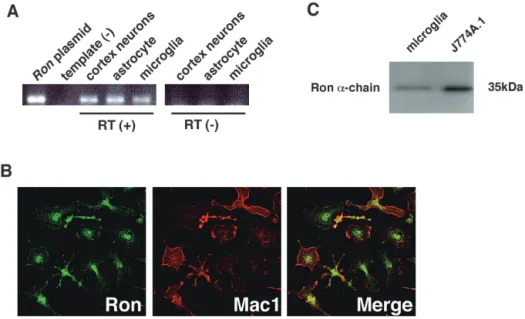
To determine which cell species express the Ron, HLP-receptor, in the CNS, RT-PCR analysis was performed using cDNA synthesized from the total RNA of primary cultured microglia, astrocytes and cerebral cortex neurons prepared from C57BL/6 mice (Fig. 1A). A specific primer set for Ron extra- cellular domain was designed to detect a full-length form of Ron, since Ron lacking the extracellular do- main was found in hematopoietic cells (12). As the negative control templates in the PCR analysis, the reverse transcriptase-free cDNA synthesis reaction mixture {RT(-) in Fig. 1A right panel} and the tem- plate-free mixture {template (-) in Fig. 1A left panel} were tested, and no PCR product was ampli- fied from them. On the other hand, the PCR prod- ucts were evidently amplified from the cDNA of all tested neural cells, and the expression levels of the Ron mRNA were estimated to be almost equal be- tween those cells (Fig. 1A, left panel). The PCR products in these studies coincided with the prod- ucts from the Ron positive control vector in their size (Ron plasmid in Fig. 1A left panel).

 In the immunocytochemical staining, the most of an LSM5 laser scanning confocal microscope (Carl

Zeiss). The viable cells were stained green with Cal- cein-AM and naked nuclei of the dead cells were stained red with PI. The number of viable or dead cells in three different fields in a well was enumer- ated and the resulting scores were determined from the scores in three wells. A proliferation index was measured from the number of cells. Results were expressed as mean ± S.E.

 Migration of microglia was assayed using a tran- swell system with HTS Fluoro Blok inserts (pore size 8 μm) (BD Biosciences). Microglia (5 × 10

4

cells/insert) were placed onto the upper chamber pre-coated with fibronectin (Lifescience Technolo- gies Inc.), and HLP was added to the medium in the bottom chamber (Fig. 3A). Cells were incubated under 5% CO

2

at 37°C for 24 h, and stained with Calcein-AM. Images of the bottom side of the mem- brane were obtained using an LSM5 (Carl Zeiss).

Five different fields were chosen in each well and the number of migrated cells was enumerated.

 An ANOVA test was used to compare several dif- ferently treated groups, and this test was followed by a post hoc test, which takes multiple testing into account using Statview software (SAS Institute, Cary, NC).

Fig. 1 Ron is expressed in microglia. (A) RT-PCR analysis. Microglia were cultured in mN3 medium for 24 h; astrocytes were cultured in DF medium containing 10% FBS for 2 weeks and contaminated cells were detached and removed by shaking culture dishes; and cortex neurons were cultured in mN3 medium for 2 days. Ron mRNA was detected in microg- lia, astrocytes, and cerebral cortex neurons; RT+, in the presence of reverse transcriptase in a reverse transcription step;

RT−, in the absence of reverse transcriptase. A plasmid containing a Ron sequence served as a positive control. (B) Immu- nocytochemical analysis for Ron. Red signal shows anti-Mac1 immunoreactivity (IR) and green signal shows anti-Ron IR.

Mac1 positive cells, indicating microglia, expressed Ron protein. (C) Western blotting for Ron in microglia and J774A.1 cells.

A 35-kDa band, corresponding to the size of Ron α -chain, was detected in cultured microglia and the murine macrophage

cell line J774A.1 using an antibody specific for Ron α -chain. J774A.1 cells served as a positive control for Ron.

(4)

Less effect of HLP on microglial survival and prolif- eration

Since it is reported that HLP promotes keratinocyte survival (4) and proliferation (32), the possibility of these effects of HLP on microglia were assessed.

The primary microglia were cultured in the absence and the presence of 10 ng/mL HLP for up to 48 h, and the population of viable and dead cells was an- alyzed by double staining with Calcein-AM and PI, respectively. With this method, the viable cells ex- hibited a green signal and dead cells exhibited a red signal (Fig. 3A). The survival ratio at 24 h after seeding was more than 80% in the absence of HLP, and it decreased to 50% 48 h after seeding. This survival profile was nearly equivalent even in the presence of HLP (Fig. 3A, B). The total number of microglia at 48 h after seeding was unchanged in either the presence or in the absence of HLP, indi- cating that HLP failed to affect the microglial pro- liferation. Together, the difference in the cell number detected between HLP-presence and -absence in mi- gration assays (Fig. 2B and C) shows that HLP en- hanced the cell migration, but not proliferation, in microglia.

Effect of HLP on regulation of cytokine mRNA in microglia

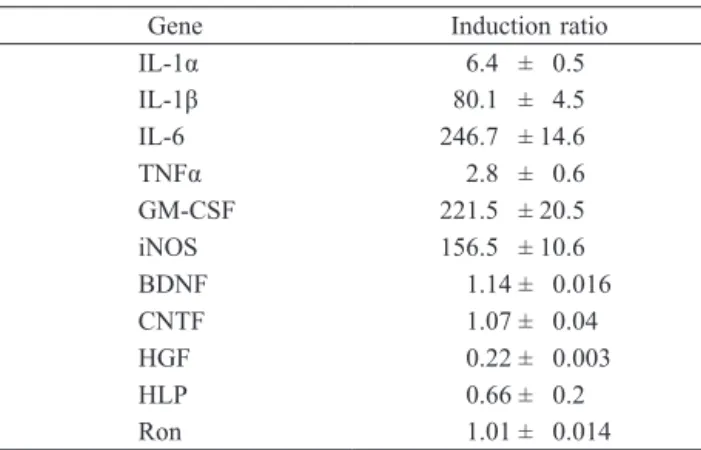
Another feature of the activated microglia is the production of many kinds of cytokines and neuro- trophic factors. These mediate either the degenera- tive or the regenerative functions of microglia in the CNS. To investigate whether HLP changes the ex- pression level of cytokines and neurotrophic factors in microglia, the level of their mRNA was measured (Table 1). Microglia were cultured in the presence and absence of 10 ng/mL HLP for 24 h, and their total RNAs were isolated and subjected to quantita- tive real-time RT-PCR analysis. The results showed that HLP-treatment decreased HGF and HLP mRNA levels, whereas the treatment did not alter the levels of other neurotrophic factors such as BDNF and CNTF. Similarly, the Ron mRNA level did not change with HLP-treatment. On the other hand, the mRNA of proinflammatory cytokines IL-1α, IL-1β, IL-6, TNFα and GM-CSF were markedly upregulat- ed in the presence of HLP. Compared with their controls (HLP-untreated), IL-6 and GM-CSF in- creased more than 200-fold, and TNFα achieved more than 2.5-fold under the HLP-treatment.

 iNOS was upregulated almost 150-fold by HLP- treatment in microglia (Table 1), It is noteworthy that iNOS was suppressed 0.7-fold by HLP in the mouse macrophage cell line, J774A.1(data not cells in our microglial culture was Mac1 positive

and the Ron staining signals were detected at the edge of cell shape in those cells, showing that Ron is expressed on the cytoplasmic membranes of mi- croglia (Fig. 1B). Additionally, the Ron signals were closely located in cell nuclei (Fig. 1B), indicating the same staining pattern as the subcellular localiza- tion of HGF-receptor/c-Met tyrosine kinase, the structural relative of Ron (27). These signals in im- munocytochemical staining for Ron could be elimi- nated using anti-Ron antibody preincubated with its blocking peptide (data not shown). This also means that the PCR product from microglial culture in Fig. 1A reflect the expression of Ron in microglia but not in contaminating neural cells. The results in- dicate that microglia is one of the Ron-expressing cell species.

 Functional Ron consists of an α- and a β-chain, which are processed from a single proform polypep- tide and the alternatively deleted Ron mRNA codes nonfunctional Ron which lacks extracellular domain (12, 31). Therefore, Western blotting was performed using an antibody specific for the α-chain, present in the extracellular domain, to evaluate the expression of functional Ron. Cell lysates of the primary mi- croglia and, as the positive control, murine macro- phage cell line J774A.1 were prepared and subjected to Western blotting. A 35-kDa band, corresponding to the size of the Ron α-chain, was clearly detected in both primary microglia and J774A.1 cells (Fig. 1C).

 These data revealed that the functional (processed) form of full-length Ron is expressed in microglia.

Effect of HLP on microglial migration

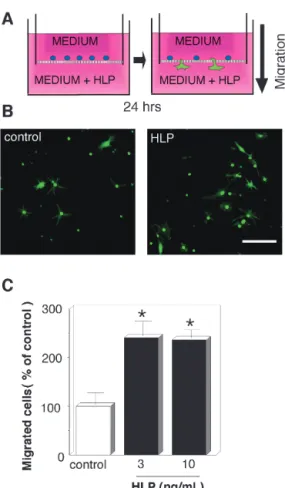
The accumulation of microglia at the affected and marginal regions in the degenerated and injured brain is observed as the results of stimulated prolif- eration and/or migration of the cells, which are typi- cal actions of the activated microglia (19). At first, the possible effect of HLP on microglial migration was assessed using a transwell chamber system (Fig. 2A). rhHLP (3, 10 ng/mL) was added in the bottom compartment of the chamber and the cells were seeded in the upper compartment which was separated from the bottom chamber with a micro- pored membrane. After 24 h incubation, the number of cells on the bottom side of the membrane was counted (Fig. 2B and C). Compared with the results from unstimulated wells, a 2- to 3-fold number of cells was detected when HLP was added (Fig. 2C).

These results showed that HLP enhances microglial

migration and/or proliferation.

(5)

shown). Furthermore, the iNOS level decreased 1/7-fold by HLP-stimulation when the macrophage was under the treatment with LPS (data not shown).

These mean that HLP shows diverse effects in iNOS production between macrophage cell line and mi- croglia.

 These results predict that HLP enhances inflam- matory process in microglia.

DISCUSSION

In the nervous system, neuronal survival and/or neu-

rite extension-promoting activities of HLP for sen- sory, sympathetic and motor neurons were revealed (5, 6, 24, 26). While the in vivo expression of Ron in microglia of multiple sclerosis patients and mouse model was reported previously (29), any function of

Fig. 2 HLP promotes microglial migration. (A) Schematic representation of the transwell chamber used for migration assays of cultured microglia. Scale bars, 100 µm. (B) Cal- cein-AM staining of migrated microglia. Microglia translocat- ed to the bottom side of the transwell chamber membrane was stained with Calcein-AM (Green). Left panel shows the effects of the culture for 24 h in the absence of HLP, and right panel shows the effects for 24 h in the presence of 10 ng/mL HLP. (C) Quantification of microglia migrated to the bottom side of the membrane. The number of cells in the absence of HLP was defined as 100%. In HLP-treated wells (3, 10 ng/mL), 2- to 3-fold increase of migrated mi- croglia, compared with controls, were observed (P < 0.05).

Experiments were done in triplicates and results are shown as mean ± S.E.

Fig. 3 HLP does not affect microglial survival and prolifer-

ation. (A) Double staining of microglia using Calcein-AM

and PI. Microglia were seeded at 5 × 10

4

cells/well and cul-

tured in mN3 medium for 24 and 48 h in both the presence

and the absence of 10 ng/mL HLP. Green shows Calcein-

AM-stained living cells and red shows PI-stained dead

cells. Scale bars, 100 µm. (B) Quantification of percent sur-

vival of microglia. Survival was defined as living cells/total

cells. (C) Quantification of proliferation of microglia. Prolifer-

ation was defined as total cells (both living and dead cells)

cultured for 48 h. Experiments were done in triplicate and

results are shown as mean ± S.E. The effect of HLP on

survival and proliferation under this condition was not sig-

nificant.

(6)

experiments (data not shown), whereas the actin re- organization and the subsequent cell membrane ruf- fling were observed within 5 min following ATP and ADP-stimulation (11). It is possible that HLP-de- pendent protein synthesis or the secretion of some motogen following HLP-stimulation is required to induce microglial migration by HLP. More impor- tantly, HLP and adenosine derivatives may share the roles in distinct physiological events that enhance microglial migration.

 mRNA for IL-1α, IL-1β, IL-6, TNFα, GM-CSF and iNOS were upregulated by HLP-treatment in microglia (Table 1), although mRNA levels of BDNF, CNTF, HGF, and HLP were unchanged or changed little. IL-1α, IL-1β, IL-6, and TNFα are all proinflammatory cytokines induced at an early phase of inflammation. GM-CSF controls granulocyte and macrophage population and has the potential to acti- vate microglia (2, 23). iNOS is an intracellular mediator of inflammation, catalyzing nitric oxide synthesis. These findings suggest that HLP enhances the early phase of inflammation in the brain through the secretion of these factors from microglia. In contrast to the function of HLP on the peripheral macrophages that suppresses inflammatory response of the cells (3, 16, 30), these data suggest that HLP has an ability to enhance inflammatory actions of microglia in the nervous system.

 Alternatively, a part of cytokines upregulated by HLP elicit neuroprotective and neurotrophic func- tions. The microglial conditioned medium could support the survival of mesencephalic neurons iso- lated from the rat embryo (17). Activated microglia could protect neuronal cell line from hydrogen per- oxide toxicity by release of IL-1α and IL-6 (1). Fur- thermore, among the cytokines upregulated by HLP, GM-CSF exhibits neurotrophic activity against NGF-dependent sympathetic neurons (9), and co- stimulation by TNFα and IL-1β enhances neuro- trophic factor production in astrocytes (28). There- fore HLP may play neuroprotective roles through the upregulation of these cytokines from microglia.

 Our present studies predict that HLP is one of the key players during neural degeneration and regener- ation through the activation of cytokine production and cell migration in microglia. The mechanisms for in vivo activation of microglia are still elusive, how- ever, the results of the present study propose novel functions of HLP in CNS and demonstrate the possibility that HLP regulates degeneration and regeneration of CNS neurons not only by direct as- sociation with neuronal cells but also in an orches- trated manner with the activation of microglia.

HLP on microglia had not been defined. This study found the expression of the Ron/HLP receptor in murine primary microglia, which led us to reveal that HLP has the potential to stimulate microglial migration and increase mRNA levels of inflammato- ry cytokines, including IL-6 and GM-CSF, and in- flammatory enzyme, iNOS in the cells. These findings are reminiscent of the involvement of HLP in activation of microglia in the brain.

 In response to various neurodegenerative diseases and injuries, microglia proliferate and are recruited to the affected region, where they undergo morpho- logical, immunophenotypical and functional changes (13, 14, 19). During these activation processes in microglia, expression of immunomodulatory cyto- kines and release of an inflammatory mediator, ni- tric oxide, are enhanced, and then microglia acquire phagocytotic properties. Similarly, the results from the present study show that HLP stimulates produc- tion of inflammatory cytokines and iNOS in primary microglia (Table 1). The in vivo states of microglia just before becoming phagocytotic may be formed with HLP.

 The present study shows that HLP was able to promote microglial migration (Fig. 2). It took 18–

24 h after HLP-stimulation to observe enhanced mi- gration of microglia, which is much longer than the time required for migration enhanced by adenosine phosphate derivatives, such as ATP or ADP (A study conducted in a similar manner as the present one concluded that ATP and ADP induce microglial mi- gration within 90 min) (11). Similarly, actin reorga- nization underlying the cell migration could not be observed within 30 min after HLP-stimulation in our

Table 1 HLP modulates cytokine mRNA in microglia

Gene Induction ratio

IL-1α 6.4 ± 0.5

IL-1β 80.1 ± 4.5

IL-6 246.7 ± 14.6

TNFα 2.8 ± 0.6

GM-CSF 221.5 ± 20.5

iNOS 156.5 ± 10.6

BDNF 1.14 ± 0.016

CNTF 1.07 ± 0.04

HGF 0.22 ± 0.003

HLP 0.66 ± 0.2

Ron 1.01 ± 0.014

The amounts of mRNA in control were defined as 1.0, and the

levels of indicated mRNA in microglia treated with HLP were

calculated in relative value. Experiments were done in triplicates

and results are shown as mean ± S.E.

(7)

Further studies in this regard are necessary to shed light on the distinct biological significance of HLP in protective and degenerative processes in the CNS.

Acknowledgements

This work was supported by the Ministry of Educa- tion, Science, Technology, Sports and Culture of Ja- pan and the Ministry of Health, Labor and Welfare of Japan.

REFERENCES

1. Bissonnette CJ, Klegeris A, McGeer PL and McGeer EG (2004) Interleukin 1alpha and interleukin 6 protect human neuronal SH-SY5Y cells from oxidative damage. Neurosci Lett 361, 40–43.

2. Chen BD, Mueller M and Chou TH (1988) Role of granulo- cyte/macrophage colony-stimulating factor in the regulation of murine alveolar macrophage proliferation and differentia- tion. J Immunol 141, 139–144.

3. Correll PH, Iwama A, Tondat S, Mayrhofer G, Suda T and Bernstein A (1997) Deregulated inflammatory response in mice lacking the STK/RON receptor tyrosine kinase. Genes Funct 1, 69–83.

4. Danilkovitch A, Donley S, Skeel A and Leonard EJ (2000) Two independent signaling pathways mediate the antiapop- totic action of macrophage-stimulating protein on epithelial cells. Mol Cell Biol 20, 2218–2227.

5. Forgie A, Wyatt S, Correll PH and Davies AM (2003) Mac- rophage stimulating protein is a target-derived neurotrophic factor for developing sensory and sympathetic neurons. De- velopment 130, 995–1002.

6. Funakoshi H and Nakamura T (2001) Identification of HGF- like protein as a novel neurotrophic factor for avian dorsal root ganglion sensory neurons. Biochem Biophys Res Com- mun 283, 606–612.

7. Funakoshi H, Yonemasu T, Nakano T, Matumoto K and Na- kamura T (2002) Identification of Gas6, a putative ligand for Sky and Axl receptor tyrosine kinases, as a novel neuro- trophic factor for hippocampal neurons. J Neurosci Res 68, 150–160.

8. Giulian D and Baker TJ (1986) Characterization of ameboid microglia isolated from developing mammalian brain. J Neu- rosci 6, 2163–2178

9. Guillemin G, Boussin FD, Le Grand R, Croitoru J, Coffigny H and Dormont D (1996) Granulocyte macrophage colony stimulating factor stimulates in vitro proliferation of astro- cytes derived from simian mature brains. Glia 16, 71–80.

10. Han S, Stuart LA and Degen SJ (1991) Characterization of the DNF15S2 locus on human chromosome 3: identification of a gene coding for four kringle domains with homology to hepatocyte growth factor. Biochemistry 30, 9768–9780.

11. Honda S, Sasaki Y, Ohsawa K, Imai Y, Nakamura Y, Inoue K and Kohsaka S (2001) Extracellular ATP or ADP induce chemotaxis of cultured microglia through Gi/o-coupled P2Y receptors. J Neurosci 21, 1975–1982.

12. Iwama A, Okano K, Sudo T, Matsuda Y and Suda T (1994) Molecular cloning of a novel receptor tyrosine kinase gene, STK, derived from enriched hematopoietic stem cells. Blood 83, 3160–3169.

13. Koizumi S, Shigemoto-Mogami Y, Nasu-Tada K, Shinozaki Y,

Ohsawa K, Tsuda M, Joshi BV, Jacobson KA, Kohsaka S and Inoue K (2007) UDP acting at P2Y(6) receptors is a me- diator of microglial phagocytosis. Nature 446, 1091–1095.

14. Konishi H, Namikawa K and Kiyama H (2006) Annexin III implicated in the microglial response to motor nerve injury.

Glia 53, 723–732.

15. Leonard EJ and Skeel A (1976) A serum protein that stimu- lates macrophage movement, chemotaxis and spreading. Exp Cell Res 102, 434–438.

16. Muraoka RS, Sun WY, Colbert MC, Waltz SE, Witte DP, De- gen JL and Friezner Degen SJ (1999) The Ron/STK receptor tyrosine kinase is essential for peri-implantation development in the mouse. J Clin Invest 103, 1277–1285.

17. Nagata K, Takei N, Nakajima K, Saito H and Kohsaka S (1993) Microglial conditioned medium promotes survival and development of cultured mesencephalic neurons from embry- onic rat brain. J Neurosci Res 34, 357–363.

18. Nakajima K, Honda S, Tohyama Y, Imai Y, Kohsaka S and Kurihara T (2001) Neurotrophin secretion from cultured mi- croglia. J Neurosci Res 65, 322–331.

19. Nakajima K and Kohsaka S (2001) Microglia: activation and their significance in the central nervous system. J Biochem (Tokyo) 130, 169–175.

20. Nakamura K, Funakoshi H, Tokunaga F and Nakamura T (2001) Molecular cloning of a mouse scavenger receptor with C-type lectin (SRCL)(1), a novel member of the scav- enger receptor family. Biochim Biophys Acta 1522, 53–58.

21. Nakamura T, Nawa K and Ichihara A (1984) Partial purifica- tion and characterization of hepatocyte growth factor from serum of hepatectomized rats. Biochem Biophys Res Com- mun 122, 1450–1459.

22. Nakamura T, Nishizawa T, Hagiya M, Seki T, Shimonishi M, Sugimura A, Tashiro K and Shimizu S (1989) Molecular cloning and expression of human hepatocyte growth factor.

Nature 342, 440–443.

23. Raivich G, Gehrmann J and Kreutzberg GW (1991) Increase of macrophage colony-stimulating factor and granulocyte- macrophage colony-stimulating factor receptors in the regen- erating rat facial nucleus. J Neurosci Res 30, 682–686.

24. Schmidt O, Doxakis E and Davies AM (2002) Macrophage- stimulating protein is a neurotrophic factor for embryonic chicken hypoglossal motoneurons. Eur J Neurosci 15, 101–

25. Shimamoto A, Kimura T, Matsumoto K and Nakamura T 108.

(1993) Hepatocyte growth factor-like protein is identical to macrophage stimulating protein. FEBS Lett 333, 61–66.

26. Stella MC, Vercelli A, Repici M, Follenzi A and Comoglio PM (2001) Macrophage stimulating protein is a novel neuro- trophic factor. Mol Biol Cell 12, 1341–1352.

27. Sun W, Funakoshi H and Nakamura T (2002) Localization and functional role of hepatocyte growth factor (HGF) and its receptor c-met in the rat developing cerebral cortex. Brain Res Mol Brain Res 103, 36–48.

28. Suzumura A, Takeuchi H, Zhang G, Kuno R and Mizuno T (2006) Roles of glia-derived cytokines on neuronal degenera- tion and regeneration. Ann N Y Acad Sci 1088, 219–229.

29. Tsutsui S, Noorbakhsh F, Sullivan A, Henderson AJ, Warren K, Toney-Earley K, Waltz SE and Power C (2005) RON-regu- lated innate immunity is protective in an animal model of multiple sclerosis. Ann Neurol 57, 883–895

30. Waltz SE, Eaton L, Toney-Earley K, Hess KA, Peace BE,

Ihlendorf JR, Wang MH, Kaestner KH and Degen SJ (2001)

Ron-mediated cytoplasmic signaling is dispensable for viabil-

ity but is required to limit inflammatory responses. J Clin In-

(8)

vest 108, 567–576.

31. Wang MH, Ronsin C, Gesnel MC, Coupey L, Skeel A, Leon- ard EJ and Breathnach R (1994) Identification of the ron gene product as the receptor for the human macrophage stim- ulating protein. Science 266, 117–119.

32. Wang MH, Wang D and Chen YQ (2003) Oncogenic and in-

vasive potentials of human macrophage-stimulating protein

receptor, the RON receptor tyrosine kinase. Carcinogenesis

24, 1291–1300.

Fig. 1 Ron  is  expressed  in  microglia.  (A)  RT-PCR  analysis.  Microglia  were  cultured  in  mN3  medium  for  24  h;  astrocytes  were  cultured  in  DF  medium  containing  10%  FBS  for  2  weeks  and  contaminated  cells  were  detached  and  remo
Fig. 3 HLP  does  not  affect  microglial  survival  and  prolifer- prolifer-ation.  (A)  Double  staining  of  microglia  using  Calcein-AM  and  PI
Table 1 HLP modulates cytokine mRNA in microglia

参照

関連したドキュメント

In this, the first ever in-depth study of the econometric practice of nonaca- demic economists, I analyse the way economists in business and government currently approach

He thereby extended his method to the investigation of boundary value problems of couple-stress elasticity, thermoelasticity and other generalized models of an elastic

Keywords: continuous time random walk, Brownian motion, collision time, skew Young tableaux, tandem queue.. AMS 2000 Subject Classification: Primary:

This article concerns the behaviour of solutions to a coupled sys- tem of Schr¨ odinger equations that has applications in many physical problems, especially in nonlinear optics..

Then it follows immediately from a suitable version of “Hensel’s Lemma” [cf., e.g., the argument of [4], Lemma 2.1] that S may be obtained, as the notation suggests, as the m A

This paper presents an investigation into the mechanics of this specific problem and develops an analytical approach that accounts for the effects of geometrical and material data on

The proof of the existence theorem is based on the method of successive approximations, in which an iteration scheme, based on solving a linearized version of the equations, is

discrete ill-posed problems, Krylov projection methods, Tikhonov regularization, Lanczos bidiago- nalization, nonsymmetric Lanczos process, Arnoldi algorithm, discrepancy