NII-Electronic Library Service
Eilll.?T-7:',.X,i,.,,,,,,.,,.,,.,,
10TU,1".gL,,O,L・.S.tg:e,:")(rlr"Nd.fi3os",?tb".Rt;?r,g,nginee[ing
a",ff,vaz.gtff,krk6iv"Jgva1dira,
NONLINEAR
ELASTO-PLASTIC
CREEP
BEIHIAVIOR
OF
'
STRIUCTI[JRAL
STEEL
I[JNDER
CONTINUOIUSLY
VARYING
STRESS
AND
TE]M[PERATURE
by
FUKUJIRO
FURUMURA*,
TAKEO
AVE**,
WHA
JUNG
KIM'"'
and
TAKESHI
OKABE"**",
Members
of
AI.J,
1.
INTRODUCTION
A
great
deal
of research results are availablefor
the
design
of structures such asturbines
and nuclear reactorsto
cletermine
the
long-term
creepdeformation
behavior
at constant eleyatedtempe[atu[es.
Very
little
is
known,
however,
for
high-rise
structuresin
fire
in
whichthe
creepprocess
is
ielatively shortterm
but
withhigh
temperatur
ratei173).
The
success of analyzingthe
behavior
of steel structuresin
fire
depends
onhow
accurately certain mechanicalproperties,
especially creep of steel, areknown
in
the
range of3so
to
6oo
eCnN7)In
the
previous
papersJN3),
the
creepbehavior
and relationshipbetween
creep strain and elasto-plastic strain under constantload
andtemperature
withthree
kinds
of structural steel,SS
41,
SM
50
A
andSM
58
Q
wereinve$tigated.
However,
in
such as actual situation$ correspendingto
columnsin
continuous structures subjectedto
fires,
the
stresses andtemperatu[es
of columns will change withtime,
Therefere,
it
is
necessaryto
know
the
creeplaw
under variable stresses andtemperatures.
The
investigatLons
ofthe
effect of varying stresses o[temperatures
onprimary
creephave
been
already repoftedby
authorsS-iO).Then,
the
mainpurpose
ofthis
studyis
to
makeclear
the
nonlinear elastD-plastic creepbehavior
unclercontinuously
varying stressand
temperature.
2.
STRESS-STRAIN
RELATIONSHIP
Tbe
stress-strain curves obtained athigh
temperatures
are shownin
Figs.]
to
3.
The
stress-strain curves obtainedtogether
with creep curves are shownin
Figs.4
to
6.
In
these
figures.
the
horizontal
straightlines
showthe
creep strains and cuivesfollowing
them
showthe
stres-strain curvesobtained
at
the
tiTne
changingthe
stresslevels
and afterthe
finish
of creeptests.
Frorn
these
figu[es
andthe
resultsof
the
previous
experiments]L3・S"iij,
the
relationshipbetween
creep strain and elasto-plastic strainhas
been
clarified.That
is
to
say, whenthe
stressis
changed,
the
stress-strain
curve
arisesor
goes
down
approximately
withthe
same
gradient
asthe
initial
tangent
and
ifthe
stress-strain curvearises
nearthe
virginstre$s-strain
curve,
the
fermer
foilows
the
latteT
with STREssfuem",bsrrtEssrpm
2 1 STRNNr-]
Fig.1.
Stress-strain
curves athigh
temperatures
(SS41}
sTRNNeG)
Fig.2,
Stress-strain
curves athigh
tempe[atures
(SM50A)
#
DT,
Eng,,
Prefessor,
Tekyo
Institute
ofTechnology
""
Dt
Eng.,
Research
Asseciate,
Tokye
Institute
ofTechnology
#""Graduate
Student.
Tokyo
Institute
ofTechno]ogy
"O:"
Visiting
Research
Assoclate,
Tokyo
InstLtute
ofTechnoLogy,
Present
Address
:KumamotD
Univefsity
Manuscript
receivedNovember
ln,
1984
-92-S
Fig3,
Stress-strain
curves athigh
temperatures
STRES5Ciglmm]) LO so 20 10 STRA:N{-)
(SM
58
Q)
STRES5Ciglmrn1] ;o lo O 1 1 s 5TRAINt.A)Fig.5.
Stress-strain
curves ebta'ined at creeptest
under step-Fig.6.
wise varying slressesa
little
difference
atloweF
level
of stress as shownin
Fig.7.
3.
TIME-AND
STRAIN-HARDENING
LAW
When
the
situationinvolves
a nonsteady state stresshistory
under constanttemperature
or a nonsteady statetemperature
history
under constant stress,the
creep strain rate can notbe
described
as afunction
of stiesses ortemperatures
alone, respectively.One
approachto
this
problem
has
been
to
describe
the
creep strain rate as afunctien
of strain ortime
in
additionto
stress and
that
of strain ortime
in
additionto
temperature.
The
creep strain rate equationincluding
stress andtirne
er
tempera-ture
andtime
as variable$is
called atime-hardening
iaw,
whiLelt
is
called a strain-hardeninglaw
if
it
is
afunction
of
stress
and strain orthat
oftemperature
and strain]ZF.(1)
Creep
under varying stressesIf,
for
instance,
the
stress
is
raised
from
a
constant
stress
a,to
alowervalue
a,after a ce[taintime
period
t,
and
t,,
the
and
the
time-hardening
law
follows
OADE
andOABC
in
(2)
Creep
uncler varyingtemperatures
If,
for
instance,
the
temperature
is
raisedfrom
aconstant constantternperature
T,
to
alowervaLueT,
afteracertaintime
of
OABC
andOADE,
andthe
time-hardening
law
follows
Both
laws
have
been
widely usedto
represent creepin
stress observedby
rnostinvestigators
that
the
strain-hardeninglaw
of creepthan
the
time-hardening
Law
for
metals.But
it
can structural steel exhlbited neithertime-nor
strain-hardeningro
le
O 1 3
srRNNen
Fig.4,
Stress-strain
curves obtained at creeptest
SIRES5Ckdind) op SO
10 10 o as 1.o 1.s sTRArgek]
Stress-straln
curves obtained at creeptest
under wise varylngtemperatures
5TRESS
Fig.7.
5TRAIN
Stress-strain
curves accompan{ed wlth creep strainto
a
higher
value a,or
iewered
from
a
constant
stress
o: strain-hardeninglaw
gives
a
paLh
ofOABC
and
OADE,
Figs,8
and9,
respective]y.temperature
T,
to
ahigher
vhlueT,
orlowered
from
aperiod
ti
orti,
the
stTain-hardeninglaw
gives
apath
OADE
andOABC
in
Figs,
10
and11,
respectively.analysis of
time-dependent
materials.It
has
been
usually
yields
abetter
representation andpredictabitity
be
deduced
from
results ofthe
previous
studiesS-iO)that
the
characteristics under step-wise stress
increments
and under--
93
-NII-Electronic Library Service
moERATURE T, Tl envaffut eCREEP STRAIN anCasLent e--c."'''
ti TLMEE...-Tl e/''tl::i
.J.,
1'ttttttt A o drdl zitsaws'''
O t, TIMEFig.8.
Illustratien
ofbehavior
of strain andtirne-hardening
creep
law
$tuEth
dl ''' LtTeCenstani T]ME・ut
Jttt
t-/t
-11t
ttl/
E."-.--g A,'....-'o-'
,/e.-B d: o OLI T]MEFig.9.
Illustration
ofbehavior
of strain andcreep
Law
TEMPERATURE TI z:tsaws ''''' ti TIME T/ time-hardening' T=Ccrstant.q
9/
t/
t/
c/
1
ez(II[ L-" , A'
''J eCIIEEP5TRNN ''''' t7' tr=dmlantJi
Tltt
tt
tt
tt
'
tt
tt
tt
tt
tt
ttA.,
""--t""""";::j'
t .-/.
/c."e
TlktE E..tTlO t, TIME e lt TIME
Fig
10.
IIIllstration
ofbehavier
ef strain and time-hardeningFig.
11.
Illustration
ofbehavior
of straln and time-hardeningcreep
law
creeplaw
step-wise
temperature
increments.
The
discrepancy
between
experimental andtime-
or strain-hardeninglaw
canbe
considereclmostly
to
be
caused
by
neglectingthe
consideration
of
plastic
strainexcept
experimental
errors.
4.
MODIFIED
STRAIN-HARDENING
LAW
AIthough
plastic
strainis
defined
astime-independent,
it
is
afunction
ef atime
in
the
strict sence,In
the
creeptest,
it
is
difficult
to
distinguish
clearly
between
plastic
and
creep
strain,
especialty
fer
a short while afterthe
loading.
Therefore,
it
seems ieasonableto
take
plastic
strain
into
consideration
in
addition
to
creep strain, whenthe
strain-hardeninglaw
is
applied.The
strain-hardeninglaw
in
whichplastic
strain wastaken
into
account asthe
samekind
of strain as creep was calledthe
modifiecl strain-hardeninglaw
in
the
caseinvolving
a nonsteady state stress ortemperature
history
under constanttemperature
or
stress, respectively.This
law
is
based
onthe
asstimptionthat
the
sumof
the
plastic
and creep strainis
constant atthe
step-wise change of stress orthat
oftempe[ature.
(1)
Creep
under varying stressesNow,
the
modified strain-hardeninglaw
is
appliedto
the
caseinvolving
a nonsteady state stresshistory
underconstant
temperature,
In
this
law,
it
is
assumedthat
if
the
stressis
changedfrom
aconstant stressto
anetherone,
the
stress-strain curve ascends or
decends
withthe
sarnegradient
asinitial
tangent
amdif
the
stress-strain curve arisesto
-94-STRE55 o
$wffut
4$vts
d7 o o q tl oj tt tl.tlTIMEziftaawE t!'t4 qTIME P or-"--]t"J'-."-FNITde-.---t
Gany[EpSIRMN,'''
'4・q K.-cREEP ' or tStRAIN' '-,d` ojCREEPSJRAdNDosEPSTRAtN''''d] ; ' o: C,/CREEPSTRNNt' dl t OlCREEPSIRNN 'v' aL ' t J ' J 1 ' t'
t ' ' ' ' ' ttafiPE
',-・,.tthIE
t/',,tln'7EFig.12.
A H
STRAIN
Stress-stiain
ielatienship accompanied with creep strain "nder step-wise varying stresses zitsthEu''
-・・t:---r
'
-
-j
r
I
o"....y
]1,ct/ro-rc
'''
'
tt
tt
-til
11 11 lt 1" tt t-.===t.
-ti/.f'
OIE'
de K b..L
lffK
--dn'
u a)Fig.13. tl TJve111ustration
ofbehavior
of medified st[aln-harde-ning cieeplaw
the
yirgin stress-straincurve,
the
former
pursues
the
latter
perfectly.
This
law
wMbe
understoodimmediatety
from
Figs.12
to
15,
If,
for
instance,
the
stressis
raisedfrom
a constant stress a,to
ahigher
yalue at after a certalntime
period
t,
{see
Figs.
12
and13),
the
cleep strain causedduring
the
time
period
t,
is
O,B
and atthe
time
t,
the
values of stress and strain changefrom
those
ofB
to
C
in
Fig.
12.
After
that,
the
creep strainfollows
the
curveCJ
(Fig.
13>
and afterthe
lapse
of
time,
t,+
t,,
the
total
creep strain
becomes
O,B+CJ.
In
this
case,the
creep
cllrveis
O,BCJ.
Also,
the
stress
is
lowered
from
aconstant
stress a,to
alower
value ah aftera
certain
time
period
t,
{see
Figs.
12
and14),
the
creep
strain
caused
during
the
tirne
periocl
t,
is
O,E
and atthe
time
t,
the
values of stress and strain changefrom
those
of
E
to
D
in
Fig.
12.
After
that,
the
creep strainfollows
the
cuive
DK
(Fig.
14>
and afterthe
lapse
of
time.
t,+
t,.
the
total
creep strain
becomes
O,E+DK.
In
this
case,the
c:eep curveis
O,EDK.
Besides,
the
stressis
[aisedfrom
a constant stress asto
ahigher
vaLue a6 afteT acertaintime
period
ts
(see
Figs,
12
and15),
the
creep strain caused'during
the
time
period
ts
is
OsF
and atthe
time
ts
the
vatues of stress and strain changefrorn
those
ofF
to
O,
by
way ofG
in
Fig.
12.
After
that,
the
creep
strain
follows
the
curveO,N
{Fig.]5)
and
afterthe
lapse
of
time,
O,F+O,N.
In
this
case,the
c[eep curveis
OsFOeN.
(2)
Creep
under varyingternperatures
Now,
the
modifiedstrain-hardefiing
Law
is
applied
to
the
case
invotving
under
constant
stress.In
this
law,
it
is
assumed as a matter ofcourse
constant
temperature
(T,
orT,)
to
another one(T,
orT,),
the
This
law
willbe
understoedirnmediately
from
Fig.
16,
If,
for
instance,
aconstanttemperature
T,
to
ahigher
valueT,
after a cerLaintime
period
ti
been
caused, atthe
time
t,
the
values of elastic andplastic
strains chThereore,
the
value ofstrain
(elasto・plastic
creep strain)increment
equalto
the
difference
of elastic strainsAE
=: ES-Ef(A,Ai),plastic
and creep strainis
constant.In
this
case,thvaEut
or4
tsFig.14.
TIMEIIIustration
ofbehavior
of modified $train-hardening creeplaw
ok
N.'1i'ts+te
'''
tttttt
F..,""/
Lip
't/'i
''t''''''
' t't'.I.".-1lo-,N1
-ntTIME ot OSS t5Fig.15.t5+tfi,
T:MEIIiustratien
ofbehavior
of modified strain-hardening creep)aw
the
totalcreepstralnbecomes
a
nonsteady
state
temperature
history
that
if
the
temperature
is
changed
from
a
stress-strain curve changes as shown
in
Fig.
16.
the
temperature
is
raisedin
amomentfrom
in
whichthe
creep strain E,(B,C,)has
ange
from
Efto
E: and Eeto
E;, respectively.changes
from
that
ofC,
to
C,
in
Fig.
16
withthe
strainaccording
to
the
assumptionthat
sum ofthe
the
value of creep strain changesfrom
B,C,(
ef)to
B!C2{
e;).While,
-95-NII-Electronic Library Service
if
the
creep strain causedduring
the
time
periocl
t,
is
B,C{(Ef'),
at
the
tirne
t,
the
value of strain changesfrom
that
ofC:
to
B,
in
Fig.
16
{CtB,>Ae).
In
this
case,the
value of creep strain changesfrom
B,C:(ef')
to
zero.However,
if
the
valueof
C;B,
is
less
than
A,A2(Ae=eg-ef),
the
value of strain changesfrom
that
of
Cl
to
the
point
whichis
AE
distant
from
C:
Also,
if
the
temperature
is
lowered
from
aconstanttemperature
T,
to
alower
valueT,
in
a moment after a certaintime
period
t3
in
which
the
creep strainBtC,(e;)
has
been
caused, atthe
time
t,
the
values of elastic and
pLastic
strains changefrom
e:to
ef and Eeto
ee, respectively.Therefore,
the
value of strain changesfrom
that
of
C,
to
C,
in
Fig.16
withthe
decrease
ofAe.
In
this
case,the
'value
of creep strain changes
fiom
B,Cz{E:)
to
BiCi(ef}.
Using
the
modified strain-hardeninglaw,
the
5TRESSeter A,/At AE
lg"f..
IIJJIt::III[.i.Illl:IIIIII
ll
ieiet,BT"
t-V]tr
Et"1/'-gL
di o 5rR4JNFig.16.
Stress-strain
retationship accompaniedwith creep strain under step-wise yarylng
temperatu[es
primary
creepbehavior
of
structural
steel
under
variable stressesand
temperatures
canbe
estimatedwith more certaintythan
the
time-
or strain-haredninglaw
whichhasbeen
widely used, especiallyin
the
case ofhigh
stressievels
accompanied withlarge
plastic
strain, as shownin
the
p[evious
papersSJiO].
5.
SHIFT
RULE
OF
THE
STRESS-STRAIN
RELATIONSHIP
In
orderto
expressthe
changein
the
level
of stress and st[ain associated withthe
changein
temperature
andcreep
strain,
it
is
necessaryto
define
a
shift
rule ofthe
stress-strain relationship,Based
onthe
results of creeptests
under varying stresses and under varyingtemperatures
and stress-strain curves obtained at vaiious creeptests.
This
shift rute containsthe
following
assumptions
as
weli
as
the
modifiecl
strain-hardeningraw.
(
1
)
If
the
stressis
changedfrom
a constant stressto
another ene,the
stress-straincurve
ascends ordecends
withthe
samegradient
asinitial
tangent
modulus andif
the
stress-strain curve arisesto
the
virgin stress-strain curve,the
former
pursues
the
latter
perfectly.
(2)
At
the
step-wise change oftemperature,
the
sum ofthe
plastic
and
creep
strain
is
constant.
5.
1
Shift
Rule
ofthe
Stress-strain
Relationship
Due
te
the
Change
in
Temperature
Now,
the
shift ruleis
appliedto
the
case
involving
a
nonsteady
statetemperature
history,
In
this
rule,it
is
assumed as amatterof
coursethat
if
the
temperature
is
changed
from
aconstant
temperature
(
T,
orT2)
to
another one(T,
orT,},
the
stress-strain curve changesas
shown
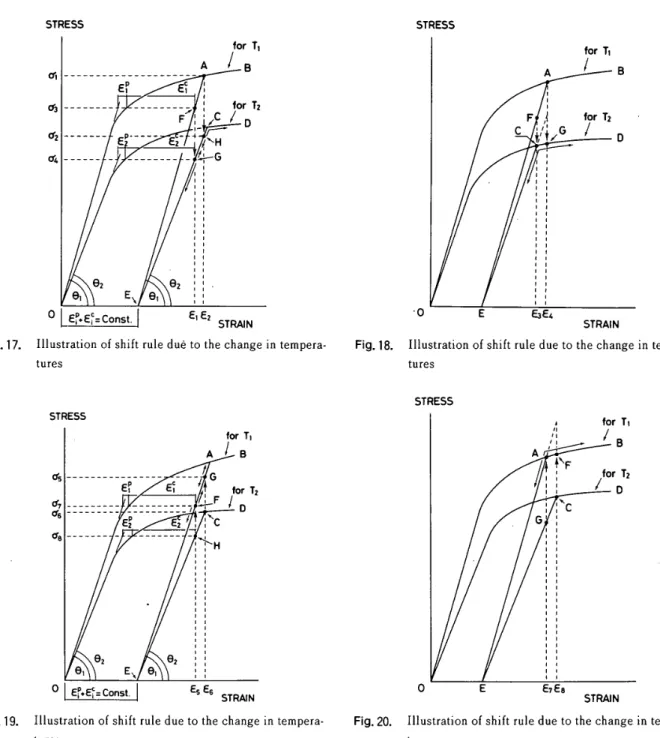
in
Figs.
17
to
20.
This
rule undet constanttota!
strain(except
thermal
expansion) willbe
llnderstoodimmediate]y
from
Figs.
17
Lo
2o,
According
to
the
assurnptionthat
the
sum
of
the
plastic
and
creep
strain
is
constant,the
stressfor
aconstanttemperature
(
T,
orT2)
is
shiftedto
the
point
for
the
sarne strain, e,, onthe
unloading or re]oading straightline
fer
another one(
T,
orT,)
through
the
point
E
(Figs.
17
to
20).
In
this
case,
if
the
vatueof
shifted
stress
is
more
than
that
of virgin stress-strain curvefor
the
same strain(see
Figs.18
to
20),
the
vatues of stressfollow
the
virgin stress-straln curve.If,
for
instance,
the
temperature
is
raised
in
amomentfrom
a constanttemperature
Ti
to
ahigher
valueT,,
the
values
of
stresses areshifted
from
that
ofF
to
G
and
A
to
H
as
shownin
Fig.
17,
respectively.After
that,
the
stressesfollow
the
curveECD.
However,
in
the
caseof
the
stress-strain relationship as shownin
Fig.18,
the
values of stressesare
shifted
from
that
of
the
stresses onthe
line
FA
to
that
ofthe
stresses onthe
virgin stress-strain cu[veCG
(for
example;F
to
C
or
A
to
G),
After
that,
the
stressesfollow
the
curveECD.
Also,
if
the
temperature
is
lowered
from
a constantternperature
Z
to
alower
valueT,,
the
values of stresses are shiftedfrom
that
ofH
to
F
andC
to
G
as $hownin
Fig.
19.
respectively.After
that,
the
stressesfollow
the
curveEAB.
HDwever,
in
the
case ofthe
stress-stiain relationship as shownin
Fig,
20,
the
values of stresses are shiftedfrom
that
ofthe
stresses onthe
Iine
GC
to
that
ofthe
stresses onthe
virgin stress-strain curveAF
(for
example;
G
to
A
orC
to
F).
After
that,
the
stressesfollow
the
curveEAB.
According
to
this
shift rule,the
creepbehavior
under variab!etemperatures
clescribed
formerly
canbe
illustrated
as
follows.
If
the
temperature
is
raised
in
a
moment
under
constant
stress
from
a
certain
temperture
T,
to
ahigher
valueT,
after-96-STRESS
q
opopq
A
E9
et
I
:
'
F7!11cp.----
:r
El
Y'LH
."-.-.
-
Z+-G
AI
11
11
/1
ll
il
11 ll
11
11
ld
ll
ld
bd
ei
::
Ex
e,
::
for
TiXe
fer
TzfD
STRESS
el
E
e,
OLEr+E7=censt
E'E2
sTRAiN
Fig
17.
Illustration
of shiftruledue
to
the
changein
tures
I
FS
letCV+l
1
d
11 Ll 11
11 11 lb
IJ lt
dd dl
11
11
lb
IP
EI
11 11 11 11 ia 11
11
STRESS
qqqoj
o
A""
.."
""tG
Ee
Ef
{+
!F
''
' fEt
ti
:Xc
1-"-ITH
!!
::
::
!l
::
::
11 11 1111el 11
11
11
11 torTiXB
tor
TiXD
for
TifB
for
hGf
o
・o
E
eE`
STRAIN
Fig.
18.
i]lustration
of shiftrutedue
to
the changein
tures
STRESS
E;
elelEx
el
E7+E:=Const
EsEsSTRArN
,1Afi}==
+XF]:i
!iN
::cG:
bl
Pl
11
bi
11
11
11
11
11 11
11
11
bl 11
11
11 11
11
ld
11
dd
dd
ld
lt
Fig.
19.
Itlustration
of shiftruledue
to
the
changein
tuTes
ferTiIB
for
TifD
O
E
E7Ee
STRAIN
Fig,
20.
Itlustration
of shift ruledue
to
the
changein
tures
a certain
time
period
t,
in
whichthe
creep strainAH
has
been
caused
as shownin
Fig.
21,
atthe
time
t,
the
value of strain changesfrom
H
to
K
by
way ofJ,
In
this
case,the
yalue of creep strain changesfrom
AH
to
DK.
While,
if
the
creep strain caused
during
the
time
period
t,
is
AH
asshown
in
Fig.
22,
atthe
time
t,
the
value of strain changesfrom
H
to
E
by
way ofI
andD.
In
this
case,the
value of creep strain changesfrom
AH
to
zero.Also,
if
the
temperature
is
lowered
from
a constantternperature
Ti
to
alower
valueT,
in
a moment afterh
certaintime
period
t3
in
whichthe
creep strainDK
has
been
caused as shownin
Fig.
21,
atthe
time
t,
the
$train
changes
frpm
K
to
H
by
way ofI.
In
this
case,the
value of creep strain ehangesfrom
DK
to
AH.
5.
2
Shitt
Rule
ot
the
Stress-strain
Relationship
Due
to
a
lncremental
Creep
Strain
This
shift
rule willbe
understoodeasily
from
the
stress relaxationbehavior']"]2).
The
stress relaxationis
the
tirne-dependent
decrease
in
stressin
a member whichis
constrainedto
a certainfixed
deformation.
If,
for
instance,
the
$tre$s
of
point
E
in
Fig.
23
is
maintained constantfor
avery shorttime,
the
state of stress and strain shiftedfrom
that
ofE
to
H,
because
ofthe
incremental
cieep strain(AE=EH)
causedduring
the
tirne
increment
(At).
But
asthe
strainis
maintained constantin
the
relaxationtest,
the
state
of
stress
and
strain
is
shifted
from
that
ofH
to
G
due
to
the
decrease
of elastic strain equalto
the
incremental
creep strain(AE),
After
that,
stresses-97-NII-Electronic Library Service
STFIES5
A
DH
ter
Ti
lc
B
1
fer12
zil
`,
,E---J-+
i/J
STRESS
A
H
e
f;"i4
D
tor
Tilc
farTl,1,
----STRESS
q
eq
O
G
o
G-
O
DF
Ei
STRAIN
$TRAIN
STRNN
Fig.21.
Illustration
ofbehavior
ofFig.22.
Illustration
ofbehavier
ofFigL23.
Illustration
of shLft ruledue
modified strain-hardening rnodified strain-hardening
to
creep straincreep
law
dur
to
shift rule cTeeplaw
dttr
to shlft rulefollow
the
curveFBC.
ts.
Numerical
Example
The
problem
of
the
nonlinearelasto-plastic
creep
behavior
of
structural
member
is
ofgreat
practical
interest.
As
the
example ofthe
use ofthe
information
presented
in
the
previous
sections,the
columnfixed
at
the
both
ends{see
Fig,24)
is
investigated.
This
celumnis
cornposed of elernentAC
(elastic-plastic
body)
and elementBC
(perfectly
elasticbody).
It
is
assumedthat
this
columndoes
notbow
orbackle
and onlythe
temperature
of elementAC
changes withtime
(see
Fig.24).
To
analyze
the
strain andstress
in
the
column
section,the
following
assumptions were made:
(1)
Plane
sections remainplane.
This
assumptionis
approximately correctfor
tong
prismatic
membersin
continuous
construction.
{2)
For
each
element,
the
strain,
stress,temperature
and
materia]properties
are assumed llnifoTm,(3}
The
the[mal
expansiondue
to
temperature
change [,.is
as・sumed
as
follows:
Strain{niu')
stros$t#gtcmoeT=
LOX10'5
×T--・-・-・-・t・・-・・-・・・--・-・・-・・--・-・・-(
1
)
whereT
is
in
degrees
Centigrade.
B
sTrtEsstltptrm').-Constant
tempareture
(eee)
c
-Vdiriable
temperature
A
Ternperature{eC)
600
1corctmin
1000Ctmin
4oo2oo
ro 10O
Z46e
10
12
TimeCminutes)
Fjg.24.
Temperatuie・time
history
intioducedi
inte
computerprogramme
-98-o 1Tan-tO,OlxE.)rOrc1conmmoasaman
6
` 2 o-1
-4
-6
2eao 1000'/':F
o / : :/:
tt//
1 1'i//1i
ltTdi,E.
I
'
O.il O.S SIRAHH(k;Fig.
25,
Assumed
stress-strain curvesFjg.
26.
-laco
.nm
Thefmal
inelastic
behavior
of column elernent
during
atemperature-tirne
history
(
4
)
The
relationshipbetween
steel
stress
a, and strain e,in
tension,
is
assumed asthose
indicated
in
Fig,25.
where
ErlE,=-LOIXIO'GXTi+O.994H'---''-・・----・・-・・-・・・---・--・・-・・・-・-・---・---'・・・(2)
In
this
expression,
E,
is
the
initiai
tangent
modulus atT
OCand
E,
is
that
atO
℃
,
Besides
these
data,
the
materialdescription
mustinclude
behavior
in
compression andduring
unloading.This
is
arrangedby
rnakingtwo
'
assumptlons
:
(a)
behavior
in
compressionis
the
same asthat
in
tension,
and
(b}
behavior
during
unioadingfrom
(or
reloadingto
)
apreviously
obtained value of stressis
linear
daldE=E,,
the
initial
tangent
modulus.(s>'To
evaluatethe
creep
deformation,
it
is
assumedthat
the
creep
strain
under
varying stressesancl
temperatures
for
the
structural
steelSS
41
is
relatedto
time
t,
absolutetemperature
T
and current stress a asthe
following
equationbased
on
the
previou$ly
obtained
ten$ile
c[eep
data,
Ec=lola/T+b)xa[CfT+dixtieT+n-.-"-".",,","..--.--."k.-."""-H"H.-..-,-.H"H--hHH...".""HHH(3)
where
a:-7.
21
×10'
bi3.
26
cll.55
×103
d:2.
25
e:8.
98
×10"
f:-3.
3oxlo"
T:absolute
temperature
t:time
(minutes)
a:stress(kg!mm!)
ec:creep strain
(%)
The
modified strain-hardening creeplaw
is
appliedfoT
the
calculation ofthe
primary
creepdeformation
and creepbehavior
under comperssivestress
is
assumed asthe
samethat
ofLensile
creep.
(6)
It
is
assumedthat
the
total
strain E, canbe
decomposecl
into
instantaneous
ancltime-dependent
components
as
fo!lows:
e==Ee+ep+Ec+er'"''""-'H'"'HHH-"'-''H'''"''"'-HH"H-HHH-"HHH''"''H'""''-"'"''-''-'"""-(4)
in
whiche.
and E. a[ethe
instantaneolls
elastie andplastic
strain, E.i$
the
time
andtemperature
depende"t
creep strain and ETis
thermal
strain.Based
onthese
assumptions,the
stress and strainis
calcuLatedfor
eachO.Ol
minuteinterval
during
heating
and coolingperiod.
Figure
26
showsthe
numerical result andhow
the
strain and stress of cross-sectien vary withtime.
After
about2.
5
minutes(2so
OC)during
heating
process,
the
creep
strain
begins
to
increase
rapidly,but
hardly
produces
during
cooLing
pracess.
Until
the
temperature
raises about2,
5
minutes(250
DC),the
compressive stTe$sincreases
to
the
peak
clue
to
the
therrnal
stfain.After
that,
the
compressive stressdecreases
due
to
the
increase
of creep strain andthe
decrease
of modulusof
elasticity.During
coolingprocess,
the
stress reversesfrom
the
state of compressionto
tensien
due
to
the
decrease
oflongitudinal
elongationby
the
thermal
strain.Finally
the
columnyields
in
tension.
7.
Conclusions
Based
onthe
detailed
investigations
ofthe
data
obtainedfrom
the
various cTeeb experiments,the
shift rulehas
been
proposed
in
orderto
evaluatethe
nonlinear elasto-plastic creepbehavior
of structural steel under continuously varying stresses andtemperatuTes.
Using
this
shift rule ofthe
stress-strain relationship andthe
modifiedstrain-hardening
law,
it
seemslike
that
the
nonlinear elasto-p}astic creepdeformation
of steel structures undercontinuouEly
varyingstrsses
andtemperatures
can evaluate with reasonable accuracy,However,
it
goes
without sayingthat
the
moredetailed
experiments and numerical analysis onthe
creepbehavior
of structural steel shouldbe
carried outto
complement
this
work.Reterences
1)
Fujimoto,
M.,
Fururnura,
F.,
Aye,
T.
andShinohara,
Y.:Primary
Creep
ofStructural
Steel
{SS41)
atHigh
Ternperatures,
Trans,
ofA.I.J.,
No,296,
October1980,
pp.145-157
2)
Fujimoto,
M.,
Furumllra,
F.
,
andAve,
T,
:
Primary
Creep
ofStructural
Steel
(SM
50
A)
atHigh
TemperatuTes
Trans.
ofA.I.J.,
No.306,
Augustl981,
pp.148-l56
3}
Fujimoto,
M,
,Fururnllra,
F.
,
andAve,
T.
:
Primary
Creep
ofStructuralSteel
(SM
58
Q}
atHighTemperatures,
Trans.
of