Edited by:
Nirmal Parajuli, Henry Ford Health System, United States
Reviewed by:
Mahesh Ramalingam, Chonnam National University Medical School, South Korea Jee in Kim, Keimyung University, South Korea
*Correspondence:
Ken Takahashi [email protected]
Specialty section:
This article was submitted to Cardiovascular Metabolism, a section of the journal Frontiers in Cardiovascular Medicine
Received: 05 January 2021 Accepted: 22 March 2021 Published: 13 April 2021 Citation:
Wang M, Liu Y, Liang Y, Naruse K and Takahashi K (2021) Systematic Understanding of Pathophysiological Mechanisms of Oxidative Stress-Related Conditions—Diabetes Mellitus, Cardiovascular Diseases, and Ischemia–Reperfusion Injury. Front. Cardiovasc. Med. 8:649785. doi: 10.3389/fcvm.2021.649785
Systematic Understanding of
Pathophysiological Mechanisms of
Oxidative Stress-Related
Conditions—Diabetes Mellitus,
Cardiovascular Diseases, and
Ischemia–Reperfusion Injury
Mengxue Wang, Yun Liu, Yin Liang, Keiji Naruse and Ken Takahashi*
Department of Cardiovascular Physiology, Graduate School of Medicine, Dentistry and Pharmaceutical Sciences, Okayama University, Okayama, Japan
Reactive oxygen species (ROS) plays a role in intracellular signal transduction under
physiological conditions while also playing an essential role in diseases such as
hypertension, ischemic heart disease, and diabetes, as well as in the process of aging.
The influence of ROS has some influence on the frequent occurrence of cardiovascular
diseases (CVD) in diabetic patients. In this review, we considered the pathophysiological
relationship between diabetes and CVD from the perspective of ROS. In addition,
considering organ damage due to ROS elevation during ischemia–reperfusion, we
discussed heart and lung injuries. Furthermore, we have focused on the transient
receptor potential (TRP) channels and L-type calcium channels as molecular targets for
ROS in ROS-induced tissue damages and have discussed about the pathophysiological
mechanism of the injury.
Keywords: oxidative stress, reactive oxygen species, inflammation, diabetes mellitus, ischemia–reperfusion injury, mitochondria, transient receptor potential channels
INTRODUCTION
At first glance, diabetes, which causes abnormal blood glucose control, and ischemia–reperfusion
injury (IRI) of the heart, which causes myocardial infarction, seem to have nothing in common.
However, both these diseases are consistent in that they cause inflammation with the release of
cytokines and the responses of immune cells. These reactions are triggered by the oxidative stress
(OS) that occurs in the body. Oxidative stress is defined as an imbalance between oxidants and
anti-oxidants in favor of the anti-oxidants (
1
). Reactive oxygen species (ROS) including hydrogen peroxide
(H
2O
2) and superoxide (
.O
−2) that are generated in the cells cause OS when they become excessive.
Oxidative stress causes diseases such as diabetes (
2
), IRI (
3
), cancer (
4
), and Alzheimer’s disease (
5
),
and, notably, this condition is affected by diet and obesity (
6
).
While the organ heart has drawn much attention in the context of ischemic heart diseases, which
is the leading cause of death among humans (
7
), IRI also occurs in several other organs such as the
lung (
8
). In addition, transplantation of organs, such as lungs and kidneys, can result in IRI due to
blood reperfusion in ischemic-isolated organs (
9
). While having their own specific mechanisms for
the development of diseases, the pathological conditions of
diabetes and IRI also share a common molecular basis in a series
of intracellular signal transduction mechanisms originating from
OS, as discussed in the present review. In addition to diabetes,
extending the pathophysiology of IRI from the perspective of
OS is meaningful to understand the diseases and development
of preventive measures and treatments involved.
PATHOPHYSIOLOGICAL RELATIONSHIP
BETWEEN DIABETES AND
CARDIOVASCULAR DISEASES FROM THE
PERSPECTIVE OF ROS
As the life-expectancy of diabetic patients has increased
significantly, the cardiovascular complications of diabetes have
become prominent. When compared with people without
diabetes, people with type 2 diabetes (T2DM) are at an increased
risk of cardiovascular diseases (CVD) (
10
). The increased
production of ROS in the diabetic heart is an important factor
in the occurrence and development of diabetic cardiomyopathy
(
11
). Reactive oxygen species can induce the inactivation of
the signaling mechanism between the insulin receptor and the
glucose transport system, which can lead to insulin resistance
(
12
). Meanwhile, diabetes is a producer of OS, which can lead
to atherosclerosis (
13
,
14
). We have explored the mechanisms by
which T2DM triggers OS and increases the risk of CVD from the
prospect of obesity, hyperglycemia, and intracellular calcium.
Obesity Plays an Important Role in Heart
Disease of Diabetic Patients
A recent study reported presence of differences in the factors
causing OS in the hearts of obese and non-obese diabetic mice.
In addition, the decreased expression of antioxidant molecules
in the hearts of non-obese diabetic mice was reported to act
as an important factor that leads to the development of heart
diseases (
15
). In this study, Li et al. created two groups of T2DM
mouse models: obese and non-obese groups. They found that
obese T2DM mice demonstrated more severe heart remodeling
and earlier contractile dysfunction than non-obese T2DM mice.
In addition, obese T2DM mice revealed severe and persistent
myocardial lipotoxicity, which was manifested by increased
free fatty acids (FFA) uptake. Excessive FFA uptake activates
the peroxisome proliferator-activated receptor alpha (PPARα)
pathway and phosphorylate glycogen synthase kinase 3 beta
(GSK-3β), while inhibiting glucose transporter 4 (GLUT4) and
fatty triglyceride lipase (ATGL). Among the tissue damage caused
by lipotoxicity, OS is the main factor (
16
). Under the effect of
lipotoxicity, the tissues absorb a large amount of FFA, leading
to excessive oxidation of FFA, a sharp increase in the amount of
oxygen consumption, and excessive ROS production (
17
–
20
). In
addition, excessive FFA and resultant oxidation lead to ceramide
synthesis, which in turn leads to increased cardiomyocyte
apoptosis through the mitochondrial pathway (
20
).
Another interesting mechanism by which obesity affects
the development of atherosclerosis through OS is
Na/K-ATPase. According to Krithika Srikanthan et al., activation of
the Na/K-ATPase signal cascade exacerbates obesity, diabetes,
dyslipidemia, and atherosclerosis, and these conditions are
all related to the imbalance of OS (
21
). Na/K-ATPase is a
scaffold and signaling protein, and is also involved in many
clinical conditions, including CVD and chronic kidney disease
(
22
,
23
). Fat accumulation in humans and mice is related to
systemic OS (
24
). The white adipose tissue of obese mice has
a trend of increased expression of NADPH oxidase (NOX) and
decreased expression of antioxidant enzymes (
25
,
26
). In cultured
adipocytes, the production of ROS was significantly increased
during the differentiation of 3T3-L1 cells into adipocytes,
indicating that the production of ROS increased simultaneously
with the accumulation of fat in adipocytes (
27
). Besides, the
increase in free fatty acid levels can induce ROS production
through the activation of NOX (
28
). Furthermore, diet-induced
OS can activate the Na/K-ATPase/Src/ROS amplification loop,
leading to the occurrence and development of dyslipidemia and
atherosclerosis (
21
).
The nuclear factor erythroid 2-related factor 2 (NRF2)
pathway is closely related to antioxidant effects and is activated
at the onset of OS (
29
). Li et al. reported that the expression
level of NRF2 and its target genes heme oxygenase 1
(HO-1) and NAD(P)H quinone dehydrogenase 1 (NQO(HO-1) increased
significantly in the heart of obese T2DM mice, but they decreased
in the hearts of non-obese T2DM mice (
15
). This result implies
that myocardial lipotoxicity and antioxidant pathway activation
occur in obese T2DM patients. This finding may provide a new
guidance for the prevention and clinical treatment of diabetic
heart diseases.
Relationship Between Increased ROS
Caused by Hyperglycemia and
Cardiovascular Dysfunction
Hyperglycemia (high levels of blood glucose) leads to increased
production of ROS, which ultimately leads to vascular
dysfunction (
30
). Meanwhile, OS from hyperglycemia leads to
insufficient glucose uptake by muscles and fat cells. Furthermore,
OS from hyperglycemia may promote β-cell dysfunction and
reduce insulin secretion by β cells (
13
,
31
). This event also
leads to further aggravation of hyperglycemia. As a result,
hyperglycemia and OS interact. It is therefore important to
understand how to reduce OS so as to reduce hyperglycemia.
Another question that needs resolution is how does high blood
sugar level trigger OS and lead to cardiovascular dysfunction.
Under a hyperglycemic condition, ROS accumulates, damages
DNA and proteins, and injures cardiomyocytes. The increase in
ROS production caused by hyperglycemia occurs through the
following ways: activation of the protein kinase C (PKC) pathway
via diacylglycerol (DAG), increased hexosamine pathway flux,
increased production of advanced glycation-end product, and
increased flux in the polyol pathway (
32
,
33
). During the ROS
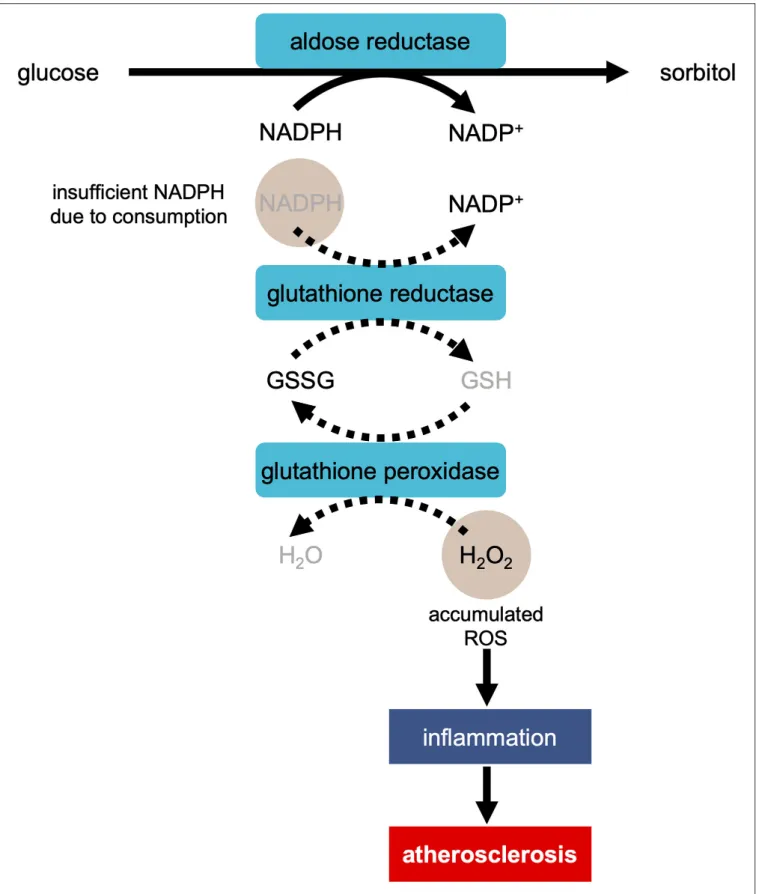
production in the polyol pathway, when aldose reductase reduces
glucose to sorbitol, excess glucose enters the polyol pathway
(Figure 1) (
34
). This reaction oxidizes NADPH to NADP
+,
consuming NADPH (
34
). As NADPH is essential for antioxidant
FIGURE 1 | Development of atherosclerosis via ROS production in the polyol pathway in the condition of hyperglycemia. In the process of the reduction of glucose to sorbitol by aldose reductase, NADPH is oxidized to NADP+, consuming NADPH. As NADPH is essential for regeneration of antioxidant glutathione (GSH), the reaction
regeneration, the decrease in the amount of NAPDH leads to the
facilitation of OS.
Simultaneously, the accumulation of ROS caused by
hyperglycemia triggers insulin resistance (
13
,
35
,
36
). Insulin
resistance occurs when the cells in the muscles, fat, and liver
do not respond appropriately to insulin and cannot uptake
glucose from the blood for deriving energy (
37
). In response,
the pancreas produce more insulin (
37
). Interestingly, insulin
resistance is a component of T2DM, high blood pressure, and
dyslipidemia; these characteristics together constitute a major
risk of CVD (
38
).
Past studies have reported that mitochondrial OS is related
to insulin resistance (
39
). Therefore, under high blood sugar
level conditions, the mitochondria are active and produce
more ROS (
40
). Elevated ROS levels can induce mitochondrial
division, which in turn affects the insulin-PI3K-AKT pathway
and GLUT4 (
12
). Glucose transporter 4 is the main glucose
transporter (
41
) in the skeletal muscles and adipose tissue.
The cells respond to insulin by increasing the expression
of GLUT4 in the plasma membrane, thereby increasing the
cellular uptake of blood glucose. When the glucose level is
high, the body produces insulin, which then activates the
PI3K/AKT pathway (
42
). Mitochondrial fission is directly
related to insulin resistance of the skeletal muscles (
43
). Past
studies have also demonstrated that restricting mitochondrial
overactivation can prevent insulin resistance (
44
). In addition,
insulin resistance caused by mitochondrial dysfunction may
lead to metabolic and cardiovascular abnormalities, thereby
increasing the incidence of CVD (
38
,
45
). In summary, OS caused
by hyperglycemia plays an important role in cardiovascular
dysfunction and both the conditions interact with and influence
each other.
Effect of OS on Calcium Handling in the
Heart Under Diabetic Conditions
Redox
regulation
of
calcium-handling
proteins
directly
affects cardiac contraction by changing intracellular calcium
concentration (
46
). As discussed earlier, hyperglycemia in
the cells can lead to excessive ROS production. The increase
in the ROS level can inhibit autonomic ganglion synaptic
transmission by oxidizing the α3 subunit of nicotinic
acetylcholine receptor, which may in turn result in fatal
arrhythmia (
47
). At the same time, ROS leads to sudden
death of a diabetic patient after myocardial infarction by
increasing post-translational protein modification, which leads
to the downregulation of Ca
2+-ATPase transcription in the
sarcoplasmic reticulum.
Ventricular contraction and relaxation are mainly controlled
by the release and uptake of Ca
2+by the sarcoplasmic reticulum
Ca
2+-ATPase 2 (SERCA2) pump (
48
,
49
). In hypertrophic
and failing myocardium, the level of SERCA2 protein and its
ability to absorb Ca
2+are inhibited. Reactive oxygen species
can oxidize and directly enhance CaMKII activity, which
in turn phosphorylates and activates several Ca
2+-handling
proteins such as the cardiac ryanodine receptor RyR2 or cardiac
SERCA (
50
).
Protein
O-linked-N-acetylglucosaminylation
(O-GlcNAcylation) plays important roles in calcium handling under
diabetic conditions (Figure 2). For example, hyperglycemia
increases the O-GlcNAc modification of
calcium/calmodulin-dependent protein kinase IIδ (CaMKIIδ), which in turn leads to
the autonomous activation of CaMKII (
51
,
52
). Furthermore,
the
hyperglycemia-induced
O-GlcNAcylation
of
CaMKII
causes ROS production by NOX2 (
53
). Autonomous activation
of CaMKII can lead to decreased cardiac contractility and
potential fatal arrhythmias, such as ventricular premature beats
and delayed depolarization. In fact, delayed depolarization
is related to long QT interval arrhythmia (
54
). On the other
hand, in the chronic hyperglycemia condition in diabetes,
O-GlcNAc transferase reduces the transcription of SERCA2, which
results in decreased calcium reuptake and impaired relaxation
(
55
). The overexpression of GlcNAcase or the inhibition of
GlcNAc modification increases the expression of SERCA2a, the
ablated sarcoplasmic reticulum Ca
2+leakage, improved cardiac
contractility, and reduced arrhythmia events (
56
).
In summary, calcium plays an important role in cardiac
dysfunction caused by ROS derived under the condition
of hyperglycemia.
IRI IN TERMS OF OXIDATIVE DAMAGE
ischemia–reperfusion injury is a type of tissue damage that
occurs when the blood flows back to the tissue after a period
of ischemia or under the lack of oxygen. IRI is often detected
in cases of organ transplants, major organ resections, and shock.
The main organs in which IRI occurs are the heart, lung, brain,
liver, kidney, and intestine (
57
–
62
). This finding contributes to
morbidity and mortality occurring in a variety of pathologies,
such as myocardial infarction and stroke caused by coronary
atherosclerosis (
63
).
ischemia–reperfusion is often associated with microvascular
injury, especially due to increased permeability of the capillaries
and arterioles, which lead to increased interstitial diffusion and
fluid filtration across the tissues. After ischemia, the re-entry
of blood into the tissue induces the release of large amounts
of oxygen free radicals. These free radicals trigger enzymatic
reactions, leading to oxidative damage to the cell membranes
as well as the production of toxic metabolites and cell injury
involving DNA, proteins, and lipids (
63
,
64
).
Interestingly, the common factor between diabetes, as
discussed in the previous section, and IRI is that OS affects
the deterioration of the pathological processes, including
inflammation. During IRI, the damaged tissues produce excessive
amounts of ROS, causing the release of proinflammatory
cytokines and apoptosis (
64
–
66
). After myocardial ischemia,
cardiac surgery, cardiogenic shock, or circulatory arrest,
myocardial IRI can lead to adverse cardiac events. Although
it is necessary to restore the blood flow to nourish the cells,
reperfusion is known for its harmful effects because of OS and the
subsequent development of intense inflammation and immune
responses (
67
–
75
). The following subsections discuss the role of
the three molecules involved in the development of IRI.
FIGURE 2 | Calcium handling in cardiomyocytes in the condition of hyperglycemia. Hyperglycemia causes modification of CaMKII by O-linked N-acetylgulcosamine (O-GlcNAcylation). This modification facilitates ROS production via NOX2. ROS enhances CaMKII activity by oxidation. CaMKII phosphorylates RyR2 and SERCA. On the other hand, hyperglycemia induces GlcNAcylation of the transcription factor Sp1, reducing the transcription of SERCA2. CaMKII, Ca2+/calmodulin-dependent
protein kinase II; ROS, reactive oxygen species; NOX2, NADPH oxidase 2; RyR2, ryanodine receptor 2; SERCA, sarcoplasmic reticulum Ca2+-ATPase 2.
TLR4
Innate immune response to invading pathogens, which is derived
from the toll receptors, is shared extensively among insects and
vertebrates (
76
). Toll-like receptor 4 (TLR4) binds to various
types of ligands such as lipopolysaccharides (LPS), low-density
lipoproteins, and heat-shock proteins (
77
,
78
). Among the
toll-like receptors (TLRs) consisting of 11 subtypes in humans, TLR2
and TLR4, predominantly TLR4, are involved in the development
of IRI (
79
). The TLR4-signaling pathway is an important
inflammatory cascade in IRI with essential functions in the
adaptive immune system (
80
,
81
). Toll-like receptor 4 responds to
endogenous molecules during the sterile inflammatory processes
such as IRI (
82
) and is considered as the key regulator in several
ischemia–reperfusion models.
As discussed earlier, OS is critically involved in the
pathogenesis of IRI. In fact, ROS facilitates TLR4 trafficking
to the plasma membrane, thereby promoting the TLR4 activity
(
83
,
84
). This event implies that the pathogenesis of IRI is
at least partly attributable to the effect of ROS on the TLR4
activation. Furthermore, Pahwa et al. postulate that ROS act as
a potential activator of TLRs and that hyperglycemia-induced OS
activates TLRs, subsequently inducing inflammatory responses in
diabetes (
85
).
The activations of TLR2, TLR3, and TLR4 increases oxidation
levels of lipids and proteins (
86
). In addition to the TLR4
activation by ROS mentioned earlier, the relationship between
ROS and TLR4 includes ROS production through the TLR4
activation. For example, TLR4 activation induced by LPS
facilitate intracellular ROS production via NOX-4 (
87
). In
TLR4-deficient mice, the ROS generation is reduced (
88
).
NF-κB
initiates
and
disseminates
innate
immune
responses
by
regulating
the
gene
pools
that
encode
proinflammatory/inflammatory cytokines (i.e., TNF-α, IL-1β,
IL-6, and granulocyte/macrophage-colony stimulating factor),
adhesion molecules (i.e., vascular cell adhesion
molecule-1, intercellular adhesion molecule-molecule-1, and E-selectin), and
chemokines (e.g., IL-8, regulated by the activation of normal
T-cells expressed and secreted, MIP-1α, and MCP-1) (
89
,
90
).
The activation of TLR4, which forms a complex with several
proteins such as CD14, myeloid differentiation primary response
88 (MyD88), and tumor necrosis factor receptor-associated
factor 6 (TRAF6), leads to NF-κB activation (
91
–
93
). Reactive
oxygen species acts on this TLR4/NF-κB pathway and further
facilitates the NF-κB activation (
94
). Ischemia–reperfusion also
leads to NF-κB activation (
95
).
The TLR4/NF-κB pathway is involved in the development of
myocardial IRI. TLR4, initially detected in monocytes, is also
expressed in other tissues, including the heart (
76
). Moreover,
TLR4 is strongly expressed in injured myocardium (
96
). MAPKs,
such as p38 and c-Jun NH2-terminal kinase (JNK), are activated
during myocardial IRI (
97
), which in turn induces an acute
inflammatory reaction. According to Lee et al., ROS produced
by NOX-2/4 causes MAPK activation (
98
). TLR4-deficient mice
have significantly less myocardial injury, as characterized by
the reduction in the myocardial infarction area, decrease in the
JNK and NF-κB activation, as well as reduction in the mRNA
expression of inflammatory cytokines, such as IL-1β, IL-6, and
MCP-1 (
99
).
The TLR4/NF-κB pathway is also involved in the development
of IRI in other organs. The deletion of TLR4 or pharmacological
antagonists reduces the severity of IRI in cardiac, hepatic, renal,
and pulmonary models (
99
–
108
). In case of the lung IRI, the
levels of phosphorylated JNK and NF-κB are diminished in
TLR4-deficient mice (
106
,
108
). Two pathways that possibly
get activated during the lung IRI are apoptosis, induced by
the activation of a transcriptional program controlled by
NF-κB and acute inflammation promoted by the activation of
resident alveolar macrophages and the expression of several
proinflammatory cytokines and chemokines, such as TNF-α,
IL-1β, IL-8, and macrophage inflammatory protein 2
(MIP-2) (
109
). The markers of lung injury, including permeability
index, myeloperoxidase content, and bronchoalveolar lavage
inflammatory cell counts were all decreased with TLR4
knockdown. The TLR4 knockdown in alveolar macrophages
resulted in almost complete weakening of the lung IRI. The
protective effect of TLR4 knockdown appears to be partly
mediated by the significant reduction in pre-transcriptional
signaling through MAPKs phosphorylation and possibly due to
the nuclear translocation of transcription factors, such as NF-κB
and activator protein-1 (
107
,
110
).
DPP4/CD26
Dipeptidyl peptidase-4 (DPP4), also known as CD26, is a
cell-surface protease offers a wide range of biological functions. As
a serine-type protease, DPP4 cleaves dipeptides from the
N-terminus, with proline residues in the penultimate position (
111
,
112
). Clinical and experimental study over the past 30 years has
clearly demonstrated that the DPP4/CD26 pathway is involved in
a variety of physiological processes and immune system diseases
(
113
). In addition, DPP4/CD26 transmembrane glycoproteins
are expressed not only by various cells of the immune system but
also by the epithelial and systemic vascular endothelial cells, by
the endothelial cells of venules and capillaries, by the cells of the
heart, kidney, lung, pancreas, spleen, and small intestine, by the
vascular smooth muscle cells, and by monocytes and hepatocytes;
moreover, it is soluble in the plasma (
111
,
114
,
115
).
DPP4 lyses multiple peptide substrates, including the
incretin hormone glucagon-like peptide-1 (GLP-1) (
116
).
Glucagon-like peptide-1 inhibits OS generation and the
subsequent inflammation (
117
–
119
). For example, GLP-1 exerts
antioxidant effects via cyclic adenosine monophosphate (cAMP),
phosphoinositide 3-kinase (PI3K), and protein kinase C-delta
(PKCδ) pathways in diabetes (
120
). Dipeptidyl peptidase-4
inhibitors prolong the bioavailability of the endogenously
secreted GLP-1, thereby exerting a beneficial therapeutic effect
on diabetes (
116
,
121
).
In addition to its involvement in the development of diabetes,
accumulating evidence indicates the role of DPP4 in IRI (
122
).
Dipeptidyl peptidase-4 deficiency preserves cardiac functions
via GLP-1 signaling in myocardial IRI (
123
). In this regard,
cardiomyocytes deficient in DPP4 are resistant to H
2O
2-induced
cell death by activating the AKT signaling (
124
). Dipeptidyl
peptidase-4 inhibitors reduce myocardial infarct size, improve
the cardiac function, and promote the myocardial regeneration
(
125
). The involvement of GLP-1 signaling in the preservation of
cardiac functions has been confirmed in various animal model
experiments, such as heart failure and myocardial infarction
(
123
,
126
–
129
). Glucagon-like peptide-1 inhibits apoptosis or
necrosis of endothelial cells (
118
) and cardiomyocytes (
130
).
Glucagon-like peptide-1-based therapies play an important role
in the protection from myocardial IRI (
127
,
131
–
133
).
The lung is the second-highest expressed organ of DDP4 in
rats (
134
). Dipeptidyl peptidase-4 can directly affect the dynamics
of lung inflammation and may itself act as a proinflammatory
signaling molecule (
135
,
136
). In the lung, the capillaries may act
as the main source of DPP4 activity, while the submucosal serous
gland and alveolar cells also express DPP4 (
111
). Similar to the
case of myocardial IRI, GLP-1 is believed to exert a protective
effect also in the lung IRI by suppressing the production of
OS (
137
).
HO-1
The presence of excessive free heme facilitates ROS formation,
thereby leading to abnormal endothelial cell function, as
observed in systemic hypertension, diabetes, and IRI (19384082).
HO is important to reduce the production of ROS (
138
).
Specifically, HO possesses the ability to degrade heme and
produce carbon monoxide (CO), a heme ligand, and biliverdin,
an antioxidant (
139
). Human HO exists in three isoforms,
HO-1, HO-2, and HO-3. Among these, HO-1 is involved in exerting
protective effect against IRI.
The expression of HO-1 is modulated by the transcription
factor NRF2, as discussed in Section Obesity plays an important
role in heart disease of diabetic patients. NRF2, which
translocated to the nucleus under OS, activates antioxidant
response element and increases the transcription of antioxidant
genes, including HO-1 (
140
). The HO-1 system includes four
main functions: (
1
) antioxidant function; (
2
) maintenance of
microcirculation; (
3
) regulation of cell cycle; and (
4
)
anti-inflammatory function (
141
). Overexpression of HO-1 exerts a
potent cellular protective effect in rat heart ischemia–reperfusion
models. HO-1 can reduce IRI due to the enhanced antioxidant
and anti-apoptotic activities (
142
,
143
).
Moreover, HO-1 possesses antiapoptotic outcomes. These
effects get mediated through the p38 MAPK-signaling
transduction pathway activated by CO (
144
). In addition,
CO-exposed animals, at least partially, demonstrate a significant
reduction in hyperoxia-induced lung apoptosis through the
anti-inflammatory MKK3/P38 MAPK pathway (
144
). Three
major MAPKs in cardiomyocytes are affected by the ischemia–
reperfusion, and the ERK pathway may be critical for cell survival
by protecting the cells from programmed cell death caused by
stress-induced activation of p38 and JNK (
145
).
EFFECTS OF ROS ON THE ION CHANNELS
AND THEIR IMPLICATION WITH
PATHOPHYSIOLOGY
The transient receptor potential (TRP) melastatin (TRPM)
subfamily belongs to the TRP cation channel superfamily, and
most of its members either have calcium ion permeability
or are calcium ion activating proteins (
146
,
147
). Changes
in the concentration of Ca
2+/Mg
2+in cells or changes in
the cell membrane potential and electrical activity can affect
various biological processes, including the cellular OS level
(
148
), endothelial cell permeability (
149
), and cell death (
150
).
Therefore, in the past 10 years, the members of this family
have attracted more and more interest and attention to CVD
(
151
,
152
), T2DM (
153
), and inflammation (
154
). The activity
of some members of the TRPM subfamily is regulated by OS
(
155
). Therefore, the emergence of OS-regulated ion channels
in an oxidative environment creates favorable conditions for
disease development.
TRPM4 in Cardiomyocytes
TRPM4 is widely expressed in various tissues (
156
–
159
),
including the atria and ventricles in both rodents (
160
,
161
) and
human (
162
,
163
).
With the increase of OS, the TRPM4 channel functions
abnormally, which promotes the onset and development of
the disease. To verify this point, it became necessary to
create an ischemic and hypoxic cellular environment. Presently,
cobalt chloride (CoCl
2) (
164
) and H
2O
2(
165
,
166
), in a
laboratory setting, are widely used to establish OS models
and fully characterized chemical agents. CoCl
2can be used to
establish a simple in vitro model of hypoxic/ischemic disease
in the laboratory, but up to now, there are few studies on
TRPM4 channel induced by CoCl
2. The possible reason is
that CoCl
2can induce the production of ROSs, but also affect
the expression of some genes, such as HIF-1α, p53, p21, and
PCNA (
167
–
169
). CoCl
2may also affect the remodeling of CMs
in hypoxic/ischemic area by activating PI3K/Akt and MAPK
pathways (
170
), and CoCl
2-induced apoptosis may be related
to mitochondria-mediated apoptosis pathway (
171
). Hydrogen
peroxide increases the activity of TRPM4 (
172
), while ATP and
ADP inhibit its activity (
173
). When ATP production in hypoxia
is insufficient, cardiomyocytes activates the K
ATPchannels (
174
)
and cause cell hyperpolarization, thereby preventing arrhythmia.
However, this process may be affected by electrical disturbances
induced by TRPM4 protein, because the channel is sensitive to
Ca
2+and ATP (
175
,
176
). Meanwhile, our previous research
results (
166
) demonstrated that TRPM4 is involved in the death
of cardiomyocytes mediated by H
2O
2. At higher concentrations,
H
2O
2increases cell death in a concentration-dependent manner,
while 9-phenanthrol (9-Phe) can partially reverse H
2O
2-induced
cell death. The reversal effect is probably the result of 9-Phe’s
direct effect on the TRPM4 channel (
166
,
177
,
178
).
TRPM2
Unlike TRPM4, TRPM2 is a cation channel permeable to Ca
2+(
179
). TRPM2 also plays an important role in cell proliferation
and survival (
180
). It is widely distributed and sensitive to OS
(
181
). However, at present, there is little information available on
the physiological and pathophysiological functions of TRPM2 in
the heart. Early studies of the TRPM2 channel function support
the observation that TRPM2 activation induces cell death by
continuously increasing the [Ca
2+]
i
(
182
–
184
).
Mitochondrial integrity is critical to the survival and function
of cardiomyocytes and is essential for maintaining the
high-energy requirements of cardiomyocytes. Ca
2+overload can
lead to mitochondrial permeability transition (MPT), but Ca
2+overload is the result of bioenergy failure after MPT occurs
following myocardial ischemia–reperfusion (
185
). This result can
be corroborated from the study of Davidson et al. (
186
). In
Langendorff-perfused mouse hearts, MitoQ, a
mitochondrial-targeted scavenger of ROS, could significantly reduce the Ca
2+wave-related mPTP opening. The mitochondria can thus benefit
from the calcium influx mediated by TRPM2 to reduce the
mitochondrial ROS production (
179
).
The heart consumes an equivalent of 6 kg of ATP per day,
most of which is produced through mitochondrial oxidative
phosphorylation (
187
). Myocardial ischemia consumes a large
amount of ATP and produces a large amount of ROS; this
process reduces mitochondrial biogenesis and mitochondrial
dysfunction, ultimately leading to cell death (
39
,
188
). However,
the results of a study showed (
189
) that TRPM2 can rescue the
ATP levels in the cells. During OS, TRPM2 maintains cell survival
after OS by regulating the antioxidant pathway and cofactors that
are regulated by NRF2.
Moreover, the TRPM2 channels can protect cardiomyocytes
from IRI (
181
), which may be due to the Ca
2+flux mediated
by TRPM2 that enhances the activity of calcineurin and the
stability of hypoxia-inducible factor (HIF) (
190
). In immune
cells, the NOX activity depends on membrane depolarization
(
191
) when the TRPM2 channel is activated and it inhibits the
production of ROS. TRPM2-mediated calcium influx can reduce
the production of ROS through the depolarization of the plasma
membrane of immune cells and the negative feedback regulation
of ROS production (
192
). This event contributes to cell functions
such as cytokine production, insulin release, cell motility, and cell
death (
193
).
L-Type Voltage-Gated Calcium Channel
Pulmonary circulation is characterized by low resistance and
low pressure, and the mean pulmonary arterial pressure (mPAP)
is <20 mmHg (
194
). Hypoxic pulmonary vasoconstriction
(HPV) is a physiological response of the arterioles. However,
there is usually no obvious effect on the pulmonary arterial
pressure during HPV on limiting the hypoxia area (
195
).
Persistent
hypoxia
induces
pulmonary
vasoconstriction
and vascular remodeling mediated by the contraction and
proliferation of pulmonary artery smooth muscle cells (PASMC),
which eventually led to pulmonary hypertension (PH) (
196
).
Pulmonary hypertension associated with hypoxia belongs to the
third group in the classification of PH (
194
). Although there is
no unified view yet on this association, hypoxia could increase
the level of ROS in PASMC (
197
–
205
).
Excessive ROS is considered to be the main factor of arterial
remodeling in PH induced by chronic hypoxia (CH) (
206
,
207
).
The specific mechanism of ROS promoting PH has not been
clarified yet, but it is evident that ROS plays an important
role in CH-induced PH vasoconstriction. Abnormal
voltage-dependent Ca
2+influx is considered to be related to the
pathogenesis of hypoxic PH (HPH) (
208
). In PASMC, cytosolic
Ca
2+concentration ([Ca
2+]
cyt) is regulated by two pathways:
voltage-dependent Ca
2+influx and voltage-independent Ca
2+influx. The influx of Ca
2+through L-type voltage-gated calcium
channels (VGCC) is an important [Ca
2+]
cyt
regulatory pathway
in HPH. Nifedipine and verapamil, which are L-type VGCC
antagonists, can prevent HPV, inhibit PASMC proliferation,
and alleviate HPH (
208
–
211
). L-type VGCC belongs to one of
the calcium ion channels, which is a polymer transmembrane
protein complex composed of five subunits of α1, α2, δ, β, and
γ. Here α1 is the main functional subunit, while the others
are auxiliary subunits. There are four subtypes of α1: α1S
(Ca
v1.1), α1C (Ca
v1.2), α1D (Ca
v1.3), and α1F (Ca
v1.4) (
212
).
Ca
v1.2 was upregulated, while L-type VGCC could functionally
enhance pulmonary vasoconstriction associated with Ca
2+influx
in PASMCs after CH exposure (
213
).
The existing pharmacological data indicates that L-type
VGCC plays an important role in the increase of [Ca
2+]
iin
PASMC induced by acute O
2tension (
214
–
218
). Experiments
are hence necessary to investigate the effects of specific
inhibitors (such as mibefradil) of T-type VGCC to determine
their role in maintaining [Ca
2+]
i
during hypoxia, although
mounting evidence have demonstrated that the application of
H
2O
2(
219
–
221
) and oxidized glutathione (GSSG) (
222
,
223
)
resulted in Ca
2+influx through L-type VGCC. In addition,
the possibility of channel opening and inward Ca
2+currents
are increased by Ca
v1.2 subunit of L-type VGCC, which was
glutathionylated by H
2O
2and GSSG in subsequent studies (
222
,
223
). Moreover, Ca
2+signaling contributed to the contraction
of PA (
224
). Furthermore, L-type VGCC has been reported
to be sensitive to plasma membrane depolarization (
225
).
Interestingly, vasoconstrictor endothelin-1 (ET-1) can stimulate
L-type VGCC-mediated increase of Ca
2+in PASMCs of CH
Wistar rats through the PKC and Rho kinase-dependent ways
(
226
,
227
). This situation is not difficult to understand, because
both PKC (
228
) and Rho kinase (
229
) can be activated by
oxidation to regulate this process. An indirect evidence of this
finding is that ET-1 could increase the production of ROS
in PASMCs (
230
–
232
). This hypothesis has not been tested
in pulmonary circulation, but the activation of L-type VGCC
induced by ET-1 in isolated cardiomyocytes is now known to be
mediated by.O
−2(
233
).
CONCLUSION
Oxidative stress is based on the balance between oxidant and
antioxidant activities derived from numerous molecules and
pathways. In this review, we discussed ROS production in
hyperglycemia under diabetic conditions, and, interestingly,
the effect of obesity on it. Moreover, OS affects calcium
handling via SERCA2 and CaMKII, thereby exacerbating cardiac
functions in diabetes. In this way, OS is involved in the
effects of diabetes on CVD. Moreover, a common mechanism
is involved in the pathology of diabetes and IRI. For example,
the OS-induced inflammation basically shares the common
mechanism of TLR4/NF-κB and TLR4/MAPK pathways in
diabetes and IRI. In addition, the DPP4/GLP-1 and
NRF2/HO-1 systems are involved in ROS scavenging in diabetes and
IRI. We also discussed the effect of OS on the activities of
ion channels, such as TRPM2, TRPM4, and L-type VGCC,
and their implications with diseases, including IRI. Further
understanding of these mechanisms is expected to promote the
development of new strategies for the prevention and cure of
these formidable diseases.
AUTHOR CONTRIBUTIONS
All authors listed have made a substantial, direct and intellectual
contribution to the work, and approved it for publication.
FUNDING
This research was funded by JSPS KAKENHI, Fund for the
Promotion of Joint International Research (Fostering Joint
International Research), 17KK0168 and JSPS KAKENHI
Grant-In-Aid for Scientific Research (B), 20H04518.
REFERENCES
1. Sies H. Oxidative stress: a concept in redox biology and medicine. Redox Biol. (2015) 4:180–3. doi: 10.1016/j.redox.2015.01.002
2. Newsholme P, Cruzat VF, Keane KN, Carlessi R, de Bittencourt PI, Jr. Molecular mechanisms of ROS production and oxidative stress in diabetes. Biochem J. (2016) 473:4527–50. doi: 10.1042/BCJ201 60503C
3. Cadenas S. ROS and redox signaling in myocardial ischemia-reperfusion injury and cardioprotection. Free Radic Biol Med. (2018) 117:76– 89. doi: 10.1016/j.freeradbiomed.2018.01.024
4. Reuter S, Gupta SC, Chaturvedi MM, Aggarwal BB. Oxidative stress, inflammation, and cancer: how are they linked? Free Radic Biol Med. (2010) 49:1603–16. doi: 10.1016/j.freeradbiomed.2010.09.006
5. Tonnies E, Trushina E. Oxidative stress, synaptic dysfunction, and Alzheimer’s disease. J Alzheimers Dis. (2017) 57:1105– 21. doi: 10.3233/JAD-161088
6. Bjorklund G, Chirumbolo S. Role of oxidative stress and antioxidants in daily nutrition and human health. Nutrition. (2017) 33:311–21. doi: 10.1016/j.nut.2016.07.018
7. Nowbar AN, Gitto M, Howard JP, Francis DP, Al-Lamee R. Mortality from ischemic heart disease. Circ Cardiovasc Qual Outcomes. (2019) 12:e005375. doi: 10.1161/CIRCOUTCOMES.118.005375
8. Laubach VE, Sharma AK. Mechanisms of lung ischemia-reperfusion injury. Curr Opin Organ Transplant. (2016) 21:246–52. doi: 10.1097/MOT.0000000000000304
9. Nieuwenhuijs-Moeke GJ, Pischke SE, Berger SP, Sanders JSF, Pol RA, Struys M, et al. Ischemia and reperfusion injury in kidney
transplantation: relevant mechanisms in injury and repair. J Clin Med. (2020) 9;253. doi: 10.3390/jcm9010253
10. Martin-Timon I, Sevillano-Collantes C, Segura-Galindo A, Del Canizo-Gomez FJ. Type 2 diabetes and cardiovascular disease: have all risk factors the same strength? World J Diabetes. (2014) 5:444–70. doi: 10.4239/wjd.v5.i4.444 11. Kaludercic N, Di Lisa F. Mitochondrial ROS formation in the pathogenesis of diabetic cardiomyopathy. Front Cardiovasc Med. (2020) 7:12. doi: 10.3389/fcvm.2020.00012
12. Boucher J, Kleinridders A, Kahn CR. Insulin receptor signaling in normal and insulin-resistant states. Cold Spring Harb Perspect Biol. (2014) 6:a009191. doi: 10.1101/cshperspect.a009191
13. Tangvarasittichai S. Oxidative stress, insulin resistance, dyslipidemia and type 2 diabetes mellitus. World J Diabetes. (2015) 6:456– 80. doi: 10.4239/wjd.v6.i3.456
14. Yuan T, Yang T, Chen H, Fu D, Hu Y, Wang J, et al. New insights into oxidative stress and inflammation during diabetes mellitus-accelerated atherosclerosis. Redox Biol. (2019) 20:247–60. doi: 10.1016/j.redox.2018.09.025
15. Li X, Wu Y, Zhao J, Wang H, Tan J, Yang M, et al. Distinct cardiac energy metabolism and oxidative stress adaptations between obese and non-obese type 2 diabetes mellitus. Theranostics. (2020) 10:2675– 95. doi: 10.7150/thno.40735
16. Hauck AK, Bernlohr DA. Oxidative stress and lipotoxicity. J Lipid Res. (2016) 57:1976–86. doi: 10.1194/jlr.R066597
17. A ISS, C AB, A JS. Changes in plasma free fatty acids associated with type-2 diabetes. Nutrients. (2019) 11:2022. doi: 10.3390/nu11092022
18. Lytrivi M, Castell AL, Poitout V, Cnop M. Recent insights into mechanisms of beta-cell lipo- and glucolipotoxicity in type 2 diabetes. J Mol Biol. (2020) 432:1514–34. doi: 10.1016/j.jmb.2019.09.016
19. Senoner T, Dichtl W. Oxidative stress in cardiovascular diseases: still a therapeutic target? Nutrients. (2019) 11:2090. doi: 10.3390/nu11092090 20. Moris D, Spartalis M, Spartalis E, Karachaliou GS, Karaolanis GI,
Tsourouflis G, et al. The role of reactive oxygen species in the pathophysiology of cardiovascular diseases and the clinical significance of myocardial redox. Ann Transl Med. (2017) 5:326. doi: 10.21037/atm.201 7.06.27
21. Srikanthan K, Shapiro JI, Sodhi K. The role of Na/K-ATPase signaling in oxidative stress related to obesity and cardiovascular disease. Molecules. (2016) 21:1772. doi: 10.3390/molecules21091172
22. Wang X, Liu J, Drummond CA, Shapiro JI. Sodium
potassium adenosine triphosphatase (Na/K-ATPase) as a therapeutic target for uremic cardiomyopathy. Expert Opin Ther Targets. (2017) 21:531–41. doi: 10.1080/14728222.2017.1 311864
23. Yan Y, Shapiro JI. The physiological and clinical importance of sodium potassium ATPase in cardiovascular diseases. Curr Opin Pharmacol. (2016) 27:43–9. doi: 10.1016/j.coph.2016.01.009
24. Furukawa S, Fujita T, Shimabukuro M, Iwaki M, Yamada Y, Nakajima Y, et al. Increased oxidative stress in obesity and its impact on metabolic syndrome. J Clin Invest. (2004) 114:1752–61. doi: 10.1172/JCI21625
25. Sakurai T, Ogasawara J, Shirato K, Izawa T, Oh-Ishi S, Ishibashi Y, et al. Exercise training attenuates the dysregulated expression of adipokines and oxidative stress in white adipose tissue. Oxid Med Cell Longev. (2017) 2017:9410954. doi: 10.1155/2017/9410954
26. Hafstad AD, Hansen SS, Lund J, Santos CXC, Boardman NT, Shah AM, et al. NADPH oxidase 2 mediates myocardial oxygen wasting in obesity. Antioxidants (Basel). (2020) 9:171. doi: 10.3390/antiox9020171
27. Lee O-H, Kwon Y-I, Hong H-D, Park C-S, Lee B-Y, Kim Y-C. Production of reactive oxygen species and changes in antioxidant enzyme activities during differentiation of 3T3-L1 adipocyte. J. Korean Soc. Appl. Biol. Chem. (2009) 52:70–5. doi: 10.3839/jksabc.2009.012
28. Inoguchi T, Li P, Umeda F, Yu HY, Kakimoto M, Imamura M, et al. High glucose level and free fatty acid stimulate reactive oxygen species production through protein kinase C–dependent activation of NAD(P)H oxidase in cultured vascular cells. Diabetes. (2000) 49:1939– 45. doi: 10.2337/diabetes.49.11.1939
29. Ma Q. Role of nrf2 in oxidative stress and toxicity. Annu Rev Pharmacol Toxicol. (2013) 53:401–26. doi: 10.1146/annurev-pharmtox-011112-140320
30. Volpe CMO, Villar-Delfino PH, Dos Anjos PMF, Nogueira-Machado JA. Cellular death, reactive oxygen species (ROS) and diabetic complications. Cell Death Dis. (2018) 9:119. doi: 10.1038/s41419-017-0135-z
31. Newsholme P, Keane KN, Carlessi R, Cruzat V. Oxidative stress pathways in pancreatic beta-cells and insulin-sensitive cells and tissues: importance to cell metabolism, function, and dysfunction. Am J Physiol Cell Physiol. (2019) 317:C420–C33. doi: 10.1152/ajpcell.00141.2019
32. Giacco F, Brownlee M. Oxidative stress and diabetic complications. Circ Res. (2010) 107:1058–70. doi: 10.1161/CIRCRESAHA.110.223545
33. Safi SZ, Qvist R, Kumar S, Batumalaie K, Ismail IS. Molecular mechanisms of diabetic retinopathy, general preventive strategies, and novel therapeutic targets. Biomed Res Int. (2014) 2014:801269. doi: 10.1155/2014/801269 34. Brownlee M. The pathobiology of diabetic complications: a unifying
mechanism. Diabetes. (2005) 54:1615–25. doi: 10.2337/diabetes.54.6.1615 35. Houstis N, Rosen ED, Lander ES. Reactive oxygen species have a causal
role in multiple forms of insulin resistance. Nature. (2006) 440:944– 8. doi: 10.1038/nature04634
36. Pitocco D, Tesauro M, Alessandro R, Ghirlanda G, Cardillo C. Oxidative stress in diabetes: implications for vascular and other complications. Int J Mol Sci. (2013) 14:21525–50. doi: 10.3390/ijms141121525
37. Lebovitz HE. Insulin resistance: definition and consequences. Exp Clin Endocrinol Diabetes. (2001) 109(Suppl 2):S135– 48. doi: 10.1055/s-2001-18576
38. Ormazabal V, Nair S, Elfeky O, Aguayo C, Salomon C, Zuniga FA. Association between insulin resistance and the development of cardiovascular disease. Cardiovasc Diabetol. (2018) 17:122. doi: 10.1186/s12933-018-0762-4
39. Kim JA, Wei Y, Sowers JR. Role of mitochondrial
dysfunction in insulin resistance. Circ Res. (2008) 102:401– 14. doi: 10.1161/CIRCRESAHA.107.165472
40. Henriksen EJ, Diamond-Stanic MK, Marchionne EM. Oxidative stress and the etiology of insulin resistance and type 2 diabetes. Free Radic Biol Med. (2011) 51:993–9. doi: 10.1016/j.freeradbiomed.2010.12.005
41. Blanco CL, McGill-Vargas LL, Gastaldelli A, Seidner SR, McCurnin DC, Leland MM, et al. Peripheral insulin resistance and impaired insulin signaling contribute to abnormal glucose metabolism in preterm baboons. Endocrinology. (2015) 156:813–23. doi: 10.1210/en.2014-1757
42. Huang X, Liu G, Guo J, Su Z. The PI3K/AKT pathway in obesity and type 2 diabetes. Int J Biol Sci. (2018) 14:1483–96. doi: 10.7150/ijbs.27173 43. Jheng HF, Tsai PJ, Guo SM, Kuo LH, Chang CS, Su IJ, et al. Mitochondrial
fission contributes to mitochondrial dysfunction and insulin resistance in skeletal muscle. Mol Cell Biol. (2012) 32:309–19. doi: 10.1128/MCB.05603-11 44. Matsuda M, Shimomura I. Increased oxidative stress in obesity: implications for metabolic syndrome, diabetes, hypertension, dyslipidemia, atherosclerosis, and cancer. Obes Res Clin Pract. (2013) 7:e330–41. doi: 10.1016/j.orcp.2013.05.004
45. Burgos-Moron E, Abad-Jimenez Z, Maranon AM, Iannantuoni F, Escribano-Lopez I, Escribano-Lopez-Domenech S, et al. Relationship between oxidative stress, er stress, and inflammation in type 2 diabetes: the battle continues. J Clin Med. (2019) 8:1385. doi: 10.3390/jcm8091385
46. Steinberg SF. Oxidative stress and sarcomeric proteins. Circ Res. (2013) 112:393–405. doi: 10.1161/CIRCRESAHA.111.300496
47. Shah MS, Brownlee M. Molecular and cellular mechanisms of cardiovascular disorders in diabetes. Circ Res. (2016) 118:1808– 29. doi: 10.1161/CIRCRESAHA.116.306923
48. Nelson BR, Makarewich CA, Anderson DM, Winders BR, Troupes CD, Wu F, et al. A peptide encoded by a transcript annotated as long noncoding RNA enhances SERCA activity in muscle. Science. (2016) 351:271–5. doi: 10.1126/science.aad4076
49. Venetucci LA, Trafford AW, O’Neill SC, Eisner DA. The sarcoplasmic reticulum and arrhythmogenic calcium release. Cardiovasc Res. (2008) 77:285–92. doi: 10.1093/cvr/cvm009
50. Erickson JR, Joiner ML, Guan X, Kutschke W, Yang J, Oddis CV, et al. A dynamic pathway for calcium-independent activation of CaMKII by methionine oxidation. Cell. (2008) 133:462–74. doi: 10.1016/j.cell.2008.02.048
51. Nishio S, Teshima Y, Takahashi N, Thuc LC, Saito S, Fukui A, et al. Activation of CaMKII as a key regulator of reactive oxygen species
production in diabetic rat heart. J Mol Cell Cardiol. (2012) 52:1103– 11. doi: 10.1016/j.yjmcc.2012.02.006
52. Singer HA. Ca2+/calmodulin-dependent protein kinase II
function in vascular remodelling. J Physiol. (2012) 590:1349– 56. doi: 10.1113/jphysiol.2011.222232
53. Lu S, Liao Z, Lu X, Katschinski DM, Mercola M, Chen J, et al. Hyperglycemia acutely increases cytosolic reactive oxygen species via O-linked GlcNAcylation and CaMKII activation in mouse ventricular myocytes. Circ Res. (2020) 126:e80–96. doi: 10.1161/CIRCRESAHA.119.316288 54. Landstrom AP, Dobrev D, Wehrens XHT. Calcium signaling
and cardiac arrhythmias. Circ Res. (2017) 120:1969– 93. doi: 10.1161/CIRCRESAHA.117.310083
55. Marsh SA, Collins HE, Chatham JC. Protein O-GlcNAcylation and cardiovascular (patho)physiology. J Biol Chem. (2014) 289:34449–56. doi: 10.1074/jbc.R114.585984
56. Hamilton S, Terentyev D. Proarrhythmic remodeling of calcium homeostasis in cardiac disease; implications for diabetes and obesity. Front Physiol. (2018) 9:1517. doi: 10.3389/fphys.2018.01517
57. Jennings RB. Historical perspective on the pathology of myocardial ischemia/reperfusion injury. Circ Res. (2013) 113:428–38. doi: 10.1161/CIRCRESAHA.113.300987
58. den Hengst WA, Gielis JF, Lin JY, Van Schil PE, De Windt LJ, Moens AL. Lung ischemia-reperfusion injury: a molecular and clinical view on a complex pathophysiological process. Am J Physiol Heart Circ Physiol. (2010) 299:H1283–99. doi: 10.1152/ajpheart.00251.2010
59. Jin R, Yang G, Li G. Inflammatory mechanisms in ischemic stroke: role of inflammatory cells. J Leukoc Biol. (2010) 87:779–89. doi: 10.1189/jlb.1109766 60. Konishi T, Lentsch AB. Hepatic ischemia/reperfusion: mechanisms of tissue injury, repair, and regeneration. Gene Expr. (2017) 17:277– 87. doi: 10.3727/105221617X15042750874156
61. Ponticelli C. Ischaemia-reperfusion injury: a major protagonist in kidney transplantation. Nephrol Dial Transplant. (2014) 29:1134–40. doi: 10.1093/ndt/gft488
62. Mallick IH, Yang W, Winslet MC, Seifalian AM. Ischemia-reperfusion injury of the intestine and protective strategies against injury. Dig Dis Sci. (2004) 49:1359–77. doi: 10.1023/b:ddas.0000042232.98927.91
63. Kalogeris T, Baines CP, Krenz M, Korthuis RJ. Ischemia/Reperfusion. Compr Physiol. (2016) 7:113–70. doi: 10.1002/cphy.c160006
64. Carden DL, Granger DN. Pathophysiology of
ischaemia-reperfusion injury. J Pathol. (2000) 190:255– 66. doi: 10.1002/(SICI)1096-9896(200002)190:3<255::AID-PATH526>3.0.CO;2-6
65. Malek M, Nematbakhsh M. Renal ischemia/reperfusion injury; from pathophysiology to treatment. J Renal Inj Prev. (2015) 4:20–7. doi: 10.12861/jrip.2015.06
66. Pantazi E, Bejaoui M, Folch-Puy E, Adam R, Rosello-Catafau J. Advances in treatment strategies for ischemia reperfusion injury. Expert Opin Pharmacother. (2016) 17:169–79. doi: 10.1517/14656566.2016.1115015 67. Chen YS, Chao A, Yu HY, Ko WJ, Wu IH, Chen RJ, et al. Analysis and
results of prolonged resuscitation in cardiac arrest patients rescued by extracorporeal membrane oxygenation. J Am Coll Cardiol. (2003) 41:197– 203. doi: 10.1016/s0735-1097(02)02716-x
68. Ito H, Maruyama A, Iwakura K, Takiuchi S, Masuyama T, Hori M, et al. Clinical implications of the ’no reflow’ phenomenon. A predictor of complications and left ventricular remodeling in reperfused anterior wall myocardial infarction. Circulation. (1996) 93:223–8. doi: 10.1161/01.cir.93.2.223
69. Kloner RA, Ellis SG, Lange R, Braunwald E. Studies of experimental coronary artery reperfusion. Effects on infarct size, myocardial function, biochemistry, ultrastructure and microvascular damage. Circulation. (1983) 68(2 Pt 2):8– 15.
70. Rokos IC, French WJ, Koenig WJ, Stratton SJ, Nighswonger B, Strunk B, et al. Integration of pre-hospital electrocardiograms and ST-elevation myocardial infarction receiving center (SRC) networks: impact on Door-to-Balloon times across 10 independent regions. JACC Cardiovasc Interv. (2009) 2:339–46. doi: 10.1016/j.jcin.2008.11.013
71. De Scheerder I, Vandekerckhove J, Robbrecht J, Algoed L, De Buyzere M, De Langhe J, et al. Post-cardiac injury syndrome and an increased humoral
immune response against the major contractile proteins (actin and myosin). Am J Cardiol. (1985) 56:631–3. doi: 10.1016/0002-9149(85)91024-0 72. Frangogiannis NG. The immune system and cardiac repair.
Pharmacol Res. (2008) 58:88–111. doi: 10.1016/j.phrs.2008. 06.007
73. Frangogiannis NG, Smith CW, Entman ML. The inflammatory response in myocardial infarction. Cardiovasc Res. (2002) 53:31–47. doi: 10.1016/s0008-6363(01)00434-5
74. Lambert JM, Lopez EF, Lindsey ML. Macrophage roles following myocardial infarction. Int J Cardiol. (2008) 130:147–58. doi: 10.1016/j.ijcard.2008.04.059 75. Lange LG, Schreiner GF. Immune mechanisms of cardiac disease. N Engl J Med. (1994) 330:1129–35. doi: 10.1056/NEJM199404213 301607
76. Schuster JM, Nelson PS. Toll receptors: an expanding role in our understanding of human disease. J Leukoc Biol. (2000) 67:767–73. doi: 10.1002/jlb.67.6.767
77. Chow JC, Young DW, Golenbock DT, Christ WJ, Gusovsky F. Toll-like receptor-4 mediates lipopolysaccharide-induced signal transduction. J Biol Chem. (1999) 274:10689–92. doi: 10.1074/jbc.274.16.10689
78. Brubaker SW, Bonham KS, Zanoni I, Kagan JC. Innate immune pattern recognition: a cell biological perspective. Annu Rev Immunol. (2015) 33:257– 90. doi: 10.1146/annurev-immunol-032414-112240
79. Arumugam TV, Okun E, Tang SC, Thundyil J, Taylor SM, Woodruff TM. Toll-like receptors in ischemia-reperfusion injury. Shock. (2009) 32:4– 16. doi: 10.1097/SHK.0b013e318193e333
80. Zhao H, Perez JS, Lu K, George AJ, Ma D. Role of Toll-like receptor-4 in renal graft ischemia-reperfusion injury. Am J Physiol Renal Physiol. (2014) 306:F801–11. doi: 10.1152/ajprenal.00469.2013
81. Zhang J, Xia J, Zhang Y, Xiao F, Wang J, Gao H, et al. HMGB1-TLR4 signaling participates in renal ischemia reperfusion injury and could be attenuated by dexamethasone-mediated inhibition of the ERK/NF-kappaB pathway. Am J Transl Res. (2016) 8:4054–67.
82. Chen GY, Nunez G. Sterile inflammation: sensing and reacting to damage. Nat Rev Immunol. (2010) 10:826–37. doi: 10.1038/nri2873
83. Nakahira K, Kim HP, Geng XH, Nakao A, Wang X, Murase N, et al. Carbon monoxide differentially inhibits TLR signaling pathways by regulating ROS-induced trafficking of TLRs to lipid rafts. J Exp Med. (2006) 203:2377– 89. doi: 10.1084/jem.20060845
84. Powers KA, Szaszi K, Khadaroo RG, Tawadros PS, Marshall JC, Kapus A, et al. Oxidative stress generated by hemorrhagic shock recruits Toll-like receptor 4 to the plasma membrane in macrophages. J Exp Med. (2006) 203:1951–61. doi: 10.1084/jem.20060943
85. Pahwa R, Jialal I. Hyperglycemia induces toll-like receptor activity through increased oxidative stress. Metab Syndr Relat Disord. (2016) 14:239– 41. doi: 10.1089/met.2016.29006.pah
86. Latorre E, Mendoza C, Layunta E, Alcalde AI, Mesonero JE. TLR2, TLR3, and TLR4 activation specifically alters the oxidative status of intestinal epithelial cells. Cell Stress Chaperones. (2014) 19:289– 93. doi: 10.1007/s12192-013-0461-8
87. Zhao H, Zhang M, Zhou F, Cao W, Bi L, Xie Y, et al. Cinnamaldehyde ameliorates LPS-induced cardiac dysfunction via TLR4-NOX4 pathway: The regulation of autophagy and ROS production. J Mol Cell Cardiol. (2016) 101:11–24. doi: 10.1016/j.yjmcc.2016.10.017
88. Pushpakumar S, Ren L, Kundu S, Gamon A, Tyagi SC, Sen U. Toll-like receptor 4 deficiency reduces oxidative stress and macrophage mediated inflammation in hypertensive kidney. Sci Rep. (2017) 7:6349. doi: 10.1038/s41598-017-06484-6
89. Bonizzi G, Karin M. The two NF-kappaB activation pathways and their role in innate and adaptive immunity. Trends Immunol. (2004) 25:280– 8. doi: 10.1016/j.it.2004.03.008
90. Baeuerle PA, Henkel T. Function and activation of NF-kappa B in the immune system. Annu Rev Immunol. (1994) 12:141–79. doi: 10.1146/annurev.iy.12.040194.001041
91. Verstrepen L, Bekaert T, Chau TL, Tavernier J, Chariot A, Beyaert R. TLR-4, IL-1R and TNF-R signaling to NF-kappaB: variations on a common theme. Cell Mol Life Sci. (2008) 65:2964–78. doi: 10.1007/s00018-008-8064-8 92. Moynagh PN. The NF-kappaB pathway. J Cell Sci. (2005) 118(Pt 20):4589–
93. Moynagh PN. TLR signalling and activation of IRFs: revisiting old friends from the NF-kappaB pathway. Trends Immunol. (2005) 26:469– 76. doi: 10.1016/j.it.2005.06.009
94. Morgan MJ, Liu ZG. Crosstalk of reactive oxygen species and NF-kappaB signaling. Cell Res. (2011) 21:103–15. doi: 10.1038/cr.2010.178
95. Li C, Ha T, Kelley J, Gao X, Qiu Y, Kao RL, et al. Modulating Toll-like receptor mediated signaling by (1–>3)-beta-D-glucan rapidly induces cardioprotection. Cardiovasc Res. (2004) 61:538–47. doi: 10.1016/j.cardiores.2003.09.007
96. Frantz S, Kobzik L, Kim YD, Fukazawa R, Medzhitov R, Lee RT, et al. Toll4 (TLR4) expression in cardiac myocytes in normal and failing myocardium. J Clin Invest. (1999) 104:271–80. doi: 10.1172/JCI6709
97. Ravingerova T, Barancik M, Strniskova M. Mitogen-activated protein kinases: a new therapeutic target in cardiac pathology. Mol Cell Biochem. (2003) 247:127–38. doi: 10.1023/a:1024119224033
98. Lee IT, Shih RH, Lin CC, Chen JT, Yang CM. Role of TLR4/NADPH oxidase/ROS-activated p38 MAPK in VCAM-1 expression induced by lipopolysaccharide in human renal mesangial cells. Cell Commun Signal. (2012) 10:33. doi: 10.1186/1478-811X-10-33
99. Chong AJ, Shimamoto A, Hampton CR, Takayama H, Spring DJ, Rothnie CL, et al. Toll-like receptor 4 mediates ischemia/reperfusion injury of the heart. J Thorac Cardiovasc Surg. (2004) 128:170–9. doi: 10.1016/j.jtcvs.2003.11.036 100. Stapel H, Kim SC, Osterkamp S, Knuefermann P, Hoeft A, Meyer R,
et al. Toll-like receptor 4 modulates myocardial ischaemia-reperfusion injury: Role of matrix metalloproteinases. Eur J Heart Fail. (2006) 8:665– 72. doi: 10.1016/j.ejheart.2006.03.005
101. Shimamoto A, Chong AJ, Yada M, Shomura S, Takayama H, Fleisig AJ, et al. Inhibition of Toll-like receptor 4 with eritoran attenuates myocardial ischemia-reperfusion injury. Circulation. (2006) 114(1 Suppl):I270–4. doi: 10.1161/CIRCULATIONAHA.105.000901
102. Oyama J, Blais C, Jr., Liu X, Pu M, Kobzik L, Kelly RA, et al. Reduced myocardial ischemia-reperfusion injury in toll-like receptor 4-deficient mice. Circulation. (2004) 109:784–9. doi: 10.1161/01.CIR.0000112575.66565.84 103. Wu HS, Zhang JX, Wang L, Tian Y, Wang H, Rotstein O. Toll-like receptor
4 involvement in hepatic ischemia/reperfusion injury in mice. Hepatobiliary Pancreat Dis Int. (2004) 3:250–3.
104. Tsung A, Hoffman RA, Izuishi K, Critchlow ND, Nakao A, Chan MH, et al. Hepatic ischemia/reperfusion injury involves functional TLR4 signaling in nonparenchymal cells. J Immunol. (2005) 175:7661– 8. doi: 10.4049/jimmunol.175.11.7661
105. Kim BS, Lim SW, Li C, Kim JS, Sun BK, Ahn KO, et al. Ischemia-reperfusion injury activates innate immunity in rat kidneys. Transplantation. (2005) 79:1370–7. doi: 10.1097/01.tp.0000158355.83327.62
106. Shimamoto A, Pohlman TH, Shomura S, Tarukawa T, Takao M, Shimpo H. Toll-like receptor 4 mediates lung ischemia-reperfusion injury. Ann Thorac Surg. (2006) 82:2017–23. doi: 10.1016/j.athoracsur.2006. 06.079
107. Merry HE, Phelan P, Doak MR, Zhao M, Hwang B, Mulligan MS. Role of toll-like receptor-4 in lung ischemia-reperfusion injury. Ann Thorac Surg. (2015) 99:1193–9. doi: 10.1016/j.athoracsur.2014.12.062
108. Zanotti G, Casiraghi M, Abano JB, Tatreau JR, Sevala M, Berlin H, et al. Novel critical role of Toll-like receptor 4 in lung ischemia-reperfusion injury and edema. Am J Physiol Lung Cell Mol Physiol. (2009) 297:L52– 63. doi: 10.1152/ajplung.90406.2008
109. Ishiyama T, Dharmarajan S, Hayama M, Moriya H, Grapperhaus K, Patterson GA. Inhibition of nuclear factor kappaB by IkappaB superrepressor gene transfer ameliorates ischemia-reperfusion injury after experimental lung transplantation. J Thorac Cardiovasc Surg. (2005) 130:194–201. doi: 10.1016/j.jtcvs.2005.02.040
110. Phelan P, Merry HE, Hwang B, Mulligan MS. Differential toll-like receptor activation in lung ischemia reperfusion injury. J Thorac Cardiovasc Surg. (2015) 149:1653–61. doi: 10.1016/j.jtcvs.2015.02.045
111. Lambeir AM, Durinx C, Scharpe S, De Meester I. Dipeptidyl-peptidase IV from bench to bedside: an update on structural properties, functions, and clinical aspects of the enzyme DPP IV. Crit Rev Clin Lab Sci. (2003) 40:209–94. doi: 10.1080/713609354
112. Rohrborn D, Wronkowitz N, Eckel J. DPP4 in diabetes. Front Immunol. (2015) 6:386. doi: 10.3389/fimmu.2015.00386
113. Waumans Y, Baerts L, Kehoe K, Lambeir AM, De Meester I. The dipeptidyl peptidase family, prolyl oligopeptidase, and prolyl carboxypeptidase in the immune system and inflammatory disease, including atherosclerosis. Front Immunol. (2015) 6:387. doi: 10.3389/fimmu.2015.00387
114. Lei Y, Hu L, Yang G, Piao L, Jin M, Cheng X. Dipeptidyl peptidase-IV inhibition for the treatment of cardiovascular disease- recent insights focusing on angiogenesis and neovascularization. Circ J. (2017) 81:770– 6. doi: 10.1253/circj.CJ-16-1326
115. Durinx C, Lambeir AM, Bosmans E, Falmagne JB, Berghmans R, Haemers A, et al. Molecular characterization of dipeptidyl peptidase activity in serum: soluble CD26/dipeptidyl peptidase IV is responsible for the release of X-Pro dipeptides. Eur J Biochem. (2000) 267:5608– 13. doi: 10.1046/j.1432-1327.2000.01634.x
116. Duez H, Cariou B, Staels B. DPP-4 inhibitors in the treatment of type 2 diabetes. Biochem Pharmacol. (2012) 83:823– 32. doi: 10.1016/j.bcp.2011.11.028
117. Chen YT, Tsai TH, Yang CC, Sun CK, Chang LT, Chen HH, et al. Exendin-4 and sitagliptin protect kidney from ischemia-reperfusion injury through suppressing oxidative stress and inflammatory reaction. J Transl Med. (2013) 11:270. doi: 10.1186/1479-5876-11-270
118. Oeseburg H, de Boer RA, Buikema H, van der Harst P, van Gilst WH, Sillje HH. Glucagon-like peptide 1 prevents reactive oxygen species-induced endothelial cell senescence through the activation of protein kinase A. Arterioscler Thromb Vasc Biol. (2010) 30:1407– 14. doi: 10.1161/ATVBAHA.110.206425
119. Shimoda M, Kanda Y, Hamamoto S, Tawaramoto K, Hashiramoto M, Matsuki M, et al. The human glucagon-like peptide-1 analogue liraglutide preserves pancreatic beta cells via regulation of cell kinetics and suppression of oxidative and endoplasmic reticulum stress in a mouse model of diabetes. Diabetologia. (2011) 54:1098–108. doi: 10.1007/s00125-011-2069-9 120. Oh YS, Jun HS. Effects of glucagon-like peptide-1 on oxidative stress and
Nrf2 signaling. Int J Mol Sci. (2017) 19:26. doi: 10.3390/ijms19010026 121. Ye Y, Keyes KT, Zhang C, Perez-Polo JR, Lin Y, Birnbaum Y. The myocardial
infarct size-limiting effect of sitagliptin is PKA-dependent, whereas the protective effect of pioglitazone is partially dependent on PKA. Am J Physiol Heart Circ Physiol. (2010) 298:H1454–65. doi: 10.1152/ajpheart.00867.2009 122. Matheeussen V, Jungraithmayr W, De Meester I. Dipeptidyl peptidase 4 as
a therapeutic target in ischemia/reperfusion injury. Pharmacol Ther. (2012) 136:267–82. doi: 10.1016/j.pharmthera.2012.07.012
123. Ku HC, Chen WP, Su MJ. DPP4 deficiency preserves cardiac function via GLP-1 signaling in rats subjected to myocardial ischemia/reperfusion. Naunyn Schmiedebergs Arch Pharmacol. (2011) 384:197–207. doi: 10.1007/s00210-011-0665-3
124. Ku HC, Chen WP, Su MJ. DPP4 deficiency exerts protective effect against H2O2induced oxidative stress in isolated cardiomyocytes. PLoS ONE. (2013)
8:e54518. doi: 10.1371/journal.pone.0054518
125. Wang XM, Yang YJ, Wu YJ. The emerging role of dipeptidyl peptidase-4 inhibitors in cardiovascular protection: current position and perspectives. Cardiovasc Drugs Ther. (2013) 27:297–307. doi: 10.1007/s10557-013-6459-8 126. Nikolaidis LA, Mankad S, Sokos GG, Miske G, Shah A, Elahi D, et al. Effects of glucagon-like peptide-1 in patients with acute myocardial infarction and left ventricular dysfunction after successful reperfusion. Circulation. (2004) 109:962–5. doi: 10.1161/01.CIR.0000120505.91348.58
127. Noyan-Ashraf MH, Momen MA, Ban K, Sadi AM, Zhou YQ, Riazi AM, et al. GLP-1R agonist liraglutide activates cytoprotective pathways and improves outcomes after experimental myocardial infarction in mice. Diabetes. (2009) 58:975–83. doi: 10.2337/db08-1193
128. Sokos GG, Nikolaidis LA, Mankad S, Elahi D, Shannon RP. Glucagon-like peptide-1 infusion improves left ventricular ejection fraction and functional status in patients with chronic heart failure. J Card Fail. (2006) 12:694– 9. doi: 10.1016/j.cardfail.2006.08.211
129. Bao W, Aravindhan K, Alsaid H, Chendrimada T, Szapacs M, Citerone DR, et al. Albiglutide, a long lasting glucagon-like peptide-1 analog, protects the rat heart against ischemia/reperfusion injury: evidence for improving cardiac metabolic efficiency. PLoS ONE. (2011) 6:e23570. doi: 10.1371/journal.pone.0023570
130. Ravassa S, Zudaire A, Diez J. GLP-1 and cardioprotection: from bench to bedside. Cardiovasc Res. (2012) 94:316–23. doi: 10.1093/cvr/cvs123