鉛直に加振した粒状体薄層における
準結晶的パターン
Pattern
formation of thin granular
layer
due to vertical vibration
農工大工
鵜川
亜希子
(Akiko Ugawa)
農工大工鈴木勝博
(Katsuhiro Suzuki)
農工大工
佐野
理(Osamu
Sano)
Abstract
Experimental study of the pattern formation on the thin horizontal granular layer, which oscillated vertically with frequency $f$ under atmospheric pressure, was made.
Pat-ternswereobserved byahigh-speed videocameraandclassifiedbymeansoftwo-dimensional
Fourier transform, as well as a direct measurement of the images. In addition to spots,
squarecells, polygons and stripes with frequency $f/2$, weobserved squares, polygons and
quasi-crystal patterns with frequency $f/4$. The dependence of oscillation amplitude and
frequency on the pattern size was analyzed.
1
INTRODUCTION
Pattern formation of thin granular layer due to vertical vibration has
been extensively studied since the pioneering work by M. Faraday
$(1831\backslash )$. Recently many experimental($\mathrm{D}\mathrm{o}\mathrm{u}\mathrm{a}\mathrm{d}\mathrm{y}$et al. 1989, Melo et al.
1994, 1995, Goldshtein et al. 1995, Umbanhower et al. 1996, Metcalf
et al. 1997, Sano
&Suzuki
1998, Sano et al. 1999) andnumeri-$\mathrm{c}\mathrm{a}\mathrm{l}(\mathrm{A}\mathrm{o}\mathrm{k}\mathrm{i}$ et al. 1996, Clement et al. 1996, Lan&Rosato 1997, Bizon
et al. 1998) investigations have revealed wavy motions
on
this layer.In spite of industrial importance and academic interest, however, the
basic understanding of the physical mechanisms underlying the
col-lective behaviors of this material is still inadequate (Jaeger&Nagel
1992, 1996, Lubkin 1995, Jaeger et al. 1996, etc.). In this paper
we
shall elucidate the detailed pattern diagram and dispersion relation
on an
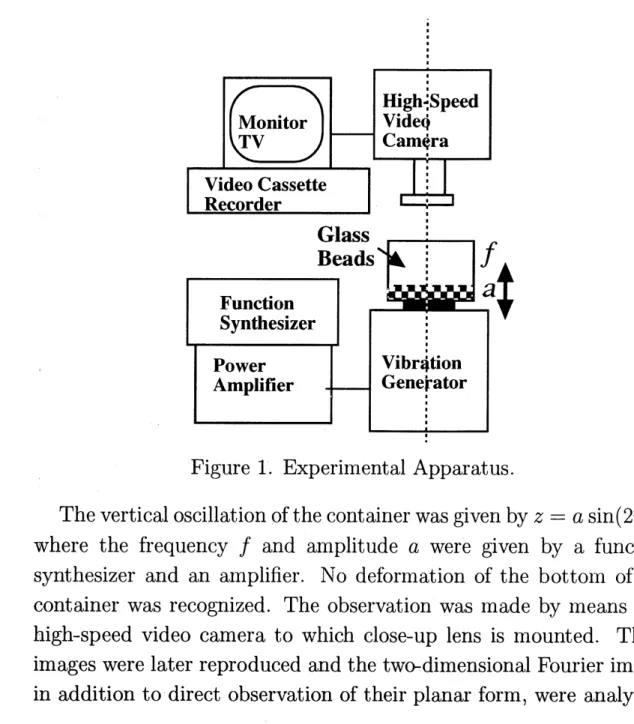
electro-mechanical vibration generator. The block diagram ofour
experimental apparatus is shown in Figure 1.Figure 1. Experimental Apparatus.
The vertical oscillation ofthe container
was
given by $z=a\sin(2\pi ft)$,where the frequency $f$ and amplitude $a$
were
given bya
functionsynthesizer and
an
amplifier. No $\mathrm{d}\mathrm{e}\mathrm{f}\mathrm{o}\Gamma \mathrm{l}\mathrm{n}\mathrm{a}\mathrm{t}\mathrm{i}\mathrm{o}\mathrm{n}$ of the bottom of thecontainer
was
recognized. The observationwas
lnade bymeans
ofa
high-speed video
camera
to which close-up lens is mounted. Theseimages
were
later reproduced and the $\mathrm{t}_{\mathrm{W}\mathrm{e}\succ}\mathrm{d}\mathrm{i}\mathrm{m}\mathrm{e}\mathrm{n}\mathrm{S}\mathrm{i}\mathrm{o}\mathrm{n}\mathrm{a}1$ Fourier image,3
RESULTS
3.1 Planar
form
We filled the glass beads of
a
diameter $d=0.13\pm 0.05\mathrm{m}\mathrm{m}$ in a vesselto a depth $h=0.7\mathrm{m}\mathrm{m}\sim 1.2\mathrm{m}\mathrm{m}$, and observed the planar form of the
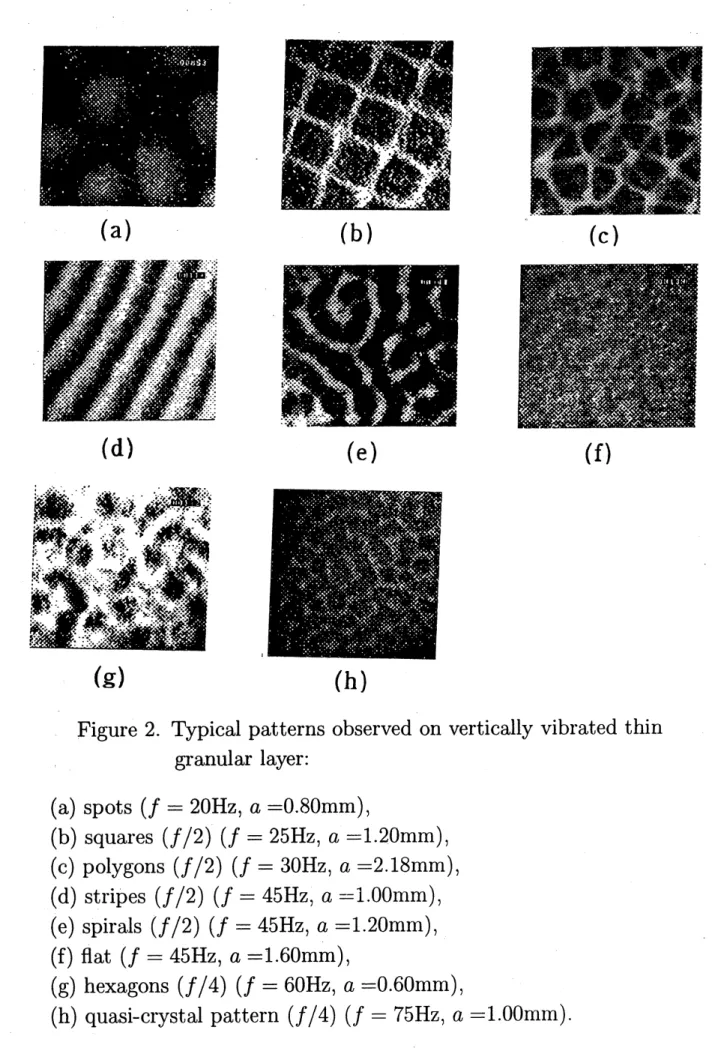
granular layer under vertical vibrations. Examples ofthe patterns
are
shown in Figure 2. The typical sequence of pattern changes, which
we
found under frequency forcing of fixed amplitude $a$ of mediumvalues is
as
follows: initially $\mathrm{f}\mathrm{l}\mathrm{a}\mathrm{t}_{l}$ surface disruptedinto spot-like
pat-terns (Fig. $2\mathrm{a}$) for frequencies
$f\approx 20\mathrm{H}\mathrm{z}$, which diffused into sheet
around spots for $f\approx 25\mathrm{H}\mathrm{z},\mathrm{d}\mathrm{e}\mathrm{v}\mathrm{e}\mathrm{l}\mathrm{o}\mathrm{p}\mathrm{e}\mathrm{d}$ to square patterns (Fig. $2\mathrm{b}$)
for $f=25\sim 35\mathrm{H}\mathrm{z}$ (sometimes $\mathrm{h}\mathrm{e}\mathrm{x}\mathrm{a}\mathrm{g}\mathrm{o}\mathrm{n}\mathrm{s}/\mathrm{t}\mathrm{r}\mathrm{i}\mathrm{a}\mathrm{n}\mathrm{g}\mathrm{l}\mathrm{e}\mathrm{S}$ (Fig. $2\mathrm{c}$)
were
observed), and stripe patterns (Fig. $2\mathrm{d}$) with
some
dislocations for$f=40\sim 45\mathrm{H}\mathrm{z}$, which sometimes evolved into spirals (Fig. $2\mathrm{e}$)$.\mathrm{T}\mathrm{h}\mathrm{e}\mathrm{s}\mathrm{e}$
patterns repeated with $2T$ (Fig. 3), where $T(=1/f)$ is the period of
external forcing. When
we
increased the frequency, patternsdisap-peared (Fig. $2\mathrm{f}$) for $f\approx 50\mathrm{H}\mathrm{z}$, and cellular patterns of
approximately
hexagonal shape reappeared for $f\approx 60\mathrm{H}\mathrm{z}(\mathrm{F}\mathrm{i}\mathrm{g}.2\mathrm{g})$, which repeated
with period $4T$. Between the patterns (e) and (g),
we
observed almostflat surface, although constituent particles of the latter
were
not atrest. These findings agree with the previous works. We also observed
quasi-crystal pattern($\mathrm{p}\mathrm{e}\mathrm{n}\mathrm{r}\mathrm{o}\mathrm{S}\mathrm{e}$ 1974, Mackay 1981, Shechtman et al.
1984, Levine&Steinhardt 1984, Christiansen et al. 1992, Edwards&
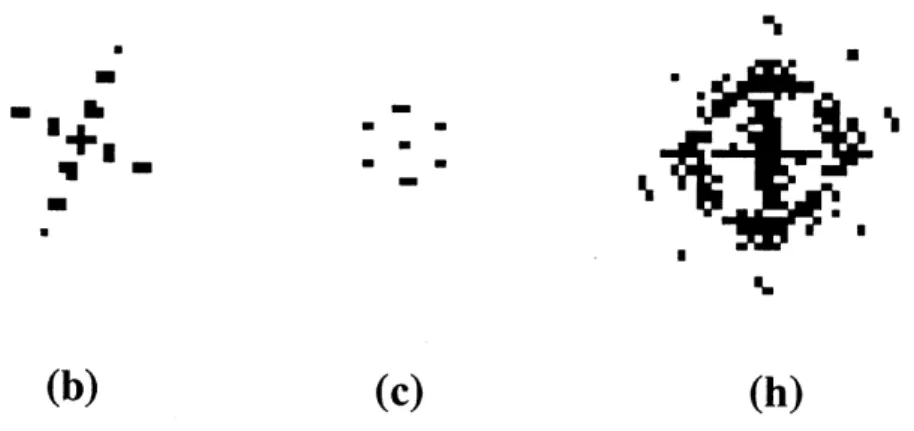
Fauve 1994) with 8-fold symmetry (Fig. $2\mathrm{h}$). Typical Fourier patterns
corresponding to Figures $2\mathrm{b},$ $2\mathrm{c}$ and $2\mathrm{h}$
are
shown in Figure 4.Fig-ure
5 is the pattern diagram in normalized frequency $f^{*}(=f\sqrt{h}/g)$against normalized acceleration amplitude $\Gamma(=4\pi^{2}f^{2}a/g)$, where $g$ is
the acceleration of gravity. In contrast to the previous works which
were
made under evacuated circumstance,we
have wider region ofconvection regime
as
wellas
the region of quasi-crystal patterns in(a) (b)
(d) (e) (f)
(g) (h)
Figure 2. Typical patterns observed
on
vertically vibrated thingranular layer:
(a) spots $(f=20\mathrm{H}_{\mathrm{Z},a}=0.80\mathrm{m}\mathrm{m})$,
(b) squares $(f/2)(f=25\mathrm{H}_{\mathrm{Z}}, a=1.20_{\mathrm{m}}\mathrm{m})$,
(c) polygons $(f/2)(f=30\mathrm{H}_{\mathrm{Z},a}=2.18\mathrm{m}\mathrm{m})$,
(d) stripes $(f/2)(f=45\mathrm{H}\mathrm{Z}, a=1.00\mathrm{m}\mathrm{m})$,
(e) spirals $(f/2)(f=45\mathrm{H}\mathrm{z}, a=1.2\mathrm{o}\mathrm{m}\mathrm{m})$,
(f) flat $(f=45\mathrm{H}\mathrm{Z},$ $a=1.60_{\mathrm{m}\mathrm{m})}$,
(g) hexagons $(f/4)(f=60\mathrm{H}\mathrm{z}, a=0.60\mathrm{m}\mathrm{m})$,
(a) $\mathrm{t}=0$ (b) $\mathrm{t}=\mathrm{T}$ (c) $\mathrm{t}=2\mathrm{T}$
Figure 3. Time sequence of thesquare pattern; (b) and (c),respectively,
are
the patterns ata
tilne $T$ and $2T$ after (a), where $T$ is the periodof external vibration. Crosses indicate the
same
position..
$-\mathrm{I}+_{\mathrm{I}}^{\mathrm{h}}$
.
.
$-\tau$
$-$
.
(b) (c) (h)
Figure 4. Fourier patterns of Figures $2\mathrm{b},$ $2\mathrm{c}$ and $2\mathrm{h}$, showing 4-fold,
$\sim\sim \mathrm{b}0$
$\mathrm{Q}\mathrm{o}^{\mathrm{g}}\vee$
$\mathrm{b}^{\mathrm{I}}7$
$f^{*}=f(\mathrm{h}/\mathrm{g})1/2$
Figure 5. Phase diagram.
$\square$: squares $(f/2),$ $\otimes$: hexagons and triangles $(f/2),$ $/$: stripes
$(f/2),$ $\mathrm{O}$: squares $(f/4),$ $\Phi$: hexagons and triangles $(f/4)$, and
$\mathrm{A}$: octagons $(f/4)$.
3.2 Size
of
the cellThe size of the cell depends
on
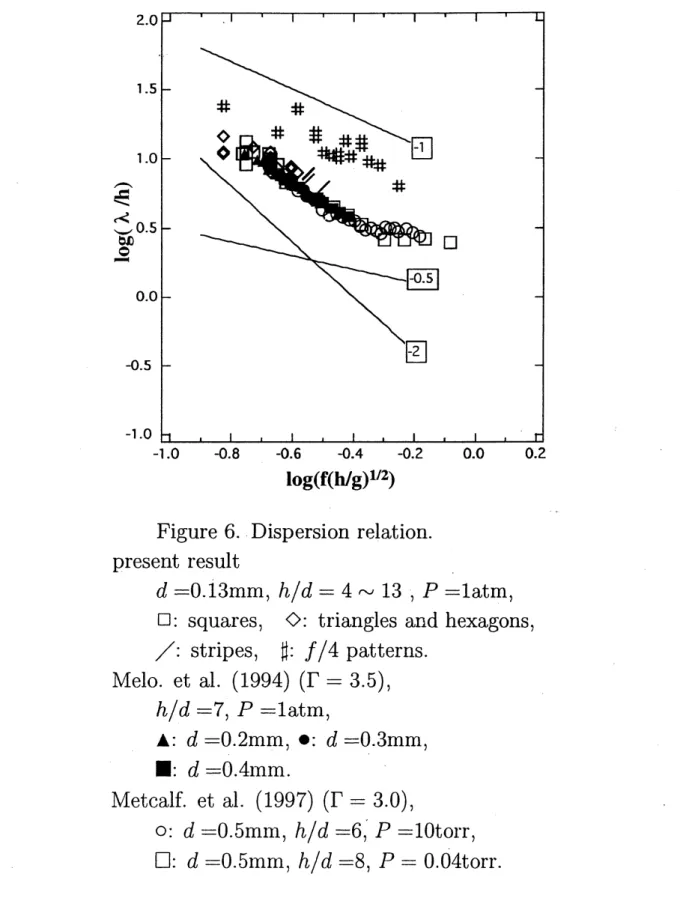
$f,$ $a$ and $h$. We plot the wavelengthof the pattern $\lambda^{*}$ normalized by the depth (i.e.
$\lambda^{*}=\lambda/h$) against
normalized frequency $f^{*}$ in Figure 6. Data estimated from previous
works (Melo et al. 1994; Metcalf et al. 1997)
are
also plotted. By thisscaling, each family of data belonging to $f/2$ and $f/4$ is well fitted by
$\lambda^{*}\propto f^{*\alpha}$ with $\alpha\approx-1$. Their intercepts in log-log plot differ by about
0.3.
Note that in thecase
of$\mathrm{c}\mathrm{a}\mathrm{p}\mathrm{i}\mathrm{l}\mathrm{l}\mathrm{a}\mathrm{r}\mathrm{y}/\mathrm{g}\mathrm{r}\mathrm{a}\mathrm{V}\mathrm{i}\mathrm{t}\mathrm{y}$waves
of the water, thedispersion relation leads to $\alpha=-2\sim-1$ for lower frequency, while
Tufillaro et al. 1989, Milner 1991, M\"uller 1993, Edwards &) Fauve
$\mathrm{i}994)$.
$\log(\mathrm{f}(\mathrm{h}/\mathrm{g})^{1}\prime \mathrm{z})$
Figure 6. Dispersion relation.
present result
$d=0.13\mathrm{m}\mathrm{m},$ $h/d=4\sim 13,$ $P=\mathrm{l}\mathrm{a}\mathrm{t}\mathrm{m}$, $\square$: squares, $\mathrm{O}$: triangles and hexagons,
/: stripes, $\#:f/4$ patterns.
Melo. et al. (1994) $(\Gamma=3.5)$,
$h/d=7,$ $P=\mathrm{l}\mathrm{a}\mathrm{t}\mathrm{m}$,
$\mathrm{A}:d=0.2\mathrm{m}\mathrm{m}$, $\bullet$: $d=0.3\mathrm{m}\mathrm{m}$,
$\blacksquare:d=0.41\mathrm{n}\mathrm{m}$.
Metcalf. et al. (1997) $(\Gamma=3.0)$,
$0:d=0.5\mathrm{I}\mathrm{n}\mathrm{m},$ $h/d=6,$ $P=10\mathrm{t}\mathrm{o}\mathrm{r}\mathrm{r}$,
$\cup$ $L$ $0$ $0$
Time $(d\mathrm{T})$
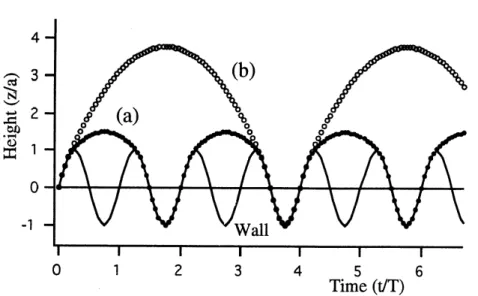
Figure 7. Schematic picture of the orbit of
a
granular particle:$(\mathrm{a})f/2$-pattern, and (b) $f/4$-pattern.
4
DISCUSSION
Our
resultsare
explainedas
follows: Granular particles pushed upby the upward motion of the vessel obtain upward momentum and
make
a
free flight during the time interval in which the upwardac-celeration due to external forcing exceeds that of the gravity. When
granular particles fall down and touch the bottom of the vessel, they
are
reflected and make successive free flights with given positions andvelocities
as new
‘initial conditions’. These conditions, however,are
in general random,
so
thatno
collective motion is observed. On theother hand, if particles make ‘soft-landing’
so
that they have thesame
velocities
as
the wall velocity at the time of collision, they arecon-vected by the downward motion of the vessel, which
are
duly releasedin the
same
phase of the next elevationas
they did previously, whichforms the periodic and correlated motion of the granular particles, $\mathrm{i}.\mathrm{e}$.
‘patterns’.
The
above-mentioned
process is possible fora
particularcombina-tion of$f,$ $a,$ $h$ and$g$, whose minimum time interval is $2T$ (subharmonic
the free flight, so that similar patterns reappear for
a
period $4T$,or
$6T,$or
$\cdots$ (Fig. 7), although the observation becomes increasinglydifficult.
Finally we shall consider the experimentally observed dispersion
relation. To this end
we
assume
(assumption 1) $2\lambda_{1}=\lambda_{2}$ , $f_{2}=f_{1}/2$,
(assumption 2) $\lambda=cf^{\alpha}$,
where $c$ is
a
constant. From assumption 1,we
have$\log\lambda_{2}=\log 2+\log\lambda 1=0.301+\log\lambda_{1}$,
which explains the difference 0.3 of the intercepts. From assumptions
1 and 2,
we
have$2cf_{1}^{\alpha}=cf_{2)}^{\alpha}$
or
2$f_{1}^{\alpha}=(f_{1}/2)^{\alpha}$ )which explains the exponent $\alpha=-1$, i.e. $\lambda=cf^{-1}$.
5
CONCLUSIONS
Pattern formation
on
vertically oscillating thin granular layer underatmospheric pressure
was
investigated bymeans
ofa
high-speed videocamera.
1. Pattern diagram is obtained by
means
of direct $\mathrm{a}\mathrm{n}\mathrm{d}/\mathrm{o}\mathrm{r}$ Fourierimages, and the sequence of transitions
are
elucidated.2. Pattern formation process, temporal periodicities, translational
$\mathrm{a}\mathrm{n}\mathrm{d}/\mathrm{o}\mathrm{r}$ rotational symmetries of the patterns
are
checked.3. In addition to regular patterns($\mathrm{S}\mathrm{q}\mathrm{u}\mathrm{a}\Gamma \mathrm{e}\mathrm{S},$
$\mathrm{t}\mathrm{r}\mathrm{i}\mathrm{a}\mathrm{n}\mathrm{g}\mathrm{l}\mathrm{e}\mathrm{S}/\mathrm{h}\mathrm{e}\mathrm{x}\mathrm{a}\mathrm{g}\mathrm{o}\mathrm{n}\mathrm{s}$, etc
of subharmonic type),
we
found quasi-crystal pattern of 8-foldsym-metry with frequency $f/4$,
as
the external forcingfrequency $f^{*}\mathrm{a}\mathrm{n}\mathrm{d}/\mathrm{o}\mathrm{r}$lation and experiment. Phys.Rev.Lett. 80:57-60.
Christiansen, B., P.Alstr\emptyset m&M.T.Levinsen 1992. Ordered
Capillary-Wave States: Quasicrystals, Hexagons, and Radial Waves. Phys.
Rev. Lett. 68: 2157-2160.
Clement, E., L.Vanel, J.Rajchenbach
&J.Duran
1996. Patternfor-mation in vibrated granular layer. Phys.Rev.E53:2972-2975.
Douady, S., S.Fauve
&C.Laroche
1989. SubharmonicInstabili-ties and defects in a granular layer under vertical vibrations.
Europhys. Lett.8:621-627.
Edwards, W.S.
&S.Fauve
1994.
Patterns and quasi-patterns in theFaraday experiment. J. Fluid Mech.278:123-148.
Faraday, M. 1831. On
a
peculiar class of acoustical figures; andon
certain forms assumed by
groups
of particles upon vibratingelas-tic surfaces. Phil. Trans. R.Soc.London 52:299-318.
Goldshtein,A., M.Shapiro, L.Moldavsky
&M.Fichman
1995.Me-chanics of collisional motion of granular materials. Part 2. Wave
propagation throughvibrofluidized granular layers. J. Fluid Mech.
287: 349-382.
Jaeger, H.M. &\mbox{\boldmath$\gamma$} S.R.Nagel 1992. Physics of the granular state.
Sci-ence
255:1523-1531.Jaeger, H.M.
&S.R.Nage11996.
Granular solids, liquids, and gases.Rev.Mod.Phys.68:1259-1273.
Jaeger, H.M., $\mathrm{S}.\mathrm{R}$.Nagel&R.P.Behringer 1996. The Physics of
gran-ular materials.Phys. Today
49
(4)$:32- 38$.Lan, Y.
&A.D.Rosato
1997.
Convection related phenomena ingran-ular dynamics simulations of vibrated beds. Phys.Fluids
9:3615-3624.
Ordered Structures. Phys.Rev. Lett. 53: 2477-2480.
Lubkin, $\mathrm{G}.\mathrm{B}$. 1995. Oscillating granular layers produce stripes,
squares, hexagons.Phys. Today48 (10)$:17-19$.
Mackay, $\mathrm{A}.\mathrm{L}$. 1981. De nive quinquangula: On the pentagon
snowflake.$Sov$.Phys. Crystallogr.26:517-522.
Melo, F., P.Umbanhower &H.L.Swinney 1994. TRansition to
para-metric wave patterns in a vertically oscillated granular layer.
Phys.Rev.Lett.
72:172-175.
Melo, F., P.Umbanhower &H.L.Swinney 1995. Hexagons, kinks,
and disorder in oscillated granular layers. Phys. Rev. Lett.
75:3838-3841.
Mesquita,O.N., S.Kane
&J.P.Gollub
1992. Hansport by capillarywaves.
Fluctuating Stokes drift. Phys. Fluids A3: 3700-3705.Metcalf, T.H., $\mathrm{J}.\mathrm{B}$.Knight
&H.M.
$\dot{\mathrm{J}}$
aeger
1997. Standingwave
pat-terns in shallow beds of vibrated granular material. Physica
$\mathrm{A}236:202_{-}210$.
Miles,J.
&N.D.Henderson
1990. Parametrically forced surfacewaves.
Ann. Rev. Fluid Mech. 22: 143-165.
Milner,S.T. 1991. Square patterns and secondary instabilities in
driven capillary waves. J.Fluid Mech. 225: 81-100.
Miiller,H.W. 1993. Periodic Riangular Patterns in the Faraday
Ex-periment. Phys.Fluids 71: 3287-3290.
Penrose, R. 1974. The Role of aesthetics in pure and applied
math-ematical research. Bull. Inst. Math.Appl.10:266-271.
Sano, O.
&K.Suzuki
1998. Pattern formationon
the granularlayer induced by vertical oscillation. Proc. 3rd Inter.
Conf.
FluidMech.:657-662. Beijing.
Sano, O.,A.Ugawa&K.Suzuki 1999. Pattern formation
on
thever-tically vibrated granular layer. Forma 14:321-329.
Shechtman,D., I.Blech,
D.Gratias&J.W.Cahn
1984. Metallic Phasewith Long-Range Orientational Order and No $\mathrm{T}\iota\cdot \mathrm{a}\mathrm{n}\mathrm{s}\mathrm{l}\mathrm{a}\mathrm{t}\mathrm{i}\mathrm{o}\mathrm{n}\mathrm{a}\mathrm{l}$
Synl-metry. Phys.Rev. Lett. 53:
1951-1953.
Tufillaro,N.B., R.Ramshankar