Japan Advanced Institute of Science and Technology
JAIST Repository
https://dspace.jaist.ac.jp/Title 外部電界によるグラフェン-化学分子ファンデルワール
ス相互作用制御と高機能素子応用 Author(s) Muruganathan, Manoharan
Citation 科学研究費助成事業研究成果報告書: 1-5
Issue Date 2018-06-01
Type Research Paper
Text version publisher
URL http://hdl.handle.net/10119/15404 Rights Description 若手研究(B), 研究期間:2016∼2017, 課題番号 :16K18090, 研究者番号:20639322, 研究分野:ナノ エレクトロニクス、センサ, NEMS
北陸先端科学技術大学院大学・先端科学技術研究科・講師
科学研究費助成事業 研究成果報告書
様 式 C−19、F−19−1、Z−19 (共通) 機関番号: 研究種目: 課題番号: 研究課題名(和文) 研究代表者 研究課題名(英文) 交付決定額(研究期間全体):(直接経費) 13302 若手研究(B) 2017 ∼ 2016 外部電界によるグラフェン-化学分子ファンデルワールス相互作用制御と高機能素子応用Graphene-molecules van der Waals (vdW) interaction control by external electric field and its high-functional application
20639322 研究者番号: MURUGANATH AN.M(Muruganathan, Manoharan) 研究期間: 16K18090 平成 30 年 6 月 1 日現在 円 3,000,000 研究成果の概要(和文):我々は、グラフェンナノリボンデバイスを用いて、グラフェン上のガス分子の吸着・ 脱離の時間評価測定を行い、グラフェン-ガス分子間のファンデルワールス(vdW)相互作用調整性について研究 した。微視的な電荷移動の詳細を理解するため、vdW密度汎関数に基づく第一原理計算を利用した。我々は、グ ラフェンとガス分子の間のvdW相互作用を制御することに成功し、各種分子における電気的同調性の範囲のユニ ークな特徴を報告した。我々は、グラフェン-金属とグラフェン-グラフェンコンタクトを持つグラフェンナノエ レクトロメカニカルシステム(GNEMS)のスイッチング動作を研究し、プルイン電圧を1V以下に抑えることに成 功した。
研究成果の概要(英文):We used graphene nanoribbon device to study the van der Waals (vdW)
interaction tunability of the graphene−gas molecules based the time evaluation measurements of gas molecules adsorption/desorption on graphene. We used the first-principles calculations with the vdW density functionals to understand the microscopic details of charge transfer. We succeeded in controlling the vdW interaction between graphene and gas molecules complexes and reported the range of electrical tunability as a unique feature for each type of molecule. We studied graphene
nano-electro-mechanical-system (GNEMS) switching operation for graphene-metal and graphene-graphene contacts and succeeded in reducing pull-in voltage to sub-1V.
研究分野: ナノエレクトロニクス、センサ, NEMS
キーワード: グラフェン センサ vdW インタラクション スイッチ
様 式 C-19、F-19-1、Z-19、CK-19(共通) 1.研究開始当初の背景
van der Waals (vdW) interaction in molecular physisorption on graphene surface gives the possibility of tuning its charge transfer. This method provides an advanced detection technique, which is applicable even to chemical molecules possessing very poor doping capability and thus hardly detectable using conventional sensing technologies. On the other hand, graphene nano-electro- mechanical (GNEM) switches is important for low power management.
2.研究の目的
First part of this project aims to sense very poor doping characteristics gas molecules using graphene-gas molecules vdW interaction tuning. Second part of the project will develop a novel method to reduce pull-in voltage of graphene NEMS by exploring the graphene vdW interaction induced Electromechanical movement.
3.研究の方法
Graphene – O2, CO2, CO, NH3, and Acetone vdW complexes sensors first-principles simulations will be done along with the experimental studies of temporal molecule adsorption / desorption processes onto graphene nanoribbons (GNRs) under an external electric field applied via the substrate
bias voltage. Metal actuation Electrode-Graphene and Graphene-Graphene GNEMS switches will be fabricated and its switching characteristics will be evaluated. GNEMS switching operations will be carried out and its measurement feedback will be used again to reduce pull-in voltage below 1 V. 4.研究成果
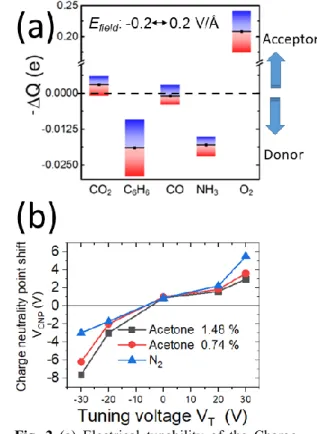
We reported the vdW interaction tunability of the graphene−CO2 complex by combining the first-principles calculations with the vdW density functionals and the time evaluation measurements of CO2 molecules adsorption/desorption on graphene under an external electric field (Fig. 1). The field-dependent charge transfer within the complex unveils the controllable tuning of CO2 from acceptor to donor. Meanwhile, the configuration of the adsorbed molecule, the equilibrium distance from graphene and O−C−O bonding angle, is modified accordingly. The range of electrical tunability is a unique feature for each type of molecule (for example: CO2, Benzene, CO, NH3, O2 in Fig. 2a).
Room temperature detection of the individual physisorption of carbon dioxide molecules
Fig. 1 (a) Schematic of CO2 adsorption
measurements at varied tuning voltages Vg (b) SEM
image of the fabricated GNR device.
Fig. 2 (a) Electrical tunability of the Charge
Transfer in different Graphene−Molecule Complexes (b) Shift of charge neutrality point for different concentrations of acetone and nitrogen, and nitrogen.
with suspended bilayer graphene (BLG) also reported. An electric field introduced by applying back-gate voltage is used to effectively enhance the adsorption rate. A unique device architecture of GNEM is designed to induce tensile strain in the BLG to prevent its mechanical deflection onto the substrate by electrostatic force. Despite the negligible charge transfer from a single physisorbed molecule, it strongly affects the electronic transport in suspended BLG by inducing charged impurity, which can shut down part of the conduction of the BLG with Coulomb impurity scattering. Accordingly, we can detect each individual physisorption as a step-like resistance change with a quantized value in the BLG. We used density functional theory simulation to theoretically estimate the possible resistance response caused by Coulomb scattering of one adsorbed CO2 molecule, which is in agreement with our measurement. The concentration of CO2 molecules used for this measurement is equivalent to ~30 ppb compared with the atmospheric pressure with carrier gas injected condition [1]. In order to study the sensing of acetone molecules, we carried out nitrogen, and acetone-nitrogen mixture gas
measurements. We are clearly able to detect the presence of 0.74 % acetone molecules in nitrogen environment by graphene-gas molecules vdW interaction tuning method as shown in Fig. 2b[2].
On the other hand, we realized the local top-gated graphene resonator inertial mass sensing of mixed H2/Ar gas. The graphene resonator is fabricated with monolayer graphene. The fabricated resonator dimensions are 900 nm in length and 500 nm in width (Fig. 3). Measurements of the fabricated resonator are performed using a co-planar structure probe and radio-frequency (RF) connectors. At the vacuum condition of the chamber, the resonant frequency of the doubly clamped graphene resonator is measured as 94.3 MHz with the quality factor of 42.2, based on transmission S-parameter characterization. The measured resonant frequency is consistent with the theoretical calculation based on the continuum model for the graphene resonator. When the chamber pressure is increased to 1.1×10⁻¹ Pa by injecting mixed H
2/Ar gas, the resonant frequency of the device is downshifted by 4.32 MHz to 89.98 MHz and the quality factor is reduced to 22.5. As the mass of the graphene resonator is increased by the adsorption of mixed gas molecules adsorption, the resonant frequency is downshifted further. The detected mass of the adsorbed gas molecules is calculated as ∼15 attograms [3].
Fig. 3 (a) Schematic diagram of graphene
resonator, inset shows optical image of the fabricated device (b) RF measurement setup (c) Measured transmission S-parameter characteristics of doubly clamped graphene resonator in Ar + H2 (9:1) mixture gas at the different pressures.
Fig. 4 Field effect mobility of graphene sensor
device without (0 min) and with (210 mins) (a) nitrogen (b) CO2 gas molecules, respectively.
Sensing of nitrogen and CO2 molecules through the vdW interaction tuning was done. For nitrogen gas environment, it was understood that N2 act as donor for negative tuning voltage, and it acted as acceptor for zero and positive tuning voltage. It clearly indicated the weak vdW interaction for nitrogen and relatively strong interaction for CO2 molecules [4]. This leads to stronger scattering for CO2 molecules than nitrogen (Fig. 4).
As an important step to understand graphene NEM contact, we studied graphene–metal static contacts by fabricating the transmission line model (TLM) pattern on a graphene nanoribbon (GNR) and dynamic contacts by GNR nano- electromechanical (GNEM) switches with and without periodic concave patterns on the suspended top electrode. A negative contact resistance extracted from the results of TLM analysis is attributable to the inhomogeneity of GNRs owing to the doping from the metal and the substrate. All the dynamic contacts in GNEM switches show clear pull-in operations, which are not reversible. GNEM switches with periodic arrays of concave contacts show global pull-in onto the bottom surface of the concave and then exhibit local pull-in onto the slanted sidewall surfaces of the concave, which is confirmed by finite element method simulation [5].
An alternative three-terminal (3T) subthermal subthreshold slope (SS) switch is required to overcome the exponential increase in leakage current with an increase in the drive current of CMOS devices. We reported a 3T graphene nanoelectromechanical (3T-GNEM) switch with a physically isolated channel in an off-state generated from heterogeneously stacked two-dimensional (2D) materials.
Hexagonal boron nitride (h-BN) was used as a dielectric layer, and graphene was used as the top double-clamped beam drain, gate and source electrode material; the drain, gate, and source layers were stacked vertically to achieve a small footprint. The drain to source contact is normally open with an air gap in an off-state, and the gate voltage is applied to mechanically deflect the drain terminal of the doubly clamped graphene beam to make electric contact with the source terminal for the on-state. This 3T-GNEM switch exhibits an SS as small as 10.4 mV/dec at room temperature, a pull-in voltage less than 6 V, and a switching voltage window of under 2 V. Since the source and drain terminals are not connected physically in the off-state, this 3T-GNEM switch is a promising candidate for future high-performance low-power logic circuits and all-2D flexible electronics [6].
[1] 水田 博,ジアン スン,マノハラン ム ルガナタン‘グラフェンを用いたナノセン サ素子による二酸化炭素分子一個の検出', 応用物理 87, 193-197 (2018)
[2] S. Taniuchi, K. Taketomi, K. Sakai, S. Saito, M. Muruganathan, H. Mizuta ‘Sensing of N2/Acetone mixed gas using graphene nanoribbon’ 65th Japan Society of Applied
Physics, Spring meeting, Mar 17-20,
Nishiwaseda Campus, Tokyo (2018).
[3] M. Muruganathan, F. Seto and H. Mizuta, ‘Graphene Nanomechanical Resonator Mass Sensing of Mixed H2/Ar Gas', Int. J. of Automation Technology 12, 24-28 (2018) [4] D. Kato, M. Muruganathan, H. Mizuta ‘Impact of charge transfer and coulomb scattering on current conduction caused by CO2 molecules physisorbed onto graphene’ 64th Japan Society of Applied Physics, Spring meeting, Mar 14-17, 2017 Yokohama.
[5] W. Wang, M. Muruganathan, J. Kulothungan and H. Mizuta, ‘Study of dynamic contacts for graphene nano-electro-mechanical switches' Jpn. J. Appl. Phys. 56 04CK02(4 pages), 2017, DOI: 10.7567/JJAP.56.04CK05
[6] N. H. Van, M. Muruganathan, J. Kulothungan and H. Mizuta, ‘Fabrication of a three-terminal graphene nanoelectromechanical switch using two-dimensional materials’, in press for Nanoscale (2018): DOI:10.1039/C7NR08439K.
5.主な発表論文等 〔雑誌論文〕(計10 件)
1. N. V. Huynh*, M. Muruganathan*, J. Kulothungan and H. Mizuta, ‘Fabrication of a three-terminal graphene nano- electromechanical switch using
Fig. 5 Graphene-graphene contact GNEMS
switch (a) Schematic diagram (b) SEM image (c) sub-1V switching operation (d) Repeated switching operaton.
two-dimensional materials’ (Refereed), in press
for Nanoscale, 2018, DOI:
10.1039/C7NR08439K (*Equal contribution) 2. M. Muruganathan, F.Seto and H.Mizuta, ‘Graphene Nanomechanical Resonator Mass Sensing of Mixed H2/Ar Gas' (Refereed), Int. J. of Automation Technology 12, 24-28, 2018, DOI: 10.20965/ijat.2018.p0024 3. 水田 博,ジアン スン,マノハラン ム ルガナタン‘グラフェンを用いたナノセン サ素子による二酸化炭素分子一個の検出' (査読有), 応用物理 87, 193-197, 2018, http://jsap.or.jp/ap/2018/03/ob870193.html 4. M. E. Schmidt, T. Iwasaki, Manoharan Muruganathan, M. Haque, H. Van Ngoc, S. Ogawa and H. Mizuta “Structurally Controlled Large-Area 10 nm Pitch Graphene Nanomesh by Focused Helium Ion Beam Milling” (Refereed) ACS Applied Materials & Interfaces DOI:10.1021/acsami.8b00427, 10, 10362− 10368, 2018.
5. M. E. Schmidt, A. M.M. Hammam, T. Iwasaki, T. Kanzaki, M. Muruganathan, S. Ogawa, and H. Mizuta, ‘Controlled Fabrication of Electrically Contacted Carbon Nanoscrolls' (Refereed), Nanotechnology, 29 235605, 2018, DOI: 10.1088/1361-6528/aab82c
6. W. Wang, M. Muruganathan, J. Kulothungan and H. Mizuta, ‘Study of dynamic contacts for graphene nano-electro-mechanical switches' (Refereed), Jpn. J. Appl. Phys. 56 04CK02(4 pages), 2017, DOI: 10.7567/JJAP.56.04CK05 〔学会発表〕(計30 件)
1. H. Mizuta, M. E. Schmidt, S. Ogawa and M. Muruganathan ‘Graphene nano-electro- mechanical (NEM) devices: Sub-thermal switching, single-molecular sensing and heat phonon engineering’ (Invited talk) The 2nd Nippon-Taiwan Workshop on Innovation of Emergent Materials, Nomi, 1-2 March 2018 2. H. Mizuta, H. Van Ngoc, M. E. Schmidt, M. Haque, T. Iwasaki, S. Ogawa, M. Muruganathan ‘Downscaled graphene nano-electro-mechanical (NEM) devices for extreme sensing and phonon engineering applications’ (Keynote talk) International Carbon Materials Conference & Exhibition (Carbontech2017), Beijing, 18-19 December 2017.
3. M. Muruganthan, HV. Ngoc, J. Kulothungan, ME. Schmidt, H. Mizuta ‘Graphene-2D Materials Nanoelectromechanical (NEM) Devices and Its Extreme Sensitivity’, (Invited talk) Nanotech Middle East Conference, Dubai, U.A.E Dec 4 - 6, 2017.
4. M. Muruganathan, D. Kato, F. Seto, J. Sun, M. E. Schmidt, and H. Mizuta ‘Multifunctional graphene nano- electromechanical (GNEM)
devices for Extreme Sensing’ (Invited talk)
Advances in Functional Materials
International Conference, University of California, Los Angeles, Aug 14 – 17 2017, USA.
5. H. Mizuta F. Seto, M. E. Schmidt, H. Van Ngoc and M. Muruganathan ‘Graphene nano-electro- mechanical (NEM) devices for extreme sensing applications’ (Invited talk) Simulation of Semiconductor Processes and
Devices (SISPAD 2017) Workshop 2
"Simulation of Advanced Sensors", 2017 6.研究組織 (1) 研究代表者 ムルガナタン マノハラン (MURUGANATHAN, Manoharan) 北陸先端科学技術大学院大学・先端科学技 術研究科・講師 研究者番号:20639322