1. Introduction
Indonesia is situated on the equator and has vast and dense tropical forests. Accordingly, In-donesia has lots of natural resources with its valuable biodiversity, not only for InIn-donesian nation, but also for the international society in general. Indonesia’s tropical forests are ranked third (on the basis of area) after Brazil and the Democratic Republic of Congo (formerly Zaire).
The Indonesian archipelago spreads over 5000 kilometers along the equator. Biogeographi-cally, this country is affected by the Indomalayan plain to the west and the Australasian to the east. On account of this, Indonesian’s biogeography can be divided into 7 main regions: Sumatra, Java-Bali, Borneo (including Natuna and Anambas), the Lesser Sunda (including Wetar and Tanimbar), Sulawesi (formerly called Celebes), Moluccas, and New Guinea, including Aru and Kai Islands. The Lesser Sundas, Sulawesi, and Moluccas are considered a traditional region between the Indo-malayan and Australasian plains. Among 17,000 islands in the archipelago, many of them have been separated from the main plains for thousands of years. Thus, these islands exhibit unique Forests in Indonesia have played important roles in preserving the growing place of numerous natu-ral resources with their valuable biodiversity of flora and fauna as an ecological function. They have also provided foods and raw materials to local people. A large, though undetermined, number of communi-ties live in and/or depend on Indonesian forests.
In order to elucidate the products of forests and the relationship between local people and the natu-ral resources, we selected two study sites and made field studies in January and February 2007, which are still strongly depending on the forest among local groups in North Sulawesi province while living in vil-lages around the forest and being engaged in agriculture: Woloan I sub-district, West Tomohon district, Tomohon city and Warembungan Village, Pineleng district, Minahasa regency. We studied how local people in both sites utilize, maintain and manage products of forests, and discussed.
Keywords: Forest management, lacal resources, forest products, North Sulawesi, Manado
A Study on Utilization and Maintenance of Local Resources at
Woloan I sub-district and Warembungan village,
North Sulawesi Province, Indonesia with Special Reference to
Forest Use and Management
Summary FRANKYRoring Rocky*1, Jun T
AKEDA*1, Lotje K
AWET*2and Eung-Cheol L EE*3
(*1Laboratory of Ecological Anthropology and Marine Ethnobiology, Department of Resource Management and
Social Sciences, Faculty of Agriculture, Saga University, JAPAN
*2Faculty of Economics, Sam Ratulangi University, Manado, Sulawesi, INDONESIA *3Seoul Jangsin University, Seoul, SOUTH KOREA
Received October 31, 2007
Source: World Resources 2000-2001. Washington DC: World Resources Institute: 246-248. Figure 1 Biotic richness: Percentage of World’s species found in Indonesia
characteristics, with high endemic species. Indonesia’s total land area is 193 million ha (735,356 sq. miles), of which 75% is classified by the Ministry of Forestry as forestland. The remaining 25% is divided into agricultural estates (5.8%), gardens (6.5%), rice fields (4.2%) and other uses (9.6%). Although Indonesia comprises only 1.3% of the earth’s land surface, it harbors a dispro-portionately high share of its biodiversity, including 11% of the world plant species, 10% of its mammal species, and 16% of its bird species. The majority of these species are found in the country’s forests. The biotic richness by percent of world species is shown in Figure 1.
The wealth of biodiversity in flora and fauna is spread all over Indonesia province, including North Sulawesi province.
About 6,000 species of plants, 1,000 species of animals and 100 kinds of microorganisms are known for their potential and used by the people in Indonesia. Thousands or maybe millions of creatures are yet to be uncovered and await discovery, which can be put to use for the human welfare all over the world. This includes the rich array of fauna in North Sulawesi province, and with its expanse of forestland, there are so many kinds of flora, which grow naturally, but are now cultivated and developed by the people. Due to the abundance of natural resources, Indonesia is called a “megabiodiversity country” and attracts international attention, especially in the aspect of natural resources conservation. International attention has become prominent as indicated by the flow of international aid and development of global issues. Indonesian tropical forests are used not only by Indonesians, but also have the role to contribute to the international community. This is reflected, for instance, in the statement that the Indonesian tropical forests are the “lungs” of the world (Ministry of Forest and Estate Crops, Republic of Indonesia, 1999).
Besides flora, North Sulawesi province is also rich in fauna, with mammals, reptiles, am-phibians, birds, fish, etc. The fauna lives naturally in the forest as wildlife. Unfortunately, the population of many kinds of fauna like anoa, babirusa, deer, maleo (Macrocephalum maleo), Sulawesi rangkong (Aceros cassidix), Cussus bear (Phalanger celebensis) and some others are 28 Bull. Fac. Agr., Saga Univ. No.93(2008)
decreasing. Recently, three of them have become very rare and difficult to find in some areas of Minahasa, Sangihe and Talaud, and also Bolaang Mongondouw, as they have been hunted and eaten by the local community. There are so many other kinds of animals still living freely and hidden from hunting and human consumption.
In Woloan I sub-district, more than 28% of inhabitants are engaged in paddy farming and plant cultivation while utilizing forest products such as cereal, root crops, legumes, vegetables, fruits, sugar palm, pakoba tree, coconut tree, and so on. They cut trees like bamboo, mahogany tree, cempaka tree (Elmerrillia celebica, Margoliaceae) and nantu tree (Palaquim obtusifolium, Sapotaceae) so that people may get the wood for housing; although the last three species were abundant until the early 1990s, they are very scanty nowadays. More than 30% of the people work as carpenters for building traditional Minahasa house, which is sold to local people in Su-lawesi Utara, especially Manado, Minahasa, Bitung and Bolaang Mongondow, and big cities such as Jakarta, Bandung, Semarang, Surabaya, Bali, Palu, Kendari, Papua, Ambon, and Ternate. It has also been exported to Germany, Argentina, France, Australia, Malaysia, the Philippines, very commonly and Costa Rica, recently.
In Warembungan village like Woloan I sub-district, where more than 33% of the people are farmers without paddy, cultivate plants and also use forest products: cereal, root crops, legumes, vegetables, fruits, sugar palms, coconut trees, candlenuts and so on. They cut trees like cempaka, bua rao and linggua for housing, but the quantity of trees was limited at this time. There is an-other important source for pure water, which is located in the western part of the village, where many kinds of trees and plants grow on the protected forest. Bauxites are also available for mate-rial construction. In addition, they hunt wild pig, cave bat, and wild white-tailed rat, and utilize lemongrass, cinnamon, mengkudu, etc. for medical use.
2. Study sites and method
The sub-district of Woloan I is located in the small town of West Tomohon district, which is part of Tomohon city, around 5 km to the west of the city and around 30 km to the south of Manado city, North Sulawesi province (Fig. 2). Woloan I sub-district, with a total area of more than 250 ha and total population of approximately 3,150 inhabitants in 2006, is rich in forest and agricultural products. In particular, it is a major producer of wooden house called traditional Mi-nahasa house, and timber in North Sulawesi. The traditional MiMi-nahasa house is a famous product from this sub-district, not only in Indonesia but also all over the world. The traditional Minahasa house is special, because all parts of the house including floors, walls, beams, ladders, plafonds and so on are made of wood. The local government has also decided the sub-district as one of the vegetables producing areas in Tomohon city. This village is rich in forest product such as hard wood trees including mahogany, yellow champaka, nantu and bamboo; wild pork and cave bat, etc. which are source of animal protein; and agricultural products such as cereals, vegetables, root crops, legumes and fruits in abundance.
Warembungan village is located around 5 kilometers to the south of Manado city, in the Pineleng district of the Minahasa regency, North Sulawesi province. Like Woloan I sub-district, inhabitants use the forest while engaging in agriculture for survival and livelihood. This village is Franky et al.: A Study on Utilization and Maintenance of Local Resources at Woloan I sub-district and Warembungan village, North Sulawesi Province, Indonesia with Special Reference to Forest Use and Management29
also known as a producer of bauxite, which is used as material construction for building houses, roads, bridges, breakwater, soil stabilization, etc. Warembungan village is also one of four vil-lages (Lota, Malalayang, and Koka village), which supply pure water for local inhabitants in Manado city and its surroundings. PDAM (Perusahaan Daerah Air Minum) Water Company is a local one, which was appointed by the government of Manado city to manage to distribute the water to local people in Manado and its surroundings.
Given the big forest potential of both Woloan I sub-district and Warembungan village, peo-ple still strongly depend on forest and are engaged in agriculture. Both Woloan I sub-district and Warembungan village not only rich in animal and tree products of forest, but also agricultural products like cereal, vegetables, fruits, root crops, legumes and so on. More then 33% of the population in Warembungan village, and more than 28% in Woloan I sub-district, are still strongly depending on forest and engaging in agriculture.
Focusing the various functions of the forests and the relationship between local people and the natural resources, the field survey was conducted in January and February 2007, at Woloan I sub-district, West Tomohon district, Tomohon city and Warembungan village, Pineleng district, Minahasa regency, North Sulawesi province. To get primary data (qualitative and quantitative) during field research, three methods were used: interviews, direct observation and questionnaires. Secondary data are based on information from Government offices in Manado city, Tomohon city, Minahasa regency, and other reference books. The main objectives of the study are as follows:
Source: Government office of North Sulawesi, 2006
Figure 2 Location of Woloan I sub-didtrict and Warembungan village 30 Bull. Fac. Agr., Saga Univ. No.93(2008)
a. To reveal and prove the functions of the forest for local farmers and local inhabitants. b. To study how the local people utilize and maintain forest and agricultural products for
sur-vival and livelihood.
c. To study how the local people gather, hunt the resources of forest and depend on agriculture, and also other potential uses.
3. Natural resources in Indonesia and North Sulawesi
a. Forest.
With the forest area of 788,691.88 ha, North Sulawesi is overgrown with many kinds of for-est resources like timber, vegetables, fruits, palm trees, orchids, rhizomes, root crops, legumes, and other kinds of the forest crops.
The trees and plants not only grow in the mountains, highland, and hilly areas, but also in rather steeps place in the swamps. The geographical location of the community and its proximity to the original sources of food varieties is obviously a positive factor, when the plant diversity of a particular locality is taken into consideration.
Food crop plants are accepted by rural communities through their customs, habits and tradi-tions as appropriate and desirable foods. People use them and know how to maintain, cultivate and prepare them for daily consumption and the other usages. In addition, people have folk knowledge as to their nutritive, therapeutic and economic value. The variety of plants in North Sulawesi province is shown in Table 1 in alphabetical order of local names.
Besides growing naturally in the forest, some of them are replanted by the local inhabitants
Table 1 Forest food crop plants in North Sulawesi province Local name Scientific name Common name Anggrek tanah Phaius tankerviluae Orchid
Anggrek bulan Phalaenopsis amabilis Orchid
Alpokat Persea gratissima Avocado
Asam jawa Tamarindus indica Tamarind
Bambu / Bulu Bambusae sp. Bamboo
Benalu Loranthus sp. Epiphyte
Beringin Ficus benyamina Banyan tree
Cempaka mariri Michelia champaca Yellow champaca Cempaka mawure Michelia alba White champaca
Cengkih Syzygium aromaticum Clove
Coklat Theobroma cacao Cacao
Duku Lansium domesticum Lanseh tree
Durian Durio zibethinus Durian
Jambu air Eugenia aquea Rose apple
Kapok Ceiba pentandra Kapok tree
Kayu lawang Cinnamomum lawang Cinnamon Kayu manis Cinnamoman burmani Cinnamon
Mahoni Swietenia mahagoni Mahogany
Mangga Mangifera indica Mango
Mengkudu Morinda citrifolia Indian mulberry
in their house yard or garden, especially as for seasonal crop plants. Shoots of some plants are grafted. Farmers do this as a means of harvesting plant easily, without having to go continually to the forest.
b. Major gathered plants and usages
The Province of North Sulawesi is widely known as “bumi nyiur melambai” (the land of waving coconut leaves) and the coconut tree is used frequently as a symbol and part of the em-blem.
Coconut plant is still cate-gorized as a basic commodity in the local economy, because it is one of the preeminent sources of income for farmers and the local community. For the peo-ple in North Sulawesi, coconut has an enormous value because it has not only been closely con-nected with so many farmers, but has also provided the
big-gest benefits of the plant for the people. Other preeminent commodities are clove, vanilla, cocoa and nutmeg.
North Sulawesi province is also rich in clove and vanilla. Clove is cultivated by farmers in almost every part of North Sulawesi province, including Woloan I and Warembungan, who had experience wealth period and vintage crop until the early 1980s. At that time, cloves were Mina-hasan mostly beneficial crop, as they were cultivated on a large scale, because of the high price; the crop did not require special processes in cultivating and maintaining, or in post-harvesting. The Minahasan have called clove as ‘Brown Gold’, because green cloves with young flowers’ buds in clusters during the harvesting are dried directly under the sunlight, causing brown in color and then are sold for a high price. Recently the price of clove has stabilized, ranging between Rp. 30,000 to 35,000 per kg, though it fetched 2 times, even 3 times in price in its heyday era. The tree begins to produce flower buds at about 5 years and reaches to full bearing tree in the age of 20. Cloves are used world-widely and also used for Minahasan food to flavor and preserve food while small buds are important part of many dishes. Cloves are able to improve a fresh effect to the body and to increase the activity of heart. Farmers eat cloves in the morning before going to
Source: Field Survey, 2007
Figure 3 Manado Bay viewed from Warembungan village
Melon Citrullus lanatus Water melon
Manggis Garcinia mangostana Mangosteen Pala Myristica fragrans Nutmeg
Pinus Pinus merkusii Sumatran pine
Rambutan Nephalium lappaceum Rambutan Seho Arenga pinnata Sugar palm Semangka Euphorbia plumerioides Water melon
Vanili Vanilla planifolia Vanilla
Source: Field survey January and February 2007, and available at: http://www. minahasaraya.net
their gardens and/or paddy fields to start work. The essential oil, eugenol, found in cloves is highly volatile, so it is used by dentists as antiseptic, and also in the manufacture of perfumes and as flavoring in medicines. See also Takeda, et al. (in press) as to other usages of spices used and consumed in Sri Lanka, India and Bangladesh. Cloves are also used in kretek cigarettes (clove cigarettes), demanding to be so that the spice now has to be imported to its original home from Zanzibar and Madagascar.
Like cloves, vanilla is native to the Moluccas and has been used in the eastern Mediterranean since the 12thcentury, when Arab traders brought it there. Vanilla is the most widely used
flavor-ing, fragrance ingredient, and expensive spice. Vanilla was an alternative crop, when clove, copra and nutmeg prices fluctuated markedly, which started around the early 1990s. Although the culti-vation of vanilla is rather complicated and expensive in the maintenance, many farmers in North Sulawesi are interested in the cultivation of this commodity, not only for its high price, but also for traditional food and medical treatment. During the harvesting time, the farmer generally sells the crop to traditional market or to spice shop, but sometimes, there are merchants who come to buy the product directly from farmers. Part of this income is used to pay the labor who helps farmers gather the vanilla, and the rest is saved for paying school expenses of kids or for repairing home.
The nutmeg tree, now grown in many areas outside its original home, including North Su-lawesi, produces a firm nut with yellow flesh. The plants live naturally in forests or cultivated in local gardens.
Sugar palm grows in abundance in North Sulawesi, both Woloan I sub-district and Warem-bungan village, but it is not being sufficiently cultivated in spite of its big benefits. It has a vari-ety of uses: part of wrapping the stem is used for brooms, rope, cloth brush, and palm rib. The male palm blossoms, once tapped, go out the liquid, namely saguer that contains sugar. Proc-essed saguer becomes palm sugar (a kind of jaggery), which varies in the color from red to chocolate. The farmers do not add any chemical substances for making sugar palm, so the prod-uct can be said organic palm sugar. The villagers usually make the sugar early in the morning in the gardens, which are located not so far from their house. Palm sugar is used in many Mina-hasan foods. One of the favorites is dodol, made of glutinous rice, coconut milk, palm sugar and kenari nuts (Canarium spp.). Several farmers make dodol in times of special events, also being as a home industry in Minahasa.
Many Minahasans drink saguer as a traditional beverage from Minahasa, because of its deli-cious taste by approximately 5% alcohol content. The taste of saguer can be adjusted petifar (ta-per) till it becomes sweet, sweet-acidic, or acidic in taste. Sweet saguer can be drunk by mothers who have a just new baby, with the aim to add contents of asi (air susu ibu: mother’s milk). Some stalls in Minahasa generally sell saguer and people believe that drinking saguer gives a good appetite. Some farmers make the saguer ‘forte’, by putting palm blossoms into bamboo containers (gatah). The ‘forte’ saguer is the starting step to making ‘forte’ cap tikus (distilled palm wine; a kind of arrack), which releases a blue flame if burned by a match. The saguer can be processed distilled into cap tikus by traditional refining methods, and the concentration of al-cohol increases to about 40%. This beverage is produced by Minahasans in the forest or in the plantation areas among the palm trees. The beverage cap tikus has been popular among Mina-Franky et al.: A Study on Utilization and Maintenance of Local Resources at Woloan I sub-district and Warembungan village, North Sulawesi Province, Indonesia with Special Reference to Forest Use and Management33
hasan farmers for a long time. Minahasan farmers generally drink a shot glass of cap tikus before going to their garden or starting work. The beverage is recognized by everyone in Minahasa as a body-warming beverage and spirit impeller for working. Cap tikus is also used as the main raw material in a number of wine fabrics in Manado. In addition, if the saguer is stored for a suffi-cient length of time, it will change into vinegar, called cuka saguer (saguer vinegar), with a spe-cific acid taste.
Like cloves, nutmeg is native to the Moluccas and has been used in the eastern Mediterra-nean since 12thcentury, when it was taken there by Arab traders. This spice tree is harvested
manually. The ripe nutmeg is indicated by firm, yellow flesh which is pickled or soaked in sugar syrup and eaten as a confectionery, also as an antidote to seasickness. The Minahasan make two kinds of nutmeg sweets: sweet acidic and hot acidic and with an aromatic fragrance apart from its delicious taste. The sweets are produced as a home industry and are typical snacks of Manado. Inside the fruit is a nut, the nutmeg, covered by a hard shiny brown shell. On the outside of the shell is a vivid red lacey web or aril. This is mace, which is also used as a spice in Minahasan dishes and the West, but which is used only in dishes of Indian origin in Southeast Asia. The dried nutmeg will keep almost indefinitely, and should be grated or crushed just before use. Often nut-megs are sold in North Sulawesi and Asia still with their hard shell, which should be broken off and discarded. Although nutmeg is a popular sweet flavoring in the West and Manado, it is used only in savory dishes in Southeast Asia such as curries and soups (Takeda et al., in press).
Long time ago, there were many pakoba trees in the forests, yards and gardens of local in-habitants, but recently the plants have become rare. Even so, some can be found in plantations and yards, which are nurtured by the community for the fruit crop or as a constructing timber for yard or land plantation. Pakoba trees that keep living until this time are approximately 20 to 30 years. Especially Tomohon city government wants to restore the natural resources of pakoba tree as a pre-eminent tree in Tomohon city in the future by recultivating it for its ecological and eco-nomic value. For this purpose, the government distributes seeds to farmers in order to cultivate large areas, hoping that the farmers will harvest the products in the future and process them to be a typical kind of food from Tomohon city. Its wood can be used for housing, furniture, firewood and also its resin as a raw material in colorant, to make fishing nets, and so on. Typical foods made by farmers, involve processing the ripe pakoba fruit for sweets, jams, etc., which assign ad-ditional value to the family. So far, the government has conducted to repair natural resources through rehabilitating forests and farm lands by replanting wood trees, including pakoba trees, and to fulfill the requirement of wood and fruit products in Tomohon city. In effort to develop, the Government considers the advantage of pakoba trees in Tomohon as a preeminent endemic crop that will have a good future. The target of replanting pakoba trees in the short term is to im-prove the participation by local farmers and the local community, especially on farm land with the aim of increasing the earnings on one hand and supporting programs (rehabilitation of forest and land agriculture) of the government in emboldening and replanting this tree on the other hand.
There are other crops cultivated by the farmers like cinnamon, coffee, cacao, sago palm, rambutan (Nephalium lappaceum), mango, jackfruit, breadfruit, banana, langsat (Lansium do-mesticum), durian (Durio zibethinus), snakefruit (salak), etc. Other locally cultivated crops such as leek, Chinese chives (Allium tuberosum), chili (Capsicum sp.), pandan (Pandanus amarillyfo-34 Bull. Fac. Agr., Saga Univ. No.93(2008)
lius), celery (Apium graveolens), ginger, water convolvulus, egg plant, spinach, long bean, corn, chayote, and so on.
There is a kind of kenari, normally known as canary nut or Java almond, and gathered by the seed from fruits of Canarium indicum and C. vulgare. Some local people coat the canary nut with jaggery from sugar palm, called halua kenari. This is done as a private or home business, and sold to the traditional markets and supermarkets, and bought as gifts of typical food from Manado. Local food name, dodol is a favorite food in Minahasa that also contains the canary nut, made by a kind of home industry in Minahasa. There is another kind of kenari (Canarium odon-tophyllum) with a taste similar to avocado. It can be eaten after being soaked in warm water.
This species contain protein, carbohydrate, and fat, and so is a nutritious foodstuff.
Bamboo is a very important product of the forest, which is used for housing materials and people eat tender young shoots from a species of rebung bamboo. Rebung is obtained by cutting at the base part of young shoots using a peda (chopping knife) or axe. It is then placed carefully into a plastic or cloth sack, as the pinfeather on the surface of rebung produces an itchy effect if coming into contact with the skin of the collector. Some are infinitely superior, lacking in the bit-terness. Bamboo shoots from a cooler climate including those grown at higher altitudes are gen-erally much sweeter. They are sold in several ways in the markets: whole, complete with their leaf sheaths or peeled and sliced ready for cooking or cut and pre-boiled.
Sago palm is one of the principal substitutes for rice in tropical areas, which have insuffi-cient rain for rice cultivation. The sago starch is obtained in two forms, spinless one (Metroxylon sagu) and prickly one (M. rumphii). It forms clumps both in cultivation and in the wild. Its natural habitat is lowland-freshwater swamps and sago palms are found throughout Sangihe Ta-laud Island though rare in Minahasan area, and are mainly consumed in the drier areas of Indone-sia. The palm builds up its storages of starch over its life of about 15 years and attains its maxi-mum store just before the inflorescence opens. One sago produces 300-500 kg of starch. The palm is felled; the trunk cut into many lengths and the pith is manually extracted and processed. The purified starch is then dried and preserved, notably as flour and baked biscuits. It is also used in the textile and pharmaceutical industries. Sago pearl just like cassava pearl is commer-cially the starch mixed again into a paste and sieved through various sized meshes. The finished sago pearl has a long shelf life.
Cashew trees are among wood products of the forest, but also cultivated in gardens, and on other land by the people of North Sulawesi province. Two edible products are obtained from the cashew tree: the cashew apple (jambu monyet) which is red or yellow, soft and juicy when ripe, but it is not a proper fruit; and the kidney-shaped nut (kacang mete), attached to the base of the fruit, which is the true fruit. People eat the fruit only when fully ripe. When it is crisp and sweet otherwise it is unpleasantly astringent. In addition, cashew apples can be processed for juice, syrup, as sweet dry apple (manisan), cashew jam, etc. The fried cashew nut is a highly nutri-tional food and enjoyed as local favorite. Besides using as food, people consume other parts of the cashew for medicine, i.e. as a treatment for dysentery. The preparation consists of boiling 1 piece from the cortex of the cashew tree and a handful of cashew leaves with 1.5 liters of water. After diluting with water, it should be drunk twice daily (morning and afternoon). In addition, the leaves are also used to treat diabetes, and burns (external use), while the cortex is used for di-Franky et al.: A Study on Utilization and Maintenance of Local Resources at Woloan I sub-district and Warembungan village, North Sulawesi Province, Indonesia with Special Reference to Forest Use and Management35
arrhea and thrush.
Tamarind fruit looks like long bean, pods and contain seeds. The pod is green at the imma-ture stage, and becomes fatter and changes color to a sandy brown when maimma-ture, with a high tar-taric acid content which is rich in vitamin C with an amount of sugar. The flesh of the fruit con-sists of dry, sticky, and dark brown pulp with the shiny black seeds and tastes like hot, unsweet-ened lemon. There are a few thick strands, running along the length of the pod, which help en-close the pulp. Women use the hard green pulp of young fruit (which is very sour and acidic) most often as a component of curry dishes and meat condiments, and mature ones in the prepara-tion of sayur asam (acidic vegetable soup). The ripe pulp is used for jams, syrup, sweets, and can be directly eaten. Farmers use leaves (which are first chewed) to apply to fresh wounds when stabbed or cut. Three seeds (from ripe pulp) with an adequate amount of sugar palm are boiled with two glasses of water, diluted and taken for stomachaches. Moreover, the tamarind heart-wood, which has a bold red wood color, can be used for furniture and flooring, because of its density and durability.
c. Wild animals and usages
North Sulawesi is important as part of the eastern side of the Wallace line, which cuts through Indonesia and was first named around 150 years ago. Wallace’s line is an imaginary line named after the English naturalist, Alfred Russell Wallace. This line indicates a clear difference in fauna between on the west side and on east side of Indonesia. Many animals endemic to Su-lawesi live in a conservation area in this province (National Development Planning Agency, Re-public of Indonesia, 2003). The wild animals in North Sulawesi province is shown in Table 2.
Table 2 Wild animals in North Sulawesi province
Local name Scientific name Common name Mammals Anoa Babulus depressicornis Lowland anoa
Babi hutan Sus celebensis Wild pork
Babirusa Babyrousa babyrussa Babirusa Bajing pohon Prosciurillus leucomus Pale tree squirrel Bajing sulawesi Prosciurillus murinus Sulawesi tree squirrel
Ikan duyung Dugong dugon Dugong
Kalong Cynopterus brachyotis Lesser dog-faced fruit bat Kelelawar Chironax melanocephalus Black-capped fruit bat Kuskus sulawesi Strigocuscus celebensis Sulawesi dwarf cuscus Kuskus, kuse Ailurops ursanus Bear cuscus
Monyet hitam Macaca nigra Celebes black macaque Monyet tonkean Macaca tonkeana Tonkean macaque Musang Tanggalong Viverra tangalunga Malay civet Musang sulawesi Macrogalidia musschenbroekii Sulawesi palm civet Rusa Cervus timorensis Deer
Tangkasi Tarsius spectrum Sulawesi tarsier
Tikus hutan Maxomys musschenbroekii Musschenbroek’s spiny-rat Tupai hidung panjang Hyosciurus ileile Northern long-nosed squirrel Reptiles Cecak terbang Draco volans Common flying lizard
Kadal Hemidactylus frenatus House gecko Ular gadung Ahaetulla prasina Green whip snake 36 Bull. Fac. Agr., Saga Univ. No.93(2008)
The increased hunting of wild animals and tree logging by the local inhabitants have resulted in the decrease of the wildlife population including scarce and even threatened species. Some in-habitants, especially farmers shoot and trap wild animals, which come to eat the harvested crops. The gardens around forests become hunting targets of the animals. Many inhabitants consume the meat of wildlife animal for protein and also believe they are useful as traditional treatments. The black-capped fruit bat (kelelawar) is used for treating asthma. People also believe that con-suming the meat of wild snake is good for health, especially as cardio tonic. People hunt wild pig, wild chicken, monitor lizards (biawak), cave bats, wild rats with white tails, etc., for family con-sumption, and also sell in traditional markets for family income.
d. Potential of the forest in North Sulawesi province
Forest in North Sulawesi province is dense with trees, and other plants, covering a large area and exhibiting a different environment compared to areas beyond it. The forest consists of a com-plex mixture of vegetation with its soil microorganisms and animals, while maintaining interde-pendence among them. North Sulawesi forest can be described as a tropical evergreen forest in-cluding many kinds type of vegetation like swamp and mangrove forest, beach forest, plain forest or low land forest, down the hill forest, and mountain forest. North Sulawesi forest is dominated by special kinds of trees belonging to the families of Moraceae, Annonaceae, and Eurphorbiaceae.
Based on instruction by the Minister of Plantations and Forestry No. 452/Kpts-II/99 on June Ular hujau Tropidolaemus wagleri Wagler’s pit-viper
Ular kobra Naja sputatrix Indonesian spitting cobra Ular laut kuning Laticauda colubrina Yellow-lipped sea snake Ular piton Python reticulatus Reticulated python Ular pohom coklat Boiga irregularis Brown cat snake
Tokek Gekko gecko Tucktoo lyzard
Amphibian Biawak Varanus salvator Water monitor Penyu bersisik Eretmochelys imbricata Hawksbill turtle Penyu hijau Chelonia mydas Green turtle
Birds Burung hantu Ninox ios Speckled boobook
Burung niu Eutrichomyias rowleyi Caerulean paradise-flycatcher Burung hantu Ninox ochracea Ochre-billied hawk-owl Burung pendeta Streptocitta albicollis, Blibong pendeta Elang alap Celebes Accipiter griseiceps Sulawesi goshawk Jalak moloneti Scissirostrum dubium Finch-billed myna Kadalan Celebes Rhampococyx calorhnychus Sulawesi lizardhawk Kakatua jambul Cacatua sulphurea Yellow-crested cockatoo
Maleo Macrocephalon maleo Maleo maleo
Pergam hijau Ducula aenea Green imperial pigeon Pergam putih Ducula luctuosa White imperial pigeon Raja perling celebes Basilornis celebensis Sulawesi myna Rangkong Rhyticeros cassidix Sulawesi rangkong
Sampiri Eos histrio Red-and-blue lory
Serindit Celebes Loriculus stigmatus Sulawesi hanging-parrot Sikatan matinan Cyornis sanfordi Matinan flycatcher Source: Field survey January and February 2007, and available at: http://www.minahasaraya.net
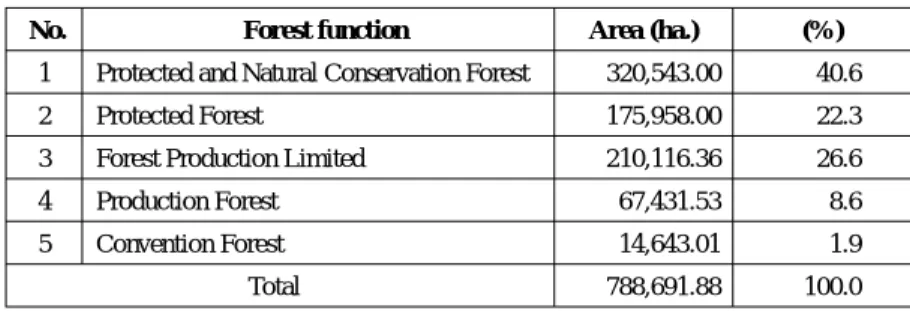
Table 3 Area of forest function
No. Forest function Area (ha.) (%) 1 Protected and Natural Conservation Forest 320,543.00 40.6
2 Protected Forest 175,958.00 22.3
3 Forest Production Limited 210,116.36 26.6
4 Production Forest 67,431.53 8.6
5 Convention Forest 14,643.01 1.9
Total 788,691.88 100.0
Source: Departement of Forestry Office, North Sulawesi Province, 2007.
Table 4 Distribution of forest function in North Sulawesi province
No City / Regency Forest function
PNCF Prot. F FPL Prod. F CL
1 Manado City 2,540.82 1,202.01 4.52 -
-2 Bitung City 9,706.16 9,329.75 - -
-3 Tomohon City 649.00 585.00 1,615.00 -
-4 Minahasa Regency 8,417.02 9,173.00 5,758.00 270.53 -5 South Minahasa Reg. 18,770.00 22,551.00 30,423.00 16,334.27 -6 North Minahasa Reg. 44,486.18 17,428.00 10,361.74 - -7 Bolaang Mongondow Reg. 193,680.00 95,089.00 259,610.62 50,826.73 14,643.00
8 Sangihe Island Reg. - 13,820.00 - -
-9 Talaud Island Reg. 29,806.68 10,199.00 2,348.00 -
-Total 320,543.00 175,958.00 210,116.36 67,431.53 14,643.00 Source: Department of Forestry, North Sulawesi Province Government, 2007
17th
1999, the forest area of the North Sulawesi region is 1,615,070 ha before the separation of Gorontalo Province from North Sulawesi province. After the separation, the forest of the North Sulawesi region decreased to 788,691.88 ha and was shared in 5 regencies and 3 cities (Depart-ment of Forestry Office, North Sulawesi Province, 2007).
Since then, the forest area of the North Sulawesi was divided into several functions as pro-tected and natural conservation forest which had the largest area with more than 40% of the total, further protected forest, forest production limited, production forest and convention forest. The smallest one was convention forest with 14,643.01 ha or 1.9% of the total forest. The forest func-tion and their area is shown in Table 3.
Based on the area of the available forest region in North Sulawesi province, it can be seen that more than 65% of the forest spread over Bolaang Mongondow. The biggest area of the na-tional park and the conservation region is located in the north of Minahasa and Talaud island, whereas the smallest one is in Tomohon city, 193,647 ha, 44,486 ha, 29,804 ha and 694 ha, re-spectively as shown in Table 4.
The forest of the national park and the conservation region has certain typical characteristics, which serve as a life support system and conservation of the species-diversity of flora and fauna, as well as a lasting manner of the biological resources and the ecosystem.
Bitung city has protected forest and natural conservation forest such as Manado city with also small area of forest production limited. Sangihe island regency, which is located in the north of Manado, has only protected forest with an area of 13,820 ha (7.9% of the total protected for-est).
In addition to extensive forests in North Sulawesi province, there are many kinds of natural and cultivated plants. The government of Tomohon city and Minahasa regency support the farm-ers to maintain the forests with programs which include community counseling about the forest, distribution of seeds and fertilizer especially for wood plants such as nantu (Palaquim obtusifo-lium), meranti (Shorea sp.), and cempaka (Elmerrillia celebica). These are used in the produc-tion forest and forest producproduc-tion limited to get more wood products in the future, as well as in the protected forest to protect soil and water flow.
More than 300 kinds of original wood trees in the forest grow in Bolaang Mongondouw (Bolmong) and Minahasa (including Manado, Tomohon and Bitung) in North Sulawesi province. They grow naturally in these forests and also cultivated by the inhabitants who live around the forest. Trees found in the North Sulawesi forest are listed in Table 5.
Table 5 Major wood trees in North Sulawesi province
No Local name Market name GP
*
Family name Scientific name DC
1 Ayat Binuang BM Datiscaceae Octomeles sumatrana IV
2 Alipega Surian Min Meliaceae Toona sureni IV
3 Alulin Min Myrtaceae Pisonia umbellifera V
4 Alwastuna Min Moraceae Ficus sp. V
5 Amurang Surian Min Meliaceae Toona sureni V
6 Apeju Pedu Min Rutaceae Evodia celebica
-7 Aras Ares Min Sonneratiaceae Duabanga moluccana
-8 Aripungu Nahe Min Lauraceae Phobe cuneata III
9 Aripungu Nahe Min Lauraceae Phobe sterculioides III
10 Aripungu Tuama Wakan Min Lauraceae Litsea albayana IV
11 Bahu Laban Min Verbenaceae Vitex sp. IV
12 Bakalaung Nyatoh BM Sapotaceae Madhuca pilippinesis II
13 Balembang Nyatoh Min Sapotaceae Palaquium sp. IV
14 Batu Kolaka BM Rosaceae Parinari corymbosa III
15 Bakele Nyatoh Min Sapotaceae Palaquium sp. IV
16 Bengkaol Ebony Min Ebenaceae Diospyros minahasae V
17 Bengkudu Mengkudu Min Rubiaceae Morinda bracteata ?
18 Besi panto Min Papilioideae Pongamia pinnata V
19 Bobang Kenari BM Bursaceae Canarium hirsutum V
20 Bojito muputio Bayur BM Guttiferae Calophyllum soulatri III 21 Bolaangitang Binuang Min Datiscaceae Tetrameles nudiflora IV
22 Bolongan bolai BM Moraceae Ficus nervasa V
23 Bongoniugu BM Myrtaceae Horsfieldia globularis IV
24 Bua rau Bua rau BM Euphorbiaceae Dracontomellon dao IV
25 Budebu Gor Rutaceae Fagara rhetsa IV
26 Bugis Bugis Min Anacardiaceae Koordersiodendron pinnatum III
27 Bulaso Wolato BM Verbenaceae Vitex cofassus II
The forest in North Sulawesi province apart from being a source of wood products, is also a source of various kinds of non-wood products. Besides rattan and bamboo, there is also resin, tree gum, and palm fiber, root-vetier oil as tree products, and bird nests, honey, beewax, silk worms, and shellac as animal products.
Most of the resin used for varnish making in Indonesia is obtained from pines (Pinus mekusii), which grow in abundance all over North Sulawesi. The pine resin is usually collected and shipped to Java for processing with its minimal local use. Some local use of “raw” resin as varnish occurs in Minahasa, such as the “damar batu” found in the iron shops, which are used in conjunction with processed varnishes in cottage furniture industries in Minahasan villages, where it is used to cover nail holes/heads and gaps in newly built wooden furniture.
28 Daagon Aga Min Moraceae Ficus variegata V
29 Daan Min Myristicaceae Myristica fatua V
30 Daan rintek Min Meliaceae Aglaia argentea III
31 Damak Agathis BM Araucariaceae Agathis celebica IV
32 Damak buaya Agathis BM Araucariaceae Agathis celebica IV 33 Damar Agathis Min Araucariaceae Agathis philippinensis IV
34 Danoan Min Loganiaceae Neuburgia celebica V
35 Danoan Aga Min Moraceae Ficus variegata V
36 Danoan Min Staphyleaceae Turpinia sphaerocarpa III
37 Dedi Kenari Min Bursaceae Canarium vulgare IV
38 Didane dankou Min Melastomataceae Astonia macrophylla V
39 Dongi Simpur BM Dilleniaceae Dillenia serrata III
40 Duguan BM Myristicaceae Myristica celebica V
41 Dungu BM Sterculiaceae Heritiera sylvatica II
42 Durian hutan Durian Min Annonaceae Cyathocalyx sp. IV
43 Ebenhout Ebony Min Ebenaceae Diospyros rumphii
-44 Entame Ebony Min Ebenaceae Diospyros ebenum
-45 Entamin Ebony Min Ebenaceae Diospyros pilosanthera
-46 Gangai Bugis K Min Anacardiaceae Koordersiodendron pinnatum III
47 Gofasa Gofasa Min Verbanaceae Vitex glabrata I
48 Gofasa Gofasa Min Verbanaceae Vitex quinata IV
49 Gofasa Batu Gofasa Min Verbanaceae Vitex quinata IV
50 Hitam Ebony Min Ebenaceae Diospyros rumphii I/II
51 Hitam laki-laki Ebony Min Ebenaceae Diospyros rumphii II 52 Hitam laki-laki Ebony Min Ebenaceae Diospyros pilosanthera II 53 Hitam perempuan Ebony BM Ebenaceae Diospyros pilosanthera IV 54 Hitam perempuan Ebony Min Ebenaceae Diospyros ebenum II 55 Ipil bila Merbau BM Caesalpinioideae Intsia palembarica I
56 Iwu BM Meliaceae Aglaia sp. II/I
57 Kajawu Bintungan Min Euphorbiaceae Bischoffia javanica II
58 Kajongian Ebony BM Ebenaceae Diospyros buxifolia III
59 Kakepajaan Min Staphyleaceae Turpinia sphaerocarpa III
60 Kalimbouwan Min Herndiaceae Hernandia evigera V
Source: Department of Forestry, North Sulawesi Province, 2007
Note: GP: Growing place; BM: Bolaang Mongondouw; Min: Minahasa; Gor: Gorontalo; DC: Durability Class I: Very durable, II: Durable, III: Rather Durable, IV: Low Durability, V: Very Low Durability
e. Conservation area
As one of the most important purpose for conservation areas is to protect the biodiversity, North Sulawesi has 8 conservation areas to protect the wild animals, firstly because animals are easily affected by human activities. They are Tangkoko rainforest, Lokon rainforest, Mount Am-bang rainforest, Manembonembo conservation area, North Karangkelang rainforest, South Karangkelang rainforest, Bunaken sea garden and Bogani Nani Wartabone National Park.
4. People and manpower
The people of Minahasa are ethnically a majority group in North Sulawesi province. Inhabi-tants who live in Woloan I sub-district and Warembungan village were all derived from this ma-jority group, and are called Minahasanese or Minahasan. Minahasa Raya is an area, covering 3 cities (Bitung, Manado and Tomohon), and 3 regencies (Minahasa, North Minahasa, and South Minahasa), which occupy six of the nine regional administrations in North Sulawesi province.
The name of the land of Minahasa has been historically changed several times: from Batac-ina, Malesung, Minaesa and then finally the current name Minahasa, meaning “becoming one united”. North Sulawesi developed into a large empire by 670 AD. In North Sulawesi the lead-ers of the different tribes, who spoke different languages, met together by a stone known as Watu Pinawetengan. There they established a community of independent states, which would form one unit to stay together and would fight any outside enemies if they were attacked.
a. Woloan I sub-district
The geographical location of Woloan I sub-district is bordered by Kayuwatu village to the north, Kamasi sub-district to the east, Lansot sub-district to the south, and Woloan II sub-district to the south. The territory is 252.58 ha in area and is occupied by approximately 868 households, with 3,143 inhabitants consisting of 1,611 men and 1,532 women.
The topography of Woloan I sub-district is remarkably flat and there are hilly areas with height of about 20-50 meters, growing mainly coconut, sugar palm, bamboo and some types of wood trees. Inhabitants occupy flatter parts on the left and right side of the main road, which connects with other sub-districts of Woloan I, like Walian, Matani, Tara Tara sub-district, etc. There are several kinds of vegetables and fruits cultivated near the homes of the inhabitants, such as long beans, sweet potato, cassava, mango, papaya, etc. It is in a strategic location, being very close to Tomohon city and other countryside areas of Minahasa district, and supported by ade-quate road access, so that the sub-district is expanding with quick mobilization of goods and serv-ices. The Woloan I sub-district office is located along the main road of this town, which is useful to quick communications and easier access by the people who need services. Moreover, the West Tomohon district office is also located in Woloan I, which helps the government develop pro-grams easily. In Woloan village, almost 100% of the total inhabitants are Christians who are be-lievers in GMIM (Christian Evangelical in Minahasa Church), Roman Catholic Church and the GPDI (Pentecostal Church), 64.8%, 31.4% and 3.4% of the population, respectively while the re-mainders belonging to Maranatha Church or Moslem. They live together harmoniously and adja-cent to one another, honoring their mutual religional differences.
As for the occupation, the majority of the local inhabitants are farmers, carpenters/ crafts-Franky et al.: A Study on Utilization and Maintenance of Local Resources at Woloan I sub-district and Warembungan village, North Sulawesi Province, Indonesia with Special Reference to Forest Use and Management41
Table 6 Job Occupations of local inhabitant in Woloan I village No Occupations Total (%)
1 Farmer 321 28.6
2 Carpenter and Craftsman 338 30.1
3 Civil Servant 48 4.3 4 Teacher 88 7.8 5 Nurse 14 1.3 6 Army/ Police 15 1.3 7 Particular office 91 8.1 8 Retired 51 4.5 9 Entrepreneurs 108 9.6 10 Driver 34 3.0 11 Ojek* 16 1.4
Source: Woloan I Village Office, January 2007
*Ojek: a motorcycle, which is driven by a man for carrying people from one place to another like a taxi.
men, and entrepreneurs, with 28.56%, 30.07% and 6.61% respectively, besides these many peo-ple working at the public service sector such as teachers, nurses, army, and so on. The occupa-tions of local inhabitants based on the 2006 census are shown in the Table 6.
Farmers harvest foods for their daily life not only from paddy fields but also get forest prod-ucts. They also produce cereals, root crops, legumes, vegetables, fruits, and so on while cultivat-ing many kinds of trees for wood, fruit and other products used for food, medicine, tools, etc. In addition, many farmers are also expert at trapping animals from the forest and the garden. To pre-pare wetland paddies and other field crops such as corn and cassava, the community has still ob-served mutual cooperation in the village, called mapalus: they work together and help each other based on their willingness to do without paying wages. It has become an inherited custom from generation to generation from Minahasan ancestors. Mapalus is a communal relationship among people in order to achieve some purposes and give benefit or value each another or cooperate to reach a target.
The breakdown of students registered in this village was 33.9% of elementary school, 31.9% of junior secondary school and the senior high school, 34.2% of higher education with a total of 893 students, ranging from 7 to 24 of age. Commonly, the students receive their elementary school and junior secondary school education in Woloan, but need to go to Tomohon, Manado, or Tondano if they want to continue their senior high school or higher education. Teachers go to To-mohon, Tondano or Manado to teach the students at Senior High School and University. How-ever, teachers do this duty happily as they follow a philosophy, known as “sitou timou tumou tou” (advocated by Dr. the late Sam Ratulangi), simply meaning “people live with dignity to help the lives of others” and his philosophy is still followed today by all educators.
Nurses work in government or private hospitals like Gunung Maria Hospital, Bethesda Hos-pital, and the Public Health Centre in Tomohon city and near the village. Severals also work for private doctors at night as part-time job, after finishing their main job in daytime. Moreover, nurses also help the community members in their village in the matter of health service.
Source: Field survey, January 2007 Figure 5 Amphitheater and Warugas in Woloan
I sub-district Source: Field survey, January 2007
Figure 4 Wooden house industry in Woloan I sub-district
Every village has its own specialty. Woloan is known for traditional wooden houses. The carpenters of Woloan build wooden houses on poles, which can be seen along the main road. Po-tential buyers are capable enough to order their own houses. Once selected, the house is taken apart and loaded on trucks to be transported to the buyer’s place, where it is unloaded and rebuilt. Besides the demand of wooden houses by people who live in North Sulawesi province and other areas in Indonesia, they even supply houses for overseas demand.
An open space theater or amphitheater in Woloan I sub-district looks out onto the beautiful scenery of Mt. Lokon and the village below. The amphitheater is used as a place to show the tra-ditional dance and music of Minahasa, as well as special events held by the government, local in-habitants and community groups. Surrounding the amphitheater, there are about 100 traditional graves of Minahasan ancestors (warugas) still in their original positions which are made of stone and consist of two parts with the upper part being triangular in shape like the ridge of a house, while the lower part is a box containing a space in the center.
b. Warembungan village
The village, Kampung, of Warembungan is one of 17 villages in Pineleng district, Minahasa regency, which is located around 5 km to the south of Manado city. Based on the census in late 2006, the population of the village is 3,637 people, with 1,980 men and 1,657 women, and with 1,006 households. The village area is 1,118 ha and the population increased to 3,865 in 2005, caused by refugees from Ambon and Ternate, who left their town and came to Warembungan vil-lage because of unstable political conditions and fear of terror bombing, and lived with relatives who had already married with local families. For maintaining their livelihood, the refugees worked for local people as farmers, looking after animals, or as laborers and other job workers. When the security got better around the middle of 2006, most of them returned back to Ambon and Ternate, though a few of refugees continue to stay in Warembungan. The geographical loca-tion of Warembungan village is is bordered by Bahu sub-district to the north, Pineleng II village to the east, Tinoor village to the south, and Koha village to the west.
There are four pioneers who lived in this village, called dotu. The village was established in the 1850s, by Dotu Rori, Dotu Tamandatu, Dotu Mantororing, and Dotu Maramis, and then built Warembungan as an authority village. The Warembungan village is led by a village head, called hukum tua, and from 1858 until now, there have been 22 hukum tua to lead the village, who are
Table 7 Occupations of local inhabitant in Woloan I sub-district No Kind of Job Total (%)
1 Farmers 550 33.1
2 Public servants (teachers, nurses, army, government offices, etc.)
251 15.1
3 Skilled laborers (carpenters, bricklayers, foremen, etc.)
86 5.2
4 Retired (army, public servant, and company em-ployee)
57 3.4
5 Entrepreneurs and private company employees 673 40.5 6 Others (drivers, ojek and temporary work) 36 2.7 Source: Field survey, January 2007
directly elected by the local inhabitants of more than 17 years of age. The Hukum tua’s term is 5 years, and it can be extended once. Besides managing and carrying out the governance of the vil-lage, the hukum tua also has authority to make regulations for arranging the local people at the village and working together with inhabitants who do government programs. The hukum tua is helped by badan permusyawaratan desa (BPD: village deliberations) when he needs considera-tions and consultaconsidera-tions for various activities at the local level. In addition, the hukum tua also be-comes a partner of the government to help with development programs of the local government.
The Warembungan village is divided into 15 sub-villages, called jaga or dusun and led by a head, called pala. The pala is helped by his assistant, called meweteng in order to motivate and organize the people to participate in village programs. The hukum tua is helped by the palas for example: when making an access road from the village to gardens and fulfilling social work pro-ject such as building a village hall, erecting security posts, cleaning the drainage, and so on.
There are 3 elementary schools, one junior secondary school, and a senior high school though no building available in Warembungan village. It has rather the same problem as Woloan I sub-district, so that the students who want to continue into senior high school or higher educa-tion, have to go to Manado, Tomohon, or Tondano city by public transportation or private car. The breakdown of students registered in this village are university (2.0%), senior high school (9.3%), junior secondary school (17.3%) and elementary school (36.8%), with a total of 1,043 students. In Warembungan village, self-employed people generally open a stall or small shop, called warung, selling local foods and beverages, or a shop for selling many kinds of household goods and tools. There are also merchants who sell forest and garden vegetables, fruits, and spices to the traditional markets in Manado or Tomohon city. The infrastructure is developing quickly in Manado city and the growth of new companies has a positive impact on way of life of local peo-ple in Manado and the surrounding areas. Some peopeo-ple from this village work in several private companies. The location of Warembungan close to Manado city, and public transport from Manado to Warembungan enable people to get jobs easily. Working all day till late at night, they do not need about transportation. Taxi is available as an alternative transport. In addition, ojek, a kind of motorcycle, will drive just in front of home with less charge.
In Warembungan village there is a mountain, containing millions of cubic meters of basalt, which stretches to other villages near Warembungan like Sea village and Tateli village. The ba-salt is managed by the local government and quarried by the local community. The baba-salt is used 44 Bull. Fac. Agr., Saga Univ. No.93(2008)
Source: Field survey in January 2007
Figure 6 Basalt as construction material broken by local people
in the construction of bridges, breakwaters, and buildings such as houses, offices and hotels, not only by local people but also by people in Manado, Tomohon and Minahasa. With the develop-ment of infrastructure in North Sulawesi province, especially Manado, Tomohon and Minahasa, significant quantities of basalt are required for construction material. It is widely used in road preparation as a sub-base coarse and base coarse, over which top soil is laid and then a mixture of heated asphalt.
Other people work to break up the stone/ basalt from the mountain near the village to sell. They break the boulders being manually operated with 5 kg hammers. It is then removed and distributed by trucks. In addition, near the village, there are some contracting and suppling com-panies, which break the basalt into various sizes by using stone crushers and gravity screening.
The Warembungan village is one of three villages (Lota village, Malalayang village, and Koka village), which supply pure water to Manado city and surrounding areas. Pure water comes from a reservoir in the mountains to the west of Warembungan village, which was built by the Dutch in 1527, and is still in use today. The reservoir is located in a protected forest area, with a wide variety of trees. Water is distributed to users in Manado city, but unfortunately some of the pipes being old now, more maintenance is needed. The leakage from pipes has been caused by the access roads from the village to gardens and the forest. It has also been damaged by vehicle tires, cow carts (roda), horses and cattle scrape at the soil around the pipes. Originally, the pipes were buried considerably deep and were not located near the access roads. Many pipes have been changed and repaired by the local government and local community.
Pure water from four sources is distributed by a pipe installation to a big reservoir, located in Pall II, Manado city. From the reservoir, the water is sent and purified further before being dis-tributed to consumers. The distribution of water is managed by a local company, called PDAM (Perusahaan Daerah Air Minum: water supply company). The company charges consumers on a monthly basis depending on the amount used. In addition, there is a small private company, which takes water directly from the same source and sends it for bottling with permission from the local government.
5. Discussions
a. Agriculture and forestry
Agriculture and forestry have held important roles for both Woloan I sub-district and Warembungan villages. Generally, they are very similar in the production of agricultural and for-est products: cereals, legumes, vegetables, fruits, wood and non-wood products. Likewise there are also similarities in the methods of farming, harvesting and gathering, and using local re-sources, etc. It is because a majority of the people who live in Woloan and Warembungan had come from the Minahasa ethnic group, who have the experience descended from their parents, village elders, and their ancestors about how to cultivate, judge the best times for cultivating, har-vesting methods, what kinds of plants to grow in their area.
Almost all source of agriculture and forest in the Woloan I sub-district were available found in Warembungan village, the difference was in the main product. The main products of Woloan I sub-district are cereals (rice and maize), root crops (cassava and sweet potato), legumes (peanut, bush beans and long beans), vegetables (Chinese cabbage, long peanut and a leafy water convol-vulus called kangkung), fruits (papaya, mango and avocado), sugar palms, pakoba trees, coconut palms, etc. They cut also trees like bamboo, cempaka trees, nantu trees, bua rao trees for hous-ing. These plants are also available in Warembungan village.
Whereas, the main products in Warembungan village are cereal (maize), root crops (sweet potato and taro), legumes (peanut and bush beans), vegetables (egg plant, spinach and long pea-nut), fruits (vanilla, alsium tree and durian), sugar palms, coconut palms, kenari trees, and so on. They hunt wild pigs, cave bats and white-tailed wild rats. They utilize trees like cempaka tree, nantu tree, linggua (Pterocarpus sp.) for house building, but the quantity of trees is now limited. There are several plants used as traditional medical treatment such as lemon grass, cinnamon, mengkudu, mayana, tungkara, etc. Pure water is available in the western part of the village and many kinds of forest plants are in the protected forest. Paddy land area is not available in this vil-lage, so farmers, instead planting fruits, vegetables, and other plants, hunt wild animals for food. b. Animal husbandry
Cattle, pig, chicken, goat, dog, cat and duck are kept and bred by people who live in both villages. However, duck and goat are neither kept by each household or in a large number. Although several people keep horses in small number, they are not kept for draught purposes. Horses are used for the purpose of transporting crops from fields to homes, or riding when going to forests or fields some distance away. Both villages did not have horses for the purpose of rac-ing, neither ride on horseback in times of events or consume the meat for food.
Pigs are most commonly kept in both villages by Christian Minahasans in general, but not by Muslim believers. Since a long time ago, people in Minahasa keep pigs for a commercial pur-pose as well as for family ceremonies such as weddings, birthdays, anniversaries and similar events. Pig pens are built in the fields because of waste disposal and unpleasant odors. If they make a pen close to their house, it is above the stream fast flowing waters. Generally, the pen is made of bamboo, with the floor laid tightly together, while the walls are interwoven up to 1.0 to 1.2 m in height and bound with gomutu strings. The roof is around 2.0-3.0 m and made of thatch (atap katu) or corrugated iron. The cage is constructed usually with openings meaning, there is a 46 Bull. Fac. Agr., Saga Univ. No.93(2008)
gap between the upper part of the wall and the roof enough to allow sunshine and air circulation. The size of the pen are 7.0-9.0 square meters, usually with 5 to 7 pale piglets, although the pen for an adult female and male is 4.0-6.0 m per pig. Some pens are made with a concrete mixture in model and size similar to the bamboo construction. The floor is made from rather oblique and harsh concrete, with a sloping gutter to flow wasted water when cleaning. The position of the gutter is located along the back wall and around 25 cm wide.
c. Gathering, hunting and fishing
In the forest, wild animal like wild pig and babirussa are caught in traps, which are set where animals often pass along and near swamps. Part of the snare rope is covered with foliage and connected to a sapling that bends easily and releases quickly when it is touched by the animal, called dodeso. When a wild pig is caught, it soon squeals, signaling that prey has been trapped, and afterwards it is killed with spear or a machete.
In general, some Minahasan people like to consume wild white-tailed rats caught in rice fields or forest. The rats are trapped or caught when smoked out of their holes. Recently, some people use guns to shoot rats and bats.
Honey from wild bees (Apis spp.) is gathered at night by men and boys, but this is only done occasionally. Hives made of stacked up and inverted pots are sometimes set up in trees, but there are rarely bees swarming inside.
Bats, called kelelawar or kalongare, are eaten as a source of animal protein by some Mina-hasans. To get bats, the hunter goes into fields or areas of the forest and set up transparent nylon nets where bats feed on many fruit trees. The net is set before dusk when bats are ready to leave the trees. The length of the net is 3.0 to 4.0 m and 1.0 to 2.0 m wide and is placed in a fork of the tree, precisely where the animals will pass when returning home. Before setting up the nets, the hunter checks the routine movements of the bats. To guarantee an abundant capture they collect next morning. While waiting for the bats they may hunt wild pigs though there are also hunters who only catch bats. Bat flesh is popular and usually sold fresh, namely people buy live bats by choosing them directly from suspended cages. The buyer usually asks the seller to slaughter and skin the bats; if the bats are not properly skinned, the meat smells bad. This scent is thought to come from a kind of gland under wing and around the neck of the bat. Bats are eaten fried, and also in curry as a spicy food with coconut milk. People believe that bat meat is good in curing asthma and also used as a medicine for skin infections like scabies. Bats are a seasonal commod-ity available in the fruit season, easily found in trees and sold at many traditional markets. But in poor fruiting season, the amount of bats is scanty and the price leaps higher as compared to better fruiting seasons. The sellers usually give only water to the bats for drinking, because if given any food they do not naturally eat which will damage the taste of the meat. In nature, bats feed on clean, eating flowers, honey and fresh fruits.
Other sources of animal protein for some inhabitants who live in Woloan I besides pig, dog, chicken and duck are golden fish and mujair fish (Oreochromis mossambicus). Other resources from the forest besides wild rat and bat, are monitor lizards, deer and wild boar (though the last two are scarce now). In addition to safe-guarding homes, dogs are used to watch over and pre-vent cattle being stolen.
In the case of Minahasans, vegetables are usually hand-picked by women when accompany-Franky et al.: A Study on Utilization and Maintenance of Local Resources at Woloan I sub-district and Warembungan village, North Sulawesi Province, Indonesia with Special Reference to Forest Use and Management47
ing their husbands and sons who work in paddy fields and gardens. While women collect the firewood, hunting activities are limited to men.
Hunting with a gun called senapan is used for shooting birds like white egret and quail, or for wild pigs. Hunters also shoot at birds feeding in the paddy fields. Farmers also use scare-crows (orang orangan) in rice fields, which are made by long nylon string from which old milk cans are hung to scare away birds.
Catapults made with a strip of rubber from used tires with branches from plants (such as mango and guava) are also taken along on group hunts. Boys use them to try to hit various kinds of birds, lizards, etc.
There are many rivers that flow through both villages and people make boxes to place at the edge of the stream on river, to keep fish fresh. The boxes are made of bamboo usually 1.5-3.0 square meters. Other farmers set bamboo fences, where the bamboo is stuck into the river bed and a net is used to prevent the fish swimming out (like a basin between the bamboo and edge of the river). Fish such as mujair fish, nila fish, golden fish and so on are caught by line fishing or directly by hand and nets. There are also farmers who keep the fish in flooded rice paddies. Kids also like to catch fish in rivers, by hand or with punctured crate at fishpond areas.
Many wild animals in fields and forests are consumed by Christian majority of the Mina-hasan people, but rarely eaten by Moslems, even though they go together to the jungle, forest and swamps for hunting.
d. Traditional wooden house
There are some people working as carpenters to build wooden houses. This is unique in the countryside for builders of traditional wooden houses enough to become a building industry. The industry has been expanding since the 1960s and it was first exported overseas in the early 1980s. As a result Woloan carpenters have become known to the people of Indonesia and all over the world. Carpenters can be seen working, continuing their work of shaping and planing timbers while being unconcerned about the weather; some of them being barehanded and bare-chested with only pants and sandals for protection. The specialist tradesmen called ‘bas’ in the local dia-lect who live in this small village are well known as the ‘home’ of wooden houses. Here, these tradesmen create fantastic kitset traditional houses from wood, without using any modern tech-nology other than electric sawing machines and planers. Every single part of these houses is made by hand. They work in a team with their closest friends or with relatives. The team is fi-nanced by the owner who pays all the expenses, materials and salaries. Significantly, despite all the obstacles they face, they can successfully build up an overseas market to sell their handiwork. The builders are paid on a daily basis, ranging from Rp. 40,000-50,000 for the chief carpenter and Rp. 30,000 to Rp. 35,000 for his assistants.
Woloan I sub-district has its own unique characteristics, distinguishing it from its neighbors in the city of Tomohon. Stretching over about 5 kilometers from where the village is located, are tens of unfinished (or completed) traditional wooden houses standing lined up next to one another. But most of these unfinished houses have been sold. The owner explained that before a kitset is delivered to the buyer, it needs to be completely assembled to ensure so that every part may fit. Then the house is disassembled before packing it in a container for shipping. Most of the wooden houses made in Woloan use knockdown technology, so that it is easy to disassemble and 48 Bull. Fac. Agr., Saga Univ. No.93(2008)
relocate. Buyers usually want them for cottages, villas or rest houses. The raw materials are readily available in many forests growing near the village, but by this time the wood has became very limited, the wood is supplied from outside area like Bolmong (Bolaang Mongondouw) re-gency or Gorontalo province. Some well-known timber such as cempaka (Michelia champaca; a kind of fragrant tropical magnolia), mahagoni (Swietenia macrophylla), kayu besi (ironwood: Eusideroxylon zwageri), linggua (Pterocarpus sp.) and nantu (Palaquium obtusifolium) are used as main components of the houses. These high quality timbers ensure that the house will last a long time, more than 70 years, even up to a 100 years. The carpenter said that they use high qual-ity woods, so the houses can be erected anywhere in the world and until this time, there have never been any complaints from their overseas buyers. Many wooden houses produced in Woloan have already been sold to Singapore, Germany, Holland, USA, Australia, Costa Rica, etc. Locally, they are sold mostly in the big cities of Indonesia. Standing near the unfinished wooden houses, there is a small office, also made from wood. This is where visitors can find out more about how the wooden houses are made as well as the various models available, types of wood, technical details, and prices. Pictures of various models on offer also hang on the office walls. Woloan-style wooden houses commonly stand on stilts. Historically, this was done to protect the household from attacks by wild animals. Although such attacks are very rare today, the houses are still built in this way. However, in terms of type, specification and design, Woloan style wooden houses are very flexible. As well as offering several standard designs, custom designs and specifications requested by a buyer are welcomed by some tradesmen.
The prices of these wooden houses are certainly low enough. For example, a 54 and a 84 square meter house with two bedrooms may cost only Rp. 45 and 65 million respectively. A 112-type house, measuring 8 meters by 14 meters, can be sold for Rp 80 million. The biggest model, with three or four bedrooms and more than 132 square meters cost around a Rp. 120 million. They are far cheaper than conventional houses of the same size. It is possible to order the wood construction with any variation of size, i.e. 6×7 m2
, 7×9 m2
, 8×15 m2
, 12×15 m2
and so on. In general the wooden house contains bedrooms, eating room as well as a sitting room and a terrace. However, the knockdown house has neither a kitchen nor bathroom. In the original construction the kitchen and bathroom are usually built separately from the main house in traditional Mina-hasan homes, which is why they do not include a kitchen and a bathroom in their prefab houses. But if the buyer wants the carpenter to provide these two spaces, they will build them. They make these houses based on order, but generally, buyers would like to have the original version. Usually standing 3 meters high, the house has two large stairs in the front and rear parts of the house as well as 19 glass windows and six doors. The height of the house can be adjusted de-pending on the buyer’s needs and conforms to their security considerations. Sometimes the house is built on stilts about 3 meters above the ground and the space underneath can be used for vari-ous purposes such as a parking area.
All Minahasan traditional houses are usually made of 3 types of wood. The main support beams and the house frame are made from iron wood, walls from cempaka wood and the ceilings are made of nantu wood. The roof of the house is made of iron sheets.
Buyers of wooden houses who put them up in North Sulawesi province pay no more addi-tional costs. But buyers from outside the province, or those from overseas, need to add the ship-Franky et al.: A Study on Utilization and Maintenance of Local Resources at Woloan I sub-district and Warembungan village, North Sulawesi Province, Indonesia with Special Reference to Forest Use and Management49