Introduction
Occupation is considered to be a field of working activities in which thanks to education, people equipped with knowledge and skills to produce the physical and mental works and meet the needs of survival and development of themselves and the society. A recent study of Nguyen Xuan Hai (2015) define that professional competency in inclusive education (IE) of teachers is their capacities to conduct care and education activities for students with disabilities according to each activitys specific demands in order to achieve the goals of IE for students with disabilities at schools. This competency is considered as specific competence in the professional approach[4].
Professional Competency in IE of school teachers has been researched in the world and Vietnam such as Corn, Hatlen, Heubner, Ryan & Siller (1995), Marilyn Friend and William Bursuck
(1996)[8],Lipsky D.,and Gartner A.(1997)[7], Richard A.Villa and Jacqueline S.Thousand (1999) [9],UNESCO and UNICEF (2001),Samuel Kirk, James J. Gallagher, Mary Ruth Coleman, Nicholas J. Anastasiow, Nick Anastasiow, Samuel A. Kirk (2008-12 Edition)[10], Le Van Tac and Sijtze (2006)[11],Nguyen Van Le (2012)[6],Nguyen Xuan Hai (2015)[2], Le Thi Thuy Hang (2015) [5], etc... These studies are reviewed in three approaches: 1)Approach to the requirements for teachers to meet the diversity of students in inclusive education and teaching;2)Approach to the focus on designing and conducting the lession toward Universal Design based on children with disabilitiess capacities and needs;and 3)Approach to the development of professional standards or competencies according to job position[4]. Up to now, however, no studies in Vietnam regarding to the specific determination of standards and criteria for professional practice competency of
Abstract
Research on Developing Standards on Professional Practice Competency of
Vietnamese School Teachers for Inclusive Education of Children with Disabilities
Received October 20, 2015
Along with the shift from knowledge-based to competence-based education,professional standards have been researched and developed in Vietnam for recent years. Some occupational categories has just been formed including various teachers in inclusive education for children with disabilities at schools.This requires to conduct more researches to provide practical and scientific evidences for the development of professional standards of this job position.This article reflects one of study results of a scientific research titled “Research on School Teacher s Competency of Professional Practice in Inclusive Education” funded by The National Foundation for Science and Technology Development (NAFOSTED),Vietnam in order to propose standards on professional practice competency of school teachers for inclusive education with 06 standards and 29 criteria. These standards are useful not only for teachers to develop their professional capacity but also for school leaders to guide the development of capacity and meet the requirement of IE of children with disabilities in Vietnam now.
Key words:inclusive education, practice competency, professional, standard, criteria, students with disabilities
NGUYEN Xuan Hai , LE Thi Thuy Hang
and EDA Yusuke
Hanoi National University of Education, Vietnam
Hanoi National College of Education, Vietnam
school teachers in IE. The contents of the article reflects the results of the study titled “Research on School Teacher s Competency of Professional Practice in Inclusive Education” funded by The National Foundation for Science and Technology Development (NAFOSTED)-Vietnam,which aims to propose standards on professional practice competency of school teachers in IE. These standards are useful not only for teachers to develop their professional capacity but also for school leaders to guide the development of capacity and meet the requirement of IE of children with disabilities in Vietnam.
Professional Standards
Professional Standard is defined and understood in different approaches among researchers all over the world. For example, Teaching Australia - an independent research agency of Australia with the task of strengthening and developing the teaching profession defined that professional standards for teachers is the development of what teachers should know and be able to do on the basis of the values of teaching profession, experiences of successful teachers and research results in the field of teaching. This concept focuses on the core values of the teaching profession[12].Elizabeth Kleinhenz and Lawrence Invarson changed from the concept of standard as a mean to measure professional achievement or ranging in describing the scope and content of professional work to a full definition of the standard as a tool that makes the judgment and decision to become fairly accurate in a context of consensus on the meanings and values[12]. According to the latest findings of Nguyen Van Le (2012), Australia published The National Framework for Professional Standards for Teaching. Based on this framework, the states develop specific professional standards. The National Framework includes 04 domains of teaching: (i) Professional Knowledge; (ii) Professional Practice; (iii) Professional Values; (iv)Professional Relationships;2)For the states,it is not necessary to develop 04 domains, only two domains 1and 2stay the same,the domains 3and 4 are not the same. However, Queensland is not completely followed this structure and Professional Standards for Queensland Teachers has 12
standards and 47 criteria to demonstrate the required competencies of the teaching profession (published in July 2005)[6].
In Vietnam, professional standards is a system of standards and criteria on professional competency of a specific profession. Professional standards when determined will provide a structural diagram of professional competence. Based on the standards, managers will assess the capacity of teachers;and more importantly,teachers will assess their levels to meet the capacity of their own to the requirements for the profession, and then they will make self-training and retraining plans to improve their professional skills,their own business,to meet the increasing requirements of professional standards. Based on this general requirement, the Government of Vietnam issued professional standards in the field of education such as professional standards for preschool teachers, professional standards of primary school teachers, professional standards for lecturers of universities, colleges, etc. For example, the standards for primary school teachers in Vietnam consist of three areas: political quality, ethics, lifestyle;knowledge; pedagogical skills. Each area is composed of 5 requirements and each requirment is composed of4 criteria[1].
Up to now,however,no professional standards in IE of the children with disabilities for teachers at all educational levels have been published, except for a few studies recommended to the Government on this issue.
Nguyen Xuan Hai discussed professional competency of teachers in IE is their capacities to conduct care and education activities for students with disabilities according to each activitys specific demands in order to achieve the goals of IE for students with disabilities at schools. This competency is considered as specific competence in the professional approach[4].
Practice competency is regarded as a sort of professional competency or professional standards. Professional practice competency in IE of teachers is a sort of competency of teacher professional standards in IE. Accordingly, professional practice competency in IE of teachers is determined by specific standards and criteria with a detailed description of these competencies.
Proposing the set of Standards on Professional Practice Competency of Vietnamese School Teachers for Inclusive Education of Children with Disabilities
Based on the analysis and study results in the field[4][6][3],the set of Standards on Professional Practice Competency of Vietnamese School Teachers for Inclusive Education of Children with Disabilities is developed and proposed with 06 standards and 29specific criteria as follows:
Including these criteria:
-Criterion 1: Choosing and using assessment tools relevant to children with disabilities type of disability, capacities and needs.
-Criterion 2: Using effective communication means with children with disabilities to determine their development in language, conception, social skills, behavior problems and related issues.
-Criterion 3: Using and combining different methods as observation, interview, portfolios, working with the CWD s parent and peers, and so on to define their capacities and difficulties,causes and related factors to their development.
-Criterion 4: Summarizing the children with disabilities assessment information scientifically, systematically and favorablly to utilize later.
-Criterion 5: Understanding and exploiting the collected information effectively to support the exact conclusions of assessment of children with disabilities capacities and needs.
/ Including these criteria:
-Criterion 1: Determining and choosing exactly educational and instructional objectives in each stage (short-term and long-term)and each domain (knowledge and skill).
-Criterion 2: Ensuring the relevance and consistence of short-term and long-term objectives as well as the logical system of knowledge for knowledge and skill-related objectives.
This work requires to ensure the linking of each step s results and minimize too high or too low objectives for children with disabilities development and progress.
-Criterion 3: Focusing on determining priority
objectives and domains to meet effectively and appropriately the children with disabilities capacities and needs in each developmental stage. -Criterion 4: Considering to the conditions of existing facilities, equipments and materials in the class and the school for the successful implementation of targeted educational and instructional objectives.
-Criterion 5: Defining roles and responsibilities of all stakeholders as the children with disabilities class teacher, subject teachers, peers, family and community members for implementation of educational and instructional objectives.
Including these criteria:
-Criterion 1: Identifying the chain or system of goal-oriented activities with a focus on identifying activities towards achieving the priority objectives of each child s developmental stage.
-Criterion 2: Identifying the chain or system of educational and instructional activities in a sequence of steps.
-Criterion 3: Identifying the priority activities based on the priority objectives.
-Criterion 4: Considering to the mainstreaming or integration, modification and accommodation of activities according to the child s progress.
Including these criteria:
-Criterion 1: Communicating effectively with all children in the classroom,ensuring that all children participate in learning activities in a positive, exciting and friendly way
-Criterion 2: Using effectively different teaching strategies (individual, group, whole class) in order to affect the development of all children in the class (such as language, behavior, and conception, etc).
-Criterion 3: Continuing to organize the activities aimed to determined educational and instructional goals in accordance with different conceptual levels of every child in the classroom.
-Criterion 4: Implementing consistently structured activities to help children recognize the contents,the sequence of activities from its start to end
task by analyzing the task, breaking activities into small steps, sequencing to ensure that they can perform each step.Involving children to participate constantly and naturally in meaningful activities based on their experiences and interactions with objects and their peers in group activities, to help children link abstract concepts to concrete and simple pictures or to allow children to express and to communicate their needs appropriately.
-Criterion 6: Interventing and adjusting for children with behavioral strategies and measures to strengthen, to extinguish the behavior, using visual aids system or alternative measures through activities.
-Criterion 7: Using reward system for every child in the class, which focuses on encouragement and rewarding for children with disabilities.
Including these criteria:
-Criterion 1: Choosing the supporting equipments and materials relevant to the contents of activities. -Criterion 2: Choosing the supporting equipments and materials suitable to the needs of health, communication, cognition and activities of children
with disabilities and other children in the classroom. -Criterion 3: Using the supporting equipments and materials at the right time,place,frequency and purpose.
-Criterion 4: Using the supporting equipments and materials safely, aesthetically, pedagogically.
Including these criteria:
-Criterion 1: Self-assessment of educational and instructional activities implementation and goal achievement.
-Criterion 2: Self-assessment of using effectively the supporting equipments and materials in the criteria of Standard 5.
-Criterion 3: Assessing the children with disabilities developmental levels in physical, language, social-emotional, behavioral and perceptual domains.
-Criterion 4: Using the assessment forms in the progress evaluation of children with disabilities. This figure reflects the set of Standards on Professional Practice Competency of Vietnamese School Teachers for Inclusive Education of Children with Disabilities as follows:
Fig.1 Standards on Professional Practice Competency of Vietnamese School Teachers for Inclusive Education of Children with Disabilities
. . / . . . . 05 criteria 05 criteria 04 criteria 07 criteria 04 criteria 04 criteria Standards on Professional Practice Competency of Vietnamese School Teachers for IE of Children with Disabilities
Assessing Teachers with Standards on Professional Practice Competency in Inclusive Education of Children with Disabilities
The teacher assessment is conducted by rating and scoring each criterion in each standard. The score of each criteria is given based on relevant evidence. Each criterion is scored by a scale of 10, a whole number. Maximum total score of 29 criteria is 29 x10= 290points.
Based on each criterion s points and total score,the teacher assessment and ranking is followed as:
a)Achievable:
-Excellent:Average score is by and above 8.5 points and all criteria is above 8.0points.
-Good:Average score is in a range from 6.5to 8.4points and all criteria is above 6.0points.
-Average:Average score is in a range from 5.
0to 6.4points and all criteria of Standard No.2and 3is above 5.0points, none is 0point.
b)Unachievable -bad:
Average score is below 5.0 points or in one of two cases:
-any criterion is 0point.
-any criterion of is Standard No. 2 and 3 is below 5.0points
Requirement:
The assessment of teachers professional practice competency should be proceeded scientifically high-fidelity of all assessed objectives.
It is recommended to collect fully and specifically relevant information and evidence of all assessed objectives at the existing time for assessment, to avoid “far” evidence or “alternative” evidence. Standard-based tearcher assessment is proceeded as follows:
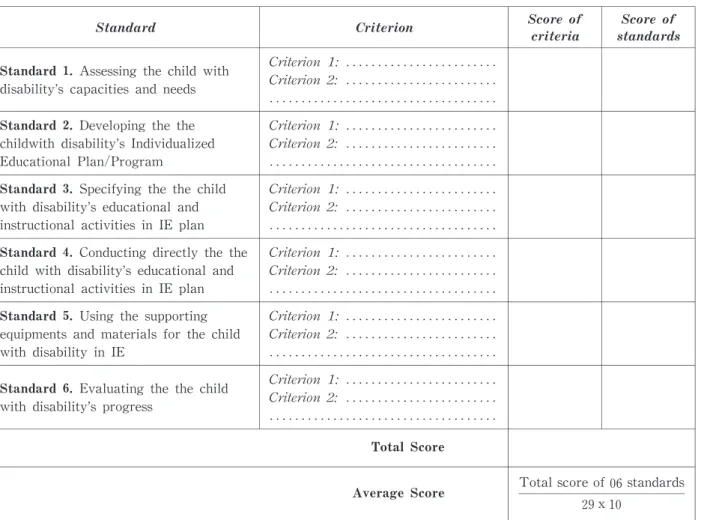
A form of self-assessment used by the teacher includes the following contents:
Teachers full name: ...Schools name:... School year:...
Table 1. Self-Assessment Form for School Teachers
Total score of 06standards 29x 10 Average Score Total Score Criterion 1: ... Criterion 2: ... ... Standard 6. Evaluating the the child
with disabilitys progress
Criterion 1: ... Criterion 2: ... ... Standard 5. Using the supporting
equipments and materials for the child with disability in IE
Criterion 1: ... Criterion 2: ... ... Standard 4. Conducting directly the the
child with disabilitys educational and instructional activities in IE plan
Criterion 1: ... Criterion 2: ... ... Standard 3. Specifying the the child
with disabilitys educational and instructional activities in IE plan
Criterion 1: ... Criterion 2: ... ... Standard 2. Developing the the
childwith disabilitys Individualized Educational Plan/Program
Criterion 1: ... Criterion 2: ... ... Standard 1. Assessing the child with
Conclusion
The following main ideas are concluded upon the above analysis:
1) IE in Vietnam has experienced for a long time with the beginning of 1990s and supported by recently various domestic study results to develop a better quality education for children with disabilities.
2) Professional standards in general and professional standards for teachers of various scientific fields have an important significance for promoting and ensuring the quality of teachers,
which is a factor that determine the quality education of schools. The set of standards? on professional practice competency, known as a component of professional competency standards in IE for school teachers in Vietnam is just only the initial findings,and needs more controlled studies to supplement and finalize.
3) The standards, if implemented in practice at schools, are useful not only for teachers to develop themselves toward professional standards, but also for principals to improve the capacity quality of teacher staff.
Teacher s Remarks for Self-Assessment:
1.Strengths:... 2.Weaknesses:... 3.Ways for Improvement:...
Teachers Self-Ranking (one of four catergories:excellent;good;average;bad):...
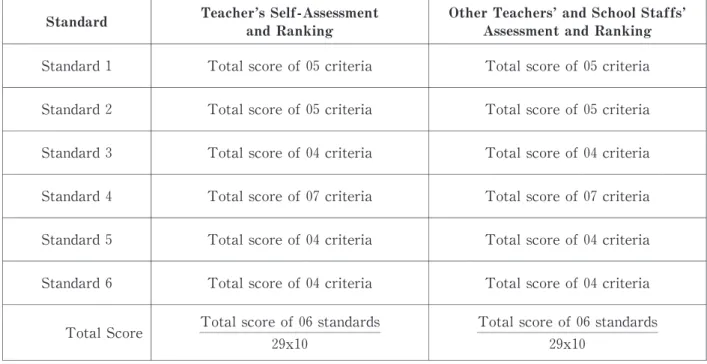
A form of teacher assessment directly used by the principal includes the following contents:
Teachers full name:...Schools name:... School year:...
Table 2. Principals Teacher Assessment Form
Total score of 06standards 29x10
Total score of 06standards 29x10
Total Score
Total score of 04criteria Total score of 04criteria
Standard 6
Total score of 04criteria Total score of 04criteria
Standard 5
Total score of 07criteria Total score of 07criteria
Standard 4
Total score of 04criteria Total score of 04criteria
Standard 3
Total score of 05criteria Total score of 05criteria
Standard 2
Total score of 05criteria Total score of 05criteria
Standard 1
Other Teachers and School Staffs Assessment and Ranking Teacher s Self-Assessment
and Ranking Standard
Principal s Remarks for Teacher Assessment:
a.Strengths:... b.Weaknesses:... c.Ways for Improvement:...
Reference
1. Ministry of Education and Training (2007), Decision No. 14/2007 /QD-BGDDT dated on May 04th 2007of Minister of Education and Training on Professional Standards of Primary School Teacher, Hanoi.
2. Nguyen Xuan Hai (2009), Management of Inclusive Education,Publishing House of the Hanoi National University of Education.
3. Nguyen Xuan Hai (6/2013), Humance Competence of Educational Intervence for Children with Disabilities in Vietnam, Scientific Journal of The Hanoi National University of Education, N04, 2013, pp124-131
4. Nguyen Xuan Hai (2015), Research on Professional Competency in Inclusive Education of School Teachers,Scientific Journal, Hanoi National University of Education, Volume 60, number 6BC, 2015, ISSN 0868-3719, pp22-30.
5.Le Thi Thuy Hang (2015),Early Intervention for Children with Disabilities, Vietnam Education Publishing House, Hanoi.
6. Nguyen Van Le et al:“Upgrading Competencies or Human Resources of Early Intervention on Education for Children with Disabilities in
Vietnam”,Timeframe of the research:2years,from 2009to 2011,a Protocol Research between Vietnam and New South Wales, Australia
7. Lipsky, D. & Gartner, A. (1997), Inclusion and School Reform:Transforming America s Classroom, Baltimore:Paul H, Brookes Publishing Company. 8. Marilyn Friend and William Bursuck (1996), Including Students With Special Needs -A Practical Guide For Classroom Teachers, Allyn and Bacon Publishing Company.
9. Richard A. Villa & Jacqueline S. Thousand (1999), Accommodation and Adaptation to Abilities and Needs of Children with Disabilities, ASCD. 10. Samuel Kirk, James J. Gallagher, Mary Ruth Coleman, Nicholas J. Anastasiow, Nick Anastasiow, Samuel A. Kirk (2008), Educating Exceptional Children, 12th?Edition, Wadsworth Publishing.
11. Le Van Tac & Sijett Begmar (2006), Research on Competence Standards of Teachers for Education of Children with Disabilities, Hanoi.
12. Pham Do Nhat Tien (2009), Professional Standards on Teachers and Principals−Global Experience and Practice in Vietnam, Ministry of Education and Training, Hanoi, Vietnam.
Ⓒ 2013Center for Educational Research and Training, Faculty of Education, Wakayama University
930Sakaedani, Wakayama City 640-8510, Japan http://center.edu.wakayama-u.ac.jp/diary.cgi
BULLETIN OF THE FACULTY OF EDUCATION WAKAYAMA UNIVERSITY
−
−
No.66February 2016
Research on Developing Standards on Professional Practice Competency of
Vietnamese School Teachers for Inclusive Education of Children with Disabilities
NGUYEN Xuan Hai LE Thi Thuy Hang EDA Yusuke
AUTHORS
Dean of the Faculty of Special Education, Hanoi National University of Education Mailing Address:136Xuan Thuy Street, Cau Giay District, Hanoi, Vietnam Website:http://hnue.edu.vn
Dean of the Faculty of Special Education, Hanoi National College of Education Mailing Address:387Hoang Quoc Viet Street, Cau Giay District, Hanoi, Vietnam Website:http://cdsptw.edu.vn/
Professor at the Faculty of Education, Wakayama University
Mailing Address:930Sakaedani, Wakayama City 640-8510, Japan Website:http://www.wakayama-u.ac.jp/en